Malcolm Turnbull’s Proposed Marriage Equality Plebiscite is Truly Extraordinary

Prime Minister Malcolm Turnbull’s policy – that, if re-elected, he will hold a plebiscite to determine whether marriage equality will finally be introduced in Australia – is truly extraordinary.


Unfortunately for him, and even more so for us, it’s not extraordinary like Adele’s voice (or, if you’re not a fan, at least her extraordinary ability to sell music).


Instead, it’s extraordinary in a ‘Donald Trump is in with a real chance of becoming President of the United States’ kind of way: unprecedented, bizarre, inconsistent and radical.


Unprecedented


The Commonwealth of Australia is now in its 116th year. A significant number of national votes, other than elections, have been held over that time, including 44 referendums (although only eight of those were successful).


But there have only been three plebiscites since Federation in 1901 – and, given the High Court has already found that Commonwealth Parliament has the power to amend the Marriage Act 1961 to introduce marriage equality[i], any national vote on marriage equality would be a non-binding plebiscite rather than a constitution-altering referendum.


Of those three plebiscites, only one has been held since World War I: the 1977 ‘multiple-choice’ vote to select a new national anthem (for the record, the options were to retain God Save the Queen, or to change to Advance Australia Fair, Song of Australia or Waltzing Matilda, with Advance Australia Fair ‘winning’ with 43.29% of the ballots cast).


With a voting age of 18 (having been lowered from 21 in 1973), only people born before April 1959 were able to participate in that symbolic decision[ii]. To put it another way, nobody born in the 1960s, 1970s, 1980s and 1990s has ever voted in any Australia-wide plebiscite.


To find a plebiscite that was used to consider a substantive issue of public policy, we have to travel even further back in time – to almost a full century before the present day. In the depths of the so-called ‘war to end all wars’, the Billy Hughes-led Commonwealth Government conducted the only other two plebiscites in our history, to determine whether to introduce military conscription.


These votes – held in October 1916 and December 1917 respectively[iii] – are in effect the only precedent of any kind for the holding of a national vote on a policy issue that did not require constitutional change.


But, with the voting age then set at 21, and the most ‘recent’ of these votes a mere 98 and a half years ago, in order to participate in a plebiscite of this kind you needed to be born in 1896 or before – or older than the current oldest person in the world[iv]. In other words, nobody alive today has ever voted in an Australia-wide plebiscite to decide a substantive policy issue.


The fact that there is literally no-one around who has participated in a policy-based plebiscite confirms that Malcolm Turnbull’s proposed public vote on marriage equality is essentially unprecedented in modern Australia.


As for ‘the Donald’, well, you don’t need to be Nate Silver to understand that his Presidential candidacy is unprecedented in contemporary American history too – there hasn’t been anything like him over the past 50, or even 100, years either.


Bizarre


One of the strangest things about Turnbull’s policy is that he wants to hold the first substantive plebiscite in almost a century on an issue like marriage equality. Think for a minute about all of the significant changes that have occurred since December 1917 without the need for such a vote.


We’ve been through multiple wars – World War II, the Korean War and the Vietnam War, and more recently we’ve followed the United States into seemingly endless wars in the Middle East (a somewhat terrifying aside: who knows how many more we would enter at the behest of President Trump?) Australia even had conscription during WWII, and again for the conflict in Vietnam – yet none of these wars, nor the introduction of conscription, required a single plebiscite to be held.


We’ve experienced the Great Depression, the post-War boom, the major challenges of the 1970s, 1980s and early 1990s, economic rationalism, and the Global Financial Crisis – still no plebiscite.


We’ve seen massive social changes too – including the rise of the women’s movement (imagine for a second the reaction of someone from 1917 to former Prime Minister Julia Gillard), and the recognition of Aboriginal land rights (to some extent anyway), as well as substantial LGBTI law reform, such as decriminalisation, anti-discrimination legislation, parenting rights (in most states and territories) and de facto relationship recognition. Not one of these social reforms needed a plebiscite either.


There has even been revolutionary change to the institution of marriage itself – with the 1975 introduction of ‘no fault divorce’ having a much greater impact on a much larger number of families than something like marriage equality could ever hope to achieve. And, once again, it was done without Commonwealth Parliament derogating from its primary responsibility to pass legislation by instead calling a national vote.


In this context, it is downright bizarre that, of all the possible issues that could have been the subject of a plebiscite over the past 98 and a half years, Malcolm Turnbull and his Liberal-National Government believe the simple question of whether two men, or two women, can marry is the one worth making the subject of an expensive and time-consuming public vote.


Although, admittedly, it’s possibly still not quite as bizarre as the fact someone who is perhaps best known as the star of a reality-TV show, and who has never held public office of any kind, is the presumptive Republican nominee for what remains the most powerful job in the world.


Inconsistent


One of the things many people find most frustrating about Malcolm Turnbull’s proposed marriage equality plebiscite is that it is entirely inconsistent with recent political history. Or, if you’re being less charitable, that it is hypocritical given the actions of the Liberal and National Parties over the past 12 years.


Then-Prime Minister John Howard did not hold a public vote before introducing his Marriage Amendment Act 2004 that legislated to deny the right to marry to lesbian, gay, bisexual, transgender and intersex (LGBTI) Australians. There was no push for a plebiscite on the issue by anyone in the Liberal and National Parties during the many failed attempts to repeal that ban in the years between 2004 and 2011, either.


During the September 2012 debate, and (sadly unsuccessful) vote, on the most recent marriage equality Bill to be considered at length, then-Opposition Leader Tony Abbott and his Coalition colleagues did not use the opportunity to describe the process of Parliament voting on marriage equality as inappropriate – they simply used the votes that they held as MPs and Senators to help block it.


All of a sudden, however, in August 2015, just as it appeared that the numbers in Parliament might finally have caught up to existing majority community support for this reform, the Liberal-National joint party-room decided to ‘backtrack’ on more than a decade of practice, and refused to use their own votes on this issue, either for or against marriage equality, altogether.


Instead, they chose to embark upon a process that we have already seen is essentially unprecedented in modern Australia – before they hold any further parliamentary votes on marriage equality, they will first conduct a $160 million Australia-wide public vote.


It is difficult to see this dramatic change in process – from MPs and Senators voting on an issue, just like all other legislation, to holding a nation-wide plebiscite – as anything other than unfair, given that it moves the goalposts on people, and campaigners, who have been working to effect this change for the past decade.


But, irrespective of whether you think a plebiscite is ‘fair’ or not, it is impossible to deny that the policy Malcolm Turnbull is taking to the July 2 election – to hold a plebiscite on marriage equality – is fundamentally inconsistent with what he, and his colleagues, have done since John Howard’s ban on marriage equality in 2004.


Donald Trump could be described as the King of Inconsistency (although he might upgrade himself to Emperor). As his recent embrace of the National Rifle Association – after previously supporting gun control measures[v] – demonstrates, there is no position he won’t change, and no principle he won’t sacrifice, in order to become POTUS.


Radical


The one defence that Liberal and National MPs – including both former Prime Minister Tony Abbott and current Prime Minister Malcolm Turnbull – regularly make with regards to holding a plebiscite is that it is ‘the most democratic way to make this decision.’ After all, how much more ‘democratic’ can you get than letting the people decide via a public vote?


And I’ll readily acknowledge, holding a plebiscite on marriage equality does fit with certain conceptions of ‘participatory’ democracy. But it is also a very different approach to determining matters of public policy from our usual modus operandi, one that does not sit particularly well with our more traditional ‘representative’ democracy.


For example, Tony Abbott has said that holding a plebiscite “is the best way to decide something that’s so important but so personal… It’s to let the people decide so that the decision, whichever way it goes, will have their authority”[vi] [emphasis added].


Implicit in describing a plebiscite as the best way to resolve controversial issues is a criticism of our Parliamentary system as an inferior, or clearly ‘second-best’, option.


This is actually an extremely radical view of how our democracy should operate – and it’s coming from precisely the same people who usually like to describe themselves as ‘capital C’ conservatives (as an aside: we’ve grown accustomed to a Liberal Party that is not liberal, a National Party that isn’t national, and even an Australian Christian Lobby that isn’t very ‘Christian’, but we should also be highlighting that contemporary ‘conservatives’ are actually nothing of the sort).


The logical conclusion of statements such as these is that Australia should be holding more plebiscites, and on a wider range of subjects, rather than simply ‘letting the politicians decide’.


In fact, this argument neatly complements the first point of this post – while a plebiscite like this is unprecedented today, by conducting a public vote on marriage equality Malcolm Turnbull and his Liberal-National colleagues would be creating a precedent to hold plebiscites on all sorts of other topics.


It is a radical shift that even WA Liberal Senator Dean Smith has identified, while warning of its potential consequences[vii]:


“We must also bear in mind the precedent being set as we embark on this latest democratic experiment. After all, if Parliament is to send the nation to a plebiscite to determine the question of same-sex marriage, what is to be done the next time an overseas military commitment is needed?


“Into the future, shall we defer to popular vote the question of euthanasia? What of changes to family law and child custody arrangements? These issues are informed by people’s moral views and impact upon people’s personal lives just as much as same-sex marriage.”


We could add to Senator Smith’s short list an almost limitless range of possible plebiscites: from abortion to assisted reproductive technology; action on climate change and even access to health and education services – all are influenced by people’s moral views, and all would have an impact on people’s lives.


More worryingly, you could easily imagine the same types of people currently agitating for a plebiscite on marriage equality subsequently calling for public votes on – or rather against – immigration, refugees and ‘flag-burning’. You could even see public votes to reintroduce the death penalty or to officially declare Australia a ‘Christian’ nation.


The fact that ‘conservatives’ within the Liberal and National Parties are willing to risk these consequences by holding a plebiscite, in what is a fairly transparent attempt to delay or defeat marriage equality, shows just how little they are committed to Australia’s traditional system of representative democracy. Theirs is a genuinely radical agenda, and it should be resisted.


It almost goes without saying that Donald Trump’s agenda as a Presidential candidate is genuinely radical too – from building a wall between the US and Mexico (and then making the Mexican Government pay for it – WTF?) to banning all Muslims from entering the United States, he’s more parts radical than conservative.


Trump

Just like US Presidential candidate Donald Trump, Malcolm Turnbull’s proposed marriage equality plebiscite is extraordinary, unprecedented, bizarre, inconsistent and radical.


**********


There are of course several other aspects of Malcolm Turnbull’s proposed marriage equality plebiscite that are truly extraordinary. As I’ve written elsewhere[viii], holding a national public vote on this issue would be:


  • Extraordinarily unnecessary, given the High Court has already found Commonwealth Parliament can introduce marriage equality,
  • Extraordinarily inappropriate, because the human rights of a minority group shouldn’t be determined by a popularity contest,
  • Extraordinarily wasteful, with a cost of at least $160 million that would be better spent on other priorities[ix], and
  • Extraordinarily divisive, with a real risk that the next six to 12 months will witness extreme attacks on lesbian, gay, bisexual, transgender and intersex Australians.


But what I have attempted to show in this post is that the process is extraordinary in and of itself. Just like Donald Trump’s candidacy to become US President, the proposal to hold a plebiscite on marriage equality is unprecedented, bizarre, inconsistent and radical.


Thankfully, there is another similarity between these two otherwise disparate phenomena: neither is inevitable. In the same way we hope (and for the religious among us, pray) the American people choose Hillary Clinton over Donald Trump come November 8, we can also choose not to have a marriage equality plebiscite via our election on July 2.


If we elect Bill Shorten and Labor at the upcoming poll, then not only will we avoid a plebiscite, we will also most likely have marriage equality within 100 days[x]. Even if the Liberal and National Parties are returned to Government, the proposed plebiscite could nevertheless still be rejected by the Opposition, Greens and minor parties in the Senate. There’s even a much slimmer chance that 2016 Malcolm Turnbull might remember pre-2015 Malcolm Turnbull’s principled stance against a plebiscite.


But none of this will happen if we don’t make our voices heard, telling anyone and everyone who will listen: We don’t want a plebiscite. We don’t need a plebiscite. All we want is to be treated equally under the law – and we shouldn’t have to negotiate an extraordinary, unprecedented, bizarre, inconsistent and radical process to do so.


Footnotes

[i] The Commonwealth v Australian Capital Territory [2013] HCA 55.

[ii] The result of the 1977 national anthem plebiscite (‘Anthem-vision’) was treated with so much importance it wasn’t even implemented for another seven years.

[iii] The October 1916 plebiscite voted narrowly against conscription 51.61% to 48.39%, while the December 1917 margin was slightly larger: 53.79% No versus 46.21% Yes.

[iv] The older person alive at the time of writing, Italian Emma Morano, was born on 29 November 1899.

[v] The Guardian, May 21 2016, “Donald Trump endorsed by NRA despite history of gun control support”.

[vi] The Guardian, 30 January 2016, “Tony Abbott will back result of plebiscite on same-sex marriage”.

[vii] Dean Smith, Sydney Morning Herald, December 21 2015, “Marriage equality plebiscite would set a precedent for when we defer to a popular vote.”

[viii] No Referendum. No Plebiscite. Just Pass the Bill.

[ix] 7 Better Ways to Spent $158.4 million.

[x] If Shorten wins, start planning those weddings for Monday 10 October.
What does Malcolm Turnbull want his legacy to be?

It’s time for Malcolm Turnbull to seriously consider what he wants his legacy to be.


That might sound premature to some, especially given that tomorrow (Monday 14 March 2016) it will be only six months since he replaced Tony Abbott as Leader of the Liberal Party. Tuesday, the clichéd ‘Ides of March’, is the six-month anniversary of his official swearing in.


However, in the life of an Australian Prime Minister, six months is not an insignificant period of time. Indeed, for many, six months is a considerable slice of their term.


In the just over 70 years since World War II, Malcolm Turnbull is the 15th person to ascend to our top job. The average term in office – even including the 16-year rule of Robert Menzies[i] – is less than five years. In fact, only four Prime Ministers[ii] in those seven decades have even made it to the five-year mark, while six ended up serving less than three years.


The pace of turnover of Prime Ministers also appears to be accelerating – in the 11 years since Turnbull entered Parliament, he is now the fifth Prime Minister (with one of those, Kevin Rudd, even having two non-consecutive turns).


Based on the above, six months is likely to represent at least 10% of Turnbull’s entire term in office, and probably more.


In fact, there are reasons to believe Turnbull’s stay in the Lodge might be shorter than the average. For example, he is third oldest person to ever be first sworn in as Prime Minister (and the two who were older[iii] served for a combined period of less than two years).


It is also reasonable to describe Turnbull’s support inside the Parliamentary Liberal Party as somewhat tenuous. His first stint as Leader, while in Opposition, lasted less than 15 months. And, even after two years of the worst Prime Minister in living memory, he only defeated Tony Abbott by 54 votes to 44 last September (and which was only moderately better than the 39 votes cast for an ‘empty chair’[iv] in the February 2015 spill motion against Abbott).


With a switch of just six votes needed to reverse that result (whether to Abbott, who clearly remains interested in returning, or another candidate from the conservative wing of the Liberals) it should be noted that a sizeable majority of Liberal MPs in marginal seats voted for Turnbull[v], meaning that any loss of seats at the upcoming 2016 election would leave him more vulnerable to a challenge from inside the Government.


Of course, if the current level of in-fighting and disorganisation within the Coalition continues, there is also the small but real chance of the Government being voted out, cutting Turnbull’s term short at 12 months or less.


This thought – that, after just six months, it is time to start seriously considering his legacy – might be confronting for Turnbull, but he should console himself with the knowledge that, for most of his contemporaries, substantial elements of their legacies were built during their first year in office.


Kevin Rudd gave the apology to the Stolen Generations after less than three months in the role. He is also most commonly remembered for his response to the Global Financial Crisis, which reached its peak in September and October 2008 – again, less than 12 months from his election win on November 24 2007.


In Julia Gillard’s case, the announcement of the ‘carbon pricing mechanism’ (forever dubbed the carbon tax) was made on February 24 2011, exactly eight months after she ousted Kevin Rudd as Prime Minister.


The National Disability Insurance Scheme is also seen as a key part of her legacy – and, while the legislation that gave it effect was not introduced until late 2012, the Productivity Commission report which preceded it was already two months into its work before Gillard even became PM[vi].


Tony Abbott continues to assert that his first Budget – the ‘horror’ 2014-15 Budget, more widely known for its unfairness– is a key part of his legacy[vii], and that was handed down just eight months into his term. His more trivial – but just as infamous – ‘captain’s call’ to reintroduce knights and dames happened two months earlier.


Even in the case of John Howard, who, given he served as Prime Minister for more than 11 years and therefore has a long and highly-contested ‘legacy’, there is probably only one key positive achievement about which almost all parts of the political spectrum agree[viii] – his gun law reforms following the Port Arthur Massacre[ix], which itself occurred less than two months after he swept to power.


Six months into his own term as Prime Minister, it is hard to pin down exactly what Malcolm Turnbull’s key achievement or achievements have been (other than the initial, widespread feeling of ‘relief’ which many Australians experienced after he deposed Abbott). Different language has been used, including much talk of ‘agility’ and ‘innovation’ and ‘excitement’, but new ideas or policies? Not so much.


That situation will change, to some extent, over the coming months, as Turnbull and Treasurer Scott Morrison put together their first Budget – to be delivered in early May (either May 10th, or 3rd if, as is now widely expected, they head to a double dissolution poll on July 2). There is obviously intense pressure on them both to set out their platform for the campaign ahead in that document.


But there is an even earlier opportunity for Malcolm Turnbull to establish his legacy as Prime Minister. Two closely-linked opportunities, in fact: the decision on what to do with the Safe Schools program, and the choice whether or not to proceed with a plebiscite on marriage equality.


Both of these issues will come to a head in the coming week. The independent review of the Safe Schools program, instigated following the internal revolt by the likes of Cory Bernardi in the Coalition Party room meeting on 23 February, was expected to be handed to the Commonwealth Department of Education on Friday 11 March[x].


While it may be another week or two before the Government announces its response to that review, you can guarantee they will be discussing it internally during the week ahead (it’s also highly likely to be debated again in the Coalition Party room meeting on Tuesday, the second-last such meeting before a potential ‘double D’-election).


Lenore Taylor has also reported that the proposal for a plebiscite on marriage equality will be considered in detail by the Turnbull Cabinet this week[xi].


While the plebiscite was first adopted as Coalition policy under then Prime Minister Abbott on 11 August last year, this will be the main, Cabinet-level discussion of the process required to hold one – the question to be asked, expected timing (which, depending on who you listen to, may or may not be before the end of 2016), the estimated cost (likely upwards of $160 million[xii]), public funding of the yes and no cases, compulsory or voluntary voting and the supporting legislation.


Again, it is possible that the marriage equality plebiscite proposal will also be discussed at the Coalition Party room meeting on Tuesday morning (it will be interesting to see whether this one also takes six hours, especially given how much Liberal and National Party MPs appear to enjoy discussing LGBTI issues).


Obviously, the approaches that Turnbull, and his Liberal-National Government, adopts on these two issues this week will be a key part of his personal legacy for LGBTI Australians. Both decisions will have direct, and long-lasting, impacts on literally hundreds of thousands of lesbian, gay, bisexual, transgender and intersex people, their children, and their families and friends.


On Safe Schools, Turnbull will choose between defending a program developed to combat homophobic, biphobic, transphobic and intersexphobic bullying of LGBTI students, thereby reducing the all-too-frequent tragedy of LGBTI youth suicide – or giving in to bullies, like the Australian Christian Lobby, and The Australian newspaper, who it seems would much prefer enforced silence about LGBTI issues in the classroom, and the schoolyard, to the detriment of children with diverse sexual orientations, gender identities or intersex characteristics.


The consequences of this choice – whether a school is genuinely inclusive, or a vacuum allowing intolerance and discrimination to fester – can and will have lifelong impacts on the students who receive, or miss out on, programs like Safe Schools as a result.


On marriage equality, too, the impacts of Turnbull’s imminent decision will be profoundly felt, not only by LGBTI Australians, but also by the children of rainbow families.


As has been made clear by Australian Marriage Equality[xiii], if Malcolm Turnbull implemented the policy position that he held before becoming Prime Minister – of supporting a ‘free’ or conscience vote – then we could have marriage equality legislation passed by the end of this week.


But, if he persists with what was originally Tony Abbott’s plebiscite – but which is now most definitely his – not only will he be wasting at least $160 million on something which is completely unnecessary and inappropriate, he will also be causing real harm to LGBTI Australians, and our kids, by ensuring that there will be a protracted, bitter, and downright nasty campaign leading up to the vote.


The Australian Christian Lobby, both with its past actions (including repeated suggestions that gay and lesbian parenting creates another Stolen Generation[xiv]), and its recent call for state and territory anti-discrimination laws to be suspended for the duration of the campaign[xv], have effectively guaranteed it.


And, even if the marriage equality plebiscite is successful, it will still be at least another 12 – and possibly up to 18 or even 24 – months before Australian couples will finally be able to wed in their own country, with some elderly couples sadly, but inevitably, passing away before they can tie the knot.


However, while the impact of these decisions will be most keenly felt by LGBTI people, young and old, and their children, I would argue they will define Malcolm Turnbull’s legacy much more broadly. This is because his approach to Safe Schools, and the plebiscite, will tell us a lot about who he is as a Prime Minister, what type of Government he leads, and ultimately about his vision for Australia.


In terms of who Malcolm Turnbull is as Prime Minister, he would like most people, and especially the ‘persuadables’ in the electorate, to believe he is still the leather jacket-clad QandA panellist, with views that are more moderate than most of the members of his party – believing in climate change, supporting a republic, and wanting to be the leader who finally introduces marriage equality.


Deep down, I’m sure Turnbull would love to be the ‘cool’ Prime Minister who attends the 2017 Sydney Gay & Lesbian Mardi Gras parade, claiming credit for removing discrimination from the Marriage Act 1961, receiving the passionate support, even adulation, from sections of the crowd in return.


But, if he caves in to the deeply homophobic and transphobic campaign against Safe Schools, led by the vitriolic and hateful scare-mongering of the Australian Christian Lobby and others, and if he continues to support an unnecessary, inappropriate, wasteful and divisive marriage equality plebiscite, then not only will Malcolm Turnbull fail to be the Leader that he thinks he is (or at least wants to be) – he will become exactly the same type of Leader as the one he replaced.


By endorsing the attack on Safe Schools, and persisting with the plebiscite, Turnbull would show that there is no core belief that he will not jettison, no principle he is not prepared to compromise, in his quest to remain Prime Minister of Australia for as long as possible. The Opposition critique of him – that he is just Tony Abbott in a more expensive suit – will be more than justified.


And, by ensuring that it will be the public’s vote that finally achieves equality in relationship recognition in Commonwealth law, and not his own vote in Parliament, he will simply become another politician whom we had to win marriage equality in spite of, and not because of[xvi].


How Turnbull handles the decisions on Safe Schools, and the plebiscite, will also reveal a great deal about the type of Government he leads.


Is it a Government that represents, and serves the interests of, all Australians? Does it believe that the real and urgent needs of young lesbian, gay, bisexual, transgender and intersex people are worthy of attention, and above all action? Does it think that people should not be legally discriminated against on the basis of their sexual orientation, gender identity of intersex status?


Or is it a Government that represents, and serves the interests of, cisgender heterosexual Australians only? Does it believe that the pressing needs of young LGBTI people can simply be ignored? Does it think that the relationships of LGBTI Australians are genuinely lesser than those of other people, and therefore should be treated as such?


Turnbull has so far studiously avoided having to address this deep divide inside the Liberal-National Coalition. On Safe Schools, rather than reject the campaign against the program outright, he simply passed the buck to an independent review – thereby encouraging the attack to continue.


And, instead of directly reprimanding MPs like George Christensen and Andrew Hastie, who have compared Safe Schools to ‘grooming’[xvii] and George Orwell’s Big Brother[xviii] respectively, Turnbull offered a meek, generic statement saying “I encourage everybody who is discussing these issues to do so in very measured language… and to consider very carefully the impact of the words they use on young people and on their families.”[xix]


On marriage equality, he has again chosen not to upset the applecart, instead leaving in place Tony Abbott’s preferred option – a plebiscite – despite the insistence of multiple members of his own Government that they will not be bound by any ‘yes’ vote[xx], thus rendering the entire exercise pointless.


Well, on both of these issues, he can no longer kick those proverbial cans any further down the road. This week, in Cabinet and most likely in the Party room too, Malcolm Turnbull will need to decide what type of Government he wants to lead – and then he will need to argue for it, in the face of likely fierce criticism from Liberal and National MPs who do not now, and likely will not ever, support LGBTI equality, possibly at the cost of their ongoing support for his leadership.


Ultimately, how Malcolm Turnbull approaches the Safe Schools debate, and the marriage equality plebiscite, in the next few weeks will tell us whether he has what Keating would describe as ‘the vision thing’.


Does Malcolm Turnbull have a vision of a better Australia, where young lesbian, gay, bisexual, transgender and intersex people can grow up happy and healthy, attending schools where they are free to be who they are, respected and accepted?


Does he see a future where all relationships are treated equally irrespective of the sexual orientations, gender identities or intersex statuses of the people involved, and is he prepared to actually do something to make that future a reality?


Does Malcolm Turnbull show, in who he is and how he governs, that he has the interests of all of us, including LGBTI Australians, at heart?


Or does his vision only extend as far as what is required to keep him in the Prime Ministership, the role that he has clearly coveted for so long?


That might sound harsh, and to some even potentially unfair, but that is what I believe is at stake in the next few weeks as Turnbull decides what to do on the Safe Schools program, and on the marriage equality plebiscite.


One final comment – some might argue that, given it is not Malcolm Turnbull who is leading the attacks on Safe Schools, and it was not his proposal to hold a plebiscite on marriage equality, assessing his ‘legacy’ on how he approaches these issues is unjustified.


To which I would respond with two observations. First, he is the Prime Minister, and the campaign against Safe Schools is happening on his watch, including by members of his own Government, which makes his response to this issue extremely relevant to how we assess his performance.


And, while the marriage equality plebiscite might not have originally been his idea, if he chooses to proceed with it, at enormous cost, both financially, and psychologically in the harm it will cause to LGBTI Australians and their children, it will very much be his responsibility.


Second, John Howard did not ‘choose’ gun control to be his legacy, nor did Kevin Rudd ‘choose’ for the GFC to dominate his first term agenda, and Julia Gillard certainly did not ‘choose’ for her stint as Prime Minister to include such a large focus on climate change.


They were responding to events that were not of their own making – Port Arthur, global markets, and even the hung parliament. But how they responded to these things is what made them Leaders – and that is why we remember these achievements as part of their legacies.


Malcolm Turnbull did not choose for the attack on Safe Schools, nor did he choose Tony Abbott’s plebiscite. But, how the Government approaches these issues is now within his control as Prime Minister – and it is up to him how he chooses to exercise that power.


Does Malcolm Turnbull choose to support Safe Schools or does he side with those who have campaigned against it? Does he proceed with a plebiscite on marriage equality, even when he knows it is unnecessary, inappropriate, wasteful and divisive? In short, what does Malcolm Turnbull want his legacy to be?


151222 Turnbull

For Prime Minister Malcolm Turnbull, it’s time to turn his mind to how he will want to be remembered.


[i] Although this also includes the three-week term of John McEwen.

[ii] Robert Menzies, Malcolm Fraser, Bob Hawke and John Howard.

[iii] John McEwen and William McMahon.

[iv] The Australian, Last Post, February 10 2015.

[v] The New Daily, “Why Turnbull could win the election – and still lose”, March 8 2016.

[vi] The Productivity Commission started its work in April 2010, and released the Disability Care & Support Final Report in August 2011.

[vii] The Australian, “Tony Abbott: My legacy the key to victory at next election”, September 26, 2015. Quote from Mr Abbott: “You can always dispute the marketing… but the 2014 Budget was a very serious structural attempt to tackle our long-term spending problems.”

[viii] Outside of ‘gun nuts’, and the accidental Liberal Democrat Senator, David Leyonhjelm.

[ix] Howard’s gun law reforms, and gun ‘buyback’, even has international admirers, as demonstrated by the 2013 segment by John Oliver on the Daily Show with Jon Stewart (as reported here: Sydney Morning Herald, “US Show Uses Howard to Embarrass Gun Lobby”, April 22, 2013).

[x] Gay News Network, “Government Comment on Safe Schools Report Not Expected for 1-2 Weeks”, 11 March 2016.

[xi] Guardian Australia, “Coalition to finalise marriage equality plebiscite details as July election looms”, March 8 2016.

[xii] See “7 Better Ways to Spend $158.4 million”.

[xiii] Sydney Morning Herald, “Majority of MPs would back marriage equality”, January 30, 2016.

[xiv] Guardian Australia, “Q&A Recap: Lyle Shelton locks horns with panel on marriage equality”, 1 March 2016.

[xv] ABC News, “Same-sex marriage plebiscite: Christian lobby group wants ‘override’ of anti-discrimination laws during campaign”, 16 February 2016.

[xvi] For more, see: “Letter to Malcolm Turnbull about the Marriage Equality Plebiscite”.

[xvii] Buzzfeed Australia, This MP Just Compared the Safe Schools Coalition to ‘Grooming’”, 25 February 2016.

[xviii] From Mr Hastie, the Member for Canning’s, Facebook page: “George Orwell foresaw where the abandonment of reason can lead society: to a world devoid of compassion and empathy for those who disagree with us. All that is left is raw power. As Orwell wrote, without reason and charity in our public debate there will be nothing left but “the thrill of victory, the sensation of trampling on an enemy who is helpless. If you want a picture of the future, imagine a boot stamping on a human face – forever.”

[xix] ABC News, “Safe schools: Turnbull warns MPs over language used in debate”, February 26 2016.

[xx] Guardian Australia, “Eric Abetz: Coalition MPs will not be bound by plebiscite on marriage equality”, January 27 2016.

Submission to Review of the Queensland Adoption Act 2009

Update 16 January 2017:

Queensland Parliament passed legislation to allow for adoption by same-sex couples on Wednesday 2 November 2016, removing a major barrier to the equal treatment of LGBTI people, and relationships, under Queensland law.

The Brisbane Times reported on this long-overdue law reform success here.

Update 11 August 2016:

On Saturday 6 August, the Queensland Government announced that, in response to this review, it will be proposing legislation to ensure that single people, and same-sex couples, will be able to adopt legally in Queensland.

The consultation report can be found here.

This is obviously wonderful news for rainbow families – both existing and prospective – and for LGBTI Queenslanders generally. I am thankful to have played a small part through this consultation. Please see my own submission to this review below.

Original Post:

The Queensland Government is currently undertaking a review of the Adoption Act 2009.

This is an important opportunity for the LGBTI community to let the Government know that the current discriminatory provisions contained in the Act – which prevent same-sex couples from together adopting children, and which also prevent a same-sex partner from adopting their partner’s child – must be removed as a matter of priority.

Full details of the consultation can be found here. Public submissions close 5pm Friday 11 March 2016. The following is my submission:

Department of Communities, Child Safety and Disability Services

Child and Family Legislative Review

PO Box 806

Brisbane QLD 4001

adoptionactreview@communities.qld.gov.au

Sunday 6 March 2016

To whom it may concern

Submission to Review of the Queensland Adoption Act 2009

Thank you for the opportunity to provide this submission as part of the five-year review of the operation of the Queensland Adoption Act 2009.

In this submission, I will primarily focus on one of the nine questions posed by the Discussion Paper, namely:

  1. Do you consider the eligibility criteria provisions of the Act to be fair and continue to meet the needs of children who require adoptive families?[i]

In my view, the answer to this question is unequivocally no.

As stated in the Discussion Paper, the Adoption Act 2009 currently requires that “To be eligible to express an interest [in adopting] a range of criteria must be met: [including]

The person has a spouse who:

  • is also eligible
  • is not the same gender as the person
  • has been the person’s spouse for at least two years”[ii] [emphasis added].

This is clearly neither fair, nor is it in the best interests of the child(ren).

To begin, including a requirement that prospective adoptive parents must be in mixed-gender relationships, rather than in a relationship with someone of the same gender, is unfair in its discriminatory approach toward the lesbian, gay, bisexual, transgender and intersex (LGBTI) community, excluding the majority of LGBTI people from even applying to adopt children in Queensland.

This discrimination is not supported by evidence showing that children are ‘better off’ being adopted exclusively by cisgender heterosexual couples.

In fact, the overwhelming majority of credible research shows that children raised in same-sex parented families are as healthy, and as happy, as those raised by mixed-sex couples.

As Deborah Dempsey found in the 2013 research paper “Same-sex parented families in Australia”[iii]:

“[o]verall, research to date considerably challenges the point of view that same-sex parented families are harmful to children. Children in such families do as well emotionally, socially and educationally as their peers from heterosexual couple families” [emphasis added].

This conclusion was supported by research in the following year, by Dr Simon Crouch and others, that:

“children with same-sex attracted parents in Australia are being raised in a diverse range of family types. These children are faring well on most measures of child health and wellbeing, and demonstrate higher levels of family cohesion than population samples.”[iv]

These findings accord with reputable studies from overseas, with evidence consistently revealing that children from same-sex parented families experience the same levels of physical and mental health as their peers, if not better.

The criteria which restricts prospective adoptive parents to those who have a spouse of a different gender should be removed from Queensland’s Adoption Act 2009 as it unnecessarily, and completely without foundation, discriminates against members of the LGBTI community.

Even more importantly, it should be removed because it potentially denies an adopted child from having the best possible adoptive parents.

As the research referred to above demonstrates, parenting ability has nothing whatsoever to do with sexual orientation, gender identity or intersex status.

Some cisgender heterosexual people make wonderful parents, while others do not. The same is undoubtedly true of members of the LGBTI community.

But to determine that only people who are in mixed-gender relationships may apply to become adoptive parents, while the LGBTI people who would make wonderful parents may not, carries with it the inherent risk that a child misses out on being adopted by more suitable parents solely because the Queensland Parliament has determined that those people do not have the ‘right’ sexual orientation, gender identity or intersex status.

After all, it is only logical that, if the pool of prospective adoptive parents is reduced because of irrelevant criteria, the overall depth and quality of that pool is diminished.

If adoption laws are to be based on the best interests of the child, and nearly all people agree that should be the case, then this is another compelling reason to remove eligibility criteria based on the gender(s) of the prospective adoptive parents.

These factors – the discriminatory impact of the Queensland Adoption Act 2009 on LGBTI people, and the failure to take into account the best interests of the child – are both exacerbated in the current denial of the ability of people who are in same-gender relationships to apply to be the adoptive parents of their partner’s child (ie step-parent adoption)[v].

In this situation, and based on the other eligibility criteria contained in the Act, the applicant, their partner and the child(ren) involved would have been living together for at least three years. That’s three years of sharing a home and living together, for all intents and purposes, as a family.

What possible justification could there be to say that an LGBTI step-parent should be denied the ability to adopt their partner’s child, where they would otherwise be able to if they were cisgender and heterosexual?

In my view, and I would hope the view of the majority of the Queensland Parliament, there can be no justification for discriminating in this way, and denying these families – because they are families, irrespective of what the current law says – the legal protections that they require, and that they deserve.

Introducing adoption equality – by removing restrictions on the ability of LGBTI people to adopt, both ‘unknown’ children and their partner’s child(ren) – would also bring Queensland laws into line with the majority of other Australian states and territories, thereby aiding national consistency in this important area of family law and legal recognition[vi].

As the Discussion Paper notes[vii], NSW, Western Australia, Tasmania and the ACT all have existing adoption equality laws. In the time since the Discussion Paper was released, Victoria has also amended its laws to ensure that LGBTI people have the ability to adopt children[viii].

With South Australia currently reviewing its adoption laws, and the realistic prospect that adoption equality will be introduced there in the near future, that would leave the Northern Territory as the only other jurisdiction in Australia continuing to discriminate against adoptive parents on the basis of their sexual orientation, gender identity or intersex status.

By passing amendments to the Adoption Act 2009 to remove discrimination against LGBTI people, Queensland Parliament would therefore be helping to recognise the 21st century reality – that rainbow families exist, and that lesbian, gay, bisexual, transgender and intersex people can be just as good parents as cisgender heterosexual people.

Thank you for taking this submission into account as part of the five-year review. If you would like more information, or to clarify any of the above, please do not hesitate to contact me at the details provided.

Sincerely

Alastair Lawrie

Shannon Fentiman

Queensland Minister for Communities, Women and Youth, and Child Safety, the Hon Shannon Fentiman MP.

[i] Discussion paper: Public consultation for the review of the operation of the Adoption Act 2009, page 9.

[ii] Ibid page 8.

[iii] Dempsey, D, “Same-sex parented families in Australia”, Child Family Community Australia, Research Paper No. 18, 2013.

[iv] Crouch, S, Waters, E McNair, R, Power, J, Davis, E, “Parent-reported measures of child health and wellbeing in same-sex parented families: a cross-sectional survey”, BMC Public Health, 21 June 2014.

[v] The Discussion Paper states on page 12 that: “A person may apply to the Chief Executive to arrange an adoption of a stated child if: the person’s spouse is not the same gender as the person.”

[vi] Which is relevant to question 7 on page 16 of the Discussion Paper: “Are there approaches in other jurisdictions that Queensland could consider?”

[vii] Discussion Paper, Appendix: Adoption in Australia – Inter-jurisdictional analysis of legislative provisions.

[viii] ABC News, “Same-Sex Adoptions Laws Pass Victorian Parliament” December 9 2015.

Submission to Victorian Greens Equal Opportunity Amendment (LGBTI Equality) Bill 2016

The Greens Member for Prahran in the Victorian Parliament, Sam Hibbins, is currently undertaking consultation on his exposure draft Bill to amend the Victorian Equal Opportunity Act 2010.

Full details of the consultation process can be found here. The following is my submission:

Mr Sam Hibbins MP

Member for Prahran

94 Chapel St

Windsor VIC 3181

sam.hibbins@parliament.vic.gov.au

Friday 12 February 2016

Dear Mr Hibbins

Consultation on Equal Opportunity Amendment (LGBTI Equality) Bill 2016

Thank you for the opportunity to provide a submission on your exposure draft Equal Opportunity Amendment Bill.

Thank you also for your commitment to improving the anti-discrimination protections that are provided to lesbian, gay, bisexual, transgender and bisexual (LGBTI) Victorians.

I agree with your statement, made as part of this consultation, that “The [Equal Opportunity] Act needs updating so that it better protects same-sex and gender diverse Victorians from discrimination at school, at work and in the community” (although I note that the phrase ‘same-sex and gender diverse’ does not include intersex people).

I believe that your exposure draft Bill addresses two of three major deficiencies in the current Act (and that I have written about previously – What’s Wrong With the Victorian Equal Opportunity Act 2010).

Specifically, the Bill would significantly improve the protected attributes that are included in the Act, by:

  • Introducing a new protected attribute of ‘intersex status’, consistent with the protections offered under the Commonwealth Sex Discrimination Act 1984, and
  • Updating the definition of ‘gender identity’ to be broader, and to remove any requirement to identify as either male or female in order to attract anti-discrimination coverage (and again in line with the 2013 Federal Labor Government reforms to the Sex Discrimination Act).

Both of these changes are overdue, and are welcome.

I also support the proposed amendments to reduce the current excessive and unjustified ‘exceptions’ that are offered to religious organisations and individuals allowing them to discriminate against LGBT Victorians in circumstances where it would otherwise be unlawful to do so.

The balance which the Bill strikes – removing religious exceptions in schools and other services, in employment and by individuals, while retaining exceptions for ‘core religious functions’, such as the appointment of ministers of religion and the conduct of religious ceremonies[i] – appears to be a reasonable one.

However, there is one major deficiency of Victorian anti-discrimination and vilification law that your exposure draft Equal Opportunity Amendment (LGBTI Equality) Bill 2016 does not address – and that is the absence of anti-vilification protections covering LGBTI people.

As I have written previously:

“There are… protections against both racial and religious vilification under Victoria’s Racial and Religious Tolerance Act 2001.

“With homophobic, biphobic, transphobic and intersexphobic vilification just as serious, and just as detrimental, as racial and religious vilification, there is no reason why LGBTI people should not have equivalent protections under Victorian law.”[ii]

In this context, the major suggestion I would make for improvement to your exposure draft Bill is for you to consider amendments to introduce protections against vilification on the basis of sexual orientation, gender identity and intersex status, equivalent to the current prohibitions on racial and religious vilification contained in the Racial and Religious Tolerance Act 2001.

Outside of these three main issues – protected attributes, religious exceptions and anti-vilification protections – the other reforms proposed by the exposure draft Bill, to “restore… the powers of the Victorian Equal Opportunity and Human Rights Commission to conduct public inquiries, enter into enforceable undertakings and to issue compliance notices” and to “restore… the power for the Commission to order someone to provide information and documents, and to order a witness… to attend and answer question” also appear reasonable.

Overall, then, I support the provisions contained in the exposure draft Equal Opportunity Amendment (LGBTI Equality) Bill 2016, but encourage you to consider adding provisions to provide protections against vilification on the basis of sexual orientation, gender identity and intersex status.

Beyond the content of the proposed Bill itself, however, I would like to make the additional point that, given the failure of the Victorian Legislative Council to support reforms in late 2015 to ensure that religious organisations could not discriminate against LGBTI people accessing adoption services, the passage of any of the above reforms would appear to be difficult, at least in the current term of Parliament.

In this context, I urge you and the Victorian Greens to work collaboratively with the state Labor Government, the Sex Party (who also supported last year’s reforms), and the Victorian LGBTI community, to persuade remaining cross-benchers, and indeed sympathetic Liberal and National MLCs, to support at least some of these reforms now – while retaining the option of passing the remainder following the 2018 election.

Thank you for taking this submission into consideration. If you would like any additional information, or to clarify any of the above, please contact me at the details provided below.

Sincerely

Alastair Lawrie

160212 Sam Hibbins

Member for Prahran, Sam Hibbins MP.

Update: 14 January 2017

The Greens introduced an amended version of this legislation into Victorian Parliament in mid-2016.

Renamed the Equal Opportunity Amendment (Equality for Students) Bill 2016, as the name suggests it focused specifically on ensuring religious schools could not discriminate against LGBT students.

Its major provision would have added the following new section to the Equal Opportunity Act 2010:

84A Discrimination against school students not exempt

Sections 82(2), 83 and 84 do not permit discrimination by a person or body that establishes, directs, controls, administers or is an educational institution that is a school against a student on the basis of the student’s sex, sexual orientation, lawful sexual activity, marital status, parental status or gender identity.”

Unfortunately, despite the modest nature of this proposed reform, it was rejected by the Victorian Legislative Council on November 9 2016, by a margin of 32 to 6 (as reported by the Star Observer here).

Footnotes:

[i] The Bill would leave sub-section 82(1) of the Victorian Equal Opportunity Act 2010 in tact:

“Nothing in Part 4 applies to-

  • the ordination or appointment of priests, ministers of religions or members of a religious order; or
  • the training or education of people seeking ordination or appointment as priests, ministers of religion or members of a religious order; or
  • the selection or appointment of people to perform functions in relation to, or otherwise participate in, any religious observance or practice.”

[ii] What’s Wrong With the Victorian Equal Opportunity Act 2010 

2016-17 Pre-Budget Submission: Save $158.4 million – Scrap the Marriage Equality Plebiscite


The Commonwealth Government has called for submissions[i] to assist it in developing the 2016-17 Budget, which, barring an early election, is due to be handed down on Tuesday 10 May.

This process is another opportunity to highlight to Prime Minister Malcolm Turnbull, Treasurer Scott Morrison and the Liberal-National Government generally just how ridiculous it is that they are proposing to waste (at least) $158.4 million on something that can be passed by the Parliament, in the usual way, for no cost.

Submissions are due by Friday 5 February 2016, with full details here. This is my submission:


Budget Policy Division

Department of the Treasury

Langton Crescent

PARKES ACT 2600

prebudgetsubs@treasury.gov.au


Tuesday 2 February 2016


To whom it may concern

2016-17 Pre-Budget Submission

Thank you for the opportunity to make a submission regarding what I believe should be the priorities for the 2016-17 Budget.

In this short submission I would like to focus on just one issue that, as well as being the right policy approach, would also have significant Budget benefits, and that is to call on the Turnbull Government to scrap the proposed marriage equality plebiscite.

There are a variety of policy justifications for not proceeding with a plebiscite on this issue, including that holding a public vote is unnecessary because the High Court has already found that Commonwealth Parliament has the constitutional power to pass marriage equality, and that subjecting the human rights of a minority group to such a process is inappropriate.

I, and many other members of the lesbian, gay, bisexual, transgender and intersex (LGBTI) community, also have serious concerns that the campaign leading up to a marriage equality plebiscite will be divisive, and expose LGBTI Australians, and the children of LGBTI families, to increased levels of homophobia, biphobia, transphobia and intersexphobia.

However, there are also strong budgetary reasons why the marriage equality plebiscite should not go ahead.

The Australian Electoral Commission has estimated that the cost of holding a stand-alone plebiscite on marriage equality would be at least $158.4 million.[ii]

Such a significant expenditure of public monies must be considered wasteful when the alternative approach – to pass (or at least to hold a free vote on) marriage equality legislation in Parliament – does not carry any additional cost.

Holding a marriage equality plebiscite could even be considered duplication, given, in the event of a ‘yes’ vote, a Bill introducing marriage equality would still need to be passed.

The two media releases, issued by the Assistant Minister to the Treasurer, the Hon Alex Hawke MP, calling for Pre-Budget Submissions, both reiterated the “Government’s commitment to restrain expenditure responsibly”.[iii]

It is difficult to think of a more perfect way to ‘restrain expenditure responsibly’ than by avoiding spending $158.4 million on something which is entirely unnecessary in the first place.

Of course, scrapping the marriage equality plebiscite also fits in with the Government’s broader fiscal policy, as outlined in the Mid-year Economic and Fiscal Outlook (MYEFO), including the “Government’s commitment to returning the budget to a sustainable position and reducing debt over the medium term”[iv].

With an underlying cash deficit estimated at $33.7 billion (or 2% of GDP) in 2016-17 (when such a plebiscite may be held), and net debt now expected to peak at 18.5% of GDP in 2017-18, it is undeniably profligate to spend an extra $158.4 million on a public vote the outcome of which is not even binding on Government MPs. This money would instead be much better used to lower the cash deficit and therefore reduce net Government debt.

Other Budget Rules, contained in the MYEFO, are also relevant to the consideration of whether to allocate money in the 2016-17 Budget to holding a plebiscite on marriage equality.

For example, I note that the MYEFO states: “This strategy sets out that:

  • new spending measures will be more than offset by reductions in spending elsewhere within the budget.”[v]

Given the monies required to hold a marriage equality plebiscite have not been allocated in the Budget to date[vi], that means it would need to be included in the 2016-17 Budget as a ‘new spending measure’ and, according to the Government’s own rules, there must be at least an equivalent amount of reductions in spending elsewhere.

It seems absurd to me that the Government would need to cut $158.4 million in spending on justice, or health, or education, or any number of other areas, simply to hold a plebiscite on something that could be resolved by the Parliament in the ordinary course of business for no extra cost.

If the Government does decide to continue down this path, and makes such cuts in order to fund a marriage equality plebiscite, then in the interests of transparency I urge it to include the details of these cuts in the Budget, linking them to this ‘new spending measure’, thereby allowing Australians to make up their own minds whether these actions meet the stated ‘commitment to restrain expenditure responsibly’.

Of course, if the Government is interested in spending a similar amount of money on issues that affect lesbian, gay, bisexual, transgender and intersex (LGBTI) Australians, then I would suggest a variety of different ways in which it could do so that would bring much greater benefit, including:

  • Removing out-of-pocket medical costs for transgender people
  • Ending involuntary surgical procedures on and sterilisation of intersex children
  • Increasing refugee places for LGBTI people fleeing persecution in Syria, Iraq and other countries
  • Funding campaigns aimed at addressing homophobia, biphobia, transphobia and intersexphobia across society and
  • Expanding the ‘safe schools’ program to cover every school in the country.

Even if the Turnbull Government is not interested in funding these programs, it would nevertheless be preferable to use this $158.4 million to reduce overall Government deficit and debt, rather than to waste it on holding an unnecessary, inappropriate and divisive public vote.

Scrapping the marriage equality plebiscite, and holding a parliamentary vote instead, might be the easiest Budget saving any Government could ever hope to make.

Thank you for taking this submission into consideration.


Sincerely

Alastair Lawrie


160202 Scott Morrison

Treasurer Scott Morrison, tasked with ‘restrain[ing] expenditure responsibly’. Scrapping the marriage equality plebiscite would be a good place to start.

[i] Media Release “2016-17 Pre-Budget Submissions” 18 December 2015 and Media Release “Deadline for Lodging 2016-17 Pre-Budget Submissions”.

[ii] As quoted on page 22 of the Senate Committee Report: Matter of a popular vote, in the form of a plebiscite or referendum, on the matter of marriage in Australia, 15 September 2015.

[iii] See links to media releases above.

[iv] Mid-Year Economic and Fiscal Outlook 2015-16 Part 3: Fiscal Strategy and Outlook.

[v] Ibid.

[vi] “Labor sees a plebiscite-sized hole in the Budget”, Huffington Post, 18 December 2015.

Response to Letter to Malcolm Turnbull About the Marriage Equality Plebiscite

A lot has happened in the 10 days since I first posted my letter to Malcolm Turnbull about the marriage equality plebiscite.

To begin with, a number of Coalition MPs have publicly revealed that, irrespective of the outcome of any plebiscite, they will continue to vote against the equal recognition of LGBTI relationships.

This conservative crusade was led by Senator Eric Abetz who told The Guardian that:

“everyone knows my view is very strongly that a marriage between a man and a woman is the foundational institution for socialising the next generation. And every member of parliament will make up his or her mind after the plebiscite is held. People will take into account the views of the electorate, the views of the nation and their own personal views… There will be people in the parliament who could not support the outcome of a plebiscite whichever way it went.”

His view – that if the voters of Australia supported marriage equality at a plebiscite they could essentially ‘get stuffed’ – was soon supported by both fellow Liberal Senator Cory Bernardi, who told Sky News that “[a] plebiscite is a glorified opinion poll, and no government should be bound by that” and Nationals Senator Bridget McKenzie, the latter so committed to opposing LGBTI equality she is willing to deny legal rights to her own brother.

Then, former Prime Minister Tony Abbott (who similarly thinks his own relationship more worthy of recognition that that of his sibling) jetted off to address an audience of homophobes in the US, telling them that:

“[w]e shouldn’t try to change something without understanding it, without grasping why it is one that one man and one woman open to children until just a very few years ago has always been considered the essence of marriage and the heart of family… We can’t shirk our responsibilities to the future, but let’s also respect and appreciate values and institutions that have stood the test of time and pass them on, undamaged, when that’s best. That’s a goal we should all be able to share” [emphasis added].

Despite claiming that he still supports holding a marriage equality plebiscite, it is clear which outcome he wanted, placing into serious doubt his sincerity in introducing legislation following a successful ‘yes’ vote (were he still Prime Minister – a position to which he obviously wishes to return).

The Australian Christian Lobby has also done its job in undermining the credibility of any marriage equality plebiscite, with comments reported by The Guardian that:

“Abbott emerged from that meeting announcing the Coalition had decided to use its numbers to block the introduction into the Australian parliament of yet another bill to change the definition of marriage… Instead, a people’s vote known as a plebiscite would be held sometime after the 2016 election, kicking the issue into the long grass (putting the issue off) and blunting the momentum of same-sex marriage lobbyists” [emphasis added].

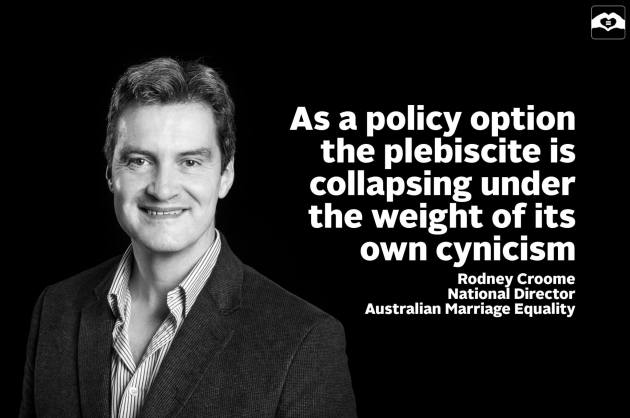
Australian Marriage Equality head Rodney Croome, quoted in the same article, quite accurately summed up these developments with the following: “[a]s a policy option, the plebiscite is collapsing under the weight of its own cynicism.”

Indeed, one of the most pleasing aspects of this week’s debate has been the increasing media scrutiny of the proposal to hold a plebiscite on marriage equality, with respected journalists such as Lenore Taylor describing it asdaft and Mark Kenny observing that:

“Malcolm Turnbull’s commitment to the plebiscite can be seen for what it really is: an internal matter – the price of entry to the leadership. Slow and costly… his own credibility with voters is also at stake if he is seen to trade principles in pursuit of power and an easier life.”

The final major development of the past 10 days was yesterday’s (Friday 29 January 2016) announcement by Australian Marriage Equality that it now believes there is majority support for passing majority equality legislation in both houses of parliament – if only the Coalition were willing to grant their MPs and Senators a free vote.

All of which puts the issue of marriage equality squarely in the Prime Minister’s court (the current one, Malcolm Turnbull, not Prime Minister-in-exile Tony Abbott). The original proposal to hold a marriage equality plebiscite may not have been his, but, now that he is in the Lodge, he owns it.

It is up to Malcolm Turnbull to decide whether Australia will be subjected to a pointless plebiscite on this issue. The time has come for him to show whether he is a leader who is strong enough to back a free vote, or whether he is instead prepared to allow this farce to drag on for not just months, but years, solely for reasons of political expediency.

The signs, however, are not good. Turnbull reiterated the Government’s position in support of a plebiscite to 3AW Radio just yesterday, saying it will “absolutely” pass parliament following a successful vote (something which Abetz, Bernardi, McKenzie and others may have more to say about in coming weeks).

Finally, he has responded to my letter to him on this subject – well, sort of anyway. Given he seems to have outsourced his decision-making on marriage equality to his homophobic predecessor Tony Abbott, it is possibly unsurprising, although nevertheless disappointing, that he has outsourced responsibility for answering correspondence regarding the marriage equality plebiscite to Attorney-General Senator George Brandis, who in turn has delegated it to his Department.

Here is the Government’s response to my letter to Malcolm Turnbull about the marriage equality plebiscite:


“27 January 2016


Mr Alastair Lawrie

[Address withheld]


Dear Mr Lawrie

Thank you for your recent correspondence to the Prime Minister, the Hon Malcolm Turnbull MP, about same-sex marriage. Your correspondence was referred to the Attorney-General, Senator the Hon George Brandis QC, as marriage falls within his portfolio responsibilities. The Attorney-General has asked that I reply to you on his behalf.

I appreciate you taking the time to write to the Government on the issue of same-sex marriage and for sharing your personal experiences. It is clear that this issue holds particular significant for you.

The Government appreciates that, like you, many Australians have strong personal views about same-sex marriage. That is why, last year, it was decided that this issue should be resolved through a national vote that gives every Australian the opportunity to have their say.

The Government believes it is thoroughly democratic to ask the Australian people whether the Marriage Act 1961 should be amended to allow for same-sex marriage, provided there are appropriate safeguards in place to protect religious freedom[i].

Although a plebiscite will cost money, the Government is of the view that every Australian should be able to have their say on this important issue.

Thank you for bringing your views to the Government’s attention.


Yours sincerely

[Name withheld]

Marriage Law and Celebrants Section”


Croome on Plebiscite


[i] The reference to “appropriate safeguards in place to protect religious freedom” is obviously of major concern, given the push for exceptions to be granted to civil celebrants and other businesses that supply weddings to allow them to discriminate against LGBTI couples. This is an issue that will be addressed in a future post.

Letter to Malcolm Turnbull About the Marriage Equality Plebiscite


The Hon Malcolm Turnbull MP

Prime Minister

PO Box 6022

House of Representatives

Parliament House

Canberra ACT 2600

Wednesday 20 January 2016


Dear Prime Minister

Re: Your Proposed Marriage Equality Plebiscite

We don’t personally know each other[i]. Which means that the only things I know about you are what I can glean from the media.

Just over four months into your Prime Ministership, three main themes have emerged:

  1. You’re rich.

Newspaper reports from around the time you deposed Tony Abbott estimated your net worth at $180 million[ii], or ‘conservatively’ at around $200 million[iii].  And you don’t just own a lot of money, you ‘own’ that description too, responding to a question from Tony Burke in Parliament in October with the following:

“… really, if the honourable member wants to go around wearing a sandwich board saying, ‘Malcolm Turnbull’s got a lot of money,’ feel free. I think people know that.”[iv]

  1. You’re Intelligent.

If there’s one thing that even your detractors are compelled to acknowledge, it is that you are not wanting for intelligence. Indeed, there are many people in public life today, no doubt including colleagues of yours, who would like to think that they are smartest person in the room. With you it seems that boast at least has the chance of being correct more often than not.

  1. You’re not Tony Abbott.

As we head into an election year, it is still not entirely clear what the Government you now lead is going to do differently from its first two years in office. What is clear, at least in presentation if not (yet) in substance, is that you are not Tony Abbott.

In fact, some might say you have rather ‘intelligently’ managed to employ that singular qualification – that you are not Tony Abbott – to retake the leadership of the Liberal Party. It also appears to be the primary explanation for why you are currently so far ahead in the polls. Right now, it even looks like you might be able to parlay the truism, that you are not someone else, into winning another term in Government.

If those three characterisations are accurate – you’re rich, you’re intelligent and you’re not Tony Abbott – then my question to you is this: why do you support a plebiscite on marriage equality?

A marriage equality plebiscite is:

  1. Profligate.

It is difficult to imagine a bigger waste of money than holding a plebiscite on this subject, when the logical alternative is introducing it through an ordinary parliamentary vote (in the same way that it was originally banned, by the then Howard Liberal-National Government, in 2004).

The Australian Electoral Commission has estimated that the cost of holding a stand-alone plebiscite would be at least $158.4 million[v]. Well, imagine one of those agile and innovative entrepreneurs (that you love so much) coming to you with the following proposition:

a) You could make this change, for no additional cost, within a month or two, and with minimal disruption to business as usual, or

b) You could instead waste the equivalent of at least three quarters of your personal net worth trying to introduce this reform, take 18 months to 2 years, and ensure there is maximum distraction from everything else you wish to accomplish?

I don’t imagine you accumulated the wealth you have today by choosing a) very often.

  1. Stupid.

What transforms choosing option b), above, from being merely a very poor decision, into an undeniably stupid one, is that even after holding a plebiscite, you will still have to pass marriage equality legislation in parliament anyway.

There is no constitutional reason for holding a public vote on this topic. The High Court has already made it abundantly clear that Commonwealth Parliament has the power to introduce marriage equality – no referendum, or plebiscite, is required.[vi]

Nor is it appropriate to subject the human rights of a minority group to what is essentially a popularity contest, preceded by what will no doubt be a vicious and ugly public debate driven by the homophobia, biphobia, transphobia and intersexphobia of many of those opposed to the legal equality of lesbian, gay, bisexual, transgender and intersex (LGBTI) Australians.

About the only reason anyone has been able to identify for holding a plebiscite on this topic is to try to paper over the cracks of deep division within the Liberal and National Parties – which sounds doesn’t sound like a very intelligent use of $158.4 million of taxpayers’ money to me.

  1. Exactly what Tony Abbott proposed.

The then Prime Minister Tony Abbott put forward the idea of a plebiscite when marriage equality was discussed at the extraordinary joint Liberal-National Party room meeting on 11 August last year.

Forgive me for being cynical for a moment, but here is a man so opposed to the concept of marriage equality that he is comfortable with his own sister being denied the same legal rights he enjoys simply because of her sexual orientation.

So, when Abbott emerged from the Coalition Party room, happy to declare support for a referendum or plebiscite as official Government policy, most LGBTI people saw it as essentially a stalling tactic, as a way to postpone the inevitable for as many years as possible – pushed by a man who, it is fair to say, does not have the best interests of LGBTI Australians at heart.

Indeed, it was reported that you spoke against the proposal for a public vote at that meeting, and told reporters the following day that a parliamentary conscience vote would have been “consistent with Liberal party tradition”, with the additional benefit that:

“One of the attractions of a free vote is that it would have meant the matter would be resolved in this Parliament, one way or another, in a couple of weeks”[vii].

And yet, despite all of this, now that you occupy the top job, you are persisting with your predecessor’s approach, of holding an unnecessary, inappropriate, wasteful and divisive plebiscite.

On marriage equality, you’re not ‘not Tony Abbott’. On marriage equality, you’re just another Tony Abbott.

**********

I started this letter by saying that we don’t personally know each other. As well as me not knowing you, that means you don’t know me either.

You don’t know that I have been together with my partner, Steven, for seven and a half years.

You don’t know that this coming Saturday, 23 January 2016, will mark the sixth anniversary of our engagement.

And, as someone who has been married to your own partner for almost 36 years, you can’t know what it feels like for successive Governments, Coalition and Labor and Coalition once more, to repeatedly tell you that your relationship is less worthy of recognition than the relationships of other Australians, simply because of who you are.

Steven and I, and tens of thousands of other couples across the country, know the bitter taste that is left in one’s mouth by this abhorrent, and completely unjustified, discrimination.

As Prime Minister of this country, a position that you have coveted for so long, you have the power to change this situation.

You could choose to start 2016 by doing what you know is right – by reverting to the policy position which you supported right up until you assumed your current titular position, and pushing for a parliamentary vote on marriage equality in the coming session.

If you did, marriage equality could be reality in Australia within a matter of months, and you would be remembered as the leader, in the true sense of the word, who helped to finally make it happen.

Or you could instead choose to continue to support a profligate and stupid plebiscite on marriage equality.

In doing so, not only would you be entirely indistinguishable from Tony Abbott on this issue, you would join the long line of other so-called ‘leaders’, from John Howard, to Kevin Rudd, Julia Gillard and Tony Abbott, whom Australians will need to achieve marriage equality in spite of, not because of.

After the last national public vote on an issue in 1999, a certain president of the Australian Republic Movement said of John Howard that:

“History will remember him for only one thing. He was the prime minister who broke this nation’s heart.”[viii]

Well, I won’t be quite so grandiose here but please know this: if you continue to support an unnecessary, inappropriate, wasteful and divisive plebiscite on marriage equality, some people will remember you for only one thing – and that is for breaking many LGBTI Australians’ hearts, mine included.

Sincerely

Alastair Lawrie


151222 Turnbull

Prime Minister Malcolm Turnbull – on support for a marriage equality plebiscite, he’s indistinguishable from predecessor Tony Abbott.


[i] We did sit next to each other, once, at a forum on climate change in the lecture theatre at Parliament House in Canberra, but we weren’t introduced, so I don’t think that counts.

[ii] “The Investments that Built Prime Minister Malcolm Turnbull’s Wealth”, Herald Sun, 18 September 2015

[iii] “So Prime Minister Malcolm Turnbull is Really, Really, Rich. Get Over It”, Sydney Morning Herald, 25 September 2015, and “Malcolm Turnbull, the Member for Net Worth”, Australian Financial Review, 17 September 2015.

[iv] Hansard, 15 October 2015.

[v] As quoted on page 22 of the Senate Committee Report: Matter of a popular vote, in the form of a plebiscite or referendum, on the matter of marriage in Australia, 15 September 2015

[vi] In the 2013 case overturning the Australian Capital Territory’s same-sex marriage laws, the High Court stated, unequivocally, that: “[w]hen used in s51(xxi), “marriage” is a term which includes a marriage between persons of the same sex.” The Commonwealth v Australian Capital Territory [2013] HCA 55, para 38

[vii] “Turnbull Dismisses Gay Plebiscite”, Perth Now, 12 August 2015.

[viii] “Turnbull Re-Launches Campaign for Australian Republic”, ABC Lateline, 10 May 2013.

What’s Wrong With the Victorian Equal Opportunity Act 2010?

This post is part of a series looking at Australia’s Commonwealth, state and territory anti-discrimination laws analysing how well – or in some cases, how poorly – they protect lesbian, gay, bisexual, transgender and intersex (LGBTI) people from discrimination and vilification (other posts in the series can be found here).

Each post examines that jurisdiction’s LGBTI anti-discrimination laws, focusing on three main areas:

  • Protected attributes
  • Religious exceptions, and
  • Anti-vilification coverage.

Unfortunately, as we shall see below, Victoria’s Equal Opportunity Act 2010 has serious deficiencies in two of these three categories. It is time for the Parliament to act to ensure LGBTI Victorians enjoy adequate protections against homophobic, biphobic, transphobic and intersexphobic discrimination and vilification, including by religious institutions.

**********

Protected Attributes

Protection against discrimination for LGBTI Victorians has developed across three distinct stages.

Victoria’s first anti-discrimination protections for lesbian, gay and bisexual people were introduced in 1995. However, rather than protecting people from discrimination on the basis of sexual orientation or homosexuality and bisexuality, the Act instead covered ‘lawful sexual activity’.

This protected attribute was defined as “engaging in, not engaging in or refusing to engage in a lawful sexual activity”[i] and, with its focus on behaviour rather than identity, it is questionable how effective these protections were in practice.

Fortunately, as the name suggests, the Equal Opportunity (Gender Identity and Sexual Orientation) Act 2000 signalled a second stage of reform, by introducing ‘sexual orientation’ as a protected attribute, defined as “homosexuality (including lesbianism), bisexuality or heterosexuality.”[ii]

While the language used may not be the same that would be used today[iii], it is clear that lesbian, gay and bisexual Victorians are all covered from that point onwards.

The same amending legislation in 2000 also introduced anti-discrimination protections for transgender Victorians for the first time.

This is because it introduced ‘gender identity’ as a protected attribute, with the following definition:

gender identity means-

(a) the identification on a bona fide basis by a person of one sex as a member of the other sex (whether or not the person is recognised as such)-

(i) by assuming characteristics of the other sex, whether by means of medical intervention, style of dressing or otherwise; or

(ii) by living, or seeking to live, as a member of the other sex; or

(b) the identification on a bona fide basis by a person of indeterminate sex as a member of a particular sex (whether or not the person is recognised as such)-

(i) by assuming characteristics of that sex, whether by means of medical intervention, style of dressing or otherwise; or

(ii) by living, or seeking to live, as a member of that sex.”[iv]

Paragraph (a) of this definition applied to transgender people, although, given its focus on ‘binary’ genders, it would appear it only covered those people whose sex was designated as male at birth, but subsequently identified as female (and vice versa). It did not appear to cover people with non-binary gender identities.

The definition in the Victorian Equal Opportunity Act 2010 was therefore no longer best practice, and a new, more inclusive definition of gender identity was needed[v] to ensure all transgender people benefitted from anti-discrimination protection.

Intersex Victorians were even worse off under the 2000 reforms. Paragraph (b) of the definition of gender identity, above, offered their only protection under Victorian law, and was problematic because:

  • It inappropriately conflated intersex status, which relates to physical sex characteristics, with gender identity, and
  • It only appeared to protect people with intersex variations where they identified as either male or female.

In order to remedy this situation, a stand-alone protected attribute of ‘sex characteristics’ was needed in the Act, based on the call by intersex activists in the March 2017 Darlington Statement[vi].

Fortunately, all of the above limitations appear to have been addressed in the third stage of LGBTI anti-discrimination protections, which were introduced as part of recent legislation prohibiting anti-gay and anti-trans conversion practices (as amendments in the Change or Suppression (Conversion) Practices Prohibition Act 2021).

This included:

  1. Introducing a new definition of sexual orientation: ‘means a person’s emotional, affectional and sexual attraction to, or intimate or sexual relations with, persons of a different gender or the same gender or more than one gender.’ This clearly protects lesbian, gay and bisexual people, as well as pansexuals and other sexual orientations.
  2. Introducing a new definition of gender identity: ‘means a person’s gender-related identity, which may or may not correspond with their designated sex at birth, and includes the personal sense of the body (whether this involves medical intervention or not) and other expressions of gender, including dress, speech, mannerisms, names and personal references.’ This means gender identity is no longer described in binary terms, thus protecting non-binary people against discrimination.
  3. Introducing a new protected attribute of ‘sex characteristics’, with the following definition: ‘means a person’s physical features relating to sex, including- (a) genitalia and other sexual and reproductive parts of the person’s anatomy; and (b) the person’s chromosomes, genes, hormones, and secondary physical features that emerge as a result of puberty.’ This means people with intersex variations of sex characteristics will finally be protected when these changes to the Equal Opportunity Act 2010 take effect (expected shortly).

Summary: It has taken longer than it should, but the Victorian Equal Opportunity Act 2010 will soon finally protect all groups within the LGBTI community against discrimination.

**********

Religious Exceptions

The religious exceptions contained in Victoria’s Equal Opportunity Act 2010, are, to put it bluntly, outrageous. They are so broad, and so generous, that they substantially, and substantively, undermine laws that are supposed to redress discrimination against LGBTI people (amongst other groups).

While the exceptions for religious bodies[vii] contained in subsection 82(1)[viii] appear largely innocuous, relating to the appointment or training of religious ministers and the selection of people to perform religious services, it is only downhill from there.

For example, subsection 82(2) states that:

“Nothing in Part 4 applies to anything done on the basis of a person’s religious belief or activity, sex, sexual orientation, lawful sexual activity, marital status, parental status or gender identity by a religious body that-

(a) conforms with the doctrines, beliefs or principles of the religion; or

(b) is reasonably necessary to avoid injury to the religious sensitivities of adherents of the religion.”

Essentially, as long as a religious organisation can show that discriminating against LGBTI people is related to their religion, they have carte blanche to do so in areas where it would be otherwise unlawful.

And, lest there be any doubt that these provisions cover religious schools – allowing them to discriminate against LGBTI teachers and students – section 83 reinforces the ‘right’ to discriminate on these grounds:

83 Religious schools

(1) This section applies to a person or body, including a religious body, that establishes, directs, controls, administers or is an educational institution that is, or is to be, conducted in accordance with religious doctrines, beliefs or principles.

(2) Nothing in Part 4 applies to anything done on the basis of a person’s religious belief or activity, sex, sexual orientation, lawful sexual activity, marital status, parental status or gender identity by a person or body to which this section applies in the course of establishing, directing, controlling or administering the educational institution that-

(a) conforms with the doctrines, beliefs or principles of the religion; or

(b) is reasonably necessary to avoid injury to the religious sensitivities of adherents of the religion.”

The Victorian Equal Opportunity Act 2010 even includes a somewhat unusual, ‘special right’ for individuals to discriminate against other individuals:

84 Religious beliefs or principles

Nothing in Part 4 applies to discrimination by a person against another person on the basis of that person’s religious belief or activity, sex, sexual orientation, lawful sexual activity, marital status, parental status or gender identity if the discrimination is reasonably necessary for the first person to comply with the doctrines, beliefs or principles of their religion.”[ix]

Tasmania is the only other jurisdiction to include a similar ‘individual’ right to discriminate, although it only allows discrimination on the basis of religion – and not on the basis of sexual orientation, gender identity or intersex status.

Perhaps the most disappointing aspect of these exceptions is that the most recent changes in this area took the law backwards.

In 2010, the then Labor Government introduced amendments to both the general religious exception, and the specific religious schools exception, so that, in order to discriminate in employment the religious body or school would first need to show that:

“(a) conformity with the doctrines, beliefs or principles of the religion is an inherent requirement of the particular position; and

(b) the person’s religious belief or activity, sex, sexual orientation, lawful sexual activity, marital status, parental status or gender identity means that he or she does not meet that inherent requirement.”[x]

However, before this ‘inherent requirement’ test could even take effect, the newly-elected Liberal-National Government repealed these provisions in 2011, effectively restoring the previous broad and generous exceptions.

Not only are groups like the Australian Christian Lobby, Christian Schools Australia and the Catholic Education Office all (predictably and) vehemently opposed to limiting what is in practice an almost unfettered right to discriminate against LGBTI employees[xi], the history of recent adoption equality legislation also shows just how committed the Liberal and National parties are to protecting this so-called ‘right’.

For those who may be unaware, as part of the long overdue introduction of equal adoption rights for same-sex couples in Victoria[xii], the Andrews Labor Government proposed that religious agencies providing adoption services should not be allowed to discriminate against LGBT people. The amendment sought to add a new subsection (3) to section 82 of the Act:

“Despite subsection (2), Part 4 applies to anything done by a religious body that is an approved agency within the meaning of the Adoption Act 1984 in relation to its exercise of any power or performance of any function or duty under that Act for or with respect to adoption, whether or not the power, function or duty relates to a service for a child within the meaning of that Act or for any other purpose.”

Unfortunately, the Liberal and National parties combined with some cross-bench MPs to defeat this amendment, meaning that, while the right of same-sex couples to adopt has now finally been passed, adoption services operated by religious organisations will continue to have the ‘right’ to turn those same couples away.

Undeterred by this setback, in the second half of 2016 the Andrews Labor Government attempted to implement its election commitment by reintroducing the inherent requirements test for anti-LGBT discrimination in employment via the Equal Opportunity Amendment (Religious Exceptions) Bill 2016.

Yet again, however, the Liberal and National parties used their numbers in the Legislative Council to block this modest reform, meaning LGBT teachers at religious schools, and employees at other religious organisations, can still be discriminated against simply because of who they are, and even where this discrimination has nothing whatsoever to do with the actual role they are performing.

With the Andrews Labor Government re-elected on 24 November 2018, and a potentially more supportive Legislative Council, it is now up to Minister for Equality Martin Foley MP and his Government to push for broader reforms than simply re-instating the ‘inherent requirement’ test for employment to considering how best to prohibit discrimination against LGBTI people accessing services.

Ultimately, of course, there is a need to remove all religious exceptions outside those required for the training and appointment of religious ministers, and for the conduct of religious ceremonies.

Summary: The religious exceptions contained in the Victorian Equal Opportunity Act 2010 are overly broad, too generous, and – frankly – outrageous. Current provisions give religious bodies and religious schools wide powers to discriminate both against LGBTI employees and against LGBTI people accessing their services.

The Labor Government is to be commended for attempting to reinstate the ‘inherent requirement’ test for discrimination in employment, and to remove exceptions for religious adoption agencies – but now, following their re-election, they must go further and, at the very least, remove exceptions which allow religious schools to discriminate against LGBT students, teachers and other staff.

**********

Anti-Vilification Coverage

This section will be the shortest of the post – because, unlike NSW, Queensland, Tasmania and the ACT, there are no anti-vilification laws covering any parts of the LGBTI community.

Given the similar absence of LGBTI anti-vilifications provisions under Commonwealth law, this means Victoria’s lesbian, gay, bisexual, transgender and intersex community do not have any recourse to legislative anti-vilification protection.

There are, however, protections against both racial and religious vilification under Victoria’s Racial and Religious Tolerance Act 2001.[xiii]

With homophobic, biphobic, transphobic and intersexphobic vilification just as serious, and just as detrimental, as racial and religious vilification, there is no reason why LGBTI people should not have equivalent protections under Victorian law.

Summary: There is currently no anti-vilification coverage for LGBTI people under Victorian law. However, given there are existing protections against racial and religious vilification, LGBTI anti-vilification laws should be introduced, too.

Significantly, in 2019, Fiona Patten MLC of the Reason Party introduced a Bill to amend the Racial and Religious Tolerance Act to include sexual orientation, gender identity and sex characteristics as protected attributes (alongside gender and disability). This prompted a parliamentary inquiry into anti-vilification protections – see my submission to that inquiry here.

This inquiry is expected to report in March 2021. Hopefully, this Bill and inquiry prompts the Victorian Government and Parliament to pass this long-overdue, and much-needed, reform.

**********

In conclusion, while the Equal Opportunity Act 2010 covers all groups within the Victorian LGBTI community against discrimination (or at least will soon, when the amendments introduced as part of the ban on conversion practices take effect), it is clear there is still plenty of work to do, including reforming the overly-generous religious exceptions contained in the Act, and ensuring LGBTI Victorians have equivalent access to anti-vilification protections as those based on race and religion.

Daniel Andrews

It’s time for Victorian Premier Daniel Andrews to make sure all Victorians are protected against discrimination, including LGBT students and teachers in religious schools, and introducing prohibitions on anti-LGBTI vilification.

If you have enjoyed reading this article, please consider subscribing to receive future posts, via the right-hand scroll bar on the desktop version of this blog or near the bottom of the page on mobile. You can also follow me on twitter @alawriedejesus

Footnotes:

[i] This definition remains in subsection 4(1) of the Equal Opportunity Act 2010.

[ii] Subsection 4(1), Equal Opportunity Act 2010.

[iii] For example, the Commonwealth Sex Discrimination Act 1984, which was amended in 2013, defines ‘sexual orientation’ as “a person’s sexual orientation towards:

(a) persons of the same sex; or

(b) persons of a different sex; or

(c) persons of the same sex and persons of a different sex.”

[iv] Subsection 4(1), Equal Opportunity Act 2010.

[v] Potentially modelled on the definition adopted by the Commonwealth Sex Discrimination Act 1984: “gender identity means the gender-related identity, appearance or mannerisms or other gender-related characteristics of a person (whether by way of medical intervention or not), with or without regard to the person’s designated sex at birth.” [Although obviously exact wording should be agreed with Victoria’s transgender community.]

[vi] While the inclusion of ‘intersex status’ in the Commonwealth Sex Discrimination Amendment (Sexual Orientation, Gender Identity and Intersex Status) Act 2013 was seen as world leading at the time, intersex activists now prefer the terminology ‘sex characteristics’ be used as a protected attribute.

[Again, the final wording of the new definition would need to be agreed in consultation with Victoria’s intersex community.]

[vii] Defined in section 81 as “(a) a body established for a religious purpose; or (b) an entity that establishes, or directs, controls or administers, an educational or other charitable entity that is intended to be, and is, conducted in accordance with religious doctrines, beliefs or principles.”

[viii] Subsection (82)(1) “Nothing in Part 4 applies to-

(a) the ordination or appointment of priests, ministers of religion or members of a religious order;

(b) the training or education of people seeking ordination or appointment as priests, ministers of religion or members of a religious order; or

(c) the selection or appointment of people to perform functions in relation to, or otherwise participate in, any religious observance or practice.”

[ix] Not only is it unclear why this section is necessary (given the protections contained in Part 4 only apply in specific areas of public life, such as employment, education, the provision of goods and services and accommodation, rather than establishing a general right to non-discrimination), it is also concerning that this ‘special right’ extends to unincorporated associations (because ‘person’ is defined in subsection 4(1) of the Equal Opportunity Act as “person includes an unincorporated association and, in relation to a natural person, means a person of any age.”)

[x] The same wording was used in both subsections 82(3) and 83(3) of the then Equal Opportunity Act 2010.

[xi] “Religious groups hit out at Labor’s move to rewrite state’s equal opportunity laws”, The Age, 8 December 2014.

[xii] As passed in the Adoption Amendment (Adoption by Same-Sex Couples) Act 2015.

[xiii] Section 7 prohibits racial vilification while section 8 prohibits religious vilification: Racial and Religious Tolerance Act 2001.

7 Better Ways to Spend $158.4 million

Despite the change of Prime Minister in September, from the homophobe Tony Abbott to the supposedly ‘gay-friendly’ incumbent Malcolm Turnbull, it appears we are stuck with the decidedly unfriendly option of holding a plebiscite to determine whether the relationships of lesbian, gay, bisexual, transgender and intersex (LGBTI) Australians should be treated equally under the law, or if they will continue to be treated as second class compared to the relationships of their cisgender heterosexual counterparts.


This blog has previously looked at the issue of a marriage equality plebiscite, with my submission to the recent Senate inquiry arguing that such a vote would be unnecessary, inappropriate, wasteful and divisive.


Just how wasteful a plebiscite would be became apparent during the course of that inquiry, with the Australian Electoral Commission estimating that the cost of holding a stand-alone vote to determine this issue would be at least $158.4 million.[i]


$158.4 million, to conduct what is essentially a glorified public opinion poll, which would not be binding on our elected officials, nor compelling them to implement the outcome in a timely manner (with the 1977 plebiscite, which selected ‘Advance Australia Fair’ as our new national anthem, not legislated until 1984).


$158.4 million, to determine what we already know – that the majority of Australians support the human rights of LGBTI Australians, and wish to see a Marriage Act that does not discriminate on the basis of sexual orientation, gender identity or intersex status.


$158.4 million, to do something that the 226 members of the Commonwealth Parliament could do for no extra cost, something that they are elected to do, and something that overturns what they have done before (with John Howard’s homophobic, biphobic, transphobic and intersexphobic ban on equal marriage passed by Parliament alone and not subjected to a public vote).


Surely there are a million better things that the Turnbull Liberal-National Government could spend this money on? This post looks at seven preferable alternatives – although I am confident that readers of this blog could nominate many, many more. Anyway, here goes – in no particular order, here’s 7 better ways to spend $158.4 million:


  1. Resettle an extra 2,297 refugees from Syria and Iraq


The biggest humanitarian crisis of 2015 – indeed, the biggest humanitarian crisis of the past decade and probably of the century so far – has been the civil war in Syria (which started almost five years ago), the subsequent rise of ISIS there and in Iraq and the horrific violence they have inflicted on the people in both places, and the enormous number of refugees that the Assad regime, the Syrian civil war and ISIS have collectively created.


While the vast majority of refugees remain located in neighbouring countries, the increasing numbers of people seeking asylum reaching Europe during 2015 – and, tragically, the deaths of many who were attempting to flee – finally prompted the Australian Government to announce it would accept 12,000 refugees from Syria and Iraq in addition to its annual intake of 13,750 refugees (then Prime Minister Tony Abbott announced this policy on 9 September[ii], making it one of his last acts in office).


The cost of this additional intake of refugees was not revealed until the Mid-Year Economic and Fiscal Outlook (MYEFO), released by new Treasurer Scott Morrison on 15 December 2015. The MYEFO papers showed that the net cost to the Budget of permanently resettling an extra 12,000 refugees fleeing the conflict in Syria and Iraq is $827.4 million over 4 years[iii].


Which means that, were the Turnbull Government to re-allocate the $158.4 million it is currently planning to spend on a marriage equality plebiscite, we could resettle at least an additional 2,297 refugees from Syria and Iraq[iv]. Surely most Australians, indeed most humans, would consider that a much better way to spend this money.


  1. Restore 2015-16 Foreign Aid Funding to Afghanistan… and Sub-Saharan Africa… and Palestine… and Middle East & North Africa… and UNICEF


Foreign Minister Julie Bishop is a ‘Julie-come-lately’ when it comes to supporting marriage equality – she only announced her personal support for it in early November 2015.[v]


However, in the same breath she also reiterated her commitment to a plebiscite: “I have absolutely no concerns about it myself, but I know there [are] a lot of people who are deeply concerned about the issue… I think the Australian people should have their say.”


So, rather than casting her vote as an elected representative, one out of 226 Federal Parliamentarians who have the power to change the law in a matter of weeks, Minister Bishop would instead prefer to waste years, and $158.4 million, on a completely unnecessary public vote, leaving her own vote as just one out of the 15.26 million Australians currently on the electoral roll[vi].


As well as abrogating her personal responsibility as an MP (which includes the ability, nay responsibility, to consider and pass legislation), according to the Australia Institute, “current foreign minister Julie Bishop [also holds] the dubious honour of being the minister to oversee the largest drop in aid spending [compared] to Gross National Income”[vii].


The Liberal-National Government of which she is a key member plans to cut aid funding by $1.4 billion per year, or 33 per cent, by 2017-18. These cuts include savage reductions in the 2015-16 Budget year across a large number of countries and international aid programs[viii].


Obviously, the $158.4 million intended to fund the marriage equality plebiscite is small change compared to these overall totals, but, applying that figure to the 2015-16 Budget year, it could restore current financial year funding to:


  • Afghanistan (2015-16 Budget cut by $52.4 million)
  • Sub-Saharan Africa ($74.2 million cut)
  • Palestine ($13.7 million cut)
  • Middle East and North Africa ($2.3 million cut) and
  • UNICEF ($14 million cut).[ix]


And there would almost be enough money left over to undo the $3 million cut to the United Nations Program on HIV and AIDS (UNAIDS) too. Perhaps Minister Bishop should spend more time advocating for Australian Government funding to assist the world’s disadvantaged, and less time calling for a pointless plebiscite.


  1. Support an additional 1,975 postgraduate students


Malcolm Turnbull likes to claim he is the ‘Innovation Prime Minister’, and that it is his mission to lead an ‘agile’ Government and an even more ‘agile’ economy. Well, instead of wasting $158.4 million on an unnecessary, inappropriate and divisive marriage equality plebiscite, he could fund Australian Postgraduate Awards for 1,975 extra students for three years instead.[x]


Imagine that – almost 2,000 extra PhDs in Australia contributing to science, and technology, and engineering, and mathematics, and countless other fields. Imagine what they could add to the sum of human knowledge. Alas, we will not find out if Turnbull insists on spending the money on something which he himself considered unnecessary just one month before becoming PM.[xi]


  1. Hire 477 more registered nurses


In his 2014-15 Federal Budget, then Treasurer Joe Hockey cut $80 billion from the states and territories, monies that were supposed to fund increases in spending on health and education over the subsequent decade. This included $50 billion in cuts to hospitals, and another $30 billion in cuts to schools.


The new Treasurer, Scott Morrison, has indicated that, not only will he not be reversing these cuts, even if the Turnbull Government increased the GST to 15% and expanded it to cover fresh food he still would not use the revenue collected to restore this funding.[xii]


Obviously, $158.4 million wouldn’t go very far in undoing the massive reductions in future health spending by both Hockey and now Morrison, but it would nevertheless be enough to pay the base salary of at least 477 registered nurses for four years[xiii] – and that’s nothing to be sneezed at.


  1. Employ an extra 578 teachers in public schools


Based on a similar approach, re-allocating $158.4 million from an unnecessary, inappropriate and divisive marriage equality plebiscite to instead give to the states and territories to allow them to employ an additional 578 teachers[xiv] in public schools across the country sounds like a much smarter, and productive, investment to me.


  1. Reduce Government debt


The Abbott Liberal-National Government was elected in September 2013 on the back of three relentlessly negative fear campaigns – against a carbon tax, against people seeking asylum, and against ‘Labor’s debt and deficit’. In fact, the ‘debt and deficit’ focus dates all the way back to the 2008-09 Global Financial Crisis, making it perhaps Abbott’s longest-serving attack on the Rudd, Gillard and Rudd Governments (including when Abbott was part of the Shadow Ministry).


Of course, in the years since they were elected the Abbott, and now Turnbull, Governments have overseen ongoing Budget deficits, and continued increases in net Government debt. Based on MYEFO, net debt will now not peak until 2017-18, at 18.5% of GDP (or $336.4 billion)[xv], with Treasury forecasting there will not be a Budget surplus until 2020-21 at the earliest.


Which makes any decision to hold a marriage equality plebiscite costing $158.4 million, in either 2016-17 (when there is expected to be a Budget deficit of $33.7 billion) or 2017-18 (with its anticipated deficit of $23 billion)[xvi], seem entirely profligate.


If Malcolm Turnbull, Scott Morrison, and their Coalition colleagues, are genuinely concerned about reducing Government ‘debt and deficit’, then deciding not to hold a $158.4 million opinion poll would have to be one of the easiest Budget ‘saves’ of all time.


  1. Fund the National Safe Schools Coalition… almost 20 times over


With the glaring, and profoundly disappointing, exception of marriage equality, the former Labor Government passed a large number of LGBTI reforms, including long overdue de facto relationship recognition, and the introduction of LGBTI anti-discrimination protections in federal law for the first time.


One initiative that received less coverage at the time was the 2013 decision to fund the national rollout of the Safe Schools Coalition, which had previously only operated in Victoria, with an $8 million grant. To their credit, the Liberal-National Government has not overturned this funding, and the expansion of Safe Schools has occurred under their watch.


The estimated cost of the marriage equality plebiscite would be enough to fund this rollout almost 20 times over – and, in practice, it would take much less than $158.4 million to help ensure that all schools across the country could participate in a program aimed at combatting homophobia, biphobia, transphobia and intersexphobia (and sadly one that will be even more needed given the hatred and prejudice likely to be whipped up by the plebiscite debate).


Indeed, there would be plenty of money left over to help fund the implementation of the reforms recommended by the 2013 Senate Inquiry into the Involuntary or Coerced Sterilisation of Intersex People in Australia, and to remove out-of-pocket medical expenses for transgender Australians, and even to fund housing services for LGBTI young people, who are disproportionately affected by homelessness.


If the Turnbull Government really wants to spend $158.4 million on issues that affect LGBTI Australians, it should redirect it to the above programs (and others aimed at improving LGBTI health and welfare). It could do so comfortable in the knowledge that it would still be able to pass marriage equality at, essentially, no cost.


**********


In conclusion, there is absolutely no reason for the Turnbull Government to hold a plebiscite on marriage equality, especially not when, as well as being publicly divisive, it would cost the taxpayer an estimated $158.4 million.


This reform, which is solely concerned with recognising the fundamental equality of lesbian, gay, bisexual, transgender and intersex Australians, and their relationships, under secular law, should be passed in the same way that John Howard’s ban on same-sex marriage was – by our 226 elected representatives, sitting in the Federal Parliament.


Which would leave the money that would have been spent on the plebiscite available for any of the seven options listed above, or for a myriad of other choices. There’s no denying that Malcolm Turnbull is an intelligent man – here’s hoping he’s smart enough to choose something other than to persist with Tony Abbott’s stupid, and damaging, plebiscite proposal.


151222 Turnbull

Prime Minister Malcolm Turnbull, who could spend $158.4 million on resettling an extra 2,297 refugees from Syria and Iraq, or who could waste it on an unnecessary, inappropriate and divisive plebiscite.


[i] As quoted on page 22 of the Senate Committee Report: Matter of a popular vote, in the form of a plebiscite or referendum, on the matter of marriage in Australia, 15 September 2015 http://www.aph.gov.au/Parliamentary_Business/Committees/Senate/Legal_and_Constitutional_Affairs/Marriage_Plebiscite/Report

[ii] Sydney Morning Herald, “Abbott Government agrees to resettle 12,000 Syrian refugees in Australia”, 9 September 2015: http://www.smh.com.au/federal-politics/political-news/abbott-government-agrees-to-resettle-12000-syrian-refugees-in-australia-20150909-gjibqz.html

[iii] MYEFO Expenditures can be found here: http://budget.gov.au/2015-16/content/myefo/html/11_appendix_a_expense.htm

[iv] Based on the current estimate of a cost of $68,950 spent per refugee over four years. The number of additional refugees would likely be higher than 2,297 given economies of scale.

[v] ABC, “Julie Bishop announces support for same-sex marriage”, 2 November 2015: http://www.abc.net.au/news/2015-11-02/julie-bishop-announces-support-for-same-sex-marriage/6906740

[vi] Source Australian Electoral Commission: http://www.aec.gov.au/Enrolling_to_vote/Enrolment_stats/

[vii] Matt Grudnoff & Dan Gilchrist, “Charity Ends at Home: The decline of foreign aid in Australia”, The Australia Institute, September 2015, p iii (full report available here: http://www.tai.org.au/content/charity-ends-home-decline-foreign-aid-australia

[viii] Ibid, and in Guardian Australia, “Budget cuts to foreign aid put Australia on track for least generous spend ever,” 14 May 2015: http://www.theguardian.com/news/datablog/2015/may/14/budget-cuts-to-foreign-aid-put-australia-on-track-for-least-generous-spend-ever

[ix] Figures from Guardian Australia article and Charity Ends at Home report, above.

[x] The 2016 Australian Postgraduate Award full time payment is $26,288 (https://www.education.gov.au/australian-postgraduate-awards ) and applying the current 1.7% inflation figure would make three years of support (2016-2018) cost $80,210.

[xi] “There is a huge number of big issues, so one of the attractions of a free vote is that it would have meant the matter would have been resolved in this parliament one way or another in a couple of weeks.” Guardian Australia, “Malcolm Turnbull says plebiscite on marriage equality will keep issue alive”, 12 August 2015: http://www.theguardian.com/australia-news/2015/aug/12/malcolm-turnbull-says-plebiscite-on-marriage-equality-will-keep-issue-alive

[xii] Guardian Australia, “Scott Morrison will not raise GST to fund states’ funding black holes”, 10 December 2015: http://www.theguardian.com/australia-news/2015/dec/10/scott-morrison-will-not-raise-gst-to-fund-states-funding-black-holes

[xiii] Based on the highest base wage of a registered nurse in NSW – $79,383, source: Health Times, “What do nurses earn?”, 17 September 2015 http://healthtimes.com.au/hub/nursing-careers/6/guidance/nc1/what-do-nurses-earn/605/ – and applying 3% salary increases for the subsequent 3 years.

[xiv] Based on the base salary of a five-year trained teacher (BA/MTeach, BSc/MTeach, BEd/BA, BEd/BSc) in NSW government schools – $65,486, source: University of Sydney Faculty of Education and Social Work: http://sydney.edu.au/education_social_work/future_students/careers/teacher_salaries.shtml – and applying 3% salary increases for the following 3 years.

[xv] MYEFO Debt Statement: http://www.budget.gov.au/2015-16/content/myefo/html/09_attachment_e.htm

[xvi] ABC, “Budget deficit increased as MYEFO released,” 15 December 2015: http://www.abc.net.au/news/2015-12-15/budget-deficit-increased-as-myefo-released/7029472

The GLORIAs 2015

The GLORIAs – the Gay or Lesbian Outrageous, Ridiculous or Ignorant (Comment) Awards – were held again at NSW Parliament House on Tuesday 10 November 2015.

Organised by Penny Sharpe MLC, hosted by David Marr, and with entertainment provided by Barbra Blacksheep, the event is an annual opportunity to highlight the ongoing serious issue of homophobia, biphobia, transphobia and intersexphobia by making fun of what are, frankly, some of the most stupid and downright offensive things said in public life over the past year or so.

There are five main categories, with the overall ‘winner’ of the Golden GLORIA decided by a ‘boo-off’. Here are the nominees and winners of this year awards:

The most OUTRAGEOUS, RIDICULOUS or IGNORANT comment from the INTERNATIONAL category:

  • Kentucky county court clerk Kim Davis, who has refused to issue marriage licences to same-sex couples
  • Anti-gay radio host Bryan Fisher who compared a clerk who refuses to issue marriage licences to same-sex couples to a ‘clerk at Auschwitz’ who refused to murder Jews
  • Ghanaian presidential hopeful George Boateng, who declared: “There is too much indiscipline in Ghana, under my presidency when a corrupt person, gay or lesbian are arrested the law will make it possible for the courts to sentence the offender to death by firing squad”
  • Ed Straker, senior writer of com, the conservative news site, writing about the ‘Rainbow Doritos’: “Doritos are a product marketed to children, so they make the perfect gateway snack to introduce children to the joys of homosexuality”
  • Texas Governor Rick Perry: “I may have the genetic coding that I’m inclined to be an alcoholic, but I have the desire not to do that – and I look at the homosexual issue the same way”
  • Former French President Nicolas Sarkozy criticised his country’s same-sex marriage law saying he “detested” the way he feels his successor, Francois Hollande, and his Socialist government “forced” the same-sex marriage bill into law in 2013. The thrice-married Sarkozy said he feels the statute is “humiliating families and humiliating people who love the family”
  • Islamic State militants have reportedly murdered two more men for the ‘crime’ of being gay in an unnamed town in Iraq’s Nineveh province
  • Rapper Azealia Banks tweeted that the “LGBT community (GGGG) are like the gay white KKK’s. Get them some pink hoods and unicorns and let them rally down rodeo drive”
  • Kazakh Party Leader Bolashak: “I think it is very easy to identify a gay person by his or her DNA. A blood test can show the presence of degeneratism in a person”

And the winner was: Kim Davis. A well-deserved honour for someone who misguidedly thinks she is a martyr simply for refusing to do the straight-forward job of treating people equally.

MEDIA

  • The Daily Telegraph for the front page “Gay Class Uproar – Parents outraged as Sydney school swaps lessons for PC movie session”
  • Germaine Greer for her views on trans* women: “I didn’t know there was such a thing [as transphobia]. Arachnophobia yes. Transphobia, no.” “It seems to me that what was going on there was that [Caitlyn Jenner] he/she wanted the limelight that the other, female, members of the family were enjoying and has conquered it, just like that” … “Just because you lop off your dick and then wear a dress doesn’t make you a fucking woman. I’ve asked my doctor to give me long ears and liver spots and I’m going to wear a brown coat but that doesn’t turn me into a fucking cocker spaniel… A man who gets his dick cut chopped off is actually inflicting an extraordinary act of violence on himself.”
  • Piers Akerman for telling a kid with two mums she is not normal: “Statistically, you are not in a ‘normal’ family, no matter how many LGBTIQ-friendly docos you may be forced to watch by politically-driven school principals”
  • Andrew Bolt: “Truth is that marriage – the institution, tradition and ceremony – are indeed all public matters. Marriage is a social, not private, construct to bind men to women for the sake of their children, so that the next generations are properly socialised to the benefit of all”
  • Keith Wheeler, writing in the Wagga Daily Advertiser: [the ‘No’ campaign in a marriage equality plebiscite should] “remind Australians that gay marriage would be encouraging homosexuality… AIDS and HIV are at a 20 year high. Perhaps the ‘grim reaper’ advertisements need revival as a reminder of the consequences of homosexual sex. … Australians should consider the plight of adopted children and those needing foster care, being sent to a homosexual home. Changes to marriage laws will change Australian society forever.”
  • Melbourne GP, Dr Jereth Kok who wrote in a piece titled “A medical perspective on transgender”, that Christians should have empathy for these “broken people” but must understand that sex reassignment therapy is a “sophisticated and cruel myth”
  • Miranda Devine for her blog that only just missed out on the nominations for last year’s GLORIAs ‘But woe betide the player who “offends the gods of homosexuality… Let’s get one thing straight. ‘Gay’ no longer just means ‘homosexual’. The word has changed meaning over the last decade. Young people use ‘gay’ to mean lame, or dumb or stupid, as in: “That’s so gay…” So why is anyone pretending that what Mitchell said had anything to do with homosexuality? It didn’t”
  • Des Houghton writing in the Courier Mail: “Even people who like me who don’t go to church should be appalled that the gay lobby seeks to trample on their rights and customs in the name of equality. The media luvvies see gay marriage is another trendy fad like chai latte with yak milk and Lycra bike shorts. I’m tired of being lectured by people like Penny Wong who insist we must all roll over and toe the gay line in the name of equality. She and her followers demand we must agree that homosexuality is a good thing, and that it would be a good thing for homosexual couples to raise other people’s children. Enough already”
  • Piers Akerman (again): “I for one, am heartily sick of the constant pro-gay marriage propaganda from the homosexual lobby and its media mouthpieces at the ABC and Fairfax. They have gone a long way toward destroying the natural family relationship of a husband and wife and a child or children… It is plain wrong to make the claim that redefining marriage to include consenting partners of the same sex is a mere bagatelle. It is not. It is a gravity-defying act”

Amid such fierce competition, the winner was perhaps always going to be Germaine Greer.

POLITICS/LAW

  • Senator Eric Abetz for allegedly telling the Liberal Party room: “Lots of homosexuals don’t want to get married, Dolce & Gabbana never got married.”
  • NSW Premier Mike Baird for saying he did not believe the film [Gayby Baby] belonged in the classroom: “I think tolerance is a good thing. But I think there should be some parameters around it.”
  • A tweet by North Queensland federal MP George Christensen that linked US gun laws to the legislation of same-sex marriage: “I’m wondering how many people who look to USA and say we should follow them on “gay marriage” because they’re America the Great would want us to follow their lead on the right to bear arms?”
  • Fred Nile: “The homosexual movement is aggressively aiming to normalise their agenda, lifestyle and ideologies into our society. I urge the Government to do the right thing by the majority of parents who do not want their children exposed [to] the queer and homosexual ideologies. This issue has inevitable detriments and consequences.”
  • Fred Nile (again) for a speech in the NSW Parliament about the Safe Schools Coalition: “The material encourages a mindset of sexual exploration as if the very process of exploration were without risk, and is unashamedly driven by an agenda to promote homosexuality amongst children… So many Australians are disgusted at the sickening agenda behind the Safe Schools program. The program is absolutely abhorrent and disgusting in that it would normalise anal sex, oral sex, chest binding and homosexual sex.”
  • Agriculture Minister Barnaby Joyce for warning us that Asia could see Australia as “decadent” if same-sex marriage is legalised, potentially damaging negotiations and out trading relationship in the region.”
  • NSW Education Minister, Adrian Piccoli for issuing a ministerial memorandum to the State’s Principals ordering that: “Gayby Baby must not be shown in school time so that it does not impact on the delivery of the planned lessons.”

A surprising result in this category, with NSW Premier Mike Baird winning (personally, I thought the second of Fred Nile’s quotes, attacking the Safe Schools Coalition, was far more offensive).

RELIGION

  • Nick Jensen and Sarah Jensen for preparing to divorce in protest against any change to the law to accommodate same-sex marriage: “My wife and I, as a matter of conscience, refuse to recognise the government regulation of marriage if its definition includes the solemnisation of same-ex couples.”
  • Rev Mark Powell, writing in Fred Nile’s newsletter: “What we are seeing is nothing less than the attempted ‘institutional grooming’ of an entire generation of young Australians. Right under our noses boys and girls are being sexualised as part of their State-funded education.”
  • Rev Robby Galatay, a conservative Tennessee pastor who implied that lesbian, gay, bisexual and transgender (LGBT) people must remain celibate or should be put to death: “God said that the sins of the people had infected the very land in which they live. So what happens to people who engage in this activity, this sexual immoral activity? Go to Leviticus 20, God gives us the punishment for engaging in these sins… They must be put to death. And their blood is on their own hands.”
  • Russian Orthodox Priest Alexander Shumsky who claimed that football players are promoting a “gay rainbow” by wearing green, pink, yellow and blue shoes. He said: “Wearing pink or blue shoes, [the players] might as well women’s panties or a bra. The liberal ideology of globalism clearly wants to oppose Christianity with football. I’m sure of it. Therefore I am glad that the Russian players have failed and, by the grace of God, no longer participate in this homosexual abomination.”
  • Foundation Christian College Principal Andrew Newhouse for telling the father of a seven-year-old girl she would not have been welcome had it known her parents were gay: “The board also has a strong view that families with same-sex parents do not support a Christian world view… I mentioned to the parent that if his daughter was to continue this topic of discussion with his peers, then it would be in both his and his daughter’s interests to move to a school that would support his world view.”
  • Lyle Shelton and the Australian Christian Lobby for its campaign against the Safe Schools Coalition. “Dressed up as an anti-bullying program, it encourages children to cross-dress at school and demands the school accept this. Children are presented with information that downplays the danger of sexually transmitted diseases and introduced to concepts every thinking parent hopes they won’t Google us. Its ‘seven-ways-to-bind your chest’ advice to girls is one of the most shocking things I’ve ever seen done in the name of a government program.”
  • Australian Marriage Forum’s David van Gend for comparing marriage equality to slavery: “The Supreme Court’s slavery decision was eventually repented of and reversed, just as the homosexual ‘marriage’ decision will have to be repented of and reversed – but after how much social damage is done?”

Another surprising winner in this category, with Sarah and Nick Jensen taking out the honours. And, while their commitment to divorce should other people enjoy the same rights as them is no doubt stupid, I would have much preferred either Lyle Shelton of the Australian Christian Lobby, or Foundation Christian College Principal Andrew Newhouse, to collect the gong.

SPORT

  • Jacques Potgeiter for using the word ‘faggot’ multiple times during the Super Rugby Clash against the Brumbies.
  • AFL commentator Brian Taylor who said of Geelong player Harry Taylor “I don’t know whether you guys down there can hear me or not. I am up here getting ready for the game and I’ve just seen that crap from Harry – he’s a big poofter, I mean give them this one Harry” during a pre-game broadcast of Channel 7’s Saturday Night Footy show.
  • Sam Newman for saying that Michael Sam’s draft kiss was an “annoyingly gratuitous act”, and that “no heterosexuals do that when they are drafted.”

A clear winner in this category: Sam Newman – who can surely now tick off homophobia as part of the lifelong game of ‘bigot bingo’ he appears to be playing.

GOLDEN GLORIA

The ‘boo-off’, from the above five winners, came down to two clear crowd favourites. And, despite the vocal jeers from people in the room who wanted to see Mr Baird win (possibly from the same people who wanted to see him lose at the State election last March), the winner, with an exceptionally loud, and sustained, boo, was Germaine ‘Gloria’ Greer.

It must be said that no-one in the history of the GLORIAs has ever campaigned so long and so hard to win the top honour, with Ms Greer making repeated, unjustified and downright malicious attacks on the trans community throughout the eligibility period of 2014 and 2015.

Now it is on to 2016 and, while we are always hopefuly there will be fewer homophobic, biphobic, transphobic and intersexphobic comments across society, sadly the fact that there is likely to be a marriage equality plebiscite sometime in the next two years guarantees there will be no shortage of outrageous, ridiculous and ignorant commentary in the months ahead.

Germaine 'Gloria' Greer

Germaine ‘Gloria’ Greer