What’s Wrong With the Northern Territory Anti-Discrimination Act?

This post is part of a series of posts looking at Australian anti-discrimination laws and analysing how well, or in many cases how poorly, they protect lesbian, gay, bisexual, transgender and intersex (LGBTI) people from discrimination and vilification. The other articles can be found here.

These articles look at the laws that exist in each jurisdiction, and assess them in three key areas:

  • Protected attributes
  • Religious exceptions, and
  • Anti-vilification coverage.

Unfortunately, the Northern Territory Anti-Discrimination Act has significant problems in relation to all three issues, meaning there is plenty of work to do for the Legislative Assembly to ensure LGBTI people are adequately protected against discrimination and vilification.

Protected Attributes

Sub-section 19(1) of the Northern Territory Anti-Discrimination Act sets out the grounds on which discrimination is prohibited, including “19(1)(c) sexuality.”

Sexuality itself is defined in section 4 of the Act as: “sexuality means the sexual characteristics or imputed sexual characteristics of heterosexuality, homosexuality, bisexuality or transsexuality.”[i]

On a positive note, employing this definition means the Act does offer protection to lesbians, gay men and bisexual people (something not all state and territory laws do – for example, New South Wales does not cover discrimination or vilification against bisexual people). Although arguably it could still benefit from the more inclusive definition of ‘sexual orientation’, as featured in the Commonwealth Sex Discrimination Act 1984[ii].

However, there are significant problems in terms of the Act’s application to discrimination against transgender people. First, because it includes ‘transsexuality’ within the term ‘sexuality’, when it is in fact about gender identity.

Second, and more importantly, by using the word ‘transsexuality’ rather than transgender (or including the term ‘gender identity’[iii] as its Commonwealth equivalent does, which would be preferred), it is possible that the Act fails to protect transgender people who are not ‘transsexual’ from discrimination, which is clearly a significant failing.

Another significant failing is the complete absence of protection against discrimination for intersex people. This stands in contrast to the Commonwealth, Tasmania, the ACT and South Australia who have all prohibited discrimination on the basis of ‘intersex status’[iv].

Summary: The Act does cover discrimination against lesbian, gay and bisexual Northern Territorians (although it could be further improved by adopting a more inclusive definition of sexual orientation). However, by using the term ‘transsexuality’, and including it within the term ‘sexuality’, it is likely the Act does not cover all transgender people. It also fails to offer any protection to intersex people.

Religious Exceptions

There are some positive, but also several negative, features of the Northern Territory Anti-Discrimination Act in terms of the special rights it grants religious organisations to discriminate against LGBTI people.

The primary provision establishing ‘religious exceptions’ is section 51:

“This Act does not apply to or in relation to:

(a) the ordination or appointment of priests, ministers of religion or members of a religious order; or

(b) the training or education of people seeking ordination or appointment as priests, ministers of religion or members of a religious order; or

(c) the selection or appointment of people to perform functions in relation to, or otherwise participate in, any religious observance or practice; or

(d) an act by a body established for religious purposes if the act is done as part of any religious observance or practice.”

The drafting of these exceptions is actually relatively narrow when compared with those that exist in other states and territories.

For example, while the first two paras above (section 51(a) and (b)) are identical to the NSW Anti-Discrimination Act 1977 section 56(a) and (b), the NSW legislation subsequently goes much further, allowing discrimination in relation to:

“(c) the appointment of any other person in any capacity by a body established to propagate religion; or

(d) any other act or practice of a body established to propagate religion that conforms to the doctrines of that religion or is necessary to avoid injury to the religious susceptibilities of the adherents of that religion.”

In contrast, the primary Northern Territory provision appears to more closely target the appointment of ministers of religion, and religious celebrations and practices, rather than the more nebulous criteria of ‘avoid[ing] injury to the religious susceptibilities of the adherents of that religion”.

Indeed, depending on the scope of ‘religious observance or practice’, and how this phrase has been interpreted by the judiciary, the NT provision is arguably more justifiable on the basis it seems to be concerned with religious freedom, rather than providing religious organisations with carte blanche to discriminate against LGBTI people.

Unfortunately, the same cannot be said of other sections of the Act. Section 37A provides an incredibly broad exception to religious schools:

“An educational authority that operates or proposes to operate an educational institution in accordance with the doctrine of a particular religion may discriminate against a person in the area of work in the institution if the discrimination:

(a) is on the grounds of:

(i) religious belief or activity; or

(ii) sexuality; and

(b) is in good faith to avoid offending the religious sensitivities of people of the particular religion.”

In effect, any religious school in the Northern Territory can discriminate against any employee or potential employee solely because they are LGBTI, irrespective of the role and no matter how qualified they may be. This is simply unacceptable and must be removed.

The section covering discrimination against students is not as broad. Sub-section 30(2) provides that:

“An educational authority that operates, or proposes to operate, an educational institution in accordance with the doctrine of a particular religion may exclude applicants who are not of that religion.”

Note that this only permits discrimination against students on the basis of their religion, and not because of their sexuality (or transsexuality). This is to be welcomed and, if 51(d) (above) has been interpreted narrowly, means LGBT students are protected against discrimination in NT religious schools.

The other provision that grants special rights to religious organisations to discriminate is sub-section 40(3), in relation to accommodation:

“A person may discriminate against a person with respect to a matter that is otherwise prohibited under this Division if:

(a) the accommodation concerned is under the direction or control of a body established for religious purposes; and

(b) the discrimination:

(i) is in accordance with the doctrine of the religion concerned; and

(ii) is necessary to avoid offending the religious sensitivities of people of the religion.”

If discrimination in relation to the appointment or training of ministers of religion is already allowed under section 51(a) and (b), which would presumably include the facilities used for housing these ministers/trainees, it is difficult to see how this particular section would be justified. As a result, it should be repealed alongside section 37A.

Summary: The main religious exceptions offered under the NT Act are relatively modest when compared to some other states and territories. Provided that ‘religious observance or practice’ has been interpreted to mean religious ceremonies and little else, section 51 may not require substantial amendment.

However, there is no justification for discrimination against LGBTI employees or potential employees in religious schools, meaning section 37A should be repealed as a matter of priority. Sub-section 40(3), allowing discrimination in relation to accommodation, also appears excessively broad.

Anti-Vilification Coverage

The Northern Territory is the only jurisdiction in Australia that does not prohibit racial vilification. In which case, it is perhaps unsurprising that there are no prohibitions on vilification against LGBTI people either (the definition of ‘discrimination’ in section 20(1) does include “harassment on the basis of an attribute”, however this falls far short of the usual standard of ‘offend, insult, humiliate or intimidate’[v]).

The Government should introduce prohibitions against anti-LGBTI vilification, as well as in relation to other attributes, including race.

Michael_Gunner

Will Chief Minister Michael Gunner fix the NT Anti-Discrimination Act?

On a positive note, during this term of Parliament the Northern Territory Government released a discussion paper looking at Modernisation of the Anti-Discrimination Act. It included examination of all of the above issues (protected attributes, religious exceptions and anti-vilification coverage), with submissions due by 31 January 2018.

However, more than two years later and nothing appears to have come from this consultation. Which means that, heading into the next Northern Territory election on 22 August 2020, the NT Anti-Discrimination Act remains in desperate need of reform. Will whoever is elected by up to the challenge?


If you have enjoyed reading this article, please consider subscribing to receive future posts, via the right-hand scroll bar on the desktop version of this blog or near the bottom of the page on mobile. You can also follow me on twitter @alawriedejesus

Footnotes:

[i] It should be noted here that these concepts (heterosexuality, homosexuality, bisexuality and transsexuality) are not further defined in the legislation.

[ii] Section 4: “sexual orientation means a person’s sexual orientation towards:

(a) persons of the same sex; or

(b) persons of a different sex; or

(c) persons of the same sex and persons of a different sex.”

[iii] “[G]ender identity means the gender-related identity, appearance or mannerisms or other gender-related characteristics of a person (whether by way of medical intervention or not), with or without regard to the person’s designated sex at birth.”

[iv] In March 2017, intersex activists from around Australia released the Darlington Statement which called for the protected attribute of ‘intersex status’ to be replaced by ‘sex characteristics’. For more information, see the OII Australia website, here.

[v] For example, sub-section 18C of the Commonwealth Racial Discrimination Act 1975 provides that:

“(1) It is unlawful for a person to do an act, otherwise than in private, if:

(a) the act is reasonably likely, in all the circumstances, to offend, insult, humiliate or intimidate another person or a group of people…”

Submission re Queensland Bill to (Finally) Equalise the Age of Consent

Updated 19 January 2017:

The Queensland Parliament voted to equalise the age of consent on Thursday 15 September 2016 (as reported by the Guardian Australia here: ‘Queensland votes to equalise age of consent for all sexual acts’).

This reform, which means the age of consent for anal sex is lowered to 16, to match the age of consent for other forms of sexual intercourse, removes a provision that had a disproportionate impact on young gay, bisexual and same-sex attracted men for a quarter of a century (myself included).

Queensland was the last jurisdiction in Australia to equalise its age of consent, coming years, and in most cases decades, after other states and territories.

Original Post:

The Queensland Government has introduced a Bill to, amongst other things, finally equalise the age of consent for anal intercourse.

This legislation – the Health and Other Legislation Amendment Bill 2016 – was referred to the Legal Affairs and Community Safety Committee for detailed consideration. The details of their inquiry can be found here.

The following is my submission:

Legal Affairs and Community Safety Committee

lacsc@parliament.qld.gov.au

Friday 22 July 2016

To the Committee

Submission re the Health and Other Legislation Amendment Bill 2016

Thank you for the opportunity to provide a submission about the Health and Other Legislation Amendment Bill 2016 (‘the Bill’).

In this submission, I will focus on Part 2 of the Bill, namely those provisions seeking to amend the Queensland Criminal Code.

Specifically, I write to support the long overdue equalisation of the age of consent for anal intercourse in Queensland.

I do so as a gay man who was born in Queensland in 1978, and who lived there until 1996, although now lives in Sydney.

The above dates mean that, for the first 12 years of my life, homosexual acts were criminalised I my home state – and I recall being vaguely aware of this fact, that ‘gay = criminal’, as I grew up in Central Queensland.

I am also old enough to remember, in slightly more detail, the historic passage of legislation in 1990 that decriminalised sex between men.

Indeed, it was only a couple of months later, when I first arrived at the religious boarding school in Brisbane that would be my home for the following five years, that I first started to realise that I was gay myself.

What I didn’t fully comprehend for another couple of years – but had certainly figured out by the time I turned 16 – was that the Goss Labor Government, and Queensland Parliament more generally, had left the important job of decriminalisation only half-done.

While they decriminalised sex between adult gay and bisexual men, they had also introduced a new form of discrimination – with the age of consent set at 18 for anal intercourse (which they referred to as ‘sodomy’), and 16 for everything else.

Admittedly, this new law technically applied to anal intercourse between anyone – meaning that 16 or 17 year old cisgender heterosexual people engaging in this form of sex were also criminalised – but it is clear they were not the real ‘targets’.

The Parliament knew it. The media knew it. The LGBTI community knew it. And this (then) teenage gay boy, even though he was still deeply entrenched in the closet, knew it too. This law was primarily concerned with prohibiting same-sex activity among teenage males.

For the years 1994 to 1996, while I was aged 16 and 17 and still living in Queensland, I was fully aware that the law treated me differently simply because of my sexual orientation.

For whatever reason – whether it was blatant homophobia, personal distaste or ‘squeamishness’ about anal intercourse, misguided beliefs about health risks or malicious stereotypes about homosexual ‘recruitment’ – my state’s lawmakers had decided to single me, and people like me, out as being lesser than our peers.

It was just one more reminder of the societal homophobia surrounding me, everywhere I looked, and one more factor that made it extremely difficult to come out to my family and friends.

I also believe it contributed to the lack of any LGBTI sexual health education during my time at high school (although obviously the religious nature of the school played a part too), something that was actually a health risk (especially given these were the peak years of deaths from AIDS-related illness in Australia, before the advent of life-saving treatments).

Of course, my story is by no means unique – there have literally been tens of thousands of young gay and bisexual men who have grown up in Queensland since the passage of the unequal age of consent in 1990. And, just like me, many of them have experienced adverse consequences due to these discriminatory laws.

Indeed, the explanatory memorandum of the Bill notes that “[s]ome in the community have identified the inconsistent age of consent for anal sex in the Criminal Code as a barrier to young people accessing safe sex education regarding anal intercourse, with gay and bisexual youth being denied peer acceptance and community support.”

It further observes that “[t]he panel [convened to consider this issue] noted that young people in same sex relationships may feel compelled to withhold information about their sexual history from their health practitioner for fear of the possible legal consequences, whether for themselves or their partner. This may have implications in terms of the young person’s access to appropriate medical treatment and also has the impact of stigmatising their relationship.”

Finally, “[t]he expert panel considered that using the term sodomy may stigmatise this form of intercourse, and homosexual relationships in particular.”

In my view, these are all compelling reasons to equalise the age of consent between anal intercourse and other forms of intercourse, and to update the language that is used in the Criminal Code to be more accurate and inclusive.

What is disappointing, even distressing, is that it has taken successive Queensland Governments more than 25 years to agree with this position and to finally take steps to remedy this injustice.

That’s a quarter of a century of prejudiced provisions, in the state’s criminal law, applying to young gay and bisexual men.

A quarter of a century sending a message to people that they are not equal simply because of who they are.

A quarter of a century limiting the sexual health education provided to young gay and bisexual mean.

A quarter of a century undermining the ability of tens of thousands of people, just like me, from accessing health services without fear of discriminatory treatment.

A quarter of a century of the Queensland Government and Parliament telling the LGBTI community, in yet another way, that is was not worthy of their respect.

And so, while I congratulate the decision by the Palaszczuk Labor Government to introduce this Bill to belatedly equalise the age of consent, and look forward to it being implemented later this year, I cannot help but take this moment to also reflect on, and condemn, the failure of previous Governments – from the Goss Labor Government, to the Borbidge Coalition, Beattie and Bligh Labor and Newman Liberal-National Governments – to remove these abhorrent provisions from the Queensland Criminal Code.

Their inaction on this issue has undeniably been to the detriment of generations of young gay and bisexual men, and it should not be forgotten.

Sincerely

Alastair Lawrie

Wayne Goss

Former Queensland Premier Wayne Goss, whose election victory in 1989 led to the decriminalisation of homosexuality 12 months later. But, for 16 and 17 year old gay and bisexual men, full decriminalisation has taken another quarter of a century.

To Plebiscite or not to Plebiscite?

To plebiscite or not to plebiscite? That is the question confronting us right now.


Malcolm Turnbull and his Liberal-National Government won re-election on Saturday July 2, albeit by the narrowest of margins in the House of Representatives. According to their election policy, they will introduce legislation in the second half of 2016 to hold a plebiscite on marriage equality, either in November this year or (more likely in my opinion) in March 2017.


Nevertheless, the picture in the Senate remains less clear, where, with counting continuing, there is a possibility the ALP, Greens and Nick Xenophon Team will collectively hold 38 Senators. All three parties formally support marriage equality and, based on those numbers, would be in a position to block the legislation required to hold the plebiscite.


The question is whether we – the lesbian, gay, bisexual, transgender, intersex and queer (LGBTIQ) community – want them to block the plebiscite or not.


For regular readers of this blog, that question might seem somewhat unexpected. Since it was first announced by then-Prime Minister Tony Abbott in August 2015, I have consistently, and often vociferously, opposed the plebiscite on marriage equality, including by:


As someone who has been engaged for more than six years, but who doesn’t want Steve and my right to marry to come at the expense of potential harm to young and vulnerable LGBTIQ people, my personal view would be that we should continue to oppose the plebiscite.


But this issue, whether to block the plebiscite or not, is much bigger than any one individual, or couple – it will affect nearly all members of the LGBTIQ community in some way.


From older couples for whom time may be running out, to younger people who have grown sick and tired of waiting for our politicians to catch up to public opinion, there may be valid arguments to ‘accept’ the plebiscite – if that is indeed the only option now on the table.


On the other hand, many rainbow families legitimately fear the damage that the anticipated homophobic and transphobic campaign by opponents of marriage equality may cause to them and their families. Meanwhile, other members of the LGBTIQ community for whom marriage equality is not a high priority may experience the harms of a plebiscite without enjoying any of the benefits.


For all of these reasons and more, I have decided to conduct a survey of the LGBTIQ community’s opinions about the plebiscite, and what we, as a community, should do next. It will be open from today (Sunday 17 July) for two weeks, closing on Sunday 31 July, and I would really appreciate it if you could take five minutes of your time to express your view:


This survey is now closed. 


As you will see in the survey, as well as asking for some optional demographic information (which will help to identify whether there are different opinions within the community on the basis of whether people are LGBTI and/or Q, their relationship status, age and whether or not they have children), the primary question (indeed the only mandatory question) asks participants to choose between the following three options:


  1. To block the plebiscite, if possible


The ‘if possible’ is added here because the Senate numbers might change in late counting, meaning the plebiscite may proceed regardless of the community’s views. However, assuming Labor, the Greens and Xenophon together reach 38 seats, this option would involve asking these parties to demonstrate their stated support for marriage equality by blocking the plebiscite and instead continuing to push for a parliamentary vote as quickly as possible.


The obvious benefit of this option is it would avoid holding a public vote costing at least $160 million, and almost inevitably preceded by a bitter and nasty campaign against LGBTIQ Australians by the Australian Christian Lobby, Australian Marriage Forum, Marriage Alliance and others.


Nevertheless, there is also a real chance that, once the plebiscite is blocked, Turnbull and his Coalition colleagues refuse to hold any parliamentary vote, meaning the equal recognition of our relationships is delayed until at least 2019 (or beyond). Blocking the plebiscite would also be open to mischaracterisation by our opponents (who could claim we are ‘afraid of democracy’ rather than being genuinely concerned about their hate-mongering).


  1. To accept the plebiscite, and fight to win


This option doesn’t necessarily mean agreeing that a plebiscite on this issue is desirable. Nevertheless, it would involve pragmatically acknowledging that, following the re-election of the Liberal-National Government, a plebiscite might be the best chance of achieving marriage equality during this term of Parliament.


As discussed earlier, there are risks in this approach. I’m not sure anybody believes Malcolm Turnbull’s naïve statements that the plebiscite debate will be ‘respectful’. As a result, it is highly likely young and vulnerable LGBTIQ people will experience real harm. And, even if we ‘win’ the plebiscite, there is still no guarantee Coalition MPs will actually pass marriage equality (or do so promptly, noting it took seven years for the national anthem plebiscite to be implemented).


But, we also need to consider the fact that there are many couples for whom waiting until 2019 (or beyond) is simply not feasible – a plebiscite might be their only option to legally wed in their own country before one or both passes away. It is, undeniably, a ‘big call’ to block what could be the only way that people who grew up in a different time, and a much less accepting country, might finally be allowed to marry.


  1. To wait to see the details of the plebiscite


Despite being announced as Liberal-National Party policy more than 11 months ago – and forming part of Turnbull’s re-election platform – there is still a lack of clarity around several key aspects of the proposed marriage equality plebiscite.


151222 Turnbull

Prime Minister Malcolm Turnbull has promised to hold a plebiscite on marriage equality, but – even after July 2 – still can’t tell us key details.


For example, it is uncertain what the exact question will be, and it may be more, or less, acceptable depending on the language used (such as whether it refers to same-sex marriage, or marriage between any two adults, or whether it even includes a reference to ‘traditional marriage’?).


The recent election campaign also revealed that there remains internal Coalition disagreement on the measure of ‘success’ – whether a simple majority will be sufficient, or whether it will also be required to be passed by a majority of voters in a majority of electorates (which will obviously be more difficult to achieve).


Finally, Prime Minister Malcolm Turnbull and Attorney-General Senator George Brandis have both so far refused to answer questions about the breadth of religious exceptions that may be included in any subsequent Bill to amend the Marriage Act – whether they will only apply to ministers of religion, whether they will also allow civil celebrants to discriminate against LGBTIQ couples, or whether they will attempt to include new ‘special rights’ to discriminate for wedding-related small businesses (eg florists, bakers and photographers etc).


For these reasons, some people might be willing to accept some plebiscites (asking a straightforward question, only requiring a simple majority, and not expanding religious exceptions) but not others, and these people may wish to see the details of any plebiscite before deciding whether it should be blocked or not.


**********


To choose your preferred option, out of the three presented above, please complete the survey here before Sunday 31 July:


This survey is now closed.


I will publish the results of the survey on Sunday 7 August (prior to the return of Commonwealth Parliament). They will inform the advocacy that I undertake on this issue from that point forward. If a clear majority of respondents favour blocking the plebiscite then I will continue to strongly campaign against it.


On the other hand, and despite any personal misgivings, if the majority of the LGBTIQ community believes this is something that, while not desirable, is ‘the pragmatic choice’, then I will turn my energies and efforts toward helping the ‘Yes’ case to succeed. [Of course, if the community is almost evenly divided on this question, then that decision becomes much more complicated].


Finally, I expect some opponents of marriage equality may query whether, by conducting my own survey of LGBTIQ community opinion about this topic, I am in effect endorsing the Turnbull Government’s proposal to hold its own national opinion poll. Pre-empting this criticism, I would note the following:


  • This survey will not cost more than $160 million to hold (or the equivalent of charging every Australian voter $10 to take part)


  • There is no easily-identifiable alternative to conducting this survey (unlike the plebiscite, which could be avoided by Parliament simply doing its job and voting on – and hopefully passing – legislation, potentially within a matter of weeks)


  • Conducting this survey will not lead to community division, and will not cause substantial harm to young and vulnerable LGBTIQ people, and


  • This survey poses a question of process – asking LGBTIQ people, who are the group with the most to win (marriage equality) and lose (through the expected homophobic and transphobic campaign by our opponents) from a plebiscite, for their preferred way to achieve equal relationship recognition. It is not asking all Australians – many of whom will not be significantly affected by marriage equality either way, and none of whom will experience any adverse impacts due to its passage – whether the relationships of LGBTIQ people are valid or otherwise.


This survey is now closed.


Malcolm Turnbull’s Mid-Term Report Card


It is now one week since polls closed, and it is gradually becoming clear that at worst Malcolm Turnbull’s Coalition will form a minority Government, with the support of Bob Katter, but it is much more likely they will achieve the slimmest of parliamentary majorities.


However, what is even clearer is that Turnbull himself emerges from this election in a greatly weakened position, with rabid elements within the Liberal Party (hello Eric Abetz and Cory Bernardi) undermining his leadership and calling for the Coalition Government to move even further to the right (if that were possible).


In fact, members of the conservative commentariat have already called for his resignation (the most predictably unhinged, but nevertheless hilarious, of the lot being Andrew Bolt).


In the midst of this in-fighting and bitter internal recriminations, and without being able to point to a clear election victory in his defence, it is now highly unlikely Malcolm Turnbull will still be Prime Minister this time next year. Indeed, many people doubt he will survive until the end of 2016.


All of which means, given he only became leader ten months ago, we are now probably more than half-way through the ‘grand experiment’ that is Turnbull’s stint in the Lodge. What better time to ask what he has to show for it? And so, here is Malcolm Turnbull’s Mid-Term Report Card as Prime Minister of Australia.


First, let’s assess the positives – what have been Turnbull’s accomplishments?


Malcolm Turnbull's Successes as Prime Minister_


Nothing. Despite being Prime Minister since September 2015, there is literally nothing I can think of to list as a lasting achievement of his time so far in office.


Sure, he managed to become Prime Minister in the first place – which is a great personal accomplishment – but filling out his own CV doesn’t automatically help anyone whose surname isn’t Turnbull (or who lives outside Point Piper).


If you had asked people late last year they might have nominated ‘getting rid of Tony Abbott’ as an achievement – and at the time I probably would have agreed. But, given Turnbull has spent every day since meticulously transforming himself into Abbott 2.0, right down to the vacuous three-word slogans (‘Jobs & growth’), it is increasingly difficult to see any difference between them.


The shrinking band of Turnbull supporters within the Coalition might also highlight his ‘victory’ on July 2, however close, as an accomplishment. And granted, winning an election is hard, but it also matters what you are able to do with it.


Given his entire election platform seemed to consist of a 10-year, $50 billion corporate tax cut – that appears doomed in the new Senate, given the size of the ALP, Greens and Xenophon contingents, and the ‘messy’ state of the cross-bench – Malcolm doesn’t have a mandate to do anything much in the remaining weeks or, at best, months of his Prime Ministership.


Now, let’s turn to the negatives – what have been the failures of PM Turnbull?


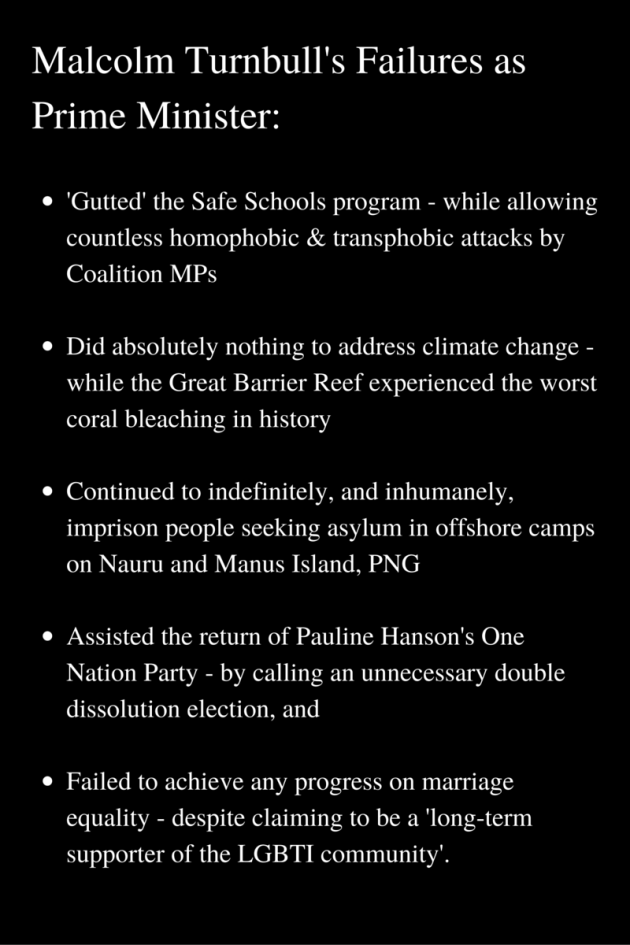
Malcolm Turnbull's Failures as Prime Minister_


On this last point, marriage equality, the list of Malcolm Turnbull’s failures might yet grow longer. Because, in the dying days of his leadership, one of his final acts as PM might be to try to push through the enabling legislation to hold the unnecessary, wasteful and divisive plebiscite, first proposed by Tony Abbott but then adopted by Turnbull in his largely unsuccessful attempts to ingratiate himself with the ‘DelCons’.


Even if marriage equality is ultimately passed after a plebiscite, it still won’t be Turnbull’s achievement – because it will be the LGBTI community and our families, friends and allies who will need to put in the hard yards to ensure a ‘Yes’ vote wins (and, irrespective of victory or defeat, it will also be the LGBTI community that pays the price of the hatred and intolerance whipped up during the campaign that precedes it).


All in all, then, that’s no achievements (or ‘A’s) to list on Malcolm’s Mid-Term Report Card, and a helluva lot of failures (or ‘F’s).


For someone who is accustomed to succeeding at most things he turns his mind to (outside the failed 1999 ‘Republic’ campaign anyway), it must be particularly galling to be such a complete non-entity when finally given the nation’s top job. In the many years ahead after he leaves office Turnbull will have to reconcile himself with being remembered as the ‘Nothingman’ Prime Minister.


Of course, he was supposed to be better than this. The Liberal who believed in climate change – once famously saying “I will not lead a party that is not as committed to effective action on climate change as I am” – but who now presides over the farcical Direct Action policy.


The inner-city moderate, small ‘l’ liberal, who in March 2016 became the first sitting Primer Minister to attend the Sydney Gay & Lesbian Mardi Gras parade – but who refused to stand up to the bigots on his backbench and their nasty attacks on Safe Schools, and their ongoing attempts to delay and/or defeat equal relationship recognition.


Malcolm Turnbull once famously described John Howard as “the Prime Minister who broke this nation’s heart”. Well, given his own inconsistencies and hypocrisies, it could be argued that Turnbull himself is far worse. Because a heart can mend, whereas during his time as Prime Minister Malcolm Turnbull has diminished our hopes – and that is something that is far harder to replenish.


Why is Australia so far behind on marriage equality?

Tonight, exactly one year ago, the US Supreme Court handed down its historic decision in Obergefell v Hodges, making same-sex marriage legal in all 50 states. In doing so, they also reinforced the sinking feeling for many Australians, myself included, that we have fallen far behind our contemporaries around the world as we continue to refuse to treat the relationships of lesbian, gay, bisexual, transgender and intersex (LGBTI) people equally under the law.


Of course, the United States was by no means the first place in the world to introduce marriage equality – that honour belongs to the Netherlands, which has had marriage equality since 1 April 2001, or more than 15 years ago. The list of countries that have joined their ranks in the time since grows longer by the year:


  • The Netherlands (2001)
  • Belgium (2003)
  • Spain (2005)
  • Canada (2005)
  • South Africa (2006)
  • Norway (2009)
  • Sweden (2009)
  • Portugal (2010)
  • Iceland (2010)
  • Argentina (2010)[i]
  • Denmark (2012)
  • Brazil (2013)
  • France (2013)
  • Uruguay (2013)
  • New Zealand (2013)
  • England & Wales (2014)
  • Scotland (2014)
  • Luxembourg (2015)
  • Ireland (2015)
  • United States (nationwide 2015)
  • Colombia (2016)
  • Finland (2017)
  • Taiwan (2017 – to take effect by 2019)
  • Germany (2017)
  • Malta (2017)


But, perhaps because of our community’s disproportionate focus on events in the United States, or simply because it was the straw that broke the camel’s back, the fact that, as of 12 months ago, LGBTI couples anywhere from Albany to Alabama and Alaska could get married, while we still could not, was the point at which many people felt we could no longer ignore the reality that, on marriage equality, Australia has officially become a backwater.


The question I am interested in asking is why? What are the factors that have caused Australia to fall so far behind its counterparts on this fundamental human rights issue? Why, when we compare ourselves to countries like the UK, US, Canada, New Zealand and South Africa, is it just us and Northern Ireland left in discriminating against couples on the basis of their sexual orientation, gender identity and intersex status?


There is a range of possible reasons that I will explore below, but first I want to highlight one factor that has not contributed to our lack of progress, and that’s public support. In short, the level of community support for marriage equality in Australia – which has consistently polled above 50% for the past seven or eight years, and is now frequently above 60% or even 70% – is not materially different to that recorded in countries that have already introduced this reform. Indeed, in several of the countries listed above, marriage equality has been implemented with much lower support from the public. So, if a lack of community support isn’t the problem, what is?


  1. The lack of a Bill of Rights


Perhaps the most obvious reason why Australia is behind the United States on marriage equality is that, while the US Bill of Rights allowed the Supreme Court in Obergefell to determine that state same-sex marriage bans are a violation of the Fourteenth Amendment’s Due Process and Equal Protection clauses, Australia has no equivalent Bill of Rights (or even nation-wide Human Rights Act). Constitutional rights have also played key roles in the history of marriage equality in other countries, including Canada and South Africa.


In contrast, given the limited human rights protections contained in our own Constitution, when the High Court of Australia was asked to rule on the constitutionality of same-sex marriages conducted in the ACT, all it could determine was whether marriage equality could be passed by Parliament at all, and if so at which level (only by Commonwealth Parliament as it turns out) rather than being able to find that the denial of the right to marry on the basis of sexual orientation, gender identity or intersex status was in itself ‘unconstitutional’.


  1. The power of the right wing of the Liberal-National Coalition


In the absence of a constitutional ‘circuit-breaker’, the onus has been on Commonwealth MPs and Senators to pass marriage equality. Unfortunately, of the 15 years since the Netherlands led the way, the Liberal and National Parties have formed Government for nine. This included the Howard Government that, in 2004, introduced legislation to amend the Marriage Act to ensure couples married overseas would not be treated equally under Australian law.


In the 12 years since then the Coalition’s stance against marriage equality has barely softened – with exactly zero Liberal or National Party MPs or Senators voting in favour of change when it was last voted on in September 2012 (and only one, Senator Sue Boyce, abstaining).


Even in the most recent term of Parliament, right-wing members of the Abbott and then Turnbull Governments succeeded first in blocking any substantive vote on marriage equality, and then in adopting a policy of holding an unnecessary, wasteful and divisive plebiscite before holding any such vote in the future.


The National Party – which can itself be considered one large bloc of the right wing of the Coalition – felt so strongly that Parliament should not vote on marriage equality without a plebiscite, it even included this condition in its agreement with Malcolm Turnbull after he deposed Tony Abbott as PM in September 2015.


The power of the right wing within the conservative side of politics, and their obsession with marriage equality (or at least, their consistent focus in denying it) appears to have been a much stronger force in Australia than in comparable countries, such as New Zealand and England & Wales, both of which passed marriage equality during Conservative Governments[ii].


  1. The power of the right wing of the Australian Labor Party


Unfortunately, it is not just on the conservative side of politics where people opposed to LGBTI equality have exercised disproportionate influence in Australia – the right wing of the ALP, and particularly the hard-line SDA (or ‘Shoppies’) led by religious fundamentalist Joe de Bruyn, have also played a key role in denying equality to LGBTI Australians.


This included helping to bind ALP parliamentarians to support Howard’s ban on marriage equality in 2004, but then opposing an attempt to impose a binding vote in favour of marriage equality at the ALP National Conference in December 2011. And, while a majority of ALP House of Reps MPs, and Senators, voted in favour of marriage equality in September 2012, it was still a much lower proportion that supported change than their comrades in both UK and New Zealand Labour.


In recent years the tide seems to have finally turned against the homophobes of the hard right of the Australian Labor Party, with the 2015 National Conference agreeing to support a binding vote from the 2019 federal election (albeit long after they should have), and their strengthening position in favour of marriage equality compelling the resignation of ‘Shoppie’ Senator Joe Bullock in March 2016. Nevertheless, the SDA’s influence in ensuring marriage equality was not passed before today should not be ignored.


  1. The lack of diversity among Australian parliamentarians


The fact that both the conservative and progressive sides of Australian politics have had higher levels of opposition to marriage equality than their equivalent parties elsewhere cannot be considered a mere coincidence. One of the reasons why I believe this is the case is the fact our Parliament is far less diverse than those in other countries.


The most obvious example, at least with respect to marriage equality, has been the dearth of ‘out’ LGBTI politicians in Commonwealth Parliament. While there has been a small number of LGBTI Senators over the past 10-15 years, the first out gay man to be elected to the House of Representatives, Trent Zimmerman, took his seat less than five months ago[iii].


This places Australian a loooooooong way behind places like Canada, the UK, New Zealand (which had the world’s first transgender MP, Georgina Beyer, last century) and even the United States. And, based on the principle that it is much harder to deny someone’s rights when they are ‘in the room’, our historical absence from the ‘House of Government’ has not only left us sitting outside looking in, it has left us behind too.


But it’s not just the lack of out LGBTI parliamentarians that has held us back – I believe the under-representation of female MPs and Senators has also played a part. While in the mid-to-late 1990s female representation in Commonwealth Parliament was among the highest in the world, Australia’s progress in this area has stalled over the past decade, with the proportion of women in the House of Representatives in particular stuck around 25%.


According to Inter-Parliamentary Union (IPU) data, Australia slipped from 20th in the world on female representation in 2001, to 48th in 2014, a downward trend that shows no signs of abating[iv]. As well as being a negative in and of itself, this lack of diversity undermines marriage equality, both because women have consistently shown higher levels of support for this reform than men and because a more gender-balanced, and therefore demographically representative, Parliament might be expected to be closer in opinion to the community’s existing strong support for marriage equality.


  1. The lack of diversity in Australia’s commercial media


Perhaps more controversially – especially to some commentators who believe that marriage equality is a trivial issue only placed on the public agenda by ‘leftists’ at the ABC – I believe the lack of diversity in our commercial media has also had a negative influence on marriage equality in this country.


I’m speaking in particular of newspapers, and especially those owned by Rupert Murdoch. As a former ‘political staffer’ I can attest that the main stories, and lead opinion pieces, in the day’s papers, including Australia’s only national broadsheet (The Australian), and the highest circulation papers in our three major cities (The Daily Telegraph in Sydney, The Herald Sun in Melbourne and The Courier Mail in Brisbane), are paid very close attention.


The fact all four newspapers have been opposed to marriage equality – almost universally at The Australian, and also by the main commentators at the tabloids (including Andrew Bolt, Piers Akerman and Miranda Devine, and Des Houghton) – means the views our politicians are reading about this issue are largely out of touch with those of the voters they are there to represent. Even in 2016, with the newspaper industry in what appears to be a death spiral, these NewsCorp publications continue to exert disproportionate influence on our politicians.


In short, I suggest the lack of diversity in our commercial media has meant that MPs and Senators have been led to believe the issue of marriage equality, and LGBTI rights more broadly, is far more ‘controversial’ than it actually is.


  1. The existence of de facto relationship recognition


The only ‘positive’ reason on this list is the fact that, at least at state and territory level, Australia has long had de facto relationship recognition, including for same-sex couples. Under Commonwealth law, LGBTI de facto relationships were also finally recognised on the same basis as cisgender heterosexual relationships by the Rudd Labor Government’s Same-Sex Relationships (Equal Treatment in Commonwealth Laws – General Law Reform) Act 2008 and Same-Sex Relationships (Equal Treatment in Commonwealth Laws – Superannuation) Act 2008.


These long-overdue reforms, to at least 85 different pieces of Commonwealth legislation, mean that – outside of marriage – LGBTI couples now largely enjoy the same rights as other couples.


The reason why this has had an impact on marriage equality is that, unlike some countries (and especially parts of the United States), relationship recognition here is not an all-or-nothing affair – just because you aren’t married doesn’t automatically mean you are considered ‘single’ under Australian law (although, as some tragic recent case studies have shown, sometimes these de facto rights are not respected in practice[v]). If these de facto rights did not exist, it is likely there would be even greater urgency for marriage equality in Australia.


  1. The lack of leadership by Australia’s Prime Ministers


Irrespective of the above half-dozen factors, I genuinely believe that, if we had had Prime Ministers who were actual ‘leaders’ on this issue over the past dozen years, the outcome could have, would have, been very different. In reality, we have had five PMs who have each demonstrated serious flaws in their approach to marriage equality.


John Howard: Instead of having a constructive debate about marriage equality in 2004, Prime Minister Howard almost instinctively sought to use the issue as a pre-election wedge against the Mark Latham-led Opposition. The fact that the relationships of LGBTI Australians would be devalued and demeaned as a result seemed to matter naught to a man who just three years previously had based an entire campaign on attacking refugees.


Kevin Rudd: In hindsight, the first stint of Prime Minister Rudd (November 2007 to June 2010) can be seen as a major missed opportunity. Too risk averse, and notoriously focus-group obsessed, he failed to grasp the possibilities of taking leadership on this issue – and therefore didn’t pursue it at the 2009 ALP National Conference. If he had, Rudd could have seized control of the agenda, just as public support in Australia was rising, thereby adding to his ‘legacy’. While he did support marriage equality during his second stint as PM (June to August 2013) he was never going to win re-election or be in a position to pass it.


Julia Gillard: The Prime Ministership of Julia Gillard is still the most disappointing to me on this issue (although Malcolm Turnbull is rapidly catching up – see below). Supposedly left wing, and an avowed atheist, the expectation was that she was an ideal candidate to make progress on marriage equality.


Wrong. For whatever reason (and speculation has long centred on a possible deal with Joe de Bruyn and the SDA to oppose marriage equality as a condition of their support for her as PM), Ms Gillard did everything in her power to deny the right to marry to LGBTI Australians, including blocking the resolution for a binding vote at the December 2011 ALP National Conference, and voting against it herself in the House of Representatives in September 2012. Whatever her other merits, I will never forgive her for standing squarely in the way of ‘equal love’.


Tony Abbott: In some respects, there is less ‘disappointment’ in Prime Minister Abbott – because nobody ever expected anything different from him. A staunch Catholic, and someone who brought his religious fundamentalism to bear in political office, he was never going to be the Prime Minister to ‘lead’ on this issue. Although the fact one of his last acts as leader was to oversee the six-hour joint party room meeting that eventually settled on a plebiscite (primarily as a means to deny or at least delay marriage equality) means he nevertheless takes his place in the pantheon of Australian Prime Ministers who have ‘screwed over’ LGBTI Australia on this issue.


Malcolm Turnbull: Last, and in many ways, ‘least’, there’s the current Prime Minister, Mr Turnbull, who claims to support marriage equality, he just doesn’t want to actually have to do anything about it. Within 24 hours of toppling Tony Abbott, he had signed a new Coalition Agreement with the National Party, caving in to them – seemingly without protest – and their demands to continue with the plebiscite on marriage equality. And he has soldiered on with this policy, right up to the July 2 election, and will presumably hold it in late 2016 or early 2017 should he win next Saturday.


An intelligent man, Turnbull does so knowing that it is entirely unnecessary, and, at $160 million, fundamentally wasteful. And he continues to advocate a plebiscite even though he understands the harms it will inevitably cause to young and vulnerable LGBTI people. Unlike others inside his party, I’m not going to accuse him of not caring about these adverse impacts – he just cares about them far less than his obvious desire to remain Prime Minister.


151222 Turnbull

Prime Minister Malcolm Turnbull, who probably cares about the harms a plebiscite will cause young & vulnerable LGBTI people – just less than his desire to remain PM.


These are seven reasons why I believe Australia is so far behind other countries on this issue. It is not an exhaustive list – no doubt others will suggest additional reasons (including possible shortcomings within the LGBTI movement itself, although from my perspective that is a topic for a different post, on a different day – and probably after the battle for marriage equality has finally been won).


One final point I would make, however, is that if the Liberal and National Parties are re-elected on July 2 then this list will automatically expand to eight. Because, if Turnbull is returned, and he does hold a plebiscite on marriage equality, then Australia will have found a unique way to ‘screw up’ on this subject.


Not one of the countries listed at the start of this post introduced marriage equality by way of a non-binding public vote. As far as I’m aware, only in Ireland has it been passed at national level via referendum – but it was actually needed there to change the Constitution.


Holding a plebiscite, which, as multiple reports over the past few days have confirmed won’t even be binding on Cabinet Ministers, let along the Bernardis and Christensens of the Coalition backbench, will involve yet more delay, and more disappointment for the LGBTI community.


So, if you’re reading this before July 2, then please think about this issue before you cast your vote, and put the Liberals and National last (or next to last, only ahead of extremists like Pauline Hanson and Fred Nile), so we can avoid an unnecessary, wasteful and divisive plebiscite. If we elect Bill Shorten’s Labor Party, we might even get to add Australia’s name to the above list between Colombia and Finland. Above all, we could end the wait of LGBTI couples in this country who have been denied equality for far too long.


Footnotes:

[i] Marriage equality has also been available in Mexico City from 2010, and is now legal in four additional states, with all being recognized nation-wide.

[ii] While only a minority of Conservative MPs in the UK, and National Party MPs in New Zealand voted in favour of marriage equality, in both places it was at least 40%, which is substantially higher than what would be expected even under a ‘free vote’ within the Coalition in Australia.

[iii] The lack of LGBTI representation in Australian Parliaments is an issue I have written about previously, see: LGBTI voices absent from the chamber

[iv] From Australian Parliament House Library “Representation of Women in Australian Parliaments 2014”.

[v] Including Tasmanian man Ben Jago who was allegedly mistreated by Tasmanian Police and the Tasmanian Coroner’s Office after the death of his de facto partner: Samesame, “I was treated like I meant nothing after my partner died”, 8 November 2015.

You’re wrong Malcolm Turnbull, homophobia is legally acceptable in Australia

It is now one week since the tragic events in Orlando, where 49 people were murdered in a gay nightclub, simply because they were lesbian, gay, bisexual or transgender (or were there as their family or friends).


I haven’t written specifically about those events for a few reasons. First, because I guess I’m still somewhat in shock about it and, like others, it will take some time to process the sheer scale of horrific, homophobic violence involved.


Second, because I haven’t wanted to talk about Orlando in the context of other public debates and risk them being unduly conflated (although, for the record, I do think it is a warning, albeit an extreme one, of the risks of a plebiscite generating hatred and vitriol towards Australia’s LGBTI community).


Third, and perhaps most importantly, I haven’t written anything because what has been written, and said, by others has been so eloquent, and so passionate, that I haven’t really felt the need to add anything. In fact, the outpouring of words and actions (including the vigils for Orlando held in many parts of the world, including here in Sydney) by LGBTI people and our allies over the past seven days has been a beautiful, and in many ways reassuring, thing to behold.


Countless others have already said the things that needed to be said, far better than I could ever say them:


Focusing on the names of the people killed, rather than that of the killer (such as CNN reporter Anderson Cooper’s touching report about the victims).


Challenging any erasure of the fact this was explicitly a homophobic and transphobic hate-crime, including:


Reminding us that this was an attack on a minority within a minority – Latinx members of the LGBT community.


Rejecting any moves to respond to homophobia with Islamophobia, as well as respecting and actively being inclusive of another minority within a minority – LGBTI Muslims.


Last, but certainly not least, seeing the individual act of homophobic and transphobic violence in the broader frame of homophobia and transphobia across the United States – and sadly, Australia – which is perhaps summed up best by this widely-shared social media image:


You werent the gunman


*********


In this context, as someone who primarily writes about LGBTI law and public policy, I didn’t have much further to offer – that is, until Australia’s right-wing media, and Prime Minister Malcolm Turnbull, made it a policy, and political, issue.


During the week, The Australian newspaper decided to turn their focus on hate-speech by some Islamic preachers. Specifically, they campaigned for the visa of Farrokh Sekaleshfar to be revoked on the basis of a speech in 2013 where he supported the imposition of the death penalty for homosexuality in some circumstances:


“Death is the sentence. There’s nothing to be embarrassed about this. Death is the sentence. We have to have that compassion for people. With homosexuals, it’s the same. Out of compassion, let’s get rid of them now.” [Mr Sekaleshfar ultimately chose to leave the country before he was forced out].


They then swung their attention towards the guests hosted by Turnbull at an Iftar dinner in Sydney, including the President of the Australian National Imams Council, Mr Shady Alsuleiman, again bringing up comments from 2013 where he reportedly said the following:


“What’s the most common disease these days? HIV, AIDS, that’s so common and there’s no cure to it. And when did it exist? Just decades ago, and more diseases are coming… [It’s] homosexuality that’s spreading all these diseases.”


Leaving aside the clear anti-Muslim bias of this newspaper – given it champions the voices of Christian advocates who condemn homosexuality rather than attacking them (hypocrisy that is perfectly skewered by the First Dog on the Moon in this cartoon, and especially the line “Christian homophobes against Islamic homophobia”) – there is a legitimate question about where the limits of ‘acceptable’ speech should be drawn, irrespective of the religion of the person saying them (Muslim, Christian, other or none).


The fact Mr Alsuleiman was a ‘dinner guest’ of the Prime Minister means it is entirely justifiable that he was asked for his view on those comments, and this was Mr Turnbull’s response:


“Homophobia is to be condemned everywhere, number one. We are a broad, diverse country and we must respect the right of gay Australians, we respect the right of the LGBTI community and the right for them to lead their lives and gather in peace and harmony. The massacre in Orlando, that shocking assault on the people in the gay nightclub is a shocking reminder, frankly, of how much hate and intolerance there is in the world, and how important it is for us to stand up for mutual respect that I spoke about earlier. That is the very foundation of our society. So I condemn, I deplore homophobia wherever it is to be found. It is not acceptable from a legal point of view in Australia, as you know, and I just – I’m sure that – well I know that [Mr Alsuleiman] has been encouraged to reflect very deeply on his remarks which were of some years ago, and it’s up to him how he restates or reconsiders his position.”


There are, of course, some fine sentiments expressed here, as well as some less-than-stellar interventions (as a public scolding, being “encouraged to reflect deeply on his remarks” is akin to Paul Keating’s description of John Hewson: “it was like being flogged with warm lettuce”).


But the thing that has stuck with me and, to be completely honest, has thoroughly pissed me off, is that the Prime Minister is fundamentally wrong. Specifically, his comment that “I deplore homophobia wherever it is to be found. It is not acceptable from a legal point of view in Australia, as you know…” IS. SIMPLY. NOT. TRUE.


Sorry, Malcolm, but you are very, very wrong: homophobia is indeed acceptable under Australian law, and in some places it is actively encouraged.


Here, I want to discuss briefly two such examples (although I’m sure readers of this blog could come up with several others):


First, as I have written previously[i], while the Racial Discrimination Act 1975 prohibits vilification on the basis of race, there are currently no prohibitions against the vilification of lesbian, gay, bisexual, transgender and intersex people under Commonwealth law. None. Zip. Zilch. Zero. Nada.


Which means that, while the Government could take action against Mr Sekaleshfar on the basis of his visa, they legally could not do anything against Mr Alsuleiman – because he would not have breached any Commonwealth laws.


Even at state and territory level, only four jurisdictions have legislated against LGBTI vilification (NSW, Queensland, Tasmania and the ACT), and in many cases those laws are incomplete or out of date too (for example, only offering protection to some members of the LGBTI community and not others[ii]).


So, while Mr Turnbull might like to say that homophobia “is not acceptable from a legal point of view in Australia, as you know”, that’s definitely not true – especially under Commonwealth law. And, based on the past term of the Abbott-Turnbull Coalition Government, with its initial attempt to wind back racial vilification, it’s a situation doesn’t look like changing any time soon either.


Second, while the historic Sex Discrimination Amendment (Sexual Orientation, Gender Identity and Intersex Status) Act 2013 introduced LGBTI anti-discrimination protections in Commonwealth law for the first time, it also contained provisions that, at the same time, severely curtailed those protections[iii].


For example, the general religious exceptions under section 37, and the specific exceptions provided to religious schools under section 38, mean there is no obligation on religious bodies to treat LGBT people fairly, or with even a minimum of respect. Indeed, religious schools are free to fire, and refuse to hire, LGBT teachers, as well as expel or refuse to enrol LGBT students.


The vast majority of state and territory anti-discrimination schemes[iv] include similar exceptions, with NSW’s Anti-Discrimination Act 1977 featuring the broadest (a school doesn’t even need to be religious, just ‘private’, in NSW to enjoy the privilege to discriminate against LGBT teachers and students).


All of which means that, were Mr Alsuleiman, or even Mr Sekaleshfar, to make similar comments, not on YouTube but instead in the classrooms or mosques (or churches) of a religious school, I cannot see the Commonwealth Government being able to do anything much about it under the law as it stands.


One aspect of this situation that sticks in the craw of many people is that all taxpayers, including LGBTI taxpayers, are effectively paying for this discrimination against LGBTI young people – because those same schools, which do not have to abide by the community standards against homophobia and transphobia that Mr Turnbull tried to articulate on Friday, still put their hands out for Commonwealth (and state and territory) funding.


But we should never forget that it is the LGBTI young people themselves, stuck in schools their parents have chosen, and potentially exposed to homophobia, biphobia, transphobia and intersexphobia from their principals and teachers, effectively condoned by governments of all levels, are the ones who ‘pay’ the highest price.


There are, of course, other aspects of Malcolm Turnbull’s comments that are offensive, not the least of which is the fact he chose to speak out against the homophobia of an Islamic preacher, because he invited him to dinner, but has so far steadfastly refused to condemn the homophobia from MPs and Senators who form part of his Government, even, for example, when they compare a program against the bullying of LGBTI young people to ‘sexual grooming’.


Here too though, rather than trying to explain this double-standard, I will quote another person who neatly summed up the glaring disparity via twitter:


Lane Sainty (@lanesainty 17 June 2016):


“I have So Many Complicated Thoughts about the two Islamic leaders criticised in the Australian press for their anti-gay comments.


I’ve seen people slamming comparisons Australian Christians – saying it’s not the same to oppose Safe Schools and to want gay people to die.


Given the suicide rates of trans kids, there’s actually an argument to be made there. But even if you accept the distinction, it’s still…


…not being an apologist for Muslim anti-LGBTI views to point out the hypocrisy of how we address queerphobia depending on religion.


Turnbull’s failure to condemn comments linking paedophilia and Safe Schools was deeply hurtful to LGBTI people. I cannot overstate this.


Yet look at his speed to denounce the sheik. Why condemn someone he shared a meal with, but not the anti-LGBTI folk on his own backbench?


Here’s the political message this sends: Islamic queerphobia = unacceptable, but Christian queerphobia = acceptable.


Actually, none of is acceptable. As long as you’re not actively calling for gays to die, you’re fine? No. That’s not how it works.


Anyway, many Muslims have written about combating homophobia within their community since Orlando. Read their words.


Just don’t forget that queerphobia doesn’t start with calling for actual violence against LGBTI people. It finishes there, if anything.”


Lane then followed that with an excellent article on Buzzfeed, with the rather self-explanatory title “7 Other Times People were Homophobic and the PM didn’t Condemn it”.


So, if Prime Minister Malcolm Turnbull genuinely “deplore[s] homophobia wherever it is to be found”, then there are some serious examples of it very close to his political home – will George Christensen, Cory Bernardi and others be similarly told to ‘reconsider their positions’?


And, if he wants to make sure homophobia “is not acceptable from a legal point of view in Australia”, then I know two places where he can start: introducing LGBTI anti-vilification protections in Commonwealth law, and removing religious exceptions from the Sex Discrimination Act 1984. If he doesn’t, then all his ‘condemnations’ of homophobia will start to sound a little hollow to me.


Footnotes:

[i] Don’t limit racial vilification protections, introduce vilification protections for LGBTI Australians instead.

[ii] In NSW, while homosexual and transgender vilification is outlawed, bisexual and intersex vilification is lawful: see What’s wrong with the NSW Anti-Discrimination Act 1977?

[iii] See What’s wrong with the Commonwealth Sex Discrimination Act 1984?

[iv] With the exception of Tasmania and, to a lesser extent, Queensland.

Dear Malcolm Turnbull, You can take my $10 and shove it… into the hands of someone who needs it

UPDATE 23 June 2016:


On Monday June 20, I received the following response from the Liberal Campaign Headquarters to my letter to the Prime Minister, Malcolm Turnbull, calling for him to abandon the unnecessary, wasteful and divisive plebiscite on marriage equality:


Campaign Support (Liberal Party of Australia)

Jun 20, 18:10 AEST


Dear Mr Lawrie,


The Turnbull Government believes that a decision on same-sex marriage should be made by a vote by all Australians via a plebiscite as soon as possible after the election.


The Prime Minister has publicly supported same sex marriage for a long time and will be voting in favour of same sex marriage.


If the majority of Australians vote ‘yes’ in the plebiscite, the Parliament should respect that decision and legalise same-sex marriage in Australia.


Thank you for taking the time to write.”


It is perhaps unsurprising that, given the brevity of this response, what it doesn’t say is just as interesting as what it does.


Specifically, the email does not include ANY qualifications about what would constitute a majority – all it says is “if the majority of Australians vote ‘yes’ in the plebiscite, the Parliament should respect that decision and legalise same-sex marriage in Australia.”


Indeed, that is exactly the same language used by the Liberal-National Coalition in their response to the pre-election survey by LGBTI organisations across the country (for more, see #rainbowvotes).


In the last few days, there have been multiple reports (on The Stirrer, on samesame.com.au and in crikey) highlighting the possibility some conservative Liberal and National MPs might seek to sabotage the outcome of a plebiscite by imposing additional requirements for ‘success’ – for example, that it would need to be supported by a majority of people, AND in a majority of electorates.


In fact, it is almost inevitable that the likes of Cory Bernardi and Eric Abetz will try, and there must be a real risk that they will succeed.


But, the response from Liberal Campaign HQ – both to my letter, and to the #rainbowvotes survey – means that, if Malcolm Turnbull and his Government are re-elected, and then seek to include any additional hurdles whatsoever to the passage of the marriage equality plebiscite, they will be nothing short of liars.


For a range of reasons (including that, if there is a change of Government on July 2, the plebiscite can still be avoided), I hope we don’t find out –but if we do, and the requirement of a majority of votes in a majority of electorates is imposed, then ‘dishonest’ will be one more adjective we can use to describe the disappointing prime ministership of one Malcolm Bligh Turnbull.


ORIGINAL POST:


Full Title: Dear Malcolm Turnbull, You can take my $10 and shove it… into the hands of someone who needs it. You can give me my rights for free, and in doing so spare Australia a divisive and harmful plebiscite campaign.


The Hon Malcolm Turnbull MP

Prime Minister of Australia

PO Box 6022

House of Representatives

Parliament House

Canberra ACT 2600


Thursday June 16 2016


Dear Mr Turnbull


You can take my $10 and shove it… into the hands of someone who needs it


I am writing to you once again on a subject I have previously written to you about[i].


Specifically, I am writing one last time in the hope you might abandon your Government’s proposal to hold an entirely unnecessary, fundamentally wasteful and inevitably divisive and harmful plebiscite on marriage equality should you win re-election on 2 July.


I call on you to demonstrate the leadership on this issue that, so far, has been lacking. Please drop the proposed plebiscite, and commit to passing marriage equality in the ‘ordinary way’: through a parliamentary vote.


A marriage equality plebiscite is entirely unnecessary


Given you have previously argued before the High Court, I know you can read a court decision. In which case, I am sure you are aware the High Court has already conclusively found[ii] that Commonwealth Parliament has the power to introduce marriage equality. There is absolutely no need to hold a referendum or plebiscite on this topic.


Indeed, holding a national public vote on such an issue, where constitutional change is not required, is almost unprecedented in our nation’s history[iii] – the last time a plebiscite was held on a substantive matter of public policy was 99 years ago (the second plebiscite on conscription during World War I).


Even if you haven’t familiarised yourself with the Court’s decision, or the history of plebiscites in this country, you have been a Member of Parliament since late 2004, just months after then Prime Minister John Howard passed legislation to deny lesbian, gay, bisexual, transgender and intersex Australians the right to marry simply because of who they are.


Since then, there have been several further parliamentary votes on this issue, including the last major vote in September 2012, when, with the exception of one Senator, the Liberal and National Parties again collectively voted to deny equal rights to LGBTI people.


It seems extraordinary to me, and to a large number of other Australians, that Coalition MPs and Senators are comfortable in using their position in parliament to reject the human rights to fellow citizens but insist on holding a plebiscite before they will use that exact same power to allow LGBTI people to wed the person they love.


A marriage equality plebiscite is fundamentally wasteful


As confirmed in the Federal Budget on 3 May, you and your Government have set aside $160 million to hold the marriage equality plebiscite[iv]. With some decisions yet to be made (including whether there will be public funding for ‘Yes’ and ‘No’ campaigns), the final cost could turn out to be even higher.


For context, the Australian Electoral Commission has announced that there are 15,676,659 Australians enrolled to vote at this year’s election[v].


In other words, it is your policy to charge every Australian voter $10 for the ‘privilege’ of returning to the polls less than 12 months later to vote on something your Government could pass in a matter of weeks, for no cost.


10 dollar note

A marriage equality plebiscite, which is entirely unnecessary, will cost every voter at least $10 to hold.


That is incredibly wasteful, especially at a time of ongoing Budget deficits and with both Labor and the Coalition now forecasting a ‘return to surplus’ in 2020-21 (at the earliest).


Of course, for many people $10 remains a lot of money and it would be preferable to leave this money in the hands of voters rather than spend it on something as entirely unnecessary as a plebiscite on marriage equality.


But, if you remain committed to spending this $160 million, there is a very long list of better ways to allocate these funds[vi], including:


  • Programs to alleviate poverty and homelessness
  • Funding more nurses
  • Funding more teachers
  • Undoing cuts to foreign aid or
  • Supporting the resettlement of refugees from Syria and Iraq.


It would be remiss of me not to also mention that the amount of money you currently plan to waste on this plebiscite is twenty times the funding which was allocated to Safe Schools ($8 million over four years), a vital program to address homophobia, biphobia, transphobia and intersexphobia, and one your Government has announced will have its funding cut in 2017[vii].


So, as someone who can afford to pay the $10 but who fundamentally disagrees with your proposed plebiscite, I implore you: please take my money and give it back to the people who need it, or spend it on something worthwhile, not on an exercise that could be avoided simply by parliamentarians doing their jobs.


A marriage equality plebiscite will inevitably be divisive – and harmful


There is one aspect of a plebiscite that is already crystal clear, beyond any doubt whatsoever – and that is it will be incredibly divisive. The reason I can say that with such confidence is the behaviour of one organisation that will play a central role in publicly advocating a ‘No’ vote: the Australian Christian Lobby.


Not only have they argued for anti-discrimination and anti-vilification laws to be suspended for the duration of any campaign[viii] (which, logically, would only be necessary if they intended to breach them), ACL ‘homophobe-in-chief’ Lyle Shelton has repeatedly demonstrated his willingness to denigrate the lives and relationships of lesbian, gay, bisexual, transgender and intersex Australians.


This includes recent comments linking Safe Schools and marriage equality to the rise of Nazism[ix], as well as his repeated suggestions[x] that same-sex parenting would create a new ‘Stolen Generation’ – statements that are at once offensive to both rainbow families and to Aboriginal and Torres Strait Islander people.


An extended national debate during which groups like the Australian Christian Lobby, and individuals like Mr Shelton, would be granted a ‘megaphone’ to express their views will inevitably cause harm, in at least two profound ways:


  • First, it will create an environment of division, hatred and fear in which violent attacks on LGBTI people become more likely.


Just this week, we have seen the terrible consequences of widespread and systemic homophobia, in the tragic deaths of at least 49 LGBT people in an Orlando nightclub. But violence based on prejudice, even on a much smaller scale, can still be devastating for the people affected.


Earlier this year, a man who lives nearby to my fiancé and me, in inner-city Sydney, was ‘gay-bashed’ twice in one night. Once, by a group of people on the street. And then a second time, by a so-called ‘good Samaritan’, who helped him back to his apartment block but then, upon discovering there was a boyfriend rather than a girlfriend waiting upstairs, turned around and said “you’re one of those fags ya f**king queer c**t” before hitting him in the face again.[xi]


If this is the level of verbal and physical violence that is happening in 2016 in ‘our’ Australia, the country that you and I both call home, then I shudder to think what will happen after three, six or even 12 months of homophobic, biphobic, transphobic and intersexphobic hate-speech is inflicted upon the population.


  • Second, it will lead to, or exacerbate existing, mental health issues among young and vulnerable LGBTI people.


There is also absolutely no doubt that subjecting young and vulnerable LGBTI people to months and months of negative public debate, in the political sphere and in the media, will cause harm.


They will hear people and groups repeatedly saying that LGBTI Australians do not deserve to be treated equally under the law simply because of who they are. That they should not have children simply because of who they are. That their relationships are lesser simply because of who they are.


For months and months, young and vulnerable LGBTI people will be told that they are lesser simply because of who they are. This campaign will have an adverse impact on the mental health of many – far, far too many – Australians.


I know because I am one of the many who have experienced depression because of the homophobic environment in which they grew up. Yes, there were multiple sources of that homophobia – including the religious boarding school I attended, and the discriminatory attitudes of my conservative parents (although, thankfully, my family ‘got better’).


But the homophobic comments in political debate, and the media, were one factor that definitely contributed to my depression. And I weep for the 12 year-old boy today, still discovering who he is, and then discovering that who he is, and who he loves, isn’t accepted by significant sections of the community.


Even though there will obviously be many other voices in the plebiscite campaign telling him that who he is is okay, if he is anything like I was back then, he will just hear the criticisms. Only the homophobic barbs will pierce that firmly-shut closet door, exacerbating the fear and isolation he already feels.


What he needs to hear is much less homophobia, not more – and particularly not months and months of vitriol from organisations whose primary concern is to ensure he never enjoys the same rights as his cisgender heterosexual peers.


You might think a ‘Yes’ vote for marriage equality at a plebiscite will be a unifying national moment, a genuine celebration of inclusiveness – and, should it succeed, there will certainly be elements of that.


But I will instead remember the young and vulnerable LGBTI people harmed by the divisive debate that preceded it, including those that tragically never make it to see their country accept them, and others who will be left scarred for years or even decades afterwards by the hateful comments a plebiscite will stir up.


**********


As you can see from the above discussion, I sincerely believe that a marriage equality plebiscite is not just entirely unnecessary, and fundamentally wasteful, it will also inevitably be divisive.


But it is not inevitable per se. As Prime Minister you have the power to stop this harmful exercise, and instead ensure marriage equality is passed in exactly the same way it was banned by John Howard back in August 2004 – via legislation.


I acknowledge that changing this policy involves standing up to, and in some cases upsetting, some of your colleagues within the Liberal and National Parties. But showing leadership in this way would also be warmly welcomed by many more people across Australia, none more than members of the lesbian, gay, bisexual, transgender and intersex communities, and our families and friends.


And so, I tell you for the final time:


You can take my $10 and shove it… into the hands of someone who needs it. You can give me my rights for free, and in doing so spare Australia a divisive and harmful plebiscite campaign.


All it takes is leadership, from you. Are you willing to show any?


Sincerely,

Alastair Lawrie


**********


If this post has raised any issues for you, you can contact:


  • QLife, Australia’s national telephone and web counselling and referral service for LGBTI people. Freecall: 1800 184 527, Webchat qlife.org.au (3pm-midnight everyday)


Footnotes:

[i] Letter to Malcolm Turnbull about the Marriage Equality Plebiscite 

[ii] The Commonwealth v Australian Capital Territory [2013] HCA 55

[iii] Malcolm Turnbull’s Marriage Equality Plebiscite is Truly Extraordinary 

[iv] Media Release: Attorney-General’s Portfolio Budget Measures 2016-17, 3 May 2016.

[v] Media Release: More than 15.6 million Australians ready to vote, 1 June 2016.

[vi] Starting with 7 Better Ways to Spend $158.4 million 

[vii] Star Observer, “Safe Schools Won’t be Funded Beyond 2017”, 18 March 2016.

[viii] Sydney Morning Herald, “Christian Lobby seeks anti-discrimination override for plebiscite campaign”, 16 February 2016.

[ix] Sydney Morning Herald, “Australian Christian Lobby likens gay marriage and safe schools to unthinkable Nazi atrocities”, 31 May 2016.

[x] Sydney Morning Herald, “Senator Wong condemns Christian Lobby’s stolen generations comment”, 21 May 2013 and

Sydney Morning Herald, “Q&A debate flares over claims same-sex marriage will lead to new stolen generation”, 1 March 2016.

[xi] Daily Telegraph, “Gay man bashed twice in Waterloo: I’ve never been so scared in my life and thought I would die”, 23 February 2016.

Letter to Candidates and Parties re LGBTI Anti-Discrimination and Anti-Vilification

[Update 29 June 2016: Responses received by midday today have been posted at the end of this post, generally in the order they were received. Further responses will be added if they are received by 5pm Thursday 30 June.]


I will be sending the below letter to all candidates contesting my local electorate (Sydney) and all parties vying for NSW Senate seats at the upcoming July 2 Federal Election (with candidates and tickets announced by the Australian Electoral Commission on Friday 10 June 2016).


Specifically, I am asking for their views on how the anti-discrimination laws that cover lesbian, gay, bisexual, transgender and intersex (LGBTI) Australians can be improved. This includes the removal of religious exceptions, both generally and specifically in relation to education, the introduction of LGBTI anti-vilification protections, and the establishment of an LGBTI Discrimination Commissioner.


It also seeks their commitment not to introduce new ‘special rights’ to discriminate against LGBTI couples as part of any marriage equality legislation – because the recognition of equal love should not be undermined by including provisions supporting differential treatment.


As always, I will post any responses that I receive here. Please feel free to send similar letters to the candidates and parties contesting your electorate and Senate seats respectively.


**********


Dear [candidate/party]


LGBTI anti-discrimination & anti-vilification


I am writing to you in your capacity as a [candidate for my electorate of Sydney/party contesting the NSW Senate] at the July 2 Federal Election.


Specifically, I am writing to seek your commitments to help improve the current anti-discrimination and anti-vilification protections provided to lesbian, gay, bisexual, transgender and intersex (LGBTI) Australians.


While the Sex Discrimination Amendment (Sexual Orientation, Gender Identity and Intersex Status) Act 2013 was historic, introducing LGBTI anti-discrimination laws at Commonwealth level for the first time, the protection that it offers remains incomplete.


For example, the exceptions provided by sections 37 and 38 of the Sex Discrimination Act 1984 (‘the Act’) to religious organisations and religious schools ensure that LGBTI people remain subject to discrimination across a wide range of areas of public life.


Unlike the laws prohibiting racial vilification in the Racial Discrimination Act 1975, there are also no protections against LGBTI vilification under Commonwealth law.


Nor does the Act establish a Commissioner with responsibility to address LGBTI Discrimination – whereas the Australian Human Rights Commission does have Commissioners for Aboriginal and Torres Strait Islander Social Justice, Age Discrimination, Disability Discrimination, Race Discrimination, Sex Discrimination and a Children’s Commissioner.


For more on what I believe are the limitations of current Commonwealth LGBTI anti-discrimination law, please see “What’s wrong with the Sex Discrimination Act 1984?”


There is one final issue relating to LGBTI anti-discrimination law that is also likely to arise in the next term of Parliament – and that is the question of whether the legislation which, hopefully, introduces marriage equality in Australia will also include new ‘special rights’ for civil celebrants, and businesses that provide wedding-related services, to discriminate against LGBTI couples.


In my opinion, the law that finally recognises equal love in this country should not be undermined by provisions that allow for differential treatment (for more on this subject, please see “In the battle for marriage equality, we must not forget to fight against religious exceptions”).


I am seeking your views on the above issues – and would therefore appreciate your answers to the following five associated questions:


  1. Will you repeal sub-section 37(1)(d) of the Sex Discrimination Act 1984, which currently allows religious organisations to discriminate against LGBTI employees, and LGBTI people accessing services, in a wide range of areas of public life?


  1. Will you repeal section 38 of the Act that provides religious schools with the ability to discriminate against LGBTI teachers and students?


  1. Do you commit to introducing new laws to protect LGBTI Australians against vilification, on an equivalent basis to racial vilification laws?


  1. Will you establish a position of LGBTI Discrimination Commissioner within the Australian Human Rights Commission, with similar responsibilities to existing Commissioners covering the areas of Race, Sex, Disability and Age?


  1. Will you oppose the inclusion of new exceptions in any marriage equality legislation that would seek to provide civil celebrants, and businesses providing wedding-related services, with the ability to discriminate against LGBTI couples?


I look forward to receiving responses from you in advance of the July 2 Federal Election on these issues of concern to me, and to other lesbian, gay, bisexual, transgender and intersex Australians.


Sincerely,

Alastair Lawrie

N-3

Responses from Candidates for the Seat of Sydney


Tula Tzoras – Online Direct Democracy

Tom Geiser – Science Party

Peter Boyle – Socialist Alliance

Tanya Plibersek – Australian Labor Party

Sylvie Ellsmore – Greens


Responses from Candidates for the NSW Senate


Ross Fitzgerald – Australian Sex Party

Colin Broadbridge – Christian Democratic Party (Fred Nile Group)

Phil Jobe – Family First

Ray Bennie – Veterans Party

Ingrid Ralph – Australian Cyclists Party

Jai Cooper – Australian Cyclists Party

Ken Canning – Socialist Alliance

Party Response – Socialist Alliance

Andrew Katelaris – Marijuana (HEMP) Party

Greg Frearson – Mature Australia

Ken Stevens – Derryn Hinch’s Justice Party

Ann Lawler – Citizens Electoral Council

Barry Keldoulis – The Arts Party

Stacey Dowson – Drug Law Reform

Janise Farrell – Voluntary Euthanasia Party

Darren McIntosh – Pirate Party Australia

Party Response – Australian Labor Party

Shayne Higson – Voluntary Euthanasia Party


Bryan Lambert – Independent

Nick Chapman – Independent

David Ash – Independent


Submission to PBAC re Consideration of Truvada as PrEP

Updated: 11 January 2017 [NB For original submission, see below]

Unfortunately, although perhaps not unexpectedly (because most first-time major submissions are rejected or at least deferred), the PBAC decided not to support the application for Truvada as PrEP to be added to the Pharmaceutical Benefits Scheme (PBS).

In its decision the PBAC stated that it “did not recommend the listing of Truvada for HIV pre-exposure prophylaxis (PrEP) on the basis of unacceptable and uncertain cost effectiveness in the proposed population and at the proposed price.”

The PBAC also included comments questioning the expected adherence of people taking PrEP: “the efficacy of Truvada was highly dependent on adherence, and that it is not clear if subjects at high risk of contracting HIV due to self-reported low adherence to safer sex practices would also have lower adherence to medication.”

This last point was strongly rejected by HIV activists and organisations when the PBAC decision was released. From the Star Observer:

“This statement is insulting, unfair, and paternalistic. It is a given that for medications to work properly, they must be taken as directed,” Nic Holas, co-founder, the Institute of Many (TIM) – a peer-run community of people living with HIV – said.

“The reasons why a person may have a ‘low adherence to safer sex practices’ are complex and varied, and should not be the basis for withholding PrEP as a necessary addition to the prevention toolkit.”

VAC’s Simon Ruth added: “Drawing a comparison between risk behaviour and adherence to medication is illogical. It is wrong and offensive to assume that gay men would not be taking every measure to protect themselves when it comes to HIV, and we view PrEP as the most powerful tool for doing that.

“PrEP demonstration projects have shown that gay men’s adherence to PrEP is extremely high, and comments like this are unhelpful, stigmatising and homophobic.”

Interestingly, and perhaps somewhat disappointingly, a new application for Truvada as PrEP is not on the agenda for the March 2017 meeting of the PBAC meaning it cannot be considered again until July 2017 at the earliest.

Even if that application is successful, however, it would still be another 3-6 (or even potentially 9 months) from that meeting until it is finally included on the PBS – or likely sometime in the first half of 2018.

In the meantime, most Australian states and territories have commenced large-scale trials of PrEP, especially in populations at higher risk of acquiring HIV (including gay men). This includes:

  • In NSW, the EPIC trial
  • In Victoria, VICPrEP (although noting that this website states the trial is now closed to participants) and
  • In Queensland, QPrEPd

In other jurisdictions, please check with your local AIDS Council (or equivalent) for more.

Original Submission

In July 2016, the Pharmaceutical Benefits Advisory Committee (PBAC) will consider whether to recommend that Truvada (tenofovir + emtricitabine) should be added to the Pharmaceutical Benefits Scheme (PBS) for the purposes of PrEP (or Pre-Exposure Prophylaxis) for HIV.

As part of this process, the PBAC accepts submissions from relevant organisations, and from members of the community who would either be personally affected by, or who are interested in, this decision. Further details on the submission process can be found here (including the main questions that a community submission should address).

The following is my personal submission calling for the approval of PrEP as a vital HIV prevention measure to help achieve the goal of the virtual elimination of HIV transmission by 2020.

**********

Consumer input: Please indicate whether you are a person with this medical condition, a friend or family member, a prescriber, a representative of an organisation or other interested person:

I am an ‘other interested person’, by which I mean I am a member of the lesbian, gay, bisexual, transgender and intersex (LGBTI) community. Specifically, I am a 37 year old gay man, and therefore a member of a community that has been disproportionately affected by HIV for essentially my entire life, and continues to be disproportionately affected to this day.

That also means I am a member of a community that would particularly benefit from the availability of a proven, highly-effective HIV-prevention measure such as the use of Truvada (tenofovir + emtricitabine) for Pre-Exposure Prophylaxis (PrEP).

Therefore, while based on my personal circumstances I will likely not be a candidate for PrEP, I passionately believe it should be made available through the PBS so that other members of my community can engage in the HIV-prevention actions that would be most effective for them, and not be prevented from doing so based on factors such as geography or cost.

What comments would you like the PBAC to take into account when it considers this submission?

It was 35 years ago this week that the first medical report of a mysterious illness affecting homosexual men in New York and California was published. Within a few years the entire world knew about AIDS, and the virus that could cause it – HIV could be transmitted sexually and via other means involving blood-to-blood contact, it was potentially deadly, and there was neither a vaccine nor a cure.

Fortunately, in the decades since there have been some significant advances, not least of which was the treatment revolution from 1996 onwards which transformed HIV from a (far-too-often) lethal virus to a chronic manageable condition (at least for those who had access to these life-changing medicines).

However, at the other end of the spectrum, prevention, there has been far less progress. There is still no vaccine – and it doesn’t seem like there will be one in the short-to-medium-term either.

There have been some advances involving ‘treatment as prevention’, where HIV treatment resulting in Undetectable Viral Load dramatically lowers the risk of transmission, which is especially beneficial for people in sero-discordant relationships.

But the effectiveness of treatment as prevention on a population-wide level also relies on extremely high levels of HIV testing among priority populations (levels which, despite increases in some well-served areas, haven’t been achieved in all locations and harder to reach populations).

Which means the primary prevention method for people in communities that are at disproportionate risk of HIV transmission within Australia, including gay men, remains exactly the same as it was in the mid-1980s – the consistent use of condoms. While that is obviously effective for a significant number of people, and will continue to remain so for many, it has clearly never been effective for everyone.

The proof of that is in the number of new HIV diagnoses reported each year. The Kirby Institute’s 2015 Annual Surveillance Report on HIV, viral hepatitis and sexually transmissible infections found that “[t]he number of HIV infections newly diagnosed in Australia has remained stable for the past three years, with 1,081 cases in 2014, 1,028 in 2013 and 1,064 in 2012” (p11), with sexual contact between men continuing to be the main route of transmission, accounting for approximately 70% of those notifications.

However, while ‘stable’ might sound vaguely positive, the Report further notes that “[t]he number of new HIV diagnoses has gradually increased by 13% over the past 10 years, from 953 diagnoses in 2005” (p32). In fact, the longer-term trend has been one of a gradual increase, from 1999 onwards, which is obviously a concern.

The biggest concern is that, more than three decades into this epidemic, more than 1,000 people are still being diagnosed with HIV in Australia each year. That is a figure I doubt anyone would find ‘acceptable’.

Indeed, recent HIV Strategies at both Commonwealth and NSW levels have made prevention a greater focus to help address this issue. The Seventh National HIV Strategy 2014-2017 lists as its first goal to “work towards achieving the virtual elimination of HIV transmission in Australia by 2020”.

The NSW HIV Strategy 2016-2020 also aims to “virtually eliminate HIV transmission in NSW by 2020”. This is part of the overall ‘Ending HIV’ agenda pursued by the NSW Government in partnership with community organisations such as ACON.

But neither the NSW nor Commonwealth Government Strategies will be able to meet their goals without the introduction of new methods to improve HIV prevention.

One such method is the use of Truvada (tenofovir + emtricitabine) for Pre-Exposure Prophylaxis (PrEP). As has been demonstrated in multiple international studies[i], PrEP is highly (although not 100%) effective in preventing HIV transmission in sex between men.

For people at high risk of acquiring HIV, including gay men and other men who have sex with men who intend or are likely to have condomless anal sex with casual partners, or with HIV-positive partners with detectable HIV viral load, PrEP has the potential to be a ‘game-changer’.

Fortunately, for many it already is – or soon will be. This includes gay men who are accessing PrEP through direct personal importation schemes. It also covers those men who have already been or will shortly be enrolled in the PrEP trials being run by various State Governments, including NSW, Victoria and Queensland.

However, while these trials are obviously welcome, and, in the absence of PBS listing accessing PrEP online is an entirely rational personal decision to make, there are problems with the current situation – including that access to PrEP is dependent on geographical location and/or financial circumstance, and that some of the people purchasing PrEP online may not be seeing their GP regularly for appropriate monitoring and sexual health check-ups.

This is clearly not a sustainable position. And, because not all those people who would benefit from PrEP are currently able to access it, nor will they be able to at least in the short-term, the current ad hoc approach means Australia will not achieve the full HIV transmission reductions that could be possible.

The only way to make the most out of the new ‘technology’ that is Truvada as PrEP is to ensure that it is made available through the PBS to people at high risk of HIV transmission.

This would then allow gay men – members of my community – to be able to engage in the HIV-prevention measures that are most effective for them, with the potential to take PrEP for those periods in their life when their risk of acquiring HIV is higher.

I genuinely believe that, only by adding Truvada as PrEP to the overall HIV prevention mix, alongside other measures such as condoms, increased testing and treatment to support treatment as prevention, and better and more appropriate sexual health education, do the Commonwealth and NSW Governments stand any chance of achieving their goals of virtually eliminating HIV transmission by 2020. And, with notifications stubbornly remaining above 1,000 each and every year, those are goals that I hope everyone, including the members of the PBAC, will support.

How did you learn about this consumer submission process to be able to submit your comments today? Are there any other comments you would like to make about the process for submitting consumer input to the PBAC?

I learnt about the consumer submission process regarding Truvada for PrEP through my involvement in the blood borne virus sector (including viral hepatitis as well as HIV) and specifically via the advocacy for HIV prevention, including access to PrEP, by organisations such as ACON and AFAO.

truvada1

The little blue pill that will make a huge impact on HIV prevention.

[i] Including McCormack S et al. Pre-exposure prophylaxis to prevent the acquisition of HIV-1 infection (PROUD): effectiveness results from the pilot phase of a pragmatic open-label randomised trial. The Lancet, early online publication. DOI: http://dx.doi.org/10.1016/S0140-6736(15)00056-2. 2015.

A Referendum, a Plebiscite & an Inheritance

There are only a few possessions that hold sentimental value for me.


Like most people, there are some photos that have a special place in my heart because they remind me of people or moments that have been significant to me. Then there’s the engagement ring Steve gave me (of course). And the unit we bought together too – well, the small part that isn’t currently owned by the bank – not because it is our dream home by any stretch of the imagination, but because it is the home we are making together.


One other object I am sentimental about is actually a copy of the Australian Constitution. No, I’m not that much of a nerd – it’s because it once belonged to my grandfather, Alexander Greig Ellis Lawrie, a Senator who represented Queensland from 1 July 1965 to 11 November 1975, and who passed away in the same year I was born.


For people who know me, and where I sit on the ideological spectrum, the fact he was a member of the Country Party might come as a bit of a surprise. But, as well as inheriting his physical appearance (or so I’m told), he also passed down – through my father who was once a National Party candidate, too – a keen interest in contributing to politics and public life.


Which meant that, when his wife – my grandmother – died early last decade, the Constitution he was provided with when he was originally sworn in, in Senate red and with his name etched on the front cover, was given to the most ‘political’ of his grandchildren.


IMG_0916

My grandfather’s Senate copy of the Australian Constitution.


One of the things I love about his copy of the Constitution is that, given he started his first term before the successful 1967 referendum on Aboriginal issues (amending the races power, and including Aboriginal people in the population of the States and Territories for the first time for the purpose of allocating seats in Parliament and determining Commonwealth grants), he has actually crossed out, in pencil, the words “other than the aboriginal race in any State” in section 51(xxvi) and struck a line through section 127 entirely.


As a consequence, it feels like I own a piece of history – an object that is connected to a special moment when Australia took a small step forward from its past, and in too many cases present, mistreatment of Aboriginal and Torres Strait Islander people.


I’ve been thinking about that 1967 referendum quite a bit of late. Not just because today, May 27, is the 49th anniversary of that historic vote. But also because it is the last time the Australian people came together to formally vote on the rights of a minority group.


At the moment there is a serious chance there will be a similar public vote at some point between November of this year, and the 50th anniversary of that referendum in May 2017. This time, however, the minority group whose rights will be decided in this way are lesbian, gay, bisexual, transgender and intersex (LGBTI) Australians.


That’s because, as you’re probably well aware by now, Prime Minister Malcolm Turnbull has promised that, if his Liberal-National Government is re-elected at the July 2 federal election, they will hold a plebiscite to decide whether to finally introduce marriage equality.


In light of this possible plebiscite, I’m sure I’m not the only person reflecting on the 1967 referendum, both as a source of inspiration – because it shows that Australia can change for the better – but also to learn some of its lessons, including how to present a vision of what a more equal country could look like.


Nevertheless, while there are some obvious similarities between these two public votes, we shouldn’t overlook the fact the marriage equality plebiscite will be a fundamentally different challenge, in at least three key ways:


First, unlike the referendum on Aboriginal issues – which was required to amend two sections of the Constitution – a plebiscite on marriage equality is entirely unnecessary. The High Court has already found that Commonwealth Parliament has the power to amend the Marriage Act 1961 to remove discrimination against LGBTI couples – it’s just that Coalition MPs and Senators are refusing to pass such legislation. In this way, the marriage equality plebiscite can be seen as a political choice rather than a legal necessity.


Second, the changes approved by the 1967 referendum enjoyed such clear political and community support that there wasn’t even an official ‘No’ case put before the people. That provides at least part of the explanation for why more than nine in ten Australians voted Yes – which remains the highest affirmative vote in any Commonwealth referendum or plebiscite.


Unfortunately, we already know there will be a well-funded and well-organised campaign against marriage equality in any upcoming plebiscite. The recent attacks on the Safe Schools program – by ‘the three Australians’ (Christian Lobby, Marriage Forum and The Australian newspaper) – is just a small foretaste of what an anti-marriage equality campaign would resemble. As a result, the Yes vote for marriage equality will be significantly lower.


Third, the decision to hold a referendum in May 1967 had the support of the community whose rights it would affect – from the accounts I have read, it seems most Aboriginal and Torres Strait Islander people were in favour of holding such a vote.


In marked contrast, it is not the LGBTI community putting forward the option of a plebiscite – indeed, the overwhelming majority of LGBTI organisations strongly oppose this proposal. Instead, a plebiscite is being advocated by the opponents of equality – not just the Australian Christian Lobby, but also by some conservative members of the Government who would prefer equal marriage never happened. This obviously creates a different dynamic for this particular public vote.


In short, a marriage equality plebiscite is a fight we have not chosen. But, if it does proceed, it will be a fight we must engage in, with all our collective efforts.


And it’s a fight that we must win, because there is simply too much at stake. Not just for the tens of thousands of couples, like my fiancé Steve and I, who are growing tired of waiting for the simple right to get married, in our own country and in front of our families and friends.


But also for the children of rainbow families, who deserve to grow up in a country where their parents are treated equally, and have the ability to get married if they so choose – surely those are the kinds of ‘family values’ that most people would support.


We must win because of the impact this change will have on literally hundreds of thousands of lesbian, gay, bisexual, transgender and intersex children and young people, both now and into the future, who will learn that most Australians believe who they are, or who they love, is now accepted.


And I sincerely believe we must all fight, and hopefully win, a plebiscite on marriage equality because of what it will ultimately say about our country – about who we are and the values we hold dear.


Is Australia an accepting, generous and inclusive nation, the home of the ‘fair go’, willing to treat people equally no matter who they are? Or are we exclusive and unequal, denying the right to get married solely on the basis of a person’s sexual orientation, gender identity or intersex status?


The experience of the May 1967 referendum on Aboriginal issues shows us that we can get the decision right. The Senate copy of the Constitution I inherited from my grandfather demonstrates that we can ‘cross out’ the discriminatory provisions that exist in our laws.


So, if we wake up on the morning of July 3 and a plebiscite on marriage equality remains squarely on the public agenda, then we must all make sure we do everything within our power to leave our own inheritance, for LGBTI people and indeed all Australians – a better, fairer, and more equal country.


**********


Things you can do right now: