The GLORIAs 2016 – ‘Winners’

The annual GLORIA awards – for the worst homophobic, biphobic, transphobic and intersexphobic comments of the past year – were held last night at NSW Parliament House.

Organised by NSW Labor MLC Penny Sharpe, they are an opportunity to reflect on all the stupid things that are said about us as a community – and making fun of the stupid people who say them.

So, here they are, the nominees, and winners, of the GLORIA awards 2016, including the winner of the 2016 Golden GLORIA (taking the mantle from last year’s worthy title-holder Germaine Greer):


  1. International


  • The Indonesian Government who told WHATSAPP to remove gay emojis.


  • Uzbekistani President, Islam Karimov who said: “When men live with men and women live with women, I think there must be something wrong up here [points at head]. Something is broken here. There is a saying: When God wants to reveal someone’s vulgarity, he first takes his reason away.” (Pink News, 9 February 2016)


  • ISIS for their continued persecution of gay men (see for example Pink News 18 January 2016)


  • Qatar for banning film screenings of The Danish Girl on the grounds of moral depravity (Pink News, 13/01/2016)


  • Irish Councillor Paddy Kilduff who said at a council meeting: “Personally I won’t be voting for it and the reason I am not voting for it – no problem with gays and lesbians – but the problem I have is with the children… when you have two women having babies and artificially inseminated… It’s gross, it’s gross. So I won’t be supporting it anyway, so you can take that back to Dublin.”


  • Prime minister of Fiji Frank Bainimarama who slammed same-sex marriage as “rubbish” and advised same-sex couples to move to Iceland and stay there if they want marriage equality. (SBS Online, 7 January 2016)


  • Marco Rubio who says that gay adoption is a “social experiment,” and children better off orphaned. (SLATE, 16 December 2015)


Who I wanted to win: It’s hard to go past ISIS

Who actually won: Marco Rubio


  1. Media


  • Miranda Devine for her column “Same sex marriage: Totalitarian tolerance”.


  • Angela Shanahan writing in the Australian, 27 February 2016: “Both sides of this argument are shying away from the truth. Bullying is not the issue here. It is the LGBTI education agenda that seeks to normalise behaviour that most parents do not consider normal.”


  • 2CH’s evening host Kel Richards who said on radio: “You really are doing something really dangerous and really terrible to those children.” According to him, the Safe Schools program is “an attempt to sexualise and recruit children for the gay and lesbian movement.” He sums it up as “disgusting gay and lesbian propaganda.” (Same Same).


  • Piers Ackerman for this column in the Daily Tele: “McGregor may identify as a woman and may even, with the blessing of the politically correct military establishment, use women’s lavatories, but until the chromosomes undergo some miraculous alchemic transformation, McGregor ¬remains by all biological and scientific rules, a bloke…”


  • Rowan Dean, for his column in the Courier Mail “Bullying in the name of dogma”


Who I wanted to win: Angela Shanahan (for implying that any child who is not cisgender and heterosexual is not normal)

Who actually won: Kel Richards


  1. Politics


  • George Christensen, who told Parliament on 25 February 2016: “If someone proposed exposing a child to this material, the parents would probably call the police, because it would sound a lot like grooming work a sexual predator might undertake.”


  • NATIONALS MP Andrew Broad, who represents the Victorian electorate of Mallee, who said to regional newspaper Sunraysia Daily: “Do I support calling a relationship between a man and a man, and a woman and a woman marriage? … I can put the rams in the paddock and they might mount one another but no lambs will come out.”


  • Former Australian Prime Minister Tony Abbott who addressed anti-gay lobby group Alliance Defending Freedom in New York saying that same-sex marriage is still “a huge ask” that would see “the erosion of family”. (Attitude, 29 January 2016)


  • Cory Bernardi who emailed a constituent to say: “You clearly haven’t got any idea what is in the program. If you did then you would be worried about your children being exposed to unhealthy ideas from such an early age.” The email then went on to say Safe Schools links to websites about “bondage clubs and adult sex toys”.


  • Former ALP Minister, Gary Johns, writing in Australian: “Private homosexual acts are not an offence by law in any state jurisdiction. Rest assured, there is no discrimination in law against gay people. Gay people are free to pursue their lives, especially happiness with a life partner.” (22 March 2016)


  • Reclaim Australia protesters who confronted Perth’s Save Safe Schools insisting they weren’t anti-gay, but needed to protect children from Safe Schools’ “Marxist ideology.” They later shouted “paedo scum, off our streets!” (Same Same)


  • Former ALP Senator Joe Bullock who quit the Senate stating: “How can I in good conscience recommend to the people that they vote for a party which is determined to deny its parliamentarians a conscience vote on the homosexual marriage question?”


  • Malcolm Turnbull for effectively saying nothing to help defend the LGBTI community from attacks on Safe Schools, and for refusing to overturn the unnecessary, inappropriate, wasteful & divisive plebiscite on marriage equality.


Who I wanted to win: Either George Christensen for comparing Safe Schools to grooming by paedophiles, or Malcolm Turnbull for failing to condemn the attacks on Safe Schools by Christensen, Cory Bernardi and others

Who actually won: Malcolm Turnbull


  1. Religion


  • Lyle Shelton, managing director of the Australian Christian Lobby, speaking on Q&A on February 29, 2016. “Studies that have been done of transgendered people who have had sex reassignment surgery, people who have been followed for 20 or so years have found that after 10 years from the surgery, that their suicide mortality rate was actually 20 times higher than the non-transgendered population. So I’m very concerned that here we are encouraging young people to do things to their bodies … like chest binding for young girls … [and] penis tucking”


  • Lyle Shelton (again) who was asked on Sky News how allowing same-sex marriage would affect his own marriage. His answer: “If the definition of marriage is changed, it’s no longer assumed … that I’m married to a woman. So that affects me straight away.”


  • Christian Activist Theodore Shoebat who claimed that the “SWAT team or the National Guard” should be used to take away children raised by “dykes and faggots” because they’re “in danger of being raped”. He continued: “Dykes are criminals! Two dykes that are supposedly married, that’s not marriage, that’s a criminal partnership. That’s an agreement between two criminals.” (Pink News, 16 January 2016)


  • The Marriage Alliance for the infamous rainbow noose image tweet


  • Colorado evangelical pastor turned random headline generator Kevin Swanson who wants girl scouts put to death for being too pro LGTB (Pink News, 14 March 2016)


  • Lyle Shelton managing director of the Australian Christian Lobby, for a third time, for his claims same-sex marriage would lead to a new “stolen generation”. (The Guardian, 1 March 2016).


  • Greek Orthodox Bishop Amvrosios of Kalavryta who said of gay couples: “Spit on them! Deprecate them! Vote against them!” (Pink News, 14 December 2015)


  • The Australian Christian Lobby for wanting the “two dads” episode of Play School cancelled.


Who I wanted to win: While it is clear Lyle Shelton desperately wants the title of Australia’s biggest homophobe, it has to be the Marriage Alliance for suggesting legalising marriage equality will lead to people killing themselves as a result of ‘PC bullying’. Seriously, how unhinged can you get?

Who actually won: Lyle Shelton – for his comment that if marriage equality was introduced, people might no longer assume he’s married to a woman.


  1. Sport


  • Jeremy Clarkson who attacked the trans community in his column for The Sunday Times – claiming the issues facing transgender people have been over exaggerated. “They were called lady boys, and in my mind they were nothing more than the punchline in a stag night anecdote.”(Pink News, 24 January 2016).


  • Footballer Serge Aurier who was been suspended for making alleged homophobic comments during a Periscope broadcast to fans. In the live video chat, Aurier claimed that coach Laurent Blanc and teammate Zlatan Ibrahimovic had engaged in oral sex – referring to Blanc as “une fiotte” (faggot). (PINK NEWS, 15/02/2016)


  • World boxing champion Manny Pacquiao has sparked criticism in the Philippines after describing gay couples as “worse than animals”. “It’s common sense. Do you see animals mating with the same sex?” Pacquiao told local broadcaster TV5.


Who I wanted to win: Manny Pacquiao (at least in part because this week he has been elected to the Philippines Parliament)

Who actually won: Manny Pacquiao


And the overall award, voted on by crowd participation (aka who got the loudest boos in the room on the night), the winner of the 2016 Golden GLORIA was:


Prime Minister Malcolm Turnbull (emerging victorious after a three-way boo-off against Marco Rubio and Lyle Shelton).


151222 Turnbull

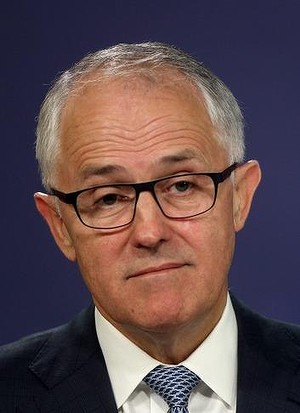
Winner of the 2016 Golden Gloria – Prime Minister the Hon Malcolm Turnbull MP.


One final note on the winner: Some people might think it unfair that he won the politics category, let alone the Golden Gloria, especially because he didn’t actually say anything. But then that is kind of the point – when the right-wing campaign against Safe Schools was in full swing, and people like George Christensen and Cory Bernardi were intent on making Australia a less safe space for young LGBTI people, he said nothing, therefore encouraging their attacks to continue.


And, even though he knows that the plebiscite is unnecessary, inappropriate, wasteful and divisive, and as Prime Minister he should be able to do something about it, he is still pursuing Tony Abbott’s public vote as his own policy – not because it is the right thing for the country, but because it appears to be the right thing for his career. Both things make him a worthy, albeit somewhat controversial, ‘winner’.


See you all next year when, if we do have a marriage equality plebiscite, there will be absolutely no shortage of nominations (and where Lyle Shelton might finally get to take home the coveted crown).
In the battle for marriage equality, we must not forget to fight against religious exceptions

The long struggle for marriage equality does not involve waging just one battle. Instead, it includes a range of related, and sometimes overlapping, fights for lesbian, gay, bisexual, transgender and intersex (LGBTI) equality.


Obviously, there is what most would consider to be the ‘central’ fight – to amend the Marriage Act 1961 to ensure all LGBTI couples who wish to can be married under secular Australian law. Victory on that particular issue is long overdue.


A closely-related fight is ensuring that the definition used to amend the Marriage Act is sex and gender neutral – referring to the union of two persons (replacing man and woman which is currently used in section 5) rather than referring to man/man, or woman/woman, unions. The latter would only be gay or same-sex marriage, instead of genuine marriage equality, and would continue to deny equal rights to some members of the LGBTI community.


Fortunately, most recent legislative attempts to amend marriage have used this more inclusive definition[i], although this is something that we will need to be vigilant about until equality is finally achieved in Australia (whenever that might eventually be).


And then there is the current procedural fight about how marriage equality should be implemented – with Malcolm Turnbull’s Liberal-National Government intent on holding an unnecessary, inappropriate, wasteful and divisive plebiscite.


The $158.4 million-plus[ii] public vote appears to be supported by only the Australia Christian Lobby and other extremists opposed to LGBTI equality, while pretty much everyone else believes Parliament should simply do its job and pass a law to introduce equality (in exactly the same way then-Prime Minister John Howard entrenched inequality in the first place, way back in 2004).


However, there is one fight that is inherently connected to the larger battle for marriage equality that seems to be commonly overlooked – and that is the need to ensure that, irrespective of how marriage equality is ultimately achieved, no new special rights are created allowing religious organisations, and individuals, to discriminate against LGBTI couples.


These so-called ‘religious exceptions’ could take several possible forms. The narrowest version would be the introduction of a new right for civil celebrants and other celebrants, like military chaplains, who are not ministers of religion to be able to refuse to officiate ceremonies solely on the basis of the sexual orientation, gender identity or intersex status of the couple involved[iii].


The next, more expansive type of special rights to discriminate would allow businesses that provide wedding-related services to deny those services to couples where one or both persons are lesbian, gay, bisexual, transgender or intersex. This is the type of exception that excites Christian fundamentalists in the United States, with claims that requiring florists and bakers to sell their products to LGBTI couples is oppressive or even totalitarian in nature.


The broadest form of new religious exceptions would more radically change existing anti-discrimination laws, allowing all individuals and businesses to discriminate against LGBTI couples on the basis of their own religious beliefs, with such discrimination not restricted to wedding-related activities.


No matter how narrowly or broadly these new special rights to discriminate are defined, they are all completely unjustified – there is no reason why civil celebrants, businesses or anyone else operating in public life should be free to deny LGBTI people equal treatment.


But, just because they are unjustified, doesn’t mean they are not on the public agenda, as recent experience in the United States amply demonstrates.


From Kentucky county clerk Kim Davis, who found fame by refusing to perform the duties of her Government job[iv], instead denying service to members of the public solely on the basis of their sexual orientation, through to more recent state-wide Bills to ‘restore religious freedom’ (or, more accurately, to reinstate the rights of individuals and businesses to treat LGBTI people as second class citizens) in North Carolina, Mississippi and elsewhere, there has been a renewed push for religious exceptions to undermine marriage equality, and anti-discrimination laws more generally.


There seem to be three, inter-related and mutually reinforcing objectives behind the religious right’s latest homophobic ‘crusade’:


  1. In a practical sense, they genuinely want to prevent the equal treatment of LGBTI people – both by being legally permitted to refuse service to LGBTI couples themselves, and to encourage the broader population to do the same;
  2. In a symbolic sense, they want to undermine the equality aspect of marriage equality – if lesbian, gay, bisexual, transgender and intersex people are allowed to marry under secular law, then Christian fundamentalists want to ensure that they are still treated as differently as possible, turned away by civil celebrants, wedding-related businesses and even public servants; and
  3. In a strategic sense, they want to use this ‘moment’, when marriage equality and LGBTI rights are being discussed across the community, to reassert the supposed primacy of ‘religious freedom’ and use it to dismantle LGBTI anti-discrimination laws where they exist – or hinder their development where they have not already been passed.


Before we judge our US counterparts too harshly, however, we must remember that conservative and other right-wing forces in Australia are engaged in exactly the same campaign here.


For example, Liberal Democrat Senator David Leyonhjelm’s Freedom to Marry Bill 2014, that would have introduced marriage equality (of a sort), included provisions that would have granted civil celebrants the ability to reject people on the basis of their sexual orientation, gender identity and intersex status[v].


Others on the ‘religious exceptions’ bandwagon include former Human Rights Commissioner, and now Liberal candidate for Goldstein, Tim Wilson[vi], as well as his former employers, the Institute of Public Affairs.


In addition to their outrageous calls for what limited LGBTI anti-vilification laws we do have[vii] to be temporarily suspended for the duration of the plebiscite, fringe group the Australian Christian Lobby (ACL) have also repeatedly argued for any Marriage Amendment Bill to include permanent special rights for individuals and businesses to discriminate against LGBTI people.


In his own words, ACL ‘homophobe-in-chief’ Lyle Shelton believes existing anti-discrimination laws are somehow a threat to Australian democracy:


“The rights to a free conscience, freedom of religion or belief, freedom of speech and freedom of expression are the nuts and bolts of democracy. If they are to fall, then we have serious questions to answer regarding out democracy…


“Most fair-minded Australians would accept the right of a person to maintain their belief that gender and biology still matter to marriage and family and to always be free to give voice to that belief.


“Marriage between a man and a woman is fundamental to a flourishing society. When the definition is changed, the law will say that gender is irrelevant to the foundation of society.


“Those who believe gender, kinship and biological identity do matter to society’s fabric will be fundamentally at odds with the law and the anti-discrimination laws will be weaponised against them.”[viii]


Leaving aside the fact the ACL have been able to use their disproportionate-sized megaphone to publicly spew forth hatred against LGBTI Australians for many years[ix], without any apparent consequence, on this as with too many other issues they have found numerous supporters within the Liberal-National Government.


Indeed, ongoing debate on the issue of whether a draft Marriage Amendment Bill should include new ‘religious exceptions’, and if so how broad they should be in scope, is a key reason why Malcolm Turnbull was forced to back down from previous statements he would announce the timing and details of the marriage equality plebiscite ahead of the 2016 Federal Election.


In reporting on the decision by Turnbull to shelve the plebiscite announcement until after the poll, Dennis Shanahan in The Australian made the following observation:


“The key to reassuring those opposed to same-sex marriage, including conservative Coalition MPs, is not only the wording of the proposed plebiscite question changing the Marriage Act but also the protections for freedom of religion and speech.


“Those involved in the talks regard it as essential that Senator Brandis provide protections for those beyond the tight circle of religious and marriage celebrants who do not want to perform same-sex marriage ceremonies.”[x]


Lenore Taylor in the Guardian Australia had earlier reported that internal tensions over the extent of these exceptions could cause the Government to delay announcing the Bill:


“The Turnbull government is wavering on its commitment to reveal details of its planned marriage equality plebiscite before the federal election because of deep divisions on crucial issues such as public funding and exemptions from anti-discrimination laws…


“[C]conservative MPs have been demanding broad exemptions from anti-discrimination laws for officials and wedding service providers, including florists, bakers and reception centres. Government sources said there were concerns that the issue would become internally “divisive.””[xi]


These reports confirm that the potential creation of new special rights to discriminate is very much a live option within the Turnbull Liberal-National Government.


This development is something that should have anyone interested in achieving marriage equality worried, especially because, as previous debates around Safe Schools and the plebiscite itself have demonstrated, the conservative and/or religious right are not shy about throwing their weight around inside the Coalition party room – and that applies just as much, if not more, under Prime Minister Turnbull as it did under his predecessor Tony Abbott.


The consequences of a conservative victory on this issue would be dire. On top of the practical and strategic problems identified above, the inclusion of new special rights to discriminate against LGBTI people in the plebiscite question – or its associated legislation – would make campaigning for marriage equality significantly more challenging.


In effect, it would ensure that the proposal considered at a plebiscite was fundamentally flawed from the beginning and that therefore many people in favour of genuine marriage equality would be forced to campaign, and vote, for something less than ideal while effectively ‘holding one’s nose’.


It would also tarnish the achievements of a successful ‘Yes’ campaign – instead of a unifying moment of national celebration, where true relationship equality was extended to lesbian, gay, bisexual, transgender and intersex Australians without qualification, we would be left with a law that continues to permit discrimination in certain circumstances. In short, a ‘Yes’ result would be marred, leaving the overall job half-finished – and making it bittersweet to celebrate ‘equality-lite’.


For all of these reasons, it is incumbent upon us to ensure that, at the same time as we fight for marriage equality, we fight against the introduction of new religious exceptions, whether in the Marriage Act itself, or the Commonwealth Sex Discrimination Act 1984 (or its state and territory equivalents).


Fortunately, we already have allies in this particular fight. In addition to the Greens, who have long campaigned against religious exceptions, the Australian Labor Party is also firmly opposed to their introduction.


160417 Guardian Why Knot

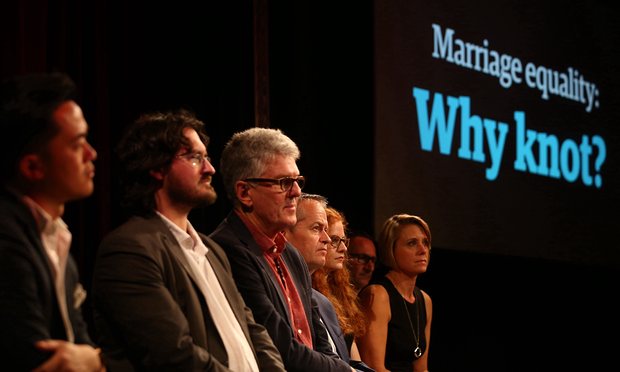
The Guardian Australia/Australian Marriage Equality event ‘Why Knot?’ where Opposition Leader Bill Shorten gave a firm commitment that Labor will oppose any expansion of religious exceptions – and will seek to repeal any provisions that are introduced by the Turnbull Liberal-National Government.


At the recent Guardian Australia/Australian Marriage Equality ‘Why Knot?’ forum in Sydney, I had the opportunity to ask Opposition Leader Bill Shorten the following:


“There is a real risk that, when Malcolm Turnbull finally gets around to drafting it, his Marriage Amendment Bill will seek to include new special rights for civil celebrants and other wedding business-providers to discriminate against LGBTI couples. Just to get it on the record: Mr Shorten, will you commit the Labor Party to voting against any attempt to expand religious exceptions beyond existing provisions and, if they do somehow end up being passed and polluting the Marriage Act, will you seek to repeal them at the earliest available opportunity?”


Mr Shorten’s answer was unexpectedly strong, and reassuring: “Yes, and yes.”


As reported by the Guardian Australia, he went on to note that “[i]t’s not allowed now under the current law – why would we water down existing laws? We don’t need to water down anti-discrimination law to keep some people [who oppose same-sex marriage] happy.”[xii]


It is possible that, after the Federal election, the combined votes of Labor and the Greens in the Senate will be able to block any attempt by a re-elected Turnbull Liberal-National Government to include expanded religious exceptions as part of its legislative package creating the plebiscite.


However, with a double dissolution election now almost inevitable on July 2nd, and the reduced Senate quotas associated with it, the final result in that Chamber will be especially hard to predict, with a range of minor parties still chances to win the 12th and final seat in each state.


Which means that there are now only two ways to avoid the creation of new special rights to discriminate against LGBTI Australians: for Shorten and Labor to be elected (and then implement their own policy to introduce marriage equality legislation within 100 days), or for a re-elected Prime Minister Turnbull to publicly commit to not introducing new religious exceptions in his own Marriage Amendment Bill.


Given his track record on LGBTI issues since taking over from Tony Abbott last September – selling the LGBTI community out on multiple occasions by ‘gutting’ the Safe Schools program and abandoning his previous personal position against holding a plebiscite – securing any enforceable commitments from Mr Turnbull will likely be an incredibly difficult task.


But, if we are committed to genuine marriage equality, then I believe this is a fight we must take on. Because if we don’t, we might find that we win marriage equality in the next 12 to 18 months but, instead of being able to celebrate achieving a better, fairer and more equal Australia, we are left to deal with new forms of exclusion, discrimination and state-sanctioned homophobia.


**********


[i] Although Greens Senator Sarah Hanson-Young’s Recognition of Foreign Marriages Bill 2014 disappointingly only sought to recognize overseas marriages between “a man and another man or a woman and another woman”.

[ii] As quoted on page 22 of the Senate Committee Report: Matter of a popular vote, in the form of a plebiscite or referendum, on the matter of marriage in Australia, 15 September 2015.

[iii] Thus providing them with the same right to ‘reject’ couples that ministers of religion already enjoy under the Marriage Act.

[iv] It is instructive to consider how people like Ms Davis would be received were they to refuse to serve African-American people, rather than LGBTI people – presumably such acts of outright racism would not be tolerated, or even celebrated, in the same way her egregious acts of homophobia and transphobia have been.

[v] For more on why Leyonhejlm’s Freedom to Marry Bill 2014 was offensive, see “Senator Leyonhjelm’s Marriage Equality Bill Undermines the Principle of LGBTI Anti-Discrimination: Should we still support it?”

[vi] In Wilson’s opinion piece in The Australian on 6 July 2015, “Religious freedom and same-sex marriage need not be incompatible” he argued for religious exceptions to be extended not just to civil celebrants but also to a wide range of wedding-related businesses.

[vii] Only four states and territories currently have vilification laws that cover lesbian, gay, bisexual, transgender and intersex (LGBTI) people: Queensland, NSW, ACT and Tasmania. There are no protections federally. Instead of suspending the paltry laws we do have, the Commonwealth Government should actually be introducing LGBTI anti-vilification laws of its own. See also: “Don’t limit racial vilification protections, introduce vilification protections for LGBTI Australians instead”.

[viii] From ACL Media Release, 5 April 2016 “ACL Concerned by Shorten Plan to Fine Business Owners who Disagree with Same-Sex Marriage.”

[ix] With Mr Shelton’s predecessor Jim Wallace saying that smoking was healthier than gay marriage, and the ACL under both leaders drawing comparisons between LGBTI parenting and the creation of another Stolen Generation, which is not just deeply offensive to LGBTI Australians but to Aboriginal and Torres Strait Islander people as well.

[x] Dennis Shanahan, The Australian, 26 March 2016, “Federal election 2016: Same-sex marriage plebiscite pause for poll”.

[xi] Lenore Taylor, Guardian Australia, 16 March 2016, “Marriage Equality: Coalition disunity puts pre-election plebiscite details in doubt.”

[xii] Paul Karp, Guardian Australia, 31 March 2016, “Shorten: Labor won’t change discrimination laws to please gay marriage opponents.”

What does Malcolm Turnbull want his legacy to be?

It’s time for Malcolm Turnbull to seriously consider what he wants his legacy to be.


That might sound premature to some, especially given that tomorrow (Monday 14 March 2016) it will be only six months since he replaced Tony Abbott as Leader of the Liberal Party. Tuesday, the clichéd ‘Ides of March’, is the six-month anniversary of his official swearing in.


However, in the life of an Australian Prime Minister, six months is not an insignificant period of time. Indeed, for many, six months is a considerable slice of their term.


In the just over 70 years since World War II, Malcolm Turnbull is the 15th person to ascend to our top job. The average term in office – even including the 16-year rule of Robert Menzies[i] – is less than five years. In fact, only four Prime Ministers[ii] in those seven decades have even made it to the five-year mark, while six ended up serving less than three years.


The pace of turnover of Prime Ministers also appears to be accelerating – in the 11 years since Turnbull entered Parliament, he is now the fifth Prime Minister (with one of those, Kevin Rudd, even having two non-consecutive turns).


Based on the above, six months is likely to represent at least 10% of Turnbull’s entire term in office, and probably more.


In fact, there are reasons to believe Turnbull’s stay in the Lodge might be shorter than the average. For example, he is third oldest person to ever be first sworn in as Prime Minister (and the two who were older[iii] served for a combined period of less than two years).


It is also reasonable to describe Turnbull’s support inside the Parliamentary Liberal Party as somewhat tenuous. His first stint as Leader, while in Opposition, lasted less than 15 months. And, even after two years of the worst Prime Minister in living memory, he only defeated Tony Abbott by 54 votes to 44 last September (and which was only moderately better than the 39 votes cast for an ‘empty chair’[iv] in the February 2015 spill motion against Abbott).


With a switch of just six votes needed to reverse that result (whether to Abbott, who clearly remains interested in returning, or another candidate from the conservative wing of the Liberals) it should be noted that a sizeable majority of Liberal MPs in marginal seats voted for Turnbull[v], meaning that any loss of seats at the upcoming 2016 election would leave him more vulnerable to a challenge from inside the Government.


Of course, if the current level of in-fighting and disorganisation within the Coalition continues, there is also the small but real chance of the Government being voted out, cutting Turnbull’s term short at 12 months or less.


This thought – that, after just six months, it is time to start seriously considering his legacy – might be confronting for Turnbull, but he should console himself with the knowledge that, for most of his contemporaries, substantial elements of their legacies were built during their first year in office.


Kevin Rudd gave the apology to the Stolen Generations after less than three months in the role. He is also most commonly remembered for his response to the Global Financial Crisis, which reached its peak in September and October 2008 – again, less than 12 months from his election win on November 24 2007.


In Julia Gillard’s case, the announcement of the ‘carbon pricing mechanism’ (forever dubbed the carbon tax) was made on February 24 2011, exactly eight months after she ousted Kevin Rudd as Prime Minister.


The National Disability Insurance Scheme is also seen as a key part of her legacy – and, while the legislation that gave it effect was not introduced until late 2012, the Productivity Commission report which preceded it was already two months into its work before Gillard even became PM[vi].


Tony Abbott continues to assert that his first Budget – the ‘horror’ 2014-15 Budget, more widely known for its unfairness– is a key part of his legacy[vii], and that was handed down just eight months into his term. His more trivial – but just as infamous – ‘captain’s call’ to reintroduce knights and dames happened two months earlier.


Even in the case of John Howard, who, given he served as Prime Minister for more than 11 years and therefore has a long and highly-contested ‘legacy’, there is probably only one key positive achievement about which almost all parts of the political spectrum agree[viii] – his gun law reforms following the Port Arthur Massacre[ix], which itself occurred less than two months after he swept to power.


Six months into his own term as Prime Minister, it is hard to pin down exactly what Malcolm Turnbull’s key achievement or achievements have been (other than the initial, widespread feeling of ‘relief’ which many Australians experienced after he deposed Abbott). Different language has been used, including much talk of ‘agility’ and ‘innovation’ and ‘excitement’, but new ideas or policies? Not so much.


That situation will change, to some extent, over the coming months, as Turnbull and Treasurer Scott Morrison put together their first Budget – to be delivered in early May (either May 10th, or 3rd if, as is now widely expected, they head to a double dissolution poll on July 2). There is obviously intense pressure on them both to set out their platform for the campaign ahead in that document.


But there is an even earlier opportunity for Malcolm Turnbull to establish his legacy as Prime Minister. Two closely-linked opportunities, in fact: the decision on what to do with the Safe Schools program, and the choice whether or not to proceed with a plebiscite on marriage equality.


Both of these issues will come to a head in the coming week. The independent review of the Safe Schools program, instigated following the internal revolt by the likes of Cory Bernardi in the Coalition Party room meeting on 23 February, was expected to be handed to the Commonwealth Department of Education on Friday 11 March[x].


While it may be another week or two before the Government announces its response to that review, you can guarantee they will be discussing it internally during the week ahead (it’s also highly likely to be debated again in the Coalition Party room meeting on Tuesday, the second-last such meeting before a potential ‘double D’-election).


Lenore Taylor has also reported that the proposal for a plebiscite on marriage equality will be considered in detail by the Turnbull Cabinet this week[xi].


While the plebiscite was first adopted as Coalition policy under then Prime Minister Abbott on 11 August last year, this will be the main, Cabinet-level discussion of the process required to hold one – the question to be asked, expected timing (which, depending on who you listen to, may or may not be before the end of 2016), the estimated cost (likely upwards of $160 million[xii]), public funding of the yes and no cases, compulsory or voluntary voting and the supporting legislation.


Again, it is possible that the marriage equality plebiscite proposal will also be discussed at the Coalition Party room meeting on Tuesday morning (it will be interesting to see whether this one also takes six hours, especially given how much Liberal and National Party MPs appear to enjoy discussing LGBTI issues).


Obviously, the approaches that Turnbull, and his Liberal-National Government, adopts on these two issues this week will be a key part of his personal legacy for LGBTI Australians. Both decisions will have direct, and long-lasting, impacts on literally hundreds of thousands of lesbian, gay, bisexual, transgender and intersex people, their children, and their families and friends.


On Safe Schools, Turnbull will choose between defending a program developed to combat homophobic, biphobic, transphobic and intersexphobic bullying of LGBTI students, thereby reducing the all-too-frequent tragedy of LGBTI youth suicide – or giving in to bullies, like the Australian Christian Lobby, and The Australian newspaper, who it seems would much prefer enforced silence about LGBTI issues in the classroom, and the schoolyard, to the detriment of children with diverse sexual orientations, gender identities or intersex characteristics.


The consequences of this choice – whether a school is genuinely inclusive, or a vacuum allowing intolerance and discrimination to fester – can and will have lifelong impacts on the students who receive, or miss out on, programs like Safe Schools as a result.


On marriage equality, too, the impacts of Turnbull’s imminent decision will be profoundly felt, not only by LGBTI Australians, but also by the children of rainbow families.


As has been made clear by Australian Marriage Equality[xiii], if Malcolm Turnbull implemented the policy position that he held before becoming Prime Minister – of supporting a ‘free’ or conscience vote – then we could have marriage equality legislation passed by the end of this week.


But, if he persists with what was originally Tony Abbott’s plebiscite – but which is now most definitely his – not only will he be wasting at least $160 million on something which is completely unnecessary and inappropriate, he will also be causing real harm to LGBTI Australians, and our kids, by ensuring that there will be a protracted, bitter, and downright nasty campaign leading up to the vote.


The Australian Christian Lobby, both with its past actions (including repeated suggestions that gay and lesbian parenting creates another Stolen Generation[xiv]), and its recent call for state and territory anti-discrimination laws to be suspended for the duration of the campaign[xv], have effectively guaranteed it.


And, even if the marriage equality plebiscite is successful, it will still be at least another 12 – and possibly up to 18 or even 24 – months before Australian couples will finally be able to wed in their own country, with some elderly couples sadly, but inevitably, passing away before they can tie the knot.


However, while the impact of these decisions will be most keenly felt by LGBTI people, young and old, and their children, I would argue they will define Malcolm Turnbull’s legacy much more broadly. This is because his approach to Safe Schools, and the plebiscite, will tell us a lot about who he is as a Prime Minister, what type of Government he leads, and ultimately about his vision for Australia.


In terms of who Malcolm Turnbull is as Prime Minister, he would like most people, and especially the ‘persuadables’ in the electorate, to believe he is still the leather jacket-clad QandA panellist, with views that are more moderate than most of the members of his party – believing in climate change, supporting a republic, and wanting to be the leader who finally introduces marriage equality.


Deep down, I’m sure Turnbull would love to be the ‘cool’ Prime Minister who attends the 2017 Sydney Gay & Lesbian Mardi Gras parade, claiming credit for removing discrimination from the Marriage Act 1961, receiving the passionate support, even adulation, from sections of the crowd in return.


But, if he caves in to the deeply homophobic and transphobic campaign against Safe Schools, led by the vitriolic and hateful scare-mongering of the Australian Christian Lobby and others, and if he continues to support an unnecessary, inappropriate, wasteful and divisive marriage equality plebiscite, then not only will Malcolm Turnbull fail to be the Leader that he thinks he is (or at least wants to be) – he will become exactly the same type of Leader as the one he replaced.


By endorsing the attack on Safe Schools, and persisting with the plebiscite, Turnbull would show that there is no core belief that he will not jettison, no principle he is not prepared to compromise, in his quest to remain Prime Minister of Australia for as long as possible. The Opposition critique of him – that he is just Tony Abbott in a more expensive suit – will be more than justified.


And, by ensuring that it will be the public’s vote that finally achieves equality in relationship recognition in Commonwealth law, and not his own vote in Parliament, he will simply become another politician whom we had to win marriage equality in spite of, and not because of[xvi].


How Turnbull handles the decisions on Safe Schools, and the plebiscite, will also reveal a great deal about the type of Government he leads.


Is it a Government that represents, and serves the interests of, all Australians? Does it believe that the real and urgent needs of young lesbian, gay, bisexual, transgender and intersex people are worthy of attention, and above all action? Does it think that people should not be legally discriminated against on the basis of their sexual orientation, gender identity of intersex status?


Or is it a Government that represents, and serves the interests of, cisgender heterosexual Australians only? Does it believe that the pressing needs of young LGBTI people can simply be ignored? Does it think that the relationships of LGBTI Australians are genuinely lesser than those of other people, and therefore should be treated as such?


Turnbull has so far studiously avoided having to address this deep divide inside the Liberal-National Coalition. On Safe Schools, rather than reject the campaign against the program outright, he simply passed the buck to an independent review – thereby encouraging the attack to continue.


And, instead of directly reprimanding MPs like George Christensen and Andrew Hastie, who have compared Safe Schools to ‘grooming’[xvii] and George Orwell’s Big Brother[xviii] respectively, Turnbull offered a meek, generic statement saying “I encourage everybody who is discussing these issues to do so in very measured language… and to consider very carefully the impact of the words they use on young people and on their families.”[xix]


On marriage equality, he has again chosen not to upset the applecart, instead leaving in place Tony Abbott’s preferred option – a plebiscite – despite the insistence of multiple members of his own Government that they will not be bound by any ‘yes’ vote[xx], thus rendering the entire exercise pointless.


Well, on both of these issues, he can no longer kick those proverbial cans any further down the road. This week, in Cabinet and most likely in the Party room too, Malcolm Turnbull will need to decide what type of Government he wants to lead – and then he will need to argue for it, in the face of likely fierce criticism from Liberal and National MPs who do not now, and likely will not ever, support LGBTI equality, possibly at the cost of their ongoing support for his leadership.


Ultimately, how Malcolm Turnbull approaches the Safe Schools debate, and the marriage equality plebiscite, in the next few weeks will tell us whether he has what Keating would describe as ‘the vision thing’.


Does Malcolm Turnbull have a vision of a better Australia, where young lesbian, gay, bisexual, transgender and intersex people can grow up happy and healthy, attending schools where they are free to be who they are, respected and accepted?


Does he see a future where all relationships are treated equally irrespective of the sexual orientations, gender identities or intersex statuses of the people involved, and is he prepared to actually do something to make that future a reality?


Does Malcolm Turnbull show, in who he is and how he governs, that he has the interests of all of us, including LGBTI Australians, at heart?


Or does his vision only extend as far as what is required to keep him in the Prime Ministership, the role that he has clearly coveted for so long?


That might sound harsh, and to some even potentially unfair, but that is what I believe is at stake in the next few weeks as Turnbull decides what to do on the Safe Schools program, and on the marriage equality plebiscite.


One final comment – some might argue that, given it is not Malcolm Turnbull who is leading the attacks on Safe Schools, and it was not his proposal to hold a plebiscite on marriage equality, assessing his ‘legacy’ on how he approaches these issues is unjustified.


To which I would respond with two observations. First, he is the Prime Minister, and the campaign against Safe Schools is happening on his watch, including by members of his own Government, which makes his response to this issue extremely relevant to how we assess his performance.


And, while the marriage equality plebiscite might not have originally been his idea, if he chooses to proceed with it, at enormous cost, both financially, and psychologically in the harm it will cause to LGBTI Australians and their children, it will very much be his responsibility.


Second, John Howard did not ‘choose’ gun control to be his legacy, nor did Kevin Rudd ‘choose’ for the GFC to dominate his first term agenda, and Julia Gillard certainly did not ‘choose’ for her stint as Prime Minister to include such a large focus on climate change.


They were responding to events that were not of their own making – Port Arthur, global markets, and even the hung parliament. But how they responded to these things is what made them Leaders – and that is why we remember these achievements as part of their legacies.


Malcolm Turnbull did not choose for the attack on Safe Schools, nor did he choose Tony Abbott’s plebiscite. But, how the Government approaches these issues is now within his control as Prime Minister – and it is up to him how he chooses to exercise that power.


Does Malcolm Turnbull choose to support Safe Schools or does he side with those who have campaigned against it? Does he proceed with a plebiscite on marriage equality, even when he knows it is unnecessary, inappropriate, wasteful and divisive? In short, what does Malcolm Turnbull want his legacy to be?


151222 Turnbull

For Prime Minister Malcolm Turnbull, it’s time to turn his mind to how he will want to be remembered.


[i] Although this also includes the three-week term of John McEwen.

[ii] Robert Menzies, Malcolm Fraser, Bob Hawke and John Howard.

[iii] John McEwen and William McMahon.

[iv] The Australian, Last Post, February 10 2015.

[v] The New Daily, “Why Turnbull could win the election – and still lose”, March 8 2016.

[vi] The Productivity Commission started its work in April 2010, and released the Disability Care & Support Final Report in August 2011.

[vii] The Australian, “Tony Abbott: My legacy the key to victory at next election”, September 26, 2015. Quote from Mr Abbott: “You can always dispute the marketing… but the 2014 Budget was a very serious structural attempt to tackle our long-term spending problems.”

[viii] Outside of ‘gun nuts’, and the accidental Liberal Democrat Senator, David Leyonhjelm.

[ix] Howard’s gun law reforms, and gun ‘buyback’, even has international admirers, as demonstrated by the 2013 segment by John Oliver on the Daily Show with Jon Stewart (as reported here: Sydney Morning Herald, “US Show Uses Howard to Embarrass Gun Lobby”, April 22, 2013).

[x] Gay News Network, “Government Comment on Safe Schools Report Not Expected for 1-2 Weeks”, 11 March 2016.

[xi] Guardian Australia, “Coalition to finalise marriage equality plebiscite details as July election looms”, March 8 2016.

[xii] See “7 Better Ways to Spend $158.4 million”.

[xiii] Sydney Morning Herald, “Majority of MPs would back marriage equality”, January 30, 2016.

[xiv] Guardian Australia, “Q&A Recap: Lyle Shelton locks horns with panel on marriage equality”, 1 March 2016.

[xv] ABC News, “Same-sex marriage plebiscite: Christian lobby group wants ‘override’ of anti-discrimination laws during campaign”, 16 February 2016.

[xvi] For more, see: “Letter to Malcolm Turnbull about the Marriage Equality Plebiscite”.

[xvii] Buzzfeed Australia, This MP Just Compared the Safe Schools Coalition to ‘Grooming’”, 25 February 2016.

[xviii] From Mr Hastie, the Member for Canning’s, Facebook page: “George Orwell foresaw where the abandonment of reason can lead society: to a world devoid of compassion and empathy for those who disagree with us. All that is left is raw power. As Orwell wrote, without reason and charity in our public debate there will be nothing left but “the thrill of victory, the sensation of trampling on an enemy who is helpless. If you want a picture of the future, imagine a boot stamping on a human face – forever.”

[xix] ABC News, “Safe schools: Turnbull warns MPs over language used in debate”, February 26 2016.

[xx] Guardian Australia, “Eric Abetz: Coalition MPs will not be bound by plebiscite on marriage equality”, January 27 2016.

2016-17 Pre-Budget Submission: Save $158.4 million – Scrap the Marriage Equality Plebiscite


The Commonwealth Government has called for submissions[i] to assist it in developing the 2016-17 Budget, which, barring an early election, is due to be handed down on Tuesday 10 May.

This process is another opportunity to highlight to Prime Minister Malcolm Turnbull, Treasurer Scott Morrison and the Liberal-National Government generally just how ridiculous it is that they are proposing to waste (at least) $158.4 million on something that can be passed by the Parliament, in the usual way, for no cost.

Submissions are due by Friday 5 February 2016, with full details here. This is my submission:


Budget Policy Division

Department of the Treasury

Langton Crescent

PARKES ACT 2600

prebudgetsubs@treasury.gov.au


Tuesday 2 February 2016


To whom it may concern

2016-17 Pre-Budget Submission

Thank you for the opportunity to make a submission regarding what I believe should be the priorities for the 2016-17 Budget.

In this short submission I would like to focus on just one issue that, as well as being the right policy approach, would also have significant Budget benefits, and that is to call on the Turnbull Government to scrap the proposed marriage equality plebiscite.

There are a variety of policy justifications for not proceeding with a plebiscite on this issue, including that holding a public vote is unnecessary because the High Court has already found that Commonwealth Parliament has the constitutional power to pass marriage equality, and that subjecting the human rights of a minority group to such a process is inappropriate.

I, and many other members of the lesbian, gay, bisexual, transgender and intersex (LGBTI) community, also have serious concerns that the campaign leading up to a marriage equality plebiscite will be divisive, and expose LGBTI Australians, and the children of LGBTI families, to increased levels of homophobia, biphobia, transphobia and intersexphobia.

However, there are also strong budgetary reasons why the marriage equality plebiscite should not go ahead.

The Australian Electoral Commission has estimated that the cost of holding a stand-alone plebiscite on marriage equality would be at least $158.4 million.[ii]

Such a significant expenditure of public monies must be considered wasteful when the alternative approach – to pass (or at least to hold a free vote on) marriage equality legislation in Parliament – does not carry any additional cost.

Holding a marriage equality plebiscite could even be considered duplication, given, in the event of a ‘yes’ vote, a Bill introducing marriage equality would still need to be passed.

The two media releases, issued by the Assistant Minister to the Treasurer, the Hon Alex Hawke MP, calling for Pre-Budget Submissions, both reiterated the “Government’s commitment to restrain expenditure responsibly”.[iii]

It is difficult to think of a more perfect way to ‘restrain expenditure responsibly’ than by avoiding spending $158.4 million on something which is entirely unnecessary in the first place.

Of course, scrapping the marriage equality plebiscite also fits in with the Government’s broader fiscal policy, as outlined in the Mid-year Economic and Fiscal Outlook (MYEFO), including the “Government’s commitment to returning the budget to a sustainable position and reducing debt over the medium term”[iv].

With an underlying cash deficit estimated at $33.7 billion (or 2% of GDP) in 2016-17 (when such a plebiscite may be held), and net debt now expected to peak at 18.5% of GDP in 2017-18, it is undeniably profligate to spend an extra $158.4 million on a public vote the outcome of which is not even binding on Government MPs. This money would instead be much better used to lower the cash deficit and therefore reduce net Government debt.

Other Budget Rules, contained in the MYEFO, are also relevant to the consideration of whether to allocate money in the 2016-17 Budget to holding a plebiscite on marriage equality.

For example, I note that the MYEFO states: “This strategy sets out that:

  • new spending measures will be more than offset by reductions in spending elsewhere within the budget.”[v]

Given the monies required to hold a marriage equality plebiscite have not been allocated in the Budget to date[vi], that means it would need to be included in the 2016-17 Budget as a ‘new spending measure’ and, according to the Government’s own rules, there must be at least an equivalent amount of reductions in spending elsewhere.

It seems absurd to me that the Government would need to cut $158.4 million in spending on justice, or health, or education, or any number of other areas, simply to hold a plebiscite on something that could be resolved by the Parliament in the ordinary course of business for no extra cost.

If the Government does decide to continue down this path, and makes such cuts in order to fund a marriage equality plebiscite, then in the interests of transparency I urge it to include the details of these cuts in the Budget, linking them to this ‘new spending measure’, thereby allowing Australians to make up their own minds whether these actions meet the stated ‘commitment to restrain expenditure responsibly’.

Of course, if the Government is interested in spending a similar amount of money on issues that affect lesbian, gay, bisexual, transgender and intersex (LGBTI) Australians, then I would suggest a variety of different ways in which it could do so that would bring much greater benefit, including:

  • Removing out-of-pocket medical costs for transgender people
  • Ending involuntary surgical procedures on and sterilisation of intersex children
  • Increasing refugee places for LGBTI people fleeing persecution in Syria, Iraq and other countries
  • Funding campaigns aimed at addressing homophobia, biphobia, transphobia and intersexphobia across society and
  • Expanding the ‘safe schools’ program to cover every school in the country.

Even if the Turnbull Government is not interested in funding these programs, it would nevertheless be preferable to use this $158.4 million to reduce overall Government deficit and debt, rather than to waste it on holding an unnecessary, inappropriate and divisive public vote.

Scrapping the marriage equality plebiscite, and holding a parliamentary vote instead, might be the easiest Budget saving any Government could ever hope to make.

Thank you for taking this submission into consideration.


Sincerely

Alastair Lawrie


160202 Scott Morrison

Treasurer Scott Morrison, tasked with ‘restrain[ing] expenditure responsibly’. Scrapping the marriage equality plebiscite would be a good place to start.

[i] Media Release “2016-17 Pre-Budget Submissions” 18 December 2015 and Media Release “Deadline for Lodging 2016-17 Pre-Budget Submissions”.

[ii] As quoted on page 22 of the Senate Committee Report: Matter of a popular vote, in the form of a plebiscite or referendum, on the matter of marriage in Australia, 15 September 2015.

[iii] See links to media releases above.

[iv] Mid-Year Economic and Fiscal Outlook 2015-16 Part 3: Fiscal Strategy and Outlook.

[v] Ibid.

[vi] “Labor sees a plebiscite-sized hole in the Budget”, Huffington Post, 18 December 2015.

Response to Letter to Malcolm Turnbull About the Marriage Equality Plebiscite

A lot has happened in the 10 days since I first posted my letter to Malcolm Turnbull about the marriage equality plebiscite.

To begin with, a number of Coalition MPs have publicly revealed that, irrespective of the outcome of any plebiscite, they will continue to vote against the equal recognition of LGBTI relationships.

This conservative crusade was led by Senator Eric Abetz who told The Guardian that:

“everyone knows my view is very strongly that a marriage between a man and a woman is the foundational institution for socialising the next generation. And every member of parliament will make up his or her mind after the plebiscite is held. People will take into account the views of the electorate, the views of the nation and their own personal views… There will be people in the parliament who could not support the outcome of a plebiscite whichever way it went.”

His view – that if the voters of Australia supported marriage equality at a plebiscite they could essentially ‘get stuffed’ – was soon supported by both fellow Liberal Senator Cory Bernardi, who told Sky News that “[a] plebiscite is a glorified opinion poll, and no government should be bound by that” and Nationals Senator Bridget McKenzie, the latter so committed to opposing LGBTI equality she is willing to deny legal rights to her own brother.

Then, former Prime Minister Tony Abbott (who similarly thinks his own relationship more worthy of recognition that that of his sibling) jetted off to address an audience of homophobes in the US, telling them that:

“[w]e shouldn’t try to change something without understanding it, without grasping why it is one that one man and one woman open to children until just a very few years ago has always been considered the essence of marriage and the heart of family… We can’t shirk our responsibilities to the future, but let’s also respect and appreciate values and institutions that have stood the test of time and pass them on, undamaged, when that’s best. That’s a goal we should all be able to share” [emphasis added].

Despite claiming that he still supports holding a marriage equality plebiscite, it is clear which outcome he wanted, placing into serious doubt his sincerity in introducing legislation following a successful ‘yes’ vote (were he still Prime Minister – a position to which he obviously wishes to return).

The Australian Christian Lobby has also done its job in undermining the credibility of any marriage equality plebiscite, with comments reported by The Guardian that:

“Abbott emerged from that meeting announcing the Coalition had decided to use its numbers to block the introduction into the Australian parliament of yet another bill to change the definition of marriage… Instead, a people’s vote known as a plebiscite would be held sometime after the 2016 election, kicking the issue into the long grass (putting the issue off) and blunting the momentum of same-sex marriage lobbyists” [emphasis added].

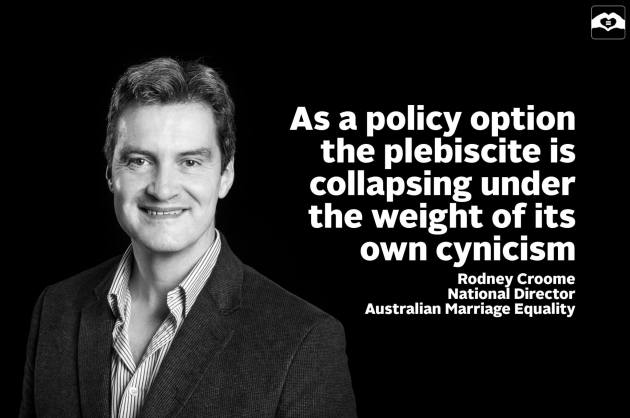
Australian Marriage Equality head Rodney Croome, quoted in the same article, quite accurately summed up these developments with the following: “[a]s a policy option, the plebiscite is collapsing under the weight of its own cynicism.”

Indeed, one of the most pleasing aspects of this week’s debate has been the increasing media scrutiny of the proposal to hold a plebiscite on marriage equality, with respected journalists such as Lenore Taylor describing it asdaft and Mark Kenny observing that:

“Malcolm Turnbull’s commitment to the plebiscite can be seen for what it really is: an internal matter – the price of entry to the leadership. Slow and costly… his own credibility with voters is also at stake if he is seen to trade principles in pursuit of power and an easier life.”

The final major development of the past 10 days was yesterday’s (Friday 29 January 2016) announcement by Australian Marriage Equality that it now believes there is majority support for passing majority equality legislation in both houses of parliament – if only the Coalition were willing to grant their MPs and Senators a free vote.

All of which puts the issue of marriage equality squarely in the Prime Minister’s court (the current one, Malcolm Turnbull, not Prime Minister-in-exile Tony Abbott). The original proposal to hold a marriage equality plebiscite may not have been his, but, now that he is in the Lodge, he owns it.

It is up to Malcolm Turnbull to decide whether Australia will be subjected to a pointless plebiscite on this issue. The time has come for him to show whether he is a leader who is strong enough to back a free vote, or whether he is instead prepared to allow this farce to drag on for not just months, but years, solely for reasons of political expediency.

The signs, however, are not good. Turnbull reiterated the Government’s position in support of a plebiscite to 3AW Radio just yesterday, saying it will “absolutely” pass parliament following a successful vote (something which Abetz, Bernardi, McKenzie and others may have more to say about in coming weeks).

Finally, he has responded to my letter to him on this subject – well, sort of anyway. Given he seems to have outsourced his decision-making on marriage equality to his homophobic predecessor Tony Abbott, it is possibly unsurprising, although nevertheless disappointing, that he has outsourced responsibility for answering correspondence regarding the marriage equality plebiscite to Attorney-General Senator George Brandis, who in turn has delegated it to his Department.

Here is the Government’s response to my letter to Malcolm Turnbull about the marriage equality plebiscite:


“27 January 2016


Mr Alastair Lawrie

[Address withheld]


Dear Mr Lawrie

Thank you for your recent correspondence to the Prime Minister, the Hon Malcolm Turnbull MP, about same-sex marriage. Your correspondence was referred to the Attorney-General, Senator the Hon George Brandis QC, as marriage falls within his portfolio responsibilities. The Attorney-General has asked that I reply to you on his behalf.

I appreciate you taking the time to write to the Government on the issue of same-sex marriage and for sharing your personal experiences. It is clear that this issue holds particular significant for you.

The Government appreciates that, like you, many Australians have strong personal views about same-sex marriage. That is why, last year, it was decided that this issue should be resolved through a national vote that gives every Australian the opportunity to have their say.

The Government believes it is thoroughly democratic to ask the Australian people whether the Marriage Act 1961 should be amended to allow for same-sex marriage, provided there are appropriate safeguards in place to protect religious freedom[i].

Although a plebiscite will cost money, the Government is of the view that every Australian should be able to have their say on this important issue.

Thank you for bringing your views to the Government’s attention.


Yours sincerely

[Name withheld]

Marriage Law and Celebrants Section”


Croome on Plebiscite


[i] The reference to “appropriate safeguards in place to protect religious freedom” is obviously of major concern, given the push for exceptions to be granted to civil celebrants and other businesses that supply weddings to allow them to discriminate against LGBTI couples. This is an issue that will be addressed in a future post.

Letter to Malcolm Turnbull About the Marriage Equality Plebiscite


The Hon Malcolm Turnbull MP

Prime Minister

PO Box 6022

House of Representatives

Parliament House

Canberra ACT 2600

Wednesday 20 January 2016


Dear Prime Minister

Re: Your Proposed Marriage Equality Plebiscite

We don’t personally know each other[i]. Which means that the only things I know about you are what I can glean from the media.

Just over four months into your Prime Ministership, three main themes have emerged:

  1. You’re rich.

Newspaper reports from around the time you deposed Tony Abbott estimated your net worth at $180 million[ii], or ‘conservatively’ at around $200 million[iii].  And you don’t just own a lot of money, you ‘own’ that description too, responding to a question from Tony Burke in Parliament in October with the following:

“… really, if the honourable member wants to go around wearing a sandwich board saying, ‘Malcolm Turnbull’s got a lot of money,’ feel free. I think people know that.”[iv]

  1. You’re Intelligent.

If there’s one thing that even your detractors are compelled to acknowledge, it is that you are not wanting for intelligence. Indeed, there are many people in public life today, no doubt including colleagues of yours, who would like to think that they are smartest person in the room. With you it seems that boast at least has the chance of being correct more often than not.

  1. You’re not Tony Abbott.

As we head into an election year, it is still not entirely clear what the Government you now lead is going to do differently from its first two years in office. What is clear, at least in presentation if not (yet) in substance, is that you are not Tony Abbott.

In fact, some might say you have rather ‘intelligently’ managed to employ that singular qualification – that you are not Tony Abbott – to retake the leadership of the Liberal Party. It also appears to be the primary explanation for why you are currently so far ahead in the polls. Right now, it even looks like you might be able to parlay the truism, that you are not someone else, into winning another term in Government.

If those three characterisations are accurate – you’re rich, you’re intelligent and you’re not Tony Abbott – then my question to you is this: why do you support a plebiscite on marriage equality?

A marriage equality plebiscite is:

  1. Profligate.

It is difficult to imagine a bigger waste of money than holding a plebiscite on this subject, when the logical alternative is introducing it through an ordinary parliamentary vote (in the same way that it was originally banned, by the then Howard Liberal-National Government, in 2004).

The Australian Electoral Commission has estimated that the cost of holding a stand-alone plebiscite would be at least $158.4 million[v]. Well, imagine one of those agile and innovative entrepreneurs (that you love so much) coming to you with the following proposition:

a) You could make this change, for no additional cost, within a month or two, and with minimal disruption to business as usual, or

b) You could instead waste the equivalent of at least three quarters of your personal net worth trying to introduce this reform, take 18 months to 2 years, and ensure there is maximum distraction from everything else you wish to accomplish?

I don’t imagine you accumulated the wealth you have today by choosing a) very often.

  1. Stupid.

What transforms choosing option b), above, from being merely a very poor decision, into an undeniably stupid one, is that even after holding a plebiscite, you will still have to pass marriage equality legislation in parliament anyway.

There is no constitutional reason for holding a public vote on this topic. The High Court has already made it abundantly clear that Commonwealth Parliament has the power to introduce marriage equality – no referendum, or plebiscite, is required.[vi]

Nor is it appropriate to subject the human rights of a minority group to what is essentially a popularity contest, preceded by what will no doubt be a vicious and ugly public debate driven by the homophobia, biphobia, transphobia and intersexphobia of many of those opposed to the legal equality of lesbian, gay, bisexual, transgender and intersex (LGBTI) Australians.

About the only reason anyone has been able to identify for holding a plebiscite on this topic is to try to paper over the cracks of deep division within the Liberal and National Parties – which sounds doesn’t sound like a very intelligent use of $158.4 million of taxpayers’ money to me.

  1. Exactly what Tony Abbott proposed.

The then Prime Minister Tony Abbott put forward the idea of a plebiscite when marriage equality was discussed at the extraordinary joint Liberal-National Party room meeting on 11 August last year.

Forgive me for being cynical for a moment, but here is a man so opposed to the concept of marriage equality that he is comfortable with his own sister being denied the same legal rights he enjoys simply because of her sexual orientation.

So, when Abbott emerged from the Coalition Party room, happy to declare support for a referendum or plebiscite as official Government policy, most LGBTI people saw it as essentially a stalling tactic, as a way to postpone the inevitable for as many years as possible – pushed by a man who, it is fair to say, does not have the best interests of LGBTI Australians at heart.

Indeed, it was reported that you spoke against the proposal for a public vote at that meeting, and told reporters the following day that a parliamentary conscience vote would have been “consistent with Liberal party tradition”, with the additional benefit that:

“One of the attractions of a free vote is that it would have meant the matter would be resolved in this Parliament, one way or another, in a couple of weeks”[vii].

And yet, despite all of this, now that you occupy the top job, you are persisting with your predecessor’s approach, of holding an unnecessary, inappropriate, wasteful and divisive plebiscite.

On marriage equality, you’re not ‘not Tony Abbott’. On marriage equality, you’re just another Tony Abbott.

**********

I started this letter by saying that we don’t personally know each other. As well as me not knowing you, that means you don’t know me either.

You don’t know that I have been together with my partner, Steven, for seven and a half years.

You don’t know that this coming Saturday, 23 January 2016, will mark the sixth anniversary of our engagement.

And, as someone who has been married to your own partner for almost 36 years, you can’t know what it feels like for successive Governments, Coalition and Labor and Coalition once more, to repeatedly tell you that your relationship is less worthy of recognition than the relationships of other Australians, simply because of who you are.

Steven and I, and tens of thousands of other couples across the country, know the bitter taste that is left in one’s mouth by this abhorrent, and completely unjustified, discrimination.

As Prime Minister of this country, a position that you have coveted for so long, you have the power to change this situation.

You could choose to start 2016 by doing what you know is right – by reverting to the policy position which you supported right up until you assumed your current titular position, and pushing for a parliamentary vote on marriage equality in the coming session.

If you did, marriage equality could be reality in Australia within a matter of months, and you would be remembered as the leader, in the true sense of the word, who helped to finally make it happen.

Or you could instead choose to continue to support a profligate and stupid plebiscite on marriage equality.

In doing so, not only would you be entirely indistinguishable from Tony Abbott on this issue, you would join the long line of other so-called ‘leaders’, from John Howard, to Kevin Rudd, Julia Gillard and Tony Abbott, whom Australians will need to achieve marriage equality in spite of, not because of.

After the last national public vote on an issue in 1999, a certain president of the Australian Republic Movement said of John Howard that:

“History will remember him for only one thing. He was the prime minister who broke this nation’s heart.”[viii]

Well, I won’t be quite so grandiose here but please know this: if you continue to support an unnecessary, inappropriate, wasteful and divisive plebiscite on marriage equality, some people will remember you for only one thing – and that is for breaking many LGBTI Australians’ hearts, mine included.

Sincerely

Alastair Lawrie


151222 Turnbull

Prime Minister Malcolm Turnbull – on support for a marriage equality plebiscite, he’s indistinguishable from predecessor Tony Abbott.


[i] We did sit next to each other, once, at a forum on climate change in the lecture theatre at Parliament House in Canberra, but we weren’t introduced, so I don’t think that counts.

[ii] “The Investments that Built Prime Minister Malcolm Turnbull’s Wealth”, Herald Sun, 18 September 2015

[iii] “So Prime Minister Malcolm Turnbull is Really, Really, Rich. Get Over It”, Sydney Morning Herald, 25 September 2015, and “Malcolm Turnbull, the Member for Net Worth”, Australian Financial Review, 17 September 2015.

[iv] Hansard, 15 October 2015.

[v] As quoted on page 22 of the Senate Committee Report: Matter of a popular vote, in the form of a plebiscite or referendum, on the matter of marriage in Australia, 15 September 2015

[vi] In the 2013 case overturning the Australian Capital Territory’s same-sex marriage laws, the High Court stated, unequivocally, that: “[w]hen used in s51(xxi), “marriage” is a term which includes a marriage between persons of the same sex.” The Commonwealth v Australian Capital Territory [2013] HCA 55, para 38

[vii] “Turnbull Dismisses Gay Plebiscite”, Perth Now, 12 August 2015.

[viii] “Turnbull Re-Launches Campaign for Australian Republic”, ABC Lateline, 10 May 2013.

7 Better Ways to Spend $158.4 million

Despite the change of Prime Minister in September, from the homophobe Tony Abbott to the supposedly ‘gay-friendly’ incumbent Malcolm Turnbull, it appears we are stuck with the decidedly unfriendly option of holding a plebiscite to determine whether the relationships of lesbian, gay, bisexual, transgender and intersex (LGBTI) Australians should be treated equally under the law, or if they will continue to be treated as second class compared to the relationships of their cisgender heterosexual counterparts.


This blog has previously looked at the issue of a marriage equality plebiscite, with my submission to the recent Senate inquiry arguing that such a vote would be unnecessary, inappropriate, wasteful and divisive.


Just how wasteful a plebiscite would be became apparent during the course of that inquiry, with the Australian Electoral Commission estimating that the cost of holding a stand-alone vote to determine this issue would be at least $158.4 million.[i]


$158.4 million, to conduct what is essentially a glorified public opinion poll, which would not be binding on our elected officials, nor compelling them to implement the outcome in a timely manner (with the 1977 plebiscite, which selected ‘Advance Australia Fair’ as our new national anthem, not legislated until 1984).


$158.4 million, to determine what we already know – that the majority of Australians support the human rights of LGBTI Australians, and wish to see a Marriage Act that does not discriminate on the basis of sexual orientation, gender identity or intersex status.


$158.4 million, to do something that the 226 members of the Commonwealth Parliament could do for no extra cost, something that they are elected to do, and something that overturns what they have done before (with John Howard’s homophobic, biphobic, transphobic and intersexphobic ban on equal marriage passed by Parliament alone and not subjected to a public vote).


Surely there are a million better things that the Turnbull Liberal-National Government could spend this money on? This post looks at seven preferable alternatives – although I am confident that readers of this blog could nominate many, many more. Anyway, here goes – in no particular order, here’s 7 better ways to spend $158.4 million:


  1. Resettle an extra 2,297 refugees from Syria and Iraq


The biggest humanitarian crisis of 2015 – indeed, the biggest humanitarian crisis of the past decade and probably of the century so far – has been the civil war in Syria (which started almost five years ago), the subsequent rise of ISIS there and in Iraq and the horrific violence they have inflicted on the people in both places, and the enormous number of refugees that the Assad regime, the Syrian civil war and ISIS have collectively created.


While the vast majority of refugees remain located in neighbouring countries, the increasing numbers of people seeking asylum reaching Europe during 2015 – and, tragically, the deaths of many who were attempting to flee – finally prompted the Australian Government to announce it would accept 12,000 refugees from Syria and Iraq in addition to its annual intake of 13,750 refugees (then Prime Minister Tony Abbott announced this policy on 9 September[ii], making it one of his last acts in office).


The cost of this additional intake of refugees was not revealed until the Mid-Year Economic and Fiscal Outlook (MYEFO), released by new Treasurer Scott Morrison on 15 December 2015. The MYEFO papers showed that the net cost to the Budget of permanently resettling an extra 12,000 refugees fleeing the conflict in Syria and Iraq is $827.4 million over 4 years[iii].


Which means that, were the Turnbull Government to re-allocate the $158.4 million it is currently planning to spend on a marriage equality plebiscite, we could resettle at least an additional 2,297 refugees from Syria and Iraq[iv]. Surely most Australians, indeed most humans, would consider that a much better way to spend this money.


  1. Restore 2015-16 Foreign Aid Funding to Afghanistan… and Sub-Saharan Africa… and Palestine… and Middle East & North Africa… and UNICEF


Foreign Minister Julie Bishop is a ‘Julie-come-lately’ when it comes to supporting marriage equality – she only announced her personal support for it in early November 2015.[v]


However, in the same breath she also reiterated her commitment to a plebiscite: “I have absolutely no concerns about it myself, but I know there [are] a lot of people who are deeply concerned about the issue… I think the Australian people should have their say.”


So, rather than casting her vote as an elected representative, one out of 226 Federal Parliamentarians who have the power to change the law in a matter of weeks, Minister Bishop would instead prefer to waste years, and $158.4 million, on a completely unnecessary public vote, leaving her own vote as just one out of the 15.26 million Australians currently on the electoral roll[vi].


As well as abrogating her personal responsibility as an MP (which includes the ability, nay responsibility, to consider and pass legislation), according to the Australia Institute, “current foreign minister Julie Bishop [also holds] the dubious honour of being the minister to oversee the largest drop in aid spending [compared] to Gross National Income”[vii].


The Liberal-National Government of which she is a key member plans to cut aid funding by $1.4 billion per year, or 33 per cent, by 2017-18. These cuts include savage reductions in the 2015-16 Budget year across a large number of countries and international aid programs[viii].


Obviously, the $158.4 million intended to fund the marriage equality plebiscite is small change compared to these overall totals, but, applying that figure to the 2015-16 Budget year, it could restore current financial year funding to:


  • Afghanistan (2015-16 Budget cut by $52.4 million)
  • Sub-Saharan Africa ($74.2 million cut)
  • Palestine ($13.7 million cut)
  • Middle East and North Africa ($2.3 million cut) and
  • UNICEF ($14 million cut).[ix]


And there would almost be enough money left over to undo the $3 million cut to the United Nations Program on HIV and AIDS (UNAIDS) too. Perhaps Minister Bishop should spend more time advocating for Australian Government funding to assist the world’s disadvantaged, and less time calling for a pointless plebiscite.


  1. Support an additional 1,975 postgraduate students


Malcolm Turnbull likes to claim he is the ‘Innovation Prime Minister’, and that it is his mission to lead an ‘agile’ Government and an even more ‘agile’ economy. Well, instead of wasting $158.4 million on an unnecessary, inappropriate and divisive marriage equality plebiscite, he could fund Australian Postgraduate Awards for 1,975 extra students for three years instead.[x]


Imagine that – almost 2,000 extra PhDs in Australia contributing to science, and technology, and engineering, and mathematics, and countless other fields. Imagine what they could add to the sum of human knowledge. Alas, we will not find out if Turnbull insists on spending the money on something which he himself considered unnecessary just one month before becoming PM.[xi]


  1. Hire 477 more registered nurses


In his 2014-15 Federal Budget, then Treasurer Joe Hockey cut $80 billion from the states and territories, monies that were supposed to fund increases in spending on health and education over the subsequent decade. This included $50 billion in cuts to hospitals, and another $30 billion in cuts to schools.


The new Treasurer, Scott Morrison, has indicated that, not only will he not be reversing these cuts, even if the Turnbull Government increased the GST to 15% and expanded it to cover fresh food he still would not use the revenue collected to restore this funding.[xii]


Obviously, $158.4 million wouldn’t go very far in undoing the massive reductions in future health spending by both Hockey and now Morrison, but it would nevertheless be enough to pay the base salary of at least 477 registered nurses for four years[xiii] – and that’s nothing to be sneezed at.


  1. Employ an extra 578 teachers in public schools


Based on a similar approach, re-allocating $158.4 million from an unnecessary, inappropriate and divisive marriage equality plebiscite to instead give to the states and territories to allow them to employ an additional 578 teachers[xiv] in public schools across the country sounds like a much smarter, and productive, investment to me.


  1. Reduce Government debt


The Abbott Liberal-National Government was elected in September 2013 on the back of three relentlessly negative fear campaigns – against a carbon tax, against people seeking asylum, and against ‘Labor’s debt and deficit’. In fact, the ‘debt and deficit’ focus dates all the way back to the 2008-09 Global Financial Crisis, making it perhaps Abbott’s longest-serving attack on the Rudd, Gillard and Rudd Governments (including when Abbott was part of the Shadow Ministry).


Of course, in the years since they were elected the Abbott, and now Turnbull, Governments have overseen ongoing Budget deficits, and continued increases in net Government debt. Based on MYEFO, net debt will now not peak until 2017-18, at 18.5% of GDP (or $336.4 billion)[xv], with Treasury forecasting there will not be a Budget surplus until 2020-21 at the earliest.


Which makes any decision to hold a marriage equality plebiscite costing $158.4 million, in either 2016-17 (when there is expected to be a Budget deficit of $33.7 billion) or 2017-18 (with its anticipated deficit of $23 billion)[xvi], seem entirely profligate.


If Malcolm Turnbull, Scott Morrison, and their Coalition colleagues, are genuinely concerned about reducing Government ‘debt and deficit’, then deciding not to hold a $158.4 million opinion poll would have to be one of the easiest Budget ‘saves’ of all time.


  1. Fund the National Safe Schools Coalition… almost 20 times over


With the glaring, and profoundly disappointing, exception of marriage equality, the former Labor Government passed a large number of LGBTI reforms, including long overdue de facto relationship recognition, and the introduction of LGBTI anti-discrimination protections in federal law for the first time.


One initiative that received less coverage at the time was the 2013 decision to fund the national rollout of the Safe Schools Coalition, which had previously only operated in Victoria, with an $8 million grant. To their credit, the Liberal-National Government has not overturned this funding, and the expansion of Safe Schools has occurred under their watch.


The estimated cost of the marriage equality plebiscite would be enough to fund this rollout almost 20 times over – and, in practice, it would take much less than $158.4 million to help ensure that all schools across the country could participate in a program aimed at combatting homophobia, biphobia, transphobia and intersexphobia (and sadly one that will be even more needed given the hatred and prejudice likely to be whipped up by the plebiscite debate).


Indeed, there would be plenty of money left over to help fund the implementation of the reforms recommended by the 2013 Senate Inquiry into the Involuntary or Coerced Sterilisation of Intersex People in Australia, and to remove out-of-pocket medical expenses for transgender Australians, and even to fund housing services for LGBTI young people, who are disproportionately affected by homelessness.


If the Turnbull Government really wants to spend $158.4 million on issues that affect LGBTI Australians, it should redirect it to the above programs (and others aimed at improving LGBTI health and welfare). It could do so comfortable in the knowledge that it would still be able to pass marriage equality at, essentially, no cost.


**********


In conclusion, there is absolutely no reason for the Turnbull Government to hold a plebiscite on marriage equality, especially not when, as well as being publicly divisive, it would cost the taxpayer an estimated $158.4 million.


This reform, which is solely concerned with recognising the fundamental equality of lesbian, gay, bisexual, transgender and intersex Australians, and their relationships, under secular law, should be passed in the same way that John Howard’s ban on same-sex marriage was – by our 226 elected representatives, sitting in the Federal Parliament.


Which would leave the money that would have been spent on the plebiscite available for any of the seven options listed above, or for a myriad of other choices. There’s no denying that Malcolm Turnbull is an intelligent man – here’s hoping he’s smart enough to choose something other than to persist with Tony Abbott’s stupid, and damaging, plebiscite proposal.


151222 Turnbull

Prime Minister Malcolm Turnbull, who could spend $158.4 million on resettling an extra 2,297 refugees from Syria and Iraq, or who could waste it on an unnecessary, inappropriate and divisive plebiscite.


[i] As quoted on page 22 of the Senate Committee Report: Matter of a popular vote, in the form of a plebiscite or referendum, on the matter of marriage in Australia, 15 September 2015 http://www.aph.gov.au/Parliamentary_Business/Committees/Senate/Legal_and_Constitutional_Affairs/Marriage_Plebiscite/Report

[ii] Sydney Morning Herald, “Abbott Government agrees to resettle 12,000 Syrian refugees in Australia”, 9 September 2015: http://www.smh.com.au/federal-politics/political-news/abbott-government-agrees-to-resettle-12000-syrian-refugees-in-australia-20150909-gjibqz.html

[iii] MYEFO Expenditures can be found here: http://budget.gov.au/2015-16/content/myefo/html/11_appendix_a_expense.htm

[iv] Based on the current estimate of a cost of $68,950 spent per refugee over four years. The number of additional refugees would likely be higher than 2,297 given economies of scale.

[v] ABC, “Julie Bishop announces support for same-sex marriage”, 2 November 2015: http://www.abc.net.au/news/2015-11-02/julie-bishop-announces-support-for-same-sex-marriage/6906740

[vi] Source Australian Electoral Commission: http://www.aec.gov.au/Enrolling_to_vote/Enrolment_stats/

[vii] Matt Grudnoff & Dan Gilchrist, “Charity Ends at Home: The decline of foreign aid in Australia”, The Australia Institute, September 2015, p iii (full report available here: http://www.tai.org.au/content/charity-ends-home-decline-foreign-aid-australia

[viii] Ibid, and in Guardian Australia, “Budget cuts to foreign aid put Australia on track for least generous spend ever,” 14 May 2015: http://www.theguardian.com/news/datablog/2015/may/14/budget-cuts-to-foreign-aid-put-australia-on-track-for-least-generous-spend-ever

[ix] Figures from Guardian Australia article and Charity Ends at Home report, above.

[x] The 2016 Australian Postgraduate Award full time payment is $26,288 (https://www.education.gov.au/australian-postgraduate-awards ) and applying the current 1.7% inflation figure would make three years of support (2016-2018) cost $80,210.

[xi] “There is a huge number of big issues, so one of the attractions of a free vote is that it would have meant the matter would have been resolved in this parliament one way or another in a couple of weeks.” Guardian Australia, “Malcolm Turnbull says plebiscite on marriage equality will keep issue alive”, 12 August 2015: http://www.theguardian.com/australia-news/2015/aug/12/malcolm-turnbull-says-plebiscite-on-marriage-equality-will-keep-issue-alive

[xii] Guardian Australia, “Scott Morrison will not raise GST to fund states’ funding black holes”, 10 December 2015: http://www.theguardian.com/australia-news/2015/dec/10/scott-morrison-will-not-raise-gst-to-fund-states-funding-black-holes

[xiii] Based on the highest base wage of a registered nurse in NSW – $79,383, source: Health Times, “What do nurses earn?”, 17 September 2015 http://healthtimes.com.au/hub/nursing-careers/6/guidance/nc1/what-do-nurses-earn/605/ – and applying 3% salary increases for the subsequent 3 years.

[xiv] Based on the base salary of a five-year trained teacher (BA/MTeach, BSc/MTeach, BEd/BA, BEd/BSc) in NSW government schools – $65,486, source: University of Sydney Faculty of Education and Social Work: http://sydney.edu.au/education_social_work/future_students/careers/teacher_salaries.shtml – and applying 3% salary increases for the following 3 years.

[xv] MYEFO Debt Statement: http://www.budget.gov.au/2015-16/content/myefo/html/09_attachment_e.htm

[xvi] ABC, “Budget deficit increased as MYEFO released,” 15 December 2015: http://www.abc.net.au/news/2015-12-15/budget-deficit-increased-as-myefo-released/7029472

Abbott’s Paid Parental Leave Scheme and Same-Sex Parents

On Saturday (7 September), it is highly likely that the Liberal and National Parties will together win at least 76 seats (and possibly many more) and that therefore Tony Abbott will be our Prime Minister when he wakes up on Sunday.

There are a range of things which he has promised which essentially amount to undoing, whether in part or in full, things that the Rudd/Gillard/Rudd Governments have done (eg the Carbon Price or the NBN), or simply taking things further in the same direction (such as the mistreatment of refugees). There have been very few major new policies or policy directions from Abbott and the Coalition.

However, there has been one major social policy commitment from Tony Abbott. Indeed, it comes with a substantial financial cost, and he has gone as far as to call it his ‘signature’ policy. That is of course Paid Parental Leave (PPL), for women who earn up to $150,000 per year, paid by the Government for 26 weeks (meaning that it is significantly more expansive in both the size of the payment, and its duration, than the existing Labor scheme).

The full details of Abbott’s PPL scheme were announced on Sunday 18 August, through a pre-release with News Corp papers, followed up by a policy launch, complete with a 14 page glossy document, outlining how the policy would operate in practice. It even included a range of scenarios, using different women’s names and estimating how much they stood to gain (and how much more that would be than the Labor scheme).

From an LGBTI activist’s point of view, however, there was a glaring omission: there was not a single mention of parents who did not neatly fit into a ‘traditional heterosexual/opposite-sex couple’. In none of the 14 pages was there a single mention of non-heterosexual or same-sex couples. Which left me, and countless other LGBTI people around the country, asking two questions:

  1. Are same-sex couples even covered by the scheme?
  2. If they are covered, how are their payments calculated? (which is a legitimate and not necessarily straight-forward question, given the PPL scheme states that, where a heterosexual father is the primary carer, he is entitled to PPL – but if he earns more than the mother, his payments are reduced according to the wage of his female partner).

On the morning of the 18th, I scanned both traditional and social media in an effort to see whether there was an answer to one or both of these questions. I could find very little outside of an assertion from Samantha Maiden on twitter that yes, same-sex couples would be covered – although that turned out to be based on nothing more than her assumption that they should be covered (I would post the full twitter exchange here except that it took a lengthy back and forth before establishing that she had absolutely no evidence for her original assertion).

I then turned to social media to ask questions directly of Tony Abbott, and, given he represents one of the most populous LGBTI electorates in Australia, Malcolm Turnbull, but neither responded. I even tried to ask the Liberal Party direct: nada. Eventually, in the evening, I managed to get an answer from Joe Hockey. I reproduce a screenshot of that exchange here:
photo
Taking him at his word would mean that, for lesbian couples, if the non-birth mother is the designated primary carer, they would be able to receive the payments based on their own wage, even if it was higher than the birth mother’s. For male same-sex couples, the primary carer’s wage would apply irrespective of whose was higher (those are the clear implications from his response).

Wanting to have more to go on than just a tweet, through my involvement in the NSW Gay & Lesbian Rights Lobby, I also helped to ensure that Paid Parental Leave, and specifically whether it covered same-sex couples on a no less favourable basis than opposite-sex couples, was one of the 42 questions which were asked in the 2013 Federal Election survey of the ALP, Liberal-Nationals and the Greens Parties. While both the ALP and Greens responses addressed this question, the Liberal Party response did not (in fact, the Liberal/Nationals did not answer the vast majority of the questions asked: see www.lgbti2013.org.au for more details, a topic I will be posting more on later in the week).

Anyway, that lack of response did not inspire much confidence in me either – both the formal 14 page policy document, and now the direct answer to a question from the NSW Gay & Lesbian Rights Lobby, Victorian Gay & Lesbian Rights Lobby, Transgender Victoria and Organisation Intersex International Australia, had failed to include any commitment that the PPL policy was intended to be non-discriminatory in its operation.

Which meant that Tony Abbott’s comments on Jon Faine on ABC Radio Melbourne on Friday 30 August were very welcome. From the Guardian Australia website:

“Abbott gets a caller during the Faine interview who is clearly unhappy with lesbian mothers – two of them – getting access to the Coalition’s PPL scheme. Will two lesbian mothers get the payment?

Abbott’s response:

If they both have kids, fine ..

Abbott says the same would happen with the government’s PPL scheme. The caller says at least they wouldn’t get $75,000.”

At the very least, Abbott has committed that his PPL scheme will cover lesbian co-parents (and, given the policy document does include adoptive parents, by rights it should cover gay male co-parents as well).

As an additional source of comfort, on Saturday 31 August at the LGBTI Policy Forum held in Melbourne, the Liberal Member for Higgins, Kelly O’Dwyer, gave the following response to an ABC journalist:

JEFF WATERS: While you’re there, if I may – will the opposition’s paid parental leave scheme include both parents in same sex relationship who is have children?

KELLY O’DWYER: Our paid parental leave scheme is non-discriminatory. We believe that the carer of the child is entitled to the paid parental leave scheme. That is what we have announced. That is what we are committed to implementing. So the person who is going to be looking after the child will be entitled to the paid parental leave scheme which is capped to ensure that that child has the best possible start in life, and that families, all families, heterosexual families, homosexual families, all families are better off. (Applause)

Overall, despite the fact that it has been much harder than it should have been to get a direct answer from Abbott and the Liberal/National Parties on this issue, we are now in a position where they have clearly promised that same-sex couples will be included in its PPL scheme.

Which means that if, for whatever reason (aka Nationals and/or backbench revolt), they do not extend Paid Parental Leave to cover same-sex parents, it will be a broken promise, and on something which Tony Abbott has claimed is his ‘signature’ policy. That would be a massive blow to the credibility of him and his new Government – put another way, given he is likely to be moving into the Lodge next week, there is significant pressure on him to live up to his commitment for his PPL policy to be LGBTI inclusive.

PS Obviously, if there are other places where the Coalition or its MPs have committed to the PPL covering same-sex couples please send them to me and I will link them here. I would hope that Serkan Ozturk at the Star Observer’s interview with Malcolm Turnbull, which is expected to be published on Thursday, will also cover this topic and I will publish his response on this as well.

Equal Marriage: A failure of political leadership pt 2

I ended my previous post on this topic on a very pessimistic note. I wrote: “Instead, it appears that LGBTI couples will need to wait another eight years or more before being able to walk down the aisle. Let’s hope that, by then, the major political parties are led by people who understand what leadership means.”

I believe this pessimism is justified because, if we look past the failures of the current crop of political leaders (Gillard, Abbott and Truss), there is little evidence to inspire confidence in the next generation. None of the most likely candidates to replace the leaders of their respective parties is, right at this moment, both advocating a yes vote on marriage equality and actually committed to voting yes. That’s right, none of the seven people who are generally considered ‘next in line’ is committed to delivering marriage equality through both words and actions.

There are three who have already committed themselves to voting against marriage equality. The first is no surprise – the future leader of the National Party, Senator Barnaby Joyce. Joyce addressed the annual anti-gay hate rally at Parliament House in 2011 (organised by the Australian Christian Lobby and the Australian Family Association) and claimed, in his usual incoherent manner, that legislating for same-sex marriage would somehow limit the ability of his four daughters to enter into opposite-sex marriages.

Joyce said, “We know that the best protection for those girls is that they get themselves into a secure relationship with a loving husband, and I want that to happen for them. I don’t want any legislator to take that right away from me.” Leaving aside the complete failure of Barnaby Joyce to learn anything from multiple waves of feminism (women can exist without husbands, it has nothing to do with ‘his’ right), it is also devoid of logic, given extending the right to same-sex couples does not affect the right of opposite-sex couples of marry if they so choose. Finally, Barnaby Joyce fails as a human being – if he is the father of four daughters, then surely he must contemplate the possibility one (or more) of those daughters may be a lesbian and wish to enter a same-sex marriage.

The next ‘future leader’ is someone who really should know better. Joe Hockey is supposedly a moderate within the Liberal Party (whatever that means in 2012), and some in the LGBTI community had speculated he may indeed vote for change. However, Hockey cruelled those hopes on ABC’s Q&A in May this year when he said that, after having children, his view on same-sex marriage had changed. He will now vote against marriage equality because he believes that children deserve the right to a mother and a father.

That rationale is almost as lacking in substance as Joyce’s, given that many heterosexual people have children outside of marriage, many opposite-sex married couples choose not to have children (or can’t because of age or infertility) and many gay and lesbian Australians are already having children. It also deliberately mischaracterises the nature of marriage in contemporary society, which has evolved such that it is now the recognition of a loving relationship between two people, nothing more and nothing less. So those hoping for leadership on marriage equality should look elsewhere than the member for North Sydney, whose views have recently regressed instead.

The final leadership contender to have already stated unequivocally that they will vote no on equal marriage is Wayne Swan (and for those thinking he is not a genuine leadership contender, please note he is still the deputy leader of the ALP, deputy prime minister and treasurer, and historically leadership challengers have occupied at least one of these positions). Sadly, despite discovering the power of arguments based on economic justice earlier this year (especially in his attacks on the mining magnates), Swan appears to have little understanding of the meaning of social justice. If he did, he would be supporting the rights of his LGBTI constituents and the principle of equality – instead he is supporting fundamental discrimination against a group of Australians simply on the basis of their sexual orientation and gender identity. Shame.

There are three other leadership contenders who, at the time of writing (Wednesday 22 August), have not declared a position on same-sex marriage: Julie Bishop, Kevin Rudd and Bill Shorten. One, two or, if Abbott allows a conscience vote, potentially all three could end up voting in favour of equality. That would obviously be a good result numerically, because even if equal marriage is likely to be defeated this year, less momentum will be lost if the result is at least close.

And yet, by failing to adopt a public position, by failing to advocate for change, each has also failed to demonstrate the qualities most desirable in a leader. Irrespective of their reasons for staying quiet (and especially with Rudd and Shorten it can be viewed through the prism of their desires to assume ALP leadership later this year, and consequently not wanting to ‘offend’ the Catholic Right of the caucus), by doing so they have effectively abdicated their responsibility to help achieve progressive social reform and thereby make Australia a better place.

That sentiment might sound a bit ‘pie in the sky’, but, as I wrote in my previous post on this topic, these reforms are usually won when true leaders stand up and be counted, when men and women of substance put forward the case for change and prosecute it until victory is achieved. It is not as if Bishop, Rudd and Shorten could claim to be surprised that same-sex marriage is a public issue either: it has been on the agenda ever since Howard amended the Marriage Act in 2004 (indeed, Rudd and Bishop were already members of parliament at that time).

Equal marriage has also been one of the most discussed issues during the life of this parliament, with Adam Bandt’s successful motion that House of Representatives MPs should consult with their constituents on this issue, the vigorous debate in the run-up to and at ALP national conference in December 2011, and particularly now with three bills already tabled in Parliament seeking to implement this reform. And I am sure that each of them would be aware of the large number of constituents writing to them on this issue (on both sides of the debate), on top of the record number of submissions to the House of Representatives and Senate committee inquiries earlier this year.

In short, there is absolutely no excuse for Julie Bishop, Kevin Rudd and Bill Shorten to have not adopted a public position on this issue. Their failure to say or do anything to help achieve marriage equality can be interpreted to mean that they simply do not care enough about LGBTI equality to take a stand. While others inside the Liberal and Labor parties have been fearless advocates, Bishop, Rudd and Shorten have been cowards. Enough said.

There is of course one last member of the current generation of major party leaders to consider: Malcolm Turnbull. As with most things Malcolm, his position on same-sex marriage is more intelligent and articulate than most, but ultimately he remains a politician of words not actions.

In early July, Turnbull delivered the Michael Kirby Lecture in which he eloquently made the conservative case for recognising same-sex relationships as marriages, equal to and no less than opposite-sex marriages (an edited extract of his speech was also published in the Sydney Morning Herald the following day). In doing so, he demolished the religious arguments against change and showed that it was bigoted to believe that LGBTI Australians should accept their status as second-class citizens. Turnbull even announced that, if the Coalition were to adopt a conscience vote on this issue, he would vote in favour of equality.

But that ignores the fact that Tony Abbott has ruled out a conscience vote and, in those circumstances, Turnbull has made clear he would follow the party line and vote against same-sex marriage. Which means that, no matter how nice his words are in support of change, Turnbull’s only ‘action’ will still be to vote against LGBTI equality. Despite being the only one of the current generation of leaders to publicly advocate legislating for same-sex marriage, Turnbull has nevertheless failed this test of political leadership.

That might sound like a harsh judgement. After all, he would have to go to the backbench in order to vote yes, and that is obviously a massive price to pay for any politician. Indeed, Australian Marriage Equality appears to give Turnbull a ‘pass mark’, listing him as a supporter on its website. But in my mind a supporter is not just someone who mouths the words – they also demonstrate their support through their actions, and that is something which Turnbull refuses to do in this case.

By contrast, I suspect he probably would move to the backbench if the vote was to deny Jewish people rights on the basis of their religion, or Indigenous Australians on the basis of their race. It is just that lesbian, gay, bisexual, transgender and bisexual Australians don’t seem to count as much (something which I hope LGBTI residents of Wentworth remember at the next federal election).

Turnbull’s vote against equality means that the failure of this generation’s political leaders on same-sex marriage is complete. Including Gillard, Abbott and Truss, none of the ten leaders or alternative leaders of our major parties have both advocated for – and committed to vote for – equal marriage. Six of them (including Joyce, Hockey and Swan) have announced they will be voting against LGBTI equality. Three (Bishop, Rudd and Shorten) have refused to indicate which way they will vote and have effectively abdicated from the responsibilities of (moral) leadership. Only one, Malcolm Turnbull, is currently advocating for a Marriage Act which does not discriminate on the basis of sexual orientation and gender identity, and even he is voting no.

That is why, even though it might be pessimistic to think Australia might not achieve equal marriage until next decade, it may also be the only realistic view. Maybe by then we will have the real leadership required to deliver this reform. In the meantime we are forced to imagine what that leadership looks like.