7 things we need to do now

Commonwealth_ Sex Discrimination Act 1984-3


At the end of a long week – which felt more like a month, and frankly had a year’s worth of ups and (mostly) downs – it’s time to take stock, and work out what we do next.


Thankfully, there are now two challenges to the Government’s pseudo postal plebiscite (aka the Australian Bureau of Statistics ‘Australian Marriage Law Postal Survey’), which will be heard by the High Court on September 5 and 6.


However, while we might hope for the best – that the judiciary finds this extraordinary and unprecedented process to be an unconstitutional abuse of executive power – we must also prepare ourselves for the worst.


In that context, I offer the following seven suggestions of how we should respond to Malcolm Turnbull’s supposed statistical survey:


  1. Enrol


The Government has already announced that, in order to participate in the ‘plebiscite’, you must be on the electoral roll by 6pm on Thursday 24 August.


So, the most immediate thing you need to do is:


  • Check your enrolment here.


  • If you aren’t enrolled, enrol to vote here.


Even if you are currently intending to boycott the ‘Australian Marriage Law Postal Survey’, you might end up changing your mind in the coming weeks and months, so please update your enrolment now and leave your options open in September and October.


  1. Engage


This step is harder than the first, especially when emotions are understandably running high and we feel that the process that has been inflicted upon us is incredibly unfair (because it is). But that doesn’t mean the pseudo postal plebiscite is necessarily going away either.


Which means we need to engage, with our family members (including extended family), our friends, our colleagues, our peers, basically anyone and everyone we have connections with, to encourage them to support the fight for equality.


Of course, there are limits to this ask. Don’t engage with trolls, or with people who show they are unwilling to genuinely engage with you (neither group is worth your time). And don’t engage where you don’t feel comfortable, and above all, safe in doing so.


But, please have these conversations wherever and whenever you can, because that’s how we remind people who are already on our side what they need to do, and how we persuade the people who have yet to make up their minds.


  1. Educate


This step, which is related to number two, is much more difficult again. It is hard when the decision by the Turnbull Coalition Government to hold this pseudo postal plebiscite has already politicised every minute, every hour and every day of our lives – politicised our mere existence – until this farce is over.


And there’s no denying the perennial problem that in struggles for justice, the burden of educating the oppressors falls disproportionately on the oppressed (when people should instead bear responsibility for educating themselves).


Nevertheless, there will still be many opportunities in the months ahead for genuine education. To provide information to people who may not have thought about LGBTIQ issues before. To answer questions from those who don’t know a lot about us, or our relationships, but who show a sincere desire to learn.


Of course, for many in our community, for different reasons, this task is not something they are willing or able to do – and that’s totally okay. And for anyone who does decide to engage in these discussions, you should always remember that your personal information is yours, and you should only disclose as much as you feel comfortable. Nobody has a ‘right’ to know everything about you.


But for those of us who are in a position to have these conversations, we should. And if you need help getting started, Australian Marriage Equality/The Equality Campaign have produced a number of useful resources (including translations into Chinese, Korean, Vietnamese, Arabic, Hindi, Greek, Italian, and Spanish).


  1. Vote


We’ve reached the fourth step on my list, and the third most important: to vote (and obviously to vote yes).


Before I start, I’d like to say to anyone who is currently considering boycotting the pseudo postal plebiscite that I completely understand where you’re coming from. It is a bullshit process, imposed for bullshit reasons. It is inherently offensive to LGBTIQ people; it is insulting, and demeaning, to our relationships.


In fact, the decision by Liberal and National MPs and Senators to adopt a supposed statistical survey on marriage equality made me even more angry, and frustrated, about a subject that I thought had exhausted my reserves of both. Despite all this, I have decided that I will vote, and I urge you to do the same, for the following reasons:


a) Most LGBTIQ people think we should


Before the Government’s appalling actions this week, PFLAG and just.equal conducted a survey of 5,261 LGBTI Australians to ascertain their views about a possible postal vote, and how we should respond as a community.


Only 15.2% thought we should boycott such a vote, with more than half publicly opposed to a postal ballot but prepared to win it if it’s held. And, even though that survey was conducted based on a hypothetical, and the subsequent reality might have changed the depth of our feelings, I don’t think it has altered our thinking.


b) Most LGBTIQ community organisations think we should


For people who have been engaged in LGBTIQ advocacy for a while, it’s no secret we sometimes don’t play well together. Which makes it all the more extraordinary that nearly all major community organisations have come out in the past 24-48 hours to say that, while they oppose the pseudo postal plebiscite, they will fight to win it.


How ironic that Malcolm Turnbull’s divisive debate, that will cause such disharmony across Australian society, could end up being a powerful unifying moment within the LGBTIQ community itself.


c) Pragmatic politics


There are several political reasons why we should vote, including the obvious one: that a yes vote offers the best chance (albeit no guarantee) of marriage equality being passed this year. A significant yes majority will also diminish the influence of the groups that oppose LGBTIQ rights, like the Australian Christian Lobby, not just on this topic but across all issues.


But, even if we lose (which is a real possibility, given a voluntary postal opinion poll has significant flaws, and skews towards older, more conservative voters, effectively stacking the decks against us), the closer the loss the easier it will be for Labor and the Greens to introduce marriage equality in future.


d) Personal


Regular readers of this blog will know that I have a strong personal motivation to campaign for equality: the desire to finally marry my fiancé of seven and a half years. However, as much as I love Steven – and trust me, it’s a lot – he’s not the reason I will be voting, and voting yes.


Teenage Alastair is. Who realised he was gay on his first day at a religious boarding school in Brisbane in 1991. Who took about a month to understand just how homophobic his surrounding environment was, and became depressed. Who, from the second term of year 8, until the final term of year 12, thought about ending his life every day, multiple times a day, because he feared he would never find acceptance for who he was.


Alastair aged 12 to 17 probably wouldn’t have understood the ethical reasons why some people in the LGBTIQ community might have wanted to boycott a supposed statistical survey. But he definitely would have understood the message of a large no victory: that his country was explicitly rejecting him, and anyone like him.


So, I’m voting for him.


Many of us have been that person. Most of us know someone who has been through something similar. All of us can empathise with what that fear, that isolation, that loneliness, feels like. So let’s stand up for all of them – including those who tragically didn’t make it – and vote yes.


  1. Take Care of Yourself


We already know that, if the pseudo postal plebiscite is not rejected by the High Court, the next four months are going to be awful. There will be misinformation, and outright lies, spread against us by those who wish to do us harm. Indeed, their hate-based campaign has already started – so much for the Prime Minister’s so-called #respectfuldebate.


We should not underestimate the impact that this battle will have on all of us, or the fact it will disproportionately affect the more vulnerable groups within the LGBTIQ community itself (including young people, trans and gender diverse people, Aboriginal and Torres Strait Islander LGBTIQ people and rainbow families and their children).


Throughout this process, we must all take care of ourselves.


There are services in place that can help if you need it, including:


  • QLife, the national telephone and web counselling service for LGBTI people, families and friends. Call 1800 184 527, 3pm to midnight everyday.


For a longer list of the support services available to LGBTIQ+ community, see this article by SBS.


Beyond these formal services, however, there are plenty of other ways to practice self-care, and self-love, during this time. If you need to talk to someone, reach out to your friends and other people in your life. If you are finding yourself negatively affected by the public debate and/or social media, switch off. If you have to take a break from the campaign, do – drop out for as long as you need.


For other tips on what you can do to take care of yourself, see the helpful info-graphic produced by ACON at the end of this article. If you are a member of an LGBTIQ family, you can also check out this handy guide produced by Rainbow Families. And if you are aware of, or come across, other useful resources, please don’t hesitate to share them in the comments below.


  1. And Each Other


The other, equally important, part of this equation is to look out for, and take care of, each other.


It is difficult to imagine a process that causes more damage, or has the prospect for greater division, than the three-month long, voluntary, non-binding ‘Australian Marriage Law Postal Survey’ designed by the Turnbull Government.


Indeed, that may have been the intention of some of those who advocated this option. At best, Coalition MPs and Senators have shown that they are completely indifferent to the harm the pseudo postal plebiscite will cause the LGBTIQ community.


They don’t care about us. So we must care about each other.


Be pro-active. Check in with the people around you to see they are okay. If you notice someone struggling, ask how they’re going, give them a call, have a cup of tea, offer a helping hand – or a shoulder to cry on.


Over recent decades, the LGBTIQ community has had to endure many challenges, to show resilience in the face of adversity. We need to do so again now.


**********


These last two steps – Take Care of Yourself. And Each Other – aren’t just the catchphrase of a trashy 90s talk-show host. They are also the two most important things we need to do in the coming weeks and months. Because while winning this vote, and achieving marriage equality, might be important, we – the members of the LGBTIQ community – are more important.


Before I finish, however, there is one last point that I need to make:


  1. Allies – It’s time to step up


I still remember early last year (although it seems longer) standing in front of a room full of mostly-cisgender, heterosexual activists and asking them for their help to win ‘Plebiscite 1.0’ – because the LGBTIQ community could not possibly win it on our own.


Well, that plea is just as relevant, probably even more so, for ‘Plebiscite 2.0’, especially with the challenges of voluntary postal voting, and an overall process engineered to benefit the side of those opposed to marriage equality.


If you consider yourself an ally of the LGBTIQ community, it’s time to step up. If you are a family member, friend, colleague or peer of an LGBTIQ person, it’s time to get involved.


Enrol. Engage and Educate (and, if you need to, educate yourselves). Vote, and encourage others to vote, too. I also have no doubt it will be an awful experience for many of you to see the trauma inflicted on the LGBTIQ people close to you – so look after them, as well as yourselves.


Most importantly, stand with us, by our sides, in this battle. Sit with us, and listen to us, if we ask you to. And fight for us, because we need you to.


And, if you’re not convinced by me, listen to the excellent advice of the even more excellent GetUp marriage equality campaigner, Sally Rugg:


“If you have ever put a rainbow filter on your Facebook profile picture, return your ballot paper the day you receive it.


If you have a friend, a family member or a co-worker who is LGBTIQ+, return your ballot paper the day you receive it.


If you have ever cringed at the words “one man and one woman to the exclusion of all others” at a wedding, return your ballot paper the day you receive it…


The postal plebiscite will be won or lost on how allies of the LGBTIQ+ community step up over the next two months.”


Over to you.


20728981_10156450372983222_6525108270708426171_o

2,756 Days. Frustration and Love.

It’s five o’clock in the morning. I’m sitting on a bus leaving Sydney, and I finally have some time to process the extraordinary events of the past few days.


It really is hard to put into words just how devastating, heart-breaking and frankly appalling the actions of the Liberal Party room on Monday evening, and Turnbull Coalition Government yesterday, have been.


First, was the devastating decision not to adopt a conscience vote on marriage equality, but to instead push once more for a ‘traditional’ plebiscite.


That’s the same unnecessary and wasteful non-binding opinion poll that was rejected by the Senate in November 2016, at the request of LGBTI Australians, because of the harm it will inevitably cause young and vulnerable members of our community.


It is no exaggeration to say that lives could be lost as a direct result of the extreme, hateful, hurtful bigotry that would accompany any such vote.


Second, was the heart-breaking decision that, even if the Senate once again rejects the legislation for a ‘traditional’ plebiscite (as it appears highly likely to do), the Government will attempt to hold a ‘postal’ plebiscite on the issue.


A ‘postal’ plebiscite has all of the disadvantages of a ‘traditional’ plebiscite, plus a few more of its own, including that it will be voluntary rather than compulsory to participate, it will disenfranchise large sections of the community, including young Australians (as even Malcolm Turnbull conceded, about the last one held twenty years ago) and, without legislation to give it effect, is constitutionally doubtful.


Which brings me to the third, and perhaps worst, decision of all – that they now intend to hold it as a ‘statistical survey’ conducted by the Australian Bureau of Statistics, rather than an actual vote overseen by the Australian Electoral Commission.


This ‘pseudo postal plebiscite’ is nothing more than a naked attempt to circumvent not just the will of the Parliament, but also the legitimate limitations of the Constitution.


Thankfully, multiple groups campaigning for marriage equality have already indicated they are seeking legal advice before potentially challenging this postal plebiscite-in-all-but-name in the High Court. Here’s hoping they are successful, and that this bad joke of a policy is stopped before it starts to wreak its damage.


These three decisions, taken together, reveal the absolute contempt that some members of the Liberal and National Parties have for lesbian, gay, bisexual, transgender and intersex Australians.


No other group has ever been subjected to this kind of process merely for the chance of being treated equally under secular law. No other group has ever been expected to jump through these ridiculous hoops just to have their human rights recognised.


Of course, in a debate that is about symbolism as much as it is about substance, it isn’t just the process they have chosen to adopt that is offensive – it is the way in which they have carried on the debate, a depressing mixture of denial, inconvenience and frustration.


Denial that marriage equality is an issue that is important to everyday Australians (it is). Denial that LGBTI couples, our families and friends exist in every electorate across the country (we do).


And denial that access to marriage rites is a fundamental right (it is – and if it wasn’t, there wouldn’t be so many Coalition MPs and Senators who have chosen to exercise that rite, and right, themselves).


It seems like many in the Liberal and National Parties find the entire marriage equality debate, and the ongoing demands of LGBTI Australians for equality under the law, to be terribly inconvenient (I’m sure there are some who probably find the mere existence of LGBTI people to be inconvenient too, but that is a topic for another time).


It is as if they are somehow ‘hard done by’ just by being forced to consider this issue, and wish it would all go away (here’s a newsflash for those MPs and Senators who mustn’t have been paying attention until now – we will not go away until we are truly equal, and we will keep on making ourselves as ‘inconvenient’ as possible in the meantime).


Then there are those, like Deputy Prime Minister Barnaby Joyce, who have actually said, out loud, that they are ‘frustrated’ by this issue, and frustrated by the fact they cannot spend their time talking about ‘more important issues’.


Frustrated? Are you f#$%ing serious?


With all due respect, they have absolutely no idea what frustration about this subject feels like.


Frustration is being a member of the LGBTI community, and having your human rights, your dignity and your worth as a person publicly debated, year after year, with no apparent resolution in sight.


Frustration is being the family member or friend of LGBTI couples, wanting nothing more than to celebrate the wedding of your loved ones, but being denied that ability because of the ongoing, unjustifiable and inexcusable inaction of Commonwealth Parliamentarians.


Frustration is me typing this, on day two thousand, seven hundred and fifty-six of my engagement to my fiancé Steve, and still having no idea when we will finally be able to ‘tie the knot’.


We have been engaged now for more than seven and a half years (it bears repeating, for the benefit of those MPs and Senators who think that marriage equality is a hypothetical issue, one that doesn’t affect the lives of real people).


In that time, we have been involved in campaigns to change the ALP platform to support marriage equality (which was won almost six years ago), and to adopt a binding vote (partially won, coming into effect at the next federal election).


We spent the better part of twelve months fighting against ‘Plebiscite 1.0’, even though it could have meant us marrying sooner, because the recognition of our relationship as adults was not worth the harm it threatened to LGBTI young people, and the children of rainbow families.


We could not stomach the thought of saying ‘I do’, while knowing the pain that would have been inflicted on 15-year olds around the country, just like 15-year old Steve and Alastair had once been, in order to for us to walk down the aisle.


And, just when we thought the marriage equality debate in this country couldn’t go any lower, it reaches a new nadir, with ‘Plebiscite 2.0’ (or a postal plebiscite, or a ‘pseudo postal plebiscite’ dressed up as a supposed statistical survey).


Whatever it is called, we’ll fight it too – to stop it from happening, and if it does proceed, to win it. Because, no matter how tired we are, we must.


The worst part of all of this is that it is a completely unnecessary battle, imposed upon us by a Government that refuses to do its job – by voting on legislation, in Parliament – but instead shirks, and outsources, its basic responsibilities.


Indeed, today could have been the day that a Bill to introduce marriage equality, one that stood a decent chance of success, was finally introduced into the House of Representatives.


That would have been a lovely way for Steve and I to celebrate nine years of being together (did I forget to mention that we first met on this day way back in 2008?)


Instead, we’ll remember our anniversary as the day the Turnbull Government reintroduced the Plebiscite (Same-Sex Marriage) Bill in the Senate, its latest attempt to delay, and if possible derail, the equal treatment of our love.


Of course, despite that personal indignity, there is another date, and another anniversary, this week that is far, far more depressing.


This coming Sunday it will be 13 years since the Senate approved the Howard Government’s original ban on marriage equality, on August 13 2004.


The passing of a law the sole aim of which was to treat LGBTI people and our relationships as lesser than other Australians was unconscionable.


The fact that, today, the Marriage Act 1961 continues to discriminate on the basis of sexual orientation, gender identity and sex characteristics is unconscionable.


That MPs and Senators in successive Parliaments have failed to take action to remove this stain from our statute books, meaning that many, many couples have died while waiting for the ability to wed, is unconscionable – and unforgivable.


And the fact that, through its actions, the Turnbull Government apparently wants nothing more than to unnecessarily prolong the engagements of couples of Steve and me, and to ensure all LGBTI Australians endure as much vitriol as possible in the meantime, is completely unconscionable too.


**********


It is now almost 8am and the bus will soon be pulling into Canberra, where I will be spending the next three days at a conference just across the lake from our institutions of Government.


From a Parliament, and Senate, that I hope will reject the reintroduced legislation to hold a traditional plebiscite.


From an Executive that will respond by pushing ahead with a ‘pseudo postal plebiscite’, a mean and tricky proposal that will cause serious and sustained injury to young and vulnerable members of the LGBTI community, and waste $122 million in the process.


And from a Judiciary who I hope will find this entire farce to be unconstitutional.


Like many in the LGBTI community, I know I am going to find today to be incredibly challenging, just like yesterday was and the day before – and probably tomorrow, and the weeks and months ahead too.


But I am going to try my best to spend the rest of today thinking about Steve, and our relationship, and not the parliamentarians who wish to do us harm.


Because I love him with all my heart. Because the last nine years have undeniably been the best years of my life.


And because one day I will marry him. It won’t be on day 2,756 of our engagement. It probably won’t be on day 3,000 either. But it will happen, and there is nothing, and nobody, who I will let stand in our way.


311032_10150319757443027_200380029_n

Steve & I at one of the many marriage equality rallies we’ve attended over the years. We’ll keep fighting until it’s won.


Marriage equality or marriage discrimination – a simple test

Based on media coverage over the past few days, it now seems possible that Commonwealth Parliament will – finally – hold a free vote in coming weeks on the right of lesbian, gay, bisexual, transgender and intersex (LGBTI) Australians to marry.


Of course, it is just as likely (perhaps even more likely) that the Turnbull Government will instead decide to hold a non-binding, voluntary postal vote on the subject, but that unnecessary, wasteful, divisive and downright offensive proposal is a subject for another day.


What I wanted to write about today is the kind of legislation that might ultimately be voted upon.


Because, amidst the understandable excitement of activists and advocates, the LGBTI community, our family members and friends, indeed all Australians who believe in fairness and the right of all people to marry the person they love, that progress might be imminent, we must not overlook a fundamental question:


Is it marriage equality, or is it marriage discrimination?


That is, does the Bill treat LGBTI-inclusive couples exactly the same as cisgender heterosexual couples, or will it introduce new special rights for civil celebrants and/or other wedding-related businesses to discriminate against us?


If it is the former, it is genuine marriage equality. If it is the latter, then it is something else, something lesser: marriage discrimination.


Unfortunately, based on multiple news reports it appears that the private member’s bill being drafted by Western Australian Liberal Senator Dean Smith will include new ‘protections’ that provide celebrants with the right to refuse to officiate the ceremonies of LGBTI couples.


Given religious celebrants already have this ability, presumably Senator Smith’s Bill will extend this ‘right to discriminate’ to (at least some) civil celebrants.


The argument that will inevitably be put forward to justify the differential treatment of couples under the Marriage Act 1961 is that it is necessary to protect the ‘religious freedom’ of the celebrants involved.


From my perspective, whether we should accept this argument, and indeed whether we should accept legislation that includes these types of ‘religious exceptions’, comes down to this simple test:


Will it treat LGBTI couples in the future differently from, and worse than, divorced people seeking to get (re-)married today?


Now, I admit this might seem to be a somewhat strange comparator, so please allow me to explain.


There is a wide range of religious beliefs about the rite of marriage, from groups who believe in marriage between more than two people, to others who do not believe in marriage between people of different faiths.


One of the more common religious beliefs about marriage, and indeed still the official position of what is the second-largest religious group in Australia (the Catholic Church, after ‘No religion’), is that divorce is a sin, and consequently people who have divorced should not be allowed to re-marry.


The Marriage Act currently allows churches, and religious celebrants, the ability to refuse to officiate the ceremonies of couples where one or both parties have already been divorced.


However, despite the fact some civil celebrants are Catholic themselves (and therefore may have some qualms about second, third or even fourth marriages), there is no equivalent right for civil celebrants to decline to perform these weddings.


And that seems like a reasonable distinction to make – because civil ceremonies under the Marriage Act are secular, rather than religious, in nature, there is no need to provide civil celebrants with the right to reject divorced people on the basis of their personal religious beliefs.


But, if it is not deemed essential to protect ‘religious freedom’ by allowing civil celebrants to discriminate on the basis of marital or relationship status now, then it should not be necessary to permit discrimination on the basis of sexual orientation, gender identity or intersex status in the future.


Indeed, by comparing the rights of divorced people seeking to re-marry today with the rights of LGBTI couples under any future legislation that seeks to permit all couples to marry, it becomes clear that:


Amendments that provide civil celebrants with the ‘right to discriminate’ against LGBTI couples are not based on protecting ‘religious freedom’, but instead are legislating a right to homophobia, biphobia, transphobia and intersexphobia.


As a result, any legislation that allows LGBTI Australians to get married, but does so on the condition that civil celebrants are able to turn them away because of their personal prejudices, is not marriage equality, it is marriage discrimination.


The Marriage Amendment (Same-Sex Marriage) Bill that was released by the Attorney-General, Senator George Brandis, during the debate on the (traditional) plebiscite way back in October 2016 clearly failed on this front.


Not only did it significantly expand the right of civil celebrants to discriminate against LGBTI couples, it also clarified that defence force chaplains (who are public servants) could reject people on the basis of their sexual orientation, gender identity or intersex status. It even allowed for-profit businesses, run by religious organisations on a commercial basis, to turn LGBTI couples away.


For all of these reasons, the Marriage Amendment (Same-Sex Marriage) Bill was Unacceptable.


It is possible that Senator Smith and others have ‘learned’ from that experience, and that his private member’s bill will look significantly different to the Brandis Bill on the surface. The new ‘protections’ may not even explicitly target LGBTI couples, and instead be couched in more neutral terms.


But the real question will be how it treats LGBTI people in its substance. Irrespective of the wording used, if the legislation allows civil celebrants and/or other wedding-related businesses to treat LGBTI couples differently from, and worse than, divorced people seeking to re-marry today, it is simply homophobia, biphobia, transphobia and intersexphobia in a pretty wedding dress (or tuxedo).


And so, by all means get excited by the possibility that the interminable debate about the right of LGBTI couples to marry in Australia might soon be over. But we should also be on guard against any proposals that provide civil celebrants and others with the ‘right to discriminate’ against us.


We’ve waited long enough for genuine marriage equality. We shouldn’t settle, or be forced to settle, for marriage discrimination.


Untitled design-2

We should hold off on cutting the celebratory wedding cakes until we know exactly what is in the substance of any Bill, including any religious exceptions it may contain.

A Quick Guide to Australian LGBTI Anti-Discrimination Laws

Quick Guide Final

I’ve written a lot about Australian LGBTI anti-discrimination and anti-vilification issues over the years, including specific articles on each relevant Commonwealth, State and Territory law (those posts can be found here).

This article seeks to take a broader approach, comparing who these laws cover, what religious exceptions they contain, and whether they provide protection against vilification, among other key questions. [Up to date at 21 February 2024]

  1. What is the relevant law?

Jurisdiction

Legislation

Commonwealth

Sex Discrimination Act 1984

New South Wales

Anti-Discrimination Act 1977
Victoria

Equal Opportunity Act 2010

Queensland

Anti-Discrimination Act 1991

Western Australia

Equal Opportunity Act 1984
South Australia

Equal Opportunity Act 1984

Tasmania

Anti-Discrimination Act 1998

Australian Capital Territory

Discrimination Act 1991

Northern Territory

Anti-Discrimination Act

  1. Are lesbians, gay men and bisexuals protected against discrimination?
                                 

Lesbians and gay men

Bisexuals

Commonwealth

New South Wales

Victoria

Queensland

Western Australia

South Australia

Tasmania

Australian Capital Territory

Northern Territory

As you can see, the NSW Anti-Discrimination Act 1977 is the only anti-discrimination law in Australia that does not cover bisexual people[i] (relatedly, it is also the only jurisdiction where heterosexuals have no protection under anti-discrimination law).

  1. Are transgender people protected against discrimination?

Different jurisdictions have adopted different approaches to transgender anti-discrimination protection, in large part due to when their respective laws were introduced. This means that while some cover gender identity broadly,[ii] others have traditionally only protected trans people with binary gender identities (where a person identifies with the ‘opposite’ gender to that which they were assigned at birth – eg MTF and FTM trans people) and exclude people with non-binary or other gender diverse identities.[iii]Thankfully, most jurisdictions have moved from the latter, to the more-inclusive former, category in the past few years.


Trans people with binary gender identities

People with non-binary gender identities

Commonwealth

New South Wales

Victoria

Queensland

Western Australia

Some*
South Australia

Tasmania

Australian Capital Territory

Northern Territory

At this stage, seven jurisdictions cover people with both binary and non-binary gender identities (with the most recent jurisdiction to adopt a more inclusive definition of gender identity being Queensland, with legislation passed in mid-2023, commencing in April 2024).

Of the other two:

  • The Western Australian Equal Opportunity Act 1984 only covers people who have been issued with a recognition certificate under the Gender Reassignment Act 2000 (meaning those people who have transitioned and where that transition has been recognised by the Government).[iv] Thankfully, the Western Australian Law Reform Commission review of the WA Equal Opportunity Act recommended changes to ensure all trans, non-binary and gender diverse people are covered. The WA Government accepted this recommendation, and had committed to introduce legislation to give it effect by the end of 2023, but there are growing fears they will not act before the next state election in early 2025; and
  • The NSW Anti-Discrimination Act 1977 also currently only covers transgender people with binary gender identities. Unfortunately, and unlike WA, the NSW Government have not yet promised to amend this protected attribute. However, they have referred the entire Act to the NSW Law Reform Commission for review. Independent Member for Sydney Alex Greenwich has also introduced his Equality Legislation which would ensure non-binary people are finally covered, although it is unclear whether these amendments will be successful.
  1. Are intersex people protected against discrimination?
 

Intersex

Commonwealth

New South Wales

Victoria

Queensland

Western Australia

South Australia

Tasmania

Australian Capital Territory

Northern Territory

When the Commonwealth Government passed the Sex Discrimination Amendment (Sexual Orientation, Gender Identity and Intersex Status) Act 2013, it became the first national parliament in the world to include ‘intersex status’ as a protected attribute.[v] Since then, Tasmania, the ACT, South Australia, Victoria, the Northern Territory and most recently Queensland, have all introduced amendments to protect intersex people against discrimination.

It should be noted however that intersex advocates have called for this terminology to be updated, with ‘intersex status’ replaced with the protected attribute of ‘sex characteristics’ (as part of the historic March 2017 Darlington Statement).

To date, the Tasmanian Parliament has amended its Anti-Discrimination Act 1998 to cover ‘intersex variations of sex characteristics’, while in August 2020 the ACT Legislative Assembly replaced intersex status with ‘sex characteristics’, with a definition supported by intersex organisations. In February 2021, the Victorian Parliament added ‘sex characteristics’ to the Equal Opportunity Act 2010. The Northern Territory Parliament added ‘sex characteristics’ to their Anti-Discrimination Act 1992 in late 2022, while Queensland’s 2023 amendments also employ the terminology of sex characteristics.

Similar to non-binary protections (or lack of protections) outlined above, the two jurisdictions which do not protect intersex people at all are WA and NSW. And, just like non-binary, there is a WA Law Reform Commission recommendation and Government commitment to introduce these reforms – but time is running out, and a current NSW Law Reform Commission inquiry, and the Greenwich Equality Bill – but no NSW Government commitment.

Finally, it should be noted that, as part of debate surrounding its amendments to the Fair Work Act (see point 11, below) in late 2022, the Commonwealth Government has promised to update the terminology of ‘intersex status’ to ‘sex characteristics’ in both the Sex Discrimination Act and Fair Work Act, although the timing of these amendments remain unclear.

  1. Are LGBT people protected against discrimination by religious organisations (general)?

As I have written extensively elsewhere, one of the key weaknesses of many LGBTI anti-discrimination laws in Australia is that they provide special rights for religious organisations to discriminate against lesbian, gay, bisexual and transgender people.[vi] We will first examine how these religious exceptions operate generally, before looking specifically at the issues of students in religious schools (question 6) and teachers and other staff in religious schools (question 7).


Do LGBT people have any protections against discrimination by religious organisations?

LGBT people have limited protections against religious discrimination

LGBT people have general protections against religious discrimination

Commonwealth

Aged care*
New South Wales

Victoria

Queensland

Western Australia

South Australia Teachers*

Tasmania

Australian Capital Territory

Northern Territory

Mostly*

There is only one LGBTI anti-discrimination law in Australia that offer full legal protection against discrimination by religious organisations, in all circumstances: Tasmania’s Anti-Discrimination Act 1998. That is because the religious exceptions contained in that legislation only allow religious organisations to discriminate on the basis of people’s religious beliefs, and not on the basis of sexual orientation, gender identity or intersex variations of sex characteristics (or relationship status).

The amendments passed in Victoria (via the Equal Opportunity (Religious Exceptions) Amendment Act 2021) come close, only allowing discrimination on the basis of religious belief in religious schools (in relation to both students and teachers), in employment and in service provision by religious organisations that is Government funded. However, it continues to allow discrimination on the basis of sexual orientation and gender identity in service provision by religious organisations where it is not Government funded.

The ACT Discrimination Act 1991 has provided protections in relation to religious schools since 2019 (covered in more detail in the following questions) and, thankfully, amendments passed in late March 2023 have extended protections in both the delivery of goods and services, and employment, in relation to religious organisations which operate in other sectors.

On the other hand, the religious exceptions contained in the anti-discrimination laws of New South Wales and Western Australia provide religious organisations with carte blanche to discriminate against LGBT people. Section 56 of the NSW Anti-Discrimination Act 1977 is a typical example of the special rights given to these bodies:

“Nothing in this Act affects:

(a) the ordination or appointment of priests, ministers of religious or members of any religious order,

(b) the training or education of persons seeking ordination or appointment as priests, ministers of religious or members of a religious order,

(c) the appointment of any other person in any capacity by a body established to propagate religion, or

(d) any other act or practice of a body established to propagate religion that conforms to the doctrines of that religion or is necessary to avid injury to the religious susceptibilities of the adherents of that religion.”

Fortunately, the Western Australian Law Reform Commission has recommended that their religious exceptions be narrowed, in line with the Victorian approach, although as explained in relation to earlier questions, it is no unclear whether legislation will be passed before the 2025 State election.

The other jurisdictions offer only limited protections against religious-based discrimination against LGBT people. Under the Commonwealth Sex Discrimination Act 1984, religious organisations can discriminate against LGBT people in all circumstances other than with respect to LGBT people accessing Commonwealth-funded aged care services[vii] (although they can still discriminate against LGBT employees in these facilities, using public monies).

The Queensland Anti-Discrimination Act 1991 actually contains the fifth-best protections for LGBT people against discrimination by religious organisations. It does not allow discrimination against LGBT students in religious schools, and has limited protections for teachers, too (see questions 6 and 7 respectively). More broadly, it does not provide a general right for religious organisations to discriminate against LGBT employees, but instead limits this right to employees where acting, or not acting, in a particular way breaches the ‘genuine occupational requirements’ of that position.[viii]  The 2022 Queensland Human Rights Commission review of the Anti-Discrimination Act 1991 has also recommended a similar approach to Victoria – but once again, despite Government commitments to introduce a new Act before the end of 2023, there is now no guarantee they will act prior to the October 2024 State election.

The South Australian Equal Opportunity Act 1984 provides broad religious exceptions outside religious schools, where they are (probably, although not conclusively) able to discriminate against LGBT students, and have to satisfy procedural obligations in order to discriminate against LGBT teachers (see questions 6 and 7, below).

Finally, the religious exceptions contained in the Northern Territory Anti-Discrimination Act are narrower than in other jurisdictions because of the specific wording that is used:

“Section 51 This Act does not apply to or in relation to: …

(d) an act by a body established for religious purposes if the act is done as part of any religious observance or practice.”

Although it does still apply across all attributes, including sexual orientation, gender identity and sex characteristics, this wording at least restricts the discrimination that is permissible to acts in relation to ‘religious observance or practice’ only (and recent changes have seen LGBT teachers finally protected against discrimination there too).

  1. Are LGBT students protected against discrimination by religious schools?
 

LGBT students at religious schools

Commonwealth

New South Wales

Victoria

Queensland

Western Australia

South Australia

Probably not*
Tasmania

Australian Capital Territory

Northern Territory

There are five jurisdictions in which LGBT students are clearly protected against discrimination by religious schools: Tasmania, Queensland, the Australian Capital Territory, the Northern Territory and, most recently, Victoria.

In another jurisdiction, the level of protection is debatable. In South Australia section 37 of the Equal Opportunity Act 1984 provides quite broad protections against discrimination by educational authorities against students on the basis of sexual orientation or gender identity.[ix] However, it is likely these protections are still overridden by the broad religious exceptions contained in sub-section 50(1)(c).[x]

In the other jurisdictions, namely the Commonwealth, NSW, and Western Australia, LGBT students do not have protection against discrimination by religious schools. Indeed, the exceptions contained in the NSW Anti-Discrimination Act 1977 go even further, allowing discrimination against lesbian, gay and transgender students by all private schools and colleges, even where those institutions are not religious.[xi]

Thankfully, the WA Law Reform Commission has recommended, and the WA Government has agreed, to protect LGBT students in religious schools against discrimination (but – and admittedly this is getting repetitive – it is unclear when this will be introduced). The Commonwealth Government has also referred the issue of religious exceptions and religious schools to the Australian Law Reform Commission for inquiry. It was initially scheduled to report in April 2023, before being extended to 31 December 2023. It has not been handed to Attorney-General Mark Dreyfus, but he is yet to table the document.

It is hoped that LGBT students might be protected as a result of the current NSW Law Reform Commission inquiry into the Anti-Discrimination Act – although the Government has made no clear commitments to do so.

For more on this subject, see Back to School, Back to Discrimination for LGBT Students and Teachers.

7. Are LGBT teachers protected against discrimination by religious schools?


LGBT teachers at religious schools

Commonwealth

New South Wales

Victoria

Queensland

Don’t Ask, Don’t Tell*
Western Australia

South Australia

Procedural requirements*
Tasmania

Australian Capital Territory

Northern Territory

Four Australian LGBTI anti-discrimination laws fully protects lesbian, gay, bisexual and transgender teachers and other staff at religious schools against discrimination: Tasmania’s Anti-Discrimination Act 1998, the ACT Discrimination Act 1991, the Victorian Equal Opportunity Act 2010 and, following recent amendments, the NT Anti-Discrimination Act 1992.

In Queensland, religious schools are allowed to discriminate against people who work for religious schools where “the person openly acts in a way that the person knows or ought reasonably to know is contrary to the employer’s religious beliefs, during a selection process; or in the course of the person’s work; or in doing something connected with the person’s work; and it is a genuine occupational requirement of the employer that the person… act in a way consistent with the employer’s religious beliefs.”[xii]

However, religious schools are not allowed to ‘seek information’ in relation to an employee’s sexual orientation or gender identity. In effect, LGBT teachers and other staff at religious schools in Queensland are subject to a ‘Don’t Ask’ Don’t Tell’ policy (which, as was seen in relation to the United States military, is nevertheless an unjust and unjustifiable imposition on a minority group). Fortunately, the Queensland Human Rights Commission review of the Anti-Discrimination Act has recommended that Don’t Ask, Don’t Tell be repealed, and replaced with genuine protections for LGBT teachers.

In South Australia, religious schools are allowed to discriminate against LGBT teachers and other staff, however this ‘right’ is subject to procedural requirements, including that the school must have a written policy outlining its discriminatory policy which is provided to people interviewed for or offered employment. The policy must also be provided on request, free of charge, to employees, students and parents (and prospective employees, students and parents) as well as to general members of the public.[xiii]

In the other three Australian jurisdictions (the Commonwealth, NSW and Western Australia[xiv]), religious schools are free to discriminate against LGBT teachers. Once again, in NSW this extends to all private schools and colleges, even where they are not religious.[xv] And, once again, the WA Government has agreed to implement Law Reform Commission recommendations to protect LGBT teachers (but date uncertain), while the Australian Law Reform Commission is also looking at this issue federally. As with students, the main hope for teachers in NSW is with the current NSW Law Reform Commission process.

For more on this subject, see Back to School, Back to Discrimination for LGBT Students and Teachers.

8. Are lesbians, gay men and bisexuals protected against vilification?


Lesbians and gay men

Bisexuals
Commonwealth

New South Wales

Partial
Victoria

Queensland

Western Australia

South Australia

Tasmania

Australian Capital Territory

Northern Territory

Only five Australian jurisdictions offer any anti-vilification protections for the LGBTI community: NSW, Queensland, Tasmania, the ACT and, most recently, the NT (which added s 20A – prohibiting conduct that ‘offends, insults, humiliates or intimidates’ people, including on the basis of sexual orientation, gender identity and sex characteristics, in late 2022).

In NSW, the situation has been complicated by 2018 amendments to both the Anti-Discrimination Act and the Crimes Act. In short, while lesbians, gay men and bisexuals are all covered by the new ‘inciting violence provisions’ in the Crimes Act, only lesbians and gay men can make civil vilification complaints to Anti-Discrimination NSW.

In contrast, the Commonwealth, Victoria, Western Australia and South Australia all have protections against racial vilification, but fail to offer equivalent protections against anti-LGBTI vilification. Although it should be noted that the Victorian Parliament previously investigated this issue, and the State Government there has long-promised (and long-failed) to introduce these reforms, while the WA Law Reform Commission has recommended LGBTI vilification provisions be introduced.

For more on this subject, see Did You Know? Most Australian Jurisdictions Don’t Prohibit Anti-LGBTI Vilification.

9. Are trans and intersex people protected against vilification?


Trans people with binary gender identities

People with non-binary gender identities

Intersex

Commonwealth

New South Wales Partial

Partial

Victoria

Queensland

Western Australia

South Australia

Tasmania

Australian Capital Territory

Northern Territory

Five jurisdictions protect transgender people with binary gender identities against vilification (NSW, Queensland, Tasmania, the ACT and NT). Following mid-2023 amendments in Queensland, four (them alongside Tasmania, the ACT and NT) also fully protect people with non-binary identities.

The situation in NSW is more complicated, and similar to that described earlier: trans, non-binary and intersex people are included in the Crimes Act incitement to violence provisions, but only trans people with binary identities can make civil vilification complaints under the Anti-Discrimination Act.

Both the WA and Victorian Governments have promised but so far failed to introduce their own reforms. Only the Commonwealth and South Australia have failed to take any steps to prohibit anti-LGBTI vilification.

For more on this subject, see Did You Know? Most Australian Jurisdictions Don’t Prohibit Anti-LGBTI Vilification.

10. What other issues exist with Australian LGBTI anti-discrimination laws?

The above questions have examined three main areas of the LGBTI anti-discrimination laws across the Commonwealth, and the States and Territories:

  • Protected Attributes
  • Religious Exceptions, and
  • Anti-Vilification Coverage.

However, these are not the only areas where there are significant problems with the anti-discrimination laws that apply to lesbian, gay, bisexual, transgender and bisexual people in Australia. The following is a non-exhaustive list of some of the other issues I have come across:

Commonwealth: The Sex Discrimination Act 1984 does not establish a position of LGBTI Discrimination Commissioner (despite providing for a Sex Discrimination Commissioner). This leaves Australia’s LGBTI community at a significant disadvantage compared to other vulnerable groups, and should be rectified (for more on this issue, see: Why we need a full-time LGBTI Commissioner at the Australian Human Rights Commission).

NSW: The Anti-Discrimination Act 1977 allows employers with five employees or less to discriminate against LGBT employees[xxi]. There are no such provisions allowing employers to discriminate on the basis of race.

Queensland: The Anti-Discrimination Act 1991 includes a particularly abhorrent section which allows discrimination against transgender people in relation to employment that involves children. Section 28 states:

“Work with children

(1) It is not unlawful to discriminate on the basis of lawful sexual activity or gender identity against a person with respect to a matter that is otherwise prohibited under subdivision 1 if-

(a) the work involves the care or instruction of minors; and

(b) the discrimination is reasonably necessary to protect the physical, psychological or emotional wellbeing of minors having regard to all the relevant circumstances of the case, including the person’s actions.”

Thankfully, the Births, Deaths and Marriages Registration Bill 2022, currently before Queensland Parliament, would repeal this provision. [The Queensland Bill has now passed, and this provision will be history come April 2024 – but I am choosing to leave it here as a reminder of how awful the anti-discrimination laws of Australia have been – laws designed to outlaw discrimination have often instead entrenched it].

Western Australia: While the Equal Opportunity Act 1984 allows for positive discrimination “to ensure that persons of a particular sexual orientation have equal opportunities with other persons”[xxiii] there are no equivalent provisions allowing for positive discrimination for transgender people.

South Australia: Disappointingly, the Equal Opportunity Act 1984 makes it lawful to discriminate “on the ground of gender identity in relation to employment or engagement if the discrimination is for the purposes of enforcing standards of appearance and dress reasonably required for the employment or engagement.”[xxiv]

11. Are LGBTI people protected against discrimination under the Commonwealth Fair Work Act 2009?

While most anti-discrimination protections are included in the nine Commonwealth, state and territory laws discussed above, there is also a key protection against discrimination located in the Fair Work Act 2009.


Are lesbians, gay men and bisexuals protected under the Fair Work Act?

Are transgender people protected? Are intersex people protected?
Commonwealth

Between the passage of the Sex Discrimination Act (Sexual Orientation, Gender Identity and Intersex Status) Act 2013, and updates to the Fair Work Act 2009 passed late last year, it was unclear whether trans, gender diverse and intersex workers were covered under the latter – because it included sexual orientation but not gender identity or intersex status/sex characteristics as protected attributes for the purposes of adverse action (section 351) and unlawful termination (section 772) protections.

Thankfully, the Albanese Government has amended the Fair Work Act to explicitly include gender identity and intersex status as protected attributes. Even better, in doing so they publicly committed to updating both the Fair Work Act, and Sex Discrimination Act, to cover sex characteristics (which is the best practice terminology supported by Intersex Human Rights Australia) rather than intersex status in the future.

[As someone who was involved in campaigning for these changes to the Fair Work Act since at least mid-2018, this has been a very satisfying update to write.]

Of course, the extensive religious exceptions which appear in the Fair Work Act 2009, allowing religious organisations to discriminate against LGBTQ employees, should also be repealed.

**********

For more detailed analysis of the LGBTI anti-discrimination laws that operate in the Commonwealth, and each State and Territory, see:

**********

If you have enjoyed reading this article, please consider subscribing to receive future posts, via the right-hand scroll bar on the desktop version of this blog or near the bottom of the page on mobile. You can also follow me on twitter @alawriedejesus

Footnotes:

[i] NSW protects only ‘homosexuality’, with the definition in section 4 of the Anti-Discrimination Act 1977 stating that ‘homosexual means male or female homosexual’. In contrast, other jurisdictions either include a protected attribute of ‘sexual orientation’, or specifically include both homosexuality and bisexuality.

[ii] For example, section 4 of the Commonwealth Sex Discrimination Act 1984 defines gender identity as ‘the gender-related identity, appearance or mannerisms or other gender-related characteristics of a person (whether by way of medical intervention or not), with or without regard to the person’s designated sex at birth.’

[iii] For example, section 38A of the NSW Anti-Discrimination Act 1977 states that ‘[a] reference in the Part to a person being transgender or a transgender person is a reference to a person… (i) who identifies as a member of the opposite sex by living, or seeking to live, as a member of the opposite sex, or (ii) who has identified as a member of the opposite sex by living as a member of the opposite sex…’

[iv] The Western Australian Equal Opportunity Act 1984 prohibits discrimination ‘against a gender reassigned person on gender history grounds’ (section 35AB), where section 4 defines a gender reassigned person as ‘a person who has been issued with a recognition certificate under the Gender Reassignment Act 2000’ while section 35AA states that ‘a person has a gender history if the person identifies as a member of the opposite sex by living, or seeking to live, as a member of the opposite sex.’

[v] With ‘intersex status’ defined in section 4 of the Commonwealth Sex Discrimination Act 1984 as ‘the status of having physical, hormonal or genetic features that are:

(a) neither wholly female nor wholly male; or

(b) a combination of female and male; or

(c) neither female nor male.’

[vi] In this section, I refer primarily to LGBT people, rather than LGBTI people, because it is generally understood that religious exceptions would not (or at the very least should not) be used against people with intersex variations.

[vii] Sub-section 37(2) of the Commonwealth Sex Discrimination Act 1984 limits the general religious exceptions contained in the Act by stating that they do “not apply to an act or practice of a body established for religious purposes if:

(a) the act or practice is connected with the provision, by the body, of Commonwealth-funded aged care; and

(b) the act or practice is not connected with the employment or persons to provide that aged care.”

[viii] Sub-section 25(3) of the Queensland Anti-Discrimination Act 1991 provides that:

“It is not unlawful for an employer to discriminate with respect to a matter that is otherwise prohibited under section 14 or 15, in a way that is not unreasonable, against a person if-

(a) the person openly acts in a way that the person knows or ought reasonably know is contrary to the employer’s religious beliefs-

(i) during a selection process; or

(ii) in the course of the person’s work; or

(iii) in doing something connected with the person’s work; and

(b) it is a genuine occupational requirement of the employer that the person, in the course of, or in connection with, the person’s work, act in a way consistent with the employer’s religious beliefs.”

[ix] SA Equal Opportunity Act 1984: “Section 37- Discrimination by educational authorities …

(2) It is unlawful for an educational authority to discriminate against a student on the ground of sex, sexual orientation or gender identity-

(a) in the terms or conditions on which it provides the student with training or education; or

(b) by denying or limiting access to a benefit provided by the authority; or

(c) by expelling the student; or

(d) by subjecting the student to other detriment.”

[x] SA Equal Opportunity Act 1984: “This Part does not render unlawful discrimination in relation to-

(c) any other practice of a body established for religious purposes that conforms with the precepts of that religion or is necessary to avoid injury to the religious susceptibilities of the adherents of that religion.”

[xi] Sections 38K(3) and 49ZO(3), NSW Anti-Discrimination Act 1977.

[xii] Sub-sections 25(2) and (3) of the Queensland Anti-Discrimination Act 1991.

[xiii] SA Equal Opportunity Act 1984: Sub-section 34(3):

“This Division does not apply to discrimination on the ground of sexual orientation or gender identity in relation to employment or engagement for the purposes of an educational institution if-

(a) the educational institution is administered in accordance with the precepts of a particular religion and the discrimination is founded on the precepts of that religion; and

(b) the educational authority administering the institution has a written policy stating its position in relation to the matter; and

(c) a copy of the policy is given to a person who is to be interviewed for or offered employment with the authority or a teacher who is to be offered engagement as a contractor by the authority; and

(d) a copy of the policy is provided on request, free of charge-

(i) to employees and contractors and prospective employees and contractors of the authority to whom it relates or may relate; and

(ii) to students, prospective students and parents and guardians of students and prospective students of the institution; and

(iii) to other members of the public.”

[xiv] Repealed/footnote removed.

[xv] Sub-sections 38C(3)(c) and 49ZH(3)(c), NSW Anti-Discrimination Act 1977.

[xvi] Footnote removed.

[xvii] Footnote removed.

[xviii] Footnote removed.

[xix] Footnote removed.

[xx] Footnote removed.

[xxi] Sub-sections 38C(3)(b) and 49ZO(3)(b), NSW Anti-Discrimination Act 1977.

[xxii] Repealed/footnote removed.

[xxiii] Section 35ZD, Western Australian Equal Opportunity Act 1984.

[xxiv] Sub-section 34(4), South Australian Equal Opportunity Act 1984.

[xxv] The inclusion of ‘marital status’ rather than ‘marital or relationship status’ is also out-dated.

5 Years of Blogging: Highlights & Thanks

Next month (July 2017) will mark five years of writing this blog. In that time, I’ve published more than 200 articles, submissions and open letters, on a wide range of topics, from marriage equality to anti-discrimination laws and plenty in between.


For reasons I will explain at the end of this post, now is an appropriate time to take a quick look back on what have been some of the highlights of the past five years, as well as to express my gratitude to the support I have received during that time (and from one person in particular).


  1. #NoPlebiscite


One of the things I am proudest of was my contribution to the campaign to stop the unnecessary, wasteful & divisive plebiscite on marriage equality. While obviously the #NoPlebiscite campaign was a group effort, and I was only one of many people involved, I think I managed to play an important role – from refining the arguments against the plebiscite, to producing effective social media messaging/materials, and conducting one of the community surveys which established that the LGBTI community would rather take the risk that marriage equality might be delayed rather than accept the certainty of young and vulnerable LGBTI people being harmed.


For more of my thoughts on the campaign against the plebiscite, see Pride, Pressure & Perseverance.


  1. #ItsTimeToBind


Another campaign in which I played something of a leading role was the push for the Australian Labor Party to adopt a binding vote on marriage equality at its 2015 National Conference. Unlike the campaign against the plebiscite, #ItsTimeToBind was only partially successful: ALP MPs and Senators will only be bound to vote for marriage equality after the next federal election (to be held in late 2018 or early 2019).


Nevertheless, if there is a change of government (which seems more likely than not at this stage), this rule change means there will be no further delays on a reform that has been delayed for far too long already – a newly-elected Shorten Labor Government will be able to pass marriage equality in a matter of months.


For more on this campaign, see What ALP National Conference Delegates Should Hear About Marriage Equality.


  1. ALP National Conference 2015


One of the things I have tried to do with this blog – and sometimes I have done this more successfully than others – is to ensure that my LGBTI activism and advocacy is about more than just marriage equality. In the lead-up to that conference this meant pursuing a broad LGBTI agenda (see 15 LGBTI Priorities for ALP National Conference 2015), beyond simply achieving a binding vote.


As a result, I drafted at least 13 different amendments to the ALP Platform that were ultimately successful, helping to contribute to the most progressive major party manifesto on LGBTI issues in Australian history. This included policies on youth suicide, homelessness, homophobia, biphobia, transphobia and intersexphobia in schools, rainbow families and inter-country adoption, consideration of an LGBTI Commissioner at the Australian Human Rights Commission and the introduction of vilification protections, LGBTI inclusion in foreign aid, and three amendments on intersex issues (including an end to involuntary medical procedures).


Perhaps the two reforms I am most proud of were a commitment to remove out-of-pocket medical expenses for trans people, and a declaration that “Labor will not detain, process or resettle lesbian, gay, bisexual, transgender or intersex refugees or asylum-seekers in countries which have criminal laws against any of communities as it makes these places unsafe environments for all of them.”


  1. Diversity of Issues


This approach – writing about a diversity of LGBTI issues – is something I have attempted to do beyond just the 2015 ALP National Conference. And, while it has been easy at different points to be distracted by the fight for marriage equality, I am happy I have managed to focus on a broad range of other topics.


This includes posts on everything from anti-vilification laws to the homosexual advance defence, the age of consent and expungement for historical homosexual offences, rainbow families (including adoption, assisted reproductive technology and inter-country adoption), relationship recognition, gender identity and access to legal documentation, intersex autonomy and involuntary medical procedures, and LGBTI refugees and people seeking asylum.


Perhaps the only high-profile issue over the past five years that I haven’t written about (both because it has been written about extensively elsewhere, and because I didn’t have much original to add) was Safe Schools. But, at the same time, I was one of only a few people to focus on the issue of LGBTI inclusion in the National (and later NSW) Health & Physical Education Curriculums.


  1. Focus on LGBTI Anti-Discrimination Law


Possibly the main issue I have written about over the past five years – and especially over the past 18 months – has been anti-discrimination law, and how well, or poorly, it protects lesbian, gay, bisexual, transgender and intersex Australians.


This includes a specific focus on how LGBTI anti-discrimination law interacts with, and is undermined by, special rights to discriminate given to religious organisations (aka ‘religious exceptions’). I have also written about the strengths and weaknesses of current LGBTI anti-discrimination laws at Commonwealth level, and in every state and territory, in a series called ‘What’s Wrong With…’


To see all of my posts on LGBTI anti-discrimination law, including the issue of religious exceptions and the ‘What’s Wrong With…’ series, see: LGBTI Anti-Discrimination / #NoHomophobiaNoExceptions.


  1. The State of Homophobia, Biphobia & Transphobia Survey


One of the more recent highlights of this blog was The State of Homophobia, Biphobia & Transphobia survey, which I conducted at the start of 2017, the results of which I have published in a series of six posts from March to June.


These articles explored the discrimination experienced by (far too many) LGBTIQ Australians in terms of verbal harassment and abuse, physical abuse or violence, where discriminatory comments occur and their impact, discrimination in education, discrimination in employment, and discrimination in health, community services or aged care.


I encourage you to read these posts in full, including the many heartbreaking personal stories of discrimination shared by survey respondents. You can find them all here: The State of Homophobia, Biphobia & Transphobia.


  1. Personal Stories


Some of the posts that I have found the most difficult to write (particularly as someone who is generally an introvert) are the ones where the subject matter has been deeply personal. These include several articles that discuss the ongoing inability of my fiancé, Steven, and I to marry under Australian law. On the other hand, I think they are probably some of the most powerful posts I have written, because they are personal in nature. You can judge for yourself, here: Personal.


  1. Feedback Received


One of the best things about writing a blog – of putting your thoughts down in ‘black and white’, and sharing them with the world – is the feedback you receive in return. This includes the many, many comments received via social media on my posts, some of which apparently aroused strong views (both for and against), but with the vast majority generating thoughtful responses from other passionate members of the LGBTI community.


Having said that, two particular pieces of feedback received over the past five years stand out in my memory:


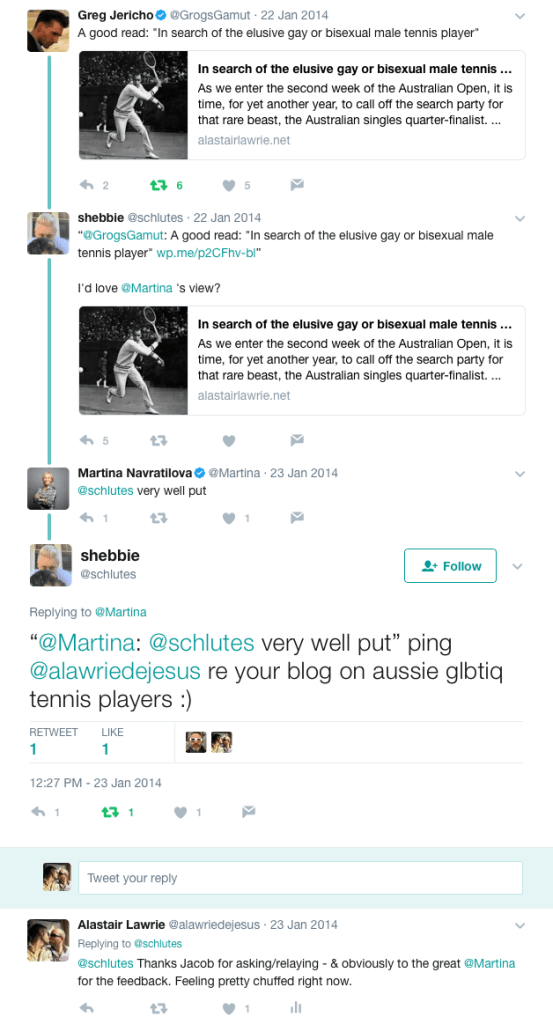
  • The great Martina Navratilova tweeting that my piece In search of the elusive gay or bisexual male tennis player was “very well put” (it also happens to be the most popular piece I’ve ever published, by far), and
  • A comment from inspiring ACT UP activist Peter Staley on my review of the Oscar-nominated documentary ‘How to Survive a Plague’ in which he features (the review itself was far from best thing I’ve written – but his engagement made it worthwhile).


Martina


  1. Audience Reach


Another satisfying part of ‘blogging’ is seeing what you’ve written reach its audience. Admittedly, writing a blog that primarily concerns itself with LGBTI law reform and policy, in Australia, is the definition of a ‘niche’ endeavour.


Nevertheless, over the past five years my blog has received almost 90,000 views, and (as of 11 June 2017) has been visited by people in 189 different geographic regions. In fact, there aren’t many countries where someone hasn’t clicked on something I’ve written (although I am still waiting for first-time readers from North Korea, Turkmenistan, Liechtenstein, Greenland, Cuba, French Guiana, Lesotho, the Democratic Republic of Congo and, in our own region, Samoa and the Solomon Islands).


Obviously, choosing to write about the things I do means it is never going to be ‘clickbait’ – but it is still pleasing to know some people have found what I’ve written to be informative, or enjoyable (or hopefully a combination of both).


  1. Thanks


Which brings me to the most important part of this post – and that is to say thanks. Thank you to you, the readers, who have clicked on, read, liked, commented on and shared the more than 200 articles, submissions and open letters I have published here.


I have genuinely appreciated your interest, your views (including where you thought I got something wrong) and your support. Writing this blog has been one of the most enjoyable things I’ve ever done, and being read by people who are passionate about the same things I am has definitely made it worthwhile.


But of course there is one person who deserves the most thanks of all – and that is my partner of almost nine years, and fiancé of more than seven, Steven. His support, encouragement, patience and, above all, belief has allowed me to devote my time and energy to this blog, and to the campaigns I have run here – I literally could not have done any of this without him. Thank you my beautiful man.


And that brings me to the underlying reason for this post. After almost five years of writing this blog, it is time to take a step – maybe even two – back and to focus on other things. This reflects an understandable desire to spend more of my available time with my fiancé. It also coincides with changing jobs (my new role will consume much more of my focus, especially in the next year or two).


At this stage, I’m still not 100% sure whether I will stop blogging completely, or whether it will simply be far less frequent (every couple of months, rather than three or four posts per month) or perhaps even about other subjects. Whatever the future holds, I’d just like to say that I hope you’ve enjoyed what I’ve written so far, and that I hope it has made a difference in some way, shape or form. Thanks very much for reading.

The State of Homophobia, Biphobia & Transphobia Survey Results, Part 6: Discrimination in Health, Community Services or Aged Care

This post is the final in a series of six, reporting the results of The State of Homophobia, Biphobia & Transphobia survey I conducted at the start of 2017[i].


In all, 1,672 lesbian, gay, bisexual, transgender, intersex and queer (LGBTIQ) Australians provided valid responses to that survey.


In this article, I will be focusing on their answers to four questions, asking whether they have experienced discrimination in health, community services or aged care, whether any of this discrimination occurred in the past 12 months, whether this discrimination related to religious organisations and to provide an example of the discrimination that they experienced.


The responses reveal a disturbing pattern of discrimination across these areas, with many LGBTIQ Australians denied equal access to services simply because of their sexual orientation, gender identity or intersex status.


The question about whether any of this discrimination occurred in relation to religious organisations is important because of the existence of ‘special rights’ to discriminate for these bodies in most states and territories[ii], leaving LGBTI people in these circumstances without any legal redress.


I also encourage you to read the examples provided in response to question four, which reveal some of the different types of discrimination that LGBTIQ people have encountered in health, community services or aged care.


The State of Homophobia, Biphobia & Transphobia-11


Question 1: Have you ever experienced discrimination because of your sexual orientation, gender identity or intersex status in relation to health, community services or aged care


Question 2: Has one or more instances of this discrimination (in health, community services or aged care) occurred in the past 12 months?


&


Question 3: Did any of this discrimination (in health, community services or aged care) occur in relation to a religious organisation?


Of the 1,611 people who answered the first question, 345 – or 21% – said they had experienced discrimination in one of these areas at some point in their lives.


Disturbingly, 189 survey respondents[iii] reported experiencing anti-LGBTIQ discrimination in health, community services or aged care in the past 12 months alone. In other words, more than half of those who had experienced discrimination in these areas reported at least one instance of this mistreatment just in 2016 – that is simply shocking.


The proportion reporting discrimination by religious organisations was 3.7%[iv]. This is thankfully lower than the rates reported for discrimination by religious organisations in education (Survey Results, Part 4) and employment (Survey Results, Part 5), although this nevertheless represents roughly 1 in 25 LGBTI people exposed without adequate protections from anti-discrimination schemes.


LGBTIQ Status


There were some significant differences in reported discrimination in health, community services and aged care between lesbian, gay, bisexual, transgender, intersex and queer survey respondents:


Lesbian


  • 26.5%[v] reported discrimination in these areas at some point
  • 14.5%[vi] experienced at least one instance in the last 12 months
  • 3.5%[vii] experienced discrimination by a religious organisation


Gay


  • 19.8%[viii] reported discrimination in these areas at some point
  • 9.9%[ix] experienced at least one instance in the last 12 months
  • 2.7%[x] experienced discrimination by a religious organisation


Bisexual


  • 16.1%[xi] reported discrimination in these areas at some point
  • 8.7%[xii] experienced at least one instance in the last 12 months
  • 4.7%[xiii] experienced discrimination by a religious organisation


Transgender


  • 35.3%[xiv] reported discrimination in these areas at some point
  • 24.9%[xv] experienced at least one instance in the last 12 months
  • 3.8%[xvi] experienced discrimination by a religious organisation


Intersex


  • 40%[xvii] reported discrimination in these areas at some point
  • 13.3%[xviii] experienced at least one instance in the last 12 months
  • 6.7%[xix] experienced discrimination by a religious organisation


Queer


  • 29.6%[xx] reported discrimination in these areas at some point
  • 19.2%[xxi] experienced at least one instance in the last 12 months
  • 4.6%[xxii] experienced discrimination by a religious organisation


LGBTIQ Category Experienced anti-LGBTIQ discrimination in health, community services or aged care (%)?
Ever Last 12 months By religious organisation
Lesbian 26.5 14.5 3.5
Gay 19.8 9.9 2.7
Bisexual 16.1 8.7 4.7
Transgender 35.3 24.9 3.8
Intersex 40 13.3 6.7
Queer 29.6 19.2 4.6


The highest rate for lifetime discrimination was from intersex respondents, although the small sample size for that group (n=15) means this figure should be treated with some caution. It is also interesting that intersex people reported average rates of recent discrimination in these areas.


Of the other groups, gay and particularly bisexual respondents reported lower rates of both lifetime, and recent, discrimination in health, community services and aged care than other groups.


In contrast to earlier survey results, lesbians reported higher rates of discrimination on both measures. One possible explanation is greater involvement, and therefore potential exposure to discrimination in, family-related health and community services.


Once again, higher rates of discrimination, and especially recent mistreatment, were reported by transgender and, to a slightly lesser extent, queer survey respondents.


It is particularly disturbing that one in five queer respondents, and fully one quarter of trans people, experienced discrimination in these areas in the past 12 months alone.


Taking a closer look at the trans cohort, and in particular respondents who identified as both trans and another LGBQ category, the figures were as follows:


Trans and lesbian: 37.2%[xxiii] ever, and 25.6% in the last 12 months


Trans and gay: 40.4%[xxiv] ever, and 28.1% in the last 12 months


Trans and bisexual: 26.7%[xxv] ever, and 16.7% in the last 12 months, and


Trans and queer: 40.1%[xxvi] ever, and 32.2% in the last 12 months.


These groups were largely consistent, although trans and bi respondents reported lower rates on both measures, while trans and queer respondents were more likely to experience recent discrimination (at almost 1 in 3 people overall).


Finally, there is little that stands out in the reported rates of discrimination by religious organisations in these areas, with the range from 2.7% (gay) to 6.7% (intersex).


Aboriginal and Torres Strait Islander People


The rates of discrimination for Aboriginal and/or Torres Strait Islander LGBTIQ people were higher for both lifetime discrimination, and especially for recent discrimination, than for their non-Indigenous counterparts.


On the other hand, Aboriginal and/or Torres Strait Islander LGBTIQ people reported lower rates of discrimination by religious organisations in health, community services or aged care. The full figures are as follows:


  • 24.6%[xxvii] reported discrimination in these areas at some point (compared to 21.3% of non-Indigenous people)
  • 17.5%[xxviii] experienced at least one instance in the past 12 months (compared to 11.5% of non-Indigenous people) and
  • 1.8%[xxix] experienced discrimination by a religious organisation (compared to 3.7% of non-Indigenous people).


  Experienced anti-LGBTIQ discrimination in health, community services or aged care (%)?
Ever Last 12 months By religious organisation
Aboriginal and/or Torres Strait Islander 24.6 17.5 1.8
Non-Indigenous 21.3 11.5 3.7


Age


Aged 24 and under


  • 15.7%[xxx] reported discrimination in these areas at some point
  • 10.8%[xxxi] experienced at least one instance in the past 12 months
  • 3.3%[xxxii] experienced discrimination by a religious organisation


25 to 44


  • 31.1%[xxxiii] reported discrimination in these areas at some point
  • 15.8%[xxxiv] experienced at least one instance in the past 12 months
  • 3.9%[xxxv] experienced discrimination by a religious organisation


45 to 64


  • 23.7%[xxxvi] reported discrimination in these areas at some point
  • 9.1%[xxxvii] experienced at least one instance in the past 12 months
  • 4%[xxxviii] experienced discrimination by a religious organisation


65 and over


  • 25.8%[xxxix] reported discrimination in these areas at some point
  • 9.7%[xl] experienced any instance in the past 12 months
  • 9.7%[xli] reported discrimination by a religious organisation


Age cohort Experienced anti-LGBTIQ discrimination in health, community services or aged care (%)?
Ever Last 12 months By religious organisation
24 and under 15.7 10.8 3.3
25 to 44 31.1 15.8 3.9
45 to 64 23.7 9.1 4
65 and over 25.8 9.7 9.7


Given their lesser years of life experience, it is perhaps unsurprising that young people experienced lower levels of lifetime discrimination in these areas. Although the fact that more than 1 in 10 LGBTIQ people aged 24 or under reported homophobic, biphobic, transphobic or intersexphobic discrimination in health or community services over the past 12 months is alarming.


What is perhaps most surprising is that people aged 25 to 44 were most likely to report both lifetime discrimination in these areas (with almost a third of respondents affected), as well as anti-LGBTIQ discrimination in the past 12 months (at almost 1 in every 6 respondents).


Meanwhile, the highest rate of reported discrimination by religious organisations was from LGBTIQ people aged 65 and over – which is possibly explained by recent interactions with religious-operated aged care services.


State or Territory of Residence


The final demographic category according to which I have analysed the survey results is the state or territory of residence:


New South Wales


  • 21.4%[xlii] reported discrimination in these areas at some point
  • 10.9%[xliii] experienced at least one instance in the last 12 months
  • 2.7%[xliv] experienced discrimination by a religious organisation


Victoria


  • 22.8%[xlv] reported discrimination in these areas at some point
  • 12.4%[xlvi] experienced at least one instance in the last 12 months
  • 4%[xlvii] experienced discrimination by a religious organisation


Queensland


  • 22%[xlviii] reported discrimination in these areas at some point
  • 11.4%[xlix] experienced at least one instance in the last 12 months
  • 6.1%[l] experienced discrimination by a religious organisation


Western Australia


  • 22.1%[li] reported discrimination in these areas at some point
  • 12.8%[lii] experienced at least one instance in the last 12 months
  • 2.7%[liii] experienced discrimination by a religious organisation


South Australia


  • 19.5%[liv] reported discrimination in these areas at some point
  • 14.3%[lv] experienced at least one instance in the last 12 months
  • 3%[lvi] experienced discrimination by a religious organisation


Tasmania


  • 16%[lvii] reported discrimination in these areas at some point
  • 10.4%[lviii] experienced at least one instance in the last 12 months
  • 1.9%[lix] experienced discrimination by a religious organisation


Australian Capital Territory


  • 23.2%[lx] reported discrimination in these areas at some point
  • 10.7%[lxi] experienced at least one instance in the last 12 months
  • 7.1%[lxii] experienced discrimination by a religious organisation


Northern Territory


  • 20%[lxiii] reported discrimination in these areas at some point
  • 10%[lxiv] experienced at least one instance in the last 12 months
  • 5%[lxv] experienced discrimination by a religious organisation


State or territory Experienced anti-LGBTIQ discrimination in health, community services or aged care (%)?
Ever Last 12 months By religious organisation
NSW 21.4 10.9 2.7
Victoria 22.8 12.4 4
Queensland 22 11.4 6.1
WA 22.1 12.8 2.7
SA 19.5 14.3 3
Tasmania 16 10.4 1.9
ACT 23.2 10.7 7.1
NT 20 10 5


These results were largely consistent across state and territory boundaries (thus lending weight to the overall figures, discussed earlier).


The lowest lifetime rates of discrimination in health, community services or aged care were in Tasmania, while the highest (but only just) were in the ACT. Meanwhile, South Australians were most likely to experience discrimination in the last 12 months, while LGBTIQ people in Queensland and the ACT reported the highest rates of discrimination in these areas by religious organisations.


**********


Question 4: If you feel comfortable, please provide an example of the discrimination you experienced in relation to health, community services or aged care [Optional]:


This question allowed respondents to provide examples of the anti-LGBTIQ discrimination they had experienced and, just as with previous survey results, these comments are often confronting to read.


A lightly-edited[lxvi] version of the answers to this question – providing examples of homophobic, biphobic, transphobic and intersexphobic discrimination in relation to health, community services or aged care – can be found at the following link:


question-4-examples-of-health-community-services-and-aged-care-discrimination


These answers demonstrate a range of different ways in which LGBTIQ people were mistreated in comparison to cisgender heterosexual people, including:


One of the most common stories was denial of LGBTIQ relationships, including refusal to treat partners as next of kin:


“I was asked if I was in a relationship and what not and gender during a visit to a new and local doctor, I said yes and gender non-binary and I was put down as single and female. Single because my partner was a woman and the system didn’t have an option for same sex couples and it was “easier”.”


“Having my female partner not being able to be with me in emergency because it was family and partners only. (Had no family in the region at the time)”


“My wife was in emergency at [redacted] Hospital and the doctor did not want to discuss with me her condition or provide me with a carers certificate because of our sexuality”


“While an inmate in the mental health unit, the doctor assigned to me was very uncomfortable when my partner was in the room. And even though I gave permission, he would not treat my partner with respect or discuss my care with her.”


“At a hospital where my partner of over ten years was not accepted as my next of kin. I had to put my son down”


“Was at a hospital after becoming very ill and my girlfriend was holding my hand. Once my nurse noticed, her attitude towards me changed and she told me that “friends” couldn’t visit”


“While my girlfriend was in hospital and had come in via ambulance I was denied access to her / the ability to see her while she was in the emergency department because a receptionist didn’t believe we were partners. Clearly thought I was ‘just a friend’”


“I was critically ill and my partner was ignored by hospital staff as my next of kin”


Another common story related to an assumption that being gay (or bi, or trans) automatically equates to being at high risk of HIV, including being subjected to additional testing or ‘safety precautions’ – or, in one case, being denied testing:


“Feeling like the dentist did not want to treat me because I answered the at risk of HIV questions (in the 90s)”


“Disclosing that I had a same sex partner opened me up to extra medical testing before procedures, including unnecessary HIV testing unrelated to my procedure.”


“I was informed that due to being bisexual, I was at a high risk of STDs, regardless of the fact that I am married and in a monogamous relationship.”


“A doctor was dismissive of my health concerns and wrote me off as an HIV magnet for being transgender.”


“Because I am open about being gay, I have been repeatedly advised by health practitioners to have an HIV test when consulting them about a range of health issues that have no relation to HIV. Of course, I have had HIV tests and would do so again if I thought I had been at risk.”


“A GP refused to test me for HIV as he had “better things to do than take care of sexually promiscuous people like” me. I had not told him anything about my sex life apart from the fact that I was gay – this was purely a homophobic assumption on his behalf. He suggested I go to a free sexual health centre in the city instead.”


It is unsurprising that these attitudes translated to adverse treatment of people who are HIV-positive:


“A doctor was bombastic when I presented at ED when he learned I was HIV +. He just carried on about my HIV Status and not the issue I presented for”


Several respondents cited the blanket ban on sexually-active gay men donating blood as being anti-LGBTIQ discrimination:


“Apparently just cause I’m gay I can’t donate blood, even tho [sic] I get tested all the time probably more times than a straight person would in their life time”


“Gay men are not allowed to give blood if they’ve had sex within the past year. It is alienating and presumptuous”


This approach also applies to some transgender people:


“Refused to donate blood. Because blood donation is a purely altruistic act, this makes one feel apart from the community. The policy of the local blood collection organisations is to treat all transgender people like gay men, irrespective of the sex they were assigned at birth, the state of the individual’s legal document, the individual’s genitals, etc.”


There was a range of stories about homophobia from GPs:


“I had a sore throat and my GP suggested that it may be because men weren’t designed to suck cock.”


“Doctor called me a homo, and multiple doctors being uncomfortable discussing sexual health issues once finding out my sexuality.”


“Being told by a doctor that I am more prone to disease because I am homosexual”


“A GP at my local health centre treated me with caution and wrote a ridiculous warning on my medical file for anyone to see. “Warning: Homosexual relations”.”


Lesbian respondents also described a variety of discrimination they had experienced:


“Talking about sex with GPs and health providers, there’s an assumption that sex is only with the opposite sex and that nothing else is sexual. Even when in a monogamous same sex relationship doctors would assume and ask questions about male sex partners and dismiss my actual partner. Ie, could you be pregnant? When they know I’m a cis woman only having sex with a cis woman.”


“Local doctor told me that I couldn’t go on the pill to stop my painful periods due to endometriosis because I was not in a sexually active relationship with a man, that because I was lesbian and not at risk of falling pregnant there was no need to be put on the pill”


“I have had a doctor tell me that I shouldn’t get a pap smear because I had never had sex with someone who had a penis, which is just wrong information and could be detrimental to my health. This denial was also mixed with her confusion and homophobia around the fact that I was queer and I felt very uncomfortable and shamed.”


This included a particularly-horrific situation involving sexual assault:


“I have received many instances of refusal of care or denial of optimal care by health professionals because of my sexuality. But the one that still traumatises me is when I went for a Pap smear with a female gp and she inserted her fingers into my vagina (for what I now know is an optional test) without telling me. I screamed and told her to stop, but she continued saying people like me like this kind of thing…she raped me. While looking at me in the face. Because I am gay.”


As with previous survey results, the most frequent stories of discrimination came from trans respondents. This included blatant transphobia, as well as deadnaming and misgendering:


“I was referred to by a receptionist to one of her co-workers as ‘a dude who wants to cut his d*ck off.’ The other replied with ‘well, you don’t want those types to breed.’”


“In 2005 I was involved in a car crash which necessitated a precautionary visit to the emergency dept at [redacted] in Perth. An orderly could not contain his mirth at me being a transgender person and kept commenting about it and laughing at me several times over a period of hours while I was required to stay motionless on my back awaiting a spinal scan.”


“I was repeatedly misgendered by nurses in a public hospital despite my efforts to correct them”


“being continually misgendered and deadnamed at a hospital”


“No doctor has refused to treat me but I have had doctors refuse to refer to me as a male once they find out, or assume every ailment must be linked to being transgender.”


It also included a refusal to provide essential trans-related medical services:


“Doctor telling me I should not get PBS for testosterone because it’s a lifestyle choice not a medical condition”


“Had a doctor tell me to stop HRT because it was dangerous, he did not seem to think being trans was real.”


“Was prevented from getting access to medical treatment and to start my transitioning for over 6 yrs by doctors.”


“My first psychiatrist was a gatekeeper who denied me access to services essential to transition.”


Several trans respondents complained about systemic discrimination in place simply to access transition:


“I think having to get diagnosed with gender dysphoria and have your life torn open by a psychologist is fucking pretty discriminatory. It’s bullshit. My body, my rules.”


“the entire process for getting access to gender related assistance is transphobic”


This comment seemed to sum up the feelings of many:


“Most doctors are totally clueless about how to treat trans people.”


A concerning theme to several stories was homophobic, biphobic and transphobic treatment of LGBTIQ people accessing mental health services:


“I was in a psychiatric ward for severe mental health issues and I mentioned that I was queer. The registrar fixated on it and tried to make it out that my sexuality was the root of all my problems. He tried to pathologise it.”


“I also had a session with a counsellor who referred to me as having a split personality when they found out I was Transgender.”


“Psychologists were the worst, though. I have serious mental illness and part of the problem was sexual assault trauma and problems with harassment and discrimination because of being bisexual. The psychologists told me that it didn’t exist and that I had to choose and that “if you want women it means you need mothering in your relationships so work on that with men”. Dangerous lies.”


“My counsellor didn’t “believe” in LGBT people or issues and told me I just needed to “get a job, join a gym and eat healthy””


“In a psychiatric ward I got told that my being gay was a part of my mental illness and a contributing factor to my depression”


Domestic and family violence was also cited as an area of anti-LGBTIQ discrimination:


“I’ve contacted domestic violence places for support groups and been told ‘women only’ even though I’m non-binary, assigned female at birth, and don’t pass as male. When I’ve asked where I’m meant to go, they’re suggested men’s behavioural change programs (I was the victim, I ended up with PTSD!) and then said they had no idea.”


“DV situation cops didn’t take a woman abusing a woman seriously”


“Having no services for DV Support to get help after a 8 yr DV relationship. Mainstream services having no understanding of LGBTIQ relationships/ community”


Finally, there were several examples of anti-LGBTIQ discrimination on the basis of religious belief:


“I was hospitalised for a suicide attempt. While there, I was sent a chaplain instead of a nurse to watch me. He spent 6 hours telling me how I was going to hell and how much god hated me and my gender was all in my head.”


“I was offered help by the salvation army after I was forced to leave home. I was told that I could just go home, once I mentioned that the cause of my situation was abuse related to my sexuality, the belief seemed to be that I should somehow change my mind and then my parents would accept me.”


“I was refused for a counselling service because the organization was religion based and insisted they wouldn’t work with someone that was beyond help like me.”


“My job in regards to [employment-related organisation] was with a religious org and it ran aged care services. The org wouldn’t recognise an aging couple’s relationship and they were placed in 2 separate care homes”


**********


Conclusion


The results of these four questions have confirmed that homophobic, biphobic, transphobic and intersexphobic discrimination in health, community services or aged care is relatively widespread, and has a significant impact on many lesbian, gay, bisexual, transgender, intersex and queer Australians.


This includes more than 1 in every 5 respondents people reporting lifetime experience of such discrimination, with 11.7% reporting at least one instance of anti-LGBTIQ discrimination in health, community services or aged care in the last 12 months alone.


Some groups within the community reported even higher rates than these already high averages, with intersex and trans people, Aboriginal and/or Torres Strait Islander LGBTIQ people and people aged 25 to 44 particularly affected.


While the rates of discrimination by religious organisations were comparatively low, it is important to note than in most cases, such discrimination is entirely lawful, due to the wide-ranging and completely unjustified religious exceptions to anti-discrimination laws in the majority of Australian jurisdictions.


The personal examples of discrimination in health, community services and aged care shared in response to question 4 demonstrate the different forms such prejudice can take, with many heart-breaking stories of homophobia, transphobia and even discrimination by mental health services.


As noted at the beginning of this post, this has been the last in my series of six articles reporting the results of my The State of Homophobia, Biphobia and Transphobia survey.


Thank you to all those people who participated in the survey, and of course to everyone who has read the results I have published. Hopefully, through this process we have demonstrated the ongoing problems caused by homophobia, biphobia, transphobia and intersexphobia in Australia – and the urgent need for our lawmakers and decision-makers to take action to address these issues.


Finally, if you would like to continue to receive articles on LGBTI rights, please sign up to this blog: on mobile, at the bottom of this page, or on desktop at the top right-hand corner of the screen.


**********


If this post has raised any issues for you, you can contact:


  • QLife, Australia’s national telephone and web counselling and referral service for LGBTI people.

Freecall: 1800 184 527, Webchat: qlife.org.au (3pm to midnight every day)


Footnotes:

[i] The previous posts can be found here:

Part 1: Verbal Harassment and Abuse

Part 2: Physical Abuse or Violence

Part 3: Where Discriminatory Comments Occur and Their Impact 

Part 4: Discrimination in Education

Part 5: Discrimination in Employment

[ii] Noting that discrimination against LGBTI people accessing aged care services from Commonwealth-funded aged care facilities operated by religious organisations is prohibited by the Sex Discrimination Act 1984 (although those same protections do not cover LGBTI employees in those facilities).

[iii] 343 people responded to question 2: 189 yes/154 no.

[iv] 344 people responded to question 3: 59 yes/285 no.

[v] 317 people responded to question 1: 84 yes/233 no.

[vi] 46 respondents.

[vii] 11 respondents.

[viii] 626 people responded to question 1: 124 yes/502 no.

[ix] 62 respondents.

[x] 17 respondents.

[xi] 508 people responded to question 1: 82 yes/426 no.

[xii] 44 respondents.

[xiii] 24 respondents.

[xiv] 365 people responded to question 1: 129 yes/236 no.

[xv] 91 respondents.

[xvi] 14 respondents.

[xvii] 15 people responded to question 1: 6 yes/9 no. Note that, given the small sample size, these percentages should be treated with some caution.

[xviii] 2 respondents.

[xix] 1 respondent.

[xx] 480 people responded to question 1: 142 yes/338 no.

[xxi] 92 respondents.

[xxii] 22 respondents.

[xxiii] 43 respondents total, with 16 yes to question 1 and 11 yes to question 2.

[xxiv] 57 respondents total, with 23 yes to question 1 and 16 yes to question 2.

[xxv] 120 respondents total, with 32 yes to question1 and 20 yes to question 2.

[xxvi] 183 respondents total, with 75 yes to question 1 and 59 yes to question 2.

[xxvii] 57 people responded to question 1: 14 yes/43 no.

[xxviii] 10 respondents.

[xxix] 1 respondent.

[xxx] 860 people responded to question 1: 135 yes/725 no.

[xxxi] 93 respondents.

[xxxii] 28 respondents.

[xxxiii] 431 people responded to question 1: 134 yes/297 no.

[xxxiv] 68 respondents.

[xxxv] 17 respondents.

[xxxvi] 274 people responded to question 1: 65 yes/209 no.

[xxxvii] 25 respondents.

[xxxviii] 11 respondents.

[xxxix] 31 people responded to question 1: 8 yes/23 no. Note that, given the small sample size, these percentages should be treated with some caution.

[xl] 3 respondents.

[xli] 3 respondents.

[xlii] 524 people responded to question 1: 112 yes/412 no.

[xliii] 57 respondents.

[xliv] 14 respondents.

[xlv] 378 people responded to question 1: 86 yes/292 no.

[xlvi] 47 respondents.

[xlvii] 15 respondents.

[xlviii] 245 people responded to question 1: 54 yes/191 no.

[xlix] 28 respondents.

[l] 15 respondents.

[li] 149 people responded to question 1: 33 yes/116 no.

[lii] 19 respondents.

[liii] 4 respondents.

[liv] 133 people responded to question 1: 26 yes/107 no.

[lv] 19 respondents.

[lvi] 4 respondents.

[lvii] 106 people responded to question 1: 17 yes/89 no.

[lviii] 11 respondents.

[lix] 2 respondents.

[lx] 56 people responded to question 1: 13 yes/43 no.

[lxi] 6 respondents.

[lxii] 4 respondents.

[lxiii] 20 people responded to question 1: 4 yes/16 no. Note that, given the small sample size, these percentages should be treated with some caution.

[lxiv] 2 respondents.

[lxv] 1 respondent.

[lxvi] In this context, lightly-edited includes:

-Removing identifying information

-Removing potentially defamatory comments and

-Removing offensive remarks.

I have also corrected some spelling/grammatical mistakes for ease of reading.

Submission re Queensland Criminal Law (Historical Homosexual Convictions Expungement) Bill 2017

Update


The Criminal Law (Historical Homosexual Convictions Expungement) Act 2017 was passed in Queensland Parliament on 10 October 2017, and took effect on 23 October.


This was a historic achievement, meaning the majority of people who have criminal convictions as a result of prohibitions on male homosexual conduct in that state can now apply to have those records expunged.


But it is only a partial victory – because people who were criminalised due to the unequal age of consent, which existed between 1991 and 2016, are not able to apply. That’s because section 18(2)(a) limits relevant offences to where:


“the other person who engaged, or allegedly engaged, in the act of omission constituting the offence –

(i) consented to the act or omission; and

(ii) was 18 years or more at the time the offence was committed or alleged to have been committed.”


This is an incredibly disappointing outcome, exposing men who would not have been convicted but for the homophobic unequal age of consent which operated for a quarter of a century, to many more years of living with unjust convictions on their criminal records. And it means the campaign to expand the expungement scheme must continue.


Update: 15 July 2017


Stop me if you’ve heard this one before.


The Queensland Parliament is considering the issue of the decriminalisation of homosexuality but, rather than treating LGBTI people the same as their cisgender heterosexual counterparts, it discriminates against gay and bisexual men, leaving them with criminal records that they would not have were it not for their sexual orientation.


No, we’re not talking about the Goss Labor Government’s fundamentally flawed decriminalisation Bill in 1990 which, while decriminalising sex between men over the age of 18, imposed an unequal age of consent for anal intercourse – an injustice that was only remedied in September last year.


Instead, we’re talking about 2017, as the Queensland Parliament, and the Palaszczuk Labor Government, appears intent on making the same mistake.


As I wrote in my submission to the Parliamentary Inquiry (see the full text at the bottom of this post), the Criminal Law (Historical Homosexual Convictions Expungement) Bill 2017 will only deliver justice for some gay and bisexual men affected by past homophobic criminal laws, not all.


For men punished because of the unequal age of consent between 1991 and 2016, and for those who were convicted before 1991 but would not have been had they engaged in penis/vagina intercourse, this legislation simply perpetuates the injustices they have already suffered, leaving them with inappropriate criminal records.


This problem was raised by several people in submissions to the Legal Affairs and Community Safety Committee as part of their inquiry into this Bill (myself included). Unfortunately, rather than listen to the community, Committee members have chosen to listen to the unconvincing arguments put forward by the Department of Justice and Attorney-General (see below for an analysis of their responses on this issue).


In their Report, tabled yesterday (14 July), the Committee recommended only that the legislation be passed; it did not make any recommendations to amend the Bill to ensure that all Queenslanders adversely affected by past criminalisation of homosexuality can apply to have their records expunged.


This Report means it is now highly unlikely the Queensland Parliament will fix the mess created by the provisions of the Bill, a mess that compounds past mistakes and once again means gay and bisexual men are treated worse because of who they are.


This discrimination is enough to invoke a bad case of déjà vu. The only question is, will it take Queensland Parliament another quarter of a century to realise the error of its ways and amend the expungements scheme, in the same way it finally amended the age of consent? Because that is too long to wait for justice, for men who have waited long enough already.


Update: 8 July 2017

Following publication of the 13 submissions received by this inquiry (including mine, reproduced in full below), the Queensland Department of Justice and Attorney-General responded to the issues that had been identified. Their letter can be found at the Inquiry website here.


Given my submission was the first received that raised serious concerns about the failure of the Bill to expunge the convictions of people prosecuted because of the unequal age of consent between 1991 and 2016, as well as the omission of people aged 16 and 17 prior to 1991, the Department addressed these issues in response to my submission (on pages 2-4).


Unfortunately, its response was underwhelming, and in some places seems to have completely missed the point of the expungement scheme.


First, the Department’s weakest argument against including people convicted due to the unequal age of consent between 1991 and 2016 was that “[t]he scheme would cease to be historical in nature and it may be considered inappropriate for such recent convictions to be expunged administratively…”


To which the obvious response is that it should not matter when an injustice occurred – whether it was 1978 or 2008 – it should be remedied.


Second, and of much greater concern, the Department argued that “[e]xtending the scheme to convictions for consensual anal intercourse with 16 and 17 year olds between 1991 and 2016 would mean that the scheme may extend to people who are currently serving sentences relevant to those convictions.”


The Department is effectively conceding that there may be people who are currently being punished for offences that would not have applied were it not for Queensland’s discriminatory treatment of anal intercourse for the past quarter of a century. That is not a justification not to extend the scheme – that is a reason to examine those convictions to determine whether they should be immediately overturned.


Third, the Department argued that including convictions between 1991 and 2016 due to the unequal age of consent “would require the decision maker to go behind the exercise of recent prosecutorial discretion”. To support this, the Department specifically cites the Director of Public Prosecution’s Guidelines as they existed at 30 August 2016.


There are two problems with this particular argument:


  • They are suggesting that people should rely on the ‘discretion’ not to prosecute, not just in recent years but also in the much less accepting (and more homophobic) 1990s. I am surely not the only person who harbours fears that at some point in the past 25 years this ‘discretion’ would have been exercised against gay and bisexual men;


  • Even the August 2016 guidelines are problematic. They state that “[a] child should not be prosecuted for sexual experimentation involving children of similar ages in consensual activity.” With all due respect, that is not the relevant criteria – the question is whether the people involved would have been convicted had it involved penis/vagina intercourse. Which means that an offence between a 16 or 17 year old and someone aged 18-plus that occurred between 1991 and 2016 should be included (even if that makes some parliamentarians feel uncomfortable).


Fourth, the Department argued that “if the scheme was extended to convictions for consensual anal intercourse with 16 and 17 year olds between 1991 and 2016, it would arguably be unfair to continue to restrict the scheme to convictions involving only homosexual activity.”


This is perhaps the only legitimate concern raised by the Department. Although it seems to me that, of the three possible options to deal with this issue, they have chosen the worst. These are:


  • To leave the scheme as is – which strands some gay and bisexual men without legal address, despite being punished because of laws that Minister for Health Cameron Dick conceded were “a source of discrimination against young people on the basis of their sexual orientation” (in his 2nd Reading Speech for the legislation that finally repealed the unequal age of consent).


  • To extend the scheme to gay and bisexual men affected by the unequal age of consent between 1991 and 2016, but not to anal intercourse between men and women. This may be prima facie discriminatory, but it does recognise the disproportionate impact of these laws on same-sex attracted people (who also did not have other lawful options for penetrative intercourse).


  • To widen the scheme to include non-LGBTI people who were also punished due to the differential treatment of anal intercourse between 1991 and 2016. This may substantially extend the scope of the scheme, but I would argue that it would be preferable to include these offences than to leave some gay and bisexual men with unfair and inappropriate criminal records, for sex offences, for the rest of their lives.


Fifth, and finally, is the worst of the arguments proffered by the Department: “[t]he Department notes that any expansion of the scheme would likely to [sic] increase the cost of the scheme.” That is not a reason to perpetuate injustice against gay and bisexual people who have been persecuted because of their sexual orientation under fundamentally unjust laws – that is a reason to provide additional funding (which, based on the Department’s letter, would likely be relatively modest).


Overall, then, I am extremely disappointed by the Department of Justice and Attorney-General’s response to my submission, which appears to be motivated more by staunchly defending the provisions of the current Bill than in grappling with the fact that, if passed, it would still leave some gay and bisexual men living with the consequences of past injustices.


Hopefully, the members of the Legal Affairs and Community Safety Committee are more persuaded by the submissions of myself, and others such as long-time campaigner John Frame that raised similar concerns, and propose amendments to address these outstanding issues. Their report is due by Friday 14 July, and I will provide a further update based on their recommendations.


Original Post

The Queensland Palaszczuk Labor Government has introduced legislation to establish a process whereby (some) people affected by the historical criminalisation of homosexuality in that state can apply to have those criminal records expunged.

This Bill is currently being considered by the Queensland Parliament Legal Affairs and Community Safety Committee. My submission to their inquiry is published below. For more details on the Bill, and the Committee’s examination of it, click here.


Acting Committee Secretary

Legal Affairs and Community Safety Committee

Parliament House

George Street

Brisbane QLD 4000

c/- lacsc@parliament.qld.gov.au


Friday 26 May 2017


Dear Committee


Submission re Criminal Law (Historical Homosexual Convictions Expungement) Bill 2017


Thank you for the opportunity to provide a submission in relation to the above-named Bill.


I support this legislation in principle, given it is aimed at redressing historical injustices experienced by members of the Queensland lesbian, gay, bisexual, transgender and intersex (LGBTI) community.


This Bill builds on the apology, delivered by Premier Annastacia Palaszczuk in Queensland Parliament on 11 May this year, in which she said:


“This Legislative Assembly offers its unreserved and sincere apology to all those persons who suffered from prejudice as a result of the discriminatory laws passed by this House, and we acknowledge that your pain and suffering continues.


“We acknowledge that shame, guilt and secrecy carried by too many for too long.


“Today, in this Legislative Assembly, we place on the record for future generations our deep regret and say to all those affected, we are sorry that the laws of this state, your State, let you down.


“To all those affected we say sorry.”


These noble sentiments were also reflected in the second reading speech for the Criminal Law (Historical Homosexual Convictions Expungement) Bill 2017 itself given by Attorney-General Yvette D’Ath:


“As this parliament apologises this afternoon, we should never forget that this abuse, this discrimination and this hatred was within our lifetime, and it was done in our name. We have seen important law reform since that time, over many years, in many stages. That includes significant reforms passed in the current Palaszczuk government, some with bipartisan support. Despite these important legislative changes, the pain and anguish caused by that earlier discrimination has never been removed for those affected Queenslanders. I am very proud to be a Labor Attorney-General finishing the important work that the Goss government started, and I am determined to get it right.”


Unfortunately, while I support both of these statements, on a practical level I cannot support the Criminal Law (Historical Homosexual Convictions Expungement) Bill 2017 in its current form.


That is because the Bill fails to address all relevant historical homosexual convictions, and instead only offers redress for one subset of the people affected by the criminalisation of homosexuality in Queensland.


This failure is based on two key flaws in the proposed expungement scheme.


The first flaw is that the Bill is limited to offences committed before 19 January 1991 – which is when the Criminal Code and Another Act Amendment Act 1990 came into effect.


As noted in the Explanatory Notes for the Bill, this is intended to “maintain the nexus between the proposed expungement scheme and decriminalisation.”


Such a ‘nexus’ would be appropriate if the legislation that implemented decriminalisation was itself non-discriminatory.


However, as current members of the Queensland Parliament are no doubt aware, the Criminal Code and Another Act Amendment Act 1990 was fundamentally unjust, in that it continued to subject anal intercourse to a higher age of consent (18 years) than other forms of sex (16 years).


This discriminatory approach primarily affected the gay and bisexual male community, and meant that for the following 25 years young same-sex attracted men in Queensland were disproportionately exposed to potential criminal sanctions for penetrative intercourse.


This discriminatory approach was only remedied in September last year, with the passage of the Health and Other Legislation Amendment Act 2016. In introducing that legislation, Minister for Health Cameron Dick stated:


“The Goss Labor government in 1990 decriminalised homosexuality, but that government introduced an anal intercourse law. The age of consent for consensual anal intercourse was set at 18 years.


“The expert panel of health experts asked to consider the implications of the current law advised me that the disparity in the age of consent for different sexual activity has adverse impacts on young people and recommended a consistent age of consent. Queensland cannot continue to discriminate between forms of sexual intercourse, particularly when we know that young people feel compelled to withhold information about their sexual history from health practitioners for fear of possible legal consequences, whether for themselves or their partner. This can have serious implications for their medical treatment, particularly as unprotected anal intercourse is the highest risk behaviour for transmission of HIV. It also has the effect of stigmatising same-sex relationships which in itself can be harmful for an individual’s wellbeing.”


Minister Dick concluded his speech by noting that:


“The Palaszczuk government is committed to improving sexual health outcomes for all Queenslanders regardless of their sexual orientation or preferences. The bill demonstrates this by standardising the age of consent for all forms of sexual intercourse, reflecting community expectations and removing a source of discrimination against young people on the basis of their sexual orientation…[emphasis added].


The Palaszczuk Government was right to identify that an unequal age of consent specifically discriminated against young people on the basis of their homosexuality and bisexuality. They, and the Queensland Parliament more generally, were also right to remedy this injustice by passing the Health and Other Legislation Amendment Act 2016 to finally introduce an equal age of consent.


Which makes it all-the-more puzzling why they have made the wrong decision in limiting the operation of the historical homosexual convictions expungement scheme to offences that occurred before 19 January 1991.


By tying the Criminal Law (Historical Homosexual Convictions Expungement) Bill 2017 to the ‘act’ of decriminalisation, they have effectively tied the Queensland expungement scheme to legislation that itself was discriminatory.


In doing so, they have developed a scheme that would deliberately exclude people who were charged or convicted for offences between January 1991 and September 2016 who would not have been were it not for their sexual orientation.


Those charges and convictions were also unjust, and that injustice should be addressed through this expungement scheme. To do otherwise – to exclude people adversely affected by the unequal age of consent which existed for a quarter of a century – is simply to perpetuate this discrimination.


It would also leave Queensland out of step with other Australian jurisdictions – with the equivalent NSW scheme allowing people charged or convicted because of the unequal age of consent which operated there between 1984 and 2003 to apply for those records to be expunged. Queensland should follow suit.


Recommendation 1: The Criminal Law (Historical Homosexual Convictions Expungement) Bill 2017 should apply to charges and convictions that were caused by the unequal age of consent for anal intercourse between January 1991 and September 2016.


The second, related flaw of this legislation is that, even for criminal offences committed prior to 19 January 1991, the right to apply to have these records expunged is limited to acts in which both parties were aged 18 years or over.


The rationale for this decision was explained in Attorney-General Yvette D’Ath’s second reading speech in the following way:


“[T]he criteria for the expungement of a Criminal Code male homosexual offence in the bill has regard to the age of consent at the date of decriminalisation on 19 January 1991 – that is, 18 years. This retains the expungement scheme’s nexus with the decriminalisation of consensual adult homosexual activity and confirms that the scheme is only applicable to historical charges and convictions. It also ensures that there is no discrimination between people charged or convicted with offences between 1991 and 2016 or people charged before the age of consent for sexual activity other than anal intercourse was changed in Queensland in 1976 from 17 years to 16 years.”


The question of what to do about the relevant age of consent prior to 1991 goes to the heart of the purpose of the expungement scheme.


If the purpose is simply to address offences prior to January 1991 that were decriminalised following the passage of the Criminal Code and Another Act Amendment Act 1990, then the approach adopted in the legislation, which limits the relevant age of consent to 18 years for all offences, admittedly has some internal consistency.


However, if the purpose of the expungement scheme is instead to provide redress to people who were charged or convicted primarily because of their sexual orientation, then I would argue that it must go further.


On a practical level, if this legislation is aimed at removing the stain of homophobia and biphobia from past laws, and above all from the criminal records of those who bore their impact, then the relevant test should not be how those acts were treated in 26-year-old legislation that, as we have seen above, was itself inherently flawed.


Instead, I believe the test should be whether the relevant act would have been criminalised if it involved consensual intercourse between a man and a woman, and specifically penis/vagina sex. Such a test goes to the core issue, which is discrimination – that the law treated gay and bisexual men differently to heterosexual people.


If this principle is adopted, then the scheme would allow people to apply with respect to:


  • Charges and convictions where both parties were 17 and over prior to 1976 (when the age of consent for penis/vagina sex was reduced to 16) and
  • Charges and convictions where both parties were 16 and over from 1976 onwards.


In this way, the legislation would actually better reflect the view, expressed in the Explanatory Notes, that:


“It is also an acknowledgment that the age of consent has changed over the years in accordance with changing societal values and expectations…”


That is because it would be based on changing societal attitudes to the age of consent for heterosexual, non-anal, intercourse, and therefore removed from discriminatory attitudes towards anal intercourse, and especially intercourse between men.


Further, if this principle was adopted, it would also provide philosophical consistency between those offences before January 1991 and those between January 1991 and September 2016 – provided Recommendation 1 is also adopted, the relevant age of consent would be 16 years for both.


Finally, this approach would also be more consistent with the position adopted by other jurisdictions – with section 105G of Victoria’s Sentencing Act 1991 setting out the relevant test as:


“on the balance of probabilities, both of the following tests are satisfied in relation to the entitled person:

(i) the entitled person would not have been charged with the historical homosexual offence but for the fact that the entitled person was suspected of having engaged in the conduct constituting the offence for the purposes of, or in connection with, sexual activity of a homosexual nature;

(ii) that conduct, if engaged in by the entitled person at the time of the making of the application, would not constitute an offence under the law of Victoria.”


Queensland should similarly ensure that the primary purpose of its expungement scheme is to provide redress for gay and bisexual men who were charged or convicted for offences for penetrative intercourse that would not have applied to penis/vagina sex between men and women.


Therefore, the relevant age of consent should be the same as that which applied to heterosexual, non-anal, sex: 17 before 1976, and 16 from that point onwards.


Recommendation 2: The Criminal Law (Historical Homosexual Convictions Expungement) Bill 2017 should apply to charges and convictions for offences where both parties were 17 and over before 1976, and 16 and over from 1976 onwards.


As stated earlier, I support the stated intention of the Queensland Government in developing, and introducing, this legislation: to provide redress for past injustices against members of the LGBTI community.


However, as I have explained above, I believe this admirable objective is imperfectly realised in the Criminal Law (Historical Homosexual Convictions Expungement) Bill 2017 as currently drafted.


That is because it would only achieve justice for some of the people adversely impacted by the past criminalisation of male same-sex activity, and not all.


If the purpose of the expungement scheme is to provide redress for the homophobic and biphobic application of the criminal law – and I suggest that this is the most appropriate objective – then it should apply to:


  • Offences between January 1991 and September 2016 where both people were aged 16 and over
  • Offences between 1976 and 1991 where both people were aged 16 and over, and
  • Offences before 1976 where both people were aged 17 and over.


In my view, this would be the closest approximation of treating all people – LGBTI and non-LGBTI alike – equally.


It would also ensure that more people, who have been subject to discrimination on the basis of their sexual orientation, and who continue to experience the consequences of this mistreatment, have access to expungement.


As observed by Attorney-General Yvette D’Ath in her second reading speech:


“We know that this is a deeply hurtful and deeply personal issue for many Queenslanders forced to live with the impact of discriminatory laws for far too long. We know that past convictions have meant there are various circumstances in which convictions or charges for criminal offences have been required to be disclosed.


“Forcing the repeated disclosure of those convictions and charges to potential employers, public administrators and others has caused people inconvenience and embarrassment and, worst of all, has forced them to continually relive the trauma associated with their arrest, charge and conviction. This has inhibited people from pursuing employment opportunities, volunteering in their communities and fully participating in civic life right up until today. It hurt those individuals, affected their friends and family, and prevented their full involvement in, and contribution to, our community. In doing so, it not only impacted individuals; it lessened our community more broadly.”


I wholeheartedly agree. But I also humbly suggest that these statements don’t just apply to ‘adults’ charged or convicted for offences committed before 19 January 1991 – they also describe the injustice experienced by people who suffered because of the discriminatory age of consent between January 1991 and September 2016.


Similarly, these sentiments reflect the adverse treatment of gay and bisexual men charged or convicted for penetrative intercourse before January 1991 who would not have been had it involved penis/vagina sex.


Both of these groups deserve justice too. That can and should be delivered through these two amendments to the Criminal Law (Historical Homosexual Convictions Expungement) Bill 2017, changes that strive to fully remove the stain of homophobia and biphobia from Queensland’s laws, thereby lessening the awful impact of discrimination on generations of gay and bisexual men.


Thank you for taking this submission into consideration as part of this inquiry. If the Committee would like to clarify any of the above, or to request additional information, please contact me at the details provided.


Sincerely

Alastair Lawrie


Palaszczuk

Premier Palaszczuk’s apology was welcome, but the Bill which gives it practical effect should cover all people adversely affected by historical convictions, not just some.

The State of Homophobia, Biphobia & Transphobia Survey Results, Part 5: Discrimination in Employment

This post is the fifth in a series of six, reporting the results of The State of Homophobia, Biphobia & Transphobia survey I conducted at the start of 2017[i].


In all, 1,672 lesbian, gay, bisexual, transgender, intersex and queer (LGBTIQ) Australians provided valid responses to that survey.


In this article, I will be focusing on their answers to four questions, asking whether they have ever experienced discrimination in employment, whether any of this discrimination occurred in the past 12 months, whether this discrimination related to employment by religious organisations and to provide an example of the discrimination that they experienced.


The responses to these questions confirm that too many LGBTIQ Australians have to worry about discrimination on the basis of their sexual orientation, gender identity and intersex status in the workplace on top of the usual career and financial worries.


The question about whether any of this discrimination occurred in relation to employment by a religious organisation is important because of the existence of special rights to discriminate for these employers in most states and territories, leaving LGBTI employees in these circumstances without any legal redress.


I also encourage you to read the examples provided in response to question four, which reveal some of the many different types of employment-related discrimination that LGBTIQ people have encountered.


The State of Homophobia, Biphobia & Transphobia-11


Question 1: Have you ever experienced discrimination because of your sexual orientation, gender identity or intersex status in relation to employment (including as an employee, contract worker or job applicant)?


Question 2: Has one or more instances of this employment-related discrimination occurred in the past 12 months?


&


Question 3: Did any of this discrimination occur in relation to employment, or an application for employment, with a religious organisation?


Of the 1,622 people who answered the first question, 491 – or 30% – said they had experienced employment-related discrimination at some point in their lives.


Disturbingly, 235 survey respondents[ii] reported experiencing anti-LGBTIQ discrimination in employment in the past 12 months alone. That is 14.5% of the total, or 1 in every 7 people who completed the survey.


The proportion that reported employment-related discrimination by religious organisations was 6.1%[iii]. This is thankfully much lower than the proportion that had reported discrimination by religious schools (in Survey Results, Part 4) – although that is likely a reflection of the expansive reach of religious schools, and comparatively smaller employment footprint of religious bodies.


Nevertheless, most of those 6% probably had no recourse to anti-discrimination protections given the excessive, and unjustified, exceptions provided to religious organisations in most Australian jurisdictions.


LGBTIQ Status


There were some significant differences in reported employment-related discrimination between lesbian, gay, bisexual, transgender, intersex and queer survey respondents:


Lesbian


  • 31.6%[iv] reported employment-related discrimination at some point
  • 15.3%[v] experienced at least one instance in the last 12 months
  • 7.8%[vi] experienced employment-related discrimination by a religious organisation


Gay


  • 34.3%[vii] reported employment-related discrimination at some point
  • 13%[viii] experienced at least one instance in the last 12 months
  • 5.9%[ix] experienced employment-related discrimination by a religious organisation


Bisexual


  • 20.3%[x] reported employment-related discrimination at some point
  • 11.1%[xi] experienced at least one instance in the last 12 months
  • 4.3%[xii] experienced employment-related discrimination by a religious organisation


Transgender


  • 44.4%[xiii] reported employment-related discrimination at some point
  • 29.2%[xiv] experienced at least one instance in the last 12 months
  • 6.8%[xv] experienced employment-related discrimination by a religious organisation


Intersex


  • 73.3%[xvi] reported employment-related discrimination at some point
  • 40%[xvii] experienced at least one instance in the last 12 months
  • 20%[xviii] experienced employment-related discrimination by a religious organisation


Queer


  • 30.3%[xix] reported employment-related discrimination at some point
  • 16.9%[xx] experienced at least one instance in the last 12 months
  • 6%[xxi] experienced employment-related discrimination by a religious organisation


LGBTIQ Category Experienced anti-LGBTIQ discrimination in employment (%)?
Ever Last 12 months By religious organisation
Lesbian 31.6 15.3 7.8
Gay 34.3 13 5.9
Bisexual 20.3 11.1 4.3
Transgender 44.4 29.2 6.8
Intersex 73.3 40 20
Queer 30.3 16.9 6


The highest rates for all three were from intersex respondents, although the small sample size for that group (n=15) means those figures should be treated with some caution.


Of the other groups, there was a large degree of consistency, with two main exceptions:


  • Bisexual respondents reported significantly lower rates of employment-related discrimination in all three areas (ever, last 12 months and by religious organisations), and
  • Transgender respondents reported significantly higher rates of lifetime employment-related discrimination, and particularly in the last 12 months (although, interestingly, not in terms of discrimination by religious organisations).


Taking a closer look at the trans cohort, and in particular respondents who identified as both trans and another LGBQ category, the figures[xxii] were as follows:


Trans and lesbian: 37.2%[xxiii] ever, and 25.6% in the last 12 months


Trans and gay: 47.4%[xxiv] ever, and 28% in the last 12 months


Trans and bisexual: 36.1%[xxv] ever, and 24.6% in the last 12 months, and


Trans and queer: 42.2%[xxvi] ever, and 25.9% in the last 12 months.


While there was little variation in terms of discrimination over the past 12 months (at a disturbingly high 1-in-4 across all groups), trans and queer, and especially trans and gay respondents were more likely to report lifetime discrimination in employment than the other two groups.


Overall, then, while lesbian, gay and queer people reported close-to-(the LGBTIQ)-average levels of employment-related discrimination across the board, bisexual respondents reported lower rates.


On the other hand, intersex and transgender respondents were particularly affected by discrimination in employment, with people who were both trans and gay and (to a lesser extent) trans and queer more likely to report lifetime discrimination.


Aboriginal and Torres Strait Islander People


The rates of discrimination for Aboriginal and/or Torres Strait Islander LGBTIQ people were higher for all three questions than for their non-Indigenous counterparts, although thankfully in relation to discrimination in the past 12 months and by religious organisations these rates were only slightly elevated:


  • 37.9%[xxvii] reported employment-related discrimination at some point (compared to 30% of non-Indigenous people)
  • 15.5%[xxviii] experienced at least one instance in the past 12 months (compared to 14.5% of non-Indigenous people) and
  • 6.9%[xxix] experienced employment-related discrimination by a religious organisation (compared to 6.1% of non-Indigenous people).


Experienced anti-LGBTIQ discrimination in employment (%)?
Ever Last 12 months By religious organisation
Aboriginal and/or Torres Strait Islander 37.9 15.5 6.9
Non-Indigenous 30 14.5 6.1


Age


These results are potentially the most interesting of this post:


Aged 24 and under


  • 20.9%[xxx] reported employment-related discrimination at some point
  • 13.8%[xxxi] experienced at least one instance in the past 12 months
  • 3.8%[xxxii] experienced employment-related discrimination by a religious organisation


25 to 44


  • 36.9%[xxxiii] reported employment-related discrimination at some point
  • 16.2%[xxxiv] experienced at least one instance in the past 12 months
  • 7%[xxxv] experienced employment-related discrimination by a religious organisation


45 to 64


  • 48.5%[xxxvi] reported employment-related discrimination at some point
  • 16.1%[xxxvii] experienced at least one instance in the past 12 months
  • 11.3%[xxxviii] experienced employment-related discrimination by a religious organisation


65 and over


  • 41.9%[xxxix] reported employment-related discrimination at some point
  • None experienced any instance in the past 12 months
  • 16.1%[xl] reported discrimination at a religious school or college


Age cohort Experienced anti-LGBTIQ discrimination in employment (%)?
Ever Last 12 months By religious organisation
24 and under 20.9 13.8 3.8
25 to 44 36.9 16.2 7
45 to 64 48.5 16.1 11.3
65 and over 41.9 0 16.1


Young people obviously have less employment history, and therefore the lower rates of reported lifetime discrimination are perhaps unsurprising. However, the fact that almost 1-in-7 suffered employment-related discrimination during the past 12 months alone, when a significant share would not even be in the workforce at all, is shocking.


Lifetime rates of discrimination then increase for the next two age groups, peaking at almost 1-in-2 for LGBTIQ people aged 45 to 64. In effect, just as many people in this cohort have experienced discrimination in employment as those who have escaped its impact – another remarkable statistic.


Perhaps just as depressing is the fact that for both people aged 25 to 44, and 45 to 64, the rates of recent anti-LGBTIQ prejudice in employment were roughly the same – at a time when they should be more ‘secure’ in their careers, almost 1-in-6 experienced employment related discrimination in the last year alone.


State or Territory of Residence


The final demographic category according to which I have analysed the survey results is the state or territory of residence:


New South Wales


  • 28.7%[xli] reported employment-related discrimination at some point
  • 13.4%[xlii] experienced at least one instance in the last 12 months
  • 5.7%[xliii] experienced employment-related discrimination by a religious organisation


Victoria


  • 33%[xliv] reported employment-related discrimination at some point
  • 14.2%[xlv] experienced at least one instance in the last 12 months
  • 6.6%[xlvi] experienced employment-related discrimination by a religious organisation


Queensland


  • 36.6%[xlvii] reported employment-related discrimination at some point
  • 17.5%[xlviii] experienced at least one instance in the last 12 months
  • 6.9%[xlix] experienced employment-related discrimination by a religious organisation


Western Australia


  • 32.7%[l] reported employment-related discrimination at some point
  • 17.3%[li] experienced at least one instance in the last 12 months
  • 5.3%[lii] experienced employment-related discrimination by a religious organisation


South Australia


  • 26.3%[liii] reported employment-related discrimination at some point
  • 15.8%[liv] experienced at least one instance in the last 12 months
  • 7.5%[lv] experienced employment-related discrimination by a religious organisation


Tasmania


  • 20.4%[lvi] reported employment-related discrimination at some point
  • 9.3%[lvii] experienced at least one instance in the last 12 months
  • 3.7%[lviii] experienced employment-related discrimination by a religious organisation


Australian Capital Territory


  • 19.6%[lix] reported employment-related discrimination at some point
  • 14.3%[lx] experienced at least one instance in the last 12 months
  • 3.6%[lxi] experienced employment-related discrimination by a religious organisation


Northern Territory


  • 35%[lxii] reported employment-related discrimination at some point
  • 10%[lxiii] experienced at least one instance in the last 12 months
  • 15%[lxiv] experienced employment-related discrimination by a religious organisation


State or territory Experienced anti-LGBTIQ discrimination in employment (%)?
Ever Last 12 months By religious organisation
NSW 28.7 13.4 5.7
Victoria 33 14.2 6.6
Queensland 36.6 17.5 6.9
WA 32.7 17.3 5.3
SA 26.3 15.8 7.5
Tasmania 20.4 9.3 3.7
ACT 19.6 14.3 3.6
NT 35 10 15


These results were largely consistent across state and territory boundaries (thus lending weight to the overall figures, discussed earlier).


Tasmania and the ACT reported low lifetime rates of employment-related discrimination, with Queensland recording the highest rates (alongside the Northern Territory, although note the latter’s small sample size, n=20).


Queensland and Western Australia reported higher levels of anti-LGBTIQ prejudice in the workplace during the last year – more than 1-in-6 employees reporting recent discrimination. Tasmania (and the Northern Territory) reported the lowest rates – but that nevertheless reflected the fact 1-in-10 LGBTIQ people were discriminated against in 2016 alone.


**********


Question 4: If you feel comfortable, please provide an example of the discrimination you experienced in relation to employment [Optional]:


This question allowed respondents to provide examples of the anti-LGBTIQ discrimination they had experienced and, just as with previous survey results, these comments are often confronting to read.


A lightly-edited[lxv] version of the answers to this question – providing examples of homophobic, biphobic, transphobic and intersexphobic discrimination in relation to employment – can be found at the following link:


question 4 examples of discrimination in employment


These answers demonstrate a range of different ways in which LGBTIQ people were mistreated in comparison to cisgender heterosexual employees, including:


  • Being refused employment


“I was told “we don’t hire faggy trans here, or anywhere in this town. If you come back in this shop, we’ll shoot you.””


“I was hired as CEO for a charity. After three interviews, a psych test and a video presentation, I was told I was the leading candidate by a mile. We negotiated start date and salary. As part of the process, I disclosed I was married to a man. That disclosure happened at 305pm on a Monday. At 740am Tuesday, I received an email advising me that the offer was withdrawn. They, of course, did not say it was because I was gay. I, apparently, did not demonstrate sufficient interest in the job.”


“Denied a job based on cultural reasons – sexuality not part of our culture therefore cannot teach about said culture. Offer of employment rescinded.”


“Got a job interview but as soon as they saw that I was a dyke I didn’t even get a chance to speak to them they acted awkward and uncomfortable and said I wouldn’t suit the job.”


  • Being fired from employment


“when they found i was homosexual i was sacked from my position as bar attendant in a league club”


“Refused employment because of my transgender status, the supervisor found a reason for dismissal on day one and asked what dose oestrogen I was on as my voice is deep and upsetting my patients”


  • Losing shifts, especially in casual or part-time employment


“My old maccas got a new restaurant manager who hated me because of it and stopped giving me shifts.”


“At my last job my employer found out I was a lesbian and coincidentally I stopped receiving any shifts.”


“I was in a casual position, the moment I began to transition however, I was shoved sideways and out the door. No more hours.”


  • Contracts not being renewed


My contract was not renewed because I am gay”


“I believe that when my homophobic boss found out I was gay, she discontinued my contract”


  • Being denied other employee entitlements


“I wasn’t allowed to nominate my partner to receive my superannuation in the event of my death.”


Some survey respondents indicated they were punished because of fears (real or perceived) that clients would react badly to their sexual orientation or gender identity:


“I have been turned down for some jobs where I would be dealing with the public in hospitality because I was a non passing trans woman.”


“I had a job interview with an organisation specialising in disability support in the Midland area (Western Australia), to work as a disability support officer. I had already done exactly the same work for about a year with two other similar organisations which both wanted me to take on more hours. Because those organisations were both a long drive from where I lived I wanted to change to a closer employer. At the end of the interview one of the two interviewers said they could not employ a transgender person because their clients would not accept me. Funny that, their clients must have been very different from the other clients who accepted me without question.”


“Clients have refused to hire me and have been open about it being related to my sexuality. My clients’ clients have been very vocal and made complaints about hiring me because of my work with young people and their sexuality/gender identity/expression”


For some, workplace homophobia, biphobia, transphobia or intersexphobia was explained by a need to ‘protect’ children:


I was sacked in 1987 because I was gay and working as a swimming teacher with children. Despite my full accreditation this was perceived to be inappropriate. I had no resources to take legal action as I was just 19, from a poor background and despite being the regional swimming champion the community had turned against me.”


“One employer was so uncomfortable with my sexuality that he would not allow his 3 daughters to have contact with me despite bringing them into the office frequently.”


“In 2012 my boss suggested that we have 2 Christmas dinners. One for people with kids, and a separate one with just me and the 2 bosses because “it’s not appropriate to allow a gay man near the kids of other staff members”. I worked at an adult store (sex shop), where I thought I’d be accepted by open minds. I was wrong.”


“I was doing work with teenagers at my church’s youth group, but when I refused to hide my sexuality I was told that I was being a bad influence on the kids and would let the devil into their lives and condemn them to damnation. I was no longer allowed to work with the teenagers.”


This last example points to a much larger issue – employment-related discrimination by religious organisations, as evidenced by the following responses:


“I was a charge nurse of an operating suite that had successfully turned around the fortunes of a religious based hospital: a new manager was appointed that decided to “root out’ all the homosexuals working in the organisation.”


“I have been asked to sign a document that guarantees my not wilfully “sinning” (listing homosexual acts as one of those sins) in order to be considered for employment at a religious school.”


“After completing my course with results and references from teachers and clinical placements which were far superior to other students, I received no interviews or call backs from employers from religious organisations. I did find work at a private company in my field and am doing well in my job. I feel like my talents and abilities were denied to the clients of these religious employers because of my gender identity and my employment options were severely limited.”


“I work as a nurse at a religious based hospital and I experience bullying/ homophobic remarks frequently at work”


“company bought out by exclusive brethren, all gays got sacked, was obvious, but they got away with it. “company restructure”…”


“I was employed by the Salvation Army. They told me not to have a photo of me and my partner on my desk even though all the Het people had their photos on their desks. I was then told they accept me being a Lesbian provided I’m not a practicing Lesbian. They put a private detective on me and harassed me out of my job.”


“I was required to resign my job in 2006 when I came out as gay because my employer was religious. The job had only tangential connection to his religion. I chose not to fight the discrimination – I had lost the heart to work there any more any way. I was then unemployed for 8 months.”


“Before I moved into my own practice, I was working in a Baptist school on a maternity leave position. The position then became a permanent role. My manager wanted me to apply and she put my name forward. They pretty much told her that they did not want me in the role because of my “sexuality”…”


“Many years ago I won a job in a religious school, was offered the job and then the offer was withdrawn with the explanation that I would not fit the culture.”


The public service was not exempt from examples of anti-LGBTIQ discrimination (although some were more historical than others):


Being told my sexuality would count against me in an interview for a public sector position.”


“In 2012 I was appointed as [senior position] in the [redacted] government. It was a high level and high profile appointment. The Deputy Secretary of the Department who appointed me, wrongly informed the Secretary (i.e. CEO) of the Department that I was gay, in the period when I was coming on board in the role. His response? He told the Dep Sec “I hope he’s not going to flaunt it”. This from one of the highest paid public servants in the entire public service in [redacted] – and the very person who was supposed to safeguard the rights of me and all his other employees. Unbelievable!”


“In the early 1990s, I was working in the Commonwealth Public Service in Sydney. I applied for a job at a higher level and was accepted for interview. I was told that although I had come first in the selection process, the job was going to be given to the second-rated candidate because as he was a “family man” he deserved the promotion (and increase in income) more than I did.”


“Face significant formal (policy) and informal (cultural attitudes) discrimination in the workplace as an ADF member. Whilst this is improving, it is wrong to say that I am not discriminated against – e.g. placed in the wrong accommodation area, having to adhere to binary uniform codes, etc.”


As suggested by the statistics earlier, transgender respondents provided a range of examples of workplace discrimination:


“Very difficult to apply for job when all experience and jobs were held under previous identity”


“I was told that because I wasn’t using my legal name in my application, I couldn’t be input into their system, and hence did not receive an interview.”


“After losing my job, at every interview I’ve been told I ‘got the job’, and once they receive my legal documents and tax file number they never get back to me. At one interview, they told me that my gender identity was a ‘mental illness’ and they needed a doctor’s note before I could work.”


“HR seemed to take me seriously at first but whenever I would make a small mistake she would blame it on my transition saying that I was a different and less capable person (primarily she blamed hormone therapy). Most of the time she would talk about me to other people and I needed to quit that job for my own mental health.”


“Employers felt uncomfortable with my gender identity and asked me not to wear a binder at work. I’ve started presenting as only female at work now. It’s killing me”


“Despite the fact I had a name tag that said Adam and had introduced myself as trans, I was constantly called she. I complained to a manager and it happened again, in a group chat to all employees and managers I yet again said in the kindest way that I do wish to be respected and not misgendered and later that night and from then on was still misgendered.”


“Refusal to change name in email system. Misgendering during heated discussions (seemingly deliberate). Office doesn’t have gender-neutral toilets, asked to use toilets of assigned gender. Could go on…”


“When I finally told my work I was Transitioning I was made to feel an outcast and I finally left the position”


“My work requires i wear a male uniform regardless of my gender identity. I didn’t get a choice of what gender uniform. Only got to choose the size”


Disturbingly, some survey respondents reported complaining about the anti-LGBTIQ conduct they experienced, but then no (or insufficient) action being taken:


“I have also been the subject of religious based hate speech in a non religious school in the lunch room and that was let slide despite my protestations.”


“Gay and AIDS jokes being made, and then on one occasion when i complained to the manager, the manager made me stay home whilst she investigated the complaint, which made me feel as if I was being punished and not the offender.”


A few respondents noted the difficulty of proving homophobic discrimination:


“It’s really hard to explain, you know when people are making decisions about you without actually saying out loud it’s homophobia. It can be very obscure & hard to prove, but its there alright.”


“I can’t prove it but have a strong suspicion my position was made redundant because my boss found out I was gay”


This final comment explicitly describes discrimination by religious organisations, the fact that it remains completely lawful in most circumstances, and the impact that this has:


“This is an area that I get upset about, especially working for a religious organisation. The invisibility and intolerance by some people is hard to bear, especially knowing that religious organisations are exempt from the Anti-Discrimination Act. Living with the fear that if management realise you are gay and sack you for being gay – this is TOTALLY LEGAL. This is totally unjust and disgraceful that anti-discrimination law actually endorses and permits discrimination. I recently had a new manager who, though looking cool, held some very conservative views. I didn’t dare sound him out on gay issues, because I would have been lectured that I was an abomination for being gay (as other people have told me). This leads me to not reveal my true identity at work and to live in some fear of discrimination (knowing the law does not protect me)”


**********


Conclusion


The results of these four questions have confirmed that homophobic, biphobic, transphobic and intersexphobic discrimination in employment is relatively widespread, and has a significant impact on lesbian, gay, bisexual, transgender, intersex and queer Australians.


This includes 3 in every 10 respondents people reporting lifetime experience of such discrimination, with 1 in 7 reporting at least one instance of anti-LGBTIQ discrimination in employment in the last 12 months alone.


Some groups within the community reported even higher lifetime rates than this already high average, with intersex and trans people, Aboriginal and/or Torres Strait Islander LGBTIQ people and people aged 45 to 64 particularly affected.


While the rates of discrimination by religious organisations were comparatively low, this is likely explained by the lower numbers of people employed in this sector (especially compared to the far higher proportion of students in religious schools).


The personal examples of employment-related discrimination shared in response to question 4 demonstrate the many different forms such prejudice can take, with a particular focus on transphobia, and discrimination by religious organisations (noting that such mistreatment is entirely lawful in most jurisdictions due to religious exceptions to anti-discrimination laws).


As noted at the beginning of this post, this has been the fifth in my series of six articles reporting the results of my The State of Homophobia, Biphobia and Transphobia survey. The remaining article, which will focus on discrimination in health and other areas, will be published within the next week.


If you would like to receive updates of these results, please sign up to this blog: on mobile, at the bottom of this page, or on desktop at the top right-hand corner of the screen.


**********


If this post has raised any issues for you, you can contact:


  • QLife, Australia’s national telephone and web counselling and referral service for LGBTI people.

Freecall: 1800 184 527, Webchat: qlife.org.au (3pm to midnight every day)


Footnotes:

[i] The previous posts can be found here:

Part 1: Verbal Harassment and Abuse

Part 2: Physical Abuse or Violence

Part 3: Where Discriminatory Comments Occur and Their Impact 

Part 4: Discrimination in Education

[ii] 490 people responded to question 2: 235 yes/255 no.

[iii] 490 people responded to question 3: 99 yes/391 no.

[iv] 320 people responded to question 1: 101 yes/219 no.

[v] 49 respondents.

[vi] 35 respondents.

[vii] 629 people responded to question 1: 216 yes/413 no.

[viii] 82 respondents.

[ix] 37 respondents.

[x] 513 people responded to question 1: 104 yes/409 no.

[xi] 57 respondents.

[xii] 22 respondents.

[xiii] 367 people responded to question 1: 163 yes/204 no.

[xiv] 107 respondents.

[xv] 62 respondents.

[xvi] 15 people responded to question 1: 11 yes/4 no. Note that, given the small sample size, these percentages should be treated with some caution.

[xvii] 6 respondents.

[xviii] 3 respondents.

[xix] 485 people responded to question 1: 147 yes/338 no.

[xx] 82 respondents.

[xxi] 29 respondents.

[xxii] I have excluded the figures for discrimination by religious employers, which ranged from 1.8% for trans and gay, to 8.1% for trans and queer, with trans and lesbian, and trans and bisexual, sitting in the middle.

[xxiii] 43 respondents total, with 16 yes to question 1 and 11 yes to question 2.

[xxiv] 57 respondents total, with 27 yes to question 1 and 16 yes to question 2.

[xxv] 122 respondents total, with 44 yes to question1 and 30 yes to question 2.

[xxvi] 185 respondents total, with 78 yes to question 1 and 48 yes to question 2.

[xxvii] 58 people responded to question 1: 22 yes/36 no.

[xxviii] 9 respondents.

[xxix] 4 respondents.

[xxx] 871 people responded to question 1: 182 yes/689 no.

[xxxi] 120 respondents.

[xxxii] 33 respondents.

[xxxiii] 431 people responded to question 1: 159 yes/272 no.

[xxxiv] 70 respondents.

[xxxv] 30 respondents.

[xxxvi] 274 people responded to question 1: 133 yes/141 no.

[xxxvii] 44 respondents.

[xxxviii] 31 respondents.

[xxxix] 31 people responded to question 1: 13 yes/18 no. Note that, given the small sample size, these percentages should be treated with some caution.

[xl] 5 respondents.

[xli] 530 people responded to question 1: 152 yes/378 no.

[xlii] 71 respondents.

[xliii] 30 respondents.

[xliv] 379 people responded to question 1: 125 yes/254 no.

[xlv] 54 respondents.

[xlvi] 25 respondents.

[xlvii] 246 people responded to question 1: 90 yes/156 no.

[xlviii] 43 respondents.

[xlix] 17 respondents.

[l] 150 people responded to question 1: 49 yes/101 no.

[li] 26 respondents.

[lii] 8 respondents.

[liii] 133 people responded to question 1: 35 yes/98 no.

[liv] 21 respondents.

[lv] 10 respondents.

[lvi] 108 people responded to question 1: 22 yes/86 no.

[lvii] 10 respondents.

[lviii] 4 respondents.

[lix] 56 people responded to question 1: 11 yes/45 no.

[lx] 8 respondents.

[lxi] 2 respondents.

[lxii] 20 people responded to question 1: 7 yes/13 no. Note that, given the small sample size, these percentages should be treated with some caution.

[lxiii] 2 respondents.

[lxiv] 3 respondents.

[lxv] In this context, lightly-edited includes:

-Removing identifying information

-Removing potentially defamatory comments and

-Removing offensive remarks.

I have also corrected some spelling/grammatical mistakes for ease of reading.

Dear Malcolm Turnbull. Pass. Marriage. Equality. Now.

The Hon Malcolm Turnbull MP

Prime Minister of Australia

PO Box 6022

House of Representatives

Parliament House

Canberra ACT 2600

Saturday 27 May 2017


Dear Prime Minister

Pass. Marriage. Equality. Now.

I am writing to you again about a subject that may be just another political problem for you to deal with, but for me is something very close to my heart.

And that is to ask you, and the Government you lead, to allow a parliamentary vote on marriage equality so that tens of thousands of couples around Australia can finally get married.

Couples like my fiancé Steven and me.

We’ve been together for almost nine years. We’ve been engaged for more than seven. And yet it is now looking increasingly unlikely Steven and I will be able to wed before our 10th relationship anniversary in August 2018.

The way things are going, we may not even be able to get married by our 10th ‘engagement-versary’ in January 2020.

All because we are two men, in love, but whose Parliament continues to refuse to treat that love equally to that between a man and a woman.

It’s not right. We know it. As opinion poll after opinion poll demonstrates, the vast majority of the Australian community know it. Deep down, you know it too.

You must know that all Australians deserve the same right to marry their partner that you enjoyed with your wife Lucy more than 37 years ago – and that right must not be denied simply because of the sexual orientation, gender identity or intersex status of the people involved.

It’s time for you to act on that knowledge. It’s time for you to summon the courage to stand up to the homophobes who believe that the Marriage Act should define some couples as being more worthy of legal recognition, and acceptance, than others.

It’s time for you to bring on a free vote inside the Parliament to resolve this issue once and for all.

Steven and me – and literally tens of thousands of couples just like us – have waited long enough for the right to say ‘I do’. All it takes to fix this horrible, and frustrating, situation is for you to finally show some leadership.

In doing so, however, you must also ensure that any amendments that are passed do not simply replace one form of discrimination with another.

I make that request because the draft legislation released by your Attorney-General, Senator George Brandis, in October of last year, would have done exactly that.

The Exposure Draft Marriage Amendment (Same-Sex Marriage) Bill would have allowed same-sex couples to legally marry, but it would also have allowed civil celebrants, religious-operated ‘for profit’ businesses and even military chaplains to discriminate against lesbian, gay, bisexual, transgender and intersex (LGBTI) people who simply wanted the right to wed.

Even worse, it singled out LGBTI couples, and LGBTI couples only, for this adverse treatment. Such homophobia, biphobia, transphobia and intersexphobia is unacceptable.

Changes to the Marriage Act 1961 should be aimed at removing these prejudices from Commonwealth law, not inserting them into new areas.

Given my serious concerns about the possibility of new ‘special rights to discriminate’ being introduced as part of any reforms, I started a petition on Change.org demanding that ‘Equal love should not be treated unequally’.

With little promotion, almost 800 people have signed this petition to you, endorsing the message that:

“Marriage equality should be exactly that: equality. It should not be undermined with provisions that treat the marriages of lesbian, gay, bisexual, transgender and intersex Australians differently from anyone else.

“Unfortunately, your proposed Marriage Amendment (Same-Sex Marriage) Bill would create new special rights to discriminate against any couple that is not ‘a man and a woman’.

“Please replace this legislation with a Bill that achieves genuine marriage equality, and most importantly one that would not see LGBTI couples treated worse than their non-LGBTI counterparts.”

I attach a copy of this petition with this letter. I encourage you to read the many passionate comments shared by its signatories, including:

“Equality cannot be conditional: that means we must have the same laws and the same language for everyone.”

“I want my gay daughter to be exactly equal under the law, not almost equal!”

“Marriage equality must be equal, without any added clause that would allow discrimination.”

“There should not be any people more equal than others. And there should definitely not be anyone allowed to discriminate against LGBTI couples. Equal means equal. Full stop.”

“Equality should be equal, simple as that. The Bill should make all couples equal, not with some being more equal than others.”

“Equality has no exemption clauses.”

“To allow this bill to pass in its current form is to give approval to more homophobia. The current religious exemptions are enough – there is NO NEED to allow celebrants, or any business, to discriminate against LGBTI people and in fact to do so is just plain wrong. Change it now.”

“Everyone should have the right to marry if they wish. Allowing individuals such as celebrants and organisations that provide goods and services to discriminate is not acceptable. Equality is the aim and should be able to be achieved quite simply and easily.”

The full list of comments is available here: Equal Love should not be Treated Unequally Petition – Comments

These are people expressing not only their desire for marriage, but just as importantly the need for genuine marriage equality – with a Marriage Act that treats all couples exactly the same. Nothing more. Nothing less. And, really, that’s not much to ask for.

Finally, I am sure that you are already aware of the recent death of long-time LGBTI rights campaigner Peter ‘Bon’ Bonsall-Boone.

Earlier this year, in a much-shared video he and his partner of more than 50 years, Peter de Waal, personally urged you to pass marriage equality. Knowing that he was terminally ill, Bon said that:

“Marriage for Peter and me would be a great fulfilment of many years of association and love, and then I will know that we are officially a part of each other. Which we have been of course, for 50 years, but that’s unofficially part of each other. To make it official would be just great.”

Unfortunately, Peter and Bon never got their wish. Not because it couldn’t have been passed in time – it could have. Simply because our country’s politicians lacked the will to do so.

Obviously, that includes you too. As Prime Minister, you bear more responsibility than any other person in Australia for the failure of marriage equality to be passed this year. And last year. Indeed, you shoulder a significant share of the blame for the twenty months since you assumed ‘the top job’ in September 2015.

Peter and Bon are not the first couple in that period where one (or both) has passed away, denied forever their chance to be treated equally under the law. They are simply the most high profile.

Nor will they be the last to suffer that fate.

But the question of how many more LGBTI couples are permanently denied the right to legal equality is something you have control over.

You cannot undo the past, but, if you choose to act now, you can prevent other couples from experiencing the same heart-breaking outcome as Peter and Bon, and countless other couples before them.

The disappointing thing is, I don’t actually believe you entered politics with the desire to be the Prime Minister that unnecessarily extended the mistreatment of lesbian, gay, bisexual, transgender and intersex Australians, and our relationships.

But that is the role that you are currently playing, and will continue to play, until you allow a parliamentary vote and ensure marriage equality is finally passed.

In the meantime, Steven and I, our family members and friends, and tens of thousands of other LGBTI couples and their families and friends – indeed all Australians who support the equal treatment of equal love – are left waiting, in a state of fading hope and growing desperation.

Please, Prime Minister, allow a free vote and Pass. Marriage. Equality. Now.

Sincerely,

Alastair Lawrie

Malcolm Turnbull Hands

How many more people die without enjoying equality is in your hands, Prime Minister Turnbull.

Submission to Inquiry into the Status of the Human Right to Freedom of Religion or Belief

Update #2:

On 3 April 2019 – immediately prior to the Morrison Liberal-National Government calling the federal election – the Committee published a Second Interim Report, which can be found here.

The Second Report discusses both the concerns of religious organisations that their rights are under threat (without providing any compelling evidence that this threat is real) and those of other organisations that religious rights are currently privileged at the expense of other groups, including LGBTI people, with my own submission quoted on page 36:

“Mr Alastair Lawrie argues that religious exceptions “inherently lead to human rights abuses against LGBT people” and give religious schools “free rein to mistreat lesbian, gay, bisexual and transgender students.”

The Report then discusses a range of different approaches to legislating in this area, including a Charter or Bill of Rights, a Religious Freedom Act (which would give religious organisations positive rights to discriminate against LGBT people), a Religious Discrimination Act (which would introduce religion as a protected attribute in Commonwealth law), as well as expanding or limiting religious exceptions in anti-discrimination laws.

The Committee only made two recommendations:

  1. The Sub-Committee recommends that the Australian Government, in consultation with the states and territories, develop and introduce or amend as necessary, legislation to give full effect to Australia’s obligations under Article 18 of the Universal Declaration on Human Rights and Article 18 of the International Covenant on Civil and Political Rights.
  2. The Sub-Committee recommends that this inquiry be continued in the 46th parliament, so as to enable a proper and thorough consideration of the international situation for the status of the human right to freedom of religion or belief before a final report can be tabled.

While at first glance Recommendation 1 appears innocuous, the prioritisation of the freedom of religion, over and above other fundamental human rights (such as the right to non-discrimination) carries significant risks for vulnerable communities, including and especially for LGBTI Australians. Article 18 of the ICCPR in particular must not be legislated on its own without important qualifications that protect others from religious-motivated discrimination.

If the Morrison Liberal-National Government is re-elected in May, LGBTI people must be on guard against any further encroachment of our rights in this area.


Update #1:

On 30 November 2017, the Committee published an Interim Report, looking at the issue of freedom of religion and how it is applied in domestic law. That report can be found here.


In particular, Chapter 7 (from page 75 onwards) discusses the interaction between religious freedom and other human rights, including the right to be free from discrimination. This is obviously the most relevant debate for the LGBTI community.


The Committee did not make any recommendations, but did raise a number of now-familiar arguments by the Australian Christian Lobby and others that rather than narrowing religious exceptions to anti-discrimination laws, they should be broadened, as well as re-framed as positive rights to discriminate (rather than simply exceptions).


It will be interesting to see, if and when the Committee hands down its final report, what recommendations it does make and how they have been shaped by subsequent debates, including the release of the Ruddock Religious Freedom Review and moves to abolish the ability of religious schools to discriminate against LGBT students.


Original Post:

The Joint Standing Committee on Foreign Affairs, Defence and Trade is currently holding an inquiry into ‘religious freedom’, although sadly it is disproportionately focused on promoting the freedom to, rather than freedom from, religious belief. My submission below attempts to redress this imbalance. For more details on the inquiry, click here.


Committee Secretary

Joint Standing Committee on Foreign Affairs, Defence and Trade

PO Box 6021

Parliament House

Canberra ACT 2066

religionorbelief@aph.gov.au


Dear Committee Secretary


Inquiry into the Status of the Human Right to Freedom of Religion or Belief


Thank you for the opportunity to provide a submission to the above-named inquiry.


In this submission, I will be focusing on Term of Reference 4, namely:


“Australian efforts, including those of Federal, State and Territory governments and non-government organisations, to protect and promote the freedom of religion or belief in Australia and around the world, including in the Indo-Pacific region.”


In my view, Australian Governments, of all levels, all-too-often promote the freedom of religion – and in particular, the freedom of christian beliefs – at the expense of the equally-important freedom from religion.


The imposition of christianity on others, including on those who are atheist or have no religious belief, as well as its negative consequences for many lesbian, gay, bisexual, transgender and intersex (LGBTI) Australians (who may or may not be christian themselves), can be observed in multiple ways.


Symbolically, there is a range of ways in which christianity is treated preferentially in Australian law which I believe is inappropriate in a country which is, or at least should be, secular (and by that I mean a nation that does not favour, or disfavour, any particular belief or lack of belief).


This includes having a formal head of state (the King or Queen of England) who is also, as a function of this role, the symbolic head of a christian denomination (the Anglican church), as well as the fact that each Commonwealth parliamentary sitting day begins with the recitation of a christian statement (the lord’s prayer).


More substantively, there are a number of ways in which the principle of separation of church and state – which should operate to protect both secular government, and the free exercise of religion, including freedom from religion – has been fundamentally breached by Federal, and State and Territory, Governments. This is especially apparent in education, and particularly in relation to public schools.


First, the inclusion of Special Religious Instruction (SRI) or Special Religious Education (SRE) in the school timetable is completely inappropriate because religious indoctrination, which is primarily christian indoctrination, should have no place in public classrooms.


On a practical level, SRI/SRE is also flawed for several reasons, including that it regularly operates as an ‘opt-out’ system rather than ‘opt-in’, and also because the ‘choice’ in many state schools is limited to either attending a lesson of christian indoctrination, or doing nothing (there can be few better examples of wasting time than mandating some students do not learn anything at all because other students are learning about their particular god or gods, something that should instead be taking place in the home or their respective place of worship).


SRI/SRE also frequently has a detrimental impact on LGBTI students. This is because it is disproportionately conducted by evangelical christians who, as numerous publicly-reported examples demonstrate, are more likely to express anti-LGBTI views, causing harm to students who are not cisgender and/or heterosexual.


As recently noted by crikey[i]:“While religious groups complain about the teaching of sex education issues, the [NSW Government] review found that religious instruction teachers were “overstepping the mark” in addressing issues of sexuality and explicitly expressing homophobic views.”


A second example of the fundamental breach of the separation of church and state in relation to government schools, which infringes upon the freedom from religion, can be found in the long-running, controversial National School Chaplaincy Program, which involves the (mis)use of public monies to pay public schools to hire people who – at least for the majority of the scheme’s existence – must be religious in order to be employed.


Despite guidelines that stipulate these religious (and in the vast majority of cases, christian) appointees must not ‘proselytise’ in the classroom or schoolyard, it is inevitable that many will – with evidence that they have repeatedly done so collected over many years[ii].


From my perspective there can be no proper policy justification for the allocation of literally hundreds of millions of Commonwealth, and therefore taxpayer, dollars on a program that preferentially employs people of a religious background (and excludes people who are not religious).


This breach is especially egregious because if public money is to be provided to promote student welfare, then that money should be directed towards employing the best qualified people to do so – trained school counsellors, who may or may not be religious (but whose religious beliefs, or lack thereof, are irrelevant to their ability to perform the role) – rather than ‘chaplains’ who must be of a religious background.


These two policies – SRI/SRE, and the National School Chaplaincy Program – are clear examples of the preferential treatment of religion, and primarily christianity, in contemporary Australia.


However, the most fundamental way in which the freedom from religion is infringed upon in Commonwealth, State and Territory policy is through the operation of ‘religious exceptions’ to anti-discrimination laws.


While appropriate recognition of freedom of religion would accord individuals and groups the right to hold beliefs, to celebrate those beliefs through religious ceremonies, as well as to appoint ministers of religion and other religious office-holders, these religious exceptions go far beyond what is necessary to achieve those aims.


Instead, they allow religious organisations to discriminate against employees, and in many cases against people accessing services, in an extraordinarily broad range of situations.


This includes discrimination in key areas of public life (including health and education), discrimination against people on the basis of irrelevant factors (for example, refusing to hire a qualified mathematics teacher on the basis of their sexual orientation), and discrimination in the use of public funds (in a number of circumstances, religious organisations are permitted to discriminate even where the service involved is part, even in large part, publicly-funded).


Of course, many religious organisations will argue that the ability to discriminate in each of these situations is necessary to ‘manifest beliefs in community with others’. However, such rights are not, and should not be, unfettered.


As observed by the Australian Human Rights Commission in their submission to this Inquiry:


“Legitimate limitations on the freedom to manifest a religion or belief in worship, observance or practice must be prescribed by law and necessary to protect public safety, order, health, or morals or the fundamental rights and freedoms of others.”


Anti-discrimination laws, such as the Commonwealth Sex Discrimination Act 1984, exist to protect a variety of groups against harm – effectively protecting their fundamental rights and freedoms – and they should not be undermined by the granting of special rights to discriminate to religious organisations.


It should also be noted that these religious exceptions are disproportionately used to adversely treat lesbian, gay, bisexual and transgender (LGBT) people[iii], who may or may not be religious themselves, but who nevertheless do not deserve to be discriminated against as they go about their daily lives simply because of who they are or who they love.


Essentially, religious exceptions to anti-discrimination laws deny too many LGBT Australians the right to be free from religion, and free from the negative consequences of homophobia, biphobia or transphobia that is based on, or claimed to be based on[iv], religious belief.


Perhaps the worst examples of these laws – and the clearest demonstration of how they inherently lead to human rights abuses against LGBT people (among others) – are the religious exceptions that allow religious schools to discriminate against students on the basis of their sexual orientation and gender identity.


For example, section 38 of the Commonwealth Sex Discrimination Act 1984 not only permits discrimination against LGBT [school] employees and contract workers (which is unacceptable in and of itself), sub-section (3) also states that:


“Nothing… renders it unlawful for a person to discriminate against another person on the ground of the other person’s sexual orientation, gender identity, marital or relationship status or pregnancy in connection with the provision of education or training by an educational institution that is conducted in accordance with the doctrines, tenets, beliefs or teachings of a particular religion or creed, if the first-mentioned person so discriminates in good faith in order to avoid injury to the religious susceptibilities of adherents of that religion or creed.”


Basically, under the Sex Discrimination Act, religious schools are given free rein to mistreat lesbian, gay, bisexual and transgender students, including by expelling or refusing to enrol these students (or refusing to enrol the children of rainbow families), teaching them that who they are is not okay, or in other ways treating them significantly worse than heterosexual and/or cisgender students.


The majority of states and territories have adopted similar provisions with NSW even going so far as allowing all non-government schools, including private schools that are not religious at all[v], to adversely treat LG and T students[vi].


It should be noted that the overwhelming majority of these religious schools are in receipt of Commonwealth, and State or Territory, funds, including from LGBT taxpayers – the notion that my taxes are being used by these organisations to actively discriminate against young lesbian, gay, bisexual and transgender students is both heartbreaking, and infuriating.


But, even if absolutely no taxpayer funds were involved, allowing religious schools to discriminate in this way would still be a fundamental breach of the human rights of these students to be who they are – including their sexual orientation and/or gender identity, which are both inherent or essential attributes – and to not be unfairly discriminated against as a result.


This principle is reinforced if we substitute students of different racial or ethnic backgrounds for LGBT students. We would not legally allow schools, whether government, religious or otherwise independent, to discriminate against students on the basis of their race or ethnicity. So why should we permit any school, irrespective of its ownership, to discriminate against LGBT students for who they are?


In short, any student, in any school, could be lesbian, gay, bisexual, transgender or intersex – and they each have a fundamental right to education, free from discrimination on the basis of their sexual orientation, gender identity or intersex status.


Logically, the only way in which this can be guaranteed is for every school to provide a learning environment that treats all students – heterosexual, cisgender and LGBTI-alike – equally.


In my view, the best interests of children in this situation, who are at their most vulnerable and whose protection is the responsibility of governments of all levels, especially in education which sits squarely in the public sphere, must supersede the religious beliefs of parents, or the schools themselves.


To suggest otherwise is to argue that LGBTI students in religious schools are just collateral damage of the ‘right’ to freedom of religion of others, and that the adverse consequences they inevitably suffer – from mistreatment and exclusion, to bullying, mental health issues and even suicide – should simply be ignored.


Well, I will not ignore these consequences, and I submit that this Committee, and the Commonwealth Parliament, must not ignore them either.


Which means that, if the Joint Standing Committee on Foreign Affairs, Defence and Trade is genuinely interested in the issue of how ‘to protect and promote the freedom of religion or belief in Australia’, then it must also consider the issues of how to protect and promote the freedom from belief, and how to protect LGBTI people from the negative consequences of the religious beliefs of others.


This includes investigating why religious indoctrination continues to feature in the nation’s public school classrooms (in the form of Special Religious Instruction or Special Religious Education), as well as why hundreds of millions of Commonwealth dollars continue to be allocated to employing religious people in our schoolyards (through the National School Chaplaincy Program).


Above all, it means questioning why religious organisations should be granted special rights to discriminate against lesbian, gay, bisexual and transgender employees, and people accessing services (through wide-ranging ‘religious exceptions’ to anti-discrimination laws), and why religious schools are legally permitted to mistreat LGBT students simply because of who they are.


Thank you again for the opportunity to provide a submission to this important inquiry. Please do not hesitate to contact me at the details provided should the Committee wish to clarify any of the above, or for further information.


Sincerely,

Alastair Lawrie


Simon Birmingham

Commonwealth Education Minister Simon Birmingham, who couldn’t find $2 million per year to continue Safe Schools, but provides $60 million+ per year to the National School Chaplaincy Program.


Footnotes:

[i] “Homophobic, anti-science and frightening” religious instruction teachers remain in NSW, crikey, 12 April 2017.

[ii] See Chaplains accused of pushing religion in schools, ABC News, 8 April 2011 and Brisbane school chaplain being investigated for proselytizing after claiming his mission is to disciple school children and their families, Courier Mail, 18 May 2014.

[iii] It is considered unlikely that religious exceptions under the Commonwealth Sex Discrimination Act 1984 would be employed against intersex people.

[iv] The inclusion of religious exceptions to anti-discrimination laws actually encourages individuals and organisations to claim that anti-LGBTI prejudice is based on religious belief because it is less likely to attract consequences (even if the anti-LGBTI prejudice in fact has nothing to do with religion whatsoever).

[v] See NSW Anti-Discrimination Act 1977 sections 49ZO(3), and 38K(3).

[vi] Remembering that, in 2017, the NSW Anti-Discrimination Act 1977 still does not protect bisexual people against discrimination.