Submission to Royal Commission into Aged Care

Royal Commission into Aged Care

GPO Box 1151

Adelaide SA 5001

ACRCenquiries@royalcommission.gov.au


Monday 25 February 2019


Dear Commissioner


Submission to Aged Care Royal Commission


Thank you for the opportunity to provide a submission to this important inquiry.


In this submission I will focus on one policy issue – the ability of religious aged care services to discriminate against lesbian, gay, bisexual and transgender (LGBT) employees – and its impact on people accessing those services, including LGBT individuals and couples.


As you are likely aware, the Sex Discrimination Amendment (Sexual Orientation, Gender Identity and Intersex Status) Act 2013 introduced anti-discrimination protections for lesbian, gay, bisexual, transgender and intersex (LGBTI) Australians under Commonwealth law for the first time.


This Act, like the majority of pre-existing state and territory laws, provided general exceptions to religious organisations allowing them to discriminate both in service delivery, and employment, including against LGBT people.


However, in an important step forward for equality, the new section 37(2)(a)[i] of the Sex Discrimination Act 1984 ‘carved out’ Commonwealth-funded aged care services so that religious organisations that receive public money cannot discriminate against LGBT people accessing those services.


This was a welcome recognition both of the importance of aged care services, and of the potential vulnerability of people who require these services, especially older LGBT people many of whom have been subject to a lifetime of homophobic, biphobic and transphobic discrimination.


Unfortunately, the same protection was not extended to LGBT employees and other staff in these services (see section 37(2)(b)[ii]).


This is wrong in principle for two main reasons.


First, whether a person is able to perform their duties as an aged care worker is unrelated to, and independent of, their sexual orientation and/or gender identity.


People should be hired, not hired or even fired, on the basis of how well they are able to provide care and support to the people accessing aged care services, not who they are attracted to or how they identify.


Second, it is completely unacceptable that taxpayers’ money should be spent subsidising such discrimination. The purpose of public funding of aged care services is to ensure older Australians have access to quality services which are able to meet their needs – it is not supposed to pay for religious organisations to impose their anti-LGBT views on the aged care workforce.


For both of these reasons, I believe the ‘carve-out’ in the Sex Discrimination Act 1984 which protects LGBT people accessing aged care services should be extended to cover LGBT employees too.


The special privilege allowing religious aged care services to discriminate in employment on the basis of sexual orientation and gender identity is wrong in practice as well, and it is here that this discrimination most clearly relates to the Royal Commission’s Terms of Reference.


This includes:


(a) the quality of aged care services provided to Australians, the extent to which those services meet the needs of the people accessing them, the extent of substandard care being provided, including mistreatment and all forms of abuse, the causes of any systemic failures, and any actions that should be taken in response;

(c) the future challenges and opportunities for delivering accessible, affordable and high quality aged care services in Australia, including:

i. in the context of changing demographics and preferences, in particular people’s desire to remain living at home as they age; and

ii. in remote, rural and regional Australia;

 (d) what the Australian Government, aged care industry, Australian families and the wider community can do to strengthen the system of aged care services to ensure that the services provided are of high quality and safe;


The first and most obvious way in which the ability of religious organisations to discriminate against LGBT employees impacts on the quality of aged care services is the reduction of potential talent in their aged care workforce.


This is an entirely logical, and foreseeable, outcome; by excluding some highly-qualified applicants,[iii] for reasons that have nothing whatsoever to do with their ability to perform the relevant role(s), the number of qualified applicants from which to choose is inevitably diminished.


This impact may be exacerbated in remote, rural and regional Australia, where the number of applicants for a position may be much smaller to begin with – any loss of highly-qualified applicants, simply because of their sexual orientation or gender identity, could have a severe impact on service standards.


And this impact will likely exist for as long as the general exception[iv] in the Sex Discrimination Act 1984 allows religious aged care services to discriminate in this way.


Because, even if a particular aged care facility doesn’t discriminate at a particular point in time, highly-qualified LGBT employees may nevertheless be discouraged from applying because of the possibility of being legally discriminated against in the future. In remote, rural and regional Australia, where there may be limited employment options, this could even result in qualified employees being lost to the aged care services industry entirely.


There is also a compelling argument that the stress of LGBT employees working in religious aged care services that may lawfully discriminate against them, where they may need to be constantly vigilant in self-censoring their words and actions lest they be ‘found out’, undermines the quality of service provided because it serves as a potential distraction from their day-to-day responsibilities.


People accessing aged care services have the right to expect the highest possible standard of care. That is not provided when an aged care service refuses to employ highly-qualified people simply because they are lesbian, gay, bisexual or transgender.


The second practical reason why allowing religious aged care services to discriminate against LGBT employees impacts on the quality of aged care services is that it can contribute to an organisational culture of homophobia, biphobia and transphobia.


Once an organisation acts in a manner that suggests discriminating against employees on the basis of their sexual orientation or gender identity is acceptable, it is hard not to see this abuse spilling over into the treatment of LGBT people accessing these services.


LGBT individuals and couples in aged care facilities may directly witness the homophobic, biphobic and transphobic mistreatment of staff, and feel less safe in their surroundings as a result. Or they could be subject to direct or indirect anti-LGBT discrimination themselves.


There is already a significant power imbalance between people accessing these services and the service-providers themselves. As a result, even if the LGBT person accessing the service technically has a right not to be discriminated against under the Sex Discrimination Act 1984, they may feel uncomfortable in making a formal complaint because of a legitimate fear that the organisation will not be responsive to it.


LGBT people accessing these services are also denied natural allies because any LGBT employees at the facility may feel unable to advocate on their behalf because they are also afraid of retribution from the organisation itself (in this case, entirely legal).


Homophobic, biphobic and transphobic discrimination against LGBT employees inevitably has a detrimental impact on LGBT individuals and couples accessing aged care services.


The third and final practical reason why allowing religious aged care services to discriminate against LGBT employees impacts on the quality of aged care services, especially for LGBT people, is that it denies them an opportunity for human connection.


Residential aged care facilities, in particular, are the ‘homes’ of the people living in them, usually for the final years or decades of their lives. The provision of services is about much more than simply providing shelter, food and health care.


For LGBT individuals and couples, having one or more LGBT employees offers the opportunity to bond with them over potential interests, and to share stories with each other (including, I might add, the ability for younger LGBT employees to learn from the older LGBT residents).


However, this opportunity is lost if an LGBT employee is unable to discuss this aspect of their lives, for fear of being discriminated against. For the resident, the possibility of conversation is replaced by silence.


Discrimination against LGBT employees in aged care services can exacerbate the social isolation experienced by LGBT individuals and couples accessing those services.


In conclusion, there are principled reasons why religious aged care services should not be able to discriminate against LGBT employees. These employees should be judged on their ability to perform the role, not on the basis of their sexual orientation or gender identity. And taxpayers’ money should not be used to subsidise anti-LGBT discrimination.


There are also practical reasons why such discrimination should be prohibited, including that it impacts on the quality of aged care services provided, contributes to a culture of homophobia, biphobia and transphobia, and denies LGBT residents an opportunity for human connection.


Therefore, to improve the quality of aged care services, including although not only for LGBT residents, the special privilege allowing such discrimination should be repealed.


Recommendation: The Royal Commission into Aged Care should call for amendment to section 37(2) of the Sex Discrimination Act 1984 (Cth) to remove the ability of religious aged care services to discriminate against employees on the basis of their sexual orientation and gender identity.


Thank you in advance for taking this submission into consideration as part of the Royal Commission. If you would like further information, please do not hesitate to contact me at the details provided below.


Sincerely

Alastair Lawrie


download

Commonwealth Minister for Aged Care Ken Wyatt.


References:

[i] 37(2) provides that “Paragraph (1)(d) does not apply to an act or practice of a body established for religious purposes if:

(a) the act or practice is connected with the provision, by the body, of Commonwealth-funded aged care; and

(b) the act or practice is not connected with the employment of persons to provide that care.”

[ii] See footnote (i), above.

[iii] I am not suggesting that all LGBT applicants are highly-qualified, some will obviously not be (in the same way some cisgender heterosexual applicants will not), but excluding highly-qualified applicants of any background reduces both the number and the depth of qualified applicants to choose from.

[iv] Section 37(1)(d) provides that “Nothing in Division 1 or 2 affects… any other act or practice of a body established for religious purposes, being an act or practice that conforms to the doctrines, tenets or beliefs of that religion or is necessary to avoid injury to the religious susceptibilities of adherents of that religion.”
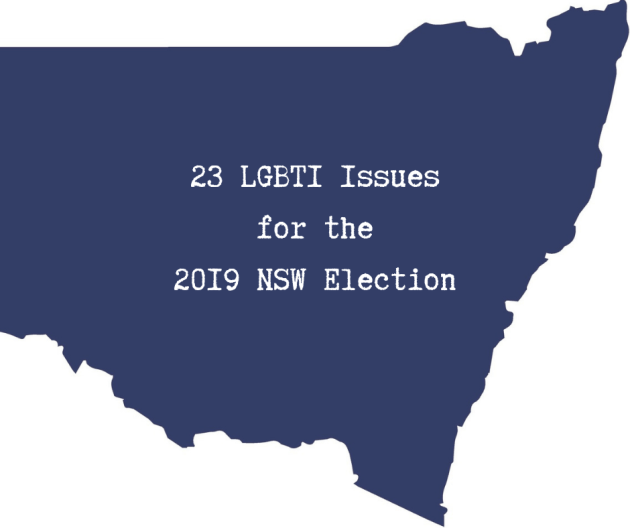

23 LGBTI Issues for the 2019 NSW Election

The 2019 NSW election will be held on Saturday March 23.

It will determine who holds Government until March 2023.

Therefore, with just over a month to go, here are 23 LGBTI issues that parties and candidates should address.


  1. Provide anti-discrimination protection to bisexual people

The NSW Anti-Discrimination Act 1977 is the only LGBTI anti-discrimination law in Australia that does not cover bisexual people. This should be amended as a matter of urgency, by adopting the Sex Discrimination Act 1984 (Cth) definition of sexual orientation.[i]


  1. Provide anti-discrimination protection to non-binary trans people

The NSW Anti-Discrimination Act 1977 also fails to protect non-binary trans people against mistreatment, because its definition of transgender is out-dated. This definition should be updated, possibly using the Sex Discrimination Act definition of gender identity, to ensure it covers all trans and gender diverse people.


  1. Provide anti-discrimination protection to intersex people

The NSW Anti-Discrimination Act 1977 does not have a stand-alone protected attribute covering people born with intersex variations. It should be amended as a matter of urgency by adopting the Yogyakarta Principles Plus 10 definition of sex characteristics: ‘each person’s physical features relating to sex, including genitalia and other sexual and reproductive anatomy, chromosomes, hormones, and secondary physical features emerging from puberty.’


  1. Remove the special privileges that allow private schools and colleges to discriminate against LG&T students and teachers

The NSW Anti-Discrimination Act 1977 is the only LGBTI anti-discrimination law in Australia that allows all privates schools and colleges, religious and non-religious alike, to discriminate on the basis of homosexuality and transgender status.[ii] These special privileges must be repealed, so that all LGBTI students, teachers and staff are protected against discrimination no matter which school or college they attend.


  1. Remove the general exception that allows religious organisations to discriminate in employment and service delivery

Section 56(d) of the NSW Anti-Discrimination Act 1977 provides that its protections do not apply to any ‘act or practice of a body established to propagate religion that conforms to the doctrines of that religion or is necessary to avoid injury to the religions susceptibilities of the adherents of that religion.’ This incredibly broad exception allows wide-ranging discrimination against lesbian, gay and trans people. This provision should be replaced by the best-practice approach to religious exceptions in Tasmania’s Anti-Discrimination Act 1998.


  1. Remove the special privilege that allows religious adoption agencies to discriminate against LG&T prospective parents

Section 59A of the NSW Anti-Discrimination Act 1977 allows religious adoption agencies to discriminate against prospective parents on the basis of homosexuality and transgender status. This special privilege should be repealed, because the ability of an individual or couple to provide a loving and nurturing environment for a child has nothing whatsoever to do with their sexual orientation or gender identity.


  1. Reform commercial surrogacy laws

Under the NSW Surrogacy Act 2010, it is illegal to enter into commercial surrogacy arrangements, either within NSW or elsewhere (including overseas), punishable by up to two years’ imprisonment. Despite this prohibition, people in NSW (including many same-sex male couples) continue to enter into international surrogacy arrangements. It is clearly not in the best interests of children born through such arrangements for either or both of their parents to be subject to criminal penalties. NSW should either legalise and appropriately regulate commercial surrogacy domestically, or remove the prohibition on international surrogacy.[iii]


  1. Recognise multi-parent families

Modern families continue to evolve, particularly in terms of the number of parents who may be involved in a child’s upbringing, and especially within rainbow families (for example, with male donors playing an increasingly active role in the lives of children born with female co-parents). This growing complexity should be recognised under the law, including the option of recording more than two parents on official documentation.


  1. Modernise the relationships register

The NSW relationships register may have declined in salience, especially within the LGBTI community, following the passage of same-sex marriage in December 2017. However, it remains an important option for couples to legally prove their relationship, especially for those who do not wish to marry (for whatever reason). However, the NSW Relationships Register Act 2010 requires modernisation, including by amending the term ‘registered relationship’ to ‘civil partnership’, and by allowing couples to hold a ceremony if they so choose.[iv]


  1. Remove surgical and medical requirements for trans access to identity documentation

Another law requiring modernisation is the NSW Births, Deaths and Marriages Registration Act 1995, which currently provides that, in order to record a change of sex, a person must first have undergone a sex affirmation procedure. This is completely inappropriate, especially because many trans and gender diverse people either do not want to, or cannot (often for financial reasons), undergo surgery. Gender identity should be based on exactly that, identity, with this law amended to allow documentation to be updated on the basis of statutory declaration only, without medical practitioners acting as gate-keepers.[v] The range of identities that are recorded should also be expanded, and this should be done in consultation with the trans and gender diverse community.


  1. Ban unnecessary and involuntary medical treatment of intersex children

One of the worst human rights abuses perpetrated against any LGBTI community in Australia is the ongoing involuntary medical treatment of intersex children, which often includes unnecessary surgical modification to sex characteristics. Despite a 2013 Senate report recommending action to end these harmful practices, nothing has been done, including in NSW. With a new review being undertaken by the Australian Human Rights Commission,[vi] whoever is elected in March must take concrete steps to ban non-consensual, medically unnecessary modifications of sex characteristics as soon as possible. In doing so, they should consult with Intersex Human Rights Australia and other intersex organisations, and be guided by the Darlington Statement.


  1. Ban gay and trans conversion therapy

Another abhorrent practice that should be banned immediately is gay or trans conversion therapy, which is not therapy but is psychological abuse. Thankfully, this problem has received increased attention over the past 12 months, including a focus on the need for multi-faceted strategies to address this issue. However, a key part of any response must be the criminalisation of medical practitioners or other organisations offering ‘ex-gay’ or ‘ex-trans’ therapy, with increased penalties where the victims of these practices are minors.[vii]


  1. Establish a Royal Commission into gay and trans hate crimes

In late 2018, the NSW Parliament commenced an inquiry into hate crimes committed against the gay and trans communities between 1970 and 2010. This inquiry handed down an interim report in late February, recommending that it be re-established after the election. However, in my view a parliamentary inquiry is insufficient to properly investigate this issue, including both the extent of these crimes, and the failures of NSW Police to properly investigate them. Any new Government should establish a Royal Commission to thoroughly examine this issue.[viii]


  1. Re-introduce Safe Schools

The Safe Schools program is an effective, evidence-based and age-appropriate initiative to help reduce bullying against lesbian, gay, bisexual, transgender and intersex students. Unfortunately, following a vitriolic homophobic and transphobic public campaign against it, the NSW Government axed Safe Schools in mid-2017. In its place is a generic anti-bullying program that does not adequately address the factors that contribute to anti-LGBTI bullying. The Safe Schools program should be re-introduced to ensure every student can learn and grow in a safe environment.[ix]


  1. Include LGBTI content in the PDHPE Syllabus

The NSW Personal Development, Health and Physical Education (PDHPE) curriculum does not require schools to teach what lesbian, gay, bisexual, transgender or intersex mean, or even that they exist. The new K-10 Syllabus, gradually implemented from the beginning of 2019, excludes LGBTI students and content that is relevant to their needs. It is also manifestly inadequate in terms of sexual health education, with minimal information about sexually transmissible infections and HIV. The Syllabus requires an urgent redraft to ensure LGBTI content is adequately covered.[x]


  1. Expand efforts to end HIV

NSW has made significant progress in recent years to reduce new HIV transmissions, with increased testing, greater access to pre-exposure prophylaxis (PrEP) and higher treatment rates. However, new HIV diagnoses among overseas-born men who have sex with men are increasing. The NSW Government should create an affordability access scheme for people who are Medicare-ineligible that covers PrEP and HIV treatments (including for foreign students). The introduction of mandatory testing of people whose bodily fluids come into contact with police (aka ‘spitting laws’)[xi] should also be opposed.[xii]


  1. Appoint a Minister for Equality

Both the NSW Government and Opposition currently have spokespeople with responsibility for women, ageing and multiculturalism. However, neither side has allocated a portfolio for equality. Whoever is elected on 23 March should appoint a Minister for Equality so that LGBTI issues finally have a seat at the Cabinet table.[xiii]


  1. Establish an LGBTI Commissioner

The Victorian Government does have a Minister for Equality (the Hon Martin Foley MP). They have also appointed a Gender and Sexuality Commissioner (Ro Allen) whose role it is to co-ordinate LGBTI initiatives at a bureaucratic level. A new Government in NSW should also appoint an LGBTI Commissioner here.


  1. Create an Office for Equality

While having leadership positions like a Minister for Equality and an LGBTI Commissioner are important, the work that is done by an Office for Equality within a central agency (like the Equality Branch within the Victorian Department of Premier and Cabinet) is essential to support LGBTI policies and programs across Government.


  1. Convene LGBTI education, health and justice working groups

The NSW Government should establish formal consultative committees across (at least) these three policy areas to ensure that the voices of LGBTI communities are heard on a consistent, rather than ad hoc, basis.


  1. Fund an LGBTI Pride Centre

Another initiative that is worth ‘borrowing’ from south of the NSW border is the creation of a Pride Centre, to house key LGBTI community organisations, potentially including a permanent LGBTI history museum. This centre would need to be developed in close partnership with LGBTI groups, with major decisions made by the community itself.


  1. Provide funding for LGBTI community organisations

There is significant unmet need across NSW’s LGBTI communities, which should be addressed through increased funding for community advocacy, and service-delivery, organisations, with a focus on intersex, trans and bi groups, and Aboriginal and Torres Strait Islander LGBTI bodies. This should also include funding for LGBTI services focusing on youth, ageing, mental health, drug and alcohol, and family and partner violence issues, and to meet the needs of LGBTI people from culturally and linguistically diverse and refugee backgrounds.


  1. Develop and implement an LGBTI Strategy

If, in reading this long list, it seems that NSW has a long way left to go on LGBTI issues, well that’s because it’s true. The birthplace of the Sydney Gay & Lesbian Mardi Gras parade has fallen behind other states and territories when it comes to LGBTI-specific policies and programs. We need a whole-of-government strategy, including clear goals and transparent reporting against them, to help drive LGBTI inclusion forward.


hviouxt placeholder


If you have enjoyed reading this article, please consider subscribing to receive future posts, via the right-hand scroll bar on the desktop version of this blog or near the bottom of the page on mobile. You can also follow me on twitter @alawriedejesus


References:

[i] For a comparison of Australian anti-discrimination laws, see: A Quick Guide to Australian LGBTI Anti-Discrimination Laws.

[ii] Sections 38C, 38K, 49ZH and 49ZO. For more, see: What’s Wrong With the NSW Anti-Discrimination Act 1977.

[iii] For more, see: Submissions to Commonwealth Parliamentary Inquiry into Surrogacy.

[iv] For more, see: Submission to Review of NSW Relationships Register Act 2010.

[v] For more, see: Identity, not Surgery.

[vi] My submission to the AHRC Consultation re Medical Interventions on People Born with Variations of Sex Characteristics can be found here.

[vii] For more, see: Criminalising Ex-Gay Therapy.

[viii] For more, see: Submission to NSW Parliamentary Inquiry into Gay and Trans Hate Crimes.

[ix] For more, see: Saving Safe Schools.

[x] For more, see: Invisibility in the Curriculum.

[xi] For more, see: Submission re Mandatory BBV Testing Options Paper.

[xii] For more HIV-related policy priorities, see ACON, Positive Life NSW, SWOP and the NSW GLRL 2019 NSW State Elections Issues’ document.

[xiii] For more, see: Increasing LGBTI Representation.

Saving Safe Schools

This post is part of a series looking at the unfinished business of LGBTI equality in Australia. You can see the rest of the posts here


Safe Schools is, simultaneously, one of the simplest policy issues in Australia, and one of the most complex.


Simple, because it is an effective, evidence-based program aimed at reducing bullying of one of the most vulnerable groups in our society: young lesbian, gay, bisexual, transgender and intersex (LGBTI) people. Surely, supporting this group, and lowering the disproportionate rates of social exclusion, and mental health issues, that they experience, should be straightforward?


Complex, because – well, have you listened to (most) Liberal and National politicians over the past few years? Did you read The Australian newspaper in 2016? [*Neither is recommended of course, but if you did you would have heard and seen a barrage of criticism of this initiative addressing anti-LGBTI bullying]


This little program became the focal point of one of the biggest culture wars in our recent history, such that among right-wing circles even the name Safe Schools has itself become toxic, synonymous with all manner of imagined problems.


It is hard to remember that, at the federal level, Safe Schools was initially the epitome of bipartisanship – announced and funded by the then Rudd Labor Government before the 2013 election, before being launched under the Abbott Coalition Government in mid-2014.


How did we get from there, to wherever the hell it is we are now? I’m not proposing to rehash that depressing history – instead, I would strongly suggest you read the excellent Quarterly Essay ‘Moral Panic 101: Equality, acceptance and the Safe Schools scandal’ by Benjamin Law.


However, I am interested in the why – why did a simple and straight-forward program aimed at reducing homophobia, biphobia, transphobia and intersexphobia in schools provoke such an angry response from so-called conservatives around the country?


Part of the explanation can be found in the response of one of the program’s greatest advocates, Victorian Premier Daniel Andrews, to the decision by the then Turnbull Liberal National Government to ‘review’ the program in early 2016. From his Facebook post:


“Schools have to be a safe place for every kid – no exceptions.

Teachers have to be given the tools to deal with every situation – no excuses.

And there is absolutely nothing wrong with this effective little program, which achieves the above two aims and nothing more.

But let’s be honest here: I don’t think these extreme Liberals are actually offended by the structure of the program, or the teachers who lead it.

I just think they’re offended by the kids who need it.

They don’t like the fact that some young people might be different.

And I’m sick of it.

I’m sick of Liberal politicians telling our kids that there’s something wrong with them – when there isn’t.

I’m sick of Liberal politicians trying to push us all back, whenever we all take a few steps forward.

Cory Bernadi [sic] says teenagers are too young to know about love and care and acceptance.

Well, I can assure you, Senator: they know a whole lot more than you.”


This offence – at the fact LGBTI kids exist – was so great that, even though the independent review found the program to be effective, age-appropriate and consistent with the curriculum, they axed it anyway. The NSW Liberal National Government, and other conservative administrations around the country, quickly followed suit.


But while the offence of Liberal politicians that LGBTI kids have the temerity to exist might be part of the explanation for Safes Schools’ axing, it is by no means a complete explanation.


One perhaps even more important contributing factor is discussed in Benjamin Law’s Quarterly Essay, in response to the changes by then Education Minister Simon Birmingham that “schools must now obtain the approval of parent bodies to train teachers [in Safe Schools], and before any lessons are taught.”


As Paul Thoemke is quoted on page 57/58 in relation to trans children: “This may be the most politically unsavvy thing I can say. But I sometimes think the greatest risk for these kids is their families… Family life can be awful for a homosexual child, too. Youth who come out meet with parental grief, confusion, denial, or rage so hot that, for everyone involved, the prospect of the child eating from dumpsters or sleeping under bridges may be preferable to coexisting with them under the same roof.”


This really is the crux of the debate. Some parents are so homophobic, biphobic, transphobic or intersexphobic (often all four) that they would prefer LGBTI children to be in a wooden box rather than sitting at a wooden desk in a safe and supportive classroom. And not ‘just’ their own children, but all LGBTI kids.


Of course, the majority of parents do not see this issue in this warped way. They, like the LGBTI community itself, want to see all children have the ability to live their best lives.


Indeed, one of the features of this debate is that it is the LGBTI community and its allies who are arguing for the best interests of kids, while our opponents, who have long (falsely) railed against us with the ‘Won’t somebody please think of the children?’ mantra in the name of ‘traditional family values’, that are acting in the interests of intolerant adults.


Unfortunately, in 2016 the Turnbull Liberal-National Government listened to the hateful minority, followed by a number of states and territories.


As a result, in early 2019, the Safe Schools program is only functional in Victoria, the ACT (called the Safe and Inclusive Schools Initiative), Western Australia (called the Inclusive Education Program) and the Northern Territory.


It has been replaced by general, and generic, ‘anti-bullying programs’ in NSW, Tasmania and South Australia (disappointingly the Queensland Labor Government has never fully supported Safe Schools), in part based on the argument that LGBTI kids don’t deserve a special program to specifically promote acceptance of their difference.


Law takes apart this view in his Quarterly Essay on page 64, responding to an example about Hindu students from Elisabeth Taylor of the Australian Christian Lobby:


“When Taylor tells me this, I’m initially taken by her argument. Why should minorities of any kind have special treatment? Why should queer kids get the attention when others [sic] kids are being bullied too? It takes a while before the obvious presents itself: first, that general anti-bullying measures have existed for decades and haven’t helped queers at school. Second, that Safe Schools doesn’t exists solely for LGBTIQ youth, but also for the countless other Australian kids who are agents – as well as victims – of schoolyard homophobia. Third: Hindu children are born into Hindu families and communities, who affirm their religion, culture and worldview. Lesbian, gay, bisexual, transgender and intersex young people do not have that luxury. Gays are mostly raised in heterosexual families. And if our families and communities don’t accept us, there are consequences. One 2010 national study found that “rates of self harm are higher in [queer] young people who are not supported when they disclose to mother, dad, brother or sister.” If these kids aren’t safe at home or school, where else do they have?”


In 2019, we still have Governments at Commonwealth level, and in half the states and territories, that really don’t seem to care about the answer to that question.


Who don’t support the right of LGBTI kids simply to be – but instead listen to a vocal minority of bigots who would prefer LGBTI kids not to be. Themselves. Supported. Or Accepted.


The question is what we do about it. I would argue the onus is on us, the LGBTI community, our allies, and indeed every Australian who supports diversity, of sexual orientations, gender identities and sex characteristics, to vote against those Governments.


Because our kids are counting on us.


Unknown-8

Victorian Premier Daniel Andrews has shown the leadership too many of his Commonwealth, state and territory counterparts refuse to.


If you have enjoyed reading this article, please consider subscribing to receive future posts, via the right-hand scroll bar on the desktop version of this blog or near the bottom of the page on mobile. You can also follow me on twitter @alawriedejesus

Treasurer Frydenberg, Please Abolish the National School Chaplaincy Program

This post is part of a series looking at the unfinished business of LGBTI equality in Australia. You can see the rest of the posts here


The Morrison Liberal-National Government is currently calling for Pre-Budget Submissions for the 2019-20 Commonwealth Budget. Submissions close 1 February 2019 – for more details click here.


Please see my submission below, which I have also sent to the Leader of the Opposition Bill Shorten and Shadow Treasurer Chris Bowen.


**********


Treasurer Josh Frydenberg MP

c/- prebudgetsubs@treasury.gov.au


Monday 28 January 2019


Dear Treasurer


Please Abolish the National School Chaplaincy Program


Thank you for the opportunity to provide a submission ahead of the upcoming 2019-20 Commonwealth Budget.


In this submission I will make the case for what should be the easiest Budget decision of them all – to save $247 million over four years by abolishing the National School Chaplaincy Program.


There are multiple reasons why this entirely unjustified program should be axed, with most stemming from the requirement that any person who acts as a school chaplain must be religious. This requirement is completely inappropriate in a contemporary society.


In theory, these positions are supposed to be about improving student welfare. In practice, they are about promoting Christian theology, including in supposedly secular public schools.


As the Guardian Australia reported, in 2015 the Education Department revealed that of 2,336 chaplains funded by the Commonwealth Government, 2,312 (or 99%) were Christian, with the negligible remainder split between Islam (13), Judaism (eight) and one each from Bahai, Buddhism and Aboriginal traditional religions.


As a program it has already been found to be unconstitutional on multiple occasions (thanks to the ongoing efforts of the courageous Ron Williams). Successive Commonwealth Governments have responded by resorting to increasingly intricate arrangements to circumvent these findings.


Indeed, on a prima facie reading, the program is clearly in breach of section 116 of the Constitution, which provides that:


‘Commonwealth not to legislate in respect of religion

The Commonwealth shall not make any law for establishing any religion, or for imposing any religious observance, or for prohibiting the free exercise of any religion, and no religious test shall be required as a qualification for any office or public trust under the Commonwealth.’


The only reason the program has not been found unlawful because of section 116 is because the money to fund it is now funnelled through grants to state and territory governments.


Instead of engaging in this intellectual dishonesty, the Commonwealth Government should instead honour the spirit of the Constitution. As Treasurer, you should acknowledge that the National School Chaplaincy Program imposes a religious test on positions that are paid for with taxpayers’ monies – and consequently abolish it.


The religious requirement for chaplaincy positions presents another legal problem, and that is it is potentially in breach of state and territory anti-discrimination and equal opportunity laws,[i] because it actively discriminates against people with different religions, or who have no religion.


This is currently being tested in the Victorian Civil and Administrative Tribunal, with a complaint against Access Ministries by a person who was barred from applying for a position with them because she was not Christian. As noted in that complaint:


‘The discrimination is not reasonably necessary for Access Ministries to comply with the doctrines, beliefs or principles of the religion associated with Access Ministries, because the work of a school chaplain takes place in a non-religious context and workplace, namely a government school, with a student population made up of students with a variety of religious affiliations and with no religious affiliation.’


Hopefully, that challenge is successful. Even if it fails, it is likely that the lawfulness of the National School Chaplaincy Program will come under fresh scrutiny as the Commonwealth Government establishes a new Religious Discrimination Act, as part of its response to the Ruddock Religious Freedom Review.


It is impossible to argue the program does not discriminate on the basis of religious belief (or lack thereof), when such discrimination lies at its heart. There must be no special loopholes as part of any new Commonwealth Religious Discrimination Act merely to allow discrimination against non-Christians, agnostics and atheists alike to continue. Nor should there be taxpayer funding for this discrimination in the Commonwealth Budget.


A third reason why the National School Chaplaincy Program should be abolished is because of its internal contradiction, with people hired as school chaplains because they are religious then required not to ‘proselytise’ their beliefs as part of their role.


There have been multiple reports, over many years, of chaplains in public schools completely disregarding this prohibition.


From 2011The United Christian Education Foundation is the chaplaincy provider at Ulladulla High School on the New South Wales South Coast.


A newsletter on its website reads: “There is much to be thankful for as we look back on another year of bringing the great news of Jesus to the precious young people at Ulladulla High School. The other week a Year 7 boy put up his hand and said, ‘I asked Jesus into my life the other day’.


“A Year 8 girl told me about the peace she now has since becoming a Christian,” the newsletter continues.


Proselytising is against the federal Education Department’s guidelines on chaplaincy, but some students at the Ulladulla school believe the chaplain is there to convert them.


“[It is] basically to make people become of his religion. That’s it really. To convert people to their religion,” said Max, a Year 8 student.


Nick, a maths teacher at the primary school nearby, was shocked when the chaplain came to his school and invited the children to pray.


“The chaplain was addressing the Year 6 children, a majority of those children would be going to the local high school and he did say that he was available for children there, and they can come to him and pray with him, or if not, he would pray for them,” he said.


And from just last year: Generate Ministries, the largest provider of school chaplains in NSW, has begun offering a “faith building” course to students and told them their chaplain is one way of accessing the program.


The subject, called Veta Morpheous, is a certificate III course for HSC students developed by the Victorian-based Veta Youth which says the studies enable students to “really invest in your spiritual growth and to explore your faith with adult mentors” and “grow in your Christian life.”


“It’s a space… to discover who you are in Christ, and to test your faith in real life,” Veta Youth says.


In a now-amended statement on its website Generate Ministries said: “The key to the program is the local ministry supervisor and the peer group supervisor… this is often the local minister, Chaplain.”


When contact about the possible breach, Generate Ministries said it only intended for chaplains funded under a separate NSW wellbeing program to offer the course. However that program also forbids chaplains from proselytising.


There are countless other examples of chaplains engaged in proselytising behaviour. Perhaps just as concerning is what is not considered proselytising, and therefore deemed acceptable, with then-Education Minister Simon Birmingham telling Senate Estimates that proselytising is only ‘attempt[ing] to convert someone to a particular religion or belief’ and that quoting the Bible is not necessarily proselytising.


I am sure many parents with children attending public schools would be horrified by that distinction.


To some extent, it is difficult to blame chaplains for engaging in this behaviour. Telling them not to proselytise – when that activity forms such a central part of their identity, their ‘mission’ – is like telling News Corp columnists not to engage in culture wars. It is their raison d’etre, and they will continue to do so for as long as they draw breath (and expel hot air).


The fault instead lies with the Howard Liberal-National Government who first funded this program, and all subsequent Governments who have extended it, knowing that employing chaplains in schools will inevitably lead to proselytising to children, irrespective of what any guideline might say.


You will own your share of that blame if you do not abolish the National School Chaplaincy Program in your first Budget as Treasurer, expected in April 2019.


The fourth problem is a much more fundamental one, and that is, if the aim of the program is to promote student welfare, the National School Chaplaincy Program is a poorly-designed, and ineffective, approach.


It is an opt-in program, and even then the funding provided does not pay for a full-time position (with schools expected to fundraise to supplement the Government’s grant). Given the people hired must satisfy a religious test, it is also not open to all of the best-qualified people for the role,[ii] meaning some students will inevitably end up with second-rate support.


In short, it is a half-hearted attempt to address what is a genuine challenge.


If the Morrison Liberal-National Government was actually serious about student welfare, it would provide funding for school counsellors in all schools, and employ people based on their qualifications not their religious beliefs. If you are not prepared to do that, it is clear student welfare is not the primary focus of the program, and it must therefore be abolished.


My fifth and final concern is a much more personal one and that is, as a long-term advocate for the lesbian, gay, bisexual, transgender and intersex (LGBTI) community, the National School Chaplaincy Program is inherently dangerous for LGBTI students.


This is not to say that all chaplains are homophobic, biphobic, transphobic or intersexphobic. I am sure there are many who are genuinely inclusive and respectful of all students irrespective of sexual orientation, gender identity or sex characteristics.


However, I am saying there have been too many examples, over too many years, of people employed under the National School Chaplaincy Program being harmful to young LGBTI people. In some cases, the organisations providing chaplains across different schools are themselves explicitly homophobic and transphobic.


For example, from 2014: ‘Citing a survey from gay rights organisation All Out, Senator [Lousie] Pratt said “students described chaplains helping them to ‘pray the gay away’ and advising them to sleep with a member of the opposite sex to ‘correct’ their same sex attraction”.’


And this, from 2015‘The school chaplaincy program in NSW is dominated by Generate Ministries, which lodged a submission to an Australian Human Rights Commission inquiry into religious freedom stating homosexuality is “a serious sin”.’


How could any LGBT student attending a school with a Generate Ministries chaplain ever feel comfortable seeking support from their supposed school welfare officer when that person thinks they are intrinsically sinful?


Meanwhile, from last year‘In one disturbing case, a transgender child was forced into seven sessions of chaplaincy counselling at her religious school – without her parents’ knowledge – in a bid to stop her from transitioning…


Canberra’s response [not to take action against gay conversion therapy] belies the fact that gay conversion ideology has been quietly pushed in schools as part of the federal government’s chaplaincy program.’


There are plenty of other examples of the National School Chaplaincy Program being the source of homophobia and transphobia. This is shameful, but not nearly as shameful as the fact taxpayers’ money – money from people like me – is being used to inflict these harms on young LGBTI people.


It is your moral responsibility, as Treasurer, to cease funding for a program that, rather than improving student welfare, contributes to the mistreatment of some of the most vulnerable members of society.


**********


As I have outlined above, the only reason the National School Chaplaincy Program remains constitutional is because successive Commonwealth Governments have chosen to circumvent decisions of the High Court.


It is possible the program is unlawful under state and territory anti-discrimination laws, because it actively discriminates on the basis of religious belief, and it would likely fall foul of any new Commonwealth Religious Discrimination Act.


The National School Chaplaincy Program also suffers from an insurmountable internal contradiction, where people whose primary purpose is to proselytise are politely asked not to. It is unsurprising that many fail to obey this direction.


It is a poorly-designed, and ineffective, student welfare program; if Governments were actually serious about student welfare they would fund qualified counsellors in all schools. The National School Chaplaincy Program is also dangerous, and harmful, to lesbian, gay, bisexual, transgender and intersex students.


While these may sound like challenges, they also represent an opportunity for you, as Treasurer, to make perhaps the easiest saving of a quarter of a billion dollars that anyone could ever make. The only question is whether you are up to the task.


Thank you in advance for taking this submission into consideration.


Sincerely

Alastair Lawrie


cc Bill.Shorten.MP@aph.gov.au Chris.Bowen.MP@aph.gov.au


unknown-7

Treasurer Josh Frydenberg, who could save $247 million – or continue to fund the discriminatory, harmful and wasteful National School Chaplaincy Program.


Update: 12 April 2019

Treasurer Frydenberg handed down the Commonwealth Budget on Tuesday 2 April 2019. Unfortunately, although perhaps not unexpectedly, the Treasurer and the Morrison Liberal-National Government have decided to continue funding for the National School Chaplaincy Program, with $61.4 million committed for each of the next four years.

However, while not unexpected, it remains a disgraceful decision, and an unjustifiable waste of $245.6 million in taxpayers money, on a scheme that is discriminatory against people who are not christian, and inherently harmful for LGBTI students in particular.

With a federal election now scheduled for Saturday 18 May 2019, it is up to the Australian public to vote out a Government that prefers to subsidise the religious indoctrination of children rather than genuinely support student welfare.


If you have enjoyed reading this article, please consider subscribing to receive future posts, via the right-hand scroll bar on the desktop version of this blog or near the bottom of the page on mobile. You can also follow me on twitter @alawriedejesus


Footnotes:

[i] In the states and territories where religious belief is a protected attribute, noting that New South Wales and South Australia currently do not prohibit religious discrimination in their anti-discrimination laws.

[ii] I am not suggesting that all people currently hired as chaplains do not have appropriate student welfare qualifications, but I am saying that, by excluding a large proportion of people because of their religious beliefs (or lack thereof) the talent pool of people hired must inevitably be significantly diminished.

Invisibility in the Curriculum

This post is part of a series looking at the unfinished business of LGBTI equality in Australia. You can see the rest of the posts here.


Did you know that the NSW Personal Development, Health and Physical Education K-10 Syllabus does not require schools to teach students what lesbian, gay, bisexual, transgender and intersex mean, or even that they exist?


The NSW Education Standards Authority reviewed the PDHPE curriculum in 2017 (see my submission to that consultation here), and released its consultation report and final K-10 syllabus in early 2018.


It is now being progressively rolled out in NSW classrooms, with full implementation by the start of the 2020 school year.


This is despite the fact the new PDHPE curriculum is entirely unfit for the 21st century, contributing to the ongoing invisibility of lesbian, gay, bisexual, transgender and intersex (LGBTI) content, and therefore of LGBTI students.


This can be seen in a number of ways. The first, and perhaps most important, is in its use – or, more accurately, lack of use – of the terms lesbian, gay, bisexual, transgender and intersex themselves.


In the 138 pages of the syllabus, these words occur three times each.[i] However, two out of these three appearances are found in the document’s glossary – with a definition of each term, and then as part of the broader definition of LGBTI people.


But teachers do not teach the glossary to their students. Instead, they are only required to teach the content for each year stage of the syllabus. And the terms lesbian, gay, bisexual, transgender and intersex can be found only once in the prescribed content, together on page 96:


‘investigate community health resources to evaluate how accessible they are for marginalised individuals and groups and propose changes to promote greater inclusiveness and accessibility eg people in rural and remote areas, lesbian, gay, bisexual, transgender and intersex people (LGBTI), people from culturally and linguistically diverse (CALD) backgrounds, people with disability.’


The problem with this is that LGBTI comes after ‘for example’ and therefore even referring to LGBTI people in this exercise is, on a prima facie reading, optional.


This issue – the status of content that appears after ‘eg’ in the syllabus – was raised, by myself and others, during the consultation process. The answer at the time was that whether this information was taught was at the discretion of the school and/or teacher. This appears to be confirmed in the consultation report, which states on page 18 that:


‘The content defines what students are expected to know and do as they work towards syllabus outcomes. Content examples clarify the intended learning. Teachers will make decisions about content regarding the sequence, emphasis and any adjustments required based on the needs, interests, abilities and prior learning of students.’


In practice, LGBTI people appear just once in the entire NSW PDHPE K-10 Syllabus, as part of an exercise about marginalised groups and inclusiveness, but schools and/or teachers can choose to remove even this most cursory of references.[ii]


This marginalisation, and exclusion, of LGBTI content and students is simply not good enough.


Another cause of the curriculum’s problems can be found if we return to the glossary, and inspect the definition of sexuality:


‘A central aspect of being human throughout life. It is influenced by an interaction of biological, psychological, social, economic, political, cultural, ethical, legal, historical, religious and spiritual factors. It is experienced and expressed in thoughts, feelings, desires, beliefs, attitudes, values, behaviours, practices, roles and relationships.’


On a philosophical level, this is actually quite an inclusive and even progressive view of the complexity of human sexuality. But on a practical level, the absence of specificity in this definition undermines any obligation for schools and/or teachers to teach about real-world diversity of sexual orientation.


This lack of prescription means that, on page 96 – which is the only place in the general syllabus where ‘sexuality’ appears not following an ‘eg’ (and therefore is the only reference that isn’t optional)[iii] – content to ‘explore external influences on sexuality and sexual health behaviours and recognise the impact these can have on their own and others’ health, safety and wellbeing’ does not necessarily include lesbian, gay or bisexual sexualities.


It is a similar story in terms of gender,[iv] with the glossary definition (‘Refers to the concepts of male and female as well as the socially constructed expectations about what is acceptable for males and females’) not particularly useful in ensuring students learn about the diversity of gender identities. There also do not appear to be any references to non-binary or gender diverse identities.[v]


These definitions of sexuality and gender, and how they are employed throughout the syllabus, could be interpreted by some supportive schools and teachers to include lesbian, gay, bisexual and transgender subject matter. But there is absolutely nothing that ensures schools and/or teachers must teach this content.


This erasure, or invisibilisation, of LGBTI people in the NSW PDHPE K-10 Syllabus is nothing short of homophobic, biphobic, transphobic and intersexphobic.


Which makes it somewhat ironic then that there are more references to homophobia and transphobia in its content than there are to LGBTI people.


On page 77: ‘describe forms of bullying, harassment, abuse, neglect, discrimination and violence and the impact they have on health, safety and wellbeing, eg family and domestic violence, homophobic and transphobic bullying, racism, cyberbullying, discrimination against people with disability.’


And on page 88: ‘propose protective strategies for a range of neglect and abuse situations, eg family and domestic violence, bullying, harassment, homophobia, transphobia and vilification.’


Although note of course that both times homophobia and transphobia appear after an ‘eg’, meaning whether they are taught in these contexts remains optional (and obviously neither of these sections explicitly refers to biphobia or intersexphobia either).[vi]


Another major problem with the new NSW PDHPE K-10 Syllabus is its approach to sexual health.


There are only two compulsory references to sexual health in the content of the syllabus, one of which we have already seen (on page 96: ‘explore external influences on sexuality and sexual health behaviours and recognise the impact these can have on their own and others’ health, safety and wellbeing’).


The other reference, on page 95, describes ‘identify methods of contraception and evaluate the extent to which safe sexual health practices allow people to take responsibility for managing their own sexual health.’


There are two problems with this statement. First, it puts the emphasis on ‘contraception’ when sexual health, and LGBTI sexual health especially, is a much broader concept. Second, it does not specifically mandate that schools and teachers instruct students about sexually transmissible infections (STIs).


In fact, quite astoundingly, the only reference to STIs in the general syllabus,[vii] on page 84 (‘identify and plan preventive health practices and behaviours that assist in protection against disease, eg blood-borne viruses, sexually transmissible infections’) makes teaching about them optional. The only time the term HIV even appears in the entire document is in the glossary.[viii]


In terms of STI-prevention, it seems the NSW PDHPE syllabus has actually gone backwards from the previous 2003 document, which at least prescribed that students learn about:


‘sexual health

-acknowledging and understanding sexual feelings

-expectations of males and females

-rights and responsibilities in sexual relationships

-sexually transmitted infections, blood-borne viruses and HIV/AIDS’ as well as to

‘identify behaviours that assist in preventing STIs, BBVs and HIV/AIDS and explore the interrelationship with drug use.’[ix]


**********


The aim of the PDHPE K-10 Syllabus is explained on page 12 of the document:


‘The study of PDHPE in K-10 aims to enable students to develop the knowledge, understanding, skills, values and attitudes required to lead and promote healthy, safe and active lives.’


Unfortunately, the more than 100 pages of the new syllabus which follow that statement make clear that it does not, and cannot, promote healthy, safe and active lives for lesbian, gay, bisexual, transgender and intersex students. After all, it is impossible for students to learn everything they need to be safe when they cannot see themselves in the curriculum.


This document represents a complete derogation of duty by the NSW Education Standards Authority, and Education Minister Rob Stokes and the Berejiklian Liberal-National that have overseen them.


They have also failed in their duty to keep all students safe, LGBTI and non-LGBTI alike, given the paucity of sexual health information, and specific content around sexually transmissible infections, in the syllabus.


To some extent it is perhaps a little unfair to single out NSW for these failures, because they are not alone in responsibility for them.


As this author has previously written, the national Health and Physical Education curriculum (which provides the framework for the NSW syllabus) developed earlier this decade by the Australian Curriculum, Assessment and Reporting Authority (ACARA), also abjectly fails to take the needs of LGBTI students seriously.


Despite repeated calls for him to intervene, then-Commonwealth Education Minister Christopher Pyne refused to take action to make LGBTI-inclusive content a priority either.


Ensuring that all teachers, in all schools, provide health and physical education content that is inclusive of all students and their needs has been placed in the ‘too hard basket’ by educational authorities, and Ministers, at multiple levels of government over multiple years.


It seems they would prefer to pretend LGBTI students do not exist rather than to take on the influence of religious schools and others who see anything that promotes the view that LGBTI people are part of the natural, beautiful diversity of humanity as some sort of ‘radical agenda’.


In this respect, the exclusion of LGBTI content from the NSW PDHPE K-10 Syllabus shares a lot in common with the current debate about the exceptions to anti-discrimination law that allow religious schools to discriminate against LGBT students, something the NSW Government has also ruled out fixing.


As with that issue, the losers out of the new PDHPE curriculum are the lesbian, gay, bisexual, transgender and intersex kids who have the right to learn about themselves, and to receive the information they need to keep themselves safe, but who are instead being made to feel invisible.


55d947e87811a0c2c684e8ea8a5b3a90fa7ed982

NSW Education Minister Rob Stokes has overseen the development of a PDHPE K-10 Syllabus that is almost completely silent on LGBTI issues.


If you have enjoyed reading this article, please consider subscribing to receive future posts, via the right-hand scroll bar on the desktop version of this blog or near the bottom of the page on mobile. You can also follow me on twitter @alawriedejesus


Footnotes:

[i] The term bisexual actually appears four times, with an additional appearance in the glossary in the definition of ‘same-sex attracted’, alongside ‘homosexual’ in its only appearance.

[ii] This interpretation – that teaching the examples which are included in the content is optional – is supported by page 24 of the consultation report, which states: ‘The content is presented to be inclusive and provide the flexibility for delivery based on the context and the ethos of schools. Schools will make decisions about the scope and range of examples to illustrate the diversity of groups in Australian society.’

[iii] There is a separate reference to ‘sexuality’ that is not optional on page 119 in the Life Skills section, for students with special needs, although it does not specifically refer to diversity of sexual orientations.

[iv] The definition of sex on page 135, described as ‘The biological characteristics that define humans as female or male. While these sets of biological characteristics are not mutually exclusive, as there are individuals who possess both, they tend to differentiate humans as males and females’, also does not ensure students learn about variations of sex characteristics.

[v] The definition of transgender or trans on page 137 states ‘A general term for a person whose gender is different to their sex at birth’.

[vi] As an aside, it must surely be difficult to teach students about homophobia and transphobia when the syllabus doesn’t require instruction about the terms lesbian, gay, bisexual, transgender and intersex in the first place.

[vii] At a minimum the Life Skills content for students with special needs makes teaching about sexually transmissible infections mandatory (on page 119: ‘recognise issues of safety in relation to sexual relationships, including contraception, sexually transmissible infections’).

[viii] In the glossary definition of sexually transmissible infections: ‘Any infection that can be passed from one person to another during sexual activity. Sexually transmissible infections include chlamydia, herpes, gonorrhea, syphilis, genital herpes, scabies, pubic lice, hepatitis and HIV.’

[ix] On page 27 of the 2003 PDHPE 7-10 Syllabus, here.

Protecting LGBT Students and Teachers Against Discrimination

Update 23 February 2019:


The Senate Legal and Constitutional Affairs Committee handed down its report on the Sex Discrimination Amendment (Removing Discrimination Against Students) Bill 2018 on Thursday 14 February 2019.


Although it is perhaps more accurate to say it handed down three reports. The majority report, by Government Senators, recommended that the Bill – which, as the name suggests, would protect LGBT students in religious schools against discrimination – not be passed. This is a broken promise, after Prime Minister Scott Morrison’s commitment to protect these students in October last year.


Even worse, Coalition members of the Committee recommended that the issue of religious exceptions be referred to the Australian Law Reform Commission for another review. For context, we have already had the Ruddock Religious Freedom Review, a Senate inquiry into the issue of discrimination against LGBT students and teachers last November, and this most recent Senate review.


We don’t need another inquiry, review or report. We just need a Government to take action to protect LGBT students and teachers. Nothing more. Nothing less.


The Labor members of the Committee provided a dissenting report, which (unsurprisingly) called for their Bill to be passed. Importantly, they also rejected all five of the Government’s amendments that would allow discrimination against LGBT students to continue, contrary to the purpose of the legislation (for more, see my original submission to the inquiry below).


On the other hand, Labor Senators also rejected the proposed Greens’ amendment that would remove the Sex Discrimination Act 1984 exception allowing religious schools to discriminate against LGBT teachers. They did restate the ALP’s commitment to protect LGBT teachers in the future, although it is unclear what form this would take.


We will need to keep pressure on Bill Shorten, and the ALP, to protect LGBT teachers and to ensure these protections are not undermined by provisions allowing religious schools to discriminate on ‘ethos and values’.


Finally, the Greens also provided a dissenting report, supporting the ALP Bill, rejecting the Government’s amendments (for the same reasons as Labor) and calling for their own amendment protecting LGBT teachers to be passed.


The Greens have also recommended an urgent review of provisions in the Fair Work Act 2009 (Cth) that allow religious schools to discriminate on the basis of sexual orientation and gender identity.


Overall, then, this was a disappointing Committee Report, with the Government’s proposed referral of the issue to the Australian Law Reform Commission nothing more than a delaying tactic.


It’s important to remember there was always going to be resistance to this change. There will always be some religious schools that want to discriminate against LGBT students and teachers. And there will always be some politicians who want to let them.


It is up to us to continue with this campaign until all schools are safe and nurturing environments for all students, irrespective of their sexual orientation and gender identity. Because our kids are counting on us.


Original submission:


there's no place for discrimination in the classroom-10


Start the new year right, by writing to support the right of LGBT students, teachers and other staff at religious schools to be free from discrimination.


The Senate Standing Committee on Legal and Constitutional Affairs is currently holding an inquiry into Labor’s Sex Discrimination Amendment (Removing Discrimination Against Students) Bill 2018, and proposed amendments to it.


Full details of this inquiry can be found here.


The most important details are that:


  • This is our opportunity to call for all schools to be made free from discrimination on the basis of sexual orientation and gender identity
  • Submissions close on Monday 21 January 2019 (ie two weeks away) and
  • Once you’ve written yours, it can be uploaded here or emailed to sen@aph.gov.au


**********


If you are looking for some ‘inspiration’ about what to write, here are my suggestions:


  1. Personal stories


If you are, or have been, a student, a family member of a student, or a teacher or other staff member at a religious educational institution (including schools and universities), please share what that experience was like.


This is especially important if you are a lesbian, gay, bisexual, transgender or intersex person, or member of a rainbow family, who has encountered homophobia, biphobia or transphobia at a religious school.


Remember, these examples can range from overt or outright discrimination (such as a student being disciplined, or a teacher being fired or not hired, simply for being LGBT) through to more subtle or insidious forms of mistreatment (being made to feel invisible, having LGBTI content excluded from subjects like health and physical education, or feeling unable to disclose your sexual orientation or gender identity, or information about your partner, to others).


The more stories that we share, the louder our collective voice for change will be.


Importantly, if your submission is deeply personal, you can ask the committee to keep your submission private. From the aph website:


If you do not want your name published on the internet, or if you want your submission to be kept confidential, you should:

  • Include the word confidential clearly on the front of your submission and provide a reason for your request.
  • Make sure that your name and contact details are on a separate page and not in the main part of your submission.

Confidential submissions are only read by members of the committee and the secretariat.

Confidential information may be placed in an attachment to the main part of your submission, with a request for the committee to keep the attachment confidential.

The committee will consider your request but you need to know that the committee has the authority to publish any submission.

The committee will contact you if the committee wants to publish something you have asked to be kept confidential.

If you are considering making a confidential submission, you should contact the committee secretariat to discuss this before you send us your submission.


  1. Call for LGBT students to be protected against discrimination


Whether you have attended or worked at a religious school or not, everyone should call for the ability of religious schools to discriminate against lesbian, gay, bisexual and transgender students to be abolished.


Labor’s Bill achieves this outcome, because it would remove both of the existing exceptions in the Commonwealth Sex Discrimination Act 1984 which allow religious schools to do exactly that.[i]


In your submission, you should ask for the Sex Discrimination Amendment (Removing Discrimination Against Students) Bill 2018 to be passed urgently, so that all students can learn in a safe and inclusive environment.


  1. Call for LGBT teachers to be protected against discrimination


One thing Labor’s Bill does not do is remove the exceptions in the Sex Discrimination Act which allow religious schools to discriminate against LGBT teachers and other staff.


This discrimination is also wrong. Teachers should be judged according to the ability to do their jobs, not whether they are heterosexual and cisgender. The billions of dollars of taxpayers’ money that is provided to religious schools each year should not be used to reject teachers and other staff simply for being LGBT.


Most importantly, in order for the classroom to be a truly safe environment for LGBT children, it must be an inclusive one for LGBT adults too.


Employing LGBT teachers means potentially having role models for kids discovering their own sexual orientations or gender identities. On the other hand, if children see teachers being discriminated against just for being lesbian, gay, bisexual or transgender, they will learn the lesson that their school thinks LGBT people are somehow less worthy than other people.


In your submission, you should ask for the Greens amendments to the Sex Discrimination Amendment (Removing Discrimination Against Students) Bill 2018 to be supported. These amendments would remove the exceptions in the Sex Discrimination Act that allow religious schools to discriminate against LGBT teachers and other staff.[ii]


However, you should call for the Parliament to make similar amendments to the Commonwealth Fair Work Act 2009 as well, because that legislation also allows religious schools to adversely treat,[iii] or unfairly dismiss,[iv] teachers because of their sexual orientation.


Finally, you could ask the Parliament to take this opportunity to amend the Fair Work Act to protect transgender and intersex people against adverse treatment and unfair dismissal, because they are currently excluded entirely from these provisions.[v]


  1. Call for the Parliament to reject the Government’s proposed amendments


The Morrison Liberal-National Government has released its own proposed amendments to the Sex Discrimination Amendment (Removing Discrimination Against Students) Bill 2018.


These amendments would allow religious schools to continue to discriminate against LGBT students in three distinct ways.


First, the Government’s amendments would reinstate one of the two current exceptions that allow religious schools to expel or otherwise mistreat students because of their sexual orientation or gender identity.[vi]


Second, the Government’s amendments would insert an entirely new provision allowing religious schools to discriminate against LGBT students as long as it formed part of ‘teaching activity’ – where teaching activity is incredibly broadly defined as ‘any kind of instruction of a student by a person employed or otherwise engaged by an educational institution.’[vii]


Third, the Government’s amendments would change the test for whether indirect discrimination is lawful in three differently-worded alternative ways,[viii] but with all three adding consideration of whether a ‘condition, requirement or practice… imposed, or proposed to be imposed [by a religious school is] in good faith in order to avoid injury to the religious susceptibilities of adherents of that religion or creed.’


The Government’s changes are unnecessary, and would introduce unnecessary complexity into the Sex Discrimination Act. None of the four Australian jurisdictions that already protect LGBT students against discrimination (Queensland, Tasmania, the ACT and the Northern Territory)[ix] include similar provisions in their anti-discrimination laws.


Most importantly, the Morrison Liberal-National Government’s proposed amendments fundamentally undermine the purpose of the legislation, by allowing religious schools to continue to discriminate against LGBT students just under a different name.


You should call for the Parliament to reject all of the Government’s proposed amendments to the Bill.


**********


Every student should be able to learn in a safe and inclusive environment, free from discrimination on the basis of their sexual orientation or gender identity.


Every teacher and staff member should be judged on their ability to perform their role, not according to who they love or how they identify.


Parliament has the opportunity to make both a reality in 2019. But, as with so many law reforms before, they won’t act unless we make them.


So, it’s time to get writing.


there's no place for discrimination in the classroom-9


Footnotes:

[i] The Bill repeals subsection 38(3) of the Sex Discrimination Act which specifically allows religious schools to discriminate against LGBT students, as well as limiting the general religious exception in subsection 37(1)(d) by adding a new subsection 37(3):

‘Paragraph (1)(d) does not apply to an act or practice of a body established for religious purposes if:

(a) the act or practice is connected with the provision, by the body, of education; and

(b) the act or practice is not connected with the employment of persons to provide that education.’

[ii] The Greens amendments repeal subsections 38(1) and 38(2) of the Sex Discrimination Act that specifically allow religious schools to discriminate against LGBT teachers and other staff, and contractors, respectively.

It also amends the proposed new subsection 37(3) so that it removes the ability of religious schools to discriminate both in terms of service provision (ie students) and employment.

[iii] Subsection 351(2) of the Fair Work Act 2009 (Cth).

[iv] Subsection 772(2) of the Fair Work Act 2009 (Cth).

[v] For more on this subject, see Unfairness in the Fair Work Act.

[vi] The Government’s amendments remove proposed new subsection 37(3) of the Sex Discrimination Act 1984 (Cth) in Labor’s Sex Discrimination Amendment (Removing Discrimination Against Students) Bill 2018 that limits the operation of the general religious exception in section 37(1)(d) of that Act. Therefore, even if subsection 38(3) is repealed, religious schools would still be able to rely on subsection 37(1)(d) to discriminate against LGBT students.

[vii] The proposed amendment reads as follows:

‘7F Educational institutions established for religious purposes

(1) Nothing in this Act renders it unlawful to engage in teaching activity if that activity:

(a) is in good faith in accordance with the doctrines, tenets, beliefs or teachings of a particular religion or creed; and

(b) is done by, or with the authority of, an educational institution that is conducted in accordance with those doctrines, tenets, beliefs or teachings.

(2) In this section:

Teaching activity means any kind of instruction of a student by a person employed or otherwise engaged by an educational institution.’

[viii] See amendments KQ 148, KQ 150 and KQ 151, here.

[ix] For more on this subject, see Back to School, Back to Discrimination for LGBT Students and Teachers.

Submission to NSW Parliamentary Inquiry into Gay and Trans Hate Crimes

Update 31 August 2019:


In what was a big news week re LGBTI rights in Australia (see also the release of the Government’s draft Religious Discrimination Bill), the NSW Parliament also tabled the Berejiklian Government’s short response to the Parliamentary Inquiry into Gay and Trans Hate Crimes.


Well, a partial response anyway, with NSW Police responding to recommendation 3 only, with a one-page letter including this statement:

“While the Inquiry identified historically negative attitudes from Officers towards members of the LGBTIQ community, I am confident the views and attitudes of the NSW Police Force today towards this community are positive, respectful and professional.”


At this stage, the new Parliament (elected on 23 March 2019) hasn’t re-established the inquiry, which was the primary recommendation of the original inquiry (see below).


Update 4 March 2019:


The Committee handed down an interim report on Tuesday 26 February (just before the issuing of the writs for the 2019 State election). That report can be found here.


The primary recommendation (Recommendation 1) is:


That the NSW Legislative Council re-establish the inquiry into Gay and Transgender hate crimes between 1970 and 2010 in the 57th Parliament and the terms of reference for further inquiry and report be subject to a decision of the House.


This is important, both because the work of the inquiry could not possibly have been completed in the short time available, and also to ensure that evidence of anti-LGBT hate crimes from regional, rural and remote NSW is gathered.


The other encouraging recommendation (Recommendation 4) is:


That, should the inquiry be re-established consistent with Recommendation 1, the committee invite witnesses to address the issue of the appropriate mechanism for independent review of past gay and transgender hate crimes.


Therefore, while the Committee has not agreed to support a Royal Commission at this stage (which was the main recommendation in my personal submission, published below), it has left the door open to recommending a Royal Commission or some other form of independent judicial inquiry in the future.


Perhaps just as interesting are the recommendations that had been featured in the draft report, but were removed at the behest of Committee members (as detailed in the minutes of the Committee published in an appendix).


Thus (Christian fundamentalist) Labor MLC, Greg Donnelly, moved that the following recommendations be axed:


That the NSW Police Force, in meeting Recommendation 3, increase the time currently allocated to the training of new policy recruits in modules relating to lesbian, gay, bisexual, transgender, intersex and queer (LGBTIQ) people.


That the NSW Police Force implement a program of ongoing education modules relating to lesbian, gay, bisexual, transgender, intersex and queer (LGBTIQ) people for all officers and other employees.


That the NSW Police Force increase the number of specialist Lesbian, Gay, Bisexual, Transgender, Intersex and Queer (LGBTIQ) Liaison Officers, particularly in rural, regional and others areas that do not currently have access to such officers.


That the NSW Police Force implement a new service to enable lesbian, gay, bisexual, transgender, intersex and queer (LGBTIQ) people to more readily access the services and support of a specialist officer to make it easier to report crimes or seek the assistance of police.


Christian Democrat MLC, Fred Nile, also caused the following recommendation to be removed:


That the NSW Police Force change the name of the Gay and Lesbian Liaison Officer program to the Lesbian, Gay, Bisexual, Transgender, Intersex and Queer (LGBTIQ) Liaison Officer Program.


Meanwhile, National MLC Trevor Khan (who is usually an ally for the LGBTI community) moved that the following recommendations be axed:


That the NSW Attorney General issue a reference to the NSW Law Reform Commission to require that it undertake a comprehensive review of the law of homicide and homicide defences in New South Wales to ensure that recent legal reforms have effectively removed any potential for injustice to occur.


That the Judicial Commission of New South Wales review the content of jury directions to ensure that they adequately ensure the fair and equal treatment of lesbian, gay, bisexual, transgender, intersex and queer (LGBTIQ) people and acknowledge the historical legacy of the ‘gay panic defence’.


Thus, while the interim report itself is not bad – recommending further investigation by the next Parliament, and leaving the door open to a Royal Commission or other independent judicial inquiry – it could, and indeed should, have been a whole lot better.


Original submission:


NSW Legislative Council Standing Committee on Social Issues


Wednesday 7 November 2018


To whom it may concern


Submission re Inquiry into gay and transgender hate crimes between 1970 and 2010


Thank you for the opportunity to provide a submission to this important inquiry.


I do so as a long-term advocate for the rights of the lesbian, gay, bisexual, transgender and intersex (LGBTI) community, including for the past six years in New South Wales.


However, this timeframe means I did not live in NSW during the period 1970 to 2010. I consequently do not have a personal experience of anti-LGBTI hate crimes in this jurisdiction during that period.


Nevertheless, I acknowledge and endorse the work of others, both individuals and organisations, who have documented the appallingly high number of gay and trans hate crimes which occurred here over the course of the past four or five decades.


This obviously includes the work of ACON, whose excellent ‘In pursuit of truth and justice’ report is cited in the terms of reference to this inquiry, as well as that of journalist Rick Feneley, whose stories over recent years have finally started to give these crimes the attention, and scrutiny, they deserve.


And it includes the work of three former NSW Police employees or consultants – Steve Page, Sue Thompson and Duncan McNab – whose work has confirmed the failure by NSW Police to adequately investigate many of these same crimes.


This failure can be seen as one reason, perhaps even the primary reason, why, of the 88 homicide cases identified in In pursuit of truth and justice, approximately 30 remain unsolved today.


I therefore welcome the initiative of the Legislative Council in establishing this inquiry, to hear from people who have been affected by these hate crimes, either directly or who have valuable information about crimes committed against others.


Indeed, this fits with ACON’s recommendation 1.2:


ACON recommends the NSW Government, in partnership with community, undertake a process to comprehensively explore, understand and document the extent of historical violence experienced by the LGBTI community.


And also with recommendation 4.1:


ACON recommends an independent investigation into the actions of the various arms of the criminal justice system to fully understand the impediments to justice during this period in history, their relevance to current practices, and to identify opportunities to finalise unsolved cases.


However, I would argue that, while a positive start, a short parliamentary inquiry is unlikely to be sufficient in and of itself to comprehensively address these issues. I form this view on the basis of the following factors:


  • The sheer scale, and seriousness, of the subject matter involved, noting that we are discussing at least 88 homicides, with more that may yet be identified through this process,
  • Remembering that figure does not include the hundreds, perhaps thousands, of additional homophobic and transphobic hate crimes that occurred during this period, including serious and violent assaults, many of which have never been properly documented,
  • The role of NSW Police in failing to adequately investigate many of these crimes (both homicides and assaults), and
  • The allegations of complicity and/or even direct participation by NSW Police members in some of these horrific crimes.


Given all of the above, I believe that this subject matter should be investigated through a Royal Commission, which would have the appropriate powers, resources and timeframes to fully explore the gay and trans hate crimes which occurred in NSW over the past half-century.


Recommendation 1: That the Committee call on the NSW Government to establish a Royal Commission into the issue of gay and trans hate crimes in NSW since 1970.


In terms of the ‘gay panic’ or ‘homosexual advance defence’ and the role it ‘played in the culture of LGBTIQ hate crimes between 1970 and 2010’ and how it ‘impacted the delivery of justice and the treatment of gay men during LGBTIQ hate crime investigations and court proceedings’, I believe it did contribute both to helping to incite these crimes, and in undermining their proper investigation.


As I wrote to the Legislative Council Provocation Committee in 2012, calling for the abolition of the gay panic defence:


In my opinion, there is nothing so different, so special or so extraordinary, in the situation where the non-violent sexual advance is made by a man to another man, as to justify offering the offender in such cases any extra legal protection. In contemporary Australia, a man who receives an unwanted sexual advance should exercise the same level of self-control as we expect of any other person.


To have a separate legal standard apply to these cases is homophobic because it implies there is something so abhorrent about a non-violent sexual advance by a man to another man that a violent reaction is almost to be expected, and at least somewhat excused. This does not reflect the reality of contemporary Australia, where, with the exception of marriage, gay men enjoy the same rights as other men, and are accepted as equals by the majority of society.


Even if a small minority of people remain firmly intolerant of homosexuality, that does not mean there should be a ‘special’ law to reduce the culpability of such a person where they are confronted by an unwanted homosexual sexual advance. To retain such a provision is unjust and discriminatory, and is a mark against any legal system which aspires to fairness.


The above discussion outlines why the homosexual advance defence is wrong in principle. What should not be forgotten is that the homosexual advance defence is also wrong in practice, or in the outcomes which it generates. After all, the defence does not simply exist in the statute books, ignored and unused. Instead, it has been argued in a number of different criminal cases, sometimes successfully.


This means there are real offenders who are in prison (or who have already been released), who have had their conviction reduced from murder to manslaughter, and most likely their sentence reduced along with it, simply because they killed in response to a non-violent homosexual advance. The legal system has operated to reduce the liability of these offenders even when broader society does not accept that such a reduction is justified. As a result, these offenders have not been adequately punished, meaning that above all these victims have not received justice.


Similarly, the family members and friends of the victims killed in such circumstances have witnessed the trials of these offenders, expecting justice to be served, only to find that the killer is not considered a murderer under the law. Instead, these family members and friends find some level of blame is placed on the actions of the victim, that somehow by engaging in a non-violent sexual advance they have helped to cause and even partly deserved their own death.


The painful ‘lessons’ of the gay panic defence, which were learnt over many decades by the LGBTI community, included the following:


  • That the life of a gay man was valued at less than that of other victims,
  • That a non-violent sexual advance by a gay man to another man was abhorrent, and that a violent response to such an advance was at least partially justified, and
  • That the law enforcement and justice systems of NSW were not on our side.


These same lessons were learnt by the perpetrators of anti-gay and anti-trans hate crimes. They worked out that LGBTI people made for easy targets, both because we were unlikely to report crimes and, even if we did, that NSW Police were unlikely to do anything about it.


Based on the behaviour of some NSW Police officers, including reportedly in the 1989 assault of Alan Rosendale, as witnessed by Paul Simes (see Rick Feneley, ‘Erased from the records; Investigation into bashing of gay man by police in Surry Hills in 1989’, Sydney Morning Herald, 19 January 2015), it seems that they too believed the lives of gay men mattered less than others.


It is perhaps unsurprising that, when the law – via the homosexual advance defence – said gay men’s lives were less valuable than those of heterosexual people, some members of the law enforcement arm of government acted in the same way.


So, while the abolition of the gay panic defence by NSW Parliament in May 2014 was a major step forward for LGBTI rights in this state, we should not underestimate the damage it caused during its (too-many) years of operation.


Thank you in advance for taking this submission into consideration as part of this inquiry. If you would like to clarify any of the above, or for additional information, please do not hesitate to contact me at the details provided.


Sincerely

Alastair Lawrie


w1-truthandjustice

ACON’s excellent ‘In pursuit of Truth and Justice’ Report is available here.

Who pays for homophobia, biphobia and transphobia?

Prejudice against the lesbian, gay, bisexual and transgender (LGBT) community comes with a hefty price tag.


It is paid for by the individuals who are subject to direct and indirect acts of discrimination, being denied employment, or services, because of who they are, who they love or how they identify.


And by others, who self-censor, missing out on opportunities and on full participation in society, because of the legitimate fear of such discrimination.


It is paid for in the adverse mental health impacts experienced by the LGBT community, with depression, anxiety and other mental illness caused by homophobia, biphobia and transphobia.


And most tragically by those who end their lives as a consequence.


It has even been estimated that homophobia costs the global economy at least $119.1 billion in lost GDP every single year (and presumably more if the effects of biphobia and transphobia are included).


But, in this post, I want to take this question – who pays for homophobia, biphobia and transphobia – more literally.


In essence, who provides the money that funds anti-LGBT prejudice? Who allows it to occur in the first place?


The answer (or at least one of the answers), sadly, is all of us. Let me explain.


You are probably aware that most religious schools in Australia currently enjoy special privileges that permit them to discriminate against LGBT students, teachers and other staff.


This includes religious exceptions such as section 38 of the Commonwealth Sex Discrimination Act 1984, as well as equivalent anti-discrimination laws in New South Wales and Victoria.


In fact, Tasmania and now the ACT are the only Australian jurisdictions that do not allow religious schools to discriminate against teachers and students on the basis of sexual orientation, gender identity or relationship status.


All of the other states and territories allow at least some discrimination against LGBT students, or teachers, or in many cases both (Queensland actually comes closest to matching Tasmania and the ACT’s ‘best practice’ approach: it does not permit discrimination against LGBT students, while LGBT teachers are subject to a ‘don’t ask, don’t tell’ regime – although that still means they can be fired if they even mention having a same-sex partner in the workplace).[i]


And you likely also know that in Australia, religious schools receive significant government funding.


But you are probably not aware just how much public money – taxpayers’ money, your money – is given to these institutions.


According to the 2018 Budget, the Commonwealth Government will provide:


  • $11.829 billion to non-government schools in 2018-19
  • $12.452 billion in 2019-20
  • $13.145 billion in 2020-21, and
  • $13.821 billion in 2021-22.


That’s a total of $51.247 billion in taxpayers’ money going to non-government schools in just four years.


In fact, it’s even worse than that. In September, the Morrison Liberal-National Government announced an extra $1.1 billion for non-government schools over the next four years (and $4.5 billion over the next decade).


And these numbers don’t include the funding provided by state and territory governments.


Based on averages published by the Australian Curriculum, Assessment and Reporting Authority (ACARA), state and territory governments provide approximately one-third of the amount funded by the Commonwealth.


That means an extra $17.43 billion of public funding over the next four years alone, bringing the overall total to $69.78 billion.


Now, a couple of important caveats. Given religious schools in Tasmania are not permitted to discriminate against either LGBT students or teachers, let’s subtract $1.438 billion from this figure (the $1.079 billion allocated to Tasmanian non-government schools in the Commonwealth Budget, plus an extra third for additional state government funding) as well as $1.083 billion for the ACT (the $811.7 million allocated by the Commonwealth, plus an extra third from the Territory government).


And, with a small proportion of non-government schools being non-religious in nature and therefore generally not allowed to discriminate (except in NSW, where the Anti-Discrimination Act 1977 permits all private schools, religious or otherwise, to discriminate against homosexual and transgender students and teachers), let’s be generous and subtract another 5%.


That still leaves $63.83 billion in Commonwealth, state and territory government funding allocated to religious schools over the next four years even though they are allowed to discriminate against LGBT teachers, students or both.[ii]


And who picks up the tab for this Government-sponsored homophobia, biphobia and transphobia? You do of course.


According to the Australian Bureau of Statistics, in June 2017 there were 19.963 million Australians aged 15 and over (and therefore potentially of taxpaying age).


This means that for every Australian individual taxpayer Commonwealth, state and territory governments will collectively give $3,198 over the next four years to religious schools that have the legal right to discriminate against LGBT students and/or teachers. Roughly $800 every year, per person, spent subsidising anti-LGBT prejudice.[iii]


What makes these figures truly offensive, obscene even, is remembering that this money is coming from LGBT teachers, who are paying for religious schools to have the ability to deny them employment in up to 40% of the jobs for which they are qualified.


From the parents of LGBT children, who are paying for the special privileges of these institutions to reject their child’s enrolment simply because of their sexual orientation or gender identity.


And from same-sex couples in rainbow families, who are paying for religious schools to deny their children admission on the basis of their parents’ relationship.


Indeed, the homophobia, biphobia and transphobia of religious schools is being paid for by the taxes of all LGBT Australians, our families, friends and allies.


And by the 61.6% of voters who just last year said that we are, or should be, equal irrespective of our sexual orientation or gender identity.


Despite that result (or perhaps even because of it) the Liberal-National Government seems intent on making what is a horrible situation worse.


Former Prime Minister Malcolm Turnbull commissioned the Ruddock Review of Religious Freedom during last year’s same-sex marriage parliamentary debate.


The contents of that review’s final report, delivered to the government in May but not yet released to the public, were leaked yesterday to Fairfax newspapers, and appear to support the further entrenchment, and possible expansion, of the ‘right’ of religious schools to discriminate against LGBT students and teachers.


This could potentially include the Commonwealth Government using the Sex Discrimination Act 1984 to override the anti-discrimination laws of states and territories like Tasmania and the ACT (and to a lesser extent Queensland) that have moved to limit these special privileges.


New Prime Minister Scott Morrison does not seem opposed to such a development, saying that the right to discriminate against gay students ‘already exists’ (ignoring the fact it has been curtailed in some jurisdictions).


Three weeks’ ago he also told Sky’s Paul Murray that:


Let me give you this example. I send my kids to a Christian school, I think that Christian school should be able to ensure they can provide education consistent with the Christian faith and teaching that I believe as a parent. That’s why I’m sending them there. I don’t think that school should be told who they can and can’t employ, or have restrictions on them in ensuring that they’re delivering to me – the parent, their client, their customer – what I’ve invested in for my children’s education.


What he fails to mention is that, by virtue of public funding for religious schools, we are all ‘investing’ in his children’s education.


And what the Ruddock Review, Prime Minister Morrison and some members of his Government seem to want is for all of us to pay even more to allow more religious schools to discriminate against more LGBT students and teachers.


Well, fuck that. Enough is enough.


It’s time we stopped handing over money so that religious schools can fuck over LGBT students.


And it’s time we stopped coughing up cash so that these institutions can tell LGBT teachers and other staff to fuck off.


These human rights violations have gone on long enough.


To borrow a phrase from the American Revolution, there should be no taxation without anti-discrimination protection. Or even more simply:


No Taxation For Discrimination.


Instead of being an excuse for expanding religious exceptions in relation to religious schools, the Religious Freedom Review should be the catalyst for these special privileges to finally be subjected to proper scrutiny.


If the Morrison Government introduces amendments to entrench and expand the exceptions in section 38 of the Sex Discrimination Act, and potentially to override the best practice approaches of the Tasmanian Anti-Discrimination Act and ACT Anti-Discrimination Act, it will be up to Labor, the Greens and the cross-bench to block it (for his part, Opposition Leader Bill Shorten is making the right noises, saying “The fact is every child is entitled to human dignity. We shouldn’t even be having this debate”).


The pressure will also be on Liberal moderates, who like to claim credit for delivering marriage equality (they didn’t, but that’s a post for another day), to stand up and help defeat proposals that will increase discrimination against that same community.


But stopping things from getting worse would hardly be a heroic achievement. The religious exceptions of the Sex Discrimination Act, and the equivalent laws in most states and territories that promote anti-LGBT prejudice, must be repealed.


Because LGBT teachers should be employed on the basis of their abilities, not their orientations or identities.


And LGBT students should not be refused enrolment, expelled, or discriminated against in any way, shape or form, just because of who they are. Not one student. Not ever.


While the rest of us shouldn’t be forced to pay for it, literally funding the homophobia, biphobia and transphobia of religious schools.


Bottom line: if religious schools want one cent from us, they must be decent to us, and that means ending their special privileges to discriminate against LGBT students, teachers and other staff once and for all.


To take action, please sign and share this petition from just.equal: www.equal.org.au/protectourkidsandteachers


aud100front

Your hard-earned dollars are funding anti-LGBT prejudice.


If you have enjoyed reading this article, please consider subscribing to receive future posts, via the right-hand scroll bar on the desktop version of this blog or near the bottom of the page on mobile. You can also follow me on twitter @alawriedejesus


Footnotes:

[i] For more information about these laws, see: A Quick Guide to Australian LGBTI Anti-Discrimination Laws.

[ii] I am not suggesting that all of these schools would discriminate against LGBT students and/or teachers. In practice, a number provide welcoming environments irrespective of sexual orientation and gender identity. However, these schools retain the legal right to discriminate on these grounds.

[iii] By way of comparison, the Commonwealth Government will provide $245.6 million over the next four years to another inappropriate and unjustified school funding initiative (the National School Chaplaincy Program), or the equivalent of $12.30 for every Australian aged 15 and over. On the other hand, the Turnbull Government, of which Scott Morrison was Treasurer, axed the $8 million Safe Schools program in 2016 – in effect, they could not even be bothered spending 40c per taxpayer, spread over four years (so just 10c per taxpayer per year), to help address homophobia, biphobia and transphobia in schools.

5 Years of Commonwealth LGBTI Anti-Discrimination Laws. 5 Suggestions for Reform.

This post is part of a series looking at the unfinished business of LGBTI equality in Australia. You can see the rest of the posts here


Five years ago today, Commonwealth Parliament passed the historic Sex Discrimination Amendment (Sexual Orientation, Gender Identity and Intersex Status) Act 2013.


Almost four decades after the Racial Discrimination Act 1975, and nearly three decades after the passage of the Sex Discrimination Act 1984, lesbian, gay, bisexual, transgender and intersex (LGBTI) Australians finally received protection against discrimination under Commonwealth law.


While the SDA amendments were ground-breaking at the time, no piece of legislation is ever perfect. Five years into its operation, here are five areas in which I believe this Act can and should be improved.


  1. Update ‘intersex status’ to ‘sex characteristics’


With the passage of the 2013 amendments to the Sex Discrimination Act, Australia became one of the first jurisdictions in the world to explicitly protect people with intersex variations against discrimination.


This is because it added ‘intersex status’ as a stand-alone protected attribute, which was defined under section 4 as:


‘means the status of having physical, hormonal or genetic features that are:

(a) neither wholly female nor wholly male; or

(b) a combination of female and male; or

(c) neither female nor male.’


However, since then intersex advocates have expressed concerns about this wording, including that it may not adequately protect all intersex people (for example, potentially conflating or confusing issues of biology and identity).


For these reasons, in the landmark March 2017 Darlington Statement, OII Australia (now Intersex Human Rights Australia) and other intersex representatives ‘call[ed] for effective legislative protection from discrimination and harmful practices on grounds of sex characteristics’ [emphasis added].


Sex characteristics was then defined in the Yogyakarta Plus 10 Principles ‘as each person’s physical features relating to sex, including genitalia and other sexual and reproductive anatomy, chromosomes, hormones, and secondary physical features emerging from puberty.’


Australia helped lead the world in including ‘intersex status’ in the Sex Discrimination Act. Five years later we should take action again by updating this attribute to refer to ‘sex characteristics’ instead.


  1. Protect LGBT students against discrimination


A positive feature of the Sex Discrimination Amendment (Sexual Orientation, Gender Identity and Intersex Status) Act 2013 was the aged care ‘carve-out’ from the otherwise overly-generous (see below) exceptions provided to religious organisations.


Sub-section 37(2) of the amended Sex Discrimination Act provides that the general exception ‘does not apply to an act or practice of a body established for religious purposes if:

(a) the act or practice is connected with the provision, by the body, of Commonwealth-funded aged care; and

(b) the act or practice is not connected with the employment of persons to provide that aged care.’


In effect, religious-operated aged care facilities that receive public funding are not permitted to discriminate against LGBT people accessing those services (although unfortunately they can still discriminate against LGBT employees).


Five years since this clause was passed, and there is exactly zero evidence that it has had any negative impact on the supposed ‘religious freedom’ of these institutions – and plenty of evidence that it has helped to protect older lesbian, gay, bisexual and transgender people from unjustifiable discrimination.


Now, it is time to ensure that an equivalent provision is introduced to protect people at the other end of the age spectrum from similar mistreatment: younger LGBT people who are students at government-funded religious schools and colleges.


These students are just as vulnerable as older LGBT people accessing aged care services, and just as with the ‘carve-out’ in sub-section 37(2), there is no reason why taxpayer money should be used to discriminate against them on the basis of their sexual orientation or gender identity.


It is time to amend the Sex Discrimination Act to remove the special privilege enjoyed by publicly-funded religious educational institutions to discriminate against LGBT students. This could be achieved by adding a similar carve-out in sub-section 37(2), and repealing sub-section 38(3), which also allows discrimination by religious schools against LGBT students.


  1. Limit overly-generous general religious exceptions


While I believe the exceptions allowing discrimination against LGBT students deserve special attention, it is also important to reform the broader religious exceptions contained in the Sex Discrimination Act.


Sub-section 37(1) currently provides that none of the Act’s LGBT discrimination protections apply to:

(a) ‘the ordination or appointment of priests, ministers of religion or members of any religious order;

(b) the training or education of persons seeking ordination or appointment as priests, ministers of religion or members of a religious order;

(c) the selection or appointment of persons to perform duties or functions for the purposes of or in connection with, or otherwise to participate in, any religious observance or practice; or

(d) any other act or practice of a body established for religious purposes, being an act or practice that conforms to the doctrines, tenets or beliefs of that religion or is necessary to avoid injury to the religious susceptibilities of adherents of that religion.’


[Section 38 provides a similarly-worded exception in relation to education, with sub-section 38(1) allowing religious schools to discriminate against teachers and other employees, and sub-section 38(2) permitting discrimination against contract workers.]


These clauses, and especially s37(1)(d), provide religious organisations with carte blanche to discriminate against LGBT Australians on the basis of their sexual orientation or gender identity. Such discrimination often has very little to do with sincerely-held religious beliefs, but is instead simply homophobia, biphobia or transphobia dressed up in a cloak of religious-sounding language.


I believe this discrimination has no place in 21st century Australia – and suspect most ordinary Australians agree (something that was confirmed in October in the wake of the leaking of the recommendations of the Ruddock Religious Freedom Review).


Fortunately, one Australian jurisdiction provides a much better precedent in this area, with legislation that still protects genuine religious freedom without endorsing broader anti-LGBT discrimination.


The Tasmanian Anti-Discrimination Act 1998 allows discrimination in certain circumstances in employment (section 51), admission as a student (section 51A) and participation in a religious observance (section 52), but only on the basis of religious belief or affiliation, and not because of sexual orientation or gender identity (or sex, pregnancy, relationship status or other attributes).


The Commonwealth Sex Discrimination Act should be amended to adopt the much-preferable Tasmanian approach to religious exceptions, thereby dramatically narrowing the special privileges allowing them to engage in discrimination that would otherwise be unlawful.


  1. Introduce protections against anti-LGBTI vilification


Currently, only four Australian jurisdictions have anti-vilification laws which protect members of the lesbian, gay, bisexual, transgender and intersex community: NSW, Queensland, Tasmania and the ACT. Of those, Queensland doesn’t cover intersex people, while NSW includes LGBTI people in the new criminal offence of ‘publicly threatening or inciting violence’ but only lesbians, gay men and trans people with binary gender identities can make civil complaints of vilification under the Anti-Discrimination Act 1977.


There are still no protections against anti-LGBTI vilification in Victoria, Western Australia, South Australia or the Northern Territory. And there is no LGBTI equivalent of section 18C of the Racial Discrimination Act 1975 under Commonwealth law either.


This is a situation that must change. Because homophobic, biphobic, transphobic and intersexphobic vilification is just as serious, and just as damaging, as racial vilification.


This was unequivocally demonstrated, and witnessed by the entire country, during last year’s same-sex marriage postal survey, with anti-LGBTI (and especially anti-trans) rhetoric in mainstream media and across society more generally. And while there were temporary, narrowly-defined prohibitions on vilification for the duration of that campaign (which have now expired), the hate-speech against our community that it stirred up continues unabated.


For all of these reasons, I believe it is beyond time for the Sex Discrimination Act to be amended to prohibit vilification on the basis of sexual orientation, gender identity and sex characteristics.


  1. Create an LGBTI Commissioner


From the Australian Human Rights Commission (AHRC) website:


‘The Commission has a President and seven Commissioners:

  • President Emeritus Professor Rosalind Croucher AM
  • Aboriginal and Torres Strait Islander Social Justice Commissioner Ms June Oscar AO
  • Age Discrimination Commissioner The Hon Dr Kay Patterson AO
  • Children’s Commissioner Ms Megan Mitchell
  • Disability Discrimination Commissioner Mr Alastair McEwin
  • Human Rights Commissioner Mr Edward Santow
  • Race Discrimination Commissioner Mr Chin Tan
  • Sex Discrimination Commissioner Ms Kate Jenkins.’


Notice who’s missing? Of the major groups protected against discrimination under legislation administered by the AHRC, only one does not have a stand-alone Commissioner of their own: the LGBTI community.


Responsibility for LGBTI issues has instead been allocated to the Human Rights Commissioner (both the current office-holder, and his predecessor, Tim Wilson) but it is merely one of a number of different, often competing priorities of their role – sometimes directly so, given their simultaneous responsibility for promoting religious freedom.


It is inevitable that, under this organisational structure, LGBTI issues will not be given the same level of attention as those of race, sex, disability and age. The best way to change this is to amend the Sex Discrimination Act to create a full-time Commissioner dedicated to addressing anti-LGBTI discrimination.


**********


The passage of the Sex Discrimination Amendment (Sexual Orientation, Gender Identity and Intersex Status) Act 2013 was an important achievement in the long struggle for LGBTI equality in Australia, in my opinion just as significant as the recognition of same-sex de facto relationships in 2008, and the long overdue legalisation of same-sex marriage late last year.


But, just five years old, these historic reforms are already showing their inherent limitations. It’s time for Commonwealth parliament to take action to ensure that the Sex Discrimination Act is effective in addressing anti-LGBTI discrimination and vilification. The five reforms suggested above would be a good place to start.


julia

Former Prime Minister Julia Gillard passed the historic Sex Discrimination Amendment (Sexual Orientation, Gender Identity and Intersex Status) Act 2013 in the dying days of her leadership.


If you have enjoyed reading this article, please consider subscribing to receive future posts, via the right-hand scroll bar on the desktop version of this blog or near the bottom of the page on mobile. You can also follow me on twitter @alawriedejesus


7 Reflections on the Marriage Debate

It has truly been an amazing few days. With the House of Representatives vote on the Smith Bill on Thursday afternoon, its royal assent on Friday morning, and commencement at 12am Saturday (instantly recognising the overseas marriages of many LGBTI couples, and allowing thousands more to register their intention to marry), Australia is a different country – a better, fairer and more inclusive country – today than it was this time last week.


Now that I’ve had a few days to let this historic achievement sink in, here are some personal reflections on the marriage debate:


  1. It’s LGBTI marriage. It’s not marriage equality.


My first reflection is probably the most controversial: while the passage of the Marriage Amendment (Definition and Religious Freedoms) Act 2017, which permits all couples to marry irrespective of their sexual orientation, gender identity or sex characteristics, is obviously welcome, it does not deserve the moniker ‘marriage equality’.


That is because, as well as amending its definition, it also changes the ‘terms and conditions’ surrounding marriage in Australia, simply because LGBTI couples are finally allowed to participate.


This includes enabling existing civil celebrants to nominate to become ‘religious marriage celebrants’, and discriminate against LGBTI couples, solely on the basis of their personal religious beliefs [sub-section 39DD(2)]. As well as unnecessarily duplicating religious exceptions from the Sex Discrimination Act 1984 within the Marriage Act itself [section 47B].


The fact these amendments have been included now, but were not previously required in relation to divorced people re-marrying, suggests they have very little to do with ‘religious freedom’, and much more to do with homophobia, biphobia and transphobia.


Informed by past experience, the majority of LGBTI Australians fear that new rights to discriminate will be primarily used to target us – with recent research finding more than 60% of respondents strongly agreeing that, even if these laws technically allow discrimination against all couples, ‘it will disproportionately discriminate against same-sex couples’.


Of course, in the interests of ensuring LGBTI couples are able to marry at all, many people were prepared to accept these concessions. I certainly understand that viewpoint. But from my perspective, it means we now enjoy LGBTI marriage (or what a respected friend of mine describes as ‘partial marriage equality’) rather than genuine marriage equality.


And I think it is important to remind ourselves of this compromise, so that we can work to remove these discriminatory provisions in coming years.


  1. It could have been worse


Despite the significant flaws of the Smith Bill, we should also remember that it could have been much worse. At the start of November, most media commentary focused on how many ‘conservative’ amendments would be passed, allowing even more discrimination against LGBTI couples.


There was even the short-lived Bill from Liberal Senator James Paterson, the entire purpose of which appeared to be about entrenching ‘religious privilege’. Followed by amendments put forward by Attorney-General George Brandis, and supported by Prime Minister Malcolm Turnbull, to permit all civil celebrants to say ‘no gays allowed’.


One of the proudest moments of my own participation in the long fight for equality came in recent months, collaborating with a small group of advocates to oppose these changes. Rodney Croome, Felicity Marlowe, Shelley Argent, Brian Greig, Sharon Dane, Ivan Hinton-Teoh, Sharyn Faulkner, Robin Banks and Peter Furness all fought for the principle of full equality until the very end.


In that struggle we were not alone, with others – notably including the Equal Marriage Rights Australia Facebook page, Pauline Pantsdown, Jacqui Tomlins and Doug Pollard –making important public contributions.


I should also take this opportunity to thank everyone – family members, friends, blog readers, No Homophobia No Exceptions followers, and complete strangers – who completed the just.equal webform, to let MPs and Senators know there should be ‘No compromise on equality’. I understand close to 200,000 emails were sent, obviously having a massive impact. Thank you.


Together, we were able to alter the conversation, so that the Smith Bill was no longer seen as a ‘starting point’, to inevitably be dragged further to the right, but as the compromise it clearly was.


Together, we were able to persuade the Greens to introduce amendments to remove the egregious elements of the Smith Bill, amendments that, even if they failed last week, can be used for advocacy in the future.


Together, we helped to stop the Marriage Amendment (Definition and Religious Freedoms) Act 2017 from being much, much worse.


  1. It could still get worse


We must not overlook the fact that the reforms introduced last week are already under serious threat, as a result of the Review into ‘Religious Freedoms’ announced by Malcolm Turnbull on 22 November.


Former Liberal MP Philip Ruddock – the Attorney-General who oversaw the introduction of the ban on marriage equality in August 2004 – will spend the first three months of 2018 examining how Australian law can ‘better protect’ religious freedoms.


As we all know, increases in special privileges for religious individuals and organisations almost inevitably come at the expense of the rights of lesbian, gay, bisexual, transgender and intersex Australians (as well as other groups, including women).


Despite this, the panel for the Ruddock Review does not include any representatives from the LGBTI community (with Ruddock joined by the head of the Australian Human Rights Commission Rosalind Croucher, retired judge Annabelle Bennett and Jesuit priest Frank Brennan).


So, by all means spend the remainder of December celebrating our recent success. Because when 2018 starts we must stand ready to defend those gains, as well as protecting a wide range of other existing LGBTI rights, which will likely come under sustained attack.


  1. Renewed appreciation of the importance of LGBTI anti-discrimination laws


Some of the rights most at risk in the Ruddock Review – as they were during the parliamentary debate of the Marriage Amendment (Definition and Religious Freedoms) Bill – are our essential LGBTI anti-discrimination protections.


Indeed, one of the few positives of the past few months, amid the intense lobbying surrounding the Smith Bill, Paterson Bill and attempted conservative amendments, has been renewed appreciation of the importance of these laws within the LGBTI community itself.


After all, it is difficult to convey the significance of provisions, like LGBTI anti-discrimination sections within the Sex Discrimination Act, that should be needed less and less in practice as homophobia recedes (although the experience of the postal survey indicates that hopeful vision of the future remains some way off).


However, even if we don’t individually use them to lodge complaints, we all rely on the standards these laws set. Hopefully, the recent focus on the subject of anti-discrimination laws means the LGBTI community will be ready to fiercely defend our existing protections in the near future.


But we must do more than merely maintain the status quo. We must campaign to improve the protections offered by these laws, especially in terms of who is covered, removing religious exceptions, and introducing LGBTI anti-vilification laws where there currently are none (Commonwealth, Victoria, Western Australia, South Australia and the Northern Territory).


To find out more about the current status of these laws in your jurisdiction, see: A Quick Guide to Australians LGBTI Anti-Discrimination Laws.


The first opportunity to improve these laws is the public consultation by the Northern Territory Government on modernisation of their Anti-Discrimination Act. Submissions close 31 January 2018. For more information, click here.


  1. Marriage is not, and never has been, the only LGBTI issue


This point may seem obvious to most (but sadly not all) people within the LGBTI community, but it is less so to those outside, including some who sit in our nation’s parliament.


The denial of the right to marry was never the only form of discrimination to adversely affect lesbian, gay, bisexual, transgender and intersex Australians. For a lot of people, it wasn’t even close to being near the top of a long list of concerns.


Now that LGBTI marriage has been legalised, it is time to ensure a wide range of other issues receive the level of attention that they deserve, including (but definitely not limited to):

  • Ending involuntary surgeries on intersex children
  • Improving access to identity documentation for trans and gender diverse people
  • Ensuring the national Health & Physical Education curriculum includes LGBTI students, and content that is relevant to their needs
  • Implementing nation-wide LGBTI anti-bullying programs in schools
  • Fixing LGBTI anti-discrimination laws (including the broken NSW Anti-Discrimination Act 1977)
  • Stopping the offshore detention, processing and resettlement of people seeking asylum, including of LGBTI people in countries that criminalise them (such as Papua New Guinea), and
  • Ending HIV.


These last two issues directly affect the LGBTI community, albeit not exclusively. There are other issues that may not be specifically ‘LGBTI’ per se, but that we have an interest in, and a responsibility to help address.


That includes improving the treatment of people seeking asylum generally, supporting the campaign for constitutional reform for Aboriginal and Torres Strait Islander people – especially because the same-sex marriage postal survey was used to push the Uluru Statement from the Heart off the political agenda – and helping to Close the Gap. Oh, and addressing climate change (including stopping the Adani coal mine) because there’s no human rights on a dead planet.


  1. The ends do not justify the means


One of the most nauseating parts of the parliamentary debate last week (amid some fairly stiff competition) was the sight of Liberal and National Party MPs trying to retrospectively justify their decision to hold the postal survey in the first place.


They must never be allowed to get away with this argument.


The postal survey was unnecessary.


It was wasteful – at a final cost of $80.5 million (a figure that Coalition MPs should arguably be forced to repay).


And it was harmful, just as LGBTI Australians always said it would be: “experiences of verbal and physical assaults more than doubled in the three months following the announcement of the postal survey compared with the prior six months”, while “more than 90% reported the postal survey had a negative impact on them to some degree.”


As Junkee’s Rob Stott aptly described it: “Hey Malcolm, I’m glad you enjoyed the postal survey. It was one of the worst times of my life.”


Even the United Nations Human Rights Committee recently criticized the Government for this process:


“While noting that the State party is currently undertaking a voluntary, non-binding postal survey on the legalization of same-sex marriage, the Committee is of the view that resort to public opinion polls to facilitate upholding rights under the Covenant in general, and equality and non-discrimination of minority groups in particular, is not an acceptable decision-making method and that such an approach risks further marginalizing and stigmatizing members of minority groups.”


Which is exactly what happened.


The fact Commonwealth Parliament has since passed LGBTI marriage cannot be used to excuse the postal survey – because passing legislation is what parliaments are supposed to do. You know, like how John Howard banned marriage equality in August 2004, without an $80.5 million farce beforehand.


The postal survey should never have happened. And it must never be allowed to happen again.


  1. This was not Malcolm Turnbull’s victory. It was ours.


Another extremely nauseating moment last week was watching Prime Minister Malcolm Turnbull try to claim credit for the passage of LGBTI marriage.


This is a so-called ‘leader’ who:

  • Refused to introduce legislation to legalise marriage equality
  • Instead, imposed an unnecessary, wasteful and harmful postal survey on the LGBTI community
  • Then refused to participate in the Yes campaign, and
  • When legislation was finally before parliament, supported amendments to allow even more discrimination against LGBTI couples.


Thankfully, his brazen ‘gloating’ has been called out by people like Magda Szubanski and perhaps even more powerfully by Jordan Raskopoulos.


Malcolm Turnbull does not deserve credit for what he did. He deserves our condemnation.


On the other hand, and given the sheer scale of the accomplishment, there are plenty of individuals and organisations that do deserve our thanks. Including the advocates I named earlier. As well as, obviously, the Yes Campaign and Australian Marriage Equality, GetUp!, PFLAG Australia, Rainbow Families Victoria, the NSW Gay & Lesbian Rights Lobby, just.equal, Equal Love, CAAH, Rainbow Labor and the unions (well, most of them), and the Greens. Plus many, many more.


Nevertheless, one of the best parts about the long struggle for LGBTI marriage in Australia is that it was truly a collective effort, much bigger than any one individual. Because it involved millions of actions, by millions of people, the vast majority of which will never be recorded by history. Which means the victory belongs to everyone who has contributed to the fight along the way. All of us.


**********


So, there you have it, my final thoughts on the marriage debate. Feel free to share yours – including where you may passionately disagree – in the comments below.


But now, on a personal level, it’s time for me to stop writing about the right to get married. And to instead go and exercise that right, by planning Steven and my long overdue wedding.


House of Reps Vote

The moment LGBTI marriage was passed by the House of Representatives.