Submission to NSW Parliament Inquiry into False or Misleading Health Practices re Ex-Gay Therapy and Intersex Sterilisation

Earlier this year, NSW Parliament’s Committee on the Health Care Complaints Commission called for submissions to an inquiry into the promotion of false or misleading health-related information or practices.

I wrote the following submission, looking at two practices in particular which negatively affect the lesbian, gay, bisexual, transgender and intersex (LGBTI) community: the practice of so-called ‘ex-gay therapy’ or conversion therapy, as well as the involuntary or coerced sterilisation of intersex people.

At this stage, while the Committee has chosen to publish 63 of the submissions it has received, it has not published mine, so I am reproducing it here. As always, I would be interested in your thoughts/feedback on the below.

Committee on the Health Care Complaints Commission

Parliament House

Macquarie St

SYDNEY NSW 2000

Friday 7 February 2014

Dear Committee

SUBMISSION TO INQUIRY INTO THE PROMOTION OF FALSE OR MISLEADING HEALTH-RELATED INFORMATION OR PRACTICES

In this submission, I would like to address two areas of ‘health-related practices’ which negatively affect the lesbian, gay, bisexual, trans* and intersex (LGBTI) communities.

Specifically, with respect to term of reference (c) “the promotion of health-related activities and/or provision of treatment that departs from accepted medical practice which may be harmful to individual or public health”, I believe the Committee should examine:

i)              ‘ex-gay’ or ‘reparative’ therapy, and

ii)             the involuntary or coerced sterilisation of intersex people.

Ex-gay or reparative therapy

I can think of few ‘health-related practices’ which so clearly fall within term of reference (c) of this inquiry than so-called ‘ex-gay’ or ‘reparative’ therapy.

This practice, which although more common in the United States is nevertheless still practiced in New South Wales, involves organisations, usually religious, offering ‘counselling’ to help transform people who are lesbian, gay or bisexual into being heterosexual, and in some cases to attempt to transform people who are trans* into being cisgender.

In short, ex-gay or reparative therapy involves attempting to change a person’s sexual orientation or gender identity, based on the belief that being lesbian, gay, bisexual or trans* is somehow ‘wrong’ or ‘unnatural’.

There are three main problems with ex-gay or reparative therapy.

First, there is absolutely nothing wrong or unnatural with being lesbian, gay, bisexual or trans*. Differences in sexual orientations and gender identities are entirely natural, and this diversity should be accepted and celebrated. Any attempts to prevent people from being LGBT simply demonstrate the homophobia, biphobia and transphobia of the people running ex-gay organisations.

Second, there is absolutely no scientific evidence to support these practices. Sexual orientation and gender identity cannot be ‘changed’ through these interventions. Indeed, the Australian Psychological Society, Royal Australian and New Zealand College of Psychiatrists and Pan American Health Organisation all note that reparative therapy does not work, and recommend against its practice.

Third, and most importantly, not only is ex-gay therapy based on homophobia, and discredited ‘pseudo-science’, but it is also fundamentally dangerous. Reparative therapy takes people who are already vulnerable, tells them that they are inherently wrong, and asks them to change something about themselves that cannot be changed. Inevitably, it leads to significant mental health problems, including self-hatred, depression and tragically, in some cases, suicide. The people that run ex-gay organisations are guilty of inflicting psychological and sometimes physical damage on others.

Given the level of harm that is perpetrated by these people, I believe it is incumbent on the NSW Parliament to introduce a legislative ban on ex-gay or reparative therapy. This should include the creation of a criminal offence for running ex-gay therapy, with an aggravated offence for running ex-gay therapy for people under the age of 18. This is necessary to send a signal that these homophobic, biphobic and transphobic practices are no longer tolerated in contemporary society, particularly in the case of minors.

Finally, while at this stage there is no evidence linking registered medical practitioners with these discredited practices in New South Wales, there is evidence overseas that some counsellors, psychologists, psychiatrists or other registered medical practitioners either practice ex-gay therapy themselves, or will refer patients to ex-gay organisations. The Committee should consider additional appropriate sanctions for any practitioners caught doing so in NSW, including potential de-registration and civil penalties.

Involuntary or coerced sterilisation of intersex people

In contrast to ex-gay therapy, which is largely performed by people who are not registered medical practitioners, some abuses perpetrated against intersex people in Australia are undertaken by the medical profession themselves.

As outlined by Organisation Intersex International Australia (OII Australia), in their submission to last year’s Senate Standing Committee on Community Affairs Inquiry into Involuntary or Coerced Sterilisation of People with Disabilities in Australia (dated 15 February 2013, pages 3-4):

“Every individual member of OII Australia has experienced some form of non-consensual medical intervention, including the following:

  • Pressure to conform to gender norms and to be a “real man” or “real woman”.
  • Involuntary gonadectomy (sterilisation) and clitorectomy (clitoris removal or reduction) as an infant, child or adolescent.
  • Medical and familial pressure to take hormone treatment.
  • Medical and familial pressure to undertake genital “normalisation” surgery.
  • Surgical intervention that went outside the terms of consent, including surgery that was normalising without consent.
  • Disclosure of non-relevant medical data to third parties without consent.”

While I understand that the terms of reference state that “[t]he inquiry will focus on individuals who are not recognised health practitioners, and organisations that are not registered health service providers”, given the significant levels of harm involved in these practices against intersex people, I would encourage the Committee to nevertheless examine this subject.

I would therefore recommend the Committee take into consideration the 2nd Report of the Senate Standing Committee on this topic, as well as OII Australia’s submissions to that Inquiry. I have also attached my own submission from that inquiry with this submission (link here: <https://alastairlawrie.net/2013/07/01/submission-to-involuntary-and-coerced-sterilisation-senate-inquiry/ ).

Thank you for considering my submission on these important topics.

Sincerely,

Alastair Lawrie

30th anniversary of decriminalisation of homosexuality in NSW

Tonight, at midnight, it will be exactly 30 years since gay and bisexual adult men in New South Wales moved from being criminals to being able to engage in consensual sexual intercourse without fear of prosecution.

Then NSW Premier, the Hon Neville Wran MP’s, private member’s bill – the Crimes (Amendment) Act 1984 – had passed the NSW Parliament on 22 May, but did not take effect until the 8th of June, 1984.

This legislation, decriminalising male same-sex sexual intercourse (for people aged 18 or over – sadly, an equal age of consent had to wait another 19 years), was the product of 14 years of hard work and tireless campaigning of gay and lesbian (and of course some early trans*) rights activists.

From the founding of the Campaign Against Moral Persecution (CAMP) in September 1970, through the proliferation of gay liberation groups during the 1970s, to the courageous ‘78ers’ who resisted NSW Police violence at the first Sydney Gay Mardi Gras Parade, and the Gay Rights Lobby, formed in 1980 – as well as numerous other groups advocating for equality on the basis of sexual orientation – this achievement was truly a collective effort.

It is thanks to the courage of these activists, who stood up and fought for their (and our) rights, to be public and be proud at a time when they were threatened with criminal sanction for simply being who they were, that people like my fiancé Steve and I can enjoy, and even take for granted, such a wide range of freedoms today.

It is because of this that I simply wanted to take this opportunity to express my gratitude for what they achieved, for themselves, for us and for future generations. To them, I say thank you. Thank you, thank you, thank you, thank you, thank you, thank you, thank you, thank you, thank you, thank you, thank you, thank you, thank you, thank you, thank you, thank you, thank you, thank you, thank you, thank you, thank you, thank you, thank you, thank you, thank you, thank you, thank you, thank you, thank you.

That’s one thanks for every year of freedom that we have enjoyed since the decriminalisation of homosexuality 30 years ago. To any of those activists who might one day read this post (highly unlikely, but then you never know), please know that we appreciate what was done, and that we owe you.

Of course, there is one way that we can try to repay at least a small part of that debt, and that is to continue pushing for legislation which allows all those who were convicted due to the homophobia of the criminal law – both before decriminalisation in 1984, and because of the unequal age of consent between 1984 and 2003 – to have those convictions expunged.

The Liberal Member for Coogee, Bruce Notley-Smith, is expected to introduce a private member’s bill to achieve just that later in June. We should lobby to ensure as many MPs as possible support this effort at redressing past injustices.

At the same time, the NSW Parliament should expressly apologise to all those harmed – both at the time and, for many, for a lifetime – by the homophobic laws which emanated from that place for far too long.

Legislation to expunge historical convictions, accompanied by a parliamentary apology for historic injustices, would be a fitting way to mark the 30th anniversary of decriminalisation of homosexuality in NSW. Let’s do what we can to make sure it happens.

Decriminalisation campaigners, including Lex Watson, at the Gay Rights Embassy opposite then Premier Neville Wran's home in 1983 (source: Adrian Short as published in Sydney Morning Herald).

Decriminalisation campaigners, including Lex Watson, at the Gay Rights Embassy opposite then Premier Neville Wran’s home in 1983 (source: Adrian Short as published in Sydney Morning Herald).

Submission to Australian Human Rights Commission’s Inquiry into Self-Harm and Suicidal Behaviour in Children

The National Children’s Commissioner at the Australian Human Rights Commission has initiated an inquiry into intentional self-harm and suicidal behaviour in children and young people.

Submissions are due on Monday 2 June: you can find more details here: <https://www.humanrights.gov.au/intentional-self-harm-and-suicidal-behaviour-children and send your submissions to nccsubmissions@humanrights.gov.au

As you would expect, my submission has focused on the particular issue of youth suicide amongst young lesbian, gay, bisexual, transgender and intersex people. As with other submissions, I would be interested in feedback about what I have written.

Thanks, Alastair

Ms Megan Mitchell

National Children’s Commissioner

Australian Human Rights Commission

Email: nccsubmissions@humanrights.gov.au

Sunday 1 June 2014

Dear Commissioner

SUBMISSION TO INQUIRY INTO INTENTIONAL SELF-HARM AND SUICIDAL BEHAVIOUR IN CHILDREN

Thank you for the opportunity to provide a submission to your inquiry into intentional self-harm and suicidal behaviour in children.

This is an incredibly important topic, and I congratulate you, as National Children’s Commissioner, for utilising your position to shine a spotlight on this national tragedy.

I write this submission as an individual, and not on behalf of any organisation. I also write this as a gay man, and someone who, as a teenager, experienced significant mental health issues, including depression and suicide ideation, because of the severe homophobia that I experienced, particularly in high school.

Given this perspective, in this submission I will focus on the over-representation of young lesbian, gay, bisexual, transgender and intersex (LGBTI) people in intentional self-harm and suicide.

I will also make five recommendations for how to help reduce this over-representation, although obviously this is not an exhaustive list of all the possible ways in which LGBTI youth suicide may be tackled.

Please find my submission attached. I am of course willing to be contacted to discuss anything contained in this submission, at the details below.

Sincerely

Alastair Lawrie

SUBMISSION TO INQUIRY INTO INTENTIONAL SELF-HARM AND SUICIDAL BEHAVIOUR IN CHILDREN

I welcome the acknowledgement, in the Call for Submissions released on 22 April, that self-harm and suicide is a particular issue for LGBTI children and young people.

In particular, the Call for Submissions cites the 2013 Growing Up Queer report, by the Young and Well Co-operative Research Centre, in finding that, of 1,032 children and young people aged 16 to 23, 41% of participants had thought about self-harm and/or suicide, 33% had harmed themselves and 16% had attempted suicide.

These are truly shocking figures – especially that 1 in 6 young lesbian, gay, bisexual, transgender and intersex Australians had attempted suicide. However, despite being shocking, they are not particularly surprising, especially as they replicate similar findings in a range of studies over the past 15-20 years.

The over-representation of self-harm and suicidal thoughts amongst same-sex attracted and gender diverse/questioning young people has been confirmed in all three Writing Themselves In reports, produced by the Australian Research Centre in Sex, Health & Society at La Trobe University in 1998, 2004 and 2010, respectively.

The over-representation of mental health issues within the broader LGBTI community, including among its young people, has also been confirmed by both the original Private Lives: A report on the health and wellbeing of GLBTI Australians study in 2005, and Private Lives 2, released in 2012 (also produced by the Australian Research Centre in Sex, Health & Society).

As well as knowing that intentional self-harm and suicidal behaviour disproportionately affects LGBTI children and young people, we also know the cause – the pervasive homophobia, biphobia, transphobia and anti-intersex prejudice which LGBTI youth experience, within their families, amongst their peers, in the media/culture, and especially in their schools.

As reported in Growing Up Queer, “[f]or many, rejection, alienation, bullying, and harassment often led to depression, suicidal ideation, and attempted suicide. Some participants spoke openly about multiple suicide attempts as a result of negotiating their sexual/gender orientation at school, at home, and in their broader communities” (page ix).

The Writing Themselves In 3 study also found a direct link between verbal abuse and physical abuse with thoughts of self-harm. As noted on page 51: “ [a]lmost double the number of young people who had been verbally abused (40%), in comparison to those who had experienced no abuse, had thought of self-harm (22%). Three times those who had been physically abused (62%), in comparison to those who reported no abuse, had thought of self-harm.”

Writing Themselves In 3 also confirmed that “[t]he most common place of abuse remained school with 80% of those who were abused naming school. This continues the trend of increased levels of reported homophobic violence in schools (69% in 1998; 74% in 2004)” (pix, emphasis added).

By knowing the problem – the over-representation of LGBTI children and young people in intentional self-harm and suicidal behaviour – and the cause – the pervasive homophobia, biphobia, transphobia and anti-intersex prejudice which confronts young people, including (but not limited to) at school – we must start to consider the solution.

What are the best ways to protect LGBTI children and young people from discrimination, bullying and abuse on the basis of their sexual orientation, gender identity or intersex status? And what are the best ways to actively promote positive views of, and self-esteem and mental health within, LGBTI children and young people (noting that these are not necessarily the same question)?

The following are five reforms which I believe, if adopted, would help to reduce the continued over-representation of lesbian, gay, bisexual, transgender and intersex young people in self-harm and suicide:

Recommendation 1: Remove anti-discrimination exemptions/exceptions which allow religious schools to discriminate against LGBT students

As indicated above, one of the key areas where LGBTI children and young people are discriminated against is in their schools. Unfortunately, in most states and territories in Australia, religious schools enjoy legal protections which allow them to actively discriminate against LGBT students (and, it should be remembered, to discriminate against LGBT teachers and even parents too).

NB I have excluded intersex students for the remainder of this particular discussion given I understand the two jurisdictions which have explicit intersex anti-discrimination protections – Tasmania and the Commonwealth – do not allow religious exceptions to these protections.

These exemptions allow religious schools to expel LGBT students, to tell same-sex attracted and gender-diverse/questioning students that they are somehow ‘wrong’, ‘unnatural’ or even ‘sinful’, to prohibit certain behaviours or actions on the basis of sexual orientation or gender identity, and to ignore the educational and emotional needs to young LGBT people in general.

An example of this discrimination was found in the ‘Statement of Faith’ by the Penrith Christian School, which stated that: “[w]e believe that homosexuality and specific acts of homosexuality are an abomination unto God, a perversion of the natural order and not to be entered into by His people” and “[w]e believe the practice of attempting to or changing ones gender through surgical and/or hormonal or artificial means is contrary to the natural order ordained by God.”

These statements came to light, and attracted significant public scrutiny, only after the then Opposition Leader, the Hon Tony Abbott MP, launched the Coalition’s education policy there during last year’s election campaign. But, it must be pointed out that there is absolutely nothing unlawful for this school, or others like it, to adopt these principles, or to enforce policies based upon them to the detriment of the LGBT students in its classrooms.

This is because in NSW, section 56(d) the Anti-Discrimination Act 1977 states that anti-discrimination coverage for lesbian, gay and trans* people does not protect them against “any… act or practice of a body established to propagate religion that conforms to the doctrines of that religion or is necessary to avoid injury to the religious susceptibilities of the adherents of that religion.”

In an absolutely extraordinary extension of these exceptions, the NSW Act also explicitly excludes all “private educational authorities” (including non-religious bodies) from having to comply with any obligation not to discriminate on the basis of homosexuality (section 49ZO(3)) and transgender status (section 39K(3)).

Sadly, despite only being introduced last year, Commonwealth anti-discrimination protections on the basis of sexual orientation and gender identity are also fundamentally undermined by the granting of wide-ranging exemptions to religious organisations.

As well as an equivalent clause to NSW’s section 56(d) – section 38(1)(d) of the Sex Discrimination Act 1984 exempts “any… act or practice of a body established for religious purposes, being an act or practice that conforms to the doctrines, tenets or beliefs of that religion or is necessary to avoid injury to the religious susceptibilities of adherents of that religion” (although not in relation to aged care) – the Commonwealth Act also includes the following in section 38(3):

“Nothing… renders it unlawful for a person to discriminate against another person on the ground of the other person’s sexual orientation, gender identity, marital or relationship status or pregnancy in connection with the provision of education or training by an educational institution that is conducted in accordance with the doctrines, tenets, beliefs or teachings of a particular religion or creed, if the first-mentioned person so discriminates in good faith in order to avoid injury to the religious susceptibilities of adherents of that religion or creed.”

In practice, both Commonwealth and NSW law gives effective carte blanche to religious schools to discriminate against, and ignore the genuine needs of, LGBT children and young people. If we are genuinely interested in the mental health and welfare of young lesbian, gay, bisexual and transgender Australians, then these exceptions must be removed.

Those who would argue against such a proposition cite ‘freedom of religion’ as somehow trumping the right of LGBT people to live their lives free from discrimination. Indeed, the then shadow, and now Commonwealth, Attorney-General, Senator the Hon George Brandis, made exactly that argument on the ABC’s QandA program in June 2013.

As I have written on numerous occasions, I strongly disagree with that argument – I do not believe that religious exemptions should extend beyond the appointment of religious office-holders or the conduct of religious ceremonies. I certainly do not believe there should exist a broad right for religious organisations to discriminate against LGBT people in public life.

However, even if some form of religious exemption or exception were to continue in the public sphere, it is incredibly difficult for anyone to make the case that the ‘freedom’ of a religious school to discriminate should override the ability of a young lesbian, gay, bisexual or transgender student to receive their education free from such discrimination – something which is and should be recognised as a fundamental right.

These are vulnerable young people, who, in the vast majority of cases, are in the process of discovering or accepting their sexual orientation and/or gender identity. In nearly all cases, they do not decide which school they attend, including whether it is religious or not (a decision which is normally made for them by their parents, often without specific knowledge of their child’s sexual orientation or gender identity). In many cases, they are also not open about their sexual orientation or gender identity at school, meaning that they are not even in a position to advocate on their own behalf when they encounter such prejudice.

In short, I think it is simply untenable to argue that the freedom of a religious school to discriminate trumps the right of LGBT students not to be discriminated against, especially when the consequence of this discrimination includes an increased risk of mental health issues, including depression, self-harm and most tragically suicide. This not a contest of equal rights, no balancing act is required – the rights of the students should always win.

In the past week, there has been discussion in the United States about trying to ‘balance’ two other supposedly competing rights – the Second Amendment ‘right to bear arms’, with the right to personal safety of others. As part of that discussion, Samuel Wurzelbacher (aka Joe the Plumber) wrote to the parent of one of the young people murdered in the Santa Barbara mass shooting and said:

“I am sorry you lost your child. I myself have a son and daughter and the one thing I never want to go through, is what you are going through now. But: As harsh as this sounds – your dead kids don’t trump my Constitutional rights.”


Mr Wurzelbacher’s comments have, quite understandably, attracted heavy criticism in the US, as well as around the world. From an Australian perspective, where more restrictive gun control laws have existed since the Port Arthur massacre in 1996, it is tempting to adopt a certain smugness, and look down upon the level of public debate in the US that such a comment is even possible.

But, in some respects at least, we are prepared to strike a similar bargain here when it comes to the deaths of LGBTI children and young people. We know that they are significantly over-represented in suicide numbers, and we know that the discrimination that LGBTI students experience in school is a major contributing factor to these suicides.

Yet, as a society, we are willing to turn a blind eye to this, and say that religious freedom, and specifically the ‘freedom’ of religious schools to discriminate on the basis of sexual orientation and gender identity, is more important than the lost lives of these young people. In effect, our current anti-discrimination law says that ‘dead LGBT kids don’t trump the rights of religious schools.’

It is time we recognised, and remedied, this situation. It is time we removed anti-discrimination exemptions and exceptions which allow religious schools to discriminate against LGBT people.

Recommendation 2: Amend the National Health & Physical Education Curriculum to be genuinely LGBTI-inclusive

One of the key issues to emerge from both the Growing Up Queer, and Writing Themselves In 3 reports, is the absence, or comparative lack of, a genuinely LGBTI inclusive curriculum, especially with respect to Health & Physical Education.

For example, Growing Up Queer reported that “[p]articipants indicated that sex education at school was heteronormative and focused on reproductive sex only. It was perceived as irrelevant to their needs.” Further, “[p]articipants noted that whilst they received no education about queer sexualities their identities were often ‘sexualised’, with teachers and peers making assumptions about their sexuality and treating them differently on the basis of these assumptions” (pix).

Writing Themselves In 3 confirms this comparative lack of attention: “[s]exuality education was not provided at all to 10% of participants, and when it was, only 15% found it useful. It was clear that quite conservative messages emphasizing heterosexual sex and danger are the norm in most Australian schools with a far smaller number providing messages inclusive of SSAGQ youth” (pxi).

Of course, LGBTI people and content should be visible across multiple parts of the school curriculum (including, for example, history and politics), rather than arbitrarily confined to Health & Physical Education (HPE). Nevertheless, if LGBTI students and issues are excluded from, and made invisible in, the HPE curriculum, it is difficult to imagine them being included elsewhere.

I also agree with the statement in Growing Up Queer that “[y]oung people’s access to comprehensive sexuality education in primary and secondary schooling is a right, and is central to sexual citizenship and the fostering of health and wellbeing in all young people” (pix).

Over the past two years, a new National HPE curriculum has been developed by the Australian Curriculum, Assessment & Reporting Authority (ACARA). Unfortunately, all three versions of the HPE curriculum – the original consultation draft released in December 2012, the revised consultation draft in mid-2013, and the version that was noted but not yet endorsed by COAG Ministers in December 2013 – have comprehensively failed to deliver a genuinely LGBTI-inclusive document.

For example, in none of the three versions of the HPE curriculum have the words lesbian, gay or bisexual even appeared (although, on a slightly more positive note, the most recent version of the HPE curriculum does at least include the words transgender and intersex, and, unlike an earlier version, actually distinguishes between the two).

Despite lesbian, gay and bisexual being the most common forms of identification for people whose sexual orientation is ‘not heterosexual’, these terms have never appeared in any version of this document. This is an appalling exclusion, making young people with diverse sexual orientations even more invisible in the school environment than they already are.

The aspirational ‘student diversity’ statement at the beginning of the document, which attempts to highlight the needs of ‘same-sex attracted, gender diverse or intersex’ students, is also undermined by the inclusion of a sentence noting that it “is designed to allow schools flexibility to meet the learning needs of all young people, particularly in the health focus area of relationships and sexuality” (emphasis added) and another that “[a]ll schools communities have a responsibility when implementing the HPE curriculum to ensure that teaching is inclusive and relevant to the lived experiences of all students” (emphasis added).

Both of these statements appear to leave the decision whether, and in what way, schools will include LGBTI students and content up to the schools themselves. In the first instance, whether LGBTI students and content are included at all is too important to be left to the ‘flexibility’ of the school itself.

Second, and far more importantly, the reference to ‘lived experiences’ could be argued to leave a loophole for schools to assert that, unless students first identify themselves or disclose their status as LGBTI, they do not exist in the eyes of the school and therefore the school does not have a responsibility to include them or content relevant to their needs.

This approach – apparently leaving it up to students to ‘come out’ before they are entitled to receive vital health information, despite the fact that doing so can, in many Australian jurisdictions, lead to the potential expulsion of that student, let alone other personal consequences for the student with their family or friends – fundamentally undermines the concept of health, and health education, as a universal human right.

There are multiple other problems in the draft National Health Physical Education Curriculum – including a lack of comprehensive sexual health education, and the complete absence of any references to Sexually Transmissible Infections (STIs) and Blood Borne Viruses (BBVs) such as HIV or viral hepatitis.

For more detail on the problems of the national HPE curriculum, and its exclusion of LGBTI students and relevant content, please see my submission to the ‘Students First’ review of the National Curriculum, provided at Attachment A (link here: <https://alastairlawrie.net/2014/03/13/submission-to-national-curriculum-review-re-national-health-physical-education-curriculum/ ).

This review, initiated at the request of the Commonwealth Education Minister, the Hon Christopher Pyne MP, is not due to report to him until 31 July, 2013. It will then be considered by Commonwealth and State and Territory Education Ministers at their next COAG meeting, scheduled for 12 December 2014.

That means there is still time to argue for a genuinely LGBTI-inclusive Health & Physical Education curriculum. There remains an opportunity for individuals and organisations, including the Australian Human Rights Commission, to call for a document that does not simply entrench the existing exclusion and invisibility of LGBTI students in classrooms around the country, but actively tries to provide for the needs of all students, including those with diverse sexual orientations, gender identities and those who are intersex.

I urge you, as National Children’s Commissioner, to intervene in this process, and call on the people undertaking the Students First Review, as well as Commonwealth, State and Territory Education Ministers, to amend the national Health & Physical Education curriculum to serve the needs of all students.

Such amendments are vital to help include lesbian, gay, bisexual, transgender and intersex students, and content relevant to their needs. Doing this would help reduce the isolation experienced by LGBTI children and young people, and therefore contribute to lower mental health issues overall, including reduced intentional self-harm and suicidal behaviour.

Recommendation 3: Ensure all schools & school systems adopt pro-active programs against homophobia, biphobia, transphobia and anti-intersex prejudice

Combatting the homophobia, biphobia, transphobia and anti-intersex prejudice which LGBTI children and young people experience in schools, and which causes mental health issues such as self-harm and suicide, is not just about anti-discrimination laws (which in some cases can be reactive, rather than pro-active), or implementing an inclusive curriculum, but it also includes ensuring the entire school environment is ‘safe’ for these students, because often what happens outside the classroom is more important than what happens inside.

This can be achieved through the implementation of comprehensive programs tackling homophobia, biphobia, transphobia and anti-intersex prejudice in as many schools as possible, in as many states and territories as possible, and in as many different types of schools (government, private and religious) as possible.

An example of such a program is the Safe Schools Coalition of Victoria, an initiative that has already achieved 131 member schools, trained 4,555 staff, and reached 20,557 students (data from www.safeschoolscoalitionvictoria.org.au)

From the Safe Schools Coalition Victoria (SSCV) website:

“Safe Schools Coalition Victoria (SSCV) is a coalition of schools and individuals dedicated to creating safer educational environments where every family can belong, every teacher can teach, and every student can learn.


“Working in partnership with the Victorian Department of Education and the Department of Health, Safe Schools Coalition Victoria (SSCV), is a ground breaking program that aims to make all schools safe and supportive places for same sex attracted, intersex and gender diverse (SSAIGD) students, teachers and families.


“The first initiative of its kind in Australia, SSCV was founded as part of Gay and Lesbian Health Victoria within the Australian Research Centre in Sex, Health & Society at La Trobe University in 2010. We work together with an active network of member schools across all age groups in the government, independent and faith-based sectors.


“This coalition model allows us to reach thousands of teachers and school staff to raise awareness and build the skills and confidence needed to actively support gender and sexual diversity in the classrooms, corridors and schoolyards of Victoria…”


The SSCV model supports member schools in a variety of ways including staff and student audits, professional learning, resources and consultations.

Unfortunately, a small-scale pilot project, targeting homophobia in NSW government schools from 2011 to 2013 – called ‘Proud Schools’ – was abandoned, seemingly without explanation, at the beginning of 2014 by the State Education Minister, the Hon Adrian Piccoli MP. At this stage, I am not aware of any specific initiative which has replaced it, leaving a significant gap this year where an anti-homophobia program should be.

However, I am aware that the Foundation for Young Australians will be launching a national version of the Victorian model – the Safe Schools Coalition Australia – at a national symposium in Melbourne on Friday 13 June 2014 (details here: https://www.etouches.com/ehome/87262).

It is unclear which State and Territory Governments are supportive of this new national initiative, which is being funded by the Commonwealth Department of Education (announced by the previous Government ahead of last year’s election). It is my sincere hope that all State and Territory Governments support the rollout of the Safe Schools Coalition Australia, and that as many schools as possible join.

This includes government, private and religious schools, as well as geographically diverse (metro, regional and rural/remote) schools, because it should not matter what school an LGBTI child or young person attends, or where they live, they have a fundamental right to an inclusive and supportive education.

I would also expect the Australian Human Rights Commission, and you as National Children’s Commissioner, to be supportive of different schools and school systems adopting pro-active programs against homophobia, biphobia, transphobia and anti-intersex prejudice, as another way to improve the mental health of young LGBTI people around Australia, and thereby help to reduce the over-representation of LGBTI youth in self-harm and suicide statistics.

Recommendation 4: Ban ex-gay or reparative therapy

The practice of ‘ex-gay’ or ‘reparative’ therapy involves organisations, usually religious, offering so-called ‘counselling’ to help transform people who are lesbian, gay or bisexual into being heterosexual, and in some cases to attempt to transform people who are trans* into being cisgender. NB I am unaware of the use of reparative therapy with respect to intersex people, and so have omitted intersex from this discussion.

Ex-gay or reparative therapy attempts to change a person’s sexual orientation or gender identity because of the belief that being lesbian, gay, bisexual or trans* is somehow ‘wrong’, ‘unnatural’ or ‘sinful’. There are three main problems with ex-gay or reparative therapy.

First, there is absolutely nothing wrong, unnatural or sinful with being lesbian, gay, bisexual or trans*. Differences in sexual orientations and gender identities are entirely natural, and this diversity should be accepted and celebrated. Any attempts to prevent people from being LGBT simply demonstrate the homophobia, biphobia and transphobia of the people running ex-gay organisations.

Second, there is absolutely no scientific evidence to support these practices. Sexual orientation and gender identity cannot be ‘changed’ through these interventions. Indeed, the Australian Psychological Society, Royal Australian and New Zealand College of Psychiatrists and Pan American Health Organisation all note that reparative therapy does not work, and recommend against its practice.

Third, and most importantly, not only is ex-gay therapy based on homophobia, biphobia and transphobia, as well as discredited ‘pseudo-science’, but it is also fundamentally dangerous. Reparative therapy takes people who are already vulnerable, tells them that they are inherently wrong, and asks them to change something about themselves that cannot be changed. Inevitably, it leads to significant mental health problems, including self-hatred, depression and tragically, in some cases, suicide.

The people that run ex-gay organisations are guilty of inflicting psychological and sometimes physical damage on others. When it involves children and young people, it is nothing short of child abuse.

Fortunately, the practice of ex-gay or reparative therapy is far less common in Australia than it is in the United States. In recent years, the number of organisations which provide this ‘counselling’ here has also declined. Nevertheless, ex-gay or reparative therapy still exists in Australia, it still damages and breaks people, and it still requires an appropriate policy response.

Given the level of harm that is perpetrated by these people, I believe Australian jurisdictions should introduce legislative bans on ex-gay or reparative therapy. This should include the creation of a criminal offence for running ex-gay therapy, with an aggravated offence for running ex-gay therapy for people under the age of 18. This is necessary to send a signal that these homophobic, biphobic and transphobic practices are no longer tolerated in contemporary society, and especially in the case of minors.

Finally, while at this stage I am not aware of evidence linking registered medical practitioners with these discredited practices, there is evidence overseas that some counsellors, psychologists, psychiatrists or other registered medical practitioners either practice ex-gay therapy themselves, or will refer patients to ex-gay organisations. Any medical practitioners found to be engaging in these practices in Australia should also receive additional sanctions, including potential deregistration and civil penalties.


Recommendation 5: Fund a national media and social media campaign against homophobia, biphobia, transphobia and anti-intersex prejudice


The first three of the recommendations above specifically target schools, not only because research has shown that schools are a major source of the discrimination and prejudice which LGBTI children and young people experience, but also because schools provide an opportunity to exert significant influence in terms of improving social attitudes and directly reducing homophobia, biphobia, transphobia and anti-intersex prejudice.

However, it should be remembered that a) not all discrimination and prejudice originates in schools and b) it is also unfair to expect that schools themselves, acting alone and somehow magically separated from the rest of society, can overcome these serious ills on their own.

It is also important to note that, while 80% of young people in Writing Themselves In 3 identified school as a site for physical or verbal abuse, significant numbers of young LGBTI people also nominated other places in their lives where they are subjected to discrimination and prejudice.

For example, more than 40% cited a social occasion as a place of abuse in 2010 (and like schools, this was an increase from the 1998 and 2004 surveys), and almost 40% indicated they had been abused on the street (although this was down on previous surveys). Meanwhile, approximately a quarter indicated they had been verbally or physically abused at home on the basis of their sexual orientation or gender identity.

It is also not hard to find numerous examples, in the media and culture more generally, of the everyday homophobia, biphobia, transphobia and anti-intersex prejudice, which all LGBTI people are subjected to, but which have a particular impact on LGBTI children and young people.

For example, just in the last month, we have witnessed an NRL player describe another player as a “f—ing gay c—t”, which was subsequently defended by a prominent national columnist, in an article titled “NRL bosses are totally gay”, as somehow not being homophobic. We have had a TV host rant about NFL footballer Michael Sam simply kissing his male partner live on air (describing it as “annoyingly gratuitous”), a Senator-elect tweet that being gay as a ‘lifestyle’ and link it with promiscuity, as well as a State MP indicate his belief that same-sex parenting would hurt that couple’s children.

That is just a small sample of the ‘slings and arrows’ of homophobia, biphobia, transphobia and anti-intersex prejudice which LGBTI Australians are exposed to all too frequently. For many of us, while such comments are offensive, and sometimes hurt, they do not necessarily lead us to self-harm, or cause significant emotional and mental anguish.

Nevertheless, for those who are already vulnerable, including some adults, but especially for young people who may still be coming to terms with being LGBTI, hearing such messages can directly cause harm, and contribute to or worsen existing mental health concerns. This harm is exacerbated if these negative statements are all that the young person hears with respect to being lesbian, gay, bisexual, transgender or intersex, and are not balanced or countered with equivalent positive messages.

Which is why I believe there would be utility in the Commonwealth Government directly funding a large national media, including social media, campaign against homophobia, biphobia, transphobia and anti-intersex prejudice. But rather than simply tackling the ‘negative’, I think such a campaign should also express a positive message about diversity of sexual orientations, gender identities and intersex status – sending the message that being LGBTI is natural, and that heterosexual, cisgender and LGBTI young people all deserve equality, and equal dignity in all aspects of life.

While there have been some great initiatives at state government level in this regard, as well as some excellent work by relevant not-for-profits/NGOs and even individuals (with campaigns like Victoria’s No to Homophobia, and the Beyond ‘That’s So Gay’ work of Daniel Witthaus), the involvement of the Commonwealth could bring benefit, both in terms of scale of resources, and by reaching LGBTI children and young people across Australia.

Of course, any such campaign would need to be co-ordinated with LGBTI organisations, as well as organisations that work in the mental health sector. But most important would be the involvement of young LGBTI people themselves.

The media and social media campaign would need to be designed so as to be relevant to young people, not just those that are LGBTI, but also to their non-LGBTI peers, in order to increase their own understanding and lessen any bullying or harassment of their friends and classmates. Young LGBTI people (and certainly people much younger than myself) would be best placed to advise on how to make such a campaign work.

I would also point out that I have made this particular recommendation in response to term of reference number eight in the Call for Submissions (namely “[t]he feasibility and effectiveness of conducting public education campaigns aimed at reducing the number of children who engage in intentional self-harm and suicidal behaviour”).

I acknowledge there are particular sensitivities in designing campaigns which specifically target those already at risk of self-harm and suicide, with the possibility that the campaign itself triggers particular negative responses. I am not an expert in this area and so am not in position to suggest whether, and if so how, an appropriate campaign could be designed that focused directly on LGBTI children and young people and that explicitly discussed self-harm or suicide – I am sure other individuals and organisations who are experts in this area will be doing so much more effectively in their own submissions.

But I do believe that an overarching campaign, which addresses the root cause of much of those problems – the homophobia, biphobia, transphobia and anti-intersex prejudice which young LGBTI people experience everyday – would provide its own additional benefits in terms of long-term mental health improvement.

Those are the five key recommendations that I would like the Australian Human Rights Commission, and you as the National Children’s Commissioner, to focus on in terms of examining how to reduce the disproportionate effects of self-harm and suicide on LGBTI children and young people.

Obviously, that is not an exhaustive list. There are other areas which are worthy of examination, including considering whether LGBTI people should be protected against vilification in the same way that Commonwealth law currently protects against racial vilification (through section 18C of the Racial Discrimination Act 1975).

I believe there would also be benefit in considering how best to fund, on a secure and ongoing basis, LGBTI community organisations to deliver services to young LGBTI people at risk, as well as how to ensure that mainstream mental health and general health services are inclusive of, and respond to the needs of, LGBTI children and young people. But once again, I would expect that other individuals and organisations will be much better placed to make submissions with respect to those topics.

In conclusion, I would like to express my thanks to the Australian Human Rights Commission, and to you as National Children’s Commissioner, for choosing to initiate an inquiry into intentional self-harm and suicidal behaviour in children and young people.

The rate of youth self-harm and suicide amongst all of Australia’s youth, including but not limited to young lesbian, gay, bisexual, transgender and intersex youth, is truly a national tragedy.

I appreciate the opportunity to make a submission to this inquiry, and look forward to seeing the Final Report in the Commissioner’s 2014 Statutory Report to Commonwealth Parliament.

Alastair Lawrie

Sunday 1 June 2014

NB Given the issues raised in this submission, I include below the same contact details for help included on the Commission’s call for submissions:

National Help and Counselling Services
Lifeline – 24 hour crisis support and suicide prevention

Kids Helpline – counselling service for children and young people aged 5 to 25 years

Headspace – counselling and referral service for young people aged 12 to 25 years

ReachOut.com – online youth mental health service

Thoughts – and Actions – on IDAHOBIT

Updated May 2017:

On 17 May 1990, the World Health Organisation agreed to declassify homosexuality as a mental health disorder. Long overdue, this move helped give weight to campaigns around the world to decriminalise homosexuality, and calls for equal rights irrespective of sexual orientation.

In 2005, the first ever International Day Against Homophobia was held on May 17, to mark the significance of the WHO’s decision, as well as bring together groups from all over the globe to campaign for equality.

In the 12 years since, IDAHO has expanded, both in the size of the event, and in its inclusiveness, with many countries now referring to it as the International Day Against Homophobia and Transphobia (IDAHOT). Globally, the ‘tag-line’ for the event has also expanded to become the ‘Global Day to Celebrate Sexual and Gender Diversities’.

I absolutely support moves for this day to be as inclusive as possible – which is why I personally prefer to refer to it as IDAHOBIT: the International Day Against Homophobia, Biphobia, Intersexphobia and Transphobia. In this way all parts of the lesbian, gay, bisexual, transgender and intersex (LGBTI) communities are acknowledged.

But enough of nomenclature. What does this day mean to me?

Well, given I spend most of my time as an LGBTI activist on issues within Australia, today I choose to reflect on the wider struggle for LGBTI equality all over the globe.

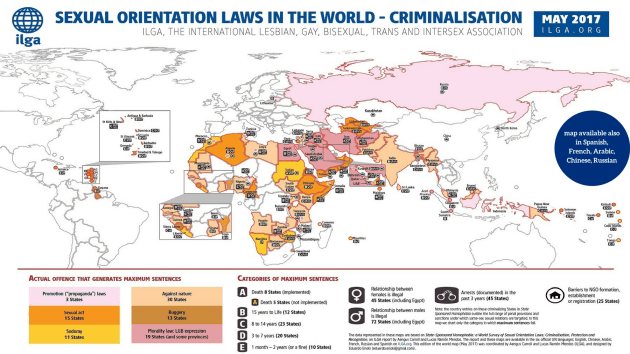
In terms of homosexuality and bisexuality, that means remembering that engaging in same-sex intercourse remains a criminal offence in at least 72 different countries. In at least four countries, being convicted for being gay or bisexual can result in the death penalty (Iran, Saudi Arabia, Yemen and Sudan), as well as in parts of Nigeria, Somalia, Iraq and Syria.

It must be pointed out that this is more than three-and-a-half times the number of countries where there is full marriage equality (20 countries in total, with parts of the UK and Mexico also recognising same-sex marriage).

So, no matter how far we think we’ve come in the 16 years since the first same-sex marriage in the Netherlands (and the rate of change has indeed been astonishing) there are many, many more countries where the battle is a much more fundamental one, where it is a fight for the right to even exist.

From an Australian perspective, we should remember that of the 53 members of the ‘Commonwealth of Nations’ (aka our colleagues among the former British Empire), approximately 40 still criminalise homosexuality and bisexuality. In other words, more than half of the countries in the world where being gay or bisexual is a crime are found within a group that accounts for just over a quarter over the total number of countries.

It is fair to say that homophobia and biphobia is one of the most awful, and enduring, legacies of the British Empire (and especially of Victorian-era Britain). It is equally fair to suggest that it is the responsibility of the United Kingdom, and other countries within the Commonwealth where LGBTI rights have progressed, such as Australia, to assist moves towards decriminalisation in these countries.

But Australia also has special responsibilities with respect of at least one country in our own neighbourhood, which still criminalises homosexuality and bisexuality, and which Australia exerted some form of control over for extended periods of the 20th century: Papua New Guinea.

It just so happens that Australia continues to use PNG for the indefinite detention of (or, what the Government calls, ‘offshore processing and resettlement’ of) refugees, including LGBTI refugees. Even if what our Government is doing on our behalf is immoral, we as Australian citizens have a moral responsibility to support, as best we can, movements within PNG to decriminalise same-sex activity (which can attract punishments of up to 14 years imprisonment).

Of course, as the name suggests, IDAHOBIT is a day to reflect on more than just lesbian, gay and bisexual rights – we must also consider the lack of recognition of and support for transgender people right around the globe.

Trans people are all too frequently denied the right to be who they are, with some countries criminalising simply being trans, while many more deny individuals the medical support that they determine is necessary for themselves, and above all the identity documentation and legal status they deserve.

But, even where being trans is recognised by law, there remains a disturbing and enduring global epidemic of transphobic violence and hate crimes. We must continue to fight to ensure that no person is physically unsafe simply because of their gender identity.

The battle for intersex rights is, to some extent, an even more fundamental one – and that is the fight to be recognised in the first place. Ignored for many years, even it must be said by other parts of the LGBTI community, intersex advocates have done amazing work in recent decades in increasing their visibility and, in turn, visibility of the discrimination which affects them.

Part of these efforts has been shining a spotlight on the absolutely horrific things which are done (and continue to be done) to intersex infants, including sterilisation and other unnecessary and harmful medical interventions. The 2013 Senate Report on Involuntary or Coerced Sterilisation of Intersex People in Australia is a good place to start to read up about these injustices.

Intersex people are also affected by some similar issues to trans people in terms of ensuring that diversity, in gender identity and sex/intersex status, is able to be recognised where it is necessary (and, where it is not relevant to be known or collected, that sex/intersex status is able to be ignored).

So, now that we’ve used IDAHOBIT to think about some of the issues affecting LGBTI people around the world, that’s our job done, isn’t it? After all, these global days of acknowledgement or recognition are usually opportunities for sombre reflection about injustices perpetrated against different individuals or groups, before we move on to the next ‘day of remembrance’ in a week or a month’s time.

Well, no. Because much more important than our thoughts about the human rights violations suffered by LGBTI people elsewhere, are the actions that we take to remedy them. It is not good enough to simply get outraged about the latest anti-LGBTI developments in Chechnya without actually doing something about it.

Of course, speaking as someone from a privileged background in a ‘Western’ country where many (but not all, especially re trans and intersex) of these rights have already been won, deciding exactly what that ‘something’ is can be difficult. It is also complicated by the worse than chequered history of ‘Western’ interventions in the affairs of other countries – including the historical legacy of anti-LGBTI laws and attitudes of European imperialism, and the modern crusades of christian evangelism.

Above all, it is our job to support the role of groups and movements within other countries who are seeking change, working with them (and certainly not dictating to them).

Which leaves what, exactly? For me, this means that on days like IDAHOBIT I consider how I can support those groups in Australia and internationally who either represent the global LGBTI cause, or who have demonstrated the ability to work effectively with LGBTI groups in other countries to achieve progress. This list includes (but is definitely not limited to):

Today, as we celebrate the International Day Against Homophobia, Biphobia, Intersexphobia and Transphobia, please consider supporting one or more of these groups so that together we can improve the lives of lesbian, gay, bisexual, transgender and intersex people everywhere.

ILGA 2017

The ILGA May 2017 map showing the criminalisation of same-sex activity.

2014 GLORIAs Form Guide

The 2014 annual GLORIAs (standing for Gay & Lesbian Outrageous, Ridiculous and Ignorant comment Awards) are coming up next week – Wednesday 14 May.

I enjoy the GLORIAs for a few reasons, not the least of which is host David Marr’s dry wit. The awards are also an important reminder that, no matter how much progress we have made, and continue to make, towards legal equality, the battle against homophobia, transphobia, biphobia and anti-intersex prejudice in social and cultural life goes on.

The GLORIAs, like the Ernies (for misogyny), are a way to hold bigots to account for the awful things that they say – it is a chance for our community to ‘take revenge’ and tell them that enough is enough. Oh, and did I mention that it is usually quite a fun night? Tickets are available here: <http://www.trybooking.com/Booking/BookingEventSummary.aspx?eid=83377

Voting for the worst comment in each of the six categories (International, Media, Politics/Law, Religion, Silliest comment within the LGBTI community, and Sport) is also open online until 5pm on the evening of the 14th: <http://www.theglorias.com.au/home So, get voting.

I have reproduced the nominees from the 6 categories below, along with the person I voted for, who I think will win, and a space to update with the name of each winner after the event. I would love to hear your thoughts on whether you agree or disagree with my reasoning.

And one final thing, thanks should go to lesbian Labor MLC Penny Sharpe, and her staff, for organising the event (which, it should be pointed out, especially after recent events at ICAC, is NOT a political fundraiser).

1. The worst INTERNATIONAL Comment of the year:

Mary Baker, Tea Party activist and leader of Conservative Moms for America: “Gay Supremacy is becoming a monster that carries greater evils than white supremacy ever did.”

Guido Barilla (of Barilla pasta fame): “For us the concept of the sacred family remains one of the fundamental values of the company… I have no respect for adoption by gay families because this concerns a person who is not able to choose”.

Brunei for adopting a new penal code that calls for death by stoning for consenting same-sex sexual activity, adultery, rape, extramarital sexual relations, and for declaring oneself to be non-Muslim.

India’s Supreme Court has refused to review the ban on gay sex it imposed last month, rejecting arguments from civil rights campaigners and the Indian government that the move was unconstitutional.

Delta County School Board member Katherine Svenson said she opposed the recently passed laws in California and Massachusetts that allow transgender students equal access to school facilities such as locker rooms and bathrooms: “I just want to emphasise: not in this district. Not until the plumbing’s changed. There would have to be castration in order to pass something like that around here.”

Nigerian President Goodluck Jonathan signed a bill on Monday that criminalizes same-sex relationships, contains penalties of up to 14 years in prison and bans gay marriage, same-sex “amorous relationships” and membership in gay rights groups.

Zimbabwe President Robert Mugabe described homosexuals as “worse than pigs, goats and birds” and “If you take men and lock them in a house for five years and tell them to come up with two children and they fail to do that, then we will chop off their heads.

Gambian President Yahya Jammeh: “We will fight these vermins called homosexuals or gays the same way we are fighting malaria-causing mosquitoes, if not more aggressively… As far as I am concerned, LGBT can only stand for Leprosy, Gonorrhoea, Bacteria and Tuberculosis; all of which are detrimental to human existence.”

Ugandan President Yoweri Museveni: “Homosexuals are actually mercenaries. They are heterosexual people but because of money they say they are homosexuals. These are prostitutes because of money”

Ugandan Ethics & Integrity Minister Simon Lokodo: “It is a social style of life that is acquired… They chose to be homosexual and are trying to recruit others. … If they were doing it in their own rooms we wouldn’t mind, but when they go for children, that’s not fair. They are beasts of the forest…. Homosexuality is unnatural, abnormal and strange to our cultures… It has no output whatsoever; it only does damage and destruction. You cannot have a right to be a sick human being. There is no right in homosexuality. It must be cured…. Excretion is through the anus, like the exhaust of an engine. The human body receives what it takes from the mouth. They’re twisting nature the wrong way. Homosexuality will destroy humanity because there is no procreation; it will destroy health because the backsides will not hold.”

Michelle Bachmann: “… the gay community, they have so bullied the American people, and they’ve so intimidated politicians. The politicians fear them, so that they think they get to dictate the agenda everywhere.”

Russian President Vladimir Putin: “We do not have a ban on non-traditional sexual relationships. We have a ban on the propaganda of homosexuality and paedophilia… You can feel relaxed and calm [in Russia], but leave children alone please”

Who I voted for: Simon Lokodo, for demonstrating in one long quote just how ‘anally-focused’ many homophobes tend to be.

Who I think will win: This has to be the toughest category to predict. Each of Ugandan President Yoweri Museveni, Gambian President Yahya Jammeh (and his acronym) and perennial nominee Zimbabwean President Robert Mugabe has a strong claim but, simply given the attention his position attracted in the lead-up to Sochi, I suspect Russian President Vladimir Putin might ice-skate his way across the line.

Who did win: In a pleasant surprise (and possibly because of he extremely unpleasant nature of the comments) Simon Lokodo.

2. The worst MEDIA comment of the year:

A poster advertising the Brisbane Queer Film Festival that featured two men kissing was deemed too explicit and banned by Brisbane City Council.

Des Houghton columnist for the Courier Mail for the column ‘Dangers Lurk on Queer Street’: “Is the push for gay marriage just another fad like chai latte with Mt Kosciuszko yak milk, fixed-wheel bicycles and Vietnamese pork belly buns?” (read it here http://www.couriermail.com.au/news/opinion/opinion-dangers-lurk-on-queer-street/story-fnihsr9v-1226703120375).

This ad for The Yellow Pages: http://www.youtube.com/watch?v=NHVjKta5FTk&feature=youtu.be&noredirect=1

Andrew Bolt: “ABC staff must call Manning a woman even when he’s still a man, just because he says so. Just like I must call a white… No. Best not go there.”

Editorial in the Bairnsdale Advertiser ‘Trans-genderism is the enemy of healthy childhood development’.

Who I voted for: Des Houghton, because if you read the entirety of his column, you get an insight into how unhappy his world must be now that the LGBTI community has the temerity to demand genuine equality.

Who I think will win: The explicitly transphobic nature of Andrew Bolt’s column must make him a strong contender.

Who did win: The Bairnsdale Advertiser.

3. The worst POLITICS / LAW comment of the year:

Tasmanian “True Green” party representative Andrew Roberts’s election leaflets: “Most parents will admit that they do not want their kiddies growing up to be more and more corrupted, as they will witness an ever increasing sodomite and lesbian behaviour in public like it’s ‘the norm,’” says the flyer, which associates gay people with disease, child abuse and drug abuse, and calls for the recriminalisation of homosexuality in Tasmania.

Dennis Jensen MP for Tangney WA, speaking on the Marriage Equality Amendment Bill 2013: “This bill is a piece of enabling legislation: it enables the dismantling of society as we know it. In essence, this bill is the apotheosis of a movement bent on legislating a social experiment. Gay marriage is a social experiment. Social experiments have poor results when viewed historically. One need only think of phrenology and eugenics, both of which, thankfully, have been consigned to the dustbins of history but not before having damaging social consequences…”

Federal election campaign flyer in Moreton, QLD with a picture of a crying child stating “I want my mum and dad … Loving kids and respecting their rights means keeping marriage laws that put kids first” (source unknown), https://www.facebook.com/TheGLORIAs/posts/508063229281606

Joe Bullock (Labor Senator-Elect) on running mate Senator Louise Pratt: “she’s a lesbian I think, although after her partner’s sex change I can’t be sure”.

Fred Nile’s (#3) speech in Parliament in support of Reparative Therapy (gay cure therapy). Hansard 14 November 2013.

NSW Premier Mike Baird for his views on “choosing to live a homosexual lifestyle” and his refusal to answer questions about this statement at a press conference after he became Premier.

George Brandis for this on QandA: TONY JONES: But just on principle, you are saying that religious freedom supersedes the freedom of your sexuality? GEORGE BRANDIS: Yes, I am, as a matter of fact. Yes, I am.

Fred Nile (#2) on the NSW Same-Sex Marriage Bill: The so-called marriage between two males is unnatural. Homosexual relations between a male and a male are strongly forbidden in both the Old Testament and the New Testament—in the New Testament particularly by Apostles Paul and Peter and, by implication, by the moral teachings of Jesus Christ. I believe that God’s creative purpose for planet Earth—which is a sensitive issue to discuss—is that the basis for the foundation of the family and the continuation of the human race is the institution of marriage.

Tony Abbott, discussing marriage equality: “I’m not saying our culture, our traditions are perfect but we have to respect them… … I’m not someone who wants to see radical change based on the fashion of the moment.”

A fundraising event for the Liberal Party hosted by Victorian Premier Denis Napthine has seen independent Frankston MP Geoff Shaw ridiculed as a “poofter bastard” by comedian Nick Giannopoulos in front of more than 300 guests.

Fred Nile (#1) for this section of Christian Democratic Party’s National Charter: (c) GOD’S GIFT OF SEX: We believe that God has established laws of sexual morality for the well-being of society prohibiting pornography, adultery, incest, homosexuality, and other sexual aberrations which debase man, as well as defile and pollute our nation. (Note that ‘homosexuality’ is listed after ‘incest’).

Alby Schultz: “I think it is abominable that gay activists continue to focus on and manipulate civil rights strategies to justify claims for same-sex marriage and keep using accusations of discrimination, inequality and homophobia to intimidate politicians and the general public.”

Cory Bernardi’s book ‘The Conservative Revolution’.

WA Liberal Upper House Member Nick Goiran for linking gay marriage to incest in a speech in Parliament.

Federal election campaign flyer in Jagajaga, VIC: “Jenny Macklin voted for same-sex marriage. Same-sex marriage WILL MEAN same-sex education in kindergartens and schools” (source unknown): https://www.facebook.com/photo.php?fbid=5080622 “92615033&set=a.358377574250173.91788.274008212687110&type=1&theatre

Who I voted for: George Brandis (and not just because it was my question on #QandA which precipitated the exchange between Tony Jones and him). Despite other comments being more overtly ‘offensive’, the fact that the then shadow/now Commonwealth Attorney-General was prepared to say, without any qualification whatsoever, that religious rights automatically trump LGBTI rights is, when you think about it, actually pretty outrageous.

Who I think will win: While I’m not confident of this prediction, the combination of the popularity or marriage equality, and current lack of popularity of our Prime Minister, makes me think Tony Abbott could take home the gong.

Who did win: As predicted Tony Abbott took out the gong (better luck next year Senator Brandis).

4. The worst RELIGION comment of the year:

Pastor Kevin Swanson of the Colorado based Reformation Church, thinks that the Disney movie ‘Frozen’ indoctrinates five-year-olds into lesbianism and bestiality: “You wonder sometimes if maybe there’s something very evil happening here … I wonder if people are thinking: ‘You know I think this cute little movie is going to indoctrinate my 5-year-old to be a lesbian or treat homosexuality or bestiality in a light sort of way.’”

Far-right American Christian author Linda Harvey blames gay teens for running away from ‘heart-broken’ homophobic parents who want to control their lives – saying they only have themselves to blame for their homelessness.

Australian Christian Lobby/Lyle Shelton for the Media Release ‘Rudd’s change on marriage sets up a new stolen generation’: “Australian Christian Lobby Managing Director Lyle Shelton said Kevin Rudd’s overnight change of mind on redefining marriage ignored the consequence of robbing children of their biological identity through same-sex surrogacy and other assisted reproductive technologies”.

Ex-Anglican Archbishop Peter Jensen: ”How do two men have sexual union? …You have joined a couple of people together at a spot where they shouldn’t be joined together, really.”

Penrith Christian School’s statement which includes the following: “We believe that homosexuality and specific acts of homosexuality are an abomination unto God, a perversion of the natural order and not to be entered into by His people.” And “We believe the practice of attempting to or changing ones gender through surgical and/or hormonal or artificial genetic means is contrary to the natural order ordained by God.”

Who I voted for: Peter Jensen. In Australia we often judge religious (and political – see Simon Lokodo’s comments, earlier) leaders in other countries for making anal sex-obsessed homophobic comments. Last year, we had the leader of the Anglican Church right here in Sydney saying basically the same thing. The fact he has now retired and may not be nominated again provided another incentive for this vote.

Who I think will win: It’s hard to look past the ACL media release equating Kevin Rudd’s support for marriage equality with the stolen generations as a ‘winner’. Which reminds me: can we officially make an Australian version of Godwin’s Law that the first person to bring up the stolen generations in an unrelated argument automatically loses?

Who did win: Penrith Christian School (NB I also collected the GLORIA for the person who nominated them, even though I still would have preferred Peter Jensen to have won).

5. The SILLIEST GLBTI comment from someone within the GLBTI community

Openly Gay Federal Election Liberal candidate for Sydney Sean O’Connor for preferencing the Christian Democratic Party (CDP) on his How To Vote card above Tanya Plibersek for Labor and The Greens (See:http://www.starobserver.com.au/news/local-news/new-south-wales-news/gay-liberal-candidate-prefers-reverend-fred-niles-party-for-sydney/108672).

Brian Coleman, the gay former Conservative London Assembly Member and ex-mayor of Barnet who described the Marriage (Same Sex Couples) Act as a “silly” and “dreadful” piece of legislation.

Gay CNN host Don Lemon talking about ex-figure skater Johnny Weir: “No one likes a gay minstrel show … so let’s just put that out there. About some of his flamboyant and over the top and all those, it seems those are the people who get the attention, but they don’t represent all of gay America.”

Who I voted for: Don Lemon. The idea of calling someone else who could be described as camp (possibly something of an understatement) as a ‘gay minstrel’ reveals much more about Don Lemon than it does about Johnny Weir. We need to accept people for whoever they are, and however they choose to express themselves. At the same time, it is not the responsibility of each and every gay man in public life to be the sole representation or role model of gay life, either in America or elsewhere.

Who I think will win: Don Lemon.

Who did win: Sean O’Connor (who, like Duncan Gay last year, had the good grace – and PR advice – to attend and collect the award in person).

6. The worst SPORT comment of the year:

Newcastle Knights NRL footballer Ryan Stig who posted a long message to Facebook and Twitter titled ‘Homosexuality demonic work’ about his opposition to marriage equality: “Homosexuality is a fairly good example of distortion of design for fairly obvious reasons. When laws such as this … are created it makes covenant with unseen realms of the demonic which work to infiltrate and come against the thought lives of our cities states [sic] and nations”.

Anthony Mundine for this comment about Redfern Now: “Watching redfern now & they promoting homosexuality! (Like it’s ok in our culture) that ain’t in our culture & our ancestors would have there head for it! Like my dad told me GOD made ADAM & EVE not Adam & Steve,” he wrote.

Alex Rodrigo Dias da Costa, former Chelsea player: “We love everyone but do not like those who do not stand for what the Bible says. But this is not homophobia…. I don’t agree that it is OK that a man lives with another man and a woman with a woman.”

PGA Golfer Steve Elkington for this tweet regarding openly gay NFL hopeful, Michael Sam: “ESPN reporting Michael Sam is leading the handbag throw at NFL combine …. No one else expected to throw today”.

Who I voted for: Anthony Mundine, not just because the comment was idiotic, or because of his repetition of the immensely stupid catch-phrase ‘Adam & Steve’, but because he disparaged the wonderful Redfern Now. At least his ignorant twitter outburst had the positive outcome of helping to inspire the creation of the Black Rainbow facebook community.

Who I think will win: Anthony Mundine, although the long-on-content but short-on-intelligence rant from Ryan Stig could be a very close second.

Who did win: Anthony Mundine (in a well-deserved effort).

Stand-in host Barbara Blacksheep, performing the now-accustomary lip-synch of 'Gloria'.

Stand-in host Barbra Blacksheep, performing the now-accustomary lip-synch of ‘Gloria’.

The Golden GLORIA

This is particularly difficult to predict, given the winner must come from the 6 winners of the above categories, and is then decided by a ‘boo-off’ on the night. Still, I will put forward my preference, and hazard a guess who the community might help ‘elect’ as the prestigious title-holder for the next 12 months, replacing the outgoing winner, NSW Roads Minister The Hon Duncan Gay.

Who I want to win: George Brandis. As explained above, I find his elevation of the religious ‘freedom to discriminate’ above the LGBTI community’s right not to be discriminated against offensive in the extreme. For more on why, feel free to read my earlier column: The last major battle for gay & lesbian legal equality in Australia won’t be about marriage, here: <https://alastairlawrie.net/2014/02/26/the-last-major-battle-for-gay-lesbian-legal-equality-in-australia-wont-be-about-marriage/

Who I think will win: Perhaps Vladimir Putin, or maybe Yahya Jammeh.

Who did win: Well, after winning his category, and in a decision which is possibly somewhat related to the unpopularity of last night’s Federal Budget, the winner of the 2014 Golden GLORIA, was Prime Minister Tony Abbott.

One final category, which wasn’t in the program, but which was awarded for the first time on the night, was the inaugural ‘good’ GLORIA, for people or organisations which have shown the most improvement in terms of accepting LGBTI people. The winner was the anti-homophobia initiative in April involving the leaders of major Australian sporting codes, and the #YouCanPlay campaign alongside it. Fittingly, ex-NRL trailblazer Ian Roberts was on hand to accept the award on their behalf.

So, that’s the GLORIAs done for another year. Thanks again to Penny Sharpe for another fabulous event – and I understand that nominations for next year’s event should open by the weekend (there is already an early frontrunner, given Miranda Devine’s recent efforts, but there’s still plenty of time left for more ridiculous, outrageous and ignorant comments to be made).

Don’t Limit Racial Vilification Protections, Add Vilification Protections for LGBTI Australians

The following is my submission to the Attorney-General’s Department’s Review of the Freedom of speech (repeal of s.18C) Bill 2014 – Exposure Draft (aka the Bill to significantly limit the scope of racial vilification protections under the Racial Discrimination Act 1975).

Submissions close on Wednesday 30 April, and more details can be found here: <http://www.ag.gov.au/Consultations/Pages/ConsultationsonamendmentstotheRacialDiscriminationAct1975.aspx

I strongly encourage you to make a submission, and include in it the call for the Commonwealth to focus on expanding protections for the benefit of all lesbian, gay, bisexual, transgender and intersex Australians, rather than limiting the operation of s18C for one Melbourne-based News Ltd columnist. Thanks.

Human Rights Policy Branch

Attorney-General’s Department

3-5 National Circuit

BARTON ACT 2600

s18cconsultation@ag.gov.au

Thursday 24 April 2014

To whom it may concern,

SUBMISSION ON RACIAL VILIFICATION AMENDMENTS

Thank you for the opportunity to make a submission on the proposed changes to the racial vilification provisions of the Racial Discrimination Act 1975, as contained in the Freedom of speech (repeal of s.18C) Bill 2014 Exposure Draft.

For the reasons explained below, I do not support the replacement of existing sections 18B, 18C, 18D and 18E with the new clauses of the Exposure Draft Bill.

However, I do believe that significant changes should be made to vilification provisions in Commonwealth law: namely, that vilification protections should be expanded to cover sexual orientation, gender identity and intersex status.

The absence of such protections leaves lesbian, gay, bisexual, transgender and intersex (LGBTI) Australians vulnerable to the same types of adverse public conduct experienced by people of different racial backgrounds, but without recourse to the same complaint resolution mechanisms.

I will now turn to these two issues – the proposed reforms, and the case for introducing LGBTI vilification protections – in more detail.

Proposed Reforms to Section 18C

In considering any potential reforms to section 18C of the Racial Discrimination Act 1975, it is useful to start at the particular sub-section which features in most debate. Sub-section 18C(1)(a) makes it “unlawful for a person to do an act, otherwise than in private, if: the act is reasonably likely, in all the circumstances, to offend, insult, humiliate or intimidate another person or a group of people.”

I am of the view that the drafting of this sub-section is probably not ideal, and, arguably, is too broad in terms of the types of conduct that at least theoretically could be captured. I do not believe that, were provisions regarding racial vilification to be drafted today, they would include the terms ‘offend’ or ‘insult’ (or at least not without aggravating factors or considerations).

However, it is one thing to suggest that the drafting of a provision is something less than ‘ideal’ – it is another to suggest that poor drafting has directly caused problems that mean it must be amended. And even if that test is satisfied, any proposed reforms to the law should be an improvement, and not worsen any potential harm.

Turning to the question of whether the drafting of section 18C has directly led to, or caused, any significant problems, I am not convinced that it has. Racial vilification protections under the Racial Discrimination Act 1975 appear to be widely supported by the community, and, for the most part, appear to be working well, both with the oversight of the Australian Human Rights Commission and in the Courts.

There is, of course, one case which is frequently cited as necessitating change to section 18C, and its related provisions, and that is the case of Eatock v Bolt [2011] FCA 1103.

Even ignoring the old legal maxim that hard cases make bad law (“Hard cases, it has frequently been observed, are apt to introduce bad law”, from Judge Rolfe in Winterbottom v Wright in 1842), it is not clear that the outcome of the “Bolt case” makes any persuasive case for change.

In the summary of that decision, Justice Mordecai Bromberg explained that “I am satisfied that fair-skinned Aboriginal people (or some of them) were reasonably likely, in all the circumstances, to have been offended, insulted, humiliated or intimidated by the imputations conveyed by the newspaper articles” of Mr Bolt (para 17).

Justice Bromberg also explained that Mr Bolt’s conduct could not fit within what are, to be frank, extremely generous exemptions in section 18D, writing that “I have not been satisfied that the offensive conduct that I have found occurred, is exempted from unlawfulness by section 18D. The reasons for that conclusion have to do with the manner in which the articles were written, including that they contained errors of fact, distortions of the truth and inflammatory and provocative language” (para 23, emphasis added).

In his summary, Justice Bromberg also articulates at least one of the reasons why laws should exist to prohibit writings such as those of Mr Bolt: “People should be free to fully identify with their race without fear of public disdain or loss of esteem for so identifying. Disparagement directed at the legitimacy of the racial identification of a group of people is likely to be destructive of racial tolerance, just as disparagement directed at the real or imagined practices or traits of those people is also destructive of racial tolerance” (para 22).

In short, there appears to at least be an arguable case that not only was the “Bolt case” decided correctly on the existing law, but also that the current provisions are operating as intended to limit the negative effects of racial intolerance. Conversely, I believe it is difficult to argue, solely on the basis of Eatock v Bolt, that section 18C is so deficient that it should be amended, and amended as a matter of high priority.

Even if the argument that change was, indeed, necessary was accepted, I do not support that changes proposed in the Freedom of speech (repeal of s.18C) Bill 2014 Exposure Draft.

I believe that the replacement of ‘offend, insult, humiliate or intimidate’ with to vilify (defined as “to incite hatred against a person or a group of persons”) or to intimidate (meaning “to cause fear of physical harm; to a person; to the property of a person; or to the members of a group of persons”), would arbitrarily and unduly limit the effectiveness of these protections.

I agree with the Australian Human Rights Commission, in their statement of Tuesday 25 March 2014, that: “the bill reduces the level of protection by providing a narrow definition of vilification and by limiting intimidation to causing fear of physical harm. It is not clear why intimidation should not include the psychological and emotional damage that can be caused by racial abuse.”

I also agree with the Australian Human Rights Commission in their concerns about the breadth of the exemptions proposed in new clause (4). As the Commission notes “[t]his provision is so broad it is difficult to see any circumstances in public that these protections would apply.”

This is at least in part because the previous limitations of section 18D – that words or conduct must be done “reasonably and good faith” to be exempted – have been removed, again without a clear explanation or motivation. In my opinion, the proposals contained in the Exposure Draft Bill would not improve the operation of racial vilification protections generally, but instead have the capacity to make things substantially worse.

Overall, while I concede that the current drafting of section 18C is not ‘ideal’, I do not believe that there are sufficient problems in practice for it to be amended. I also strongly oppose the replacement of sections 18B, 18C, 18D and 18E of the current Racial Discrimination Act 1975, with the clauses contained in the Freedom of speech (repeal of s.18C) Bill 2014 Exposure Draft.

Recommendation 1. The Freedom of speech (repeal of s.18C) Bill 2014 – Exposure Draft should not be introduced into or passed by the Commonwealth Parliament.

Need to expand vilification protections to cover sexual orientation, gender identity and intersex status

While I do not believe a case has been made to reform the racial vilification provisions of the Racial Discrimination Act 1975, I do believe there is a strong case for expanding vilification provisions under Commonwealth law to offer additional protection to LGBTI Australians.

In a similar way to their ongoing problems with race, some extreme elements within Australian society continue to demonstrate their difficulty in accepting people, and treating them equally, irrespective of sexual orientation, gender identity or intersex status.

Both groups – Australians of diverse racial backgrounds, and LGBTI people – are regularly subject to vilification in public contexts, whether that be in political or media debates, or in harassment and abuse in public spaces.

Significantly, while LGBTI Australians finally achieved anti-discrimination protections under Commonwealth law in 2013 (a mere 38 years after the passage of the Racial Discrimination Act), the Sex Discrimination Act amendments did not include protections from homophobic, biphobic, transphobic and anti-intersex vilification. Unlike people of diverse races, LGBTI people still cannot launch complaints about vilification under Commonwealth law.

There is no philosophical or conceptual reason why this should be the case – both are vulnerable groups, subject to vilification against which they deserve to be protected.

The vilification of LGBTI people can take many forms. A 2003 NSW Attorney-General’s Report found that, in the previous 12 months, 56% of gay men and lesbians had been subject to one or more forms of homophobic abuse, harassment or violence.

This violence can also be extreme – as demonstrated by the disturbingly high number of gay men violently murdered in Sydney during the 1980s and 1990s, but whose tragic deaths are only now being properly investigated.

In terms of vilification in public debate, there are almost too many examples of homophobia, biphobia, transphobia and anti-intersex discrimination to choose from (and certainly enough to hold an annual event ‘celebrating’ the worst of these comments in a range of different areas of public life, aka The GLORIAs).

One notorious example from recent years was the homophobic comment of a religious figure, addressing a ‘National Marriage Day’ rally outside Parliament House in 2012, who said “I’m convinced that homosexuals (re)produces (sic) themselves by molesting children.”

Unfortunately, heading inside Parliament House, the tenor of public debate is sometimes not much better. Over the past 12 years we have seen Senators argue that allowing two men or two women to marry could lead to humans having sex with animals, arguing that enacting marriage equality would potentially result in another ‘Stolen Generations’, and abusing parliamentary privilege to smear an openly-gay High Court Justice with unfounded allegations of paedophilia (apparently solely because of his homosexuality).

This is not to say that all, or even any, of those comments would necessarily qualify as vilification under an equivalent provision to section 18C, but, the fact those comments are able to be made in our National Parliament provides a small insight into the type of abuse and vitriol which continues in other forums, day-in, day-out, which are not subject to the same levels of scrutiny.

That includes street-level harassment and abuse which my fiancé Steven and I, like many thousands of other LGBTI Australians, experience all-too-frequently. Anyone who is ‘visibly’ identifiable as lesbian, gay, bisexual, transgender or intersex, including non-LGBTI people who are perceived as being LGBTI by others, and anyone who simply wants to engage in the tender act of holding one’s same-sex partner’s hand, knows the risks that being or expressing who you are in public can bring, from being yelled at from passing cars, to the very real threat of much, much worse.

Of course, the introduction of s18C-style protections on the basis of sexual orientation, gender identity and intersex status will not automatically lead to a reduction in such abuse, but it will allow for people to contest the most egregious examples of homophobic, biphobic, transphobic and anti-intersex vilification in public life.

Over time, the introduction of vilification protections for LGBTI Australians, on top of the recently passed anti-discrimination laws, would help to send a strong signal to the wider community that such conduct was no longer tolerated.

The impetus for sending such a signal can be found in figures which show that lesbian, gay, bisexual, transgender and intersex Australians continue to experience disproportionately high rates of mental health issues, including depression, attempted suicide and suicide.

This problem is especially pronounced amongst younger LGBTI people, with young same-sex attracted people estimated to be 6 times more likely to attempt suicide than their heterosexual counterparts (source: National LGBTI Health Alliance). Young people’s experience of discrimination and homophobia has been found to play a key role in this huge, and sadly persisting, health disparity.

Not only is public vilification in the form of homophobia, biphobia, transphobia and anti-intersex discrimination wrong in and of itself, it has serious consequences, including in negative mental health outcomes for LGBTI people.

I believe that anti-LGBTI vilification must be prohibited under the Sex Discrimination Act, in the same way that racial vilification was in 1995 when the Racial Hatred Act amended the Racial Discrimination Act, and that it should be done as soon as possible.

Recommendation 2. The Sex Discrimination Act 1984 should be amended to prohibit vilification on the basis of sexual orientation, gender identity and intersex status.

Obviously, there are other potential attributes which could also be aided by the introduction of vilification protections, including those grounds which already have Commonwealth anti-discrimination laws (sex, disability and age), but, as I am not an expert in any of those issues, I am not in a position to argue for or against their inclusion in this submission.

Nevertheless, I strongly believe that these questions – whether vilification protections should be expanded, and which additional groups they should cover – are the ones which should be occupying the mind of our Commonwealth Attorney-General, and indeed all MPs, rather than working out how to restrict the protections offered by the racial vilification provisions contained in the Racial Discrimination Act 1975.

I sincerely hope that this submission assists in helping to turn that conversation around, and that we, as a community, start to focus on enhancing instead of undermining human rights.

Thank you for taking these comments into consideration. Should you require clarification or further information, I can be contacted at the details below.

Sincerely,

Alastair Lawrie

Dear Joe Hockey, If you’re serious about cutting expenditure, you must axe school chaplains

As promised during the 2013 federal election campaign, one of the first actions of the Tony Abbott-led Liberal-National Government was to establish a National Commission of Audit, to review all Commonwealth expenditure in an effort to reduce spending and ultimately deliver a Budget surplus.

Indeed, the Terms of Reference for the Commission of Audit described it as a “full-scale review of the activities of the Commonwealth government to:

-ensure taxpayers are receiving value-for-money from each dollar spent;

-eliminate wasteful spending; …

-identify areas or programs where Commonwealth involvement is inappropriate…” [among other objectives].

The Commission’s first report was delivered to the Treasurer, Joe Hockey, in mid-February, and the second was handed over at the end of March. The contents of both reports were, quite cynically, kept from the public ahead of the Western Australian half-Senate election on 5 April (because you wouldn’t want an electorate to actually be informed about impending spending cuts before they vote), although, with only one month left until the Federal Budget is handed down it’s highly likely they will be released in the next week or two.

It is expected that the Commission will recommended that the axe fall on (or at least make significant cuts to) a wide range of different programs, with apparently ‘authorised’ leaks focusing on things like the aged pension, Medicare (through a $6 co-payment) and other vital health, education and welfare services.

However, there is one program that, I believe, meets all of the above criteria and thoroughly deserves to be cut as part of any serious expenditure review: the National School Chaplaincy and Student Welfare Program. It is almost impossible to argue that putting ministers of religion into government schools could ever be value-for-money, when compared with almost any other government expense. As well as being enormously wasteful spending, it would also seem to be the definition of a program where Commonwealth involvement is inappropriate.

And yet, given the highly political nature of the Commission of Audit, I suspect it is unlikely the National School Chaplaincy Program is under any real threat. Even if the Commission were to recommend its abolition, it is hard to believe that Joe Hockey would actually follow through on any such advice when he rises to the dispatch box on the night of Tuesday 13 May.

More’s the pity. The National School Chaplaincy Program is amongst the worst examples of public policy over the past decade (and there have been some absolute shockers in that time). It was introduced by John Howard in the dying days of his government (2007), as he realised his grip on power was loosening with age – basically, it was a sop to ultra-conservatives and religious fundamentalists (both of which can be found in the form of the Australian Christian Lobby) to entice them to remain aboard his sinking electoral ship.

Alas, in a demonstration that poor policy, and religious pork-barrelling, can be bipartisan, the incoming Prime Minister, Kevin Rudd, maintained the National Schools Chaplaincy Program throughout his first stint in the Lodge. When it came time to review the first three years of its operation, frustratingly he and his then Deputy, Education Minister Julia Gillard, chose to continue, rather than close, the program.

As Prime Minister in the lead-up to the 2010 poll, Gillard then announced a $222 million extension of the program til the end of this year (2014). This money was also provided to allow for expansion of the scheme’s coverage, from 2,700 schools up to 3,550 schools.

The only figure that accomplished anything to at least partially mitigate the genuine awfulness of the National Schools Chaplaincy Program over the past seven years was Education Minister Peter Garrett, who changed the program guidelines from the start of 2012 to allow schools to choose between chaplains or qualified student counsellors (hence the revised name). He also attempted to introduce a requirement that all workers, including chaplains, have some level of relevant qualifications, although recognition of ‘prior learning’ on the job was also encouraged.

Nevertheless, the vast majority of people employed as a result of this scheme remain ministers of religion. Imagine that: in 2014, the Commonwealth Government provides up to $24,000 per year to more than three and a half thousand schools to subsidise the employment of someone whose primary ‘qualification’, indeed whose primary vocation full stop, is to proselytise.

Ironically, the National School Chaplaincy and Student Welfare Program Guidelines then go to great lengths to attempt to limit the ability of chaplains to proselytise or evangelise from their position of authority within the school community, which is about as useful as telling a tree to stop growing leaves (or telling Cory Bernardi to stop being a bigot). It seems like the apotheosis of a set of rules where adherence, rather than breach, will be the exception.

The Guidelines themselves are also full of loopholes, allowing chaplains to “provid[e] services with a spiritual content (excluding religious education) including facilitating discussion groups and lunch time clubs” with approval and consent, as well as “performing religious services/rites (such as worship or prayer during school assembly etc), with… appropriate prior consent”.

This is an obvious and serious contravention of the principle of the separation of church and state. In the United States, such a program – paying for men (and some women) of faith to introduce their religion into government schools – would be struck out as unconstitutional by their Supreme Court.

Sadly, the anaemic interpretation of section 116 of the Constitution adopted by the High Court of Australia in the “DOGS case” [Attorney-General (Vic); Ex Rel Black v Commonwealth [1981] HCA 2; (1981) 146 CLR 559 (2 February 1981)] meant that it was never going to be struck down here, or at least not on those grounds.

Even after the program was successfully challenged by Toowoomba father, and man of principle, Ron Williams in 2012, with the High Court finding that the scheme did not have a legislative basis to appropriate money, the Government squibbed the ideal chance to abandon a flawed program and instead rushed through legislation to support its ongoing operation [as an aside, the High Court will be hearing a further challenge from Mr Williams, on May 6-8 2014, that the rushed omnibus Bill was itself unconstitutional].

And even if the National School Chaplaincy Program is ultimately found to be constitutional, there is still absolutely zero evidence that it is effective at improving the overall welfare of students.

If any of the Howard, Rudd, Gillard, Rudd (again) or now Abbott Governments genuinely considered that student welfare was a matter of priority, they would properly fund, rather than part subsidise, actual student counsellors or social workers to perform that function in every school, not implement a scheme where cashed-up churches could target individual cash-starved schools and offer the ‘services’ of ministers of religion, essentially as a backdoor way of indoctrinating a fresh generation of children.

There are ways in which the introduction of ministers of religion into schools can lead to direct harm too, not least of which being the issue of potential child sex abuse. In fact, at the same time as the hearings of the Royal Commission into Institutional Responses to Child Sex Abuse, the Government continues to encourage the employment of ministers of religion in public schools, with a code of conduct that allows them to have physical contact with students because “there may be some circumstances where physical contact may be appropriate such as where the student is injured or distraught”. [NB Obviously I am not saying that most, or even many, school chaplains are child sex abusers, but it seems unnecessary, and unnecessarily risky, to bring in people from institutions with a long history of covering-up such abuse and placing them in positions of trust in public schools.]

In addition, some (although obviously not all) ministers of religion also present a clear and present danger to young lesbian, gay, bisexual, transgender and intersex (LGBTI) students, given the blatant homophobia adopted by particular churches and their officials. This threat is explicitly acknowledged by the Guidelines, which in response attempts to prohibit discriminatory behaviour on the basis of sexuality (although it doesn’t appear as though either gender identity or intersex status are mentioned at all).

In the same way as the prohibition on ‘proselytising’ described above, however, it is inevitable that there will be some ministers of religion, in some schools, who deliberately flout those rules, and in the process cause untold harm to young LGBTI students.

In short, the National Schools Chaplaincy Program is philosophically unsound, has no evidence that it benefits student welfare, is expensive, potentially causes harm and is clearly an inappropriate activity to be funded through taxpayers’ money. Surely, out of all of the programs funded by the Commonwealth, across almost all areas, it should be at or near the top of any Commission of Audit ‘hit-list’.

Even if the Commission of Audit abrogates its basic responsibility to recommend that the National School Chaplaincy Program be axed, Treasurer Joe Hockey will still have to make a decision on the future of the program as part of the 2014-15 Budget, because, as noted earlier, funding for the scheme runs out at the end of this year.

What action Joe Hockey takes on this will reveal a great deal about what kind of Treasurer he intends to be. Of all the incoming Abbott Ministers, Hockey has been the loudest in condemning middle-class welfare, in arguing that the role of Government must be smaller, and that inappropriate or unjustifiable programs should be cut.

Well, here is an ideal opportunity to live up to at least some of that rhetoric, savings upwards of $222 million in the process (that’s the equivalent of one and a half $6 GP co-payments for every person in Australia). If he does so on 13 May, then he should be applauded for it (noting of course that there might, just might, be some other things in the Budget that warrant a somewhat different response).

If Hockey fails to rise to the occasion, and extends or even expands funding for ministers of religion in our public schools, then it will show that he is not serious at all about reining in inappropriate spending, and does not believe in small Government – instead, it will simply demonstrate that he believes in big government of a different kind, one that takes money from genuine welfare programs and places it in the hands of ministers of religion for the propagation of their beliefs.

So, now it’s over to you Joe: would you rather take money from people who simply want to see their doctor via a bulk-billed appointment, or from a program which funds the placement of ministers of religion into our public schools? I know which one I would choose. I guess we’ll find out on Budget night which one you do.

Submission to National Curriculum Review re Health & Physical Education Curriculum

The following is my submission to the review of the national curriculum, initiated by the Commonwealth Minister for Education, the Hon Christopher Pyne MP at the end of 2013. Given the appointment of Mr Kevin Donnelly to co-chair this review, I am not confident that all, or indeed, any of the concerns below will be listened to. But the inclusion of LGBTI students and content in our schools system is so important that I believe it is still worth a shot.

National Curriculum Review Submission

Thursday 13 March 2014

Thank you for the opportunity to make a submission on the development of the national school curriculum.

In this submission I will limit my comments to the development of the national Health & Physical Education (HPE) curriculum. In particular, I will be commenting on whether the HPE curriculum as drafted addresses the needs of, and genuinely includes, lesbian, gay, bisexual, transgender and intersex (LGBTI) students.

I have previously made submissions on the initial public consultation draft of the HPE curriculum, released in December 2012 (a copy of my submission is provided at <https://alastairlawrie.net/2013/04/11/submission-on-national-health-physical-education-curriculum/ ), and on the revised draft released for limited public consultation in June and July 2013 (see <https://alastairlawrie.net/2013/07/30/submission-on-redrafted-national-health-physical-education-curriculum/ ).

In both of those submissions I was strongly critical of the fact that the draft HPE curriculums did not genuinely attempt to include LGBTI students (including omission of the words lesbian, gay or bisexual), did not provide adequate sexual health education, and did not provide adequate information regarding HIV and other Blood Borne Viruses (BBVs), including viral hepatitis.

A second revised draft of the curriculum was prepared by the Australian Curriculum, Assessment and Reporting Authority (ACARA) ahead of the meeting of Commonwealth, State and Territory Education Ministers in November 2013. It has been reported that Education Ministers did not agree to the second revised draft, but instead simply noted its development in anticipation of this review.

Nevertheless, the second revised draft HPE curriculum was published in February 2014 on the Australian Curriculum website (www.australiancurriculum.edu.au).

I have analysed the second revised draft, and sincerely hope that my comments below convey the seriousness of my concerns about the ongoing exclusion of LGBTI students and content, and the potential negative health impacts that this exclusion will have over the short, medium and long-term.

The current version of the national Health & Physical Education curriculum does nothing to put all ‘Students First’, which I understand to be the guiding principle of this review. In fact, by continuing to exclude some students, and marginalising content which is relevant to their needs, the draft HPE curriculum places lesbian, gay, bisexual, transgender and intersex students last.

If the HPE curriculum were to be implemented as it currently stands, it would actively contribute to, and reinforce, the disproportionate rates of mental health problems, depression and, most tragically, suicide, which continue to affect young LGBTI people.

By failing to include detailed BBV and sexual health education, the HPE curriculum would also leave young people, and gay and bisexual men and trans* people specifically, exposed to unnecessary risk of transmission of HIV and other infections.

And by not ensuring that all students are provided with information that is relevant to their own needs and personal circumstances, the HPE curriculum will undermine the fundamental human right to health of the next generation of young LGBTI people. This right must be respected, and not denied to people merely on the basis of other peoples’ attitudes towards their sexual orientation, gender identity or intersex status.

This review is an(other) opportunity to address some of the serious shortcomings of the draft HPE curriculum. Please seize this opportunity and recommend that the curriculum be amended to ensure LGBTI students are included, with content that is relevant and targeted to meet their needs, including around sexual health and BBV education.

The remainder of this submission will look at five key areas of the draft HPE curriculum. They are:

  • Terminology
  • Student Diversity
  • Bullying & Discrimination
  • Sexual Health, and
  • HIV and other BBVs.

Terminology

One significant problem that has consistently appeared through the initial draft, revised draft and now second revised draft of the Health & Physical Education curriculum is that of terminology. Specifically, the HPE curriculum has either completely excluded terms that are essential for young people to learn, or included terms or definitions that are not appropriate in the circumstances.

The biggest problem in terminology, featured in all three drafts, has been the failure to even include the words lesbian, gay or bisexual. Despite these being the most common forms of identification for people whose sexual orientation is ‘not heterosexual’, these terms have never appeared in any version of this document.

In fact, the ongoing refusal to name lesbians, gay men and bisexuals – despite the fact that students will have heard these terms regularly amongst their families and friends, in culture and in broader society, and that an increasing number of young people, including students, will be using these terms to describe themselves – is almost bizarre in its stubbornness to deny reality.

Even if there may be a reason for sometimes using the umbrella term same-sex attracted, to ensure that people who may be sexually attracted to people of their own sex but who do not use the terms lesbian, gay or bisexual to identify themselves are included, there is absolutely no justification for not naming lesbian, gay and bisexual identities within the HPE curriculum (for example, by using the description “same-sex attracted, including lesbian, gay and bisexual people”). The failure to do so contributes to the marginalisation of lesbian, gay and bisexual young people.

On a related issue, the HPE curriculum as drafted appears to use the incredibly broad, and arguably poorly-defined, term ‘sexuality’ at multiple points in the document when ‘sexual orientation’ would be more appropriate.

For example, the Glossary defines ‘sexuality’ as “[a] central aspect of being human throughout life. Sexuality encompasses sex, gender identities and roles, sexual orientation, pleasure, intimacy and reproduction and is influenced by the interaction of biological, psychological, social, economic, political, cultural, ethical, legal, historical, religious and spiritual factors”. The breadth of this definition makes some of the references to sexuality in the curriculum either too vague to be practicable, or even unintelligible.

The more widely-accepted term ‘sexual orientation’, which the curriculum does not define, and only appears to use once (in the definition of ‘sexuality’, reproduced above), would be more constructive, especially when references are made to differences or diversity in ‘sexuality’. Using the term sexual orientation would also more clearly include different orientations (including lesbian, gay and bisexual) than using the term sexuality alone.

On a positive note, there have been some improvements in references to, and definitions for, diversity in gender identity, including transgender people (which at least is included as part of the Glossary definition of ‘gender diverse’).

There have also been improvements in terms of the recognition of intersex people, who are now at least referenced in the statement on student diversity, and provided with a separate definition in the Glossary (where previously it had been erroneously included within the definition of gender diverse).

Nevertheless, defining a term in the Glossary and then using it once in the main text of the curriculum itself (and even then only as part of an ‘aspirational statement’ at the beginning of the document) is not sufficient to guarantee that the needs of transgender and intersex students are met.

In summary, the HPE curriculum needs to be significantly amended, such that it actually includes the terms lesbian, gay and bisexual, and that it adequately includes information about these sexual orientations, as well as transgender and intersex people, throughout the document.

Student Diversity

As discussed above, the HPE curriculum includes a statement on ‘Student Diversity’ at the beginning of the document, and this includes two paragraphs on ‘Same-sex attracted and gender-diverse students’.

I welcome some of the changes that have been made to this section between the revised draft and the second revised draft. In particular, these paragraphs now make a variety of positive statements (including that “it is crucial to acknowledge and affirm diversity in relation to sexuality and gender’” – noting my view, expressed earlier, that the use of ‘sexual orientation’ would be preferable here – while talking about “inclusive… programs” and the needs of “all students”).

Indeed, the last sentence of the section is particularly encouraging where it notes that being inclusive and relevant is “particularly important when teaching about reproduction and sexual health, to ensure that the needs of all students are met, including students who may be same-sex attracted, gender diverse or intersex”.

However, these positive developments continue to be undermined by the preceding statements that the HPE curriculum “is designed to allow schools flexibility to meet the learning needs of all young people, particularly in the health focus area of relationships and sexuality” (emphasis added) and that “[a]ll schools communities have a responsibility when implementing the HPE curriculum to ensure that teaching is inclusive and relevant to the lived experiences of all students” (emphasis added).

Both of these statements appear to leave the decision whether, and in what way, schools will include LGBTI students and content up to the schools themselves. In the first instance, whether LGBTI students and content are included at all is too important to be left to the ‘flexibility’ of the school itself.

Second, and far more importantly, the reference to ‘lived experiences’ could be argued to leave a loophole for schools to assert that, unless students first identify themselves or disclose their status as LGBTI, they do not exist in the eyes of the school and therefore the school does not have a responsibility to include them or content relevant to their needs.

This approach – apparently leaving it up to students to ‘come out’ before they are entitled to receive vital health information, despite the fact that doing so can, in many Australian jurisdictions, lead to the potential expulsion of that student, let alone other personal consequences for the student with their family or friends – fundamentally undermines the concept of health, and health education, as a universal human right.

And, while this appears to be a somewhat negative and narrow interpretation of these paragraphs, it is a realistic one given that a statement which appeared in the initial consultation draft, which stated that “same-sex attracted and gender diverse students exist in all Australian schools” was abandoned in the revised draft, and, despite arguments put forward for its re-inclusion was not included in the second revised draft.

In my view, whether to include LGBTI students and content should not be an issue of ‘flexibility’ between different schools. Instead, there should be a minimum level of LGBTI education provided to every student in every school – and, after all, isn’t a national minimum standard what the curriculum should be aiming to achieve?

This would be further supported by the re-inclusion of a statement which notes that “lesbian, gay, bisexual, transgender and intersex students exists across all Australian schools, and all schools must provide LGBTI-specific content to each and every student”.

Bullying & Discrimination

One area where there has been significant improvement from the initial draft and revised draft to the second revised draft has been an increase in content that attempts to redress anti-LGBTI bullying and discrimination.

In particular, I welcome the commitment in the Glossary definition of ‘discrimination’ that “[t]he types of discrimination that students must learn about include racial, sex and gender discrimination, homophobia and transphobia” (emphasis added).

I also welcome the increased content in year band descriptions that explicitly includes learning about homophobia, in years 7/8 and 9/10.

However, there are still a range of improvements that could be made to ensure that the curriculum adequately informs students about the need to stamp out discrimination and bullying of LGBTI students.

First, it is important to note that ‘homophobia’ does not necessarily include all forms of discrimination or prejudice against LGBTI people. The inclusion of transphobia in the Glossary is valuable, however, it should also be included in the year band descriptions to ensure that it is not overlooked. Both the Glossary and year band descriptions should also include biphobia and anti-intersex discrimination, which should not automatically be subsumed within a catch-all category of ‘homophobia’.

Second, discussion of homophobia, biphobia, transphobia and anti-intersex discrimination should not be left until years 7/8 to be introduced into the HPE curriculum, but should be commenced in years 5/6 alongside education about racism.

This is vital not only because anti-LGBTI bullying and discrimination can occur from a young age (including all-too-common insults like “that’s so gay”), but also because some young lesbian, gay and bisexual students are coming out earlier and earlier (and deserve to be protected), while some trans* and intersex youth may have disclosed their status earlier still.

Third, in the year band description for years 9/10, heading “[c]ritique behaviours and contextual factors that influence health and wellbeing of their communities” instead of using the term “such as… homophobia” (emphasis added) the curriculum should say “including homophobia, biphobia, transphobia and anti-intersex prejudice” to ensure that schools cannot opt out of providing this content.

Fourth, I would highlight the inconsistency in providing information about homophobia and transphobia to students, which as I have indicated above is a positive development, with the ongoing exclusion of the words lesbian, gay and bisexual from the document in its entirety, and the exclusion of the words transgender and intersex from the year band descriptions (which provide the main content of the curriculum).

It would seem nigh on impossible to appropriately teach students about the negatives of homophobia and transphobia (together with biphobia and anti-intersex discrimination, which should be added) at the same time that lesbian, gay, bisexual, transgender and intersex students are either not explicitly mentioned in the year band descriptions, or not even mentioned at all in the entire curriculum.

Sexual health

One of the key aspects of any Health & Physical Education curriculum must be the provision of comprehensive, inclusive and up-to-date education around sexual health.

Unfortunately, none of the three drafts of the HPE curriculum released to date have provided even a bare minimum of information about the best practices to support sexual health, not just for LGBTI people, but also for cisgender heterosexual students.

While the Glossary does at least provide a definition of ‘sexual health’ (“[a] state of physical, mental and social wellbeing in relation to sexuality. It requires a positive and respectful approach to sexuality and sexual relationships, as well as the possibility of having pleasurable and safe sexual experiences, free of coercion, discrimination and violence”), there is either limited or no support to implement this in practice in the year band descriptions.

In the year bands 5/6 and 7/8, which represent key ages for sexual health education, there is some discussion of physical changes surrounding puberty, and even changing feelings and attractions, but there does not appear to be any unit or module where students are taught the ‘nitty-gritty’ of sexual health, including discussion of different sexual practices, sexually transmitted infections (STIs) and the best ways to reduce the risks of STI transmission (including but not limited to condom usage).

I continue to find it extraordinary that the national minimum standard for Health & Physical Education to students does not even refer to STIs or condoms.

One of the arguments that has been mounted in defence of this omission is that this level of detail is not necessary in the curriculum, and that it will be covered as different jurisdictions and school systems implement their own syllabus.

I completely disagree. Given how fundamental sexual health is to the health and wellbeing of young people, surely the national HPE curriculum is the perfect place to guarantee that all students, rights across the country and irrespective of whether they attend government or non-government schools, receive the best possible information.

In addition, the reticence to provide any real detail around sexual health in the curriculum, on the basis that ‘specifics’ are not required, looks more like evasion when compared with some of the other sections of the curriculum which are, in fact, quite detailed (for example, in the year 5/6 band description it suggests “experimenting with different music genres such as Indian Bhangra music when performing creative dances”).

If something as specific as Indian Bhangra music can be named in the HPE document, then there must also be space for detailed discussion of the importance of sexual health, different sexual practices, STIs and condoms.

HIV and other BBVs

My fifth and final concern is related to the fourth, and that is the complete exclusion of HIV, and other BBVs like viral hepatitis, from the curriculum.

As I have written previously, I simply cannot understand that a national Health & Physical Education curriculum, developed and written in the years 2012 and 2013, does not even refer to HIV, hepatitis B and hepatitis C, which together directly affect almost half a million Australians.

It is vital that students learn about these BBVs, and most importantly how to reduce the risks of their transmission (for example, condom usage, hepatitis B vaccination, not sharing injecting equipment and safe tattooing and body art practices). If we do not provide this information, at the age that young people need it most, then we are failing in our duty of care towards the next generation.

The ongoing exclusion of HIV in particular looks odd (or, to be less charitable, short-sighted and ill-conceived). More than 30 years into the HIV epidemic in Australia, and with Melbourne hosting the 20th International AIDS Conference in July 2014, the proposed national minimum standard for Health & Physical Education curriculum does not even bother to mention it.

This is far from the ‘best practice’ approach that Australia adopted to the HIV epidemic in the 1980s. A best practice approach to the HPE curriculum now would, as a minimum, ensure that all students learn about HIV, hepatitis B and hepatitis C, and the best ways to reduce the risks of transmission.


Conclusion


As I have outlined above, I have serious concerns about the second revised draft Health & Physical Education curriculum, including its continued exclusion of LGBTI students and content relevant to their needs, as well as minimal or non-existent education regarding sexual health and HIV and other BBVs.

As reviewers of the national curriculum, I believe it is your responsibility to remedy these significant shortcomings, and ensure that the final HPE curriculum adopted is one that provides for the best possible health education and outcomes for all students, including lesbian, gay, bisexual, transgender and intersex students.

That is my definition of Students First.

Sincerely,

Alastair Lawrie

Is there a moral obligation on athletes to come out?

Following my post in January (“In search of the elusive gay or bisexual male tennis player”) I was asked by the Star Observer to write about lesbian, gay and bisexual sportspeople and whether they should be out or not. I took that to mean whether there is a moral obligation on LGB athletes to come out – and my piece discussing that topic can be found at the following link: <http://www.starobserver.com.au/opinion/soapbox-opinion/to-be-out-or-not-out-in-sport/118055

Coincidentally, it was written on the weekend before Mike Sam came out, making the topic of lesbian, gay and bisexual involvement in sport quite topical.

Of course, I really wish I could have written that yes, they do have a moral obligation, in particular to other members of the LGB community – but that would ignore both the individual behind the ‘athlete’, including their personal story (and struggles that we may not be aware of), and the many reasons why they may choose not to be out in their chosen sport, including homophobia and biphobia. In any event, I hope that I have done the topic justice, and would love to know your thoughts about what I wrote.

Two final notes: firstly, I deliberately chose not to cover the issues of trans* and intersex involvement in sports, because I didn’t feel that I had the necessary expertise to write about those subjects. Besides, I am confident there are many people better placed to write about trans* and sport, and intersex and sport, respectively.

Second, I was a little surprised that my references to ‘outing’, specifically that I believe there might be some circumstances in which outing a virulently or malevolently homophobic politician might be acceptable, didn’t attract any critical responses. Perhaps that position is a little less controversial than I thought? In any event, I might write more on the topic of outing at a later date.

No Homophobia, No Exceptions

During the week, the NSW Gay & Lesbian Rights Lobby (which I am involved in as the Policy Working Group Chair), launched its No Homophobia, No Exceptions campaign, calling for the removal of religious exceptions to LGBTI anti-discrimination protections contained in the Commonwealth Sex Discrimination Act 1984 and the NSW Anti-Discrimination Act 1977.

This is an incredibly important campaign, given these exceptions will possibly be the last barriers to full LGBTI equality in Australia to fall, and a campaign which I am very proud to be involved in.

Now, while this blog, and the posts which I put up here, only ever reflect my personal views on things (ie in this blog I do not speak on behalf of the GLRL, or any other organisation), I would like to take the opportunity to put up a link to two other pages which form key parts of the No Homophobia, No Exceptions campaign.

The first is an op-ed I wrote for the Star Observer newspaper, outlining the reasons for the campaign, and calling for the LGBTI community to get involved. Link here: <http://www.starobserver.com.au/opinion/soapbox-opinion/no-homophobia-no-exceptions/117476

The second link is to a Change.org petition which asks people to support the campaign, by calling on Commonwealth Attorney-General, Senator the Hon George Brandis, and NSW Attorney-General, The Hon Greg Smith MP, to repeal these provisions.

If you support the campaign, and the principle that all people deserve to be treated equally in all areas of public life, irrespective of sexual orientation, gender identity or intersex status, then I strongly encourage you to sign. Link here: http://www.change.org/en-AU/petitions/senator-hon-george-brandis-remove-religious-exceptions-from-anti-discrimination-laws

Thanks.