Submission re Queensland Anti-Discrimination Bill 2024 (Exposure Draft)

Strategic Policy and Legislation

Department of Justice and Attorney-General

GPO Box 149

Brisbane QLD 4001

Submitted via email: adactreview@justice.qld.gov.au

Friday 22 March 2024

To whom it may concern

Submission re the Anti-Discrimination Bill 2024 (Exposure Draft)

Thank you for the opportunity to provide this short submission in response to the Queensland Anti-Discrimination Bill 2024 (Exposure Draft) as released in February 2024.

I do so as a long-term advocate for the human rights of lesbian, gay, bisexual, transgender, intersex and queer (LGBTIQ) Australians, with a particular focus on anti-discrimination and vilification law reform.

I note that this consultation has coincided with a number of other developments in LGBTIQ human rights, both federally (renewed debate about a Religious Discrimination Bill, and Sex Discrimination Act 1984 (Cth) amendments to protect LGBTQ students and teachers in religious schools) and in my home state of NSW (including the Conversion Practices Ban Act 2024 (NSW), which was passed this morning), that have restricted my ability to engage more fully with this important consultation process.

However, I did wish to make the following four brief points in relation to key aspects of the Exposure Draft as released.

First, I welcome the fact that the Bill would protect all parts of the LGBTIQ community against discrimination, through the inclusion of the protected attributes of sexual orientation, gender identity and sex characteristics (as proposed in clause 10).

This would retain the status quo, as created by the Births, Deaths and Marriages Registration Act 2023 (Qld), which ensured that non-binary people were finally included within the scope of gender identity, and that intersex people were finally protected by the addition of sex characteristics as a separate attribute (while noting that these amendments have yet to commence).

I also welcome the expansive and inclusive definitions of these attributes, as proposed in Schedule 1 of the Exposure Draft, as well as the explicit inclusion of sex work activity as a protected attribute (replacing lawful sexual activity).

Second, I welcome the fact that the Bill would protect all parts of the LGBTIQ community against vilification, through the inclusion of sexual orientation, gender identity and sex characteristics in clause 84 which regulates ‘hateful, reviling, seriously contemptuous, or seriously ridiculing conduct.’

Once again, this is consistent with the existing Anti-Discrimination Act 1991 (Qld) as amended by the Births, Deaths and Marriages Registration Act (although once again not yet commenced).

I also particularly welcome the inclusion of disability as a relevant attribute for the purposes of this clause, which would be a positive development arising out of the Exposure Draft.

Third, I welcome the narrower approach the Exposure Draft Bill takes in relation to exceptions for employment by religious bodies, and especially for employment by religious educational institutions.

Proposed clause 29, which only allows discrimination on the basis of religious belief or religious activity if: religious participation is a genuine occupational requirement of the work; the worker cannot meet this requirement because of their religious belief or religious activity; and ‘the discrimination is reasonable and proportionate in the circumstances’ – is a significant improvement on the equivalent provision in the existing Anti-Discrimination Act.

Section 25, which essentially creates a ‘Don’t Ask, Don’t Tell’ environment for LGBTQ teachers and other staff in Queensland’s religious schools, is one of the worst features of the current law, not only from an LGBTIQ human rights perspective but more broadly.

Teachers should be employed on the basis of their ability to teach, not their sexual orientation or gender identity.

Removing ‘Don’t Ask, Don’t Tell’, thereby lifting the requirement for many LGBTQ teachers and other workers in religious schools to remain in the closet and maintain hyper-vigilance to prevent unintended disclosure of their orientation or identity, would also have the consequence of allowing them to focus on doing the best job they can – to teach students.

Which means that this reform will ultimately benefit everyone.

Fourth, I welcome the retention of a narrow approach to exceptions for religious educational institutions, as proposed in clause 36.

The Exposure Draft Bill is similar to section 41(a) the existing Act, in allowing discrimination by religious schools against students, but only on the basis of their religion, and only at the point of enrolment.

I also specifically welcome proposed sub-clause 36(2):

‘To remove any doubt, it is declared that a person can not rely on subsection (1) to discriminate against another person on the basis of a protected attribute other than religious belief or religious activity.’

As well as the example provided: ‘A person can not rely on subsection (1) to discriminate against another person on the basis of the other person’s gender identity.’

These provisions are essential to ensure all LGBTQ students are protected, both at enrolment and beyond.

They also have the added benefit of supporting the religious freedom of children and young people, to learn and to grow as they engage in their education, including to question, challenge and develop their own faith, which may be different to the faith of their school.

Finally, I am aware of the submission made by the Australian Discrimination Law Experts Group (ADLEG) and endorse their position on the Exposure Draft Bill, including their specific comments and suggestions regarding a range of further improvements to this legislation.

Thank you in advance for your consideration of this short submission. Please do not hesitate to contact me, at the details provided, should you require any additional information.

Sincerely

Alastair Lawrie

Queensland Election 2020: LGBTI Anti-Discrimination Questions

The Queensland state election will be held on Saturday 31 October, 2020.

One of the primary issues affecting the lesbian, gay, bisexual, transgender and intersex (LGBTI) community that, in my opinion, should be on the agenda is modernisation of the Anti-Discrimination Act 1991.

As my previous article examining this legislation explains, there are (at least) five major problems with Queensland’s Anti-Discrimination Act, including:

  • A narrow definition of gender identity that excludes non-binary people
  • The lack of any protection for intersex people
  • The ‘Don’t Ask, Don’t Tell’ approach to LGBT teachers and other staff at religious schools
  • The working with children exception allowing discrimination against transgender people, and
  • The assisted reproductive technology exception allowing discrimination against lesbian, gay and bisexual people.

Given the upcoming election, I have sent the below questions to representatives of all parties currently represented in the Queensland Parliament, as well as the Independent Member for Noosa, asking them to outline their commitments to reform the Anti-Discrimination Act 1991.

Any answers received prior to the election will be published at the end of this post.

**********

The Queensland Anti-Discrimination Act 1991 is now almost 30 years old, and in 2020 does not provide adequate protections against discrimination for the lesbian, gay, bisexual, transgender and intersex (LGBTI) community.

With the upcoming state election now only eight weeks away, I would appreciate your/your Party’s responses to the following questions, which focus on five of the major problems with this legislation:

  1. The definition of ‘gender identity’ in the Anti-Discrimination Act’s Dictionary currently excludes non-binary people. Will you update the definition of gender identity to ensure non-binary Queenslanders are protected against discrimination and vilification?
  2. Intersex people are not currently covered by the Anti-Discrimination Act. Will you introduce a new protected attribute of ‘sex characteristics’ and ensure intersex Queenslanders are protected against discrimination and vilification?
  3. LGBT teachers and other staff at religious schools are currently subjected to an inappropriate and ineffective ‘Don’t Ask, Don’t Tell’ framework (section 25). Will you amend the Anti-Discrimination Act to ensure all teachers and staff, in all schools, are protected against discrimination on the basis of their sexuality or gender identity?
  4. Under sub-section 28 of the Anti-Discrimination Act, employers are currently permitted to discriminate against transgender employees where their ‘work involves the care or instruction of minors’. This provision is abhorrent in 2020. Will you repeal the ‘working with children’ exception relating to transgender employees?
  5. Under sub-section 45A(1) of the Anti-Discrimination Act, discrimination on the basis of sexuality is currently permitted in relation to assisted reproductive technology. Such discrimination against rainbow families cannot be justified. Will you repeal the ‘assisted reproductive technology’ exception relating to lesbian, gay and bisexual Queenslanders?

I look forward to your/your Party’s responses to these questions. Please note that, if received, your answers will be published on www.alastairlawrie.net, and at ‘No Homophobia, No Exceptions’.

Sincerely,

Alastair Lawrie

**********

Update 29 October 2020:

I have received the below response from Greens MP Michael Berkman. As you can see, the answers to my questions are encouraging, particularly if the Greens are in a balance of power position after 31 October.

Disappointingly, with only two days left until the Queensland State election, I am yet to receive a formal response from either the Labor Party or Liberal-National Party. I will post any correspondence I receive before Saturday here.

28 October 2020 

Dear Alistair, 

Anti-Disrcrimination Act 1991 

Thank you for your email of 5 September 2020, seeking the Queensland Greens’ policy positions ahead of the 2020 Queensland election. 

The Queensland Greens are committed to an inclusive society free from discrimination. I have addressed your questions with corresponding numbers below. All statements are complementary to statements by the Greens’ spokespeople, including myself, and other policy documents which are on the public record. 

The Greens are committed to: 

  1. Updating the definition of ‘gender identity’ in the ​Anti-Discrimination Act 1991​ (Qld) (the Act) to ensure non-binary Queenslanders are protected against discrimination and vilification. 
  2. Introducing a new protected attribute of ‘sex characteristics’ and ensuring intersex Queenslanders are protected against discrimination and vilification. 
  3. Eliminating the exemptions from anti-discrimination law which currently operate to deny protections LGBTIQA+ teachers and other staff at religious schools under anti-discrimination law. 
  4. Repealing the ‘working with children’ exception relating to employees under section 28 of the Act. 
  5. Repealing the ‘assisted reproductive technology’ exception at section 45A of the Act. 

I hope that this information is of assistance. Please do not hesitate to contact my office … if you would like to discuss this matter in more detail. 

Kind regards, 

Michael Berkman MP 

Will Premier Palaszczuk and/or Opposition Leader Frecklington make election commitments to modernise the Anti-Discrimination Act 1991 to better protect LGBTI Queenslanders against discrimination and vilification?

Did You Know? Most Australian Jurisdictions Don’t Prohibit Anti-LGBTI Vilification

Updated: 2 April 2023

Hate-speech against minority groups is inherently harmful, and most people accept it should be regulated in some way (even if there is debate about what such regulation should look like).

Indeed, more than a quarter of a century since racial vilification was prohibited under Commonwealth law – the Racial Hatred Act was passed by Parliament in August 1995 – many probably assume that vilification against minority groups, including against lesbian, gay, bisexual, transgender and intersex (LGBTI) people, is already outlawed.

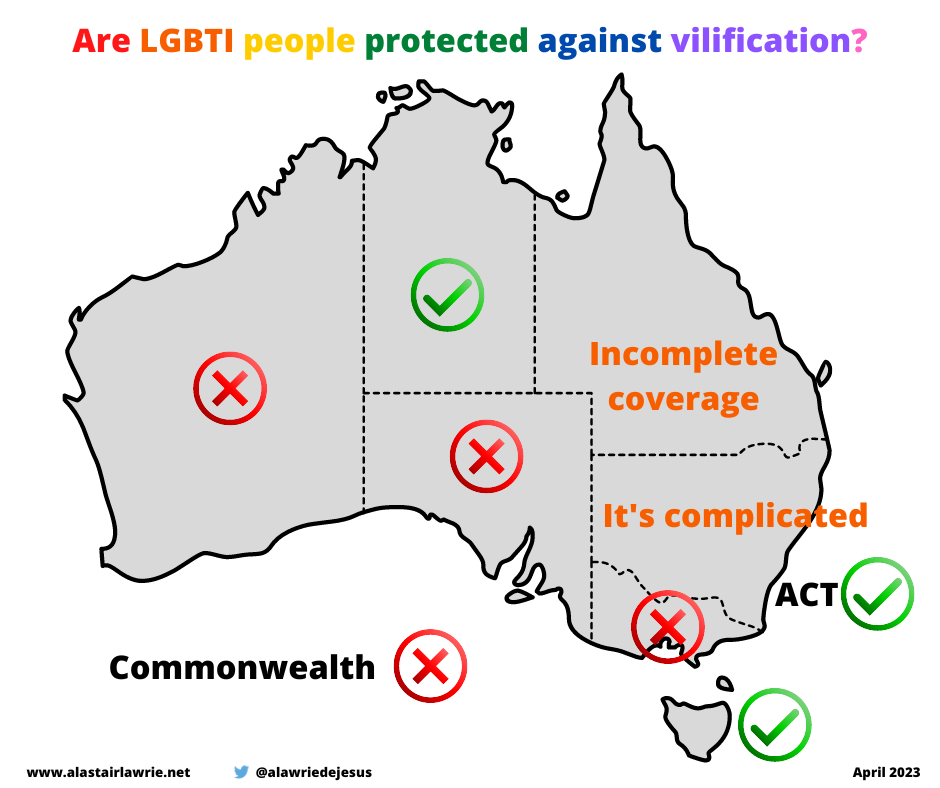
Which means that some would likely be surprised to discover the majority of Australian jurisdictions still do not prohibit vilification against LGBTI people, and that even among those states and territories that do, only three cover all parts of our community.

Tasmania

The first jurisdiction that prohibits vilification against all of lesbians, gay men, bisexuals, transgender and intersex people is Tasmania.

Section 19 of the Anti-Discrimination Act 1998 (Tas) outlaws ‘inciting hatred’:

‘A person, by a public act, must not incite hatred towards, serious contempt for, or severe ridicule of, a person or a group of persons on the ground of’ protected attributes including sexual orientation, gender identity and intersex variations of sex characteristics.’

Tasmania also has best practice protections under section 17(1), which further provides that:

‘A person must not engage in any conduct which offends, humiliates, intimidates, insults or ridicules another person… in circumstances in which a reasonable person, having regard to all the circumstances, would have anticipated that the other person would be offended, humiliated, intimidated, insulted or ridiculed.’

Once again, the attributes covered include sexual orientation, gender identity and intersex variations of sex characteristics.

Australian Capital Territory

The ACT is the second jurisdiction that prohibits vilification against all of lesbians, gay men, bisexuals, transgender and intersex people.

Section 67A of the Discrimination Act 1991 (ACT) makes vilification unlawful:

‘It is unlawful for a person to incite hatred toward, revulsion of, serious contempt for, or severe ridicule of a person or group of people on the ground of any of the following, other than in private:

(b) gender identity

(f) sex characteristics

(g) sexuality.’

Northern Territory

For a long time, the Northern Territory Anti-Discrimination Act 1992 contained no prohibitions on LGBTI vilification (or indeed vilification on the basis of any attribute including race).

However, in late 2022, reforms were introduced which included the following provision:

’20A Offensive behaviour because of an attribute

(1) A person must not do an act that:

(a) is reasonably likely, in all the circumstances, to offend, insult, humiliate or intimidate another person or a group of people; and

(b) is done because of an attribute of the other person or of some or all of the people in the group.’

Given the same legislation amended the Act to update the existing attribute of sexuality to sexual orientation, while adding protected attributes of gender identity and sex characteristics, the NT has now become just the third jurisdiction to protect all of the LGBTI community against vilification.

Queensland

Queensland is one of two other jurisdictions that protect some, but not all, parts of the LGBTI community against vilification.

Section 124A of the Anti-Discrimination Act 1991 (Qld) provides that:

‘A person must not, by a public act, incite hatred towards, serious contempt for, or severe ridicule of, a person or group of persons on the ground of the race, religion, sexuality or gender identity of the person or members of the group.’[iii]

And it should be noted that the definition of gender identity in this Act only includes ‘binary’ transgender gender, not non-binary or other gender diverse people (‘gender identity, in relation to a person, means that the person… identifies, or has identified, as a member of the opposite sex by living or seeking to live as a member of that sex’).

Meaning that, currently, only LGB and some T Queenslanders are protected.

However, a Bill currently before Queensland Parliament would amend the definition of gender identity to include people with non-binary gender identities, as well as adding the protected attribute of sex characteristics. Once that legislation is passed, Queensland will become the third jurisdiction to protect all of the LGBTI community against vilification.

New South Wales

The situation in NSW is far more complex. The Anti-Discrimination Act 1977 (NSW) contains civil sanctions against vilification targeting binary transgender people, as well as lesbians and gay men.

Specifically, section 38S(1) prohibits anti-transgender vilification:

‘It is unlawful for a person, by a public act, to incite hatred towards, serious contempt for, or severe ridicule of-

(a) a person on the ground that the person is a transgender person, or

(b) a group of persons on the ground that the members of the group are transgender persons.’

However, this clause does not protect non-binary or other gender diverse people, because the definition in section 38A of the Act is out-dated:

‘A reference in this Part to a person being transgender or a transgender person is a reference to a person, whether or not the person is a recognised transgender person-

(a) who identifies as a member of the opposite sex by living, or seeking to live, as a member of the opposite sex, or

(b) who has identified as a member of the opposite sex by living as a member of the opposite sex…

and includes a reference to the person being thought of as a transgender person, whether the person is, or was, in fact a transgender person.’

Section 49ZT(1) then prohibits vilification – meaning inciting hatred towards, serious contempt for, or severe ridicule – of ‘a person or group of persons on the ground of the homosexuality of the person or members of the group’.

Note that this only refers to homosexuality, meaning civil sanctions under the Anti-Discrimination Act 1977 (NSW) do not cover bisexual people.

On the other hand, amendments to the Crimes Act 1900 (NSW), introduced in 2018, created a criminal offence of ‘publicly threatening or inciting violence on grounds of race, religion, sexual orientation, gender identity or intersex or HIV/AIDS status’. Section 93Z(1) now provides that:

‘A person who, by a public act, intentionally or recklessly threatens or incites violence towards another person or a group of persons on any of the following grounds is guilty of an offence:

(c) the sexual orientation of the other person or one or more of the members of the group

(d) the gender identity of the other person or one or more of the members of the group

(e) that the other person is, or one or more of the members of the group are, of intersex status…’

The individual penalty for contravention of this provision is up to 100 penalty units or 3 years imprisonment (or both).

Following the recent NSW State election, the new Government has committed to refer the Anti-Discrimination Act to the NSW Law Reform Commission for review. Hopefully this review recommends amendments to ensure its civil vilification prohibitions also cover bisexuals, non-binary or other gender diverse people and intersex people – as well as fixing some of the many, many other problems with Australia’s worst LGBTI anti-discrimination law.[iv]

*

Four other jurisdictions do not prohibit anti-LGBTI vilification, at all:

Commonwealth

There is currently no prohibition – civil or criminal – on anti-LGBTI vilification in Commonwealth law.

This remains the case more than 25 years since the Racial Hatred Act 1995 (Cth) added section 18C to the Racial Discrimination Act 1975 (Cth) (‘the RDA’):

‘(1) It is unlawful for a person to do an act, otherwise than in private, if:

(a) the act is reasonably likely, in all the circumstances, to offend, insult, humiliate or intimidate another person or a group of people; and

(b) the act is done because of the race, colour or national or ethnic origin of the other person or of some or all of the people in the group.’

Unfortunately, while the Albanese Labor Government has explicitly committed to introducing new Commonwealth prohibitions on religious vilification, they have not made any equivalent promises to outlaw anti-LGBTI vilification.

Victoria

Victoria is another jurisdiction that fails to protect LGBTI people against vilification.

The Equal Opportunity Act 2010 (Vic) contains no prohibitions against vilification, for anyone. While, as the name suggests, the Racial and Religious Tolerance Act 2001 (Vic) currently only prohibits racial and religious vilification.

On the positive side, and unlike the Commonwealth, there are at least signs of possible progress in Victoria, with Fiona Patten MLC having introduced a Racial and Religious Tolerance Bill 2019. Her Bill would add sexual orientation, gender identity and sex characteristics (among other categories) to the list of protected attributes in that Act.

The issue of anti-vilification protections is also being considered by a parliamentary committee, with that inquiry due to report by 1 September 2020.[vii] Which leaves sufficient time for the Victorian Government to take action to address this shortcoming before the next election, on 26 November 2022.

Update: Obviously, the Andrews Government did not remedy this situation prior to last year’s election. However, in response to the recent TERF and neo-Nazi protest against trans and gender diverse people, they have recommitted to introducing these reforms, so hopefully LGBTI vilification will finally be banned in Victoria at some point in 2023.

Western Australia

Another jurisdiction with disappointingly out-dated anti-discrimination legislation – perhaps the second-worst in the country behind only NSW – is Western Australia.

The Equal Opportunity Act 1984 (WA) does not contain any prohibitions on vilification, on any attribute. However, the Criminal Code Act 1913 (WA) does create a range of offences linked to racial vilification[viii] – although there are no equivalent offences for anti-LGBTI vilification.

The Western Australian Government has referred the Equal Opportunity Act 1984 (WA) to the Law Reform Commission of Western Australia for review. Encouragingly, one of the terms of reference for this inquiry is to consider ‘the inclusion of vilification, including racial, religious, sexual orientation and impairment vilification’.

However, the website for the inquiry has not been updated for more than 12 months (since 6 March 2019), and the next Western Australian election is due in less than 12 months (scheduled for 13 March 2021), making it highly unlikely for LGBTI anti-vilification protections to be passed this term.

Update: The WA Law Reform Commission did in fact recommend the introduction of vilification protections on the basis of sexual orientation, gender identity and sex characteristics (among other attributes). The re-elected McGowan Government committed to introducing many of the Commission’s recommendations in August 2022 – with an expectation these will be legislated during 2023.

South Australia

South Australia also has no anti-vilification coverage for the LGBTI community.

The Equal Opportunity Act 1984 (SA) does not include any vilification provisions, while, as the name suggests, the Racial Vilification Act 1996 (SA) only covers vilification based on race.

Unlike Victoria and Western Australia, though, I am not aware of any South Australian Government processes considering the issue of LGBTI anti-vilification laws.

*

Vilification against members of the lesbian, gay, bisexual, transgender and intersex community can be incredibly damaging, especially for younger and/or vulnerable individuals. This was demonstrated, painfully and unequivocally, by the harm caused by the Turnbull Liberal/National Government’s wasteful and unnecessary same-sex marriage postal survey in 2017.

However, it is disturbing to realise that, in 2023, just over one million Australians – out of a population of more than 26 million – live in jurisdictions that prohibit vilification against all parts of the LGBTI community: Tasmania, the ACT and Northern Territory.

As we have seen, another two states – Queensland and NSW – offer only partial coverage, while the Commonwealth, Victoria, Western Australia and South Australia offer no legal protection at all.

Well. That. Is. Simply. Not. Good. Enough.

Anti-discrimination protections are essential to the full participation of lesbian, gay, bisexual, transgender and intersex people in Australian life. And we have allowed them to atrophy for far too long. We need to fight even harder to make sure LGBTI anti-discrimination and anti-vilification laws are made much, much better.

[This article is part of a series. Find other ‘Did You Know?’ posts here.]

Footnotes: (NB Some of these footnotes are now out of date)

[i] ‘Article 9. We call for effective legislative protection from discrimination and harmful practices on grounds of sex characteristics.’ Darlington Statement, 10 March 2017.

[ii] ‘Understanding ‘sex characteristics’ as each person’s physical features relating to sex, including genitalia and other sexual and reproductive anatomy, chromosomes, hormones, and secondary physical features emerging from puberty.’ The Yogyakarta Principles plus 10: Additional principles and state obligations on the application of international human rights law in relation to sexual orientation, gender identity, gender expression and sex characteristics to complement the Yogyakarta Principles, 10 November 2017.

[iii] Somewhat confusingly, section 124A is found in Chapter 4, Part 4 of the Anti-Discrimination Act 1991 (Qld), titled ‘Racial and religious vilification’, which may lead some people to erroneously assume LGBT vilification is not prohibited.

[iv] For more, see What’s Wrong With the NSW Anti-Discrimination Act 1977?

[v] Clause 42(1)(b) of the Second Exposure Draft Religious Discrimination Bill.

[vi] Clause 42(1)(c) of the Second Exposure Draft Religious Discrimination Bill. For more, see: The ‘Bad Faith’ Religious Discrimination Bill Must Be Blocked.

[vii] You can see my submission to that inquiry, here.

[viii] Including:

Section 77 Conduct intended to incite racial animosity or racist harassment

Section 78 Conduct likely to incite racial animosity or racist harassment

Section 79 Possession of material for dissemination with intent to incite racial animosity or racist harassment

Section 80 Possession of material for dissemination that is likely to incite racial animosity or racist harassment

Section 80A Conduct intended to racially harass

Section 80B Conduct likely to racially harass.

[ix] For a comparative analysis, see A Quick Guide to Australian LGBTI Anti-Discrimination Laws

A Quick Guide to Australian LGBTI Anti-Discrimination Laws

Quick Guide Final

I’ve written a lot about Australian LGBTI anti-discrimination and anti-vilification issues over the years, including specific articles on each relevant Commonwealth, State and Territory law (those posts can be found here).

This article seeks to take a broader approach, comparing who these laws cover, what religious exceptions they contain, and whether they provide protection against vilification, among other key questions. [Up to date at 21 February 2024]

  1. What is the relevant law?

Jurisdiction

Legislation

Commonwealth

Sex Discrimination Act 1984

New South Wales

Anti-Discrimination Act 1977
Victoria

Equal Opportunity Act 2010

Queensland

Anti-Discrimination Act 1991

Western Australia

Equal Opportunity Act 1984
South Australia

Equal Opportunity Act 1984

Tasmania

Anti-Discrimination Act 1998

Australian Capital Territory

Discrimination Act 1991

Northern Territory

Anti-Discrimination Act

  1. Are lesbians, gay men and bisexuals protected against discrimination?
                                 

Lesbians and gay men

Bisexuals

Commonwealth

New South Wales

Victoria

Queensland

Western Australia

South Australia

Tasmania

Australian Capital Territory

Northern Territory

As you can see, the NSW Anti-Discrimination Act 1977 is the only anti-discrimination law in Australia that does not cover bisexual people[i] (relatedly, it is also the only jurisdiction where heterosexuals have no protection under anti-discrimination law).

  1. Are transgender people protected against discrimination?

Different jurisdictions have adopted different approaches to transgender anti-discrimination protection, in large part due to when their respective laws were introduced. This means that while some cover gender identity broadly,[ii] others have traditionally only protected trans people with binary gender identities (where a person identifies with the ‘opposite’ gender to that which they were assigned at birth – eg MTF and FTM trans people) and exclude people with non-binary or other gender diverse identities.[iii]Thankfully, most jurisdictions have moved from the latter, to the more-inclusive former, category in the past few years.


Trans people with binary gender identities

People with non-binary gender identities

Commonwealth

New South Wales

Victoria

Queensland

Western Australia

Some*
South Australia

Tasmania

Australian Capital Territory

Northern Territory

At this stage, seven jurisdictions cover people with both binary and non-binary gender identities (with the most recent jurisdiction to adopt a more inclusive definition of gender identity being Queensland, with legislation passed in mid-2023, commencing in April 2024).

Of the other two:

  • The Western Australian Equal Opportunity Act 1984 only covers people who have been issued with a recognition certificate under the Gender Reassignment Act 2000 (meaning those people who have transitioned and where that transition has been recognised by the Government).[iv] Thankfully, the Western Australian Law Reform Commission review of the WA Equal Opportunity Act recommended changes to ensure all trans, non-binary and gender diverse people are covered. The WA Government accepted this recommendation, and had committed to introduce legislation to give it effect by the end of 2023, but there are growing fears they will not act before the next state election in early 2025; and
  • The NSW Anti-Discrimination Act 1977 also currently only covers transgender people with binary gender identities. Unfortunately, and unlike WA, the NSW Government have not yet promised to amend this protected attribute. However, they have referred the entire Act to the NSW Law Reform Commission for review. Independent Member for Sydney Alex Greenwich has also introduced his Equality Legislation which would ensure non-binary people are finally covered, although it is unclear whether these amendments will be successful.
  1. Are intersex people protected against discrimination?
 

Intersex

Commonwealth

New South Wales

Victoria

Queensland

Western Australia

South Australia

Tasmania

Australian Capital Territory

Northern Territory

When the Commonwealth Government passed the Sex Discrimination Amendment (Sexual Orientation, Gender Identity and Intersex Status) Act 2013, it became the first national parliament in the world to include ‘intersex status’ as a protected attribute.[v] Since then, Tasmania, the ACT, South Australia, Victoria, the Northern Territory and most recently Queensland, have all introduced amendments to protect intersex people against discrimination.

It should be noted however that intersex advocates have called for this terminology to be updated, with ‘intersex status’ replaced with the protected attribute of ‘sex characteristics’ (as part of the historic March 2017 Darlington Statement).

To date, the Tasmanian Parliament has amended its Anti-Discrimination Act 1998 to cover ‘intersex variations of sex characteristics’, while in August 2020 the ACT Legislative Assembly replaced intersex status with ‘sex characteristics’, with a definition supported by intersex organisations. In February 2021, the Victorian Parliament added ‘sex characteristics’ to the Equal Opportunity Act 2010. The Northern Territory Parliament added ‘sex characteristics’ to their Anti-Discrimination Act 1992 in late 2022, while Queensland’s 2023 amendments also employ the terminology of sex characteristics.

Similar to non-binary protections (or lack of protections) outlined above, the two jurisdictions which do not protect intersex people at all are WA and NSW. And, just like non-binary, there is a WA Law Reform Commission recommendation and Government commitment to introduce these reforms – but time is running out, and a current NSW Law Reform Commission inquiry, and the Greenwich Equality Bill – but no NSW Government commitment.

Finally, it should be noted that, as part of debate surrounding its amendments to the Fair Work Act (see point 11, below) in late 2022, the Commonwealth Government has promised to update the terminology of ‘intersex status’ to ‘sex characteristics’ in both the Sex Discrimination Act and Fair Work Act, although the timing of these amendments remain unclear.

  1. Are LGBT people protected against discrimination by religious organisations (general)?

As I have written extensively elsewhere, one of the key weaknesses of many LGBTI anti-discrimination laws in Australia is that they provide special rights for religious organisations to discriminate against lesbian, gay, bisexual and transgender people.[vi] We will first examine how these religious exceptions operate generally, before looking specifically at the issues of students in religious schools (question 6) and teachers and other staff in religious schools (question 7).


Do LGBT people have any protections against discrimination by religious organisations?

LGBT people have limited protections against religious discrimination

LGBT people have general protections against religious discrimination

Commonwealth

Aged care*
New South Wales

Victoria

Queensland

Western Australia

South Australia Teachers*

Tasmania

Australian Capital Territory

Northern Territory

Mostly*

There is only one LGBTI anti-discrimination law in Australia that offer full legal protection against discrimination by religious organisations, in all circumstances: Tasmania’s Anti-Discrimination Act 1998. That is because the religious exceptions contained in that legislation only allow religious organisations to discriminate on the basis of people’s religious beliefs, and not on the basis of sexual orientation, gender identity or intersex variations of sex characteristics (or relationship status).

The amendments passed in Victoria (via the Equal Opportunity (Religious Exceptions) Amendment Act 2021) come close, only allowing discrimination on the basis of religious belief in religious schools (in relation to both students and teachers), in employment and in service provision by religious organisations that is Government funded. However, it continues to allow discrimination on the basis of sexual orientation and gender identity in service provision by religious organisations where it is not Government funded.

The ACT Discrimination Act 1991 has provided protections in relation to religious schools since 2019 (covered in more detail in the following questions) and, thankfully, amendments passed in late March 2023 have extended protections in both the delivery of goods and services, and employment, in relation to religious organisations which operate in other sectors.

On the other hand, the religious exceptions contained in the anti-discrimination laws of New South Wales and Western Australia provide religious organisations with carte blanche to discriminate against LGBT people. Section 56 of the NSW Anti-Discrimination Act 1977 is a typical example of the special rights given to these bodies:

“Nothing in this Act affects:

(a) the ordination or appointment of priests, ministers of religious or members of any religious order,

(b) the training or education of persons seeking ordination or appointment as priests, ministers of religious or members of a religious order,

(c) the appointment of any other person in any capacity by a body established to propagate religion, or

(d) any other act or practice of a body established to propagate religion that conforms to the doctrines of that religion or is necessary to avid injury to the religious susceptibilities of the adherents of that religion.”

Fortunately, the Western Australian Law Reform Commission has recommended that their religious exceptions be narrowed, in line with the Victorian approach, although as explained in relation to earlier questions, it is no unclear whether legislation will be passed before the 2025 State election.

The other jurisdictions offer only limited protections against religious-based discrimination against LGBT people. Under the Commonwealth Sex Discrimination Act 1984, religious organisations can discriminate against LGBT people in all circumstances other than with respect to LGBT people accessing Commonwealth-funded aged care services[vii] (although they can still discriminate against LGBT employees in these facilities, using public monies).

The Queensland Anti-Discrimination Act 1991 actually contains the fifth-best protections for LGBT people against discrimination by religious organisations. It does not allow discrimination against LGBT students in religious schools, and has limited protections for teachers, too (see questions 6 and 7 respectively). More broadly, it does not provide a general right for religious organisations to discriminate against LGBT employees, but instead limits this right to employees where acting, or not acting, in a particular way breaches the ‘genuine occupational requirements’ of that position.[viii]  The 2022 Queensland Human Rights Commission review of the Anti-Discrimination Act 1991 has also recommended a similar approach to Victoria – but once again, despite Government commitments to introduce a new Act before the end of 2023, there is now no guarantee they will act prior to the October 2024 State election.

The South Australian Equal Opportunity Act 1984 provides broad religious exceptions outside religious schools, where they are (probably, although not conclusively) able to discriminate against LGBT students, and have to satisfy procedural obligations in order to discriminate against LGBT teachers (see questions 6 and 7, below).

Finally, the religious exceptions contained in the Northern Territory Anti-Discrimination Act are narrower than in other jurisdictions because of the specific wording that is used:

“Section 51 This Act does not apply to or in relation to: …

(d) an act by a body established for religious purposes if the act is done as part of any religious observance or practice.”

Although it does still apply across all attributes, including sexual orientation, gender identity and sex characteristics, this wording at least restricts the discrimination that is permissible to acts in relation to ‘religious observance or practice’ only (and recent changes have seen LGBT teachers finally protected against discrimination there too).

  1. Are LGBT students protected against discrimination by religious schools?
 

LGBT students at religious schools

Commonwealth

New South Wales

Victoria

Queensland

Western Australia

South Australia

Probably not*
Tasmania

Australian Capital Territory

Northern Territory

There are five jurisdictions in which LGBT students are clearly protected against discrimination by religious schools: Tasmania, Queensland, the Australian Capital Territory, the Northern Territory and, most recently, Victoria.

In another jurisdiction, the level of protection is debatable. In South Australia section 37 of the Equal Opportunity Act 1984 provides quite broad protections against discrimination by educational authorities against students on the basis of sexual orientation or gender identity.[ix] However, it is likely these protections are still overridden by the broad religious exceptions contained in sub-section 50(1)(c).[x]

In the other jurisdictions, namely the Commonwealth, NSW, and Western Australia, LGBT students do not have protection against discrimination by religious schools. Indeed, the exceptions contained in the NSW Anti-Discrimination Act 1977 go even further, allowing discrimination against lesbian, gay and transgender students by all private schools and colleges, even where those institutions are not religious.[xi]

Thankfully, the WA Law Reform Commission has recommended, and the WA Government has agreed, to protect LGBT students in religious schools against discrimination (but – and admittedly this is getting repetitive – it is unclear when this will be introduced). The Commonwealth Government has also referred the issue of religious exceptions and religious schools to the Australian Law Reform Commission for inquiry. It was initially scheduled to report in April 2023, before being extended to 31 December 2023. It has not been handed to Attorney-General Mark Dreyfus, but he is yet to table the document.

It is hoped that LGBT students might be protected as a result of the current NSW Law Reform Commission inquiry into the Anti-Discrimination Act – although the Government has made no clear commitments to do so.

For more on this subject, see Back to School, Back to Discrimination for LGBT Students and Teachers.

7. Are LGBT teachers protected against discrimination by religious schools?


LGBT teachers at religious schools

Commonwealth

New South Wales

Victoria

Queensland

Don’t Ask, Don’t Tell*
Western Australia

South Australia

Procedural requirements*
Tasmania

Australian Capital Territory

Northern Territory

Four Australian LGBTI anti-discrimination laws fully protects lesbian, gay, bisexual and transgender teachers and other staff at religious schools against discrimination: Tasmania’s Anti-Discrimination Act 1998, the ACT Discrimination Act 1991, the Victorian Equal Opportunity Act 2010 and, following recent amendments, the NT Anti-Discrimination Act 1992.

In Queensland, religious schools are allowed to discriminate against people who work for religious schools where “the person openly acts in a way that the person knows or ought reasonably to know is contrary to the employer’s religious beliefs, during a selection process; or in the course of the person’s work; or in doing something connected with the person’s work; and it is a genuine occupational requirement of the employer that the person… act in a way consistent with the employer’s religious beliefs.”[xii]

However, religious schools are not allowed to ‘seek information’ in relation to an employee’s sexual orientation or gender identity. In effect, LGBT teachers and other staff at religious schools in Queensland are subject to a ‘Don’t Ask’ Don’t Tell’ policy (which, as was seen in relation to the United States military, is nevertheless an unjust and unjustifiable imposition on a minority group). Fortunately, the Queensland Human Rights Commission review of the Anti-Discrimination Act has recommended that Don’t Ask, Don’t Tell be repealed, and replaced with genuine protections for LGBT teachers.

In South Australia, religious schools are allowed to discriminate against LGBT teachers and other staff, however this ‘right’ is subject to procedural requirements, including that the school must have a written policy outlining its discriminatory policy which is provided to people interviewed for or offered employment. The policy must also be provided on request, free of charge, to employees, students and parents (and prospective employees, students and parents) as well as to general members of the public.[xiii]

In the other three Australian jurisdictions (the Commonwealth, NSW and Western Australia[xiv]), religious schools are free to discriminate against LGBT teachers. Once again, in NSW this extends to all private schools and colleges, even where they are not religious.[xv] And, once again, the WA Government has agreed to implement Law Reform Commission recommendations to protect LGBT teachers (but date uncertain), while the Australian Law Reform Commission is also looking at this issue federally. As with students, the main hope for teachers in NSW is with the current NSW Law Reform Commission process.

For more on this subject, see Back to School, Back to Discrimination for LGBT Students and Teachers.

8. Are lesbians, gay men and bisexuals protected against vilification?


Lesbians and gay men

Bisexuals
Commonwealth

New South Wales

Partial
Victoria

Queensland

Western Australia

South Australia

Tasmania

Australian Capital Territory

Northern Territory

Only five Australian jurisdictions offer any anti-vilification protections for the LGBTI community: NSW, Queensland, Tasmania, the ACT and, most recently, the NT (which added s 20A – prohibiting conduct that ‘offends, insults, humiliates or intimidates’ people, including on the basis of sexual orientation, gender identity and sex characteristics, in late 2022).

In NSW, the situation has been complicated by 2018 amendments to both the Anti-Discrimination Act and the Crimes Act. In short, while lesbians, gay men and bisexuals are all covered by the new ‘inciting violence provisions’ in the Crimes Act, only lesbians and gay men can make civil vilification complaints to Anti-Discrimination NSW.

In contrast, the Commonwealth, Victoria, Western Australia and South Australia all have protections against racial vilification, but fail to offer equivalent protections against anti-LGBTI vilification. Although it should be noted that the Victorian Parliament previously investigated this issue, and the State Government there has long-promised (and long-failed) to introduce these reforms, while the WA Law Reform Commission has recommended LGBTI vilification provisions be introduced.

For more on this subject, see Did You Know? Most Australian Jurisdictions Don’t Prohibit Anti-LGBTI Vilification.

9. Are trans and intersex people protected against vilification?


Trans people with binary gender identities

People with non-binary gender identities

Intersex

Commonwealth

New South Wales Partial

Partial

Victoria

Queensland

Western Australia

South Australia

Tasmania

Australian Capital Territory

Northern Territory

Five jurisdictions protect transgender people with binary gender identities against vilification (NSW, Queensland, Tasmania, the ACT and NT). Following mid-2023 amendments in Queensland, four (them alongside Tasmania, the ACT and NT) also fully protect people with non-binary identities.

The situation in NSW is more complicated, and similar to that described earlier: trans, non-binary and intersex people are included in the Crimes Act incitement to violence provisions, but only trans people with binary identities can make civil vilification complaints under the Anti-Discrimination Act.

Both the WA and Victorian Governments have promised but so far failed to introduce their own reforms. Only the Commonwealth and South Australia have failed to take any steps to prohibit anti-LGBTI vilification.

For more on this subject, see Did You Know? Most Australian Jurisdictions Don’t Prohibit Anti-LGBTI Vilification.

10. What other issues exist with Australian LGBTI anti-discrimination laws?

The above questions have examined three main areas of the LGBTI anti-discrimination laws across the Commonwealth, and the States and Territories:

  • Protected Attributes
  • Religious Exceptions, and
  • Anti-Vilification Coverage.

However, these are not the only areas where there are significant problems with the anti-discrimination laws that apply to lesbian, gay, bisexual, transgender and bisexual people in Australia. The following is a non-exhaustive list of some of the other issues I have come across:

Commonwealth: The Sex Discrimination Act 1984 does not establish a position of LGBTI Discrimination Commissioner (despite providing for a Sex Discrimination Commissioner). This leaves Australia’s LGBTI community at a significant disadvantage compared to other vulnerable groups, and should be rectified (for more on this issue, see: Why we need a full-time LGBTI Commissioner at the Australian Human Rights Commission).

NSW: The Anti-Discrimination Act 1977 allows employers with five employees or less to discriminate against LGBT employees[xxi]. There are no such provisions allowing employers to discriminate on the basis of race.

Queensland: The Anti-Discrimination Act 1991 includes a particularly abhorrent section which allows discrimination against transgender people in relation to employment that involves children. Section 28 states:

“Work with children

(1) It is not unlawful to discriminate on the basis of lawful sexual activity or gender identity against a person with respect to a matter that is otherwise prohibited under subdivision 1 if-

(a) the work involves the care or instruction of minors; and

(b) the discrimination is reasonably necessary to protect the physical, psychological or emotional wellbeing of minors having regard to all the relevant circumstances of the case, including the person’s actions.”

Thankfully, the Births, Deaths and Marriages Registration Bill 2022, currently before Queensland Parliament, would repeal this provision. [The Queensland Bill has now passed, and this provision will be history come April 2024 – but I am choosing to leave it here as a reminder of how awful the anti-discrimination laws of Australia have been – laws designed to outlaw discrimination have often instead entrenched it].

Western Australia: While the Equal Opportunity Act 1984 allows for positive discrimination “to ensure that persons of a particular sexual orientation have equal opportunities with other persons”[xxiii] there are no equivalent provisions allowing for positive discrimination for transgender people.

South Australia: Disappointingly, the Equal Opportunity Act 1984 makes it lawful to discriminate “on the ground of gender identity in relation to employment or engagement if the discrimination is for the purposes of enforcing standards of appearance and dress reasonably required for the employment or engagement.”[xxiv]

11. Are LGBTI people protected against discrimination under the Commonwealth Fair Work Act 2009?

While most anti-discrimination protections are included in the nine Commonwealth, state and territory laws discussed above, there is also a key protection against discrimination located in the Fair Work Act 2009.


Are lesbians, gay men and bisexuals protected under the Fair Work Act?

Are transgender people protected? Are intersex people protected?
Commonwealth

Between the passage of the Sex Discrimination Act (Sexual Orientation, Gender Identity and Intersex Status) Act 2013, and updates to the Fair Work Act 2009 passed late last year, it was unclear whether trans, gender diverse and intersex workers were covered under the latter – because it included sexual orientation but not gender identity or intersex status/sex characteristics as protected attributes for the purposes of adverse action (section 351) and unlawful termination (section 772) protections.

Thankfully, the Albanese Government has amended the Fair Work Act to explicitly include gender identity and intersex status as protected attributes. Even better, in doing so they publicly committed to updating both the Fair Work Act, and Sex Discrimination Act, to cover sex characteristics (which is the best practice terminology supported by Intersex Human Rights Australia) rather than intersex status in the future.

[As someone who was involved in campaigning for these changes to the Fair Work Act since at least mid-2018, this has been a very satisfying update to write.]

Of course, the extensive religious exceptions which appear in the Fair Work Act 2009, allowing religious organisations to discriminate against LGBTQ employees, should also be repealed.

**********

For more detailed analysis of the LGBTI anti-discrimination laws that operate in the Commonwealth, and each State and Territory, see:

**********

If you have enjoyed reading this article, please consider subscribing to receive future posts, via the right-hand scroll bar on the desktop version of this blog or near the bottom of the page on mobile. You can also follow me on twitter @alawriedejesus

Footnotes:

[i] NSW protects only ‘homosexuality’, with the definition in section 4 of the Anti-Discrimination Act 1977 stating that ‘homosexual means male or female homosexual’. In contrast, other jurisdictions either include a protected attribute of ‘sexual orientation’, or specifically include both homosexuality and bisexuality.

[ii] For example, section 4 of the Commonwealth Sex Discrimination Act 1984 defines gender identity as ‘the gender-related identity, appearance or mannerisms or other gender-related characteristics of a person (whether by way of medical intervention or not), with or without regard to the person’s designated sex at birth.’

[iii] For example, section 38A of the NSW Anti-Discrimination Act 1977 states that ‘[a] reference in the Part to a person being transgender or a transgender person is a reference to a person… (i) who identifies as a member of the opposite sex by living, or seeking to live, as a member of the opposite sex, or (ii) who has identified as a member of the opposite sex by living as a member of the opposite sex…’

[iv] The Western Australian Equal Opportunity Act 1984 prohibits discrimination ‘against a gender reassigned person on gender history grounds’ (section 35AB), where section 4 defines a gender reassigned person as ‘a person who has been issued with a recognition certificate under the Gender Reassignment Act 2000’ while section 35AA states that ‘a person has a gender history if the person identifies as a member of the opposite sex by living, or seeking to live, as a member of the opposite sex.’

[v] With ‘intersex status’ defined in section 4 of the Commonwealth Sex Discrimination Act 1984 as ‘the status of having physical, hormonal or genetic features that are:

(a) neither wholly female nor wholly male; or

(b) a combination of female and male; or

(c) neither female nor male.’

[vi] In this section, I refer primarily to LGBT people, rather than LGBTI people, because it is generally understood that religious exceptions would not (or at the very least should not) be used against people with intersex variations.

[vii] Sub-section 37(2) of the Commonwealth Sex Discrimination Act 1984 limits the general religious exceptions contained in the Act by stating that they do “not apply to an act or practice of a body established for religious purposes if:

(a) the act or practice is connected with the provision, by the body, of Commonwealth-funded aged care; and

(b) the act or practice is not connected with the employment or persons to provide that aged care.”

[viii] Sub-section 25(3) of the Queensland Anti-Discrimination Act 1991 provides that:

“It is not unlawful for an employer to discriminate with respect to a matter that is otherwise prohibited under section 14 or 15, in a way that is not unreasonable, against a person if-

(a) the person openly acts in a way that the person knows or ought reasonably know is contrary to the employer’s religious beliefs-

(i) during a selection process; or

(ii) in the course of the person’s work; or

(iii) in doing something connected with the person’s work; and

(b) it is a genuine occupational requirement of the employer that the person, in the course of, or in connection with, the person’s work, act in a way consistent with the employer’s religious beliefs.”

[ix] SA Equal Opportunity Act 1984: “Section 37- Discrimination by educational authorities …

(2) It is unlawful for an educational authority to discriminate against a student on the ground of sex, sexual orientation or gender identity-

(a) in the terms or conditions on which it provides the student with training or education; or

(b) by denying or limiting access to a benefit provided by the authority; or

(c) by expelling the student; or

(d) by subjecting the student to other detriment.”

[x] SA Equal Opportunity Act 1984: “This Part does not render unlawful discrimination in relation to-

(c) any other practice of a body established for religious purposes that conforms with the precepts of that religion or is necessary to avoid injury to the religious susceptibilities of the adherents of that religion.”

[xi] Sections 38K(3) and 49ZO(3), NSW Anti-Discrimination Act 1977.

[xii] Sub-sections 25(2) and (3) of the Queensland Anti-Discrimination Act 1991.

[xiii] SA Equal Opportunity Act 1984: Sub-section 34(3):

“This Division does not apply to discrimination on the ground of sexual orientation or gender identity in relation to employment or engagement for the purposes of an educational institution if-

(a) the educational institution is administered in accordance with the precepts of a particular religion and the discrimination is founded on the precepts of that religion; and

(b) the educational authority administering the institution has a written policy stating its position in relation to the matter; and

(c) a copy of the policy is given to a person who is to be interviewed for or offered employment with the authority or a teacher who is to be offered engagement as a contractor by the authority; and

(d) a copy of the policy is provided on request, free of charge-

(i) to employees and contractors and prospective employees and contractors of the authority to whom it relates or may relate; and

(ii) to students, prospective students and parents and guardians of students and prospective students of the institution; and

(iii) to other members of the public.”

[xiv] Repealed/footnote removed.

[xv] Sub-sections 38C(3)(c) and 49ZH(3)(c), NSW Anti-Discrimination Act 1977.

[xvi] Footnote removed.

[xvii] Footnote removed.

[xviii] Footnote removed.

[xix] Footnote removed.

[xx] Footnote removed.

[xxi] Sub-sections 38C(3)(b) and 49ZO(3)(b), NSW Anti-Discrimination Act 1977.

[xxii] Repealed/footnote removed.

[xxiii] Section 35ZD, Western Australian Equal Opportunity Act 1984.

[xxiv] Sub-section 34(4), South Australian Equal Opportunity Act 1984.

[xxv] The inclusion of ‘marital status’ rather than ‘marital or relationship status’ is also out-dated.

What’s Wrong With the Queensland Anti-Discrimination Act 1991?

This post is part of a series examining the anti-discrimination laws that exist in each Australian jurisdiction and analysing how well, or how poorly, they protect lesbian, gay, bisexual, transgender and intersex (LGBTI) people from discrimination. Other posts in the series can be found here.

Specifically, each post considers three main aspects of LGBTI anti-discrimination legislation:

  • Protected attributes
  • Religious exceptions, and
  • Anti-vilification coverage.

Contrary to what some might expect, Queensland’s laws are at least ‘average’, and in some cases, particularly in relation to anti-vilification laws, ‘better than average’, across these three areas. Unfortunately, that says more about the major flaws that exist across most anti-discrimination laws in Australia than it necessarily does about the Anti-Discrimination Act 1991 (‘the Act’) itself.

There are still significant problems that must be addressed with this legislation, beginning with the issue of who is – and isn’t – covered.

**********

Protected Attributes

Like most of its counterparts in other states, Queensland’s Anti-Discrimination Act does not protect all parts of the LGBTI community from discrimination.

On the positive side, it does cover all lesbian, gay and bisexual people – with discrimination on the basis of ‘sexuality’ prohibited in section 7 of the Act (defined as “sexuality means heterosexuality, homosexuality or bisexuality” in the Dictionary found in the Schedule).

On the less positive side, it only covers some transgender people, and not others. That is because, while section 7 also includes ‘gender identity’, the Act’s definition of this term is out-dated:

“gender identity, in relation to a person, means that the person-

(a) identifies, or has identified, as a member of the opposite sex by living or seeking to live as a member of that sex; or

(b) is of indeterminate sex and seeks to live as a member of a particular sex.”

While this does protect transgender people who were previously identified as male but now identify as female (and vice-versa), it does not include non-binary trans people. In order to rectify this situation, the Act’s definition of gender identity should be updated to reflect the definition used in the Commonwealth Sex Discrimination Act 1984[i].

Even worse off than transgender Queenslanders, however, are people with intersex variations – while part (b) of the definition of ‘gender identity’ may apply to some intersex people in limited circumstances, there is no stand-alone protected attribute for intersex people and therefore no clear-cut protection against discrimination for them.

Again, this could be rectified with the introduction of ‘sex characteristics’ as a protected attribute in the legislation[ii].

Overall: While the Queensland Anti-Discrimination Act 1991 does protect lesbian, gay and bisexual people, and some transgender people, from discrimination, it leaves other trans people (especially those whose identity is non-binary) and most intersex people out in the cold. This should be fixed as a matter of priority, by updating the definition of gender identity, and adding sex characteristics as a protected attribute.

**********

Religious Exceptions

Queensland has adopted a unique approach to religious exceptions through the Anti-Discrimination Act 1991, in which case I will spend more time than normal discussing this element.

The primary religious exception is found in section 109:

“Religious bodies

(1) The Act does not apply in relation to-

(a) the ordination or appointment of priests, ministers of religion or members of a religious order; or

(b) the training or education of people seeking ordination or appointment as priests, ministers of religion or members of a religious order; or

(c) the selection or appointment of people to perform functions in relation to, or otherwise participate in, any religious observance or practice; or

(d) unless section 90 (Accommodation with religious purposes) applies – an act by a body established for religious purposes if the act is –

(i) in accordance with the doctrine of the religion concerned; and

(ii) necessary to avoid offending the religious sensitivities of people of the religion.

(2) An exemption under subsection (1)(d) does not apply in the work or work-related area or in the education area.”

The first three sub-sections ((a), (b) and (c)) are at least concerned with the appointment of ministers of religion, or the conduct of religious celebrations, and are therefore more likely to be excusable on the basis of protecting ‘religious freedom’.

Unfortunately, the wording used in sub-section (d) – “in accordance with the doctrine of the religion concerned and necessary to avoid offending the religious sensitivities of people of the religion” – is incredibly broad, and permits discrimination against a wide range of people in terms of service delivery.

However, sub-section (2) is unusual and, as far as I can tell, not replicated in any other state or territory legislation. In essence, it provides that religious bodies cannot discriminate against employees unless their role is directly connected with ‘religious observance or practice’. It also means religious schools cannot discriminate against students on the basis of their sexuality or gender identity[iii].

If section 109 was the only source of religious exceptions in the legislation, Queensland’s Act would almost be assessed as positive. However, there are other sections that complicate this assessment.

Chief among them is section 25:

“Genuine occupational requirements

(1) A person may impose genuine occupational requirements for a position.

Examples of genuine requirements for a position-

…Example 4-

Employing persons of a particular religion to teach in a school established for students of the particular religion

(2) Subsection (3) applies in relation to-

(a) work for an educational institution (an employer) under the direction or control of a body established for religious purposes; or

(b) any other work for a body established for religious purposes (also an employer) if the work genuinely and necessarily involves adhering to and communicating the body’s religious beliefs.

(3) It is not unlawful for an employer to discriminate with respect to a matter that is otherwise prohibited under section 14 or 15, in a way that is not unreasonable, against a person if-

(a) the person openly acts in a way that the person knows or ought reasonably to know is contrary to the employer’s religious beliefs-

(i) during a selection process; or

(ii) in the course of the person’s work; or

(iii) in doing something connected with the person’s work; and

Example for paragraph (a)

A staff member openly acts in a way contrary to a requirement imposed by the staff member’s employer in his or her contract of employment, that the staff member abstain from acting in a way openly contrary to the employer’s religious beliefs in the course of, or in connection with the staff member’s employment.

(b) it is a genuine occupational requirement of the employer that the person, in the course of, or in connection with, the person’s work, act in a way consistent with the employer’s religious beliefs.

(4) Subsection (3) does not authorise the seeking of information contrary to section 124[iv].

(5) For subsection (3), whether the discrimination is not unreasonable depends on all the circumstances of the case, including, for example, the following-

(a) whether the action taken or proposed to be taken by the employer is harsh or unjust or disproportionate to the person’s actions;

(b) the consequences for both the person and the employer should the discrimination happen or not happen.

(6) Subsection (3) does not apply to discrimination on the basis of age, race or impairment.

(7) To remove any doubt, it is declared that subsection (3) does not affect a provision of an agreement with respect to work to which subsection (3) applies, under which the employer agrees not to discriminate in a particular way.

(8) In this section-

religion includes religious affiliation, beliefs and activities.”

That is obviously a lot to take in. So here are my three key observations:

  • This section expands the religious exceptions offered under section 109, so that religious bodies can discriminate on the basis of sexuality and gender identity against teachers and other staff in schools generally, but against employees in other religious organisations only “if the work genuinely and necessarily involves adhering to and communicating the body’s religious beliefs”.
  • In both cases this is limited by a potentially vague ‘reasonableness test’ (determining “whether the action taken or proposed to be taken by the employer is harsh or unjust or disproportionate to the person’s actions”), and
  • In both cases it is also limited by a ‘Don’t Ask, Don’t Tell’ clause – discrimination is only permitted where “the person openly acts in a way that the person knows or ought reasonably to know is contrary to the employer’s religious beliefs” and the religious school or body cannot ask about sexuality or gender identity. This would therefore protect teachers or other staff who did not discuss their sexual orientation at their school or workplace[v].

Of course, as even the US Government and Military has eventually been forced to concede, ‘Don’t Ask, Don’t Tell’ is a terrible policy, ‘invisibilising’ LGBT people in the workplace, forcing them to deny who they are and silencing them in everyday conversations (for example, gay teachers would not be able to openly acknowledge their partners at all in the classroom or even in the staffroom). It also exposes LGBT employees to potential harassment and bullying.

‘Don’t Ask, Don’t Tell’ is also a terrible policy with respect to LGBT students, because it denies them visible role models to look up to, or from whom to seek relevant information.

But, and here is the extraordinary part, these exceptions – allowing religious schools and other bodies to discriminate against ‘out’ lesbian, gay, bisexual and transgender employees – are actually the third-best religious exceptions in Australia (behind only Tasmania and recently-passed ACT laws), because they don’t allow these organisations to explicitly deny employment solely on the basis of sexuality or gender identity.

The other, much more unambiguously positive part of the Act’s religious exceptions is that section 25 does not apply to students – which means that, while a religious school can reject students who are not from a particular religion, they cannot reject students on the basis of their sexuality or gender identity.

Overall: Queensland’s approach to religious exceptions is unique, and its protection of LGBT students against discrimination is to be welcomed. However, other parts of the Anti-Discrimination Act 1991 provide overly-generous rights to religious schools and other bodies to discriminate against LGBT employees, and people accessing services, and these should be significantly curtailed.

Specifically, subsection 109(1)(d), which allows discrimination on the basis of sexuality and gender identity in relation to service-provision, should be repealed.

And, while the limitations on discrimination in relation to employment (including a ‘reasonableness test’ and a ‘Don’t Ask, Don’t Tell’ clause) might mean Queensland’s legislation is better than most, permitting discrimination in such circumstances is still unacceptable in the 21st century, meaning section 25 should ultimately also be abolished.

**********

Anti-Vilification Coverage

Queensland is one of only four Australian jurisdictions to provide anti-vilification protections to LGBT people – the others being NSW, the ACT and Tasmania (noting that Commonwealth anti-vilification law only applies to race).

Unlike NSW, the Queensland Anti-Discrimination Act treats all types of prohibited vilification exactly the same – establishing vilification on the basis of race, religion, sexuality and gender identity in the same section (124A)[vi], and creating the offence of serious racial, religious, sexuality or gender identity vilification in another (section 131A).

The same penalties apply irrespective of attribute (“for an individual – 70 penalty units or 6 months imprisonment; or for a corporation – 350 penalty units”).

Of course, given the out-dated definition of gender identity used, and the Act’s exclusion of sex characteristics, not all parts of Queensland’s LGBTI community are currently protected against vilification – although this could be rectified at the same time as the protected attributes, described earlier.

One other, relatively minor, fault that should also be corrected is that, while the offences themselves cover sexuality and gender identity alongside race and religion, the titles of the relevant Parts or Chapters do not (“Part 4 Racial and religious vilification” and “Chapter 5A Serious racial and religious vilification”).

This obviously does not impact on the substantive rights involved. However, it may be misleading to a casual reader of the legislation, and in some cases may cause people to mistakenly believe that they are not protected against vilification. As a result, it would be preferable if these titles were renamed to be genuinely inclusive.

Overall: Queensland’s anti-vilification protections are comparatively strong, but could be further strengthened by updating the definition of gender identity, adding sex characteristics, and ensuring that the titles of relevant Parts/Chapters are inclusive and not potentially misleading.

**********

Other Issues

There are two additional serious problems with the Anti-Discrimination Act 1991, and it would be negligent to conclude this analysis without addressing them.

The first is the truly awful subsection 28(1), which states:

“Work with children

(1) It is not unlawful to discriminate on the basis of lawful sexual activity[vii] or gender identity against a person with respect to a matter that is otherwise prohibited under subdivision 1 if-

(a) the work involves the care or instruction of minors; and

(b) the discrimination is reasonably necessary to protect the physical, psychological or emotional wellbeing of minors having full regard to all the relevant circumstances of the case, including the person’s actions.”

This is genuinely appalling – the very law that is supposed to protect transgender people against discrimination implies that trans employees may be unsuitable to work with children, and could even be a threat to the ‘physical, psychological or emotional wellbeing of minors’.

There was never a time that such a prejudiced subsection would have been acceptable, and it most definitely is not today – there is no excuse for the Palaszczuk Labor Government to leave this provision in place today.

The second additional flaw is found in section 45A, which states that the protection against discrimination in goods and services, located in section 46, “does not apply to the provision of assisted reproductive technology services if the discrimination is on the basis of relationship status or sexuality.”

Again, there can be no justification for such discrimination against lesbian, gay and bisexual people in terms of their access to in-vitro fertilisation, artificial insemination or gamete, zygote or embryo transfer. This section must also be repealed as part of the overall much-needed updating of the Queensland Anti-Discrimination Act 1991.

Annastacia Palaszczuk

Premier Annastacia Palaszczuk needs to raise the standard of the ‘so-so’ Queensland Anti-Discrimination Act 1991 before the State election due on 31 October 2020.

If you have enjoyed reading this article, please consider subscribing to receive future posts, via the right-hand scroll bar on the desktop version of this blog or near the bottom of the page on mobile. You can also follow me on twitter @alawriedejesus

Footnotes:

[i] Defined in section 4 of that Act as “gender identity means the gender-related identity, appearance or mannerism or other gender-related characteristics of a person (whether by way of medical intervention or not), with or without regard to the person’s designated sex at birth.”

[ii] In March 2017, intersex activists issued the Darlington Statement, which called for this terminology (sex characteristics) to be used instead of the protected attribute of ‘intersex status’, which is found in the Commonwealth Sex Discrimination Act 1984.

[iii] Although section 42 does allow religious schools to discriminate against “applicants who are not of the particular sex or religion”. A similar provision allows religious boarding schools to discriminate on the basis of sex or religion as well (section 89).

[iv] “124 Unnecessary information

(1) A person must not ask another person, either orally or in writing, to supply information on which unlawful discrimination might be based.”

[v] Without looking at relevant case law, it is unclear how well, or poorly, the ‘Don’t Ask, Don’t Tell’ approach serves transgender people in the workplace.

[vi] “Section 124A Vilification on grounds of race, religion, sexuality or gender identity unlawful

(1) A person must not, by a public act, incite hatred towards, serious contempt for, or severe ridicule of, a person or group of persons on the ground of the race, religion, sexuality or gender identity of the person or members of the group.

(2) Section (1) does not make unlawful-

(a) the publication of a fair report of a public act mentioned in subsection (1); or

(b) the publication of material in circumstances in which the publication would be subject to a defence of absolute privilege in proceedings for defamation; or

(c) a public act, done reasonably and in good faith, for academic, artistic, scientific or research purposes or for other purposes in the public interest, including public discussion or debate about, and expositions of, any act or matter.”

[vii] The Act defines lawful sexual activity as “means a person’s status as a lawfully employed sex worker, whether or not self-employed”.