NSW State Same-Sex Marriage Inquiry Introductory Comments

On Friday (15 March 2013) I had the privilege of appearing with the NSW Gay and Lesbian Rights Lobby at the Legislative Council inquiry hearings into state-based same-sex marriage laws. While the Lobby’s co-convenor Justin Koonin gave some brilliant introductory comments on behalf of the Lobby and gay and lesbian communities more generally, I was able to give an introductory statement outlining how the issue of marriage equality affects me personally (and of course Steve too, who attended in the public gallery).

Below is the text of the statement which I read out at the inquiry hearings (I will provide a link to the published transcript of the full proceedings, including questions and answers, when they are published on the NSW Parliament website):

NSW State Same-Sex Marriage Inquiry Introductory Comments

I have been asked to appear on behalf of the Lobby as both a Committee member, and as someone who is directly affected by whether state-based same-sex marriage is introduced in NSW.

My fiancé Steve and I have been together for more than four and a half years, and we have been engaged for more than 3. Needless to say, he made me the happiest man alive when he said yes when I asked him to marry me in January 2010. And yes, I did get down on bended knee to propose.

However, unlike most engaged couples, we knew that, because of the 2004 federal Marriage Act amendments, our prospective wedding would not be legally recognised in our own country, and that the federal government did not issue Certificates of Non Impediment to get married overseas.

Since then, we have been actively playing the ‘waiting game’’: waiting to see if the ALP National Conference would agree to marriage equality, waiting to see how federal parliament would vote, and now waiting to see whether NSW will introduce same-sex marriage – more than 3 years since Steve said “Of course I will”, we are still waiting to see whether we can both legally say “I do.”

Of course, we cannot and will not wait forever. Fortunately, CNIs can now be issued, so getting married in another country is a possibility. This could even include New Zealand, after this week’s successful 2nd reading debate vote there.

But getting married in another country is significantly more expensive, means that many family members and friends would not be able to attend our special day, and still would not be legally recognised at home.

Please don’t misunderstand me – we are glad to have more choices than we did back in January 2010. But those choices come with costs – legal, financial, social, and emotional. Steve and I, and thousands of other same-sex couples across NSW, are confronted with these negative consequences right now.

Critics of marriage equality often claim that its introduction would be a form of social engineering. To the contrary, I submit it is social engineering to determine that only people of a particular sexual orientation, or indeed gender identity or sex, have certain rights.

Surely it is an arbitrary and intrusive level of state intervention for governments to determine on these grounds whether a couple can get married under law, how long they might have to wait, whether they have to go overseas, and as a result, how much it costs, or even who can attend.

These are the real world consequences of the upcoming decision by NSW parliament on whether its same-sex attracted citizens can get married.

Letter to Premier O’Farrell about renaming Taylor Square

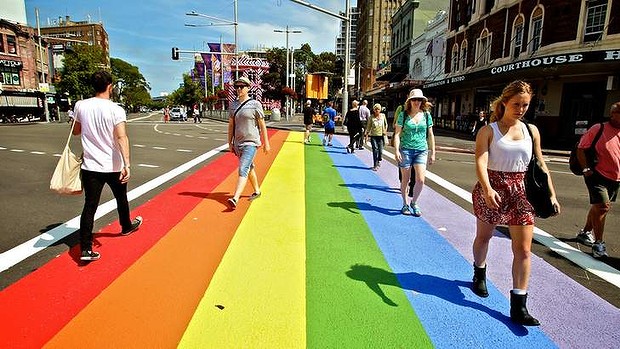
10 days ago, the NSW Premier Barry O’Farrell suggested that Taylor Square could be renamed after former High Court Justice Michael Kirby. While I support recognising his achievements, I think that it would be better to rename the square after both Mr Kirby and current, lesbian High Court Justice Virginia Bell. The outcome would reflect both the gay and lesbian history of this location. Below I have included the text of a letter which I sent to the NSW Premier on this subject this afternoon.

Taylor Square Rainbow Crossing

Dear Premier O’Farrell,

RENAMING TAYLOR SQUARE

I am writing in relation to comments which you made in the Legislative Assembly on Thursday 28 February 2013, in response to a question from the Member for Sydney, Mr Alex Greenwich MP, regarding the Government’s commitment to the Lesbian, Gay, Bisexual, Transgender and Intersex (LGBTI) community.

In particular, during your answer you suggested that Taylor Square could be renamed after former High Court Justice Michael Kirby, who, as you said in the Chamber, is “a great individual who epitomises that good community.”

While I agree with the sentiment of your proposal, I note that Mr Kirby is already highly decorated, including having the former National Centre in HIV Epidemiology and Clinical Research (NCHECR) at the University of New South Wales renamed the Kirby Institute for Infection and Immunity in Society in his honour.

Of course, this does not mean the state of New South Wales, and the City of Sydney, should not further celebrate the contributions of such an eminent jurist, and the first openly gay man appointed to the High Court.

However, I would humbly like to suggest that, if you wish to pursue this proposal, you could also consider co-naming the square after the first openly lesbian woman appointed to the High Court, Ms Virginia Bell. The location could then be known as either the Kirby-Bell Square or the Bell-Kirby Square.

I make this suggestion because I think it is important to recognise and celebrate the achievements of both the gay and lesbian communities, who each have a historical connection to Taylor Square.

Ms Bell, who replaced Mr Kirby on the High Court following his retirement, is another distinguished resident of Sydney, and one who began her legal career in the inner-city working at the Redfern Legal Centre.

Ms Bell was also a participant in the very first Sydney Gay Mardi Gras on 24 June 1978, which, fortuitously, assembled at Taylor Square before commencing the march. Renaming Taylor Square in Ms Bell’s honour, alongside Mr Kirby, would therefore acknowledge some of the important LGBTI history of this particular location.

Thank you in advance for considering my suggestion for renaming Taylor Square to be Kirby-Bell or Bell-Kirby Square, which I think would be more inclusive of the lesbian and gay communities of Sydney.

Sincerely

Alastair Lawrie

How to Survive a Plague

How to Survive a Plague

So, last Sunday Steve and I had the privilege of watching the documentary How to Survive a Plague at the Mardi Gras Film Festival, presented by Queer Screen.

I say privilege, because this is both one of the best, and one of the most important, documentaries that I have ever seen. This blog post is my way of saying thank you to director David France for putting this documentary together, something which must have been an incredibly difficult thing to do, because of the subject matter involved, and because of the heavy responsibility of portraying the people and events involved honestly and respectfully.

How to Survive a Plague chronicles the activities of ACT UP (the AIDS Coalition to Unleash Power) and its off-shoot TAG (the Treatment Action Group), from the epicentre of the AIDS crisis, the gay male community in New York City in 1987, through to the introduction of protease inhibitors/triple combination therapy in the mid-1990s.

I must admit that I cried (well, more accurately, sobbed) at many points during this film, from the visceral sense of fear experienced by these men and unflinchingly projected through the screen, through to the wonderful moments of comradery as they fought for and often won small victories in their long (and ultimately, but much too late of course, victorius) war for fair treatment, and including the tragic loss, too soon, of crusaders like Ray Navarro and Bob Rafsky (the scene with his ex-wife and child in the church after his funeral is especially raw).

Many direct action protests are captured, including the October 11, 1992 political funeral in Washington DC (where activists scattered ashes of the fallen on the White House lawns), and then the funeral of Mark Lowe Fischer in New York just before the 1992 Presidential election, where they took the open casket and chanted pleas for the polical class to listen and do something, anything, right outside the Republican Campaign Headquarters there.

But it is two speeches which for me truly stood out. The first, the amazing speech by Peter Staley to the International AIDS Conference in San Francisco in 1990. That speech is just about perfect in terms of political oratory, conveying a message while also grabbing the audience and forcing them to take on as their own the opinions and priorities of the speaker. The second, more ‘impromptu’ speech, is heart-breaking because of the sense of disunity and despair it revealed – I dare anyone not to be jolted out of their seats when they see Larry Kramer yell ‘Plague!’ to a room full of activists, who are themselves depressed and divided about the scale and severity of the challenge confronting them.

Of course, the documentary ends on a relatively positive note, as we see many of the activists from the archival footage, alive and now doing other, very worthy things with their lives (like most audience members I am in awe of the capacity of people like that to have fought such a long campaign, and then to sign up for one or indeed several more eg Mark Harrington, Peter Staley).

But just because many people in the Western world, and some in the developing world, are doing well health-wise in the fourth decade of the HIV/AIDS epidemic, does not mean that we can’t do better, both in terms of reducing transmission, and increasing access to treatments (and ultimately, of course, to finding a cure).

And the fact that as a society we are now doing comparatively well on this issue is the exact reason why we should watch movies like this, to reflect on the battles fought that got us here, and to thank and pay tribute to the activists who gave so much to ensure that people who followed would have a better, and more hopeful, existence.

Gardasil vaccine for boys starts

Gardasil Vaccine Image

So, last Friday, 15 February 2013, the Federal Government scheme providing Gardasil vaccinations to teenage boys commenced.

I have written about this issue before (in my Top 12 moments of 2012), but I think it bears repeating – this is an absolutely fantastic initiative, and one that will save the lives of many, many gay and bisexual men in the future.

The fact that Gardasil was provided only to girls up to now is a direct result of the decision made by the then-Minister for Health, Tony Abbott, under the Howard Liberal-National Government in 2007. That decision, which attempted to redefine Gardasil as being a vaccine against cervical cancer first and foremost, effectively disregarded the mounting evidence that Human Papillomavirus (HPV) is the cause of many cancers (genital, anal, mouth and throat), in both men and women.

On the flipside, the current Health Minister, Tanya Plibersek, will be responsible for saving the lives of many gay and bisexual men in future by expanding this scheme to provide Gardasil to school-age boys. Thank you Minister for this decision, which will hopefully inspire other countries around the world to do the same thing, and save as many gay and bisexual men from these unnecessary cancers as possible.

The text of Tanya Plibersek’s media release is included below.

The Hon Tanya Plibersek MP

Minister for Health

MEDIA RELEASE

15 February 2013

Boys get their world-first dose of Gardasil ® to protect against HPV

Australian schoolboys have begun receiving the first of three vaccinations to protect them against cancers and disease caused by the human papillomavirus (HPV), Health Minister Tanya Plibersek said today.

Ms Plibersek said more than 280,000 boys will be eligible for the free Gardasil® vaccine this year, which is estimated to prevent a quarter of new HPV infections.

Vaccination will protect boys from cancer and genital warts, and continue to reduce the rates of cervical cancer among women.

In a world first announced in July, schoolboys will join more than one million Australian girls aged 12-16 years who have already been fully vaccinated against HPV under the school vaccination program.

“The HPV vaccine is the best protection against the HPV virus; a virus that infects four out of five sexually active people at some point in their lives and is linked to cancer and other disease.”

“Because of our work in this area, Australia’s HPV vaccine coverage rates are among the best in the world, resulting in a significant drop in HPV-related infections.”

Since the HPV vaccination program started in 2007 there has been a reduction in HPV-related infections in young women and a reduced incidence of genital warts in males and females.

There has also been a reduction in pre-cancerous lesions in young women.

“We’re confident that extending the program to males will reduce HPV-related cancers and disease in the future,” Ms Plibersek said.

More than 400,000 boys and girls will start to have their first vaccination this month, with follow up doses from April and August.

The vaccinations will be delivered by qualified immunisation providers in all states and territories, but only if parents and guardians provide their consent.

The Gillard government is working with all states and territories to implement the HPV school vaccination program.

Parents, students and health professionals can find more information about the HPV school vaccination program at australia.gov.au/hpv.

Further information: A media website, with the eligible state and territory year groups and downloadable audio and video clips from HPV experts, is available at hpv.health.gov.au/media.

My Top 12 of 2012

On the last day of 2012, I thought it might be an opportune time to reflect on the major achievements, and disappointments, for the LGBTI community over the past 12 months. The following list of 12 highlights (or indeed ‘lowlights’ for a few) include a mix of domestic, and international, developments, as well as a couple which are not directly LGBTI-related, but which indirectly could have a major impact on LGBTI people. Of course, any ‘list-making exercise’ involves inherently subjective judgments about what is important, and I would be interested to hear your views about what should have made the list but is not included (and vice versa).

And so, in no particular order, here are my 12 highs and lows of 2012.
Gardasil Vaccine Image

1. Boys to get free Gardasil vaccine

On 12 July, Federal Health Minister Tanya Plibersek announced that, from next year, boys aged 12 and 13 would be provided with three free doses of the Gardasil vaccine, which protects against the Human Papilloma Virus (HPV). This is a massive long-term win for the LGBTI community – and in particular gay and bisexual men – and finally overturns the homophobic decision of the previous Government to exclude teenage boys from the National Immunisation Program.

The then Health Minister, Tony Abbott, who initially resisted listing Gardasil for anyone, eventually chose to restrict free access to Gardasil to school-age girls on the basis that this would protect these girls from HPV, and the boys who would in future sleep with them, thereby reducing the prevalence of HPV across the ‘broader community’. Except that, obviously, it would do little to reduce HPV prevalence amongst men who have sex with men, who would not be immunised.

This is significant because, while most people understand that HPV causes cervical cancer, it also causes penile, anal, and mouth and throat cancers. So, as a result of Tony Abbott excluding boys from accessing this vaccine from its commencement in 2007, there will be a six year cohort of gay and bisexual men who could have been protected against the cause of many types of cancer, but will instead potentially suffer long-term serious health consequences. To me, that is the epitome of the phrase blood on his hands.

Still, this is not to detract from the announcement by Minister Plibersek, and the amazing achievement that all gay and bisexual men born in Australia from the year 2000 onwards will have a dramatically reduced risk of developing cancer. Well done, Tanya.

2. National LGBTI Aged Care and Ageing Strategy

Another major achievement by the Federal Government this year was the release of the National LGBTI Aged Care and Ageing Strategy by the Minister for Mental Health and Ageing, Mark Butler. This strategy, released on 20 December, is absolutely essential to help end the stigma of silence surrounding, and the direct and indirect discrimination confronted by, older LGBTI people as they engage with aged care services and enter aged care facilities.

The fact that it was released at all is a testament to the hard work, over many years, by people such as academic Jo Harrison, and the National LGBTI Health Alliance, and of course to a Minister and Government that was willing to both listen to, and work with, the community on this issue. The strategy is also backed up with a commitment of funding (at least $2.5 million), which will help aged care service providers to learn how to be inclusive of LGBTI individuals, couples, carers and their families.

However, this is funding that must also be protected from a Shadow Treasurer, Joe Hockey, who has already identified this bucket of money as a potential saving should the Coalition win Government next year. So, well done Mark, and hands off, Joe.

3. Government MPs, including PM Gillard, join with Coalition to vote down marriage equality

Of course, when it comes to assessing the record of the Federal Government on LGBTI rights in 2012, most people will (quite understandably) not be able to look past the failure of the parliament to pass marriage equality. Dozens of ALP MPs, including Prime Minister Julia Gillard, Treasurer and Deputy Prime Minister Wayne Swan, and former Prime Minister Kevin Rudd, joined with all but one member of the Coalition (Liberal Senator Sue Boyce, who notably abstained), to vote against legislation which would have finally granted genuine equality to same-sex relationships.

This defeat was inevitable because of the decision by the ALP national conference in December 2011 to grant a conscience vote to its parliamentarians, rather than enforce a binding vote in favour of marriage equality. But just because defeat was inevitable, and expected, does not mean it was any less devastating for those of us longing to be acknowledged as first-class citizens.

Indeed, the scale of the defeat – 98 votes against and 42 in favour in the House of Representatives, and a somewhat closer 41 votes against and 26 in favour in the Senate – was particularly disheartening, especially as it shows the fight for equal marriage is likely ten or more years away from success.

The fact that the Prime Minister was one of those who stood intransigently against LGBTI Australians is something that will never be forgotten. This is someone who is able to identify and eloquently denounce sexism and misogyny ‘wherever she sees it’, but who either has a blind spot when it comes to homophobia, or who warmly embraces it. Shame, Julia, shame.

*The one positive development when it comes to marriage equality under federal law came in January when the Attorney-General Nicola Roxon implemented another ALP national conference decision, which was to allow same-sex couples marrying overseas to be issued with Certificates of No Impediment (CNI). As well as overturning the homophobic policy of previous Attorney-General Phillip Ruddock, this decision means that many more Australian couples – like Steve and I – will at least be able to marry elsewhere, even if our own country doesn’t recognise it.

4. Campbell Newman rolls back the clock

One of the most disappointing developments of 2012, especially for someone who grew up in Queensland during the 1980s and early 1990s, was the speed and scale of the newly-elected Liberal-National Party Government’s ‘crusade’ against LGBTI rights. Elected with a huge majority (78 seats out of a parliament of 89), Campbell Newman and his colleagues wasted no time in identifying the number one issue which they needed to address – the fact that LGBTI Queenslanders had come dangerously close to being accepted as equal.

In their first 9 months in office, the Newman LNP Government has:

  • Removed funding for the Queensland Association for Healthy Communities (QAHC), the only HIV/AIDS peak body in the state which services the men who have sex with men (MSM) community. The Health Minister Lawrence Springborg attempted to justify this decision on the basis that HIV rates were rising faster in Queensland than in the rest of the country – but the figures released later in 2012 showed that HIV rates have actually declined in Queensland, counter to a national rise. Which leaves just one possible explanation for why QAHC was defunded – the homophobia of the LNP and Minister Springborg.
  • Amended the civil union laws, which had been introduced by the Bligh Government at the end of its term, to remove the ability of same-sex couples to have a legally-binding ceremony. Apparently having any ceremony at all was ‘mimicking’ marriage and needed to be outlawed as a matter of priority.
  • Announced that it will remove the ability of same-sex couples (as well as single people) to access surrogacy. It is still unclear what the penalty will be for couples who break this proposed law, although at various times during the year it appeared the Newman Government would introduce gaol terms for people whose only crime was attempting to found a family.
  • Introduced a new ‘student protection’ policy which will require school staff, including counsellors, to report to the principal any sexual activity between a student under 16 with someone over 16 (irrespective of their actual age difference), and of any student between the ages of 16 and 18 who has engaged in ‘sodomy’. This policy further entrenches the discriminatory age of consent provisions in Queensland (which has a higher age of consent for anal intercourse), and poses a danger to the health and safety of students who are simply seeking counselling and advice. At this stage it appears that school nurses – who are employed by Queensland Health rather than the Education Department – are exempt from this policy, although how long that exemption lasts remains to be seen.

The christian fundamentalist war against LGBTI people being waged north of the Tweed is a possible blueprint for a newly-elected Abbott Liberal-National Government to implement federally. Which makes the federal election to be held sometime during 2013 all the more important. In the meantime, the LGBTI people of Queensland are watching their rights being dismantled, one at a time. Shame, Campbell, shame.

5. Uganda debates ‘kill the gays’ bill

There have been several distressing stories internationally during the year. The appeals court in Cameroon upholding a three-year gaol term for Jean-Claude Roger Mbede simply for sending a text message to another man saying “I’m very much in love with you” was heart-breaking. The backwards steps being taken in Russia are also an obvious concern (not only do gay pride parades remain banned, but attacks against LGBTI Russians are rising at the same time the Russian parliament is considering legislation to outlaw ‘propaganda of homosexuality among minors’).

But without doubt the number one ‘lowlight’ internationally this year was the move by parliamentarians in Uganda to introduce capital punishment for homosexuality. The Anti-Homosexuality Bill (or Kill the Gays Bill as it is commonly referred), if passed, would mean Uganda would join 7 other countries where homosexuality is subject to the death penalty, out of 76 countries where being LGBTI is still a crime.

As the year ends there has been a short reprieve, with the Bill not coming on for a vote until at least February 2013, and some reports that the death penalty may ultimately be dropped from the Bill – although sadly not imprisonment. Still, the prospect of a country potentially introducing capital punishment for homosexuality this decade is almost too depressing for words.

Allout image

6. The emergence of AllOut (@allout)

One of the key groups which emerged to draw attention to, and fight against, the Kill the Gays Bill, was AllOut (a New York-based organisation which uses online and real-world tools to help the global LGBT movement for equality). In fact, I would argue that the emergence of AllOut is itself a major highlight of 2012.

AllOut is taking the best and most up to date models of activism and applying them to causes as diverse as LGBTI equality in Brazil, same-sex parenting in the EU, ending gay ‘cures’ in California, as well as trying to help stop the Ugandan Kill the Gays Bill. Here’s hoping that AllOut has a long and proud future, as it complements the work of existing and established organisations like the International Lesbian and Gay Association (ILGA).

7. International moves towards marriage equality

Another highlight of 2012 was the ongoing progress of the marriage equality movement. Leaving aside victories in the US (which I will discuss below), marriage rights were extended to LGBTI couples in Denmark in June. And the governments of Scotland, Luxemburg and France have all committed to marriage equality in the next few years. In England and Wales, and New Zealand, it appears likely that equal marriage will be passed next year by parliaments with conservative governments (Tory Prime Minister David Cameron is helping to drive legislation in Westminster, while National Party Prime Minister John Key has indicated he will support a private member’s bill in the Beehive).

The fact that two conservative leaders have embraced marriage equality shows just how far this movement has come over the past few years, and the fact that further progress is inevitable. Of course, it also further underscores just how out of touch and embarrassing Julia Gillard and Tony Abbott are on this issue, but one day they too will be mere footnotes to our record of achievement.

8. The United States takes a giant leap for LGBTI ‘humankind’

It seemed like 2012 was the year in which the United States of America, and its people, finally ‘got it’ when it comes to LGBTI equality. The President, Barack Obama, announced that he supported marriage equality back in May (in part because he could muster no arguments against it when discussing the topic with his daughters). He was subsequently re-elected to serve a second term, and it seems that his pro-equality stance was a help rather than a hindrance (something which Julia Gillard should – but probably won’t – notice).

But Obama’s re-election was just one of many victories on Tuesday November 6 – a date on which LGBTI rights in the US took a bigger step forward than any single day since the Stonewall Riots in 1969. After 32 consecutive losses in state-wide referenda on same-sex marriage, all four states which voted in November bucked the trend and supported equality. As a result, Maine, Maryland and Washington became the 7th, 8th and 9th US states to introduce marriage equality, while a referenda to ban same-sex marriage in Minnesota was also defeated.

The significant of these victories should not be underestimated. For years, the radical right in the US has used these ballots to ‘get out the christian vote’ – indeed, Karl Rove employed this strategy to help George W Bush secure re-election as recently as 2004. Instead, in 2012, the American people decided to vote for acceptance and inclusion rather than intolerance and hate. What. A. Change.

To top things off, in Wisconsin, Tammy Baldwin was elected as the first openly gay person ever to serve in the US Senate. And that’s not even counting the fact the most influential political analyst of the US election was a gay man, Nate Silver.

This truly was a watershed election, and paves the way for bigger changes in the future. Which might be upon us sooner than we thought, with the US Supreme Court to hear cases considering both Proposition 8 (the Californian ban on same-sex marriage), and the constitutional validity of the Defense of Marriage Act, in 2013. Let’s hope that the Court’s decisions are amongst the highlights (and not lowlights) of next year.

120525_nelderkin_idjfrankocean_055x

9. Hip-hop comes of age

There was a similar sea-change when it came to US popular culture this year. After many, many, many years of waiting, it seems like hip-hop finally started to change its homophobic ways, and to deal with the subject of homosexuality with a little bit of respect rather than just a whole lot of ‘faggots’ and ‘fucking homos’.

Leading the charge was Jay-Z, who followed Obama’s announcement by declaring that he too backed equal marriage rights. Other hip-hop stars also expressed their support. Rappers Macklemore and Ryan Lewis then released one of the best bits of pro-LGBTI propaganda of the past few years (well, outside of the 2011 GetUp! video anyway) in the form of single Same Love, which was also used in the successful marriage equality referendum campaign in Washington State. And Azealia Banks (of 212 fame) came out at as bisexual in February, a statement which may take on even more significance in February 2013 when she releases her debut album.

But for mine the most important development in hip-hop in 2012 was the beautiful and tender letter written by rapper Frank Ocean, talking about his first love – a man – and published the week before his full-length debut Channel Orange was released. This was a hip-hop star not just coming out, but coming out at the start of his career, and making no apologies for who he was and who he loved.

Of course, there have been other music stars who have come out (Elton John, George Michael, KD Lang, Melissa Etheridge, and countless others), but usually this has been at the end of their careers – or at least long after they were well established. Even ‘out and proud from the beginning’ groups like the Scissor Sisters (personal favourites of mine) have played in the more traditionally gay-friendly genres of pop and dance, rather than the decidedly less accommodating field of rap/hip-hop.

What made Frank Ocean’s declaration even more significant was that he backed it up with what has been widely recognised as the best album of the year – which is just one of six categories in which he is nominated for a Grammy. Channel Orange is a brilliant collection of highly personal songs, including several which are sung to or about a male love interest. Bad Religion is just about the best piece of art on the subject of unrequited (same-sex) love ever. Frank Ocean didn’t just make gay hip-hop for a gay audience, he made great hip-hop that covered many topics, including same-sex love, and looks to have found a large audience around the world. Even if you don’t like his music, you cannot help but admire his accomplishments.

10. Royal Commission into Child Sex Abuse

This is the first of two developments which are not explicitly LGBTI-related but which are fundamentally important to all Australians, including the LGBTI community. The decision by the Federal Government to appoint a Royal Commission into child sex abuse is a necessary first step in dealing with this evil scourge, as well as recognition of the courage of people like Detective Chief Inspector Peter Fox and numerous others in pushing for it, despite many setbacks along the way.

There are two potential long-term consequences for the LGBTI community as the Royal Commission runs its course. The first is that the hypocrisy of the Catholic Church, and other religious organisations, will become ever more apparent. Some of the same religious figures who have been arguing about the so-called ‘perils’ of recognising the love between two consenting adults, have also been involved in negligent inaction within their own churches about the very real problem of child sex abuse. Some may even ultimately be found to have engaged in the criminal cover-up of child sex abuse, instead preferring to pay hush money to the victims and simply moving the offenders around. The fact that the broader community will be able to see through the hypocrisy of these figures should make it much easier to push for LGBTI equality in the future.

The second consequence is much more ambiguous. One tactic which christian fundamentalists could resort to during the Royal Commission is to blame ‘gay priests’ for child sex abuse, and to try to link homosexuality and paedophilia in the public debate. This strategy, blaming ‘the gays’ for child sex abuse, was used by bigots like France Arena in NSW in the 1990s, and it is easy to see it being attempted again – with much unpleasantness all round.

But I think this ultimately could be a good thing. Public understanding of these issues has moved on since then. Provided the Royal Commission is handled sensitively and gay and lesbian lobby groups are ready for the debate, this could actually be an opportunity to forever break any connection between these two essentially unrelated ideas (homosexuality and paedophilia).

11. Asylum seekers are sent to Nauru and Manus Island

Again, this ‘lowlight’ is not directly LGBTI related. But I would include it here because any time a country turns its backs on asylum seekers – to the extent that it chooses to send them to detention centres in other countries for unspecified periods of time – is something so terrible that it cannot, and must not, be ignored. To put it bluntly, this is a national disgrace, and something which the Labor Government and Liberal-National Opposition should forever be ashamed about. Unfortunately, given the current state of political debate in our country, there does not seem to be much hope this situation will change any time soon.

Of course, as I have written previously, there are LGBTI dimensions to this issue as well. There will inevitably be some asylum seekers who are sent to Manus Island and Nauru who were seeking asylum in Australia because of LGBTI persecution in their home country. It should also be noted that, for gay and bisexual men who are detained in either of these centres, both Nauru and Papua New Guinea criminalise male homosexuality, and so they may be exposed to prosecution on that basis. Still, this is an issue which is larger than just these injustices to LGBTI asylum seekers – no asylum seeker should be imprisoned simply for seeking safety from persecution. Not now, not ever.

12. Exposure Draft Human Rights and Anti-Discrimination Bill 2012

I thought I might end on a positive note – and also something which represents unfinished business for 2013. In November, the Federal Government finally released the exposure draft Human Rights and Anti-Discrimination Bill 2012. As well as consolidating the existing protected attributes of race, sex, disability and age, this Bill would for the first time provide federal anti-discrimination protection to lesbian, gay, bisexual and transgender Australians (*at this stage, intersex people are not properly protected, although hopefully that will be rectified during the committee stage).

If passed, this legislation would be another significant LGBTI-related achievement by the Labor Government. Building on relationship recognition and public sector superannuation reforms in 2008, passport changes for transgender people, Gardasil vaccinations for boys and the National LGBTI Aged Care and Ageing Strategy (both above), this would contribute to a fairly broad-based and substantial record of reform. To some extent, it is a shame that the failure to recognise marriage equality is so large a defeat that it overshadows much of this significant level of achievement. But then the Government has no-one to blame for that than itself.

Still, that is getting ahead of ourselves. Returning to the Bill, there are two major hurdles left to overcome. The first is in securing sufficient cross-bench support so that the Bill passes the House of Representatives, although the noises on this seem to be positive. The second, much more difficult, hurdle to overcome is ensuring that the legisation is passed before the federal election is called. With at most five months of sitting time left in this parliament, it is touch and go whether the Bill will be passed in time. Whether it does is the most important domestic LGBTI story of the first half of 2013. Fingers (and toes) crossed.

Complaint re Reference to A.I.D.S on Form

My fiancé Steve and I went to Queensland last week on holiday. The main purpose was to attend my mother’s 65th birthday. However, we also decided to treat ourselves to a night in Noosa, and to a massage the following morning, so that we could both de-stress.

But our enjoyment of said massage was compromised somewhat by the ‘client form’ which asked a range of questions about health conditions which could be relevant (for example, whether you were suffering from a shoulder or leg injury etc). One part of this form read “Please circle if you have any of the following” and one of the options was “A.I.D.S”

I could not believe my eyes. First, I find it difficult to understand how a massage could involve any risk of HIV transmission (given there is no exchange of bodily fluids or other means of transmission).

Second, and much more offensively, I can’t recall the last time I saw someone use the phrase AIDS as shorthand to refer to someone who may be HIV-positive. In fact, it may be more than a decade since I saw the conflation of the two, especially on a document which has probably been distributed hundreds if not thousands of times.

I was too shocked to raise the issue at the time, but did take a copy of the form to use as the basis of a complaint to the company which provided the massage. I have written the below email to the company outlining my concern with the form. I have also copied this email to the Queensland Association for Healthy Communities for their information (and possible follow-up).

At this stage, I am giving the company the benefit of the doubt. I am hoping that it may be an ‘innocent mistake’, and that they do not understand how offensive this form is. As such, I am not naming the organisation on this post today.

Nevertheless, should they fail to respond positively to this complaint, or fail to respond at all, I will of course name the company involved so that other fair-minded people can avoid them when they go on holiday and want to relax. After all relaxing is far more enjoyable without an added dose of unjust discrimination.

Dear ,

I am writing today to raise an issue which occurred during my massage at your premises in Noosa last Friday October 12th 2012. In particular, I am referring to your Client Form, which I was required to fill in before having my massage.

This form included a section headed “Please circle if you have any of the following” and one of the options listed was “A.I.D.S”. I find this inclusion to be incorrect and offensive.

First, I imagine that this question was seeking to establish whether a client potentially has a blood borne virus (in this case HIV, not AIDS). I also imagine that this question is at least intending to ensure the massager is able to take appropriate precautions regarding this blood borne virus – although I am having trouble working out what precautions would be necessary given massages do not involve an exchange of bodily fluids and I cannot think of another way of possible transmission that is relevant in this situation.

Could you please enlighten me what the response would have been by your company if someone had circled the response “A.I.D.S”? Is this response supported by scientific evidence and/or advice from the Queensland Department of Health?

Second, and much more importantly, I would like to point out that there is a difference between someone being HIV positive, and someone who is currently experiencing AIDS. While you must be HIV positive to experience AIDS, there are many, many people who are HIV positive who do not experience Acquired Immune Deficiency Syndrome.

Conflating the two conditions, or using “A.I.D.S” as shorthand for all people who may be HIV positive, is extremely offensive and unnecessary. It reflects thinking from the 1980s and not 2012.

Ironically, if you seeking to protect your employees, the way that you are asking this question may not achieve what you want in any event – if someone is HIV positive but does not have AIDS, then their correct/factual answer would be to leave “A.I.D.S” un-circled.

To rectify this situation, I would ask that you please consult with the Queensland Association for Healthy Communities about both your responsibilities in this area, and, if you must ask people whether they have a blood borne virus, how that information should be sought from the client. I have copied this email to them for their information and follow-up.

I look forward to your reply to this email, including the actions that you have taken to amend this form.

Sincerely,

Alastair Lawrie

Letter to Chris Bowen/Brendan O’Connor on LGBTI Asylum Seekers

Update 6 February 2013: So, this correspondence was never answered by Minister Bowen, before he left the portfolio in last week’s reshuffle. I don’t know for sure what that is a reflection of, but can only assume that not answering in 6 months means he was not open to scrutiny on the issue of LGBTI asylum-seekers and in particular their treatment on Nauru, Manus Island and, eventually, in Malaysia.

With the appointment of Brendan O’Connor as the new Minister for Immigration I have resent the original correspondence, including the questions below, to Minister O’Connor. If I have not received a response within 4-6 weeks it will be time to pursue this again but in a more public format. Thanks for reading.

Original Post: Like many Australians, I was appalled by the recent decision of the Australian Government to accept the recommendations of the Houston Report and send asylum seekers to Nauru and Papua New Guinea for indefinite periods (and by the Government’s refusal to rule out sending asylum seekers to Malaysia in the longer-term). I am also appalled by the potential consequence of this decision for LGBTI asylum seekers, and have written the following letter to Australia’s Immigration Minister, Mr Chris Bowen. I will of course write a similar letter to the Opposition’s Immigration spokesperson Scott Morrison, given the Liberal and National Parties supported the move to ‘offshore processing’. As always I will post any response received.

Dear Minister Bowen,

I am writing to express my disagreement and disappointment with the Australian Government’s decision to implement the offshore processing of asylum seekers.

I think that this decision is a failure of our human rights obligations under international law, not to mention a failure of our moral obligations as human beings to open our arms and our hearts to people fleeing persecution.

Given that your government has now committed to process asylum seekers in Nauru, Papua New Guinea and, in the medium term, through ‘regional processing’ in Malaysia, I am also writing with several questions which I would like answered about one particular issue – the treatment of lesbian, gay, bisexual, transgender and intersex (LGBTI) asylum seekers.

  1. Do you acknowledge that there are many countries around the world where being LGBTI is illegal and/or subject to government harassment and intimidation?
  2. Do you accept that LGBTI people have the right to seek asylum on the grounds of persecution of their sexual orientation or gender identity?
  3. Do you agree that this means LGBTI asylum seekers should be accepted by countries like Australia, rather than be returned to their originating country and asked to ‘return to the closet’ or conceal their sexual orientation or gender identity? (Disturbingly, there have been some cases within Australia suggesting that LGBTI asylum seekers can be returned in such circumstances, something which is not required of people fleeing persecution on political, religious or other grounds. I am simply seeking your confirmation that you do not support this special and discriminatory imposition on LGBTI asylum seekers).
  4. Do you support the right of LGBTI people to seek sexual companionship, form loving relationships and found families no matter where they are in the world? Are these fundamental rights which should be protected?
  5. Do you agree that asylum seekers who are fleeing persecution on the grounds of sexual orientation or gender identity (or indeed who are fleeing on other grounds but are LGBTI), should not be sent to any country which criminalises or discriminates against LGBTI people?
  6. Are you aware that homosexuality is currently illegal in all three countries to which the Australian Government currently intends to send asylum seekers?
  7. Will the laws of these jurisdictions apply to asylum seekers being detained by the Australian government (or, in the case of Malaysia, to asylum seekers who may be living in the community)?
  8. What representations have the Australian Government made to, and what agreements have the Australian Government sought with, the governments of Nauru, Papua New Guinea and Malaysia, on the specific treatment of LGBTI asylum seekers?
  9. Do you agree that, if LGBTI asylum seekers are unable to seek sexual companionship, form loving relationships or found families in Nauru, Papua New Guinea and Malaysia, that this is a fundamental breach of their human rights?
  10. As a fellow human being, are you comfortable that the Australian Government will reject someone who is fleeing the death penalty in another country for simply being who they are and instead send them to a third country where it remains a criminal offence to be who they are?

I have copied this letter to the Prime Minister, Foreign Affairs Minister and Attorney-General given these issues cut across several portfolios. I look forward to your prompt response.

Yours sincerely,

Alastair Lawrie

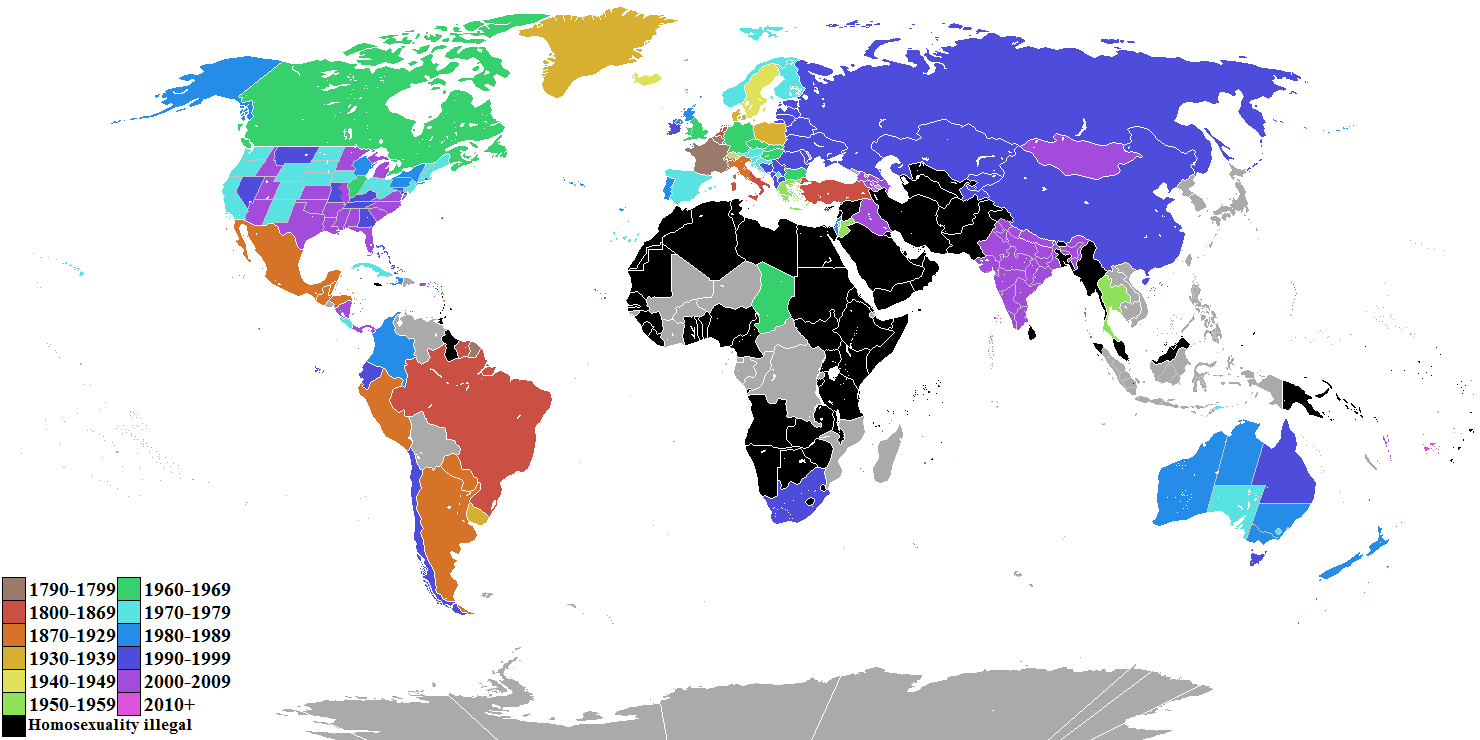
As an illustration of why there remain so many LGBTI refugees, the following map indicates the countries in which homosexuality remains illegal – while there has been significant progress over the past 50 years, there remains far too many countries shaded black, including of course Papua New Guinea:

Decriminalization_of_homosexuality_by_country

Submission on Homosexual Advance Defence

The following is a submission which I am lodging today with the NSW Legislative Council Provocation Committee which is inquiring into the Partial Defence of Provocation. It is an opportunity to make the argument that the homosexual advance defence, or ‘gay panic’ defence, should be repealed because it is unjust and discriminatory. The Committee has extended the deadline to Friday 24 August 2012 so I would encourage anyone interested to make a similar submission.

NB On Tuesday 23 2013, the Committee handed down its final report. In it, all members of the Committee, including the Chair, Mr Fred Nile, recommended that non-violent sexual offences should not be the basis of a provocation defence. Which means in practice, that all members have recommended that the Homosexual Advance Defence be abolished. This is obviously a great result – it is now up to the Premier, the Hon Barry O’Farrell MP, to implement this reform, as quickly as possible. The full report can be found here: http://www.parliament.nsw.gov.au/Prod/parlment/committee.nsf/0/61173C421853420ACA257B5500838B2E?open&refnavid=CO4_1

Submission to the Legislative Council Provocation Committee Inquiry into the Partial Defence of Provocation

This submission will focus on one aspect of the operation of the partial defence of provocation – the so-called homosexual advance (or ‘gay panic’) defence.

In particular, it will argue that the law of provocation should be reformed by either amending s.23 of the Crimes Act 1900 to ensure that non-violent sexual advances cannot be considered as an act which induces provocation, or by repealing s.23 in its entirety to remove the partial defence of provocation altogether.

This is necessary to ensure that never again can a person who commits homicide have their offence downgraded, from murder to manslaughter, with a consequent reduction in maximum sentence, simply on the basis of a non-violent sexual advance.

As noted in the Committee’s briefing paper for this inquiry, the statutory basis of the partial defence of provocation lies in s.23 of the Crimes Act. In particular, sub-sections (1) and (2) provide that:

(1) Where, on the trial of a person for murder, it appears that the act or omission causing death was an act done or omitted under provocation and, but for this subsection and the provocation, the jury would have found the accused guilty of murder, the jury shall acquit the accused of murder and find the accused guilty of manslaughter.

(2) For the purposes of subsection (1), an act or omission causing death is an act done or omitted under provocation where:

(a) the act or omission is the result of a loss of self-control on the part of the accused that was induced by any conduct of the deceased (including grossly insulting words or gestures) towards or affecting the accused, and

(b) that conduct of the deceased was such as could have induced an ordinary person in the position of the accused to have so far lost self-control as to have formed an intent to kill, or to inflict grievous bodily harm upon, the deceased,

It is difficult to comprehend how these sub-sections have ever operated to mitigate the responsibility of an offender who kills another person in response to a non-violent sexual advance. It is almost impossible to understand how it could still be the case in 2012.

The ultimate fault for this sorry state of affairs lies with the majority of High Court justices in Green v The Queen [1997] HCA 50. With all due respect to Chief Justice Brennan, Justice Toohey and Justice McHugh, they incorrectly applied the ordinary person element in sub-section (2)(b) to mitigate the responsibility of the offender. As has been made clear in repeated criticisms of this decision, the ‘ordinary person’ in contemporary Australia is not so homophobic that their response to a non-violent homosexual advance is to form the intent to kill that person or to wish to inflict grievous bodily harm upon them.

This point was of course made eloquently by Justice Kirby in his dissent:

“If every woman who was the subject of a “gentle”, “non-aggressive” although persistent sexual advance… could respond with brutal violence rising to an intention to kill or inflict grievous bodily harm on the male importuning her, and then claim provocation after a homicide, the law of provocation would be sorely tested and undesirably extended… Any unwanted sexual advance, heterosexual or homosexual, can be offensive. It may intrude on sexual integrity in an objectionable way. But this Court should not send the message that, in Australia today, such conduct is objectively capable of being found by a jury to be sufficient to provoke the intent to kill or inflict grievous bodily harm. Such a message unacceptably condones serious violence by people who take the law into their own hands.”

The truly offensive nature of the homosexual advance defence is revealed by asking why it invariably applies only to non-violent sexual advances by a man to another man? As Kirby asks, rhetorically, if a non-violent sexual advance from one man to another was sufficient to justify forming the intention to kill or seriously wound, why should this not also apply to a non-violent sexual advance by a man to a woman? Further, why shouldn’t a woman who receives an unwanted non-violent sexual advance from another woman have access to the partial defence of provocation? Why doesn’t it also apply to a man who receives an unwanted non-violent sexual advance from a woman? Or, in my case, as a gay man, why can’t I access the partial defence of provocation if I receive an unwanted sexual advance from another man?

The answer is that in all of these cases society justifiably expects the recipient of the unwanted sexual advance to exercise self-control. A violent response to an unwanted non-violent sexual advance, to the extent that the recipient forms the intention to kill or seriously wound, is so beyond the pale, or so far out of the ‘ordinary’, that we do not extend any reduction in culpability to the offender in these circumstances.

In my opinion, there is nothing so different, so special or so extraordinary, in the situation where the non-violent sexual advance is made by a man to another man, as to justify offering the offender in such cases any extra legal protection. In contemporary Australia, a man who receives an unwanted sexual advance should exercise the same level of self-control as we expect of any other person.

To have a separate legal standard apply to these cases is homophobic because it implies there is something so abhorrent about a non-violent sexual advance by a man to another man that a violent reaction is almost to be expected, and at least somewhat excused. This does not reflect the reality of contemporary Australia, where, with the exception of marriage, gay men enjoy the same rights as other men, and are accepted as equals by the majority of society.

Even if a small minority of people remain firmly intolerant of homosexuality, that does not mean there should be a ‘special’ law to reduce the culpability of such a person where they are confronted by an unwanted homosexual sexual advance. To retain such a provision is unjust and discriminatory, and is a mark against any legal system which aspires to fairness.

The above discussion outlines why the homosexual advance defence is wrong in principle. What should not be forgotten is that the homosexual advance defence is also wrong in practice, or in the outcomes which it generates. After all, the defence does not simply exist in the statute books, ignored and unused. Instead, it has been argued in a number of different criminal cases, sometimes successfully.

This means there are real offenders who are in prison (or who have already been released), who have had their conviction reduced from murder to manslaughter, and most likely their sentence reduced along with it, simply because they killed in response to an non-violent homosexual advance. The legal system has operated to reduce the liability of these offenders even when broader society does not accept that such a reduction is justified. As a result, these offenders have not been adequately punished, meaning that above all these victims have not received justice.

Similarly, the family members and friends of the victims killed in such circumstances have witnessed the trials of these offenders, expecting justice to be served, only to find that the killer is not considered a murderer under the law. Instead, these family members and friends find some level of blame is placed on the actions of the victim, that somehow by engaging in a non-violent sexual advance they have helped to cause and even partly deserved their own death.

The saddest part of preparing this submission was in reading the Committee’s briefing paper and learning that, not only have at least 11 men been killed in these circumstances in NSW, but also that 11 families were so profoundly let down by the justice system between January 1990 and September 2004. It is highly likely that the defence has been used more times since then, dishonouring more victims and causing additional pain to more families already dealing with the loss of a loved one.

I wrote earlier that it is the fault of the High Court, in Green v The Queen, that the homosexual advance defence remains a part of the criminal law. Where the courts get it wrong, as they clearly have in this area, it is the responsibility of the parliament to remedy the error and thereby ensure the justice system operates in a fair and non-discriminatory manner.

There are two options for the NSW Parliament to abolish the homosexual advance defence.

The first would be to amend s.23 of the Crimes Act 1900 by inserting a section which would exclude non-violent homosexual advances from forming the basis of provocation. This was the course of action recommended by the Homosexual Advance Defence Working Group in 1998, and appears to have been adopted in the ACT and NT.

The second option would be repeal s.23 in its entirety and abolish the partial defence of provocation altogether, as has been done by Tasmania, Victoria and Western Australia.

As I have concentrated solely on the homosexual advance defence and not on the impact of such a change on cases involving family violence and other instances where the partial defence of provocation may be applied, I am not in a position to recommend which of these options should be adopted in the broader context (for example, if s.23 is repealed entirely, it may be necessary to incorporate a new provision for ‘defensive homicide’, as the Victorian Parliament did in 2008).

Nevertheless, I believe it is clear the NSW Parliament should adopt one of these courses of action to ensure that no more killers are able to rely on the homosexual advance defence to reduce their conviction from murder to manslaughter. The homosexual advance defence is unjust, it is discriminatory and it should be made history.

Recommendation

The NSW Parliament should either:

a)      Amend s.23 of the Crimes Act 1900 by inserting a section which would exclude non-violent homosexual advances from forming the basis of provocation; or

b)      Repeal s.23 of the Crimes Act, thereby removing the partial defence of provocation entirely.

Alastair Lawrie

10 August 2012