Submission on Review of NSW Surrogacy Act 2010

The NSW Attorney-General’s Department is currently reviewing the Surrogacy Act 2010, legislation which allowed equal access to altruistic surrogacy within NSW, but made a criminal offence, with a penalty of to 2 years’ imprisonment, of entering into commercial surrogacy arrangements both within NSW and overseas.

Submissions are due by 30 April (next Wednesday), and full details about the review can be found here: <http://www.lpclrd.lawlink.nsw.gov.au/lpclrd/lpclrd_consultation/lpclrd_stat_reviews.html?s=1810621881

As with the NHMRC review of the Ethical Guidelines re Assisted Reproductive Technology, this subject matter is complicated, and I am sure that some people reading this blog will disagree with some of my conclusions (particularly re commercial surrogacy). if that’s the case, then I encourage you to leave a comment below and/or write your own submission.

The Director,

Justice Policy

Department of Attorney General and Justice

GPO Box 6

SYDNEY NSW 2001

justice.policy@agd.nsw.gov.au

Wednesday 23 April

Dear Director,

SUBMISSION RE REVIEW OF SURROGACY ACT 2010

Thank you for the opportunity to provide my personal submission in response to the review of the NSW Surrogacy Act 2010.

As suggested by the terms of reference, this submission is separated into two parts: the first examines whether the policy objectives of the Act remain valid, while the second considers whether the terms of the Act remain appropriate for securing those objectives.

Part A: Do the policy objectives of the Surrogacy Act 2010 remain valid?

The review outlines that the policy objectives of the Surrogacy Act 2010 are to:

  • Protect the interests of children born as a result of surrogacy arrangements;
  • Provide legal certainty for parties to surrogacy arrangements, and
  • Prevent the commercialisation of human reproduction.

Overall, I believe that the first two of these policy objectives remain valid, while the third should be replaced with the policy objective “To prevent the exploitation of people for the purposes of human reproduction”. I also believe that an additional policy objective should be added: “To recognise and support diversity in family structures and relationships.”

Protect the interests of children born as a result of surrogacy arrangements

As with likely all other people making submissions to this review, I strongly support the retention of this policy objective. I also agree with the inclusion of this objective as the primary Guiding Principle in section 3 of the Act: “[t]his Act is to be administered by reference to the principle that, in relation to any surrogacy arrangement, the best interests of the child of the surrogacy arrangement are paramount.”

I note that the best interests of children born through surrogacy are protected and supported by the equal treatment of all people, irrespective of sexual orientation, gender identity and intersex status, because, as all reputable research has shown, none of these characteristics are relevant in determining whether an individual or couple will be a good, caring and loving parent(s).

The Surrogacy Act 2010 should be commended for not drawing any distinctions on the basis of these attributes, and the non-discriminatory nature of its operative provisions should be retained.

However, the role of the Act in affirming the diversity of family structures and relationships that already exist in NSW could be strengthened by the elevation of a principle reflecting this reality in a new stand-alone policy objective.

Such a possibility was considered during the second reading speech debate in 2010[1], as well as in the Standing Committee on Law and Justice’s 2009 Report entitled ‘Legislation in Altruistic Surrogacy’, which helped to inform development of the Act.

I believe that a new policy objective – namely, “To recognise and support diversity in family structures and relationships” – should be added to the Act to highlight the non-discriminatory approach of the legislation and the fact that all people can be good parents, irrespective of sexual orientation, gender identity or intersex status.

Recommendation 1: A new policy objective should be added to the Surrogacy Act 2010– “To recognise and support diversity in family structures and relationships.”

Provide legal certainty for parties to surrogacy arrangements

Not only do I believe that this policy objective remains valid, but I also believe that the Act, and its framework for transfer of parentage of children born through surrogacy arrangements, is largely successful in achieving this outcome. Therefore, this policy objective should be retained.

Prevent the commercialisation of human reproduction

I do not support this policy objective, and believe it should be replaced with a new policy objective: “To prevent the exploitation of people for the purposes of human reproduction.”

By way of explanation, I believe the inclusion of the current policy objective is, to some degree, an attempt to address the issue of potential reproductive exploitation (especially of women), but that it confuses the means (a ban on commercial reproduction, including surrogacy) with the ends (preventing reproductive exploitation). It is the ends that should be reflected in the policy objectives rather than the means.

Further, I believe that the question whether commercial surrogacy is and always will be wrong, in every possible circumstance, is complex, and one about which different people, well-motivated and passionate about human rights and welfare, can and do reach different conclusions. However, one conclusion about which I hope all people would agree is that people, and especially women, should not be exploited for their reproductive capabilities.

Personally, I do not feel confident in saying that every possible arrangement, between a birth mother and the intended parent(s) of the child, is inherently wrong – and wrong to the point where it should be criminalised – simply because of the exchange of money in addition to those which cover the birth mother’s costs.

Nor do I necessarily believe that the nature of a surrogacy arrangement automatically and fundamentally changes, from one which is recognised and supported in legislation (altruistic surrogacy), to one which is not only prohibited but attracts a maximum penalty of two years’ imprisonment (commercial surrogacy), because of the exchange of that money.

Of course, I am cognisant of the fact that the introduction of financial ‘rewards’ to the already ethically-complex area of surrogacy arrangements carries with it significant risks. Chief among those are the risk that people, and especially the women acting as surrogate mothers, will be exploited for their reproductive capabilities.

However, I also believe there are other ways in which people can be exploited for their reproductive capabilities (such as through emotional and/or familial pressure). Indeed, the Surrogacy Act 2010 already contains a range of safeguards that have nothing to do with commercialisation, but are directed at preventing exploitation (for example, the requirement for an independent counsellor’s report to verify that the birth mother has an “understanding of the social and psychological implications of the making of a parentage order” and “whether any consent given by the birth parent or parents to the parentage order is informed consent, freely and voluntarily given” – subsections 17(3)(a) and (f)).

In my view, it is the prevention of exploitation that should be the policy objective in this area, rather than commercialisation per se. This new objective should then be used to guide whether and, if so, how commercial surrogacy arrangements should be allowed (see discussion in part B).

Recommendation 2: The policy objective “To prevent the commercialisation of human reproduction” should be replaced with a new policy objective “To prevent the exploitation of people for the purposes of human reproduction.”

Part B: Do the terms of the Surrogacy Act 2010 remain appropriate to secure those objectives?

For the most part, the provisions of the Surrogacy Act 2010 work well in protecting the interests of children born as a result of surrogacy arrangements and in providing legal certainty for parties to surrogacy arrangements. As indicated in Part A, I also believe that the non-discriminatory way in which the legislation has been drafted could be enhanced further by the addition of a new policy objective (“To recognise and support diversity in family structures and relationships”).

However, I believe that there is a clear divergence in determining whether the provisions of the Act remain appropriate depending on which of the two alternative policy objectives discussed in Part A (‘prevent commercialisation’ or ‘prevent exploitation’) is adopted.

For example, if the over-arching goal of the legislation remains to prevent commercialisation in any form, then the ban on commercial surrogacy in section 8 (which includes a maximum penalty of 1000 penalty units or 2 years’ imprisonment, or both, for those people who are in contravention) would clearly still be appropriate.

The prohibition on commercial surrogacy arrangements entered into overseas by people ordinarily resident or domicile in NSW, as outlined in the ‘geographical nexus for offences’ provision in section 11, would also remain a valid attempt to secure the objective of preventing commercialisation.

However, if the policy objective of preventing commercialisation is actually seen as a means to the end of preventing exploitation (which I believe it is), or indeed, if it were to be replaced with the explicit policy objective of preventing exploitation of people and especially women for their reproductive capabilities, then we are forced to consider how these provisions are currently operating, and their impact on people both in NSW and overseas.

I suspect that, even before the Surrogacy Act 2010 was introduced, there were few, if any, commercial surrogacy arrangements entered into within NSW, and that this situation would remain the case today.

I also believe that there is evidence that the number of overseas commercial surrogacy arrangements was growing at the time of the legislation’s passage, and that, since its introduction, the number of these arrangements entered into by people resident or domiciled in NSW has likely decreased. This could be seen as evidence that the ban has reduced exploitation.

However, I also believe that there is sufficient anecdotal and other evidence that some overseas commercial surrogacy arrangements entered into by people living in NSW continue. The overwhelming desire for some individuals or couples to become parents, together with the low numbers of ‘stranger’-child adoptions, both within Australia and internationally, means that this option continues to be at or near the top of the list of possible routes to parenthood. The criminal penalty attached to section 8 is unlikely to deter such people.

The result of this is that, while some individuals or couples may choose (or have the money to choose) commercial surrogacy arrangements in countries with strong regulation and low economic disadvantage, which at least reduces the possibility of exploitation, others opt for (or are financially restricted to choosing) countries with little or no regulation, as well as higher economic inequality or disadvantage than Australia, thereby significantly increasing the risks of exploitation of the women acting as surrogate mothers.

Thus, while the ban on commercial surrogacy may be effective in preventing the exploitation of women within Australia, I believe it has to be acknowledged that it is not entirely successful in preventing the potential for exploitation of women in other countries.

In this context, we are forced to consider whether there are alternative approaches to the question of commercial surrogacy that could lower the overall level of exploitation of all women.

At least one option, which should at least be considered, would be legalising commercial surrogacy arrangements within NSW, and placing them within a tightly regulated system with the ability to be overseen by appropriate domestic agencies, while at the same time continuing the prohibition on commercial surrogacy arrangements entered into overseas.

This framework – domestic legalisation and overseas ban – arguably may have the best potential to reduce the overall level of reproductive exploitation of women.

However, it is difficult to consider the respective advantages or disadvantages of such a framework in the absence of a proposal outlining exactly how a domestic commercial surrogacy scheme could operate. I believe it is nearly impossible to compare the known harms of surrogate exploitation in (some) overseas countries, with the hypothetical risks of exploitation under an unknown domestic commercial surrogacy scheme.

For this reason, I believe that the NSW Law Reform Commission or similar body should be given the responsibility to consider this issue, but, rather than recommend whether commercial surrogacy should be legalised or not, they should instead design what a ‘model’ domestic commercial surrogacy scheme would look like, with the guiding principle of minimising the risks of exploitation.

This model could then be used as the basis for a genuine and sustained debate, in the community, the media and amongst politicians, about whether the current system (a blanket ban), or a system which allows for tightly-regulated domestic commercial surrogacy, is the best way to reduce the risk of exploitation of all women, and not just those living in NSW.

Of course, it may be that it is impossible to design a domestic commercial surrogacy scheme that sufficiently reduces the risks of exploitation of people (and especially women) for their reproductive capabilities.

It may also be that, after this process, the majority of people still believe that the ‘commercialisation’ of human reproduction is always wrong, and that commercial surrogacy should always be illegal.

However, given we are aware that at least some overseas commercial surrogacy arrangements continue to occur, and appear likely to continue well into the future, I believe it is incumbent upon us to consider whether there are any alternatives to the current regulatory approach and, after considering those alternatives, decide what is the most appropriate way “To prevent the exploitation of people for the purpose of human reproduction.”

Recommendation 3: The NSW Law Reform Commission, or similar body, should be asked to design a ‘model’ framework for domestic commercial surrogacy arrangements, with a guiding principle to minimise the risks of the exploitation of people for the purpose of human reproduction.

Should you require additional information, or to clarify any of the recommendations included in this submission, I can be contacted at the details below.

Sincerely,

Alastair Lawrie

[1]http://www.parliament.nsw.gov.au/prod/parlment/NSWBills.nsf/0/71c024816771a264ca2577c100195683/$FILE/LC%2010210.pdf

13 Highs & Lows of 2013: No 13 (Alleged) Police Brutality at Sydney Mardi Gras

As I did last year, I am going to end the year by writing about the highlights – and lowlights – of the last 12 months. As always, choosing the best and worst of the year is a subjective process, and reflects my own experiences as a cis-gender gay man, who engages in LGBTI advocacy, in Sydney. But I hope that the list I have selected is reflective of some of the major issues of 2013, at least in Australia anyway. If not, please feel free to tell me why I’m wrong in the comments section below.

No 13. (Alleged) Police Brutality at Sydney Mardi Gras

Let’s begin by remembering one of the true low-points of this year – the (alleged) actions of NSW Police officers which marred Australia’s, and one of the world’s, premier LGBTI events, the Sydney Mardi Gras, in February and March.

As we approach the end of the year, almost 2 million people, from right around the world, have watched the Youtube clip of the way Police officers treated Jamie Jackson on Oxford St on the night of the Mardi Gras Parade. (http://www.youtube.com/watch?v=wxtFtVfAeeE)

Jamie Jackson Mardi Gras

Others have read about the way long-term LGBTI activist Bryn Hutchinson was (allegedly) treated by NSW Police officers, also on Oxford St after the parade had finished. Now that all charges against Mr Hutchinson, and his sister Kate, have been dismissed by the courts, he has written about his experiences in the Star Observer. (http://www.starobserver.com.au/opinion/soapbox-opinion/my-terror-of-crossing-oxford-street-at-mardi-gras/113785)

But it is important to remember that it was not just these two isolated incidents that left a sour taste in the mouths of many after what is supposed to be a celebration of pride and diversity. Nor were instances of alleged Police brutality confined to the night of the Parade and Party, but instead occurred throughout the Mardi Gras Festival.

In fact, Sydney Mardi Gras and ACON received at least 58 complaints about the way people had been treated by NSW Police over the entire Mardi Gras season. These complaints included allegations of intimidation and aggression by Police on Oxford St after the Parade had finished, reports of homophobic language and behaviour at the main Party, of intimidation, violence, excessive physical force and coercion during drug operations at both the Harbour Party and main Party, and other aggressive and intimidating behaviour in LGBTI venues along Oxford St during the Festival.

Since March, Sydney Mardi Gras, ACON, the Inner City Legal Centre (ICLC) and the NSW Gay & Lesbian Rights Lobby (GLRL) have been attempting to work through these issues in consultation with the LGBTI community. They recently released an advocacy document outlining 12 recommendations to the NSW government, although, with just 2 months left til the 2014 season gets underway, it is currently unclear how many will be accepted by Premier Barry O’Farrell, Police Minister Michael Gallacher and others. (http://glrl.org.au/images/stories/Publications/20131115_policing_at_lgbti_events_and_venues.pdf)

What is likely is that NSW Police will be much better behaved – at least for the 2014 Mardi Gras Festival, Parade and Party. They will be told by their superiors that to repeat what happened this year would reflect badly on the Government (in the media), as well as potentially jeopardising the money that is brought into the NSW economy by Mardi Gras and associated events. They will also be keenly aware that all eyes will be on them come February and March 2014, to see if their poor behaviour is repeated (on camera).

Nevertheless, the real test will come in 2015, 2016 and beyond, when the immediate controversy has died down, media interest has waned, and the temptation will emerge for some elements of the Police (because it should always be remembered that not all Police act poorly) to slip back into the (alleged) intimidation and outright aggression of 2013.

If the majority of the Mardi Gras, ACON, ICLC and GLRL recommendations are adopted (especially recommendations 1-3), then we may see some positive long-term cultural changes within NSW Police, meaning that future Mardi Gras patrons may not suffer in the same way that Jamie, Bryn and others did this year.

But, in my opinion, the two best recommendations for helping to ensure that NSW Police are ‘well-behaved’ at future Mardi Gras events are perhaps the two that are least likely to be adopted by the NSW Government.

The first, recommendation 7, calls for an end to drug detection dog operations. The evidence against the use of sniffer dogs has piled up since legislation was first passed authorising their use, without warrants, in NSW public places in 2001. The 2006 Ombudsman’s Report was damning in terms of their lack of effectiveness, as well as the risks, including health risks, of their ongoing use. In 2011, just 20% of drug dog indications resulted in Police actually finding drugs on the person searched.

The 2013 Mardi Gras experience, especially for attendees of the Harbour Party, simply confirmed the vagueness of what constitutes ‘reasonable grounds’, as well as the gross invasion of civil liberties and indeed bodily integrity involved in a subsequent drug search.

The use of drug detection dogs should end, end of story. And yet, with both the current Coalition, and previous Labor, Governments seemingly addicted to ‘law & order’, that outcome seems incredibly unlikely.

Something which is slightly more feasible is the subject of the other key recommendation (11), which calls for the establishment of a “transparent, representative civilian-led police complaints and investigatory body with the appropriate resources, capabilities and knowledge” to oversee NSW Police. Obviously, such a body would help remedy issues experienced, not just by the LGBTI community, but also by other vulnerable groups across NSW, including Aboriginal and Torres Strait Islanders, young people and people from Culturally and Linguistically Diverse (CALD) backgrounds.

It should be acknowledged that the NSW Government has taken a small step down this path, by appointing the former Commonwealth Attorney-General, Robert McClelland, to review the investigation and oversight of police critical incidents (those where police actions have resulted in the death or serious injury of a member of the community). But this represents just a small sub-set of police actions which should be subject to independent review, and it is undeniably a long, and hard, road from this narrow review to the introduction of a broad-based, independent complaints body. We’ll see what happens on this in coming months (and, I suspect, years).

There is one final comment which I feel compelled to make. In the aftermath of the incidents during this year’s Mardi Gras, some members of Sydney’s LGBTI community focused on the possible involvement of Police officers from outside the Surry Hills Local Area Command. Specifically, they argued that if we could somehow return to a (simpler) time when Surry Hills Police were sufficient to patrol the Mardi Gras, supplemented by others from around Sydney who volunteered to be on duty, then the problems of 2013 would somehow disappear.

To me, that ignores a much deeper problem. If a Police officer is going to behave in an allegedly homophobic and aggressive way on the busiest gay night of the year, on Oxford St, in front of thousands of people, then how are they going to treat an individual LGBTI person, when nobody is looking, in other parts of Sydney, or indeed elsewhere in the state?

I am not interested in just having an LGBTI-friendly Police force serving the inner-city enclaves of Surry Hills and Newtown, while simultaneously ignoring the potential for homophobia outside those supposedly safe borders. Any officer, from any part of the State, should be able to be called up for duty around Mardi Gras and behave in a responsible and respectful manner.

Above all, every single officer, in every single station across NSW, must be able to deal with, and respond appropriately to, the concerns of LGBTI people. If they can’t, they should have their badges taken off them, because they’re not fit to be a Police officer.

Submission on Alex Greenwich’s Anti-Discrimination Amendment (Private Educational Authorities) Bill 2013

The following is my submission, lodged today, in response to a discussion paper and Bill released by the Member for Sydney, Mr Alex Greenwich. The Paper and Bill seek to remove exceptions which allow private educational authorities, including religious schools, the right to discriminate against lesbian, gay and transgender students. Unfortunately, I think that to achieve that goal, more amendments to the NSW Anti-Discrimination Act 1977 may need to be made. In any event, I believe that there are a range of other amendments which should also be made at the same time, including the removal of section 56 generally. Anyway, here it is:

Mr Alex Greenwich

Member for Sydney

Sydney@parliament.nsw.gov.au

Monday 30 September 2013

Dear Mr Greenwich

Submission on Anti-Discrimination Amendment (Private Educational Authorities) Bill 2013

Thank you for the opportunity to provide a submission in response to your discussion paper on anti-discrimination law reform, released in August 2013, and in particular in relation to your Anti-Discrimination Amendment (Private Educational Authorities) Bill 2013 (the Bill), which you introduced into NSW Parliament on 19 September 2013.

First of all, let me say that I welcome your strong commitment to removing the discrimination that can be experienced by lesbian, gay and transgender students in private educational institutions, including private schools. As has been demonstrated by the Writing Themselves In reports, and countless other research projects over the years, schools can be one of the major sources of homophobia and trans-phobia in the lives of young people.

It is vital that any ‘exceptions’ in the NSW Anti-Discrimination Act 1977 which may authorise schools to discriminate against lesbian, gay and transgender students are removed, and this must apply to all types of private schools, including religious schools. From what I have read, both in the Discussion Paper and associated media, as well as in your Second Reading Speech, I believe this is what your Bill is attempting to achieve.

However, I do have some concerns about the Anti-Discrimination (Private Educational Authorities) Bill 2013, in particular:

  • It is unclear whether the Bill, as drafted, will accomplish this aim
  • There are a range of other amendments which also need to be made to the Anti-Discrimination Act 1997 and
  • If the Bill is aimed at removing the right to discriminate from religious schools, thereby provoking an expected negative response from religious organisations, then I believe that the right of religious organisations to discriminate more broadly under s56 should be removed at the same time.

Turning first to the question of whether the Bill, if passed, would actually achieve the aim of removing the right to discriminate from all schools, including religious schools, I note that the Bill simply removes those provisions of the Anti-Discrimination Act 1997 which provide a specific right to discriminate (namely, sections 31A(3)(a), 38K(3), 46A(3), 49L(3)(a), 49ZO(3) and 49ZYL(3)(b)).

However, the Bill does not amend or seek to repeal the catch-all section which provides exceptions to religious organisations to discriminate – and that is found in section 56(d) which states: “Nothing in this Act affects: (d) any other act or practice of a body established to propagate religion that conforms to the doctrines of that religion or is necessary to avoid injury to the religious susceptibilities of the adherents of that religion.”

I am concerned that, by leaving this section unamended, the effect of your Bill would be to remove the right to discriminate from private educational authorities that are not religious, but that religious schools would retain the right to discriminate against lesbian, gay and transgender students on the basis of their ‘religious principles or beliefs’. The practical effect of the Bill would therefore have a positive outcome for a much, much smaller cohort of students than what is intended.

This reading of the Anti-Discrimination Act 1977, and in particular s56(d), appears to be supported by the main case in this area in recent years: OW & OV v Members of the Board of the Wesley Mission Council [2010] NSWADT 293. This case involved a service operated by the Wesley Mission, which sought to utilise the ‘protections’ offered in s56(d) to discriminate against gay male foster carers. The Wesley Mission was ultimately successful in its appeal.

While foster care is obviously not exactly the same as providing education in religious schools, I believe that it is potentially analogous in terms of indicating how broad the religious exceptions under s56(d) are in practice, and in particular in suggesting that they would operate to shield religious schools that discriminate against lesbian, gay and transgender students from the scope of the Anti-Discrimination Act 1977.

This also appears to be the opinion of the current Attorney-General of NSW, the Hon Greg Smith SC MP. In a speech titled Religious Vilification, Anti-Discrimination Law and Religious Freedom, which he gave on 24 August 2011, the Attorney-General discussed the operation of s56:

“116. Section 56 creates a general exemption from the ADA for religious bodies. Religious bodies are not required to comply with the ADA in relation to:

  1. The training, education, ordination or appointment of religious leaders [s56(a)&(b)];
  2. The appointment of any other person [s56(c)];
  3. Any other act or practice that conforms to the doctrines of that religion or is necessary to avoid injury to the religious susceptibilities of the adherents of thast religion [s56(d)].

117. Section 56 was included in the ADA when first enacted. While other jurisdictions have adopted a general exception from their anti-discrimination statutes for religious bodies, the exceptions are narrower than that under the ADA in the following ways:

a. While section 56(c) of the ADA exempts the appointment of persons ‘in any capacity’ by a religious body, other jurisdictions exempt only appointment of persons to perform functions related to religious practices;

b. Some other jurisdictions have provisions equivalent to s56(d) of the ADA, but others are narrower. Those that are narrower limit the exemption to acts done as part of a religious practice [NT], or don’t extend the exemption to discrimination in work or education [Qld], or limit the grounds of discrimination that are exempt.” [emphasis added]

The implication from this speech, and in particular from para 117(b) above, is that the Attorney-General believes that the protections offered by s56(d) would be available to a school or educational facility run by a religious organisation. This also appears to be the interpretation of s 56(d) by other organisations and advocacy groups which work in this area, including the Inner-City Legal Centre and Public Interest Advocacy Centre.

If that is the case – that either your Bill does not operate to limit the right of religious schools to discriminate against lesbian, gay and transgender students, or that there may be some ongoing uncertainty in this area – then might I suggest you seek additional legal advice on the scope of s56(d), and whether further amendments to your Bill might be necessary to guarantee the rights of lesbian, gay and transgender students in religious schools not to be discriminated against. Obviously, if the Bill is to be debated and ultimately voted upon in late 2013 or early 2014, it would be useful to have clarity about the exact protections to be offered by the Bill beforehand.

Moving on to my second concern about the Bill, which applies irrespective of whether students at religious schools are covered or not, specifically that there are a range of other serious problems with the NSW Anti-Discrimination Act 1977, and it is my belief that these issues should be considered at the same time by the Parliament.

For example, as well as protecting lesbian, gay and transgender students, anti-discrimination protections should also be offered to teachers and other employees at the same schools, irrespective of their sexual orientation or gender identity.

In fact, I believe that religious exceptions should be limited to only cover the appointment of ministers of religion, and the conduct of religious ceremonies. In short, religious organisations should no longer be sanctioned by the State to discriminate in employment and service delivery in places like hospitals or social services – and a reform to the existing law is a perfect opportunity to make such changes.

There are also a range of problems with the current scope of, and definitions included in, the NSW Anti-Discrimination Act 1977, including the fact that it protects homosexuals (in s49ZF) rather than people with different sexual orientations (with the effect that, while lesbians and gay men are covered, bisexuals are not).

The NSW Act also includes what I understand to be an out-dated definition of transgender (in s38A), rather than the preferred definition of gender identity as passed in the Commonwealth Sex Discrimination Amendment (Sexual Orientation, Gender Identity and Intersex Status) Act 2013. Indeed, the NSW Act does not even cover intersex status at all, unlike its Commonwealth counterpart. I hope that you, and other MPs involved in this area of public policy, are consulting with groups representing the transgender and intersex communities about whether, and how, to deal with these issues.

There are also other problems with the current Act, including what I find to be an objectionable difference in financial penalties for individual offenders found guilty of vilification; the maximum financial penalty for racial or HIV/AIDS vilification (set at 50 Penalty Units) is five times higher than that for homosexual or transgender vilification (set at 10 Penalty Units). There can be no justification for this discrepancy, which effectively creates a hierarchy of offensiveness, with some types of vilification considered more serious than others.

The above problems with the NSW Anti-Discrimination Act 1977 are simply those which I have identified from my own reading and research. I am sure that there are other issues which also need to be addressed. This to me suggests that there is sufficient impetus for a more comprehensive re-write of the Act. While the subject of protecting lesbian, gay and transgender students is an incredibly important one, I believe that the range of problems identified above should all be dealt with at the same time.

Which brings me to my third concern with the draft Anti-Discrimination Amendment (Private Educational Authorities) Bill 2013, and that is a concern around tactics or strategy.

By attempting to limit the right of religious organisations to discriminate against lesbian, gay and transgender students in their schools, you are taking on something which many churches take to be an inalienable ‘right’ – the ability to indoctrinate young people with their religious teachings against homosexuality or transgender identity.

As a result, I would expect a significant backlash from those same religious organisations against your Bill. The size or scale of that backlash might only be slightly less than that which could be expected from an attempt to narrow the broader exceptions contained in section 56 (by limiting its coverage to the appointment of ministers and conduct of religious ceremonies).

In that case, it is my personal view that, as well as removing the specific provisions concerning private educational authorities (as featured in your Bill), any attempt to reform the NSW Anti-Discrimination Act 1977 should also contain provisions which significantly reduce the scope of s56. If people such as yourself are going to take on the right of religious organisations to discriminate, then why not do so more comprehensively, rather than in what could be described a piecemeal (or at the very least, narrowly-targeted) fashion?

Which is not to say that moves to protect lesbian, gay and transgender students from discrimination are not welcome – they obviously are. And I also wish to restate my support for the overall intention of the Bill; protecting young people who are lesbian, gay and transgender from homophobia and trans-phobia is an incredibly important objective.

However, any attempt to do so must ensure that the Bill captures all private schools, including religious schools. And, even if that drafting issue is resolved, it remains my personal view that reform to the NSW Anti-Discrimination Act 1977 should go much further, and address broader issues including but not limited to restricting the scope of section 56.

Thank you for considering this submission.

Yours sincerely,

Alastair Lawrie

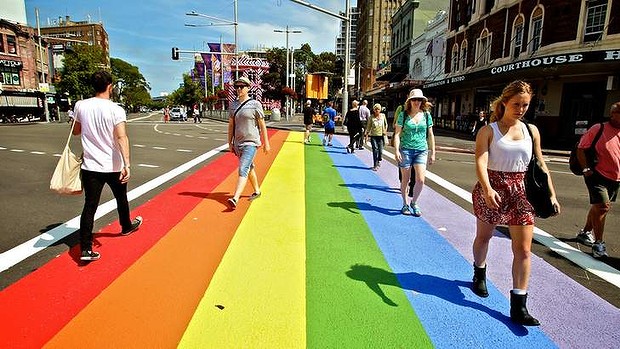
Rainbow Crossings? What else have you got?

The City of Sydney held its Rainbow Flag/Crossing public consultation on Tuesday night (July 16th) at Paddington Town Hall.

While I am not the world’s biggest fan of a Rainbow Flag (I think that it would be a ‘nice’ thing for Sydney to have to commemorate the LGBTI history of the city, but there might be better options to do that as well – see discussion below), I went along because the forum also included a panel looking at the most important issues confronting Sydney’s LGBTI community today.

The following are my four main observations about the forum:

1. Who knew that butcher’s paper, hastily scrawled ideas and scribes reporting back to the broader group was still a thing, especially in a room full of more than 100 people? It was certainly not what I expected when I walked in the door (and I still don’t know whether it worked or not).

2. The forum, including a presentation from the person who ‘led’ the Rainbow Crossing movement, probably demonstrated the limitations of that particular form of activism. While chalking is/was a great opportunity to engage different people from across the wider community (and extend the message of acceptance to straight allies), its moment may have passed. And showing photos of Chinese children chalking a rainbow outside rubble, or Vietnamese orphans living with HIV jumping behind a rainbow, might not be as inspiring as you think – it might instead lead audience members to wonder about the much bigger problems which these people face, and which will not be overcome with temporary distractions.

3. There are probably better, although admittedly more expensive, ideas for celebrating the LGBTI community of Sydney than either a Rainbow Flag or Rainbow Crossings. Our table’s (entirely unoriginal) idea was to provide for a permanent LGBTI museum, which could provide an ongoing reflection on the history of LGBTI Sydney, and Australia. I think something might have been lost in the translation of our notes to what ended up on the City of Sydney website on this – whereas we wrote ‘permanent LGBTI museum’ the website describes it merely as ‘permanent space for a museum and exhibitions’. To put it bluntly, we don’t just want the space, we want the funding to help make a museum happen (link to Have Your Say consultation here: http://sydneyyoursay.com.au/GLBTI?module=news#tool)

4. The discussion of the issues confronting the LGBTI community in Sydney today was probably the most interesting part of the night. A lot of worthy ideas were raised (including youth suicide and mental health, discrimination in schools, religious exceptions, transgender services etc). But one issue which was apparently not raised outside our table, and which certainly wasn’t reported on by anybody back to the group (we weren’t asked) was the issue of rising HIV notifications. Less than 2 weeks since the release of figures showing a 24% rise of HIV notifications in NSW in 2012, and an 18% rise in notifications resulting from sex between men (which still accounts for 81% of transmissions in the state), it seemed that HIV notifications, and the enormous challenges which lie beneath it, wasn’t worth much of a mention. I was a little bit shocked by that result (although some older, more cynical heads around the table described it as disappointing but not surprising).

In any event, the failure of rising HIV notifications to register at a community event like this, and especially less than 2 weeks since the data was released, means that there is a lot of work for groups like ACON to do. But just as importantly, I think it means there is a collective responsibility for the gay male community of Sydney to consider why we don’t think increasing HIV notifications is a major issue for our community in 2013.

2nd Anniversary of Election of O’Farrell Government

So, last week I wrote a column on behalf of the NSW Gay and Lesbian Rights Lobby (GLRL) for the Star Observer, looking at the 2 year anniversary of the election of the O’Farrell Liberal-National Government in NSW. It has been published today, and can be found at the following link: http://www.starobserver.com.au/opinion/2013/04/03/speaking-out-6/101597 . I will publish the full text of the article here next week (ie after the current edition).

Basically, NSW has not gone backwards on LGBTI law reform over the past 2 years, unlike our neighbours North of the Tweed under Premier Campbell Newman (who continues to wage war against the rights of and services for the Queensland LGBTI community). It is unclear which model the likely incoming Prime Minister Tony Abbott will follow (although one has to suspect he will be more like Newman than O’Farrell).

But just because O’Farrell and his Government have not gone backwards doesn’t mean there has been any great progress either. The next 12 months will be key, in particular seeing whether he and his Government support state-based marriage equality, abolish the homosexual advance or gay panic defence and continue, and hopefully expand, the Proud Schools program.

Full text:

As always, there has been a lot going on over the past month, including the community’s response to police (mis)conduct during the Mardi Gras Festival, as well as the Legislative Council’s hearings into State-based marriage equality laws.

One event which almost went unnoticed was the 2nd anniversary of the election of the O’Farrell Government, which happened last week. This officially marked the halfway point of this term of Parliament.

Many people in the LGBTI community probably greeted the election of a Liberal/National Government back in March 2011 with a degree of trepidation, not knowing exactly what to expect on gay and lesbian issues. The good news is that there have not been any major backwards steps on gay and lesbian law reform in NSW.

In fact, there have been some small wins, with the continuation of the Proud Schools pilot, and the passage of a symbolic motion in favour of marriage equality by the Legislative Council in mid-2012. However, there have been no major advances on gay and lesbian rights under the O’Farrell Government so far either.

As the Gay & Lesbian Rights Lobby, we believe that over the next 12 months it is time for the Liberal/National Government, and the Parliament more broadly, to demonstrate its commitment to treating the LGBTI people of NSW equally.

There are three major legislative and policy issues which are already on the agenda for the coming year. The first is the Upper House Inquiry into the partial defence of provocation, which is due to report by 2 May. We will be looking for the O’Farrell Government to abolish the homosexual advance or ‘gay panic’ defence, because non-violent sexual advances should never be a justification to downgrade a murder conviction to manslaughter.

The second issue is the State-based marriage equality Bill, which should be voted on later in 2013. The GLRL wants parliamentarians of all political persuasions to support the legal recognition of the equality of same-sex relationships.

The third issue which is already on the agenda is a decision on the long-term future of Proud Schools. At the Lobby, we believe that all LGBTI students deserve to have an education free from bullying, prejudice and discrimination. Consequently, we want to see Proud Schools continued and indeed expanded across NSW.

This is obviously not an exhaustive list, and the Lobby will be campaigning on other issues, including removing religious exceptions in anti-discrimination law and calling for a review of the criminalisation of commercial surrogacy arrangements, during the ‘second half’ of this term.

But, by acting on the three issues identified above, the O’Farrell Government, and the NSW Parliament generally, would demonstrate that they genuinely believe LGBTI people should be treated equally. Time will tell.

OFarrell hand

Premier O’Farrell – We won’t let you put these issues to one side this year…

NSW State Same-Sex Marriage Inquiry Introductory Comments

On Friday (15 March 2013) I had the privilege of appearing with the NSW Gay and Lesbian Rights Lobby at the Legislative Council inquiry hearings into state-based same-sex marriage laws. While the Lobby’s co-convenor Justin Koonin gave some brilliant introductory comments on behalf of the Lobby and gay and lesbian communities more generally, I was able to give an introductory statement outlining how the issue of marriage equality affects me personally (and of course Steve too, who attended in the public gallery).

Below is the text of the statement which I read out at the inquiry hearings (I will provide a link to the published transcript of the full proceedings, including questions and answers, when they are published on the NSW Parliament website):

NSW State Same-Sex Marriage Inquiry Introductory Comments

I have been asked to appear on behalf of the Lobby as both a Committee member, and as someone who is directly affected by whether state-based same-sex marriage is introduced in NSW.

My fiancé Steve and I have been together for more than four and a half years, and we have been engaged for more than 3. Needless to say, he made me the happiest man alive when he said yes when I asked him to marry me in January 2010. And yes, I did get down on bended knee to propose.

However, unlike most engaged couples, we knew that, because of the 2004 federal Marriage Act amendments, our prospective wedding would not be legally recognised in our own country, and that the federal government did not issue Certificates of Non Impediment to get married overseas.

Since then, we have been actively playing the ‘waiting game’’: waiting to see if the ALP National Conference would agree to marriage equality, waiting to see how federal parliament would vote, and now waiting to see whether NSW will introduce same-sex marriage – more than 3 years since Steve said “Of course I will”, we are still waiting to see whether we can both legally say “I do.”

Of course, we cannot and will not wait forever. Fortunately, CNIs can now be issued, so getting married in another country is a possibility. This could even include New Zealand, after this week’s successful 2nd reading debate vote there.

But getting married in another country is significantly more expensive, means that many family members and friends would not be able to attend our special day, and still would not be legally recognised at home.

Please don’t misunderstand me – we are glad to have more choices than we did back in January 2010. But those choices come with costs – legal, financial, social, and emotional. Steve and I, and thousands of other same-sex couples across NSW, are confronted with these negative consequences right now.

Critics of marriage equality often claim that its introduction would be a form of social engineering. To the contrary, I submit it is social engineering to determine that only people of a particular sexual orientation, or indeed gender identity or sex, have certain rights.

Surely it is an arbitrary and intrusive level of state intervention for governments to determine on these grounds whether a couple can get married under law, how long they might have to wait, whether they have to go overseas, and as a result, how much it costs, or even who can attend.

These are the real world consequences of the upcoming decision by NSW parliament on whether its same-sex attracted citizens can get married.

Letter to Premier O’Farrell about renaming Taylor Square

10 days ago, the NSW Premier Barry O’Farrell suggested that Taylor Square could be renamed after former High Court Justice Michael Kirby. While I support recognising his achievements, I think that it would be better to rename the square after both Mr Kirby and current, lesbian High Court Justice Virginia Bell. The outcome would reflect both the gay and lesbian history of this location. Below I have included the text of a letter which I sent to the NSW Premier on this subject this afternoon.

Taylor Square Rainbow Crossing

Dear Premier O’Farrell,

RENAMING TAYLOR SQUARE

I am writing in relation to comments which you made in the Legislative Assembly on Thursday 28 February 2013, in response to a question from the Member for Sydney, Mr Alex Greenwich MP, regarding the Government’s commitment to the Lesbian, Gay, Bisexual, Transgender and Intersex (LGBTI) community.

In particular, during your answer you suggested that Taylor Square could be renamed after former High Court Justice Michael Kirby, who, as you said in the Chamber, is “a great individual who epitomises that good community.”

While I agree with the sentiment of your proposal, I note that Mr Kirby is already highly decorated, including having the former National Centre in HIV Epidemiology and Clinical Research (NCHECR) at the University of New South Wales renamed the Kirby Institute for Infection and Immunity in Society in his honour.

Of course, this does not mean the state of New South Wales, and the City of Sydney, should not further celebrate the contributions of such an eminent jurist, and the first openly gay man appointed to the High Court.

However, I would humbly like to suggest that, if you wish to pursue this proposal, you could also consider co-naming the square after the first openly lesbian woman appointed to the High Court, Ms Virginia Bell. The location could then be known as either the Kirby-Bell Square or the Bell-Kirby Square.

I make this suggestion because I think it is important to recognise and celebrate the achievements of both the gay and lesbian communities, who each have a historical connection to Taylor Square.

Ms Bell, who replaced Mr Kirby on the High Court following his retirement, is another distinguished resident of Sydney, and one who began her legal career in the inner-city working at the Redfern Legal Centre.

Ms Bell was also a participant in the very first Sydney Gay Mardi Gras on 24 June 1978, which, fortuitously, assembled at Taylor Square before commencing the march. Renaming Taylor Square in Ms Bell’s honour, alongside Mr Kirby, would therefore acknowledge some of the important LGBTI history of this particular location.

Thank you in advance for considering my suggestion for renaming Taylor Square to be Kirby-Bell or Bell-Kirby Square, which I think would be more inclusive of the lesbian and gay communities of Sydney.

Sincerely

Alastair Lawrie

Submission on Homosexual Advance Defence

The following is a submission which I am lodging today with the NSW Legislative Council Provocation Committee which is inquiring into the Partial Defence of Provocation. It is an opportunity to make the argument that the homosexual advance defence, or ‘gay panic’ defence, should be repealed because it is unjust and discriminatory. The Committee has extended the deadline to Friday 24 August 2012 so I would encourage anyone interested to make a similar submission.

NB On Tuesday 23 2013, the Committee handed down its final report. In it, all members of the Committee, including the Chair, Mr Fred Nile, recommended that non-violent sexual offences should not be the basis of a provocation defence. Which means in practice, that all members have recommended that the Homosexual Advance Defence be abolished. This is obviously a great result – it is now up to the Premier, the Hon Barry O’Farrell MP, to implement this reform, as quickly as possible. The full report can be found here: http://www.parliament.nsw.gov.au/Prod/parlment/committee.nsf/0/61173C421853420ACA257B5500838B2E?open&refnavid=CO4_1

Submission to the Legislative Council Provocation Committee Inquiry into the Partial Defence of Provocation

This submission will focus on one aspect of the operation of the partial defence of provocation – the so-called homosexual advance (or ‘gay panic’) defence.

In particular, it will argue that the law of provocation should be reformed by either amending s.23 of the Crimes Act 1900 to ensure that non-violent sexual advances cannot be considered as an act which induces provocation, or by repealing s.23 in its entirety to remove the partial defence of provocation altogether.

This is necessary to ensure that never again can a person who commits homicide have their offence downgraded, from murder to manslaughter, with a consequent reduction in maximum sentence, simply on the basis of a non-violent sexual advance.

As noted in the Committee’s briefing paper for this inquiry, the statutory basis of the partial defence of provocation lies in s.23 of the Crimes Act. In particular, sub-sections (1) and (2) provide that:

(1) Where, on the trial of a person for murder, it appears that the act or omission causing death was an act done or omitted under provocation and, but for this subsection and the provocation, the jury would have found the accused guilty of murder, the jury shall acquit the accused of murder and find the accused guilty of manslaughter.

(2) For the purposes of subsection (1), an act or omission causing death is an act done or omitted under provocation where:

(a) the act or omission is the result of a loss of self-control on the part of the accused that was induced by any conduct of the deceased (including grossly insulting words or gestures) towards or affecting the accused, and

(b) that conduct of the deceased was such as could have induced an ordinary person in the position of the accused to have so far lost self-control as to have formed an intent to kill, or to inflict grievous bodily harm upon, the deceased,

It is difficult to comprehend how these sub-sections have ever operated to mitigate the responsibility of an offender who kills another person in response to a non-violent sexual advance. It is almost impossible to understand how it could still be the case in 2012.

The ultimate fault for this sorry state of affairs lies with the majority of High Court justices in Green v The Queen [1997] HCA 50. With all due respect to Chief Justice Brennan, Justice Toohey and Justice McHugh, they incorrectly applied the ordinary person element in sub-section (2)(b) to mitigate the responsibility of the offender. As has been made clear in repeated criticisms of this decision, the ‘ordinary person’ in contemporary Australia is not so homophobic that their response to a non-violent homosexual advance is to form the intent to kill that person or to wish to inflict grievous bodily harm upon them.

This point was of course made eloquently by Justice Kirby in his dissent:

“If every woman who was the subject of a “gentle”, “non-aggressive” although persistent sexual advance… could respond with brutal violence rising to an intention to kill or inflict grievous bodily harm on the male importuning her, and then claim provocation after a homicide, the law of provocation would be sorely tested and undesirably extended… Any unwanted sexual advance, heterosexual or homosexual, can be offensive. It may intrude on sexual integrity in an objectionable way. But this Court should not send the message that, in Australia today, such conduct is objectively capable of being found by a jury to be sufficient to provoke the intent to kill or inflict grievous bodily harm. Such a message unacceptably condones serious violence by people who take the law into their own hands.”

The truly offensive nature of the homosexual advance defence is revealed by asking why it invariably applies only to non-violent sexual advances by a man to another man? As Kirby asks, rhetorically, if a non-violent sexual advance from one man to another was sufficient to justify forming the intention to kill or seriously wound, why should this not also apply to a non-violent sexual advance by a man to a woman? Further, why shouldn’t a woman who receives an unwanted non-violent sexual advance from another woman have access to the partial defence of provocation? Why doesn’t it also apply to a man who receives an unwanted non-violent sexual advance from a woman? Or, in my case, as a gay man, why can’t I access the partial defence of provocation if I receive an unwanted sexual advance from another man?

The answer is that in all of these cases society justifiably expects the recipient of the unwanted sexual advance to exercise self-control. A violent response to an unwanted non-violent sexual advance, to the extent that the recipient forms the intention to kill or seriously wound, is so beyond the pale, or so far out of the ‘ordinary’, that we do not extend any reduction in culpability to the offender in these circumstances.

In my opinion, there is nothing so different, so special or so extraordinary, in the situation where the non-violent sexual advance is made by a man to another man, as to justify offering the offender in such cases any extra legal protection. In contemporary Australia, a man who receives an unwanted sexual advance should exercise the same level of self-control as we expect of any other person.

To have a separate legal standard apply to these cases is homophobic because it implies there is something so abhorrent about a non-violent sexual advance by a man to another man that a violent reaction is almost to be expected, and at least somewhat excused. This does not reflect the reality of contemporary Australia, where, with the exception of marriage, gay men enjoy the same rights as other men, and are accepted as equals by the majority of society.

Even if a small minority of people remain firmly intolerant of homosexuality, that does not mean there should be a ‘special’ law to reduce the culpability of such a person where they are confronted by an unwanted homosexual sexual advance. To retain such a provision is unjust and discriminatory, and is a mark against any legal system which aspires to fairness.

The above discussion outlines why the homosexual advance defence is wrong in principle. What should not be forgotten is that the homosexual advance defence is also wrong in practice, or in the outcomes which it generates. After all, the defence does not simply exist in the statute books, ignored and unused. Instead, it has been argued in a number of different criminal cases, sometimes successfully.

This means there are real offenders who are in prison (or who have already been released), who have had their conviction reduced from murder to manslaughter, and most likely their sentence reduced along with it, simply because they killed in response to an non-violent homosexual advance. The legal system has operated to reduce the liability of these offenders even when broader society does not accept that such a reduction is justified. As a result, these offenders have not been adequately punished, meaning that above all these victims have not received justice.

Similarly, the family members and friends of the victims killed in such circumstances have witnessed the trials of these offenders, expecting justice to be served, only to find that the killer is not considered a murderer under the law. Instead, these family members and friends find some level of blame is placed on the actions of the victim, that somehow by engaging in a non-violent sexual advance they have helped to cause and even partly deserved their own death.

The saddest part of preparing this submission was in reading the Committee’s briefing paper and learning that, not only have at least 11 men been killed in these circumstances in NSW, but also that 11 families were so profoundly let down by the justice system between January 1990 and September 2004. It is highly likely that the defence has been used more times since then, dishonouring more victims and causing additional pain to more families already dealing with the loss of a loved one.

I wrote earlier that it is the fault of the High Court, in Green v The Queen, that the homosexual advance defence remains a part of the criminal law. Where the courts get it wrong, as they clearly have in this area, it is the responsibility of the parliament to remedy the error and thereby ensure the justice system operates in a fair and non-discriminatory manner.

There are two options for the NSW Parliament to abolish the homosexual advance defence.

The first would be to amend s.23 of the Crimes Act 1900 by inserting a section which would exclude non-violent homosexual advances from forming the basis of provocation. This was the course of action recommended by the Homosexual Advance Defence Working Group in 1998, and appears to have been adopted in the ACT and NT.

The second option would be repeal s.23 in its entirety and abolish the partial defence of provocation altogether, as has been done by Tasmania, Victoria and Western Australia.

As I have concentrated solely on the homosexual advance defence and not on the impact of such a change on cases involving family violence and other instances where the partial defence of provocation may be applied, I am not in a position to recommend which of these options should be adopted in the broader context (for example, if s.23 is repealed entirely, it may be necessary to incorporate a new provision for ‘defensive homicide’, as the Victorian Parliament did in 2008).

Nevertheless, I believe it is clear the NSW Parliament should adopt one of these courses of action to ensure that no more killers are able to rely on the homosexual advance defence to reduce their conviction from murder to manslaughter. The homosexual advance defence is unjust, it is discriminatory and it should be made history.

Recommendation

The NSW Parliament should either:

a)      Amend s.23 of the Crimes Act 1900 by inserting a section which would exclude non-violent homosexual advances from forming the basis of provocation; or

b)      Repeal s.23 of the Crimes Act, thereby removing the partial defence of provocation entirely.

Alastair Lawrie

10 August 2012