“Queer Wars” by Dennis Altman and Jonathan Symons

Today, May 17, is IDAHOBIT (the International Day Against Homophobia, Transphobia and Biphobia[i] – previously known as IDAHO, and IDAHOT). Described as a “worldwide celebration of sexual and gender diversities”, it was started in 2004, with the date chosen to commemorate the World Health Organisation’s 1990 decision to declassify homosexuality as a mental disorder.


To mark this occasion I thought it would be useful to focus on the issue of LGBTI rights around the globe. In my view, given the relatively advanced state of LGB rights in places like Australia[ii], it is time we devoted more attention to considering how we can effectively contribute to the international struggle for LGBTI rights.


Fortunately, a recent book, Queer Wars, written by Dennis Altman and Jonathan Symons, concentrates on exactly this issue, so I will use this post to look at the many interesting ideas and debates that they have raised.


Specifically, Queer Wars sets out to answer two questions:

  • “[F]irst, why, as homosexuality has become more visible globally, have reactions to sexual and gender diversity become so polarised?”[iii] and
  • Second, “what is to be done? As writers who believe passionately in the right of people to choose how they love and how they present themselves, we are equally concerned to think through how we can best achieve these rights globally.”


In answering the first question, the book takes a fascinating look at how, and how far, LGBTI rights have progressed in six extremely varied countries: Australia, Spain, Cuba, India, South Africa and South Korea[iv], including the factors that have aided, or hindered, change in these places respectively (the need to address HIV, and prevent its spread among men who have sex with men, being a frequent, although not universal, motivator for reform among this group).


It then spends some time considering the specific factors that may have held back change, especially in other parts of Africa and in much of the Middle East, as well as possible explanations for recent attacks on LGBTI rights from Russia to Uganda and elsewhere.


Without wishing to over-simplify what is a complex discussion of often inter-related influences, these include:


  • An almost inevitable reactionary backlash to the progress that has been made. This can be triggered when the rights of LGBTI people are recognised more quickly than their acceptance by the community. But it also derives from the well-resourced and highly organised efforts, of people like Scott Lively and groups like the World Congress of Families, to oppose LGBTI rights across the world. As noted on page 105:


“International organising to oppose gay rights – and, more broadly, anything that suggests the blurring of gender lines or acceptance of gender diversity – has paralleled the growth of international gay organising. American-based organisations defending ‘family values’ have been particularly active in promoting an anti-homosexual line both in international fora and within a number of overseas countries.”


  • The scapegoating of LGBTI communities by authoritarian regimes when they need a distraction from other problems, a tactic perfected by Zimbabwe President Robert Mugabe[v], and later emulated, to some extent, by Russian Leader Vladimir Putin.


  • The role of organised religion – including the Catholic Church, the virulently-homophobic Anglican Church in parts of Africa, as well as fundamentalist Islam and Hinduism – also cannot be ignored in this context. As Altman and Symons note on page 24:


“One of the few issues on which religious fundamentalists of all faiths can agree is opposition to homosexuality, and much contemporary anti-homosexual rhetoric is justified through particular interpretations of religious texts, even where it is driven by other factors.”


  • Finally, one of the more interesting recurring topics of Queer Wars is the role of ‘masculinity’, or at least particular conceptions of it, in contributing to attacks on LGBTI rights. From pages 108-109:


“RW Connell’s concept of ‘hegemonic masculinity’, aimed at preserving the dominance of men over women, is important; as Connell writes: ‘the contempt for homosexuality and homosexual men… is part of the ideological package of hegemonic masculinity’. Opposition to sexual diversity combines both consciously political and unconscious fears and desires, which makes countering it particularly difficult.”


The relative local strength of these four factors goes a long way to explaining why, “[d]epending on where in the world one stands there is huge progress towards greater acceptance, or increased intolerance.”[vi]


The more pertinent, and challenging, question is what to do about it, and in this respect Queer Wars presents a thoughtful analysis of the opportunities, and pitfalls, of ‘global gay activism’.


Starting first with the limits of what those in the developed or ‘Western’ world can do to assist their global queer comrades, Altman and Symons present a stark warning of the risks of campaigns for LGBTI rights being externally imposed on countries (rather than developed in partnership with or, ideally led by local groups, with support where necessary – and only where invited – from outside organisations). As noted on page 34:


“Is speaking out strongly for gay rights, as is now the practice of the US and other governments, helpful – or does it, in practice, help fuel, even create, more political homophobia? What to western eyes might seem a basic assertion of human rights can easily be portrayed in much of the world as echoing a colonial language of a paternalistic civilising mission.”


Even more damning is the description on page 144, which is perhaps one of the strongest passages in the entire book:


“Rahul Rao describes the plight of third world queers, trapped between homophobic nationalist governments and the frequently misguided interventions of the ‘gay international’, with a phrase that he borrows from Hannah Arendt’s account of Jews in World War II choosing between ‘malevolent enemies and condescending friends’. Since the relationship between western and third world activists will often be one of inequality, it is easy for activists to participate accidentally in a ‘discursive colonisation’, which presumes that western concerns will be universal and so ignores the wishes of intended allies.”


Given this, what then can ‘we’ effectively contribute? On this, Queer Wars seems to make two main arguments:


  • First, that – as frustrating, slow-moving (some might say glacial) and occasionally opaque as its processes are – we should primarily concentrate on using international and regional human rights[vii] instruments, bodies and, where they exist, courts, to push the LGBTI agenda. This includes:


“The ‘Universal Periodic Review’ of each [UN] state’s human rights records, conducted every four years by the United Nations Human Rights Council, [which] creates an opportunity for other governments and civil society actors (both domestic and international) to discuss issues of concern, [and] which frequently include sexuality.”[viii]


  • Second, that this agenda should be relatively narrowly conceived, focusing on the right to be free from criminalisation, and the right to be free from violence. This argument is best encapsulated on page 135:


“If the international system were able to protect people from violence and persecution, this would create space for local activists to push for a deeper acceptance of diverse sexualities, kinships and families. The forms of liberation they pursue may be unfamiliar to us; indeed, some western activists may regard them as ‘liberation-lite’. Since international campaigners are likely to misunderstand the kinds of changes that will gain local acceptance, the international effort should focus on universal protection against criminalisation and violations of personal safety. If international consensus can be built around these minimal protections, this will support more transformative local changes without dictating them.”


This is not to completely rule out other types of activity. At multiple points, the book describes the inter-connectedness between this decriminalisation agenda and global efforts to combat the HIV epidemic (with men who have sex with men recognised as a priority population by most international organisations)[ix].


After a long discussion of ‘aid conditionality’[x], and the major risks involved in this approach, the authors also do not exclude the possibility of ‘Western’ Governments providing specific aid “to expand support for local community-based and –led LGBTI programmes”[xi], although even here care must be taken to avoid perceptions of the external imposition of a pro-LGBTI agenda.


And, of particular relevance for a country like Australia, which detains LGBTI people seeking asylum in countries where they are at risk of criminal prosecution, Queer Wars highlights the importance of the acceptance of refugees fleeing persecution on the basis of their sexual orientation, gender identity or intersex status[xii].


Nevertheless, Altman and Symons’ main focus remains on working towards an international consensus in favour of decriminalisation, and personal safety, thereby helping to allow the conditions for local activists to push the issues, and agenda, that are most relevant to them. In this way, we, as privileged activists in ‘Western’ countries can best avoid what they describe, perhaps accurately, as the “traps of well-meaning egoism”[xiii].


**********


Outside of these two main arguments, Queer Wars touches on a range of other pertinent topics concerning international LGBTI issues across its 158 pages, including:


  • A necessary reminder that one of the key historical forces that has contributed to the fact that, in 2016, 77[xiv] countries continue to have criminal laws against homosexuality, was the British Empire (later known as the Commonwealth of Nations, or just ‘the Commonwealth’). As noted on page 113 “[t]he majority of countries that retain criminal sanctions against homosexual behaviour are members of either the Commonwealth or the Organisation of Islamic Cooperation (OIC), or both”.


Altman and Symons also note that “Margaret Thatcher’s ‘Section 28’ laws in the UK in 1988, which was aimed at preventing ‘the promotion of homosexuality’, were in some ways forerunners of what is now occurring globally”[xv], including recent laws against ‘gay propaganda’ passed by Russia.


  • We should also remember that, just because LGBTI rights might be reflected in a country’s laws, does not automatically mean the ‘real-life’ situation for LGBTI people in that country is especially ‘rosy’. Examples of this include the contrast between Singapore, where homosexuality remains illegal, and Russia, where sexual acts are lawful[xvi], as well as variations within South Africa, with it Constitutional protections around sexual orientation – and recognition of marriage equality – but which also gave the world the term ‘corrective rape’[xvii] for the sexual assault of women perceived as lesbian.


  • Highlighting that the rate of ‘advancement’ on LGBTI issues can vary within countries between sexual orientation and gender identity. Some places are more likely to recognise diversity in gender identity – such as India, through the hijra identity[xviii], and fa’fanine in some Polynesian cultures[xix] – while in others transgender rights lag far behind those of lesbian, gay and bisexual people (with few countries explicitly acknowledging, and therefore protecting, intersex status).


  • Above all, that even the use of ‘Western’ terms like LGBTI can be problematic, because it assumes that all countries, and all cultures, will adopt the same approach to, and definitions of, differences in sexual orientations (or even that a person’s sexual practice should form the basis of an ‘identity’ in the first place), gender identities and intersex characteristics.


Overall, then, Queer Wars was a pretty appropriate book to read in the lead-up to, and then explore via this post on, IDAHOBIT. In my view, it asks the right questions that ‘we’, as LGBTI activists in the ‘Western’ world should be considering about the contemporary global situation, and how we can best assist our ‘queer comrades’ in other countries.


Better still, it provides thoughtful answers, even if Altman and Symons’ conclusions can be somewhat frustrating because of their limited scope (although the reasons for that narrow focus are well-argued). And it wraps it all together in an accessible and engaging package.


Finally, if I did have one criticism, it would be that the book doesn’t answer some of the more detailed or specific questions that I have, as an Australian cis gay man, about how I can contribute to campaigns for the recognition of LGBTI rights of people in the countries in our region, and especially Papua New Guinea and South Pacific nations.


However, given Queer Wars is explicitly global in focus, that’s an entirely unfair criticism to make – instead, it’s a conversation that I’ll need to have elsewhere, albeit one that will be better-informed for having read Altman and Symons’ book.


Queer Wars


Footnotes

[i] Taken from the official website: http://dayagainsthomophobia.org Personally, I prefer to describe it as the International Day Against Homophobia, Biphobia, Intersexphobia and Transphobia, although that terminology is not yet in widespread use.

[ii] Noting that some discrimination against lesbian, gay and bisexual Australians remains, not just marriage equality but also barriers to inclusive education and limits on anti-discrimination protections, and of course acknowledging that the rights of transgender and intersex Australians remain poorly protected in many more areas.

[iii] Page 3.

[iv] Pages 47-70.

[v] From pages 28-29: “As president Mugabe tightened his hold over Zimbabwe he scapegoated the small homosexual organisations as un-African and responsible for many of the economic troubles of the country, paving the way for increasing homophobic rhetoric from a number of African leaders.”

[vi] Page 32.

[vii] Altman and Symons take a nuanced view of ‘human rights’, including defining it by how they fit within the political systems within which they are recognized – from page 141: “The ‘political conception’ of human rights offers a persuasive explanation of how human rights are formulated in the international system, but it is also inherently conservative: a claim will only become a human right when a preponderance of international opinion (as expressed by states) accepts it” (emphasis in original). As they readily acknowledge, this conception “makes more modest claims for human rights” (p140), which may help to explain their focus on campaigns against criminalization, and for personal safety, to the exclusion of other issues.

[viii] Page 154.

[ix] “The Global Fund to Fight AIDS, Tuberculosis and Malaria was founded in 2002 as a partnership between governments, civil society, the private sector and people affected by the diseases, and has sought to link funding to governments’ demonstrating that they are willing to work effectively with marginalized populations most vulnerable to HIV, usually identified as MSM [men who have sex with men]” pages 127-128.

[x] Defined on page 124 as “[c]onditionality refers to linking conditions to the provision of benefits such as loans or aid.” This is a practice that has been emerging in recent years as the Governments of the US and UK have sought to require greater acceptance of different sexual orientations as a pre-cursor to receiving, or continuing to receive, aid.

[xi] Page 130.

[xii] Discussion on pages 88-89.

[xiii] Page 144.

[xiv] The exact number is different according to different sources – this is based on the website of Australian Professor Paula Gerber: https://antigaylaws.org

[xv] Page 98.

[xvi] Page 112.

[xvii] Discussion of South Africa from page 62 onwards.

[xviii] Page 59.

[xix] Page 16.

The GLORIAs 2016 – ‘Winners’

The annual GLORIA awards – for the worst homophobic, biphobic, transphobic and intersexphobic comments of the past year – were held last night at NSW Parliament House.

Organised by NSW Labor MLC Penny Sharpe, they are an opportunity to reflect on all the stupid things that are said about us as a community – and making fun of the stupid people who say them.

So, here they are, the nominees, and winners, of the GLORIA awards 2016, including the winner of the 2016 Golden GLORIA (taking the mantle from last year’s worthy title-holder Germaine Greer):


  1. International


  • The Indonesian Government who told WHATSAPP to remove gay emojis.


  • Uzbekistani President, Islam Karimov who said: “When men live with men and women live with women, I think there must be something wrong up here [points at head]. Something is broken here. There is a saying: When God wants to reveal someone’s vulgarity, he first takes his reason away.” (Pink News, 9 February 2016)


  • ISIS for their continued persecution of gay men (see for example Pink News 18 January 2016)


  • Qatar for banning film screenings of The Danish Girl on the grounds of moral depravity (Pink News, 13/01/2016)


  • Irish Councillor Paddy Kilduff who said at a council meeting: “Personally I won’t be voting for it and the reason I am not voting for it – no problem with gays and lesbians – but the problem I have is with the children… when you have two women having babies and artificially inseminated… It’s gross, it’s gross. So I won’t be supporting it anyway, so you can take that back to Dublin.”


  • Prime minister of Fiji Frank Bainimarama who slammed same-sex marriage as “rubbish” and advised same-sex couples to move to Iceland and stay there if they want marriage equality. (SBS Online, 7 January 2016)


  • Marco Rubio who says that gay adoption is a “social experiment,” and children better off orphaned. (SLATE, 16 December 2015)


Who I wanted to win: It’s hard to go past ISIS

Who actually won: Marco Rubio


  1. Media


  • Miranda Devine for her column “Same sex marriage: Totalitarian tolerance”.


  • Angela Shanahan writing in the Australian, 27 February 2016: “Both sides of this argument are shying away from the truth. Bullying is not the issue here. It is the LGBTI education agenda that seeks to normalise behaviour that most parents do not consider normal.”


  • 2CH’s evening host Kel Richards who said on radio: “You really are doing something really dangerous and really terrible to those children.” According to him, the Safe Schools program is “an attempt to sexualise and recruit children for the gay and lesbian movement.” He sums it up as “disgusting gay and lesbian propaganda.” (Same Same).


  • Piers Ackerman for this column in the Daily Tele: “McGregor may identify as a woman and may even, with the blessing of the politically correct military establishment, use women’s lavatories, but until the chromosomes undergo some miraculous alchemic transformation, McGregor ¬remains by all biological and scientific rules, a bloke…”


  • Rowan Dean, for his column in the Courier Mail “Bullying in the name of dogma”


Who I wanted to win: Angela Shanahan (for implying that any child who is not cisgender and heterosexual is not normal)

Who actually won: Kel Richards


  1. Politics


  • George Christensen, who told Parliament on 25 February 2016: “If someone proposed exposing a child to this material, the parents would probably call the police, because it would sound a lot like grooming work a sexual predator might undertake.”


  • NATIONALS MP Andrew Broad, who represents the Victorian electorate of Mallee, who said to regional newspaper Sunraysia Daily: “Do I support calling a relationship between a man and a man, and a woman and a woman marriage? … I can put the rams in the paddock and they might mount one another but no lambs will come out.”


  • Former Australian Prime Minister Tony Abbott who addressed anti-gay lobby group Alliance Defending Freedom in New York saying that same-sex marriage is still “a huge ask” that would see “the erosion of family”. (Attitude, 29 January 2016)


  • Cory Bernardi who emailed a constituent to say: “You clearly haven’t got any idea what is in the program. If you did then you would be worried about your children being exposed to unhealthy ideas from such an early age.” The email then went on to say Safe Schools links to websites about “bondage clubs and adult sex toys”.


  • Former ALP Minister, Gary Johns, writing in Australian: “Private homosexual acts are not an offence by law in any state jurisdiction. Rest assured, there is no discrimination in law against gay people. Gay people are free to pursue their lives, especially happiness with a life partner.” (22 March 2016)


  • Reclaim Australia protesters who confronted Perth’s Save Safe Schools insisting they weren’t anti-gay, but needed to protect children from Safe Schools’ “Marxist ideology.” They later shouted “paedo scum, off our streets!” (Same Same)


  • Former ALP Senator Joe Bullock who quit the Senate stating: “How can I in good conscience recommend to the people that they vote for a party which is determined to deny its parliamentarians a conscience vote on the homosexual marriage question?”


  • Malcolm Turnbull for effectively saying nothing to help defend the LGBTI community from attacks on Safe Schools, and for refusing to overturn the unnecessary, inappropriate, wasteful & divisive plebiscite on marriage equality.


Who I wanted to win: Either George Christensen for comparing Safe Schools to grooming by paedophiles, or Malcolm Turnbull for failing to condemn the attacks on Safe Schools by Christensen, Cory Bernardi and others

Who actually won: Malcolm Turnbull


  1. Religion


  • Lyle Shelton, managing director of the Australian Christian Lobby, speaking on Q&A on February 29, 2016. “Studies that have been done of transgendered people who have had sex reassignment surgery, people who have been followed for 20 or so years have found that after 10 years from the surgery, that their suicide mortality rate was actually 20 times higher than the non-transgendered population. So I’m very concerned that here we are encouraging young people to do things to their bodies … like chest binding for young girls … [and] penis tucking”


  • Lyle Shelton (again) who was asked on Sky News how allowing same-sex marriage would affect his own marriage. His answer: “If the definition of marriage is changed, it’s no longer assumed … that I’m married to a woman. So that affects me straight away.”


  • Christian Activist Theodore Shoebat who claimed that the “SWAT team or the National Guard” should be used to take away children raised by “dykes and faggots” because they’re “in danger of being raped”. He continued: “Dykes are criminals! Two dykes that are supposedly married, that’s not marriage, that’s a criminal partnership. That’s an agreement between two criminals.” (Pink News, 16 January 2016)


  • The Marriage Alliance for the infamous rainbow noose image tweet


  • Colorado evangelical pastor turned random headline generator Kevin Swanson who wants girl scouts put to death for being too pro LGTB (Pink News, 14 March 2016)


  • Lyle Shelton managing director of the Australian Christian Lobby, for a third time, for his claims same-sex marriage would lead to a new “stolen generation”. (The Guardian, 1 March 2016).


  • Greek Orthodox Bishop Amvrosios of Kalavryta who said of gay couples: “Spit on them! Deprecate them! Vote against them!” (Pink News, 14 December 2015)


  • The Australian Christian Lobby for wanting the “two dads” episode of Play School cancelled.


Who I wanted to win: While it is clear Lyle Shelton desperately wants the title of Australia’s biggest homophobe, it has to be the Marriage Alliance for suggesting legalising marriage equality will lead to people killing themselves as a result of ‘PC bullying’. Seriously, how unhinged can you get?

Who actually won: Lyle Shelton – for his comment that if marriage equality was introduced, people might no longer assume he’s married to a woman.


  1. Sport


  • Jeremy Clarkson who attacked the trans community in his column for The Sunday Times – claiming the issues facing transgender people have been over exaggerated. “They were called lady boys, and in my mind they were nothing more than the punchline in a stag night anecdote.”(Pink News, 24 January 2016).


  • Footballer Serge Aurier who was been suspended for making alleged homophobic comments during a Periscope broadcast to fans. In the live video chat, Aurier claimed that coach Laurent Blanc and teammate Zlatan Ibrahimovic had engaged in oral sex – referring to Blanc as “une fiotte” (faggot). (PINK NEWS, 15/02/2016)


  • World boxing champion Manny Pacquiao has sparked criticism in the Philippines after describing gay couples as “worse than animals”. “It’s common sense. Do you see animals mating with the same sex?” Pacquiao told local broadcaster TV5.


Who I wanted to win: Manny Pacquiao (at least in part because this week he has been elected to the Philippines Parliament)

Who actually won: Manny Pacquiao


And the overall award, voted on by crowd participation (aka who got the loudest boos in the room on the night), the winner of the 2016 Golden GLORIA was:


Prime Minister Malcolm Turnbull (emerging victorious after a three-way boo-off against Marco Rubio and Lyle Shelton).


151222 Turnbull

Winner of the 2016 Golden Gloria – Prime Minister the Hon Malcolm Turnbull MP.


One final note on the winner: Some people might think it unfair that he won the politics category, let alone the Golden Gloria, especially because he didn’t actually say anything. But then that is kind of the point – when the right-wing campaign against Safe Schools was in full swing, and people like George Christensen and Cory Bernardi were intent on making Australia a less safe space for young LGBTI people, he said nothing, therefore encouraging their attacks to continue.


And, even though he knows that the plebiscite is unnecessary, inappropriate, wasteful and divisive, and as Prime Minister he should be able to do something about it, he is still pursuing Tony Abbott’s public vote as his own policy – not because it is the right thing for the country, but because it appears to be the right thing for his career. Both things make him a worthy, albeit somewhat controversial, ‘winner’.


See you all next year when, if we do have a marriage equality plebiscite, there will be absolutely no shortage of nominations (and where Lyle Shelton might finally get to take home the coveted crown).

What’s Wrong With the Commonwealth Sex Discrimination Act 1984?

This post is part of a series examining anti-discrimination laws around the country, focusing on how well, or in many cases how poorly, they protect lesbian, gay, bisexual, transgender and intersex (LGBTI) Australians against discrimination and vilification. The other posts can be found at the page LGBTI Anti-Discrimination[i] while the text of the Commonwealth Sex Discrimination Act 1984 (‘the Act’) can be found at the Federal Register of Legislation.[ii]

In this post I will be analysing the Act in terms of three main areas: protected attributes, religious exceptions and anti-vilification coverage. I will then briefly discuss any other key ways in which the protections offered by the Act could be improved or strengthened.

As we shall see, while the fact the Sex Discrimination Act includes all sections of the LGBTI community is to be welcomed, there are still some serious deficiencies that need to be remedied before it can be considered an effective anti-discrimination, and anti-vilification, framework.

**********

Protected Attributes

The Commonwealth Sex Discrimination Act 1984 is one of only four anti-discrimination laws in Australia that explicitly includes all of lesbians, gay men and bisexuals[iii], and transgender[iv] and intersex[v] people (with the other jurisdictions being Tasmania, the ACT and South Australia).

This high level of inclusivity is in large part a consequence of the fact the Commonwealth was the last jurisdiction in Australia to introduce any protections against anti-LGBTI discrimination.

The Sex Discrimination Amendment (Sexual Orientation, Gender Identity and Intersex Status) Act 2013 was only passed in June 2013, taking effect on August 1st of that year – more than three decades after the NSW Anti-Discrimination Act 1977 first covered homosexual discrimination (way back in 1982).

It is perhaps logical then that the most recently passed anti-discrimination law in the country would use the most contemporary terminology. Nevertheless, the achievements of the Act, and the breadth of the protected attributes that are covered, should still be celebrated.

In particular, the Sex Discrimination Amendment (Sexual Orientation, Gender Identity and Intersex Status) Act 2013 was the first national anti-discrimination law in the world to explicitly include intersex status as a stand-alone protected attribute. Although, it should be noted that, in the March 2017 Darlington Statement, intersex activists called for this terminology to be replaced by the protected attribute ‘sex characteristics’ as being more accurate and more inclusive.

The definitions of the other protected attributes introduced – sexual orientation and gender identity – are progressive in that they do not reinforce a sex or gender ‘binary’.

Sexual orientation in the Act refers to attraction to “the same sex” or “a different sex” (rather than the opposite sex), while the definition of gender identity does not require a transgender person to identify as male or female (and does not impose any medical or surgical requirements to receive protection either).

Overall, then, the Sex Discrimination Act 1984 is strong in terms of the protected attributes that it covers. Unfortunately, it is mostly downhill from here.

**********

Religious Exceptions

While the Sex Discrimination Act 1984 is close to the best of any jurisdiction when it comes to protected attributes, in terms of religious exceptions it repeats the same mistakes of most state and territory anti-discrimination legislation.

Under sub-section 37(1), the Act provides religious organisations with extremely broad special rights to discriminate against LGBT[vi] Australians:

“37 Religious bodies

(1) Nothing in Division 1 or 2 affects:

(a) the ordination or appointment of priests, ministers of religion or members of any religious order;

(b) the training or education of persons seeking ordination or appointment as priests, ministers of religion or members of a religious order;

(c) the selection or appointment of persons to perform duties or functions for the purposes of or in connection with, or otherwise to participate in, any religious observance or practice; or

(d) any other act or practice of a body established for religious purposes, being an act or practice that conforms to the doctrines, tenets or beliefs of that religion or is necessary to avoid injury to the religious susceptibilities of adherents of that religion.”

If religious exceptions are supposed to protect ‘religious freedom’, then the first three paragraphs above, (a)-(c), at least have the benefit of being targeted at activities that are essentially religious in nature (the appointment of religious office-holders, and the holding of religious ceremonies).

However, paragraph (d) appears to endorse discrimination against lesbian, gay, bisexual and transgender Australians across large swathes of public life, including in community, health and welfare services, provided the organisation that does the discriminating was established by a religious body.

This is overly generous, and completely unjustified – especially, although not solely, because the vast majority of these services receive public funding. After all, the sexual orientation or gender identity of a social worker or healthcare professional has absolutely zero bearing on their competence in their role.

The same provision also means that these services can turn away lesbian, gay, bisexual and transgender clients – irrespective of their personal circumstances and need – which is perhaps even more offensive than discriminating against LGBT employees.

Just in case there was any doubt whether religious schools were covered by sub-section 37(1)(d)[vii], the Act then includes an entire section which allows these schools to discriminate against LGBT teachers[viii], contract workers[ix] and students[x].

It appears some religious schools believe the capacity of a person to teach mathematics or science or English is somehow affected by their sexual orientation or gender identity. And it seems that the teachers employed by these schools are expected to impart the values of exclusion and intolerance to their students – what better way for young people to learn to discriminate against LGBT people, all endorsed by the Sex Discrimination Act.

There is however one area in which the Act refused to provide carte blanche to religious organisations to discriminate against LGBTI people, and that was through the inclusion of sub-section 37(2):

“Paragraph (1)(d) does not apply to an act or practice of a body established for religious purposes if:

(a) the act or practice is connected with the provision, by the body, of Commonwealth-funded aged care; and

(b) the act or practice is not connected with the employment of persons to provide that aged care.”[xi]

In other words, religious organisations that operate Commonwealth-funded aged care services cannot discriminate against lesbian, gay, bisexual or transgender people accessing those services (although they can continue to fire, or refuse to hire, LGBT employees).

This ‘carve-out’ was passed despite opposition from some sections of the then Tony Abbott-led Liberal-National Opposition, including Shadow Attorney-General George Brandis[xii], as well as some particularly vocal and extreme religious organisations, with the provisions taking effect on August 1st 2013.

In practice, there has been no controversy about the operation of this carve-out[xiii] – basically, it works to protect LGBT people accessing aged care services, irrespective of who operate those services, while having no adverse impact on religious freedom.

It is now time that this approach – limiting the ability of religious organisations to discriminate against LGBT people in one area of public life – was expanded to protect LGBT employees in those same aged care services, as well protecting employees and clients across education, community, health and welfare services[xiv].

After all, the worthy objects of the Sex Discrimination Act 1984, including “to eliminate, so far as is possible, discrimination against persons on the ground of sex, sexual orientation, gender identity, intersex status, marital or relationship status, pregnancy or potential pregnancy or breastfeeding in the areas of work, accommodation, education, the provision of goods, facilities and services, the disposal of land, the activities of clubs and the administration of Commonwealth laws and programs”[xv] cannot be met if, in the same text it allows LGBT Australians to be discriminated against by a large number of organisations, and across a wide range of services.

**********

Anti-Vilification Coverage

This section will be the shortest of this post because, well, there isn’t any – the Sex Discrimination Act 1984 contains no coverage against vilification for lesbian, gay, bisexual, transgender and intersex Australians.

This stands in marked contrast to the situation for vilification based on race, which is prohibited by section 18C of the Racial Discrimination Act 1975 – a section that has operated effectively for more than two decades (just ask Andrew Bolt), and which has withstood multiple recent attempts at its severe curtailment.

Given homophobic, biphobic, transphobic and intersexphobic vilification are just as serious, and just as detrimental, as racial vilification, there is no reason why LGBTI Australians should not have equivalent protections under the Sex Discrimination Act 1984[xvi].

This would also bring the Commonwealth into line with the four Australian jurisdictions[xvii] that already prohibit vilification against at least some parts of the LGBTI community.

**********

Other Issues

There are several other areas in which the Sex Discrimination Act 1984 does not currently provide adequate protections for the LGBTI community, including:

The failure to create an LGBTI Commissioner

Part V of the Act creates the position of Sex Discrimination Commissioner within the Australian Human Rights Commission (AHRC). Other areas of discrimination also benefit from the appointment of stand-alone full-time Commissioners, whose primary purpose is to combat such discrimination (including the Race, Age and Disability Commissioners).

However, no equivalent position, addressing LGBTI discrimination, was created with the passage of the Sex Discrimination Amendment (Sexual Orientation, Gender Identity and Intersex Status) Act 2013.

This serious oversight meant that, for most of the last term of Parliament, LGBTI issues were handled on a part-time basis by the then ‘Freedom Commissioner’ (and now Liberal MP), Tim Wilson, whose primary role was to ‘defend’ traditional rights. Whenever those two areas of human rights were deemed to come into conflict, LGBTI issues seemed to come off second-best[xviii].

If LGBTI discrimination is to be treated seriously by the Commonwealth Government, it must provide the same level of resources to address it within the AHRC – and that means introducing an LGBTI Commissioner as a matter of priority.

Superannuation protections exclude transgender and intersex people

Section 14 of the Act prohibits discrimination in employment, with sub-section 14(4) focusing on superannuation. However, while it prohibits discrimination on the basis of sexual orientation, it excludes gender identity and intersex status from the list of relevant attributes[xix], apparently leaving transgender and intersex people without protection in this area.

Partnerships of five or less people can discriminate against LGBTI people

Section 17 of the Sex Discrimination Act 1984 prohibits discrimination in relation to ‘partnerships’, including who is invited to become a partner and the terms and conditions on which they are invited. However, these protections only apply to situations where there are six or more partners, meaning that LGBTI are not protected where there are five or less partners[xx].

Voluntary bodies have no restriction on their ability to discriminate

Section 39 of the Act provides a very broad ‘right’ for voluntary bodies to discriminate on a wide range of protected attributes, including sexual orientation, gender identity and intersex status, including in determining who may be admitted as members, and the benefits that members receive. While acknowledging the importance of the ‘freedom to associate’, it seems strange that there is no requirement that the discrimination be related to the purpose of the voluntary body, but is instead essentially unrestricted.

Discrimination by marriage celebrants

As part of the recent passage of LGBTI marriage by Commonwealth Parliament, the Sex Discrimination Act was amended so that, in addition to the existing ability of ministers of religion and military chaplains to decline to perform wedding ceremonies, the new category of ‘religious marriage celebrants’ will also be free to discriminate against LGBTI couples seeking to marry[xxi]. This is despite the fact this includes existing civil celebrants who have nominated to so discriminate based on nothing more than their personal religious beliefs.

Protections in sport exclude transgender and intersex people aged 12 and over

Section 42 of the Sex Discrimination Act 1984 limits the coverage of anti-discrimination protection in relation to sport, in particular by allowing discrimination against transgender and intersex people in “any competitive sporting activity in which the strength, stamina or physique of competitors is relevant” where the participants are aged 12 or over. As with the voluntary bodies provision, this exception appears unnecessarily broad.

Requesting information that does not allow options other than male or female is not prohibited

Finally, section 43A provides that “[t]he making of a request for information is not unlawful… merely because the request does not allow for a person to identify as being neither male nor female” and that “[n]othing… makes it unlawful to make or keep records in a way that does not provide for a person to be identified as being neither male nor female.” If we are to truly recognise diversity in sex and gender, it should be reflected in requests for information.

**********

Summary

Based on the above discussion, the LGBTI anti-discrimination protections that were introduced via the Sex Discrimination Amendment (Sexual Orientation, Gender Identity and Intersex Status) Act 2013 can be described as a good start (albeit one that was long overdue).

That it includes all sections of the LGBTI community is obviously welcome, and the ‘carve-out’ of aged care service provision from religious exceptions is important in and of itself, as well as demonstrating that those same kind of exceptions are both unnecessary and unjustified.

On the other hand, the fact the Act permits discrimination by religious aged care services against LGBT employees, as well as religious organisations providing education, community, health and welfare services – against employees and clients – is its biggest downfall.

Other major problems include the complete absence of anti-vilification coverage for the LGBTI community (unlike section 18C of the Racial Discrimination Act 1975), and the failure to create an LGBTI Commissioner within the Australian Human Rights Commission.

All of which means there is plenty of work left to do until the Sex Discrimination Act 1984 provides a comprehensive and effective anti-discrimination, and anti-vilification, framework for lesbian, gay, bisexual, transgender and intersex Australians.

Christian Porter

Commonwealth Attorney-General Christian Porter should spend a little more time fixing the serious problems of the Sex Discrimination Act 1984, and a little less trying to undermine it through his proposed Religious Discrimination Bill.

If you have enjoyed reading this article, please consider subscribing to receive future posts, via the right-hand scroll bar on the desktop version of this blog or near the bottom of the page on mobile. You can also follow me on twitter @alawriedejesus


Footnotes:

[i] See LGBTI Anti-Discrimination

[ii] See the Federal Register of Legislation

[iii] Discrimination on the ground of sexual orientation is prohibited by section 5A, with sexual orientation defined by the Act in section 4 as “sexual orientation means a person’s orientation towards:

(a) persons of the same sex; or

(b) persons of a different sex; or

(c) persons of the same sex and persons of a different sex.”

[iv] Discrimination on the ground of gender identity is prohibited by section 5B, with gender identity defined by the Act in section 4 as “gender identity means the gender-related identity, appearance or mannerisms or other gender-related characteristics of a person (whether by way of medical intervention or not), with or without regard to the person’s designated sex at birth.”

[v] Discrimination on the ground of intersex status is prohibited by section 5C, with intersex status defined by the Act in section 4 as “intersex status means the status of having physical, hormonal or genetic features that are:

(a) neither wholly female nor wholly male; or

(b) a combination of female and male; or

(c) neither female nor male.”

[vi] Prima facie, it also appears to allow discrimination against intersex people, although the lengthy consultation process that preceded the legislation’s passage demonstrated that religious organisations did not propose to use this exception for that purpose. The Explanatory Memorandum for the Act also indicates these exceptions should not be used with respect to this protected attribute.

[vii] There isn’t really any doubt – sub-section 37(1)(d) clearly applies to religious schools, which means that, just like the NSW Anti-Discrimination Act 1977, religious schools can actually choose from between two different exceptions to defend their discrimination against LGBT teachers and students.

[viii] Section 38 Educational institutions established for religious purpose

(1) Nothing in paragraph 14(1)(a) or (b) or 14(2)(c) renders it unlawful for a person to discriminate against another person on the ground of the other person’s sex, sexual orientation, gender identity, marital or relationship status or pregnancy in connection with employment as a member of the staff of an educational institution that is conducted in accordance with the doctrines, tenets, beliefs or teachings of a particular religion or creed, if the first-mentioned person so discriminates in good faith in order to avoid injury to the religious susceptibilities of adherents of that religion or creed.

[ix] Section 38(2) Nothing in paragraph 16(b) renders it unlawful for a person to discriminate against another person on the ground of the other person’s sex, sexual orientation, gender identity, martial or relationship status or pregnancy in connection with a position as a contract worker that involves the doing of work in an educational institution that is conducted in accordance with the doctrines, tenets, beliefs or teachings of a particular religion or creed, if the first-mentioned person so discriminates in good faith in order to avoid injury to the religious susceptibilities of adherents of that religion or creed.

[x] Section 38(3) Nothing in section 21 renders it unlawful for a person to discriminate against another person on the ground of the other person’s sexual orientation, gender identity, marital or relationship status or pregnancy in connection with the provision of education or training by an educational institution that is conducted in accordance with the doctrines, tenets, beliefs or teachings of a particular religion or creed, if the first-mentioned person so discriminates in good faith in order to avoid injury to the religious susceptibilities of adherents of that religion or creed.

[xi] This provision is reinforced by sub-section 23(3A) which states that religious organisations cannot discriminate against LGBT residents of Commonwealth-funded aged care facilities in terms of accommodation: “Paragraph 3(b) does not apply to accommodation provided by a religious body in connection with the provision, by the body of Commonwealth-funded aged care.”

[xii]See #QandA, Senator Brandis and LGBTI anti-discrimination reforms

[xiii] Given the wide range of scare campaigns run by the Australian Christian Lobby, and others, over recent years (calling for the abolition of the Safe Schools program, and their unsuccessful opposition to marriage equality) there is no doubt if there had been any practical problems with the aged care provisions they would have been splashed across the front page of The Australian by now.

[xiv] This would involve repealing sub-section 37(1)(d) entirely, as well as restricting related provisions (such as sub-section 23(3)(b) that allows religious bodies to discriminate in the provision of accommodation) so that they only apply with respect to the appointment and training of ministers of religion, and the holding of religious ceremonies.

[xv] Sub-section 3(b).

[xvi] For more on this issue – the contrast between section 18C of the RDA, and the lack of LGBTI anti-vilification protections federally – see Don’t Limit Racial Vilification Protections, Introduce Vilification Protections for LGBTI Australians Instead

[xvii] Queensland, NSW, the ACT and Tasmania.

[xviii] For more on this issue, see Why we need a full-time LGBTI Commissioner at the Australian Human Rights Commission

[xix] (4) Where a person exercises a discretion in relation to the payment of a superannuation benefit to or in respect of a member of a superannuation fund, it is unlawful for the person to discriminate, in the exercise of the discretion, against the member or another person on the ground, in either case, of the sex, sexual orientation or marital or relationship status of the member or that other person.

[xx] The same situation applies with respect to sex, marital or relationship status, pregnancy or potential pregnancy, breastfeeding or family responsibilities.

[xxi Section 40 includes the following:

“(2A)  A minister of religion (as defined in subsection 5(1) of the Marriage Act 1961) may refuse to solemnise a marriage despite anything in Division 1 or 2, as applying by reference to section 5A, 5B, 5C or 6, if any of the circumstances mentioned in paragraph 47(3)(a), (b) or (c) of the Marriage Act 1961 apply.

(2AA)  A religious marriage celebrant (as defined in subsection 5(1) of the Marriage Act 1961) may refuse to solemnise a marriage despite anything in Division 1 or 2, as applying by reference to section 5A, 5B, 5C or 6, if:

(a)  the identification of the person as a religious marriage celebrant on the register of marriage celebrants has not been removed at the time the marriage is solemnised; and

(b)  the circumstances mentioned in subsection 47A(1) of the Marriage Act 1961apply.

(2AB)  A chaplain in the Defence Force may refuse to solemnise a marriage despite anything in Division 1 or 2, as applying by reference to section 5A, 5B, 5C or 6, if any of the circumstances mentioned in paragraph 81(2)(a), (b) or (c) of the Marriage Act 1961apply.

Note: Paragraph 37(1)(d) also provides that nothing in Division 1 or 2 affects any act or practice of a body established for religious purposes that conforms to the doctrines, tenets or beliefs of that religion or is necessary to avoid injury to the religious susceptibilities of adherents of that religion.”

Submission to Senate Inquiry into Treatment of Asylum Seekers on Nauru & Manus Island

UPDATE: 5 June 2016


The Senate Legal and Constitutional Affairs References Committee, chaired by Senator Glenn Lazarus, was unable to complete its inquiry into the treatment of people seeking asylum on Nauru and Manus Island before Malcolm Turnbull announced the election on 8 May.


However, they did release an Interim Report based on the submissions it had already received, which can be found here.


A range of disturbing matters are raised in this Report, including submissions to the effect that, in just a 13-month period (June 2014 to July 2015), the Department of Immigration and Border Protection recorded:


  • “134 incidents of actual self-harm, many amounting to attempted suicide and including some by children
  • 75 instances of the use of force against asylum seekers, by other asylum seekers and by [Regional Processing Centre] staff
  • 26 ‘major disturbances’ of various kinds, all serious in nature and posing risks to the safety of asylum seekers and staff
  • 34 instances of serious assault requiring medical treatment [and]
  • 16 serious accidents of injuries and 23 public health risks.”


I encourage you to read the short report to see at least a little of what is being done by our Government to people who deserve its protection, not abuse.


The Committee also recognised the particular issues confronting LGBTI people seeking asylum being detained, processed and resettled in Nauru and Papua New Guinea, including the following extended section on pages 12 and 13:


LGBTI asylum seekers


1.57 The committee received some evidence focused on the situation of lesbian, gay, bisexual, transgender and intersex (LGBTI) people held in the [Regional Processing Centres]. Mr Alastair Lawrie noted that male homosexual conduct remained a criminal offence in both Nauru and PNG, and expressed the view that ‘the Australian Government inflicts serious harm on LGBTI people seeking asylum by detaining, processing and resettling them in countries that continue to criminalise homosexuality.’ Mr Lawrie cited reports of abuse, assault and marginalisation of homosexual asylum seekers in the [Regional Processing Centres], and the lack of appropriate health and community services in the two countries. [Australian Lawyers for Human Rights] shared these concerns, citing Amnesty International’s reporting about gay refugees and resettlement in PNG.


1.58 The NSW Gay & Lesbian Rights Lobby highlighted that ‘LGBTI refugees are some of the most vulnerable individuals held in detention around the world’, and submitted that they were subject to ‘severe discrimination’ in the [Regional Processing Centres] and their host countries, as well as in refugee status determination processes.


1.59 Mr Lawrie argued that LGBTI asylum seekers (whether or not their claims for refugee status were based on their sexuality) should be housed and processed in Australia. The NSW Gay & Lesbian Rights Lobby agreed, and also offered a number of recommendations for specific training and education of relevant officials and service providers, as well as improved services, to better address the specific needs and vulnerabilities of LGBTI asylum-seekers.”


Given their inability to complete the inquiry, the Committee made only one recommendation: “The committee recommends that, should it be unable to complete its inquiry prior to the 2016 national election, the Senate should refer this matter for committee consideration, in similar terms as appropriate, in the 45th Parliament.”


However, even that recommendation, to essentially resume the Inquiry after the July 2 poll, was a bridge too far for Liberal and National Party Senators on the Committee who, disappointingly, “instead recommended[ed] that examination of Australia’s border protection activities be referred to the more reliable and cost-effective forum of Senate Estimates.”


As a result, it is unclear whether this issue will receive sufficient parliamentary scrutiny in the next term.


There is, nevertheless, one positive development that has occurred since the Committee handed down its Interim Report – on 27 May the Government of Nauru announced that it had decriminalised homosexuality.


In its media release “Nauru Government updates Criminal Code”, they announced passage of “the Crimes Act 2016 [which] replaces the hundred year old Nauruan Criminal Code 1899 which was drawn from the Queensland Criminal Code.”


In doing so, they confirmed the influence of international human rights advocacy:


“The Government of Nauru continues to show progressive leadership and in keeping with its legislative agenda, has passed a new number of laws including the decriminalising of homosexuality and suicide.


“In complying with its international obligations under various international treaties, The Nauru Parliament has had laws drafted to be consistent with appropriate international standards.”


Of course, the passage of this law, while welcome, will not necessarily do much to prevent ongoing reports of abuse as highlighted in the Committee’s Interim Report, but it is at least a small step forward, not just for LGBTI people seeking asylum being detained on Nauru, but for the LGBTI people of Nauru too.


ORIGINAL POST:


The Senate Legal and Constitutional Affairs Committee is currently conducting an Inquiry into the Conditions and Treatment of Asylum Seekers and Refugees at the Regional Processing Centres in the Republic of Nauru and Papua New Guinea. My submission to this inquiry has now been published by the Committee and is reproduced below.

More details about the Inquiry, and other submissions, can be found here.


Committee Secretary

Senate Legal and Constitutional Affairs Committee

PO Box 6100

Parliament House

Canberra ACT 2600

legcon.sen@aph.gov.au

Thursday 31 March 2016


To whom it may concern


Submission to Senate Inquiry into Conditions and Treatment of Asylum Seekers and Refugees in Nauru and PNG


Thank you for the opportunity to provide a submission to the Senate Legal and Constitutional Affairs Committee Inquiry into Conditions and Treatment of Asylum Seekers and Refugees at the Regional Processing Centres in the Republic of Nauru and Papua New Guinea (‘the Inquiry’).


From the outset, I wish to express my opposition to the policies adopted by both the current Liberal-National Government, and the previous Labor Government, which detain (sometimes indefinitely), process and in some cases resettle people seeking asylum in Nauru and Papua New Guinea (PNG).


I believe that the actions of successive Australian Governments are in breach not just of international human rights law, but also fall far short of basic standards of human decency, denying the opportunity of a better life to people fleeing persecution in other countries.


However, while I oppose the overall detention, processing and resettlement of all people seeking asylum in Nauru and PNG, in this submission I will focus on one group of people for whom these policies cause particular problems: lesbian, gay, bisexual, transgender and intersex (LGBTI) people.


It is my view that the Australian Government inflicts serious harm on LGBTI people seeking asylum by detaining, processing and resettling them in countries that continue to criminalise homosexuality.


Before I address this issue in more detail, I would like to clarify that here I am not simply referring to people who claim asylum based on persecution because of their sexual orientation, gender identity or intersex status in other countries, but also include people who seek asylum on the basis of persecution of another attribute (such as race, religion or political views) and who are LGBTI. Both groups are negatively affected by the Australian Government’s current approach.


In this submission, examining the treatment of LGBTI people seeking asylum, I will primarily focus on two of the Inquiry’s six criteria:

a) conditions and treatment of asylum seekers and refugees at the regional processing centres in the Republic of Nauru and Papua New Guinea;

d) the extent to which the Australian-funded regional processing centres in the Republic of Nauru and Papua New Guinea are operating in compliance with Australian and international legal obligations.


**********


Sending LGBTI people seeking asylum to countries that criminalise homosexuality is itself a human rights abuse, and one that exposes those people to other forms of abuse and mistreatment


The Australian Government currently detains people seeking asylum in two countries outside of Australia: Nauru and PNG.


In both countries, male homosexuality remains criminalised. In both places, the maximum penalty is set at 14 years imprisonment. And in both, the origins of their current laws can be traced back to British, and subsequently Australian, imperial rule.


Nauru has two main criminal offences under its Criminal Code (which, I understand, are based on Queensland’s 1899 Criminal Code) that are relevant to this discussion:


“Section 208 Unnatural Offences

Any person who:

(1) Has carnal knowledge of any person against the order of nature; or

(2) Has carnal knowledge of an animal; or

(3) Permits a male person to have carnal knowledge of him or her against the order of nature;

is guilty of a crime, and is liable to imprisonment with hard labour for fourteen years[i]” and


“Section 211 Indecent Practices between Males

Any male person who, whether in public or private, commits any act of gross indecency with another male person, or procures another male person to commit any act of gross indecency with him, or attempts to procure the commission of any such act by any male person with himself or with another male person, whether in public or private, is guilty of a misdemeanour, and is liable to imprisonment with hard labour for three years.”


Despite comments in recent years by the Government of Nauru that suggested homosexuality could be decriminalise there, these offences remain in place today.


Papua New Guinea also has two main offences under its Criminal Code that are relevant (and the offences, and even the language used, again appear to be based on Queensland’s since repealed criminal provisions):


“Section 210. Unnatural Offences.

(1) A person who-

(a) sexually penetrates any person against the order of nature; or

(b) sexually penetrates an animal; or

(c) permits a male person to sexually penetrate him or her against the order of nature,

is guilty of a crime.

Penalty: Imprisonment for a term not exceeding 14 years.

(2) A person who attempts to commit and offences against Subsection (1) is guilty of a crime.

Penalty: imprisonment for a term not exceeding seven years” and


“Section 212. Indecent Practices Between Males.

(1) A male person who, whether in public or private-

(a) commits an act of gross indecency with another male person; or

(b) procures another male person to commit an act of gross indecency with him; or

(c) attempts to procure the commission of any such act by a male person with himself or with another male person,

is guilty of a misdemeanour.

Penalty: Imprisonment for a term not exceeding three years.”


Unlike Nauru, there does not even appear to be any prospect of the PNG offences being repealed in the short or medium-term future.


Thus, prime facie, it appears that any members of the LGBTI community who engage in what could be described as male-male sexual activity – which would include gay men, bisexual men, some trans people (including because of mis-gendering by authorities) and some intersex people – would be committing criminal offences if they are sent to Nauru or PNG.


The criminalisation of male homosexuality in both PNG and Nauru stands in stark contrast with the situation in Australia, where all states and territories have decriminalised sexual activity between men (with Tasmania the last state to do so, in 1997).


If LGBTI people seeking asylum were instead allowed to have their claims processed on Australian soil, they would not need to fear being prosecuted simply because of who they are.


The legal situation in Australia is also relevant in establishing that the criminalisation of homosexual sexual activity in both Nauru and PNG is a contravention of international human rights law. It does so in two ways:


(i) The first United Nations Human Rights Committee (UNHRC) decision to find that laws criminalising male homosexuality were a violation of the ‘right to privacy’ in article 17 of the International Covenant on Civil and Political Rights (ICCPR)[ii] involved an Australian complainant. The case of Toonen v Australia[iii] – which considered a complaint against the ‘sodomy’ laws of Tasmania – was ground-breaking when it was handed down in early 1994, and remains relevant around the world today[iv] (as we shall see below).


(ii) The Australian Government, and Parliament, then confirmed that the international human right to privacy included consensual sexual activity between adults through the passage of the Human Rights (Sexual Conduct) Act 1994. Specifically, subsection 4(1) provided that: “[s]exual conduct involving only consenting adults acting in private is not to be subject, by or under any law of the Commonwealth, a State or a Territory, to any arbitrary interference with privacy within the meaning of Article 17 of the International Covenant on Civil and Political Rights.”


And yet, despite a 1994 decision of the UNHRC finding that the international human right to privacy should include the right to consensual sexual activity between adults, and despite this being confirmed as a right by the Australian Parliament more than 20 years ago, successive Australian Governments have effectively determined that this right should not apply to LGBTI people seeking asylum who seek protection from Australia.


Instead, successive Australian Governments have detained, processed and, in some case, resettled LGBTI people seeking asylum in countries that continue to criminalise male homosexual activity, exposing them to what I would argue are human rights violations under both Australian and international law.


There has previously been a suggestion that the criminal laws of Nauru and PNG, and especially those laws that prohibit homosexual sexual activity, might not apply to people seeking asylum who are being detained in either or both of those places.


However, I have raised this issue directly with respective Immigration Ministers under both the previous Labor and current Liberal-National Governments, and neither has explicitly ruled out the application of these criminal laws.


In September 2012, I asked then Immigration Minister the Hon Chris Bowen MP:


“Are you aware that homosexuality is currently illegal in all three countries [at the time, they also sought to send people seeking asylum to Malaysia] to which the Australian Government currently intends to send asylum seekers?” and

“Will the laws of these jurisdictions apply to asylum seekers being detained by the Australian Government?”[v]


The response from the Department of Immigration and Citizenship, received in June 2013 (see Appendix A), refused to answer these questions – and therefore refused the opportunity to deny that the offences would indeed apply.


I wrote to the new Minister for Immigration the Hon Scott Morrison MP in February 2014, raising the same issues, this time specifically in relation to Manus Island, following the release of the Amnesty International Report This is Breaking People.[vi] In this letter, I included the following statement, something that I continue to firmly believe today:


“If you, as Minister for Immigration and Border Protection and therefore Minister responsible for the welfare of asylum seekers and refugees, cannot guarantee that section 210 and 212 of the PNG Penal Code do not apply to detainees on Manus Island, then you cannot send LGBTI people there in good conscience.”[vii]


The response to that letter, again from the Department rather than the Minister, and received in February 2014 (see Appendix B), did nothing to allay concerns that the criminal laws applied to LGBTI people seeking asylum held on Manus Island:


“The enforcement of PNG domestic law is a matter for the Government of PNG. The government is aware of laws relating to homosexual activity in PNG and understands that there have been no recent reports of prosecutions under those laws.


“If homosexual activity should occur in the OPC [Offshore Processing Centre], there is no mandatory obligation under PNG domestic law for Australian officers or contracted services providers to report such activity to the PNG Government or police.”


There is a lot to absorb from those short paragraphs and indeed from the letter as a whole (and I will attempt to address these issues in turn).


However, one thing that does not appear anywhere in this correspondence is a denial that the criminal laws of PNG apply to LGBTI people seeking asylum and refugees on Manus Island, irrespective of whether they are awaiting assessment or have had their applications approved and are living in the community.


Thus, on the basis of both letters, it can safely be asserted that the laws that criminalise homosexuality in PNG, and Nauru, apply to LGBTI people seeking asylum detained in both places by the Australian Government.


Looking at the specific claims in the February 2014 letter in more detail, we must remember that it does not actually matter whether the criminal laws of either PNG or Nauru have been the subject of prosecution in recent years. As the United Nations Human Rights Committee decided in the 1994 Toonen case:


“The Committee considers that Sections 122(a), (c) and 123 of the Tasmanian Criminal Code “interfere” with the author’s privacy, even if those provisions have not been enforced for a decade. In this context, it notes that the policy of the Department of Public Prosecutions not to initiate criminal proceedings in respect of private homosexual conduct does not amount to a guarantee that no actions will be brought against homosexuals in the future… The continued existence of the challenged provisions therefore continuously and directly “interferes” with the author’s privacy.”


In this light, the continued existence of the laws of Nauru and PNG criminalising male homosexuality is sufficient to constitute a human rights abuse of any person who is included by their scope, irrespective of whether the laws are actively being enforced or not.


The February 2014 letter actually highlights this potential abuse, even as it attempts to reject a claim made in the This is Breaking People report, namely that staff on Manus Island had a legal requirement to report homosexual activity to PNG police.


The letter itself only states that “there is no mandatory obligation under PNG domestic law”, not that such behaviour could not and would not ever be reported to the PNG Government or police – thus reinforcing the potential threat to LGBTI people seeking asylum.


The threat of criminal prosecution under PNG law has even been directly brought to the attention of people seeking asylum being detained on Manus Island. From The Guardian in September 2014[viii]:


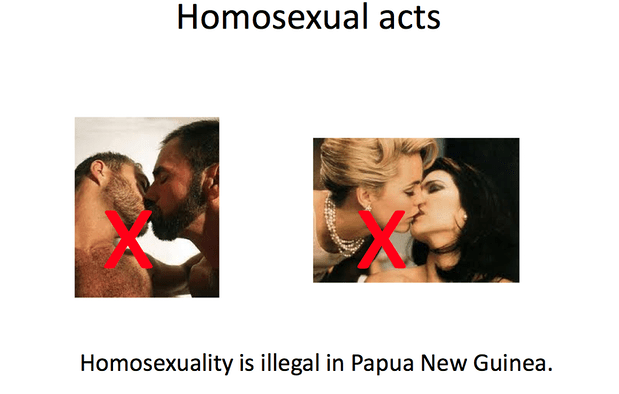
Guardian Australia has obtained a copy of an orientation presentation shown to asylum seekers on Manus after they arrived on the island. It was prepared by the Salvation Army and shows a picture of two men kissing with a large red cross through it.


“The delivery notes attached to the presentation warn; “Homosexuality is illegal in Papua New Guinea. People have been imprisoned or killed for performing homosexual acts.”


A spokesman for the Salvation Army confirmed the slides were used in the presentation to asylum seekers and said they formed part of a “broader education program about life in PNG.””
 

160427 Refugee Submission No Kissing

The slide from the Salvation Army presentation that was shown to people seeking asylum after their arrival on Manus Island (source: Guardian Australia).


Given this context, and applying the precedent of Toonen decision above, it is undeniable that the treatment of LGBTI people seeking asylum by the Australian Government is in clear breach of international human rights law.


This breach also directly causes other serious harms to these people seeking asylum. This includes increased discrimination against, and ostracising of, LGBTI people by other people seeking asylum in these detention centres.


As has been highlighted by multiple reports, including Amnesty International’s This is Breaking People, work by Human Rights Watch[ix], and the previously quoted article in The Guardian, the threat of criminalisation means LGBTI people who have been the victim of mistreatment in the detention centres – whether by other people seeking asylum or even detention centre employees – are far less likely to bring such mistreatment to the attention of relevant authorities.


Distressingly, these reports include multiple allegations that gay and bisexual men seeking asylum have been subject to sexual assaults inside detention centres but, due to the threat of the criminal laws being imposed on them for their homosexuality, have chosen not to make official complaints about these assaults.


That seems like an inevitable outcome of the offshore detention centre system created by successive Australian Governments, and yet it is no less abhorrent for this inevitability.


This abhorrent situation is reflected in the quotes of gay asylum seekers in both The Guardian article and Human Rights Watch report. From Human Rights Watch:


“A gay asylum seeker said, “I have not come to stay in Manus, a country where it’s possible [for a gay man] to be jailed for 14 years. If I wanted to live like this I would have stayed in Iran and gone to prison, been released, and then sent to prison again.”


“Another said, “Everyone leaves me. No one considers me a friend. Those few men who do are only with me because they want to take advantage of me sexually. They become my friends and after they use me they leave. And make fun of me. It’s very hard here.””[x]


And from The Guardian article[xi]:


“Author Karim writes:


“In this camp I suffer a lot. For example about four month ago I had to protect myself from a vicious man who tried to rape me, I lodged a complaint against the man, but I’ve got no reply yet.


“Life in the camp became harder because after that incident everyone stopped talking to me, I am completely alone, they are bullying and humiliating me at all time.


“I asked the psychologists to help me, but I’ve been ignored.”


“[Another author] Ahmed continues:


“I have to hide my sexuality because in this country, like Iran, there are a lot of people – fanatics – whom if they find out anyone is gay they would harass them and maybe even try to kill them.


“I have to hide my personality once again. I have to lie as someone else.


“It feels like this is a disease that is consuming me for all these years and society will never leave me alone. It feels like the universe doesn’t want you to live in the serenity of one moment, I don’t know what I have done to the universe, or what it has against me.


“I can’t live one moment without anxiety stress and sadness, it doesn’t let me live happily with anyone who I love or feel love, I don’t know what is my crime that I have to be punished so harshly.”


And from Omid (also in The Guardian article):


“I couldn’t return to Iran and be executed by the Iranian government. Hence living in PNG was not any better, because being gay is considered a crime in PNG as well, and the punishment for such crime is 14 years imprisonment.


“I am so sorry that I was born gay. I never meant to hurt you, mum.


“I wish our boat had sunk in the ocean and stopped me living the most painful year of my life.


“I thought Australia and its people would be my protector, but they taught me otherwise.”


These are the tragic lessons that we, as a country, are teaching LGBTI people seeking asylum by detaining, processing and resettling them in countries that criminalise homosexuality.


Another direct and very real consequence of the threat of criminalisation is the associated failure to provide proper sexual health education and services to LGBTI people seeking asylum.


Leaving aside the claims that people seeking asylum on Manus Island have been denied access to condoms (which the February 2014 letter rejected, but which is difficult to verify in the absence of independent monitoring), it is highly questionable whether appropriate and inclusive sexual health education is provided to all people seeking asylum who are held, including lesbian, gay, bisexual, transgender and intersex people.


But it is beyond doubt that LGBTI people seeking asylum are forced to exercise extreme caution when attempting to access sexual health services given doing so may expose them to criminal sanction. Criminalisation in this context, as in many other areas, directly jeopardises public health outcomes, and specifically increases the risks of HIV transmission.


Indeed, as the United Nations Human Rights Committee wrote more than two decades ago in relation to Toonen:


“The Australian Government observes that statutes criminalising homosexual activity tend to impede public health programmes “by driving underground many of the people at the risk of infection”. Criminalisation of homosexual activity thus would appear to run counter to the implementation of effective education programmes in respect of the HIV/AIDS prevention. Second, the Committee notes that no link has been shown between the continued criminalisation of homosexual activity and the effective control of the spread of the HIV/AIDS virus.”


Thus, in addition to breaching the human rights of LGBTI people seeking asylum under international and Australian law by detaining them in countries that criminalise homosexuality, the Australian Government is also increasing the risks of those same people seeking asylum contracting a virus that, while manageable with access to appropriate care and treatment, nevertheless still killed 1.5 million people worldwide in 2013 alone[xii].


Before concluding this submission, I would like to make two final observations.


First, the Committee will note that throughout I have referred to lesbian, gay, bisexual, transgender and intersex people seeking asylum. I have done so even while I acknowledge that for some members of this community – including lesbians, bisexual women and some transgender and some intersex people – the criminal laws against male homosexual activity in both Nauru and PNG will not technically apply.


Nevertheless, I believe that the unsafe situation created by these laws does apply to all LGBTI people seeking asylum who are detained there. By retaining laws against male homosexuality, both Governments effectively encourage discrimination across all of these population groups.


The consequence of this is that even for lesbians, bisexual women and those transgender and intersex people, they remain at increased risk of harassment and abuse (by both other people seeking asylum and detention centre employees), and sexual assault, as well as being denied access to appropriate and inclusive sexual health education and related services.


Second, I note that in both the June 2013 and February 2014 letters the Labor and Liberal-National Governments indicated that, were an LGBTI person seeking asylum to lodge an objection to being detained on either Nauru or PNG because of their laws against homosexuality, there is some possibility that they may not be sent to either place.


From the June 2013 letter:


“Pre-Transfer Assessment is undertaken prior to a person’s transfer to an RPC [Regional Processing Centre] to consider whether there are specific circumstances or special needs that mean it is not reasonably practicable to transfer an asylum seeker to an RPC at this time.


“Where a person raises concerns against a designated RPC, the Departmental officer refers to relevant country information, as well as the assurances received by Australia from the RPC governments[xiii], to assess if those charges are credible. If the person makes credible claims against all RPCs, the case is brought to the Minister’s attention in accordance with his guidelines for considering the exercise of his power under section 198AE of the Migration Act 1958 to exempt that person from transfer.”


From the February 2014 letter:


“Any claims made against Nauru and PNG by an IMA [Illegal Maritime Arrival][xiv], including claims concerning the treatment of homosexuals, bisexual, transgender and intersex asylum seekers in either country, are considered prior to transfer. Where an IMA makes such a claim, consideration is given to whether the IMA can be transferred to the proposed country, or an alternative country, or whether the IMA’s case should be referred to the Minister for consideration of exemption from transfer.”


While this process may appear to offer a small glimmer of hope to an even smaller number of LGBTI people seeking asylum, there are significant problems with any process that requires people to raise these concerns before being sent to either Nauru or Manus Island.


Imposing this requirement presupposes that the LGBTI person seeking asylum involved is aware that they are likely to be sent to one of these two countries, and that they also have knowledge of the criminal laws in both potentially applying to them.


It also requires them to be aware of the process involved in making such a claim (which is highly unlikely, especially in the absence of legal representation), and that they have the ability to raise it, with an appropriate Government representative, in the increasingly short period of time between detention by the Australian Government and transfer.


And it forces an LGBTI person seeking asylum to make this claim in an environment where they may be travelling with family members and friends (to whom they may not be ‘out’), or other members of their community that may not be accepting of different sexual orientations, gender identities or intersex people.


Finally, the June 2013 letter itself acknowledges that there may be some delay between a person seeking asylum protection from the Australian Government, and them making a claim on the basis of their LGBTI status. From that letter:


“Unlike other persecuted groups, sexual orientation and gender identity is not a readily visible characteristic and has to be revealed by the individual. Homosexual and transsexual applicants may, therefore, have only spoken to a handful of people, or none at all, about their sexuality and have kept it a secret. Interviewers and decision-makers should, therefore, not be surprised if an applicant suddenly raises the issue of sexual orientation or gender identity late in an application process, prefaced perhaps by an earlier weak or false claim on other grounds.”


Given this, it makes absolutely no sense to limit the ability of LGBTI people seeking asylum to make claims for protection against their detention on either Nauru or Manus Island, PNG to prior to their detention there – they should be able to make such a claim, and request transfer from these facilities (preferably to be processed in Australia), at any point.


**********


Overall, I believe that the actions of successive Australian Governments, in sending lesbian, gay, bisexual, transgender and intersex (LGBTI) people seeking asylum to Nauru and PNG, both countries that criminalise male homosexuality, is a fundamental breach of international human rights law.


This breach has flow-on consequences, by leading to increased harassment and abuse of LGBTI people seeking asylum, including by other people seeking asylum and by detention centre employees, and exposing them to sexual assault, as well as denying them access to appropriate and inclusive sexual health education and related services, increasing their risk of contracting HIV.


I submit that, instead of detaining, processing and resettling LGBTI people seeking asylum on Nauru and Manus Island, PNG, the Australian Government must instead ensure that the claims of these people are processed in Australia, where they are not criminalised and where they can be provided with access to appropriate support services.


Thank you for taking this submission into account as part of this Inquiry. If the Committee would like additional information about any of the above, or to clarify any part of this submission, please do not hesitate to contact me at the details provided.


Sincerely,

Alastair Lawrie


**********


Appendix A

Dear Mr Lawrie,

Thank you for your email of 7 September 2012 to the former Minister for Immigration and Citizenship, the Hon Chris Bowen MP, concerning the treatment of lesbian, gay, bisexual, transgender and intersex (LGBTI) asylum seekers. Your letter has been referred to me for a reply. I apologise for the delay in responding.

The Australian Government’s commitment to removing discrimination was demonstrated by its reforms to remove discrimination from 85 Commonwealth laws. These reforms, which passed in 2009, removed discrimination and equalised treatment for same-sex couples in areas of taxation, social security, health, aged care, superannuation, immigration, child support and family law.

The Government is also proceeding with introducing long overdue protections against discrimination on the basis of sexual orientation, gender identity and intersex status. On 21 March 2013, the Attorney-General introduced the Sex Discrimination Amendment (Sexual Orientation, Gender Identity and Intersex Status) Bill 2013. This Bill will ensure that protections from discrimination for people who are gay, lesbian, bisexual, transgender and intersex are put in place as soon as practicable.

Concerning the transfer of post-13 August 2012 irregular maritime arrivals (IMAs) to Regional Processing Countries (RPC) and the treatment of LGBTI asylum seekers, as a signatory to the 1951 Convention Relating to the Status of Refugees and its 1967 Protocol (the Refugee Convention), Australia takes its international obligations seriously and is committed to providing protection to refugees consistent with the obligations set out in the Refugees Convention and other human rights treaties to which Australia is a party. Any person has the right to seek protection in Australia from persecution in their home country.

The Government has signed Memoranda of Understanding (MoU) with the Governments of Nauru and Papua New Guinea which permit people who arrived irregularly by boat on or after 13 August 2012 to be taken to Nauru or Papua New Guinea (Manus Island) for assessment of their claims against the Refugee Convention. Changes to the Migration Act 1958 (the Act) which give effect to regional processing arrangements were passed by the Australian Parliament and became law on 18 August 2012.

The MoU signed with Nauru and Papua new Guinea reaffirms the commitment of both countries to the Refugee Convention, with people transferred to the Regional Processing Country (RPC) to be treated with dignity and respect in line with human rights standards.

The Department of Immigration and Citizenship recognises that human rights abuses and gender-related persecution can also be experienced by people on the basis of their sexual orientation and/or gender identity. As such, an applicant’s gender-related claims may include claims relating to their
sexual orientation and/or gender identity.

In the guidelines set out in the Departmental Procedures Advice Manual 3 (PAM3), for the guidance of interviewing officers, they are advised that

“Unlike other persecuted groups, sexual orientation and gender identity is not a readily visible characteristic and has to be revealed by the individual. Homosexual and transsexual applications may, therefore, have only spoken to a handful of people, or none at all, about their sexuality and have kept it a secret. Interviewers and decision makers should, therefore, not be surprised if an applicant suddenly raises the issue of sexual orientation or gender identity late in an application process, prefaced perhaps by an earlier weak or false claim on other grounds.”

Pre-Transfer Assessment is undertaken prior to a person’s transfer to an RPC to consider whether there are specific circumstances or special needs that mean it is not reasonably practicable to transfer an asylum seeker to an RPC at this time.

Where a person raises concerns against a designated RC, the Departmental officer refers to relevant country information, as well as the assurances received by Australia from the RPC governments, to assess if those charges are credible. If the person makes credible protection claims against all RPCs, the case is brought to the Minister’s attention in accordance with his guidelines for considering the exercise of his power under section 198AE of the Migration Act 1958 to exempt that person from transfer.

A copy of the Minister’s s198AE guidelines and the Pre-Transfer Assessment form and guidelines can be found at the Department’s website at: www.immi.gov.au/visas/humanitarian/whatsnew.htm

Also for your information, I attach a copy of the relevant sections of PAM3 regarding gender and sexual orientation. For a full interactive copy of that document you may need to contact your nearest public library which should be able to provide free access.

Thank you for writing about this matter and I apologise again for the delay in respond.

Yours sincerely

[Name withheld]

Director

Protection Policy Section

6 June 2013


**********


Appendix B

Dear Mr Lawrie

Treatment of homosexual, bisexual, transgender and intersex asylum seekers

Thank you for your letter of 2 February 2014 to the Hon Scott Morrison MP, Minister for Immigration and Border Protection, concerning the treatment of homosexual, bisexual, transgender and intersex asylum seekers. The Minister appreciates the time you have taken to bring these matters to his attention and has asked that I reply on his behalf. I regret the delay in responding.

As a party to the 1951 Convention Relating to the Status of Refugees and its 1967 Protocol (the Refugees Convention), Australia takes its international obligations seriously. Australia is committed to treating asylum seekers fairly and humanely, and providing protection to refugees consistent with the obligations set out in the Refugees Convention, and other relevant international treaties to which Australia is a party.

The Australian Government has taken a number of measures to deter people smuggling and to ensure that people do not take the dangerous journey to Australia in boats organised by people smugglers. Under Australian domestic law, all illegal maritime arrivals (IMAs) entering Australia by sea without a visa will be liable for transfer to Nauru and Papua New Guinea (PNG) where any asylum claims they may have will be assessed, and if found to be a refugee, they will be resettled in Nauru and PNG or in another country.

Any claims made against Nauru and PNG by an IMA, including claims concerning the treatment of homosexuals, bisexual, transgender and intersex asylum seekers in either country, are considered prior to transfer. Where an IMA makes such a claim, consideration is given to whether the IMA can be transferred to the proposed country, or an alternative country, or whether the IMA’s case should be referred to the Minister for consideration or exemption from transfer.

Nauru and PNG are also both parties to the Refugee Convention. The Memoranda of Understanding (MOU) they have signed with Australia on the offshore processing arrangements reaffirm their commitment to the Refugees Convention and to treating people transferred with dignity and respect in accordance with human rights standards.

The enforcement of PNG domestic law is a matter for the Government of PNG. The government is aware of laws relating to homosexual activity in PNG and understands that there have been no recent reports of prosecution under those laws.

If homosexual activity should occur in the OPC, there is no mandatory obligation under PNG domestic law for Australian officers or contracted services providers to report such activity to the PNG Government or police.

The department notes the release of the reports by both the United Nations High Commissioner for Refugees (UNHCR) and Amnesty International on the Manus OPC. Any reports received by the department will be reviewed, and observations or comments verified. Where reports make practical observations that can be implemented and would improve the operations of the centres, the government will address these in partnership with Nauru and PNG to address any deficiencies in good faith.

Any claims of mistreatment at the Manus OPC would be primarily a matter for the Administrator of the OPC. The Manus OPC is administered by PNG under PNG law, with support from Australia. The PNG Minister for Foreign Affairs and Immigration appoints the Administrator of the Centre (a PNG national) under section 15D of the Papua New Guinea Migration Act 1978 (the Act). The Administrator, who, under the Act has control and management of the Centre (currently the Chief Migration Officer, Head of the PNG Immigration and Citizenship Service Authority) has an Operations Manager at the OPC reporting to him, who has oversight of the day-to-day operations of the OPC.

To assist PNG in the implementation of the MOU, the government has contracted appropriately trained and experienced service providers to ensure that transferees’ needs are adequately met, including through the provision of health and welfare services. Transferees can report any concerns to OPC staff.

Regarding the distribution of condoms, I can assure you that condoms are available at the Manus OPC, and the department’s contracted health service provider, International Health and Medical Service, conduct regular health information sessions on safe sex practices.

Thank you for bringing your concerns to the Minister’s attention.

Yours sincerely

[Name withheld]

Acting Assistant Secretary

Community Programmes Services Branch

9 / 7 / 2014


**********


Footnotes

[i] Attempt to commit unnatural offences is also an offence under section 209, with a maximum penalty of 7 years imprisonment.

[ii] Article 17: 1. No one shall be subjected to arbitrary or unlawful interference with his privacy, family, home or correspondence, nor to unlawful attacks on his honour and reputation. 2. Everyone has the right to the protection of the law against such interference or attacks.

[iii] Toonen v Australia, Communication No. 488/1992, UN Doc CCPR/C/50/D/488/1992 (1994).

[iv] From an article in New Matilda, celebrating the 20th anniversary of the Toonen decision (20 Years Since Toonen Changed the World, 11 April 2014): “Perhaps most dramatic of all has been the impact of the Tasmanian UN decision around the world. The Tasmanian decision was the first time the UN had recognised the equal rights of LGBTI people. When the Indian High Court overruled that country’s anti-gay laws in 2009 it was on the basis of the Tasmanian decision. When the UN Secretary-General Ban Ki Moon successfully urged the President of Malawi to release men gaoled for being gay, he cited the Tasmanian decision.In 2011 the UN Human Rights Commissioner, Navi Pillay, described the Tasmanian decision as a “watershed with wide-ranging implications for the human rights of millions of people.”

[v] Letter to Chris Bowen on LGBTI Asylum Seekers

[vi] A copy of the This is Breaking People report can be found here.

[vii] Letter to Scott Morrison about Treatment of LGBTI Asylum Seekers and Refugees sent to Manus Island, PNG

[viii] Guardian Australia, ‘Gay asylum seekers on Manus island write of fear of persecution in PNG’, September 24 2014.

[ix] Human Rights Watch, ‘Australia/Papua New Guinea: The Pacific Non-Solution’, July 15 2015.

[x] Ibid.

[xi] Op cit, Guardian Australia, September 24 2014.

[xii] World Health Organisation Global Health Observatory data.

[xiii] Based on the principles of the Toonen UNHRC decision, these assurances are irrelevant – the continued existence of laws criminalising male homosexuality should be sufficient to prevent the transfer of LGBTI people seeking asylum to these countries.

[xiv] This is the term used in the letter, not one that I would personally use or approve.

In the battle for marriage equality, we must not forget to fight against religious exceptions

The long struggle for marriage equality does not involve waging just one battle. Instead, it includes a range of related, and sometimes overlapping, fights for lesbian, gay, bisexual, transgender and intersex (LGBTI) equality.


Obviously, there is what most would consider to be the ‘central’ fight – to amend the Marriage Act 1961 to ensure all LGBTI couples who wish to can be married under secular Australian law. Victory on that particular issue is long overdue.


A closely-related fight is ensuring that the definition used to amend the Marriage Act is sex and gender neutral – referring to the union of two persons (replacing man and woman which is currently used in section 5) rather than referring to man/man, or woman/woman, unions. The latter would only be gay or same-sex marriage, instead of genuine marriage equality, and would continue to deny equal rights to some members of the LGBTI community.


Fortunately, most recent legislative attempts to amend marriage have used this more inclusive definition[i], although this is something that we will need to be vigilant about until equality is finally achieved in Australia (whenever that might eventually be).


And then there is the current procedural fight about how marriage equality should be implemented – with Malcolm Turnbull’s Liberal-National Government intent on holding an unnecessary, inappropriate, wasteful and divisive plebiscite.


The $158.4 million-plus[ii] public vote appears to be supported by only the Australia Christian Lobby and other extremists opposed to LGBTI equality, while pretty much everyone else believes Parliament should simply do its job and pass a law to introduce equality (in exactly the same way then-Prime Minister John Howard entrenched inequality in the first place, way back in 2004).


However, there is one fight that is inherently connected to the larger battle for marriage equality that seems to be commonly overlooked – and that is the need to ensure that, irrespective of how marriage equality is ultimately achieved, no new special rights are created allowing religious organisations, and individuals, to discriminate against LGBTI couples.


These so-called ‘religious exceptions’ could take several possible forms. The narrowest version would be the introduction of a new right for civil celebrants and other celebrants, like military chaplains, who are not ministers of religion to be able to refuse to officiate ceremonies solely on the basis of the sexual orientation, gender identity or intersex status of the couple involved[iii].


The next, more expansive type of special rights to discriminate would allow businesses that provide wedding-related services to deny those services to couples where one or both persons are lesbian, gay, bisexual, transgender or intersex. This is the type of exception that excites Christian fundamentalists in the United States, with claims that requiring florists and bakers to sell their products to LGBTI couples is oppressive or even totalitarian in nature.


The broadest form of new religious exceptions would more radically change existing anti-discrimination laws, allowing all individuals and businesses to discriminate against LGBTI couples on the basis of their own religious beliefs, with such discrimination not restricted to wedding-related activities.


No matter how narrowly or broadly these new special rights to discriminate are defined, they are all completely unjustified – there is no reason why civil celebrants, businesses or anyone else operating in public life should be free to deny LGBTI people equal treatment.


But, just because they are unjustified, doesn’t mean they are not on the public agenda, as recent experience in the United States amply demonstrates.


From Kentucky county clerk Kim Davis, who found fame by refusing to perform the duties of her Government job[iv], instead denying service to members of the public solely on the basis of their sexual orientation, through to more recent state-wide Bills to ‘restore religious freedom’ (or, more accurately, to reinstate the rights of individuals and businesses to treat LGBTI people as second class citizens) in North Carolina, Mississippi and elsewhere, there has been a renewed push for religious exceptions to undermine marriage equality, and anti-discrimination laws more generally.


There seem to be three, inter-related and mutually reinforcing objectives behind the religious right’s latest homophobic ‘crusade’:


  1. In a practical sense, they genuinely want to prevent the equal treatment of LGBTI people – both by being legally permitted to refuse service to LGBTI couples themselves, and to encourage the broader population to do the same;
  2. In a symbolic sense, they want to undermine the equality aspect of marriage equality – if lesbian, gay, bisexual, transgender and intersex people are allowed to marry under secular law, then Christian fundamentalists want to ensure that they are still treated as differently as possible, turned away by civil celebrants, wedding-related businesses and even public servants; and
  3. In a strategic sense, they want to use this ‘moment’, when marriage equality and LGBTI rights are being discussed across the community, to reassert the supposed primacy of ‘religious freedom’ and use it to dismantle LGBTI anti-discrimination laws where they exist – or hinder their development where they have not already been passed.


Before we judge our US counterparts too harshly, however, we must remember that conservative and other right-wing forces in Australia are engaged in exactly the same campaign here.


For example, Liberal Democrat Senator David Leyonhjelm’s Freedom to Marry Bill 2014, that would have introduced marriage equality (of a sort), included provisions that would have granted civil celebrants the ability to reject people on the basis of their sexual orientation, gender identity and intersex status[v].


Others on the ‘religious exceptions’ bandwagon include former Human Rights Commissioner, and now Liberal candidate for Goldstein, Tim Wilson[vi], as well as his former employers, the Institute of Public Affairs.


In addition to their outrageous calls for what limited LGBTI anti-vilification laws we do have[vii] to be temporarily suspended for the duration of the plebiscite, fringe group the Australian Christian Lobby (ACL) have also repeatedly argued for any Marriage Amendment Bill to include permanent special rights for individuals and businesses to discriminate against LGBTI people.


In his own words, ACL ‘homophobe-in-chief’ Lyle Shelton believes existing anti-discrimination laws are somehow a threat to Australian democracy:


“The rights to a free conscience, freedom of religion or belief, freedom of speech and freedom of expression are the nuts and bolts of democracy. If they are to fall, then we have serious questions to answer regarding out democracy…


“Most fair-minded Australians would accept the right of a person to maintain their belief that gender and biology still matter to marriage and family and to always be free to give voice to that belief.


“Marriage between a man and a woman is fundamental to a flourishing society. When the definition is changed, the law will say that gender is irrelevant to the foundation of society.


“Those who believe gender, kinship and biological identity do matter to society’s fabric will be fundamentally at odds with the law and the anti-discrimination laws will be weaponised against them.”[viii]


Leaving aside the fact the ACL have been able to use their disproportionate-sized megaphone to publicly spew forth hatred against LGBTI Australians for many years[ix], without any apparent consequence, on this as with too many other issues they have found numerous supporters within the Liberal-National Government.


Indeed, ongoing debate on the issue of whether a draft Marriage Amendment Bill should include new ‘religious exceptions’, and if so how broad they should be in scope, is a key reason why Malcolm Turnbull was forced to back down from previous statements he would announce the timing and details of the marriage equality plebiscite ahead of the 2016 Federal Election.


In reporting on the decision by Turnbull to shelve the plebiscite announcement until after the poll, Dennis Shanahan in The Australian made the following observation:


“The key to reassuring those opposed to same-sex marriage, including conservative Coalition MPs, is not only the wording of the proposed plebiscite question changing the Marriage Act but also the protections for freedom of religion and speech.


“Those involved in the talks regard it as essential that Senator Brandis provide protections for those beyond the tight circle of religious and marriage celebrants who do not want to perform same-sex marriage ceremonies.”[x]


Lenore Taylor in the Guardian Australia had earlier reported that internal tensions over the extent of these exceptions could cause the Government to delay announcing the Bill:


“The Turnbull government is wavering on its commitment to reveal details of its planned marriage equality plebiscite before the federal election because of deep divisions on crucial issues such as public funding and exemptions from anti-discrimination laws…


“[C]conservative MPs have been demanding broad exemptions from anti-discrimination laws for officials and wedding service providers, including florists, bakers and reception centres. Government sources said there were concerns that the issue would become internally “divisive.””[xi]


These reports confirm that the potential creation of new special rights to discriminate is very much a live option within the Turnbull Liberal-National Government.


This development is something that should have anyone interested in achieving marriage equality worried, especially because, as previous debates around Safe Schools and the plebiscite itself have demonstrated, the conservative and/or religious right are not shy about throwing their weight around inside the Coalition party room – and that applies just as much, if not more, under Prime Minister Turnbull as it did under his predecessor Tony Abbott.


The consequences of a conservative victory on this issue would be dire. On top of the practical and strategic problems identified above, the inclusion of new special rights to discriminate against LGBTI people in the plebiscite question – or its associated legislation – would make campaigning for marriage equality significantly more challenging.


In effect, it would ensure that the proposal considered at a plebiscite was fundamentally flawed from the beginning and that therefore many people in favour of genuine marriage equality would be forced to campaign, and vote, for something less than ideal while effectively ‘holding one’s nose’.


It would also tarnish the achievements of a successful ‘Yes’ campaign – instead of a unifying moment of national celebration, where true relationship equality was extended to lesbian, gay, bisexual, transgender and intersex Australians without qualification, we would be left with a law that continues to permit discrimination in certain circumstances. In short, a ‘Yes’ result would be marred, leaving the overall job half-finished – and making it bittersweet to celebrate ‘equality-lite’.


For all of these reasons, it is incumbent upon us to ensure that, at the same time as we fight for marriage equality, we fight against the introduction of new religious exceptions, whether in the Marriage Act itself, or the Commonwealth Sex Discrimination Act 1984 (or its state and territory equivalents).


Fortunately, we already have allies in this particular fight. In addition to the Greens, who have long campaigned against religious exceptions, the Australian Labor Party is also firmly opposed to their introduction.


160417 Guardian Why Knot

The Guardian Australia/Australian Marriage Equality event ‘Why Knot?’ where Opposition Leader Bill Shorten gave a firm commitment that Labor will oppose any expansion of religious exceptions – and will seek to repeal any provisions that are introduced by the Turnbull Liberal-National Government.


At the recent Guardian Australia/Australian Marriage Equality ‘Why Knot?’ forum in Sydney, I had the opportunity to ask Opposition Leader Bill Shorten the following:


“There is a real risk that, when Malcolm Turnbull finally gets around to drafting it, his Marriage Amendment Bill will seek to include new special rights for civil celebrants and other wedding business-providers to discriminate against LGBTI couples. Just to get it on the record: Mr Shorten, will you commit the Labor Party to voting against any attempt to expand religious exceptions beyond existing provisions and, if they do somehow end up being passed and polluting the Marriage Act, will you seek to repeal them at the earliest available opportunity?”


Mr Shorten’s answer was unexpectedly strong, and reassuring: “Yes, and yes.”


As reported by the Guardian Australia, he went on to note that “[i]t’s not allowed now under the current law – why would we water down existing laws? We don’t need to water down anti-discrimination law to keep some people [who oppose same-sex marriage] happy.”[xii]


It is possible that, after the Federal election, the combined votes of Labor and the Greens in the Senate will be able to block any attempt by a re-elected Turnbull Liberal-National Government to include expanded religious exceptions as part of its legislative package creating the plebiscite.


However, with a double dissolution election now almost inevitable on July 2nd, and the reduced Senate quotas associated with it, the final result in that Chamber will be especially hard to predict, with a range of minor parties still chances to win the 12th and final seat in each state.


Which means that there are now only two ways to avoid the creation of new special rights to discriminate against LGBTI Australians: for Shorten and Labor to be elected (and then implement their own policy to introduce marriage equality legislation within 100 days), or for a re-elected Prime Minister Turnbull to publicly commit to not introducing new religious exceptions in his own Marriage Amendment Bill.


Given his track record on LGBTI issues since taking over from Tony Abbott last September – selling the LGBTI community out on multiple occasions by ‘gutting’ the Safe Schools program and abandoning his previous personal position against holding a plebiscite – securing any enforceable commitments from Mr Turnbull will likely be an incredibly difficult task.


But, if we are committed to genuine marriage equality, then I believe this is a fight we must take on. Because if we don’t, we might find that we win marriage equality in the next 12 to 18 months but, instead of being able to celebrate achieving a better, fairer and more equal Australia, we are left to deal with new forms of exclusion, discrimination and state-sanctioned homophobia.


**********


[i] Although Greens Senator Sarah Hanson-Young’s Recognition of Foreign Marriages Bill 2014 disappointingly only sought to recognize overseas marriages between “a man and another man or a woman and another woman”.

[ii] As quoted on page 22 of the Senate Committee Report: Matter of a popular vote, in the form of a plebiscite or referendum, on the matter of marriage in Australia, 15 September 2015.

[iii] Thus providing them with the same right to ‘reject’ couples that ministers of religion already enjoy under the Marriage Act.

[iv] It is instructive to consider how people like Ms Davis would be received were they to refuse to serve African-American people, rather than LGBTI people – presumably such acts of outright racism would not be tolerated, or even celebrated, in the same way her egregious acts of homophobia and transphobia have been.

[v] For more on why Leyonhejlm’s Freedom to Marry Bill 2014 was offensive, see “Senator Leyonhjelm’s Marriage Equality Bill Undermines the Principle of LGBTI Anti-Discrimination: Should we still support it?”

[vi] In Wilson’s opinion piece in The Australian on 6 July 2015, “Religious freedom and same-sex marriage need not be incompatible” he argued for religious exceptions to be extended not just to civil celebrants but also to a wide range of wedding-related businesses.

[vii] Only four states and territories currently have vilification laws that cover lesbian, gay, bisexual, transgender and intersex (LGBTI) people: Queensland, NSW, ACT and Tasmania. There are no protections federally. Instead of suspending the paltry laws we do have, the Commonwealth Government should actually be introducing LGBTI anti-vilification laws of its own. See also: “Don’t limit racial vilification protections, introduce vilification protections for LGBTI Australians instead”.

[viii] From ACL Media Release, 5 April 2016 “ACL Concerned by Shorten Plan to Fine Business Owners who Disagree with Same-Sex Marriage.”

[ix] With Mr Shelton’s predecessor Jim Wallace saying that smoking was healthier than gay marriage, and the ACL under both leaders drawing comparisons between LGBTI parenting and the creation of another Stolen Generation, which is not just deeply offensive to LGBTI Australians but to Aboriginal and Torres Strait Islander people as well.

[x] Dennis Shanahan, The Australian, 26 March 2016, “Federal election 2016: Same-sex marriage plebiscite pause for poll”.

[xi] Lenore Taylor, Guardian Australia, 16 March 2016, “Marriage Equality: Coalition disunity puts pre-election plebiscite details in doubt.”

[xii] Paul Karp, Guardian Australia, 31 March 2016, “Shorten: Labor won’t change discrimination laws to please gay marriage opponents.”

Submission to QLRC Review of Expunging of Criminal Convictions for Historical Gay Sex Offences

Update: 17 January 2017

The Queensland Law Reform Commission’s report on ‘Expunging criminal convictions for historical gay sex offences’ was tabled in Queensland Parliament on Tuesday 29 November 2016. You can find a copy of the report, which was actually completed in August 2016, here.

After tabling the report, Attorney-General the Hon Yvette D’Ath expressed the Palaszczuk Labor Government’s commitment to progressing legislation to create an expungement scheme.

As reported by the Brisbane Times (‘Government outlines path to expunging historical gay convictions’), Ms D’Ath said:

“This is a chance for some closure for Queenslanders who continue to be hurt by the legacy of decades-old discrimination, wrongs inflicted by a past regime, from a very different Queensland from the modern state we enjoy today…

“As a parliament, we should apologise to those Queenslanders for these historic wrongs and for the hurt that followed them in the decades since.”

The recommendations included in the QLRC report, which is the starting point for legislation that is expected to be introduced in the first half of this year, appear reasonable.

The QLRC also notes, on page iii, that:

“At present, the age of consent is generally 16 years but is 18 years for sodomy. If the age of consent for sodomy were changed to 16 years prior to or in conjunction with the commencement of the proposed expungement legislation, applications for expungement in respect of eligible offences would be decided by reference to the age of consent of 16 years.”

This is obviously welcome (given it was included in my original submission – see below), especially now that the age of consent has in fact been equalised.

However, the report also recommends that expungement should apply with respect to:

“an offence under sections 208(1), 208(3), 209 or 211 of the Criminal Code, as in force prior to 19 January 1991 (the ‘date of legalisation’) except as constituted by heterosexual activity”.

When read together, there is a risk that these two recommendations will create the perverse situation that a gay or bisexual man, who was successfully prosecuted for male-male intercourse involving at least one party who was 16 or 17 years old will be able to have that conviction expunged where it occurred before 1991 – but will not be able to do so if it occurred between 1991 and the (long overdue) equalisation of the age of consent in 2016.

This is an issue that Attorney-General D’Ath specifically, and the Queensland Government generally, must address – because nobody should be subject to a criminal record in 2017 simply because of their sexual orientation, and that applies irrespective of whether the conduct occurred before ‘legalisation’, or ‘equalisation’.


Original post:

The Queensland Law Reform Commission (QLRC) is currently undertaking a review into the possible establishment of a scheme to expunge criminal convictions for historical gay sex convictions in that state. Details of the review, including a Consultation Paper, can be found here.

Submissions response to that paper are due on Tuesday 29 March 2016. The following is my submission:

The Secretary

Queensland Law Reform Commission

PO Box 13312

George St Post Shop QLD 4003

lawreform.commission@justice.qld.gov.au

Tuesday 22 March 2016

To whom it may concern,

Submission on Review of Expunging of Criminal Convictions for Historical Gay Sex Offences

Thank you for the opportunity to provide a submission in response to the Consultation Paper on this important subject.

In this submission I will attempt to answer the nine separate questions asked in the Consultation Paper[i].

I will also make two additional recommendations addressing issues that, while not specifically raised in the Paper, are closely tied to those that are and, I believe, must be addressed at the same time.

Overall, I welcome the interest of the Queensland Government in considering a scheme to allow LGBTI people generally, and gay and bisexual men in particular, to have unjust charges and convictions expunged from their criminal records.

Consensual same-sex sexual activity should never have been criminalised, and, in my opinion, it is doubly unjust to leave these charges and convictions in place, potentially to be held against people decades after they were originally penalised under these discriminatory laws.

**********

Joh

Former Queensland Premier, Joh Bjelke-Petersen.

First, to some context to explain why I am particularly interested in this review. I was born in Central Queensland in 1978, roughly halfway through the Joh Bjelke-Petersen era. I am therefore old enough to remember at least parts of the fierce debates around the potential decriminalisation of male homosexuality in the late 1980s[ii], as well as the extraordinary homophobia and hysteria that accompanied the emergence of the HIV/AIDS epidemic throughout that decade.

I also remember, vaguely, the passage of legislation decriminalising male homosexuality by the Goss Labor Government in November 1990[iii].

That achievement – the decriminalisation of same-sex sexual intercourse between adults[iv] – happened only a couple of months before I first realised that I was gay, and I am obviously thankful that this reform was in place before I reached adulthood.

However, I am not thankful that the Goss Government failed to accept the recommendation of the Criminal Justice Commission (CJC)[v] to introduce an equal age of consent for both homosexual and heterosexual sexual activity, but instead decided to set the age of consent at 16 for most sexual activities, but at 18 for ‘sodomy’ (that is, anal intercourse)[vi].

The principle set out by the CJC: “[i]t would accord with principles of sexual equality and anti-discrimination that the age of consent for males and females be the same irrespective of whether the sexual act is heterosexual or homosexual”[vii], was clearly sound.

By ignoring this principle, the Goss Government potentially exposed me to criminal prosecution, including a maximum penalty of 14 years imprisonment – because, during the time I was 16 and 17 years old (1994 to 1996), had I engaged in non-oral penetrative sex I could have been charged with, and convicted of, ‘unlawful sodomy’[viii].

While, prima facie, this offence applies to both heterosexual and homosexual conduct, and therefore some might describe it as non-discriminatory in nature, it simply cannot be denied that the impact of this unequal age of consent falls disproportionately on young same-sex attracted men.

Using my own situation, my heterosexual peers could engage in at least some types of non-oral penetrative sex without the fear of criminal prosecution, while I, obviously, could not. This disparity was unjust then, in mid-1990s Queensland. And it is extraordinarily unjust now.

It is almost unfathomable that, in 2016, the unequal age of consent for anal intercourse remains in place under Queensland law – rendering it the only place in Australia to maintain such a distinction. The Borbidge, Beattie, Bligh, Newman and (so far) Palaszczuk[ix] Governments have all failed to finish the job left only half-completed by the Goss Government more than 25 years ago.

Goss

Former Queensland Premier Wayne Goss, who ended the long rule of the National Party in 1989, and decriminalised homosexual activity between adults in 1990, but left the job half-complete by introducing an unequal age of consent for anal intercourse.

There are three main reasons why I am raising this issue here, as part of my submission to a review looking at expunging criminal convictions for historical gay sex offences:

  1. The objective of the proposed expungement scheme is to provide redress to people who have been unjustly punished because of discriminatory criminal laws, or the discriminatory application of criminal laws. In this context, we should not avoid the fact that, in 2016, there remain some criminal laws that, because of the type of conduct that is prohibited, continue to place an unjustifiable and discriminatory burden on young gay and bisexual men in particular.
  2. It is highly likely that there are men who have been criminalised due to this discriminatory age of consent in the 25 years since homosexual intercourse between adults was first legalised in Queensland but who, because most expungement schemes do not apply to conduct that remains subject to criminal sanction, would nevertheless not be allowed to have their criminal records expunged, and
  3. In my opinion, it makes no sense whatsoever to establish a framework to expunge ‘historical gay sex offences’ from criminal records while, at the same time, maintaining other criminal laws that mean there will likely be more people who are penalised as a result of the discriminatory application of those offences into the future.

For all of these reasons, I believe that the age of consent for anal intercourse, currently 18, must be made equal to the age of consent for other types of sexual activity, 16, either prior to or at the same time as the establishment of a scheme to expunge historical gay sex offences[x].

To not do so – leaving the current discriminatory age of consent in place – is not only unjust, it would also mean that, at some point in the future, when the age of consent is finally equalised, the expungement scheme will need to be amended to add all of those people unnecessarily penalised since the passage of the Criminal Code and Another Act Amendment Act 1990.

Recommendation 1: The Queensland Government should equalise the age of consent for anal intercourse, by making it 16 instead of 18, prior to or at the same time as any expungement scheme takes effect.

**********

The following section will address the nine questions asked in the QLRC Consultation Paper.

  1. Is there a need to change the law to introduce a new scheme for expungement?

Yes, I believe there is a clear need for a new legislative scheme to address this issue. The existing pardon scheme is not capable of providing appropriate redress to all of the people affected by these discriminatory criminal laws, or discriminatory application of criminal laws. Nor does it achieve the removal of convictions from a person’s history, which is an essential component of any scheme.

Spent convictions are also substantively different in nature from expungement, minimising the consequences of previous convictions (although even then not for all purposes, such as applying for some positions), rather than acknowledging the wrongness of, and attempting to remove, convictions that should never have been imposed in the first place.

For this reason, my preference would be to have a separate act for an expungements scheme. However, if it is included in existing spent convictions legislation, there should be clear delineation between the two concepts.

  1. Which criminal offences should be covered by an expungement scheme, and how should they be defined?

The criminalisation of same-sex activity extended beyond sexual activity to include prosecution for a range of other offences where they would not otherwise have been prosecuted if not for their sexual orientation.

For this reason, the expungement scheme should also extend beyond covering offences such as ‘buggery’ and ‘indecency between males’, to include offences such as soliciting, and it should not be limited solely to male same-sex activity (while noting that it will nevertheless predominantly be men who are affected).

It should also include attempting or conspiring to commit, or inciting, any of the eligible offences. And, as I made clear above, it should include people criminalised due to the unequal age of consent for anal intercourse.

In terms of how the offences are identified or defined, I suspect it would be difficult to list, from the outset, all relevant offences where people were prosecuted primarily because of who they were.

As a result, I prefer the combined option suggested in the Consultation Paper[xi], whereby known offences could be included in the legislation, other offences could be added by regulations where necessary, and a description test could be included to ensure that additional offences could be expunged where they are shown to be relevant in individual cases.

Finally, I am not opposed to consent, age and lawfulness being included as criteria for expungement – provided the age of consent for anal intercourse is lowered to 16, otherwise a range of people would be prevented from being able to seek redress because of the ongoing unjustified and inappropriate criminalisation of this activity.

  1. Should an exungement scheme also apply to charges for an offence or other legal processes related to a conviction?

I prefer the Victorian approach, which applies to the conviction, the charge to which the conviction relates and “any investigation or legal process associated with that charge or the conviction.”

This is important given the ever-expanding requirement to disclose charges and other matters (beyond simply convictions) in a range of circumstances, and the increased sharing of such information between Australians jurisdictions.

  1. Should an expungement scheme be confined to living persons?

No. I believe appropriate representatives (such as a spouse, parent, child or sibling) should be able to apply for expungement, as is the case in the ACT, NSW and Victoria. This is because the injustice of the discriminatory application of criminal laws does not change simply because the person charged or convicted has since died.

  1. What type of scheme should it be?

While it would be ideal to be able to adopt a scheme that operated automatically, expunging criminal records of individuals without first compelling them to effectively re-visit the injustice perpetrated on them by having to make an application for expungement, I do not believe this is possible, especially because the past criminalisation of same-sex activity included some offences that would remain criminal today (for example, where there was no consent).

As a result, I believe Queensland should follow the approach adopted by South Australia, the ACT, NSW and Victoria in establishing a ‘case-by-case’ scheme – noting that such a scheme must be adequately funded to limit any delay to people who have already been denied justice for too long.

In terms of deciding who the decision-maker should be, my preference would be for the establishment of an independent panel – although that may not be possible depending on the resources allocated to this scheme. In which case, an administrative scheme (overseen by the Director-General of the Department of Justice and Attorney-General) would ensure accessibility, flexibility, privacy and lower cost (and align with the approach adopted in Victoria, NSW and the ACT).

  1. When should a conviction be expunged under a scheme (the criteria for expungement)?

From my perspective, while the overall purpose of the scheme is to provide redress for people who would not have been charged but for the fact the activity was of a homosexual nature, the specific criteria that should be applied should be consent (where it is relevant), age and lawfulness (that is, whether the activity would constitute a criminal offence today).

However, as I have already made clear in this submission, in relation to age the scheme should also cover people who have been prosecuted as a result of the unequal and discriminatory age of consent that has operated in Queensland since the decriminalisation of adult same-sex sexual activity.

  1. What should be the effect of ‘expungement’ under a scheme (the consequences of a conviction becoming expunged)?

The governing principle should be to, as far as possible, restore the person’s position at law as if the charge or conviction had never been imposed. That would suggest that the Government should adopt more, rather than fewer, protections against disclosure.

I would support:

  • The person not being required to disclose information about the expunged conviction
  • A question about the person’s criminal history being taken not to refer to the expunged conviction
  • In applying an Act to a person, a reference to a conviction being taken not to refer to the expunged conviction
  • In applying an Act to a person, a reference to the person’s character not allowing or requiring anyone to take the expunged conviction into account and
  • Ensuring that the expunged conviction or its non-disclosure is not a proper ground for refusing to a person, or dismissing the person from, an appointment, post, status or privilege and that the person may reapply if such was refused solely on the basis of the conviction before it was expunged.[xii]

It also means that there should be criminal offences to disclose information about an expunged conviction, from records kept by or on behalf of a public authority, or by a person with access to official records, and to fraudulently or dishonestly obtain information about an expunged conviction from records kept by or on behalf of a public authority.[xiii]

Although the exceptions nominated in the Consultation Paper – such as being a disclosure to or with the consent of the person, or to inform a public authority holding information about convictions that the conviction itself is expunged – also seem reasonable.[xiv]

In terms of whether official records should be annotated or destroyed, I am drawn to the Victorian approach, where official records of convictions are annotated to record the fact that the conviction is expunged, and where entries about an expunged conviction in electronic databases or extracts of official records are to be removed, made incapable of being found, or de-identified. This is because undertaking these actions is likely to assist in preventing the further disclosure of these records.

Finally, I do not take a position on whether an expunged conviction should be able to be revived. While in theory such a safeguard appears necessary, based on the experience in the UK, and in Australian states and territories that have adopted expungement schemes to date, it is unlikely that large numbers of people will have their records expunged, thereby reducing the risk of an inappropriate expungement that ultimately requires reversal.

  1. What procedural features should an expungement scheme have, and how should it operate?

Again, I am drawn largely to the Victorian approach (although most features are shared across schemes). This would include allowing the person convicted of the offences to apply, or the guardian of the convicted person to apply if the convicted person is unable to apply because of a disability.

It also includes the application being required to be in writing, in an approved form, incorporating:

  • The person’s name, date of birth and address at the time of the application and at the time of the conviction (where known)
  • When and where the person was convicted and details of the offence and
  • Authorising a police record check and giving consent to the disclosure to the decision-maker of official records created by the courts, police or office of public prosecutions relating to the conviction,

but not requiring the person to include the transcript or sentencing remarks (as mandated in South Australia)[xv].

I also support the person having the opportunity to include supporting information or statements, and evidence of the other person(s) involved, as well as being able to withdraw an application, and being given an opportunity to provide further information before an application, which is proposed to be refused, is finally decided (as required in NSW and the ACT).[xvi]

In terms of the decision-making process itself, while I support the decision-maker being able to request or require further information from the applicant, or from another person or body, I do not believe the decision-maker must have regard to any available record of the investigation or proceedings. I also support the approach in NSW, Victoria and UK, where an oral hearing is not to be held.[xvii]

Given the need to provide justice to people who have already been denied justice for too long, I support the approach in Victoria, requiring an application to be determined “as promptly as possible”. Procedural fairness would also dictate that an applicant be provided with written notice of the decision, including reasons. In order to ensure that the records are actually expunged, the notice of the decision should also be given to the ‘data controller’ for official records held by the courts, police and the office of public prosecutions.

Finally, in terms of review processes, I support the right to re-apply, following an earlier refusal, where additional supporting material becomes available. People who have their application refused should also be able to seek review of the decision by the Queensland Civil and Administrative Tribunal (which would be consistent with the ACT, NSW and Victoria), although I do not support the right of the ‘data controller’ to seek review of a decision to approve an application.

  1. Are there any other matters that should be considered?

Yes. As discussed in the Consultation Paper[xviii], I support consequential amendments to the Queensland Anti-Discrimination Act 1991 to ensure that people cannot be discriminated against on the basis of charges or convictions that have since been expunged.

I also support amendments to the Working with Children (Risk Management and Screening) Act 2000 – and any other scheme that considers historic offences for registration or eligibility – to guarantee that expunged charges and convictions are not able to be accessed or considered.

Finally, in terms of resources, there are two distinct needs. The first is for an education campaign to raise awareness amongst people who may have been affected by past criminalisation, and to provide information about their options under the scheme. Such a campaign should be funded by the Government and delivered in partnership with Queensland LGBTI community organisations.

The second would be the direct provision of legal advice and assistance to people who wish to pursue their rights under the scheme, as well as access to counselling and other related services where relevant.

**********

There is one final issue that, although not considered in detail in the Consultation Paper, is, in my view at least, intrinsically linked to a scheme designed to provide redress to people who have experienced injustice because of the criminalisation of same-sex sexual activity.

It is my sincere belief that, at the same time as the Queensland Parliament (hopefully) passes legislation to establish an expungement scheme, it should also offer an apology to all those who have suffered adverse consequences as a result of this unjustified and inappropriate criminalisation.

As I have made clear earlier in this submission, I believe this apology should also be extended to people who have been criminalised as a result of the unequal age of consent for anal intercourse that has been in operation since homosexual sexual activity between adults was first legalised.

While symbolic, an apology to all of these people would be an important step not just towards healing the wounds of the past, but also towards demonstrating the commitment of the Queensland Parliament to ensure that similar injustices are not perpetrated again in the future.

Recommendation 2: That, at the same time as it passes legislation to establish an expungement scheme, the Queensland Parliament should offer an apology to all those who were subject to criminalisation for same-sex sexual activity in the past, including those who have been criminalised because of the unequal age of consent for anal intercourse.

**********

Thank you for taking this submission into account as part of this important review. If you would like more information, or to clarify any of the above, please do not hesitate to contact me at the details provided.

Sincerely

Alastair Lawrie

[i] QLRC, Consultation Paper: Review of expunging of criminal convictions for historical gay sex offences, p23-40.

[ii] I was unusually interested in politics and current affairs as a child – some things never change.

[iii] Criminal Code and Another Act Amendment Act 1990.

[iv] By repealing then sections 208 (Unnatural offences), 209 (Attempt to commit unnatural offences) and 211 (Indecent practices between males) from the Queensland Criminal Code.

[v] Criminal Justice Commission, Reforms in laws relating to homosexuality: An information paper, 1990.

[vi] Section 208 of the reformed Criminal Code still creates the offence of “Unlawful sodomy: A person who does, or attempts to do, any of the following commits a crime – (a) sodomises a person under 18 years; (b) permits a male person under 18 years to sodomise him or her… Maximum penalty – 14 years imprisonment.”

[vii] Op cit, page 60.

[viii] Obviously, this law would also have applied had I been 18 or 19 and had a partner who was a year or two younger than I was – something that is not uncommon, and a situation that would not attract criminal prosecution if it involved vaginal intercourse.

[ix] Although I understand that the Palaszczuk Labor Government is currently seeking advice on this issue, from an expert panel including ‘health experts’: Brisbane Times, Queensland Government considers lowering age of anal sex consent to 16, August 20 2015.

[x] Irrespective of the current review by the Palaszczuk Government (see above), I believe this is an issue that the QLRC should also consider in detail given it is inherently linked to its consideration of an expungement scheme.

[xi] QLRC Consultation Paper, Option 4, page 26.

[xii] All options from QLRC Consultation Paper, ibid, pages 33-34.

[xiii] Ibid, pages 34-35

[xiv] Ibid, page 35.

[xv] Ibid, page 36.

[xvi] Ibid, page 37.

[xvii] Ibid.

[xviii] Ibid, page 39.

What does Malcolm Turnbull want his legacy to be?

It’s time for Malcolm Turnbull to seriously consider what he wants his legacy to be.


That might sound premature to some, especially given that tomorrow (Monday 14 March 2016) it will be only six months since he replaced Tony Abbott as Leader of the Liberal Party. Tuesday, the clichéd ‘Ides of March’, is the six-month anniversary of his official swearing in.


However, in the life of an Australian Prime Minister, six months is not an insignificant period of time. Indeed, for many, six months is a considerable slice of their term.


In the just over 70 years since World War II, Malcolm Turnbull is the 15th person to ascend to our top job. The average term in office – even including the 16-year rule of Robert Menzies[i] – is less than five years. In fact, only four Prime Ministers[ii] in those seven decades have even made it to the five-year mark, while six ended up serving less than three years.


The pace of turnover of Prime Ministers also appears to be accelerating – in the 11 years since Turnbull entered Parliament, he is now the fifth Prime Minister (with one of those, Kevin Rudd, even having two non-consecutive turns).


Based on the above, six months is likely to represent at least 10% of Turnbull’s entire term in office, and probably more.


In fact, there are reasons to believe Turnbull’s stay in the Lodge might be shorter than the average. For example, he is third oldest person to ever be first sworn in as Prime Minister (and the two who were older[iii] served for a combined period of less than two years).


It is also reasonable to describe Turnbull’s support inside the Parliamentary Liberal Party as somewhat tenuous. His first stint as Leader, while in Opposition, lasted less than 15 months. And, even after two years of the worst Prime Minister in living memory, he only defeated Tony Abbott by 54 votes to 44 last September (and which was only moderately better than the 39 votes cast for an ‘empty chair’[iv] in the February 2015 spill motion against Abbott).


With a switch of just six votes needed to reverse that result (whether to Abbott, who clearly remains interested in returning, or another candidate from the conservative wing of the Liberals) it should be noted that a sizeable majority of Liberal MPs in marginal seats voted for Turnbull[v], meaning that any loss of seats at the upcoming 2016 election would leave him more vulnerable to a challenge from inside the Government.


Of course, if the current level of in-fighting and disorganisation within the Coalition continues, there is also the small but real chance of the Government being voted out, cutting Turnbull’s term short at 12 months or less.


This thought – that, after just six months, it is time to start seriously considering his legacy – might be confronting for Turnbull, but he should console himself with the knowledge that, for most of his contemporaries, substantial elements of their legacies were built during their first year in office.


Kevin Rudd gave the apology to the Stolen Generations after less than three months in the role. He is also most commonly remembered for his response to the Global Financial Crisis, which reached its peak in September and October 2008 – again, less than 12 months from his election win on November 24 2007.


In Julia Gillard’s case, the announcement of the ‘carbon pricing mechanism’ (forever dubbed the carbon tax) was made on February 24 2011, exactly eight months after she ousted Kevin Rudd as Prime Minister.


The National Disability Insurance Scheme is also seen as a key part of her legacy – and, while the legislation that gave it effect was not introduced until late 2012, the Productivity Commission report which preceded it was already two months into its work before Gillard even became PM[vi].


Tony Abbott continues to assert that his first Budget – the ‘horror’ 2014-15 Budget, more widely known for its unfairness– is a key part of his legacy[vii], and that was handed down just eight months into his term. His more trivial – but just as infamous – ‘captain’s call’ to reintroduce knights and dames happened two months earlier.


Even in the case of John Howard, who, given he served as Prime Minister for more than 11 years and therefore has a long and highly-contested ‘legacy’, there is probably only one key positive achievement about which almost all parts of the political spectrum agree[viii] – his gun law reforms following the Port Arthur Massacre[ix], which itself occurred less than two months after he swept to power.


Six months into his own term as Prime Minister, it is hard to pin down exactly what Malcolm Turnbull’s key achievement or achievements have been (other than the initial, widespread feeling of ‘relief’ which many Australians experienced after he deposed Abbott). Different language has been used, including much talk of ‘agility’ and ‘innovation’ and ‘excitement’, but new ideas or policies? Not so much.


That situation will change, to some extent, over the coming months, as Turnbull and Treasurer Scott Morrison put together their first Budget – to be delivered in early May (either May 10th, or 3rd if, as is now widely expected, they head to a double dissolution poll on July 2). There is obviously intense pressure on them both to set out their platform for the campaign ahead in that document.


But there is an even earlier opportunity for Malcolm Turnbull to establish his legacy as Prime Minister. Two closely-linked opportunities, in fact: the decision on what to do with the Safe Schools program, and the choice whether or not to proceed with a plebiscite on marriage equality.


Both of these issues will come to a head in the coming week. The independent review of the Safe Schools program, instigated following the internal revolt by the likes of Cory Bernardi in the Coalition Party room meeting on 23 February, was expected to be handed to the Commonwealth Department of Education on Friday 11 March[x].


While it may be another week or two before the Government announces its response to that review, you can guarantee they will be discussing it internally during the week ahead (it’s also highly likely to be debated again in the Coalition Party room meeting on Tuesday, the second-last such meeting before a potential ‘double D’-election).


Lenore Taylor has also reported that the proposal for a plebiscite on marriage equality will be considered in detail by the Turnbull Cabinet this week[xi].


While the plebiscite was first adopted as Coalition policy under then Prime Minister Abbott on 11 August last year, this will be the main, Cabinet-level discussion of the process required to hold one – the question to be asked, expected timing (which, depending on who you listen to, may or may not be before the end of 2016), the estimated cost (likely upwards of $160 million[xii]), public funding of the yes and no cases, compulsory or voluntary voting and the supporting legislation.


Again, it is possible that the marriage equality plebiscite proposal will also be discussed at the Coalition Party room meeting on Tuesday morning (it will be interesting to see whether this one also takes six hours, especially given how much Liberal and National Party MPs appear to enjoy discussing LGBTI issues).


Obviously, the approaches that Turnbull, and his Liberal-National Government, adopts on these two issues this week will be a key part of his personal legacy for LGBTI Australians. Both decisions will have direct, and long-lasting, impacts on literally hundreds of thousands of lesbian, gay, bisexual, transgender and intersex people, their children, and their families and friends.


On Safe Schools, Turnbull will choose between defending a program developed to combat homophobic, biphobic, transphobic and intersexphobic bullying of LGBTI students, thereby reducing the all-too-frequent tragedy of LGBTI youth suicide – or giving in to bullies, like the Australian Christian Lobby, and The Australian newspaper, who it seems would much prefer enforced silence about LGBTI issues in the classroom, and the schoolyard, to the detriment of children with diverse sexual orientations, gender identities or intersex characteristics.


The consequences of this choice – whether a school is genuinely inclusive, or a vacuum allowing intolerance and discrimination to fester – can and will have lifelong impacts on the students who receive, or miss out on, programs like Safe Schools as a result.


On marriage equality, too, the impacts of Turnbull’s imminent decision will be profoundly felt, not only by LGBTI Australians, but also by the children of rainbow families.


As has been made clear by Australian Marriage Equality[xiii], if Malcolm Turnbull implemented the policy position that he held before becoming Prime Minister – of supporting a ‘free’ or conscience vote – then we could have marriage equality legislation passed by the end of this week.


But, if he persists with what was originally Tony Abbott’s plebiscite – but which is now most definitely his – not only will he be wasting at least $160 million on something which is completely unnecessary and inappropriate, he will also be causing real harm to LGBTI Australians, and our kids, by ensuring that there will be a protracted, bitter, and downright nasty campaign leading up to the vote.


The Australian Christian Lobby, both with its past actions (including repeated suggestions that gay and lesbian parenting creates another Stolen Generation[xiv]), and its recent call for state and territory anti-discrimination laws to be suspended for the duration of the campaign[xv], have effectively guaranteed it.


And, even if the marriage equality plebiscite is successful, it will still be at least another 12 – and possibly up to 18 or even 24 – months before Australian couples will finally be able to wed in their own country, with some elderly couples sadly, but inevitably, passing away before they can tie the knot.


However, while the impact of these decisions will be most keenly felt by LGBTI people, young and old, and their children, I would argue they will define Malcolm Turnbull’s legacy much more broadly. This is because his approach to Safe Schools, and the plebiscite, will tell us a lot about who he is as a Prime Minister, what type of Government he leads, and ultimately about his vision for Australia.


In terms of who Malcolm Turnbull is as Prime Minister, he would like most people, and especially the ‘persuadables’ in the electorate, to believe he is still the leather jacket-clad QandA panellist, with views that are more moderate than most of the members of his party – believing in climate change, supporting a republic, and wanting to be the leader who finally introduces marriage equality.


Deep down, I’m sure Turnbull would love to be the ‘cool’ Prime Minister who attends the 2017 Sydney Gay & Lesbian Mardi Gras parade, claiming credit for removing discrimination from the Marriage Act 1961, receiving the passionate support, even adulation, from sections of the crowd in return.


But, if he caves in to the deeply homophobic and transphobic campaign against Safe Schools, led by the vitriolic and hateful scare-mongering of the Australian Christian Lobby and others, and if he continues to support an unnecessary, inappropriate, wasteful and divisive marriage equality plebiscite, then not only will Malcolm Turnbull fail to be the Leader that he thinks he is (or at least wants to be) – he will become exactly the same type of Leader as the one he replaced.


By endorsing the attack on Safe Schools, and persisting with the plebiscite, Turnbull would show that there is no core belief that he will not jettison, no principle he is not prepared to compromise, in his quest to remain Prime Minister of Australia for as long as possible. The Opposition critique of him – that he is just Tony Abbott in a more expensive suit – will be more than justified.


And, by ensuring that it will be the public’s vote that finally achieves equality in relationship recognition in Commonwealth law, and not his own vote in Parliament, he will simply become another politician whom we had to win marriage equality in spite of, and not because of[xvi].


How Turnbull handles the decisions on Safe Schools, and the plebiscite, will also reveal a great deal about the type of Government he leads.


Is it a Government that represents, and serves the interests of, all Australians? Does it believe that the real and urgent needs of young lesbian, gay, bisexual, transgender and intersex people are worthy of attention, and above all action? Does it think that people should not be legally discriminated against on the basis of their sexual orientation, gender identity of intersex status?


Or is it a Government that represents, and serves the interests of, cisgender heterosexual Australians only? Does it believe that the pressing needs of young LGBTI people can simply be ignored? Does it think that the relationships of LGBTI Australians are genuinely lesser than those of other people, and therefore should be treated as such?


Turnbull has so far studiously avoided having to address this deep divide inside the Liberal-National Coalition. On Safe Schools, rather than reject the campaign against the program outright, he simply passed the buck to an independent review – thereby encouraging the attack to continue.


And, instead of directly reprimanding MPs like George Christensen and Andrew Hastie, who have compared Safe Schools to ‘grooming’[xvii] and George Orwell’s Big Brother[xviii] respectively, Turnbull offered a meek, generic statement saying “I encourage everybody who is discussing these issues to do so in very measured language… and to consider very carefully the impact of the words they use on young people and on their families.”[xix]


On marriage equality, he has again chosen not to upset the applecart, instead leaving in place Tony Abbott’s preferred option – a plebiscite – despite the insistence of multiple members of his own Government that they will not be bound by any ‘yes’ vote[xx], thus rendering the entire exercise pointless.


Well, on both of these issues, he can no longer kick those proverbial cans any further down the road. This week, in Cabinet and most likely in the Party room too, Malcolm Turnbull will need to decide what type of Government he wants to lead – and then he will need to argue for it, in the face of likely fierce criticism from Liberal and National MPs who do not now, and likely will not ever, support LGBTI equality, possibly at the cost of their ongoing support for his leadership.


Ultimately, how Malcolm Turnbull approaches the Safe Schools debate, and the marriage equality plebiscite, in the next few weeks will tell us whether he has what Keating would describe as ‘the vision thing’.


Does Malcolm Turnbull have a vision of a better Australia, where young lesbian, gay, bisexual, transgender and intersex people can grow up happy and healthy, attending schools where they are free to be who they are, respected and accepted?


Does he see a future where all relationships are treated equally irrespective of the sexual orientations, gender identities or intersex statuses of the people involved, and is he prepared to actually do something to make that future a reality?


Does Malcolm Turnbull show, in who he is and how he governs, that he has the interests of all of us, including LGBTI Australians, at heart?


Or does his vision only extend as far as what is required to keep him in the Prime Ministership, the role that he has clearly coveted for so long?


That might sound harsh, and to some even potentially unfair, but that is what I believe is at stake in the next few weeks as Turnbull decides what to do on the Safe Schools program, and on the marriage equality plebiscite.


One final comment – some might argue that, given it is not Malcolm Turnbull who is leading the attacks on Safe Schools, and it was not his proposal to hold a plebiscite on marriage equality, assessing his ‘legacy’ on how he approaches these issues is unjustified.


To which I would respond with two observations. First, he is the Prime Minister, and the campaign against Safe Schools is happening on his watch, including by members of his own Government, which makes his response to this issue extremely relevant to how we assess his performance.


And, while the marriage equality plebiscite might not have originally been his idea, if he chooses to proceed with it, at enormous cost, both financially, and psychologically in the harm it will cause to LGBTI Australians and their children, it will very much be his responsibility.


Second, John Howard did not ‘choose’ gun control to be his legacy, nor did Kevin Rudd ‘choose’ for the GFC to dominate his first term agenda, and Julia Gillard certainly did not ‘choose’ for her stint as Prime Minister to include such a large focus on climate change.


They were responding to events that were not of their own making – Port Arthur, global markets, and even the hung parliament. But how they responded to these things is what made them Leaders – and that is why we remember these achievements as part of their legacies.


Malcolm Turnbull did not choose for the attack on Safe Schools, nor did he choose Tony Abbott’s plebiscite. But, how the Government approaches these issues is now within his control as Prime Minister – and it is up to him how he chooses to exercise that power.


Does Malcolm Turnbull choose to support Safe Schools or does he side with those who have campaigned against it? Does he proceed with a plebiscite on marriage equality, even when he knows it is unnecessary, inappropriate, wasteful and divisive? In short, what does Malcolm Turnbull want his legacy to be?


151222 Turnbull

For Prime Minister Malcolm Turnbull, it’s time to turn his mind to how he will want to be remembered.


[i] Although this also includes the three-week term of John McEwen.

[ii] Robert Menzies, Malcolm Fraser, Bob Hawke and John Howard.

[iii] John McEwen and William McMahon.

[iv] The Australian, Last Post, February 10 2015.

[v] The New Daily, “Why Turnbull could win the election – and still lose”, March 8 2016.

[vi] The Productivity Commission started its work in April 2010, and released the Disability Care & Support Final Report in August 2011.

[vii] The Australian, “Tony Abbott: My legacy the key to victory at next election”, September 26, 2015. Quote from Mr Abbott: “You can always dispute the marketing… but the 2014 Budget was a very serious structural attempt to tackle our long-term spending problems.”

[viii] Outside of ‘gun nuts’, and the accidental Liberal Democrat Senator, David Leyonhjelm.

[ix] Howard’s gun law reforms, and gun ‘buyback’, even has international admirers, as demonstrated by the 2013 segment by John Oliver on the Daily Show with Jon Stewart (as reported here: Sydney Morning Herald, “US Show Uses Howard to Embarrass Gun Lobby”, April 22, 2013).

[x] Gay News Network, “Government Comment on Safe Schools Report Not Expected for 1-2 Weeks”, 11 March 2016.

[xi] Guardian Australia, “Coalition to finalise marriage equality plebiscite details as July election looms”, March 8 2016.

[xii] See “7 Better Ways to Spend $158.4 million”.

[xiii] Sydney Morning Herald, “Majority of MPs would back marriage equality”, January 30, 2016.

[xiv] Guardian Australia, “Q&A Recap: Lyle Shelton locks horns with panel on marriage equality”, 1 March 2016.

[xv] ABC News, “Same-sex marriage plebiscite: Christian lobby group wants ‘override’ of anti-discrimination laws during campaign”, 16 February 2016.

[xvi] For more, see: “Letter to Malcolm Turnbull about the Marriage Equality Plebiscite”.

[xvii] Buzzfeed Australia, This MP Just Compared the Safe Schools Coalition to ‘Grooming’”, 25 February 2016.

[xviii] From Mr Hastie, the Member for Canning’s, Facebook page: “George Orwell foresaw where the abandonment of reason can lead society: to a world devoid of compassion and empathy for those who disagree with us. All that is left is raw power. As Orwell wrote, without reason and charity in our public debate there will be nothing left but “the thrill of victory, the sensation of trampling on an enemy who is helpless. If you want a picture of the future, imagine a boot stamping on a human face – forever.”

[xix] ABC News, “Safe schools: Turnbull warns MPs over language used in debate”, February 26 2016.

[xx] Guardian Australia, “Eric Abetz: Coalition MPs will not be bound by plebiscite on marriage equality”, January 27 2016.

Submission to Review of the Queensland Adoption Act 2009

Update 16 January 2017:

Queensland Parliament passed legislation to allow for adoption by same-sex couples on Wednesday 2 November 2016, removing a major barrier to the equal treatment of LGBTI people, and relationships, under Queensland law.

The Brisbane Times reported on this long-overdue law reform success here.

Update 11 August 2016:

On Saturday 6 August, the Queensland Government announced that, in response to this review, it will be proposing legislation to ensure that single people, and same-sex couples, will be able to adopt legally in Queensland.

The consultation report can be found here.

This is obviously wonderful news for rainbow families – both existing and prospective – and for LGBTI Queenslanders generally. I am thankful to have played a small part through this consultation. Please see my own submission to this review below.

Original Post:

The Queensland Government is currently undertaking a review of the Adoption Act 2009.

This is an important opportunity for the LGBTI community to let the Government know that the current discriminatory provisions contained in the Act – which prevent same-sex couples from together adopting children, and which also prevent a same-sex partner from adopting their partner’s child – must be removed as a matter of priority.

Full details of the consultation can be found here. Public submissions close 5pm Friday 11 March 2016. The following is my submission:

Department of Communities, Child Safety and Disability Services

Child and Family Legislative Review

PO Box 806

Brisbane QLD 4001

adoptionactreview@communities.qld.gov.au

Sunday 6 March 2016

To whom it may concern

Submission to Review of the Queensland Adoption Act 2009

Thank you for the opportunity to provide this submission as part of the five-year review of the operation of the Queensland Adoption Act 2009.

In this submission, I will primarily focus on one of the nine questions posed by the Discussion Paper, namely:

  1. Do you consider the eligibility criteria provisions of the Act to be fair and continue to meet the needs of children who require adoptive families?[i]

In my view, the answer to this question is unequivocally no.

As stated in the Discussion Paper, the Adoption Act 2009 currently requires that “To be eligible to express an interest [in adopting] a range of criteria must be met: [including]

The person has a spouse who:

  • is also eligible
  • is not the same gender as the person
  • has been the person’s spouse for at least two years”[ii] [emphasis added].

This is clearly neither fair, nor is it in the best interests of the child(ren).

To begin, including a requirement that prospective adoptive parents must be in mixed-gender relationships, rather than in a relationship with someone of the same gender, is unfair in its discriminatory approach toward the lesbian, gay, bisexual, transgender and intersex (LGBTI) community, excluding the majority of LGBTI people from even applying to adopt children in Queensland.

This discrimination is not supported by evidence showing that children are ‘better off’ being adopted exclusively by cisgender heterosexual couples.

In fact, the overwhelming majority of credible research shows that children raised in same-sex parented families are as healthy, and as happy, as those raised by mixed-sex couples.

As Deborah Dempsey found in the 2013 research paper “Same-sex parented families in Australia”[iii]:

“[o]verall, research to date considerably challenges the point of view that same-sex parented families are harmful to children. Children in such families do as well emotionally, socially and educationally as their peers from heterosexual couple families” [emphasis added].

This conclusion was supported by research in the following year, by Dr Simon Crouch and others, that:

“children with same-sex attracted parents in Australia are being raised in a diverse range of family types. These children are faring well on most measures of child health and wellbeing, and demonstrate higher levels of family cohesion than population samples.”[iv]

These findings accord with reputable studies from overseas, with evidence consistently revealing that children from same-sex parented families experience the same levels of physical and mental health as their peers, if not better.

The criteria which restricts prospective adoptive parents to those who have a spouse of a different gender should be removed from Queensland’s Adoption Act 2009 as it unnecessarily, and completely without foundation, discriminates against members of the LGBTI community.

Even more importantly, it should be removed because it potentially denies an adopted child from having the best possible adoptive parents.

As the research referred to above demonstrates, parenting ability has nothing whatsoever to do with sexual orientation, gender identity or intersex status.

Some cisgender heterosexual people make wonderful parents, while others do not. The same is undoubtedly true of members of the LGBTI community.

But to determine that only people who are in mixed-gender relationships may apply to become adoptive parents, while the LGBTI people who would make wonderful parents may not, carries with it the inherent risk that a child misses out on being adopted by more suitable parents solely because the Queensland Parliament has determined that those people do not have the ‘right’ sexual orientation, gender identity or intersex status.

After all, it is only logical that, if the pool of prospective adoptive parents is reduced because of irrelevant criteria, the overall depth and quality of that pool is diminished.

If adoption laws are to be based on the best interests of the child, and nearly all people agree that should be the case, then this is another compelling reason to remove eligibility criteria based on the gender(s) of the prospective adoptive parents.

These factors – the discriminatory impact of the Queensland Adoption Act 2009 on LGBTI people, and the failure to take into account the best interests of the child – are both exacerbated in the current denial of the ability of people who are in same-gender relationships to apply to be the adoptive parents of their partner’s child (ie step-parent adoption)[v].

In this situation, and based on the other eligibility criteria contained in the Act, the applicant, their partner and the child(ren) involved would have been living together for at least three years. That’s three years of sharing a home and living together, for all intents and purposes, as a family.

What possible justification could there be to say that an LGBTI step-parent should be denied the ability to adopt their partner’s child, where they would otherwise be able to if they were cisgender and heterosexual?

In my view, and I would hope the view of the majority of the Queensland Parliament, there can be no justification for discriminating in this way, and denying these families – because they are families, irrespective of what the current law says – the legal protections that they require, and that they deserve.

Introducing adoption equality – by removing restrictions on the ability of LGBTI people to adopt, both ‘unknown’ children and their partner’s child(ren) – would also bring Queensland laws into line with the majority of other Australian states and territories, thereby aiding national consistency in this important area of family law and legal recognition[vi].

As the Discussion Paper notes[vii], NSW, Western Australia, Tasmania and the ACT all have existing adoption equality laws. In the time since the Discussion Paper was released, Victoria has also amended its laws to ensure that LGBTI people have the ability to adopt children[viii].

With South Australia currently reviewing its adoption laws, and the realistic prospect that adoption equality will be introduced there in the near future, that would leave the Northern Territory as the only other jurisdiction in Australia continuing to discriminate against adoptive parents on the basis of their sexual orientation, gender identity or intersex status.

By passing amendments to the Adoption Act 2009 to remove discrimination against LGBTI people, Queensland Parliament would therefore be helping to recognise the 21st century reality – that rainbow families exist, and that lesbian, gay, bisexual, transgender and intersex people can be just as good parents as cisgender heterosexual people.

Thank you for taking this submission into account as part of the five-year review. If you would like more information, or to clarify any of the above, please do not hesitate to contact me at the details provided.

Sincerely

Alastair Lawrie

Shannon Fentiman

Queensland Minister for Communities, Women and Youth, and Child Safety, the Hon Shannon Fentiman MP.

[i] Discussion paper: Public consultation for the review of the operation of the Adoption Act 2009, page 9.

[ii] Ibid page 8.

[iii] Dempsey, D, “Same-sex parented families in Australia”, Child Family Community Australia, Research Paper No. 18, 2013.

[iv] Crouch, S, Waters, E McNair, R, Power, J, Davis, E, “Parent-reported measures of child health and wellbeing in same-sex parented families: a cross-sectional survey”, BMC Public Health, 21 June 2014.

[v] The Discussion Paper states on page 12 that: “A person may apply to the Chief Executive to arrange an adoption of a stated child if: the person’s spouse is not the same gender as the person.”

[vi] Which is relevant to question 7 on page 16 of the Discussion Paper: “Are there approaches in other jurisdictions that Queensland could consider?”

[vii] Discussion Paper, Appendix: Adoption in Australia – Inter-jurisdictional analysis of legislative provisions.

[viii] ABC News, “Same-Sex Adoptions Laws Pass Victorian Parliament” December 9 2015.

Submission to Commonwealth Parliamentary Inquiry into Surrogacy

Update 19 May 2016:

In advance of the widely-anticipated election announcement by Malcolm Turnbull on Sunday May 8, a range of Parliamentary Committees handed down inquiry reports in the first week of May. This included the inquiry into surrogacy conducted by the House of Representatives Standing Committee on Social Policy and Legal Affairs, with their final report – called Surrogacy Matters – available here.

This update will provide a brief summary of that report, including consideration of whether they incorporated any of the recommendations made in my submission to the inquiry (included below).

Perhaps unsurprisingly, given the Committee was chaired by George ‘the Safe Schools program is like grooming’ Christensen, the Committee did not support any change in approach to commercial surrogacy in Australia:

Recommendation 1. The Committee recommends that the practice of commercial surrogacy remain illegal in Australia.

Nevertheless, this is still a disappointing outcome, particularly given the Committee did accept my suggestion that a body like the Australian Law Reform Commission (ALRC) could be tasked to develop best practice legislation in this area – they just decided to limit it to altruistic surrogacy:

Recommendation 2. The Committee recommends that the Australian Government, in conjunction with the Council of Australian Governments, consider the development of a model national law that facilitates altruistic surrogacy in Australia. The model law should have regard to the following four guiding principles:

  • that the best interests of the child should be protected (including the child’s safety and well-being and the child’s right to know about their origins),
  • that the surrogate mother is able to make a free and informed decision about whether to act as a surrogate,
  • that sufficient regulatory protections are in place to protect the surrogate mother from exploitation, and
  • that there is legal clarity about the parent-child relationships that result from the arrangement.

Looking at this recommendation in detail, I can see absolutely no reason why these same ‘guiding principles’ could not also be used to develop a framework for commercial surrogacy for inclusion in the model law (but that would take a Committee, and a Parliament, with more courage than the one that was just dissolved).

On the positive side, the Committee notes on page 5 that “[m]any inquiry participants also highlighted a number of discriminatory provisions that exist in relation to gender, marital status and sexual orientation” in state and territory laws (and referenced submissions from the Australian Human Rights Commission, myself, and the NSW Gay & Lesbian Rights Lobby).

As a result, one of the factors the Committee believes the ALRC should consider is “the need for State and Territory laws to be non-discriminatory” (Recommendation 3), which is obviously welcome.

However, the Committee’s recommendations around international commercial surrogacy are far less welcome – and far more frustrating.

The Committee acknowledged that the ban on domestic commercial surrogacy is a major contributing factor to Australian couples, including LGBTI couples, seeking access to commercial surrogacy in other countries. It also acknowledged that the criminalisation of this practice, by Queensland, NSW and the ACT, has so far been ineffective in stopping it.

But, instead of using this evidence to justify a reconsideration of the domestic prohibition of commercial surrogacy, the Committee decided to reinforce this ‘criminalisation’ agenda:

Recommendation 9. The Committee recommends that the Australian Government introduce legislation to amend the Migration Act 1958 such that Australian residents seeking a passport for a young child to return to Australia are subject to screening by Department of Immigration and Border Protection officials to determine whether they have breached Australian or international surrogacy laws while outside Australia, and that, where the Department is satisfied that breaches have occurred, the Minister for Immigration is given the authority to make determinations in the best interests of the child, including in relation to the custody of the child.

So, in Christensen & co’s ideal world, Department of Immigration and Border Protection officials will investigate Australian families who return from overseas with children born through surrogacy arrangements and, presumably, assist in their criminal prosecution under state and territory law.

Most worrying of all is the proposal for the Minister for Immigration to make determinations about the custody of that child, including potentially stripping their parents of responsibility. Imagine for a moment the current Minister, Peter Dutton (or his predecessor, Scott Morrison) making such decisions, including about LGBTI families? Let’s hope that terrifying reality never comes to pass.

All in all then, while the Committee’s Surrogacy Matters report does include some positive recommendations (such as supporting the principle that state and territory surrogacy laws should be non-discriminatory), its failure to reconsider the ban on domestic commercial surrogacy, and its approach to international commercial surrogacy, is frustrating and worrying, respectively.

George Christensen

George Christensen, Committee Chair.


**********

Original Post:

Committee Secretary

House of Representatives Standing Committee on Social Policy and Legal Affairs

PO Box 6021

Parliament House

Canberra ACT 2600

spla.reps@aph.gov.au


Thursday 11 February 2016


To whom it may concern


Submission to Commonwealth Parliamentary Inquiry into Surrogacy


Thank you for the opportunity to make a submission to the inquiry into surrogacy, being conducted by the House of Representatives Standing Committee on Social Policy and Legal Affairs.


In this submission, I will not be addressing all eight terms of reference of the inquiry in detail.


Instead, I propose to focus on the following three issues:


  • Surrogacy and lesbian, gay, bisexual, transgender and intersex (LGBTI) parent(s)
  • National consistency and
  • Commercial surrogacy, including international commercial surrogacy.


These three issues are of particular relevance to the first three terms of reference of the inquiry:


  1. the role and responsibility of states and territories to regulate surrogacy, both international and domestic, and differences in existing legislative arrangements
  2. medical and welfare aspects for all parties, including regulatory requirements for intending parents and the role of health care providers, welfare services and other service providers [and]
  3. issues arising regarding informed consent, exploitation, compensatory payments, rights and protections for all parties involved, including children.


For context, I am writing this submission as an LGBTI advocate and activist, and as someone who is in a long-term same-sex relationship, but not as someone who intends to enter into a surrogacy arrangement at any point in the foreseeable future.


Surrogacy and LGBTI parents


While I am not an expert in surrogacy policy and/or law across Australia, I am aware that different jurisdictions have adopted different approaches to the eligibility of LGBTI people to access surrogacy.


Specifically, it is my understanding that, while most Australian jurisdictions now allow non-discriminatory access to altruistic surrogacy (including my current state of residence, NSW), some jurisdictions continue to prohibit same-sex couples solely on the basis of their sexual orientation – including both South Australia and Western Australia.


There can be no justification for this discrimination.


The overwhelming majority of credible research shows that children raised in same-sex parented families are as healthy, and as happy, as those raised by mixed-sex couples.


As Deborah Dempsey found in the 2013 research paper “Same-sex parented families in Australia”[i]:


“[o]verall, research to date considerably challenges the point of view that same-sex parented families are harmful to children. Children in such families do as well emotionally, socially and educationally as their peers from heterosexual couple families” [emphasis added].


This conclusion was supported by research in the following year, by Dr Simon Crouch and others, that:


“children with same-sex attracted parents in Australia are being raised in a diverse range of family types. These children are faring well on most measures of child health and wellbeing, and demonstrate higher levels of family cohesion than population samples.”[ii]


These findings accord with reputable studies from overseas, with evidence consistently revealing that children from same-sex parented families experience the same levels of physical and mental health as their peers, if not better.


Given this, I believe that it is time for the remaining Australian jurisdictions to remove any outstanding discrimination against LGBTI people seeking access to surrogacy. To support this objective, the current inquiry should express its support for the equal treatment of LGBTI parents and prospective parents, and encourage remaining jurisdictions to amend their laws.


Recommendation 1: The Committee should expressly support the principle that there should be no discrimination against LGBTI people seeking access to surrogacy and should encourage jurisdictions that currently discriminate against LGBTI people in this area to remove such discrimination as a matter of priority.


National Consistency


The above issue (LGBTI eligibility) is just one area where there is significant inconsistency in the legislative approach to surrogacy across Australia.


There are a variety of other inconsistencies, including the very different treatment of international commercial surrogacy by different states and territories (which will be addressed in more detail below).


There seems to be little justification for Australian jurisdictions to adopt such widely divergent approaches.


Moreover, the differences in legislative approach can have significant impacts on people who may be mobile, moving regularly between jurisdictions, who are contemplating becoming parents and where surrogacy is one, or even the most likely, method in which this may occur.


Alternatively, the differences in legislative approaches to surrogacy may induce, or in some cases compel, people to move between states and territories, especially to avoid possible criminal sanction.


As someone who has already lived in four different jurisdictions for extended periods (and twice in one of those jurisdictions), it seems illogical that at different points in time I would not have had access to altruistic surrogacy due to where I lived at the time, or that currently accessing international commercial surrogacy would make me a criminal in some of those places, but not others.


Wherever possible – and provided that LGBTI people are not denied access to surrogacy because of their sexual orientation, gender identity or intersex status – I believe that the laws regulating surrogacy should be consistent across all Australian jurisdictions, and that the current inquiry should adopt this as a principle for proposed reforms.


Recommendation 2: Provided that LGBTI people are not discriminated against, the Committee should expressly support the principle that the laws regulating surrogacy should be uniform across Australian states and territories, wherever possible.


Commercial Surrogacy, including International Commercial Surrogacy


The first two parts of this submission have covered issues that should be uncontroversial for most people – that LGBTI parents, and prospective parents, should be treated equally, and that, wherever possible, there should be national consistency on the laws which apply to surrogacy.


There is no denying, however, that the third issue is inherently controversial – and that is the question of whether, and if so how, commercial surrogacy should be allowed in Australia.

The current response by Australian states and territories has been to prohibit domestic commercial surrogacy in all circumstances, with three jurisdictions[iii] going one step further and criminalising participation in international commercial surrogacy arrangements as well.


My approach to this issue is informed by the following four observations:


  1. Surrogacy arrangements, and especially commercial surrogacy arrangements, contain a risk of exploitation of the surrogate
  2. The risk of exploitation significantly increases in the absence of appropriate regulatory oversight
  3. There are some women who perform the role of surrogate, who wish to be paid for this service and who would not be exploited by doing so, and
  4. There are many prospective parents, including but not limited to LGBTI (and especially gay male) people, for whom commercial surrogacy is their most likely avenue to become parents and who are therefore willing to participate in these arrangements, domestically or internationally and, in some cases, irrespective of its potential illegality.


Based on these observations, I do not believe that the current approach adopted by the states and territories on this issue is the correct one.


Instead, it is my view that it would be preferable for commercial surrogacy to be made lawful within Australia, but only within a regulatory framework that includes appropriate safeguards and oversight to minimise the risk of exploitation of surrogates.


As I have submitted previously to the NSW Government[iv], and to the National Health & Medical Research Council[v], I believe that the NSW and/or Australian Law Reform Commissions could be tasked with investigating this issue, and proposing a regulatory framework that significantly reduces the risk of surrogate exploitation.


This framework could then be considered by the respective Parliaments, rather than debating the issue of commercial surrogacy in the abstract, which is too often the case, and which too easily leads to blanket bans rather than a more considered approach.


Indeed, as I wrote to the NHMRC:


“While I agree that commercial surrogacy raises a variety of complex ethical issues, I do not necessarily agree with… broad-sweeping and all-encompassing statement[s] against commercial surrogacy. I do not believe there is sufficient evidence to assert that in every single situation commercial surrogacy is ‘unethical’ or ‘wrong’.


“Of course, I am, like most people, sensitive to the very real potential for commercial surrogacy to result in the exploitation of women for their reproductive capabilities. This has to be a major, if not the major, consideration in determining whether to allow commercial surrogacy and if so what form of regulation might be appropriate.


“However, I am also aware that the current legal situation – where commercial surrogacy in Australia is banned, and as a direct result of these laws an increasing number of Australian individuals and couples are engaging in commercial surrogacy arrangements overseas – may in fact cause a far greater degree of exploitation of women, certainly in developing countries and/or countries which do not closely regulate surrogacy arrangements.


“It may be that a domestic ban on commercial surrogacy has, contrary to the intended outcome of those who introduced it, in fact resulted in greater exploitation of women when considered as a whole. It may also be that, creating a domestic commercial surrogacy scheme, which would allow for direct oversight by Commonwealth (or State and Territory) authorities, could lead to a significant reduction in the potential for such exploitation…


“I… believe that this is an issue that requires further investigation, and could be the subject of a comprehensive review by the Australian Law Reform Commission, or their State and Territory equivalents.


“The ALRC could be asked not to review whether such a scheme should be adopted but to determine, if commercial surrogacy was to be allowed in Australia, what the best possible scheme (with the least potential for the exploitation of women) would look like. The Parliament, and the wider community, could then discuss and debate the option that was put forward and make an informed choice about whether such a model was preferable to the ongoing domestic ban on commercial surrogacy (and the corresponding trend to overseas surrogacy arrangements).”


It is my view that this process has the potential to produce a regulatory framework to allow commercial surrogacy within Australia that would significantly reduce the risk of surrogate exploitation and therefore allay the concerns, and garner the support, of a majority of stakeholders.


Recommendation 3: The Committee should recommend that the Australian Law Reform Commission be asked to review the issue of domestic commercial surrogacy and develop a regulatory scheme that significantly reduces the risk of exploitation of surrogates and which is then presented for the consideration of Parliament.


The above discussion obviously focuses on the issue of domestic commercial surrogacy, leaving the even more vexed question of international commercial surrogacy unanswered.


To some extent, I would hope that, were commercial surrogacy to be allowed within Australia, the demand to engage in international commercial surrogacy arrangements would be significantly reduced.


However, the introduction of such a scheme, either nationwide or in some states and/or territories, is likely to be years away. In the meantime, Australian individuals and couples will continue to seek to participate in international commercial surrogacy arrangements.


I think it is undeniable that some of these arrangements have already led, and will continue to lead, to the exploitation of the surrogate involved. There have also been very public examples of such arrangements where the child involved has been abandoned.


But I also believe that there are other examples where no such exploitation has taken place, and that the arrangement has demonstrably been to the benefit of all parties concerned, including the parents, the surrogate and the child(ren).


Given this, there are a range of options that could be explored, including the introduction of ‘mutual recognition’ laws, where, provided appropriate safeguards and oversight exist, the commercial surrogacy schemes of specific countries are deemed to be accepted under Australian law. However, I will leave it to experts in this area to provide submissions on how such options might be drafted.


What I do want to comment on is the approach of Queensland, New South Wales and the Australian Capital Territory in criminalising those people who currently engage in international commercial surrogacy arrangements.


While, as indicated above, I understand the motivations behind such prohibitions, I question whether in practice they have been successful. Specifically, it is my understanding that individuals and couples from all three jurisdictions continue to engage in international commercial surrogacy.


Even if the overall number who do so has been reduced from before the respective bans were introduced (which may not be verifiable, and therefore may or may not be true), there are nevertheless negative consequences for children who are born through such arrangements.


This can include increased uncertainty of their legal parentage when their families have returned to Queensland, NSW and the ACT, as well as the obvious risk of criminal sanctions being imposed on their primary caregiver(s) were the international commercial surrogacy arrangement involved to come to the attention of authorities. As a general principle, it is difficult to see how criminalising the parents involved in such cases would benefit the child(ren).


In this context, and given the laws in all three jurisdictions have been in operation for some time, I believe it would be useful for Queensland, New South Wales and the Australian Capital Territory to specifically review their criminalisation of international commercial surrogacy arrangements, including the potential detriment of these policies on the children born as a result of such arrangements.


Recommendation 4: The Committee should recommend that states and territories that have introduced criminal sanctions for people engaging in international commercial surrogacy arrangements should review the effectiveness of these laws, including investigating their impact on the children born as a result of these arrangements.


Thank you again for the opportunity to make a submission to this inquiry. I can be contacted at the details provided with this submission should the Committee wish to obtain additional information, or to seek clarification of any of the above.


Sincerely

Alastair Lawrie


[i] Dempsey, D, “Same-sex parented families in Australia”, Child Family Community Australia, Research Paper No. 18, 2013.

[ii] Crouch, S, Waters, E McNair, R, Power, J, Davis, E, “Parent-reported measures of child health and wellbeing in same-sex parented families: a cross-sectional survey”, BMC Public Health, 21 June 2014.

[iii] ACT (Parentage Act 2004, s45), NSW (Surrogacy Act 2010, s11) and Queensland (Surrogacy Act 2010, s54).

[iv] Submission on Review of the NSW Surrogacy Act 2010, April 23 2014.

[v] Submission on NHMRC Review of Ethical Guidelines for Assisted Reproductive Technology Stage 2, September 17 2015.

What’s Wrong With the NSW Anti-Discrimination Act 1977?

UPDATED 11 March 2023:

This post is part of a series looking at anti-discrimination laws around Australia and examining how well, or how poorly, they protect lesbian, gay, bisexual, transgender and intersex (LGBTI) people against discrimination and vilification.[i]

This includes analysing three key issues: protected attributes, religious exceptions and anti-vilification coverage. Unfortunately, as we shall see below, the Anti-Discrimination Act 1977 has serious shortcomings in all of these areas, and NSW has gone from having the first gay anti-discrimination laws in Australia, to having the worst.

It is clear this legislation is in urgent need of major reform. What is less clear is whether the current NSW Government is up to the task.

Protected Attributes

As indicated above, NSW was the first jurisdiction in Australia to introduce anti-discrimination protections for ‘homosexuals’. In fact, it passed these laws in late 1982, 18 months before homosexuality was decriminalised, meaning a gay man could not be discriminated against for who he was (in some areas of public life at least), but could still be convicted for having sexual intercourse in private. The problem is that the protected attributes included in the Anti-Discrimination Act 1977 have not kept pace with community standards in the decades since.

There was one positive clarification in 1994 that “homosexual means male or female homosexual”[ii] (to overcome any erroneous assumption that homosexuality only referred to gay men). However, the only significant expansion in the past 41 years was the introduction of transgender as a protected attribute in 1996:

Section 38A Interpretation

A reference in this Part to a person being transgender or a transgender person is a reference to a person, whether or not the person is a recognised transgender person[iii]:

(a) who identifies as a member of the opposite sex by living, or seeking to live, as a member of the opposite sex, or

(b) who has identified as a member of the opposite sex by living as a member of the opposite sex, or

(c) who, being of indeterminate sex, identifies as a member of a particular sex by living as a member of that sex,

and includes a reference to the person being thought of as a transgender person, whether the person is, or was, in fact a transgender person.”

While this reform was a major step forward, it nevertheless failed to cover all discrimination on the basis of gender identity. This protected attribute focuses only on binary genders – covering people whose sex was designated as male at birth, but now identify as female (and vice versa). It does not cover other people along a more inclusive spectrum, including people who do not identify exclusively as either male or female.

Section 38A of the NSW Anti-Discrimination Act 1977 is therefore no longer best practice, and a new, more inclusive definition[iv] should be adopted to ensure all trans and gender diverse people, including non-binary people, benefit from anti-discrimination protection.

Intersex people are even worse off under the Act. Paragraph (c) of the definition above offers their only protection under NSW law, but it is problematic because:

  • It inappropriately conflates intersex, which relates to physical sex characteristics, with gender identity, and
  • It only appears to protect people with innate variations of sex characteristics where they identify as either male or female.

To remedy this situation, a stand-alone protected attribute of ‘sex characteristics’ should be introduced, based on the March 2017 Darlington Statement by intersex activists.[v]

There is, however, one section within the LGBTI community that is not included in the entire Anti-Discrimination Act, not even in an out-dated, fundamentally flawed or only partial way. In fact, one of the five letters of the acronym has no anti-discrimination coverage at all: bisexual people.

NSW is the only jurisdiction in Australia where its anti-discrimination laws do not cover discrimination on the basis of bisexuality. That is as bizarre as it is offensive.

It must be remedied at the earliest possible opportunity by the NSW Parliament, with either the introduction of a new stand-alone protected attribute of ‘bisexual’, or (preferably) by the modernisation of the current protected attribute of ‘homosexual’ to instead refer to ‘sexual orientation’, in line with the Commonwealth Sex Discrimination Act 1984[vi].

Summary: The protected attributes contained in the NSW Anti-Discrimination Act 1977 are the narrowest in the country, only offering protection to gay men, lesbians, and some transgender people. It needs to be updated to ensure it covers gender identity and sex characteristics – so that non-binary and intersex people are protected – as well as extending anti-discrimination protection to bisexual people, whose exclusion is a gross oversight that has been allowed to stand for far too long.

**********

Religious Exceptions

In contrast to its narrowly-defined protected attributes, the religious exceptions included in the NSW Anti-Discrimination Act are in fact the broadest in Australia.

These loopholes allow religious organisations to discriminate against lesbian, gay and transgender people in a wide variety of circumstances, and are so generous that they substantially, and substantively, undermine the overall purpose of the legislation (which is supposedly “[a]n Act to render unlawful racial, sex and other types of discrimination in certain circumstances and to promote equality of opportunity between all persons”).

The main exceptions permitting anti-LG&T discrimination by religious organisations are found in section 56 of the Act:

Section 56 Religious bodies

Nothing in this Act affects:

(a) the ordination or appointment of priests, ministers of religion or members of any religious order,

(b) the training or education of persons seeking ordination or appointment as priests, ministers of religion or members of a religious order,

(c) the appointment of any other person in any capacity by a body established to propagate religion, or

(d) any other act or practice of a body established to propagate religion that conforms to the doctrines of that religion or is necessary to avoid injury to the religious susceptibilities of the adherents of that religion.”

While sub-sections (a) and (b) might appear reasonable, as they are at least related to the internal training and appointment of ministers of religion, sub-sections (c) and especially (d) are outrageous in their breadth, essentially sanctioning discrimination against lesbian, gay and transgender employees and people accessing services in any organisation that is considered ‘religious’, including schools, hospitals and social services.

The operation of these provisions, and sub-section 56(d) in particular, in giving effective carte blanche to religious organisations to discriminate on the basis of sexual orientation and gender identity in NSW was confirmed in a 2010 decision of the Court of Appeal[vii], allowing Wesley Mission to discriminate against a male same-sex couple who had applied to be foster carers to children in need.

Wesley successfully defended its prejudiced approach on the basis that “[t]he biblical teaching on human sexuality makes it clear that monogamous heterosexual partnership within marriage is both the norm and ideal.”[viii] This was in spite of the fact Wesley allowed single men and women to be carers (apparently they believed two dads or two mums had less to offer than one).

The ‘right to discriminate’ provided to religious organisations by section 56 of the NSW Anti-Discrimination Act 1977 is essentially without restriction. And this general ability to exclude lesbian, gay and transgender people in NSW is supplemented by additional loopholes covering specific areas of public life.

One of these covers discrimination in adoption services. While the equal right of same-sex couples to adopt was recognised in NSW law in 2010, those very same reforms inserted the following into the Anti-Discrimination Act 1977:

Section 59A Adoption services

(1) Nothing in Part 3A [transgender protections] or 4C [homosexual protections] affects any policy or practice of a faith-based organisation concerning the provision of adoption services under the Adoption Act 2000 or anything done to give effect to any such policy or practice.”

Which means that a religious organisation that operates an adoption service is legally permitted to deny a child the best possible adoptive parents solely because they might be lesbian, gay or transgender.

Perhaps the most (in)famous exceptions in the Act are those that apply to ‘private educational authorities’.[ix] Even though subsection 56(d) already allows religious schools to do whatever they want in relation to lesbian, gay and transgender teachers and students, NSW Parliament added specific clauses to ensure that private educational authorities can:

  • Discriminate against transgender employees[x]
  • Discriminate against transgender students, including by refusing their admission, attaching conditions to their admission, denying them benefits as a student, or by expelling them[xi]
  • Discriminate against lesbian and gay employees[xii] and
  • Discriminate against lesbian and gay students, including by refusing their admission, attaching conditions to their admission, denying them benefits as a student, or by expelling them[xiii].

Imagine considering it justified to seek special privileges to discriminate against these groups, let alone for State Parliament to condone such discrimination via legislation?

Perhaps the most extraordinary part of the ‘private educational authorities’ exceptions is that they aren’t even restricted to religious schools – in fact, the Anti-Discrimination Act 1977 allows all non-government schools and colleges, even where they have absolutely nothing to do with religion, to refuse to employ lesbian, gay and transgender people, and exclude or expel LG&T students.

Summary: The religious exceptions contained in the NSW Anti-Discrimination Act 1977 are the broadest in Australia, and fundamentally undermine the integrity of a framework which is supposed to address discrimination on the basis of sexual orientation and gender identity. Subsections 56(c) and (d) should be repealed, as well as the more specific exceptions offered to religious organisations in relation to adoption services, and those allowing private educational authorities to discriminate against lesbian, gay and transgender employees and students.

**********

Anti-Vilification Coverage

There is one area where anti-discrimination law in NSW has improved recently, and that is anti-vilification coverage, with the passage of the Crimes Amendment (Publicly Threatening and Inciting Violence) Act 2018.

However, because this was a piecemeal change, rather than part of a comprehensive reform package, it means NSW is left with a two-tier, fundamentally inconsistent anti-vilification regime.

On one hand, the civil prohibitions against vilification contained in the Anti-Discrimination Act 1977 only apply to homosexuality [xiv] and, as explained above, narrowly-defined transgender [xv] .

This means that bisexuals, non-binary people and people with innate variations of sex characteristics are not able to make complaints of vilification to Anti-Discrimination NSW.

On the other hand, the new Crimes Act 1900 offence of ‘publicly threatening or inciting violence’ in section 93Z applies to all of:

  • Sexual orientation
  • Gender identity, and
  • Intersex status.

All three are defined in section 93Z(5) [xvi] using the broadly-inclusive definitions of the Commonwealth Sex Discrimination Act 1984, and mean that bisexuals, non-binary people and people with innate variations of sex characteristics are protected in NSW anti-discrimination laws for the first time (although note that, once again, intersex advocates have called for intersex status to be replaced by the protected attribute of sex characteristics). [xvii]

The penalty for this offence is also relatively high: up to three years imprisonment for individuals, and up to 500 penalty units for corporations.

Summary: The 2018 anti-vilification reforms are welcome, both for bringing anti-LGBTI vilification provisions into closer alignment with other forms of vilification, and also for including bisexual, non-binary and intersex people for the first time. However, if anything, these changes have underscored just how out of date the other anti-vilification provisions of the Anti-Discrimination Act itself are, given it still covers only lesbian, gay and some trans people. This remains an area in desperate need of reform.

**********

Other Issues

While the ‘What’s Wrong With’ series concentrates on the three main areas of protected attributes, religious exceptions and anti-vilification coverage, I will also raise other issues relating to LGBTI anti-discrimination laws where they are significant.

In the case of the NSW Anti-Discrimination Act 1977, these include:

  • An incredibly broad exception allowing “the exclusion of a transgender person from participation in any sporting activity for members of the sex with which the transgender person identifies”[xviii]
  • An inappropriate exception allowing superannuation funds to “treat… the transgender person as being of the opposite sex to the sex with which the transgender person identifies”[xix] and
  • Perhaps most alarmingly, exceptions which allow employers to discriminate against lesbian, gay and transgender applicants and employees “if the number of persons employed by the employer… does not exceed 5”[xx].

In fact, a similar exception also permits discrimination in relation to the ground of sex[xxi] – but no such limitation applies to race[xxii].  Which means that the NSW Parliament has effectively determined that racial discrimination cannot be tolerated in employment in any circumstances – but discrimination against lesbians, gay men, transgender people and even women is acceptable in some circumstances. That message is unconscionable, and these provisions must be made uniform (by abolishing the exceptions applying to homosexual, transgender and sex discrimination in employment).

**********

In conclusion, it is clear that, while NSW once had the first gay anti-discrimination laws in Australia, it now has the nation’s worst LGBTI laws – with significant problems in terms of protected attributes and religious exceptions, and serious shortcomings where it does have anti-vilification coverage. These and other issues must be addressed by the Government, and Parliament more broadly, as a matter of priority.

NSW ADA homosexuality 1982

NSW was the first Australian jurisdiction to introduce anti-discrimination laws covering any part of the LGBTI community – but 41 years later still doesn’t protect bisexual, non-binary or intersex people.

If you have enjoyed reading this article, please consider subscribing to receive future posts, via the right-hand scroll bar on the desktop version of this blog or near the bottom of the page on mobile. You can also follow me on twitter @alawriedejesus

Footnotes:

[i] The other posts in the series can be found here: LGBTI Anti-Discrimination

[ii] Section 4 Definitions.

[iii] From section 4: “recognised transgender person means a person the record of whose sex is altered under Part 5A of the Births, Deaths and Marriages Registration Act 1995 or under the corresponding provisions of a law of another Australian jurisdiction.”

[iv] Potentially modelled on the definition adopted by the Commonwealth Sex Discrimination Act 1984: “gender identity means the gender-related identity, appearance or mannerisms or other gender-related characteristics of a person (whether by way of medical intervention or not), with or without regard to the person’s designated sex at birth” [Although obviously exact wording should be agreed with NSW’s trans and gender diverse community.]

[v] Intersex Human Rights Australia, and other intersex activists from Australia and Aotearoa/New Zealand, issued the Darlington Statement as a call for wide-ranging law and policy reforms, including ‘for effective legislative protection from discrimination and harmful practices on grounds of sex characteristics’ (paragraph 9, here).

This terminology (‘sex characteristics’) is intended to replace the previous protected attribute of ‘intersex status’, as included in section 4 of the Sex Discrimination Act 1984, and defined as: “intersex status means the status of having physical, hormonal or genetic features that are:

(a) neither wholly female nor wholly male; or

(b) a combination of female and male; or

(c) neither female nor male.”

[vi] Section 4 of the Sex Discrimination Act 1984 states ““sexual orientation” means a person’s sexual orientation towards:

(a) persons of the same sex; or

(b) persons of a different sex; or

(c) persons of the same sex and persons of a different sex.”

[vii] OV & OW v Members of the Board of the Wesley Council [2010] NSWCA 155 (6 July 2010).

[viii] OW & OV v Members of the Board of the Wesley Mission Council [2010] NSWADT 293 (10 December 2010).

[ix] Defined in section 4 as “private educational authority means a person or body administering a school, college, university or other institution at which education or training is provided, not being:

(a) a school, college, university or other institution established under the Education Reform Act 1990 (by the Minister administering that Act), the Technical and Further Education Commission Act 1990 or an Act of incorporation of a university, or

(b) an agricultural college administered by the Minister for Agriculture.”

[x] Section 38C prohibits discrimination against transgender applicants and employees, but subsection (3)(c) clarifies that this prohibition does not apply to discrimination by private educational authorities.

[xi] Section 38K Education

(1) It is unlawful for an educational authority to discriminate against a person on transgender grounds:

(a) by refusing or failing to accept the person’s application for admission as a student, or

(b) in the terms on which it is prepared to admit the person as a student.

(2) It is unlawful for an educational authority to discriminate against a student on transgender grounds:

(a) by denying the student access, or limiting the student’s access, to any benefit provided by the educational authority, or

(b) by expelling the student or subjecting the student to any other detriment.

(3) Nothing in this section applies to or in respect of a private educational authority.”

[xii] Section 49ZH prohibits discrimination against lesbian and gay applicants and employees, but, just like for transgender people, subsection (3)(c) clarifies that this prohibition does not apply to discrimination by private educational authorities.

[xiii] Section 49ZO Education

(1) It is unlawful for an educational authority to discriminate against a person on the ground of homosexuality:

(a) by refusing or failing to accept the person’s application for admission as a student, or

(b) in the terms on which it is prepared to admit the person as a student.

(2) It is unlawful for an educational authority to discriminate against a student on the ground of homosexuality:

(a) by denying the student access, or limiting the student’s access, to any benefit provided by the educational authority, or

(b) by expelling the student or subjecting the student to any other detriment.

(3) Nothing in this section applies to or in respect of a private educational authority.”

[xiv] Section 49ZT

[xv] Section 39S

[xvi] Gender identity means the gender related identity, appearances or mannerisms or other gender related characteristics of a person (whether by way of medical intervention or not), with or without regard to the person’s designated sex at birth.

Intersex status means the status of having physical, hormonal or genetic features that are:

  • neither wholly female nor wholly male,
  • a combination of female and male, or
  • neither female nor male.

Sexual orientation means a person’s orientation towards:

  • persons of the same sex, or
  • persons of a different sex, or
  • persons of the same sex and persons of a different sex.

[xvii] Interestingly, it also means heterosexual people are covered by the publicly threatening or inciting violence offence in the Crimes Act 1900, although they still don’t have any coverage under the Anti-Discrimination Act 1977 itself (for discrimination, or civil complaints of vilification).

[xviii] Section 38P. It is hoped that, given the work in recent years by transgender groups, the Australian Human Rights Commission and Australian sporting organisations, these provisions could be narrowed if not repealed entirely in future years.

[xix] Section 38Q.

[xx] Included in both sub-sections 38C(3)(b) and 49ZO(3)(b).

[xxi] Section 25(3)(b).

[xxii] Section 8, which covers Discrimination against applicants and employees on the ground of race, does not include any exception based on the number of employees that an employer has.