Submission to Inquiry into Right Wing Extremist Movements in Australia

Senate Legal and Constitution Affairs Committee

Submitted via email: legcon.sen@aph.gov.au

Friday 5 April 2024

To the Committee

Inquiry into Right Wing Extremist Movements in Australia

Thank you for the opportunity to provide this short submission in response to the Committee’s inquiry into right wing extremist movements in Australia.

I do so as a long-standing advocate for the rights of the lesbian, gay, bisexual, transgender, intersex and queer (LGBTIQ) community, including in relation to anti-discrimination and vilification laws but also more broadly.

In this context, I express my genuine hope that the Committee, in its inquiry, looks at the role anti-LGBTIQ prejudice, and especially transphobia, has played in the rise of right wing extremism in Australia, in particular over the past 12 months.

The rise of homophobia, biphobia and transphobia since March 2023

There has been a disturbing rise in anti-LGBTIQ prejudice, including hate speech as well as threats of intimidation and violence, since early last year.

This has come from individuals and groups that can largely be described as being far-right in political ideology.

Some of the most notable events include:

  • The rally against trans rights held in Melbourne on 18 March 2023, to which neo-Nazi groups turned up, performing Nazi salutes on the steps of Victorian Parliament, and shouting at trans counter-protestors while holding a banner proclaiming ‘destroy paedo freaks’ (emphasising the explicit anti-trans views of these fascists),
  • The violent attack by so-called ‘Christian Lives Matter’-associated individuals on 21 March 2023 against a small group of LGBTIQ protestors, and NSW Police officers, in Belfield in Sydney, and
  • Disgusting and offensive homophobic comments on social media by then-One Nation MLC Mark Latham to Independent Member for Sydney Alex Greenwich MP (which I will decline to republish here), the following week.

All of the above occurred within a two-week period. Sadly, however, the rise of anti-LGBTIQ hate speech and extremism did not end there, but has continued and in some ways worsened.

The 12 months since March 2023 have seen a large number of LGBTIQ and related community events shut down amid credible threats of intimidation and violence by right wing extremists.

This includes Drag Story Times (which are nothing more than voluntary gatherings where people in costumes read books to parents and their children, promoting imagination and inclusivity) being cancelled at libraries and other community venues around the country, on the advice of police because the safety of attendees could not be guaranteed.

Most recently, this included deaths threats against ABC employees forcing the cancellation of a Drag Story Time that was to be held in the lead up to the 2024 Sydney Gay & Lesbian Mardi Gras, and a rally outside a Cumberland Council meeting in late February which was debating Drag Story Times (and which ultimately passed a motion banning them), with some protestors shouting offensively the word ‘trannies’.

It should obviously be noted that drag is not necessarily the same as LGBTIQ, although there is significant cross-over in the entertainers who perform in drag (with many being same-gender attracted and/or gender diverse) and importantly with the people who are against both conflating the two in any event (as seen clearly at the Cumberland Council protest).

The impact of these cumulative developments on the LGBTIQ community has been profound, with legitimate fears for our safety against this rising tide of extremism.

I write that as a privileged cisgender gay man, who has been out for more than 25 years and who has been advocating on LGBTIQ rights for almost as long – but who has felt less safe in public over the past year than at any point this century.

This feeling of vulnerability has been compounded by the sense the Commonwealth Government has effectively left us on our own in the face of these attacks.

The Commonwealth Government has been missing in action on anti-LGBTIQ extremism

Disappointingly, the Commonwealth Government’s response to the specific element of anti-LGBTIQ prejudice, and especially transphobia, in the overall rise of right wing extremism over the past 12 months has ranged from inadequate and incomplete, to completely absent.

Admittedly, there was widespread condemnation of Mr Latham’s tweets about Mr Greenwich, including the homophobic nature of his communications. Which was welcome, but that’s about as far as it goes.

The Commonwealth Government’s response, including its public comments, to the anti-trans neo-Nazi display on the steps of Victorian Parliament concentrated on the Nazi aspect of this activity (which obviously deserves condemnation) while largely ignoring the transphobia at its core (which is no less worthy of political denunciation).

This can be seen through its legislative response in Parliament, including in the Counter-Terrorism Legislation Amendment (Prohibited Hate Symbols and Other Measures) Bill 2023, which focused on the public display of Nazi symbols, including people engaging in Nazi salutes, while not addressing hate speech against LGBTIQ people more generally.

My understanding of this legislation is that it would not capture a situation of a group of thugs dressed in black assembling on the steps of Victorian Parliament, shouting at trans people and waving a banner which says ‘destroy paedo freaks’, provided they did not also wear Nazi symbols or perform a Nazi salute.

For the trans people targeted, surely both situations are intimidating – but only one is now regulated.

The Commonwealth Government has also been missing in action in terms of addressing the right wing threats of intimidation and violence against LGBTIQ and related community events, including Drag Story Times, shutting down gatherings right around the country.

This is a national problem requiring a national response, and yet I cannot recall a single strong public condemnation from a senior Government Minister, from the Prime Minister down, to this phenomenon.

Nor has there been any kind of legislative response, or funding for LGBTIQ community organisations and/or Local Governments, to increase safety to allow these events to proceed.

Indeed, in the absence of clear Commonwealth Government action (and, it must be said, lack of State and Territory Government action too), it has been left up to the LGBTIQ community itself, through initiatives such as Rainbow Community Angels, to enable events like Drag Story Time go ahead in spite of right wing extremist threats.

The fact the Commonwealth Government has been missing in action on anti-LGBTIQ prejudice is reinforced by comparing its actions over the past 12 months to religious hate speech and threats of intimidation and violence against religious minorities.

There have been repeated strong public condemnation of anti-semitism from the Prime Minister, and multiple other senior Government Ministers including the Attorney-General.

There have been repeated promises to introduce Commonwealth laws to prohibit vilification on the basis of religious belief (with these laws expected to be introduced shortly despite the Government’s simultaneous refusal to implement its broader commitment to a Religious Discrimination Bill and Sex Discrimination Act amendments to protect LGBTQ students and teachers in religious schools in the absence of agreement from the Opposition).

The Commonwealth Government has also announced, and delivered, tens of millions of dollars to faith-based organisations to enhance their and their respective communities’ safety (with the Attorney-General announcing a $40 million grant round on 17 May 2023, coincidentally the International Day Against Homophobia, Biphobia and Transphobia, or IDAHOBIT).

The LGBTIQ community has not received the same commitments, or funding, from the Government despite facing similar challenges in terms of hate speech, threats, intimidation and violence.

What the Commonwealth Government should be doing to address anti-LGBTIQ extremism

There are a range of actions which, in my view, the Commonwealth Government should be undertaking to address increasing right wing anti-LGBTIQ extremism.

This includes measures which not only respond to the visible growth of this hatred over the past 12 months, but would also ideally help to prevent and reduce anti-LGBTIQ prejudice in the community generally, thereby removing what appears to be fertile ground for right wing extremists to recruit on and organise around.

These measures include:

  1. Clear public condemnation of right wing anti-LGBTIQ extremism

    The basic starting point should be clear and consistent public condemnation of the anti-LGBTIQ, and especially anti-trans, extremism which has gathered pace over the past 12 months.

    This should include statements from the Prime Minister, and other senior Government Ministers including the Attorney-General, and must leave no doubt that such extremism will not be tolerated.

    2. Fund a national strategy countering anti-LGBTIQ prejudice

    In the context of other recent domestic and international developments, the Commonwealth Government has sought to expedite a new national anti-racism strategy, in partnership with the Australian Human Rights Commission.

    Anti-LGBTIQ prejudice is no less serious a threat as racism, with substantial impacts on the lives of lesbian, gay, bisexual, transgender, intersex and queer Australians. It too warrants development of a funded national strategy to help combat it, including initiatives to prevent homophobia, biphobia, transphobia and anti-intersex bigotry.

    3. Introduce Commonwealth laws prohibiting anti-LGBTIQ vilification

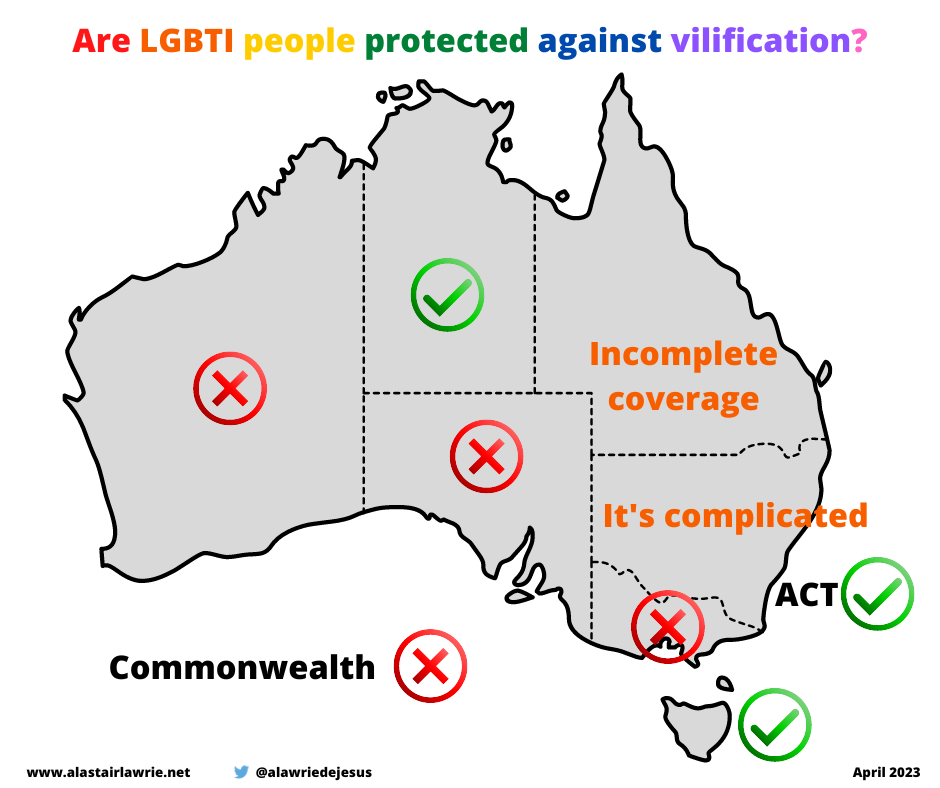
    There is currently no Commonwealth protection against anti-LGBTIQ vilification under the Sex Discrimination Act 1984. Protections at state and territory level are a patchwork replete with many holes, with anti-LGBTIQ vilification prohibited in Tasmania, the ACT, Queensland and Northern Territory, while civil vilification provisions in NSW cover only gay men, lesbians and some transgender people (although Crimes Act prohibitions on inciting violence apply across the LGBTIQ community). There are no protections in Victoria, South Australia or Western Australia.

    The Albanese Government has an opportunity to address these gaps by introducing nation-wide prohibitions on vilification on the basis of sexual orientation, gender identity and sex characteristics, based on existing vilification provisions in section 18C of the Racial Discrimination Act 1975.

    This should be done at the same time as the Government implements its commitment to prohibit religious vilification, given there is little difference in the potential harm vilification causes these respective groups.

    4. Fund safety initiatives for LGBTIQ community organisations and Local Governments

    Similarly, the Commonwealth Government should be providing funding for initiatives to protect the safety of LGBTIQ Australians on an equivalent basis to the programs it has already delivered to faith groups.

    This should include a grants program for LGBTIQ community organisations to upgrade their safety infrastructure, as well as to provide safety training to members of the LGBTIQ community to help protect us against the growing threat of right wing extremism.

    The Government should also fund Local Governments to upgrade their own security settings, so that community events such as Drag Story Times can be held safely despite any threats of intimidation and violence emanating from far-right extremists.

    5. Create and appoint an LGBTIQ Commissioner at the Australian Human Rights Commission

    The above measures should be supported by institutional infrastructure to ensure they are delivered, and delivered in line with community expectations.

    One part of this infrastructure, currently absent, is a stand-alone, dedicated Commissioner for Sexual Orientation, Gender Identity and Sex Characteristics at the AHRC (with responsibility for these issues presently an ad hoc, part-time responsibility of the Sex Discrimination Commissioner).

    The creation and appointment of an LGBTIQ Commissioner would help to ensure that addressing homophobia, biphobia, transphobia and anti-intersex bigotry is given an appropriate emphasis both within the Commission and beyond.

    6. Create and appoint a Commonwealth Government LGBTIQ Advisory Committee

    Another current gap in federal institutional infrastructure is the absence of any Minister with dedicated responsibility for LGBTIQ issues, and/or specific office within a central agency with the onus for co-ordinating policy and service-delivery on LGBTIQ issues.

    Nor is there a national LGBTIQ Advisory Committee to help present views from the full diversity of LGBTIQ communities across the country.

    While all should, in my view, be created, perhaps the most important is the advisory committee – because perhaps, had the Commonwealth Government an existing consultative mechanism, they may have already taken action to address the rise of right wing anti-LGBTIQ extremism, rather than left us feeling like we’re on our own.

    Thank you in advance you your consideration of this submission. Please do not hesitate to contact me, at the details provided, if you require clarification or additional information.

    Sincerely

    Alastair Lawrie 

    Neo-Nazis turn up to an anti-trans rally on the steps of Victorian Parliament, March 2023.

    Commonwealth 2024-25 Pre-Budget Submission on LGBTIQ Priorities

    Pre-Budget Submissions

    Treasury

    Langton Cres

    Parkes ACT 2600

    Submitted via email: PreBudgetSubmissions@treasury.gov.au

    Thursday 25 January 2024

    To whom it may concern

    Supporting the Equality and Human Rights of the LGBTIQ Community

    Thank you for the opportunity to provide this short submission to inform the Commonwealth Government’s development of its 2024-25 Budget.

    I do so as a long-standing advocate on behalf of the lesbian, gay, bisexual, transgender, intersex and queer (LGBTIQ) community.

    In this capacity I submit the following four priorities for increased funding to support the realisation of equality and other fundamental human rights of LGBTIQ Australians.

    1. Commissioner for Sexual Orientation, Gender Identity and Sex Characteristics at the Australian Human Rights Commission (AHRC)

    The Commonwealth Government should fund the creation of a Commissioner for Sexual Orientation, Gender Identity and Sex Characteristics (SOGISC) within the AHRC.

    Currently, there are Commissioners for:

    • Race
    • Sex
    • Disability
    • Age
    • Aboriginal and Torres Strait Islander Social Justice
    • Children, and
    • Human Rights.

    However, when discrimination on the basis of sexual orientation, gender identity and intersex status was prohibited through passage of the Sex Discrimination Amendment (Sexual Orientation, Gender Identity and Intersex Status) Act 2013, no equivalent position was established for our community.

    The consequence of this omission is that responsibility within the AHRC for advocating on discrimination affecting LGBTIQ people has floated variously between the President, Human Rights Commissioner and Sex Discrimination Commissioner – with no permanent home, and therefore no sustained focus on the realisation of LGBTIQ human rights.

    At the moment, responsibility for what is sometimes called the ‘LGBTIQ portfolio’ lies with Sex Discrimination Commissioner Anna Cody, who is somehow supposed to deal with the myriad issues affecting LGBTIQ Australians after they have addressed discrimination affecting women. They are supported in targeting LGBTIQ discrimination by just one dedicated full-time adviser, in contrast to the full team of advisers that support Commissioners on other topic areas.

    This situation is simply not good enough. LGBTIQ equality and human rights deserve the same attention as other cohorts. This should be rectified by:

    • Funding the creation of a stand-alone Commissioner for Sexual Orientation, Gender Identity and Sex Characteristics within the AHRC
    • Supported by a team of advisers of the same size, and with the same resourcing, as existing Commissioners for Race, Disability and Age Discrimination.

    2. National Strategy Against Anti-LGBTIQ Prejudice

    The past 12 months have seen a dramatic escalation in anti-LGBTIQ violence and vilification across Australia, including:

    • The TERF and neo-Nazi rally against trans people in Melbourne in March 2023
    • The religious fundamentalist (‘Christian Lives Matter’) riot against queer protestors in Sydney in March 2023, and
    • Fascist and far-right attempts to intimidate and shut down queer and queer-related community events, including drag story times, around the country.

    As far as I am aware, there has been no formal, co-ordinated Commonwealth Government response to the rise of anti-LGBTIQ extremism during this time.

    This stands in contrast to the Government’s commitment to addressing racism, including through its funding for and support of the development of a National Anti-Racism Framework (with work being undertaken by the AHRC).

    Indeed, Commonwealth Minister for Multicultural Affairs Andrew Giles MP cited neo-Nazi incidents as a justification for the Anti-Racism Framework. As reported by the Guardian:[1]

    “There have been at least two neo-Nazi incidents on the streets of Melbourne in recent times, and that lends a sense of urgency.” It was “more important than ever to have a society that is anchored in a sense that we all deserve to be valued.”

    This overlooks the fact that, as noted above, one of, if not the most, prominent neo-Nazi event in 2023 was the TERF and neo-Nazi rally against trans rights on the steps of Victorian Parliament in March 2023.

    If that incident provides justification for an Anti-Racism Framework, surely it must also provide justification, and motivation, for the Commonwealth Government to fund and develop a National Strategy Against Anti-LGBTIQ Prejudice.

    After all, LGBTIQ Australians, and especially trans and gender diverse Australians, also ‘deserve to be valued’.

    3. Gender affirming healthcare

    Trans and gender diverse Australians should have the ability to live their authentic lives. For many, although not all, this involves accessing gender affirming healthcare, including (but not limited to) hormone treatments and gender affirmation surgical procedures.

    However, for far too many trans and gender diverse people, this health care is financially out of reach, with prohibitive out-of-pocket costs attached to hormones, surgeries and other services.

    This is a denial of the fundamental right to healthcare for people on the basis of who they are. It also carries significant consequences, with this lack of access contributing to higher rates of mental health issues, depression and even self-harm.

    Gender affirming healthcare can be life-saving – while its denial can have the opposite outcome. This healthcare is not elective, but essential, and should be funded as such.

    The Commonwealth Government should therefore use the 2024-25 Budget to remove out-of-pocket costs for gender affirming healthcare, including hormones, surgeries and other medical services which assist trans and gender diverse people live authentically.

    4. A National Intersex Community-Controlled Healthcare Service

    Finally, I am aware of a Pre-Budget Submission from Intersex Human Rights Australia (IHRA), which includes the following recommendation:

    That the government provides $2,100,000 in annual resourcing to develop and sustain an intersex community-controlled healthcare service, to support the provision of biopsychosocial health and medical services for people with innate variations of sex characteristics and families, and support provision of policy advice to government. The service will be developed and run by Intersex Human Rights Australia, which currently provides advocacy and pilot psychosocial support services [emphasis in original].

    I unreservedly endorse this call. The health needs of the intersex community are currently not being met by the Australian healthcare system, with manifestly inadequate resourcing undermining health outcomes for many intersex people.

    IHRA is well-placed to contribute to the process of addressing these shortcomings, with what is a modest sum of money. As noted in their Pre-Budget Submission:

    This proposal ensures that IHRA can support the currently unmet healthcare needs of children, parents and carers, prospective parents, and adults, across the lifespan, and beyond current funding arrangements. It incidentally seeks to ensure the sustainability of IHRA as an intersex community-controlled healthcare service provider…

    It is my sincere hope funding can be found for this initiative in the upcoming Budget.

    Please do not hesitate to content me, at the details provided, should you require additional information in relation to this submission.

    Thank you in advance to taking these priorities into consideration.

    Sincerely

    Alastair Lawrie

    Will Treasurer Jim Chalmers deliver on any of the above four priorities in Tuesday’s Budget?

    [1] ‘Labor to speed up new anti-racism strategy amid voice and Israel-Hamas war tension’, Guardian Australia, 20 October 2023: https://www.theguardian.com/australia-news/2023/oct/20/labor-to-speed-up-new-anti-racism-strategy-amid-voice-and-israel-hamas-war-tensions

    Religious school homophobia causes long-term harm. But change is possible.

    [Content warning: homophobia; violence; suicidal ideation]

    I realised I was same-gender attracted on my first day at a religious boarding school in Brisbane in the 1990s. It was terrible timing, and meant my high school experience there was a living hell.

    This was a school that was proud to publish its homophobia in its school rules – homosexuality would not be tolerated because it was not in accordance with god’s will.

    It was abundantly clear that ‘coming out’ as gay was simply not an option. To do so would likely be met with punishment. And so I didn’t.

    At its worst, I vividly recall a school pastor giving a sermon to a chapel full of 600-or-so year 11 and 12 students, talking about how a child from his former parish had come to see him ‘struggling with confusion’ about who he was. He said the child ultimately committed suicide – before observing this was not the worst thing he could have done.

    For many queer kids sitting there that day, like me, the sermon’s underlying message was obvious: much better to be dead than gay.

    The school’s overall approach to LGBTQ issues oscillated between that kind of explicit prejudice on one hand, and silence and invisibility on the other (including failing to provide any relevant sex education, which was particularly dangerous at a time when HIV/AIDS was still killing thousands).

    Looking back, I think this ‘invisibilisation’ was actually more detrimental in terms of its impact on me, because it meant suffering in silence, completely alone, with the people who were supposed to be looking after me offering no solace.

    The climate created by the school’s silence on sexual orientation and gender identity also allowed anti-LGBTQ bigotry to flourish amongst its students.

    While I cannot be certain homophobia was a conscious motivator in the multiple physical assaults I experienced in Year 11 (which went unpunished by the school), the fact I was ‘different’ in some fundamental way, left cowered by fear into being withdrawn and isolated, rendered me vulnerable.

    I can be more confident homophobia was behind the choice by Year 11 students to bestow on me the ‘Big fat poof’ award at the end of Year 12, in front of both peers and boarding school staff, with the latter doing nothing to respond to it.

    Not even to check if I was okay.

    That was almost three decades ago, so why I am writing about it now?

    Because, with Commonwealth Parliament yet again debating the issue of protections for LGBTQ students and teachers – and yet again looking like letting the LGBTQ community down – there’s two points I want people, and especially politicians, to know.

    First, that religious school homophobia, biphobia and transphobia causes serious harm. For me, that meant thinking about committing suicide every single day from the start of Term 2 in Year 8, until the final term of Year 12. Sometimes upwards of twenty times a day.

    That is no way for a child to live. And definitely no way to learn, or to grow.

    Nor does it suddenly end when the students who are the victims of this prejudice leave the school gates for the final time.

    Trust me, I know. Those terrible five years have impacted me for much, much longer than that again.

    The hurt and the harm I suffered was a major contributing factor to the lost decade that was my twenties, culminating in my thankfully unsuccessful attempt at suicide around my 29th birthday, more than a decade post-school.

    Life got better when I met partner just after I turned 30, but I am not ashamed to admit that even now the trauma from my schooling is something I have discussed with my psychologist multiple times over the past 12 months.

    And so, if the Labor Government chooses to break their clear election promise to protect LGBTQ students in religious schools, it won’t just be a betrayal of the students currently enrolled in homophobic, biphobic and transphobic schools – who, as highlighted by Equality Australia’s ‘Dismissed, Denied and Demeaned’ report released on Monday, continue to be vulnerable now.

    It will be a betrayal of their futures too, with the impacts continuing to be felt in the 2030s, 40s and 50s.

    Second, while it may not initially seem like it, my story is one of hope.

    Because those experiences were in Queensland – a state which legislated to protect LGBTQ students in religious schools against discrimination two decades ago, and which is currently consulting on promised reforms to protect LGBTQ teachers too.

    Far from causing religious schools to cease to exist, as baseless scare-mongering by groups like Christian Schools Australia assert, the main outcome has simply been that LGBTQ students can finally learn and grow safe from discrimination on the basis of who they are.

    And, I’m reliably informed by people whom I trust, that includes at the school I went to. Change is possible.

    Sadly, that still has not happened everywhere, with religious schools legally free to discriminate against LGBTQ students under Commonwealth law, and in NSW, WA and SA too.

    Commonwealth Parliament can rectify this by immediately implementing the straight-forward recommendations of the ALRC report. If they do, they would be choosing to bestow a brighter future on LGBTQ students right across Australia.

    *****

    For LGBTIQ people, if this post has raised issues for you, please contact QLife on 1800 184 527, or via webchat: https://qlife.org.au/resources/chat

    Or contact Lifeline Australia on 13 11 14.

    Five years at a homophobic religious boarding school caused decades of harm.

    *****

    For an extended account of my experiences at that homophobic and harmful religious boarding school, you can read the following:

    Finally, if you have appreciated reading this article, please consider subscribing to receive future posts, via the right-hand scroll bar on the desktop version of this blog or near the bottom of the page on mobile. You can also follow me on twitter @alawriedejesus

    The Year the Commonwealth Government Went MIA on LGBTIQ Issues

    [I wrote this piece about 10 days ago, in the lead-up to the anniversary of the horrific events at Victorian Parliament in March last year. Unfortunately, it wasn’t picked up by media outlets – but the past week has made these comments even more urgent, so I am publishing it here.]

    One year ago last Monday (on Saturday 18 March 2023), Australians witnessed the horrific sight of neo-Nazis turning up to an anti-trans rally on the steps of Victorian Parliament, holding a banner saying ‘destroy paedo freaks’ and performing Nazi salutes.

    It was a chilling reminder of the serious threat posed by right-wing extremism to LGBTIQ communities in general, and trans and gender diverse people in particular.

    Rather than being a one-off, that awful anti-LGBTIQ spectacle was just the first in a long line of rallies and related hate speech threatening our communities over the past 12 months.

    Within days, so-called ‘Christian Lives Matter’ members engaged in what can only be described as a riot against peaceful LGBTIQ protestors (and NSW Police) in the Sydney suburb of Belfield.

    April onwards saw a dramatic rise in threats of violence and intimidation by right-wing extremists across the country, directed to local councils and libraries holding Drag Story Times.

    Most recently, the ABC was forced to cancel a Drag Story Time that was to be held in conjunction with the Sydney Gay & Lesbian Mardi Gras following death threats against their employees.

    The attacks on our communities have been terrifying. They have been relentless. And they are part of a disturbing international trend of intolerance.

    But where has the Commonwealth Government been when we have needed their leadership? 

    They were quick to introduce legislation to ban the display of Nazi hate symbols, later amended to also prohibit the Nazi salute. This was welcome, but addresses only part of the problem.

    A group of thugs intimidating trans people with a banner saying ‘destroy paedo freaks’ is a serious issue irrespective of what clothes they wear, flags they fly or salutes they perform.

    Sadly, though, we have not seen the Albanese Government respond to the rise in anti-LGBTIQ right-wing extremism with the seriousness it deserves. 

    We have not seen or heard clear and consistent condemnation of growing homophobia, biphobia and transphobia, or even of the violent threats against community events.

    There has been no commitment to introduce much-needed Commonwealth laws prohibiting anti-LGBTIQ vilification.

    And no open engagement with LGBTIQ communities about the threats we face, or additional funds committed to help with our safety.

    Instead, it has been left to unfunded groups like Rainbow Community Angels, who attempt to make events like Drag Story Time a safe place for attendees, to stand up against the far-right, unassisted.

    It’s possible the Government would say that primary responsibility for these issues lies with states and territories, but these are problems that call for national leadership.

    By contrast, faith communities have been actively engaged and largely supported when they have raised concerns about intolerance. 

    Government representatives, from Prime Minister Albanese down, have spoken up in recent months against religious hate speech, particularly in the form of anti-semitism. The Government has made repeated promises to introduce religious vilification laws, expected to be tabled within weeks.

    [NB Since this piece was written, the Government has confirmed it is pushing ahead with these amendments, separate to the Religious Discrimination Bill and any Sex Discrimination Act changes, meaning it may be the only part of those overall reforms that actually pass.]

    And $40 million in Commonwealth funding for the safety of religious organisations was announced by Attorney-General Mark Dreyfus last May (on the International Day Against Homophobia, Biphobia and Transphobia no less).

    The LGBTIQ community can’t even convince the Government to create and appoint a stand-alone LGBTIQ+ Discrimination Commissioner at the Australian Human Rights Commission. LGBTIQ issues remain a part-time, ad hoc responsibility of the Sex Discrimination Commissioner.

    Promises to address anti-LGBTIQ vilification, and funding for LGBTIQ community safety, remain nowhere to be seen.

    I’m a 45-year old cis gay man. I grew up in Joh Bjelke-Petersen’s Queensland, and survived five years at a deeply homophobic religious boarding school. Coming out of, and coming out after, that environment was tough.

    But the rise in overt, targeted, public bigotry over the past 12 months has left me feeling less safe than at any time since the 1990s.

    What has made things worse is the silence and inaction of the Albanese Government. This has left me, and many others in our community, feeling forgotten too.

    Source: Herald Sun.

    If you have enjoyed reading this article, please consider subscribing to receive future posts, via the right-hand scroll bar on the desktop version of this blog or near the bottom of the page on mobile. You can also follow me on twitter/X @alawriedejesus

    The worst of times

    As the dust settles on the recent federal election, and the new Albanese Labor Government settles into office, I wanted to take this short(ish) opportunity to reflect on the term of Parliament just ended, and especially its impact on LGBTIQ Australians.

    To the surprise of few readers of this blog, the reflection of the past three years in the rear-view mirror (now thankfully receding into the distance) is far from pretty. Indeed, in my opinion, the 2019-2022 term of the Morrison Liberal/National Government was the worst for LGBTIQ people in my lifetime, by some margin.

    There are many reasons for arriving at this conclusion, chief among them the Religious Discrimination Bill, which came to dominate the Morrison Government’s legislative agenda, especially in its dying days.

    Remember, this was a law that sought to legally protect offensive, humiliating, insulting and ridiculing comments against women, LGBT people, people with disability and people of minority faiths. By over-riding existing state and territory anti-discrimination laws, it also procedurally denied access to justice for victims of discrimination.

    The Coalition’s Religious Discrimination Bill featured the broadest special privileges allowing religious organisations to discriminate against employees and people accessing their services of any anti-discrimination law in Australia. 

    If passed, it could have entrenched existing discrimination against LGBT students ‘under the guise of religious views’ – while it definitely would have permitted new forms of discrimination against LGBT teachers by over-riding states and territories that had already protected them.

    For more on the problems of the Religious Discrimination Bill, read: Why the Religious Discrimination Bill must be rejected (in 1,000 words or less) 

    And even though LGBT people were obviously not the only targets of what I would describe as legislated hatred, I don’t think anyone would deny that denying the rights of LGBT Australians was a primary motivator both for the Morrison Government itself, and for the religious fundamentalists who supported the Bill.

    But the Religious Discrimination Bill was by no means the only attack on LGBTIQ people by the Morrison Government.

    In the final 12 months alone, we saw all bar six Liberal and National Party Senators vote for a One Nation motion calling for an end to gender-affirming and supporting health care for trans children and teenagers (in June 2021).

    In September, the Coalition also rejected straight-forward amendments to the Fair Work Act 2009 (Cth) which would have seen trans, gender diverse and intersex workers protected on exactly the same basis as others, including lesbian, gay and bisexual workers (for more, see: Pathetic, and antipathetic, in equal measure).

    In February 2022, on the very day that the Religious Discrimination Bill was finally abandoned, Tasmanian Liberal Senator Claire Chandler introduced legislation seeking to ban trans women and girls from participating in sport. Despite being a private member’s bill, it was later explicitly and repeatedly supported by Morrison himself, and no doubt would have been a priority for his Government had they been re-elected.

    And of course the election campaign itself was marred by the toxic transphobia of candidate for Warringah, Katherine Deves, hand-picked by Morrison himself in a transparent effort to invent a culture war and win the votes of bigots (for more, see: Ten months of transphobia). 

    Then there was the issue of LGBT students in religious schools, a topic about which the Morrison Government continually found new ways to disappoint, ultimately abandoning some of the most vulnerable members of the community.

    Morrison had promised way back in October 2018 to protect LGBT kids before the end of that year – a commitment he spent the following three and a half years running away from (for more, see: Scott Morrison’s Broken Promise to Protect LGBT Students is Now Three Years Old). By the time he was booted from office, his broken promise to end discrimination against LGBT students was 1,318 days old (and yes, I was counting).

    The appalling treatment of LGBT kids during the Religious Discrimination Bill debate in February demonstrates just how little he, and his Ministers, cared about this group. Not only did Morrison’s proposed amendments only seek to prohibit expulsion – which would have allowed religious schools to continue to mistreat students in 1,001 other ways, from differential treatment and exclusion, through to discipline, detention, suspension and even asking them to leave).

    But the calculated choice to exclude trans and non-binary children from any and all protection whatsoever (and therefore only to prohibit the technical expulsion of lesbian, gay and bisexual kids), was a wholly-prejudiced policy so heinous it can never be forgiven, and that includes anyone who voted for it.

    The mistreatment of LGBT students also neatly illustrates why the last term of Parliament was truly the worst of times because, as much as what made the past three years horrific were the constant attacks on our community, just as damaging in the long run was the Morrison Government’s failure to take action to address long-standing human rights abuses against LGBTIQ Australians.

    Not least of which are coercive surgeries and other non-consenting medical interventions on children born with innate variations of sex characteristics (otherwise known as intersex children).

    Not only did the Abbott, Turnbull and Morrison Governments successively fail to implement any of the recommendations of the ground-breaking Senate Inquiry into this issue from October 2013 – almost nine years ago – but, as far as I am aware, they also didn’t even acknowledge, let alone respond to, the Australian Human Rights Commission’s Report from October 2021 either (‘Ensuring health and bodily integrity: Protecting the human rights of people born with variations in sex characteristics in the context of medical interventions’).

    Now, as someone who is in their mid-40s, I’m old enough to recognise that the last term of Parliament is not the only three-year period which has been challenging for LGBTIQ Australians.

    Indeed, I suspect readers are probably thinking of two other terms which were also brutal – the 2001-2004 term of the Howard Government during which the marriage ban was originally passed, and the 2016-2019 term of the Turnbull/Morrison Government, and especially the plebiscite debate and then postal survey.

    But I would argue that neither was as relentlessly awful as the three years just concluded.

    In terms of Howard, it was really only the final six months of the 2001-2004 term during which he sought to use same-sex marriage (as it was then called) as a wedge against the Labor Opposition – the first two and a half years were awful for other reasons (especially in the (mis)treatment of First Nations people, and people seeking asylum) but did not specifically target LGBTIQ Australians in the same way as the Morrison Government.

    And in terms of the 2016-2019 term of the Turnbull (and later Morrison) Government, I absolutely acknowledge that the debate about the plebiscite, in the last half of 2016, and then the postal survey (which, let’s not forget, was the idea of now-Opposition Leader Peter Dutton) in the last half of 2017, were completely unnecessary, totally divisive and ultimately damaging for far too many LGBTIQ people.

    At the same time, it was nevertheless a debate about improving the legal recognition of LGBTIQ relationships, and the Australian people eventually delivered marriage equality, which was a welcome and long-overdue step forward (no thanks to the Liberal Party, who must never be allowed to claim credit for this outcome – see: Liberals Claiming Credit for Marriage Equality Can Get in the Bin).

    In contrast, the debate around the Religious Discrimination Bill concerned a law that sought to strip existing rights away from LGBT people, including protections against discrimination, and the ability to go about our day-to-day lives without being subjected to offensive, humiliating, insulting and ridiculing comments simply because of who we are.

    The Religious Discrimination Bill debate also dragged on far longer than the plebiscite/postal survey – with the first exposure draft released in August 2019 (followed by a second in December of that year), and the Bill not stopped until February 2022 (30 months later).

    I should at least acknowledge two additional contextual factors which help to explain just why the past three years have been so rough – although neither reduces the culpability of the Morrison Government for its actions.

    The first is that there was obviously a cumulative effect of the Abbott/Turnbull/Morrison Government’s homophobia, biphobia, transphobia and anti-intersex discrimination. With the safe schools debate and decision to de-fund it occurring in the first term, and the plebiscite debate and postal survey (plus religious freedom review) in the second, the LGBTIQ community was already worn down by seemingly continuous debates about our lives.

    Although, as the Treasurer who allocated funding for the plebiscite and then postal survey, Scott Morrison is responsible for a significant share of that accumulated stress.

    The second is there is no doubt the ongoing COVID-19 pandemic since early 2020 has exacerbated the harms caused by the Morrison Government’s attacks on our community, especially because it left us isolated and alone in our homes when we needed each other for support and reinforcement to fight back against the Religious Discrimination Bill.

    But once again, that context does nothing to exculpate the outgoing Government – indeed, the fact they were willing to push ahead with this divisive legislation, during bushfires, and floods, and a global pandemic, and instead of doing anything to alleviate climate change, only renders them more guilty.

    There is one last question which needs to be addressed, and that is: why does writing this down matter? Especially post-election?

    After all, the Morrison Government has been defeated. The country has (thankfully) moved on. While for the LGBTIQ community, we already know the past three years were the worst of times, because we endured them, and for many have the scars to prove it.

    To which I say there are still (at least) two reasons for publishing this article.

    The first is to ensure the Coalition’s homophobia, biphobia, transphobia and anti-intersex discrimination is properly recorded.

    This is especially important as the Liberal Party inevitably tries to rewrite the history of the recent past, to present some kind of softer, kinder, gentler image to the electorate. But there was nothing soft, or kind, or gentle, about 2019, 2020, 2021, and early 2022 for lesbian, gay, bisexual, transgender, intersex and queer Australians.

    The second is because I think it helps to explain how many of us are feeling, right now. Yes, there is a sense of relief the attacks on us have ended (for now), but that welcome feeling doesn’t even begin to outweigh the sheer exhaustion from fighting constant battles over the last three, or six, or nine, years.

    The tiredness in our collective bones.

    On a personal level, and as an advocate with more than two decades experience, I will willingly concede the past three years have been the toughest of them all. 

    The end of 2021, when two years of a global pandemic was followed by the introduction of the final Religious Discrimination Bill in late November, was particularly rough. It is definitely no coincidence that, in late December, exactly three days after lodging our submissions to both Parliamentary inquiries into the Bill, I came down with shingles (the working title for this post was actually ‘Scott Morrison’s Homophobia Gave Me Shingles’ but I assumed, probably correctly, nobody would click on that).

    My body was saying, loudly and clearly, enough. Especially as illness ruined the planned summer break, preventing me from seeing my parents in Queensland.

    Of course, the Religious Discrimination Bill debate continued, relentless, rolling on into Committee hearings in early January and Parliamentary debate in early February. But so did my need to stand up for my community, and try to see it defeated. Which we did. Collectively. But it came with a significant cost.

    For me, that was burnout worse than anything I have experienced before, and – being completely honest – which I’ve only just recovered from (and which helps to explain the lack of recent posts).

    Anyway, the point of this is not to say ‘woe is me’ (I’m fine, now). But it is to acknowledge there are a lot of people still feeling pretty bruised and battered by the past three years. And so we should try to show the care towards each other that the Morrison Government didn’t.

    Together, we saw off the Religious Discrimination Bill. Together, we can put the worst of times behind us.

    NB This post is written in a personal capacity, and does not reflect the views of employers past or present.

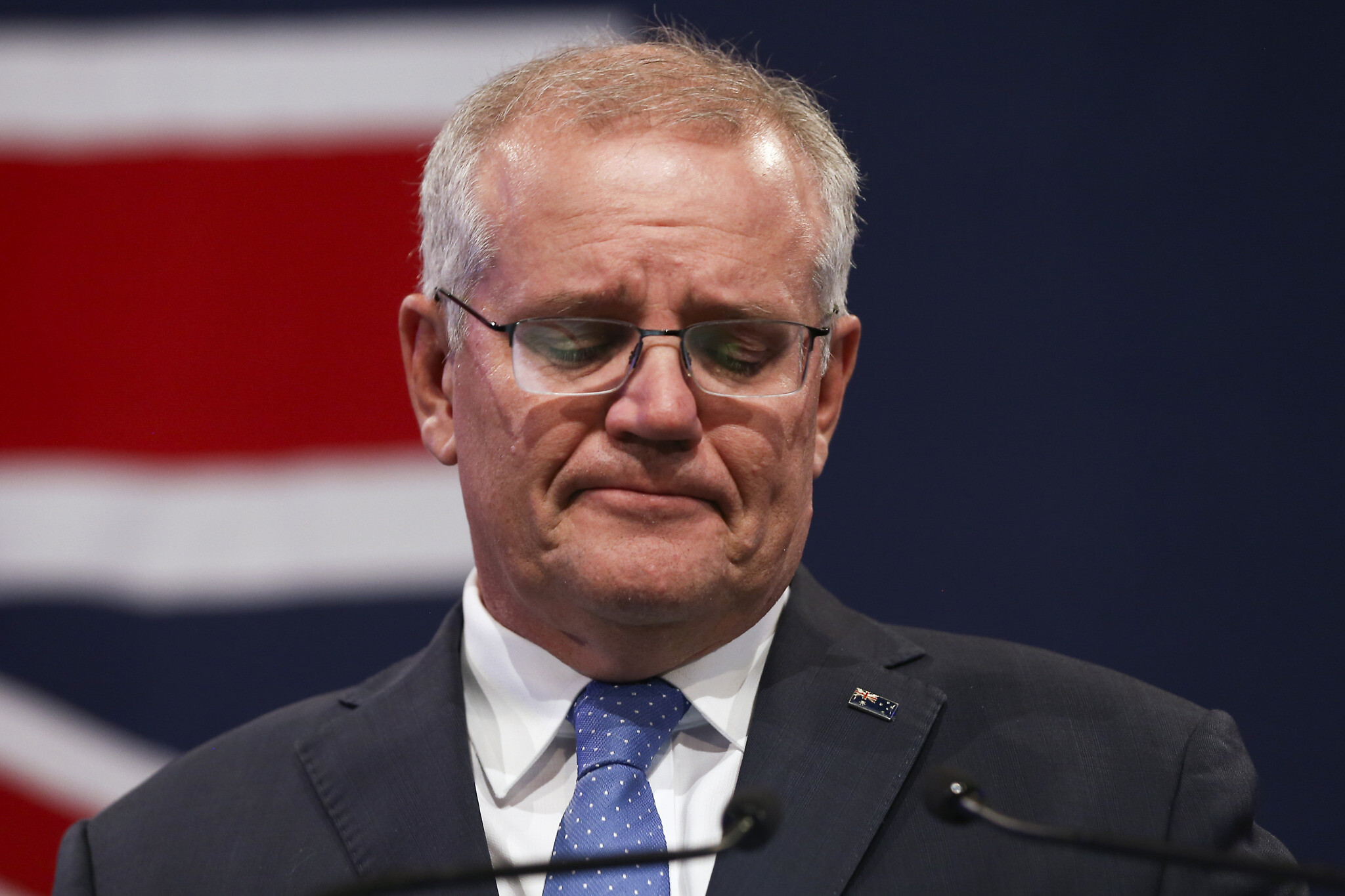
    Scott Morrison’s defeat ended the worst Commonwealth Parliamentary term for LGBTIQ rights in my lifetime.

    If you have enjoyed reading this article, please consider subscribing to receive future posts, via the right-hand scroll bar on the desktop version of this blog or near the bottom of the page on mobile. You can also follow me on twitter @alawriedejesus

    Submission re Tasmanian Law Reform Institute Sexual Orientation and Gender Identity Conversion Practices Issues Paper

    via Law.Reform@utas.edu.au

    28 January 2021

    To whom it may concern

    Thank you for the opportunity to make a submission on this important topic.

    I do so as a long-term advocate for Australia’s lesbian, gay, bisexual, transgender and intersex (LGBTI) community, including through my website www.alastairlawrie.net

    While my primary law reform focus is on improving LGBTI anti-discrimination and anti-vilification legislation, I have also previously made multiple submissions in relation to sexual orientation and gender identity conversion practices, including in New South Wales[i] and Victoria.[ii]

    In this submission, I will attempt to answer most, although not all, of the answers posed in the Issues Paper.

    However, I also wish to acknowledge that the most important voices in this debate are those of the survivors of these abhorrent practices, including survivors of sexual orientation and gender identity conversion practices in Tasmania.

    Therefore, where my answers may diverge from the submissions made by survivors, both individuals and organisations, I urge you to prioritise their views as the experts on the wide scope of these practices, the serious harms they cause and the most effective way(s) in which to prohibit them.

    Question 1: After considering the background and working definition, in your opinion, what are and are not ‘sexual orientation and gender identity conversion practices’?

    In my view, the terminology ‘sexual orientation and gender identity conversion practices’ is appropriate, as it avoids the limitations of alternatives such as ‘ex-gay or ex-trans therapy’.

    I defer to survivors on the matter of all of the possible acts that should be included in any definition. However, the scope of any definition must not be limited to only cover conversion practices which occur in health settings (a mistake made in the Queensland Health Legislation Amendment Act 2020).

    On the other hand, it must cover conversion practices which occur in religious settings, both formal and informal, because that is where survivors tell us most of the harm is inflicted.

    In terms of the possible definition, I think the TLRI working definition captures the core components of conversion practices:

    (a) acts or statements;

    (b) that are aimed at changing, suppressing, or eradicating the sexual orientation or gender identity of another person; and

    (c) are based on a claim, assertion or notion that non-conforming sexual orientation or gender identity is a physical or psychological dysfunction that can be suppressed or changed.

    My one concern in this definition is the use of the word ‘non-conforming’, implying that there are sexual orientations or gender identities which do conform, or are ‘the norm’.

    I would suggest consideration of alternative phrasing, perhaps to words to the effect of ‘that a sexual orientation that is not heterosexuality or a gender identity that is not cisgender’.

    This wording may also help to ensure that support services for same-sex attracted and gender diverse people exploring their identities, as well as assistance for people considering or undergoing a gender transition, are not captured in the definition (noting these have been expressly excluded in both the Queensland legislation, and the ACT Sexuality and Gender Identity Conversion Practices Act 2020).

    Finally, I support the inclusion of removing a person from Tasmania for the purpose of sexual orientation and gender identity conversion practices conducted outside the state in any definition and/or offences, because the harm is still inflicted on Tasmanians.

    Question 2: Should people be allowed to consent to SOGI conversion practices? If so, at what age, and under what conditions?

    No, I do not believe it is possible to ‘consent’ to SOGI conversion practices, even for adults.

    The ideology which underpins conversion practices – that people who are same-sex attracted or gender diverse are ‘broken’ and require ‘fixing’ – is dangerous and incredibly harmful. The ideology is also erroneous – LGBT people are beautiful, just as we are – meaning any consent derived from it is based on a falsehood.

    In addition, people who have been indoctrinated with this abusive ideology, whether in familial, educational, health and/or religious settings, and therefore experience severe shame about who they are, are not in a position to provide genuine consent to what is simply further abuse.

    As someone who attended a deeply homophobic religious boarding school in Queensland in the 1990s – where same-sex attraction was demonised from the school rules to the pulpit (with one pastor suggesting suicide was not the worst possible outcome for children struggling with their sexual orientation)[iii] – and consequently developed profound self-loathing, I may have even participated in more-formal conversion practices had they been offered, either at the school or afterwards.

    I don’t believe that my ‘consent’ in such circumstances would have been any more real on the day I turned 18 than the day before.

    The practices themselves are the problem, and they should be unlawful irrespective of who is being subjected to them.

    On the other hand, I do support potential differentiation in penalty on the basis of who is being harmed. For example, while sexual orientation and gender identity conversion practices should be unlawful in all circumstances, I favour increased maximum sentences where the victim is a child or young adult under the age of 18 or a person with decision-making impairments (to use the terminology outlined in the Issues Paper).

    Question 3: Have you been involved in or offered, or are you aware of, any forms of SOGI conversion practices in Tasmania? If so, what were the effects on you, or the person exposed to them?

    Not applicable.

    Question 4: Do you think that Tasmanian law should be changed to address SOGI conversion practices? If so, should this be through comprehensive reform, amendment or both (a hybrid)?

    I do not believe current Tasmanian laws are sufficient to deal with the harms caused by sexual orientation and gender identity conversion practices. Nor do I believe they can be addressed simply by amendments to existing laws. Therefore, I support either comprehensive reform, or a hybrid approach.

    This would, at a minimum, include creating criminal offences covering sexual orientation and gender identity conversion practices, as well as providing civil remedy options to ensure that survivors of these abuses have the ability to seek financial compensation.

    As discussed in my answer to question 2, above, I believe these responses (criminal offences and civil remedies) should cover all people who are subjected to sexual orientation and gender identity conversion practices. However, the available penalties should be higher where the person subject to harm is a child or young adult under the age of 18 or a person with decision-making impairments.

    Question 5: Should some or all forms of SOGI conversion practices be criminalised in Tasmania? If so, which, if any should be dealt with as serious (indictable) crimes and which, if any, should be dealt with as less serious (summary) offences?

    Yes, sexual orientation and gender identity conversion practices should be criminalised.

    Given the serious harms caused by these practices, I believe that at least some of these activities should constitute indictable offences.

    As indicated in my answers to both questions 2 and 4, above, I also believe there should be higher maximum penalties where the person subject to harm is a child or young adult under the age of 18 or a person with decision-making impairments. This may involve the creation of separate offences, or the inclusion of age and decision-making capacity as aggravating factors in sentencing.

    Again, given the seriousness of the harms inflicted by sexual orientation and gender identity conversion practices, I believe that imprisonment should be an option, particularly for the worst instances of abuse (although, being unfamiliar with sentences under Tasmanian criminal law, I am not in a position to recommend a maximum term of imprisonment).

    Finally, as indicated in my response to question 1, I believe these offences must extend beyond just health practitioners to include religious settings, both formal and informal, because that is where survivors tell us most of the harm is inflicted, as well as other areas (for example, educational settings).

    Question 6: Should some or all forms of SOGI conversion practices be made civil wrongs in Tasmania? If so, what sort of practices should people be liable for and how should those subject to such practices be compensated?

    Yes, sexual orientation and gender identity conversion practices should be made civil wrongs in Tasmania, in addition to being subject to criminal sanctions. This is necessary to allow the people harmed by such abuses to seek financial compensation.

    Given people who have been exposed to the harmful ideology which underpins conversion practices may not be aware for some time afterwards that what they experienced was, in fact, abuse, I am in favour of extending the limitation period beyond the ordinary three years, and potentially up to 12 years.

    Question 7: Should any existing Tasmanian laws (besides criminal laws or the Civil Liability Act 2002 (Tas)) be amended to cover SOGI conversion practices? If so, which ones and in which ways?

    Provided that sexual orientation and gender identity conversion practices are covered by both criminal penalties and civil remedies (including financial compensation), I am agnostic about the specific vehicle(s) to deliver the latter.

    I note that inclusion within Tasmania’s best practice anti-discrimination framework, via the Anti-Discrimination Act 1998, may confer some benefits (including in terms of access to dispute resolution, potential lesser exposure to costs as well as possible greater variation in outcomes such as public apologies).

    Inclusion in the Anti-Discrimination Act may also allow the Anti-Discrimination Commissioner to investigate conversion practices, even in the absence of a specific complaint from survivors. 

    However, I defer to the views of survivors about their preferred regulatory approach.

    Question 8: Are there any other models or approaches that are preferable to, or should complement, changing the law?

    I also defer to survivors, both individuals and organisations, about the best ways to detect or report sexual orientation and gender identity conversion practices.

    However, I agree with the view expressed in the Issues Paper that it may be difficult to enforce any law against these abuses.

    This includes both the criminal law – where it may be difficult to establish proof beyond a reasonable doubt (although I nevertheless support the creation of criminal offences to send a strong public statement that such practices are contrary to community interests, are wrong, and are fundamentally harmful). 

    And it will also be difficult to enforce under civil law because it will place the onus on people who have experienced psychological abuse (and potentially physical abuse, too) to bring actions and to therefore possibly be retraumatised through the litigation process.

    As with most complex problems, legislation alone will never be sufficient on its own to combat the ills of sexual orientation and gender identity conversion practices.

    This is especially true because eliminating such practices also means eradicating the harmful ideology which underpins it (that people who are same-sex attracted or gender diverse are ‘broken’ and require ‘fixing’). That will require the concerted and sustained efforts of government and non-government organisations, in partnership with survivors.

    I obviously defer to survivor organisations about which support and other services require funding to accomplish this objective.

    Question 9: Are there any other matters that you consider relevant to this Inquiry and would like to raise?

    I agree with the view expressed in the Issues Paper that criminalisation may drive sexual orientation and gender identity conversion practices further underground.

    However, I do not believe this risk is sufficient to justify not prohibiting practices which inflict severe harm on many of the community’s most vulnerable people, including LGBT children and young adults.

    This risk can also be mitigated by ensuring that law enforcement is appropriately trained and resourced to address the serious problems caused by conversion practices, as well as empowering an independent authority to investigate systemic issues (for example, the Tasmanian Anti-Discrimination Commissioner, as discussed above in response to Question 7).

    Finally, I understand that some groups may oppose any regulation in this area on the basis of ‘religious freedom’.

    However, such opposition does not understand that freedom of religion is not absolute. As Article 18(3) of the International Covenant on Civil and Political Rights makes clear:

    Freedom to manifest one’s religion or beliefs may be subject only to such limitations as are prescribed by law and are necessary to protect public safety, order, health or morals or the fundamental rights and freedoms of others.

    Laws which seek to protect people against sexual orientation and gender identity conversion practices – which, in my view, constitute psychological torture and can and in many cases do lead to adverse mental health outcomes including depression, self-harm and even suicide – would therefore be clearly justified under international human rights law.

    Thank you in advance for your consideration of this submission. Please do not hesitate to contact me, at the details provided, should you require additional information.

    Sincerely

    Alastair Lawrie
    Footnotes:


    [i] Submission to NSW Parliament Inquiry into False or Misleading Health Practices re Ex-Gay Therapy and Intersex Sterilisation, 16 June 2014. Available at https://alastairlawrie.net/2014/06/16/submission-to-nsw-parliament-inquiry-into-false-or-misleading-health-practices-re-ex-gay-therapy-and-intersex-sterilisation/

    [ii] Submission to Victorian Government Consultation on Banning Conversion Practices, 24 November 2019. Available at: https://alastairlawrie.net/2019/11/24/submission-to-victorian-government-consultation-on-banning-conversion-practices/

    [iii] I have previously written about my experiences at that school, here: The longest five years.

    Private Lives. Public Discrimination. Political Exacerbation.

    In November, La Trobe University’s Australian Research Centre in Sex, Health and Society (ARCSHS) released ‘Private Lives 3: The Health and Wellbeing of LGBTIQ People in Australia’. 

    Building on reports in 2005 and 2011, Private Lives is Australia’s largest national survey of the health and wellbeing of lesbian, gay, bisexual, transgender, intersex and queer (LGBTIQ) people.

    Covering a diversity of topics, from households and relationships, to housing and homelessness, general health and wellbeing, mental health and wellbeing, alcohol, tobacco and other drug use, and intimate partner and family violence (among others), it makes for both fascinating reading and invaluable research. I strongly encourage you to download and read it.

    However, as someone with a particular interest in all things LGBTIQ discrimination, it is their section on ‘Discrimination, harassment and feelings of acceptance’ I will focus on today.

    The Private Lives 3 findings in this area are, frankly, disturbing.

    Asked, ‘to what extent do you feel accepted in the following situations?’, just 60.7% of LGBTIQ Australians answered ‘a lot’ or ‘always’ in relation to work.

    That figure dropped to 55.3% in educational institutions, and 43.4% when accessing a health or support service.

    Only 30.5% of LGBTIQ people said they felt accepted a lot or always in public (eg in the street/park), and a perhaps unsurprising but still shockingly low figure of 10.5% at religious or faith-based events or services.

    It is also unsurprising that cisgender members of the LGBTIQ community reported higher rates of acceptance than trans and non-binary people.

    For example, while 68.5% of cisgender men and 61% of cisgender women felt accepted a lot or always at work, this fell to 50% for trans women, 48.8% for trans men and just 43% for non-binary people.[i]

    There was a similar divergence in terms of acceptance by sexual orientation, with gay and, to a lesser extent, lesbian respondents reporting higher rates than bisexual, pansexual, queer and asexual people.

    For example, while 69.6% of gay and 63.8% of lesbian people said they felt accepted at work always or a lot, just 53.6% of bisexual, 54.5% of pansexual, 54.5% or queer and 47.4% of asexual people said the same thing.[ii]

    The responses to the question ‘In the past 12 months, to what extent do you feel you have been treated unfairly because of your sexual orientation or gender identity?’ are just as disturbing (if not more). As the authors (Hill, Bourne, McNair, Carman and Lyons) observe on page 40:

    ‘Almost six in ten participants reported that they had been treated unfairly to some degree (either a little, somewhat, a lot or always) because of their sexual orientation in the past 12 months, with 4.5% reporting a lot or always. Over three quarters (77.5%) of trans and gender diverse participants reported that they had been treated unfairly to some degree because of their gender identity in the past 12 months, with 19.8% reporting a lot or always.’

    Even more shocking are the high reported rates of experiences of vilification – and worse – based on sexual orientation and/or gender identity. In the previous 12 months:[iii]

    • 34.6% of respondents reported experiencing verbal abuse (including hateful or obscene phone calls) due to their sexual orientation or gender identity
    • 23.6% experienced harassment such as being spat at and offensive gestures
    • 22.1% received written threats of abuse via emails or social media
    • 14.6% experienced threats of physical violence, physical attack or assault without a weapon
    • 11.8% experienced sexual assault
    • 11.4% received written threats of abuse in other ways
    • 10% experienced refusal of service
    • 9.9% experienced refusal of employment or being denied promotion
    • 5.3% received written threats of abuse via graffiti, and
    • 3.9% experienced physical attack or assault with a weapon (knife, bottle, stones).

    ‘Overall, trans and gender diverse participants reported higher levels of harassment and abuse than cisgender participants. For example, a greater proportion of trans women (51.6%), non-binary participants (49.4%) and trans men (45%) reported verbal abuse in the past 12 months due to their sexual orientation or gender identity compared to 28.7% of cisgender women and 32.7% of cisgender men.’

    This is nothing short of an epidemic of discrimination, harassment, vilification and violence against LGBTQ Australians on the basis of their sexual orientation and, especially, gender identity. And it is getting worse, not better.

    For example, reported rates of verbal abuse increased from 25.5% in Private Lives 2 (released in 2011) to 34.6% in Private Lives 3; harassment such as being spat at and offensive gestures rose from 15.5% in PL2 to 23.6% in PL3; physical attack or assault with a weapon doubled, from 1.8% to 3.9%; and sexual assault quadrupled, from 2.9% to 11.8%.

    Let me think, what happened in the period between Private Lives 2, and the survey period for Private Lives 3 (from 24 July to 1 October 2019), which could have caused greater homophobia, biphobia and transphobia in the Australian community?

    It seems undeniable that the Coalition Government’s proposed plebiscite on same-sex marriage, and actual postal survey – and the toxic public debate surrounding both – has directly contributed to increased anti-LGBTQ prejudice.

    Nor should we underestimate the negative impact of the ‘religious freedom’ movement which they deliberately unleashed, with the Religious Freedom Review in 2018, and the Morrison Government’s First Exposure Draft Religious Discrimination Bill which was released right in the middle of the Private Lives 3 survey period, in August 2019.

    What should happen from here?

    The Private Lives 3 survey results show us the scale of the problem: appalling rates of discrimination, harassment, vilification and violence against LGBTQ Australians on the basis of their sexual orientation and, especially, gender identity. And we have a pretty good idea about who is to blame (at least for making the situation much, much worse than it already was). But what is the solution?

    I would argue the following three actions would be a good place to start (although I’m sure readers of this blog could offer other useful suggestions, via the comments section below):

    1. Improve LGBTI anti-discrimination laws

    The introduction of Commonwealth anti-discrimination protections for the LGBTI community, through the historic Sex Discrimination Amendment (Sexual Orientation, Gender Identity and Intersex Status) Act 2013, was an important step, although by no means the end of the journey.

    As I have written previously, these laws need to be strengthened, including by:

    • Updating ‘intersex status’ to ‘sex characteristics’
    • Protecting LGBT students, teachers and other staff in religious schools against discrimination
    • Limiting overly-generous religious exceptions that permit discrimination against LGBT people across many areas of public life, and
    • Appointing a Commissioner for Sexual Orientation, Gender Identity and Sex Characteristics at the Australian Human Rights Commission.

    Discrimination in employment, especially against trans and gender diverse employees as identified in Private Lives 3, also needs to be addressed by explicitly including gender identity and sex characteristics in adverse action and unlawful termination provisions of the Fair Work Act 2009 (Cth). 

    2. Introduce LGBTI anti-vilification protections

    One of the long-standing, missing pieces of LGBTI law reform, at least at Commonwealth level, is protection against anti-LGBTI vilification. The high rates of hate-speech reported through Private Lives 3 has merely confirmed the urgency of addressing this gap.

    As I hav consistently advocated over many years,[iv] given homophobia, biphobia, transphobia and intersexphobia can be just as harmful as racism, the Sex Discrimination Act 1984 (Cth) should be amended to prohibit anti-LGBTI vilification on an equivalent basis to the prohibition of racial vilification in section 18C of the Racial Discrimination Act 1975 (Cth).

    3. Publicly-fund programs against homophobia, biphobia, transphobia and intersexphobia

    Being an advocate for LGBTI law reform, it is easy to forget that changing the law can only ever be one part of the solution – and often only a small part at that.

    To address the ongoing, high levels of anti-LGBTQ discrimination in employment, healthcare, education and other areas of public life identified in Private Lives 3, we need well-funded, publicly-funded campaigns explicitly targeting homophobia, biphobia, transphobia and intersexphobia.

    We also need our elected representatives to lead by example, by calling out prejudice on the basis of sexual orientation, gender identity and sex characteristics, and making sure anti-LGBTIQ comments are never acceptable in public debate.

    What is actually happening?

    Unfortunately, when we examine what is being done in relation to the three actions described above, the answer is not much. In fact, worse than just political inaction, the Coalition Government seems intent on exacerbating these problems rather than solving them.

    For example, the proposed Religious Discrimination Bill – which Attorney-General Christian Porter recently confirmed remained part of the Government’s legislative agenda – would make it easier for religious individuals and organisations to discriminate against LGBTIQ Australians, including by refusing to provide healthcare services that benefit members of our communities (for more, see The ‘Bad Faith’ Religious Discrimination Bill Must Be Blocked).

    That same legislation also calculatingly, and explicitly, undermines state and territory anti-vilification laws (where they exist), by making it easier for people to make comments that ‘offend, humiliate, intimidate, insult or ridicule’ LGBTI people as long as those comments are motivated by faith. This includes over-riding the ‘best practice’ Anti-Discrimination Act 1998 (Tas).

    As for culture change, then-Prime Minister Malcolm Turnbull first ‘gutted’ then abolished entirely the national, evidence-based program targeting bullying against LGBT kids in schools (Safe Schools).

    Meanwhile, current Prime Minister Scott Morrison has publicly attacked school counsellors who support trans and gender diverse children, deriding them as ‘gender whisperers’ in a now-infamous tweet. And he has taken more concrete action to remove trans-inclusive toilet door signs in the Department of Prime Minister & Cabinet, than he has to implement his 2018 promise to protect LGBT students in religious schools against discrimination (for more, see ‘Scott Morrison’s Broken Promise to Protect LGBT Students is Now Two Years Old).

    The findings of Private Lives 3 reveal a bushfire of bigotry is burning in the Australian community – but far-too-often our elected representatives are the ones who are fanning the flames.

    Of course, it isn’t just the Commonwealth Government who should be taking action to address discrimination, harassment, vilification and violence against LGBTQ Australians. Our state and territory governments, too, need to step up, including by modernising their own anti-discrimination laws.[v] The Anti-Discrimination Act 1977 (NSW), and Equal Opportunity Act 1984 (WA) in particular have fallen far, far below community standards.

    Victoria, Western Australia, South Australia and the Northern Territory also need to introduce their own LGBTI anti-vilification laws (in addition to the Commonwealth), while it is probably fair to say all Governments could be doing more to combat homophobia, biphobia, transphobia and intersexphobia in their respective jurisdictions.

    Nevertheless, I would argue that the sheer size of the challenge which confronts us, as so disturbingly revealed in the ‘Discrimination, harassment and feelings of acceptance’ pages of Private Lives 3, demonstrates a national approach is desperately needed.

    That obviously means stopping those things which would simply make the problem worse – including by abandoning any Religious Discrimination Bill that would undermine the rights of LGBTIQ Australians. But it also requires positive steps to make things better.

    We’ll find out in 2021 whether the Commonwealth Government, and Parliament more broadly, is willing to do that which is necessary – or allow anti-LGBTIQ prejudice to rage on.

    Footnotes:


    [i] The rates of acceptance at health services were even lower, showing a significant drop-off for cisgender women. Specially, while 55.5% of cisgender men felt accepted ‘a lot/always’, this fell to 42.4% for cisgender women, 46.5% for trans women, 30.1% for trans men and just one in five non-binary people (21.5%).

    [ii] The rates of acceptance at health services were even lower. Only gay respondents felt accepted ‘a lot/always’ more often than not (54.8%), compared to just 40.1% of lesbian, 43.8% bisexual, 37.3% pansexual, 26.7% queer and 33.3% asexual respondents. 

    [iii] Check out the full list on page 40 of the Private Lives 3 Report.

    [iv] See also: ‘Did You Know? Most Australian Jurisdictions Don’t Prohibit Anti-LGBTI Vilification‘.

    [v] For a comprehensive discussion of LGBTI anti-discrimination protections around the country, see: A Quick Guide to Australian LGBTI Anti-Discrimination Laws

    Scott Morrison’s Broken Promise to Protect LGBT Students is Now Three Years Old

    Update: 11 October 2021

    Today marks three years since Scott Morrison first stated ‘We do not think that children should be discriminated against’, before going on to promise to amend the Sex Discrimination Act to protect LGBT students in religious schools against discrimination before the end of 2018.

    Three years later, and not only has the Prime Minister failed to take any steps to implement this promise, but the prospect of the Morrison Liberal/National Government doing anything about it seems more distant than ever.

    The losers from Scott Morrison’s broken promise are the generation of students, going to school right now, being discriminated against right now, being harmed right now, because he said one thing to try to win the Wentworth by-election, and then did nothing afterwards – presumably because he doesn’t really care about LGBT kids, and he never really did.

    **********

    Original Post: 11 October 2020

    Two years ago today, Prime Minister Scott Morrison promised to protect lesbian, gay, bisexual and transgender (LGBT) students in religious schools against discrimination. He stated, unequivocally: ‘We do not think that children should be discriminated against.’ 

    This promise was made following the leaking of the Ruddock Religious Freedom Review’s recommendations, which sought to clarify but not repeal the existing ability of religious schools to discriminate against LGBT kids just because of who they are, and the significant public backlash it received from people who did not realise these schools already enjoyed this extraordinary special privilege under the Commonwealth Sex Discrimination Act 1984.

    Morrison further committed to introducing amendments to prevent religious schools mistreating LGBT students in this way before the end of 2018, saying: ‘I believe this view is shared across the Parliament and we should use the next fortnight to ensure this matter is addressed.’ 

    Scott Morrison has reneged on his promise to protect LGBT students in religious schools against discrimination. Brazenly. Deliberately. And without any apparent consideration of the serious harms his broken promise will cause to a generation of LGBT kids.

    Morrison’s Government never even bothered to introduce a Bill into Parliament to attempt to implement his commitment, let alone tried to have it passed.

    When the Greens, with the Discrimination Free Schools Bill 2018, and then Labor, with the Sex Discrimination Amendment (Removing Discrimination Against Students) Bill 2018, both sought to do so themselves, the Liberal/National Government referred these Bills to Senate inquiries rather than debating them.

    Even after those inquiries, which took place in late 2018 and over the summer of 2018/19 respectively, handed down their reports, the Morrison Government failed to support those proposals and still did not propose a Bill of their own. Instead, they stalled and effectively counted down the clock until the 2019 Federal election. 

    On the very last day before the writs were issued for that election, Attorney-General Christian Porter referred the issue of ‘religious exceptions’ generally to the Australian Law Reform Commission (ALRC) for a detailed, 12-month review. 

    After the Morrison Government was re-elected on 18 May 2019, they returned to power with even less sense of urgency to give effect to his promise from October 2018. Instead, they gave priority to preparing two Exposure Drafts of the Religious Discrimination Bill, in late 2019 and early 2020, legislation that would

    • Make it easier to make comments that ‘offend, humiliate, intimidate, insult or ridicule’ minorities, including LGBTI people
    • Make it easier for health practitioners to refuse to provide services that benefit minorities, including LGBTI people
    • Make it easier for religious organisations to discriminate against others, and
    • Make it more difficult for big business to promote diversity and inclusion, including for LGBTI people.

    On the other hand, they first delayed the ALRC’s reporting timeline until December 2020. And then, on 2 March 2020, the Attorney-General amended the ALRC’s reporting deadline to be ‘12 months from the date the Religious Discrimination Bill is passed by Parliament.’ 

    That change alone is enough to guarantee Morrison’s promise – which, let’s remember, was to protect LGBT students before the end of 2018 – will not happen this term.

    First, the Religious Discrimination Bill may not pass (and, in its current form, it most definitely should not). Second, even if it passes, it will not happen until the first half of 2021 at the earliest. At a minimum, that makes the ALRC’s new reporting deadline the first half of 2022, which is when the next federal election is due (by May 2022, although there is increasing speculation it will instead be held in late 2021).

    Even after the ALRC ultimately delivers its report, it usually takes a Government at least six months to prepare a formal response, and six months again to introduce legislation based on its response. 

    Which means, even if the Government still feels bound by Morrison’s original promise from October 2018, even if the Liberal/National Government is re-elected, even if Morrison remains Prime Minister, even if the ALRC recommends how to implement his commitment, even if the Government accepts the ALRC recommendation, even if the Government prepares and introduces legislation to make this change and even if Parliament passes it, that legislation will not happen until 2023, and will likely not take effect until 2024.

    A student in Year 7 when Scott Morrison first promised to urgently protect LGBT kids in religious schools against discrimination will finish Year 12 before his Government gives effect to it – if they ever do.

    This isn’t just any ordinary broken promise either. In raising hopes that some of the most vulnerable members of our community might finally be legally protected, and then comprehensively dashing them, Morrison has broken hearts, while leaving a trail of broken lives in his wake.

    That’s because anti-discrimination exceptions allowing religious schools to mistreat LGBT students just because of who they are inflict serious, real-life harm on those kids.

    Religious schools can harm LGBT kids through the hateful things they say to them. And they can harm LGBT kids by not saying anything positive at all, leaving children who are struggling to figure out who they are to suffer, alone, in the all-enveloping silence of the closet.

    Religious schools can harm LGBT kids by expelling them because of their sexual orientation or gender identity. But, generally, they don’t need to – the threat alone is enough. Where a student does bravely decide to come out despite that school’s prejudiced views, the school can ‘encourage parents to find a more suitable environment for their child’ (and what parent would force a school to expel their child in such circumstances?).

    Religious schools can harm LGBT kids in myriad ways that fall short of expulsion too, from special rules targeting same-sex attraction, and erasing gender diversity.

    Above all, religious schools can harm LGBT kids by creating a toxic environment, where those students know they will not receive safety and protection if they need it – something other kids figure out all too quickly, and take advantage of with impunity. 

    I know the above from bitter personal experience – barely surviving five years at a religious boarding school in Brisbane in the early 1990s.

    When they weren’t saying hateful things about my sexual orientation (like the pastor who suggested that, for kids struggling with ‘confusion’, killing themselves was not the worst possible outcome), they said nothing at all, leaving a dangerous void in which homophobia can, and did, flourish.

    Their explicit rules against same-sex attraction didn’t need to be enforced either – all students knew being ‘out and proud’ simply wasn’t an option. Worst of all, the school’s anti-LGBT stance meant other boarders were free to ‘police’ any students who displayed even the subtlest signs of difference: I was subjected to both verbal, and at times physical, abuse.

    The most depressing part of all is the realisation that, in many parts of Australia, little has changed in the past 25 years. While, thankfully, Queensland, Tasmania, the ACT and Northern Territory have all legislated to remove the special privileges allowing religious schools to discriminate against LGBT kids, other jurisdictions have not. 

    In 2020, it is appalling and infuriating that religious schools in NSW, Victoria, Western Australia and South Australia can still legally mistreat LGBT students simply because of who they are. 

    And they still do, too. As Oliver Griffith wrote, in 2018, about his own, more-recent experiences at a religious school (in an article called Growing up gay in a Christian school had lasting effects on my life’):

    ‘Growing up gay in an environment like this is a challenge because you are faced with your realisation of your own identity and at the same time are taught by people you trust that you are a deviant, a danger to society, and otherwise should be shunned from the community… the open criticism of homosexuality meant that I was always aware that revealing who I was to the people around me could result in being ostracised from my friends and the teachers I had learnt to respect. Despite becoming aware of my sexuality at the age of 14, I never revealed this publicly until I was in my 20s.’

    My, and Oliver’s, stories of survival are by no means unique. And, of course, there are the countless stories we will never get to hear, because those students took their own lives as a direct consequence of the homophobia, biphobia and transphobia of religious schools, all legally supported by our Commonwealth Government.

    The serious harms caused by the special exceptions provided to religious schools is backed up by the evidence. As expert in this area, Dr Tiffany Jones, wrote in the conclusion of their submission to the 2018 Senate inquiry titled ‘The Wrong of ‘Discrimination Rights’:

    The data outlined in this submission adds to the author’s past submissions on [Sex Discrimination Act] Drafts citing evidence showing that the majority of LGBT students who attended religious schools rated them as homophobic spaces and that many LGBT students in religious schools suffered attempts to be ‘converted to heterosexuality’ or were forced out of their schools (eg in 2012). This submission shows new evidence that this trend continues in Australian religious schools, especially for people on the trans-spectrum. This is despite the fact that conversion attempts are widely and strongly denounced by peak psychology bodies.

    Past submissions from the author showed there are significantly fewer policy-based protections for LGBT students in religious schools, which is highly problematic as policy protections are associated with decreased risks of experiencing homophobic and transphobic violence and decreased risks of self-harm and suicide rates for the group. However, the 2018 data shows that anti-LGBT conversion approaches contribute to harm the wellbeing of not only LGBT students, but most people attending those schools – who are significantly more likely to consider self-harm and suicide, and attempt self-harm and suicide.

    The 2018 data show ‘gay’ is still the top insult in Australian schools. Trans-spectrum people suffer from more staff targeting just attending school as legally enforced. If our nation requires youth to attend school, and insists on funding religious schools, then those schools must be safe. The small portion of extremist conservative religious schools of Australia (not all religious schools, but those taking advantage of the SDA’s exemptions which effectively endorse anti-LGBT approaches) provide an educational environment lacking in basic social competencies for entering a modern diverse Australia and following its laws outside of the unrealistic ‘bubble’ of these schools. We need to ensure safety and better citizenship education at these schools. Not only for LGBTs, but for all students experiencing the wellbeing and educational deficits of discrimination on gender identity, gender expression and sexual orientation. [emphasis in original]

    Dr Jones is correct – if we compel students to attend school, then we must ensure that all school environments are safe for all students, including lesbian, gay, bisexual and transgender kids.

    Currently, they are not. Religious schools are legally allowed to harm LGBT students, by what they say, and what they don’t say. By what they do (in enforcing anti-LGBT policies and rules), and what they don’t need to (because of the threat hanging over the heads of LGBT kids). And most of all, religious schools are legally permitted to harm LGBT students by creating toxic cultures in which homophobic, biphobic and transphobic bullying and violence can thrive.

    Two years ago today, Prime Minister Scott Morrison promised to protect LGBT students in religious schools against discrimination. He has done nothing in the two years since to give effect to this commitment.

    While Scott Morrison might be able to walk away from his words, he cannot walk away from his responsibility for the serious harm being inflicted, needlessly, on another generation of LGBT kids because of his inaction. Harm that will still be felt by too many long after his time as Prime Minister comes to an end.

    **********

    It is clear from the history of this issue that the PM is not going to take action just because it is the right thing to do. He will only make this change if we put enough pressure on him. On that basis, it’s up to all of us to tell Morrison that:

    • It’s time to honour your October 2018 promise to protect LGBT students in religious schools against discrimination on the basis of who they are
    • It’s time to help LGBT kids thrive no matter which school they attend, and
    • It’s time to stop delaying this much-needed reform and just get it done already.

    There are a variety of ways you can let him know your thoughts:

    Twitter: https://twitter.com/ScottMorrisonMP

    Email webform: https://www.pm.gov.au/contact-your-pm

    Mail: The Hon Scott Morrison MP Prime Minister Parliament House Canberra ACT 2600

    Telephone (Parliament House Office): (02) 6277 7700

    Most importantly, don’t forget to add a personal explanation of why this issue is important to you. Thanks!

    **********

    For LGBTI people, if this post has raised issues for you, please contact QLife on 1800 184 527, or via webchat: https://qlife.org.au/ or contact Lifeline Australia on 13 11 14.

    Scott Morrison’s broken promise to protect LGBT students in religious schools against discrimination turns two years old today (11 October 2021).

    If you have enjoyed reading this article, please consider subscribing to receive future posts, via the right-hand scroll bar on the desktop version of this blog or near the bottom of the page on mobile. You can also follow me on twitter @alawriedejesus

    Opening Statement to Victorian Inquiry into Anti-Vilification Protections

    On 25 June, I was invited to give evidence to the Victorian Parliamentary Inquiry into Anti-Vilification Protections. My opening statement, highlighting the need to introduce prohibitions on vilification on the basis of sexual orientation, gender identity and sex characteristics, is published below (the full transcript of my evidence, including answers to questions from members of the Legislative Assembly’s Legal and Social Issues Committee, can be found here).

    This evidence builds on my submission to the inquiry in December 2019. The Committee’s original timeline requires them to report by 1 September 2020, although given current circumstances it would of course be understandable for this deadline to be extended. Hopefully, whenever the Committee reports, they recommend that LGBTI Victorians are finally provided with legal protections against vilification.

    **********

    “Thank you very much for the opportunity to appear today and give evidence on this important topic. I do so as an advocate for LGBTI anti-discrimination law reform for close to two decades. This includes previously serving as the chair of the policy working groups of both Victorian and New South Wales gay and lesbian rights lobbies, although I appear here in a personal capacity. In my comments I will focus on terms of reference 4, ‘comparisons in the operation of the Victorian Act with legislation in other jurisdictions’, and 8, ‘possible extension of protections or expansion of protection to classes of people not currently protected’.

    Starting with the comparative approach, it is clear that Victoria has fallen behind the standards set by several other Australian jurisdictions. In my own state of New South Wales protections against vilification on the basis of homosexuality were first added to the Anti-Discrimination Act in 1993, just four years after racial vilification was first prohibited and before passage of the commonwealth Racial Hatred Act 1995. Transgender vilification protections were then added in 1996. While there are limitations to these protections, such as the exclusion of bisexual, non-binary and intersex people, many LG and T people here have enjoyed anti-vilification coverage for close to a quarter of a century.

    LGBT people have also been protected against vilification in Queensland for almost 20 years following the inclusion of both sexuality and gender identity in their vilification provisions in 2002. The ACT Discrimination Act has included prohibitions on vilification on the basis of sexuality and transsexuality from 2004, with gender identity replacing transsexuality in 2010 and intersex added in 2016, meaning the ACT’s vilification provisions cover the entire LGBTI community, one of two such laws in the country.

    The other jurisdiction to cover all of lesbians, gay men, bisexuals, transgender and intersex people is Tasmania, which has the most extensive anti-vilification laws in Australia. These protections have two parts. Section 19 of the Tasmanian Anti-Discrimination Act prohibits public acts that:

    incite hatred towards, serious contempt for, or severe ridicule of, a person or a group of persons …

    That section has included sexual orientation from its commencement in 1999, and it included transsexuality within sexual orientation from that time until 2014. Gender identity and intersex variations of sex characteristics were both added in May last year. Section 17 separately prohibits:

    conduct which offends, humiliates, intimidates, insults or ridicules another person on the basis of an attribute …

    Those provisions have covered sexual orientation, gender identity and intersex status, or intersex variations of sex characteristics, since 2014. From a comparative approach alone, it is disappointing the Victorian Racial and Religious Tolerance Act has not been extended beyond racial and religious vilification since it commenced in 2002.

    Turning now to the second issue—the possible extension of protection to classes of people not currently protected—I think the preamble to the Act is quite instructive. Paragraph 3 in particular reads:

    … some Victorians are vilified on the ground of their race or their religious belief or activity. Vilifying conduct is contrary to democratic values because of its effect on people of diverse ethnic, Indigenous and religious backgrounds. It diminishes their dignity, sense of self-worth and belonging to the community. It also reduces their ability to contribute to, or fully participate in, all social, political, economic and cultural aspects of society as equals, thus reducing the benefit that diversity brings to the community.

    From an LGBTI advocate’s perspective, it seems obvious to me that the exact same description could be applied to my community. Some people are vilified on the ground of their sexual orientation, gender identity or sex characteristics. This conduct is contrary to democratic values because of its effect on us. Homophobia, biphobia, transphobia and intersex phobia diminish our dignity, sense of self-worth and belonging to the community. It also reduces our ability to contribute to or fully participate in all aspects of society as equals and reduces the benefits of diversity.

    Explaining this to you in a more structured or systematic way, I would submit (1) sexual orientation, gender identity and sex characteristics are fundamental or inherent human characteristics; (2) lesbian, gay, bisexual, transgender and intersex people are frequently subjected to vilification on the basis of who they are; and (3) that vilification can cause serious harm and should therefore be legally prohibited.

    In 2020 the first point is obviously not up for serious debate. In terms of points 2 and 3, I would draw the committee’s attention to a community survey which I conducted at the end of 2016 with 1672 LGBTIQ respondents from around Australia, including 386 in Victoria [*see below]. One of the questions asked, ‘Have you ever experienced verbal harassment or abuse because of your sexual orientation, gender identity or intersex status?’. Overall 74 per cent of respondents answered yes, with 48 per cent of all respondents then reporting at least one instance of verbal harassment or abuse in the previous 12 months.

    That is one in two LGBTIQ Australians indicating they were verbally abused in the year 2016 alone, which I should note was before the postal survey. Perhaps unsurprisingly but nevertheless disappointingly, these rates were even higher amongst transgender respondents: 68.3 per cent reported abuse in the previous 12 months. And intersex respondents, 82.2 per cent in the previous year. The rates in Victoria were average for the country, 74.1 per cent reporting abuse or harassment ever and 49.8 per cent in the previous 12 months.

    Now I acknowledge that many—indeed, likely most—of these responses would fall short of the legal standard for vilification, but no doubt some would meet it. Taking just one respondent’s experience:

    I have been referred to as a tranny and had both my sexuality and gender identity mocked and invalidated repeatedly. I have been told to kill myself an innumerable number of times, including being told to ‘get my teeth and gender straight or kill myself’, and that my gender is ‘cancer’. This is just a short list of the abuse I’ve suffered.

    When asked for the location for anti-LGBTI comments in the previous 12 months, 92 per cent of respondents said social media, 83 per cent said politics, 81 per cent religion, 80 per cent media and 67 per cent in a public space. Finally, when asked to explain the impact that witnessing homophobic, bi-phobic, transphobic and intersex-phobic comments had on him, here are just two of the comments received:

    They make me feel worthless, like a freak, like I don’t deserve to live, like I don’t deserve anything, like I will be alone forever, like no-one will love me, like I should just kill myself because it would be easier.

    And:

    … disgust and shame at both myself and Australia. I feel marginalised, oppressed, fearful, frustrated and in some cases terrified of the country I live in.

    This brings me back to the preamble of the Racial and Religious Tolerance Act and the benefit that including sexual orientation, gender identity and sex characteristics as protected attributes would bring. In my view it would not only reflect Victoria’s democratic values but enhance the dignity, self-worth and belonging of a significant cohort of Victorians. That would be a positive outcome, and I hope the committee, and the Parliament ultimately, agrees. Thank you.”

    *These figures, and quotes, are taken from my 2016 research survey ‘The State of Homophobia, Biphobia and Transphobia’.

    No Homophobia No Exceptions (1)

    For LGBTI people, if this post has raised issues for you, please contact QLife on 1800 184 527, or via webchat: https://qlife.org.au/ or contact Lifeline Australia on 13 11 14.

    If you have enjoyed reading this article, please consider subscribing to receive future posts, via the right-hand scroll bar on the desktop version of this blog or near the bottom of the page on mobile. You can also follow me on twitter @alawriedejesus

    Did You Know? Most Australian Jurisdictions Don’t Prohibit Anti-LGBTI Vilification

    Updated: 2 April 2023

    Hate-speech against minority groups is inherently harmful, and most people accept it should be regulated in some way (even if there is debate about what such regulation should look like).

    Indeed, more than a quarter of a century since racial vilification was prohibited under Commonwealth law – the Racial Hatred Act was passed by Parliament in August 1995 – many probably assume that vilification against minority groups, including against lesbian, gay, bisexual, transgender and intersex (LGBTI) people, is already outlawed.

    Which means that some would likely be surprised to discover the majority of Australian jurisdictions still do not prohibit vilification against LGBTI people, and that even among those states and territories that do, only three cover all parts of our community.

    Tasmania

    The first jurisdiction that prohibits vilification against all of lesbians, gay men, bisexuals, transgender and intersex people is Tasmania.

    Section 19 of the Anti-Discrimination Act 1998 (Tas) outlaws ‘inciting hatred’:

    ‘A person, by a public act, must not incite hatred towards, serious contempt for, or severe ridicule of, a person or a group of persons on the ground of’ protected attributes including sexual orientation, gender identity and intersex variations of sex characteristics.’

    Tasmania also has best practice protections under section 17(1), which further provides that:

    ‘A person must not engage in any conduct which offends, humiliates, intimidates, insults or ridicules another person… in circumstances in which a reasonable person, having regard to all the circumstances, would have anticipated that the other person would be offended, humiliated, intimidated, insulted or ridiculed.’

    Once again, the attributes covered include sexual orientation, gender identity and intersex variations of sex characteristics.

    Australian Capital Territory

    The ACT is the second jurisdiction that prohibits vilification against all of lesbians, gay men, bisexuals, transgender and intersex people.

    Section 67A of the Discrimination Act 1991 (ACT) makes vilification unlawful:

    ‘It is unlawful for a person to incite hatred toward, revulsion of, serious contempt for, or severe ridicule of a person or group of people on the ground of any of the following, other than in private:

    (b) gender identity

    (f) sex characteristics

    (g) sexuality.’

    Northern Territory

    For a long time, the Northern Territory Anti-Discrimination Act 1992 contained no prohibitions on LGBTI vilification (or indeed vilification on the basis of any attribute including race).

    However, in late 2022, reforms were introduced which included the following provision:

    ’20A Offensive behaviour because of an attribute

    (1) A person must not do an act that:

    (a) is reasonably likely, in all the circumstances, to offend, insult, humiliate or intimidate another person or a group of people; and

    (b) is done because of an attribute of the other person or of some or all of the people in the group.’

    Given the same legislation amended the Act to update the existing attribute of sexuality to sexual orientation, while adding protected attributes of gender identity and sex characteristics, the NT has now become just the third jurisdiction to protect all of the LGBTI community against vilification.

    Queensland

    Queensland is one of two other jurisdictions that protect some, but not all, parts of the LGBTI community against vilification.

    Section 124A of the Anti-Discrimination Act 1991 (Qld) provides that:

    ‘A person must not, by a public act, incite hatred towards, serious contempt for, or severe ridicule of, a person or group of persons on the ground of the race, religion, sexuality or gender identity of the person or members of the group.’[iii]

    And it should be noted that the definition of gender identity in this Act only includes ‘binary’ transgender gender, not non-binary or other gender diverse people (‘gender identity, in relation to a person, means that the person… identifies, or has identified, as a member of the opposite sex by living or seeking to live as a member of that sex’).

    Meaning that, currently, only LGB and some T Queenslanders are protected.

    However, a Bill currently before Queensland Parliament would amend the definition of gender identity to include people with non-binary gender identities, as well as adding the protected attribute of sex characteristics. Once that legislation is passed, Queensland will become the third jurisdiction to protect all of the LGBTI community against vilification.

    New South Wales

    The situation in NSW is far more complex. The Anti-Discrimination Act 1977 (NSW) contains civil sanctions against vilification targeting binary transgender people, as well as lesbians and gay men.

    Specifically, section 38S(1) prohibits anti-transgender vilification:

    ‘It is unlawful for a person, by a public act, to incite hatred towards, serious contempt for, or severe ridicule of-

    (a) a person on the ground that the person is a transgender person, or

    (b) a group of persons on the ground that the members of the group are transgender persons.’

    However, this clause does not protect non-binary or other gender diverse people, because the definition in section 38A of the Act is out-dated:

    ‘A reference in this Part to a person being transgender or a transgender person is a reference to a person, whether or not the person is a recognised transgender person-

    (a) who identifies as a member of the opposite sex by living, or seeking to live, as a member of the opposite sex, or

    (b) who has identified as a member of the opposite sex by living as a member of the opposite sex…

    and includes a reference to the person being thought of as a transgender person, whether the person is, or was, in fact a transgender person.’

    Section 49ZT(1) then prohibits vilification – meaning inciting hatred towards, serious contempt for, or severe ridicule – of ‘a person or group of persons on the ground of the homosexuality of the person or members of the group’.

    Note that this only refers to homosexuality, meaning civil sanctions under the Anti-Discrimination Act 1977 (NSW) do not cover bisexual people.

    On the other hand, amendments to the Crimes Act 1900 (NSW), introduced in 2018, created a criminal offence of ‘publicly threatening or inciting violence on grounds of race, religion, sexual orientation, gender identity or intersex or HIV/AIDS status’. Section 93Z(1) now provides that:

    ‘A person who, by a public act, intentionally or recklessly threatens or incites violence towards another person or a group of persons on any of the following grounds is guilty of an offence:

    (c) the sexual orientation of the other person or one or more of the members of the group

    (d) the gender identity of the other person or one or more of the members of the group

    (e) that the other person is, or one or more of the members of the group are, of intersex status…’

    The individual penalty for contravention of this provision is up to 100 penalty units or 3 years imprisonment (or both).

    Following the recent NSW State election, the new Government has committed to refer the Anti-Discrimination Act to the NSW Law Reform Commission for review. Hopefully this review recommends amendments to ensure its civil vilification prohibitions also cover bisexuals, non-binary or other gender diverse people and intersex people – as well as fixing some of the many, many other problems with Australia’s worst LGBTI anti-discrimination law.[iv]

    *

    Four other jurisdictions do not prohibit anti-LGBTI vilification, at all:

    Commonwealth

    There is currently no prohibition – civil or criminal – on anti-LGBTI vilification in Commonwealth law.

    This remains the case more than 25 years since the Racial Hatred Act 1995 (Cth) added section 18C to the Racial Discrimination Act 1975 (Cth) (‘the RDA’):

    ‘(1) It is unlawful for a person to do an act, otherwise than in private, if:

    (a) the act is reasonably likely, in all the circumstances, to offend, insult, humiliate or intimidate another person or a group of people; and

    (b) the act is done because of the race, colour or national or ethnic origin of the other person or of some or all of the people in the group.’

    Unfortunately, while the Albanese Labor Government has explicitly committed to introducing new Commonwealth prohibitions on religious vilification, they have not made any equivalent promises to outlaw anti-LGBTI vilification.

    Victoria

    Victoria is another jurisdiction that fails to protect LGBTI people against vilification.

    The Equal Opportunity Act 2010 (Vic) contains no prohibitions against vilification, for anyone. While, as the name suggests, the Racial and Religious Tolerance Act 2001 (Vic) currently only prohibits racial and religious vilification.

    On the positive side, and unlike the Commonwealth, there are at least signs of possible progress in Victoria, with Fiona Patten MLC having introduced a Racial and Religious Tolerance Bill 2019. Her Bill would add sexual orientation, gender identity and sex characteristics (among other categories) to the list of protected attributes in that Act.

    The issue of anti-vilification protections is also being considered by a parliamentary committee, with that inquiry due to report by 1 September 2020.[vii] Which leaves sufficient time for the Victorian Government to take action to address this shortcoming before the next election, on 26 November 2022.

    Update: Obviously, the Andrews Government did not remedy this situation prior to last year’s election. However, in response to the recent TERF and neo-Nazi protest against trans and gender diverse people, they have recommitted to introducing these reforms, so hopefully LGBTI vilification will finally be banned in Victoria at some point in 2023.

    Western Australia

    Another jurisdiction with disappointingly out-dated anti-discrimination legislation – perhaps the second-worst in the country behind only NSW – is Western Australia.

    The Equal Opportunity Act 1984 (WA) does not contain any prohibitions on vilification, on any attribute. However, the Criminal Code Act 1913 (WA) does create a range of offences linked to racial vilification[viii] – although there are no equivalent offences for anti-LGBTI vilification.

    The Western Australian Government has referred the Equal Opportunity Act 1984 (WA) to the Law Reform Commission of Western Australia for review. Encouragingly, one of the terms of reference for this inquiry is to consider ‘the inclusion of vilification, including racial, religious, sexual orientation and impairment vilification’.

    However, the website for the inquiry has not been updated for more than 12 months (since 6 March 2019), and the next Western Australian election is due in less than 12 months (scheduled for 13 March 2021), making it highly unlikely for LGBTI anti-vilification protections to be passed this term.

    Update: The WA Law Reform Commission did in fact recommend the introduction of vilification protections on the basis of sexual orientation, gender identity and sex characteristics (among other attributes). The re-elected McGowan Government committed to introducing many of the Commission’s recommendations in August 2022 – with an expectation these will be legislated during 2023.

    South Australia

    South Australia also has no anti-vilification coverage for the LGBTI community.

    The Equal Opportunity Act 1984 (SA) does not include any vilification provisions, while, as the name suggests, the Racial Vilification Act 1996 (SA) only covers vilification based on race.

    Unlike Victoria and Western Australia, though, I am not aware of any South Australian Government processes considering the issue of LGBTI anti-vilification laws.

    *

    Vilification against members of the lesbian, gay, bisexual, transgender and intersex community can be incredibly damaging, especially for younger and/or vulnerable individuals. This was demonstrated, painfully and unequivocally, by the harm caused by the Turnbull Liberal/National Government’s wasteful and unnecessary same-sex marriage postal survey in 2017.

    However, it is disturbing to realise that, in 2023, just over one million Australians – out of a population of more than 26 million – live in jurisdictions that prohibit vilification against all parts of the LGBTI community: Tasmania, the ACT and Northern Territory.

    As we have seen, another two states – Queensland and NSW – offer only partial coverage, while the Commonwealth, Victoria, Western Australia and South Australia offer no legal protection at all.

    Well. That. Is. Simply. Not. Good. Enough.

    Anti-discrimination protections are essential to the full participation of lesbian, gay, bisexual, transgender and intersex people in Australian life. And we have allowed them to atrophy for far too long. We need to fight even harder to make sure LGBTI anti-discrimination and anti-vilification laws are made much, much better.

    [This article is part of a series. Find other ‘Did You Know?’ posts here.]

    Footnotes: (NB Some of these footnotes are now out of date)

    [i] ‘Article 9. We call for effective legislative protection from discrimination and harmful practices on grounds of sex characteristics.’ Darlington Statement, 10 March 2017.

    [ii] ‘Understanding ‘sex characteristics’ as each person’s physical features relating to sex, including genitalia and other sexual and reproductive anatomy, chromosomes, hormones, and secondary physical features emerging from puberty.’ The Yogyakarta Principles plus 10: Additional principles and state obligations on the application of international human rights law in relation to sexual orientation, gender identity, gender expression and sex characteristics to complement the Yogyakarta Principles, 10 November 2017.

    [iii] Somewhat confusingly, section 124A is found in Chapter 4, Part 4 of the Anti-Discrimination Act 1991 (Qld), titled ‘Racial and religious vilification’, which may lead some people to erroneously assume LGBT vilification is not prohibited.

    [iv] For more, see What’s Wrong With the NSW Anti-Discrimination Act 1977?

    [v] Clause 42(1)(b) of the Second Exposure Draft Religious Discrimination Bill.

    [vi] Clause 42(1)(c) of the Second Exposure Draft Religious Discrimination Bill. For more, see: The ‘Bad Faith’ Religious Discrimination Bill Must Be Blocked.

    [vii] You can see my submission to that inquiry, here.

    [viii] Including:

    Section 77 Conduct intended to incite racial animosity or racist harassment

    Section 78 Conduct likely to incite racial animosity or racist harassment

    Section 79 Possession of material for dissemination with intent to incite racial animosity or racist harassment

    Section 80 Possession of material for dissemination that is likely to incite racial animosity or racist harassment

    Section 80A Conduct intended to racially harass

    Section 80B Conduct likely to racially harass.

    [ix] For a comparative analysis, see A Quick Guide to Australian LGBTI Anti-Discrimination Laws