Submission re NSW Curriculum Review Interim Report

Update 19 December 2020:

The NSW Curriculum Review Final Report was finally released in June 2020.

Unfortunately, instead of recommending any improvements to address the long-standing invisibility of LGBTI students and their needs in the NSW curriculum, the Review will likely further entrench this invisibility for years, or even decades, to come.

There is no mention of LGBTI issues in the NSW Curriculum Review Report’s entire 140 pages. Just as revealing as this exclusion is the fact the section on ‘[t]he changing student population’ on page 5 talks about different school systems (Government, private and religious), different geographic regions (regional, rural, remote, as well as Western Sydney), Aboriginal and Torres Strait Islander students, students from culturally and linguistically diverse backgrounds, and students with disability. But not students with diverse sexual orientations, gender identities or sex characteristics.

The key recommendation of the report is to: ‘Design new syllabuses for each subject, including subjects of the senior years, to reduce the volume of mandated content where appropriate and to prioritise the learning of core facts, concepts and principles’.

When our starting position is that the current NSW Personal Development, Health and Physical Education (PDHPE) curriculum does not compel teachers to even mention the basic fact that lesbian, gay, bisexual, transgender and intersex people exist, let alone provide LGBTI students with the basic information they need to be safe, it seems inevitable that LGBTI content will remain in the ‘non-core’ basket for the foreseeable future.

Unfortunately, the NSW Government Response to the Curriculum Review expresses support for this recommendation. And so, with the curriculum for each NSW subject set to be reviewed and redrafted, again, in the next 3-4 years, LGBTI students are set to be left behind once more. A disappointing outcome from a very disappointing review.

Original Post:

Thank you for the opportunity to provide this submission, in response to the NSW Curriculum Review Interim Report (Nurturing Wonder and Igniting Passion: Designs for a future school curriculum), released in October 2019.

I make this submission as a long-term advocate for the lesbian, gay, bisexual, transgender and intersex (LGBTI) community, and as someone who has consistently called for an inclusive national, and NSW, Personal Development, Health & Physical Education (PDHPE) syllabus.

In this context, I wish to express my disappointment with the Interim Review, which ignores the needs of LGBTI students, and potentially makes the introduction of a genuinely-inclusive PDHPE syllabus more difficult.

For example, in describing ‘the changing student population’ on page 5, the Review discusses the ‘size and diversity of today’s student population’, including highlighting metro versus regional, rural and remote, public versus religious/independent schools, Aboriginal and Torres Strait Islander students, students who speak a language other than English at home, and students with disability – but there is no mention of LGBTI students.

This absence continues throughout the rest of the document, including wherever there is a focus on meeting the needs of diverse students (such as the section on ‘an inclusive curriculum’ on pages 65-66: ‘within each school subject, the curriculum should be designed as far as possible to be inclusive of, and accessible to, every student’). In fact, LGBTI students, and related issues, do not appear once in the 116 pages of the Interim Report.

This exclusion is even more concerning in the context of ‘Reform Direction 1: Creating a less crowded curriculum’. While I understand there is some pushback on ‘overcrowded and overly prescriptive syllabuses [that] create pressure on teachers and schools’ (page 6 of the Interim Report Consultation Workbook), I am worried this proposal will in fact make schools less safe for LGBTI students.

For example, one comment highlighted in the Interim Report implies that a range of topics have been unnecessarily added to the curriculum, and should therefore be considered for removal, including ‘anxiety/depression, resiliency training, childhood obesity, road safety, water safety, Asian studies, healthy school canteens, bush fire safety awareness, languages, cyber safety and anti-bullying’ (page 27, emphasis added.)

Surely, anti-bullying, and attempting to create a safe environment for all students in which to learn, is actually a core requirement of each and every school?

But the bigger problem of Reform Direction 1 is that it proposes a ’15 to 20 per cent reduction’ in the content of each and every syllabus – when, as I submitted during its development, the current PDHPE syllabus excludes LGBTI students and content that is relevant to their needs, and consequently needs to have content added.

As I wrote at the beginning of 2019:[i]

*****

the new PDHPE curriculum is entirely unfit for the 21st century, contributing to the ongoing invisibility of lesbian, gay, bisexual, transgender and intersex (LGBTI) content, and therefore of LGBTI students.

This can be seen in a number of ways. The first, and perhaps most important, is in its use – or, more accurately, lack of use – of the terms lesbian, gay, bisexual, transgender and intersex themselves.

In the 138 pages of the syllabus, these words occur three times each. However, two out of these three appearances are found in the document’s glossary – with a definition of each term, and then as part of the broader definition of LGBTI people.

But teachers do not teach the glossary to their students. Instead, they are only required to teach the content for each year stage of the syllabus. And the terms lesbian, gay, bisexual, transgender and intersex can be found only once in the prescribed content, together on page 96:

‘investigate community health resources to evaluate how accessible they are for marginalised individuals and groups and propose changes to promote greater inclusiveness and accessibility eg people in rural and remote areas, lesbian, gay, bisexual, transgender and intersex people (LGBTI), people from culturally and linguistically diverse (CALD) backgrounds, people with disability.’

The problem with this is that LGBTI comes after ‘for example’ and therefore even referring to LGBTI people in this exercise is, on a prima facie reading, optional.

This issue – the status of content that appears after ‘eg’ in the syllabus – was raised, by myself and others, during the consultation process. The answer at the time was that whether this information was taught was at the discretion of the school and/or teacher. This appears to be confirmed in the consultation report, which states on page 18 that:

‘The content defines what students are expected to know and do as they work towards syllabus outcomes. Content examples clarify the intended learning. Teachers will make decisions about content regarding the sequence, emphasis and any adjustments required based on the needs, interests, abilities and prior learning of students.’

In practice, LGBTI people appear just once in the entire NSW PDHPE K-10 Syllabus, as part of an exercise about marginalised groups and inclusiveness, but schools and/or teachers can choose to remove even this most cursory of references.

This marginalisation, and exclusion, of LGBTI content and students is simply not good enough.

Another cause of the curriculum’s problems can be found if we return to the glossary, and inspect the definition of sexuality:

‘A central aspect of being human throughout life. It is influenced by an interaction of biological, psychological, social, economic, political, cultural, ethical, legal, historical, religious and spiritual factors. It is experienced and expressed in thoughts, feelings, desires, beliefs, attitudes, values, behaviours, practices, roles and relationships.’

On a philosophical level, this is actually quite an inclusive and even progressive view of the complexity of human sexuality. But on a practical level, the absence of specificity in this definition undermines any obligation for schools and/or teachers to teach about real-world diversity of sexual orientation.

This lack of prescription means that, on page 96 – which is the only place in the general syllabus where ‘sexuality’ appears not following an ‘eg’ (and therefore is the only reference that isn’t optional) – content to ‘explore external influences on sexuality and sexual health behaviours and recognise the impact these can have on their own and others’ health, safety and wellbeing’ does not necessarily include lesbian, gay or bisexual sexualities.

It is a similar story in terms of gender, with the glossary definition (‘Refers to the concepts of male and female as well as the socially constructed expectations about what is acceptable for males and females’) not particularly useful in ensuring students learn about the diversity of gender identities. There also do not appear to be any references to non-binary or gender diverse identities.

These definitions of sexuality and gender, and how they are employed throughout the syllabus, could be interpreted by some supportive schools and teachers to include lesbian, gay, bisexual and transgender subject matter. But there is absolutely nothing that ensures schools and/or teachers must teach this content.

This erasure, or invisibilisation, of LGBTI people in the NSW PDHPE K-10 Syllabus is nothing short of homophobic, biphobic, transphobic and intersexphobic.

Which makes it somewhat ironic then that there are more references to homophobia and transphobia in its content than there are to LGBTI people.

On page 77: ‘describe forms of bullying, harassment, abuse, neglect, discrimination and violence and the impact they have on health, safety and wellbeing, eg family and domestic violence, homophobic and transphobic bullying, racism, cyberbullying, discrimination against people with disability.’

And on page 88: ‘propose protective strategies for a range of neglect and abuse situations, eg family and domestic violence, bullying, harassment, homophobia, transphobia and vilification.’

Although note of course that both times homophobia and transphobia appear after an ‘eg’, meaning whether they are taught in these contexts remains optional (and obviously neither of these sections explicitly refers to biphobia or intersexphobia either).

Another major problem with the new NSW PDHPE K-10 Syllabus is its approach to sexual health.

There are only two compulsory references to sexual health in the content of the syllabus, one of which we have already seen (on page 96: ‘explore external influences on sexuality and sexual health behaviours and recognise the impact these can have on their own and others’ health, safety and wellbeing’).

The other reference, on page 95, describes ‘identify methods of contraception and evaluate the extent to which safe sexual health practices allow people to take responsibility for managing their own sexual health.’

There are two problems with this statement. First, it puts the emphasis on ‘contraception’ when sexual health, and LGBTI sexual health especially, is a much broader concept. Second, it does not specifically mandate that schools and teachers instruct students about sexually transmissible infections (STIs).

In fact, quite astoundingly, the only reference to STIs in the general syllabus, on page 84 (‘identify and plan preventive health practices and behaviours that assist in protection against disease, eg blood-borne viruses, sexually transmissible infections’) makes teaching about them optional. The only time the term HIV even appears in the entire document is in the glossary.

In terms of STI-prevention, it seems the NSW PDHPE syllabus has actually gone backwards from the previous 2003 document, which at least prescribed that students learn about:

‘sexual health

-acknowledging and understanding sexual feelings

-expectations of males and females

-rights and responsibilities in sexual relationships

-sexually transmitted infections, blood-borne viruses and HIV/AIDS’ as well as to

‘identify behaviours that assist in preventing STIs, BBVs and HIV/AIDS and explore the interrelationship with drug use.’

The aim of the PDHPE K-10 Syllabus is explained on page 12 of the document:

‘The study of PDHPE in K-10 aims to enable students to develop the knowledge, understanding, skills, values and attitudes required to lead and promote healthy, safe and active lives.’

Unfortunately, the more than 100 pages of the new syllabus which follow that statement make clear that it does not, and cannot, promote healthy, safe and active lives for lesbian, gay, bisexual, transgender and intersex students. After all, it is impossible for students to learn everything they need to be safe when they cannot see themselves in the curriculum.

*****

Hopefully, this summary of the problems of the existing PDHPE syllabus explains why I am so reluctant to embrace any call for curriculum content to be reduced, given LGBTI content is invisible to begin with and instead should be increased.

The final issue I wish to address is ‘Reform Direction 13: Introducing a major project’, and in particular the proposal that this project – which would apparently contribute a significant proportion to a student’s final school results – be undertaken by working in teams.

I believe requiring students to work together in teams in this way is only possible where schools are safe learning environments for everyone – and that NSW schools, both government and non-government, currently are not safe for lesbian, gay, bisexual, transgender and intersex students.

This is not just because of the exclusion of LGBTI issues from the PDHPE syllabus (although that is obviously a contributing factor), but also because of high rates of homophobic, biphobic and transphobic bullying – which has been exacerbated by the Government’s decision to axe the Safe Schools program which was specifically designed to address these issues.

LGBTI students in non-government schools are especially vulnerable given the exceptions in the Anti-Discrimination Act 1977 (NSW), allowing all private schools and colleges (whether they are religious or not), to discriminate against and expel LGBTI kids.

It is perhaps ironic that the Interim Report states on page 45 that:

studies have highlighted the importance of inclusive, supportive environments in which all learners’ backgrounds, strengths and starting points are recognised and welcomed, strong relationships are built, and collaborative learning (including project-based and problem-based learning) is encouraged.

The reality is that too many LGBTI students, in too many NSW schools, do not enjoy ‘inclusive, supportive environments’ in which they are ‘recognised and welcomed’. Unless and until this is fixed, then any proposal for a team-based major project in the final years of the NSW curriculum should be abandoned.

Thank you for taking this submission into consideration. Please do not hesitate to contact me at the details provided should you require additional information.

Sincerely

Alastair Lawrie

There's no place for discrimination in the classroom-6

Every student has the right to be safe, and to learn about themselves, in every school. The NSW Curriculum Review Interim Report could take us further away from that goal than ever.

Footnotes:

[i] Invisibility in the Curriculum, 23 January 2019.

Submission to Victorian Government Consultation on Banning Conversion Practices

Update 6 February 2021:

On Thursday night (4 February 2021), the Victorian Parliament passed the Change or Suppression (Conversion) Practices Prohibition Act 2021. Significantly, this Bill goes even further than recent reforms in Queensland and the Act in terms of the anti-gay and anti-trans practices that are now banned, including in religious settings.

This legislation is the product of decades of advocacy by the survivors of conversion practices, and sets the benchmark for other states and territories to follow, including obviously NSW (which, as with so many LGBTI law reform priorities, has fallen behind other jurisdictions). At this stage, it seems like Tasmania will be the next cab off the rank (with the issue currently being considered by the Tasmanian Law Reform Institute – see my submission to their consultation, here).

Original Post:

The Victorian Government is currently consulting on legislative options to ban conversion practices, including ‘ex-gay therapy’ and ‘ex-trans therapy’. Submissions close 24 November 2019, with more details here. The following is my personal submission:

**********

Thank you for the opportunity to provide this submission in response to the Discussion Paper: ‘Legislative options to implement a ban of conversion practices.’

I write this as a long-term advocate for the lesbian, gay, bisexual, transgender and intersex (LGBTI) community, as someone who survived five years at an explicitly homophobic religious boarding school in Queensland in the early 1990s,[i] and as someone who has written on this issue previously.[ii]

While I am not Victorian, given early-adopting jurisdictions will be effectively setting the standard for other states and territories to follow (including my current state of NSW), I am interested to ensure that the scheme introduced by the Victorian Government is as strong as possible.

On that basis, my answers to the consultation questions are as follows:

Do you agree with the HCC’s definition?

Would you suggest any changes?

Should the definition of conversion practices be broad enough to capture the practices that do not involve health services or counselling?

What treatments and practices should be expressly excluded from the definition?

The Health Complaints Commissioner’s definition appears reasonable. It is particularly important that the second part of the definition – ‘including efforts to eliminate sexual and/or romantic attractions or feelings toward individuals of the same gender, or efforts to change gender expressions’ – is retained.

This is because the harms caused by conversion practices arise exclusively in the context of activities trying to prevent people from identifying as lesbian, gay, bisexual or transgender.

There is no evidence of harmful ‘conversion practices’ in the other direction (forcing people to be LGBT), and therefore care should be taken to ensure that support services for LGBT people, and especially LGBT children and young people, are not inadvertently captured in any definition of conversion practices.

The definition should, however, capture anti-LGBT conversion practices outside health services or counselling. Conversion practices are basically psychological torture and as such they should not be acceptable in any context.

There may nevertheless be scope for increased penalties, or additional regulatory responses, where these practices occur in health services or counselling given the duty of care involved in these settings.

Who do you think should be protected?

Should protection be limited to children and people experiencing vulnerability? If so, what vulnerable groups should be included?

Should protection be available to all members of the community?

In what ways do you think the issue of consent is relevant to determining who should be protected?

I think all people should be protected, including adults. Again, my starting position is that conversion practices are psychological torture. And torture is not acceptable in any context, or with respect to any victim.

We should also remember that an adult who seeks out conversion practices has likely grown up in a homophobic, biphobic or transphobic environment, and that the cumulative effect of years or even decades of this bigotry and intolerance is probably the primary causative factor in them agreeing to participate in such harmful activities. It is therefore not truly free and informed consent.

Of course, there are some groups who are particularly vulnerable, including children as well as people with mental ill-health or other reasons for diminished legal capacity. The penalties for engaging in conversion practices aimed at these vulnerable groups could be made higher than for other adults (for example, by making the vulnerability of the victim an aggravating factor in sentencing).

Who do you think should be banned from providing conversion practices?

Specific professionals or persons? Or everyone who offers conversion practices?

These practices should be banned by anyone. There is no justification to allow psychological torture in any context.

There may however be reasons to provide additional regulatory responses for health practitioners, including counsellors, who engage in these practices (including referring people to these practices). This could include being suspended, or deregistered from providing any health services in the future, in addition to criminal or other penalties which apply to everyone.

Do you think conversion practices should be regulated wherever they occur or only in certain contexts or places?

If only health professionals are regulated, then again it should not matter where the conversion practices take place, because psychological torture should be prohibited wherever it occurs. It is a breach of the duty to care for patients for health practitioners to engage in these practices, or to refer others to them, in any context or place.

Do you think conversion practices should be regulated through criminal law, civil regulatory schemes or civil laws, or a combination of these?

What aspects of each approach would be effective in regulating conversion practices?

What aspects of each approach would be less effective in regulating conversion practices?

Given the abhorrent practices involved, and their harmful consequences on the lives of victims, I believe there should be criminal penalties for providing conversion practices, and for referring people to conversion practices.

This is a proportionate response to the seriousness of the underlying offence, and necessary to send a signal to the community that such practices will not be tolerated, any time, any where.

However, acknowledging the potential difficulty in criminal prosecution in these areas, these laws should be supplemented by civil regulatory sanctions, enforced by the Health Complaints Commissioner, Commissioner for Children and Young People or another similar body.

Finally, victims of such practices should be able to make claims of negligence against the people providing them, especially where it involves health practitioners and/or counsellors. Again, this is in recognition of the damage caused to their lives. Any laws necessary should be changed to allow this outcome, and provide financial redress for the victims.

What rights do you think are relevant to consider when determining how best to implement a ban of conversion practices?

Can the impact on these rights be justified in light of the harm conversion practices cause?

The most important rights in terms of this debate are the right to health, and the right to non-discrimination (given conversion practices are an attack on people with diverse sexual orientations and/or gender identities).

I acknowledge that there may be an adverse impact on freedom of religion, in that some individuals and organisations may assert that these practices are in line with their religious beliefs against LGBT identities.

However, their religious beliefs do not justify the imposition of psychological torture on others, including children and vulnerable people. In the same way that religious beliefs do not justify physical torture, including female genital mutilation, a position already reflected in Australian law.[iii]

Are there other matters that you consider critical for the design of legislation or effective implementation?

I reiterate my view that the approach adopted in states like Victoria will exert considerable influence on the position that will ultimately be embraced in others states and territories. As such, I strongly encourage the Victorian Government to introduce the strongest possible ban on these abhorrent practices, for the benefit of LGBT people nation-wide.

Thank you in advance for taking this submission into consideration. Please do not hesitate to contact me at the details supplied should you require clarification or additional information.

Sincerely

Alastair Lawrie

Footnotes:

[i] See The Longest Five Years.

[ii] See Criminalising Ex-Gay Therapy August 6, 2018; Submission to NSW Parliament Inquiry into False or Misleading Health Practices re Ex-Gay Therapy and Intersex Sterilisation 16 June, 2014.

[iii] And, hopefully, one day religious beliefs will not be used to justify male genital mutilation/circumcision either.

What Gender Reveal Parties Actually Reveal

If the Germans hadn’t invented the term schadenfreude several centuries ago, we would have needed to create it to describe the most 21st century of phenomena: laughing at gender reveal fail videos.

These videos are (unintentionally) hilarious not just because when they go wrong, they go very wrong. With people coming up with increasingly intricate and in many cases bizarre scenarios to ‘stand out’, the potential for things to go awry has grown exponentially.

They are also deeply funny because the concept of a gender reveal party itself is inherently problematic, which means that laughing at the misfortunate of those involved is usually a guilt-free pleasure.

If you’re reading this and still think gender reveal parties are just a bit of harmless fun, perhaps it is useful to consider what exactly it is these parties are revealing – which is far more about the parent(s) than about their child(ren).

First, they reveal that some parents don’t seem to understand the difference between sex and gender.

Sex is biological (defined by the Oxford English Dictionary as ‘either of the two main categories (male and female) into which humans and many other living things are divided on the basis of their reproductive functions’).

On the other hand, gender is identity-based (with the Yogyakarta Principles defining gender identity as ‘each person’s deeply felt internal and individual experience of gender, which may or may not correspond with the sex assigned at birth, including the personal sense of the body (which may involve, if freely chosen, modification of bodily appearance or function by medical, surgical or other means) and other expressions of gender, including dress, speech and mannerisms’).[i]

Given it is impossible to know a child’s gender identity before or at birth (and usually for years after that), this means these celebrations should at the very least be renamed ‘sex reveal parties’.

Second, they reveal that some parents don’t seem to understand that both sex and gender are much more complicated than just male and female.

At its very core, a gender reveal party is an attempt to place an unborn child (or children) into one of two boxes: boy or girl.

And yet, in 2019, we know that gender identity is a spectrum, and there is a wide range of other options, including non-binary.

We also know that some children will be ‘born with physical sex characteristics that don’t fit medical and social norms for female or male bodies’ (the definition of intersex from Intersex Human Rights Australia).[ii]

Gender reveal parties therefore deliberately exclude some of the beautiful diversity of the human experience.[iii]

Third, they reveal that some parents are willing participants in a reductivist view of gender.

Gender reveal parties simplify the concepts of male and female into blue and pink respectively, as though entire genders can be signified by, even summed up by, a colour. When there is obviously more diversity within genders, and more similarities across people of different genders, than such a basic dichotomy can hope to represent.

Somewhat amusingly, these colours are also the exact opposite of those from just a century ago. From US Ladies Home Journal in June 1918:

‘The generally accepted rule is pink for the boys, and blue for the girls. The reason is that pink, being a more decided and stronger color, is more suitable for the boy, while blue, which is more delicate and dainty, is prettier for the girl.’

Mush less amusingly, while the colours have changed, some of those gender stereotypes remain and gender reveal parties tend to entrench, rather than question, them.

Based on these three factors, gender reveal parties can actually be harmful. By supporting a view that gender will match sex assigned at birth, they can make life much more difficult for trans and gender diverse children.

By raising expectations that babies will be born with sex characteristics that are exclusively male or female, they can erase intersex children (and even potentially increase pressure for unnecessary surgeries post-birth to ensure their bodies match these societal ‘norms’).

And by entrenching the notion that boys and girls are inherently different, and reinforcing stereotypes about how they will (or should) behave, gender reveal parties place artificial restrictions on all of us, and our behaviours.

It may sound like I am unsympathetic to the parents who hold gender reveal parties. I’m not, at least in part because most are simply replicating the actions of those around them (and those they follow on social media), and probably haven’t considered any of the issues described above. They are acting out of ignorance rather than malice.[iv]

I’m also sympathetic because, as a society, we seem to be placing an ever-greater emphasis on gender, certainly much more than I can remember as a child growing up in the 1980s. From unnecessarily gendered toys, to unnecessarily gendered toiletries, and even unnecessarily gendered grocery items, heightened expectations of ‘gender conformity’ are all around us – so it is perhaps only natural they will be felt most keenly by expecting parents.

The challenge then is what we can do to overcome these norms, especially the emerging norm that parents will hold gender reveal parties in the first place.

I have four suggestions to start, from the easiest to the most difficult:

  1. Don’t hold a gender reveal party

If you are having a child, simply refuse to have one of these ‘celebrations’. Which is easy for someone like me to say (a cis gay man who has decided, with his partner, not to have children, at least in part because of the climate emergency), so let’s move on…

  1. Don’t attend gender reveal parties

If you are invited to one of these ‘celebrations’, don’t attend. If people all stopped going, parents would stop holding them.

  1. Let the person know why you’re not attending

This is clearly more difficult than simply not turning up, especially because many of us prefer to avoid confrontation. But if we are to do the hard yards of ending this social norm, then we should take the time to explain to the person who has sent the invitation why you won’t be there.

  1. Stop asking ‘What are you having?’

Obviously, this is another degree of difficulty again, especially because this is something we’ve been conditioned to ask, usually first, when someone says they are pregnant (and something I have been guilty of, on more than one occasion).

But what does it actually matter? And aren’t there more interesting and/or important questions to ask, like ‘What are you looking forward to?’ ‘What are you nervous about?’ ‘Are you prepared?’ and ‘Is there anything I can do to help?’

For those having difficulty making this mental adjustment, consider thinking of it this way. When you are asking ‘What are you having?’ what you’re really asking is ‘What are your child’s sex chromosomes and/or genitalia?’ and ‘What gender do you currently intend to raise your child even though you cannot know now their eventual gender identity?’

Rationally, an expecting parent who knows the difference between sex and gender could also respond to the ‘What are you having?’ inquiry by saying that they’ll get back to the questioner in five, ten, 15 or even 20 years, when the child decides for themself.

Which brings me to the primary exception to my ‘no gender reveal parties’ stance: where trans and gender diverse people announce their own gender identity. This is truly something to celebrate, especially for those who’ve overcome years or even decades of transphobia from families, schools, and society in general.

[I suppose I would also make an exception for parents who hold a gender reveal party and then release a colour like green or brown and tell attendees that they’ll let their child determine their identity for themselves.]

Other than that, gender reveal parties are a social phenomenon that has risen to prominence incredibly quickly over the past decade – and hopefully will recede just as quickly in the early 2020s.

Indeed, that’s the view of the woman whose 2008 post is widely-credited as popularising ‘gender reveal parties’, Jenna Karvunidis. From NPR in July 2019:[v]

‘Plot twist! The baby from the original gender reveal party is a girl who wears suits,’ Karvunidis says. ‘She says ‘she’ and ‘her’ and all that, but you know she really goes outside gender norms’.

… Karvunidis says her views on sex and gender have changed, especially when she’s talking to her daughter.

‘She’s telling me ‘Mom, there are many genders. Mom, there’s many different sexualities and all different types,’ and I take her lead on that,’ Karvunidis says.

She says she does have some regrets and understands these parties aren’t beneficial to everyone.

‘I know it’s been harmful to some individuals. It’s 2019, we don’t need to get our joy by giving others pain,’ she says. ‘I think there’s a new way to have these parties.’

And that idea is as simple as just eating cake.

‘Celebrate the baby,’ she says. ‘There’s no way to have a cake cut into it, to see if they’re going to like chess. Let’s just have a cake.’

Which is a great idea. And then to eat any leftovers while watching videos of gender reveal party fails because, let’s face it, some of them are funny as hell.

Untitled design (5)

An infamous 2017 gender reveal party fail, which caused a 47,000 acre fire in Arizona.


Footnotes:

[i] Yes, I’m aware that both the concepts of sex and gender, and the relationship between them, are far more complex. However, in the context of ‘gender reveal parties’ it’s clear these celebrations are based on biological sex (chromosomes and/or genitalia) rather than identity-based ideas of gender.

[ii] IHRA website, here.

[iii] We should note here that variations in sex characteristics is separate to non-binary gender identities, with many intersex people identifying with the ‘sex’ they were assigned at birth. Again for the Intersex Human Rights Australia website:

‘Some intersex people and some non-intersex (‘endosex’) people use nonbinary terms to describe their identities and sex classifications. Often, however, we encounter assumptions that to be intersex is to be nonbinary, or to be nonbinary is to be intersex. These assumptions are harmful. They fail to recognize the diversity of the intersex population, and in this case even the existence of intersex boys and girls, and intersex women and men.’

[iv] Of course, some parents possibly are deliberately setting expectations that their children will be either male or female, and that they will ‘act accordingly’ (including not identifying as trans or gender diverse), to which I say ‘fuck you’.

[v] Woman who popularized gender reveal parties says her views on gender have changed.

The Religious Discrimination Debate is a Test for the States and Territories

The Religious Discrimination Bill, released in late August by Attorney-General Christian Porter, would be the biggest reform to anti-discrimination law in Australia in at least 15 years, since the passage of the Age Discrimination Act 2004.


In fact, it is potentially the most radical change to our federal anti-discrimination system since, well, the beginnings of anti-discrimination law in this country.


That’s because it fundamentally undermines one of the key concepts of this framework: concurrent Commonwealth, and State/Territory, jurisdictions.


Since the passage of the Commonwealth Racial Discrimination Act 1975, NSW Anti-Discrimination Act 1977, and similar laws elsewhere, these laws have operated effectively alongside each other, without directly interfering with each other.


Where conduct was prohibited under laws at both levels, the victims of such discrimination were able to choose where to lodge their complaint. Successive Commonwealth Governments haven’t sought to cover the field, or explicitly override the provisions of State and Territory anti-discrimination laws.


But this is no longer the case. The Religious Discrimination Bill dramatically, and unprecedentedly, upsets Australia’s anti-discrimination applecart.


Section 41 provides that ‘statements of belief’ do not constitute discrimination for the purposes of any anti-discrimination law – including each of the Racial, Sex, Disability and Age Discrimination Acts at Commonwealth level, and all equivalent state and territory laws.


The Apple Isle has even more to lose than the others – with section 17(1) of their Anti-Discrimination Act 1998 singled out by name as being specifically overruled.


This is undoubtedly because it offers the most effective form of protection against conduct that ‘offends, humiliates, intimidates, insults or ridicules’ a wide range of groups, including LGBTI people, women, single parents, people in de facto relationships, divorced people and people with disability, among others.


But all State and Territory Governments should be alert and alarmed at this unwanted and unwarranted intrusion, not least because of the proposal that the Commonwealth Attorney-General be allowed to override even more laws by future regulation, without needing the approval of federal Parliament (and with Senate numbers making it extremely difficult for these regulations to be disallowed).


It is not just the principle of federalism that is offended by this hostile takeover. It is the fact the Religious Discrimination Bill makes it easier to offend the rights of vulnerable groups in each and every Australian jurisdiction that makes its contents so disturbing.


This makes the current religious discrimination debate a major test for State and Territory Governments around the country. Will they stand up to the Commonwealth Government’s decision to undermine their anti-discrimination laws?


More importantly, will they stand up for the communities in their respective states and territories – LGBTI people, women, single parents, people in de facto relationships, divorced people and people with disability – who stand to lose the most as a consequence of the Religious Discrimination Bill?


There is another, related challenge for State and Territory Governments from these developments. At the same time as the Attorney-General was releasing his exposure draft Bill, the reporting date for the Australian Law Reform Commission’s review of ‘religious exceptions’ was pushed back to December 2020.


This is the inquiry that was established earlier this year to examine whether provisions which allow religious schools to discriminate against LGBT students, and teachers, should be amended, or repealed entirely.


The delay means any legislation arising from this inquiry will likely not be passed until the second half of 2021 – and therefore won’t be in place until the 2022 school year at the earliest.


This is incredibly disappointing given Prime Minister Scott Morrison’s broken promise, in October 2018, that he would ensure LGBT students were protected before the end of last year. Effectively, this will now be delayed by more than three years.


The contrast with the Religious Discrimination Bill is also revealing. On one hand, the Morrison Government wants to pass a stand-alone Religious Discrimination Bill before the end of this year – a substantial, and radical, change to our federal anti-discrimination regime, with just one month of public consultation.


On the other, it refuses to make what are modest, straight-forward changes to protect LGBT students and teachers in religious schools for several years. It has decided to vacate that field, and consequently to vacate their responsibilities to vulnerable kids.


In the meantime, LGBT students and teachers will continue to be subject to abuse and mistreatment, simply on the basis of who they are, in schoolyards, classrooms and staff-rooms around the country.


And so it is now up to State and Territory Governments to show the leadership that the Commonwealth Government won’t. For NSW, Victoria, South Australia and Western Australia to pass urgent changes to protect LGBT students. And for all jurisdictions other than Tasmania and the ACT to cover LGBT teachers.


Because all kids deserve to grow and learn in a safe environment. And they don’t deserve to wait until 2022 to know what that feels like.


Berejiklian Andrews RD Bill

NSW Premier Gladys Berejiklian at Sydney Gay & Lesbian Mardi Gras, and Victorian Premier Daniel Andrews at Midsumma. Will they stand up against the Religious Discrimination Bill which will make it easier to discriminate against LGBTI people in their respective states?


If you have enjoyed reading this article, please consider subscribing to receive future posts, via the right-hand scroll bar on the desktop version of this blog or near the bottom of the page on mobile. You can also follow me on twitter @alawriedejesus

Submission to Tasmanian Law Reform Institute Inquiry into Legal Recognition of Sex and Gender

Update: In June 2020, the Tasmanian Law Reform Institute published its final report from this inquiry. You can find a copy here.

In terms of its review of the Tasmanian Parliament’s ground-breaking 2019 birth certificate reforms, it found that:

“The Final Report concludes that the changes made by the Justice and Related Legislation (Marriage and Gender Amendments) Act 2019 (Tas) achieve the objective of reducing discrimination and trauma experienced by intersex and gender diverse Tasmanians by making it easier to obtain identification documents that accords with their gender identity… The Final Report further concludes that the new laws are generally consistent with best practice international human rights approaches and approaches being considered in other Australian jurisdictions.”

That is both a welcome finding by itself, and confirmation other states and territories should be looking to the Tasmanian legislation as a ‘best practice’ approach on which to base their own laws.

In terms of medical interventions on children born with intersex variations of sex characteristics, the “Report makes a number of recommendations intended to eliminate the practice of non- consensual surgical interventions and to enshrine existing legal principles regarding the capacity of children to consent, or not consent, to medical treatment.”

Recommendation 7 in particular stated that:

The Criminal Code should be reformed to criminalise non- consensual medical interventions in the following terms:

178F Unnecessary medical intervention to change the sex characteristics of children.

(1) Any person who performs a surgical, hormonal, or other medical intervention to alter or modify the sex characteristics of a child is guilty of a crime, unless:

(a)  it is performed to address a clear danger to the life or health of the child and it cannot be deferred until the child is able to give informed consent; or

(b)  it takes place with the informed consent of the child.

(2) Nothing in this Section is intended to apply to interventions involving a consenting transgender child seeking treatment to delay puberty or secondary sexual differentiation.

Charge: Performing unnecessary medical intervention to change the sex characteristics of a non-consenting child.

Once again this is a welcome development. It is now up to the Tasmanian Government to implement these reforms as quickly as possible (although obviously in consultation with intersex advocates and organisations like Intersex Human Rights Australia) and hopefully start the process of ending this significant human rights abuse.

**********

Original post: The Tasmanian Law Reform Institute is currently conducting an inquiry into matters arising from the passage of trans and gender diverse birth certificate reforms earlier this year, as well as issues relating to coercive surgeries and other medical treatments on children born with variations of sex characteristics.

The following is my personal submission, focusing on the latter topic. Submissions are due Tuesday 20 August, and you can find more details here.

**********

Submission to Tasmanian Law Reform Institute Inquiry into Legal Recognition of Sex and Gender

Tasmanian law Reform Institute

Private Bag 89

Hobart, TAS 7001

via Law.Reform@utas.edu.au

Wednesday 14 August 2019

To whom it may concern

Submission re Inquiry into Legal Recognition of Sex and Gender

Thank you for the opportunity to provide a submission to this important inquiry.

I make this submission as a long-term advocate for the lesbian, gay, bisexual, transgender and intersex (LGBTI) community and, particularly for the purposes of this inquiry, as an ally to intersex Australians.

In this submission I will respond, generally, to those questions (5 through 9) that are focussed on the question of coercive surgeries and other medical treatments on children born with variations of sex characteristics.
These invasive and involuntary medical interventions, which continue in Australia today, are one of the biggest human rights violations against any members of the LGBTI community.

Indeed, given the serious, lifelong consequences of these human rights violations, I believe addressing coercive surgeries and medical treatments on intersex children is one of the most important human rights issues in Australia. Period.

Which is why it is so disappointing that so little action has been taken since the ground-breaking 2013 Senate Inquiry into Involuntary or Coerced Sterilisation of Intersex People in Australia.[i]

Specifically, in the past six years, the Commonwealth Liberal-National Government has failed to make any progress whatsoever in ending these unjustified and unacceptable practices.

In this context, I obviously welcome the additional focus on this issue by the Tasmanian Law Reform Institute.

This includes asking relevant questions in terms of what should be done to address this problem, especially in question 5 (which includes consideration of court approvals, legislative prohibitions with possible criminal penalties, independent advocates, independent counselling and advice, and specialist tribunals).

However, I also note that the same issues are being considered, at the moment, by the Australian Human Rights Commission (AHRC) as part of its own investigation of this topic. [ii]

This has included a public consultation process from July to September 2018,[iii] and ongoing involvement of and consultation with intersex people.

I understand that this investigation is expected to conclude by the end of 2019, with a report and recommendations for how these human rights violations should be addressed nation-wide.

The AHRC is relevant to this submission in three main ways.

First, I reiterate the five recommendations made to that investigation, including:

Recommendation 1. Australian Governments must introduce legislation to prohibit deferrable medical interventions, including surgical and medical interventions, that alter the sex characteristics of infants and children without personal consent, including penalties for breaching such laws.

Recommendation 2. Individuals who are asked to provide consent to necessary, non-deferrable medical interventions must have access to counselling and peer support, including from intersex people and intersex-led community organisations.

Recommendation 3. Australian governments must explicitly prohibit the ability of parents and guardians to provide consent to modifications to the sex characteristics of children born with variations of sex characteristics on the basis of social or cultural rationales.

Recommendation 4. That a new independent oversight body be created to review necessary, non-deferrable, therapeutic medical interventions on children born with variations of sex characteristics, comprising clinicians, human rights experts, child advocates and intersex-led community organisations.

Recommendation 5. That Commonwealth, state and territory governments provide ongoing funding to intersex-led community organisations, for the purposes of:

  • Peer support of individuals and families to inform decision-making about medical interventions
  • Serving on the new independent oversight body that reviews medical interventions
  • Broader peer support for all members of the intersex community, and
  • Systemic advocacy for all people with variations of sex characteristics.

Second, I express my support for the submission made by Intersex Human Rights Australia (IHRA) to the AHRC investigation[iv] (a submission that was also endorsed by the AIS Support Group Australia, Disabled People’s Organisations Australia, LGBTI Legal Service, and People with Disability Australia).

I note in particular that on page 66 of their submission, in response to the question ‘Should all non-emergency and/or deferrable medical interventions that alter a child’s sex characteristics, where the child does not have legal capacity to consent, be prohibited by law? If so, should this prohibition be civil or criminal?’ IHRA responded that:

We support the Darlington Statement’s call for criminal prohibitions of all non-deferrable medical interventions that alter a child’s sex characteristics [emphasis added].

I encourage the Tasmanian Law Reform Institute to adopt the IHRA submission as the primary foundation of its approach to these issues (and, wherever there are conflicts between my own recommendations and the position of IHRA, I defer to them on the basis that intersex people should have the right to self-determination as well as the right to bodily autonomy).

Third, given the ongoing AHRC investigation – covering largely the same issues as those featured in questions 5 through 9 of this inquiry – I encourage the Tasmanian Law Reform Institute to consider how it can work together with the Australian Human Rights Commission, and contribute to its efforts. This would potentially avoid any duplication in work (including duplication in the calls on intersex people to make multiple submissions on the same subject matter).

As indicated earlier, I welcome the focus provided by the Tasmanian Law Reform Institute to the issue of ongoing human rights violations against children born with variations of sex characteristics.

It is my sincere hope that the AHRC process, possibly with input from the Tasmanian Law Reform Institute, can make a series of practical recommendations to end coercive surgeries and other involuntary medical treatments on intersex children.

And that ultimately, the Commonwealth Government, and all State and Territory Governments, work together to implement these recommendations as quickly as possible so that these human rights violations end once and for all.

Thank you for taking this submission into consideration. Please do not hesitate to contact me, at the details below, should you require further information.

Sincerely

Alastair Lawrie

Footnotes:

[i] See the Final Report of that Senate Inquiry here and my personal submission to that inquiry here.

[ii] See the Australian Human Rights Commission website.

[iii] See my submission to that consultation here.

[iv] The IHRA submission to the AHRC investigation can be found here, and is attached with this submission.

1200px-Intersex_flag.svg

The Right to Learn

The right to education is one of the most fundamental of all human rights.


This is both because education has incredible intrinsic value, and because of the significant consequences it can have on an individual’s life outcomes, from employment to health, housing and justice, as well as the ability to fully participate in society.


The community also has a collective interest in ensuring that all of its members are able to access the right to learn. Why then does Australia allow ongoing inequality in the enjoyment of this important right?


I could be talking here about the gross disparity in educational outcomes for Indigenous Australians compared to their non-Indigenous counterparts (with the latest Closing the Gap report showing that Governments are not on track to meet commitments for school attendance, and literacy and numeracy).


I could also be talking about the completely disproportionate levels of funding provided by the Commonwealth to private schools over public schools, with ACARA estimating that the Commonwealth Government allocated $8,053 for every private school student compared to just $2,645 per public school student in 2016-17. (Apparently some students are worth more than others.)


Instead, for the purposes of this article, I will focus on the fact that cisgender heterosexual students are better able to exercise their right to learn than lesbian, gay, bisexual and transgender (LGBT) students.


This is because cisgender heterosexual students in Australia are free to enjoy the right to education without fear of discrimination simply on the basis of these attributes. Unfortunately, the same is not true for far too many LGBT students around the country.


That is because the anti-discrimination laws of several Australian jurisdictions allow religious schools to lawfully discriminate against students on the basis of their sexual orientation and gender identity. This includes:


The Commonwealth Sex Discrimination Act 1984


The NSW Anti-Discrimination Act 1977 (which in fact allows all private schools and colleges to discriminate on the basis of homosexuality, and transgender, even where the school is not religious)


The Victorian Equal Opportunity Act 2010


The Western Australian Equality Opportunity Act 1984, and


The South Australian Equal Opportunity Act 1984 (although for South Australia the legal situation is not entirely certain).


On the other hand, LGBT students are legally protected against discrimination at religious schools in Queensland, Tasmania, the ACT and the Northern Territory [for a complete summary of the situation nationally see: Back to School, Back to Discrimination for LGBT Students and Teachers].


However, we should not allow this conversation to be dominated by dry legal analysis, when it is the discrimination these laws permit that we should highlight.


For example, these were just some of the responses to my 2017 survey looking at The State of Homophobia, Biphobia and Transphobia in Australia:


“I was given detention and threatened with suspension for revealing I was attracted to girls at a Christian high school. I was forced to endure hands-on prayer to rid me of the homosexual demons.”


“I was at a Christian private school in north Sydney, we had lessons in religion that focused on why being gay is wrong and how you can change.”


“My friend goes to a Catholic school and is bisexual. Her music teacher gives her shit about being bisexual and says that she is sinning and she will be going to hell.”


I also know from bitter personal experience just how toxic these environments can be, having (barely) survived five years at a religious boarding school in Queensland in the early 1990s.


As these accounts demonstrate, the discrimination LGBT students endure at the hands of religious schools concerns far more than simply admission, or expulsion – instead, it is more insidious, and effects every moment of every school day.


The fact this prejudice is legally allowed in several Australian jurisdictions is almost unbelievable – and totally unacceptable.


Students should be focused on studying for their exams, not studying how to conceal their sexual orientation or gender identity.


Students should be worrying about whether the person they ask to take to the formal says yes, not worrying that they will be suspended because their date is the same gender they are.


Students should be doing what most teenagers do – complaining about their school uniform – not fearing punishment for wearing the uniform that matches their gender identity.


Students should be learning what they need to stay safe in their health and physical education, and sex-ed, classes, not being made to feel invisible and forced to pick up bits and pieces from far less reliable sources.


Students who experience homophobic, biphobic or transphobic bullying should be able to have confidence that their school will be on their side, not wondering whether they will be the ones disciplined instead simply because they are LGBT.


Students should be thinking about what they would like to do after they finish their education, not contemplating whether they will even survive it.


Above all, students should be given the gift of curiosity about the world around them, not taught that the world hates them because of who they are.


These are just some of the ways in which lesbian, gay, bisexual and transgender students are currently denied the same right to learn that their cisgender heterosexual equivalents enjoy.


It is a situation that has been created by the actions of politicians – and has been allowed to persist because of their inaction.


That includes Prime Minister Scott Morrison’s broken promise, made in October last year, to protect LGBT students in religious schools against discrimination by amending the Sex Discrimination Act before the end of 2018.


Instead, we now have an Australian Law Reform Commission inquiry into religious exceptions that won’t report until April 2020, and a re-elected Liberal-National Government that likely won’t do anything until the second half of next year (at the earliest).


This is simply not good enough. We must remind them of that fact every single day until they act – because LGBT students will be discriminated against every single day until they do.


We must also pressure the state governments of NSW, Victoria, Western Australia and South Australia to fix their own broken laws. There is no possible excuse any of them could proffer that would justify allowing this mistreatment to continue.


Because reading is fundamental, as is writing, arithmetic, and all of the other essential skills that are imparted by teachers today. And all students deserve access to them, irrespective of who they are.


Education is a human right that must be provided to everyone equally, without discrimination on the basis of sexual orientation or gender identity. That currently isn’t the case in Australia. It’s something we must change for the sake of LGBT students now, and for the generations yet to come.


The right to learn

All students have an equal right to education, including LGBT students.

Putting the ‘International’ Back into IDAHOBIT: Supporting International LGBTI Rights

This post is part of a series looking at the unfinished business of LGBTI equality in Australia. You can see the rest of the posts here

Today we celebrate the International Day Against Homophobia, Biphobia, Transphobia and Intersexphobia (variously abbreviated as IDAHO, IDAHOT, IDAHOTB or IDAHOBIT).

In Australia, we do a relatively good job of focusing on what the day means in terms of the challenges that remain in order to achieve lesbian, gay, bisexual, transgender and intersex (LGBTI) rights – domestically anyway.

However, we are much less successful in remembering the first word in the day’s title, and highlighting the even greater barriers left in addressing and overcoming homophobia, biphobia, transphobia and intersexphobia globally.

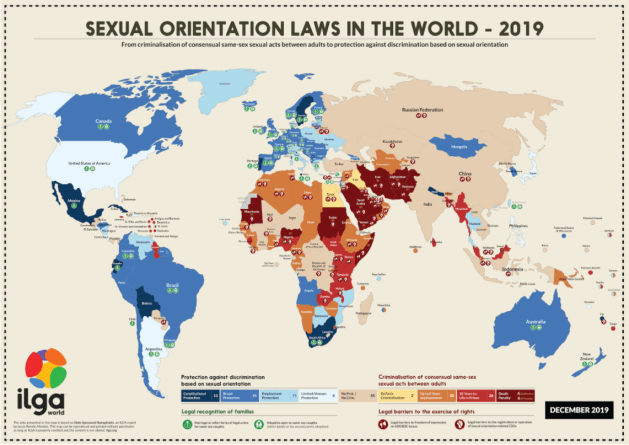
According to the International Lesbian, Gay, Bisexual, Trans and Intersex Association (ILGA), as of December 2019 there were 68 UN Members States in which consensual same-sex sexual acts remained criminalised, plus Palestine (Gaza), the Cook Islands, and some provinces in Indonesia (from pp47 State-Sponsored Homophobia Report: Global Legislation Overview Update December 2019).

A significant number of these countries are within our region. In Oceania, that includes:

Country Maximum Penalty for Homosexuality
Cook Islands 14 years imprisonment
Kiribati 14 years imprisonment
Papua New Guinea 14 years imprisonment
Samoa 5 years imprisonment
Solomon Islands 14 years imprisonment
Tonga 10 years imprisonment
Tuvalu 14 years imprisonment

There are a number of other countries that criminalise same-sex sexual activity in South-East Asia, too:

Country Maximum Penalty for Homosexuality
Brunei 10 years imprisonment
Malaysia 20 years imprisonment
Myanmar 10 years imprisonment
Singapore 2 years imprisonment

*As well as some provinces within Indonesia, including Aceh.

And Australia has another important connection with a large number of countries that still criminalise homosexuality around the world, with half being members of the Commonwealth (including more than half of countries within the Commonwealth itself).

Therefore, while Australia might have fully decriminalised homosexuality in 2016 (when Queensland finally equalised the age of consent for anal intercourse), there is still a long way to go on this issue internationally.

Screen Shot 2020-05-13 at 10.49.15 am

Source: ILGA

Of course, there is even further to go – both domestically and internationally – for trans and gender diverse people to have the right for their identity documentation to reflect their gender identity based on self-declaration, and to be able to live their lives free from discrimination, violence and in some countries criminalisation. For more, see ILGA’s 2017 Trans Legal Mapping Report.

And, as on so many issues, progress on intersex rights has lagged even further behind, with very few countries following Malta’s 2015 lead in banning coercive surgeries and other involuntary medical treatments on intersex people. That includes Australia, too, with governments at all levels failing to implement the recommendations of the 2013 Senate Inquiry on this subject in the intervening six years. [Unfortunately, I am note aware of an equivalent State-Sponsored Intersexphobia/Intersex Legal Mapping Report].

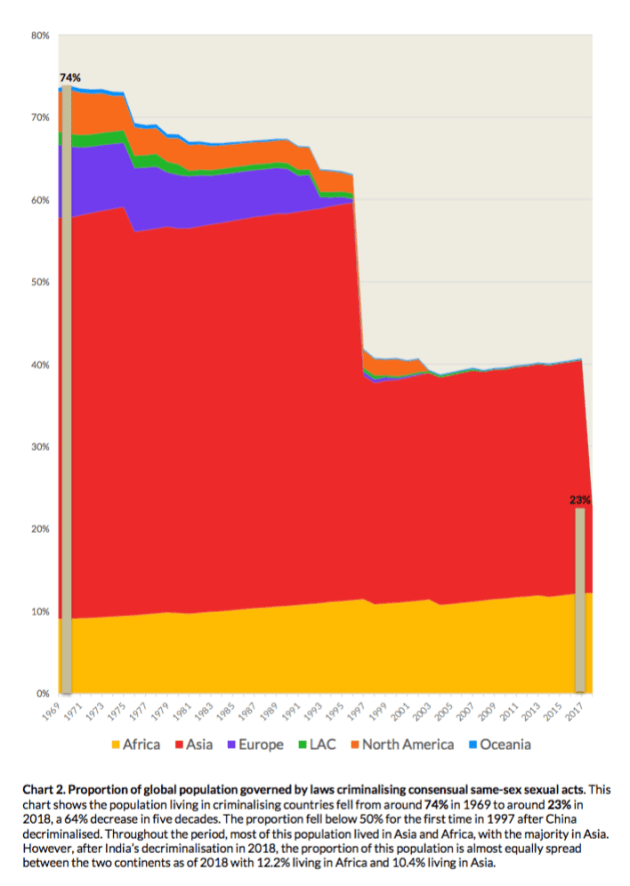
Thankfully, it’s not all bad news. There has been some significant progress in recent years on at least some of these issues, not least of which was the historic September 2018 decision by the Supreme Court of India to declare section 377 of the Indian Penal Code unconstitutional, thereby legalising homosexuality in the second most-populous country on earth.

That case, after years of amazing advocacy by Indian activists, helps make the following graph look much more encouraging:

ILGA Criminalisation by Population Graph copy

Nevertheless, there are still far too many countries where people are not free to love who they love, not able to identify with their gender and be protected against discrimination, violence and criminalisation, and not subject to coercive surgeries and other involuntary medical treatments because of their sex characteristics.

So, what can Australia do? There are a range of ways in which Australia can better support progress on LGBTI rights internationally, including the following:

  1. Support decriminalisation as a key priority of foreign policy

Australia should support decriminalisation for all LGBTI people around the world as a key human rights objective of our foreign policy. This should include a primary focus on decriminalisation within our region, as well as within the Commonwealth.

Unfortunately, the most recent Foreign Policy White Paper makes exactly zero references to supporting LGBTI human rights (despite my submission calling for their inclusion).

Of course, achieving this goal depends on partnership with communities within these countries, not only because they are best placed to know how to advocate for decriminalisation, but also because Australia acting unilaterally would risk entrenching anti-LGBTI policies and laws.

  1. Support LGBTI rights through international human rights architecture

This includes using our current term on the United Nations Human Rights Council to prioritise LGBTI rights, as well as actively supporting the reappointment of the UN Independent Expert on Sexual Orientation and Gender Identity. And it also includes regularly raising LGBTI rights issues within the Commonwealth Heads of Government framework (with the next CHOGM meeting in Rwanda next year).

Australia could also consider appointing an Ambassador for LGBTI Rights in the same way that we have appointed an Ambassador for Women and Girls.

  1. Support LGBTI rights through foreign aid

Another way in which Australia can better support LGBTI rights internationally is by supporting LGBTI human rights through our foreign aid policies (and of course by ensuring our foreign aid Budget is increased overall, after a series of mean-spirited and unjustified cuts under the Liberal-National Government have reduced it to 0.19-0.21% of GDP, far short of the UN target of 0.70% and far short of our capacity, and responsibility, as one of the richest countries on the planet).

This could include funding for international LGBTI associations, such as the International Lesbian, Gay, Bisexual, Trans and Intersex Association (ILGA), OutRight International and Kaleidoscope Trust, as well as other human rights organisations that include a focus on LGBTI rights (such as Human Rights Watch). It also means actively supporting the Commonwealth Equality Network, and LGBTI organisations working towards decriminalisation within our region.

  1. Accept LGBTI refugees and people seeking asylum

We should acknowledge that, while the aim is to ensure lesbian, gay, bisexual, transgender and intersex people are safe everywhere, this is not currently the case and will not be possible in some places for some time. Australia should therefore ensure its refugee framework helps to protect LGBTI people fleeing persecution, including through appropriate assessment processes, and providing improved support services post-resettlement. Oh, and that obviously means not detaining, processing and settling LGBTI refugees offshore, including in countries that criminalise them (for more, see Australia’s (Mis)Treatment of LGBTI Refugees).

  1. Set a better example on LGBTI rights domestically

Australia’s ongoing (mis)treatment of refugees, including LGBTI people seeking asylum, raises another key challenge – in order to better support human rights internationally, we must be seen to respect human rights domestically. That is obviously not currently occurring when it comes to our refugee policy.

It is also not the case in terms of our own treatment of trans and gender diverse people. We must make sure all states and territories follow Tasmania’s recent lead in best practice access to identity documentation on the basis of identity not surgery. And we must finally make long overdue progress on intersex human rights, including protecting the bodily autonomy and integrity of intersex children against coercive surgeries and other involuntary medical treatments.

**********

As we commemorate International Day Against Homophobia, Biphobia, Transphobia and Intersexphobia (IDAHOBIT) today, we should by all means celebrate how far we have come within Australia, as well as highlighting those challenges that remain domestically. But we must not forget the ‘International’ focus of the day, and the important role Australia can play in making progress on LGBTI rights everywhere, for everyone.

**********

If you have enjoyed reading this article, please consider subscribing to receive future posts, via the right-hand scroll bar on the desktop version of this blog or near the bottom of the page on mobile. You can also follow me on twitter @alawriedejesus

Australia’s (Mis)Treatment of LGBTI Refugees

This post is part of a series looking at the unfinished business of LGBTI equality in Australia. You can see the rest of the posts here


Of all the issues that involve human rights violations against lesbian, gay, bisexual, transgender and intersex people in Australia there are two that particularly stand out (at least in my view).


One – ongoing coercive medical treatments and surgeries on children born with intersex variations – I have written about previously.


The other is the deliberate mistreatment of LGBTI refugees and people seeking asylum by the Australian Government.


Of course, this abuse is only one small part of Australia’s broader shameful approach to refugee issues, but, as we shall see below, it does raise specific issues around where people are processed and how claims are assessed.


The following are three key areas where the Australian Government’s approach to LGBTI refugees and people seeking asylum should urgently be improved, as well as one suggestion for further consideration.


  1. End the detention, processing and settlement of LGBTI refugees in countries that criminalise homosexuality


To begin, I should reiterate my personal opposition to Australia’s overall ‘offshore processing’ policy, which essentially involves the indefinite detention of refugees in prisons in the South Pacific. There is no justification for this approach.


There can also be no possible justification for the detention, processing and settlement of LGBTI refugees and people seeking asylum in countries that criminalise homosexuality. And yet that is exactly what Australia has done for the past seven years.


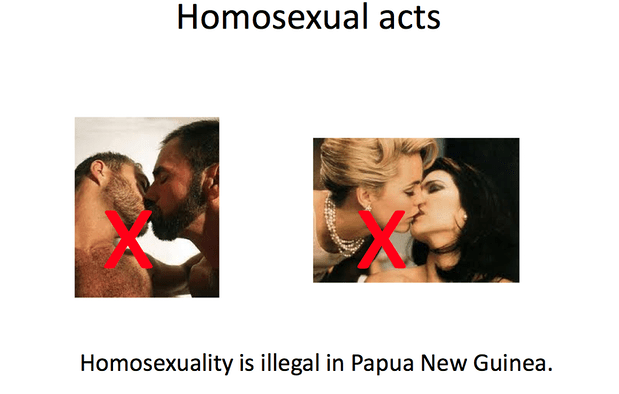
This includes Nauru, where homosexuality remained criminalised until May 2016,[i] and Manus Island in Papua New Guinea, a country where the maximum penalty for male same-sex intercourse is still 14 years imprisonment.


There is no exception for people held in Australia’s immigration detention facilities in these countries either. This is demonstrated by the following report from Behrouz Boochani in The Guardian:


It was five years ago in Fox prison camp. A group of immigration officers accompanied by a number of interpreters burst in. All of a sudden, one of the officers stood on a chair precisely like a king’s representative in ancient times, like one of those men reading the king’s announcement for convicts. The officer took a piece of paper, and surrounded by dozens of refugees he started to read. The announcement was serious, decisive, to the point and threatening, like his voice. “Homosexuality is illegal in Papua New Guiana [sic] and considered as a crime. If anyone in the immigration detention engages in this behaviour, he will be sentenced to 14 years in prison.” It was a dire warning from the prison’s officials and directly targeted homosexual prisoners.


The article then details the horrendous impact of these laws on Alex* (pseudonym), a gay Iranian refugee imprisoned on Manus Island, who was gradually but inevitably broken by the homophobic environment there, through intimidation, harassment, abuse and even rape. His experiences ultimately led him to risk his life again by returning to Iran, before seeking asylum elsewhere – and served as a cautionary tale to other queer men on the island. As Boochani concluded:


No one knows how many gay, transgender or bisexual refugees live on Manus, but what is clear is that the suffering they experienced in their countries has been repeated on Manus in a disastrous way. Fear, humiliation, threat, banishment, rape – these are all concepts and experiences lived daily by these men. Gay, transgender and bisexual men here have experienced even greater torment than other refugees. [emphasis added]


Successive Australian Governments have been fully aware of these abuses. I know, because I have written about this issue to multiple Immigration Ministers,[ii] including then Minister – now Prime Minister – Scott Morrison in 2014. His Department’s response failed to even guarantee that LGBTI asylum seekers would not be reported to PNG police for same-sex sexual activity.


Given his ‘tough on border security’ rhetoric, there appears little hope that a re-elected Morrison Liberal-National Government would take any action to address these human rights violations.


On the other hand, there is some chance that a Shorten Labor Government might finally take a different approach. This is at least in part due to a commitment in the 2018 Australian Labor Party National Platform that:


Labor will not detain, process or resettle lesbian, gay, bisexual, transgender or intersex refugees or asylum seekers in countries which have criminal laws against any of these communities as it makes these places unsafe environments for all of them.[iii]


Consequently, there is a possibility the situation may change, along with the Government, on Saturday 18 May – although that will only happen if LGBTI and refugee advocates maintain pressure on Labor to fulfil this commitment.


160427 Refugee Submission No Kissing

The slide from the Salvation Army presentation that was shown to people seeking asylum after their arrival on Manus Island (source: Guardian Australia).


  1. Improve the assessment process for LGBTI claims for asylum


This is another major problem confronting lesbian, gay, bisexual, transgender and intersex refugees and people seeking asylum in Australia, one that has existed for many years, even decades.


Practically, the decision-makers of the Refugee and Migration Division of the Administrative Appeals Tribunal (known until 2015 as the Refugee Review Tribunal) have struggled to appropriately consider the diversity of sexual orientations and gender identities from other countries, leading to a very low rate of success in receiving refugee protection (a 2003 study by Professor Jenni Millbank showed that at most only 20% of claims were approved).


As reported in the Sydney Morning Herald:


Tribunal officials have long been accused of judging applicants based on a slew of Western gay stereotypes, such as effeminate manner or dress. In one notorious case, an applicant was deemed not gay after failing questions about Madonna, Better Midler, Oscar Wilde and Greco-Roman wrestling. The man barely spoke English and was mystified by the topics. “I don’t understand it,” he said to his interviewer. “I’m sorry.”


When in 2004 his case came before the High Court on appeal (after the Federal Court had first ruled against the applicant), the justices were staggered by the line of questioning used by the Tribunal, describing it as very odd, and almost bordering on the bizarre. “Madonna, Better Midler and so on are phenomena of Western culture,” declared Justice Michael Kirby at the time. “In Iran, where there is death for some people who are homosexuals, these are not in the forefront of the mind. Survival is.”


Unfortunately, more recent cases do not indicate that this inherent Western-gay bias has been overcome. The SMH further reported that:


Last year [2016], a man from Bangladesh was rejected in part because he was unable to correctly pronounce or spell the name of a Sydney gay club he’d visited called the Stonewall, according to Tribunal documents – which incorrectly referred to the nightclub as a “day venue”. In a similar 2014 case, an asylum seeker was told he wasn’t gay because, although he described having two monogamous relationships, he hadn’t “explored his homosexuality” by going to Sydney’s gay bars, and had little knowledge of Oxford Street.


There are additional reports of Tribunal members asking inappropriately sexual questions, as well as applicants being encouraged to supply video of themselves engaging in sexual activity in an attempt to ‘prove’ their homosexuality to the Tribunal. This occurs because, as the SMH notes, “there are no guidelines for dealing with LGBTQI applicants.”


This situation must change, as a matter of priority. Unfortunately, there is no indication that a re-elected Morrison Liberal-National Government will take action to address these problems.


Once again, however, these is some reason to be optimistic about a Shorten Labor Government, which includes these commitments in its Platform:


The assessment and review of protection claims of specific lesbian, gay, bisexual, transgender, intersex and queer asylum seekers will be underpinned by appropriate and relevant assessment tools and processes that reflect cultural experiences of the lesbian, gay, bisexual, transgender, intersex and queer community.

In assessing asylum claims where the fear of persecution arises from a person’s lesbian, gay, bisexual, transgender, intersex and queer status, the fact that the country the person is fleeing has criminal penalties for engaging in homosexual sex is sufficient of itself to establish that fear of persecution is well-founded, and any assessment of the asylum seeker’s identity and fear must take account of the very different manifestations of lesbian, gay, bisexual, transgender, intersex and queer identity that other cultures, especially ones profoundly hostile to lesbian, gay, bisexual, transgender, intersex and queer people, necessarily engender.


Labor will ensure asylum seekers who self-identify as lesbian, gay, bisexual, transgender, intersex and queer will be assessed by officers who have expertise and empathy with anti-discrimination principles and human rights law. Officers, translators and interpreters at all levels of the assessment process will have specific lesbian, gay, bisexual, transgender, intersex and queer cultural awareness training to ensure the discrimination asylum seekers face in their country of origin or transit are not replicated.


As with ending detention of LGBTI refugees in countries criminalising homosexuality however, the challenge will be in ensuring that a new Government follows through on its promises.


  1. Increase support for LGBTI refugees and people seeking asylum in Australia


Another area where urgent reform is needed is the level of support provided to lesbian, gay, bisexual, transgender and intersex refugees within Australia.


The few dedicated support services that exist receive minimal funding, and consequently are unable to meet the significant needs of this vulnerable population.


Particular challenges include the fact that LGBTI refugees and people seeking asylum may not be comfortable in disclosing their sexual orientation, gender identity or sex characteristics to services based on their ethnicity or background, but at the same time may not be welcomed by or receive adequate support from LGBTI services.


As noted in a 2018 Star Observer article on this topic:


LGBTI asylum seekers can also find themselves caught between lack of acceptance from diaspora communities and lack of understanding from mainstream LGBTI communities.


First and foremost, these gaps should be addressed by providing direct Government funding for peer-led LGBTI refugee services. However, this alone may not be sufficient to ensure LGBTI refugees and people seeking asylum are able to access the full breadth of services they may require.


Therefore, there should also be funding to support education and training programs for ethnic community organisations to assist them to be welcoming environments for LGBTI refugees (as well as inclusiveness training for interpreters, who have a key role to play not just in supporting LGBTI people seeking asylum to access services, but also in their claims for protection).


There is also a need for LGBTI community organisations to provide greater social support and outreach to LGBTI refugees and people seeking asylum in Australia. This would help to establish connections between LGBTI refugees and the wider LGBTI community, and may result in better social outcomes over the medium- to long-term.


**********


While the above three issues are presented as concrete recommendations for change, the following suggestion is raised to prompt further discussion:


  1. Introduce quotas or targets for the intake of LGBTI refugees


I should preface this discussion by saying that, philosophically, I don’t support the introduction of quotas or targets within Australia’s overall refugee program based on demographic criteria. Instead, Australia should accept refugees based on the assessment of need by the UN Refugee Agency (the UNHCR).


However, that is not how the Australian refugee framework currently operates.


Since 2015, the Australian Government has adopted a policy of prioritising Christian refugees from the Middle East (which itself is/was a part of the special quota for refugees fleeing the conflict in Syria and Iraq, operating in addition to Australia’s regular refugee intake).


I agree with many of the criticisms of this approach made in this New York Times column, Australia’s immoral preference for Christian refugees, although these criticisms do not appear to have influenced Australia’s ongoing pro-Christian bias.


Indeed, it seems the Morrison Liberal-National Government wants to introduce even greater demographic criteria within the refugee program.


During the election campaign, it has announced ‘the proposed makeup of the humanitarian program for the first time. This will include an overall target of 60% of the offshore component allocated to women. Women made up 50.8% in 2017-18.’[iv] [emphasis added]


In this context, the obvious question is: if Christians and women receive allocated quotas (or targets), then why not lesbian, gay, bisexual, transgender and intersex refugees?


Indeed, there are strong arguments in favour of this approach.


Based on analysis of 2018 UNHCR figures, and the 2019 ILGA State-Sponsored Homophobia Report, of the five top refugee-hosting countries, four retain criminal sanctions for homosexuality:


Country

Number of refugees Criminal penalties for homosexuality
Turkey 3.5 million Not criminalised
Uganda 1.4 million Life imprisonment
Pakistan 1.4 million 10 years
Lebanon 1 million 1 year
Iran 979,400

Death penalty


A significant number of LGBTI refugees are therefore unsafe and at risk even after they have fled persecution elsewhere.


There are also a number of countries in our own Oceania region that criminalise homosexuality, including PNG, Kiribati, Solomon Islands, Tuvalu and Cook Islands (all of which have a maximum penalty of 14 years imprisonment), Tonga (10 years imprisonment) and Samoa (5 years imprisonment). And that’s not mentioning the recent attempt by the Government of Brunei to introduce the death penalty (which they have backed down from – for now – but retain a punishment of imprisonment up to 10 years).


As stated earlier, my personal preference is that there are no demographic criteria for determining the intake of refugees. But, if Australia’s current approach, which gives priority to Christians and women, does continue, I can see no good reason why there should not also be quotas or targets for the intake of refugees who are lesbian, gay, bisexual, transgender and intersex.


**********


Disclaimer: As with all posts, this article reflects my own views and not those of any employer, past or present.


If you have enjoyed reading this article, please consider subscribing to receive future posts, via the right-hand scroll bar on the desktop version of this blog or near the bottom of the page on mobile. You can also follow me on twitter @alawriedejesus


Footnotes:

[i] Of course, just because homosexuality has been decriminalized in Nauru doesn’t necessarily mean it is now a welcoming environment for LGBTI refugees and people seeking asylum. This is confirmed by the following accounts, including:

In detention: Gay on Nauru, in Archer Magazine (July 2018) and

True love in Nauru, in The Monthly (September 2017)

[ii] Lest I be accused of partisanship, I also wrote to Labor Immigration Ministers Chris Bowen and Brendan O’Connor on the same subject in 2012 and 2013.

[iii] This is a commitment I drafted ahead of the 2015 National Conference, and remains one of my proudest achievements in LGBTI advocacy.

[iv] Of course, there is a great irony in the Coalition supporting a gender-based quota for refugee intake, while it steadfastly opposes gender-based quotas for the pre-selection of its candidates.

Trans out-of-pocket medical costs

This post is part of a series looking at the unfinished business of LGBTI equality in Australia. You can see the rest of the posts here


One of the biggest challenges facing members of the LGBTI community – albeit one that has traditionally not received significant attention – is the prohibitive cost involved for trans and gender diverse people in accessing medical treatments related to their gender identity, including (if they wish to) transition.


These expenses can mean the difference between being able to affirm one’s gender identity or not, and are so high that they effectively push some trans people into poverty.


As this March 2018 story from ABC expands:


‘There’s a massive price tag on being transgender in Australia. For some, the cost of surgery and treatment for gender dysphoria will crack $100,000.


‘The ABC… has been following one woman’s effort to find the money she needs to transition, while living below the poverty line. Stand-up comedy has been Cassie Workman’s main income for the past seven or eight years.


‘Normally, it’s just enough cash to scrape by, but recently she’s also been diverting as much as she can towards an estimated $85,000 in medical, administrative and incidental costs associated with her transition to a woman.’


The issue of trans out-of-pocket medical costs was also included in this excellent March 2019 The Conversation article on LGBTI policy priorities by Liam Elphick:


‘Medicare and private health insurance do not cover many treatments that transgender and gender-diverse people may require to transition, such as surgical changes, because these are deemed “cosmetic”.


‘As transgender advocate and lawyer Dale Sheridan tole me: “While an approximate 10% Medicare rebate is provided for genital surgery, the treatment undertaken for most transgender and gender-diverse people is far in excess of this. For example, I have spent over $15,000 on four years of electrolysis to remove my facial hair, and there is no rebate available because this is considered cosmetic. However, having a beard does not match my female appearance and has caused much dysphoria.”’


Perhaps the most encouraging development in this area has been the recent release of ACON’s ‘A blueprint for improving the health and wellbeing of the trans & gender diverse community in NSW’, which has given the issue of trans out-of-pocket medical costs the attention that it deserves.


It notes on page 20 that:


‘For medical services to be covered by the public health system in Australia, they must be medically necessary, clinically effective and cost effective. For many trans and gender diverse people, the ability to alter their body is part of affirming their gender and can be an important treatment if they are experiencing distress or unease from being misgendered and/or feeling incongruence between their gender identity and their body.


‘Research has demonstrated that access to gender-affirming care has led to reduced mental health risks and improved quality of life for trans and gender diverse people.’


These reasons – better mental health and quality of life outcomes – are important reasons why trans out-of-pocket medical costs must be reduced (or better-still, eliminated). But there is an even more fundamental argument: people have a human right to live their affirmed gender identity, and that right is just as important as health, education and housing.


ACON’s Blueprint, the development of which was driven by the trans and gender diverse community of NSW, contains six priority areas, with the first two most directly related to the issue of medical expenses:


Priority A: Clear and easy pathways for accessing gender-affirming care [and]

Priority B: Affordable and available gender-affirming healthcare.[i]


Combined, these two priorities include seven recommendations – called ‘solutions’ – to address these issues:


A1: Develop plain-language resources on trans and gender diverse health and human rights and establish a peer worker program to support trans and gender diverse people in navigating the health system, including when seeking gender-affirming care.


A2: Provide ongoing GP training, information and support so trans and gender diverse people can access gender-affirming hormone therapy through primary healthcare, using an informed consent model, and gender-affirmation treatment plans that are based on the individual needs of the patient.


A3: Increase the availability of specialists who are inclusive and have expertise in gender-affirming care, for those who may need specialist care in affirming their gender.


B2: Cover gender-affirming healthcare as medically necessary services under Medicare and the PBS.


B2: Provide an exemption for trans men and non-binary people assigned female at birth from the 2015 Pharmaceutical Benefits Advisory Committee (PBAC) restrictions on how testosterone is prescribed under the PBS.


B3: Amend the NSW Health Waiting Time and Elective Surgery Policy to remove ‘gender reassignment surgery’ as a discretionary procedure and conduct a review to ensure that all gender-affirming surgeries are included within one of the 3 clinical urgency categories.


B4: Remove gendered categories in health services or programs, such as Medicare billing codes, where there is no clinical need for them.


This document is a clear pathway forward to providing accessible and affordable healthcare to trans and gender diverse people.


With many of these recommendations falling within Commonwealth responsibility, that means – as with so many issues – the upcoming federal election on 18 May could make a big difference to trans out-of-pocket medical costs.


Indeed, this topic was covered in the recent Equality Australia, Intersex Human Rights Australia and LGBTI Health Alliance survey of the major parties, which asked:


Will your party ensure access to gender affirmation treatment and gender diverse people through Medicare? Will your party commit to developing a Trans and Gender Diverse Health Strategy?


Unfortunately, the perfunctory response from the Liberal-National Parties did not address the issue:


‘The Morrison Government continues to support Medicare funding at record levels and takes the advice of medical experts (the Medical Services Advisory Committee) regarding what medical treatments are listed under Medicare.’


The Labor Party response was somewhat better:


‘Many gender affirmation treatments for trans and gender diverse people are covered by Medicare. Labor will ensure that Medicare and the Pharmaceutical Benefits Scheme continue to implement anti-discriminatory policies for LGBTIQ Australians and that same sex couples and their families are not discriminated against in their access to or use of Medicare or the PBS. The health needs of trans and gender diverse Australians will be given specific consideration as part of Labor’s National LGBTIQ Health and Inclusion Strategy.’


Although the ALP response also linked to their National Platform, which is far more explicit on this subject [from page 144]:


‘Labor acknowledges the right of all Australians, including transgender and gender diverse people, to live their gender identity. For many, this includes accessing specialist health services and for some people can involve gender affirming medical technologies. Cost should not be a barrier to accessing these services. Labor commits to removing, wherever possible, barriers to accessing these services and consulting with experts in government. This should materialise in a focus on creating fair, equal and affordable access to medical care and treatments relevant to trans and gender diverse Australians.’


Indeed, the platform commitment to reducing costs, wherever possible, for trans-related medical expenses was highlighted in the Daily Telegraph’s transphobic front-page story on Thursday (‘Doctor Alarm at ALP Gender Agenda’, 25 April 2019):


‘Mr Shorten refused to answer questions from The Daily Telegraph about the policies, which also argue the cost of “gender affirming medical technologies” should be reduced because “cost should not be a barrier to accessing these services”.’


[Of course, if the Daily Telegraph were capable of actual journalism, they would realise this commitment on reducing costs has been in the ALP National Platform since 2015 – I should know, I helped write it[ii].]


Daily Telegraph transphobic front page

The Daily Telegraph‘s transphobic front page from 25 April 2019, which, in addition to targeting trans kids, criticised ALP policy to reduce the cost of ‘gender affirming medical technologies’.


The Greens’ survey response was longer, and included the following commitments:


‘Transgender and gender diverse people are best placed to determine their own transition pathways which may include gender-affirming medical treatments such as hormones and surgical interventions. Under the current healthcare model, gender-affirming treatments are approved at the discretion of medical professionals which can lead to transgender, gender diverse and intersex people being unfairly denied the right to access these treatments.


‘The Greens will provide a way to appeal these determinations by ensuring that all people can access a dedicated complaints body to review medical decisions regarding gender-affirming treatments and surgeries.


‘Finally, as part of the Greens plan to establish a national LGBTIQ+ health strategy, the Department would be tasked with investigating access to gender affirmation treatment for trans and gender diverse people, including whether such treatments could be funded through Medicare.’


On the basis of these survey responses, it is clear that, if the Morrison Liberal-National Government is re-elected, there will be little change to the current prohibitive expenses involved in trans medical treatments.


On the other hand, if the Labor Party is elected, combined with a strong Greens Senate presence, there is at least the possibility of progress on this issue.


Of course, this isn’t the only issue confronting trans and gender diverse Australians. As the ACON Blueprint notes [page 33], access to appropriate identity documentation remains the highest priority identified by community members:


‘The importance of having I.D.s reflecting trans and gender diverse people’s gender featured prominently in the community consultation process. Being able to change legal sex classification and name on NSW birth certificates or NSW recognised death certificates through a simple administrative procedure was the top ranked priority out of 28 options amongst all respondents to the online survey.’[iii]


However, while that policy change is essential, addressing it by itself would only fix part of the problem. Because, unless we simultaneously reduce the high out-of-pocket costs of trans medical treatments, we will continue to consign too many trans and gender diverse Australians to financial hardship and poverty. And that state of affairs is unacceptable.


28256


If you have enjoyed reading this article, please consider subscribing to receive future posts, via the right-hand scroll bar on the desktop version of this blog or near the bottom of the page on mobile. You can also follow me on twitter @alawriedejesus


Footnotes:

[i] The other four are:

Priority C: An inclusive and knowledgeable NSW health sector

Priority D: Official government I.D.s and records that reflect trans and gender diverse people’s gender through simple administrative procedures

Priority E: Workplaces, education settings and other environments that are inclusive and respectful of the needs of trans and gender diverse people [and]

Priority F: A vibrant, resourced trans and gender diverse community advocating for its own needs and priorities.

[ii] The original 2015 commitment, which I wrote, read:

‘Labor acknowledges the right of all Australians, including transgender and gender diverse people, to live their gender identity. For many, this includes accessing specialist health services and for some people can involve gender affirmation surgery. Cost should not be a barrier to accessing these services and/or surgery, and Labor commits to removing, wherever possible, out-of-pocket health expenses for transgender people incurred in relation to their gender identity.’

[iii] This is an issue I have previously written about, including here: Identity, not Surgery.

Scott Morrison is Unfit to be Prime Minister

Scott Morrison became Australia’s 30th Prime Minister on 24 August 2018. In my opinion, based on his (mis)treatment of the LGBTI community, he is unfit to hold that esteemed position. Here’s why:


  1. As Treasurer, Morrison allocated $160million to the same-sex marriage plebiscite


In his first Budget as Treasurer in May 2016, Morrison allocated $160million to the unnecessary, harmful and divisive plebiscite on same-sex marriage. This is despite the fact Parliament could have voted on this issue for free, and the money better spent on literally almost anything else.


  1. As Treasurer, Morrison oversaw $80.5million in spending on the postal survey


Despite the Senate rejecting legislation to hold the Turnbull Liberal-National Government’s proposed plebiscite, it decided to hold a postal survey instead. While Finance Minister Matthias Cormann signed the cheque, the money still came from Treasurer Morrison’s Budget. Once again, Parliament could have voted on this issue for nothing – but they chose to throw away $80.5million of our taxes anyway. Liberal and National Party MPs and Senators should be asked to repay it.


  1. During the postal survey, Morrison campaigned for a No vote


Given his conservative religious background, it is unsurprising Morrison campaigned for people to be denied equality under secular law simply because of their sexual orientation, gender identity or sex characteristics. During the postal survey he said that:


“My view on this topic is as important as everyone else’s. That is why we are having a survey on it. My view is, look I am voting no, it is okay to say no and people should know that.”

To some extent, Morrison was entitled to express that opinion. However, it is included here to demonstrate he believed the postal survey was a legitimate process to determine this issue, a context that makes the next two acts substantially more objectionable.


  1. Morrison voted for every discriminatory amendment put forward during parliamentary debate on same-sex marriage


Following the announcement of the 61.6% Yes vote on 15 November 2017, the Parliament still had to pass legislation to give that result legal effect (thus demonstrating the fundamental wastefulness of the postal survey). During debate of Dean Smith’s Marriage Amendment (Definition and Religious Freedoms) Bill 2017, Morrison moved amendments to protect organisations and charities that espoused discriminatory beliefs including:


  • ‘the gender difference and complementarity of men and women is an inherent and fundamental feature of human society and is reflected in the gender difference and complementarity of a man and a woman united in marriage’, and
  • ‘the normative state of gender is binary and can, in the overwhelming majority of cases, be identified at birth.’


Thankfully, it was defeated. Morrison also voted for every single other set of amendments seeking to add anti-LGBTI discrimination to the Bill. Perhaps the worst was an amendment to insert two separate definitions of marriage in the Marriage Act 1961 (Cth):


‘marriage means:

(a) the union of a man and a woman to the exclusion of all others, voluntarily entered into for life; or

(b) the union of 2 people to the exclusion of all others, voluntarily entered into for life.’


Again, this amendment was defeated. But we cannot forget that, despite more than 3-in-5 Australians voting for equality, Morrison voted to entrench separate definitions for marriage in the Act itself. This goes against one of the most important political lessons of the 20th century: separate but equal is never equal.


  1. Morrison abstained from voting on the same-sex marriage bill


Despite:

  • Allocating $160million to the plebiscite in his Budget
  • Overseeing $80.5million spending on the postal survey
  • Campaigning during the postal survey, and
  • Participating in debate on the Marriage Amendment (Definition and Religious Freedoms) Bill 2017,

Morrison abstained on the final vote on this legislation.


As discussed above, he clearly saw the postal survey process as legitimate, but he didn’t see the outcome as legitimate when his side lost. Morrison ultimately refused to implement the will of the people.


This was a gross insult to the 7,817,247 Australians who voted Yes, including the 55% of people who voted Yes in his electorate of Cook.


Scott Morrison didn’t respect our vote on the postal survey. He doesn’t deserve our vote on 18 May.


However, it isn’t just on marriage that Morrison’s words and actions mean he is, in my view, unfit to hold the highest office in the land.


  1. As Minister for Immigration, Morrison imprisoned LGBTI people seeking asylum in countries that criminalised them


Morrison was Minister for Immigration from September 2013 to December 2014. During this time, he imprisoned people seeking asylum on both Nauru and Manus Island, Papua New Guinea. This included lesbian, gay, bisexual, transgender and intersex refugees, despite the fact both Nauru and PNG criminalised homosexuality. This policy effectively continued their persecution – and he continued to do so even after this issue was raised with him.


  1. As Treasurer, Morrison axed funding for the Safe Schools program


Morrison as Treasurer signed off on the axing of an effective, evidence-based anti-bullying program that cost just $8million over three years but provided significant benefits to LGBTI students. This Budget cut was ideological not financial – elsewhere he found room for the $80.5million postal survey, as well as more than $60million per year for the National School Chaplaincy Program.


  1. As Prime Minister, Morrison tweeted against programs supporting trans children


On 5 September 2018 – less than a fortnight into the job – Morrison published his infamous ‘gender whisperers’ tweet:


Morrison gender whisperers copy


His ‘let kids be kids’ message in practice said that children should be protected from the very idea that trans and gender diverse people exist. Worse, Morrison was arguing trans and gender diverse children, who are some of the most vulnerable members of the Australian community, should be left to struggle in isolation, without any support from their schools.


If there is a better example of ‘un-Prime Ministerial’ behaviour, I am yet to see it.


  1. As Prime Minister, Morrison refused to condemn gay conversion therapy


In the same week, Morrison was asked about his policy on anti-gay and anti-trans conversion therapy, a practice that is nothing less than the psychological torture of people on the basis of their sexual orientation or gender identity. His response:


“I think people should make their own choices about their own lives… That’s always been my view. I’ve never been involved in anything like that, I’ve never supported anything like that. So mate, it’s just not an issue for me, and I’m not planning to get engaged in the issue.”


He has refused to take any action on this issue in the seven months since. Once again, Morrison has displayed his lack of concern for people whose life experiences are different to his own.


Indeed, on all four of these issues – LGBTI people seeking asylum, LGBTI students, trans and gender diverse children and survivors of anti-gay and anti-trans conversion therapy – he has shown that he basically does not care about some of the most disadvantaged people in society.


If Scott Morrison does not have empathy for others, he should not receive the votes of others.


  1. As Prime Minister, Morrison broke his promise to protect LGBT students against discrimination


In response to the leaking of recommendations from the Ruddock Religious Freedom Review in October 2018, Morrison promised he would protect lesbian, gay, bisexual and transgender students against discrimination by religious schools before the end of the year.


That deadline came and went, and his Government never even introduced a Bill to try to give effect to this commitment. The 45th Parliament has now expired, with LGBT students just as exposed to mistreatment and abuse as they were before his hollow words.


In fact, Morrison delayed any action on this issue by referring the subject of ‘religious exceptions’ to the Australian Law Reform Commission for review by 10 April 2020, meaning LGBT students will not be protected until the start of the 2021 school year (at the earliest). This is an egregious breach of faith of the Australian people, who expected him to back his promise with action.


  1. Morrison has no policies on LGBTI issues


Less than four weeks before the election and it appears the Liberal Party has no policies on LGBTI issues. Try searching the Liberal Party’s website. There’s nothing there. Nada. Zero. Zilch.


In the first 11 days of the election campaign the only comments I can find Morrison has made on LGBTI issues is the same, re-hashed promise to protect LGBT students against discrimination – you know, the promise he has already broken once. It’s clear he does not have a plan for lesbian, gay, bisexual, transgender and intersex Australians.


If Scott Morrison won’t govern for all Australians, he shouldn’t govern any Australians.


  1. Morrison won’t tell us what’s in his Religious Discrimination Bill


The other major outcomes of the Religious Freedom Review were a proposal for a Religious Discrimination Bill (which was recommended by Ruddock) and a promise to appoint a Religious Freedom Commissioner (which was not recommended).


These represent the biggest changes to Commonwealth anti-discrimination law since the introduction of the Age Discrimination Act 2004.


However, despite having the Religious Freedom Review for 11 months, and comments in December by Attorney-General Christian Porter about “the Religious Discrimination Bill, which we are well-advanced on the drafting of and which we would have out early next year, so that people can see it”, we are yet to see any details of this legislation.


Indeed, the day before the election was called, it was reported that:


“Attorney-General Christian Porter told The Australian the religious discrimination bill was “well advanced” but “not at the point of readiness”. “It remains clear government policy and, if re-elected, one of the first orders of business would be to pursue that legislation” (‘Religious freedom bill fails to meet election deadline’, The Australian, 10 April 2019).


This is particularly worrying for LGBTI Australians because, while protecting religious minorities against discrimination would be welcome, a Religious Discrimination Bill could also include new rights for religious organisations to discriminate against LGBTI people (the same kinds of amendments that Morrison himself voted for during the same-sex marriage debate).


The reality is we are being deliberately kept in the dark about legislation that could have significant impacts on Australian society, something the Government itself says will be implemented shortly after the election. That, in my opinion, is treating voters with contempt.


Updated 13 May 2019:


13. Morrison refused to disendorse a candidate who linked same-sex marriage to paedophilia


Early in the election campaign it was reported that the Liberal candidate for Scullin, Gurpal Singh, had linked same-sex marriage to paedophilia in an interview during the same-sex marriage postal survey. Despite a significant public backlash, and the disendorsement of other candidates for equally-discriminatory comments, Morrison steadfastly refused to disendorse Mr Singh for more than two weeks. Singh was only forced to resign following publication of unrelated (and despicable) comments about rape. The entire saga clearly demonstrated that for Morrison – who had repeatedly used the phrase ‘the standard you walk past is the standard you accept’ – extreme homophobia is entirely acceptable.


**********


Of course, there are other, non-LGBTI issues that cast serious doubt on Scott Morrison’s suitability for the position of Prime Minister (other actions from his time as Minister for Immigration, and bringing a lump of coal into Parliament, spring immediately to mind).


But, even ignoring everything else, on the basis of his (mis)treatment of LGBTI people alone, in my view it is clear Morrison is unfit to be the leader of this country. It’s now up to the rest of Australia whether they see fit to keep him there on 18 May.


Updated 24 May 2019:


To the shock, and disappointment, of many LGBTI people, the majority of Australians did indeed see fit to keep Scott Morrison in the top job last Saturday. His surprise victory leaves him with significant personal clout within the Liberal-National Government.


How he uses that clout will be crucial in determining whether the re-elected Coalition Government actively seeks to wind back LGBTI rights in Australia, and if so how aggressively it pursues that agenda.


The first test will be the Religious Discrimination Bill (or Religious Freedom Bill), likely to be introduced in the second half of 2019. LGBTI Australians must be prepared to do everything in our power to stop this legislation if it expands the rights of religious organisations to discriminate against us. We’ll be watching, and ready to act if necessary.


Updated 22 December 2019:


Seven months after the shock federal election result, we now know the answers to the questions posed above, namely ‘whether the re-elected Coalition Government actively seeks to wind back LGBTI rights in Australia, and if so how aggressively it pursues that agenda.’


Unfortunately, those answers are yes, and very. Scott Morrison has continued to demonstrate he is entirely unfit to be Australia’s Prime Minister. That includes for the following, additional reasons:


  1. Morrison’s Religious Discrimination Bill is a direct attack on the rights of LGBTI people


Morrison likes to talk about ‘quiet Australians’. But under his Religious Discrimination Bill (which was finally released in late August), religious bigots will be allowed to loudly express their homophobia, biphobia, transphobia and intersexphobia. In workplaces, and classrooms, in health services, in restaurants, cafes and shops, and all other areas of public life.


In doing so, the Bill directly overrides, and winds back, existing protections under all other Commonwealth, state and territory anti-discrimination laws, including Tasmania’s best practice Anti-Discrimination Act 1998 (despite Attorney-General Porter promising in August that it would not).


The Government’s Religious Discrimination Bill will also directly impact the health care of LGBTI Australians, including allowing doctors and pharmacists to refuse to provide hormone therapy to trans and gender diverse people, and PEP and PrEP to gay, bisexual and other men who have sex with men.


After going through a public consultation process on its first exposure draft, during which LGBTI groups, legal organisations and even the Australian Human Rights Commission pointed out the many flaws of the legislation, the Government made the Bill worse in an effort to appease religious fundamentalists like the Sydney Anglicans (which seems to have worked).


The overall result is that if the second Exposure Draft Religious Discrimination Bill is passed by Commonwealth Parliament in 2020, the rights of religious fundamentalists will be privileged over and above the rights of LGBTI Australians – and women, single parents, divorced people, people in de facto relationships, people with disability, and even religious minorities. For more, see Paul Karp’s excellent summary of what we should be afraid of [spoiler: a lot].


  1. Morrison has effectively abandoned LGBT students in religious schools


As I wrote previously, Morrison broke his promise to protect LGBT students in religious schools before the end of 2018, before having Attorney-General Christian Porter refer it to the Australian Law Reform Commission the day before the election was called.


When Porter released the first Exposure Draft Religious Discrimination Bill in August, he also narrowed the scope of those terms of reference, and extended the reporting date until 12 December 2020. Now that the Government has chosen to release a second Exposure Draft, it is highly likely this timeline will be extended again, and the ALRC will consequently not report until at least 2021.


Given the usual six-month period for the Government to respond to that report, there will be no action until at least late 2021, and it is almost certain that the Coalition Government will not seek to pass any reforms before the next election, due in May 2022.


This would mean that, almost four years from his initial promise to protect them, Scott Morrison would have done exactly nothing to stop vulnerable LGBT kids from being discriminated in schoolyards around the country. Discrimination that takes place. Every. Single. Day.


  1. Morrison spends his time as Prime Minister attacking trans-inclusive sporting policies…


In August, Morrison chose to criticise Cricket Australia for issuing national guidelines aimed at making community cricket more inclusive for trans and gender participants.


He stated that “[t]here are far more practical ways than these heavy, mandatory ways of doing it. Why there’s the necessity to get the sledgehammer on this, it’s mystifying to me and we should manage it calmly”, before adding “[i]t’s pretty heavy-handed to put it mildly. The thing about sport is it should be driven locally by local clubs.”


With the obvious implication that some local clubs would inevitably decide not to be inclusive, and that this would be fine with our so-called ‘leader’.


  1. …and trans-inclusive toilets


Perhaps the most bizarre, and offensive, use of Prime Ministerial time came later in August, when Morrison chose to exercise his ‘authority’ (official, certainly not moral) to have a sign taken down from a toilet door in the Department of Prime Minister and Cabinet. Yes, you read that correctly.


The sign in question simply said ‘PM&C is committed to staff inclusion and diversity. Please use the bathroom that best fits your gender identity.’ Direct. Inclusive. And welcoming.


But apparently that was too much for our fragile PM to bear, declaring “[i]t’s just political correctness over the top. It’s just not necessary. I’ve got a clear view about this and I’m sure this will be sorted… It’s ridiculous. It’ll be sorted out. I’ve had a chat to the incoming head of Prime Minister and Cabinet, who’s putting his feet under the desk on Monday… I think people can work out which room to use.”


Perhaps, instead of appointing himself Minister for – or, more accurately, against – trans sporting policies, and toilet door signs, Morrison could have spent that valuable time meeting with [ex-]fire chiefs about this year’s bushfire season.


  1. Morrison’s Government locked up gay journalists fleeing Saudi Arabia


As just one example of the Liberal-National Government’s ongoing horrific approach to refugees and people seeking asylum generally, and LGBTI refugees specifically, earlier this year the Morrison Government responded to a gay couple, who were journalists, fleeing the homophobic and politically repressive regime in Saudi Arabia, by locking them up in immigration detention.


One of the pair, Sultan, described their experience in a recent interview: “[a]lthough I’ve been threatened, intimidated and bullied in Saudi Arabia, I was never thrown in a jail cell without charge. That didn’t happen to us until we came to Australia.”


Just let the full horror of that statement sink in for a minute.


Fortunately, for Sultan and Nassar, they were released from held detention in recent weeks. However, there is no guarantee in terms of what the future holds for them. Or for other LGBTI refugees and people seeking asylum, including those gay and bisexual men who have been abandoned by our Government in Papua New Guinea despite laws there criminalising them.


  1. Morrison’s suicide prevention announcement excluded LGBTI people


In July, Prime Minister Morrison announced a new suicide prevention ‘national priority’, with the goal of ‘working towards a zero suicide goal.’


Which is obviously a welcome development. Except in doing so, he deliberately excluded LGBTI people as a priority population, with his media release stating: “I am particularly focused on continuing our strong support for those most at risk, including our veterans, Indigenous Australians and young people.”


Morrison might say he wants ‘zero suicides’, but he will not achieve that lofty goal if he makes zero reference to, and devotes minimal resources to, addressing the disproportionately high rates of suicide amongst the LGBTI community.


Although perhaps his omission was partly-based on the self-awareness that, if he explicitly included LGBTI people as a priority population, he would have to acknowledge the fact the past six and a half years of Abbott/Turnbull/Morrison Government have exacerbated this problem, from axing Safe Schools, holding an unnecessary, wasteful and divisive postal survey, failing to protect LGBT students in religious schools, and Morrison personally targeting trans and gender diverse young people.


  1. Morrison’s Government plans to exclude LGBTI questions from the 2021 Census


One further area where some self-reflection might benefit the Government generally, and Scott Morrison specifically, is the issue of the 2021 Census.


Despite giving the Australian Bureau of Statistics $80.5 million to ask all Australians what they thought of same-sex relationships just two years ago, the Morrison Government is now rejecting calls to include questions around sexual orientation, gender identity and intersex status for the next Census in 18 months.


This decision came after pressure from Assistant Treasurer Michael Sukkar’s office, with Australian Statistician David Kalisch at first saying “Sukkar’s office ‘did not provide any guidance about what should be on or off the [test] form,’ before conceding ‘they did express a preference but ultimately it was my call.’”


The real kicker though is the follow-up explanation that was offered:


“Kalisch noted there were ‘some sensitivities’ around the questions, because ‘some people in the broader community’ were ‘challenged to understand’ what the question about gender meant, given that the census already asks about sex. He said there was ‘sensitivity’ around asking Australians their sexuality and he had considered making the question optional.”


Is there a better example of the place of LGBTI Australians under the Morrison Liberal-National Government?


When we opposed the ABS holding a single-question, nation-wide opinion poll on the legitimacy of our relationships, and families, the Government held it anyway.


But when we seek to be included in questions in the usual 2021 Census, in order to collect robust data to address health disparities facing our communities, just asking about who we are is considered far too ‘sensitive’.


It is impossible to escape the conclusion that lesbian, gay, bisexual, transgender and intersex Australians do not count under the Morrison Government. We won’t for as long as Scott Morrison is Prime Minister, an office he is manifestly unfit to occupy.


Morrison


Disclaimer: As with all posts, this article reflects my own views and not those of any employer, past or present.


If you have enjoyed reading this article, please consider subscribing to receive future posts, via the right-hand scroll bar on the desktop version of this blog or near the bottom of the page on mobile. You can also follow me on twitter @alawriedejesus