Submission to Australian Human Rights Commission Sexual Orientation, Gender Identity and Intersex (SOGII) Rights Consultation

One of my favourite campaigns of recent times – It Gets Better – performs a valuable role, letting vulnerable LGBTI youth know that, while the homophobia, biphobia, transphobia and intersexphobia they may be experiencing is awful, for most of them, it will get better. I emphasise the word most here because we should always remember that it does not get better for everyone.

Meanwhile, as the LGBTI movement itself ‘ages’, many of us are increasingly celebrating the past, and reflecting on significant community milestones (such as last year’s 30th anniversary of the decriminalisation of male homosexuality in NSW, or the 40th anniversary of Sydney’s Gay & Lesbian Mardi Gras which is now only three years away). But, while absolutely necessary, looking backwards should never obscure the challenges that remain ahead.

This consultation, including an examination of legislation, policies and practices by government(s) that unduly restrict sexual orientation, gender identity and intersex rights, provides an opportunity to highlight some of the major obstacles which continue to prevent LGBTI Australians achieving full equality. In this submission, I will concentrate on six such areas:

  1. Involuntary or coerced sterilisation of intersex children

These unjustified practices – surgeries performed with the aim of ‘normalising’ intersex children according to the expectations of their parents, their doctors, and/or society at large, so that they conform to an exclusionary man/woman binary model of sex – are human rights abuses, plain and simple.

Obviously done without the child’s consent, such practices can involve sterilisation, as well as other ‘cosmetic’ (ie unnecessary), largely irreversible surgery on genitalia to make their bodies fit within the idea of what a man or woman ‘should’ be, ignoring the individual involved and their fundamental rights to bodily integrity, and personal autonomy.

That these practices continue in 2015 is abhorrent – and the fact the Commonwealth Government has yet to formally respond to the Senate’s 2013 Report into this issue (http://www.aph.gov.au/Parliamentary_Business/Committees/Senate/Community_Affairs/Involuntary_Sterilisation/Sec_Report/~/media/Committees/Senate/committee/clac_ctte/involuntary_sterilisation/second_report/report.ashx) is, or at least should be, a scandal.

  1. Restrictions on the rights of transgender people

Another group within the LGBTI community whose rights continue to trail those whose identities are based on sexual orientation (lesbian, gay and bisexual people) are transgender Australians.

This includes the fact there continue to be ‘out-of-pocket’, in many cases quite significant, expenses for medical support for trans* people simply to affirm their gender identity. This is a denial of their human rights – access to trans* surgeries and related medical services should not be restricted by the capacity to pay, but instead should be fully publicly-subsidised through Medicare.

The ongoing requirement that married transgender Australians must divorce their spouses in order for their gender identity to be legally recognised is also a fundamental breach of their rights, and must end.

  1. Processing and resettlement of LGBTI refugees in countries which criminalise homosexuality

Australian Governments, of both persuasions, are guilty of violating the human rights of LGBTI refugees. These are people who are (often) fleeing persecution on the basis of their sexual orientation, gender identity or intersex status, and seeking our protection.

Australia’s response? To detain them, indefinitely, in inhumane prison camps on Nauru and Manus Island. For many, while detained they are at risk of prosecution under the laws of Papua New Guinea and/or Nauru, both of which continue to criminalise male-male intercourse. Even after they are found to be refugees, they are then ‘resettled’ in these countries, in effect exposing people who have fled persecution to potentially more persecution.

While I believe the offshore processing and resettlement of all refugees is unjust, it should be recognised it has a disproportionately negative impact on LGBTI refugees.

  1. Denial of the right of LGBTI students to an inclusive education

It is encouraging that greater numbers of young LGBTI people feel comfortable in disclosing their status at an earlier age – and for some, that they attend genuinely inclusive schools. However, this inclusion is by no means universal.

For example, the recently developed national Health & Physical Education curriculum does not even include the words lesbian, gay or bisexual, and does not guarantee students will be taught comprehensive sexual health education (even omitting the term HIV). This is a massive failure to ensure all students learn vital information that is relevant to their health.

Similarly, while the national Safe Schools Program is a welcome initiative to counter homophobia and bullying, participation in the program is optional, with most schools (and even some entire jurisdictions) opting out. The right to attend school free of discrimination should not depend on a student’s geographic location, or their parent/s’ choice of school.

Finally, religious exceptions to anti-discrimination legislation (in all jurisdictions outside Tasmania), mean many LGBTI students are at risk of discrimination, by their school, simply for being who they are.

  1. Limitations on anti-discrimination protections

Students are not the only LGBTI individuals let down by Australia’s current anti-discrimination framework. These same religious exceptions mean that, in most jurisdictions, LGBTI people can be discriminated against in a wide range of areas of public life, both as employees and people accessing services, in education, health, community services and (as employees) in aged care.

The attributes which are protected under anti-discrimination law also vary widely, with intersex people only truly protected under Commonwealth and Tasmanian law, different definitions of transgender (including extremely narrow protections in Western Australian legislation), and NSW excluding bisexual people altogether.

Finally, only four jurisdictions have vilification protections for (some) members of the LGBTI community – with no Commonwealth LGBTI equivalent of section 18C of the Racial Discrimination Act.

  1. Ongoing lack of marriage equality

I include this not because I consider it as important as the issues listed above, but simply as someone who has been engaged to be married for more than five years – and has no idea how much longer he will have to wait to exercise the same rights as cisgender heterosexual couples, with the only difference being who I love. Marriage discrimination is wrong, it is unjust, and it must go.

This submission is by no means comprehensive – there are a variety of other issues which I have excluded due to arbitrary word length restrictions (including mental health issues, anti-LGBTI violence, and discrimination against rainbow families – with my partner and I able to adopt in Sydney, but not Melbourne or Brisbane).

In conclusion, while it does get better, and over time, it most certainly has got better, there are still many ways in which the rights of LGBTI Australians continue to be denied – and about which we, as LGBTI advocates and activists, should remain angry, and most importantly, take action.

Human Rights Commissioner Tim Wilson, who is leading the consultation on SOGII Rights

Human Rights Commissioner Tim Wilson, who is leading the consultation on SOGII Rights

NB Public submissions to the AHRC SOGII Rights consultation close on Friday 6 February. For more details, head to: <https://www.humanrights.gov.au/sogii-rights

For more information on some of the topics listed above, see my previous posts on:

– Submission to Involuntary and Coerced Sterilisation of Intersex People Senate Inquiry <https://alastairlawrie.net/2013/07/01/submission-to-involuntary-and-coerced-sterilisation-senate-inquiry/

– Letter to Scott Morrison About Treatment of LGBTI Asylum-Seekers and Refugees Sent to Manus Island <https://alastairlawrie.net/2014/02/02/letter-to-scott-morrison-about-treatment-of-lgbti-asylum-seekers-and-refugees-sent-to-manus-island-png/

– Letter to Minister Pyne Calling for COAG to Reject Health & Physical Education Curriculum Due to Ongoing LGBTI Exclusion <https://alastairlawrie.net/2014/12/09/letter-to-minister-pyne-calling-for-coag-to-reject-health-physical-education-curriculum-due-to-ongoing-lgbti-exclusion/

– The Last Major Battle for Gay & Lesbian Legal Equality in Australia Won’t be about Marriage <https://alastairlawrie.net/2014/02/26/the-last-major-battle-for-gay-lesbian-legal-equality-in-australia-wont-be-about-marriage/  and

– Bill Shorten, Will you Lead on Marriage Equality? <https://alastairlawrie.net/2015/01/24/bill-shorten-will-you-lead-on-marriage-equality/

LGBTI Highs & Lows of 2014

A short final post to bring to a close this blog for another year. As always, the past 12 months have been incredibly busy, having seen significant achievements in LGBTI rights in some areas, and a disappointing lack of progress in others. The following are my personal views on a couple of the major highlights of 2014, two ongoing ‘lowlights’, and one item of unfinished business.

  1. NSW Finally Repeals the Homosexual Advance Defence

In May, NSW Parliament passed the Crimes Amendment (Provocation) Act 2014, finally removing the homophobic and biphobic ‘homosexual advance’ or ‘gay panic’ defence from our statute books. This was a long overdue reform, and is testament to the hard work of many, many LGBTI activists, and organisations (including, but not limited to, the NSW Gay & Lesbian Rights Lobby), over the past 15-20 years.

From my own perspective, I was happy to play a small role as part of the overall movement to abolish this discriminatory law. I was one of 52 individuals and organisations to lodge a submission to the Parliamentary inquiry into the Partial Defence of Provocation in 2012 (submission here: https://alastairlawrie.net/2012/08/10/submission-on-homosexual-advance-defence/ ), and also made a submission to the then Attorney-General on the draft Crimes Amendment (Provocation) Bill in late 2013 (submission here: https://alastairlawrie.net/2013/11/14/submission-on-crimes-amendment-provocation-bill-2013-re-homosexual-advance-or-gay-panic-defence/ ).

Now that NSW has finally removed this stain from the Crimes Act, it is time for Queensland and South Australia to also consign the homosexual advance defence to the dustbin of history.

  1. Victoria and NSW Pass Legislation Allowing Historical Convictions for Homosexual Sex to be Expunged

This was another long overdue law reform, and one that is essential to help remedy some of the injustice caused, both by the criminalisation of male-male sexual intercourse (with decriminalisation taking effect in Victoria in March 1981, and in NSW in June 1984), and also by the differential age of consent post-decriminalisation (with the age of consent equalised in Victoria in 1991, and in NSW, shamefully, not until 2003).

This achievement belongs primarily to those campaigners in Victoria who kept the issue alive for many years, if not decades (including Jamie Gardiner, someone whom I am privileged to be able to call a friend and mentor), and who put in the legal policy development work over the past couple of years (including Anna Brown, of the Victorian Gay & Lesbian Rights Lobby and the Human Rights Law Centre), among numerous others. The NSW reforms were able to successfully ‘piggyback’ on this advocacy south of the border.

For my part, I was able to pursue this issue as the Policy Working Group chair of the NSW Gay & Lesbian Rights Lobby 2012-2014, as well as writing to the new Premier, Mike Baird, in May of this year calling for a party vote in favour of Bruce Notley-Smith’s Bill (letter here: https://alastairlawrie.net/2014/05/25/letter-to-nsw-premier-mike-baird-re-lgbti-equality-and-conscience-votes/ ).

But I am perhaps most proud that it was a motion that I drafted which was passed at ALP State Conference in July which ensured the Labor Opposition would vote, as a bloc, in favour of this reform – although it would be remiss of me not to say that it was Penny Sharpe’s advocacy behind the scenes that ensured this motion was successful.

As with the homosexual advance defence, it is now up to other states to similarly pass legislation to allow men affected by these laws to have their convictions expunged. And for Queensland, this must also include amendments to finally introduce an equal age of consent (with a higher age of consent for anal intercourse still in force there).

  1. Australia Still Persecuting LGBTI Refugees

Onto the ‘lowlights’ of 2014 and the first could be taken from 12 months previously – and in fact it is, with Australia’s ongoing policy of sending LGBTI refugees to countries which criminalise homosexuality for processing and resettlement also featuring atop my end of year Highs & Lows from 2013 (see original post here: https://alastairlawrie.net/2013/12/27/no-1-australia-sends-lgbti-refugees-to-countries-which-criminalise-homosexuality/ ).

Sadly, the situation one year later isn’t all that different. The policy is still in breach of our international human rights obligations, is still fundamentally unjust, and is still an insult to humanity itself – both of the refugees, and ours because it is being done in our name. The Immigration Department essentially confirmed in a response to me that the Government will continue to send LGBTI refugees to Manus Island in Papua New Guinea, and to Nauru, for the foreseeable future (see my letter and their response, on behalf of Minister Scott Morrison, here: https://alastairlawrie.net/2014/02/02/letter-to-scott-morrison-about-treatment-of-lgbti-asylum-seekers-and-refugees-sent-to-manus-island-png/ ).

The only glimmers of hope at the end of another depressing year in this area are that a) Minister Morrison is today being replaced in the Immigration portfolio and b) the treatment of LGBTI asylum seekers and refugees has been receiving increased media coverage, both in LGBTI community publications (including the Star Observer and samesame) and importantly in mainstream media (with a special mention of the Guardian Australia for their ongoing work in this area).

  1. Lack of Progress on Involuntary or Coerced Sterilisation of Intersex People

This ‘lowlight’ is also taken from the 2013 list of Highs & Lows, although at that stage it was presented in a much more favourable manner, given the Senate Standing Committee on Community Affairs had only recently handed down its report on the Involuntary or Coerced Sterilisation of Intersex People in Australia (see post here: https://alastairlawrie.net/2013/12/25/no-3-senate-report-on-involuntary-or-coerced-sterilisation-of-intersex-people-in-australia/ ).

Unfortunately, 12 months on and there has apparently been little progress in this area – despite the Report itself being debated in the Senate in March, I am unaware of any formal Government response, let alone significant reforms to implement its recommendations. Let’s hope that, in 2015, the Commonwealth and State and Territory Governments all take action to ensure that the human rights of intersex children are no longer violated in this way.

  1. Campaign for the ALP to Adopt a Binding Vote on Marriage Equality

The final entry in this list of ‘Highs & Lows’ is actually an item of unfinished business, both of the past 12 months, and also stretching back to the 2011 ALP National Conference, which adopted marriage equality in the party’s platform, but then immediately undermined it by enabling members of the parliamentary party to vote against this plank of the platform for any reason whatsoever.

As I have written previously (see my major post on this topic, ‘Hey Australian Labor, It’s Time to Bind on Marriage Equality’ https://alastairlawrie.net/2014/07/13/hey-australian-labor-its-time-to-bind-on-marriage-equality/ ), it is highly unlikely that marriage equality will pass Commonwealth Parliament in this term without a binding vote for ALP MPs. Which means that the votes by the Tasmanian State ALP Conference in July, and Queensland State Conference in August, to support a binding vote were incredibly encouraging, and even the close loss in NSW in July was heartening (because, if those voting patterns were repeated across Australia, it would likely be successful at the national level).

This campaign, which I refer to as #ItsTimeToBind, will be one of the most important of 2015, as we move towards ALP National Conference in Melbourne in July. Let’s see whether Bill Shorten will stand up and be a Leader who supports the fundamental equality of lesbian, gay, bisexual, transgender and intersex Australian, without exception.

So, that brings me to the end of my writing for another year. On a personal note, I would like to say a heartfelt thank you to everyone who has read, commented (even when they have disagreed), shared and liked my posts. As you can probably tell, I enjoy writing, and I enjoy it even more when I know that people are interacting with it (and the almost 16,000 unique visitors, from 141 countries, this year is both humbling and, to be honest, a little bit exciting).

On that point, if you do enjoy reading and visiting this blog, please consider signing up (either on WordPress or via email – the subscription options for both are located at the top of the right-hand side-bar), and to stay up-to-date you can also follow me on twitter https://twitter.com/alawriedejesus . Have a happy and safe end to 2014, and let’s hope that 2015 brings with it even more progress towards full LGBTI equality, both in Australia and overseas. Thanks, Alastair

Letter to Minister Pyne Calling for COAG to Reject Health & Physical Education Curriculum Due to Ongoing LGBTI Exclusion

The Hon Christopher Pyne MP

Commonwealth Minister for Education

PO Box 6022

House of Representatives

Parliament House

CANBERRA ACT 2600

C.Pyne.MP@aph.gov.au

Tuesday 9 December 2014

Dear Minister Pyne

Call for COAG to Reject Health & Physical Education Curriculum Due to Ongoing LGBTI Exclusion

I am writing to you in advance of the COAG Education Ministers Council meeting on Friday 12 December 2014 in Canberra. Specifically, I am writing to request that you, and your state and territory ministerial counterparts, reject the national Health & Physical Education (HPE) curriculum and start again.

I make this serious request on the basis that this curriculum does not ensure that all students are provided with health and physical education that is relevant to their needs, including those students that are lesbian, gay, bisexual, transgender and intersex (LGBTI).

The development of the national HPE curriculum has, like other national curricula, been a long process, with multiple stages of public consultation.

This has included:

None of these versions of the HPE curriculum have been genuinely LGBTI-inclusive. None of these three documents have even included the words lesbian, gay or bisexual. Not once. How can a national HPE curriculum support all students, including those with diverse sexual orientations, if it cannot even name them?

It must also be pointed out that none of the three drafts of the HPE curriculum have included sufficient sexual health information, with no references to sexually transmissible infections, condoms and/or safer sex and, more than 30 years into the HIV epidemic, none have even mentioned HIV or other blood borne viruses. These omissions mean Australian students, including but not limited to LGBTI students, will not be given the information that they need to stay safe in future.

Of course, the national HPE curriculum, like other curricula, underwent an additional review during 2014, after you requested that Mr Kevin Donnelly and Mr Ken Wiltshire review the entirety of the Australian curriculum (see my submission to this review here:  https://alastairlawrie.net/2014/03/13/submission-to-national-curriculum-review-re-national-health-physical-education-curriculum/).

Unfortunately, the outcome of this review, at least as far as the HPE curriculum is concerned, is far from positive (see my summary of this: https://alastairlawrie.net/2014/11/09/the-national-curriculum-review-fails-to-support-lgbti-students/).

In their report, released in October 2014, Mr Donnelly and Mr Wiltshire noted that at least one jurisdiction, one religion-based school system, and a number of other individual schools, have each rejected the inclusion of even minimal content for same-sex attracted and gender diverse students, and will oppose any attempt to introduce comprehensive sexual health education.

The national curriculum review also found that the HPE curriculum is overcrowded, and recommended that “[t]he core content should be reduced and a significant portion should become part of school-based curriculum…” This jeopardises further the few positive references that have made it into the current draft (such as the option for schools to teach students about homophobia, alongside racism, sexism and other forms of discrimination).

Finally, the national curriculum review report supported the views of some religious organisations that the HPE curriculum should grant schools even greater flexibility in how ‘sexuality education’ should be delivered, when it should be delivered (allowing schools to delay provision of this vital information), and even flexibility in who should teach it (commenting that “[w]e think this is the way forward” in response to suggestions that older teachers should deliver these topics).

The specific recommendation in this area notes “[t]he two controversial areas of sexuality and drugs education should remain, but schools should be given greater flexibility to determine the level of which these areas are introduced and the modalities in which they will be delivered…”

The net outcome of the national curriculum review, at least as it concerns Health & Physical Education, is this: a curriculum that already largely excluded LGBTI students and content, is, in practice, found to be essentially optional, with at least one jurisdiction, one religion-based school system, and other individual schools all opting-out. What LGBTI-related subject matter there is remains under threat as the content is slimmed down, while those religious schools that do teach ‘sexuality education’ will have the ‘flexibility’ to choose when it is taught, how it is taught and even by whom it is taught.

This is the exact opposite of what a national curriculum should be. A national Health & Physical Education curriculum should be a document that recognises that, no matter what state they reside in, and irrespective of the type of school they attend (government, religious or private), all LGBTI students have the fundamental right to an inclusive education, to learn about themselves and their sexual orientations, gender identities and intersex status, to be taught that who they are is okay, and not to be silenced, excluded or marginalised.

The existing version of the HPE curriculum does not even come close to recognising that right, and, as such, I believe it should be rejected and the entire curriculum development process begun again.

I call on you and the state and territory ministers attending the COAG Education Ministers Council meeting to take this serious course of action because the failure to do so will have serious consequences for the next generation of LGBTI young people and students.

I am sure you are aware young LGBTI people are at greater risk of experiencing bullying (including homophobic, biphobic, transphobic and intersexphobic discrimination) and physical abuse, are at greater risk of depression and other mental health issues and, most tragically of all, are at greater risk of attempting or committing suicide than their non-LGBTI peers.

The development of a national Health & Physical Education curriculum was an unprecedented opportunity to address some of these issues by guaranteeing that, in their classrooms at least, young LGBTI people were provided with an inclusive and understanding environment. Unfortunately, despite two public consultations and the national curriculum review, the current draft of the national HPE curriculum fails miserably to seize this opportunity.

We can do better, we should do better, we must do better, for the sake of young LGBTI people around the country, now and in coming years. Please reject the national Health & Physical Education curriculum and start again.

Sincerely

Alastair Lawrie

Will Minister Pyne listen to the needs of LGBTI students?

Will Education Minister Christopher Pyne listen to the needs of LGBTI students?

Cc: The Hon Adrian Piccoli MP, NSW Minister for Education (office@piccoli.minister.nsw.gov.au)

The Hon James Merlino MP, Victorian Minister for Education (james.merlino@parliament.vic.gov.au)

The Hon John-Paul Langbroek MP, Queensland Minister for Education, Training and Development (education@ministerial.qld.gov.au)

The Hon Peter Collier MLA, Western Australian Minister for Education (Minister.Collier@dpc.wa.gov.au)

The Hon Jennifer Rankine MP, South Australian Minister for Education and Child Development (minister.rankine@sa.gov.au)

The  Hon Jeremy Rockliff MP, Tasmanian Minister for Education and Training (jeremy.rockliff@parliament.tas.gov.au)

The Hon Joy Burch MLA, Australian Capital Territory Minister for Education and Training (BURCH@act.gov.au)

The Hon Peter Chandler MLA, Northern Territory Minister for Education (minister.chandler@nt.gov.au)

The National Curriculum Review Fails to Support LGBTI Students

The Final Report of the Review of the Australian Curriculum, conducted by Ken Wiltshire and Kevin Donnelly, was released on Sunday 12 October 2014, accompanied by the Commonwealth Government’s Response (both documents can be found at the following link: <http://www.studentsfirst.gov.au/review-australian-curriculum ).

Based on initial reporting (including this article by Samantha Maiden in The Sunday Telegraph <http://www.dailytelegraph.com.au/news/nsw/teenagers-should-be-given-lessons-on-sex-and-drugs-national-curriculum-report-states/story-fni0cx12-1227087475187 ), you could be forgiven for believing that the outcome of the Review was, overall, a positive one for LGBTI students, with a commitment to include content relevant to their needs.

Unfortunately, however, a closer examination of the Final Report, and the Government’s Response, reveals that it is nothing more than another missed opportunity, yet another failure to ensure that the national Health & Physical Education (HPE) curriculum caters to the needs of all students, including those of different sexual orientations, gender identities and intersex status.

To understand just how far short of this standard the ‘Wiltshire & Donnelly’ Review falls, we must first look back at the development of the HPE curriculum. Drafted by the Australian Curriculum, Assessment & Reporting Authority (ACARA) during 2012 and 2013, the HPE curriculum was subject to two rounds of formal public consultation, before the current draft was submitted for the consideration of COAG Education Ministers late last year.

Despite a number of submissions highlighting the HPE curriculum’s failure to genuinely include LGBTI students and content (including two from yours truly: <https://alastairlawrie.net/2013/04/11/submission-on-national-health-physical-education-curriculum/ and <https://alastairlawrie.net/2013/07/30/submission-on-redrafted-national-health-physical-education-curriculum/ ), and even after some minor tinkering around the edges (with a couple of welcome references to ‘homophobia’ and ‘transphobia’ added), the current draft of the HPE curriculum does not guarantee that all students will learn what they need to know to be comfortable in who they are, and to stay safe.

In particular, as I made clear in my submission to the National Curriculum Review itself, the draft HPE curriculum:

  • Has significant problems in terms of terminology – for example, it does not even use the words ‘lesbian’, ‘gay’ or ‘bisexual’ once in the entire document.
  • Includes a fine-sounding commitment to student diversity that is almost immediately undermined by allowing “schools flexibility to meet the learning needs of all young people” – and which is especially poor when compared with the first draft that clearly stated that “same-sex attracted and gender diverse students exist in all Australian schools”.
  • Does not ensure students receive comprehensive sexual health education – with no year band descriptions providing a minimum level of information about sexually transmissible infections, and no references to condoms either, and
  • Completely excludes HIV and other BBVs, like hepatitis B and C – despite the fact that, more than 30 years into the HIV epidemic in Australia, the number of transmissions is rising (with one potential cause a lack of comprehensive and inclusive sexual health/BBV education for students).

[NB My full submission to the National Curriculum Review is available here: <https://alastairlawrie.net/2014/03/13/submission-to-national-curriculum-review-re-national-health-physical-education-curriculum/ ].

The choice to appoint noted homophobe Kevin Donnelly (see my letter to Minister Pyne calling for Mr Donnelly to be sacked on that basis: <https://alastairlawrie.net/2014/01/11/letter-to-minister-pyne-re-health-physical-education-curriculum-and-appointment-of-mr-kevin-donnelly/ ) to review what was already a poor document was obviously a major concern.

And I will be the first to admit that the Final Report of the National Curriculum Review, including its recommendations about the HPE curriculum, is not as bad as was initially anticipated. But just because it did not live down to some exceptionally low expectations, does not mean that the outcome for the HPE curriculum, and its potential impact on LGBTI students, was in any way positive.

The first major failing of the National Curriculum Review’s approach is that it appears to concede, without mustering much opposition, that, far from being a national minimum standard, the HPE curriculum is essentially optional.

For example, it notes that “one jurisdiction said it would refuse to implement the content in sexual orientation” (which appears to be Western Australia), while “a few schools are implacably opposed to the inclusion of such material [sexuality education] and some have refused to teach it”, and “[o]ne organisation claimed they would not teach it as prescribed as it did not fit in with their religious values.”

Presumably, that final organisation was the National Catholic Education Office (NCEC), with the Final Report noting that “the submission by the NCEC signals that Catholic schools reserve the right to implement the Australian Curriculum according to the uniquely faith-based and religious nature of such schools: For example, as usual in all Catholic schools, the new Health and Physical Education Curriculum will need to be taught in the context of a Personal Development program informed by Catholic values on the life and personal issues involved” (emphasis in original).

Which means that Catholic Schools – which now account for more than 1-in-5 students across Australia – (presumably) Western Australian schools, and select other schools, have all refused to implement a document that wasn’t even genuinely LGBTI-inclusive to start.

The second major failing, or in this case potential failing, of the National Curriculum Review’s approach is that it supports “the need to reduce the amount of content overall”, noting that “[s]ubmissions and consultations and the opinion of the subject matter specialist suggest that it is overcrowded and needs some slimming down and some restricting of year-level content. Some of the content could well be addressed more in school-based activity.”

Indeed, one of its key recommendations is that “[t]he core content should be reduced and a significant portion should become part of school-based curriculum…” While this recommendation isn’t explicitly linked to LGBTI-related content, there is now a real risk that, in finalising the HPE Curriculum, either at the COAG Education Ministers meeting in December, or subsequently during 2015, what little LGBTI-inclusive material there is may be on the chopping block. This is something that will need to be monitored closely in coming months.

The third major failing of the National Curriculum Review in this area is that, rather than mandating that every student, in every school, receives a minimum level of LGBTI-related education, it instead supports ever greater levels of ‘flexibility’ in terms of what is delivered in the classroom (noting that that the original HPE curriculum already supported ‘flexibility’ in this area).

For example, in one particularly telling paragraph it notes “[o]ther schools, including Christian schools, have advised us that they are comfortable with the inclusion of such content [sexuality education] in the health and physical education curriculum, provided there is flexibility so that they are able to teach it at the age level they deem appropriate, and by mature teachers rather than younger ones who may feel challenged in this arena. We think this is the way forward.”

Which, upon analysis, is actually a pretty bizarre statement – not just because it shouldn’t matter how old a teacher is, as long as they are appropriately qualified, but also because the National Curriculum Review is essentially agreeing to schools disregarding the evidence of when it is best to provide sexuality/sexual health education to students. Instead, the Review supports allowing schools to teach this content at whatever age they wish, without any justification, and presumably delaying it beyond the age at which it would be most valuable.

The recommendation in this area goes even further: “[t]he two controversial areas of sexuality and drugs education should remain, but schools should be given greater flexibility to determine the level at which these areas are introduced and the modalities in which they will be delivered…” (emphasis added). Which means that even how sexuality education is taught is apparently negotiable.

The net outcome of the National Curriculum Review, at least as it concerns Health & Physical Education, is this: A curriculum that already largely excludes LGBTI students and content, is, in practice, essentially optional, with at least one jurisdiction, one religion-based school system, and other individual schools all opting-out. What LGBTI-related subject matter there is remains under threat as the content is ‘slimmed down’ in coming months, while those religious schools that do teach ‘sexuality education’ will have the ‘flexibility’ to choose when it is taught, how it is taught and even by whom it is taught.

Which, to me at least, sounds like the exact opposite of what a national curriculum should be – and demonstrates just how big a missed opportunity this entire process has been.

A national Health & Physical Education curriculum should be a document that recognises that, no matter what state they reside in, and irrespective of the type of school they attend (government, religious or private), all LGBTI students have the fundamental right to an inclusive education.

The existing HPE curriculum does not even come close to recognising that right, and the Final Report of the Australian Curriculum Review will not deliver it, either. That is why we must give the ‘Wiltshire & Donnelly’ Review a fail – because it fails to support LGBTI students.

Two final points. First, at least one of the explanations for why the National Curriculum Review has ultimately failed LGBTI students lies in the fact that it actively bought into the notion that the area of ‘sexuality education’ is somehow controversial. Well, that is simply not true.

Just because there are people who disagree with something does not make it controversial. Just because some governments, religious organisations, individual schools and even some parents do not think students should be taught material because it is LGBTI-inclusive, does not mean their opinion is valid.

None of their individual or collective prejudices about sexual orientation, gender identity or intersex status trump the rights of LGBTI students to hear about themselves in the classroom, and to be taught that who they are is okay. Nor do the so-called interests of these groups override the need to reduce the number of suicides of young lesbian, gay, bisexual, transgender and intersex people, an ongoing tragedy in schools and communities across the country.

Which brings me to my final point. Some people believe that the inclusion of the following paragraph indicates that the Curriculum Review is supportive of LGBTI students:

“Expert medical opinion is clear that, along with the earlier maturation of young people, there is currently a serious crisis – including youth suicides – occurring in Australian society in this domain as a result of a lack of forums and spaces where young people can discuss such issues, including sexuality. The school setting, on the assumption that the curriculum is balanced and objective in dealing with what are sensitive and often controversial issues, offers one of the few neutral places for this to occur.”

Of course, I agree with the majority of this statement (reference to ‘controversial’ aside) – as would many advocates operating in this area. But, if you are to raise the spectre of youth suicide, and LGBTI youth suicide in particular, but then fail to deliver a document that would do anything to tackle this crisis, then, Mr Wiltshire and Mr Donnelly, your words aren’t just hollow and tokenistic, they are offensive.

Ken Wiltshire & Kevin Donnelly's National Curriculum Review has failed LGBTI students around the country.

Ken Wiltshire & Kevin Donnelly’s National Curriculum Review has failed to support LGBTI students around the country.

Letter to Bill Shorten re LGBTI Under-Representation in Parliament

The Hon Bill Shorten MP

Leader of the Opposition

PO Box 6022

House of Representatives

Parliament House

CANBERRA ACT 2600

Monday 13 October 2014

Dear Mr Shorten

LGBTI UNDER-REPRESENTATION IN PARLIAMENT

On this day exactly one year ago, you were elected Leader of the Australian Labor Party, after the historic first ballot in which ordinary party members were allowed to cast a vote.

During the public campaign which preceded this ballot, one of the issues which you raised was the lack of representation of some groups within society inside the ALP caucus, and the Commonwealth Parliament more broadly.

Specifically, during your campaign you announced: “[w]e should consider quotas for sections of our community that are under-represented in our parliaments, including Indigenous Australians and the LGBTI (Lesbian, Gay, Bisexual, Transgender and Intersex) community.”

It is encouraging that a then candidate, and now leader, of a major Australian political party so openly acknowledges the failure of our nation’s Parliament to even come close to approximating the demography of its population.

It is shameful there have only ever been four recognised Indigenous members of the Commonwealth Parliament – and that the first Indigenous ALP MP, and first-ever female Indigenous MP, Senator Nova Peris, entered Parliament only last year, after more than 112 years of ALP caucuses.

It is almost as shameful that there have only ever been six openly identified members of the LGBTI community elected to Commonwealth Parliament, and none in the House of Representatives[1]. Of those six, only two have been from the Australian Labor Party – Senator the Hon Penny Wong and Senator Louise Pratt – and the latter was essentially ‘replaced’ in Parliament earlier this year, at the WA half-Senate election, by Senator Joe Bullock, a person who strongly opposes LGBTI equality.

It is clear from this historic under-representation that there have been countless talented and capable Aboriginal and Torres Strait Islander, and LGBTI, individuals who have not had the opportunity to serve in the nation’s Parliament – and that our Parliament has unarguably been poorer for their absence. It is also clear that this under-representation continues today.

One of the options for resolving this ongoing under-representation is, as you identified last year, the introduction of ‘quotas’ for Indigenous and LGBTI candidates (by which I assume you mean the implementation of new rules within the ALP setting minimum targets for Indigenous and LGBTI candidates in ‘winnable seats’).

The benefit of such an approach has been amply demonstrated by the success of targets for female candidates within the ALP over the past 20 years. When the 35% target (now 40%) was first adopted in 1994, the proportion of female MPs within the major parties was roughly the same: 14.5% within the ALP, 13.9% within the Liberal Party.

Two decades later, and the difference between the two major parties is stark: 42.4% of current ALP Commonwealth MPs are women, while only 21.6% of Liberal MPs are women (and, of course, there is only one woman inside the Abbott Liberal-National Cabinet, significantly lower than during the previous two terms of Labor Government).

While there have been other contributing factors, including the work of EMILY’s List, it is undeniable that the affirmative action rules first adopted in 1994 have played a major part in helping to ensure the ALP caucus is now more representative of the Australian population, and that talented and capable female candidates have a fairer chance at being elected to the nation’s parliament.

It is also no coincidence that, of the three ‘social groups’ mentioned in this letter – women, Indigenous people and LGBTI people – the only one where the ALP has adopted minimum targets is also the only one where the ALP has a significantly better track record than the Liberal Party.

All of which suggests that, despite some of the criticism which your original proposal received, ‘quotas’ – or some form of affirmative action rules – are at least worthy of further consideration as one possible policy tool to overcome Indigenous and LGBTI under-representation.

Other approaches to improve LGBTI representation specifically, include actively stamping out any institutionalised homophobia, biphobia, transphobia and intersexphobia that may exist within the Australian Labor Party, including in affiliated organisations that participate in and strongly influence the direction of the Party.

And, if you are serious, and indeed if the ALP is serious, about ensuring that the issue of ongoing LGBTI under-representation in Commonwealth Parliament is finally addressed, then I believe the ALP should also ‘reach out’ to the LGBTI community by ensuring that LGBTI equality is a core, and non-negotiable, plank in the national ALP policy platform.

That means recognising that LGBTI Australians are full and equal citizens in every single way, including in the recognition of our relationships, and not allowing ‘conscience votes’ where individual MPs are allowed to vote against this equality simply on the basis of personal prejudice(s).

Each of these three approaches – affirmative action rules, stamping out any internal homophobia, and adopting a platform supporting full equality, with no exceptions – would increase the engagement and involvement of LGBTI people inside the ALP and ultimately ensure more LGBTI members of parliament. Ideally, from my perspective, all three would be adopted.

My questions to you, Mr Shorten, are these:

12 months since you were elected Leader of the Australian Labor Party, and more than a year since you identified the under-representation of LGBTI people in parliament as an issue to be addressed, what approach(es) do you support?

With the pre-selection of some ALP candidates for the 2016 federal election already underway, what steps have you taken to ensure that these processes encourage more LGBTI people to nominate as potential candidates?

And, finally, what (if any) possible rules changes are you developing with respect to this issue, to be put forward for consideration at the next ALP National Conference in Melbourne in July 2015?

I look forward to receiving your answers to these questions, and your response to this important issue more broadly, in the near future.

Sincerely,

Alastair Lawrie

[1] For more on this, see https://alastairlawrie.net/2013/11/16/lgbti-voices-absent-from-the-chamber/

12 months after being elected, what is Bill Shorten doing on LGBTI under-representation in Parliament?

12 months after being elected, what is Bill Shorten doing on LGBTI under-representation in Parliament?

15 LGBTI Priorities for ALP National Conference 2015

There are now less than 12 months left until the next Australian Labor Party National Conference. To be held in Melbourne next July 24 to 26, National Conference is still the supreme decision-making body of the (traditionally) centre-left major party of Australian politics. National Conference is therefore the main opportunity to secure ‘progressive’ change in ALP policies during this term of Parliament, including on those issues affecting the LGBTI community.

And the first National Conference held after a loss of Government, as this one will be, offers more chance than most to help ‘reset’ the direction of the Australian Labor Party, to reject some of the worst policies of the Rudd-Gillard-Rudd Government (including the processing and resettlement of LGBTI refugees in countries which criminalise homosexuality) and to propose new, better policies which promote the fundamental equality of LGBTI Australians.

Which means that now is the time for LGBTI activists and advocates to be considering what our priorities should be for next year’s National Conference, and to start the process of lobbying (whether from inside or outside the party) to help achieve them.

The following is my list of priorities for LGBTI reform to the Labor Party platform. It is not comprehensive – I’m sure other people will have slightly different priorities, and I welcome feedback, particularly on issues which I have (either consciously or unconsciously) excluded. But I thought I would share this list to ‘kick off’ the debate, and help ensure we start planning our actions towards ALP National Conference 2015.

1. Remove religious exemptions from the Sex Discrimination Act 1984

One of the most important reforms of the previous Labor Government was the introduction of LGBTI anti-discrimination protections under Commonwealth law for the first time. The passage of the Sex Discrimination Amendment (Sexual Orientation, Gender Identity and Intersex Status) Act 2013, albeit some 38 years after the Racial Discrimination Act and 29 years since the passage of the original Sex Discrimination Act, was indeed a historic achievement.

However, it was also a fundamentally flawed one, because it included wide-ranging exemptions allowing religious organisations to discriminate against employees, and people accessing services, on the basis of sexual orientation and gender identity.

These exemptions are a blight on the Sex Discrimination Act and will undermine lesbian, gay, bisexual and transgender equality for as long as they exist. It is essential that ALP National Conference adopts a policy of removing religious exemptions from Commonwealth law, outside of the appointment of ministers of religion, and the conduct of religious ceremonies (ie those exemptions genuinely necessary for the exercise of religious freedom, not those which some religious organisations wish to use simply to discriminate against LGBT people across multiple areas of public life).

And while many may see this goal as unachievable, the Sex Discrimination Amendment (Sexual Orientation, Gender Identity and Intersex Status) Act 2013 itself showed that it is indeed possible. By rejecting religious exemptions with respect to intersex status, and simultaneously ensuring that religious exemptions do not apply to LGBT people accessing aged care services, the last Parliament demonstrated that religious exemptions are not inviolable. It’s time to persuade the majority of delegates to next year’s National Conference to agree.

For more on this subject, see The Last Major Battle for Gay & Lesbian Equality Won’t be About Marriage <https://alastairlawrie.net/2014/02/26/the-last-major-battle-for-gay-lesbian-legal-equality-in-australia-wont-be-about-marriage/

2. Introduce Commonwealth LGBTI anti-vilification protections

One of the major social policy debates in the 1st half of 2014 concerned Attorney-General George Brandis’ exposure draft Bill seeking to repeal section 18C of the Racial Discrimination Act, a move that would have essentially gutted racial anti-vilification protections under Commonwealth law.

Fortunately, unlike many other social and economic ‘reforms’ put forward by the Abbott regime in its first 12 months in office, this move was soundly rejected, with a significant public backlash, as well as a strong pushback by the Australian Labor Party.

Well, now that racial anti-vilification protections have been saved, it’s time for the ALP to support the introduction of Commonwealth anti-vilification protections for LGBTI Australians.

No-one can seriously argue that homophobia, biphobia, transphobia and intersexphobia aren’t real, and substantial, problems in modern public life. We, as LGBTI Australians, deserve the same protections from vilification as other groups receive from different kinds of abuse. Nothing more and nothing less.

For more on this subject, see Don’t Limit Racial Vilification Protections, Introduce Vilification Protections for LGBTI Australians Instead
<https://alastairlawrie.net/2014/04/24/dont-limit-racial-vilification-protections-introduce-vilification-protections-for-lgbti-australians-instead/

3. Implement the recommendations of the Senate Inquiry into the Involuntary or Coerced Sterilisation of Intersex People in Australia

Another key development during the last term of Parliament was the Senate’s inquiry into the involuntary or coerced sterilisation of intersex people (to see the full report, click here: <http://www.aph.gov.au/~/media/Committees/Senate/committee/clac_ctte/involuntary_sterilisation/second_report/report.ashx and to see my submission to that inquiry, click here: <https://alastairlawrie.net/2013/07/01/submission-to-involuntary-and-coerced-sterilisation-senate-inquiry/ ).

These practices, which shamefully continue today, are some of the most serious human rights violations, not just of LGBTI Australians, but of any person in contemporary Australia.

While the recommendations of the Senate inquiry are by no means comprehensive, their implementation would be a good start towards ensuring that intersex children are no longer subjected to unnecessary and unjustified ‘medical procedures’, and certainly not before they are in a position to either grant, or withhold, consent.

A related reform would be to support the removal of the exemption from policy frameworks on Female Genital Mutilation which permit such surgical interventions on intersex girls for rationales that include cultural issues such as marriage opportunities. A principle of non-discrimination should apply in all circumstances. For more information on this see OII Australia’s third submission to the Senate Inquiry, here: <http://oii.org.au/22613/third-submission-senate-inquiry-sterilisation/

4. Remove all out-of-pocket costs for trans* surgeries

The ability of people to access whatever medical support they require to affirm their gender identity isn’t just fundamental to their mental and physical health, it is a fundamental human right. As such, access to trans* surgeries and related medical procedures should not be restricted by the capacity to pay, but instead should be fully publicly subsidised through Medicare.

The Shorten Labor Opposition has been strong in standing up against the Abbott Government’s moves towards a US-style ‘user pays’ health system in Australia. They should be equally firm in asserting the right to full public funding of trans*-related medical expenses, including ensuring no out-of-pocket expenses for trans* surgeries.

5. Training for health professionals on trans*, gender diverse & intersex issues

The last two priorities – intersex sterilisation and trans* medical expenses – demonstrate the ongoing influence of health professionals in the lives of trans*, gender diverse and intersex people. That influence has the potential to be positive, but unfortunately in too many situations can and does directly lead to harm, often of a serious and/or permanent nature.

One of the key ways to overcome these negative impacts is to increase the basic knowledge of health professionals about trans*, gender diverse and intersex issues through introductory, and ongoing, training (which could also be used to increase knowledge about the health needs of lesbian, gay and bisexual people at the same time – although arguably, and leaving people like Dr David Van Gend and Philip Pocock aside, sexual orientation is treated marginally better than gender identity and intersex status by health professionals).

Hopefully by addressing the sometimes woeful level of (mis)understanding of trans*, gender diverse and intersex issues by health professionals we can go some way to changing some of the health indicators where trans*, gender diverse and intersex (and also lesbian, gay and bisexual) individuals ‘underperform’ compared to other Australians.

6. Introduce a genuinely-inclusive national Health & Physical Education curriculum

The draft national Health & Physical Education curriculum was developed by the Australian Curriculum, Assessment & Reporting Authority (ACARA) during 2012 and 2013, primarily while Peter Garrett was Education Minister – although briefly under the responsibility of then Minister Bill Shorten, too.

Unfortunately, even before the incoming Education Minister Christopher Pyne got his hands on it, the draft HPE curriculum was unambiguously a dud. It failed to be inclusive of LGBTI students and content – it doesn’t use the words lesbian, gay or bisexual once – and also failed to ensure that all schools would provide comprehensive sexual health education to students (scandalously, it doesn’t even refer to HIV or other blood borne viruses at all in the entire document).

And after Minister Pyne delegated the review of the overall national curriculum, including HPE, to noted homophobe Kevin Donnelly (alongside Ken Wiltshire), the version which will ultimately be adopted sometime later this term is likely to be even worse, especially in terms of its LGBTI-inclusiveness (or lack thereof).

This outcome will be a huge, and sadly bipartisan, missed opportunity, to improve the lives of thousands of lesbian, gay, bisexual, transgender and intersex young people around the country.

The Labor Party should accept its share of responsibility for this – and take action at the 2015 National Conference to remedy it, by including a commitment in the party’s platform to introduce a genuinely LGBTI-inclusive national Health & Physical Education curriculum.

To see my letter to Minister Pyne calling for Kevin Donnelly to be sacked from the Students First Review, click here: <https://alastairlawrie.net/2014/01/11/letter-to-minister-pyne-re-health-physical-education-curriculum-and-appointment-of-mr-kevin-donnelly/ and a copy of my submission to the review of the national curriculum can be found here: <https://alastairlawrie.net/2014/03/13/submission-to-national-curriculum-review-re-national-health-physical-education-curriculum/
Will Bill Shorten support full LGBTI equality at ALP National Conference 2015?

Will Bill Shorten support full LGBTI equality at ALP National Conference 2015?

7. Provide long-term commitment to support Safe Schools

On the other hand, one of the best things which the Labor Government did with respect to LGBTI students and young people in its last term in office was to provide a 3-year, $8 million grant to the Foundation for Young Australians to support the national roll-out of the Victorian Safe Schools Coalition program.
Perhaps surprisingly, this initiative has (so far) not been cut by the Abbott Government, and the NSW launch of Safe Schools was held at the end of July 2014, with other states to follow.

With the need for multiple programs to address the ongoing problems of homophobia, biphobia, transphobia and intersexphobia in our schools, which we know takes a terrible, and often tragic, toll in terms of poorer mental health outcomes, I would like to see a clear commitment in the ALP platform to support the Safe Schools program on an ongoing basis into the future.

8. Provide ongoing funding for LGBTI service delivery organisations

The last Labor Government also provided a range of other important grants supporting LGBTI service delivery, including funding for the National LGBTI Health Alliance with respect to developing the aged care and ageing strategy, and $3.3 million over 2 years to the QLife counselling service, commencing July 2013.

Obviously, these issues – LGBTI aged care and ageing requirements, and the need for dedicated LGBTI counselling services – are not going away anytime soon. As such, the national platform should explicitly support the provision of ongoing funding to LGBTI service delivery organisations, including the National LGBTI Health Alliance and also other peak trans*, intersex, lesbian, gay and bisexual service delivery organisations, to ensure these types of programs aren’t simply ad hoc, disappearing after two or three years, but become a permanent part of the health and community services sector.

9. Appoint a Spokesperson for Equality

The first Commonwealth (Minister or) Assistant Minister for Women was appointed by Prime Minister Malcolm Fraser in 1976, and it has been a permanent portfolio at federal level (in some shape or form) since it was reintroduced by Prime Minister Hawke in 1983.

However, there has never been a corresponding portfolio for lesbian, gay, bisexual, transgender and intersex people and issues – and I would argue it is long overdue. The Victorian Opposition Leader, Daniel Andrews, showed the way in May 2013 by appointing Martin Foley as the Victorian Shadow Parliamentary Secretary for Equality, the first position of its kind in the country.

It’s time that the federal Labor Party did the same – and, given Bill Shorten did not create an equality portfolio when he was elected leader late last year, there is no reason why the 2015 National Conference shouldn’t create one for him.

Of course, putting LGBTI policies on a sustainable footing takes more than simply appointing one spokesperson within caucus. If elected, the ALP should also introduce LGBTI ministerial advisory bodies, either reporting directly to the Equality Minister/Assistant Minister, or separate bodies advising key portfolios which affect the LGBTI community (including Health, Education and Attorney-General’s). This is essential to help ensure the voice of the LGBTI is heard, loud and clear, by the government.

10. Support anti-homophobia, -biphobia, -transphobia and -intersexphobia campaigns and initiatives

Law reforms aimed at combatting the suite of ‘phobias’, such as the removal of religious exceptions from the Sex Discrimination Act, and introducing LGBTI anti-vilification protections, are absolutely essential, but are not in and of themselves enough to address the problems of anti-LGBTI discrimination in society.

That requires a more co-ordinated and sustained effort, including support for public education campaigns, like the Victorian Government’s support for the No To Homophobia initiative. There is no reason why a similar, broad-based national campaign should not be funded.

It also means supporting the efforts of organisations like the Australian Human Rights Commission in addressing discrimination outside specific complaints (such as their work with sporting groups on lesbian, gay and bisexual discrimination and, hopefully sometime in the near future, on anti-trans* and -intersex prejudice on the playing field, too).

Speaking of the AHRC, it is simply unacceptable in 2014 for there not to be a dedicated, full-time LGBTI commissioner. The challenges presented by LGBTI discrimination are complex and unique, and should not be subsumed within another policy area – and certainly not be seen as a part-time job of the so-called ‘Freedom Commissioner’, who only last year was arguing the LGBTI people should not be protected from discrimination under the law, unless that discrimination was by Government. ALP National Conference 2015 should support a real, full-time LGBTI commissioner at the Human Rights Commission.

11. Make support for LGBTI human rights an explicit goal of Australia’s foreign policy

One of the more pleasing political developments in recent years has been the growth in bipartisan support for Australian engagement to support LGBTI human rights internationally.

Of course, with roughly 80 countries criminalising homosexuality – and more than half of those countries members of the Commonwealth – there is plenty of scope for Australia to do more, and specifically to support any and all moves towards decriminalisation, as well as broader legal and cultural acceptance of diversity in sexual orientation, gender identity and intersex status.

Given the scale of this challenge, I believe the ALP should adopt support for LGBTI human rights as an explicit priority of international engagement and foreign policy in the 2015 National Platform.

12. Introduce a binding vote for ALP MPs on marriage equality

This is the issue which will dominate discussion, at least from an LGBTI perspective (and possibly in terms of media coverage as well), ahead of next year’s national conference. I have listed it at number 12, not because I think it is any more or less important than the other issues included, but to highlight the fact that there are actually other important topics that require our attention prior to next July’s gathering.

Having said that, readers of my blog would be aware that this is something that I feel passionately about, having already written a lengthy post about why #ItsTimeToBind for Australian Labor on marriage equality (see: <https://alastairlawrie.net/2014/07/13/hey-australian-labor-its-time-to-bind-on-marriage-equality/ ).

In short, there is absolutely no justification whatsoever why a collectivist party, which binds on nearly all policy issues, should make an exception to allow some of its MPs to vote against the fundamental equality of all couples. That is simply legitimising prejudice on the basis of sexual orientation, gender identity and intersex status, it is wrong, and it must end.

13. Abolish the National School Chaplaincy Program

This issue, and the next, are not explicitly (or at least not exclusively) LGBTI policy issues. But they are issues which do have an impact, and a potentially disproportionate impact at that, on the LGBTI community.

In the case of the National School Chaplaincy Program, not only is it a gross waste of money (especially in a supposedly ‘tight’ fiscal environment), as well as a completely unjustified breach of the separation of church and state, it is also a program which potentially exposes thousands of young LGBTI students to the prejudices of religious fundamentalists who are keen to tell them that they are wrong for simply being who they are.

There have already been multiple reports of such abuse (including those outlined in one of Senator Louise Pratt’s final speeches in the Senate – see here for a transcript <http://thatsmyphilosophy.wordpress.com/2014/06/18/senator-louise-pratt-on-school-chaplaincy/ ) and it would be unsurprising, to say the least, if they were simply the tip of the iceberg, given the hate-driven ideology of some groups involved in religious programs and activities in schools around the country.

Overall, the main reasons to abolish the National School Chaplaincy Program aren’t necessarily LGBTI-related (see my post Dear Joe Hockey, $245million for Schools Chaplains? You Cannot Be Serious <https://alastairlawrie.net/2014/05/15/dear-joe-hockey-245-million-for-school-chaplains-you-cannot-be-serious/ ). But the LGBTI community still has an undeniable interest in supporting a platform change so that the ALP commits to abolishing the scheme, in its entirety, when it returns to office.

14. End the offshore processing & resettlement of refugees

As with chaplaincy, this is not an exclusively LGBTI policy issue – after all, the fact that Australia ‘exports’ asylum-seekers who arrive by boat, imprisoning them for several years in either Nauru or Papua New Guinea (tragically it seems at the risk of being killed, by violence or by criminal negligence), with the aim of ‘resettlement’ in those same countries despite their comparative lack of resources, is wrong no matter what the sexual orientation, gender identity or intersex status of the person(s) involved.

But the fact that LGBTI refugees are being placed at increased risk, given both Nauru and PNG retain colonial (including Australian colonial) era laws criminalising homosexuality, adds both an extra layer of oppression, as well as additional motivation for LGBTI advocates and activists to call for the end of offshore processing and resettlement – something that, depressingly, was reintroduced by the last Labor Government. It’s up to delegates at the 2015 National Conference to correct this appalling mistake.

For more on this issue, see my letter to Minister Scott Morrison, calling for an end to this situation (including his Department’s exceptionally disappointing response: <https://alastairlawrie.net/2014/02/02/letter-to-scott-morrison-about-treatment-of-lgbti-asylum-seekers-and-refugees-sent-to-manus-island-png/ ) as well as my piece 13 Highs & Lows of 2013: No 1. Australia sends LGBTI refugees to countries which criminalise homosexuality (<https://alastairlawrie.net/2013/12/27/no-1-australia-sends-lgbti-refugees-to-countries-which-criminalise-homosexuality/ ).

15. Support the pre-selection of openly-LGBTI candidates for winnable seats

This issue potentially can’t wait until National Conference 2015, with some jurisdictions having already commenced the pre-selection process for the next federal election, due in September 2016. However, if nothing is done on this between now and next July then I believe National Conference should step in.

As I have written previously, there has still never been an openly LGBTI MP in the Australian House of Representatives (see: <
https://alastairlawrie.net/2013/11/16/lgbti-voices-absent-from-the-chamber/ ), leaving us well behind our counterparts in the UK, Canada, New Zealand and even the US.

From an ALP point of view, while former Cabinet Minister Senator Penny Wong continues to blaze a trail (and is now Leader of the Opposition in the Senate), LGBTI-community representation has actually halved this year, with the homophobe Joe Bullock replacing Louise Pratt at April’s WA election re-run.

The issue of LGBTI under-representation in Parliament was actually identified as a priority to be addressed by Bill Shorten while he was campaigning for the Labor leadership in September and October 2013. While his possible solution was controversial (he suggested that quotas be considered, in a similar way to affirmative action rules for women), he was right to highlight the lack of diversity in caucus as a long-term problem to be overcome (noting of course that it also took until 2013 for Labor to elect an Aboriginal MP in either House).

Well, history shows he won that ballot, and it is now almost 12 months later, with pre-selections commencing – so it’s time for Opposition Leader Shorten to follow through on his interest in this issue and put forward his ideas on how the ALP can overcome any structural barriers that it has that has meant no openly LGBTI candidate has ever been pre-selected for a winnable seat.

If he does not, if the pre-selection process continues as normal with LGBTI candidates continuing to be excluded, and Mr Shorten does not put forward any concrete proposals for increasing LGBTI representation inside the ALP, then I think we should be actively considering quotas, or other potential ideas to increase LGBTI representation in the Commonwealth Parliament, as amendments to the Party’s Rules at next year’s conference.

So, there you have it, my list of 15 LGBTI policy priorities for next year’s ALP National Conference. As you can see, it’s not comprehensive by any stretch of the imagination. In particular, I have not included nationally-consistent, best practice birth certificate reforms (affecting both trans* and intersex individuals, in different ways), in part because, being honest, I do not fully understand the issues involved, and in part because some activists may prefer to pursue this at state level (which currently has constitutional power), rather than federally. But I very much welcome feedback on what possible platform amendments in that area would look like (hint: feel free to leave a comment below).

Of course, this list will nevertheless still be criticised by some within the ALP – either because they see it as somehow too radical, or because they would prefer to adopt a ‘small target’ strategy ahead of the next election. And of course it would attract negative comments from those opposed to any form of LGBTI equality.

But I make no apologies for the fact that we should be pursuing what these critics might attack as a ‘gay agenda’ – because there is nothing wrong with pursuing an agenda of inclusivity and equality. None of the reforms above are unnecessary, or unjustified. Each would improve the lives of LGBTI people.

And all of them should be adopted by a Party that, even if only occasionally, still likes to use the word progressive to describe itself. It’s up to us to make sure that as many of these policies are adopted as possible at next year’s National Conference. It’s time to make sure the ALP stands up for substantive LGBTI equality.

12 Lesbian, Gay, Bisexual, Transgender and Intersex (LGBTI) Athletes I Admire Most

Updated 14 July 2019:

It is now five years since I posted this list, and it is time for a refresh.

On the positive side, it means I can include some LGBTI athletes who have emerged (or, more accurately, that I have become more conscious of) over that time. This includes Megan Rapinoe, lesbian star of the recent soccer World Cup and outspoken LGBT activist, unapologetically gay figure skater Adam Rippon, and Erin Phillips, Olympic basketball medallist and AFL Women’s dual best and fairest.

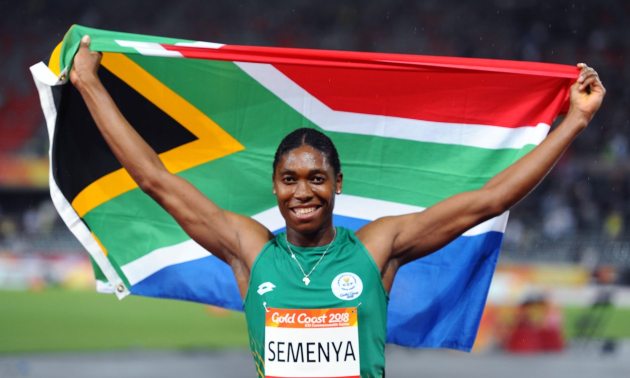
It also means I can include Caster Semenya, who obviously was already an Olympic champion prior to my original post, but is now both more readily identified as an intersex athlete and who has since married her female partner.

On the negative side, it means removing people for less pleasant reasons, including WNBA player Britney Griner who in 2015 pled guilty to disorderly conduct charges after an incident of domestic violence involving her then same-sex partner.

Most disappointingly, it means ‘cancelling’ the woman who was previously number one on this list – Martina Navratilova – after she made a series of unacceptable comments about trans women athletes earlier this year, including calling them ‘cheats’. While I continue to respect Martina for what she accomplished in tennis career, and her pioneering efforts as a lesbian athlete, I cannot look up to a transphobe as a role model.

So here it is, my reviewed and renewed list of 12 LGBTI athletes I admire most:

12: Megan Rapinoe

I respect Rapinoe not just for her achievements on the field – including two-time World Cup winner, Olympic gold medal winner and US National Team co-captain. Perhaps just as important has been her stance on social justice issues off the pitch, including being a prominent supporter of Colin Kaepernick and efforts to draw attention to racial inequality in the US, herself kneeling during the US national anthem in 2016. And it obviously helps that Rapinoe has publicly called out the divisiveness and prejudice of President Donald Trump.

See also: Abby Wambach, Michelle Heyman, Chloe Logarzo and Sam Kerr.

uploadscardimage10104155e3b328c-bd15-4003-94cc-aaef266502da.png950x534__filtersquality80

11: Billie Jean King

Billie Jean King as an athlete was not necessarily a lesbian role model, and in fact was outed against her will in a palimony lawsuit filed by a former partner in 1981 towards the end of her playing career. But she was a champion on the court, and especially as someone who fought hard – and successfully – for equal pay for women tennis players. After her career finished, and King finally came out as a lesbian on her own terms, she also made up for lost time as an outspoken advocate for LGBT equality, and in 2009 was awarded the Presidential Medal of Freedom by Barack Obama for her work advocating for the rights of women and the LGBT community.

10: Michael Sam

So much was written about Michael Sam that adding much here is almost redundant. He makes this list alone for the courage of coming out publicly prior to NFL draft camp (although his teammates knew during his final season of College football) – and accepting the risk that he would be drafted lower, or even not at all, because of this declaration. To risk killing off your career, by being honest about who you are from the outset, in a sport where no active player has ever come out, is the definition of brave.

The moment where he emotionally celebrated being drafted by the St Louis Rams by kissing his then-boyfriend Vito Cammisano, broadcast live on ESPN to millions of Americans, was a beautiful moment (with added points for how much it seemed to piss off American homophobes). The fact he ultimately did not play in the NFL should not undermine the courage he showed – or the fact that he has made it easier for those that follow.

See also: US basketball player Jason Collins came out via Sports Illustrated in April 2013 and, in March 2014, played for the Brooklyn Nets, becoming the first openly-gay active player in any of the ‘big four’ North American men’s sports competitions (baseball, basketball, football and ice hockey), although baseball player Glenn Burke was apparently open about being gay to his teammates and club owners in the late 1970s, but not to the public at large.

Michael Sam Vito Cammisano

Michael Sam embraces boyfriend Vito Cammisano live on ESPN after being drafted.

9: Erin Phillips

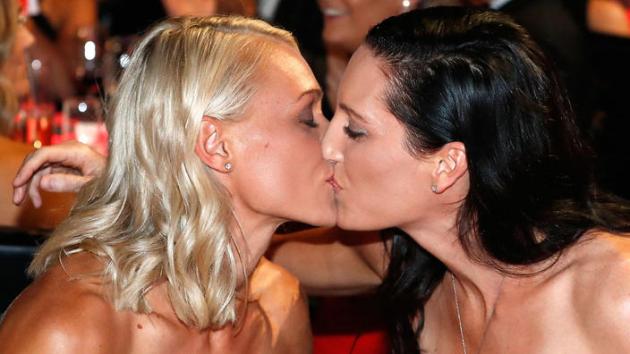
Phillips is an amazing athlete, and it is impossible to overstate her achievements in two very different sports. She has been a world champion and Olympic Games silver medallists with the Australian basketball team, as well as a two-time WNBA champion. Phillips has also been the most public representative of the AFL Women’s competition, winning two AFLW premierships, and two league best and fairests, in the first three years of competition. Plus, she had her own viral moment, kissing her wife Tracy Gahan, on winning the first of those awards – something that we are still waiting for on the men’s side.

AFLW Awards

8: Adam Rippon

Rippon’s sporting achievement perhaps do not match some of the other athletes on this list, although he did win a team figure skating bronze medal in the 2018 Pyeongchang Winter Olympics. However, I look up to him both for his perseverance – after missing out on both the 2010 and 2014 Olympics – and for his uncompromising ‘gayness’, both in his sport and in his public appearances. He is a role model that many can look up to for many years to come.

See also: Belle Brockhoff, Gus Kenworthy, Ireen Wust and Blake Skjellerup.

7: Matthew Mitcham

Another athlete to come out before their first Olympic Games – aged just 20, in the lead-up to Beijing in 2008 – Mitcham went on to claim the Gold Medal in the men’s 10 metre platform, with the highest-scoring dive in Olympic history. The fact that he had been so public about his sexual orientation also meant that the world got to see him celebrating his victory by embracing his then boyfriend, Lachlan Fletcher, in the stands – a forerunner to the Sam-Cammisano, and Phillips-Gahan, moments.

See also: It would be remiss not to mention British Olympic bronze medallist diver Tom Daley, especially given his December 2013 coming out video on YouTube has been watched more than 11 million times around the world.

Matthew Mitcham Lachlan Fletcher Beijing

Matthew Mitcham celebrates his Gold Medal victory in Beijing with then-partner Lachlan Fletcher

6: Amelie Mauresmo

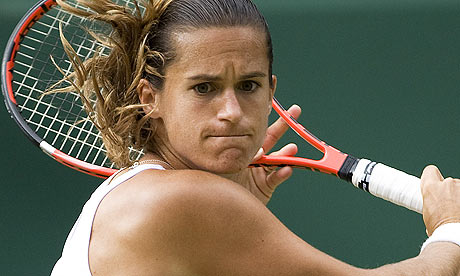
One of the most famous athletes to come out early in their careers was French tennis player Amelie Mauresmo, who not only came out publicly at the age of 19 during the 1999 Australian Open (where she went on to make the final), but who also endured negative comments from other players in response. The fact that she persevered against her (on-court) psychological struggles, to become world number 1 and then both Australian Open and Wimbledon Champion in 2006 is truly admirable.

See also: I have written previously about the large number of out female tennis players (link here) compared to the complete absence of any out male players. Of those women, one of my favourites is Casey Dellacqua, who came out in August 2013, with the simple announcement that she and her partner Amanda had become parents.

amelie-mauresmo-001

5: Greg Louganis

Greg Louganis is the only person to feature on this list who was not openly LGBTI during their sports career (although Billie Jean King was not out by choice). And, while he may go down in history as one of the greatest divers of all time (winning two gold medals at both the Los Angeles and Seoul Olympics), that is not the reason I have included him here either.

He features because of his disclosure in 1995 that he was both gay and HIV-positive, having tested positive at the start of 1988. In doing so, he was confronted by, and helped to challenge, the stigma and discrimination surrounding HIV, at a time when large numbers of people in the US, Australia and other Western countries were still dying from AIDS-related illness (noting of course that this continues to be true for much of the world today).

Louganis has since worked as an advocate for people living with HIV, as well as for the human rights of the LGBT community, thus demonstrating his champion abilities extended from the diving board to the real world.

See also: Australian Sydney Olympic silver medallist, trampolinist Ji Wallace, who announced he was gay in 2005, and HIV-positive in August 2012, and who has since become another advocate for people living with HIV.

4: Renee Richards

One of the true pioneers of LGBTI sports, Renee Richards transitioned in 1975. She was subsequently denied entry to compete at the 1976 US Open Tennis championships. Richards contested this ban in the New York Supreme Court, which ruled in her favour, allowing her to compete at the 1977 US Open where, despite losing in first round singles, she made the women’s doubles final.

Richards continued to compete until 1981, rising as high as number 20 in the rakings (in February 1979). She may not have won a title, but in the period since she has won an enormous amount of respect for being a trailblazer for trans* participation in sports.

See also: Mianne Bagger, Danish born Australian resident, was the first trans* woman to play in a professional golf tournament at the Women’s Australian Open in 2004. She went on to qualify for and play on the European Women’s Golf Tour. Trans* Canadian athlete Michelle Dumaresq is another pioneer in this field, competing in the 2002, 2003 and 2004 World Mountain Biking Championships. And obviously Hannah Mouncey, who has bravely fought for inclusion in the AFL Women’s competition (and has played in the VFLW).

3: Louisa Wall

Wall made her international debut for the Silver Ferns in netball in 1988 at the age of just 17. Later, she went on to compete in international rugby union, coming out publicly as a lesbian prior to playing for the New Zealand team that won the women’s World Cup in 1998.

As if that wasn’t impressive enough, Wall entered Parliament in 2008, and it was her Private Member’s Bill which was eventually passed on 17 April 2013, making New Zealand the 13th country in the world to achieve marriage equality. That list of achievements is enough to make most people (this author included) feel pretty inadequate by comparison.

Louisa Wall MP and partner Prue Katea

Louisa Wall with partner Prue Katea celebrating passage of the NZ Marriage Amendment Bill

2: Ian Roberts

Looking back on it now, almost 20 years later, it is difficult to overstate the significance of Ian Roberts’ coming out – for so many people around the world (including for the author, who was 17, deeply in the closet and at a religious boarding school in Brisbane at the time).

The fact that someone who was one of the ‘hard men’ of rugby league, having played 9 State of Origin matches and 13 Tests for Australia, talked openly about being gay – and, importantly, who continued to play the game for another three years – was simply amazing.

At the time, it was also supposed to be a ‘game changer’, with Roberts opening the door for other gay or bisexual rugby league (and Australian rules) players to come out, too. In 2019, in Australia at least, none have followed in his footsteps, thus underscoring just how significant his original declaration was. Although, on a positive note, just this year we did see Andy Brennan become the first out A-League soccer player.

See also: While no other Australian top flight rugby league or Australian rules players have come out since Roberts retired, Welsh rugby union and rugby league dual captain (and British Lions captain to boot), Gareth Thomas came out as gay in 2009, prior to his rugby league international appearances.

1: Caster Semenya

Caster Semenya’s achievement on the track are beyond impressive:

  • Olympic gold medal winner in the 800m in London 2012 and Rio 2016
  • World champion in 2009, 2011 and 2017, as well as
  • Double gold medallist (800m and 1500m) at the 2018 Commonwealth Games.

The fact that she has achieved this despite near-constant speculation about her (intersex) variations of sex characteristics, and ongoing attempts by the International Association of Athletics Federations to change the rules in a targeted way to make her ineligible to compete is nothing short of amazing. I sincerely hope that Semenya is successful in her current appeals against the ban, and that one day we simply look back on how brilliant she was as an athlete.

See also: Indian sprinter Dutee Chand, who has also been affected by rules targeting female athletes with ‘hyperandrogenism’, and who has also confronted homophobia in her home country by announcing earlier this year she is in a same-sex relationship.

caster-semenya-gold-coast-1500m-by-mark-shearman

Submission to NSW Parliament Inquiry into False or Misleading Health Practices re Ex-Gay Therapy and Intersex Sterilisation

Earlier this year, NSW Parliament’s Committee on the Health Care Complaints Commission called for submissions to an inquiry into the promotion of false or misleading health-related information or practices.

I wrote the following submission, looking at two practices in particular which negatively affect the lesbian, gay, bisexual, transgender and intersex (LGBTI) community: the practice of so-called ‘ex-gay therapy’ or conversion therapy, as well as the involuntary or coerced sterilisation of intersex people.

At this stage, while the Committee has chosen to publish 63 of the submissions it has received, it has not published mine, so I am reproducing it here. As always, I would be interested in your thoughts/feedback on the below.

Committee on the Health Care Complaints Commission

Parliament House

Macquarie St

SYDNEY NSW 2000

Friday 7 February 2014

Dear Committee

SUBMISSION TO INQUIRY INTO THE PROMOTION OF FALSE OR MISLEADING HEALTH-RELATED INFORMATION OR PRACTICES

In this submission, I would like to address two areas of ‘health-related practices’ which negatively affect the lesbian, gay, bisexual, trans* and intersex (LGBTI) communities.

Specifically, with respect to term of reference (c) “the promotion of health-related activities and/or provision of treatment that departs from accepted medical practice which may be harmful to individual or public health”, I believe the Committee should examine:

i)              ‘ex-gay’ or ‘reparative’ therapy, and

ii)             the involuntary or coerced sterilisation of intersex people.

Ex-gay or reparative therapy

I can think of few ‘health-related practices’ which so clearly fall within term of reference (c) of this inquiry than so-called ‘ex-gay’ or ‘reparative’ therapy.

This practice, which although more common in the United States is nevertheless still practiced in New South Wales, involves organisations, usually religious, offering ‘counselling’ to help transform people who are lesbian, gay or bisexual into being heterosexual, and in some cases to attempt to transform people who are trans* into being cisgender.

In short, ex-gay or reparative therapy involves attempting to change a person’s sexual orientation or gender identity, based on the belief that being lesbian, gay, bisexual or trans* is somehow ‘wrong’ or ‘unnatural’.

There are three main problems with ex-gay or reparative therapy.

First, there is absolutely nothing wrong or unnatural with being lesbian, gay, bisexual or trans*. Differences in sexual orientations and gender identities are entirely natural, and this diversity should be accepted and celebrated. Any attempts to prevent people from being LGBT simply demonstrate the homophobia, biphobia and transphobia of the people running ex-gay organisations.

Second, there is absolutely no scientific evidence to support these practices. Sexual orientation and gender identity cannot be ‘changed’ through these interventions. Indeed, the Australian Psychological Society, Royal Australian and New Zealand College of Psychiatrists and Pan American Health Organisation all note that reparative therapy does not work, and recommend against its practice.

Third, and most importantly, not only is ex-gay therapy based on homophobia, and discredited ‘pseudo-science’, but it is also fundamentally dangerous. Reparative therapy takes people who are already vulnerable, tells them that they are inherently wrong, and asks them to change something about themselves that cannot be changed. Inevitably, it leads to significant mental health problems, including self-hatred, depression and tragically, in some cases, suicide. The people that run ex-gay organisations are guilty of inflicting psychological and sometimes physical damage on others.

Given the level of harm that is perpetrated by these people, I believe it is incumbent on the NSW Parliament to introduce a legislative ban on ex-gay or reparative therapy. This should include the creation of a criminal offence for running ex-gay therapy, with an aggravated offence for running ex-gay therapy for people under the age of 18. This is necessary to send a signal that these homophobic, biphobic and transphobic practices are no longer tolerated in contemporary society, particularly in the case of minors.

Finally, while at this stage there is no evidence linking registered medical practitioners with these discredited practices in New South Wales, there is evidence overseas that some counsellors, psychologists, psychiatrists or other registered medical practitioners either practice ex-gay therapy themselves, or will refer patients to ex-gay organisations. The Committee should consider additional appropriate sanctions for any practitioners caught doing so in NSW, including potential de-registration and civil penalties.

Involuntary or coerced sterilisation of intersex people

In contrast to ex-gay therapy, which is largely performed by people who are not registered medical practitioners, some abuses perpetrated against intersex people in Australia are undertaken by the medical profession themselves.

As outlined by Organisation Intersex International Australia (OII Australia), in their submission to last year’s Senate Standing Committee on Community Affairs Inquiry into Involuntary or Coerced Sterilisation of People with Disabilities in Australia (dated 15 February 2013, pages 3-4):

“Every individual member of OII Australia has experienced some form of non-consensual medical intervention, including the following:

  • Pressure to conform to gender norms and to be a “real man” or “real woman”.
  • Involuntary gonadectomy (sterilisation) and clitorectomy (clitoris removal or reduction) as an infant, child or adolescent.
  • Medical and familial pressure to take hormone treatment.
  • Medical and familial pressure to undertake genital “normalisation” surgery.
  • Surgical intervention that went outside the terms of consent, including surgery that was normalising without consent.
  • Disclosure of non-relevant medical data to third parties without consent.”

While I understand that the terms of reference state that “[t]he inquiry will focus on individuals who are not recognised health practitioners, and organisations that are not registered health service providers”, given the significant levels of harm involved in these practices against intersex people, I would encourage the Committee to nevertheless examine this subject.

I would therefore recommend the Committee take into consideration the 2nd Report of the Senate Standing Committee on this topic, as well as OII Australia’s submissions to that Inquiry. I have also attached my own submission from that inquiry with this submission (link here: <https://alastairlawrie.net/2013/07/01/submission-to-involuntary-and-coerced-sterilisation-senate-inquiry/ ).

Thank you for considering my submission on these important topics.

Sincerely,

Alastair Lawrie

10 Things I Hate About Marriage Inequality. #9: Because sometimes I feel guilty for having #firstworldproblems

Have you ever felt that pang of guilt that we in Australia spend so much time campaigning for marriage equality when so many of our LGBTI comrades around the world are fighting for things that are even more fundamental, like the right to simply be who they are without fear of criminal prosecution?

I must admit I have – sometimes, when I am writing my umpteenth submission calling for the right to simply marry my fiancé, or attending my 20th or even 30th rally supporting marriage equality, I do feel slightly guilty for having what on twitter might be referred to as #firstworldproblems (albeit of a far less trivial nature than complaints like ‘my raisin bran had too many raisins in it this morning’).

When you look at this recently released map from ILGA (the International Lesbian, Gay, Bisexual, Trans and Intersex Association):

ILGA 2016

ILGA, June 2016.

and see large sections of the globe coloured orange (where being gay is a criminal offence) and even dark red (countries which have the death penalty for homosexuality) – and they are at least as large as, and include many more people, than the sections which are dark green (ie countries and states that have full marriage equality) – then experiencing such guilt might seem understandable.

Now, before I get roundly slammed for expressing this view, I acknowledge that this perhaps says more about me than about the Australian marriage equality movement per se. I also recognise that these thoughts are likely the products of internalising a couple of the arguments which have been used against LGBTI equality for some time.

The first, that people elsewhere have it worse off than us (undoubtedly true), and that we should be grateful for what we have (also true – although from my perspective I am grateful to the activists who have brought that situation about), is essentially an attempt to say that we already have ‘enough’ rights, and therefore should stop campaigning for more.

This argument is easy to reject – just because we have already achieved some rights (decriminalisation, anti-discrimination protections etc), doesn’t mean we should accept anything less than full equality – and that includes exactly the same legal recognition of our relationships as already enjoyed by cisgender heterosexual couples.

However, the second, related argument is a little more difficult to dismiss out of hand, and that is that there are bigger and more important issues in the world, and consequently we should be concentrating our efforts on those instead.

In the domestic context, this type of argument is used by marriage equality opponents to say that jobs, the economy, health, education – indeed, all manner of things – are more important than marriage equality, and that we should just ‘drop it’ and put those other issues first.

Of course, our straightforward response to that argument is that Parliament is capable of dealing with more than one issue at a time, and therefore there is no need to put things like marriage equality on the backburner until somehow all of those other issues are magically ‘fixed’ first.

In the international context, the argument would go something like: given there are still roughly 75 countries where being gay is a crime, achieving decriminalisation globally is far more important than campaigning for marriage equality in countries like Australia where we already enjoy most substantive rights, and therefore that is where we should exert all our energies.

Based on the domestic example (above), the most logical response is to say that we are capable of doing both – that there is absolutely no reason why we cannot simultaneously campaign for marriage equality within Australia (and similar countries), while also supporting movements for decriminalisation elsewhere.

But, and here’s the important thing, the strength of that argument is based on us actually DOING both. If we only look at improving our own (already quite privileged) lot, and effectively ignore the struggle for more basic equality from lesbian, gay, bisexual, transgender and intersex people in other countries then, at the very least, we expose ourselves to the potential criticism that we are being indulgent (even if most would see such criticism as unfair).

That is not to say that anyone should feel guilty for campaigning for their own individual equality or rights – and not just because, as I have discovered perhaps a little late in life, guilt is not an especially productive emotion. To me, one of life’s great joys lies in finding the strength to stand up against the discrimination or prejudice that we encounter.

But I guess I am saying that, if we are interested in campaigning for full equality for ourselves, by securing marriage equality domestically, we should also see that struggle in its appropriate context, and also devote some of our time and effort to helping the fight for equality by our LGBTI comrades in other countries.

NB If, after reading this, you agree with me and want to do more (or even if you disagree vehemently with what I’ve written but still want to help international LGBTI equality), here are five groups which you might consider joining/supporting:

30th anniversary of decriminalisation of homosexuality in NSW

Tonight, at midnight, it will be exactly 30 years since gay and bisexual adult men in New South Wales moved from being criminals to being able to engage in consensual sexual intercourse without fear of prosecution.

Then NSW Premier, the Hon Neville Wran MP’s, private member’s bill – the Crimes (Amendment) Act 1984 – had passed the NSW Parliament on 22 May, but did not take effect until the 8th of June, 1984.

This legislation, decriminalising male same-sex sexual intercourse (for people aged 18 or over – sadly, an equal age of consent had to wait another 19 years), was the product of 14 years of hard work and tireless campaigning of gay and lesbian (and of course some early trans*) rights activists.

From the founding of the Campaign Against Moral Persecution (CAMP) in September 1970, through the proliferation of gay liberation groups during the 1970s, to the courageous ‘78ers’ who resisted NSW Police violence at the first Sydney Gay Mardi Gras Parade, and the Gay Rights Lobby, formed in 1980 – as well as numerous other groups advocating for equality on the basis of sexual orientation – this achievement was truly a collective effort.

It is thanks to the courage of these activists, who stood up and fought for their (and our) rights, to be public and be proud at a time when they were threatened with criminal sanction for simply being who they were, that people like my fiancé Steve and I can enjoy, and even take for granted, such a wide range of freedoms today.

It is because of this that I simply wanted to take this opportunity to express my gratitude for what they achieved, for themselves, for us and for future generations. To them, I say thank you. Thank you, thank you, thank you, thank you, thank you, thank you, thank you, thank you, thank you, thank you, thank you, thank you, thank you, thank you, thank you, thank you, thank you, thank you, thank you, thank you, thank you, thank you, thank you, thank you, thank you, thank you, thank you, thank you, thank you.

That’s one thanks for every year of freedom that we have enjoyed since the decriminalisation of homosexuality 30 years ago. To any of those activists who might one day read this post (highly unlikely, but then you never know), please know that we appreciate what was done, and that we owe you.

Of course, there is one way that we can try to repay at least a small part of that debt, and that is to continue pushing for legislation which allows all those who were convicted due to the homophobia of the criminal law – both before decriminalisation in 1984, and because of the unequal age of consent between 1984 and 2003 – to have those convictions expunged.

The Liberal Member for Coogee, Bruce Notley-Smith, is expected to introduce a private member’s bill to achieve just that later in June. We should lobby to ensure as many MPs as possible support this effort at redressing past injustices.

At the same time, the NSW Parliament should expressly apologise to all those harmed – both at the time and, for many, for a lifetime – by the homophobic laws which emanated from that place for far too long.

Legislation to expunge historical convictions, accompanied by a parliamentary apology for historic injustices, would be a fitting way to mark the 30th anniversary of decriminalisation of homosexuality in NSW. Let’s do what we can to make sure it happens.

Decriminalisation campaigners, including Lex Watson, at the Gay Rights Embassy opposite then Premier Neville Wran's home in 1983 (source: Adrian Short as published in Sydney Morning Herald).

Decriminalisation campaigners, including Lex Watson, at the Gay Rights Embassy opposite then Premier Neville Wran’s home in 1983 (source: Adrian Short as published in Sydney Morning Herald).