Submission re Queensland Criminal Law Amendment Bill 2016

Update 21 March 2017:

Tonight, Queensland Parliament has voted to – finally – abolish the homosexual advance defence (sometimes referred to as the ‘gay panic’ defence) from state law.

This move, while long overdue, is obviously welcome, removing one more piece of homophobic legislation from the Queensland statute books.

To read more about the passage of the Criminal Law Amendment Bill 2016, see tonight’s report in the Brisbane TimesGay panic laws pass Queensland Parliament, removing partial defence’.

Finally, I thank Mr Rob Molhoek, LNP member for Southport, for this ‘shout-out’ in his speech on the Bill:

“In his submission to the committee, Mr Alistair [sic] Lawrie commented that—

Even if a small minority of people remain firmly intolerant of homosexuality, that does not mean there should be a ‘special’ law to reduce the culpability of such a person where they are confronted by an unwanted homosexual sexual advance. To retain such a provision is unjust and discriminatory, and is a mark against any legal system which aspires to fairness.

I agree with that statement made by Mr Lawrie. I firmly believe that discrimination of any type, be it based on sexuality, age, gender or any other matter, has no place in our laws. That is why I support this proposed legislation.”

Update 22 February 2017:

The Report by the Queensland Legal Affairs and Community Safety Committee into the Criminal Law Amendment Bill 2016 was handed down yesterday. For a copy of the report, click here.

Pleasingly, the Committee’s main recommendation is that the Bill – which would finally abolish the homosexual advance defence or ‘gay panic defence’ in Queensland – should be passed.

The discussion of the abolition of this partial defence to murder, from pages 4 to 18, features a number of references to my own submission (which can be found in the post below).

This includes consideration of my concerns (and the concerns of others) about the drafting of and definitions for both ‘circumstances of an exceptional character’ and ‘unwanted sexual advance’.

I welcome the Committee’s interest in these issues, as well as their agreement to my own recommendation that the operation of the law as amended should be reviewed after 5 years to ensure it has functioned as intended (on page 18: “The committee agrees that the proposals in Clause 10 of the Bill should be reviewed in five years to establish whether they have operated as intended”).

For more on how this committee inquiry has been received, see The Brisbane Times article ‘Gay panic law reform bill should be passed, committee recommends’. 

Whether the Bill is passed is now up to Queensland Parliament, including the crossbenchers who hold the balance of power. Hopefully they agree to consign the homosexual advance defence to the history books as quickly as possible.

Original post:

The Palaszczuk Labor Government has proposed legislation that would, among other things, finally abolish the ‘homosexual advance defence’, or ‘gay panic’ defence, under Queensland law.

Its Criminal Law Amendment Bill 2016 is currently the subject of an inquiry by the Legal Affairs and Community Safety Committee. Full details of the Inquiry can be found here – my submission to the inquiry is included below.

The Committee is due to report by 21 February 2017. Hopefully, the homosexual advance defence is consigned to the history books shortly thereafter.

**********

The Research Director

Legal Affairs and Community Safety Committee

Parliament House

Brisbane QLD 4000

lacsc@parliament.qld.gov.au

Monday 16 January 2017

Dear Committee,

Submission re Criminal Law Amendment Bill 2016

Thank you for the opportunity to provide a submission regarding the Criminal Law Amendment Bill 2016.

In this submission I will be focusing exclusively on the proposed amendments to section 304 of the Queensland Criminal Code, as contained in clause 10 of the Bill.

Overall, I welcome these proposed amendments, given the stated intention of the Queensland Government that they will give effect to their election commitment to repeal the homosexual advance defence, or ‘gay panic’ defence.

As noted by Attorney-General the Hon Yvette D’Ath in her second reading speech:

“The amendment to section 304 provides that the partial defence is excluded if the sudden provocation is based on an unwanted sexual advance, other than in circumstances of an exceptional character. I know that there has developed a reference to this amendment as removing the ‘gay panic’ defence – that is, a situation where the defendant claims to have been provoked to murder by a homosexual advance by the deceased. I absolutely acknowledge this amendment’s importance to the lesbian, gay, bisexual, trans and intersex community – as it is to all Queenslanders who have voiced their criticism that such an advance could establish the partial defence.”

Indeed, the abolition of this defence, in the two Australian jurisdictions where it remains in place (Queensland and South Australia) is a priority for the LGBTI community nation-wide.

That is because the idea that a lesser level of criminal punishment – manslaughter rather than murder – should apply where a man kills another man because of an unwanted sexual advance is, to put it simply, abhorrent.

This point was made eloquently by Justice Kirby in his dissent in the High Court’s decision in Green v The Queen [1997] HCA 50:

“If every woman who was the subject of a “gentle”, “non-aggressive” although persistent sexual advance… could respond with brutal violence rising to an intention to kill or inflict grievous bodily harm on the male importuning her, and then claim provocation after a homicide, the law of provocation would be sorely tested and undesirably extended… Any unwanted sexual advance, heterosexual or homosexual, can be offensive. It may intrude on sexual integrity in an objectionable way. But this Court should not send the message that, in Australia today, such conduct is objectively capable of being found by a jury to be sufficient to provoke the intent to kill or inflict grievous bodily harm. Such a message unacceptably condones sexual violence by people who take the law into their own hands.”

The truly offensive nature of the homosexual advance defence is revealed by asking why it invariably applies to non-violent sexual advances by a man to another man. As Kirby asks, rhetorically, if a non-violent sexual advance from one man to another was sufficient to justify forming the intention to kill or seriously wound, why should this not also apply to a non-violent sexual advance by a man to a woman? Further, why shouldn’t a woman who receives an unwanted non-violent sexual advance from another woman have access to the partial defence of provocation? Why doesn’t it also apply to a man who receives an unwanted non-violent sexual advance from a woman?

The answer is that in all of these cases society justifiably expects the recipient of the unwanted sexual advance to exercise self-control. A violent response to an unwanted non-violent sexual advance, to the extent that the recipient forms the intention to kill or seriously wound, is so beyond the pale, or so far out of the ordinary, that we do not extend any reduction in culpability to the offender in these circumstances.

In my opinion, there is nothing so different, so special or so extraordinary, in the situation where the non-violent sexual advance is made by a man to another man, as to justify offering the offender in such cases any extra legal protection. In contemporary Australia, a man who receives an unwanted sexual advance should exercise the same level of self-control as we expect of any other person.

To have a separate legal standard apply to these cases is homophobic because it implies there is something so objectionable about a non-violent sexual advance by a man to another man that a violent reaction is almost to be expected, and at least somewhat excused. This does not reflect the reality of contemporary Australia, where, with the exception of marriage, gay men enjoy (most of) the same rights as other men, and are accepted as equals by the majority of society.

Even if a small minority of people remain firmly intolerant of homosexuality, that does not mean there should be a ‘special’ law to reduce the culpability of such a person where they are confronted by an unwanted homosexual sexual advance. To retain such a provision is unjust and discriminatory, and is a mark against any legal system which aspires to fairness.

The above discussion outlines why the homosexual advance defence is wrong in principle. What should not be forgotten is that the homosexual advance defence is also wrong in practice, or in the outcomes which it generates. After all, the defence does not simply exist in the statute books, ignored and unused. Instead, it has been argued in a number of different criminal cases, sometimes successfully.

This means there are real offenders who are in prison (or who have already been released), who have had their conviction reduced from murder to manslaughter, and most likely their sentence reduced along with it, simply because they killed in response to an non-violent homosexual advance. The legal system has operated to reduce the liability of these offenders even when broader society does not accept that such a reduction is justified. As a result, these offenders have not been adequately punished, meaning that above all these victims have not received justice.

Similarly, the family members and friends of the victims killed in such circumstances have witnessed the trials of these offenders, expecting justice to be served, only to find that the killer is not considered a murderer under the law. Instead, these family members and friends find some level of blame is placed on the actions of the victim, that somehow by engaging in a non-violent sexual advance they have helped to cause and even partly deserved their own death.

For all of these reasons, I strongly support the abolition of the homosexual advance defence, or ‘gay panic’ defence, in any jurisdiction where it remains.

Therefore, I commend the Queensland Palaszczuk Labor Government for its commitment to remove this abhorrent law from the statute books via the Criminal Law Amendment Bill 2016.

It does so through the inclusion of clause 10, which would amend section 304 of the Queensland Criminal Code, the provision that establishes the partial defence to murder of provocation.

Specifically, I welcome the proposed insertion of new sub-section 304(3A):

“Further, sub-section (1) does not apply, other than in circumstances of an exceptional character, if the sudden provocation is based on an unwanted sexual advance to the person.”

Prima facie, the inclusion of this new sub-section substantively removes the partial defence of provocation for circumstances where the ‘provoking conduct’ was an unwanted, non-violent sexual advance.

In principle, then, the homosexual advance defence, or ‘gay panic’ defence, would be abolished in Queensland by the passage of this Bill.

However, I do have two concerns about the drafting of the amendments to section 304, and their potential operation.

First, by including the phrase ‘other than in circumstances of an exceptional character’, I am concerned that this leaves the door slightly ajar to at least some cases where the homosexual advance defence may be sought to be used.

I note that, for the purposes of new sub-section 3A, there is no restriction on what might constitute ‘circumstances of an exceptional character’ (with proposed new sub-section 6A merely providing that regard may be had to any history of violence, or of sexual conduct, between the offender and the victim).

This leaves room for judicial interpretation, and the possibility, albeit remote, that the homosexual advance defence may still be successfully raised.

For this reason, I suggest that the operation of the reforms to 304 be reviewed after a period of five years, to assess whether these amendments have operated as intended.

Recommendation 1: The operation of the proposed reforms to section 304 should be reviewed after five years, to assess how they have operated in practice, including how the term ‘circumstances of an exceptional character’ has been applied in cases where a defendant has sought to invoke what would be described as the homosexual advance defence.

The second concern I have about the proposed amendments is the inclusion of the definition of ‘unwanted sexual advance’ in new sub-section 9:

“In this section-

unwanted sexual advance, to a person, means a sexual advance that-

(a) is unwanted by the person; and

(b) if the sexual advance involves touching the person – involves only minor touching.

Examples of what may be minor touching depending on all the relevant circumstances-

patting, pinching, grabbing or brushing against the person, even if the touching is an offence against section 352(1)(a) or another provision of this Code or another Act.”

The attempt to provide clarity of what forms an unwanted sexual advance, as a means to prevent the successful use of the homosexual advance defence, is clearly welcome.

The reference to section 352(1)(a) is also useful because, as the Attorney-General noted in her second reading speech “the spectrum of conduct that falls within the offence of sexual assault is very broad”, and this should not automatically result in an increased ability of a murderer to seek to have their charge downgraded.

However, the creation of a definition of unwanted sexual advance creates the risk, and arguably the incentive, for the perpetrator of these types of offences to exaggerate the ‘touching’ that was involved in the unwanted sexual advance that preceded the murder.

Given the nature of these cases, there will necessarily be no ability for the victim to provide any evidence disputing this exaggeration.

It would obviously be disappointing if, in attempting to remove the homosexual advance defence, the Government introduces a provision that instead allows its continued use, in certain circumstances, with the defendant induced to increase their claims about the unwanted sexual advance by the deceased.

It is difficult to see how this particular risk can be completely excluded – other than by adopting the approach of some other states and territories (including Victoria, Western Australia and Tasmania) to abolish the partial defence of provocation entirely.

As with the definition of ‘circumstances of an exceptional character’ above, I suggest that the operation of these provisions generally, and the definition of ‘unwanted sexual advance’ specifically, be reviewed after five years, to determine whether there have been any unintended or unforeseen consequences of these amendments.

If there have been, then at that point it may be appropriate to consider abolishing the partial defence of provocation altogether, and replacing it with specific defences or partial defences for a limited range of scenarios (for example, in the context of family violence).

Recommendation 2: The operation of the proposed reforms to section 304 should be reviewed after five years, to assess how they have operated in practice, including how the definition of ‘unwanted sexual advance’ has been applied, and whether it has simply induced defendants to exaggerate their claims about the unwanted sexual advance by the deceased.

Thank you again for the opportunity to provide this submission regarding the Criminal Law Amendment Bill 2016, and specifically about clause 10, a provision that is intended to finally abolish the homosexual advance defence, or ‘gay panic’ defence, in Queensland.

As indicated above, I welcome these reforms in principle. The above two recommendations are offered in order to help ensure that the intention of the Bill is reflected in practice.

I can be contacted at the details provided with this submission, should the Committee have any questions about this submission, or require any additional information about the matters raised.

Sincerely

Alastair Lawrie

Yvette D'Ath

Queensland Attorney-General Yvette D’Ath, who introduced the Criminal Law Amendment Bill on 30 November last year.

2016: Annus Homophobicus


In November 1992, the Queen of England (and, unfortunately, still the Queen of Australia too) gave a speech in which she described the previous 12 months as her ‘annus horribilis’.


To be fair, it had been a rough year for Ms Windsor, with the separation of her eldest son from his wife, the divorce of her only daughter from her husband, frequent tabloid scandals (hello toe-sucking!) and even a fire in one of her (many) houses[i].


But, as bad as Elizabeth II’s year was back then, it’s frankly got nothing on how depressing, and frustrating, 2016 has been for lesbian, gay, bisexual, transgender and intersex (LGBTI) Australians.


So, as the year draws to a close, and we look back on the (too few) highs and (far too many) lows, it feels apt to declare the past 12 months to be our very own ‘annus homophobicus’.


It started in January with the launch of a ferocious, and well co-ordinated, attack on the Safe Schools program by the Australian Christian Lobby, The Australian newspaper and extremists in the right-wing of the Liberal-National Government.


And, even after Prime Minister Malcolm Turnbull ‘gutted’ the program in early March, the campaign against what is a vital anti-bullying program designed to help LGBTI students has continued, as unyielding as it is lacking in compassion.


The year ended with the tragic death of 13-year-old Brisbane high school student, Tyrone Unsworth, in late November. Indigenous and gay, Tyrone had suffered relentless bullying because of his sexual orientation, until he ultimately took his own life.


A death that, understandably, shook many members of our community to the core, it was particularly hard for LGBTI Aboriginal and Torres Strait Islander people.[ii] It was a tragedy that demonstrated the very need for a program that homophobic bigots had spent the best part of a year trying to dismantle.


In between, 2016 was dominated by Turnbull’s proposed plebiscite on marriage equality – a policy that was completely unnecessary, fundamentally wasteful and, if held, would inevitably be harmful for countless young and vulnerable members of the LGBTI community, including the children of rainbow families.


It took the collective efforts of a variety of LGBTI groups, alongside the work of many individual activists, over several months, to finally defeat the planned plebiscite in early November. But that sustained campaign, against a proposal that had been put forward simply to delay or defeat rather than achieve equality, left a large number of people almost completely drained (myself included).


The past 12 months has also witnessed a rise in homophobic and transphobic hate-speech. It seems that anti-LGBTI rhetoric is both more common, and more ‘acceptable’, in Australia now than at any point over the past 10 to 15 years.


And it certainly does not help that the frequent abuse of LGBTI people coming from inside the Government, by the likes of Cory Bernardi and George Christensen, has gone without any obvious punishment from an allegedly-moderate Prime Minister too scared to stand up to his more-conservative colleagues.


Even worse than hate-speech, 2016 has seen plenty of horrific hate-based actions, both here and around the world.


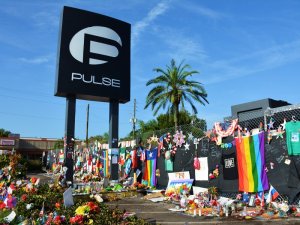
This includes the almost unspeakable tragedy in Orlando on June 12th, with the mass murder of 49 people, and wounding of 53 others, at Pulse. With the popular gay nightclub holding a Latin night, most of the victims were young and Latinx. Six months later, it remains impossible not to cry when reading or watching tributes[iii] to the casualties of this terror attack.


pulse-tribute

Tributes to victims outside the Pulse nightclub in Orlando, Florida.


Acts of homophobic and transphobic violence were not limited to the United States, however. In Australia, too, there were countless assaults on LGBTI people.


The one that hit closest to home – both literally[iv] and figuratively – was the young Sydney man who was ‘gay-bashed’ twice in one night[v], the second time by a supposed ‘good Samaritan’ who had initially helped him after the first attack, only to assault the victim himself after learning he was gay.


This was a crime based on homophobia that could happen to anyone, anywhere, anytime, including my fiancé Steven and me.


**********


The net effect of these events, alongside other shocking outcomes of the past year (including Brexit and the election of Donald Trump), has been sufficient to undermine the belief that progress is somehow inevitable, that the future will always be better than the past.


But, as LGBTI Australians, we don’t need the fear-fuelled success of a xenophobic campaign against immigrants in the UK, or of a sexist and racist tyrant-in-training in the US, to remind us that political change is not inherently positive.


As many of you would know, the past few years have seen a number of areas where progress on LGBTI policy and law reform hasn’t just stalled, but been actively wound back.


One of the first acts of the Campbell Newman-led Liberal-National Queensland Government in 2012 was to abolish ceremonies as part of the recently-passed civil partnership scheme in that state[vi].


In Victoria, the Baillieu Coalition Government repealed the ‘inherent requirement’ test from that state’s Equal Opportunity Act – which had required religious employers to demonstrate that discrimination against LGBT employees was an essential part of the role – before it had even commenced operation in 2011[vii].


The Tasmanian Liberal Government not only made discrimination by religious schools easier in 2015 (thereby undermining what has been the nation’s best anti-discrimination scheme), it is currently committed to reducing protections against vilification, including those enjoyed by LGBTI Tasmanians.


And we shouldn’t forget the decision by Prime Minister Turnbull to discontinue funding for the Safe Schools program (with Commonwealth money to cease from 2017), an initiative that his predecessor, Tony Abbott, had actually implemented less than three years earlier.


It is clear then, that progress on LGBTI issue is not inevitable. And it is almost enough to challenge the wisdom of one of Martin Luther King, Jr’s many note-worthy quotes, namely that “The arc of the moral universe is long, but it bends toward justice.”


Almost, but not quite.


As painful as the past 12 months have been for many, especially for members of Australia’s LGBTI communities, we nevertheless must see these events in their historical context, and recognise that – at least on a (much) longer time-scale – overall, things are still headed in a positive direction. And that remains the case even if there are twists and turns, even significant bumps, along the way.


But the most important lesson to remember is that, while the arc may ‘bend toward justice’, it only does so because good people come together to take action to make change happen.


Just as US cultural anthropologist Margaret Mead famously observed: “Never doubt that a small group of thoughtful, committed citizens can change the world; indeed, it’s the only thing that ever has.”


One of the best examples of this maxim actually comes from one of the major LGBTI victories of 2016 – the long overdue equalisation of the age of consent for male homosexuality in Queensland.


While this was discriminatory legislation that affected many, its repeal was only a priority for a dedicated few[viii], including long-time LGBTI activist John Frame[ix] among others.


Through painstaking, and often thankless, campaigning over years and eventually decades, they chipped away at an unjust law until it was finally amended in September this year, almost 25 years since it was first introduced.


There were other wins this year too. The Palaszczuk Labor Government in Queensland also passed legislation to allow adoption by same-sex couples, while the Weatherill Labor Government in South Australia ended 2016 with a flurry of pro-LGBTI law reform, including relationship recognition, same-sex adoption and trans birth certificate changes[x].


And of course, there was the LGBTI community’s success in defeating the marriage equality plebiscite, a victory that was by no means guaranteed at this point last year[xi].


All of which is to show that, despite the increasingly toxic political environment that we appear to be operating in, and the significant losses cited above, positive change is still possible – if we keep our sights on the country, and world, that we want to create, and work towards it patiently, gradually, relentlessly.


**********


For my part, as I look ahead to 2017, I will be redoubling my efforts to improve Australia’s incomplete, inconsistent and in many cases inadequate system of LGBTI anti-discrimination and anti-vilification laws.


I know others will concentrate their energies on (finally) achieving marriage equality, as well as a myriad of other reforms, from ending the involuntary sterilisation of intersex infants, to further trans birth certificate changes, ending the inhumane detention of LGBTI refugees and reinvigorating the Safe Schools program.


So, let’s end 2016 by reflecting, relaxing and hopefully recuperating, so that when the new year rolls around we are ready to dust ourselves off, fight once more and bend that arc towards a more just country for LGBTI Australians.


**********


I have one final favour to ask. Could you please take 5-15 minutes to complete this short survey about your experiences of homophobic, biphobic, transphobic and intersexphobic discrimination, over the past 12 months, and previously?


The results of this research will be used to advocate for better protections against discrimination for LGBTI people across Australia, as well as to campaign for the introduction of LGBTI anti-vilification laws where they do not currently exist.


Please TAKE THE SURVEY NOW.

**********


If this post has raised any issues for you, you can contact:


  • QLife, Australia’s national telephone and web counselling and referral service for LGBTI people. Freecall: 1800 184 527, Webchat: qlife.org.au (3pm-midnight every day)
  • Lifeline: 13 11 14, lifeline.org.au


Footnotes:

[i] See The Guardian “How the Royal Family Bounced Back from its Annus Horribilis” 24 May 2012.

[ii] If you have a chance, please read Dameyon Bonson’s excellent op-ed “I am Indigenous. I am Gay. Unlike Tyrone Unsworth, I Survived” in The Guardian Australia, 28 November 2016.

[iii] For example, see Anderson Cooper’s emotional tribute on CNN in the days after the tragedy here.

[iv] The victim lived in our apartment complex, with the second attack happening just 50 meters from our building.

[v] The Daily Telegraph “Gay man bashed twice in Waterloo: I’ve never been so scared in my life, and thought I would die” 23 February 2016.

[vi] Thankfully, these ceremonies were reintroduced by the subsequently (and surprisingly) elected Palaszczuk Government.

[vii] The current Victorian Liberal-National Opposition, led by Matthew Guy, defeated Andrews Labor Government legislation to reinsert this test in November 2016.

[viii] With many focusing on more ‘popular’ issues like marriage equality.

[ix] See samesame.com.au “It’s time to update Queensland’s sex laws” 23 August 2015.

[x] For more on LGBTI successes of the past 12 months, see Lane Sainty’s summary in Buzzfeed “13 Times Australia’s LGBTI Community Had a Win in 2016” 16 December 2016.

[xi] For more, see Pride, Pressure & Perseverance.

What’s Wrong With the Queensland Anti-Discrimination Act 1991?

This post is part of a series examining the anti-discrimination laws that exist in each Australian jurisdiction and analysing how well, or how poorly, they protect lesbian, gay, bisexual, transgender and intersex (LGBTI) people from discrimination. Other posts in the series can be found here.

Specifically, each post considers three main aspects of LGBTI anti-discrimination legislation:

  • Protected attributes
  • Religious exceptions, and
  • Anti-vilification coverage.

Contrary to what some might expect, Queensland’s laws are at least ‘average’, and in some cases, particularly in relation to anti-vilification laws, ‘better than average’, across these three areas. Unfortunately, that says more about the major flaws that exist across most anti-discrimination laws in Australia than it necessarily does about the Anti-Discrimination Act 1991 (‘the Act’) itself.

There are still significant problems that must be addressed with this legislation, beginning with the issue of who is – and isn’t – covered.

**********

Protected Attributes

Like most of its counterparts in other states, Queensland’s Anti-Discrimination Act does not protect all parts of the LGBTI community from discrimination.

On the positive side, it does cover all lesbian, gay and bisexual people – with discrimination on the basis of ‘sexuality’ prohibited in section 7 of the Act (defined as “sexuality means heterosexuality, homosexuality or bisexuality” in the Dictionary found in the Schedule).

On the less positive side, it only covers some transgender people, and not others. That is because, while section 7 also includes ‘gender identity’, the Act’s definition of this term is out-dated:

“gender identity, in relation to a person, means that the person-

(a) identifies, or has identified, as a member of the opposite sex by living or seeking to live as a member of that sex; or

(b) is of indeterminate sex and seeks to live as a member of a particular sex.”

While this does protect transgender people who were previously identified as male but now identify as female (and vice-versa), it does not include non-binary trans people. In order to rectify this situation, the Act’s definition of gender identity should be updated to reflect the definition used in the Commonwealth Sex Discrimination Act 1984[i].

Even worse off than transgender Queenslanders, however, are people with intersex variations – while part (b) of the definition of ‘gender identity’ may apply to some intersex people in limited circumstances, there is no stand-alone protected attribute for intersex people and therefore no clear-cut protection against discrimination for them.

Again, this could be rectified with the introduction of ‘sex characteristics’ as a protected attribute in the legislation[ii].

Overall: While the Queensland Anti-Discrimination Act 1991 does protect lesbian, gay and bisexual people, and some transgender people, from discrimination, it leaves other trans people (especially those whose identity is non-binary) and most intersex people out in the cold. This should be fixed as a matter of priority, by updating the definition of gender identity, and adding sex characteristics as a protected attribute.

**********

Religious Exceptions

Queensland has adopted a unique approach to religious exceptions through the Anti-Discrimination Act 1991, in which case I will spend more time than normal discussing this element.

The primary religious exception is found in section 109:

“Religious bodies

(1) The Act does not apply in relation to-

(a) the ordination or appointment of priests, ministers of religion or members of a religious order; or

(b) the training or education of people seeking ordination or appointment as priests, ministers of religion or members of a religious order; or

(c) the selection or appointment of people to perform functions in relation to, or otherwise participate in, any religious observance or practice; or

(d) unless section 90 (Accommodation with religious purposes) applies – an act by a body established for religious purposes if the act is –

(i) in accordance with the doctrine of the religion concerned; and

(ii) necessary to avoid offending the religious sensitivities of people of the religion.

(2) An exemption under subsection (1)(d) does not apply in the work or work-related area or in the education area.”

The first three sub-sections ((a), (b) and (c)) are at least concerned with the appointment of ministers of religion, or the conduct of religious celebrations, and are therefore more likely to be excusable on the basis of protecting ‘religious freedom’.

Unfortunately, the wording used in sub-section (d) – “in accordance with the doctrine of the religion concerned and necessary to avoid offending the religious sensitivities of people of the religion” – is incredibly broad, and permits discrimination against a wide range of people in terms of service delivery.

However, sub-section (2) is unusual and, as far as I can tell, not replicated in any other state or territory legislation. In essence, it provides that religious bodies cannot discriminate against employees unless their role is directly connected with ‘religious observance or practice’. It also means religious schools cannot discriminate against students on the basis of their sexuality or gender identity[iii].

If section 109 was the only source of religious exceptions in the legislation, Queensland’s Act would almost be assessed as positive. However, there are other sections that complicate this assessment.

Chief among them is section 25:

“Genuine occupational requirements

(1) A person may impose genuine occupational requirements for a position.

Examples of genuine requirements for a position-

…Example 4-

Employing persons of a particular religion to teach in a school established for students of the particular religion

(2) Subsection (3) applies in relation to-

(a) work for an educational institution (an employer) under the direction or control of a body established for religious purposes; or

(b) any other work for a body established for religious purposes (also an employer) if the work genuinely and necessarily involves adhering to and communicating the body’s religious beliefs.

(3) It is not unlawful for an employer to discriminate with respect to a matter that is otherwise prohibited under section 14 or 15, in a way that is not unreasonable, against a person if-

(a) the person openly acts in a way that the person knows or ought reasonably to know is contrary to the employer’s religious beliefs-

(i) during a selection process; or

(ii) in the course of the person’s work; or

(iii) in doing something connected with the person’s work; and

Example for paragraph (a)

A staff member openly acts in a way contrary to a requirement imposed by the staff member’s employer in his or her contract of employment, that the staff member abstain from acting in a way openly contrary to the employer’s religious beliefs in the course of, or in connection with the staff member’s employment.

(b) it is a genuine occupational requirement of the employer that the person, in the course of, or in connection with, the person’s work, act in a way consistent with the employer’s religious beliefs.

(4) Subsection (3) does not authorise the seeking of information contrary to section 124[iv].

(5) For subsection (3), whether the discrimination is not unreasonable depends on all the circumstances of the case, including, for example, the following-

(a) whether the action taken or proposed to be taken by the employer is harsh or unjust or disproportionate to the person’s actions;

(b) the consequences for both the person and the employer should the discrimination happen or not happen.

(6) Subsection (3) does not apply to discrimination on the basis of age, race or impairment.

(7) To remove any doubt, it is declared that subsection (3) does not affect a provision of an agreement with respect to work to which subsection (3) applies, under which the employer agrees not to discriminate in a particular way.

(8) In this section-

religion includes religious affiliation, beliefs and activities.”

That is obviously a lot to take in. So here are my three key observations:

  • This section expands the religious exceptions offered under section 109, so that religious bodies can discriminate on the basis of sexuality and gender identity against teachers and other staff in schools generally, but against employees in other religious organisations only “if the work genuinely and necessarily involves adhering to and communicating the body’s religious beliefs”.
  • In both cases this is limited by a potentially vague ‘reasonableness test’ (determining “whether the action taken or proposed to be taken by the employer is harsh or unjust or disproportionate to the person’s actions”), and
  • In both cases it is also limited by a ‘Don’t Ask, Don’t Tell’ clause – discrimination is only permitted where “the person openly acts in a way that the person knows or ought reasonably to know is contrary to the employer’s religious beliefs” and the religious school or body cannot ask about sexuality or gender identity. This would therefore protect teachers or other staff who did not discuss their sexual orientation at their school or workplace[v].

Of course, as even the US Government and Military has eventually been forced to concede, ‘Don’t Ask, Don’t Tell’ is a terrible policy, ‘invisibilising’ LGBT people in the workplace, forcing them to deny who they are and silencing them in everyday conversations (for example, gay teachers would not be able to openly acknowledge their partners at all in the classroom or even in the staffroom). It also exposes LGBT employees to potential harassment and bullying.

‘Don’t Ask, Don’t Tell’ is also a terrible policy with respect to LGBT students, because it denies them visible role models to look up to, or from whom to seek relevant information.

But, and here is the extraordinary part, these exceptions – allowing religious schools and other bodies to discriminate against ‘out’ lesbian, gay, bisexual and transgender employees – are actually the third-best religious exceptions in Australia (behind only Tasmania and recently-passed ACT laws), because they don’t allow these organisations to explicitly deny employment solely on the basis of sexuality or gender identity.

The other, much more unambiguously positive part of the Act’s religious exceptions is that section 25 does not apply to students – which means that, while a religious school can reject students who are not from a particular religion, they cannot reject students on the basis of their sexuality or gender identity.

Overall: Queensland’s approach to religious exceptions is unique, and its protection of LGBT students against discrimination is to be welcomed. However, other parts of the Anti-Discrimination Act 1991 provide overly-generous rights to religious schools and other bodies to discriminate against LGBT employees, and people accessing services, and these should be significantly curtailed.

Specifically, subsection 109(1)(d), which allows discrimination on the basis of sexuality and gender identity in relation to service-provision, should be repealed.

And, while the limitations on discrimination in relation to employment (including a ‘reasonableness test’ and a ‘Don’t Ask, Don’t Tell’ clause) might mean Queensland’s legislation is better than most, permitting discrimination in such circumstances is still unacceptable in the 21st century, meaning section 25 should ultimately also be abolished.

**********

Anti-Vilification Coverage

Queensland is one of only four Australian jurisdictions to provide anti-vilification protections to LGBT people – the others being NSW, the ACT and Tasmania (noting that Commonwealth anti-vilification law only applies to race).

Unlike NSW, the Queensland Anti-Discrimination Act treats all types of prohibited vilification exactly the same – establishing vilification on the basis of race, religion, sexuality and gender identity in the same section (124A)[vi], and creating the offence of serious racial, religious, sexuality or gender identity vilification in another (section 131A).

The same penalties apply irrespective of attribute (“for an individual – 70 penalty units or 6 months imprisonment; or for a corporation – 350 penalty units”).

Of course, given the out-dated definition of gender identity used, and the Act’s exclusion of sex characteristics, not all parts of Queensland’s LGBTI community are currently protected against vilification – although this could be rectified at the same time as the protected attributes, described earlier.

One other, relatively minor, fault that should also be corrected is that, while the offences themselves cover sexuality and gender identity alongside race and religion, the titles of the relevant Parts or Chapters do not (“Part 4 Racial and religious vilification” and “Chapter 5A Serious racial and religious vilification”).

This obviously does not impact on the substantive rights involved. However, it may be misleading to a casual reader of the legislation, and in some cases may cause people to mistakenly believe that they are not protected against vilification. As a result, it would be preferable if these titles were renamed to be genuinely inclusive.

Overall: Queensland’s anti-vilification protections are comparatively strong, but could be further strengthened by updating the definition of gender identity, adding sex characteristics, and ensuring that the titles of relevant Parts/Chapters are inclusive and not potentially misleading.

**********

Other Issues

There are two additional serious problems with the Anti-Discrimination Act 1991, and it would be negligent to conclude this analysis without addressing them.

The first is the truly awful subsection 28(1), which states:

“Work with children

(1) It is not unlawful to discriminate on the basis of lawful sexual activity[vii] or gender identity against a person with respect to a matter that is otherwise prohibited under subdivision 1 if-

(a) the work involves the care or instruction of minors; and

(b) the discrimination is reasonably necessary to protect the physical, psychological or emotional wellbeing of minors having full regard to all the relevant circumstances of the case, including the person’s actions.”

This is genuinely appalling – the very law that is supposed to protect transgender people against discrimination implies that trans employees may be unsuitable to work with children, and could even be a threat to the ‘physical, psychological or emotional wellbeing of minors’.

There was never a time that such a prejudiced subsection would have been acceptable, and it most definitely is not today – there is no excuse for the Palaszczuk Labor Government to leave this provision in place today.

The second additional flaw is found in section 45A, which states that the protection against discrimination in goods and services, located in section 46, “does not apply to the provision of assisted reproductive technology services if the discrimination is on the basis of relationship status or sexuality.”

Again, there can be no justification for such discrimination against lesbian, gay and bisexual people in terms of their access to in-vitro fertilisation, artificial insemination or gamete, zygote or embryo transfer. This section must also be repealed as part of the overall much-needed updating of the Queensland Anti-Discrimination Act 1991.

Annastacia Palaszczuk

Premier Annastacia Palaszczuk needs to raise the standard of the ‘so-so’ Queensland Anti-Discrimination Act 1991 before the State election due on 31 October 2020.

If you have enjoyed reading this article, please consider subscribing to receive future posts, via the right-hand scroll bar on the desktop version of this blog or near the bottom of the page on mobile. You can also follow me on twitter @alawriedejesus

Footnotes:

[i] Defined in section 4 of that Act as “gender identity means the gender-related identity, appearance or mannerism or other gender-related characteristics of a person (whether by way of medical intervention or not), with or without regard to the person’s designated sex at birth.”

[ii] In March 2017, intersex activists issued the Darlington Statement, which called for this terminology (sex characteristics) to be used instead of the protected attribute of ‘intersex status’, which is found in the Commonwealth Sex Discrimination Act 1984.

[iii] Although section 42 does allow religious schools to discriminate against “applicants who are not of the particular sex or religion”. A similar provision allows religious boarding schools to discriminate on the basis of sex or religion as well (section 89).

[iv] “124 Unnecessary information

(1) A person must not ask another person, either orally or in writing, to supply information on which unlawful discrimination might be based.”

[v] Without looking at relevant case law, it is unclear how well, or poorly, the ‘Don’t Ask, Don’t Tell’ approach serves transgender people in the workplace.

[vi] “Section 124A Vilification on grounds of race, religion, sexuality or gender identity unlawful

(1) A person must not, by a public act, incite hatred towards, serious contempt for, or severe ridicule of, a person or group of persons on the ground of the race, religion, sexuality or gender identity of the person or members of the group.

(2) Section (1) does not make unlawful-

(a) the publication of a fair report of a public act mentioned in subsection (1); or

(b) the publication of material in circumstances in which the publication would be subject to a defence of absolute privilege in proceedings for defamation; or

(c) a public act, done reasonably and in good faith, for academic, artistic, scientific or research purposes or for other purposes in the public interest, including public discussion or debate about, and expositions of, any act or matter.”

[vii] The Act defines lawful sexual activity as “means a person’s status as a lawfully employed sex worker, whether or not self-employed”.

Do you feel proud, Malcolm?

Update 18 February 2017:


Over the past five years I have written to a number of Immigration Ministers (including Chris Bowen and Brendan O’Connor under Labor, and Scott Morrison under the Coalition), expressing concerns about the mistreatment of LGBTI people seeking asylum, and especially the policy of detaining, processing and resettling LGBTI refugees in countries that criminalise homosexuality (such as Papua New Guinea and, until May 2016, Nauru).


It is fair to say that I have received an equal number of disappointing replies to my correspondence – my letters, and the responses to them, are published here.


I was prompted to write again in October 2016, this time to Prime Minister Malcolm Turnbull, following the exchange between Labor Senator Louise Pratt and the Secretary of the Department of Immigration and Border Security, Mr Michael Pezzullo, at Senate Estimates.


During that exchange, not only did Mr Pezzullo display a stunning lack of awareness of the ongoing criminalisation of homosexuality in our nearest neighbour, he also seemed uninterested in the issue of how PNG’s criminal laws might impact LGBTI people seeking asylum sent there by the Australian Government.


Predictably – although still shocking – Mr Pezzullo argued that Australia’s obligation towards these people seeking asylum ended at the point of transfer to Manus Island, and therefore we collectively bore no responsibility for ensuring that their human rights were respected.


The full letter I wrote to the Prime Minister is reproduced below. Almost four months later I have finally received a response, not from Mr Turnbull, nor even from the current Immigration Minister Peter Dutton, but instead from the Department of Immigration of Border Protection. This is what they sent:


Dear Mr Lawrie


Thank you for your correspondence of 9 November 2016 to the Prime Minister, the Hon Malcolm Turnbull MP, concerning the treatment of homosexual, bisexual, transgender and intersex asylum seekers. Your correspondence has been referred to the Minister for Immigration and Border Protection as the matters raised fall within his portfolio responsibilities. The Minister appreciates the time you have taken to bring these matters to his attention and has asked that I reply on his behalf. I apologise for the delay in responding.


As out lined in the Department’s response to your previous letters to the former Minister for Immigration and Border Protection, the Hon Scott Morrison MP, and the former Minister for Immigration and Citizenship, the Hon Chris Bowen MP, Australia takes its international obligations seriously, including those under the 1951 Convention relating to the Status of Refugees and its 1967 Protocol (the Refugees Convention).


As previously advised, the Australian Government has taken a number of measures to deter people smuggling and to ensure that people do not take the dangerous journey to Australia in boats organised by people smugglers. Under Australian domestic law, all illegal maritime arrivals (IMAs) entering Australia by sea without a visa will be liable for transfer to a regional processing country where any asylum claims they may have will be assessed. The Government has signed Memoranda of Understanding with the Governments of Nauru and Papua New Guinea (PNG), which support this.


As previously noted in the Department’s response to your letter to the former Minister for Immigration and Border Protection, the Hon Scott Morrison MP, any claims made against a regional processing country by the IMA, including claims concerning the treatment of homosexuals in the regional processing country, are considered prior to transfer. Where an IMA makes such a claim, consideration is given to whether the IMA can be transferred to the proposed regional processing country, or an alternative regional processing country, or whether the IMA’s case should be referred to the Minister for consideration of exemption from transfer.


As previously advised, the enforcement of PNG domestic law is a matter for the Government of PNG. The Australian Government is aware of laws relating to homosexual activity in PNG but also understand that there have been no reports of prosecutions under those laws since 2012. As of May 2016 same-sex activity is legal in Nauru.


Further, I confirm that if homosexual activity should occur in the Regional Processing Centres, there is no mandatory obligation under PNG or Nauru domestic law for Australian officers or contracted service providers to report such activity to the respective Government or police.


Thank you for brining your concerns to the Government’s attention.


Yours sincerely

[Signature withheld]

A/g Director ABF Ministerial Correspondence Section

Support Group – Australian Border Force

14 February 2017


There are obviously a number of worrying statements in this letter, including:


  • The Department of Immigration and Border Protection has reiterated the process that LGBTI people seeking asylum who arrive by boat must, in the short period between arrival and transfer, declare their sexual orientation, gender identity and intersex status, and express their specific concerns about being detained in PNG. This ignores the lived experience of LGBTI people seeking asylum, their often legitimate safety concerns in disclosing their status especially in close proximity to other people seeking asylum who may be unaware and/or not accepting of them, and the fact that for many people seeking asylum it takes months or even years for them to disclose anti-LGBTI persecution as the basis of their refugee claim. It also presumes that they are aware of the current criminal laws of Papua New Guinea, something of which even the Secretary of the Department of Immigration and Border Security was ignorant.


  • The letter also repeats previous ‘assurances’ that there is no mandatory reporting obligation in relation to homosexual activity in the Manus Island detention facility. However, this avoids the real problem – the criminal laws of PNG do apply to LGBTI people seeking asylum and refugees on Manus Island, and homosexual conduct can be reported to PNG police. The mere threat of such referral is sufficient to cause real fear among LGBTI people in this situation, alongside legitimate safety concerns (after all, it is difficult to report anti-LGBTI violence to police when the same authorities can prosecute you for simply being who you are).


Overall, then, there is nothing in the response from the Department of Immigration and Border Protection to suggest that the situation for LGBTI people seeking asylum detained on Manus Island will improve anytime soon. Shamefully, the human rights abuse of LGBTI people put there by the Australian Government will continue for the foreseeable future. Which means that our responsibility to stand up for them, and campaign for change, must continue too.


Original Post:


The Hon Malcolm Turnbull MP

Prime Minister of Australia

PO Box 6022

House of Representatives

Parliament House

Canberra ACT 2600


Tuesday 25 October 2016


Dear Prime Minister Turnbull


LGBTI Refugees and People Seeking Asylum


I am writing to you about a subject that is incredibly important, but one that does not often attract significant attention – from the media, from the public and, above all, from the Australian Government.


That subject is the mistreatment of lesbian, gay, bisexual, transgender and intersex (LGBTI) refugees, and people seeking asylum, including the decision by successive Australian Governments to detain, process and even seek to resettle these people in countries that criminalise homosexuality.


I believe that this approach, exposing people who have sought Australia’s protection to persecution and prosecution in other countries, simply because of who they are, is a fundamental breach of human rights.


I have expressed concerns about this mistreatment from the very beginning of Australia’s current offshore processing regime. Within one month of the passage of legislation authorising the removal of people seeking asylum who arrived in Australia by boat to Nauru and Manus Is, Papua New Guinea (PNG) in August 2012, I wrote to both then Immigration Minister Chris Bowen, and then Shadow Immigration Minister – and now Treasurer – Scott Morrison.


In that letter I asked: “Do you agree that asylum seekers who are fleeing persecution on the grounds of sexual orientation or gender identity (or indeed who are fleeing on other grounds but are LGBTI), should not be sent to any country which criminalises or discriminates against LGBTI people?


“Are you aware that homosexuality is current illegal in all three countries[i] to which the Australian Government currently intends to send asylum seekers? [And] Will the laws of these jurisdictions apply to asylum seekers being detained by the Australian government?”


It took nine months to obtain a reply, not from Minister Bowen, nor from his successor (Brendan O’Connor), but instead from the Department of Immigration. But the reply I did receive was incredibly disappointing.


Not only did it fail to answer whether LGBTI people transferred to Nauru and PNG could be subject to criminal prosecution, it then indicated that, in order to avoid the risk of mistreatment on the basis of sexual orientation, gender identity or intersex status in those countries, people seeking asylum needed to raise those concerns in the extremely short ‘window period’ prior to transfer[ii].


It seems the Australian Government was completely uninterested in LGBTI people transferred to Nauru and PNG if they only disclosed their sexual orientation, gender identity or intersex status after being transferred.


Someone else who was uninterested in this subject was Shadow Immigration Minister Scott Morrison, who never even bothered to reply to my correspondence.


Undeterred, following the change of Government in September 2013 and with Mr Morrison assuming the role of Minister for Immigration and Border Protection, I wrote to him again in February 2014.


In that letter I repeated my concerns about the mistreatment of LGBTI refugees and people seeking asylum transferred to Manus Island and included reference to the Amnesty International Report This is Breaking People, which had found that:

  • “Section 210 of the PNG Penal Code, which makes male-male penetrative sexual intercourse a criminal offence punishable by up to 14 years’ imprisonment, applies to asylum seekers detained on Manus Island
  • Section 212 of the PNG Penal Code, which makes other sexual activity between men, termed ‘gross indecency’, a criminal offence carrying a maximum penalty of 3 years’ imprisonment, also applies to asylum seekers detained there [and]
  • Asylum seekers held on Manus Island have been informed that if they are found to have engaged in male-male sexual intercourse, they will be reported to PNG Police…”


I then included a personal challenge to Mr Morrison: “If you, as Minister for Immigration and Border Protection and therefore Minister responsible for the welfare of asylum seekers and refugees, cannot guarantee that sections 210 and 212 of the PNG Penal Code do not apply to detainees on Manus Island, then you cannot send LGBTI people there in good conscience.”


This time around, it only took the Department of Immigration and Border Security five and a half months to respond to my concerns[iii]. Their underwhelming response included the following statement:


“The enforcement of PNG domestic law is a matter for the Government of PNG. The government is aware of laws relating to homosexual activity in PNG and understands that there have been no recent reports of prosecution under those laws.


“If homosexual activity should occur in the [Offshore Processing Centre], there is no mandatory obligation under PNG domestic law for Australian officers or contracted service providers to report such activity to the PNG Government or police.”


In short, the then Australian Government – of which you were a senior Minister – rejected the claim that there was mandatory reporting of ‘homosexual activity’ to PNG police, but explicitly did not deny that the laws of that country, outlawing sex between men, applied to the refugees and people seeking asylum that we, as a country, had placed there.


In March of this year, I raised the issue of the mistreatment of LGBTI refugees and people seeking asylum again, this time through a submission to the Senate Legal and Constitutional Affairs Committee inquiry into conditions and treatment of asylum seekers and refugees in Nauru and PNG.


Unfortunately, that Senate inquiry lapsed due to your calling of a double dissolution election but, before Parliament was dissolved, the Committee issued an interim report, including the following paragraph:


“1.57 The committee received some evidence focused on the situation of lesbian, gay, bisexual, transgender and intersex (LGBTI) people held in the [Regional Processing Centres]. Mr Alastair Lawrie noted that male homosexual conduct remained a criminal offence in both Nauru[iv] and PNG, and expressed the view that ‘the Australian Government inflicts serious harm on LGBTI people seeking asylum by detaining, processing and resettling them in countries that continue to criminalise homosexuality.’ Mr Lawrie cited reports of abuse, assault and marginalisation of homosexual asylum seekers in the [Regional Processing Centres], and the lack of appropriate health and community services in the two countries…”


Thankfully, post-election the Senate has decided to initiate a new inquiry looking at the issue of abuse, self-harm and neglect of asylum seekers in Nauru and PNG, and its investigation is ongoing.


On a more negative note, however, it is unclear how the Government will respond to any findings from such an inquiry, given Liberal and National Party Senators recommended, in the interim report, that “examination of Australia’s border protection activities be referred to the more reliable and cost-effective forum of Senate Estimates.”


Coincidentally, it is Senate Estimates that leads me to write to you, in your role as Prime Minister, today.


Last Monday, 17 October 2016, during the Legal and Constitutional Affairs Committee’s Senate Estimates Hearing of the Department of Immigration and Border Protection, there was an extraordinary exchange between WA Labor Senator Louise Pratt, and Departmental Secretary Mr Michael Pezzullo.


And by extraordinary, I mean extraordinarily dismissive of the legitimate concerns of Senator Pratt, and others including myself, about the mistreatment of gay, bisexual and same-sex attracted refugees and people seeking asylum placed on Manus Island by successive Australians Governments.


I have included the full text of this exchange as an Attachment with this letter[v]. I strongly encourage you to read it. If you do, you will see how little priority has been given to this issue, including by the Department of Immigration and Border Protection under the Prime Ministerships of your predecessors and now of course under you.


First, it was surprising to witness, via the following exchange, Mr Pezzullo appear not to know that male homosexuality is criminalised under PNG law:


“Senator PRATT: And in the meantime, no homosexual conduct is allowed.

Mr Pezzullo: I do not know whether it is allowed or not.
Senator.

PRATT: Well, it is illegal.

Mr Pezzullo: I am not an expert on those laws in the domestic jurisdiction of PNG.”


Given, as we have seen above, I have raised this issue with successive Ministers for Immigration, and received multiple responses from the Department of which he is now the head, not to mention the ongoing advocacy on this subject by organisations like the Human Rights Law Centre, Amnesty International, Kaleidoscope Human Rights Foundation and NSW Gay & Lesbian Rights Lobby, it is alarming to hear the Secretary’s lack of knowledge about the risk of prosecution for LGBTI[vi] people detained and processed on Manus Island.


Second, and less surprisingly but even more worryingly, was the distinct lack of concern on display by Mr Pezzullo, with the implication that the mistreatment of LGBTI refugees and people seeking asylum was not something that had crossed his desk, or that he had actively turned his mind to, in his two years as Secretary:


“Senator PRATT: In that context, how is the issue of people’s sexual identity and the illegality of that in PNG being addressed within that?

Mr Pezzullo: You will need to ask the PNG government. I do not know, is the answer.” [And later]

“Senator PRATT: Or homosexual law reform in PNG perhaps?

Mr Pezzullo: Well, that is not something that my department has any role in.

CHAIR: Nor has the Australian government.

Mr Pezzullo: We have enough on our plate. I do not mean to belittle the point, but the pursuit of law reform around same-sex attraction in foreign jurisdictions is not on my to-do list.”


Third, and perhaps least surprising – but most worrying – of all, was the position stated by Mr Pezzullo, at multiple points, that the Australian Government has no responsibility towards LGBTI refugees and people seeking asylum that it has sent to Manus Island after they have been transferred. For example:


“Senator PRATT: Australia has a responsibility in this regard, because we are not supposed to engage in these activities in offshore processing as a way of in a sense refoulement of the refugee process, because people might be subject to further persecution.

Mr Pezzullo: The historical basis of the transfers—noting that there has not been a transfer into regional processing for some 2 1⁄2 years; the Australian government acquitted its nonrefoulement obligations over 2 1⁄2 years ago, at a minimum—“ [And later]

“Senator PRATT: So it has no further responsibility to the human rights of those men?

Mr Pezzullo: Not pursuant to—Australia observes its human rights, diplomacy and policy objectives in all manner of ways that the foreign minister and her officers discharge. But in terms of ensuring that through the transfer mechanisms that were agreed in 2012 and 2013 we did not refoule persons who had come into our jurisdiction we acquitted those obligations at that time.”


In effect, Mr Pezzullo was arguing, on behalf of the Australian Government – your Government – that, once Australia had transferred refugees and people seeking asylum to Manus Island, and unless those LGBTI refugees had explicitly raised concerns in the hours or at most days between their arrival by boat and their transfer, Australia had no ongoing responsibility towards them.


Now, Mr Pezzullo may or may not be correct from a legal viewpoint. I am sure there are human rights advocates, and potentially courts and tribunals both in Australia and in Papua New Guinea, who might take a different view.


But he is definitely wrong in every other respect. Australia, and the Australian Government, absolutely has a responsibility towards LGBTI refugees that, through its actions, it has caused to be sent to Manus Island for detention, processing and even resettlement.


It has a moral obligation. An ethical obligation. A social obligation. A human obligation.


These are people who sought the protection of the Australian Government, which then chose to send them to countries where, far from being safe from persecution, they were – and still are – at risk of criminal prosecution simply because of who they are.


I cannot see how anyone could possibly assert that the successive Australian Governments, and Prime Ministers, who have created this situation and exposed these people to potential harm, do not have a responsibility towards them.


And obviously that means that your Government, and now you as Prime Minister, also have a moral, ethical, social and above all human responsibility to do something about it.


The question I have for you is: will you?


Will you take action to remove LGBTI refugees and people seeking asylum from Manus Island, where they were placed by the Australian Government and where they are still subject to criminalisation?


Prime Minister, you are a Member of Parliament representing one of the ‘gayest’ electorates in Australia, with literally thousands, if not tens of thousands, of LGBTI people living in the seat of Wentworth.


You claim to support the equality of LGBTI people, both legally and socially. Earlier this year, you even became the first sitting Prime Minister to attend Australia’s largest ‘Pride’ event, the Sydney Gay & Lesbian Mardi Gras Parade.


That night, you joined in celebrating the hard-fought and hard-won freedom, and increasing equality[vii] and acceptance, of Australia’s LGBTI community, surrounded by tens of thousands of lesbian, gay, bisexual, transgender and intersex people, as well as their families and friends.


That very same night, and for hundreds of nights beforehand and every night since, just 3,500km to the North, a much smaller number of gay, bisexual and same-sex attracted refugees had far less reason to celebrate: certainly not freedom, and instead of equality and acceptance, a fear of prosecution and persecution by a Government that considers them criminals.


And the only difference between these two groups – between the ‘loud and proud’ crowd on Oxford St, and the isolated and vulnerable individuals on Manus – is where they were born.


The actions of successive Australian Governments have put the latter group where they are, directly in harm’s way. As the Prime Minister since September 2015, and leader of the current Liberal-National Government, you now keep them there.


You might have celebrated ‘pride’ with Australia’s LGBTI community almost 8 months ago, but contributing to the detention, processing and resettlement of LGBTI refugees in countries that criminalise them is nothing to be proud of.


And I think, deep down, you understand that. In which case, it is up to you to do something that you, your Government and the country you lead can be proud of:


Bring. Them. Here.


Your predecessors negotiated with the PNG Government for Manus Island to become the site of the ‘Regional Processing Centre’. You have the power to negotiate with the PNG Government to close that same centre and bring the refugees and people seeking asylum there back to Australia.


In fact, after the PNG Supreme Court earlier this year ruled that the detention of refugees and people seeking asylum on Manus Island was illegal, and in breach of the PNG Constitution’s right to personal liberty[viii], I suspect their Government would welcome such a move.


Bring them here and end the frankly horrific situation whereby LGBTI people who have fled persecution in other parts of the world, including those fleeing persecution on the grounds of sexual orientation, gender identity or intersex status, have been deliberately left in a place where they are subject to criminal laws on the basis of those same attributes.


Successive Australian Governments put them there. You, as Prime Minister, and leader of the current Government, can get them out. Do something that makes us all proud. Please, Prime Minister Turnbull, bring them here.


Sincerely,

Alastair Lawrie


malcolm-turnbull-mardi-gras

Prime Minister Malcolm Turnbull, celebrating ‘pride’ at the 2016 Sydney Gay & Lesbian Mardi Gras Parade. Not pictured: The gay, bisexual and same-sex attracted refugees and people seeking asylum detained on Manus Island, PNG.


**********


Attachment A

Senate Estimates Monday 17 October 2016

Legal and Constitutional Affairs Committee Hearing re Department of Immigration and Border Protection

Senator PRATT: I would like to know how many men on Manus have been given positive refugee status determinations on the basis of their sexuality.

Mr Pezzullo: Their claim of persecution relates to sexuality?

Senator PRATT: That is right.

Mr Pezzullo: I will ask Ms Noble or other officers to join me, but I am not sure that we would immediately have that data to hand, because we do not do the refugee status determination. Unless Ms Moy can answer the question directly, we will take it on notice.

Senator PRATT: You would agree that some would have had to have been found as refugees, basically?

Mr Pezzullo: Possibly. I do not know.

Ms Moy: The RSD process in Papua New Guinea is run by ICSA. We are not privy to the information of each claim. We would need to go to Papua New Guinea and ask them that question. So we would need to take it on notice.

Senator PRATT: But that is a difficult thing, given that homosexuality is actually illegal in PNG. They are having to make these disclosures to the PNG government, in which case they may even have a well-founded fear of persecution from within PNG. Is that not correct?

Mr Pezzullo: We will have to take on notice how the PNG authorities have dealt with the assessment of claims pursuant to both their international legal obligations and the operation of their domestic law.

Senator PRATT: Well, homosexuality is a criminal offence there. It is illegal.

Mr Pezzullo: I understand the point you are making. What I am saying is that how the PNG authorities have assessed those claims is a matter that would not be readily known to Ms Moy and myself.

Senator PRATT: What is the government’s advice to those men who are currently on Manus who are refugees because they are gay and who are about to be resettled in PNG?

Mr Pezzullo: Which government’s advice? The advice of the Australian government?

Senator PRATT: Yes.

CHAIR: Well, that is not a question for you, Mr Pezzullo. You are not here to give advice to people in detention in another country.

Senator PRATT: Australia has a responsibility in this regard, because we are not supposed to engage in these activities in offshore processing as a way of in a sense refoulement of the refugee process, because people might be subject to further persecution.

Mr Pezzullo: The historical basis of the transfers—noting that there has not been a transfer into regional processing for some 21⁄2 years; the Australian government acquitted its nonrefoulement obligations over 21⁄2 years ago, at a minimum—

Senator PRATT: In that context, how is the issue of people’s sexual identity and the illegality of that in PNG being addressed within that?

Mr Pezzullo: You will need to ask the PNG government. I do not know, is the answer. Australia, through two agreements, two heads of agreement—one initiated under the Gillard government and one under the Rudd government and then consolidated under subsequent governments—entered into agreements to transfer persons who arrived here by illegal maritime means into the jurisdictions of either Nauru or PNG, two separate transfers. At that point our nonrefoulement obligations had to be addressed and acquitted, and they were. There is no ongoing—

Senator PRATT: In what manner were issues of sexuality addressed within that agreement? Or were they not?

Mr Pezzullo: You cannot refoule persons back to the country of origin where they have raised claims of persecution. There were no claims of persecution against the states or the regimes of Nauru and PNG.

Senator PRATT: I understand that that is about returning people to their country of origin. But in effect we have taken them to a country where they could be subject to exactly the same form of persecution, where they are supposed to be having their claim for asylum processed.

Mr Pezzullo: Well, you speculate that. When you say we have ‘taken them to a country’—we cannot simply drop people off. We entered into intergovernmental agreements, to transfer persons from the Australian migration jurisdiction to other migration jurisdictions. At that point, the last of which occurred 21⁄2 years ago, because there have been no transfers since, all of Australia’s obligations in that regard were discharged.

Senator PRATT: In other words, the Australian government has no responsibility to those gay men who are currently detained on Manus in terms of whether their human rights in relation to their sexuality will be upheld in PNG or not.

Mr Pezzullo: I understand the question you are asking. You say that the Australian government has no responsibility in that circumstance, but the Australian government—a number of governments, actually, that straddle several parliamentary terms—discharged all of its legal undertakings at the time of the transfer, yes.

Senator PRATT: So it has no further responsibility to the human rights of those men?

Mr Pezzullo: Not pursuant to—Australia observes its human rights, diplomacy and policy objectives in all manner of ways that the foreign minister and her officers discharge. But in terms of ensuring that through the transfer mechanisms that were agreed in 2012 and 2013 we did not refoule persons who had come into our jurisdiction we acquitted those obligations at that time.

Senator PRATT: But we have a contract with the PNG government that—

Mr Pezzullo: We have an agreement, yes.

Senator PRATT: We have an agreement for which the PNG government is paid, and within that agreement there are men whose original claim for protection was based on their homosexual identity. Their claims are being processed in a country in which homosexuality is illegal.

Mr Pezzullo: Senator, you state, as an assertion—in what I think is a question—that their original claims were founded on sexuality.

Senator PRATT: They may or may not have been.

Mr Pezzullo: Thank you.

Senator PRATT: The question is that people who are homosexual and who are currently detained or being processed on Manus—their homosexuality may or may not have been part of their original claim—are being processed in a country in which homosexuality is illegal and they are being forced to be there.

Mr Pezzullo: Which might mean, in the circumstances that you describe—and this is a matter for the government of Papua New Guinea—that the government of Papua New Guinea is not able to resettle those gentlemen within their domestic jurisdiction. In that case, the government of PNG will need to enter into arrangements with so-called third country resettlement options where that clash with domestic law—or that contradiction with domestic law, if I can characterise it in those terms—is not applicable.

Senator PRATT: And in the meantime, no homosexual conduct is allowed.

Mr Pezzullo: I do not know whether it is allowed or not.
Senator

PRATT: Well, it is illegal.

Mr Pezzullo: I am not an expert on those laws in the domestic jurisdiction of PNG. I understand the point of the question you are asking. What I am saying is: those persons—the single adult men who are on Manus—are in the legal jurisdiction of the government of Papua New Guinea. They have both international obligations that pertain to the 1951 Refugee Convention, which include non-refoulement, and other complementary protections that attach to various other covenants that that government has entered into. Then they have domestic laws which, as I understand from reporting, can be characterised in the way that you have described. It is now a matter for the government of Papua New Guinea to resolve: how do you settle a person who you know to have a well-founded fear of persecution—across a range of matters, one of which might be related to sexuality—within your domestic jurisdiction? I do not know—Ms Moy might be able to assist me—if we have been asked for technical assistance in terms of how to perhaps assist with the country options. I just do not know.

Ms Moy: Not at this stage.

Senator PRATT: Or homosexual law reform in PNG perhaps?

Mr Pezzullo: Well, that is not something that my department has any role in.

CHAIR: Nor has the Australian government.

Mr Pezzullo: We have enough on our plate. I do not mean to belittle the point, but the pursuit of law reform around same-sex attraction in foreign jurisdictions is not on my to-do list.

Senator PRATT: I think I have exhausted that. Clearly the government has no further responsibility.

**********

Footnotes:

[i] At the time the Australian Government continued to advocate the transfer of refugees and people seeking asylum to Malaysia, in addition to Nauru and PNG.

[ii] From the response: “Pre-Transfer Assessment is undertaken prior to a person’s transfer to a [Regional Processing Country] to consider whether there are specific circumstances or special needs that mean it is not reasonably practicable to transfer an asylum seeker to an RPC at this time.

Where a person raises concerns against a designated RPC, the Departmental officer refers to relevant country information, as well as assurances received by Australia from the RPC governments, to assess if those charges are credible. If the person makes credible protection claims against all RPCs, the case is brought to the Minister’s attention in accordance with his guidelines for considering the exercise of is power under section 198AE of the Migration Act 1958 to exempt that person rom transfer.”

[iii] The response is included with the original letter, here.

[iv] Since the time of my submission to that inquiry, and in very welcome news, Nauru has finally decriminalised male homosexuality.

[v] The original transcript for this hearing can be found on pages 132-134 here.

[vi] I note that only ‘male’ refugees have been transferred to Manus Island, in which case the majority of people affected by these laws will be gay, bisexual and same-sex attracted ‘men’. However, for consistency with previous letters (to Ministers Bowen and Morrison) that also dealt with Nauru (to which women and children have been sent) the term LGBTI will continue to be used throughout this post.

[vii] Although obviously still not full equality, not just on the issue of marriage, but also in relation to trans birth certificates, non-consensual surgeries on intersex infants and extensive religious exceptions to anti-discrimination laws, among other issues.

[viii] ABC News, PNG’s Supreme Court rules detention of asylum seekers on Manus Island is illegal, 27 April 2016.

What’s Wrong With Western Australia’s Equal Opportunity Act 1984?

This post is part of a series examining the anti-discrimination laws that exist in each Australian jurisdiction and analysing how well, or how poorly, they protect lesbian, gay, bisexual, transgender and intersex (LGBTI) people from discrimination. Other articles in the series can be found here.

Specifically, each post considers three main aspects of LGBTI anti-discrimination legislation:

  • Protected attributes
  • Religious exceptions, and
  • Anti-Vilification Coverage.

Unfortunately, as we shall see below, the Western Australian Equal Opportunity Act 1984 (‘the Act’) has significant problems in terms of all three elements, making it serious competition to the NSW Anti-Discrimination Act 1977 for the (unwanted) title of worst LGBTI anti-discrimination law in the country.

**********

Protected Attributes

As with most Australian anti-discrimination laws (other than those in the Commonwealth, South Australia, Tasmania and the ACT), the Equal Opportunity Act 1984 only protects some parts of the LGBTI community from discrimination, but not others.

On the positive side, it does include all lesbian, gay and bisexual members of the community – with ‘sexual orientation’ defined in section 4 as:

“in relation to a person, means heterosexuality, homosexuality, lesbianism or bisexuality and includes heterosexuality, homosexuality, lesbianism or bisexuality imputed to the person.”[i]

On the negative side, however, it completely excludes intersex people from anti-discrimination protection, an omission that should be rectified immediately.

On the negative and downright bizarre side, the Western Australian Act adopts a completely unique approach that results in only transgender people whose gender identity as been officially recognised by the State Government benefiting from anti-discrimination coverage.

Specifically, rather than prohibiting discrimination on the basis of gender identity (which would be best practice), the Act only prohibits discrimination against “a gender reassigned person on gender history grounds”.[ii]

Section 4 of the Act states that “gender reassigned person means a person who has been issued with a recognition certificate under the Gender Reassignment Act 2000 or a certificate which is an equivalent certificate for the purposes of that Act”, while section 35AA prescribes that “[f]or the purposes of this Part, a person has a gender history if the person identifies as a member of the opposite sex by living, or seeking to live, as a member of the opposite sex.”

Prima facie, the combination of these two definitions mean that only people who have transitioned from male to female, or vice versa, and had that transition recognised by the Government via the Gender Reassignment Act are protected from discrimination. People who have yet to transition, or any trans person who is non-binary, are not covered by these clauses. This is a serious flaw, and one that must be corrected by the WA State Government.

Conclusion: While lesbian, gay and bisexual Western Australians are included in the protected attributes of the Equal Opportunity Act 1984, intersex people are completely excluded, as are a large number of trans people (either because their gender identity has not been formally recognised under the Gender Reassignment Act, or because their gender identity is non-binary).

Both flaws should be rectified as a matter of priority, with the adoption of the protected attribute of ‘gender identity’ as found in the Commonwealth Sex Discrimination Act 1984, and the inclusion of ‘sex characteristics’ as called for by intersex activists in the March 2017 Darlington Statement.

**********

Religious Exceptions

While it’s approach to trans anti-discrimination regulation is unique, the Equal Opportunity Act’s provisions surrounding the rights of religious organisations to discriminate against LGBT people are pretty standard for a state and territory (or even Commonwealth) law[iii]. Unfortunately, that ‘standard’ allows homophobic, biphobic and transphobic discrimination in an incredibly wide range of circumstances.

Section 72 of the Act states:

Religious bodies

Nothing in this Act affects-

(a) the ordination or appointment of priests, ministers of religion or members of any religious order; or

(b) the training or education of persons seeking ordination or appointment as priests, ministers of religion or members of a religious order; or

(c) the selection or appointment of persons to perform duties or functions for the purposes of or in connection with, or otherwise to participate in any religious observance or practice; or

(d) any other act or practice of a body established for religious purposes, being an act or practice that conforms to the doctrines, tenets or beliefs of that religion or is necessary to avoid injury to the religious susceptibilities of adherents of that religion.”

The first three sub-sections ((a), (b) and (c)), can potentially be justified on the basis that there is a direct connection with the appointment and training of religious office-holders, or the conduct of religious ceremonies.

However, sub-section 72(d) is effectively a blanket exception that allows any religious organisation – including religious-operated schools, hospitals and community services – to discriminate against LGBT employees, and LGBT people accessing their services. This is clearly unacceptable.

Religious schools don’t even need to rely on this broad exception. That’s because they have additional, specific protections in section 73, which allow them to discriminate against teachers and other employees (sub-section (1)), contract workers (sub-section (2)), and even students (sub-section (3)).

Sub-section (1) is incredibly generous (with sub-section (2) adopting similar wording):

“(1) Nothing in this Act renders it unlawful for a person to discriminate against another person on any one or more of the grounds of discrimination referred to in this Act in connection with employment as a member of the staff of an educational institution that is conducted in accordance with the doctrines, tenets, beliefs or teachings of a particular religion or creed, if the first-mentioned person so discriminates in good faith in order to avoid injury to the religious susceptibilities of adherents of that religion or creed.”

Even though the wording used in relation to students is slightly narrower, it nevertheless envisages discrimination against students on the basis of sexual orientation or against gender reassigned persons on the basis of their gender history:

“(3) Nothing in this Act renders it unlawful for a person to discriminate against another person on any one or more of the grounds of discrimination referred to in this Act, other than the grounds of race, impairment or age, in connection with the provision of education or training by an educational institution that is conducted in accordance with the doctrines, tenets, beliefs or teachings of a particular religion or creed, if the first-mentioned person so discriminates in good faith in favour of adherents of that religion or creed generally, but not in a manner that discriminates against a particular class or group of persons who are not adherents of that religion or creed.”[iv]

Given education is conducted in the public sphere, it is, in nearly all circumstances, at least partially paid for by taxpayers, and above all it is the right of students to receive a comprehensive and inclusive education free from discrimination, there can be no justification for the continued existence of the exceptions for religious schools outlined in section 73. Just like sub-section 72(d), they should be repealed as a matter of priority.

Conclusion: The religious exceptions contained in the WA Equal Opportunity Act are, sadly, similar to those that exist in most Australian jurisdictions, in that they provide religious organisations generally, and religious schools in particular, extremely generous rights to discriminate against lesbian, gay, bisexual and trans employees and people accessing services. These religious exceptions must be curtailed to better protect LGBT Western Australians against discrimination.

**********

Anti-Vilification Coverage

This will be the shortest section of this post because, well, there isn’t any: there is currently no prohibition on vilification of LGBTI people under the Equal Opportunity Act 1984. This lack of protection is similar to the Commonwealth, Victoria, South Australia and the Northern Territory.

Interestingly, the Act also excludes racial vilification. Instead, Western Australia has chosen to outlaw racial vilification via the Criminal Code 1913, which creates a total of eight related offences, including:

Section 77. Conduct intended to incite racial animosity or racist harassment

Any person who engages in any conduct, otherwise than in private, by which the person intends to create, promote or increase animosity towards, or harassment of a racial group, or a person as a member of a racial group, is guilty of a crime and is liable to imprisonment for 14 years” and

Section 78. Conduct likely to incite racial animosity or racist harassment

Any person who engages in any conduct, otherwise than in private, that is likely to create, promote or increase animosity towards, or harassment of, a racial group, or a person as a member of a racial group, is guilty of a crime and is liable to imprisonment for 5 years.”[v]

However, there are exactly zero offences outlawing vilification of LGBTI people in the Code. This disparity is completely unjustified, especially given the real and damaging impact of homophobia, biphobia, transphobia and intersexphobia on people’s lives (similar to the detrimental impact of racism).

If vilification offences are to be retained, as I believe they should (even if some right-wing Commonwealth MPs and Senators may disagree), then they should be expanded to cover vilification against members of the LGBTI community.

Conclusion: Neither the Equal Opportunity Act nor the Criminal Code prohibit LGBTI vilification, despite the latter creating a number of offences against racial vilification. Similar offences should also be established against the vilification of lesbian, gay, bisexual, transgender and intersex Western Australians.

**********

Other Issues

We have already seen, under ‘Protected Attributes’ above, that the Equal Opportunity Act offers only limited anti-discrimination protections to Western Australia’s trans and gender diverse community.

Unfortunately, this ‘anti-trans’ approach is replicated in a number of other sections of the Act, and is even featured in the Long Title: “An Act to promote equality of opportunity in Western Australia and to provide remedies in respect of discrimination on the grounds of sex, marital status, pregnancy, sexual orientation, family responsibility or family status, race, religious or political conviction, impairment, age, or publication of details on the Fines Enforcement Registrar’s website, or involving sexual or racial harassment or, in certain cases, on gender history grounds” [emphasis added].

Note that, not only does ‘gender history’ come last, it is also the only ground which features the qualifier ‘in certain cases’.

The objects of the Act are also exclusionary with respect to trans people. While object (a) in section 3 the Act seeks to ‘eliminate, so far as possible’ discrimination on grounds including sexual orientation and “in certain cases, gender history”, object (d) excludes trans people altogether:

“to promote recognition and acceptance within the community of the equality of persons of all races and of all persons regardless of their sexual orientation, religious or political convictions or their impairments or ages.”

Apparently, promoting recognition and acceptance of transgender people is not a priority.

This approach is also reflected in substantive parts of the Bill. Whereas section 35ZD allows discrimination in favour of people on the basis of their sexual orientation “to ensure that persons of a particular sexual orientation have equal opportunities with other persons” and “to afford persons of a particular sexual orientation access to facilities, services or opportunities to meet their special needs” (ie positive discrimination), there is no equivalent section for transgender people (or gender reassigned people with a gender history).

There is even a sub-section (74(3a)) that ensures an aged care service cannot discriminate solely in favour of transgender people (even though other aged care services can discriminate on the basis of ‘class, type, sex, race, age or religious or political conviction’[vi]).

Even the way some sections of Part IX, which aims to provide ‘Equal opportunity in public employment’, are drafted indicate that transgender discrimination is to be considered separately. For example, section 140 states:

“The objects of this Part are-

(a) to eliminate and ensure the absence of discrimination in employment on the ground of sex, marital status, pregnancy, family responsibility or family status, sexual orientation, race, religious or political conviction, impairment, age or the publication of relevant details on the Fines Enforcement Registrar’s website; and

(aa) to eliminate and ensure the absence of discrimination in employment against gender reassigned persons on gender history grounds; and

(b) to promote equal employment opportunity for all persons.”[vii]

It is bizarre that even the protected attribute of ‘publication of relevant details on the Fines Enforcement Registrar’s website’ is included with sex, race and sexual orientation (among others), while gender reassigned persons are included in a separate sub-section.

Whenever the Western Australian Equal Opportunity Act 1984 is finally updated to ensure all transgender and gender diverse people are protected from discrimination, these additional sections will need to be updated to ensure that, as a protected attribute, gender identity is finally treated equally to other attributes.

Update:

In October 2018, the Western Australian Attorney-General John Quigley announced that the Equal Opportunity Act would be referred to the Law Reform Commission of Western Australia for a comprehensive review. This was in the wake of the leaking of the recommendations from the Ruddock Religious Freedom Review, and publicity about the issue of discrimination against LGBT students and teachers in religious schools.

In March 2019, the Law Reform Commission of Western Australia confirmed the details of this review (which can be found here).

Importantly, from an LGBTI perspective, this includes consideration of:

a. the objects of the Act and other preliminary provisions;

b. the grounds of discrimination including (but not limited to) introducing grounds of gender identity and intersex status;

e. the inclusion of vilification, including racial, religious, sexual orientation and impairment vilification;

g. exceptions to grounds of discrimination including (but not limited to) those for religious institutions;

l. interaction with the Commonwealth Marriage Amendment (Definition and Religious Freedoms) Act 2017 and with other relevant Commonwealth laws or proposed laws.

It will be essential for LGBTI advocates within WA, and with support nationally, to engage with the Law Reform Commission process, and then to pressure the McGowan Government to bring the Equal Opportunity Act 1984 into the 21st century.

Update 11 July 2020:

Unfortunately, while the Law Reform Commission process was commenced in early 2019, as of mid-2020 there have been no official consultations or publications arising from this Review. The website for the inquiry has not even been updated since 6 March 2019. With the next State election due on 13 March 2021, it is now highly unlikely the Review will be completed this term.

Mark McGowan

Will WA Labor Premier Mark McGowan, elected in March 2017, update the out-dated Equal Opportunity Act 1984?

If you have enjoyed reading this article, please consider subscribing to receive future posts, via the right-hand scroll bar on the desktop version of this blog or near the bottom of the page on mobile. You can also follow me on twitter @alawriedejesus

Footnotes:

[i] With discrimination on the basis of sexual orientation then prohibited under Part IIB of the Act.

[ii] Section 35AB.

[iii] Other than Tasmania’s exceptions, which are significantly narrower and, to a lesser extent, Queensland’s and the Northern Territory’s.

[iv] Interestingly, the phrase “other than the grounds of race, impairment or age” is omitted from the exceptions relating to teachers and contract workers – presumably religious schools can discriminate on these attributes then too.

[v] Other related offences include:

79 Possession of material for dissemination with intent to incite racial animosity or racist harassment

80 Possession of material that is likely to incite racial animosity or racist harassment

80A Conduct intended to racially harass

80B Conduct likely to racially harass

80C Possession of material for display with intent to racially harass

80D Possession of material for display that is likely to racially harass

[vi] Sub-section 74(2)(a).

[vii] Section 146 includes a similar delineation.

Submission re Queensland Adoption and Other Legislation Amendment Bill 2016

The Queensland Labor Government has proposed legislation to finally allow adoption by same-sex couples in that state. The Adoption and Other Legislation Amendment Bill 2016 is currently being considered by a Parliamentary Committee, before being debated and voted upon later in 2016.

My submission to the Committee is included below. If you are reading this post on Wednesday 12 October, you can also watch the Committee’s public hearings about the Bill here.

**********

Research Director

Health, Communities, Disability Services and Domestic and Family Violence Prevention Committee

Parliament House

George St

Brisbane QLD 4000

c/- hcdsdfvpc@parliament.qld.gov.au

Tuesday 4 October 2016

To the Committee

Submission re Queensland Adoption and Other Legislation Amendment Bill 2016

Thank you for the opportunity to provide a submission regarding the Adoption and Other Legislation Amendment Bill (‘the Bill’).

In this submission, I will focus on one aspect of this legislation – the proposed reform to allow same-sex couples to adopt children.

This reform is outlined in clause 13 of the Bill, which would amend section 76 of the Adoption Act 2009 to remove the requirement that a person expressing an interest in being assessed for suitability as an adoptive parent has a spouse, and that their spouse is not of the same gender as themself.

I strongly support this reform, for two reasons.

First, it removes unjustifiable discrimination against lesbian, gay, bisexual, transgender and intersex people.

The overwhelming majority of credible research shows that children raised in same-sex parented families are as healthy, and as happy, as those raised by mixed-sex couples.

As Deborah Dempsey found in the 2013 research paper “Same-sex parented families in Australia”[i]:

“[o]verall, research to date considerably challenges the point of view that same-sex parented families are harmful to children. Children in such families do as well emotionally, socially and educationally as their peers from heterosexual couple families”.

This conclusion was supported by research in the following year, by Dr Simon Crouch and others, that:

“children with same-sex attracted parents in Australia are being raised in a diverse range of family types. These children are faring well on most measures of child health and wellbeing, and demonstrate higher levels of family cohesion than population samples.”[ii]

These findings accord with reputable studies from overseas, with evidence consistently revealing that children from same-sex parented families experience the same levels of physical and mental health as their peers, if not better.

Based on this research, continuing to impose legal criteria that restricts prospective adoptive parents to those who have a spouse of a different gender, can be seen for what it really is – discrimination against LGBTI people that is both unnecessary, and completely without foundation.

It is time such discrimination was removed from the statute book, and I am grateful that the Bill will accomplish this.

Second, and even more importantly, removing this discrimination is in the best interests of children because it will help ensure an adopted child has the best possible adoptive parents.

As the research demonstrates, parenting ability has nothing whatsoever to do with sexual orientation, gender identity or intersex status.

Some cisgender heterosexual people make wonderful parents, while others do not. The same is undoubtedly true of members of the LGBTI community.

But to determine that only people who are in mixed-gender relationships may apply to become adoptive parents, while the LGBTI people who would make wonderful parents may not, carries with it the inherent risk that a child misses out on being adopted by more suitable parents solely because past Queensland Parliaments have determined that those people do not have the ‘right’ sexual orientation, gender identity or sex.

After all, it is only logical that, if the pool of prospective adoptive parents is reduced because of irrelevant criteria, the overall depth and quality of that pool is diminished.

Indeed, this argument was explicitly acknowledged in the second reading speech by Minister Fentiman, who noted that:

“[t]he bill recognises the need to provide fairness and equity and amends eligibility criteria to enable same-sex couples, single people and people undergoing fertility treatment to adopt a child. This will result in a broader and more flexible pool of people from which to select for assessment as suitable adoptive parents. Importantly, this change will mean more options will be available for matching a child to prospective adoptive parents who will best meet the child’s individual needs.”

On the basis of the above two reasons – that the Bill will remove unjust discrimination against LGBTI people, and that the proposed changes are in the best interests of children who are adopted – I urge the Committee to recommend that the Adoption and Other Legislation Amendment Bill 2016 be passed.

Ultimately, I call on the Queensland Parliament to support this reform as a matter of priority, thus recognising the diversity of modern families, and ensuring that they are treated equally under the law.

Thank you again for the opportunity to provide a submission on this important Bill. Should the Committee want any additional information, or wish to clarify any of the above, I can be contacted at the details provided below.

Sincerely

Alastair Lawrie


[Update 10 January 2017: Queensland Parliament passed legislation to allow for adoption by same-sex couples on Wednesday 2 November 2016, removing a major barrier to the equal treatment of LGBTI people, and relationships, under Queensland law. The Brisbane Times reported on this long-overdue law reform success here.]


Footnotes:

[i] Dempsey, D, “Same-sex parented families in Australia”, Child Family Community Australia, Research Paper No. 18, 2013.

[ii] Crouch, S, Waters, E McNair, R, Power, J, Davis, E, “Parent-reported measures of child health and wellbeing in same-sex parented families: a cross-sectional survey”, BMC Public Health, 21 June 2014.

Victoria’s Equal Opportunity Amendment (Religious Exceptions) Bill 2016

Update: 15 January 2017


Unfortunately, this legislation was voted down by the Victorian Legislative Council on 6 December 2016.


As reported by The Age here (‘Coalition and conservative crossbenchers unite to vote down equal rights bills’), the Liberal and National Parties rejected the Equal Opportunity Amendment (Religious Exceptions) Bill 2016, describing it as an attack on ‘religious freedom’.


Of course, it was nothing of the sort – instead it was a modest (some might argue too modest) reform that would have simply required religious schools and other religious bodies to demonstrate that any discrimination against LGBT employees was because of an ‘inherent requirement’ of the relevant job. Nothing less, and nothing more.


But even that was too much for Coalition MLCs, meaning lesbian, gay, bisexual and transgender teachers at religious schools, and LGBT employees at other religious organisations, can continue to be discriminated against for at least another two years, solely because of who they are and irrespective of the responsibilities of the actual role they are performing.


Hopefully, Victoria’s LGBTI community remembers this shameful sell-out by the Liberal and National Parties when they cast their ballots on 24 November 2018 – and that the next Parliament strengthens the state’s LGBTI anti-discrimination laws as a matter of priority in early 2019.


Original Post:


Ten days ago I wrote about the first of two LGBTI law reforms put forward by the Andrews Labor Government that are currently before the Victorian Parliament – the Births, Deaths and Marriages Registration Amendment Bill 2016.

This post will discuss the second – the Equal Opportunity Amendment (Religious Exceptions) Bill 2016.

As the title suggests, this Bill will amend the religious exceptions currently contained in the Equal Opportunity Act 2010, making it more difficult, in certain circumstances, for religious bodies and schools to discriminate against employees on the basis of their sexual orientation or gender identity[i].

It does this by reintroducing the ‘inherent requirements test’ for employment by religious bodies or schools, which was part of the Act as passed in 2010, but which was subsequently repealed by the Baillieu Liberal-National Government in 2011 before it commenced operation.

This test is set out in clauses 3 and 4 of the Bill, which would amend the current exceptions applying to religious bodies and religious schools featured in sections 82 and 83 respectively:

“(3) Nothing in Part 4 applies to anything done in relation to the employment of a person by a religious body where-

(a) conformity with the doctrines, beliefs or principles of the religion is an inherent requirement of the particular position; and

(b) the person’s religious belief or activity, sex, sexual orientation, lawful sexual activity, marital status, parental status or gender identity means that the person does not meet that inherent requirement.

(4) The nature of the religious body and the religious doctrines, beliefs or principles in accordance with which it is conducted must be taken into account in determining what is an inherent requirement for the purposes of subsection (3).”[ii]

As you can see from this proposed wording, these are very modest changes. All the Bill does is to remove the ‘blanket’ ability for religious bodies and schools to discriminate against all employees on the basis of these attributes, replacing it with a slightly narrower ability whereby, in order to discriminate, the body or school must show that such discrimination is required because of the particular position involved.

As described by Attorney-General Martin Pakula in his second reading speech:

“A large number of people are employed by or seek to be employed by religious bodies and schools in Victoria, in a range of different positions. In these circumstances, it is fair to ask these organisations to demonstrate the necessary connection between their religious beliefs and principles, and proposed discrimination in employment because of an individual’s personal attribute…

“What the test will do, and appropriately so, is require those organisations that do seek to discriminate in employment on religious grounds to demonstrate the necessary connection between their particular religious beliefs and the need to discriminate.”

pakulamartin58250

Victorian Attorney-General Martin Pakula

Despite the extremely modest nature of the Bill, it has nevertheless attracted strong opposition from the Australian Christian Lobby[iii] and the Liberal and National Opposition, meaning that, although it has cleared the Legislative Assembly where the Government has the numbers, it is unclear whether it will be passed in the Legislative Council where the Government does not, and where it is expected to be debated later this week (with Victorian Parliament sitting from Tuesday 11 October).

Given this, I have sent a short email to all members of the Victorian upper house, encouraging them to pass this Bill, with the text included at the end of this post.

Before we get to that, however, an important caveat. Regular readers of this blog would be aware that I am opposed to religious exceptions beyond those that are necessary for the appointment of religious office-holders, and for the observance of religious ceremonies.

Indeed, these views formed part of my criticisms of the Victorian anti-discrimination framework, expressed earlier this year in my post What’s Wrong With Victoria’s Equal Opportunity Act 2010?[iv]

On this basis, I would obviously support amendments to the religious exceptions contained in the Act that go beyond what has been proposed by the Andrews Labor Government. This would, at the very least, include extending the ‘inherent requirement test’ to protect those people accessing services, including education, from these religious bodies and schools, in addition to employees.

However, we have already seen an unsuccessful attempt by the Victorian Government, this term, to restrict the rights of religious bodies to discriminate against people accessing services – it sought to prevent discrimination against same-sex couples by religious adoption agencies as part of the broader introduction of adoption equality.

Those particular amendments to religious exceptions were defeated in the Victorian Legislative Council, while the overall reform passed.

In this context, it is difficult to see how any amendments to religious exceptions that go further than those currently proposed would be passed by the upper house[v]. Indeed, the fate of the narrow changes that are contained in the Equal Opportunity Amendment (Religious Exceptions) Bill 2016 still seems precarious.

As a result, I have chosen to send this short email calling for these reforms to be passed, as a minimum standard, and in the hope that more comprehensive changes may be able to be made by a subsequent parliament, one where (hopefully) the influence of the extreme right is less powerful[vi].

**********

Monday 10 October 2016

Dear Member of the Victorian Legislative Council

Please Support the Equal Opportunity Amendment (Religious Exceptions) Bill 2016

I am writing to call on you to support the Equal Opportunity Amendment (Religious Exceptions) Bill 2016 when it comes before the Legislative Council.

This Bill is an important reform that will better protect lesbian, gay, bisexual and transgender (LGBT) employees, and prospective employees, from discrimination that has absolutely nothing to do with their ability to do their jobs.

As noted by Attorney-General Martin Pakula in his second reading speech, these reforms simply ask religious bodies and schools to “demonstrate the necessary connection between their religious beliefs and principles, and proposed discrimination in employment because of an individual’s personal attribute.”

These are modest changes, and it is difficult to see how the introduction of an ‘inherent requirement test’ can be argued against.

In practice, voting against the reforms contained in the Equal Opportunity Amendment (Religious Exceptions) Bill 2016 is effectively saying that LGBT people can be discriminated against simply because of their sexual orientation or gender identity, even where there is absolutely no reason why they cannot perform a particular role.

I do not believe such an extreme ideological position is sustainable in 2016. I sincerely hope you agree, and in doing so, vote for this Bill.

Please do not hesitate to contact me, at the details provided below, should you have any questions, or wish to clarify any of the above.

Sincerely,

Alastair Lawrie

Footnotes:

[i] Noting that intersex status is not a protected attribute under Victorian law.

[ii] The wording of the amendment in relation to religious schools is largely similar.

[iii] Media Release, Is this kind of Government interference really warranted?, 1 September 2016.

[iv] Also expressed through my Submission to Victorian Greens Equal Opportunity Amendment (LGBTI Equality) Bill 2016.

[v] Perhaps the only complementary change that stands some chance of success in the current political environment would be the introduction of a provision requiring religious bodies and schools seeking to use the ‘inherent requirement exception’ to advertise the fact it will discriminate against LGBT employees with respect to particular positions, rather than simply asserting this ability as part of any defence to discrimination proceedings. However, determining whether such an amendment would be passed is best left to Victorian LGBTI advocates.

[vi] In drafting this email I have been careful to avoid language that rules out the need for further reform, or that would contradict amendments to the Bill, such as those proposed by the Victorian Greens (which would limit the ability of religious bodies or schools to discriminate to a greater degree), even if it is my personal view that such amendments are unlikely to be successful at this time.

Victoria’s Births, Deaths and Marriages Registration Amendment Bill 2016

Update: 14 January 2017


Unfortunately, this necessary and important legislation was voted down by the Victorian Legislative Council on December 6 2016.


As reported by SBS here (‘Gender change voted down in Vic parly’), the Victorian Liberal and National Parties combined with cross-bench conservative MLCs to reject the Births, Deaths and Marriages Registration Amendment Bill 2016.


In the process, Victorian Coalition MPs have ensured that the process for transgender people to amend their birth certificates remains onerous, and continues to exclude a large number of trans and gender diverse people completely, especially those who identify as non-binary and gender-fluid.


The decision to reject this vital reform was shameful, and will hopefully be remembered by all LGBTI Victorians when they go to the polls next, in November 2018.


Original post:


The Andrews Labor Government, elected in November 2014, has repeatedly demonstrated its commitment to the rights of lesbian, gay, bisexual, transgender and intersex (LGBTI) Victorians in its first two years in office. This includes:

  • Creating the nation’s first Minister for Equality (Martin Foley)
  • Appointing a Gender and Sexuality Commissioner (Rowena Allen) and establishing an LGBTI Taskforce
  • Legalising adoption by same-sex couples
  • Apologising to people unjustly convicted for historical homosexual offences
  • Committing funds to establish a Pride Centre, and
  • Defending the Safe Schools program from Commonwealth Government attacks.

It is currently pursuing two further important items of law reform. The first of these is the Births, Deaths and Marriages Registration Amendment Bill 2016 (the second, the Equal Opportunity Amendment (Religious Exceptions) Bill 2016, will be the subject of a later post).

As noted by Attorney-General Martin Pakula in the Bill’s second reading speech, “[t]he bill implements the government’s pre-election commitment to remove barriers for trans, gender diverse and intersex Victorians to apply for new birth certificates.”

Specifically, the Births, Deaths and Marriages Registration Amendment Bill 2016 will:

  • Remove the requirement for trans and gender diverse people to undergo gender affirmation surgery in order to alter their official records, including birth certificates
  • Remove the requirement for trans and gender diverse people to be unmarried in order to alter their records (thus ending the policy of ‘forced trans divorce’)
  • Simplify the process for adults to alter their records – with the new system based on a statutory declaration by the individual, supported by a statement from another adult who has known them for more than 12 months
  • Allow children to alter their records for the first time (with the application made by parent(s) or guardian(s), and supported by a statement from a doctor or registered psychologist that the alteration is in the child’s interest), and
  • Allow individuals to nominate a descriptor of their choice – ‘male’, ‘female’ or any other term chosen by the applicant (provided it is not obscene or offensive) – to recognise their trans, gender diverse or non-binary identity.

Writing as a cisgender gay man, these reforms seem very straightforward – allowing trans and gender diverse people to access documentation that reflects their identity, removing inappropriate and unjust barriers (such as the requirement to undergo gender affirmation surgery – something many trans people will never do – and abolishing the horrific practice of forced trans divorce).

The reforms also appear to be widely supported by trans, gender diverse and intersex advocates, with Transgender Victoria’s Chair Brenda Appleton noting that “[t]his is a profoundly important reform for our community, as many of us are currently prevented from changing the most basic form of documentation to reflect our true identity.”[i]

Intersex advocate Gina Wilson also welcomed the changes in the same media release: “[f]or the Victorian Parliament to say ‘we give you here a document that acknowledges the truth of your life’ would be life changing… It is very difficult to explain to someone who has never struggled to fit in the way Intersex people often have to how much joy and relief that would bring.”

Consequently, one would hope such legislation, respecting the autonomy of people to nominate their own gender identity or sex, rather than having one imposed upon them (by the medical profession, and ultimately by the Government), would be uncontroversial.

Alas, those hopes were forlorn. The Bill has been opposed by the ‘unholy’ triumvirate of contemporary Australian politics: the right-wing of the Coalition, the Australian Christian Lobby, and News Corp (in this case, via the Herald Sun).

The Bill has already been debated, and voted on, in the Legislative Assembly, where it only passed by a margin of 45 votes to 35. The debate leading up to this vote saw a number of ill-informed and, frankly, intolerant, contributions by some members of the Liberal and National Parties, perhaps none ‘less-informed’ than that by the Member for Ripon, Louise Staley. Her speech included the following ignorant observations:

“I oppose this bill. This bill goes too far. This government is in thrall to highly contested gender theories. This is the sort of post-modernist mumbo jumbo we have come to expect from the Andrews Labor Government…

“I ask the house to reflect on what we are doing when we allow a man – and the statistics show most transgender people are born male – who has male chromosomes and who naturally has the right to enjoy the privileges we as a society still give to men, such as earning more and dominating business and politics, to choose to be recognised by the state as a woman because he feels like a sex he biologically is not and cannot by definition actually ever experience. I cannot help feel that such men are engaged in a radical form of mansplaining, telling women what really makes one a woman…

“The feminist in me objects strongly to a man changing his birth certificate to female because he feels enough of a woman to identify as one but not enough to take the step of permanently doing so…

“There are also women-only spaces, services, shelters et cetera that explicitly exclude men for feminist or safety reasons. Allowing preoperative transgender people to join these bodies – especially, I may add, to make political points or to pursue activism – will at some point cause great distress to all involved.”

Many of the worst aspects of transphobia – deliberately misgendering trans people, invalidating non-binary identities, creating panic about trans women accessing women’s spaces – are present and accounted for in Ms Staley’s offensive and outrageous speech. If you want to read the full catastrophe, you can find it here (but make sure you don’t eat immediately beforehand).

160930-louise-staley

Transphobic Victorian Liberal MLA Louise Staley

Of course, right-wing Liberal and National Party MPs are not the only ones capable of extreme transphobia. As expected, Lyle Shelton and the Australian Christian Lobby have lived down to their already-low public reputation by inciting bathroom panic as part of their campaign against the Bill. In a web post titled “Why is This Government Putting Women at Risk?”[ii] (yes, seriously), they wrote:

“Australian Christian Lobby Managing Director Lyle Shelton said radical changes that would allow men identifying as women to enter women’s private spaces such as toilets and change rooms needed wider discussion…

“Mr Shelton said Mr Andrews [sic] new laws would make private space unsafe for women. “Why should a man identifying as a woman be allowed into a woman’s gym or a domestic violence shelter? Why should biological males identifying as women be allowed into women’s public toilets and shower facilities?””

It seems the ACL is intent on importing the worst kind of hate-speech from its international counterparts, and especially from anti-LGBTI groups in the United States, whipping up fear against trans women and vilifying people on the basis of their gender identity[iii].

And of course, where right-wing Liberals and Nationals and the ACL ‘lead’ (into the gutter), News Corp papers usually follow – with the Herald Sun backing the transphobic campaign against what should, on its merits, be uncontentious legislation.

In an appalling article titled “Laws allowing Victorians to choose sex on birth certificate raise safety concerns,”[iv] Rita Panahi wrote:

“New laws allowing Victorians to choose their sex on a birth certificate will compromise the safety of female-only spaces, including single-sex schools  changing rooms, domestic violence shelters and even prisons, according to a women’s rights group…

“The proposed changes, which passed the Lower House earlier this month, could see boys and men identifying as female – but with no intention of undergoing gender reassignment or clinical treatment – being allowed access to areas reserved for girls and women.”

Umm, Rita, that would be because they are girls and women, and therefore have the right to access ‘areas reserved for girls and women’. And, just like Ms Staley and Mr Shelton before you, you should already be aware that deliberating misgendering trans people in this way is extremely offensive.

The Bill that has prompted this backlash is expected to be debated in the Legislative Council in the week beginning Tuesday 11 October. Given that the ALP does not have a majority in the Upper House (even with the addition of Greens and Sex Party MLCs), and the ongoing scare campaign against its provisions, it is now uncertain whether the Births, Deaths and Marriages Registration Amendment Bill 2016 will in fact be passed.

As a result, I have sent the below short email to all Members of the Victorian Legislative Council, calling on them to support the Bill. If you have time between now and October 10th, I encourage you to do the same. You can find the contact list for MLCs here.

**********

Friday 30 September 2016

Dear Member of the Victorian Legislative Assembly

Please Support the Births, Deaths and Marriages Registration Amendment Bill 2016

I am writing to you to urge you to support the Births, Deaths and Marriages Registration Amendment Bill 2016 when it is debated and voted upon in October.

This legislation is important because it will remove the barriers that exist for trans, gender diverse and intersex people in terms of accessing new birth certificates.

Specifically, I understand that the Bill will:

  • Remove the requirement for trans and gender diverse people to undergo gender affirmation surgery in order to alter their official records, including birth certificates
  • Remove the requirement for trans and gender diverse people to be unmarried in order to alter their records (thus ending the policy of ‘forced trans divorce’)
  • Simplify the process for adults to alter their records – with the new system based on a statutory declaration by the individual, supported by a statement from another adult who has known them for more than 12 months
  • Allow children to alter their records for the first time (with the application made by parent(s) or guardian(s), and supported by a statement from a doctor or registered psychologist that the alteration is in the child’s interest), and
  • Allow individuals to nominate a descriptor of their choice – ‘male’, ‘female’ or any other term chosen by the applicant (provided it is not obscene or offensive) – to recognise their trans, gender diverse or non-binary identity.

These appear to be straightforward reforms that respect the autonomy of people to nominate their own gender identity or sex, rather than having one imposed upon them by clinicians or the Government. I note they are also supported by trans, gender diverse and intersex advocates.

As highlighted by Jo Hirst, these reforms “won’t mean much to most Victorians, but to an estimated 4 per cent of the population it means everything. It’s certainly significant for my little boy, who’s transgender. He recently told me it would mean more to him than food.”[v]

Hirst then further observes that “[t]o have their birth certificate reflect their true identity would empower young transgender people to fully participate in all the educational, social, sporting and job opportunities our society has to offer. Most importantly it would give them a sense of validation that would help them feel whole.”

I therefore call on you to support the Births, Deaths and Marriages Registration Amendment Bill 2016 to better recognise the human rights of trans, gender diverse and intersex Victorians, by simplifying the process by which they can ensure official records reflect their gender identity or sex.

If you have any questions or would like additional information, please contact me at the details provided below.

Sincerely,

Alastair Lawrie

**********

Footnotes:

[i] Media Release, Birth certificate reforms will deliver respect and recognition for trans, gender diverse and intersex Victorians, 12 September 2016.

[ii] Australian Christian Lobby, Why is this Government Putting Women at Risk?, 29 August 2016.

[iii] Noting of course that anti-LGBTI vilification is not prohibited currently under either Victorian or Commonwealth law.

[iv] Herald Sun, Laws allowing Victorians to choose sex on birth certificate raise safety concerns, 27 September 2016.

[v] Sydney Morning Herald, Surgical sterilisation shouldn’t be the cost of correcting a transgender person’s birth certificate, 15 September 2016.

Why I’ll be watching tonight’s AFL Pride Game

I was an unlikely AFL fan – growing up on a cattle property in Central Queensland in the 1980s, following rugby league would have been the more logical choice. Despite this, during primary school I became increasingly interested in the ‘Southern’ football code and, when my (dearly-departed) Brisbane Bears entered the league in 1987, I was officially a fan.


That interest grew during the 90s, including playing a few games (very badly) while at uni. My fandom reached a peak during the glory days of the ‘merged’ Brisbane Lions (2001-2004) and the years I lived in Melbourne (2003-2008).


It is fair to say my active interest was waned a bit since then – probably the result of a combination of the abysmal performance of my team (only making one final series out of the past 12) and the fact I have moved back ‘North’ (first to Canberra, and then to Sydney).


Nevertheless, this Saturday night I will be sitting down to watch an AFL game between two teams that are not my own – the Sydney Swans and St Kilda Saints. The reason? Because tonight’s first ever AFL Pride Game is a historic occasion, and means a lot to me, not just as a footy fan, but also as a gay Australian.


The Pride Game demonstrates that the most-attended sporting code in the country understands (at least some of) the challenges that are presented by homophobia – both across society generally, but also the specific challenges facing Australian rules football.


The most obvious of these is the fact that, for a competition that started as the Victorian Football League way back in 1896 (before Australia even formally existed), there has still never been an out player at elite level[i].


As part of the build-up to the Pride Game, the League has publicly re-iterated its support for current players who may decide to come out, and its commitment – to build a supportive environment to allow them to do so – does seem sincere[ii].


Perhaps even more encouraging has been the fact that the AFL appears to understand that this is about more than simply accepting one or more gay players, it is actually about changing the culture of the sport, including the institutions that surround the game and the media that commentates on it.


In this respect, Australian rules does seem to have its fair share of, how should we put it, stupid people saying stupid things. From Jason Akermanis – who famously called for gay players to stay in the closet so that others could safely enjoy the ‘homoeroticism around football clubs’, including ‘slapping blokes on the bum and just having a bit of fun’[iii] – to commentator Brian Taylor – who described a player as a ‘poofter’ live on TV just two years ago[iv] – and controversy-generator Sam Newman – who, as well as describing Michael Sam kissing his partner as an “annoyingly gratuitous act”[v], has previously said that Melbourne did not need “mincing, lisping, parading people wandering all over the country” and warned of “having the whole state [of Victoria] infested with people we don’t actually want”[vi] – there are plenty of candidates for (re-)education about the real harms caused by homophobia.


The need to change the sport’s culture also includes ensuring that fans are not subjected to a homophobic environment. A widely-reported[vii] incident from earlier this year, where homophobic slurs at a North Melbourne-Fremantle fixture were apparently met with smiles from security guards, demonstrates that this is still a serious problem in 2016[viii].


On the positive side, however, the League responded relatively swiftly by updating its ticketing conditions to state that “no person… shall acts towards or speak to any other person in a manner, or engage in any other conduct which threatens, disparages, vilifies or insults another person (the person vilified) on any basis, including but not limited to a person’s race, religion, colour, descent or national or ethnic origin, special ability/disability or sexual orientation, preference or identity.”[ix]


The comments by St Kilda CEO Matt Finnis, in the lead-up to tonight’s game, demonstrates that (at least some) senior figures within the League genuinely understand the need for inclusivity:


“People shouldn’t feel ashamed to hold their partner’s hand at the footy. People shouldn’t feel uncomfortable because they might hear a homophobic slur… It’s really important to say everyone’s welcome at a Saints game… The footy hasn’t been the most welcoming place for everyone so we think we can do our bit.”[x]


Hopefully, both at tonight’s historic Pride Game and in all the games that follow, Australian rules football does become a genuinely more inclusive place, for players and fans.


Of course, the challenges faced by the AFL, and the steps that it is taking to address them, is not happening in isolation. In recent years, there has been growing focus on the issue of homophobia in sports more broadly.


This includes the ground-breaking Out on the Fields[xi] study, which found that:


  • 80% of participants have witnessed or experienced homophobia in sport
  • 75% believe an openly gay person would not be very safe as a spectator at a sporting event, and
  • 50% of gay men and 48% of lesbians have been personally targeted.


Perhaps most disturbing is the fact that 70% of young respondents (under 22) still believe youth team sport is not safe for gay people. Full results here (source: Out on the Fields):


infographic-aus


A number of major Australian sporting codes (including the AFL, NRL, ARU, FFA, Cricket Australia, Swimming Australia, Waterpolo Australia, Basketball Australia and Golf Australia) have also taken steps to tackle homophobia through the Pride in Sports Index[xii] and related initiatives.


These are all important measures in changing sporting culture. But it is perhaps tonight’s AFL Pride Game that has most publicly caught the collective imagination. And that isn’t particularly surprising, given how closely ingrained ‘footy’ is in the fabric of Australian life (for many people anyway).


Which is also the opportunity of tonight’s game – to help overcome homophobia in all parts of society, not just in those traditionally considered to be more ‘gay-friendly’. The Pride Game will reach some people who would never even consider attending, or watching the highlights of, the Sydney Gay & Lesbian Mardi Gras (which ends near the SCG, home of the Sydney Swans) or Melbourne’s Pride March (held in St Kilda). In addressing homophobia everywhere, we need more vehicles like this.


One of my favourite stories of the past week reveals just how much cultural influence Australian rules football can exert, and also how much potential for change the Pride Game has. It involved former player Nicky Winmar, who famously stood up against the racism he was experiencing from AFL fans by visibly showing he was a proud Indigenous man, now showing similar pride in his gay son Tynan:


“I’m proud I can do this for him, and his friends and others out there – if you’re gay, be proud of who you are,” [Nicky] Winmar said. “I was proud to stand up for indigenous people in sport and now it’s time to stand up for these guys. Life is too short.”[xiii]


Stories like this are what culture changes looks like.


And if we were in any doubt about that, the backlash from some has merely confirmed it. This has ranged from 3AW’s Tom Elliot’s ill-informed contribution in the media (“Not a single professional AFL footballer has come out and admitted he is gay, speaks volumes. Footy is simply that, footy, why make it bigger than what it is? I don’t want to be lectured, I don’t want a political message”[xiv]) to religious fundamentalists distributing homophobic flyers criticising the AFL’s decision to hold the game[xv]. Both responses indicate that this game matters, and that its message of inclusivity matters.


For all of these reasons, and despite the fact my beloved Brisbane Bears/Lions aren’t playing (which is possibly a small mercy, given the way they’re playing they’d likely lose badly against both), I will definitely be watching tonight’s first ever AFL Pride Game. The code, and the two teams involved, are showing leadership and that leadership should be rewarded.


Oh, and there is one final aspect of tonight’s game that I applaud – the inspired choice to hold it on the anniversary of Howard’s homophobic ban on marriage equality. It shows that even our largest sports reject the discrimination imposed through that abhorrent Act – and that they stand with the majority of the community in believing all Australians should have the same rights, irrespective of sexual orientation, gender identity and intersex status. It’s time for our politicians to catch up.


**********


[NB I acknowledge that this post primarily focuses on male team sports, rather than female team sports, which have a history of more out players, in Australia and globally, and is arguably more inclusive of differences in sexual orientation. I have done so because, at least for time being, the AFL is a male competition (although like many others I look forward to next year’s inaugural AFL national women’s league[xvi]) and also because, given the disproportionate media attention given to male team sports in Australia, they consequently have a disproportionate capacity to affect cultural change.

I also note that this post largely addresses issues of sexual orientation, rather than those of gender identity or intersex status (which share some elements – in terms of abusive comments and behaviour – but which have additional challenges, such as being excluded from participation on the basis of that identity/status). Both the Out on the Fields study, and to a lesser extent the Pride in Sports Index, provide greater emphasis on the inclusion of lesbian, gay and bisexual athletes than transgender or intersex participants. This has also been reflected in the build up to and media coverage of the Pride Game itself, which has focused almost exclusively on gay men. Obviously, as on many subjects concerning LGBTI rights, there is a long distance yet to go in terms of addressing trans and intersex inclusion in sports.]


Endnotes:

[i] Of course, the AFL is not alone in this absence – of the four major men’s football codes in Australia (Australian rules, rugby league, rugby union and soccer/football), there has only ever been one openly gay elite player, rugby league star Ian Roberts, who came out more than 20 years ago. The fact nobody has joined him since both underscores the barriers that continue to confront gay and bisexual players today, and highlights how courageous he truly was.

[ii] There is some debate about whether the amount of discussion of this issue, including multiple public comments by League officials that gay players would be welcomed, has in fact increased the pressure on players considering ‘coming out’. Possibly – but this is still a preferable approach to the alternative, which would be for the AFL to remain silent on the topic, leaving players in greater doubt about whether they would be accepted or not.

[iii] Full quote: “But some or my, the homoeroticism around football clubs… what workplace would you be able to see 20 men nude all the time if you wanted to? When you’re slapping blokes on the bum and just having a bit of fun, what would that [having an out player there] do to a man in there when you actually work out, “Oh wait a second, wait a second. I don’t know if I can handle that guy.” Aker defends call for players to stay in the closet, May 20, 2010, The Age. http://www.theage.com.au/afl/afl-news/aker-defends-call-for-gay-players-to-stay-in-closet-20100519-vg2j.html

[iv] AFL commentator Brian Taylor slammed for homophobic slur on Geelong’s Harry Taylor, July 14, 2014, ABC Online. http://www.abc.net.au/news/2014-07-13/afl-commentator-slammed-for-homophobic-slur/5592660

[v] NFL Draftee Michael Sam’s kiss ‘annoyingly gratuitous’: Sam Newman, May 15, 2014, The Age. http://www.theage.com.au/afl/afl-news/nfl-draftee-michael-sams-kiss-annoyingly-gratuitous-sam-newman-20140514-zrd41.html

[vi] Newman anti-gay comments slammed, December 8, 2004, The Age. http://www.theage.com.au/news/National/Newman-antigay-comments-slammed/2004/12/08/1102182357178.html

[vii] AFL to change ticket policy after homophobic slurs, April 19, 2016, Star Observer. http://www.starobserver.com.au/news/afl-to-change-ticket-policy-after-homophobic-slurs/148600

[viii] On a personal level, while I witnessed a significant number of homophobic incidents at games in Melbourne, I haven’t observed the same behavior at the few games I have attended in Canberra and Sydney, and have comfortably held my partner’s hand and kissed him too, without incident.

[ix] Despite this positive step, the terminology used (preference) and the terms that have been excluded (gender identity and intersex status) show there is still some way to go.

[x] St Kilda CEO Matt Finnis thrilled about St Kilda and Sydney Pride Game, August 11, 2016, Brisbane Times. http://www.brisbanetimes.com.au/afl/afl-news/st-kilda-ceo-matt-finnis-thrilled-about-st-kilda-and-sydney-pride-game-20160811-gqq783.html

[xi] Website: http://www.outonthefields.com/media/#Australia

[xii] Website: http://www.prideindiversity.com.au/prideinsport/

[xiii] Nicky Winmar making a proud stand for his gay son Tynan, August 10, 2016, Herald Sun. http://www.heraldsun.com.au/sport/afl/nicky-winmar-making-a-proud-stand-for-his-gay-son-tynan/news-story/0a82b9ecd5ae1c6056682b5652a4b154

[xiv] Despite criticism, AFL Pride Game set to be life-changing, August 11, 2016, samesame.com.au http://www.samesame.com.au/news/14080/Despite-criticism-AFL-Pride-Game-set-to-be-life-changing

[xv] St Kilda, Sydney targeted in protest against AFL’s first gay pride game, April 30, 2016, The Age. http://www.theage.com.au/afl/afl-season-2016-st-kilda-sydney-targeted-in-protest-against-afls-first-gay-pride-game-20160429-goi52g.html

[xvi] Eight teams named for inaugural women’s league, June 15, 2016, AFL website. http://www.afl.com.au/news/2016-06-15/eight-teams-named-for-inaugural-womens-league

Submission re Queensland Bill to (Finally) Equalise the Age of Consent

Updated 19 January 2017:

The Queensland Parliament voted to equalise the age of consent on Thursday 15 September 2016 (as reported by the Guardian Australia here: ‘Queensland votes to equalise age of consent for all sexual acts’).

This reform, which means the age of consent for anal sex is lowered to 16, to match the age of consent for other forms of sexual intercourse, removes a provision that had a disproportionate impact on young gay, bisexual and same-sex attracted men for a quarter of a century (myself included).

Queensland was the last jurisdiction in Australia to equalise its age of consent, coming years, and in most cases decades, after other states and territories.

Original Post:

The Queensland Government has introduced a Bill to, amongst other things, finally equalise the age of consent for anal intercourse.

This legislation – the Health and Other Legislation Amendment Bill 2016 – was referred to the Legal Affairs and Community Safety Committee for detailed consideration. The details of their inquiry can be found here.

The following is my submission:

Legal Affairs and Community Safety Committee

lacsc@parliament.qld.gov.au

Friday 22 July 2016

To the Committee

Submission re the Health and Other Legislation Amendment Bill 2016

Thank you for the opportunity to provide a submission about the Health and Other Legislation Amendment Bill 2016 (‘the Bill’).

In this submission, I will focus on Part 2 of the Bill, namely those provisions seeking to amend the Queensland Criminal Code.

Specifically, I write to support the long overdue equalisation of the age of consent for anal intercourse in Queensland.

I do so as a gay man who was born in Queensland in 1978, and who lived there until 1996, although now lives in Sydney.

The above dates mean that, for the first 12 years of my life, homosexual acts were criminalised I my home state – and I recall being vaguely aware of this fact, that ‘gay = criminal’, as I grew up in Central Queensland.

I am also old enough to remember, in slightly more detail, the historic passage of legislation in 1990 that decriminalised sex between men.

Indeed, it was only a couple of months later, when I first arrived at the religious boarding school in Brisbane that would be my home for the following five years, that I first started to realise that I was gay myself.

What I didn’t fully comprehend for another couple of years – but had certainly figured out by the time I turned 16 – was that the Goss Labor Government, and Queensland Parliament more generally, had left the important job of decriminalisation only half-done.

While they decriminalised sex between adult gay and bisexual men, they had also introduced a new form of discrimination – with the age of consent set at 18 for anal intercourse (which they referred to as ‘sodomy’), and 16 for everything else.

Admittedly, this new law technically applied to anal intercourse between anyone – meaning that 16 or 17 year old cisgender heterosexual people engaging in this form of sex were also criminalised – but it is clear they were not the real ‘targets’.

The Parliament knew it. The media knew it. The LGBTI community knew it. And this (then) teenage gay boy, even though he was still deeply entrenched in the closet, knew it too. This law was primarily concerned with prohibiting same-sex activity among teenage males.

For the years 1994 to 1996, while I was aged 16 and 17 and still living in Queensland, I was fully aware that the law treated me differently simply because of my sexual orientation.

For whatever reason – whether it was blatant homophobia, personal distaste or ‘squeamishness’ about anal intercourse, misguided beliefs about health risks or malicious stereotypes about homosexual ‘recruitment’ – my state’s lawmakers had decided to single me, and people like me, out as being lesser than our peers.

It was just one more reminder of the societal homophobia surrounding me, everywhere I looked, and one more factor that made it extremely difficult to come out to my family and friends.

I also believe it contributed to the lack of any LGBTI sexual health education during my time at high school (although obviously the religious nature of the school played a part too), something that was actually a health risk (especially given these were the peak years of deaths from AIDS-related illness in Australia, before the advent of life-saving treatments).

Of course, my story is by no means unique – there have literally been tens of thousands of young gay and bisexual men who have grown up in Queensland since the passage of the unequal age of consent in 1990. And, just like me, many of them have experienced adverse consequences due to these discriminatory laws.

Indeed, the explanatory memorandum of the Bill notes that “[s]ome in the community have identified the inconsistent age of consent for anal sex in the Criminal Code as a barrier to young people accessing safe sex education regarding anal intercourse, with gay and bisexual youth being denied peer acceptance and community support.”

It further observes that “[t]he panel [convened to consider this issue] noted that young people in same sex relationships may feel compelled to withhold information about their sexual history from their health practitioner for fear of the possible legal consequences, whether for themselves or their partner. This may have implications in terms of the young person’s access to appropriate medical treatment and also has the impact of stigmatising their relationship.”

Finally, “[t]he expert panel considered that using the term sodomy may stigmatise this form of intercourse, and homosexual relationships in particular.”

In my view, these are all compelling reasons to equalise the age of consent between anal intercourse and other forms of intercourse, and to update the language that is used in the Criminal Code to be more accurate and inclusive.

What is disappointing, even distressing, is that it has taken successive Queensland Governments more than 25 years to agree with this position and to finally take steps to remedy this injustice.

That’s a quarter of a century of prejudiced provisions, in the state’s criminal law, applying to young gay and bisexual men.

A quarter of a century sending a message to people that they are not equal simply because of who they are.

A quarter of a century limiting the sexual health education provided to young gay and bisexual mean.

A quarter of a century undermining the ability of tens of thousands of people, just like me, from accessing health services without fear of discriminatory treatment.

A quarter of a century of the Queensland Government and Parliament telling the LGBTI community, in yet another way, that is was not worthy of their respect.

And so, while I congratulate the decision by the Palaszczuk Labor Government to introduce this Bill to belatedly equalise the age of consent, and look forward to it being implemented later this year, I cannot help but take this moment to also reflect on, and condemn, the failure of previous Governments – from the Goss Labor Government, to the Borbidge Coalition, Beattie and Bligh Labor and Newman Liberal-National Governments – to remove these abhorrent provisions from the Queensland Criminal Code.

Their inaction on this issue has undeniably been to the detriment of generations of young gay and bisexual men, and it should not be forgotten.

Sincerely

Alastair Lawrie

Wayne Goss

Former Queensland Premier Wayne Goss, whose election victory in 1989 led to the decriminalisation of homosexuality 12 months later. But, for 16 and 17 year old gay and bisexual men, full decriminalisation has taken another quarter of a century.