Submission re Foreign Policy White Paper

Update:


The Foreign Policy White Paper was released in November 2017 (under then Foreign Minister Julie Bishop, and then Prime Minister Malcolm Turnbull).


While in all four areas raised in my submission there were improvements from the call for submissions, in each the final outcome remains unsatisfactory.


First, after having not even mentioned climate change in the original call for submissions, the White Paper at least discusses climate change and some of the implications it raises for Australia, both here and internationally. This includes from page 33 and again from page 84.


However, there is little indication that climate change will be THE international policy challenge facing Australia in the 21st century, and very little discussion about what we will do to avoid it (although perhaps that has more do to with the complete lack of domestic commitment to combatting climate change).


Second, and again after not mentioning refugees, people seeking asylum and displaced persons as an issue in the call for submissions, the White Paper does at least discuss the challenge posed by more than 60 million displaced people around the world – albeit in a somewhat cursory fashion on pages 92 and 93 (and with little indication how we will play our role in helping to stop that number from growing even further).


Third, there is now some discussion of Australian aid, and the role that it can (and should) play, particularly in the Asia-Pacific region (including a commitment on page 97 that: “Australia will continue to work with international institutions such as the World Health Organization to help prevent, detect and respond to health emergencies and to combat antimicrobial resistance. Australia will invest a further $220 million in the Global Fund to Fight AIDS, Tuberculosis and Malaria, which as saved more than 20 million lives since 2002.”)


Although, perhaps unsurprisingly, there is no discussion of how Australia intends to restore our foreign aid budget to at least the 0.50% of GDP target which used to have bi-partisan support, let alone reach the 0.70% United Nations target.


Fourth, and finally, the term human rights also makes a belated and welcome appearance in the Foreign Policy White Paper. In particular, there is a pleasing focus on gender equality, and improving the situation for women and girls, both in our region and around the world.


However, despite the fact that up to 72 countries continue to criminalise homosexuality (source: ILGA 2017 State-Sponsored Homophobia Report), including our nearest neighbour Papua New Guinea, there is exactly zero reference to support for LGBTI rights around the world.


In contrast, there are multiple references of support for freedom of religion (reflecting the same disproportionate attention given to that right, over and above the rights of LGBTI people, that has dominated the Liberal-National Government during the Abbott, Turnbull and now Morrison leaderships).


Original Post:


Below is my personal submission regarding the development of the Australian Government’s Foreign Policy White Paper. Submissions close Tuesday 28 February 2017. For more details, please see the Department of Foreign Affairs & Trade’s website.

**********

Foreign Policy White Paper Submission

c/- whitepaper@dfat.gov.au


To whom it may concern,


Submission re Foreign Policy White Paper


Thank you for the opportunity to provide a submission to inform the Australian Government’s development of its Foreign Policy White Paper.


This is a personal submission, prompted by the four-page Call for Submissions, published on the Department of Foreign Affairs and Trade website.


In this submission, I will address four main issues that I believe must be addressed in any responsible Foreign Policy White Paper: climate change; refugees; foreign aid; and human rights.


Which is why it was so disappointing to note that three of these four issues were not mentioned, at all, in that four-page document.


There was not even a single mention of the threat posed by global warming, the humanitarian challenge of the growth in displaced persons and people seeking asylum, or the need to promote the human rights of all people, including lesbian, gay, bisexual, transgender and intersex (LGBTI) people, around the world.


Admittedly, there was at least one cursory reference to “our overseas development assistance program”, although, as we shall see below, even that was inadequate.


In any event, please see below my explanation of why each of these four policy areas must form a central part of the Foreign Policy White Paper that is expected to be released in late 2017.


  1. Climate Change & Global Warming


I find it extraordinary that the White Paper call for submissions completely failed to mention[i] what must be the most important challenge facing the world in the 21st century: climate change, and specifically accelerating global warming.


In 2017, there is no doubt that the actions of humans have contributed to a rapidly warming planet. Indeed, the Government’s own Bureau of Meteorology confirmed, in its most recent Annual Climate Statement[ii], that:


  • 2016 was Australia’s fourth warmest year on record, 0.87 degrees above the long-term average
  • It was also the warmest year on record for ocean temperatures in the Australian region, with an annual mean sea surface temperature 0.73 degrees above average, and
  • Our three most populous states, NSW, Victoria and Queensland, also had the highest average minimum temperatures on record during the past 12 months.


Globally, the news is even more confronting. The same report confirmed that:


  • 2016 was the warmest year on record around the world, 0.83 degrees above the long-term average
  • “This surpasses the previous record set in 2015, and is the third year running that the new record has been set” [emphasis added]
  • January, February, March, April, July, August and December 2016 were all the warmest respective months on record, and
  • “The global ocean surface temperature for the calendar year was also the warmest on record in 2016, surpassing the record set in 2015.”


This is nothing short of a climate emergency. And it is a situation that will directly affect Australia, and its people, just as it affects every other country and people in the world (after all, if the planet cooks, we will all cook with it).


The threat of climate change is an international problem – consequently, the response to it must be international in nature too. That includes a response from Australia, both through domestic policy (with the introduction of an effective price on carbon), but also in its foreign policy settings.


Climate change generally, and global warming specifically, may well be the most significant challenge we, as a species, have ever faced. I believe responding to this threat must be the number one priority of any new Foreign Policy White Paper that the Australian Government produces.


170227-climate-change-final

Climate change is real, and it cannot be ignored (source: Bureau of Meteorology).


  1. Refugees and People Seeking Asylum


A second issue that, almost as bizarrely, is not even mentioned in the Foreign Policy White Paper call for submissions is the growing number of displaced people around the world, including refugees and people seeking asylum.


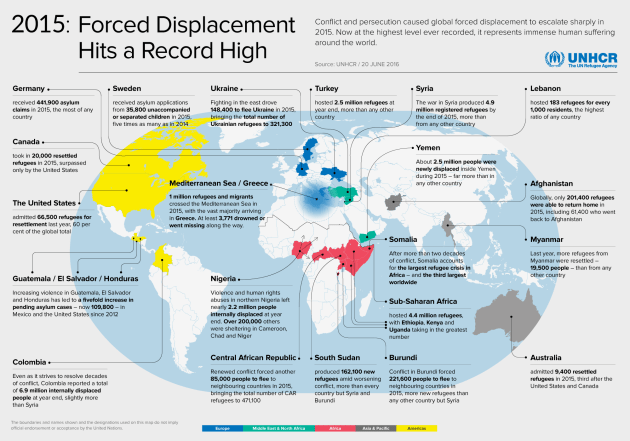
This is despite the fact that the most recent Global Trends: Forced Displacement report by the United Nations High Commissioner for Refugees (UNHCR)[iii] noted that “[g]lobal forced displacement has increased in 2015, with record-high numbers.”


Indeed, that same report revealed there were:


  • 65.3 million forcibly displaced persons worldwide, including
    • 21.3 million refugees
    • 40.8 million internally displaced persons, and
    • 3.2 million asylum seekers
  • 12.4 million people newly displaced due to conflict or persecution in 2015 alone, and
  • 2.0 million asylum applications submitted (a new record-high) with 441,900 asylum claims just in Germany as a result of the war in Syria.


It should not have taken widely-shared, tragic photographs of Alan Kurdi in September 2015 to make us realise this is truly a global humanitarian crisis.


The numbers alone confirm that this is an international issue of the highest order, and addressing its causes, while responding to the consequences, must be a foreign policy priority for all countries, including Australia.


One of the many depressing statistics found in the UNHRC’s report confirms that it currently is not: “[d]uring 2015, the total number of refugees admitted for resettlement stood at 107,100”[iv]. That’s 107,100 out of a total of 21.3 million.


Of course, the Australian Government may claim that, given 9,400 of those refugees were resettled here (the third-highest of any country), we do not need to do more.


But that ignores the fact we benefit from our location, and isolation, and therefore do not have the same number of in-country applications for asylum as other places. And it also overlooks the wealth and privilege we currently enjoy.


As a country we can, and must, do more in response to the growing number of displaced persons around the world, and that should be reflected in our new Foreign Policy White Paper.


170227-unhcr-forced-displacement-2015-final

Source: UNHCR


  1. Foreign Aid


The one issue, out of the four priority areas highlighted above, that is at least touched on in the call for submissions is foreign aid. Topic 5: Australia confronts a range of strategic, security and transnational challenges on page 3 includes the following question:


“How can our foreign policy, including our overseas development assistance program, support a more prosperous, peaceful and stable region?”


However, while this question at least acknowledges the importance of foreign aid (or in this case ‘overseas development assistance’), it does so largely within the framework of Australia’s national interest, rather than in the context of our common humanity.


Irrespective of this broader ‘framing’, one of the main answers to this question is actually to increase our foreign aid spending.


Drastic budget cuts to Australia’s foreign aid budget in recent years – with $1 billion, or 20%, cut in 2015-16, and a further $224 million reduction in 2016-17 – have seen foreign aid as a share of Gross Domestic Product (GDP) fall to an estimated 0.23%[v].


Indeed, “[b]etween 2012 and 2016, Australia’s foreign aid as a share of national income has fallen steeply from 0.36% to 0.23%.”[vi]


This leaves our foreign aid allocation at less than half the previous bipartisan goal of reaching 0.5% of GDP by 2015.


And, significantly, it is less than one third of the United Nations target that countries provide at least 0.7% of their national income as foreign aid.


The cuts to foreign aid have the potential to cause real and lasting damage across our region, and around the world, to countries and people that can least afford it.


As a result, I believe that the Foreign Policy White Paper should feature both a recommitment to the United Nations target, as well as a de-coupling of our foreign aid budget from an almost-exclusive focus on Australia’s national interest.


If we fail to do either, then we are at grave risk of changing from the land of ‘the fair go’ to the country of ‘what’s in it for us?’


170227-foreign-aid-gdp

Foreign aid as a share of GDP is plummeting, according to the Government’s own figures (source: The Conversation).


  1. Human rights, including LGBTI rights


There is one final issue that is completely omitted from the four-page Call for Submissions regarding the Foreign Policy White Paper: international human rights.


As a long-term LGBTI advocate and activist, I would like to focus on one specific sub-set of international human rights – the rights of lesbian, gay, bisexual, transgender and intersex people around the world.


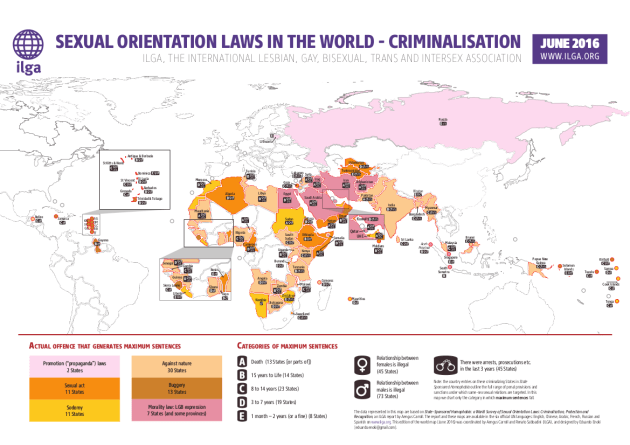
In June 2016, the International Lesbian, Gay, Bisexual, Trans and Intersex Association (ILGA) estimated that same-sex sexual acts were illegal in 72 states, or a full 37% of United Nations members[vii]. This includes 13 States (or part thereof) where same-sex sexual acts attract the death penalty.


The criminalisation of homosexuality is also a particular problem in our own region of Oceania, with prohibitions in our nearest neighbour Papua New Guinea, as well as Kiribati, Samoa, Solomon Islands, Tonga and Tuvalu (plus Cook Islands who are associates to New Zealand).


There are an additional four countries in South-East Asia where same-sex acts remain illegal (Brunei Darussalam, parts of Indonesia, Malaysia and Singapore).


Long-standing LGBTI advocate Peter Tatchell last week actually stated that “[t]here remain 75 countries and dependent territories that still criminalise same-sex relations – with nearly half of these jurisdictions outlawing both male and female homosexuality”.[viii]


And, in a specific challenge to countries like the United Kingdom and Australia, he observed that “[h]omosexuality remains criminalised in 36 out of the 52 Commonwealth member states” where “[m]ost of these anti-gay laws were imposed by Britain during the colonial era.”[ix]


The ongoing criminalisation of people on the basis of their sexual orientation, as well as other anti-LGBTI human rights abuses such as the involuntary sterilisation of intersex infants and the failure to recognise and accept trans and gender diverse people, is a major problem in the early 21st century.


I believe Australia should adopt a pro-active role in supporting groups that are working to address these human rights violations, both in our region (where, as we have seen above, there is plenty of work still to do) and around the world.


We should also seek, wherever possible, to progress the positive recognition and acceptance of LGBTI human rights in international forums, including the United Nations as well as other groups such as the Commonwealth Heads of Government Meeting (CHOGM).


Finally, both of these activities – support for the work of LGBTI rights organisations in our region and globally, as well as the pursuit of LGBTI human rights internationally – should be reflected in the Foreign Policy White Paper.


170227-ilga-sexual-orientation-criminalisation-map

Same-sex sexual activity remains criminalised in far too many countries around the world (source: ILGA).


**********


Obviously, in each of the four issues outlined in this submission – climate change, refugees, foreign aid and LGBTI rights – the Australian Government can be legitimately criticised for not doing enough to achieve progress domestically.


We can and must do better in terms of reducing our own carbon emissions, of adopting a more humane approach to refugees and people seeking asylum, of increasing our foreign aid budget and of respecting the rights of lesbian, gay, bisexual, transgender and intersex Australians.


But, at the same time as addressing these ourselves, I believe we can – and above all must – help to achieve progress on these issues globally, because the rise of global warming, the growth in the number of displace persons, the unmet need for foreign aid, and discrimination against LGBTI people, are problems that transcend state borders.


Which means the solutions cross state borders too – and that therefore Australia has a role to play in fixing them.


Thank you in advance for taking this submission into account as the Australian Government develops its Foreign Policy White Paper.


Please do not hesitate to contact me, at the details provided, should you require additional information.


Sincerely,

Alastair Lawrie


Footnotes:

[i] Question 2, on page 3 of the call for submissions, refers to ‘environmental degradation’, a phrase that is so vague it can be interpreted in multiple ways, and does not begin to capture the urgency of the climate emergency we currently face.

[ii] Bureau of Meteorology Annual Climate Statement 2016.

[iii] UNHRC, Global Trends: Forced Displacement in 2015.

[iv] Ibid, page 26.

[v] The Conversation, Savage budget cuts pull Australia down in foreign aid rankings, May 4, 2016.

[vi] Ibid.

[vii] See ILGA, State-Sponsored Homophobia 2016 report here.

[viii] Guardian, There are reasons to be cheerful… LGBTI rights gains in unlikely countries, February 20, 2017.

[ix] Ibid.

What’s Wrong With Tasmania’s Anti-Discrimination Act 1998?

This is part of a series of posts looking at Australia’s anti-discrimination laws and discussing how well, or how poorly, they protect lesbian, gay, bisexual, transgender and intersex people. The articles on other jurisdictions can be found here.

In these posts, I have analysed Commonwealth, state and territory legislation with respect to three main issues:

  • Protected Attributes
  • Religious Exceptions, and
  • Anti-Vilification Coverage

This post will be the shortest of the nine, because in all three areas Tasmania’s Anti-Discrimination Act 1998 is either best practice, or close to best practice.

**********

Protected Attributes

 Unlike some other schemes, Tasmania’s Anti-Discrimination Act 1998 protects all parts of the lesbian, gay, bisexual, transgender and intersex community against discrimination.

Section 16 sets out the protected attributes of the Act, and they include sexual orientation (sub-section c), gender identity (ea) and intersex variations of sex characteristics (eb) [noting that Intersex Human Rights Australia’s position is that this last attribute should simply be ‘sex characteristics’ rather than intersex variations of sex characteristics, in line with the Yogyakarta Principles plus 10].

The definitions of these terms in section 3 are also inclusive:

sexual orientation includes-

(a) heterosexuality; and

(b) homosexuality; and

(c) bisexuality”

gender identity means the gender-related identity, appearance or mannerisms of other gender-related characteristics of an individual including gender expression (whether by way of medical intervention or not), with or without regard to the individual’s designated sex at birth, and may include being transgender or transsexual”

gender expression means any personal physical expression, appearance (whether by way of medical intervention or not), speech, mannerisms, behavioural patterns, names and personal references that manifest or express gender or gender identity”

sex characteristics means a person’s physical, hormonal or genetic features relating to sex, including genitalia and other sexual and reproductive anatomy, chromosomes, genes, hormones, and secondary sex characteristics”.

Overall, the Tasmanian Anti-Discrimination Act 1998 adopts close to best practice in terms of the protected attributes it includes, covering all LGBTI Tasmanians.

**********

Religious Exceptions

The Anti-Discrimination Act 1998 is best practice when it comes to religious exceptions – in fact, Tasmania is better, far better, than any other Australian jurisdiction in this area.

There are three provisions outlining relevant religious exceptions in the Act:

Section 51 “Employment based on religion

(1) A person may discriminate against another person on the ground of religious belief or affiliation or religious activity in relation to employment if the participation of the person in the observance or practice of a particular religion is a genuine occupational qualification or requirement in relation to the employment.

(2) A person may discriminate against another person on the ground of religious belief or affiliation or religious activity in relation to employment in an educational institution that is or is to be conducted in accordance with the tenets, beliefs, teachings, principles or practices of a particular religion if the discrimination is in order to enable, or better enable, the educational institution to be conducted in accordance with those tenets, beliefs, principles or practices.”

Section 51A “Admission of person as student based on religion

(1) A person may discriminate against another person on the ground of religious belief or affiliation or religious activity in relation to admission of that other person as a student to an educational institution that is or is to be conducted in accordance with the tenets, beliefs, teachings, principles or practices of a particular religion.

(2) Subsection (1) does not apply to a person who is enrolled as a student at the educational institution referred to in that subsection.

(3) Subsection (1) does not permit discrimination on any grounds referred to in section 16 other than those specified in that subsection.

(4) A person may, on a ground specified in subsection (1), discriminate against another person in relation to the admission of the other person as a student to an educational institution, if the educational institution’s policy for the admission of students demonstrates that the criteria for admission relates to the religious belief or affiliation, or religious activity, of the other person, the other person’s parents or the other person’s grandparents.”

Section 52. “Participation in religious observance

A person may discriminate against another person on the ground of religious belief or religious activity in relation to-

(a) the ordination or appointment of a priest; or

(b) the training and education of any person seeking ordination or appointment as a priest; or

(c) the selection or appointment of a person to participate in any religious observance or practice; or

(d) any other act that-

(i) is carried out in accordance with the doctrine of a particular religion; and

(ii) is necessary to avoid offending the religious sensitivities of any person of that religion.”

At first glance these exceptions appear extensive in their application. However, the most important point to observe is that discrimination by religious bodies, including religious schools, is only allowed on the basis of the person being discriminated against’s religion – for example, a christian school offering preferential enrolment to students that are christian.

It specifically does not allow discrimination on the basis of other attributes, such as the person being discriminated against’s sexual orientation, gender identity or intersex variations of sex characteristics.

In this way, the Tasmanian Anti-Discrimination Act 1998 is clearly superior to other state and territory LGBTI discrimination laws, as well as the Commonwealth Sex Discrimination Act 1984 (which not only provides a general religious exception allowing discrimination against LGBT people in a wide range of circumstances, but also a specific one with respect to religious schools that permits discrimination against LGBT students and teachers). It is therefore pleasing that the ACT Government embraced the Tasmanian approach in its recent reforms to protect LGBT students and teachers at religious schools – although it retains exceptions for health and other community services at this stage.

**********

Anti-Vilification Coverage

The anti-vilification protections afforded LGBTI Tasmanians under the Anti-Discrimination Act 1998 are also strong. There are actually two provisions that prohibit vilification under the Act:

Section 17 “Prohibition of certain conduct and sexual harassment

(1) A person must not engage in any conduct which offends, humiliates, insults or ridicules another person on the basis of an attribute referred to in section 16(e), (a), (b), (c), (d), (ea), (eb) and (k), (fa), (g), (h), (i) or (j) in circumstances in which a reasonable person, having regard to all the circumstances, would have anticipated that the other person would be offended, humiliated, intimidated, insulted or ridiculed…”

Section 19 “Inciting hatred

A person, by a public act, must not incite hatred towards, serious contempt for, or severe ridicule of, a person or a group of persons on the ground of-

(a) the race of the person or any member of the group; or

(b) any disability of the person or any member of the group; or

(c) the sexual orientation or lawful sexual activity of the person or any member of the group; or

(d) the religious belief or activity of the person or any member of the group; or

(e) the gender identity or intersex variations of sex characteristics of the person or any member of the group.”

The effect of these two provisions mean that LGBTI Tasmanians are protected both against conduct that offends, humiliates, insults or ridicules, as well as conduct that incites hatred, serious contempt or serious ridicule. This means Tasmania’s LGBTI anti-vilification provisions are the equal best in the country, alongside the ACT.

[Although it should be noted that, in its previous term, the Tasmanian Liberal Government attempted to undermine these anti-vilification protections. It sought to introduce amendments that would have permitted vilification for public acts done in good faith for ‘religious purposes’ (where “religious purpose includes, but is not limited to, conveying, teaching or proselytising a religious belief”). This would have inevitably resulted in increased vilification of lesbian, gay, bisexual and transgender Tasmanians. Thankfully, while the Bill was passed by the Liberal-majority Legislative Assembly, it was rejected by the Independent-majority Legislative Council in August 2017.]

will-hodgman

Former Tasmanian Premier Will Hodgman sought to undermine LGBTI anti-vilification protections.

**********

Overall, it is clear that Tasmania’s Anti-Discrimination Act 1998 is the best LGBTI anti-discrimination law in Australia. It has set the standard to which all other jurisdictions should aspire.

If you have enjoyed reading this article, please consider subscribing to receive future posts, via the right-hand scroll bar on the desktop version of this blog or near the bottom of the page on mobile. You can also follow me on twitter @alawriedejesus

What’s Wrong With South Australia’s Equal Opportunity Act 1984?

This post is part of a series looking at Australia’s anti-discrimination laws, and examining how well, or how poorly, they protect lesbian, gay, bisexual, transgender and intersex (LGBTI) people against discrimination. The other posts in the series can be found here.

In particular, they assess Commonwealth, State and Territory legislation in terms of the following three issues:

  • Protected Attributes
  • Religious Exceptions, and
  • Anti-Vilification Coverage.

Unfortunately, while South Australia has expanded the range of people legally protected against discrimination, the Equal Opportunity Act 1984 remains grossly inadequate because of the breadth of religious exceptions it offers, and its failure to establish LGBTI vilification offences.

**********

Protected Attributes

Section 29 of the Equal Opportunity Act 1984 protects lesbian, gay, bisexual, transgender and intersex South Australians from discrimination.

Sub-section (2a) defines discrimination “on the ground of gender identity” to include (among other things):

  • “if the person treats another unfavourably because the other is or has been a person of a particular gender identity or because of the other’s past sex;
  • if the person treats another unfavourably on the basis of a characteristic that appertains generally to persons of a particular gender identity, or on the basis of a presumed characteristic that is generally imputed to persons of a particular gender identity… and
  • if the person requires a person of a particular gender identity to assume characteristics of a sex with which the person does not identify.”

Importantly, unlike some jurisdictions, South Australia protects all trans people against discrimination (and not just people with binary gender identities).

The protections against discrimination “on the ground of sexual orientation” contained in sub-section (3) are similarly broad, and would cover all lesbian, gay and bisexual South Australians.

The Relationships Register Act 2016 has expanded this coverage even further by introducing a new protected attribute of ‘intersex status’, with the addition of sub-section 29(4)[i].

With this change, South Australia has become only the fourth jurisdiction in Australia – after the Commonwealth, Tasmania and the Australian Capital Territory – to explicitly protect intersex people against discrimination. Although it should be noted that in the March 2017 Darlington Statement, intersex activists called for this terminology to be replaced by a protected attribute of ‘sex characteristics’.

Summary: The South Australian Equal Opportunity Act 1984 protects lesbian, gay, bisexual, transgender and intersex people against discrimination – with the 2017 inclusion of ‘intersex status’ making it only the fourth Australian jurisdiction, out of nine, to cover the entire LGBTI community.

**********

Religious Exceptions

Unfortunately, while the Equal Opportunity Act 1984 will soon be close to best practice on protected attributes, in terms of religious exceptions it is anything but.

Section 50 sets out an incredibly broad range of circumstances in which religious organisations are legally entitled to discriminate against LGBTI South Australians:

Religious bodies

(1) This Part does not render unlawful discrimination in relation to-

(a) the ordination or appointment of priests, ministers of religion or members of a religious order; or

(b) the training or education of persons seeking ordination or appointment as priests, ministers of religion or members of a religious order; or

(ba) the administration of a body established for religious purposes in accordance with the precepts of that religion; or

(c) any other practice of a body established for religious purposes that conforms with the precepts of that religion or is necessary to avoid injury to the religious susceptibilities of the adherents of that religion.”

While paragraphs (a) and (b) are at least directly related to religious appointments – and therefore somewhat defensible because of their connection to freedom of religion – paragraph (ba) and especially paragraph (c) effectively encourage discrimination by religious organisations in healthcare and other community services.

It is also unclear whether this general exception allows religious schools to discriminate against LGBTI students. That is because there is a separate section which provides exceptions for religious schools regarding students (section 37), and it does not allow discrimination on the basis of sexual orientation, gender identity or intersex status.

However, unlike the Queensland Anti-Discrimination Act 1991 which protects LGBT students, there is nothing in the general religious exception in section 50 of South Australia’s Equal Opportunity Act 1984 which states that it does not apply to religious schools.

This means that it is still possible the general religious exception in section 50 allows discrimination despite what section 37 says – a risk even the SA Equal Opportunity Commission expressed concern about in their submission to the South Australian Law Reform Institute’s review of Exceptions under the Equal Opportunity Act 1984 (p73). Indeed, the Law Reform Institute recommended:

“that section 50(1)(c) should be removed to make it clear that it does not apply to discrimination with respect to potential or current students of religious educational institutions” (pp83-84).

The situation is also complicated with respect to teachers in religious schools, with sub-section 34(3) setting out a separate, specific exception in that area:

“(3) This Division does not apply to discrimination on the ground of sexual orientation,  gender identity or intersex status in relation to employment or engagement for the purposes of an educational institution if-

(a) the educational institution is administered in accordance with the precepts of a particular religion and the discrimination is founded on the precepts of that religion; and

(b) the educational authority administering the institution has a written policy stating its position in relation to the matter; and

(c) a copy of the policy is given to a person who is to be interviewed for or offered employment with the authority or a teacher who is to be offered engagement as a contractor by the authority; and

(d) a copy of the policy is provided on request, free of charge-

(i) to employees and contractors and prospective employees and contractors of the authority to whom it relates or may relate; and

(ii) to students, prospective students and parents and guardians of students and prospective students of the institution; and

(iii) to other members of the public.”

Some may see this as a relatively positive approach, because at the very least it allows everyone to be informed about the policies any particular school adopts. And, admittedly, it is preferable to the carte blanche approach adopted in other states (and especially in New South Wales).

However, there are three important qualifications to this ‘benign’ assessment:

  • It still allows discrimination against teachers and other employees in religious schools. This discrimination – which has no connection whatsoever to the ability of LGBTI teachers and other staff to do their jobs – remains unacceptable, irrespective of the procedural steps a school must first negotiate,
  • It is (I believe) unique in Australia in that it specifically states that religious schools can discriminate on the basis of intersex status (despite there being no supporting evidence of doctrines, tenets or beliefs which discriminate against people born with intersex variations), and
  • The general religious exception in sub-section 50(c) may still apply, for the same reason that it may allow religious schools to discriminate against LGBT students – meaning it is possible that religious schools can ‘pick and choose’ the basis on which they discriminate against teachers and employees (and therefore potentially avoid these procedural hurdles altogether).

There is one final religious exception which allows discrimination against LGBTI South Australians – sub-section 35(2b) allows ‘associations’ to exclude and otherwise adversely treat people on the basis of their intersex status, gender identity or sexual orientation “if the association is administered in accordance with the precepts of a particular religion and the discrimination is founded on the precepts of that religion.”

Summary: The religious exceptions contained in the South Australian Equal Opportunity Act 1984 allow discrimination against LGBTI people in a wide range of circumstances, including healthcare, community services, associations and in education (although there is some uncertainty about how far the exceptions apply in that area).

[NB In late 2020, the South Australian Liberal Government released the Equal Opportunity (Religious Bodies) Amendment Bill 2020 for public consultation. This Bill would remove any ability for religious schools to discriminate against LGBT students (although not teachers) as well as limiting the special privileges of religious organisations to discriminate against both LGBT employees and people accessing their services in other nominated areas (such as housing, health and aged care).

However, this would still permit discrimination in other areas (such as university education). Therefore, while if passed this Bill would represent a significant improvement from the current provisions of the Equality Opportunity Act 1984 (SA), it would nevertheless fall well short of the best practice approach to religious exceptions in the Anti-Discrimination Act 1998 (Tas). For more information, please see my submission in response to the Equal Opportunity (Religious Bodies) Amendment Bill 2020.]

**********

Anti-Vilification Coverage

This section will be the shortest of this post – because there is none. Lesbian, gay, bisexual, transgender and intersex South Australians have no protection against anti-LGBTI vilification under the Equal Opportunity Act 1984[ii].

This is despite the fact that an entire stand-alone act exists with respect to racial vilification (the Racial Vilification Act 1996). Given homophobia, biphobia, transphobia and intersexphobia are just as damaging, and just as harmful, as racism, the lack of equivalent protections against anti-LGBTI vilification is, in my opinion, shameful.

**********

Other Issues

There are a few additional issues in the Equal Opportunity Act 1984 that it would be remiss not to at least mention.

On the negative side, there is a very broad ‘inherent requirement’ exception in relation to employment. Sub-section 34(2) provides that:

“This Division does not apply to discrimination on the ground of sex, sexual orientation, gender identity or intersex status in relation to employment or engagement for which it is a genuine occupational requirement that a person be of a particular sex, sexual orientation, gender identity or intersex status.”

It is difficult to think of many jobs in which it is an inherent requirement that someone be of a particular sexual orientation, gender identity or intersex status. It would be interesting to see on what possible basis the drafters attempted to justify this sub-section.

Similarly, sub-section 34(4) allows discrimination in employment against transgender people generally, and non-binary gender diverse people in particular, on the basis of their appearance, stating that:

“This Division does not apply to discrimination on the ground of gender identity in relation to employment or engagement if the discrimination is for the purposes of enforcing standards of appearance and dress reasonably required for the employment or engagement.”

Once again, it is hard to see how such discrimination can possibly be justified, and I would argue that both sub-sections (34(2) and (4)) should be repealed.

On the other hand, there are two exceptions that allow positive discrimination in favour of LGBTI people.

The first, in sub-section 35(2a), permits LGBT-specific associations to be created (for “persons of a particular gender identity”, for “persons of a particular sexual orientation (other than heterosexuality), or for “persons of intersex status”, noting that heterosexuality remains privileged within Australian society).

The second, in section 47, authorises actions designed to overcome discrimination against minority groups:

Measures intended to achieve equality

This Part does not render unlawful an act done for the purpose of carrying out a scheme or undertaking intended to ensure that persons of a particular sex, sexual orientation, gender identity or intersex status, have equal opportunities with, respectively, all other persons, in circumstances to which this Part applies.”

Nevertheless, while these final two provisions are welcome, they do not negate the harmful aspects of the Act, including its overly-generous religious exceptions, and the complete lack of anti-vilification coverage for LGBTI South Australians.

It remains to be seen whether the Liberal Government, under Premier Steven Marshall, will take any action to improve the South Australian Equal Opportunity Act 1984.

_MEG1426_0

Will Liberal Premier Steven Marshall amend South Australia’s out-dated Equal Opportunity Act 1984?

If you have enjoyed reading this article, please consider subscribing to receive future posts, via the right-hand scroll bar on the desktop version of this blog or near the bottom of the page on mobile. You can also follow me on twitter @alawriedejesus

Footnotes:

[i] “(4) For the purposes of this Act, a person discriminates on the ground of intersex status-

(a) if the person treats another unfavourably because of the other’s intersex status or past intersex status; or

(b) if the person treats another unfavourably because the other does not comply, or is not able to comply, with a particular requirement and-

(i) the nature of the requirement is such that a substantially higher proportion of persons who are not of intersex status complies, or is able to comply, with the requirement than of those of intersex status; and

(ii) the requirement is not reasonable in the circumstances of the case; or

(c) if the person treats another unfavourably on the basis of a characteristic that appertains generally to persons of intersex status, or presumed intersex status, or on the basis of a presumed characteristic that is generally imputed to persons of intersex status; or

(d) if the person treats another unfavourably because of an attribute of or a circumstance affecting a relative or associate of the other, being an attribute or circumstances described in the preceding paragraphs.”

[ii] Although South Australia is not alone in this regard – there are also no LGBTI vilification protections in Commonwealth law, and in Victoria, Western Australia and the Northern Territory.

Equal Means Equal – Submission to Inquiry into Marriage Amendment (Same-Sex Marriage) Bill

Update 15 February 2017:

The Senate Committee Inquiry into the Exposure Draft Marriage Amendment (Same-Sex Marriage) Bill has been completed, with its report tabled in Parliament this afternoon (Wednesday 15 February 2017). A copy of the Report can be found here.


The Report itself includes some positives, and some areas of possible concern.


On the positive side, the Committee has acknowledged that adding a stand-alone right for ministers of religion to discriminate against same-sex couples is both unnecessary, and explicitly discriminatory (page 15).


The Committee also did not support the introduction of broad new rights for civil celebrants to discriminate against LGBTI couples, noting that they “are authorised to perform a function on behalf of the state and should be required to uphold Commonwealth law” (page 24).


On the other hand, the Committee has attempted to define a new category of ‘religious marriage celebrants’ – who are not ministers of religion but conduct marriages for faith communities – and then providing them with similar rights to discriminate as ministers of religion (page 23).


While that compromise may seem reasonable, some of these same celebrants also officiate at secular ceremonies, and under no circumstances should they be allowed to discriminate when they are effectively operating as a civil celebrant.


In the same way, the proposal that existing civil celebrants should be allowed to register as ‘religious marriage celebrants’, and therefore benefit from the same right to discriminate (page 24), must not apply to any situation in which they continue to oversee civil ceremonies.


The Committee also questioned the need for new special rights for religious bodies and organisations to discriminate against same-sex couples – although that is because it believes they may already be allowed to do so because of the overly-generous religious exceptions provided under the Sex Discrimination Act 1984 (page 31).


It also discusses, although doesn’t explicitly support, clarifying their ‘right’ to refuse to provide facilities, goods and services in situations that are “intrinsic to, directly associated with and intimately involved in a wedding ceremony” (page 32). Once again, this would unacceptably undermine a reform that is, at its heart, supposed to be about the equal recognition of equal love.


Finally, the Committee observed that “[i]n relation to military chaplains, the committee notes that the proposed amendment would not change the current law”, and then suggests the reintroduction of ‘marriage officers’ to provide an alternative method for LGBTI military couples to marry (page 24).


While it may not change existing law, a) there must not be a new stand-alone note to section 81 that singles out same-sex couples for adverse treatment and b) as public servants, paid for with our taxes, and with an obligation to serve all personnel equally, the right of military chaplains to discriminate in this way should be abolished.


With the Report finalised, pressure now returns to our 150 House of Representatives MPs, and 74 Senators (with two current vacancies), to find a way forward on marriage equality, and ensure it is passed as quickly as possible.


But it must also be done as fairly as possible. I would argue there is absolutely nothing in the Committee Report that would justify the inclusion of new special rights to discriminate against LGBTI couples in any marriage equality bill.


In which case, in the coming weeks and months it will be up to us to continue to remind Prime Minister Malcolm Turnbull – and Opposition Leader Bill Shorten, as well as the Greens and crossbench MPs and Senators, in fact anyone who will listen to us – that equal means equal, and that means passing marriage equality without new religious exceptions.


Original Post:

The Senate is currently conducting an inquiry into the Exposure Draft Marriage Amendment (Same-Sex Marriage) Bill. This is the legislation that the Government would have introduced had the marriage equality plebiscite been held, and had that vote been successful.

Full details of the inquiry can be found here. It is due to report on Monday 13 February 2017, although what happens afterwards remains unclear.

My submission to the inquiry, which focuses on the provisions of the Bill that seek to treat LGBTI couples differently to, and worse than, other couples, has now been published, and is reproduced below:


Committee Secretary

Select Committee on the Exposure Draft of the Marriage Amendment (Same-Sex Marriage) Bill

Department of the Senate

PO Box 6100

Canberra ACT 2600

samesex.marriage.sen@aph.gov.au


Friday 13 January 2017


Dear Committee Secretary


Submission on the Exposure Draft of the Marriage Amendment (Same-Sex Marriage) Bill


Thank you for the opportunity to provide a submission in relation to this inquiry, which is examining the Government’s Exposure Draft Marriage Amendment (Same-Sex Marriage) Bill (‘the Bill’).


In this submission, I will explain my personal reasons for opposing several provisions contained within the Bill, before addressing terms of reference a), b) and c) in detail. This will include my main recommendations for amendment to, and improvement of, the proposed legislation, before concluding with a short summary of this submission and its recommendations.


**********


Introduction: Equal Means Equal


I met my fiancé Steven in August 2008, two weeks after my 30th birthday and just one week after the wedding of my brother to his wife.


It was clear from the very beginning that this relationship was different from any that had come before. And I know that applies for both of us.


Within 12 months we began planning the rest of our lives together. Steven and I have lived together from January 2010 onwards, and now own a home together.


More importantly, we have been engaged to be married since 23 January of that same year.


That means, in exactly ten days’ time, we will have been waiting for the legal right to get married for a full seven years. Our engagement has already lasted longer than the marriages, from beginning to end, of many Australian couples.


All we want is exactly the same right to wed, and to have that wedding recognised under secular law, as my brother when he married his wife, and as my sister when she married her husband in 2006.


Significantly, the Bill that is being considered as part of this inquiry would allow Steven and I to finally ‘tie the knot’. That aspect of the Bill, contained in clause 1 (amending subsection 5(1) (definition of marriage) to “omit “a man and a woman”, substitute “2 people””), is obviously welcome.


However, if passed as drafted, a number of other provisions in the Bill would ensure that, rather than being treated the same as my brother and his wife, or my sister and her husband, this legislation would ensure Steven and I were subject to adverse, and discriminatory, treatment simply because of who we are.


The civil celebrant who officiated at the ceremony between my sister and her husband would have the ‘right’ to reject us because we are not “a man and a woman”.


Any ‘religious organisation or body’, broadly defined, that provided wedding-related facilities, goods and services would be able to turn us away because of our sexual orientation. And that ‘right’ would apply even where they operated for profit, and even though the same groups could not discriminate against my siblings.


In short, the Bill would establish two different classes of couples – ‘man and woman’ couples, versus everyone else – with the latter category, including Steven and me, enjoying lesser rights than the former.


While this legislation will deliver marriage, it will not deliver marriage equality. That outcome is unacceptable both to me, and to my fiancé Steven.


There is no legitimate reason why we should be treated worse than my brother and my sister were when they decided to marry their respective partners. Because we are not ‘worse than’ anyone, them included.


Equal means equal. Or at least it should – and I sincerely believe that principle must be reflected in the Marriage Act.


**********


Term of reference a) the nature and effect of proposed exemptions for ministers of religion, marriage celebrants and religious bodies and organisations, the extent to which those exemptions prevent encroachment upon religious freedoms, and the Commonwealth Government’s justification for the proposed exemptions.


The Bill proposes four new and/or expanded special rights to discriminate against couples that include lesbian, gay, bisexual, transgender and intersex (LGBTI) Australians. All four are unnecessary and unjustified. All four should be removed from the legislation to help achieve genuine marriage equality.


  1. A specific right for ministers of religion to discriminate against couples that are not “a man and a woman”


I should begin by noting that I agree with the ability of authorised celebrants who are ministers of religion to refuse to perform any religious ceremonies, including weddings, that do not fit within the beliefs of their religion. That obviously includes the right to refuse to marry LGBTI couples, even if I personally believe that such discrimination is abhorrent.


However, it is important to remember that ministers of religion already have the right to refuse to perform any ceremony under existing section 47 of the Marriage Act 1961:


Ministers of religion not bound to solemnise marriage etc.

Nothing in this Part: (a) imposes an obligation on an authorised celebrant, being a minister of religion, to solemnise any marriage…”


If the right for LGBTI couples to marry was finally recognised under Commonwealth law, that section would plainly allow ministers of religion to deny them service. Therefore, no new amendments are required to the Act to allow ministers of religion to refuse to officiate LGBTI weddings.


In which case, the proposed repeal of section 47, and replacement with a more detailed right to discriminate, is entirely unnecessary. In particular, proposed new sub-section 47(3) states:


Refusing to solemnise a marriage that is not the union of a man and woman

(3) A minister of religion may refuse to solemnise a marriage despite any law (including this Part) if:

(a) the refusal is because the marriage is not the union of a man and a woman; and

(b) any of the following applies:

(i) the refusal conforms to the doctrines, tenets or beliefs of the religion of the minister’s religious body or religious organisation;

(ii) the refusal is necessary to avoid injury to the religious susceptibilities of adherents of that religion;

(iii) the minister’s conscientious or religious beliefs do not allow the minister to solemnise the marriage.”


The inclusion of this unnecessary new sub-section, which highlights the ability of ministers of religion to discriminate against one class of couple (LGBTI people) and one class of couple only, is discriminatory and should be rejected.


Recommendation 1: Proposed new section 47, and especially sub-section 47(3), is both unnecessary and discriminatory and should be removed from the Bill. Existing section 47 of the Marriage Act would continue to allow ministers of religion to refuse to perform any marriage ceremony.


**********


  1. A new special right for civil celebrants to discriminate against couples that are not “a man and a woman”


Currently, only ministers of religion have an explicit ‘opt-out’ clause under the Marriage Act 1961, allowing them to decline to perform any marriages with which they disagree.


No equivalent provision or power exists for civil celebrants – which is entirely reasonable, given they are essentially ‘small businesses’, providing a service that the government has authorised them to, and explicitly not acting on behalf of any religion or religious organisation.


However, the Bill proposes an entirely new special right for ‘secular’ civil celebrants to reject LGBTI couples just because of who they are. Proposed new section 47A reads:


Marriage celebrants may refuse to solemnise marriages

(1) A marriage celebrant (not being a minister of religion) may refuse to solemnise a marriage despite any law (including this Part) if:

(a) the refusal is because the marriage is not the union of a man and a woman; and

(b) the marriage celebrant’s conscientious or religious beliefs do not allow the marriage celebrant to solemnise the marriage.”


This is, to put it simply, outrageous.


There is absolutely no reason why someone who is engaged in small business should be able to discriminate in such a way, against people who are LGBTI, solely because of their personal beliefs. It is the equivalent of encouraging celebrants to put up a sign saying ‘no gays (or lesbians, or bisexuals, or trans people, or intersex people) allowed’.


The fact that, unlike ministers of religion who are able to discriminate against any couples, civil celebrants will only be allowed to discriminate against LGBTI couples, merely highlights the homophobia, biphobia, transphobia and intersexphobia that lies at the heart of this proposed new section.


And, with civil ceremonies now accounting for three-in-four of all mixed-sex weddings[i], and likely forming an even higher proportion of LGBTI weddings (at least in part because some religions will continue to turn couples away that are not “a man and a woman”), this prejudiced provision will impact on a large number of LGBTI couples. For all of these reasons, it should be rejected.


Recommendation 2: Proposed new section 47A, which establishes an entirely new special right for civil celebrants to discriminate against LGBTI couples, and LGBTI couples only, is discriminatory and should be removed from the Bill.


**********


  1. A new special right for religious bodies and organisations to discriminate against couples that are not “a man and a woman”


Unfortunately, under the Bill it is not just civil celebrants who will be allowed to put up unwelcome (on multiple levels) signs saying ‘no gays, or lesbians, or bisexuals, or trans people, or intersex people, allowed.’


Religious bodies or organisations will also be able to do so under proposed new section 47B, which reads:


Religious bodies and organisations may refuse to make facilities available or provide goods or services

(1) A religious body or a religious organisation may, despite any law (including this Part), refuse to make a facility available, or to provide goods or services, for the purposes of the solemnisation of a marriage, or for purposes reasonably incidental to the solemnisation of a marriage, if:

(a) the refusal is because the marriage is not the union of a man and a woman; and

(b) the refusal:

(i) conforms to the doctrines, tenets or beliefs of the religion of the religious body or religious organisation; or

(ii) is necessary to avoid injury to the religious susceptibilities of adherents of that religion.”


There are a number of significant problems with this provision.


First and foremost, by not defining what a ‘religious body’ or ‘religious organisation’ is, it is difficult to know exactly who will be able to exercise this new specific right to discriminate (with the possibility that the number of groups permitted to turn away LGBTI couples will be quite high).


Secondly, by not defining the phrases ‘for the purposes of the solemnisation of a marriage, or for purposes reasonably incidental to the solemnisation of a marriage’, (and especially the term ‘reasonably incidental’) it is also difficult to know the scope of this new special right to discriminate.


However, even if both the number of groups allowed to discriminate, and the exact circumstances in which they were allowed to do so, were known, this proposed new section would still be fundamentally flawed.


That is because it authorises discrimination against LGBTI couples far beyond any right to refuse to conduct weddings in places of worship, like churches, which would likely be justified on the basis of religious freedom.


Instead, it permits adverse treatment of couples who are not “a man and a woman” in a wide range of circumstances, including in hiring venues where it is not a place of worship, and in the provision of goods and services even where this is engaged in on a commercial basis, for profit.


One consequence of this is that it would establish a negative precedent for the future expansion of this right to discriminate to other individuals and businesses, such as florists, bakers, photographers or wedding reception venues, who are not religious bodies or organisations, to refuse service to LGBTI couples.


If other commercial enterprises are allowed to do so (because they are run by religious groups), and even civil celebrants are permitted to discriminate on the basis of their personal beliefs, it is entirely predictable that additional groups will demand their own ability to reject couples who are not “a man and a woman.”


Despite all of the above faults, however, the major flaw with the provision is that it is a direct attack on LGBTI couples and LGBTI couples only. It singles out any relationship that doesn’t fit within the definition of “a man and a woman” for special, and detrimental treatment – and literally nobody else.


That makes this proposed provision homophobic, biphobic, transphobic and intersexphobic, and it too should be rejected.


Recommendation 3: Proposed new section 47B, which establishes an entirely new right for religious bodies or organisations to discriminate in the provision of wedding-related facilities, goods and services against LGBTI couples, and LGBTI couples only, is discriminatory and should be removed from the Bill.


**********


  1. A specific right for Defence Force chaplains to discriminate against couples that are not “a man and a woman”


The Bill’s fourth and final new and/or expanded special right to discriminate against LGBTI couples is provided to Defence Force chaplains.


This is established through the addition of a note to existing section 81 of the Marriage Act 1961, which deals with the rights of Defence Force chaplains to refuse to solemnise weddings. That note would read:


“Example: a chaplain may refuse to solemnise a marriage that is not the union of a man and a woman where the refusal conforms to the doctrines, tenets or beliefs of the chaplain’s church or faith group.”


While these chaplains are ministers of religion, and therefore would potentially have the ability to discriminate against any couple, they are also a special class of celebrant, because:


  • They are public servants, paid for out of everyone’s taxes – LGBTI and non-LGBTI, and religious and non-religious, alike[ii], and
  • In their duties, Defence Force chaplains are expected to “administer spiritual support to all members, regardless of their religion”[iii] (emphasis added).


Therefore, permitting discrimination by Defence Force chaplains fails in principle on two counts:


  • As public servants, they should not be able to discriminate against members of the public simply because of their personal beliefs – otherwise we are allowing the Australian equivalent of Kim Davis, and
  • In providing spiritual support for Defence Force personal, they are expected to do so for all people, not just those who are cisgender and heterosexual.


Which means that, if Defence Force chaplains are to continue to be authorised to officiate any weddings, it must include the weddings of LGBTI people. To do otherwise is, once again, homophobic, biphobic, transphobic and intersexphobic, and it should be rejected.


Recommendation 4: The proposed new note to section 81, which establishes a specific right for Defence Force chaplains to discriminate against LGBTI couples, and LGBTI couples only, is discriminatory and should be removed from the Bill. As public servants who are obligated to support all Defence Force personnel, these chaplains should be required to marry all couples, regardless of sexual orientation, gender identity or intersex status, otherwise their ability to officiate wedding ceremonies should be removed.


**********


As suggested by term of reference a), the above four new and/or expanded special rights to discriminate against LGBTI couples have ostensibly been included in the Bill by the Government on the basis of the need to protect ‘religious freedom’.


However, I would argue that, upon closer inspection, they do no such thing. Rather than protecting religious freedom, these provisions instead protect homophobia, biphobia, transphobia and intersexphobia and merely use religion as an excuse.


This can be seen when one remembers that there are a wide variety of different religious beliefs about marriage.


Some people believe only cisgender heterosexual couples should be able to marry.


Others do not believe in divorce, and therefore oppose the right of people to participate in second, or subsequent, weddings.


Some even continue to hold the (once widespread) belief that people of different faiths should not marry – and, in extreme cases, that people of different types of christianity should not marry.


I should note that I do not share any of the above beliefs. But others do, and I have no doubt that their views are sincerely held.


Given this, there is no possible justification for the Marriage Amendment (Same-Sex Marriage) Bill to allow civil celebrants, religious bodies and organisations and Defence Force chaplains to discriminate against LGBTI couples but not discriminate against divorced people, or against interfaith couples (or on the basis of other religious beliefs about marriage).


The fact that it does so, establishing new special rights to discriminate against LGBTI couples, and only LGBTI couples, reveals the fundamental truth of this Bill: it has very little to do with protecting religious freedom, and is more concerned with ensuring people who hold anti-LGBTI views are free to discriminate against couples who are not “a man and a woman” in a wide variety of circumstances.


In effect, the Bill privileges homophobic, biphobic, transphobic and intersexphobic beliefs, rather than protecting religious beliefs.


That is unacceptable, and merely confirms the earlier recommendations in this submission that these new and/or expanded special rights to discriminate are discriminatory and should be removed from the Bill.


I should note here that the Government, having revealed its discriminatory intentions, cannot now turn around and extend these new special rights to discriminate to cover divorced people and interfaith couples because they will only be doing so to cover up the anti-LGBTI nature of its original legislation.


Instead, the Government, and Parliament, should focus on amending the Bill to ensure that all couples are (finally) treated in exactly the same way – that equal means equal.


**********


Term of reference b) the nature and effect of the proposed amendment to the Sex Discrimination Act 1984 and the Commonwealth Government’s justification for it.


Currently, sub-section 40(2A) of the Sex Discrimination Act 1984, the legislation that establishes Commonwealth anti-discrimination protections on the basis of sexual orientation, gender identity and intersex status, ensures that “anything done by a person in direct compliance with the Marriage Act 1961” cannot be the subject of an anti-discrimination claim under that legislation.


This is justified because it would be entirely unreasonable to hold civil celebrants and others accountable for discriminating against LGBTI couples (because they legally cannot marry them) that has been made compulsory since the Howard Government prohibited marriage equality in August 2004.


The amendment of the Marriage Act, to permit all couples to marry irrespective of sexual orientation, gender identity or intersex status, and the removal of this requirement, should therefore be an opportunity to remove or at least significantly curtail this exception to the protections contained in the Sex Discrimination Act.


Indeed, the only provision of the Marriage Act that should require an exception would be the ongoing ability of ministers of religion to discriminate against any couples, as established by existing section 47.


Consequently, sub-section 40(2A) of the Sex Discrimination Act could, and I would argue should, be restricted to the following:


“Nothing in Division 1 or 2, as applying by reference to section 5A, 5B, 5C or 6, affects anything done by a person as authorised by section 47 of the Marriage Act 1961” (emphasis added).


Instead, the Bill as drafted actually proposes to expand the exception to the Sex Discrimination Act, because it would permit any discrimination that is ‘as authorised by’ the entirety of the Marriage Act, as redrafted.


This is obviously intended to capture all four of the new and/or expanded special rights to discriminate against LGBTI couples outlined earlier. Given the inclusive way this amendment is framed, it may even permit additional forms of anti-LGBTI discrimination.


In my view, this is a perverse outcome. Legislation that is intended to remove a long-standing inequality, and injustice, affecting lesbian, gay, bisexual, transgender and intersex Australians, by finally allowing them to marry, actually expands relevant exceptions to the Sex Discrimination Act, thereby increasing the circumstances in which they can lawfully be discriminated against.


Once again, this confirms the inappropriateness of the four new and/or expanded special rights to discriminate against LGBTI couples. The proposed amendment to section 40(2A) of the Sex Discrimination Act is also inappropriate, and should be replaced with a narrower exception to that legislation.


Recommendation 5: The proposed expansion to the exception contained in sub-section 40(2A) of the Sex Discrimination 1984, allowing discrimination ‘as authorised by’ the Marriage Act 1961, expands the circumstances in which LGBTI people can be discriminated against. This is inappropriate, and this provision should be removed from the Bill. It should be replaced by an amendment that limits this exception to discrimination that is authorised by existing section 47 of the Marriage Act, which allows ministers of religion (and only ministers of religion) to discriminate.


**********


Term of reference c) potential amendments to improve the effect of the bill and the likelihood of achieving the support of the Senate.


In terms of amendments to improve the effect of the Bill, I have already made five recommendations to significantly improve its impact on the recognition of the human rights of LGBTI Australians. In this section, I will nominate two further areas of necessary reform.


  1. The Bill should refer to marriage equality rather than same-sex marriage


The Bill, as drafted, would allow all couples, including those that involve lesbian, gay, bisexual, transgender and intersex individuals, to marry under the law. This is an important reform, and it will substantively improve the lives of many LGBTI Australians.


However, the title of the Bill – the Marriage Amendment (Same-Sex Marriage) Bill – only refers to ‘same-sex marriage’, rather than marriage equality.


This is problematic because the term same-sex marriage does not include all LGBTI couples. It specifically excludes some transgender people (especially those who identify as non-binary or gender-fluid) and some intersex people.


The term same-sex marriage should be replaced with marriage equality in the title of the Bill, to ensure that, alongside recognising the substantive human rights of LGBTI Australians, it symbolically recognises the diversity of these communities.


Of all major contemporary public policy issues, marriage is a subject in which both the substantive, and the symbolic, are equally important.


Recommendation 6: The Bill should be retitled the Marriage Amendment (Marriage Equality) Bill.


**********


  1. The Bill should allow couples to apply to have specified pre-existing unions recognised as marriages


The wait for marriage equality to be recognised under Australian law has been long, often painfully so.


It is entirely understandable that, in the interim, many LGBTI couples have chosen alternative ways to have their relationships recognised. This includes many who have travelled overseas (or to consulates within Australia), where marriage equality is lawful, to wed.


It also includes couples who have decided to have their relationships recognised under state and territory relationship recognition schemes, including civil partnerships and registered relationships, with or without an associated formally-recognised ceremony.


While the Bill will, thankfully, recognise the former (overseas marriages) as marriages, it will not provide any avenue for the latter (civil partnerships or registered relationships) to be recognised in a similar manner.


Allowing couples in this situation to apply to have their existing relationship recognised as married would be an acknowledgement of the fact that their mutual commitment to a shared life, and wish to be married, has existed since the date of their commitment being made.


It would also acknowledge the discrimination that these couples have endured as a result of the exclusionary nature of the Commonwealth Marriage Act 1961.


Recommendation 7: The Bill should allow couples to apply to have specified pre-existing unions, including civil partnerships and registered relationships under state and territory law, to be recognised as marriages where they so desire.


**********


  1. Marriage equality should be passed as a matter of priority


Term of reference c) asks for ‘potential amendments to improve the… likelihood of achieving the support of the Senate.’ With all due respect, I believe that to be an inappropriate request.


The real question is why the Senate – and the House of Representatives – have not yet passed legislation to recognise the equality of our relationships, irrespective of sexual orientation, gender identity or intersex status.


It has been more than a dozen years since the Howard Government’s homophobic ban on marriage equality was first passed by the Commonwealth Parliament.


That means LGBTI couples have now experienced more than a dozen years of discrimination, treated as distinctly ‘2nd class’ in comparison to the relationships of cisgender heterosexual Australians.


Tragically, in those dozen years, there have also been countless LGBTI relationships where one or both members have passed away without being able to have their relationship recognised under Commonwealth law. The longer the ban continues, the more relationships will be denied justice.


That same dozen years has witnessed much ‘sound and fury’ within the Commonwealth Parliament on this issue, including countless inquiries in the House of Representatives and the Senate (with this one now added to the list), ultimately achieving nothing – because we still cannot marry.


So, rather than asking how the Bill can be amended to improve the chances of Senators voting for it, as if just one more ‘compromise’ will be enough to secure sufficient support to get it over the line, we should be asking why won’t Senators, and their colleagues in the lower house, do their jobs and pass marriage equality as a matter of priority.


Recommendation 8: The Australian Parliament should pass marriage equality as a matter of priority, because LGBTI Australians have waited long enough – too long, in fact – to have their relationships recognised as equal under secular law.


**********


Conclusion


In this submission, I hope I have successfully conveyed my passion, not just for the subject of marriage equality generally, but also about the issue of marriage equality and religious exceptions specifically – and why any amendments to the Marriage Act should ensure that all couples are treated exactly the same.


I am glad that these issues are being examined by the Senate, through this inquiry, and I look forward to the Committee making recommendations to improve both the substance, and the symbolism, of the Marriage Amendment (Same-Sex Marriage) Bill.


Thank you for your consideration of this submission. I would welcome the opportunity to speak to the matters raised above at a Committee hearing, should one (or more) be held.


I have also included a Summary of this submission on the following two pages.


Please do not hesitate to contact me, at the contact details provided with this submission, should you require clarification, or further information.


Sincerely

Alastair Lawrie


**********


Summary


Marriage equality is an important issue that affects tens of thousands, hundreds of thousands, Australians, including couples like my fiancé Steven and me.


We have been together for more than eight and a half years, and engaged for almost seven years. All we want is the right to be married under secular law, in exactly the same way that my brother married his wife, and my sister married her husband.


Unfortunately, while the Marriage Amendment (Same-Sex Marriage) Bill would allow us to marry, it would not do so equally, because it would expose us to potential discrimination that my siblings did not experience.


It is marriage, but not marriage equality. And that is not good enough, because equal means equal – and that principle should be reflected in the Marriage Act.


I make seven recommendations to improve the Marriage Amendment (Same-Sex Marriage) Bill, as well as an eighth, that marriage equality should be passed as a matter of priority.


Recommendation 1: Proposed new section 47, and especially sub-section 47(3), is both unnecessary and discriminatory and should be removed from the Bill. Existing section 47 of the Marriage Act would continue to allow ministers of religion to refuse to perform any marriage ceremony.


Recommendation 2: Proposed new section 47A, which establishes an entirely new special right for civil celebrants to discriminate against LGBTI couples, and LGBTI couples only, is discriminatory and should be removed from the Bill.


Recommendation 3: Proposed new section 47B, which establishes an entirely new right for religious bodies or organisations to discriminate in the provision of wedding-related facilities, goods and services against LGBTI couples, and LGBTI couples only, is discriminatory and should be removed from the Bill.


Recommendation 4: The proposed new note to section 81, which establishes a specific right for Defence Force chaplains to discriminate against LGBTI couples, and LGBTI couples only, is discriminatory and should be removed from the Bill. As public servants who are supposed to support all Defence Force personnel, these chaplains should be required to marry all couples, regardless of sexual orientation, gender identity or intersex status, otherwise their ability to officiate wedding ceremonies should be removed.


Recommendation 5: The proposed expansion to the exception contained in sub-section 40(2A) of the Sex Discrimination 1984, allowing discrimination ‘as authorised by’ the Marriage Act 1961, expands the circumstances in which LGBTI people can be discriminated against. This is inappropriate, and this provision should be removed from the Bill. It should be replaced by an amendment that limits this exception to discrimination that is authorised by existing section 47 of the Marriage Act, which allows ministers of religion (and only ministers of religion) to discriminate.


Recommendation 6: The Bill should be retitled the Marriage Amendment (Marriage Equality) Bill.


Recommendation 7: The Bill should allow couples to apply to have specified pre-existing unions, including civil partnerships and registered relationships under state and territory law, to be recognised as marriages where they so desire.


Recommendation 8: The Australian Parliament should pass marriage equality as a matter of priority, because LGBTI Australians have waited long enough – too long, in fact – to have their relationships recognised as equal under secular law.


Whenever marriage equality is finally passed by the Commonwealth Parliament, and I genuinely hope it does so soon, it must ensure that all couples are treated equally, because we cannot end up with a situation where ‘some couples are more equal than others’.


equalmeansequal-4


Footnotes:


[i] “[T]he proportion of marriage ceremonies overseen by a civil celebrant increased again to 74.9 per cent of all marriages in 2015”: Marriage and Divorces, Australia, 2015, Australian Bureau of Statistics, November 2016.

[ii] The Defence Jobs Australia website indicates that chaplains are paid over $94,200 following completion of basic training.

[iii] Also from the Defence Jobs Australia website.

Submission to Inquiry into Freedom of Speech in Australia

Update 1 March 2017:

The Joint Committee on Human Rights handed down its report on Freedom of Speech in Australia yesterday (Tuesday 28 February). A full copy of the report can be found here.

On the positive side, the Committee did not make formal recommendations to wind back, or even repeal, section 18C of the Racial Discrimination Act 1975, although it did include a number of options that, if implemented, would effectively undermine racial vilification protections in this country.

On the negative side, and despite accepting and publishing my submission (see below), the Committee apparently failed to consider the issue of whether anti-vilification laws should be expanded to cover other groups who are currently not protected in Commonwealth law, including lesbian, gay, bisexual, transgender and intersex (LGBTI) Australians.

Disappointingly, Labor members did not refer to this issue in their additional comments, nor did the Australian Greens as part of their dissenting report. All of which means that the campaign to secure Commonwealth LGBTI anti-vilification laws that are equivalent to section 18C must continue.


Original post:

As many of you would be aware, Commonwealth Parliament is currently conducting an inquiry into ‘freedom of speech in Australia’ – specifically whether the racial vilification protections offered by section 18C in the Racial Discrimination Act 1975 should be restricted.

The following is my submission to this inquiry, arguing that not only is there insufficient justification to amend (or even repeal) 18C, but that Parliament should instead be considering how to better protect lesbian, gay, bisexual, transgender and intersex Australians against vilification.

Full details of the Inquiry, including the 374 submissions (and counting) that have been published, can be found here.


**********


Parliamentary Joint Committee on Human Rights

18Cinquiry@aph.gov.au


Dear Committee Members

Submission to Inquiry into Freedom of Speech in Australia

Thank you for the opportunity to provide a submission to this inquiry into what is an important issue.


In this submission I will primarily focus on terms of reference 1 (concerning sections 18C and 18D of the Racial Discrimination Act 1975) and 4 (how the Australian Human Rights Commission can better protect freedom of speech), rather than terms of reference 2 (regarding the processes that apply to complaint handling) or 3 (‘soliciting complaints’).


I am writing this submission from the perspective of an Australian with Anglo-Celtic heritage, and therefore someone who is unlikely to be subject to racial vilification in this country.


However, I also write as an out gay man, who has witnessed, and experienced, vilification on the basis of sexual orientation. Those experiences particularly inform the latter part of this submission.


**********


Term of Reference 1: Whether the operation of Part IIA of the Racial Discrimination Act 1975 (Cth) imposes unreasonable restrictions upon freedom of speech, and in particular whether, and if so how, ss 18C and 18D should be reformed.


No law is ever perfect. Each piece of legislation that exists today could probably be better drafted in some way (or indeed many ways).


That statement applies to the Racial Discrimination Act 1975, in the same manner as any other law, including its provisions that make racial vilification unlawful.


As the Committee would be aware, section 18C stipulates that:


“(1) It is unlawful for a person to do an act, otherwise than in private, if:

  • the act is reasonably likely, in all the circumstances, to offend, insult, humiliate or intimidate another person or a group of people; and
  • the act is done because of the race, colour or national or ethnic origin of the other person or of some or all of the people in the group.”


As I wrote in my submission to the Government’s Exposure Draft Freedom of Speech (Repeal of s.18C) Bill 2014, “I do not believe that, were provisions regarding racial vilification to be drafted today, they would include the terms ‘offend’ or ‘insult’ (or at least not without aggravating factors or considerations).”


It is at least possible to argue that the type of conduct that is, prima facie, captured by these terms – insult and offend – is too broad.


But, as I then went on to observe in that same submission, “it is one thing to suggest that the drafting of a provision is something less than ‘ideal’ – it is another to suggest that poor drafting has directly caused problems that mean it must be amended.”


And it is on that second point that I believe the case to amend or even repeal section 18C falls down. Because I am yet to be convinced that the drafting of 18C itself has caused serious problems in the operation of Australia’s racial vilification framework.[i]


There are three main arguments that support this conclusion.


First, racial vilification generally, and section 18C specifically, has been subject to considerable public debate since the election of the then-Abbott Liberal-National Government in September 2013.


Many critics have argued, at times vociferously, that the section as drafted is an unacceptable infringement upon the right to free speech. If such a claim were true, then these same critics should be able to provide examples of speech that are unlawful currently, that would be lawful if this section was reformed, and which are clearly in the public interest to be heard.


I am unaware of anyone who has, over those past three years, been able to provide a compelling example. That failure seriously undermines the case for change.


Second, I believe it is equally difficult to find an example of section 18C being applied incorrectly in case law, such that speech that should have been lawful was, ultimately, found to be unlawful by the courts.


The most famous (or infamous) case that is often cited is Eaton v Bolt [2011] FCA 1103. However, as I observed in my submission to the Government’s Freedom of Speech (Repeal of s.18C) Bill 2014, “it is not clear that the outcome of the “Bolt case” makes any persuasive case for change.”


I went on to write:


“In the summary of that decision, Justice Mordecai Bromberg explained that “I am satisfied that fair-skinned Aboriginal people (or some of them) were reasonably likely, in all the circumstances, to have been offended, insulted, humiliated or intimidated by the imputations conveyed by the newspaper articles” of Mr Bolt (para 17).


“Justice Bromberg also explained that Mr Bolt’s conduct could not fit within what are, to be frank, extremely generous exemptions in section 18D, writing that “I have not been satisfied that the offensive conduct that I have found occurred, is exempted from unlawfulness by section 18D. The reasons for that conclusion have to do with the manner in which the articles were written, including that they contained errors of fact, distortions of the truth and inflammatory and provocative language” (para 23, emphasis added).


“In his summary, Justice Bromberg also articulates at least one of the reasons why laws should exist to prohibit writings such as those of Mr Bolt: “People should be free to fully identify with their race without fear of public disdain or loss of esteem for so identifying. Disparagement directed at the legitimacy of the racial identification of a group of people is likely to be destructive of racial tolerance, just as disparagement directed at the real or imagined practices or traits of those people is also destructive of racial tolerance” (para 22).

“In short, there appears to at least be an arguable case that not only was the “Bolt case” decided correctly on the existing law, but also that the current provisions are operating as intended to limit the negative effects of racial intolerance. Conversely, I believe it is difficult to argue, solely on the basis of Eatock v Bolt, that section 18C is so deficient that it should be amended, and amended as a matter of high priority.”

That remains my opinion today.


Third, it is impossible to argue for amendment to, or repeal of, section 18C in isolation, and without considering the generous exemptions provided by section 18D:


“Section 18C does not render unlawful anything said or done reasonably and in good faith:

  • in the performance, exhibition or distribution of an artistic work; or
  • in the course of any statement, publication, discussion or debate made or held for any genuine academic, artistic or scientific purpose or any other genuine purpose in the public interest; or
  • in making or publishing:
    1. a fair and accurate report of any event or matter of public interest; or
    2. a fair comment on any event or matter of public interest if the comment is an expression of a genuine belief held by the person making the comment.”


These provisions, and especially the protections for ‘fair comment’ on a ‘matter of public interest’ if it is ‘an expression of a genuine belief’, cover an extremely wide range of potential statements where they otherwise offend, insult, humiliate or intimidate other persons or groups on the basis of their race, colour or national or ethnic origin.


Once again, it is up to advocates for change to the existing law to provide examples of speech that remains unlawful, despite section 18D, and that it is clearly in the public interest to hear. As with section 18C discussed above, I am not aware of any such example.


Recommendation 1: Sections 18C and 18D of the Racial Discrimination Act 1975 should remain as currently drafted.


In the absence of a compelling case to amend or repeal sections 18C and 18D of the Racial Discrimination Act 1975, I would like to suggest an alternative area of anti-vilification law reform for which there is, from my perspective, a clear and urgent need for reform: the introduction of vilification protections for lesbian, gay, bisexual, transgender and intersex (LGBTI) Australians.


Despite the almost relentless criticism of racial vilification laws over the past three years, and especially in certain mainstream media publications in 2016, there has been comparative silence, or near silence, about the fact there are currently no Commonwealth protections against vilification on the basis of sexual orientation, gender identity or intersex status.


The Commonwealth is not alone in failing to offer these protections: only NSW, Queensland, Tasmania and the ACT have laws that expressly prohibit anti-LGBTI vilification[ii].


This is an issue that I have repeatedly attempted to draw attention to, via multiple policy submissions (including the already-mentioned submission on the Government’s Exposure Draft Freedom of Speech (Repeal of s.18C) Bill 2014, a submission to the Australian Law Reform Commission’s Inquiry into Traditional Rights and Freedoms, and a submission in response to their Interim Report, as well as a submission to the Australian Human Rights Commission’s consultation on Rights & Responsibilities, led by the now-Member for Goldstein, Tim Wilson).


In each process I have made the case that, if race-based vilification is considered legally unacceptable, then so too should be homophobic, biphobic, transphobic and intersexphobic vilification.


As I wrote in the Star Observer newspaper in May 2014[iii]:


“[T]here is no conceptual or philosophical reason why racial vilification should be deemed to be so serious a problem as to require a legal complaints and resolution scheme, but vilification based on homophobia, transphobia, biphobia and anti-intersex prejudice should not.


“After all, both groups – Australians of diverse racial backgrounds and LGBTI people – are regularly subject to vilification in public contexts, whether that be in political or media debates, or in harassment and abuse in public spaces.


“For LGBTI people, this includes comments made in Federal Parliament itself. Over the past [15] years, we have had three… senators rhetorically link marriage equality with bestiality, repeat claims that allowing two men or women to wed will create another stolen generation, and smear an openly-gay High Court Justice with allegations of paedophilia (apparently solely on the basis of the judge’s homosexuality).


“Vilification based on sexual orientation, gender identity or intersex status occurs all-too-frequently at the everyday ‘street level’, too. Anyone who is visibly identifiable as LGBTI, including non-LGBTI people who are perceived as being LGBTI by others, or indeed anyone who simply wants to engage in the tender act of holding one’s same-sex partner’s hand, knows the risks that expressing who you are in public can bring, from being yelled at from passing cars, to the very real threat of much worse.


“Such fears are grounded in hard statistics. A 2003 NSW Attorney-General’s Report found that in the previous 12 months, 56 per cent of gay men and lesbians had been subject to one of more forms of homophobic abuse, harassment or violence. And that’s before we take into account the disturbingly high number of gay and bisexual men violently murdered in Sydney during the 1980s and 1990s, but whose deaths are only now being properly investigated.


“The consequences of anti-LGBTI vilification are also reflected in figures that show that LGBTI Australians continue to experience disproportionately high rates of mental health issues, including depression, self-harm and, most tragically, suicide. It is not hard to draw a link between public denigration and contempt for a person’s identity or status, and poorer personal mental health.


“So, if Australians of diverse racial backgrounds and LGBTI people are both subject to vilification, and both experience negative outcomes as a result, why shouldn’t both vulnerable groups have the same level of legal protection?”


That question remains relevant to this Committee today, and especially to this particular Inquiry.


I would argue that, given the harms of homophobic, biphobic, transphobic and intersexphobic vilification outlined above, rather than recommending amendment to or repeal of sections 18C and 18D of the Racial Vilification Act 1975, the Committee should instead support the introduction of equivalent provisions in the Sex Discrimination Act 1984 to prohibit vilification against LGBTI Australians.


Recommendation 2: The Sex Discrimination Act 1984 should be amended to make vilification on the basis of sexual orientation, gender identity or intersex status unlawful. These provisions should be drafted on the same basis as existing prohibitions against racial vilification in the Racial Discrimination Act 1975.


**********


Term of Reference 4: Whether the operation of the [Australian Human Rights] Commission should be otherwise reformed in order better to protect freedom of speech and, if so, what those reforms should be.


I would like to make one final point, related to the previous discussion, about the terms of reference to this inquiry, and the overall direction of anti-vilification reform in Australia.


Namely, there continues to be disproportionate focus on freedom of speech, with little attention paid to the potential harmful outcomes from unfettered or completely unregulated speech.


This ideological bent is already apparent in the term of reference highlighted above (focused on free speech and not its effects), but is revealed even more clearly by examining the paragraph in the Terms of Reference that follows:


“The Committee is asked, in particular, to consider the recommendations of the Australian Law Reform Commission in its Final Report on Traditional Rights and Freedoms – Encroachments by Commonwealth Laws [ALRC Report 129 – December 2015], in particular Chapter 4 – “Freedom of Speech”.


Turning to that Report, the relevant recommendation is found at 4.251 on page 126:


“The ALRC concludes that the following Commonwealth laws should be further reviewed to determine whether they unjustifiably limit freedom of speech:

  • Pt IIA of the RDA, in conjunction with consideration of anti-vilification laws more generally.”


That last phrase – “in conjunction with consideration of anti-vilification laws more generally” – only fully makes sense when considered in the context of the preceding discussion in paragraphs 4.207 to 4.209 on page 119 of the Report:


“The ALRC has not established whether s 18C of the RDA has, in practice, caused unjustifiable interferences with freedom of speech. However, it appears that pt IIA of the RDA, of which s 18C forms a part, would benefit from more thorough review in relation to freedom of speech.


“In particular, there are arguments that s 18C lacks sufficient precision and clarity, and unjustifiably interferes with freedom of speech by extending to speech that is reasonably likely to ‘offend’. The provision appears broader than is required under international law to prohibit the advocacy of racial hatred and broader than similar laws in other jurisdictions, and may be susceptible to constitutional challenge.


“However, any such review should not take place in isolation. Stakeholders put forward arguments that people should also be protected from vilification on other grounds, including sex, sexual orientation and gender identity” (emphasis added).


In short, the Government asked the Australian Law Reform Commission to examine traditional rights and freedoms, including freedom of speech. The ALRC then considered sections 18C and 18D in detail, but was not in a position to determine whether or not these sections unjustifiably interfered with freedom of speech.


Instead, the ALRC recommended that this part of the Racial Discrimination Act 1975 be reviewed further – as part of a broader review of anti-vilification laws, including whether these protections should be extended to others grounds, such as sexual orientation and gender identity.


However, in establishing this Inquiry, the Government appears to have done the exact opposite: it has focused solely on the protection of freedom of speech, and not at all on the consequences of unfettered free speech, ignoring any possible need to introduce additional protected attributes in Commonwealth anti-vilification law.


Once again, I would urge the Committee – and through you, the Parliament – to consider the issue of whether LGBTI anti-vilification protections should be established in Commonwealth legislation, and in this way to give full effect to the recommendation of the ALRC.


**********


Thank you again for the opportunity to provide this submission, and for taking it into account as part of the Committee’s deliberations.


Should you have any questions, or to request additional information, please do not hesitate to contact me at the contact details provided with this submission.


Sincerely,

Alastair Lawrie

Friday 9 December 2016


Footnotes:

[i] Please note here that, as stated in the introduction, I am not commenting on the processes that apply to complaint handling, which includes complaints with little or no substance, as well as the timelines involved in resolving complaints. Other individuals and/or organisations are better placed to make recommendations on those particular matters (although I suspect it may involve a combination of procedural changes, and increased funding for the Commission and Courts to enable the existing caseload to be dealt with in a more timely manner).

[ii] Victoria, Western Australia and South Australia have racial vilification laws but no LGBTI equivalent, while the Northern Territory has neither.

[iii] Star Observer, “Where’s the LGBTI Equivalent of Section 18C?” 19 May 2014.

Back to School, Back to Discrimination for LGBT Students and Teachers

Every year, millions of students, and hundreds of thousands of teachers and other staff, start at Australian schools excited by the possibilities of the following 12 months – of the opportunities to learn (or teach) about the world around them, and about themselves.

However, for far too many students – and teachers and other staff – in schools around the country it will be another year in which they have to worry about being discriminated against, lawfully, simply because of their sexual orientation or gender identity.

That’s because, under the anti-discrimination laws of five out of nine Australian jurisdictions, lesbian, gay, bisexual and transgender (LGBT) students can legally be treated adversely by religious schools[i]. Six jurisdictions allow discrimination against LGBT teachers and other staff – plus one state which has a ‘don’t ask, don’t tell’ approach.

To find out what the law is in your jurisdiction, see below. And to find out just how many students, teachers and other staff are potentially affected by these discriminatory provisions, please read to the end of the article.

**********

Commonwealth

While LGBT students, teachers and other staff are protected against discrimination under the Commonwealth Sex Discrimination Act 1984, these protections are fundamentally undermined by the inclusion of two excessively broad exceptions for religious organisations.

The first is contained in sub-section 37(1)(d), which states that:

“Nothing in Division 1 or 2 affects… any other act or practice of a body established for religious purposes, being an act or practice that conforms to the doctrines, tenets or beliefs of that religion or is necessary to avoid injury to the religious susceptibilities of adherents of that religion.”

It is highly likely that this provision allows religious schools to discriminate against LGBT students, teachers and staff. But, just in case there was any doubt, the Act includes an additional ‘right to discriminate’ just for religious schools:

“Section 38

Educational institutions established for religious purposes

(1) Nothing in paragraph 14(1)(a) or (b) or (14)(2)(c) renders it unlawful for a person to discriminate against another person on the ground of the other person’s sex, sexual orientation, gender identity, marital or relationship status or pregnancy in connection with employment as a member of the staff of an educational institution that is conducted in accordance with the doctrines, tenets, beliefs or teachings of a particular religion or creed, if the first-mentioned person so discriminates in good faith in order to avoid injury to the religious susceptibilities of adherents of that religion or creed.”

Sub-section 38(2) establishes a similar ‘right to discriminate’ against contract workers, while sub-section 38(3) reiterates the ability of religious schools to discriminate against LGBT students.

In short, instead of protecting LGBT students and teachers at religious schools against discrimination, the Commonwealth Sex Discrimination Act 1984 authorises their mistreatment (a pattern that, as we shall below, is sadly replicated in most states and territories).

Can religious schools discriminate against LGBT students under Commonwealth law? Yes.

Can religious schools discriminate against LGBT teachers and other staff under Commonwealth law? Yes.

**********

New South Wales

As I have written elsewhere[ii], despite being the first Australian jurisdiction to introduce gay anti-discrimination laws, NSW now has perhaps the worst LGBT anti-discrimination legislation in the country. A key reason for that is the extremely generous exceptions provided to religious (and other non-government) schools.

As with the Commonwealth, it is likely NSW religious schools have the ‘right to discriminate’ against LGBT students, teachers and other staff[iii] as part of the general religious exception provided by sub-section 56(d):

“Nothing in this Act affects… any other act or practice of a body established to propagate religion that conforms to the doctrines of that religion or is necessary to avoid injury to the religious susceptibilities of the adherents of that religion.”

And, just like the Commonwealth, there is also a specific exception applying only to schools – however, in what is a unique approach, the NSW Anti-Discrimination Act 1977 actually allows all non-government schools to discriminate against students on the grounds of homosexuality or transgender status, even where they are not religious:

“Section 49ZO Education

(1) It is unlawful for an educational authority to discriminate against a person on the ground of homosexuality:

(a) by refusing or failing to accept the person’s application for admission as a student, or

(b) in the terms on which it is prepared to admit the person as a student.

(2) It is unlawful for an educational authority to discriminate against a student on the ground of homosexuality:

(a) by denying the student access, or limiting the student’s access, to any benefit provided by the educational authority, or

(b) by expelling the student or subjecting the student to any other detriment.

(3) Nothing in this section applies to or in respect of a private educational authority” (emphasis added).

Section 38K establishes a similar right for NSW non-government schools (religious and not-religious alike) to discriminate against transgender students.

There are also equivalent sections regarding lesbian, gay and transgender teachers and other staff at non-government schools (religious and not-religious alike): section 49ZH and 38C respectively.

Therefore, all NSW non-government schools are able to fire (or not hire) LGT teachers and other staff under the Anti-Discrimination Act 1977, and to refuse to admit, treat adversely and even expel students merely for being lesbian, gay or transgender. That is, in a word, appalling.

Can religious schools discriminate against LGBT students under NSW law? Yes – and that includes non-government schools that are not religious, too.

Can religious schools discriminate against LGBT teachers and other staff under NSW law? Yes, including non-government schools that are not religious.

**********

Victoria

Victoria is another jurisdiction that has adopted the ‘two-fold’ approach to permitting discrimination by religious schools against LGBT students, teachers and other staff.

First up, sub-section 82(2) of the Victorian Equal Opportunity Act 2010 states that:

“Nothing in Part 4 applies to anything done on the basis of a person’s religious belief or activity, sex, sexual orientation, lawful sexual activity, marital status, parental status or gender identity by a religious body that-

(a) conforms with the doctrines, beliefs or principles of the religion; or

(b) is reasonably necessary to avoid injury to the religious sensitivities of adherents of the religion.”

This is then supplemented by section 83, which is entirely concerned with providing religious schools with an explicit ‘right to discriminate’:

Religious schools

(1) This section applies to a person or body, including a religious body, that establishes, directs, controls, administers or is an educational institution that is, or is to be, conducted in accordance with religious doctrines, beliefs or principles.

(2) Nothing in Part 4 applies to anything done on the basis of a person’s religious belief or activity, sex, sexual orientation, lawful sexual activity, marital status, parental status or gender identity by a person or body to which this section applies in the course of establishing, directing, controlling or administering the educational institution that-

(a) conforms with the doctrines, beliefs or principles of the religion; or

(b) is reasonably necessary to avoid injury to the religious sensitivities of adherents of the religion.”

In 2016, there were two attempts to limit the impact of these sections – the first, by the Andrews Labor Government, would have compelled religious schools (and other religious employers) to demonstrate that discrimination against LGBT employees was an ‘inherent requirement’ of the respective position[iv]. The second, by the Victorian Greens, would have prohibited discrimination against LGBT students.

Unfortunately, both Bills were voted down by the Upper House (and specifically by Liberal and National Party MLCs) leaving LGBT students, teachers and other staff in Victorian religious schools exposed to mistreatment solely because of who they are.

Can religious schools discriminate against LGBT students under Victorian law? Yes.

Can religious schools discriminate against LGBT teachers and other staff under Victorian law? Yes.

**********

Queensland

It may be surprising for some (especially given they only equalised the age of consent in 2016), but Queensland is one of four jurisdictions that does not provide carte blanche for religious schools to discriminate against LGBT students, teachers and other staff.

That is because they have adopted a more limited version of the broad general exception enacted elsewhere. Section 109 of the Queensland Anti-Discrimination Act 1991 provides:

Religious bodies

(1) The Act does not apply in relation to-

(d) unless section 90 (Accommodation with religious purposes) applies – an act by a body established for religious purposes if the act is –

(i) in accordance with the doctrine of the religion concerned; and

(ii) necessary to avoid offending the religious sensitivities of people of the religion.

(2) An exemption under subsection (1)(d) does not apply in the work or work-related area or in the education area (emphasis added).

LGBT students are protected from discrimination as a result of this provision.

Prima facie, it would appear that LGBT teachers and other staff should be too – after all, sub-section (2) says the religious exception does not apply to work.

However, there is an additional section of the Anti-Discrimination Act 1991 that does authorise discrimination against LGBT employees of religious schools in certain circumstances. Section 25 states:

“25 Genuine occupational requirements

(1) A person may impose genuine occupational requirements for a position.

Example 4- employing persons of a particular religion to teach in a school established for students of the particular religion

(2) Subsection (3) applies in relation to-

(a) work for an educational institution (an employer) under the direction or control of a body established for religious purposes…

(3) It is not unlawful for an employer to discriminate with respect to a matter that is otherwise prohibited under section 14 or 15, in a way that is not unreasonable, against a person if-

(a) the person openly acts in a way that the person knows or ought reasonably to know is contrary to the employer’s religious beliefs-

(i) during a selection process; or

(ii) in the course of the person’s work; or

(iii) in doing something connected with the person’s work; and

Example for paragraph (a)- A staff member openly acts in a way contrary to a requirement imposed by the staff member’s employer in his or her contract of employment, that the staff member abstain from acting in a way openly contrary to the employer’s religious beliefs in the course of, or in connection with the staff member’s employment.

(b) it is a genuine occupational requirement of the employer that the person, in the course of, or in connection with, the person’s work, act in a way consistent with the employer’s religious beliefs.

(4) Subsection (3) does not authorise the seeking of information contrary to section 124.

(5) For subsection (3), whether the discrimination is not unreasonable depends on all the circumstances of the case, including, for example, the following-

(a) whether the action taken or proposed to be taken by the employer is harsh or unjust or disproportionate to the person’s actions;

(b) the consequences for both the person and the employer should the discrimination happen or not happen.”

Summarising the above, religious schools in Queensland can discriminate against LGBT teachers and other staff if:

  • the employee acts in a way contrary to the employer’s religious beliefs during the selection process, at work or in connection with work, and
  • the employer can show it was a genuine occupational requirement that the employee act in accordance with those religious beliefs.

But, if the teacher or staff member does not act in such a way (which presumably includes the mere acknowledgement of having a same-sex partner, for example), they cannot be punished simply for being lesbian, gay, bisexual or transgender. Further, the religious school cannot ask whether the employee is LGBT.

In short, Queensland allows a ‘don’t ask, don’t tell’ approach to LGBT teachers and staff in religious schools – but they can still be fired for being ‘out’ at work. Of course, more than two decades of US military policy demonstrated the folly of DADT – and it says a lot about the terrible state of Australian LGBT anti-discrimination laws that the Anti-Discrimination Act 1991 remains the third-best law in this particular area.

Can religious schools discriminate against LGBT students under Queensland law? No.

Can religious schools discriminate against LGBT teachers and other staff under Queensland law? Yes, in some circumstances (including where it is a genuine occupational requirement, and the employee is ‘out’ at work). No, when the employee is not ‘out’ – and a ‘don’t ask, don’t tell’ policy applies.

**********

Western Australia

The Western Australian Equal Opportunity Act 1984 is far less complex – and far less positive – in terms of its approach to LGBT anti-discrimination protections for students, teachers and staff in religious schools.

Just like the Commonwealth, NSW and Victoria, Western Australia provides ‘dual’ exceptions to religious schools granting them the ‘right to discriminate’. Sub-section 72(d) notes:

Religious bodies

Nothing in this Act affects… any other act or practice of a body established for religious purposes, being an act or practice that conforms to the doctrines, tenets or beliefs of that religion or is necessary to avoid injury to the religious susceptibilities of adherents of that religion.”

Section 73 then sets out specific, additional exceptions with respect to teachers:

(1) “Nothing in this Act renders it unlawful for a person to discriminate against another person on any one or more of the grounds of discrimination referred to in this Act in connection with employment as a member of the staff of an educational institution that is conducted in accordance with the doctrines, tenets, beliefs or teachings of a particular religion or creed, if the first-mentioned person so discriminates in good faith in order to avoid injury to the religious susceptibilities of adherents of that religion or creed”

And students:

(3) “Nothing in this Act renders it unlawful for a person to discriminate against another person on any one or more of the grounds of discrimination referred to in this Act, other than the grounds of race, impairment or age, in connection with the provision of education or training by an educational institution that is conducted in accordance with the doctrines, tenets, beliefs or teachings of a particular religion or creed, if the first-mentioned person so discriminates in good faith in favour of adherents of that religion or creed generally, but not in a manner that discriminates against a particular class or group of persons who are not adherents of that religion or creed.”

Prima facie, that possibly means Western Australian religious schools can only discriminate against students on the basis of their religion, not their sexual orientation or gender identity. However, unlike Queensland’s section 109(2), there is no equivalent limitation on the general religious exception in WA, meaning religious schools still (probably) retain the right to discriminate against LGBT students under section 72(d).

Overall, then, Western Australia provides multiple grounds for religious schools to discriminate against LGBT teachers and other staff, and likely one ground to discriminate against LGBT students.

Can religious schools discriminate against LGBT students under Western Australian law? Yes (probably).

Can religious schools discriminate against LGBT teachers and other staff under Western Australian law? Yes.

**********

South Australia

The Equal Opportunity Act 1984 makes it clear that religious schools in South Australia can discriminate against LGBT teachers and other staff, as a result of a specific exception in section 34. However, it imposes strict procedural requirements if a religious school wishes to utilise such exceptions:

(3)         This Division does not apply to discrimination on the ground of sexual orientation, gender identity or intersex status in relation to employment or engagement for the purposes of an educational institution if— 
(a)         the educational institution is administered in accordance with the precepts of a particular religion and the discrimination is founded on the precepts of that religion; and (b)         the educational authority administering the institution has a written policy stating its position in relation to the matter; and 
(c)         a copy of the policy is given to a person who is to be interviewed for or offered employment with the authority or a teacher who is to be offered engagement as a contractor by the authority; and 
(d)         a copy of the policy is provided on request, free of charge— 
(i)         to employees and contractors and prospective employees and contractors of the authority to whom it relates or may relate; and 
(ii)         to students, prospective students and parents and guardians of students and prospective students of the institution; and 
(iii)         to other members of the public.

The situation for LGBT students is slightly less clear-cut, with sub-sections 37(1) and (2) providing that:

Discrimination by educational authorities

(1) It is unlawful for an educational authority to discriminate against a person on the ground of sex, sexual orientation or gender identity-

(a) by refusing or failing to accept an application for admission as a student; or

(b) in the terms or conditions on which it offers to admit the person as a student.

(2) It is unlawful for an educational authority to discriminate against a student on the ground of sex, sexual orientation or gender identity-

(a) in the terms or conditions on which it provides the student with training or education; or

(b) by denying or limiting access to a benefit provided by the authority; or

(c) by expelling the student; or

(d) by subjecting the student to other detriment.”[v]

These protections, for LGBT students, appear to be quite strong – however, it should be noted that the general religious exceptions featured in section 50 may still apply to this situation. Again, unlike Queensland’s section 109(2), there is no equivalent limitation on the Act’s general religious exceptions, meaning religious schools still (probably) retain the right to discriminate against LGBT students under sub-sections 50(ba) and (c).

This also appears to be the view of the Equal Opportunity Commission, as expressed in its submissions to the Law Reform Institute review of LGBTI laws in South Australia[vi].

Can religious schools discriminate against LGBT students under South Australian law? Probably.

Can religious schools discriminate against LGBT teachers and other staff under South Australian law? Yes, although procedural requirements may apply.

**********

Tasmania

Despite being the last Australian jurisdiction to decriminalise homosexuality, Tasmania was the first – and, to date, remains one of only two – states or territories to ensure that all LGBT students, teachers and staff cannot be discriminated against solely because of their sexual orientation or gender identity.

That is because the religious exceptions offered under the Anti-Discrimination Act 1998 are narrowly drafted. In terms of employment, section 51 states that:

Employment based on religion

(1) A person may discriminate against another person on the ground of religious belief or affiliation or religious activity in relation to employment if the participation of the person in the observance or practice of a particular religion is a genuine occupational qualification or requirement in relation to the employment.

(2) A person may discriminate against another person on the ground of religious belief or affiliation or religious activity in relation to employment in an educational institution that is or is to be conducted in accordance with the tenets, beliefs, teachings, principles or practices of a particular religion if the discrimination is in order to enable, or better enable, the educational institution to be conducted in accordance with those tenets, beliefs, teachings, principles or practices.”

In short, a Tasmanian religious school can discriminate against a teacher or staff member because of their religion – but there is no equivalent right to discriminate on the basis of their sexual orientation or gender identity.

The protection in relation to LGBT students is even more unambiguous. Section 51A provides:

Admission of person as student based on religion

(1) A person may discriminate against another person on the ground of religious belief or affiliation or religious activity in relation to admission of that other person as a student to an educational institution that is or is to be conducted in accordance with the tenets, beliefs, teachings, principles or practices of a particular religion.

(2) Subsection (1) does not apply to a person who is enrolled as a student at the educational institution referred to in that subsection.

(3) Subsection (1) does not permit discrimination on any grounds referred to in section 16 other than those specified in that subsection.

(4) A person may, on a ground specified in subsection (1), discriminate against another person in relation to the admission of the other person as a student to an educational institution, if the educational institution’s policy for the admission of students demonstrates that the criteria for admission relates to the religious belief or affiliation, or religious activity, of the other person, the other person’s parents of the other person’s grandparents.”

Not only does this section only apply to admission (and therefore does not authorise discrimination once a student is enrolled, including potential expulsion), it also only applies to the grounds of religious belief or affiliation, and religious activity.

Once again, a religious school can only discriminate against students on the basis of their (or their parents’/grandparents’) religion – they cannot legally mistreat students on the basis of their, or their family’s, sexual orientation or gender identity. In this way, the Tasmanian Anti-Discrimination Act 1998 provides a model to which other Australian jurisdictions should aspire (and which the ACT Government has recently emulated).

Can religious schools discriminate against LGBT students under Tasmanian law? No.

Can religious schools discriminate against LGBT teachers and other staff under Tasmanian law? No.

**********

Australian Capital Territory

The ACT Government recently passed the Discrimination Amendment Act 2018 which has successfully adopted the best-practice approach of Tasmania in this area.

The previous specific exceptions for religious schools (in section 33) were abolished, and the general religious exception (in section 32) has been limited, and now does not allow religious schools to discriminate against students, teachers and other staff on the basis of their sexual orientation, gender identity or intersex status.

Like Tasmania, they do allow schools to preference students and teachers in admission and employment, respectively – although have gone even further than Tasmania by requiring schools that want to discriminate in this way to publish their policies.

Can religious schools discriminate against LGBT students under ACT law? No.

 Can religious schools discriminate against LGBT teachers and other staff under ACT law? No.

**********

Northern Territory

The Northern Territory allows discrimination by religious schools against LGBT teachers and other staff. Arguably, it does so only once (instead of providing two separate ‘rights to discriminate’, like the Commonwealth and some other states) – although once is still one time too many.

While the ‘general religious exception’ in the NT’s Anti-Discrimination Act is comparatively constrained (covering “an act by a body established for religious purposes if the act is done as part of any religious observance or practice”: sub-section 51(d)), there is an additional special ‘right to discriminate’ against LGBT teachers and staff. Section 37A provides that:

“An educational authority that operates or proposes to operate an educational institution in accordance with the doctrine of a particular religion may discriminate against a person in the area of work in the institution if the discrimination:

(a) is on the grounds of:

(i) religious belief or activity; or

(ii) sexuality; and

(b) is in good faith to avoid offending the religious sensitivities of people of the particular religion.”

However, there is no equivalent right to discriminate against LGBT students – indeed, like the current Tasmanian legislation, the NT only allows religious schools to discriminate on the basis of the student’s faith (sub-section 30(2) provides that “[a]n educational authority that operates, or proposes to operate, an educational institution in accordance with the doctrine of a particular religion may exclude applicants who are not of that religion.”)

Combined with the more limited general religious exception outlined above, that means NT religious schools probably cannot discriminate against LGBT students. Consequently, the Northern Territory actually has the fourth-best LGBT anti-discrimination laws in Australia on this issue.

Can religious schools discriminate against LGBT students under Northern Territory law? No.

Can religious schools discriminate against LGBT teachers and other staff under Northern Territory law? Yes.

**********

Summary

In conclusion, then, far too many LGBT students, teachers and other staff members will start the 2019 school year in a vulnerable position – they can be lawfully discriminated against simply because of who they are.

In terms of students, such discrimination is permitted in religious schools under the anti-discrimination laws of:

  • Commonwealth
  • New South Wales
  • Victoria
  • Western Australia, and
  • South Australia (probably).

Only Queensland, Tasmania, the Australian Capital Territory and the Northern Territory have chosen to protect students in religious schools from homophobic, biphobic and transphobic discrimination.

As we have seen, the situation for teachers and other staff members is even worse – they can be legally mistreated under anti-discrimination legislation in:

  • Commonwealth
  • New South Wales
  • Victoria
  • Western Australia
  • South Australia (although procedural requirements may apply), and
  • Northern Territory.

In Queensland, LGBT teachers at religious schools can be discriminated against if they are ‘out’ – otherwise a ‘don’t ask, don’t tell’ policy applies. Only Tasmania and the ACT refuse to provide religious schools with an explicit ‘right to discriminate’ against LGBT teachers and other staff.

Up to this point, this discussion has been very ‘legal’, and somewhat technical. But it is important to remember that the impact of these religious exceptions is significant in practical terms.

Based on data from the Australian Bureau of Statistics[vii], in 2015 there were more than 1 million students enrolled at Australian schools where lesbian, gay, bisexual and transgender students could be discriminated against simply because of who they are.

In fact, the exact number was 1,007,864[viii]. With the number of students in non-government schools rising by 1.4% per year, this has likely risen to above 1,040,000 at the start of 2019 (despite recent changes meaning LGBT students in Canberra are now protected).

The number of teachers and other staff that can be lawfully discriminated against is just as confronting.

In 2015, 110,073.8 Full Time Equivalent positions[ix] were at religious schools that could legally discriminate against teachers and other staff members who were lesbian, gay, bisexual or transgender.

An additional 28,944.1 FTE positions – employees at religious schools in Queensland – could be adversely treated if they were ‘out’ at work.


In fact, of the 141,806.1 FTE positions at religious schools nationally, only the 2,788.2 FTE positions in Tasmania were fully protected against discrimination on the basis of their sexual orientation or gender identity – or less than 2% of teachers and staff members at religious schools nationally. Although, from the 2019 school year, they will be joined by teachers and other staff at religious schools in the ACT (2,690.8 FTE positions in 2015).

The numbers of students, teachers and staff who can legally be discriminated against if they happen to be LGBT are almost too large to comprehend. They remain so even when broken down by jurisdiction.

For example, in my (adopted) home state of NSW, 409,728 students[x] attend, and 41,487.8 FTE[xi] teachers and other staff members are employed at, religious schools that can practice this (abhorrent) discrimination.

Of course, not all religious schools engage in the mistreatment of lesbian, gay, bisexual and transgender students, teachers and staff. I’m sure there are many that refuse to discriminate on the basis of sexual orientation and gender identity, and aspire to be genuinely inclusive learning environments.

But the fact remains that these schools retain the legal ability to exclude LGBT students and employees simply because of who they are – and, in my opinion at least, I do not believe they can be fully inclusive until this ‘right to discriminate’ is removed.

And so, with the school year commencing, and parliamentary sittings set to resume around the country shortly, I would argue that Commonwealth, state and territory MPs (outside Tasmania and the ACT) should educate themselves about this unacceptable discrimination.

If they do, they might finally take action to ensure that all students can learn in classrooms that are free from anti-LGBT discrimination – and are taught by the best teachers available, including LGBT teachers, and not just the best cisgender heterosexual teachers.

If they don’t – if Members of Parliament continue to allow more than 1 million students to attend, and more than 110,000 teachers and staff to be employed at, religious schools that can lawfully discriminate on the basis of sexual orientation and gender identity – then those MPs deserve to receive an ‘F’, in 2019, and for every year until this unacceptable situation is fixed.

theres-no-place-for-discrimination-in-the-classroom

And there’s no place for discrimination in the school staffroom, either.

If you have enjoyed reading this article, please consider subscribing to receive future posts, via the right-hand scroll bar on the desktop version of this blog or near the bottom of the page on mobile. You can also follow me on twitter @alawriedejesus


Footnotes:

[i] Intersex students (and teachers and other staff) are not included in this article because, irrespective of their jurisdiction, they should be protected by the Commonwealth Sex Discrimination Act 1984, and, according to major religious groupings during the development of that legislation, the religious exceptions contained therein do not apply to intersex status.

[ii] What’s Wrong With the NSW Anti-Discrimination Act 1977.

[iii] It should be noted that the NSW Anti-Discrimination Act does not prohibit discrimination on the basis of bisexuality, at all – it is included as part of the LGBT acronym here for the sake of consistency across the article.

[iv] For more, see Victoria’s Equal Opportunity Amendment (Religious Exceptions) Bill 2016.

[v] Note that these provisions only apply to students – there is no equivalent section for teachers and other staff.

[vi] This would also reflect judicial interpretation of the general religious exception in NSW (including in cases like OW & OV v Members of the Board of the Wesley Mission Council [2010] NSWADT 293 (10 December 2010)).

[vii] Australian Bureau of Statistics – 4221.0 Schools, Australia, 2015, released 04/02/2016

[viii] This calculation is based on the total number of students attending Catholic and Independent schools nationally (1,305,843) minus the number of similar students in those jurisdictions where they are protected from discrimination: Queensland (262,166); Tasmania (24,142) and Northern Territory (11,671). Unfortunately, the dataset provided does not identify Independent schools as religious versus non-religious, although the proportion that are non-religious is considered to be extremely small. Therefore, for the purposes of calculating this estimate, all Independent schools have been allocated as ‘religious’.

[ix] As with the previous calculation, this figure is based on the number of FTE positions at Catholic and Independent schools Australia-wide (141,806.1) minus the 28.944.1 in Queensland where the ‘don’t ask, don’t tell’ policy applies, and 2,788.2 in Tasmania, where LGBT teachers and staff are protected against anti-LGBT discrimination. Once again, the dataset provided does not identify Independent schools as religious versus non-religious, although the proportion that are non-religious is considered to be extremely small. Therefore, for the purposes of calculating this estimate, all Independent schools have been allocated as ‘religious’.

[x] Noting that the caveat that applies to national figures (about the treatment of religious versus non-religious Independent schools) does not apply here – all non-government schools in NSW can discriminate against LGBT students, including non-religious schools.

[xi] The caveat – about the treatment of religious versus non-religious schools – does apply here however, because non-religious Independent schools in NSW cannot discriminate against LGBT teachers and staff, only LGBT students.

Our 7-Year Engagement (and Counting)

7 years isn’t just the name of a nauseatingly awful song by Lukas Graham. It also happens to be the length of time that, as of today, Steve and I have been engaged.


On 23 January 2010, after about 18 months together and on a trip to Melbourne, I asked him to marry me. He made me an incredibly happy man when he said, “Of course I will.”


What should have followed were several months of wedding planning – including the inevitable fights over guest-lists, and the small ‘p’ politics of who sits at which table (or, more likely in our case, arguments over the music play-list).


What has followed has been seven years of advocacy – of fighting for the right just to be treated the same as other Australians, and the capital ‘P’ politics of trying to change the ALP national platform, then attempting to make that platform binding, of resisting an unnecessary, wasteful and divisive plebiscite, and finally of arguing for Commonwealth Parliament to actually hold a vote on marriage equality, instead of countless inquiries and endless delays.


It’s fair to say that, after seven years of campaigning for change, Steve and I are becoming increasingly frustrated by the inability of our so-called leaders to pass this reform. After all, it should take seven seconds, rather than seven years, for most people to recognise that all couples deserve to be treated equally under the law, irrespective of their sexual orientation, gender identity or intersex status.


It’s also true to say that many lesbian, gay, bisexual, transgender and intersex (LGBTI) Australians are feeling worn out, and worn down, by the ongoing battle, of having exactly the same conversations, with the same nonsensical responses by those against marriage equality, ending in the same result: yet more inaction.


There is a real risk that many in the LGBTI community, not to mention our family members, friends and allies, will find this debate increasingly tiresome (I know that, even as someone who is clearly passionate about this topic, I am starting to find writing about it somewhat tedious).


To a large extent, that is what our opponents want. They would love nothing more than for people who support marriage equality to become depressed about the lack of tangible results to date, and to consequently give up the fight.


Groups like the Australian Christian Lobby lost the policy argument a long time ago – they are now engaged in a war of attrition, hoping that, if this issue sits in the too hard basket for long enough, it will disappear from the political agenda altogether.


We can’t afford to let that happen. As annoying as it is – as boring as it is – we must start the year in exactly the same way we started last year, and the year before that, and the year before that (plus several more besides).


By writing letters to, and calling, our MPs and Senators, by using traditional media, and social media, to keep marriage equality in the spotlight, by marching, and protesting, by making a noise, and generally making a nuisance of ourselves.


Our 226 elected federal representatives must be constantly reminded that we will not go away until this, the simplest of reforms, is finally passed.


It could even happen this year. All it would take is for Malcolm Turnbull to demonstrate the leadership that many once hoped he possessed. Or for the Liberal party-room to decide the issue has dragged on long enough, and by holding a conscience vote. Or even for a small handful of Liberal MPs and Senators to decide this is something worth crossing the floor over.


Of course, marriage equality may not happen this year either. It could be delayed until 2018, 2019 or even longer. But no matter how much time it takes, we will continue pushing until our parliamentarians catch up to where the Australian population has been for some time.


In the meantime, there are literally tens of thousands of couples just like Steve and I who are essentially stuck in limbo, unable to do the basic things other engaged couples do: pick a wedding date, book a venue, and send out invitations (to those who make the agreed-upon final cut anyway).


We are reminded of this discrimination every time a day like today rolls around – the anniversary of an engagement that was happily entered into, but that has been unhappily, and involuntarily, extended by our government.


On a personal level I must admit I am finding this particular anniversary – our 7-year ‘engagement-versary’ – to be a particularly frustrating one, and just a little bit odd too.


It is weird to consider that we have now been engaged so long there is even a popular myth – at least partially backed up by research[i], as it turns out – that this is the time at which many married couples actually start to divorce.


And it’s a strange event to ‘celebrate’ – or at least commemorate – when you would prefer to be able to reflect on your wedding instead (as an aside, if we were married, the traditional 7-year gifts are wool, or copper – does that mean I should be buying Steve a nice new jumper?)


It is probably fitting that I will spend our anniversary at work, listening in the background to yet another Senate Committee hearing discussing whether couples like us should have the ability to marry – and, if we do, what new special ‘rights’ civil celebrants, religious bodies and others should have to discriminate against us[ii].


If I had the opportunity to address that Committee, I’d let them know how large a difference they could make if they just made a small change to the Marriage Act, thereby allowing Steve and I – and thousands of couples just like us – to exchange wedding vows.


I’d finish my testimony by making my own vow, on behalf of Steve and I – that I will not stop fighting until our relationship is finally treated equally under the law. Because one day, hopefully not too far in the future, we deserve the right to celebrate our first wedding anniversary, and not our 8th, 9th or even 10th engagement anniversary.


melbourne-trip

Steve (left) and I on the January 2010 trip to Melbourne during which we got engaged. 7 years later and I only love him more.


Footnotes:

[i] New York Times, Study Finds a 7-Year Itch, and a 4-Year One, 5 October 1999.

[ii] The Senate is holding an inquiry into the Marriage Amendment (Same-Sex Marriage) Bill, with the first hearing, in Melbourne, held on Monday 23 January. Full details of the inquiry can be found here.

Submission re Queensland Criminal Law Amendment Bill 2016

Update 21 March 2017:

Tonight, Queensland Parliament has voted to – finally – abolish the homosexual advance defence (sometimes referred to as the ‘gay panic’ defence) from state law.

This move, while long overdue, is obviously welcome, removing one more piece of homophobic legislation from the Queensland statute books.

To read more about the passage of the Criminal Law Amendment Bill 2016, see tonight’s report in the Brisbane TimesGay panic laws pass Queensland Parliament, removing partial defence’.

Finally, I thank Mr Rob Molhoek, LNP member for Southport, for this ‘shout-out’ in his speech on the Bill:

“In his submission to the committee, Mr Alistair [sic] Lawrie commented that—

Even if a small minority of people remain firmly intolerant of homosexuality, that does not mean there should be a ‘special’ law to reduce the culpability of such a person where they are confronted by an unwanted homosexual sexual advance. To retain such a provision is unjust and discriminatory, and is a mark against any legal system which aspires to fairness.

I agree with that statement made by Mr Lawrie. I firmly believe that discrimination of any type, be it based on sexuality, age, gender or any other matter, has no place in our laws. That is why I support this proposed legislation.”

Update 22 February 2017:

The Report by the Queensland Legal Affairs and Community Safety Committee into the Criminal Law Amendment Bill 2016 was handed down yesterday. For a copy of the report, click here.

Pleasingly, the Committee’s main recommendation is that the Bill – which would finally abolish the homosexual advance defence or ‘gay panic defence’ in Queensland – should be passed.

The discussion of the abolition of this partial defence to murder, from pages 4 to 18, features a number of references to my own submission (which can be found in the post below).

This includes consideration of my concerns (and the concerns of others) about the drafting of and definitions for both ‘circumstances of an exceptional character’ and ‘unwanted sexual advance’.

I welcome the Committee’s interest in these issues, as well as their agreement to my own recommendation that the operation of the law as amended should be reviewed after 5 years to ensure it has functioned as intended (on page 18: “The committee agrees that the proposals in Clause 10 of the Bill should be reviewed in five years to establish whether they have operated as intended”).

For more on how this committee inquiry has been received, see The Brisbane Times article ‘Gay panic law reform bill should be passed, committee recommends’. 

Whether the Bill is passed is now up to Queensland Parliament, including the crossbenchers who hold the balance of power. Hopefully they agree to consign the homosexual advance defence to the history books as quickly as possible.

Original post:

The Palaszczuk Labor Government has proposed legislation that would, among other things, finally abolish the ‘homosexual advance defence’, or ‘gay panic’ defence, under Queensland law.

Its Criminal Law Amendment Bill 2016 is currently the subject of an inquiry by the Legal Affairs and Community Safety Committee. Full details of the Inquiry can be found here – my submission to the inquiry is included below.

The Committee is due to report by 21 February 2017. Hopefully, the homosexual advance defence is consigned to the history books shortly thereafter.

**********

The Research Director

Legal Affairs and Community Safety Committee

Parliament House

Brisbane QLD 4000

lacsc@parliament.qld.gov.au

Monday 16 January 2017

Dear Committee,

Submission re Criminal Law Amendment Bill 2016

Thank you for the opportunity to provide a submission regarding the Criminal Law Amendment Bill 2016.

In this submission I will be focusing exclusively on the proposed amendments to section 304 of the Queensland Criminal Code, as contained in clause 10 of the Bill.

Overall, I welcome these proposed amendments, given the stated intention of the Queensland Government that they will give effect to their election commitment to repeal the homosexual advance defence, or ‘gay panic’ defence.

As noted by Attorney-General the Hon Yvette D’Ath in her second reading speech:

“The amendment to section 304 provides that the partial defence is excluded if the sudden provocation is based on an unwanted sexual advance, other than in circumstances of an exceptional character. I know that there has developed a reference to this amendment as removing the ‘gay panic’ defence – that is, a situation where the defendant claims to have been provoked to murder by a homosexual advance by the deceased. I absolutely acknowledge this amendment’s importance to the lesbian, gay, bisexual, trans and intersex community – as it is to all Queenslanders who have voiced their criticism that such an advance could establish the partial defence.”

Indeed, the abolition of this defence, in the two Australian jurisdictions where it remains in place (Queensland and South Australia) is a priority for the LGBTI community nation-wide.

That is because the idea that a lesser level of criminal punishment – manslaughter rather than murder – should apply where a man kills another man because of an unwanted sexual advance is, to put it simply, abhorrent.

This point was made eloquently by Justice Kirby in his dissent in the High Court’s decision in Green v The Queen [1997] HCA 50:

“If every woman who was the subject of a “gentle”, “non-aggressive” although persistent sexual advance… could respond with brutal violence rising to an intention to kill or inflict grievous bodily harm on the male importuning her, and then claim provocation after a homicide, the law of provocation would be sorely tested and undesirably extended… Any unwanted sexual advance, heterosexual or homosexual, can be offensive. It may intrude on sexual integrity in an objectionable way. But this Court should not send the message that, in Australia today, such conduct is objectively capable of being found by a jury to be sufficient to provoke the intent to kill or inflict grievous bodily harm. Such a message unacceptably condones sexual violence by people who take the law into their own hands.”

The truly offensive nature of the homosexual advance defence is revealed by asking why it invariably applies to non-violent sexual advances by a man to another man. As Kirby asks, rhetorically, if a non-violent sexual advance from one man to another was sufficient to justify forming the intention to kill or seriously wound, why should this not also apply to a non-violent sexual advance by a man to a woman? Further, why shouldn’t a woman who receives an unwanted non-violent sexual advance from another woman have access to the partial defence of provocation? Why doesn’t it also apply to a man who receives an unwanted non-violent sexual advance from a woman?

The answer is that in all of these cases society justifiably expects the recipient of the unwanted sexual advance to exercise self-control. A violent response to an unwanted non-violent sexual advance, to the extent that the recipient forms the intention to kill or seriously wound, is so beyond the pale, or so far out of the ordinary, that we do not extend any reduction in culpability to the offender in these circumstances.

In my opinion, there is nothing so different, so special or so extraordinary, in the situation where the non-violent sexual advance is made by a man to another man, as to justify offering the offender in such cases any extra legal protection. In contemporary Australia, a man who receives an unwanted sexual advance should exercise the same level of self-control as we expect of any other person.

To have a separate legal standard apply to these cases is homophobic because it implies there is something so objectionable about a non-violent sexual advance by a man to another man that a violent reaction is almost to be expected, and at least somewhat excused. This does not reflect the reality of contemporary Australia, where, with the exception of marriage, gay men enjoy (most of) the same rights as other men, and are accepted as equals by the majority of society.

Even if a small minority of people remain firmly intolerant of homosexuality, that does not mean there should be a ‘special’ law to reduce the culpability of such a person where they are confronted by an unwanted homosexual sexual advance. To retain such a provision is unjust and discriminatory, and is a mark against any legal system which aspires to fairness.

The above discussion outlines why the homosexual advance defence is wrong in principle. What should not be forgotten is that the homosexual advance defence is also wrong in practice, or in the outcomes which it generates. After all, the defence does not simply exist in the statute books, ignored and unused. Instead, it has been argued in a number of different criminal cases, sometimes successfully.

This means there are real offenders who are in prison (or who have already been released), who have had their conviction reduced from murder to manslaughter, and most likely their sentence reduced along with it, simply because they killed in response to an non-violent homosexual advance. The legal system has operated to reduce the liability of these offenders even when broader society does not accept that such a reduction is justified. As a result, these offenders have not been adequately punished, meaning that above all these victims have not received justice.

Similarly, the family members and friends of the victims killed in such circumstances have witnessed the trials of these offenders, expecting justice to be served, only to find that the killer is not considered a murderer under the law. Instead, these family members and friends find some level of blame is placed on the actions of the victim, that somehow by engaging in a non-violent sexual advance they have helped to cause and even partly deserved their own death.

For all of these reasons, I strongly support the abolition of the homosexual advance defence, or ‘gay panic’ defence, in any jurisdiction where it remains.

Therefore, I commend the Queensland Palaszczuk Labor Government for its commitment to remove this abhorrent law from the statute books via the Criminal Law Amendment Bill 2016.

It does so through the inclusion of clause 10, which would amend section 304 of the Queensland Criminal Code, the provision that establishes the partial defence to murder of provocation.

Specifically, I welcome the proposed insertion of new sub-section 304(3A):

“Further, sub-section (1) does not apply, other than in circumstances of an exceptional character, if the sudden provocation is based on an unwanted sexual advance to the person.”

Prima facie, the inclusion of this new sub-section substantively removes the partial defence of provocation for circumstances where the ‘provoking conduct’ was an unwanted, non-violent sexual advance.

In principle, then, the homosexual advance defence, or ‘gay panic’ defence, would be abolished in Queensland by the passage of this Bill.

However, I do have two concerns about the drafting of the amendments to section 304, and their potential operation.

First, by including the phrase ‘other than in circumstances of an exceptional character’, I am concerned that this leaves the door slightly ajar to at least some cases where the homosexual advance defence may be sought to be used.

I note that, for the purposes of new sub-section 3A, there is no restriction on what might constitute ‘circumstances of an exceptional character’ (with proposed new sub-section 6A merely providing that regard may be had to any history of violence, or of sexual conduct, between the offender and the victim).

This leaves room for judicial interpretation, and the possibility, albeit remote, that the homosexual advance defence may still be successfully raised.

For this reason, I suggest that the operation of the reforms to 304 be reviewed after a period of five years, to assess whether these amendments have operated as intended.

Recommendation 1: The operation of the proposed reforms to section 304 should be reviewed after five years, to assess how they have operated in practice, including how the term ‘circumstances of an exceptional character’ has been applied in cases where a defendant has sought to invoke what would be described as the homosexual advance defence.

The second concern I have about the proposed amendments is the inclusion of the definition of ‘unwanted sexual advance’ in new sub-section 9:

“In this section-

unwanted sexual advance, to a person, means a sexual advance that-

(a) is unwanted by the person; and

(b) if the sexual advance involves touching the person – involves only minor touching.

Examples of what may be minor touching depending on all the relevant circumstances-

patting, pinching, grabbing or brushing against the person, even if the touching is an offence against section 352(1)(a) or another provision of this Code or another Act.”

The attempt to provide clarity of what forms an unwanted sexual advance, as a means to prevent the successful use of the homosexual advance defence, is clearly welcome.

The reference to section 352(1)(a) is also useful because, as the Attorney-General noted in her second reading speech “the spectrum of conduct that falls within the offence of sexual assault is very broad”, and this should not automatically result in an increased ability of a murderer to seek to have their charge downgraded.

However, the creation of a definition of unwanted sexual advance creates the risk, and arguably the incentive, for the perpetrator of these types of offences to exaggerate the ‘touching’ that was involved in the unwanted sexual advance that preceded the murder.

Given the nature of these cases, there will necessarily be no ability for the victim to provide any evidence disputing this exaggeration.

It would obviously be disappointing if, in attempting to remove the homosexual advance defence, the Government introduces a provision that instead allows its continued use, in certain circumstances, with the defendant induced to increase their claims about the unwanted sexual advance by the deceased.

It is difficult to see how this particular risk can be completely excluded – other than by adopting the approach of some other states and territories (including Victoria, Western Australia and Tasmania) to abolish the partial defence of provocation entirely.

As with the definition of ‘circumstances of an exceptional character’ above, I suggest that the operation of these provisions generally, and the definition of ‘unwanted sexual advance’ specifically, be reviewed after five years, to determine whether there have been any unintended or unforeseen consequences of these amendments.

If there have been, then at that point it may be appropriate to consider abolishing the partial defence of provocation altogether, and replacing it with specific defences or partial defences for a limited range of scenarios (for example, in the context of family violence).

Recommendation 2: The operation of the proposed reforms to section 304 should be reviewed after five years, to assess how they have operated in practice, including how the definition of ‘unwanted sexual advance’ has been applied, and whether it has simply induced defendants to exaggerate their claims about the unwanted sexual advance by the deceased.

Thank you again for the opportunity to provide this submission regarding the Criminal Law Amendment Bill 2016, and specifically about clause 10, a provision that is intended to finally abolish the homosexual advance defence, or ‘gay panic’ defence, in Queensland.

As indicated above, I welcome these reforms in principle. The above two recommendations are offered in order to help ensure that the intention of the Bill is reflected in practice.

I can be contacted at the details provided with this submission, should the Committee have any questions about this submission, or require any additional information about the matters raised.

Sincerely

Alastair Lawrie

Yvette D'Ath

Queensland Attorney-General Yvette D’Ath, who introduced the Criminal Law Amendment Bill on 30 November last year.

If we want genuine marriage equality, we’re going to have to fight – & write – for it

2017 might be the year that Australia finally introduces marriage equality[i].

If it is, it will only be because lesbian, gay, bisexual, transgender and intersex (LGBTI) Australians, and our families, friends and allies, have fought long and hard to make it happen.

However, there is also a very real risk that we end up with something less than genuine equality.

This is because there are some members within the Liberal National Coalition who are willing to support the right of LGBTI couples to marry, but only on the condition that new special rights to discriminate against us are included in any amendments to the Marriage Act.

That is simply not good enough.

As the US Supreme Court found more than 60 years ago[ii], separate but equal is not equal. And so we must reject any attempt to impose a 2nd-class system of marriage for LGBTI Australians, where we can be treated differently to cisgender heterosexual couples, merely because of who we are.

In the same way that we have fought, and continue to fight, for the right to marry, we must also fight for the right to marry equally.

The battleground for this campaign is the Government’s Exposure Draft Marriage Amendment (Same-Sex Marriage) Bill, released in October 2016. This is the legislation that the Government would have introduced had its (unnecessary, wasteful and divisive) plebiscite been held, and had it been successful.

While the Bill allows any two people to marry – and therefore would provide LGBTI Australians with the ability to finally tie the knot – it also proposes four new special rights to discriminate against any relationship that is “not the union of a man and a woman[iii].” This includes:

  1. A specific provision allowing ministers of religion to reject LGBTI couples, and only LGBTI couples[iv] – even though ministers of religion can already reject any couple for any reason. That means this clause is both unnecessary, and unfairly targets our relationships.
  1. An entirely new right for civil celebrants to reject LGBTI couples, and only LGBTI couples[v]. No other section of the Marriage Act 1961 currently allows these celebrants to discriminate. This homophobic provision is especially concerning given three out of every four weddings in Australia are conducted by civil celebrants.
  1. A specific provision allowing ‘religious bodies and organisations[vi] to deny facilities to, and withhold goods and services from, LGBTI couples, and only LGBTI couples[vii]. This has been included despite existing religious exceptions to anti-discrimination laws, at both Commonwealth and state and territory level, and applies even where these groups are engaged in commercial enterprise.
  1. A new right for Defence Force chaplains to reject LGBTI couples, and only LGBTI couples[viii]. This is despite the fact these chaplains are public servants, paid for by all taxpayers – including LGBTI Australians – and that they are expected to “administer spiritual support to all members, regardless of their religion” (emphasis added)[ix].

None of these new special rights to discriminate against LGBTI couples are necessary. All are completely unjustified. All must be challenged.

Fortunately, this Bill generally, and these proposed new ‘religious exceptions’ specifically, are currently the subject of a Senate inquiry.

The Select Committee examining this Bill has called for public submissions, which close next Friday (13 January). Full details of the Inquiry, including how to lodge, can be found here.

I encourage you to make your own submission, calling for the Committee, and ultimately the Parliament, to reject these four new special rights to discriminate against LGBTI couples.

In doing so, you could make the following two main points:

  • This Bill is NOT marriage equality

While the Marriage Amendment (Same-Sex Marriage) Bill would allow LGBTI couples to finally marry, by including new special rights to discriminate against LGBTI couples – and only LGBTI couples – the Bill actually establishes a 2nd-class system of marriage for some Australians based on their sexual orientation, gender identity or intersex status. ‘Separate but equal’ is not equal – which means this Bill would not deliver genuine marriage equality.

  • The exceptions included in this Bill do not protect religious freedom, they promote homophobia and transphobia

There are a variety of different religious beliefs about marriage. Some people believe only cisgender heterosexual couples should be able to marry[x]. Others do not believe in divorce, and therefore oppose the right of people to participate in second (or subsequent) weddings. Some even continue to hold the (once widespread) belief that people of different faiths should not marry.

If the Marriage Amendment (Same-Sex Marriage) Bill reflected genuine concerns about protecting ‘religious freedom’, it would allow civil celebrants, religious bodies and organisations and Defence Force chaplains to discriminate against divorced people, or against inter-faith couples[xi].

The fact that it does not, and that it establishes new special rights to discriminate solely against LGBTI couples, reveals the fundamental truth of this legislation: it has very little to do with protecting religious freedom, and much more to do with promoting homophobia, biphobia, transphobia and intersexphobia[xii].

**********

3 Ways to Take Action

If you agree with me, then now is the time to get involved, to get fighting – and writing – to let the Senate Committee, and the Government, know that marriage equality should mean exactly that: equality. And we won’t accept anything less.

Here are three ways you can take action in the next week:

  1. Write your own submission to the Senate Inquiry. As noted above, details on how to do so can be found here. Alternatively, two LGBTI organisations have designed web platforms to make writing a submission easier:
  1. Complete these surveys about the Bill. Both the NSW Gay & Lesbian Rights Lobby and just.equal (& PFLAG Australia) are consulting the LGBTI community about what they think of the proposed religious exceptions. Let them know your views here:
  1. Sign and share this petition to Prime Minister Malcolm Turnbull, demanding that Equal love should not be treated unequally.

Above all, if you think that equal means equal, no ifs, buts, or maybes, then it’s time to get writing…

equalmeansequal-3

Footnotes:

[i] Of course, if Malcolm Turnbull continues to fail to show any leadership on this issue, we might instead be forced to wait until 2019 or 2020.

[ii] Brown v Board of Education, 347 US 483 (1954)

[iii] Interestingly, this phrase would not cover all LGBTI couples – for example, civil celebrants, religious bodies and organisations and Defence Force chaplains would not be able to reject heterosexual couples where one or both members are transgender and where the couple identifies as a man and a woman.

[iv] Proposed sub-section 47(3)

[v] Proposed new section 47A

[vi] It is worrying that these terms are not defined in the Bill, meaning the number of bodies or organisations allowed to discriminate against LGBTI couples could be high.

[vii] Proposed new section 47B

[viii] Proposed new note to section 81

[ix] For more on why these new special rights to discriminate must be rejected, see The Marriage Amendment (Same-Sex Marriage) Bill in Unacceptable.

[x] Of course, they should not be able to impose that belief on others through secular law.

[xi] I am not arguing for either to be made lawful, merely highlighting the double-standard that lies at the heart of the Marriage Amendment (Same-Sex Marriage) Bill.

[xii] The Government, having revealed its (homophobic) intentions, also cannot now turn around and extend these new special rights to discriminate against divorced people and inter-faith couples because they will only be doing so to ‘cover up’ the anti-LGBTI nature of its original legislation.

2016: Annus Homophobicus


In November 1992, the Queen of England (and, unfortunately, still the Queen of Australia too) gave a speech in which she described the previous 12 months as her ‘annus horribilis’.


To be fair, it had been a rough year for Ms Windsor, with the separation of her eldest son from his wife, the divorce of her only daughter from her husband, frequent tabloid scandals (hello toe-sucking!) and even a fire in one of her (many) houses[i].


But, as bad as Elizabeth II’s year was back then, it’s frankly got nothing on how depressing, and frustrating, 2016 has been for lesbian, gay, bisexual, transgender and intersex (LGBTI) Australians.


So, as the year draws to a close, and we look back on the (too few) highs and (far too many) lows, it feels apt to declare the past 12 months to be our very own ‘annus homophobicus’.


It started in January with the launch of a ferocious, and well co-ordinated, attack on the Safe Schools program by the Australian Christian Lobby, The Australian newspaper and extremists in the right-wing of the Liberal-National Government.


And, even after Prime Minister Malcolm Turnbull ‘gutted’ the program in early March, the campaign against what is a vital anti-bullying program designed to help LGBTI students has continued, as unyielding as it is lacking in compassion.


The year ended with the tragic death of 13-year-old Brisbane high school student, Tyrone Unsworth, in late November. Indigenous and gay, Tyrone had suffered relentless bullying because of his sexual orientation, until he ultimately took his own life.


A death that, understandably, shook many members of our community to the core, it was particularly hard for LGBTI Aboriginal and Torres Strait Islander people.[ii] It was a tragedy that demonstrated the very need for a program that homophobic bigots had spent the best part of a year trying to dismantle.


In between, 2016 was dominated by Turnbull’s proposed plebiscite on marriage equality – a policy that was completely unnecessary, fundamentally wasteful and, if held, would inevitably be harmful for countless young and vulnerable members of the LGBTI community, including the children of rainbow families.


It took the collective efforts of a variety of LGBTI groups, alongside the work of many individual activists, over several months, to finally defeat the planned plebiscite in early November. But that sustained campaign, against a proposal that had been put forward simply to delay or defeat rather than achieve equality, left a large number of people almost completely drained (myself included).


The past 12 months has also witnessed a rise in homophobic and transphobic hate-speech. It seems that anti-LGBTI rhetoric is both more common, and more ‘acceptable’, in Australia now than at any point over the past 10 to 15 years.


And it certainly does not help that the frequent abuse of LGBTI people coming from inside the Government, by the likes of Cory Bernardi and George Christensen, has gone without any obvious punishment from an allegedly-moderate Prime Minister too scared to stand up to his more-conservative colleagues.


Even worse than hate-speech, 2016 has seen plenty of horrific hate-based actions, both here and around the world.


This includes the almost unspeakable tragedy in Orlando on June 12th, with the mass murder of 49 people, and wounding of 53 others, at Pulse. With the popular gay nightclub holding a Latin night, most of the victims were young and Latinx. Six months later, it remains impossible not to cry when reading or watching tributes[iii] to the casualties of this terror attack.


pulse-tribute

Tributes to victims outside the Pulse nightclub in Orlando, Florida.


Acts of homophobic and transphobic violence were not limited to the United States, however. In Australia, too, there were countless assaults on LGBTI people.


The one that hit closest to home – both literally[iv] and figuratively – was the young Sydney man who was ‘gay-bashed’ twice in one night[v], the second time by a supposed ‘good Samaritan’ who had initially helped him after the first attack, only to assault the victim himself after learning he was gay.


This was a crime based on homophobia that could happen to anyone, anywhere, anytime, including my fiancé Steven and me.


**********


The net effect of these events, alongside other shocking outcomes of the past year (including Brexit and the election of Donald Trump), has been sufficient to undermine the belief that progress is somehow inevitable, that the future will always be better than the past.


But, as LGBTI Australians, we don’t need the fear-fuelled success of a xenophobic campaign against immigrants in the UK, or of a sexist and racist tyrant-in-training in the US, to remind us that political change is not inherently positive.


As many of you would know, the past few years have seen a number of areas where progress on LGBTI policy and law reform hasn’t just stalled, but been actively wound back.


One of the first acts of the Campbell Newman-led Liberal-National Queensland Government in 2012 was to abolish ceremonies as part of the recently-passed civil partnership scheme in that state[vi].


In Victoria, the Baillieu Coalition Government repealed the ‘inherent requirement’ test from that state’s Equal Opportunity Act – which had required religious employers to demonstrate that discrimination against LGBT employees was an essential part of the role – before it had even commenced operation in 2011[vii].


The Tasmanian Liberal Government not only made discrimination by religious schools easier in 2015 (thereby undermining what has been the nation’s best anti-discrimination scheme), it is currently committed to reducing protections against vilification, including those enjoyed by LGBTI Tasmanians.


And we shouldn’t forget the decision by Prime Minister Turnbull to discontinue funding for the Safe Schools program (with Commonwealth money to cease from 2017), an initiative that his predecessor, Tony Abbott, had actually implemented less than three years earlier.


It is clear then, that progress on LGBTI issue is not inevitable. And it is almost enough to challenge the wisdom of one of Martin Luther King, Jr’s many note-worthy quotes, namely that “The arc of the moral universe is long, but it bends toward justice.”


Almost, but not quite.


As painful as the past 12 months have been for many, especially for members of Australia’s LGBTI communities, we nevertheless must see these events in their historical context, and recognise that – at least on a (much) longer time-scale – overall, things are still headed in a positive direction. And that remains the case even if there are twists and turns, even significant bumps, along the way.


But the most important lesson to remember is that, while the arc may ‘bend toward justice’, it only does so because good people come together to take action to make change happen.


Just as US cultural anthropologist Margaret Mead famously observed: “Never doubt that a small group of thoughtful, committed citizens can change the world; indeed, it’s the only thing that ever has.”


One of the best examples of this maxim actually comes from one of the major LGBTI victories of 2016 – the long overdue equalisation of the age of consent for male homosexuality in Queensland.


While this was discriminatory legislation that affected many, its repeal was only a priority for a dedicated few[viii], including long-time LGBTI activist John Frame[ix] among others.


Through painstaking, and often thankless, campaigning over years and eventually decades, they chipped away at an unjust law until it was finally amended in September this year, almost 25 years since it was first introduced.


There were other wins this year too. The Palaszczuk Labor Government in Queensland also passed legislation to allow adoption by same-sex couples, while the Weatherill Labor Government in South Australia ended 2016 with a flurry of pro-LGBTI law reform, including relationship recognition, same-sex adoption and trans birth certificate changes[x].


And of course, there was the LGBTI community’s success in defeating the marriage equality plebiscite, a victory that was by no means guaranteed at this point last year[xi].


All of which is to show that, despite the increasingly toxic political environment that we appear to be operating in, and the significant losses cited above, positive change is still possible – if we keep our sights on the country, and world, that we want to create, and work towards it patiently, gradually, relentlessly.


**********


For my part, as I look ahead to 2017, I will be redoubling my efforts to improve Australia’s incomplete, inconsistent and in many cases inadequate system of LGBTI anti-discrimination and anti-vilification laws.


I know others will concentrate their energies on (finally) achieving marriage equality, as well as a myriad of other reforms, from ending the involuntary sterilisation of intersex infants, to further trans birth certificate changes, ending the inhumane detention of LGBTI refugees and reinvigorating the Safe Schools program.


So, let’s end 2016 by reflecting, relaxing and hopefully recuperating, so that when the new year rolls around we are ready to dust ourselves off, fight once more and bend that arc towards a more just country for LGBTI Australians.


**********


I have one final favour to ask. Could you please take 5-15 minutes to complete this short survey about your experiences of homophobic, biphobic, transphobic and intersexphobic discrimination, over the past 12 months, and previously?


The results of this research will be used to advocate for better protections against discrimination for LGBTI people across Australia, as well as to campaign for the introduction of LGBTI anti-vilification laws where they do not currently exist.


Please TAKE THE SURVEY NOW.

**********


If this post has raised any issues for you, you can contact:


  • QLife, Australia’s national telephone and web counselling and referral service for LGBTI people. Freecall: 1800 184 527, Webchat: qlife.org.au (3pm-midnight every day)
  • Lifeline: 13 11 14, lifeline.org.au


Footnotes:

[i] See The Guardian “How the Royal Family Bounced Back from its Annus Horribilis” 24 May 2012.

[ii] If you have a chance, please read Dameyon Bonson’s excellent op-ed “I am Indigenous. I am Gay. Unlike Tyrone Unsworth, I Survived” in The Guardian Australia, 28 November 2016.

[iii] For example, see Anderson Cooper’s emotional tribute on CNN in the days after the tragedy here.

[iv] The victim lived in our apartment complex, with the second attack happening just 50 meters from our building.

[v] The Daily Telegraph “Gay man bashed twice in Waterloo: I’ve never been so scared in my life, and thought I would die” 23 February 2016.

[vi] Thankfully, these ceremonies were reintroduced by the subsequently (and surprisingly) elected Palaszczuk Government.

[vii] The current Victorian Liberal-National Opposition, led by Matthew Guy, defeated Andrews Labor Government legislation to reinsert this test in November 2016.

[viii] With many focusing on more ‘popular’ issues like marriage equality.

[ix] See samesame.com.au “It’s time to update Queensland’s sex laws” 23 August 2015.

[x] For more on LGBTI successes of the past 12 months, see Lane Sainty’s summary in Buzzfeed “13 Times Australia’s LGBTI Community Had a Win in 2016” 16 December 2016.

[xi] For more, see Pride, Pressure & Perseverance.