10 Things I Hate About Marriage Inequality. #9: Because sometimes I feel guilty for having #firstworldproblems

Have you ever felt that pang of guilt that we in Australia spend so much time campaigning for marriage equality when so many of our LGBTI comrades around the world are fighting for things that are even more fundamental, like the right to simply be who they are without fear of criminal prosecution?

I must admit I have – sometimes, when I am writing my umpteenth submission calling for the right to simply marry my fiancé, or attending my 20th or even 30th rally supporting marriage equality, I do feel slightly guilty for having what on twitter might be referred to as #firstworldproblems (albeit of a far less trivial nature than complaints like ‘my raisin bran had too many raisins in it this morning’).

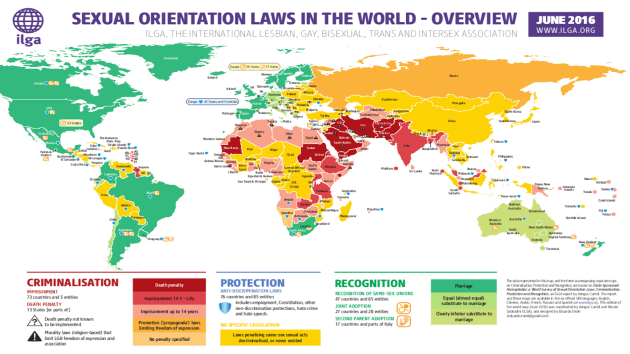
When you look at this recently released map from ILGA (the International Lesbian, Gay, Bisexual, Trans and Intersex Association):

ILGA 2016

ILGA, June 2016.

and see large sections of the globe coloured orange (where being gay is a criminal offence) and even dark red (countries which have the death penalty for homosexuality) – and they are at least as large as, and include many more people, than the sections which are dark green (ie countries and states that have full marriage equality) – then experiencing such guilt might seem understandable.

Now, before I get roundly slammed for expressing this view, I acknowledge that this perhaps says more about me than about the Australian marriage equality movement per se. I also recognise that these thoughts are likely the products of internalising a couple of the arguments which have been used against LGBTI equality for some time.

The first, that people elsewhere have it worse off than us (undoubtedly true), and that we should be grateful for what we have (also true – although from my perspective I am grateful to the activists who have brought that situation about), is essentially an attempt to say that we already have ‘enough’ rights, and therefore should stop campaigning for more.

This argument is easy to reject – just because we have already achieved some rights (decriminalisation, anti-discrimination protections etc), doesn’t mean we should accept anything less than full equality – and that includes exactly the same legal recognition of our relationships as already enjoyed by cisgender heterosexual couples.

However, the second, related argument is a little more difficult to dismiss out of hand, and that is that there are bigger and more important issues in the world, and consequently we should be concentrating our efforts on those instead.

In the domestic context, this type of argument is used by marriage equality opponents to say that jobs, the economy, health, education – indeed, all manner of things – are more important than marriage equality, and that we should just ‘drop it’ and put those other issues first.

Of course, our straightforward response to that argument is that Parliament is capable of dealing with more than one issue at a time, and therefore there is no need to put things like marriage equality on the backburner until somehow all of those other issues are magically ‘fixed’ first.

In the international context, the argument would go something like: given there are still roughly 75 countries where being gay is a crime, achieving decriminalisation globally is far more important than campaigning for marriage equality in countries like Australia where we already enjoy most substantive rights, and therefore that is where we should exert all our energies.

Based on the domestic example (above), the most logical response is to say that we are capable of doing both – that there is absolutely no reason why we cannot simultaneously campaign for marriage equality within Australia (and similar countries), while also supporting movements for decriminalisation elsewhere.

But, and here’s the important thing, the strength of that argument is based on us actually DOING both. If we only look at improving our own (already quite privileged) lot, and effectively ignore the struggle for more basic equality from lesbian, gay, bisexual, transgender and intersex people in other countries then, at the very least, we expose ourselves to the potential criticism that we are being indulgent (even if most would see such criticism as unfair).

That is not to say that anyone should feel guilty for campaigning for their own individual equality or rights – and not just because, as I have discovered perhaps a little late in life, guilt is not an especially productive emotion. To me, one of life’s great joys lies in finding the strength to stand up against the discrimination or prejudice that we encounter.

But I guess I am saying that, if we are interested in campaigning for full equality for ourselves, by securing marriage equality domestically, we should also see that struggle in its appropriate context, and also devote some of our time and effort to helping the fight for equality by our LGBTI comrades in other countries.

NB If, after reading this, you agree with me and want to do more (or even if you disagree vehemently with what I’ve written but still want to help international LGBTI equality), here are five groups which you might consider joining/supporting:

10 Things I Hate About Marriage Inequality. #10: Because it makes me embarrassed to be Australian

[Updated 4 August 2016]

On Friday 13 August 2004, the Senate passed the Howard Government’s shameful amendments to the Commonwealth Marriage Act 1961. These amendments included a new definition of marriage – “marriage means the union of a man and a woman to the exclusion of all others, voluntarily entered into for life” – thus confirming the second-class legal status of same-sex relationships in Australian law.

In mid-2014, in the lead-up to the 10th anniversary of the passage of that homophobic law, I wrote a series of posts on the top ten things which I hate about marriage inequality, to ‘celebrate’ (or, more accurately, to vent). Sadly, as we approach the 12th anniversary on 13 August 2016, the list remains all-too-relevant today.

As you would expect, given how much this ongoing discrimination against LGBTI-inclusive couples pisses me (and, let’s be honest, most of us) off, there are some things which I had to leave out. But I hope you will nevertheless enjoy reading the ten reasons that did end up making the cut. Anyway, on with the list:

#10: Because it makes me embarrassed to be Australian

The 1st marriage equality laws came into effect in the Netherlands on 1 April 2001. In the now 15 years since, it has been joined by 19 other countries, namely:

  • Belgium (2003)
  • Spain (2005)
  • Canada (2005)
  • South Africa (2006)
  • Norway (2009)
  • Sweden (2009)
  • Portugal (2010)
  • Iceland (2010)
  • Argentina (2010)
  • Denmark (2012)
  • Brazil (2013)
  • France (2013)
  • Uruguay (2013)
  • New Zealand (2013)
  • Luxembourg (2015)
  • Ireland (2015)
  • United States (nationwide 2015)
  • Colombia (2016)
  • Finland (from 2017)

Marriage equality is also recognised in some parts of Mexico and the United Kingdom (England, Wales & Scotland, although it remains unlawful in Northern Ireland).

I think most lesbian, gay, bisexual, transgender and intersex (LGBTI) Australians probably accepted lagging behind the Netherlands on this particular reform (well, most social changes actually), and trailing their Southern neighbours Belgium too. Although it was perhaps a little bit of a surprise that highly-Catholic Spain would get there so quickly – but I guess we got used to that.

Canada was less of a surprise. Meanwhile, no-one could begrudge South Africa, especially given it was achieved, in part, as a consequence of the inclusive Constitution adopted in the post-apartheid era. And I suppose we probably couldn’t expect to get there ahead of most of the Scandinavian countries either.

But the longer this list has become – and, sadly, it will likely be longer still by the time we eventually get there – the more embarrassing it has become to be an Australian, and that embarrassment stings whether you are an LGBTI individual, or couple, or simply someone who believes in the equality of all people irrespective of sexual orientation, gender identity or intersex status.

It didn’t need to be this way. I am old enough to remember a time, in my youth, when, at least at the Commonwealth level, Australia was capable of doing some things better than most of the world. When we adopted a world-leading response to the emergence of HIV/AIDS. When we were one of the first countries to recognise same-sex couples for the purposes of immigration. When we allowed ‘gays in the military’ ahead of, or at the same time as, the majority of our peers.

Alas, no more. On what has become one of the signature issues for progressive reform, not just for LGBTI rights but for social justice more generally, we have fallen, and are falling further, behind.

It has to stick in the craw of most decent Australians that the New Zealand Parliament managed to pass marriage equality, even with a Conservative Government, while at the same time our Parliament, with a then-Labor Government, could not. And thinking about the fact that LGBTI couples have been able to get married in the cornfields of the American mid-West (Iowa) for more than seven years (and can now marry everywhere in the US, from Alabama to Alaska), while we cannot, is enough to make one cringe.

My fiancé, Steve, likes to talk about how ‘his’ country (Portugal) has had marriage equality for six years – even though his parents left there in the 1970s. In recent years my response to that argument has been to point out that ‘my’ country (Scotland) has it, too – but then, my ancestors have been in Australia for more than two centuries, so it is even more difficult for me to stake that claim.

We only talk about our respective ancestral countries in that way because the one where we were both born, and where we are (second-class) citizens, refuses to acknowledge that our love can be the same as any other adult couple. In truth, at times we would prefer to identify with another country – even one where our links might be more (mine) or less (his) tenuous – because being a citizen of Australia is, and there isn’t really a nicer way of putting it, downright embarrassing.

There are, of course, many other reasons for Australians to feel embarrassed (including our shameful treatment of Aboriginal and Torres Strait Islander people and also our, frankly, criminal abuse of people seeking asylum). But the ongoing failure of our country to recognise marriage equality must also take its very own place on that ignominious list. Shame, Australia, shame.

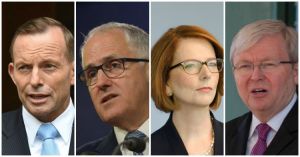
Abbott-Turnbull-Gillard-Rudd-750x393

The four Australian Prime Ministers since John Howard was defeated have all failed to overturn his 2004 ban on marriage equality.

The last major battle for gay & lesbian legal equality in Australia won’t be about marriage

[Updated March 4th 2015]

This Saturday, the 37th annual Sydney Gay & Lesbian Mardi Gras Parade will work its way up Oxford St with its now traditional mix of politics, colour and movement, and above all, pride. Pride in who we are, pride in our community, and pride in what we have managed to achieve.

Because life is unarguably better for the vast majority of Australia’s lesbian, gay, bisexual, transgender and intersex (LGBTI) population in 2015 than it has ever been before. And that indeed is something to be proud about.

Following the first Mardi Gras on 24 June 1978, many of the barriers to legal equality have been removed. NSW passed anti-discrimination laws in 1982, followed by the decriminalisation of gay sex in 1984. Same-sex couples have since achieved de facto relationship recognition, and there is now equal access to assisted reproductive technology and adoption in most Australian jurisdictions.

It is likely that one area where legal rights have yet to be achieved will, once again, be the dominant theme of many of the more politically-oriented floats in this year’s parade – the Australian Parliament’s ongoing refusal to recognise marriage equality between all couples.

As someone who is engaged to be married, and who has been for more than four years but is currently prohibited from doing so, I understand why marriage equality is an issue which arouses such intense passion, and an admirable level of commitment from many activists around Australia.

But marriage equality is also something which most of us know is probably, some might say almost inevitably, going to be achieved at some point in the next five, at most 10, years.

When that day comes, when the first couples legally married under federal law have shared their vows and celebrated their commitments to each other in front of their families and friends, there will still be a major outstanding issue of legal inequality confronting lesbian, gay, bisexual and transgender (LGBT) Australians.

It appears just as inevitable that, long after those couples dance their waltzes and cut their wedding cakes, the anti-discrimination protections which are offered to LGBT Australians under most state and federal laws will continue to be seriously undermined by the wide-ranging exceptions which are offered to religious organisations (NB Intersex is not included here because religious exemptions under the Commonwealth Sex Discrimination Act 1984 do not apply on those grounds).

These exceptions allow religious schools to actively discriminate against LGBT teachers and students. Religious hospitals and community welfare organisations can utilise these loopholes to discriminate against LGBT employees, as well as patients and clients. And, while the historic federal reforms passed via the Sex Discrimination Amendment (Sexual Orientation, Gender Identity and Intersex Status) Act 2013 do not allow religious-operated aged care facilities to discriminate against LGBT people accessing their services, LGBT people can still be denied employment in those facilities simply because of who they are.

All of these services – education and health, community welfare and aged care – are located firmly and squarely in the public sphere, and address some of the most fundamental human needs in life. It is these same characteristics, that they are public services meeting public needs, that are used to justify the substantial amounts of public funding which subsidise the religious organisations running them, money which comes from all taxpayers, religious and non-religious, LGBTI and non-LGBTI alike.

Yet, despite operating in the public sphere, almost always using public money, these organisations are granted exceptions from the same legal obligations that are imposed on any other group, namely the responsibility not to discriminate on the basis of sexual orientation and gender identity.

The justification for these ‘special rights’? Basically, that the ability to discriminate against lesbian, gay, bisexual and transgender people is so fundamental to the exercise of religious freedom that it cannot be limited.

Note that we are not here talking about who is appointed as office-holders, including ministers, within a religion itself, what a particular religion may or may not believe in terms of morality, how religious ceremonies are undertaken, or even who can attend a religious ceremony. These are things that are central to religious freedom, and most people would not advocate the imposition of limits on the ability of religious organisations to discriminate in these areas.

Instead, some religious organisations (and we must say some, because not all groups hold these views) believe that they should have the right to fire a gay teacher, to expel a bisexual school student, to refuse to employ a lesbian aged care worker, or to deny services to someone who is transgender, even when all of the above is clearly done in the public sphere.

This is a much more substantive denial of rights than simply being denied access to marriage rites. Religious exceptions to anti-discrimination laws can affect LGBT people in multiple areas of their lives, including times and places when they are at their most vulnerable. In practical terms, I believe it is religious exceptions and not marriage inequality that is the biggest battle left to be won for full gay and lesbian legal equality.

It is also a battle that looks set to be fought more ferociously than that over marriage equality. Some of the largest religious organisations in the country don’t just support these exceptions, they are prepared to wage cultural war to defend them.

The Wesley Mission recently spent eight years, and went all the way to the NSW Court of Appeal, defending their right to deny allowing a male same-sex couple to become foster carers to children in need. Wesley did so on the basis that: “[t]he biblical teaching on human sexuality makes it clear that monogamous heterosexual partnership within marriage is both the norm and ideal” (OW & OV v Members of the Board of the Wesley Mission Council [2010] NSWADT 293 (10 December 2010).

Further, they submitted that: “Wesley Mission’s tradition views a monogamous heterosexual partnership in marriage as the ideal family role model for the vulnerable and sometimes damaged children we foster. Other understandings fall short of that norm.” And finally that “[t]he proposition that we should provide a framework for children to be cared for and nurtured within the context of a homosexual lifestyle is fundamentally unacceptable to our evangelical teaching and practice.”

The irony, some might say hypocrisy, of these statements is that, in the same case, Wesley Mission admitted that single people could themselves become foster carers through their service. Apparently they believed that two dads or two mums had less to offer foster children than one.

The net effect of the Wesley Mission case was to provide judicial confirmation of the breadth of the religious exceptions offered under section 56(d) of the NSW Anti-Discrimination Act 1977. That section reads: “[n]othing in this Act affects: any other act or practice of a body established to propagate religion that conforms to the doctrines of that religion or is necessary to avoid injury to the religious susceptibilities of the adherents of that religion.”

In short, if you are lesbian, gay, bisexual or transgender, then you have no legal right or expectation to be treated fairly and without discrimination by a religious employer, or religious-operated service, in NSW.

It is no surprise then that, when the Federal Parliament was considering the Exposure Draft Human Rights and Anti-Discrimination (HRAD) Bill 2012, the precursor of the Sex Discrimination Amendment (Sexual Orientation, Gender Identity and Intersex Status) Act 2013, key NSW religious organisations would argue for religious exceptions to be established in Commonwealth law, too.

What is perhaps surprising is that some churches made submissions to the Senate inquiry considering the HRAD Bill that these exceptions do not go far enough.

The Standing Committee of the Synod of the Anglican Church Diocese of Sydney, and the Catholic Archdiocese of Sydney (including the Diocese of Parramatta and the Catholic Education Commission of NSW), both argued that the concept of exceptions was problematic, and that the right to discriminate against LGBT people should instead be re-contextualised as a positive right.

From the Anglican submission: “[w]hile exceptions are necessary, casting the protection of these rights in a wholly negative manner, in the form of ‘exceptions’, does not do justice to their importance. It suggests they are merely to be tolerated rather than positively recognised and upheld as legitimate and important in themselves.”

Meanwhile, in a ‘Diedre Chambers’ style coincidence, the Catholic submission also wrote: “the terminology of “exceptions” is problematic and fails to acknowledge that the right of freedom of religion is a fundamental human right, which the Commonwealth government is obliged to protect under international law. In our view, the terminology of “exceptions” should be replaced with the terminology of “protections”. Using the terminology of “protections” would recognise that conduct which is deemed not to be unlawful because it is covered by an exception related to religion is in fact lawful because it accords with the fundamental human right of freedom of religion” [emphasis in original].

Both submissions also go further than concerns surrounding terminology to argue that the exceptions which are offered to religious organisations should also be available to individuals – that is, that their personal beliefs should allow them to discriminate, even in their professional lives and when not working for a religious organisation.

For example, the Anglican submission recommended that “[a]n employee should not be required by their employer to undertake particular tasks or provide services in a particular context that are contrary to the employee’s genuinely held religious convictions where this is reasonable.”

Thankfully, that style of exception, which is located somewhere on the bottom half of the slippery slope down to the abhorrent type of laws currently attracting controversy in several US states, was not included in the final Commonwealth legislation. But in making that submission, the Anglican Church of Sydney has made clear the direction it wants anti-discrimination, or more accurately, pro-discrimination, laws to head [As an aside, if it had been passed then, when marriage equality does eventually become a reality, such provisions would have allowed individual employees to refuse to sell wedding cakes, or serve as wedding photographers, merely because of the sexual orientation and/or gender identities of the couples involved].

And they will fight equally hard to ensure that the current framework of exceptions applies in as many contexts as possible. The eventual removal of these exceptions in terms of people accessing aged care services was strongly resisted from some religious bodies, even if their arguments for doing so were quite weak (the Anglican submission on the HRAD Bill suggested that “[i]t may be unsettling to these communities to have residents who do not share their beliefs, values and ethos facility on matters of sexual practice”).

They have been more successful in fighting against recent proposed changes to NSW law that were simply attempting to remove the right of religious and other private schools to discriminate against gay, lesbian and transgender students (NB Bisexuality is shamefully still not a protected attribute in the NSW Anti-Discrimination Act 1977). Alex Greenwich’s amendments are currently on hold, at least in part because of the influence of the two major churches in the Parliament.

As we have seen, some religious organisations have demonstrated over the past 10 years that they are prepared to fight, by whatever means necessary (through the courts, in parliamentary inquiries, by lobbying parliamentarians directly and in public debate) to maintain and even extend the reach of these exceptions.

While this may seem to some like a theoretical (or even theological) debate, they are not doing so because they want the law to recognise abstract rights – they are engaged in this battle because they want the retain the ability to actively discriminate against LGBT people in real life.

Sadly, there are too many stories of this happening, of religious exceptions causing real-world harm to LGBT people. In the lead-up to Mr Greenwich’s Bill being introduced, several lesbian and gay students came forward with stories of being sent to the counsellor’s office for being “sick” (that is, for being gay), of being called disgusting and a disgrace – by a teacher no less – and threatened with exclusion from senior school, and of being told not to talk about their sexuality in addition to being excluded from school events (source: “Discrimination has no place in schools” Alex Greenwich, Sydney Morning Herald, 19 September, 2013).

Not forgetting the recent incident where the Sacred Heart Primary School at Broken Hill, which falls within the Wilcannia-Forbes Catholic Diocese, rejected a young girl’s kindergarten application simply because her parents were two women (source: “Same-sex enrolment row prompts call for law change”, ABC News Online, 15 December 2011).

Of course, these are just some of the stories that we are aware about. Most people who are discriminated against by religious organisations, either directly or indirectly, do not speak up, because they are aware that the discriminatory actions of those bodies are entirely lawful, or because they fear retribution from those organisations if they do so.

Which brings me back to the Mardi Gras Parade. While for many of us the decision to participate on Saturday is an easy one, choosing to celebrate pride in who we are and as part of our community, for others the decision whether to be visible or not in this manner can be significantly more complicated.

For people already engaged with religious organisations in different ways, or whose profession may involve applying for jobs with them (for example, more than a third of schools in Australia are religious, an even higher proportion amongst secondary schools), choosing to be ‘out’ through Mardi Gras can have serious repercussions.

Some people can and do have a legitimate fear that being identified as lesbian, gay, bisexual or transgender could result in them being fired, or being refused employment in the first place, in being expelled from school (or seriously mistreated while there), or being denied necessary services. Neither state nor federal anti-discrimination law would currently protect them in these circumstances.

In this respect, despite all of the progress in law reform since the first Mardi Gras parade was held back in 1978, there is still an incredibly long way to go. That is one of the reasons why we must ensure that Mardi Gras, as well as being a celebration of pride, also continues to serve its role as a political protest.

It is also why me must continue to campaign for equality, and to fight for our rights, including the right not to be discriminated against. Given the scale of the challenge involved in removing these unjust religious exceptions, and how hard (some) religious organisations will struggle to retain them (and therefore to maintain their position of privilege in society), we should be aware that it is not a fight that we will win in months. It will take several years, at least – if not decades.

But it is a battle we must wage nonetheless. Because, if LGBT Australians are ever to be truly equal under the law, then the special exceptions granted to religious organisations under Commonwealth, state and territory laws must end.

Explanatory notes: I have attempted to be clear in this post about when I am speaking about gay and lesbian, or LGBT, or LGBTI, because sometimes the law affects these groups in different ways (and please accept my apologies if I have made some errors in this respect). For example, removing religious exceptions cannot be the last major battle for bisexual legal equality – especially if they are not included in the NSW Anti-Discrimination Act in the first place.

Equally, I am not in a position to argue that religious exceptions are the biggest legal issue confronting transgender Australians when uniform positive recognition of gender identity is not yet a reality. And, while intersex people are not subject to religious exceptions under the Sex Discrimination Act, I also wouldn’t describe this issue as more important than banning involuntary medical sterilisation, something I have written about previously (see link: https://alastairlawrie.net/2013/12/25/no-3-senate-report-on-involuntary-or-coerced-sterilisation-of-intersex-people-in-australia/).

Finally, while I wrote in the second paragraph that, for the vast majority of LGBTI Australians, life is unarguably better than it has ever been before, I do not wish to underestimate the ongoing problems of mental illness, depression and suicide which affect many young LGBTI people, or indeed the plight of LGBTI asylum-seekers, who Australia continues to send to Nauru and Manus Island, PNG, for ‘processing and resettlement’.

One (more) final thing: if you liked this post, please consider sharing. Thanks, Alastair

No 8 Marriage Equality Marches on Around the World

In contrast to the lack of sustained progress in Australia, internationally marriage equality continued its onwards march in 2013. In fact, we end the year with approximately 10% of the world’s population now living in jurisdictions where same-sex couples are able to get married.

That seemed like an impossible goal five years ago, let alone way back in 2001 when the Netherlands had the somewhat radical (but in reality also rather conservative) idea that all couples should be allowed to wed, irrespective of their sexual orientation, gender identity or intersex status.

In 2013, marriage equality became a reality for couples in Brazil (16 May), France (18 May), Uruguay (5 August) and New Zealand (19 August). Which means 15 countries now treat all of their couples equally. It should also be noted that England and Wales also passed marriage equality during the year, although it won’t commence until March 29 2014 (NB Given Scotland has yet to pass marriage equality, and it looks unlikely to pass Northern Ireland, I do not include the United Kingdom in the number of countries with full equality).

There was just as much progress in the United States – both through the courts, and through legislatures around the country.

First, to the two momentous decisions of the US Supreme Court, both handed down on 26 June. In one, plaintiff Edith Windsor (a phenomenal woman, and deserved nominee for Time Person of the Year) was successful in her case that the Defense of Marriage Act, passed by Congress and signed by then President Bill Clinton back in 1996, was in fact unconstitutional.

The Court declared DOMA to be “a deprivation of the liberty of the person protected by the Fifth Amendment”. The consequence of this decision is that the US Federal Government is compelled to recognise the validity, and entitlements, of couples who are married under various state laws providing marriage equality around the country.

In the second decision, the Supreme Court struck down California’s Proposition 8 from 2008, a ballot initiative which had outlawed same-sex marriages just five months after they commenced in June of that year. The Supreme Court, in Hollingsworth v Perry found that the appeal, by people seeking to uphold the marriage ban, did not have standing meaning that a lower court ruling, reinstating marriage equality, stood. Californian same-sex marriages resumed shortly after this decision.

Probably more important has been the ongoing moves to introduce marriage equality through state legislatures. The year started with marriage equality taking effect in Maryland on 1 January, and it was followed by Delaware (1 July), Minnesota (1 August), Rhode Island (1 August), New Jersey (21 October – although this was largely the result of a state court case, after the Governor had previously vetoed marriage equality legislation), and Hawaii (2 December), with Illinois to commence formally on 1 June next year (although couples where a partner has a serious illness can marry now).

This is remarkable progress – and underscores just how conservative Australia is by comparison. After all, if roughly one third of US states (plus DC) have already introduced marriage equality, and with progress in Australia looking several more years away, we have well and truly cemented our place as the backwater of the Anglo-sphere on this issue.

In fact, Australia, with last week’s High Court decision overturning the ACT’s same-sex marriage laws, has provided one of the few ‘lowlights’ of the global marriage equality movement. The other that springs immediately to mind was the recent referendum in Croatia which, by a margin of 65% to 35%, voted to enshrine the definition of marriage as “a living union of a woman and a man” in that country’s constitution. Shame.

Leaving Australia and Croatia aside, though, the prospects for continued global progress on marriage equality look assured. It is highly likely that Scotland will pass equality early next year, and, after its elections this week, there is a good chance of Chile following suit (which would make it the fourth South American country to do so). I am sure that other countries, and more US states, will also take the plunge in the next 12 months.

Which leaves LGBTI-inclusive couples in Australia with a helluva lot more choices in overseas places where they can get married. Which is all very nice and well, but what we really want is the ability to marry at home, in front of our family and friends. Til then, we will continue to fall further and further behind the rest of the world.

I was going to end there but, contrary to my usual nature, I will instead sign off with my personal highlight of global marriage equality in 2013 – and that was the moment that marriage equality passed across the Tasman, and in particular the singing of a traditional Maori love song immediately afterwards. I challenge you to watch this and not get chills down your spine: http://www.youtube.com/watch?v=q9pOJ8Bc_-g

UPDATE: Just 3 days after I posted this, and two more US states have legalised same-sex marriage – New Mexico and Utah – bringing the total number to 18 (plus DC). With this rate of progress it is becoming increasingly difficult to keep track of developments, which, as an LGBTI activist, is a wonderful (and somewhat novel), problem to have. May it continue into 2014.

No 9 Still No Marriage Equality in Australia

This is an issue where there were a number of different highs – and lows – over the course of the past 12 months. Given my naturally glass half empty personality, we’ll start with the lows.

The most obvious ‘low’ was the High Court’s ruling last Thursday (12 December), overturning the ACT’s same-sex marriage laws as unconstitutional, after just five days of operation, as well as annulling the marriages of all the couples who had taken the opportunity to tie the knot under the law.

One can only imagine how awful the past few days would have been for these couples, experiencing the elation of being married, at long last, to the frustration of having that status ripped from their grasp just days later.

In fact, 2013 was not a good year for the idea of state and territory same-sex marriage laws generally. State-based marriage was defeated, narrowly, in votes the Tasmanian upper house (after passing the lower house, yet again), and by one vote in the NSW upper house (although it was likely headed for defeat in the lower house there). A similar Bill was defeated by a much larger margin in South Australian Parliament.

Now, it seems the High Court has ruled out the option of state-based marriage permanently (at least as far as they are close enough to marriage under the Commonwealth Marriage Act to deserve the title ‘marriage’).

And the Federal Election was also not a good one as far as marriage equality was concerned. A Prime Minister who supported marriage equality, leading a party the majority of whose MPs had voted yes just 12 months earlier, was replaced by a Prime Minister who remains staunchly opposed to equality (even that of his own sister), leading a Liberal-National Coalition of whom exactly ZERO MPs voted yes in September 2012.

Overall, then, there was a lot of bad news to spread around. But 2013 was not universally negative for marriage equality in Australia.

The same High Court decision that overturned the ACT’s same-sex marriage laws also included a key finding – that the Federal Parliament unambiguously has the power to introduce marriage equality.

That might sound, to some, as merely a small win, but it actually takes one of the main arguments against marriage equality in the Commonwealth arena off the table (namely that s51xxi of the constitution – aka the ‘marriage power’ – could only mean marriage of opposite-sex couples).

In what turned out to be a quite progressive judgment (despite the outcome), the Justices wrote:

“”marriage” is to be understood in s 51(xxi) of the Constitution as referring to a consensual union formed between natural persons in accordance with legally prescribed requirements which is not only a union the law recognises as intended to endure and be terminable only in accordance with law but also a union to which the law accords a status affecting and defining mutual rights and obligations.”  Link to full judgment here: http://www.austlii.edu.au/au/cases/cth/high_ct/2013/55.html

In short, marriage can be the union of two people (or more, if the Parliament so chooses) irrespective of their sexual orientation, gender identity or intersex status. That is a statement of what is ‘possible’. It is up to our parliamentarians to make it real.

Another ‘high’ was that those couples in the ACT were able to marry in the first place. The fact that, for five full days, newspapers and TV stations around the country carried pictures of happy couples getting married, where the only difference was that their spouse was the same sex as themselves, can only be of cementing victory in the long war of acceptance.

Same-sex couples were married, the sky didn’t fall, nobody else’s marriage was diminished and, for the benefit of people like Senator Bernardi, no pets were interfered with either.

Another glimmer of hope is that the Liberal Party’s position was slightly better at the 2013 election than it was at the 2010 one. While previously the Liberals and Nationals were universally committed to voting no on marriage equality, prior to September 7 they adopted the line that whether there was a conscience vote would be “a matter for the post-election Coalition party-room”.

Given Tony Abbott’s strong opposition, there is no guarantee of a conscience vote happening, but the door is at least slightly ajar – it is now up to people like Malcolm Turnbull to force it open.

Another door that is slightly ajar is the possibility of the 2014 ALP National Conference adopting a binding vote in favour of marriage equality. Something that should have happened in 2011, when the platform was changed, were it not for the homophobic position adopted by then Prime Minister Julia Gillard, is a live option because of recent remarks by AWU National Secretary Paul Howes, who conceded that he had been wrong to support a conscience vote back then.

With Howes’ crucial support, and another three years of time elapsed, there might, just might, be enough support from conference delegates to impose a binding vote on Parliamentary members of the Labor Party. And that is definitely something worth fighting for. Because, mathematically, we may well need a conscience vote from the Coalition, and a binding vote from Labor, for any marriage equality Bill to pass the Commonwealth Parliament, at least this term anyway.

The formation, last week, of a cross-party group to work towards marriage equality in the Parliament, drawing members from the Coalition (Sue Boyce), ALP (Louise Pratt) and Greens (Sarah Hanson-Young), will also likely be remembered as a key step along the road to equality.

The final ‘high’ from 2013 is something which now probably doesn’t hold a lot of sway, but which was a powerful statement of intent at the time: then Prime Minister Kevin Rudd’s ‘Bartlet’ moment on the ABC’s Q&A. (http://www.youtube.com/watch?v=CdU3ooAZSH8)

When asked by a Christian pastor how, as a Christian, Rudd could support marriage equality when the Bible commands him to believe differently, Rudd rebuked him with a smackdown that was brilliant both in its argument and in its eloquence. It was Rudd at his best – and, watching it three months later, it still brings a smile to my face.

Even if it was only for a few fleeting months, we finally had a Prime Minister join the majority of the Australian population in the 21st century in believing that all couples must be treated equally.

How much longer we have to wait for that community belief to be reflected in the statute books will depend a lot on what happens in 2014, inside the Coalition Party-room and at ALP National Conference. I guess it’s time to prepare to protest once more.

No 10 The Federal Election on September 7

This would possibly have been higher on the list, were it not for the fact the outcome was pretty much inevitable, long before polling day (and certainly by the time I finished working at Parliament House in mid-2012).

But the September 7 election was still a significant moment, because it drew the final curtain on the Rudd & Gillard (& Rudd again) Labor Government that, in less than 6 years, achieved more for LGBTI rights than any other federal Government in history.

Perhaps we, as a community, took some of those achievements for granted. Perhaps, because many of those reforms were so long overdue (case in point: de facto relationship recognition) that they didn’t feel like achievements at all, instead they were simply the actions of a Parliament finally catching up to where the population already was.

More likely, for many of the LGBTI people of Australia, the achievements of the Labor Government were overshadowed by one major law reform which they didn’t implement. As someone who is engaged to be married myself, I understand that frustration (and I would add another couple of major policy failures as well – but more on them later in this countdown).

Nevertheless, the fact that the Rudd/Gillard/Rudd Government did not introduce marriage equality should not mean that we completely disregard their achievements in other areas. After all, they accomplished infinitely more in a little over 5 and a half years than the Howard Government did in twice that time (to be honest, the only positive Howard Government LGBTI achievement I can think of was allowing same-sex couples access to their partner’s superannuation, but even that wasn’t mandated, didn’t cover Commonwealth public sector employees, and was only passed as a trade-off when they introduced the marriage ban in 2004).

The positive list of Labor achievements between 2007 and 2013 includes:

  • De facto relationship recognition (and access to the Family Court on relationship breakdown)
  • The inclusion of sexual orientation, gender identity and intersex status in federal anti-discrimination legislation for the first time (again, more on that later in the countdown)
  • Another first, this time the first National LGBTI Ageing and Aged Care Strategy
  • Providing funding for the National LGBTI Health Alliance for mental health projects
  • Providing funding for QLife, the national network of LGBTI telephone counselling services, to allow a 1800 number to be operational across the country 7 nights a week (the importance of which really shouldn’t be underestimated)
  • Introducing trans* and intersex passport reform, with M, F and X categories (where X includes indeterminate/unspecified/intersex)
  • Permitting LGBTI inclusive couples to access Certificates of No Impediment, to at least allow them to be married overseas, if not at home
  • Providing Gardasil vaccinations to teenage boys, so that future generations of gay and bisexual men are protected from anal, penile and throat cancer
  • Introducing Australian Government Guidelines on the Recognition of Sex and Gender, and
  • Removing some gender requirements for PBS medicines, meaning easier access to some treatments for trans* and intersex people.

The above list (which I am sure is not exhaustive) is, all things considered, a pretty impressive one.

It is a shame that, through their own actions (or, more specifically, inaction), the Rudd and Gillard Government will, for many, be remembered more because of the failure to recognise the fundamental equality of love, than any of the things I have noted above. Because, in reality, they left the state of LGBTI affairs in Australia a far better place on 7 September 2013, than what they inherited on 24 November 2007.

Still, there is one way in which the outgoing Labor Government could be remembered more fondly over time – and that is if the actions of the newly-elected Abbott-led Liberal and National Government make them seem better in hindsight.

Already, that looks like a distinct possibility. The first LGBTI-related action of the Abbott Government was taking the ACT and their same-sex marriage laws to the High Court (thus seeing them overturned). And there are plenty of other tests to come over the next 12-24 months, including deciding whether to continue funding for some of the above-named initiatives. Not to mention the potential threat to anti-discrimination reforms, and in particular the possibility of Brandis & co reintroducing an exemption for religious aged care service providers.

So, while we (quite rightly) criticise the Rudd & Gillard Labor Government for what it didn’t do, perhaps every once in a while we should also reflect on the good things that it did accomplish.

Denying Marriage Equality is Theft

Next week, the High Court will hear the Commonwealth’s application for the ACT’s same-sex marriage laws to be overturned. Arguments will focus primarily on whether the 2004 amendments to the Commonwealth Marriage Act ‘cover the field’ in terms of legislating under sub-section51(xxi) of the Constitution, or whether the amendments have instead left the door open for State and Territory Governments to establish a new category of marriage, namely same-sex marriage.

But perhaps the Court should also consider sub-section 51(xxxi), which gives the Commonwealth Parliament power for “the acquisition of property on just terms from any State or person for any purpose in respect of which the Parliament has the power to make laws.” Maybe our High Court Justices should ask whether laws which take away the right of LGBTI couples to get married are tantamount to theft.

Allow me to explain. The most direct way in which the marriage equality ban takes money from LGBTI couples is that, currently, it forces couples overseas in order for their marriage to have any legal standing at the time of the ceremony. The couple obviously incurs significantly higher costs than for a domestic wedding. Even if the ACT laws are allowed to stand, for Australian couples who wish to have a ceremony with legal standing, however briefly, the vast majority will need to hold their wedding a long distance from home.

With recent estimates of the average cost of weddings being in the vicinity of $35,000, or even $54,000, it is grossly unjust to force some couples to pay even more, merely because of their sexual orientation, gender identity or intersex status.

Compounding this, a system which forces LGBTI couples to travel, either interstate or overseas, to get married reinforces a financial threshold on which couples can tie the knot, with only the well-off able to do so. Someone’s class should never determine whether they can access a legal institution like marriage.

The next theft comes when the couple returns home – at customs, they are summarily, and completely without justification, stripped of their state of being married. Something which means so much to the couple – enough for them to travel to undertake it – is confiscated, without any compensation. Surely an argument could be mounted that this amounts to “the acquisition of property on [un]just terms”?

Something else which is stolen from LGBTI couples is the ability to celebrate their wedding with their desired guests. This happens in two ways. For those who choose to travel to get married, many of their family and friends will be unable to attend the ceremony due to cost, or the need to take extended time off work. For other couples, like my fiancé Steve and myself, who instead choose to wait until they can legally wed in Australia, the passage of time will have the same effect.

In our case, we both have elderly grandmothers who we love dearly and who we would love to have at our nuptials. That would have been possible when we first got engaged, at the start of 2010, although, sadly, my grandmother is probably now too frail to travel to our wedding, even in Australia. By the time marriage equality is eventually passed, I fear the same will be the case for Steve’s grandmother – and he will be devastated by that.

The ability to celebrate our wedding with the people who matter most to us has been ripped from our grasp by the Commonwealth Parliament. We, and other couples like us, feel it acutely. As an aside, perhaps so-called ‘family values’ campaigners should consider how they would react to government intervention on their wedding guest list – because that is what has been imposed on us.

The theft which is a consequence of the ban on marriage equality will not even stop whenever a Bill is finally passed – it will keep on stealing from us into the future. Explaining this ‘future theft’ is what eventually helped my rural, LNP-voting conservative parents understand why I feel so passionately about this issue.

Earlier this year, they had their 40th wedding anniversary. Which is something worthy of celebration – and so they did. Because these things, anniversaries, matter. One day, Steve and I hope to do likewise. Except that, the longer the ban on our marriage lasts, the less likely we will both be alive in order to celebrate a 50th, or even 40th, wedding anniversary. Even after the ban is eventually lifted, it will still be lifting precious things from our pockets.

Of course, what is being stolen from us is likely too intangible to be considered by the High Court under sub-section51(xxxi). But this theft is exactly what should be reflected upon by any Parliamentarian who is considering voting against the right of LGBTI couples to get married.

What makes the current ban ever harder to stomach is that, everyone, from Tony Abbott down, knows that marriage equality is inevitable. Which makes the ongoing refusal of our MPs to pass it seem extremely petty. Especially when what they are stealing from us, both now and in the future, is something grand.

Liberal-National Policies on LGBTI Issues for Federal Election 2013

I was tempted to leave the content of this article completely blank, because that would be a reasonably accurate reflection of the LGBTI policies of the Liberal-National Parties for the election that is now only two days away. That is because, outside of two not very encouraging exceptions, the Coalition doesn’t appear to have any LGBTI policies for this year’s poll.

The Real Solutions booklet, which Tony Abbott and his team have been clutching tight for most of this year, makes no mention of LGBTI Australians. And, as far as I can tell, none of the policies which have been put up on the Liberal campaign website do so either (although I am happy to be corrected).

The two exceptions that I mention include Abbott’s signature Paid Parental Leave scheme (covered in my blog post earlier this week, a commitment which does not include references to same-sex couples in the formal policy document, but which Abbott, Hockey and O’Dwyer have subsequently been forced to confirm will include LGBTI parents).

And the second exception is marriage equality, which does not actually involve a policy commitment at all, only that the decision will be left to a post-election party-room to decide whether to have a conscience vote in the next term, rather than having a formal position against (although the Opposition Leader has made his own views – which remain strongly opposed to marriage equality – very clear).

This paucity of policies was confirmed through the 2013 LGBTI Federal Election Survey, which was recently conducted by the NSW Gay & Lesbian Rights Lobby, Victorian Gay & Lesbian Rights Lobby, Transgender Victoria and Organisation Intersex International Australia. This was a question and answer document, with 43 different questions spread over 12 distinct topics.

Unfortunately, while the ALP and Greens provided individual answers to all 43 questions, the Liberal-National Coalition did not provide individual answers, instead they provided a cover letter, and two-and-a-bit page attachment, which provided broad brushstrokes but very few details of what they will (and won’t) do.

The LGBTI groups I mentioned then analysed this response according to four different categories: Yes/Good Response, Qualified/Partial Response, No/Bad Response and Response does not answer the question. (For a copy of the survey documents, including the Liberal-National letter and the assessment made by the four groups, go to www.lgbti2013.org.au)

The result: for a full 29 of the 43 questions asked (ie two thirds of the total), the Liberal-National Parties’ response was deemed to not answer the question at all. In fact, in only 4 out of 43 responses (less than 10%) were the Liberal-Nationals deemed to give a positive response, with 8 qualifieds, and 2 outright nos. By way of comparison, the LGBTI groups deemed that the ALP did not answer 4 questions out of 43, and the Greens only 1 out of the 43 questions, and the clear majority of both responses were deemed to be Yes/Good.

Given that they answered less than a third of the questions asked, it is no surprise that there are entire policy areas which the Liberal-National Coalition have simply not taken a position on, and these touch a number of things which are very important to different sections of the LGBTI community.

Specifically, the Abbott Liberal-National Coalition failed to provide an answer on:

  • Whether they support the recent amendments to the Sex Discrimination Act which have prohibited discrimination against LGBT people by religious organisations in aged care services
  • Whether they oppose the introduction of civil unions before the passage of marriage equality
  • Whether they will continue to issue Certificates of No Impediment, which currently allow Australian couples to marry in other countries which have already legislated for marriage equality
  • Whether they will attempt to overrule States and Territories that introduce marriage equality (either through new legislation or High Court challenge)
  • Whether they will continue to fund dedicated LGBTI health initiatives, outside of HIV, and (possibly) some mental health initiatives
  • Whether they will retain the dedicated National LGBTI Ageing and Aged Care Strategy, and keep LGBTI as a special needs group in the Aged Care Act
  • Whether they will provide public funding for trans* surgeries
  • Whether they would help end ‘normalising’ surgery (including coerced sterilisation) on intersex infants
  • Whether they will use foreign policies resources to advocate specifically for decriminalisation of homosexuality around the world and
  • Whether they support the ‘resettlement’ of LGBTI refugees in countries that criminalise homosexuality (such as Papua New Guinea and Nauru).

As you can see, that is a pretty impressive roll-call of issues which the Liberal-National Coalition failed to provide an answer on. In my personal opinion, I think that this is a pretty disappointing (*alert: possible understatement) level of detail from people who will likely be occupying the Government benches from next week.

One interpretation of this would be that, by not answering these questions, they are leaving open the possibility of doing any and all of them (which could include doing positive things which they have not answered, but could equally involve doing a range of negative things, including taking away rights for LGBTI people or funding for LGBTI initiatives).

Another interpretation would be that, by failing to outline any concrete negative plans – for example, by failing to state that they will bring back religious exemptions in aged care services in the Sex Discrimination Act – even after being specifically asked, they will not have a mandate to do these when in Government. After all, it is difficult to claim a mandate to roll back rights or strip funding when you keep those policies (if you have them) a secret. And that is an argument that I expect the LGBTI community will be using if the Abbott Government does adopt negative policies in these areas after the election.

NSW Same-Sex Marriage Inquiry Submission

Given the NSW Legislative Council inquiry is set to release its final report on the issue of state-based marriage laws at 3:30pm today, I thought now might be a good opportunity to publish my submission to the inquiry from back in March (but which was not published by the Committee on their website, given the overwhelming community response to this inquiry).

Anyway, as you can see it is a bit of a personal submission and I obviously stand by what I submitted, but acknowledge that I am going to need to be clearer from here on the difference between marriage equality (where all lesbian, gay, bisexual, transgender and intersex people can marry whoever they choose), and same-sex marriage, which, as the name suggests, is much more limited but which, sadly, might be the only constitutional option available to NSW (we’ll see later today.

Anyway, here is my submission. Let me know whay you think:

Legislative Council Social Issues Committee

Inquiry into Same Sex Marriage Law in NSW

Submission by Alastair Lawrie

Friday 1 March 2013

I am writing in support of the introduction of state-based marriage laws in NSW. While, ultimately, marriage equality can only be fully realised in Australia through the passage of an inclusive federal Marriage Act, in the meantime I encourage the NSW parliament to allow lesbian, gay, bisexual, transgender and intersex-inclusive (LGBTI) couples to have their relationships recognised through state-based marriage, if they so choose.

In this submission I will briefly address the four terms of reference, before discussing the story of my relationship with my fiancé Steve, and the reasons why I think we deserve the same right to be married as anybody else.

1)      Any legal issues surrounding the passing of marriage laws at a State level, including but not limited to:

  1. a.       The impact of interaction of such law with the Commonwealth Marriage Act 1961
  2. b.      The rights of any party married under such law in other States’ and Federal jurisdiction
  3. The rights of the parties married under such a law upon dissolution of the marriage.

I am not a constitutional or family law lawyer and, as such, I do not propose to discuss whether state-based marriage laws would be constitutional in great detail, or how these laws would interact with Commonwealth and other state and territory laws, or indeed, act upon the breakdown of such marriages.

I will simply note that there is legal debate about the constitutional possibilities of state-based marriage. Professor George Williams has canvassed the legal arguments in favour of state-based marriage laws in his article “Can Tasmania Legislate for Same-Sex Marriage?”[1] I think that there is at least a credible argument, as outlined in his article, to say that it is possible that the Courts could find state-based marriage to be constitutional.

It should also be remembered that there is still some doubt that an amendment to the Commonwealth Marriage Act 1961 introducing marriage equality would be constitutional at the federal level. Irrespective of which level of government first introduces marriage equality, this matter will inevitably end up in the courts.

It should also be noted that the federal parliament has abrogated its responsibility in this area. By explicitly introducing a ban on equal marriage in 2004, and then rejecting legislation to overturn that ban in 2012, Australia’s federal parliamentarians have comprehensively failed in their duty to provide basic fairness and equality to its LGBTI citizens, including the LGBTI citizens of NSW. Based on the size of this defeat, and the immediate political outlook, it appears unlikely that this ban will be overturned at any point in the next five or even possibly 10 years.

In this context, with legal uncertainty about which level of Government can introduce marriage equality, and faced with the homophobic, bi-phobic, trans-phobic and anti-intersex intransigence of the federal parliament, I believe it is incumbent upon state parliamentarians to at least attempt to introduce marriage equality at a state level.

In the event that the legislation is overturned by the courts, which is as always their prerogative, nothing will have been lost. LGBTI-inclusive couples will know that there is a risk of this outcome, and will enter into any state-based marriages with open eyes. Nevertheless, if people are married and the legislation is ruled invalid at a later date, at least in the interim these couples will have the belief that they are married under law. And the overturning of these marriages by the courts may provide the spark required for the federal parliament to finally take the necessary action in this area.

In the event that the legislation is found to be valid by the courts, which is also possible, then the NSW parliament will have done a truly wonderful thing by recognising the ability of thousands of LGBTI-inclusive couples to have their relationships recognised as marriages under law, if they so desire. This would be an amazing recognition by state parliamentarians of the equality of LGBTI people, and the value of their relationships. If there is even a small chance of this outcome, then I cannot think of a valid reason for the parliament to shy away from this noble endeavour.

2)      The response of other jurisdictions both in Australia and overseas to demands for marriage equality.

The movement for marriage equality, both within Australia and across the world, is strong and only growing stronger. Despite the setback of defeat in federal parliament last September, and the subsequent defeat of Tasmanian state-based marriage legislation in late 2012, other Australian jurisdictions are still considering their own marriage equality proposals (including the Australian Capital Territory and South Australia). Indeed, it has been reported that the Tasmanian Labor Government and Greens are considering reintroducing their state-based marriage legislation after the upper house elections in the first half of this year (noting that the legislation was only narrowly defeated in their upper house).

Around the world, marriage equality has already been introduced in 11 extremely diverse countries: South Africa, Argentina, Canada, Portugal, Spain, Belgium, the Netherlands, Denmark, Sweden, Norway and Iceland. I am also aware of current marriage equality proposals in our near neighbours New Zealand, as well as Taiwan, Nepal, Andorra, France, Luxembourg, Finland, Scotland, England and Wales, Uruguay and Colombia (in fact, it is difficult keeping track of the long list of countries which are actively considering this issue, which means I am sure to have missed some).

In other countries with federal structures of government, state-based marriage equality has been introduced in some states of Brazil, Mexico and the United States. The United States is the best illustration of the ongoing progress of the movement for marriage equality. It is now legal there in nine states (Connecticut, Iowa, Maine, Massachusetts, Maryland, Maine, New Hampshire, New York, Vermont, and Washington, as well as the District of Columbia). While in early-adopting US jurisdictions marriage equality was introduced through either court decisions or legislative reforms (or through a combination of both), the recent additions of Maryland, Maine and Washington were the result of popular ballots (and a referendum to ban marriage equality was also defeated in Minnesota last November).

The tide of public opinion across the world is turning in favour of marriage equality, and this is one reason why 11 national governments, and some sub-national states, have introduced LGBTI equality. It is my hope that the Australian Government eventually comes to the same conclusion – but in the meantime, I believe that the parliamentarians of NSW have an ethical obligation to, at least partially, fill that void.

3)      Any alternative models of legislation including civil unions.

In some jurisdictions, civil unions have been offered as a supposed compromise proposal between the LGBTI community on the one hand, who are calling for formal relationship recognition, and religious fundamentalists on the other, who believe that the term marriage is reserved only for ‘traditional heterosexual’ couples and that, while substantive rights can be conferred on non-heterosexual couples, these relationships should carry a different name (ie civil unions or civil partnerships).

In truth, this is not a genuine compromise but instead simply a reinforcement or further entrenchment of inequality. Deliberately choosing a separate name inherently makes those relationships ‘different’ or ‘other’. Saying that opposite-sex/heterosexual couples can be ‘married’, while all other couples can only be ‘civil unioned’, does not overcome inequality; it simply perpetuates it, finding a novel way to demonstrate that those relationships are second-class.

The idea that different groups of people can be considered equal while having separate institutions has been tried before, in many different countries and applying to many different groups (including groups based on race, religion and sex). In none of these different contexts has it actually meant genuine equality. In terms of racial segregation, the US Supreme Court, in the famous case of Brown v Board of Education (1954), saw through the conceit of this concept and instead found that ‘separate but equal is never equal’.

That principle applies just as much to LGBTI people, and to their relationship recognition. To set up an entirely new system of relationship recognition for LGBTI-inclusive couples, and to maintain that system separate from the relationship recognition granted to heterosexual/opposite-sex couples, is not genuine equality. It is no wonder that the vast majority of LGBTI people reject this type of distinction and instead demand full equality. We will accept nothing less.

There are two additional points which should be made in relation to civil unions. The first is that civil unions have been adopted in some jurisdictions which are quite similar to Australia – including New Zealand, the United Kingdom and some US states. In none of these places have civil unions been adopted as a long-term solution – as described above, New Zealand, Scotland, England and Wales are all actively considering moving to marriage equality in the near future (and in several US states civil unions were merely a precursor to marriage equality). Civil unions have proved to be only an inconvenient half-way house or road-stop along the toad to equality, merely delaying full equality and ultimately pleasing no-one. There is no reason why NSW should adopt such a flawed approach.

Secondly, in some jurisdictions, particularly US states, civil unions have held some attraction because they did not have de facto recognition laws in place beforehand, meaning that the introduction of civil unions at least had the advantage of conferring additional substantive rights which LGBTI-inclusive couples did not already possess. Given that NSW and Australia have both passed comprehensive de facto relationship recognition for LGBTI-inclusive couples, this reason does not apply here. Once again, there is no justification for a new and separate category of relationships called civil unions.

4)      Changes in social attitudes (if any) to marriage in Australia.

The concept of marriage has undergone many changes over time. Originally an institution which involved male ownership of women (with that ownership passing from the father to the husband), the law now recognises the two parties to a marriage to be equal. In some countries and at some points in time, there were also laws against marriage between races – happily miscegenation laws are a thing of the past. The majority of marriages used to be performed within churches, whereas now the vast majority of weddings are officiated by civil celebrants. And the ideas of divorce, and later no-fault divorce, have been added to our marriage laws, without undermining the institution itself.

These changes show that the institution of marriage has evolved over time, changing for the better to accommodate ongoing enlightenment in societal attitudes on gender, race, religion and relationship breakdown. Through these changes, what we now understand as the fundamental nature of marriage – that it is an institution to recognise the love and commitment between two people – has not altered.

This meaning can evolve again to accommodate the fact that lesbian, gay, bisexual, transgender and intersex people are equal citizens, and should be treated equally in every respect, including relationship recognition. If society, through its laws, conveys certain rights on opposite-sex/heterosexual couples, there is no good argument to deny those same rights to other people on the basis of their sexual orientation, gender identity or intersex status.

This is a proposition which has been accepted by the majority of the Australian population. Opinion poll after opinion poll has shown that a growing majority of people support the extension of marriage rights to all adult couples, whether opposite-sex/heterosexual or LGBTI-inclusive. A Galaxy Poll in August 2012 found that 64% of Australians supported marriage equality, with only 30% opposed. This support existed across men and women, across all age groups, and from voters of all political persuasions.

The figures for NSW were consistent with this level of support – 62% of people in NSW supported marriage equality, including 28% strongly supporting, while only 32% in total were opposed. I am loathe to cite opinion polls as a stand-alone reason for social change (see Appendix A for further discussion of this point). Nevertheless, it is clear that the population have already accepted the solid public policy reasons for marriage equality – our parliamentarians should do the same.

Steve and me

My fiancé Steve and I have been together for more than four and a half years. We met two weeks after my 30th birthday. I had begun to think that I might not ever meet the person who I was supposed to be with, and then suddenly, he was standing right there in front of me.

Steve and I are the epitome of your average, everyday couple. We have our ups and downs, just like everyone else, but we know that we love each other and that is enough to get us through.

We live our lives in the suburbs. We both work, and are trying to save enough money to buy a house (and, like other couples, are finding it hard in the Sydney property market!) We might have children in the future, we might not – we certainly want to own our own house and be settled in one place before we seriously consider doing so.

Steve and I make compromises for each other – he moved to Canberra to be with me when I was working there, and I have subsequently moved to Sydney when he wanted to move back. We do most things together, and wouldn’t have it any other way.

We got engaged more than 3 years ago. I took him on a holiday to Melbourne, and was so incredibly happy when I got down on bended knee and he said yes. I still can’t believe that someone as wonderful as him has agreed to spend the rest of his life with me.

We want to have our wedding in Australia – that is why we decided to wait for last year’s Marriage Act Amendment Bills to be considered by the federal parliament, in the hope that our federal parliamentarians might allow us to get married in the same way that opposite-sex/heterosexual couples can.

Steve and I decided that, after that terribly disappointing defeat, we would nevertheless wait for the NSW state-based marriage proposal to be debated before making the decision about finally setting a date, and most importantly, a venue. Of course, state-based marriage is not quite the same – it involves setting up a new marriage scheme separate from the existing one. But we think that it would be incredibly powerful to have our marriage recognised by the state in which we live.

If the NSW marriage amendment is defeated, then we will not wait any longer. More than three years is long enough – and I certainly don’t think many heterosexual couples would accept their engagement being made that long because their government(s) refused to allow them to tie the knot. They certainly wouldn’t accept potentially being made to wait more than 10 years, which is possible if both the federal and state parliament voted no on this issue.

Obviously, that means Steve and I will have to go overseas to get married. If New Zealand passes their law in the first half of this year, then we would most likely go there. One of the advantages of New Zealand as a location is that at least some of our family members and friends might be able to join us on our special day. If New Zealand doesn’t pass marriage equality, then we are thinking we might go to New York.

That is not as romantic as it might sound. While some of it would obviously be wonderful, and I will be happy wherever I get to marry my husband, it will also be bittersweet because we would be doing so in the absence of most of our family and friends, who would not be able to travel there (whether because they could not get enough time off work, could not afford the expense, have young children, are too old, or have health problems and cannot travel that far).

Imagine that – the decisions of your government(s) effectively determining the guest list at your wedding. No other married couples would tolerate that, and nor do we. In particular, Steve and I both have grandmothers who we love very dearly, and would love to have them with us – Steve in particular would be devastated if his grandmother was unable to attend our wedding.

If we were able to get married in Sydney, then at the very least his grandmother should be able to join us (and if it had been in place federally when we first got engaged my grandmother might have been able to join us too, although she is now probably getting too old to even travel to Sydney). As it stands, if we are forced to go to New Zealand, then neither of our grandmothers would be able to join us due to their age and health.

These are the real world consequences of the decision made by the federal parliament last year, and the potential consequences of your decision later this year. Please consider them before you cast your vote on this issue.

And please do not consider passing civil unions as some kind of supposed ‘compromise’ between the LGBTI community and religious fundamentalists. Steve and I are engaged to be married, not civil union-ed. When I proposed to him, I asked whether he would marry me – and when we do (finally) have our wedding, I will be asking him to be my husband, not my civil partner.

Civil unions, passed in the absence of marriage equality, are inherently second-best. Steve and I do not accept them as a substitute, and nor should we have to.

There are thousands of other LGBTI-inclusive couples in NSW, just like Steve and me, waiting to get married. We are the couples who watched last year while the federal parliament deliberated on our fundamental human rights and who, sadly, decided that we are not first-class citizens in our own country, that our relationships are not deserving of the same recognition as others.

We will be watching again later this year, when it comes time for NSW parliamentarians to cast their votes. Hopefully, the members of the NSW Legislative Assembly and Legislative Council can ‘show up’ their federal counterparts, by demonstrating just how easy it is to make thousands of people profoundly happy.

After all, that is the ultimate consequence of this vote. There is no downside in voting to allow additional couples to celebrate their love by getting married. But the upside is immense – being able to make many thousands of LGBTI-inclusive couples, and their families and friends, happy. I don’t think the choice is that hard – please make the right one.


[1] Williams, George, “Can Tasmania Legislate for Same-Sex Marriage?”, The University of Tasmania Law Review, Vol 31, No 2, 2012, pp117-133.

George Brandis, Tony Abbott, Marriage Equality & CNIs

Marriage Equality Red Background Rings

This week saw the passage of marriage equality in Uruguay, and then New Zealand. Next week will witness France adopt marriage equality legislation. These are the 12th, 13th and 14th countries around the world to have done so.

This spate of activity has provided renewed focus on the issue of marriage equality within Australia. In particular, it has prompted more people to scrutinise the position of Tony Abbott and the Liberal-National Opposition, because they will almost inevitably form Government after the election on September 14th.

Some people have pointed to Tony Abbott’s recent comments to say that he is softening his stance of marriage equality. Specifically, he has said that the matter will be debated inside the Coalition party-room after the election, with the possibility that they may adopt a conscience vote on the matter.

I disagree that this is necessarily a positive development. Instead, I think Abbott’s position is a complete cop-out. It avoids legitimate scrutiny in the lead-up to the poll, leaving voters unclear exactly what he, and his Government, will do once in office.

It also means that people and groups who oppose marriage equality can exert their homophobic influence behind closed doors to ensure that there is no progress. No doubt bigots like the Australian Christian Lobby will be there, actively lobbying in secret, with their decidely un-christian views.

The potential outcomes of this ‘evasive manoeuvre’ by Abbott include that the Coalition’s policy does not change, and that there is therefore no conscience vote next term. We could also end up with civil unions, a so-called compromise which basically nobody wants, but which seems to be favoured by people like Warren Entsch, who has traditionally been one of the more progressive Liberal MPs.

In fact, civil unions seem to me like the most likely outcome of an incoming Liberal-National Government. I genuinely can’t see marriage equality happening under someone as fundamentally conservative as one T Abbott, and that is why I fear we may still be three terms away from Australia-wide reform. Imagine how many countries we will have fallen behind by then?

But, there is one scenario in which we could even go backwards in terms of marriage equality in Australia. I know, that doesn’t seem possible, but there is actually one marriage reform which has been implemented by the current Labor Government which could be wound back under a Coalition Government, in what would be a worst-case scenario.

This would involve the incoming Attorney-General, who will most likely be Senator the Hon George Brandis SC, revoking the January 2012 decision by the then Labor Attorney-General, the Hon Nicola Roxon MP, which allowed Australian LGBTI-inclusive couples to obtain Certificates of No Impediment (CNIs) to marry overseas (in the countries that require them).

In fact, this would simply be the Coalition reverting to the policy which they adopted from 2004 to 2007, when, under then Attorney-General, the Hon Philip Ruddock MP, the Liberal-National Government refused to issue CNIs to same-sex couples, thereby cruelling the chances of most Australian LGBTI-inclusive couples from taking advantage of overseas developments.

To be honest, I don’t know how likely this worst-case scenario is. I would hope that we have come a long way since the end of the Howard era in 2007, and that an incoming Abbott regime would not wind back this particular right.

On the other hand, many Queenslanders probably thought last year that, even if he wasn’t going to be a pro-equality champion, Campbell Newman and the LNP wouldn’t wind back existing LGBTI rights. How wrong they were.

Anyway, that is why I have written the following letter to Shadow Attorney-General Brandis, and copied it to Mr Abbott. Basically, I am asking them to support marriage equality, through party policy or at least a conscience vote. But, if they are unable to do either of those, to at the very least continue to grant CNIs to Australian LGBTI-inclusive couples to marry overseas.

I don’t know what kind of reply to expect. But, as always, whatever I get I will post here.

This is the text of the letter which I sent yesterday:

Dear Senator Brandis

Marriage Equality and Certificates of No Impediment

I am writing to you about the issue of marriage equality, and specifically the policy which the Liberal-National Opposition will take on this issue to the Federal election to be held on 14 September 2013.

I am a 34 year old man who has been together with my wonderful fiancé for almost 5 years – and we have been engaged to be married for more than 3 of those.

All we want is to be able to have a legally-recognised wedding ceremony in front of our family and friends in our own country. All we want is exactly the same rights which other Australians already enjoy.

I strongly encourage the Liberal-National Opposition to support marriage equality as formal policy ahead of the September poll. This would show that the Liberal-National Coalition accept lesbian, gay, bisexual, transgender and intersex (LGBTI) Australians as first-class citizens, deserving of both respect and full legal equality.

Failing that, and as a bare minimum, the Liberal and National Parties should publicly commit to holding a conscience vote on this issue in the next term of Parliament, so that those MPs who wish to support LGBTI equality are free to do so. There have already been several Liberal MPs and candidates who have expressed their desire to take advantage of a non-binding vote to support marriage equality, should one be granted.

Finally, I have a specific question relating to the Attorney-General portfolio. In 2005, your Coalition colleague, the Hon Philip Ruddock MP, as Attorney-General prohibited the granting of Certificates of No Impediment (CNIs) to Australian LGBTI-inclusive couples who wished to marry overseas.

This ban remained in place until overturned by the Hon Nicola Roxon MP on 1 February 2012. This allows Australians couples, and those LGBTI-inclusive couples which include dual or multiple nationalities, to take advantage of the growing number of countries to have implemented marriage equality.

Just this month, Uruguay, New Zealand and France have become the 12th, 13th and 14th countries to accept marriage equality, as part of a growing worldwide movement. Even if the Australian Parliament does not grant marriage equality in the near future, should not mean we are prevented from taking advantage of the equality that already exists overseas.

My question is this: Do you commit a Liberal-National Government to continuing to grant CNIs to LGBTI-inclusive couples who wish to marry overseas?

I would appreciate your reply on all the issues raised in this letter, but in particular, on whether a Liberal-National Government would continue to grant CNIs to all Australian couples, irrespective of sexual orientation, gender identity and intersex status.

Thank you in advance for considering this important issue.

Yours sincerely,

Alastair Lawrie