Submission to National Curriculum Review re Health & Physical Education Curriculum

The following is my submission to the review of the national curriculum, initiated by the Commonwealth Minister for Education, the Hon Christopher Pyne MP at the end of 2013. Given the appointment of Mr Kevin Donnelly to co-chair this review, I am not confident that all, or indeed, any of the concerns below will be listened to. But the inclusion of LGBTI students and content in our schools system is so important that I believe it is still worth a shot.

National Curriculum Review Submission

Thursday 13 March 2014

Thank you for the opportunity to make a submission on the development of the national school curriculum.

In this submission I will limit my comments to the development of the national Health & Physical Education (HPE) curriculum. In particular, I will be commenting on whether the HPE curriculum as drafted addresses the needs of, and genuinely includes, lesbian, gay, bisexual, transgender and intersex (LGBTI) students.

I have previously made submissions on the initial public consultation draft of the HPE curriculum, released in December 2012 (a copy of my submission is provided at <https://alastairlawrie.net/2013/04/11/submission-on-national-health-physical-education-curriculum/ ), and on the revised draft released for limited public consultation in June and July 2013 (see <https://alastairlawrie.net/2013/07/30/submission-on-redrafted-national-health-physical-education-curriculum/ ).

In both of those submissions I was strongly critical of the fact that the draft HPE curriculums did not genuinely attempt to include LGBTI students (including omission of the words lesbian, gay or bisexual), did not provide adequate sexual health education, and did not provide adequate information regarding HIV and other Blood Borne Viruses (BBVs), including viral hepatitis.

A second revised draft of the curriculum was prepared by the Australian Curriculum, Assessment and Reporting Authority (ACARA) ahead of the meeting of Commonwealth, State and Territory Education Ministers in November 2013. It has been reported that Education Ministers did not agree to the second revised draft, but instead simply noted its development in anticipation of this review.

Nevertheless, the second revised draft HPE curriculum was published in February 2014 on the Australian Curriculum website (www.australiancurriculum.edu.au).

I have analysed the second revised draft, and sincerely hope that my comments below convey the seriousness of my concerns about the ongoing exclusion of LGBTI students and content, and the potential negative health impacts that this exclusion will have over the short, medium and long-term.

The current version of the national Health & Physical Education curriculum does nothing to put all ‘Students First’, which I understand to be the guiding principle of this review. In fact, by continuing to exclude some students, and marginalising content which is relevant to their needs, the draft HPE curriculum places lesbian, gay, bisexual, transgender and intersex students last.

If the HPE curriculum were to be implemented as it currently stands, it would actively contribute to, and reinforce, the disproportionate rates of mental health problems, depression and, most tragically, suicide, which continue to affect young LGBTI people.

By failing to include detailed BBV and sexual health education, the HPE curriculum would also leave young people, and gay and bisexual men and trans* people specifically, exposed to unnecessary risk of transmission of HIV and other infections.

And by not ensuring that all students are provided with information that is relevant to their own needs and personal circumstances, the HPE curriculum will undermine the fundamental human right to health of the next generation of young LGBTI people. This right must be respected, and not denied to people merely on the basis of other peoples’ attitudes towards their sexual orientation, gender identity or intersex status.

This review is an(other) opportunity to address some of the serious shortcomings of the draft HPE curriculum. Please seize this opportunity and recommend that the curriculum be amended to ensure LGBTI students are included, with content that is relevant and targeted to meet their needs, including around sexual health and BBV education.

The remainder of this submission will look at five key areas of the draft HPE curriculum. They are:

  • Terminology
  • Student Diversity
  • Bullying & Discrimination
  • Sexual Health, and
  • HIV and other BBVs.

Terminology

One significant problem that has consistently appeared through the initial draft, revised draft and now second revised draft of the Health & Physical Education curriculum is that of terminology. Specifically, the HPE curriculum has either completely excluded terms that are essential for young people to learn, or included terms or definitions that are not appropriate in the circumstances.

The biggest problem in terminology, featured in all three drafts, has been the failure to even include the words lesbian, gay or bisexual. Despite these being the most common forms of identification for people whose sexual orientation is ‘not heterosexual’, these terms have never appeared in any version of this document.

In fact, the ongoing refusal to name lesbians, gay men and bisexuals – despite the fact that students will have heard these terms regularly amongst their families and friends, in culture and in broader society, and that an increasing number of young people, including students, will be using these terms to describe themselves – is almost bizarre in its stubbornness to deny reality.

Even if there may be a reason for sometimes using the umbrella term same-sex attracted, to ensure that people who may be sexually attracted to people of their own sex but who do not use the terms lesbian, gay or bisexual to identify themselves are included, there is absolutely no justification for not naming lesbian, gay and bisexual identities within the HPE curriculum (for example, by using the description “same-sex attracted, including lesbian, gay and bisexual people”). The failure to do so contributes to the marginalisation of lesbian, gay and bisexual young people.

On a related issue, the HPE curriculum as drafted appears to use the incredibly broad, and arguably poorly-defined, term ‘sexuality’ at multiple points in the document when ‘sexual orientation’ would be more appropriate.

For example, the Glossary defines ‘sexuality’ as “[a] central aspect of being human throughout life. Sexuality encompasses sex, gender identities and roles, sexual orientation, pleasure, intimacy and reproduction and is influenced by the interaction of biological, psychological, social, economic, political, cultural, ethical, legal, historical, religious and spiritual factors”. The breadth of this definition makes some of the references to sexuality in the curriculum either too vague to be practicable, or even unintelligible.

The more widely-accepted term ‘sexual orientation’, which the curriculum does not define, and only appears to use once (in the definition of ‘sexuality’, reproduced above), would be more constructive, especially when references are made to differences or diversity in ‘sexuality’. Using the term sexual orientation would also more clearly include different orientations (including lesbian, gay and bisexual) than using the term sexuality alone.

On a positive note, there have been some improvements in references to, and definitions for, diversity in gender identity, including transgender people (which at least is included as part of the Glossary definition of ‘gender diverse’).

There have also been improvements in terms of the recognition of intersex people, who are now at least referenced in the statement on student diversity, and provided with a separate definition in the Glossary (where previously it had been erroneously included within the definition of gender diverse).

Nevertheless, defining a term in the Glossary and then using it once in the main text of the curriculum itself (and even then only as part of an ‘aspirational statement’ at the beginning of the document) is not sufficient to guarantee that the needs of transgender and intersex students are met.

In summary, the HPE curriculum needs to be significantly amended, such that it actually includes the terms lesbian, gay and bisexual, and that it adequately includes information about these sexual orientations, as well as transgender and intersex people, throughout the document.

Student Diversity

As discussed above, the HPE curriculum includes a statement on ‘Student Diversity’ at the beginning of the document, and this includes two paragraphs on ‘Same-sex attracted and gender-diverse students’.

I welcome some of the changes that have been made to this section between the revised draft and the second revised draft. In particular, these paragraphs now make a variety of positive statements (including that “it is crucial to acknowledge and affirm diversity in relation to sexuality and gender’” – noting my view, expressed earlier, that the use of ‘sexual orientation’ would be preferable here – while talking about “inclusive… programs” and the needs of “all students”).

Indeed, the last sentence of the section is particularly encouraging where it notes that being inclusive and relevant is “particularly important when teaching about reproduction and sexual health, to ensure that the needs of all students are met, including students who may be same-sex attracted, gender diverse or intersex”.

However, these positive developments continue to be undermined by the preceding statements that the HPE curriculum “is designed to allow schools flexibility to meet the learning needs of all young people, particularly in the health focus area of relationships and sexuality” (emphasis added) and that “[a]ll schools communities have a responsibility when implementing the HPE curriculum to ensure that teaching is inclusive and relevant to the lived experiences of all students” (emphasis added).

Both of these statements appear to leave the decision whether, and in what way, schools will include LGBTI students and content up to the schools themselves. In the first instance, whether LGBTI students and content are included at all is too important to be left to the ‘flexibility’ of the school itself.

Second, and far more importantly, the reference to ‘lived experiences’ could be argued to leave a loophole for schools to assert that, unless students first identify themselves or disclose their status as LGBTI, they do not exist in the eyes of the school and therefore the school does not have a responsibility to include them or content relevant to their needs.

This approach – apparently leaving it up to students to ‘come out’ before they are entitled to receive vital health information, despite the fact that doing so can, in many Australian jurisdictions, lead to the potential expulsion of that student, let alone other personal consequences for the student with their family or friends – fundamentally undermines the concept of health, and health education, as a universal human right.

And, while this appears to be a somewhat negative and narrow interpretation of these paragraphs, it is a realistic one given that a statement which appeared in the initial consultation draft, which stated that “same-sex attracted and gender diverse students exist in all Australian schools” was abandoned in the revised draft, and, despite arguments put forward for its re-inclusion was not included in the second revised draft.

In my view, whether to include LGBTI students and content should not be an issue of ‘flexibility’ between different schools. Instead, there should be a minimum level of LGBTI education provided to every student in every school – and, after all, isn’t a national minimum standard what the curriculum should be aiming to achieve?

This would be further supported by the re-inclusion of a statement which notes that “lesbian, gay, bisexual, transgender and intersex students exists across all Australian schools, and all schools must provide LGBTI-specific content to each and every student”.

Bullying & Discrimination

One area where there has been significant improvement from the initial draft and revised draft to the second revised draft has been an increase in content that attempts to redress anti-LGBTI bullying and discrimination.

In particular, I welcome the commitment in the Glossary definition of ‘discrimination’ that “[t]he types of discrimination that students must learn about include racial, sex and gender discrimination, homophobia and transphobia” (emphasis added).

I also welcome the increased content in year band descriptions that explicitly includes learning about homophobia, in years 7/8 and 9/10.

However, there are still a range of improvements that could be made to ensure that the curriculum adequately informs students about the need to stamp out discrimination and bullying of LGBTI students.

First, it is important to note that ‘homophobia’ does not necessarily include all forms of discrimination or prejudice against LGBTI people. The inclusion of transphobia in the Glossary is valuable, however, it should also be included in the year band descriptions to ensure that it is not overlooked. Both the Glossary and year band descriptions should also include biphobia and anti-intersex discrimination, which should not automatically be subsumed within a catch-all category of ‘homophobia’.

Second, discussion of homophobia, biphobia, transphobia and anti-intersex discrimination should not be left until years 7/8 to be introduced into the HPE curriculum, but should be commenced in years 5/6 alongside education about racism.

This is vital not only because anti-LGBTI bullying and discrimination can occur from a young age (including all-too-common insults like “that’s so gay”), but also because some young lesbian, gay and bisexual students are coming out earlier and earlier (and deserve to be protected), while some trans* and intersex youth may have disclosed their status earlier still.

Third, in the year band description for years 9/10, heading “[c]ritique behaviours and contextual factors that influence health and wellbeing of their communities” instead of using the term “such as… homophobia” (emphasis added) the curriculum should say “including homophobia, biphobia, transphobia and anti-intersex prejudice” to ensure that schools cannot opt out of providing this content.

Fourth, I would highlight the inconsistency in providing information about homophobia and transphobia to students, which as I have indicated above is a positive development, with the ongoing exclusion of the words lesbian, gay and bisexual from the document in its entirety, and the exclusion of the words transgender and intersex from the year band descriptions (which provide the main content of the curriculum).

It would seem nigh on impossible to appropriately teach students about the negatives of homophobia and transphobia (together with biphobia and anti-intersex discrimination, which should be added) at the same time that lesbian, gay, bisexual, transgender and intersex students are either not explicitly mentioned in the year band descriptions, or not even mentioned at all in the entire curriculum.

Sexual health

One of the key aspects of any Health & Physical Education curriculum must be the provision of comprehensive, inclusive and up-to-date education around sexual health.

Unfortunately, none of the three drafts of the HPE curriculum released to date have provided even a bare minimum of information about the best practices to support sexual health, not just for LGBTI people, but also for cisgender heterosexual students.

While the Glossary does at least provide a definition of ‘sexual health’ (“[a] state of physical, mental and social wellbeing in relation to sexuality. It requires a positive and respectful approach to sexuality and sexual relationships, as well as the possibility of having pleasurable and safe sexual experiences, free of coercion, discrimination and violence”), there is either limited or no support to implement this in practice in the year band descriptions.

In the year bands 5/6 and 7/8, which represent key ages for sexual health education, there is some discussion of physical changes surrounding puberty, and even changing feelings and attractions, but there does not appear to be any unit or module where students are taught the ‘nitty-gritty’ of sexual health, including discussion of different sexual practices, sexually transmitted infections (STIs) and the best ways to reduce the risks of STI transmission (including but not limited to condom usage).

I continue to find it extraordinary that the national minimum standard for Health & Physical Education to students does not even refer to STIs or condoms.

One of the arguments that has been mounted in defence of this omission is that this level of detail is not necessary in the curriculum, and that it will be covered as different jurisdictions and school systems implement their own syllabus.

I completely disagree. Given how fundamental sexual health is to the health and wellbeing of young people, surely the national HPE curriculum is the perfect place to guarantee that all students, rights across the country and irrespective of whether they attend government or non-government schools, receive the best possible information.

In addition, the reticence to provide any real detail around sexual health in the curriculum, on the basis that ‘specifics’ are not required, looks more like evasion when compared with some of the other sections of the curriculum which are, in fact, quite detailed (for example, in the year 5/6 band description it suggests “experimenting with different music genres such as Indian Bhangra music when performing creative dances”).

If something as specific as Indian Bhangra music can be named in the HPE document, then there must also be space for detailed discussion of the importance of sexual health, different sexual practices, STIs and condoms.

HIV and other BBVs

My fifth and final concern is related to the fourth, and that is the complete exclusion of HIV, and other BBVs like viral hepatitis, from the curriculum.

As I have written previously, I simply cannot understand that a national Health & Physical Education curriculum, developed and written in the years 2012 and 2013, does not even refer to HIV, hepatitis B and hepatitis C, which together directly affect almost half a million Australians.

It is vital that students learn about these BBVs, and most importantly how to reduce the risks of their transmission (for example, condom usage, hepatitis B vaccination, not sharing injecting equipment and safe tattooing and body art practices). If we do not provide this information, at the age that young people need it most, then we are failing in our duty of care towards the next generation.

The ongoing exclusion of HIV in particular looks odd (or, to be less charitable, short-sighted and ill-conceived). More than 30 years into the HIV epidemic in Australia, and with Melbourne hosting the 20th International AIDS Conference in July 2014, the proposed national minimum standard for Health & Physical Education curriculum does not even bother to mention it.

This is far from the ‘best practice’ approach that Australia adopted to the HIV epidemic in the 1980s. A best practice approach to the HPE curriculum now would, as a minimum, ensure that all students learn about HIV, hepatitis B and hepatitis C, and the best ways to reduce the risks of transmission.


Conclusion


As I have outlined above, I have serious concerns about the second revised draft Health & Physical Education curriculum, including its continued exclusion of LGBTI students and content relevant to their needs, as well as minimal or non-existent education regarding sexual health and HIV and other BBVs.

As reviewers of the national curriculum, I believe it is your responsibility to remedy these significant shortcomings, and ensure that the final HPE curriculum adopted is one that provides for the best possible health education and outcomes for all students, including lesbian, gay, bisexual, transgender and intersex students.

That is my definition of Students First.

Sincerely,

Alastair Lawrie
Letter to Prime Minister Abbott re Intercountry Adoption by Same-Sex Couples

The Hon Tony Abbott MP

Prime Minister

PO Box 6022

House of Representatives

Parliament House

CANBERRA ACT 2600

Cc Dr Ian Watt

Secretary

Department of Prime Minister & Cabinet

PO Box 6500

CANBERRA ACT 2600

Saturday March 8 2014

Dear Prime Minister

INTER-COUNTRY ADOPTIONS BY SAME-SEX COUPLES

I am writing regarding the issue of inter-country adoptions. Specifically, I call on you to ensure that the processes governing inter-country adoptions treat all couples equally, regardless of sexual orientation, gender identity or intersex status.

I note that you announced in December 2013 that the Department of Premier and Cabinet would be investigating the issue of inter-country adoptions, reporting to you on ways the processes governing inter-country adoptions can be streamlined ahead of the Council of Australian Governments (COAG) meeting, now scheduled for Friday 2 May in Canberra.

I also note recent reports about the potential for new arrangements for recognising adoptions by Australians with respect to children from Taiwan and South Korea.

However, I am unaware of any reports about work underway to ensure that all bilateral and, where relevant, multilateral, agreements concerning adoption entered into by Australia recognise the equal rights of all couples, including same-sex couples, to adopt.

There is no legitimate reason to prevent couples that may include lesbian, gay, bisexual, transgender or intersex (LGBTI) individuals from adopting.

In fact, the most recent report on the issue of same-sex parenting, commissioned by the Australian Institute of Family Studies, reaffirmed independent research over the past decade in finding that “there is now strong evidence that same-sex parented families constitute supportive environments in which to raise children.”

The report – Same-Sex Parented Families in Australia by Dr Deborah Dempsey (December 2013) – further confirmed that “children in such families do as well emotionally, socially and educationally as their peers from heterosexual couple families.”

Speaking about the report to the Sydney Morning Herald in February 2014, author Dr Dempsey said “[i]t’s not the family structure that matters so much as the kind of care; that children are loved, and are taken care of.” In practice, same-sex couples are just as capable of providing for the best interests of the child as opposite-sex couples.

Given these and other research results, I seek your commitment to ensure there is no discrimination against same-sex couples contained in any inter-country adoption agreement which Australia signs.

On a related issue, one of the administrative barriers to efficient inter-country adoption processes must be the variety of different, often conflicting, adoption criteria that operate in Australian states and territories.

For example, while my fiancé Steven and I would likely be eligible to adopt in Sydney, we would not be eligible to adopt were we to relocate to Melbourne. I doubt that our suitability as parents would differ simply because we moved 1000km to the South.

As before, there is no legitimate reason to prevent couples that include LGBTI individuals from adopting, and that must include within and between Australian jurisdictions.

The report which you have commissioned and will be presenting to the COAG meeting in May is an ideal opportunity for you to call on the states and territories to adopt uniform adoption laws, in particular to ensure that all Australian states and territories allow all couples to adopt, irrespective of sexual orientation, gender identity or intersex status.

This would be a benefit not just to the administrative efficiency of Australia’s inter-country adoption processes, but also to the equal rights and status of lesbian, gay, bisexual, transgender and intersex Australians.

Finally, I note during the week reports of disagreement within the Coalition partyroom on the subject of single and same-sex couple parenting. Specifically, it was reported that Senator Cory Bernardi expressed his support for Minister Kevin Andrews’ defence of so-called ‘traditional families’.

In response, Liberal MP for Herbert, Ewen Jones, defended families headed by single people, and same-sex couples, saying that what was more important was that children were loved, not what gender their parents were. Mr Jones later told Fairfax Radio “I think it’s the quality of the role model, male or female, not the sexuality of the parents that maters” – a sentiment similar to that expressed by Dr Dempsey, above.

It was also reported that you responded to the debate by saying “[w]e need to be as supportive of people as possible, regardless of their circumstances.”

Taking you at your word, I sincerely hope that you will be supportive of all Australian couples, including same-sex or otherwise LGBTI-inclusive couples, having the same rights to adopt children from other countries.

You have the chance to demonstrate this support through the review of inter-country adoption which you have commissioned, and through your advocacy at the upcoming COAG meeting which will discuss this issue. I and other same-sex couples around the country will be watching which approach you take.

Thank you in for your consideration of this correspondence.

Sincerely,

Alastair Lawrie

The last major battle for gay & lesbian legal equality in Australia won’t be about marriage

[Updated March 4th 2015]

This Saturday, the 37th annual Sydney Gay & Lesbian Mardi Gras Parade will work its way up Oxford St with its now traditional mix of politics, colour and movement, and above all, pride. Pride in who we are, pride in our community, and pride in what we have managed to achieve.

Because life is unarguably better for the vast majority of Australia’s lesbian, gay, bisexual, transgender and intersex (LGBTI) population in 2015 than it has ever been before. And that indeed is something to be proud about.

Following the first Mardi Gras on 24 June 1978, many of the barriers to legal equality have been removed. NSW passed anti-discrimination laws in 1982, followed by the decriminalisation of gay sex in 1984. Same-sex couples have since achieved de facto relationship recognition, and there is now equal access to assisted reproductive technology and adoption in most Australian jurisdictions.

It is likely that one area where legal rights have yet to be achieved will, once again, be the dominant theme of many of the more politically-oriented floats in this year’s parade – the Australian Parliament’s ongoing refusal to recognise marriage equality between all couples.

As someone who is engaged to be married, and who has been for more than four years but is currently prohibited from doing so, I understand why marriage equality is an issue which arouses such intense passion, and an admirable level of commitment from many activists around Australia.

But marriage equality is also something which most of us know is probably, some might say almost inevitably, going to be achieved at some point in the next five, at most 10, years.

When that day comes, when the first couples legally married under federal law have shared their vows and celebrated their commitments to each other in front of their families and friends, there will still be a major outstanding issue of legal inequality confronting lesbian, gay, bisexual and transgender (LGBT) Australians.

It appears just as inevitable that, long after those couples dance their waltzes and cut their wedding cakes, the anti-discrimination protections which are offered to LGBT Australians under most state and federal laws will continue to be seriously undermined by the wide-ranging exceptions which are offered to religious organisations (NB Intersex is not included here because religious exemptions under the Commonwealth Sex Discrimination Act 1984 do not apply on those grounds).

These exceptions allow religious schools to actively discriminate against LGBT teachers and students. Religious hospitals and community welfare organisations can utilise these loopholes to discriminate against LGBT employees, as well as patients and clients. And, while the historic federal reforms passed via the Sex Discrimination Amendment (Sexual Orientation, Gender Identity and Intersex Status) Act 2013 do not allow religious-operated aged care facilities to discriminate against LGBT people accessing their services, LGBT people can still be denied employment in those facilities simply because of who they are.

All of these services – education and health, community welfare and aged care – are located firmly and squarely in the public sphere, and address some of the most fundamental human needs in life. It is these same characteristics, that they are public services meeting public needs, that are used to justify the substantial amounts of public funding which subsidise the religious organisations running them, money which comes from all taxpayers, religious and non-religious, LGBTI and non-LGBTI alike.

Yet, despite operating in the public sphere, almost always using public money, these organisations are granted exceptions from the same legal obligations that are imposed on any other group, namely the responsibility not to discriminate on the basis of sexual orientation and gender identity.

The justification for these ‘special rights’? Basically, that the ability to discriminate against lesbian, gay, bisexual and transgender people is so fundamental to the exercise of religious freedom that it cannot be limited.

Note that we are not here talking about who is appointed as office-holders, including ministers, within a religion itself, what a particular religion may or may not believe in terms of morality, how religious ceremonies are undertaken, or even who can attend a religious ceremony. These are things that are central to religious freedom, and most people would not advocate the imposition of limits on the ability of religious organisations to discriminate in these areas.

Instead, some religious organisations (and we must say some, because not all groups hold these views) believe that they should have the right to fire a gay teacher, to expel a bisexual school student, to refuse to employ a lesbian aged care worker, or to deny services to someone who is transgender, even when all of the above is clearly done in the public sphere.

This is a much more substantive denial of rights than simply being denied access to marriage rites. Religious exceptions to anti-discrimination laws can affect LGBT people in multiple areas of their lives, including times and places when they are at their most vulnerable. In practical terms, I believe it is religious exceptions and not marriage inequality that is the biggest battle left to be won for full gay and lesbian legal equality.

It is also a battle that looks set to be fought more ferociously than that over marriage equality. Some of the largest religious organisations in the country don’t just support these exceptions, they are prepared to wage cultural war to defend them.

The Wesley Mission recently spent eight years, and went all the way to the NSW Court of Appeal, defending their right to deny allowing a male same-sex couple to become foster carers to children in need. Wesley did so on the basis that: “[t]he biblical teaching on human sexuality makes it clear that monogamous heterosexual partnership within marriage is both the norm and ideal” (OW & OV v Members of the Board of the Wesley Mission Council [2010] NSWADT 293 (10 December 2010).

Further, they submitted that: “Wesley Mission’s tradition views a monogamous heterosexual partnership in marriage as the ideal family role model for the vulnerable and sometimes damaged children we foster. Other understandings fall short of that norm.” And finally that “[t]he proposition that we should provide a framework for children to be cared for and nurtured within the context of a homosexual lifestyle is fundamentally unacceptable to our evangelical teaching and practice.”

The irony, some might say hypocrisy, of these statements is that, in the same case, Wesley Mission admitted that single people could themselves become foster carers through their service. Apparently they believed that two dads or two mums had less to offer foster children than one.

The net effect of the Wesley Mission case was to provide judicial confirmation of the breadth of the religious exceptions offered under section 56(d) of the NSW Anti-Discrimination Act 1977. That section reads: “[n]othing in this Act affects: any other act or practice of a body established to propagate religion that conforms to the doctrines of that religion or is necessary to avoid injury to the religious susceptibilities of the adherents of that religion.”

In short, if you are lesbian, gay, bisexual or transgender, then you have no legal right or expectation to be treated fairly and without discrimination by a religious employer, or religious-operated service, in NSW.

It is no surprise then that, when the Federal Parliament was considering the Exposure Draft Human Rights and Anti-Discrimination (HRAD) Bill 2012, the precursor of the Sex Discrimination Amendment (Sexual Orientation, Gender Identity and Intersex Status) Act 2013, key NSW religious organisations would argue for religious exceptions to be established in Commonwealth law, too.

What is perhaps surprising is that some churches made submissions to the Senate inquiry considering the HRAD Bill that these exceptions do not go far enough.

The Standing Committee of the Synod of the Anglican Church Diocese of Sydney, and the Catholic Archdiocese of Sydney (including the Diocese of Parramatta and the Catholic Education Commission of NSW), both argued that the concept of exceptions was problematic, and that the right to discriminate against LGBT people should instead be re-contextualised as a positive right.

From the Anglican submission: “[w]hile exceptions are necessary, casting the protection of these rights in a wholly negative manner, in the form of ‘exceptions’, does not do justice to their importance. It suggests they are merely to be tolerated rather than positively recognised and upheld as legitimate and important in themselves.”

Meanwhile, in a ‘Diedre Chambers’ style coincidence, the Catholic submission also wrote: “the terminology of “exceptions” is problematic and fails to acknowledge that the right of freedom of religion is a fundamental human right, which the Commonwealth government is obliged to protect under international law. In our view, the terminology of “exceptions” should be replaced with the terminology of “protections”. Using the terminology of “protections” would recognise that conduct which is deemed not to be unlawful because it is covered by an exception related to religion is in fact lawful because it accords with the fundamental human right of freedom of religion” [emphasis in original].

Both submissions also go further than concerns surrounding terminology to argue that the exceptions which are offered to religious organisations should also be available to individuals – that is, that their personal beliefs should allow them to discriminate, even in their professional lives and when not working for a religious organisation.

For example, the Anglican submission recommended that “[a]n employee should not be required by their employer to undertake particular tasks or provide services in a particular context that are contrary to the employee’s genuinely held religious convictions where this is reasonable.”

Thankfully, that style of exception, which is located somewhere on the bottom half of the slippery slope down to the abhorrent type of laws currently attracting controversy in several US states, was not included in the final Commonwealth legislation. But in making that submission, the Anglican Church of Sydney has made clear the direction it wants anti-discrimination, or more accurately, pro-discrimination, laws to head [As an aside, if it had been passed then, when marriage equality does eventually become a reality, such provisions would have allowed individual employees to refuse to sell wedding cakes, or serve as wedding photographers, merely because of the sexual orientation and/or gender identities of the couples involved].

And they will fight equally hard to ensure that the current framework of exceptions applies in as many contexts as possible. The eventual removal of these exceptions in terms of people accessing aged care services was strongly resisted from some religious bodies, even if their arguments for doing so were quite weak (the Anglican submission on the HRAD Bill suggested that “[i]t may be unsettling to these communities to have residents who do not share their beliefs, values and ethos facility on matters of sexual practice”).

They have been more successful in fighting against recent proposed changes to NSW law that were simply attempting to remove the right of religious and other private schools to discriminate against gay, lesbian and transgender students (NB Bisexuality is shamefully still not a protected attribute in the NSW Anti-Discrimination Act 1977). Alex Greenwich’s amendments are currently on hold, at least in part because of the influence of the two major churches in the Parliament.

As we have seen, some religious organisations have demonstrated over the past 10 years that they are prepared to fight, by whatever means necessary (through the courts, in parliamentary inquiries, by lobbying parliamentarians directly and in public debate) to maintain and even extend the reach of these exceptions.

While this may seem to some like a theoretical (or even theological) debate, they are not doing so because they want the law to recognise abstract rights – they are engaged in this battle because they want the retain the ability to actively discriminate against LGBT people in real life.

Sadly, there are too many stories of this happening, of religious exceptions causing real-world harm to LGBT people. In the lead-up to Mr Greenwich’s Bill being introduced, several lesbian and gay students came forward with stories of being sent to the counsellor’s office for being “sick” (that is, for being gay), of being called disgusting and a disgrace – by a teacher no less – and threatened with exclusion from senior school, and of being told not to talk about their sexuality in addition to being excluded from school events (source: “Discrimination has no place in schools” Alex Greenwich, Sydney Morning Herald, 19 September, 2013).

Not forgetting the recent incident where the Sacred Heart Primary School at Broken Hill, which falls within the Wilcannia-Forbes Catholic Diocese, rejected a young girl’s kindergarten application simply because her parents were two women (source: “Same-sex enrolment row prompts call for law change”, ABC News Online, 15 December 2011).

Of course, these are just some of the stories that we are aware about. Most people who are discriminated against by religious organisations, either directly or indirectly, do not speak up, because they are aware that the discriminatory actions of those bodies are entirely lawful, or because they fear retribution from those organisations if they do so.

Which brings me back to the Mardi Gras Parade. While for many of us the decision to participate on Saturday is an easy one, choosing to celebrate pride in who we are and as part of our community, for others the decision whether to be visible or not in this manner can be significantly more complicated.

For people already engaged with religious organisations in different ways, or whose profession may involve applying for jobs with them (for example, more than a third of schools in Australia are religious, an even higher proportion amongst secondary schools), choosing to be ‘out’ through Mardi Gras can have serious repercussions.

Some people can and do have a legitimate fear that being identified as lesbian, gay, bisexual or transgender could result in them being fired, or being refused employment in the first place, in being expelled from school (or seriously mistreated while there), or being denied necessary services. Neither state nor federal anti-discrimination law would currently protect them in these circumstances.

In this respect, despite all of the progress in law reform since the first Mardi Gras parade was held back in 1978, there is still an incredibly long way to go. That is one of the reasons why we must ensure that Mardi Gras, as well as being a celebration of pride, also continues to serve its role as a political protest.

It is also why me must continue to campaign for equality, and to fight for our rights, including the right not to be discriminated against. Given the scale of the challenge involved in removing these unjust religious exceptions, and how hard (some) religious organisations will struggle to retain them (and therefore to maintain their position of privilege in society), we should be aware that it is not a fight that we will win in months. It will take several years, at least – if not decades.

But it is a battle we must wage nonetheless. Because, if LGBT Australians are ever to be truly equal under the law, then the special exceptions granted to religious organisations under Commonwealth, state and territory laws must end.

Explanatory notes: I have attempted to be clear in this post about when I am speaking about gay and lesbian, or LGBT, or LGBTI, because sometimes the law affects these groups in different ways (and please accept my apologies if I have made some errors in this respect). For example, removing religious exceptions cannot be the last major battle for bisexual legal equality – especially if they are not included in the NSW Anti-Discrimination Act in the first place.

Equally, I am not in a position to argue that religious exceptions are the biggest legal issue confronting transgender Australians when uniform positive recognition of gender identity is not yet a reality. And, while intersex people are not subject to religious exceptions under the Sex Discrimination Act, I also wouldn’t describe this issue as more important than banning involuntary medical sterilisation, something I have written about previously (see link: https://alastairlawrie.net/2013/12/25/no-3-senate-report-on-involuntary-or-coerced-sterilisation-of-intersex-people-in-australia/).

Finally, while I wrote in the second paragraph that, for the vast majority of LGBTI Australians, life is unarguably better than it has ever been before, I do not wish to underestimate the ongoing problems of mental illness, depression and suicide which affect many young LGBTI people, or indeed the plight of LGBTI asylum-seekers, who Australia continues to send to Nauru and Manus Island, PNG, for ‘processing and resettlement’.

One (more) final thing: if you liked this post, please consider sharing. Thanks, Alastair

Is there a moral obligation on athletes to come out?

Following my post in January (“In search of the elusive gay or bisexual male tennis player”) I was asked by the Star Observer to write about lesbian, gay and bisexual sportspeople and whether they should be out or not. I took that to mean whether there is a moral obligation on LGB athletes to come out – and my piece discussing that topic can be found at the following link: <http://www.starobserver.com.au/opinion/soapbox-opinion/to-be-out-or-not-out-in-sport/118055

Coincidentally, it was written on the weekend before Mike Sam came out, making the topic of lesbian, gay and bisexual involvement in sport quite topical.

Of course, I really wish I could have written that yes, they do have a moral obligation, in particular to other members of the LGB community – but that would ignore both the individual behind the ‘athlete’, including their personal story (and struggles that we may not be aware of), and the many reasons why they may choose not to be out in their chosen sport, including homophobia and biphobia. In any event, I hope that I have done the topic justice, and would love to know your thoughts about what I wrote.

Two final notes: firstly, I deliberately chose not to cover the issues of trans* and intersex involvement in sports, because I didn’t feel that I had the necessary expertise to write about those subjects. Besides, I am confident there are many people better placed to write about trans* and sport, and intersex and sport, respectively.

Second, I was a little surprised that my references to ‘outing’, specifically that I believe there might be some circumstances in which outing a virulently or malevolently homophobic politician might be acceptable, didn’t attract any critical responses. Perhaps that position is a little less controversial than I thought? In any event, I might write more on the topic of outing at a later date.

No Homophobia, No Exceptions

During the week, the NSW Gay & Lesbian Rights Lobby (which I am involved in as the Policy Working Group Chair), launched its No Homophobia, No Exceptions campaign, calling for the removal of religious exceptions to LGBTI anti-discrimination protections contained in the Commonwealth Sex Discrimination Act 1984 and the NSW Anti-Discrimination Act 1977.

This is an incredibly important campaign, given these exceptions will possibly be the last barriers to full LGBTI equality in Australia to fall, and a campaign which I am very proud to be involved in.

Now, while this blog, and the posts which I put up here, only ever reflect my personal views on things (ie in this blog I do not speak on behalf of the GLRL, or any other organisation), I would like to take the opportunity to put up a link to two other pages which form key parts of the No Homophobia, No Exceptions campaign.

The first is an op-ed I wrote for the Star Observer newspaper, outlining the reasons for the campaign, and calling for the LGBTI community to get involved. Link here: <http://www.starobserver.com.au/opinion/soapbox-opinion/no-homophobia-no-exceptions/117476

The second link is to a Change.org petition which asks people to support the campaign, by calling on Commonwealth Attorney-General, Senator the Hon George Brandis, and NSW Attorney-General, The Hon Greg Smith MP, to repeal these provisions.

If you support the campaign, and the principle that all people deserve to be treated equally in all areas of public life, irrespective of sexual orientation, gender identity or intersex status, then I strongly encourage you to sign. Link here: http://www.change.org/en-AU/petitions/senator-hon-george-brandis-remove-religious-exceptions-from-anti-discrimination-laws

Thanks.

Letter to Scott Morrison about Treatment of LGBTI Asylum Seekers and Refugees Sent to Manus Island, PNG

UPDATE: Sunday 20 July 2014

On Friday 18 July, I received the following response from the Department of Immigration and Border Protection, to my correspondence about the treatment of LGBTI asylum seekers and refugees:

Dear Mr Lawrie

Treatment of homosexual, bisexual, transgender and intersex asylum seekers

Thank you for your letter of 2 February 2014 to the Hon Scott Morrison MP, Minister for Immigration and Border Protection, concerning the treatment of homosexual, bisexual, transgender and intersex asylum seekers. The Minister appreciates the time you have taken to bring these matters to his attention and has asked that I reply on his behalf. I regret the delay in responding.

As a party to the 1951 Convention Relating to the Status of Refugees and its 1967 Protocol (the Refugees Convention), Australia takes its international obligations seriously. Australia is committed to treating asylum seekers fairly and humanely, and providing protection to refugees consistent with the obligations set out in the Refugees Convention, and other relevant international treaties to which Australia is a party.

The Australian Government has taken a number of measures to deter people smuggling and to ensure that people do not take the dangerous journey to Australia in boats organised by people smugglers. Under Australian domestic law, all illegal maritime arrivals (IMAs) entering Australia by sea without a visa will be liable for transfer to Nauru and Papua New Guinea (PNG) where any asylum claims they may have will be assessed, and if found to be a refugee, they will be resettled in Nauru and PNG or in another country.

Any claims made against Nauru and PNG by an IMA, including claims concerning the treatment of homosexuals, bisexual, transgender and intersex asylum seekers in either country, are considered prior to transfer. Where an IMA makes such a claim, consideration is given to whether the IMA can be transferred to the proposed country, or an alternative country, or whether the IMA’s case should be referred to the Minister for consideration or exemption from transfer.

Nauru and PNG are also both parties to the Refugee Convention. The Memoranda of Understanding (MOU) they have signed with Australia on the offshore processing arrangements reaffirm their commitment to the Refugees Convention and to treating people transferred with dignity and respect in accordance with human rights standards.

The enforcement of PNG domestic law is a matter for the Government of PNG. The government is aware of laws relating to homosexual activity in PNG and understands that there have been no recent reports of prosecution under those laws.

If homosexual activity should occur in the OPC, there is no mandatory obligation under PNG domestic law for Australian officers or contracted services providers to report such activity to the PNG Government or police.

The department notes the release of the reports by both the United Nations High Commissioner for Refugees (UNHCR) and Amnesty International on the Manus OPC. Any reports received by the department will be reviewed, and observations or comments verified. Where reports make practical observations that can be implemented and would improve the operations of the centres, the government will address these in partnership with Nauru and PNG to address any deficiencies in good faith.

Any claims of mistreatment at the Manus OPC would be primarily a matter for the Administrator of the OPC. The Manus OPC is administered by PNG under PNG law, with support from Australia. The PNG Minister for Foreign Affairs and Immigration appoints the Administrator of the Centre (a PNG national) under section 15D of the Papua New Guinea Migration Act 1978 (the Act). The Administrator, who, under the Act has control and management of the Centre (currently the Chief Migration Officer, Head of the PNG Immigration and Citizenship Service Authority) has an Operations Manager at the OPC reporting to him, who has oversight of the day-to-day operations of the OPC.

To assist PNG in the implementation of the MOU, the government has contracted appropriately trained and experienced service providers to ensure that transferees’ needs are adequately met, including through the provision of health and welfare services. Transferees can report any concerns to OPC staff.

Regarding the distribution of condoms, I can assure you that condoms are available at the Manus OPC, and the department’s contracted health service provider, International Health and Medical Service, conduct regular health information sessions on safe sex practices.

Thank you for bringing your concerns to the Minister’s attention.

Yours sincerely

[Name withheld]

Acting Assistant Secretary

Community Programmes Services Branch

9 / 7 / 2014

Some quick thoughts on the above:

  • Even though we are more than a decade into our post-Tampa nightmare of refugee policy in Australia, it is still shocking to see people simply seeking asylum in Australia described, by government officials, as Illegal Maritime Arrivals (IMAs). And it is probably almost as shocking realising that the same government official doesn’t even need to spell out what an OPC is anymore, instead it is taken as a given.
  • While the letter acknowledges there is no mandatory reporting of homosexual activity under PNG law, it explicitly does not state that there is no reporting of homosexual activity to PNG Police, or refute the claim that asylum seekers have been told they will be reported if found to engage in such activity.
  • It is difficult to accept the statement that “[t]o assist PNG in the implementation of the MOU, the government has contracted appropriately trained and experienced service providers to ensure that transferees’ needs are adequately met” from the same Government that is responsible for the death, in custody, of Reza Berati just over two weeks after I wrote my initial letter.
  • It is obviously welcome that, at least on paper, the Government claims it makes condoms available to asylum seekers on Manus Island – although whether they are made available in reality would be difficult to verify (given the shroud of secrecy surrounding, and lack of journalist access to, the detention facilities in PNG and Nauru).
  • The main problem remains however, and that is there is no firm commitment not to send LGBTI asylum seekers for ‘processing’ to countries which criminalise homosexuality, and no commitment that LGBTI refugees will not be permanently resettled in countries where they are liable to punishment merely for sexual intercourse.
  • The process outlined in the letter – that an asylum seeker must make a claim against the laws of PNG or Nauru prior to their transfer, is farcical given what we know about the current way asylum seekers are being assessed: while they are detained on navy or customs vessels, on the open sea, through a short interview (with as few as four questions by some reports) via teleconference to officials in mainland Australia. It is outrageous to suggest that the only way a gay asylum seeker can avoid being sent to another country which criminalises their sexual orientation is to declare their sexual orientation at short notice, whilst intimidated by naval or customs personnel (and potentially while intimidated by other asylum seekers, including possible family members), and to specifically claim protection against countries which they may not even be aware they are being taken to, and may not know criminalise homosexuality.

While I certainly wasn’t expecting to take much comfort from this response from the Department of Immigration and Border Protection, it is still depressing to realise that, yet again, so little solace is to be found.

ORIGINAL LETTER

The Hon Scott Morrison MP

Minister for Immigration and Border Protection

PO Box 6022

House of Representatives

Parliament House

CANBERRA ACT 2600

Sunday 2 February 2014

Dear Minister

TREATMENT OF LGBTI ASYLUM SEEKERS AND REFUGEES SENT TO MANUS ISLAND, PAPUA NEW GUINEA

I am writing regarding the treatment of lesbian, gay, bisexual, transgender and intersex (LGBTI) asylum seekers and refugees sent to Manus Island, Papua New Guinea, both for offshore processing and permanent resettlement.

In particular, I am writing about concerning allegations raised in the Amnesty International Report This is Breaking People: Human rights violations at Australia’s asylum seeker processing centre on Manus Island, Papua New Guinea, which was released on 11 December 2013.

Chapter 8 of that report, titled ‘Asylum claims on the basis of sexual orientation’ (pages 73-75), details a range of serious allegations about the mistreatment of LGBTI asylum seekers sent to Manus Island for processing.

Specifically, Amnesty International found that:

  • Section 210 of the PNG Penal Code, which makes male-male penetrative sexual intercourse a criminal offence punishable by up to 14 years’ imprisonment, applies to asylum seekers detained on Manus Island
  • Section 212 of the PNG Penal Code, which makes other sexual activity between men, termed ‘gross indecency’, a criminal offence carrying a maximum penalty of 3 years’ imprisonment, also applies to asylum seekers detained there
  • Asylum seekers held on Manus Island have been informed that if they are found to have engaged in male-male sexual intercourse, they will be reported to PNG Police (despite no requirement for mandatory reporting)
  • Gay asylum seekers have reported being subject to bullying and harassment from other detainees and staff, including physical and verbal abuse and attempted molestation, but are not reporting this abuse because of fear of prosecution for their homosexuality
  • Interviewees have indicated that some gay asylum seekers have changed or are considering changing their asylum claim, from persecution on the basis of sexual orientation to persecution on another ground, in order to avoid prosecution (thereby jeopardising the chances of their claim ultimately being accepted)
  • Interviewees have indicated that some gay asylum seekers have chosen to return home, despite the risks involved to the personal safety/liberty, rather than be subjected to ongoing mistreatment because of their sexual orientation on Manus Island and
  • Condom distribution has been banned within the Manus Island detention facility, despite the risk of HIV transmission.

In these circumstances, it is perhaps unsurprising that Ms Renate Croker, the senior official from the Department of Immigration & Border Protection located at the Manus Island detention facility, told Amnesty International that “she was unaware of any asylum claims being made on the basis of LGBTI identity.”

Not only is this contradicted by the Amnesty Report – which interviewed a man who reported that his claim was based on persecution due to his sexual orientation, and who expressed concern about being transferred to Manus Island for this reason – it also ignores the fact that some gay asylum seekers may have changed their claims to other grounds (for the reasons outlined above), or that some asylum seekers may happen to be LGBTI but their claim is in fact based on persecution on other grounds (for example, race or religion).

Irrespective of how their claim is being dealt with, the Australian Government has a responsibility to protect the human rights of any and all LGBTI asylum seekers who have sought protection in Australia. This includes the right to freedom from prosecution on the basis of sexual orientation, gender identity or intersex status, the right to claim asylum and the right to health.

From the information contained in the This is Breaking People report, it seems the Australian Government is falling well short of its obligations in this area.

I should note at this point that I am strongly opposed to the offshore processing and permanent resettlement of any asylum seekers by the Australian Government. This policy does not constitute a humane response, nor does it live up to our international humanitarian and legal responsibilities.

However, the mistreatment of LGBTI asylum seekers and refugees raises particular problems, problems that do not appear to be recognized by the Australian Government. Nor does there appear to be any evidence the Government is taking action to remedy them.

Even if the offshore processing and permanent resettlement of refugees continues, this must not include the processing and resettlement of LGBTI asylum seekers and refugees in countries which criminalise homosexuality (which both PNG and Nauru currently do).

If you, as Minister for Immigration and Border Protection and therefore Minister responsible for the welfare of asylum seekers and refugees, cannot guarantee that sections 210 and 212 of the PNG Penal Code do not apply to detainees on Manus Island, then you cannot send LGBTI people there in good conscience.

If you, as Minister for Immigration and Border Protection, cannot guarantee that LGBTI asylum seekers and refugees will not be subject to homophobic bullying and harassment, and will be free to lodge claims for protection on the basis of persecution due to their sexual orientation, gender identity or intersex status, then you must not detain them in such facilities.

If you, as Minister for Immigration and Border Protection, cannot guarantee that all asylum seekers and refugees, including but not limited to LGBTI people, have access to condoms, then you are potentially endangering their lives and you should be held accountable for any health problems which occur as a result (noting that HIV continues to be life-threatening in the absence of treatment).

It has been clear since the reintroduction of offshore processing of asylum seekers in Nauru and Papua New Guinea, passed by the previous Labor Government and supported by the Liberal-National Opposition in mid-2012, that the criminalisation of homosexuality in these countries constituted a significant threat to the human rights of LGBTI asylum seekers sent there.

Indeed, I wrote to you as Shadow Minister for Immigration expressing my concerns about this exact issue in September 2012. I did not receive a response addressing the subject of LGBTI asylum seekers prior to your assumption of the role of Minister for Immigration and Border Protection in September 2013.

I sincerely hope, now that you are the person directly responsible for the health and wellbeing of asylum seekers and refugees, and especially after the Amnesty International Report This is Breaking People has confirmed that these human rights abuses are real, that you take this issue, and your responsibilities, seriously.

I look forward to your response on this important issue.

Yours sincerely,

Alastair Lawrie

A copy of the Amnesty International Report This is Breaking People, can be found here: <http://www.amnesty.org.au/images/uploads/about/Amnesty_International_Manus_Island_report.pdf

Letter to Minister Piccoli re Proud Schools

UPDATE (Saturday 8 February): Yesterday, I received a response from the NSW Government to my letter about Proud Schools (below). It was not from the Minister, but rather from the Executive Director, Learning and Engagement, in the Department of Education and Communities.

In short, it appears that the NSW Government has completed its review of Proud Schools and on that basis has decided to abandon the Proud Schools pilot/model. Unfortunately, it does not appear as if the review of the Proud Schools pilot is going to be released.

Equally concerning, while the response talks about a “Wellbeing Framework for Education”, there appears to be very little detail about what this might entail. Given the homophobia, biphobia, transphobia and anti-intersex discrimination which continues to affect LGBTI students (a fact reinforced by the Growing Up Queer report, released yesterday), there will need to be a lot more information provided about this framework before it could be supported.

As an aside, I find it curious that in a letter about Proud Schools, and replying to a letter about Proud Schools/the needs of LGBTI students, the response does not refer to LGBTI students specifically, instead making generic statements about ‘all students’. Hmmm…

The full text of the letter:

Dear Mr Lawrie

I write in response to your email of 12 January 2014 to the Hon Adrian Piccoli MP, Minister for Education regarding the Proud Schools pilot. The Minister has asked me to respond on his behalf.

The Department of Education and Communities is committed to providing safe and supportive learning environments that respect and value diversity and that are free from all forms of violence, bullying, discrimination, harassment and vilification.

We know that learning outcomes are better where students are happy, safe and supported at school. We also know that when school communities work together real improvements in promoting understanding and reducing discrimination can be made.

From the Proud Schools pilot it has emerged that a ‘one size fits all’ approach will not be appropriate for a systemic school system.

Significant work is currently underway on developing a Wellbeing Framework for Education. This framework will provide schools with guidance and evidence informed practice to support all students within the context of their school and in consultation with their school communities. The subsequent development of any wellbeing materials will need to carefully balance the wellbeing of all young people.

Thank you for your email.

Yours sincerely

[NAME WITHHELD]

Executive Director, Learning and Engagement

5 February 2014

ORIGINAL POST Today (Tuesday 28 January) is the first official day of the school year for teachers across NSW. Tomorrow, students return to school for the first time in 2014. And yet, with teachers and students coming back, it is still unclear whether something else is returning to NSW schools this year – the Proud Schools program.

A three-year pilot of Proud Schools – which is designed to help schools include LGBTI students, and protect them from bullying – was due to be completed at the end of 2013. The pilot project was also subject to a formal review last year, to help determine whether it should be expanded, and if so in what form.

But, as far as I can tell, this review has not yet been released, and no announcement appears to have been made about the future of the Proud Schools program. Is the Proud Schools pilot being extended? Is the program being rolled out beyond the initial very small number of schools in which is began? Has Proud Schools been axed? If so, has it been replaced with another program aimed at serving the needs of LGBTI students in NSW?

Concerned about the lack of information, I wrote to the NSW Minister for Education, the Hon Adrian Piccoli, about this subject two weeks ago. Below is my letter to him (dated 12 January). I have yet to receive a response to this, but will update this post if I do.

Dear Minister

PROUD SCHOOLS/PROGRAMS FOR LGBTI STUDENTS

I am writing regarding the Proud Schools program, which has been piloted across a small number of NSW schools over the past three years (2011-2013).

I understand that the Proud Schools pilot was the subject of a review by the NSW Government during 2013, and that, following this review, the NSW Government was to make a decision about the long-term future of Proud Schools.

Has this review been finalised? If so, has a decision been taken by the NSW Government concerning the future of the Proud Schools program? If so, when will this decision, and the review upon which it was based, be made public?

I write because there are only two weeks left until the 2014 school year commences, and believe that it is important for schools, teachers and LGBTI students to have some certainty about the future of this program.

Even if the NSW Government decides not to continue with the specific Proud Schools initiative, it is vital that a program which supports the needs of LGBTI students is rolled out across NSW schools, not just in the small number that were involved in Proud Schools, but across the entire state.

This is because LGBTI students are subject to increased levels of bullying and harassment based on homophobia, bi-phobia, trans*-phobia and anti-intersex prejudice, experience higher rates of mental illness as a result of this discrimination, and are at risk of not receiving education that is inclusive of their needs.

I seek your assurance that you are giving this issue priority, and will have a program in place in NSW schools from the beginning of the 2014 school year.

I look forward to your response to this letter.

Yours sincerely

Alastair Lawrie

In search of the elusive gay or bisexual male tennis player

As we enter the second week of the Australian Open, it is time, for yet another year, to call off the search party for that rare beast, the Australian singles quarter-finalist. Not seen since 2009, this critically-endangered animal is quickly going the way of its relative, the Australian winner, not seen since 1976 (male) and 1978 (female) respectively, and now presumed extinct.

But, believe it or not, there is at least one creature in tennis which is even rarer, indeed almost mythical – the openly gay or bisexual male tennis player.

In the long history of this genteel sport, there have been only two male tennis players of note who have been linked to homo- or bi-sexuality, and both had tragic personal stories. The first, 1930s German world number 1 and dual French Open winner, Gottfried Von Cramm, was jailed for 6 months by the Nazi regime for ‘morals charges’, as the result of an affair with another man.

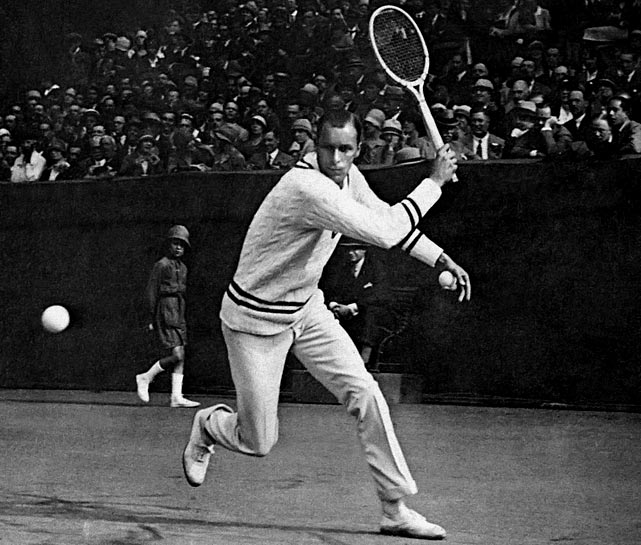
The second, the great Bill Tilden of the US, the best player in the world in the 1920s and winner of 3 Wimbledons and 7 US Opens, was twice jailed after his career had finished for male same-sex encounters (one with a 14 year old sex worker and a second with a 16 year old hitchhiker – their respective ages certainly making this a more complicated case to ‘categorise’).

Bill Tilden. Source: Sports Illustrated.

Bill Tilden. Source: Sports Illustrated.

There have been no openly gay or bisexual male players in the post-Second World War period, and certainly none of any note in the Open era.

Contrast this with the cavalcade of greats from the women’s game known to have been lesbian, bisexual or, at the very least, to have been in same-sex relationships. This includes greats like Helen Jacobs (winner of 5 grand slams); Billie Jean King (12 grand slams), who was famously outed through a ‘palimony’ lawsuit from an ex-partner; Martina Navratilova, winner of 18 slams who voluntarily came out in 1981 early in her career; and Hana Mandlikova, winner of 4 slams (and who, towards the end of her career, became an Australian citizen).

They are joined by some of the best doubles players of the past 30 years as well, including Gigi Fernandez (winner of 17 Grand Slam doubles titles and 2 Olympic gold medals), Lisa Raymond (6 Grand Slam doubles titles) and our own Rennae Stubbs, winner of 4 Grand Slam doubles titles and a 4-time Olympian.

Perhaps the most famous lesbian player of the past 15 years was Amelie Mauresmo, the Frenchwoman who made the Final of the Australian Open in 1999, and ‘came out’ at the same time, acknowledging her girlfriend Sylvie. All that, at 19 years of age (as an aside, it is worth noting that one of the players who, at least early in her career, had a reputation for being mentally fragile on the court, was incredibly strong off it). Mauresmo went on to become world number 1, and won both the Australian Open and Wimbledon Championships later in her career.

Amelie Mauresmo. Source: The Guardian.

Amelie Mauresmo. Source: The Guardian.

In 2013, in a sign of how far the women’s tour has come, Australia’s Casey Dellacqua came out via a short statement announcing the birth of her and her partner Amanda’s son, Blake. About the only consequence of that announcement has been an increase in questions from reporters about how she manages life on tour with a new-born.

It is fair to say that, when a male player does eventually come out, it will provoke a much larger response, from the tennis community, the media and of course the fans. Unlike other sports, this will not necessarily be because men’s tennis is, in an inherently sexist view, deemed more important than the women’s game (because of the wonderful work of people like Billie Jean King, gender inequality is far less in tennis than elsewhere), but simply because the novelty of a men’s tennis player coming out will make it big news.

But why is it novel? Why, when tennis as a sport has shown itself to be at ease with the concept of openly lesbian or bisexual female players, has no male player felt sufficiently at ease to come forward and identify himself? Is there such a fundamental difference between the men’s and women’s tours?

Now, I will preface the rest of this article by saying that I am not an ‘insider’ on the men’s tour, and don’t know of any gay or bisexual male players (nor am I going to play the ‘is he or isn’t he’ game of speculation – sorry). But the following are some reasons which I believe might help explain why a tennis player would choose not to come out (and, where relevant, why that factor might be more relevant for a male player):

Tennis is a truly global sport. In an age of increasing world-wide sporting competition, there are still surprisingly few sports that could be considered truly global – meaning sports that compete on each continent, and draw elite players from each continent. Tennis is one, alongside athletics and soccer and, well, I’m struggling to think of too many others. Possibly not coincidentally, soccer and athletics have also been sports where, male players in particular, have not come out until relatively recently (Robbie Rogers and Thomas Hitzlsperger in the last 18 months finally joining their tragic earlier standard-bearer in football, Justin Fashanu).

With at least 72 countries around the world still criminalising homosexuality (and some of those only criminalising male, rather than female, same-sex sexual intercourse), the threat of having to play in a country where you are considered a criminal must be a relevant consideration. Of course, most players set their own schedules, and none of the Grand Slams or compulsory Masters tournaments are held in countries where homosexuality is criminalised. Even the End of Year Championships, which moves around, hasn’t been held in a city with operative ‘anti-sodomy’ laws since New York in the late 1970s.

However, the Davis Cup (at least until 2018) was held annually in countries all around the world, on a rotating home-and-away basis. This format meant that, in 2013, Australia played ties in Chinese Taipei, Uzbekistan and Poland. Of those, Uzbekistan has laws criminalising male, but not female, homosexuality (by up to 3 years imprisonment). With some countries, like Australia, placing a high emphasis on players representing their country in Davis Cup, this must make it a more difficult calculation to decide whether to come out in tennis, compared to an athlete in a domestic-only sport (for example, Australian rules football).

Elite tennis players earn more ‘off-court’ than on. While tennis prizemoney has increased exponentially since the beginning of the Open era (and probably makes Billie Jean King simultaneously wince, and feel satisfied), the bounty to be had off-court, at least by the very top players, is even greater. For example, Forbes magazine estimated in August 2013 that, over the previous 12 months, Roger Federer earned $71.5million, including ‘only’ $6.5million in prizemoney versus $65million in endorsements.

On the women’s side, 2013’s top earner (and incidentally the highest-paid female athlete in the world at the time) Maria Sharapova earned an estimated $29million, with $6million from prizemoney and $23million in endorsements. For some players, this disparity is even greater – Kei Nishikori earned $10.5million, with ‘just’ $1.5million coming from on-court activities.

The reason is that tennis players are truly marketable commodities, both globally and within each country, or to put it bluntly, ‘market’, especially to consumers with higher average levels of disposable income. For a player to come out, in a world where more than one third of countries criminalise homosexuality, means potentially making themselves unsaleable in a large number of markets.

This consideration is even more acute when you consider that one way in which elite players line their pockets during the off-season is to play exhibition matches, increasingly staged in oil-rich Middle Eastern countries (often with their own laws against homosexuality). It is possible that an openly gay male player’s invitation could get ‘lost in the mail’ in such circumstances.

In short, elite tennis players – or those with an aspiration of being an elite player at some stage in their career (nearly all young players) – may still have a genuine financial incentive to stay in the closet. Again, this would be different from an athlete in a domestic-only sport, whose consideration about off-field sponsorship only depends on the reaction of sponsors within one country, and therefore may feel my able to come out when social attitudes within that country change.

The men’s tour may have a more homophobic culture than the women’s tour. As indicated earlier, I am not a tennis insider, so this is largely speculation. But, from an outsider’s perspective, it certainly seems like there is some evidence to support this assertion. For example, it is difficult to imagine a player on the women’s tour making the following comments, both before and after winning a major championship, and largely getting away with it:

Before the championship, at Queens: “Last year I played well here and played like a faggot at Wimbledon… Better to play like a faggot here and play well at Wimbledon.” And then, after winning: “Then I hit another serve, huge. And that ball was on the line, was not even close. And that guy, he looks like a faggot little bit, you know. This hair all over him. He call it. I couldn’t believe he did it.” Goran Ivanisevic, Wimbledon winner 2001 (and later back on tour as the coach of fellow Croatian Marin Cilic).

Australia’s own Lleyton Hewitt has similar form. In 2005, he finally experienced some reprobation for yelling out “Poof” on court. Years earlier – at the End of Year Championships in Shanghai, 2002 – I remember watching Hewitt shout, on multiple occasions, “Poofter”, when he lost points. The Australian television commentator remarked at the time “I think Hewitt thinks he will get away with this in China” and he pretty much did – despite much larger previous backlashes when he made remarks based on disability and race.

Contrast this with the reaction of one of the then youngest players on tour, the UK’s Laura Robson, who in a dignified yet steadfast manner supported the ‘rainbow’-coloured protests in 2012 following comments by notorious homophobe, and one-time tennis player, Margaret Court*. From memory, no male players joined that protest – and I doubt many would if similar circumstances arose today.

On the flipside, there are some reasons why, theoretically at least, it should be easier for a tennis player to come out than athletes in other sports.

First, competitive tennis is largely an individual sport. Yes, there is doubles, but finding an open-minded playing partner must surely be more likely than expecting every single member of a football team to be supportive. Indeed, the women’s doubles greats, listed above, and including Martina Navratilova, never seemed to encounter too much of a problem recruiting partners (although that might also be because they were so good that the promise of winning would overcome most obstacles). And, while there are some teams competitions throughout the year (most importantly Davis Cup for men and Federation Cup for women), these are only for short time periods, with many elite players opting out of them from time to time.

In my opinion, tennis is such an individual sport that it is almost individualist – in that it encourages, and has a long history of, strong characters breaking out of any box that seeks to capture them, and doing things their own way, both on court and off (see: McEnroe, John; Connors, Jimmy). It doesn’t seem outrageous to think that a gay male player could similarly have struck out on their own, saying “That’s how I play, this is who I am, deal with it.”

A second factor making it potentially easier for a gay or bisexual male player to come out now is the rapidly ageing nature of the men’s tour. Contrary to earlier generations, the average age of the men’s top 10 is now more than 30 years old (as at the end of 2018).  Indeed, only two players in the top 10 are younger than 29: Alexander Zverev at 21 years and 8 months, and Dominic Thiem at 25 years and 3 months.

Further, while there are currently a number of exciting young players inside the top 100, or just outside (Stefanos Tsitsipas, Denis Shapovalov, Felix Auger-Aliassime, Alex De Minaur, Frances Tiafoe, Taylor Fritz, Reilly Opelka, Casper Ruud, Andrey Rublev, Miomir Kecmanovic, Ugo Humbert, Alexei Popyrin, Corentin Moutet and Alejandro Davidovich Fokina), all of them are already older than both Boris Becker when he won Wimbledon and Michael Chang when he won the French Open.

An ageing tour should help because it is probably not reasonable to expect everyone to ‘do a Mauresmo’ and come out at age 19 (heck, I was nervous enough telling my family at that age, let alone the whole world). But it is reasonable to think that, as players mature during their 20s, and even play on until their early to mid 30s, at least one, and possibly more, might eventually feel comfortable enough to disclose their sexual orientation while still playing.

A third reason why a gay or bisexual male player should find it somewhat easier to come out today is that so many women have already done so. Players like Mauresmo, and Navratilova, and Raymond and Dellacqua (and recently Alison Van Uytvanck), have all shown that it is possible to disclose one’s sexuality and remain active through the week-in, week-out grind of the tennis tour.

Of course, in doing so, they have had to overcome the very same barriers I outlined earlier. They have all had to negotiate the vagaries of the global tour, and decide whether to play in countries with higher levels of homophobia, including places where female same-sex sexual activity is banned.

And they have had to confront a very real, and demonstrated, loss of sponsorship. Billie Jean King’s endorsements basically dried up the day after she was so publicly outed. Martina Navratilova probably earned an order of magnitude less off-court than she would have had she not revealed who she was. Even Amelie Mauresmo likely lost out financially, potentially millions of Euros, because of her courage at age 19.

Martina Navratilova. Winner on-court, missed out on endorsements off-court. Source: The Guardian.

Martina Navratilova. Winner on-court, missed out on endorsements off-court. Source: The Guardian.

Bisexual female and lesbian tennis players have also had to overcome homophobia on the tour. Mauresmo had to withstand not-very-subtle ‘plays like a man’ critiques in 1999 from other players like Martina Hingis and, in a lapse of judgment, Lindsay Davenport. But, and this is the important part, both were forced to apologise. In that same year, US player Alexandra Stevenson’s mother commented during Wimbledon that her daughter needed to be protected from “lesbians in the locker-room”. This time around, Davenport was on the right side of the debate, and called the comments out as bizarre and ignorant.

In short, the very existence of openly lesbian players has brought forward the arguments around homosexuality, on court and in the stands, and those arguments have been won – at least on the women’s tour. King, and Navratilova, and Mauresmo, and others, have had to fight these battles, and have eventually emerged victorious, together with the help of allies (some of whom themselves needed to be educated).

Which brings me to my almost prosaic conclusion: no gay or bisexual male player has come out in the open era because none have chosen to take on that fight. For whatever reason, as individuals – not just tennis players, but humans – each man has decided that taking on that battle, with at least some attendant personal cost, is not in their own interest. That is an understandable conclusion for an individual to arrive at, separately.

Even so, as each year brings more players onto the tour, it brings us closer to the point where a player (or multiple players) will look at those same factors, and reach the opposite view. Surely we cannot be too many years away from a male tennis player casually talking about his boyfriend in a post-match interview, releasing a statement that he and his husband have had a child together, or even going to the Wimbledon Winners’ Ball together (which would be a pretty awesome way to come out, come to think of it).

Casey Dellacqua. Where is out male equivalent? Source: Sydney Morning Herald

Casey Dellacqua. Where is our male equivalent? Source: Sydney Morning Herald

For this tennis-mad LGBTI activist, I hope that day is not too far away. Not just because it would add to the already long list of same-sex attracted tennis players to look up to but, if Australian singles players continue to under-perform at home as they have done in the recent past, having an openly gay or bisexual male player might give me someone to barrack for in the second week of the next Australian Open.


UPDATE 18 January 2016:

With this year’s Australian Open starting today, I thought I would take a look back on this post, to see what has changed during the past two years. The answer is: lots, and not very much at the same time.

Australian tennis has rediscovered what it is like to have players reach the Australian Open quarter-finals, with Nick Kyrgios achieving the feat last year (2015), and he and Bernard Tomic possibilities to do so again this year and into the future.

Amelie Mauresmo continues to break down barriers, this time as coach, since June 2014, of men’s world number 2 Andy Murray.

The ‘ageing’ trend amongst the male tour might finally be on the cusp of slowing down, and eventually reversing. While the upper echelon remains, for now at least, older than any generation in memory (the only player under the age of 28 inside the current top ten is Kei Nishikori, and even he is 26), there is a large group of new young players who appear of the cusp of breaking through.

Nick Kyrgios (ranked 30) and Thanasi Kokkinakis (ranked 86) have youthful company inside the top 100 with Borna Coric, Hyeon Chung and Alexander Zverev (currently ranked 40, 51 and 83 respectively), and look likely to be joined by Karen Khachanov, too.

While I wrote in the original post that older players might stand more chance of coming out on their own terms, it is also possible that this new generation of players will shake things up in more ways than just their on-court play.

The past few years have also seen an acceleration of the welcome trend for currently-active male professional athletes to come out as either gay or bisexual. Most prominently Michael Sam came out as gay just two weeks after my original post, with Jason Collins also becoming the first openly gay man to play in the NBA that same month (having come out publicly the previous year). They have been joined by male athletes across a wide range of sports, including New Zealand Olympic rower Robbie Manson and US Winter Olympic freestyle skier silver medallist Gus Kenworthy, among others.

Of course, one thing that hasn’t changed is that there remains no out gay or bisexual male tennis players. That is a fact that still astounds me. I had thought, when writing the original post, that it was only a matter of months, or potentially just a year or two, before a player would finally break down that particular closet door.

Perhaps the culture of the men’s tennis tour is more homophobic than it appears from the outside. Perhaps there are other factors that have not been identified or considered. We probably won’t know for sure until a male player does finally come out (and even then only if they choose to discuss such things). In the meantime, the wait for an openly gay or bisexual male tennis player continues.


*It is an extraordinary, and extraordinarily awful, achievement that someone who has won 24 Grand Slam singles titles could, through years of expressing hateful and discriminatory comments, be better known as a bigot than a former champion.

Letter to Minister Pyne re Health & Physical Education Curriculum and Appointment of Mr Kevin Donnelly

UPDATE (Saturday 8 February): This week, I received a reply from Minister Pyne to my letter to him, on 11 January (see below), in which I requested that he sack Mr Kevin Donnelly from the national curriculum review because his homophobia made him unsuitable to be involved in any review of a Health & Physical Education curriculum.

In a somewhat unsurprising, but nevertheless extremely disappointing, response, Minister Pyne did not address any of the comments made by Mr Donnelly, nor deal with the problem that through his comments Mr Donnelly appears to be unable to oversee a HPE curriculum that serves the needs of all students, including lesbian, gay, bisexual, trans* and intersex (LGBTI) students.

So, while the issue of Mr Donnelly’s homophobia has received welcome public scrutiny, especially over the course of the past week, it seems Minister Pyne doesn’t really care about it – certainly not enough to actually respond to concerns which are put directly to him.

Which, sadly, makes me even more fearful of what the final HPE document will look like when it is released later in 2014.

Full text of Minister Pyne’s letter:

Dear Mr Lawrie

Thank you for your email of 11 January 2014 regarding the review of the Australian Curriculum.

As the Minister for Education, I am focussed on improving schools and student outcomes through proven policies and initiatives. Under our Students First approach, the Coalition Government is working with the states and territories on the priority areas of teacher quality, principal autonomy, parental engagement and strengthening our curriculum.

Over the past ten years, education outcomes in Australia have gone backwards, both relatively against other countries, but also in real terms. Some have identified that the reason for this is due to our curriculum not being robust enough.

I appointed Professor Ken Wiltshire AO and Dr Kevin Donnelly to review the curriculum to evaluate its robustness, impartiality and balance. Between them, Professor Wiltshire and Dr Donnelly have a tremendous amount of experience in not only the school education sector, but also in education curricula. I am confident that their considerable expertise will allow them to bring a balanced approach to this review process.

The reviewers are interested in hearing the views of parents and communities, educators and schools, and state and territory governments, to inform their analysis. This is an open public consultation process where the community are able to have their say.

I appreciate you taking the time to contact me to express your views. I encourage you to make a submission to the review. Comments will be accepted until Friday 28 February 2014. Information can be found at http://www.studentsfirst.gov.au/review-australian-curriculum.

Yours sincerely

Christopher Pyne MP

29 January 2014

ORIGINAL POST 11 January: Dear Minister Pyne

LGBTI INCLUSION IN NATIONAL HEALTH & PHYSICAL EDUCATION CURRICULUM AND APPOINTMENT OF MR KEVIN DONNELLY TO CURRICULUM REVIEW

I wrote to you in September 2013, following your appointment as Commonwealth Minister for Education, regarding the development of the National Health & Physical Education (HPE) curriculum by the Australian Curriculum, Assessment and Reporting Authority (ACARA).

In that letter, I raised serious concerns about the draft HPE curriculum, including both the initial draft released in December 2012, and revised draft, released in mid-2013, specifically:

  • That the draft HPE curriculum failed to include lesbian, gay, bisexual, transgender and intersex (LGBTI) students, and content relevant to their needs;
  • That the sexual health information provided in the draft HPE curriculum was grossly insufficient; and
  • That the draft HPE curriculum was inadequate because it failed to even mention HIV, or other blood borne viruses (like hepatitis B and C), let alone ensuring students received the vital education necessary to reduce future transmissions.

I note that, since that letter, the COAG Standing Council on School Education and Early Childhood (SCSEEC) met in Sydney on 29 November 2013. Significantly, that meeting did not endorse the draft HPE curriculum, but instead it was only ‘noted’. From the communiqué:

“The Standing Council today noted that ACARA has developed the Australian Curriculum content and achievement standards for … health and physical education … according to its current curriculum development processes.

Ministers noted that the Australian Government will be undertaking a review of the Australian Curriculum, and will bring forward recommendations from the review to the Standing Council in 2014.”

This means that there should be the opportunity for the Health & Physical Education curriculum to be improved as part of the overall review. In particular, there is now time for the HPE curriculum to be amended to specifically include LGBTI students and content, increased sexual health information and education about HIV and other BBVs.

Unfortunately, following your announcement yesterday, Friday 10 January 2014, of the two people entrusted with reviewing the curriculum, I have serious doubts that any improvements are now possible. Indeed, I am concerned that whatever amendments are made to the HPE curriculum will be entirely negative ones, and further contribute to the exclusion and marginalisation of LGBTI students in Australia.

This is because one of the people you have appointed, Mr Kevin Donnelly, has made sustained negative comments about the education needs of LGBTI students over the past decade.

For example, in 2004 Mr Donnelly is reported as saying that “[v]ery few parents would expect that it is the role of schools to teach children about the positive aspects of gay, lesbian and transgender sex lifestyles” and that “[f]orgotten is that many parents would consider the sexual practices of gays, lesbians and transgender individuals decidedly unnatural and that such groups have a greater risk in terms of transmitting STDs and AIDS” (source: Sydney Morning Herald, 3 May 2004, “Government staffer says new-age warriors waging culture wars in class”).

Mr Donnelly returned to similar themes the following year, criticising the Australian Education Union for arguing that “school curricula should “enhance understanding and acceptance of gay, lesbian, bisexual and transgender people.”” He went on to write “[f]orgotten is that many parents would consider the sexual practices of GLBT people unnatural and that most parents would prefer their children to form a relationship with somebody of the opposite sex. This is apart from the fact that many parents expect that it is their duty, not that of teachers and schools, to teach such sensitive matters” (source: News Weekly, 26 March 2005, “Teacher Unions Enforcing the Gender Agenda”).

In the same article, he wrote “it is also wrong to introduce students to sensitive sexual matters about which most parents might be concerned and that the wider community might fine unacceptable” in response to a lesbian teacher simply telling her students of her relationship.

Mr Donnelly’s views are not confined to last decade, either. In an article published on The Drum website on 6 December 2011 (“Marriage Equality: Secrets of a Successful Campaign”), he wrote:

“Such has been the cultural-left’s success in relation to gender issues that the so-called Melbourne Declaration, the blue print for Australian school education, argues that all school sectors, faith based, independent and government, must provide an education free of discrimination based on gender and sexual orientation.

A strict interpretation of the Melbourne Declaration is that religious schools will lose the freedom they currently have to discriminate in relation to who they enrol and who they employ. One also expects that the proposed national curriculum, in areas like health, will enforce a positive view of GLBT issues.”

Implicit in these comments is that private/religious schools should be able to discriminate against LGBTI students and teachers, and that the national curriculum need not include a positive approach to ‘GLBT issues’.

In short, over the past decade, Mr Donnelly has repeatedly argued against positive representations of LGBTI students and issues, has argued that same-sex relationships are ‘sensitive matters’ that should not be referred to in schools, and has on multiple occasions repeated the view, without condemnation, that “many parents would consider the sexual practices of GLBT people (decidedly) unnatural”.

As part of his role in reviewing the broader national curriculum, Mr Donnelly will have responsibility for reviewing the draft national HPE curriculum. Based on his public comments of the past decade, he is eminently unsuitable for this position. In my view, Mr Donnelly has amply demonstrated that he is incapable of reviewing, and redrafting, a national Health and Physical Education curriculum that meets the needs of all Australian students, not simply those who are cis-gender and heterosexual.

Given this evidence, the responsible course of action for you to take, as Commonwealth Minister for Education, would be to terminate his appointment. I urge you to do so.

Irrespective of what decision you take in relation to Mr Donnelly’s specific role, your announcement of the broader curriculum review on 10 January has confirmed that it is now your responsibility to ensure that the final Health and Physical Education curriculum is genuinely inclusive, and meets the needs of all students, including LGBTI students. This is a serious burden, and one that I sincerely hope you give serious attention to during 2014.

Thank you in advance for your consideration of the matters raised in this letter. I look forward to your reply.

Yours sincerely,

Alastair Lawrie

No 1 Australia Sends LGBTI Refugees to Countries which Criminalise Homosexuality

I wish that I could have finished this countdown with something more positive. Indeed, I was tempted to elevate the achievement of the Sex Discrimination Amendment Act 2013 to No 1, just so I could end on a high note.

Alas, Australia’s ongoing mistreatment of refugees, including the gross violation of their human rights, is simply too heinous to ignore, and too severe to downplay. And in 2013, these abuses reached a new low, with the then Rudd Government introducing, and the incoming Abbott Government retaining, a new policy to permanently resettle refugees who arrive by boat in Nauru and on Manus Island in Papua New Guinea.

More than just a fundamental breach of Australia’s international obligations, this policy is an attempt to permanently turn our backs to the humanity of people fleeing persecution in other countries, people who were seeking our compassion but, when they arrived, found none.

All of this is bad enough to attract the opprobrium of anyone interested in human rights, including LGBTI rights. But there is a special reason for LGBTI activists and advocates to oppose the resettlement of refugees in Nauru and Papua New Guinea – and that is that both countries continue to criminalise male homosexuality, by up to 14 years imprisonment.

While the letter of the law only applies to male homosexuality, any place which criminalises sex between people of the same-sex is not a safe environment to send refugees who are lesbian, gay, bisexual, transgender or intersex. The potential dangers of doing so were apparent when the then Gillard Government first announced that Nauru and Manus Island were to be re-opened as ‘offshore processing centres’ in mid-2012.

At the time I wrote to the Immigration Minister, Chris Bowen, asking him whether the Government supported the rights of LGBTI asylum-seekers, and whether they could guarantee that the laws criminalising homosexuality would not be applied to the people we sent there (original letter: https://alastairlawrie.net/2012/09/07/letter-to-chris-bowen-on-lgbti-asylum-seekers/). A similar letter was sent to then Opposition Immigration Spokesperson Scott Morrison.

It took almost ten months, and some harassment, for the Government to reply, and when they finally did, in June 2013, they did not answer the question – effectively conceding that the criminal laws of Nauru and Papua New Guinea do apply to LGBTI refugees we send there (response here: https://alastairlawrie.net/2013/06/30/lgbti-refugees-on-nauru-manus-island/).

In a sign of things to come, Mr Morrison never replied. All of which meant that I was completely unsurprised by the Amnesty International Report “This is Breaking People”, released on 11 December 2013, which spelled out just how awful the consequences of this policy are for LGBTI asylum seekers (report here: http://www.amnesty.org/en/library/asset/ASA12/002/2013/en/b2f135dc-3353-420d-b587-05d2b3db6e2f/asa120022013en.pdf see especially discussion on pages 73-75).

But just because I am unsurprised, does not mean I am not outraged – and you should be too. In short, gay refugees sent to Manus Island are:

  • Told that same-sex sexual activities are prohibited
  • Told that, if they engage in same-sex sexual activities, they will be reported to PNG Police (despite there being no legal onus for the operators to do so)
  • NOT provided with condoms (and with safe-sex education comprising a talk telling them not to have sex) and
  • Subject to bullying and harassment from other detainees on the basis of their sexual orientation.

In such circumstances, it is even less surprising that the senior Australian Government official at the camp, Renate Croker, said she was unaware of any person claiming asylum on the basis of persecution due to their LGBTI status.

Not only is this apparently incorrect – with Amnesty International interviewing several gay male asylum-seekers, including at least one quoted as saying he had made a claim on that basis – it also ignores the fact that people can be LGBTI but claim asylum because of persecution on other grounds (eg race, religion).

Indeed, one of the refugees interviewed claimed that other people have considered changing and/or changed their applications to be refer to other grounds, rather than be exposed to further bullying or harassment inside the camp, as well as to minimise the threat of being reported to PNG Police. He further “explained that some gay men have chosen to return to their home countries with IOM [International Organization for Migration]’s assistance, despite the risks they face upon return.”

All of which made the comments of Minister Morrison in response to the report all the more chilling. The following excerpt is taken from Oliver Laughland’s excellent article in the Guardian Australia on 13 December (titled Scott Morrison denies Amnesty report findings on Manus island detention):

Morrison said this [automatic reporting to PNG Police] was not the policy of the government but added all asylum seekers on Manus were provided with “clear advice” on “relevant laws” in Papua New Guinea. Homosexuality is illegal in PNG and can carry a 14-year sentence. Morrison was asked repeatedly by Guardian Australia if the “relevant laws” included those relating to homosexuality but he declined to go into detail, adding: “In these press conferences you get to ask the questions, you don’t get to give the responses as well.” Morrison added that the department was “unaware of any claims or declarations of homosexuality or of any reports of homosexuality being investigated by the police at the centre”. [full article here: http://www.theguardian.com/world/2013/dec/13/scott-morrison-denies-amnesty-report-findings-on-manus-island-detention).

In short, our current Immigration Minister has all-but confirmed that PNG laws criminalising homosexuality apply to LGBTI refugees sent there, as well as expressing a clear lack of understanding about the nature of sexual orientation, homophobia and the reasons why LGBTI refugees might not want to make a ‘declaration’, including but not limited to the risk of criminal punishment.

All-in-all, the situation confronting LGBTI refugees sent to Manus Island, and by extension, Nauru, is a nightmare. But it cannot be divorced from the broader nightmare that is Australia’s bipartisan ‘Pacific Solution Mark II’. The fact that we are sending any refugees to be processed, and permanently resettled, on Nauru and in PNG is a massive failure of our political system, and of the Australian people for allowing it to happen, for it to be done in our name.

Tragically, as 2013 draws to a close, it is unclear how any of this is going to change. I would like to be able to end this article, and this countdown, by saying something like “Here’s hoping in 2014 we take the first steps towards a humane refugee assessment system.” But the pessimist in me, reflecting on all of the events of the past 12 to 18 months, wants to say instead “Please just don’t let it become any worse”.