Letter to Minister Piccoli re Proud Schools

UPDATE (Saturday 8 February): Yesterday, I received a response from the NSW Government to my letter about Proud Schools (below). It was not from the Minister, but rather from the Executive Director, Learning and Engagement, in the Department of Education and Communities.

In short, it appears that the NSW Government has completed its review of Proud Schools and on that basis has decided to abandon the Proud Schools pilot/model. Unfortunately, it does not appear as if the review of the Proud Schools pilot is going to be released.

Equally concerning, while the response talks about a “Wellbeing Framework for Education”, there appears to be very little detail about what this might entail. Given the homophobia, biphobia, transphobia and anti-intersex discrimination which continues to affect LGBTI students (a fact reinforced by the Growing Up Queer report, released yesterday), there will need to be a lot more information provided about this framework before it could be supported.

As an aside, I find it curious that in a letter about Proud Schools, and replying to a letter about Proud Schools/the needs of LGBTI students, the response does not refer to LGBTI students specifically, instead making generic statements about ‘all students’. Hmmm…

The full text of the letter:

Dear Mr Lawrie

I write in response to your email of 12 January 2014 to the Hon Adrian Piccoli MP, Minister for Education regarding the Proud Schools pilot. The Minister has asked me to respond on his behalf.

The Department of Education and Communities is committed to providing safe and supportive learning environments that respect and value diversity and that are free from all forms of violence, bullying, discrimination, harassment and vilification.

We know that learning outcomes are better where students are happy, safe and supported at school. We also know that when school communities work together real improvements in promoting understanding and reducing discrimination can be made.

From the Proud Schools pilot it has emerged that a ‘one size fits all’ approach will not be appropriate for a systemic school system.

Significant work is currently underway on developing a Wellbeing Framework for Education. This framework will provide schools with guidance and evidence informed practice to support all students within the context of their school and in consultation with their school communities. The subsequent development of any wellbeing materials will need to carefully balance the wellbeing of all young people.

Thank you for your email.

Yours sincerely

[NAME WITHHELD]

Executive Director, Learning and Engagement

5 February 2014

ORIGINAL POST Today (Tuesday 28 January) is the first official day of the school year for teachers across NSW. Tomorrow, students return to school for the first time in 2014. And yet, with teachers and students coming back, it is still unclear whether something else is returning to NSW schools this year – the Proud Schools program.

A three-year pilot of Proud Schools – which is designed to help schools include LGBTI students, and protect them from bullying – was due to be completed at the end of 2013. The pilot project was also subject to a formal review last year, to help determine whether it should be expanded, and if so in what form.

But, as far as I can tell, this review has not yet been released, and no announcement appears to have been made about the future of the Proud Schools program. Is the Proud Schools pilot being extended? Is the program being rolled out beyond the initial very small number of schools in which is began? Has Proud Schools been axed? If so, has it been replaced with another program aimed at serving the needs of LGBTI students in NSW?

Concerned about the lack of information, I wrote to the NSW Minister for Education, the Hon Adrian Piccoli, about this subject two weeks ago. Below is my letter to him (dated 12 January). I have yet to receive a response to this, but will update this post if I do.

Dear Minister

PROUD SCHOOLS/PROGRAMS FOR LGBTI STUDENTS

I am writing regarding the Proud Schools program, which has been piloted across a small number of NSW schools over the past three years (2011-2013).

I understand that the Proud Schools pilot was the subject of a review by the NSW Government during 2013, and that, following this review, the NSW Government was to make a decision about the long-term future of Proud Schools.

Has this review been finalised? If so, has a decision been taken by the NSW Government concerning the future of the Proud Schools program? If so, when will this decision, and the review upon which it was based, be made public?

I write because there are only two weeks left until the 2014 school year commences, and believe that it is important for schools, teachers and LGBTI students to have some certainty about the future of this program.

Even if the NSW Government decides not to continue with the specific Proud Schools initiative, it is vital that a program which supports the needs of LGBTI students is rolled out across NSW schools, not just in the small number that were involved in Proud Schools, but across the entire state.

This is because LGBTI students are subject to increased levels of bullying and harassment based on homophobia, bi-phobia, trans*-phobia and anti-intersex prejudice, experience higher rates of mental illness as a result of this discrimination, and are at risk of not receiving education that is inclusive of their needs.

I seek your assurance that you are giving this issue priority, and will have a program in place in NSW schools from the beginning of the 2014 school year.

I look forward to your response to this letter.

Yours sincerely

Alastair Lawrie

In search of the elusive gay or bisexual male tennis player

As we enter the second week of the Australian Open, it is time, for yet another year, to call off the search party for that rare beast, the Australian singles quarter-finalist. Not seen since 2009, this critically-endangered animal is quickly going the way of its relative, the Australian winner, not seen since 1976 (male) and 1978 (female) respectively, and now presumed extinct.

But, believe it or not, there is at least one creature in tennis which is even rarer, indeed almost mythical – the openly gay or bisexual male tennis player.

In the long history of this genteel sport, there have been only two male tennis players of note who have been linked to homo- or bi-sexuality, and both had tragic personal stories. The first, 1930s German world number 1 and dual French Open winner, Gottfried Von Cramm, was jailed for 6 months by the Nazi regime for ‘morals charges’, as the result of an affair with another man.

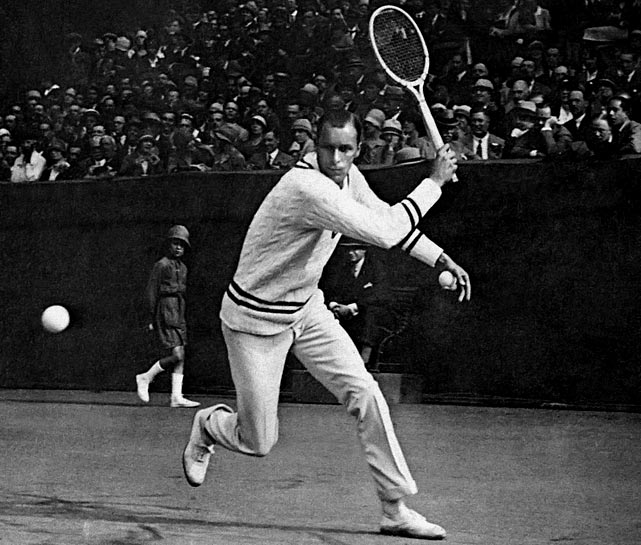
The second, the great Bill Tilden of the US, the best player in the world in the 1920s and winner of 3 Wimbledons and 7 US Opens, was twice jailed after his career had finished for male same-sex encounters (one with a 14 year old sex worker and a second with a 16 year old hitchhiker – their respective ages certainly making this a more complicated case to ‘categorise’).
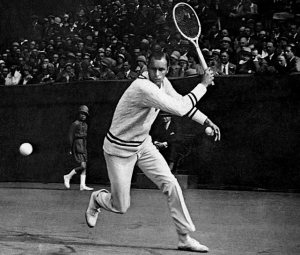
Bill Tilden. Source: Sports Illustrated.

Bill Tilden. Source: Sports Illustrated.

There have been no openly gay or bisexual male players in the post-Second World War period, and certainly none of any note in the Open era.

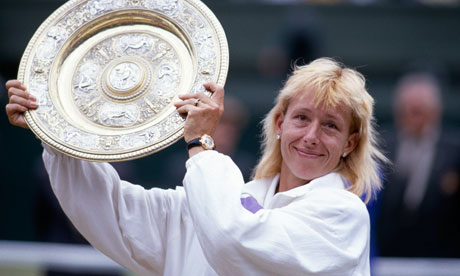
Contrast this with the cavalcade of greats from the women’s game known to have been lesbian, bisexual or, at the very least, to have been in same-sex relationships. This includes greats like Helen Jacobs (winner of 5 grand slams); Billie Jean King (12 grand slams), who was famously outed through a ‘palimony’ lawsuit from an ex-partner; Martina Navratilova, winner of 18 slams who voluntarily came out in 1981 early in her career; and Hana Mandlikova, winner of 4 slams (and who, towards the end of her career, became an Australian citizen).

They are joined by some of the best doubles players of the past 30 years as well, including Gigi Fernandez (winner of 17 Grand Slam doubles titles and 2 Olympic gold medals), Lisa Raymond (6 Grand Slam doubles titles) and our own Rennae Stubbs, winner of 4 Grand Slam doubles titles and a 4-time Olympian.

Perhaps the most famous lesbian player of the past 15 years was Amelie Mauresmo, the Frenchwoman who made the Final of the Australian Open in 1999, and ‘came out’ at the same time, acknowledging her girlfriend Sylvie. All that, at 19 years of age (as an aside, it is worth noting that one of the players who, at least early in her career, had a reputation for being mentally fragile on the court, was incredibly strong off it). Mauresmo went on to become world number 1, and won both the Australian Open and Wimbledon Championships later in her career.

Amelie Mauresmo. Source: The Guardian.

Amelie Mauresmo. Source: The Guardian.

In 2013, in a sign of how far the women’s tour has come, Australia’s Casey Dellacqua came out via a short statement announcing the birth of her and her partner Amanda’s son, Blake. About the only consequence of that announcement has been an increase in questions from reporters about how she manages life on tour with a new-born.

It is fair to say that, when a male player does eventually come out, it will provoke a much larger response, from the tennis community, the media and of course the fans. Unlike other sports, this will not necessarily be because men’s tennis is, in an inherently sexist view, deemed more important than the women’s game (because of the wonderful work of people like Billie Jean King, gender inequality is far less in tennis than elsewhere), but simply because the novelty of a men’s tennis player coming out will make it big news.

But why is it novel? Why, when tennis as a sport has shown itself to be at ease with the concept of openly lesbian or bisexual female players, has no male player felt sufficiently at ease to come forward and identify himself? Is there such a fundamental difference between the men’s and women’s tours?

Now, I will preface the rest of this article by saying that I am not an ‘insider’ on the men’s tour, and don’t know of any gay or bisexual male players (nor am I going to play the ‘is he or isn’t he’ game of speculation – sorry). But the following are some reasons which I believe might help explain why a tennis player would choose not to come out (and, where relevant, why that factor might be more relevant for a male player):

Tennis is a truly global sport. In an age of increasing world-wide sporting competition, there are still surprisingly few sports that could be considered truly global – meaning sports that compete on each continent, and draw elite players from each continent. Tennis is one, alongside athletics and soccer and, well, I’m struggling to think of too many others. Possibly not coincidentally, soccer and athletics have also been sports where, male players in particular, have not come out until relatively recently (Robbie Rogers and Thomas Hitzlsperger in the last 18 months finally joining their tragic earlier standard-bearer in football, Justin Fashanu).

With at least 72 countries around the world still criminalising homosexuality (and some of those only criminalising male, rather than female, same-sex sexual intercourse), the threat of having to play in a country where you are considered a criminal must be a relevant consideration. Of course, most players set their own schedules, and none of the Grand Slams or compulsory Masters tournaments are held in countries where homosexuality is criminalised. Even the End of Year Championships, which moves around, hasn’t been held in a city with operative ‘anti-sodomy’ laws since New York in the late 1970s.

However, the Davis Cup (at least until 2018) was held annually in countries all around the world, on a rotating home-and-away basis. This format meant that, in 2013, Australia played ties in Chinese Taipei, Uzbekistan and Poland. Of those, Uzbekistan has laws criminalising male, but not female, homosexuality (by up to 3 years imprisonment). With some countries, like Australia, placing a high emphasis on players representing their country in Davis Cup, this must make it a more difficult calculation to decide whether to come out in tennis, compared to an athlete in a domestic-only sport (for example, Australian rules football).

Elite tennis players earn more ‘off-court’ than on. While tennis prizemoney has increased exponentially since the beginning of the Open era (and probably makes Billie Jean King simultaneously wince, and feel satisfied), the bounty to be had off-court, at least by the very top players, is even greater. For example, Forbes magazine estimated in August 2013 that, over the previous 12 months, Roger Federer earned $71.5million, including ‘only’ $6.5million in prizemoney versus $65million in endorsements.

On the women’s side, 2013’s top earner (and incidentally the highest-paid female athlete in the world at the time) Maria Sharapova earned an estimated $29million, with $6million from prizemoney and $23million in endorsements. For some players, this disparity is even greater – Kei Nishikori earned $10.5million, with ‘just’ $1.5million coming from on-court activities.

The reason is that tennis players are truly marketable commodities, both globally and within each country, or to put it bluntly, ‘market’, especially to consumers with higher average levels of disposable income. For a player to come out, in a world where more than one third of countries criminalise homosexuality, means potentially making themselves unsaleable in a large number of markets.

This consideration is even more acute when you consider that one way in which elite players line their pockets during the off-season is to play exhibition matches, increasingly staged in oil-rich Middle Eastern countries (often with their own laws against homosexuality). It is possible that an openly gay male player’s invitation could get ‘lost in the mail’ in such circumstances.

In short, elite tennis players – or those with an aspiration of being an elite player at some stage in their career (nearly all young players) – may still have a genuine financial incentive to stay in the closet. Again, this would be different from an athlete in a domestic-only sport, whose consideration about off-field sponsorship only depends on the reaction of sponsors within one country, and therefore may feel my able to come out when social attitudes within that country change.

The men’s tour may have a more homophobic culture than the women’s tour. As indicated earlier, I am not a tennis insider, so this is largely speculation. But, from an outsider’s perspective, it certainly seems like there is some evidence to support this assertion. For example, it is difficult to imagine a player on the women’s tour making the following comments, both before and after winning a major championship, and largely getting away with it:

Before the championship, at Queens: “Last year I played well here and played like a faggot at Wimbledon… Better to play like a faggot here and play well at Wimbledon.” And then, after winning: “Then I hit another serve, huge. And that ball was on the line, was not even close. And that guy, he looks like a faggot little bit, you know. This hair all over him. He call it. I couldn’t believe he did it.” Goran Ivanisevic, Wimbledon winner 2001 (and later back on tour as the coach of fellow Croatian Marin Cilic).

Australia’s own Lleyton Hewitt has similar form. In 2005, he finally experienced some reprobation for yelling out “Poof” on court. Years earlier – at the End of Year Championships in Shanghai, 2002 – I remember watching Hewitt shout, on multiple occasions, “Poofter”, when he lost points. The Australian television commentator remarked at the time “I think Hewitt thinks he will get away with this in China” and he pretty much did – despite much larger previous backlashes when he made remarks based on disability and race.

Contrast this with the reaction of one of the then youngest players on tour, the UK’s Laura Robson, who in a dignified yet steadfast manner supported the ‘rainbow’-coloured protests in 2012 following comments by notorious homophobe, and one-time tennis player, Margaret Court*. From memory, no male players joined that protest – and I doubt many would if similar circumstances arose today.

On the flipside, there are some reasons why, theoretically at least, it should be easier for a tennis player to come out than athletes in other sports.

First, competitive tennis is largely an individual sport. Yes, there is doubles, but finding an open-minded playing partner must surely be more likely than expecting every single member of a football team to be supportive. Indeed, the women’s doubles greats, listed above, and including Martina Navratilova, never seemed to encounter too much of a problem recruiting partners (although that might also be because they were so good that the promise of winning would overcome most obstacles). And, while there are some teams competitions throughout the year (most importantly Davis Cup for men and Federation Cup for women), these are only for short time periods, with many elite players opting out of them from time to time.

In my opinion, tennis is such an individual sport that it is almost individualist – in that it encourages, and has a long history of, strong characters breaking out of any box that seeks to capture them, and doing things their own way, both on court and off (see: McEnroe, John; Connors, Jimmy). It doesn’t seem outrageous to think that a gay male player could similarly have struck out on their own, saying “That’s how I play, this is who I am, deal with it.”

A second factor making it potentially easier for a gay or bisexual male player to come out now is the rapidly ageing nature of the men’s tour. Contrary to earlier generations, the average age of the men’s top 10 is now more than 30 years old (as at the end of 2018).  Indeed, only two players in the top 10 are younger than 29: Alexander Zverev at 21 years and 8 months, and Dominic Thiem at 25 years and 3 months.

Further, while there are currently a number of exciting young players inside the top 100, or just outside (Stefanos Tsitsipas, Denis Shapovalov, Felix Auger-Aliassime, Alex De Minaur, Frances Tiafoe, Taylor Fritz, Reilly Opelka, Casper Ruud, Andrey Rublev, Miomir Kecmanovic, Ugo Humbert, Alexei Popyrin, Corentin Moutet and Alejandro Davidovich Fokina), all of them are already older than both Boris Becker when he won Wimbledon and Michael Chang when he won the French Open.

An ageing tour should help because it is probably not reasonable to expect everyone to ‘do a Mauresmo’ and come out at age 19 (heck, I was nervous enough telling my family at that age, let alone the whole world). But it is reasonable to think that, as players mature during their 20s, and even play on until their early to mid 30s, at least one, and possibly more, might eventually feel comfortable enough to disclose their sexual orientation while still playing.

A third reason why a gay or bisexual male player should find it somewhat easier to come out today is that so many women have already done so. Players like Mauresmo, and Navratilova, and Raymond and Dellacqua (and recently Alison Van Uytvanck), have all shown that it is possible to disclose one’s sexuality and remain active through the week-in, week-out grind of the tennis tour.

Of course, in doing so, they have had to overcome the very same barriers I outlined earlier. They have all had to negotiate the vagaries of the global tour, and decide whether to play in countries with higher levels of homophobia, including places where female same-sex sexual activity is banned.

And they have had to confront a very real, and demonstrated, loss of sponsorship. Billie Jean King’s endorsements basically dried up the day after she was so publicly outed. Martina Navratilova probably earned an order of magnitude less off-court than she would have had she not revealed who she was. Even Amelie Mauresmo likely lost out financially, potentially millions of Euros, because of her courage at age 19.

Martina Navratilova. Winner on-court, missed out on endorsements off-court. Source: The Guardian.

Martina Navratilova. Winner on-court, missed out on endorsements off-court. Source: The Guardian.

Bisexual female and lesbian tennis players have also had to overcome homophobia on the tour. Mauresmo had to withstand not-very-subtle ‘plays like a man’ critiques in 1999 from other players like Martina Hingis and, in a lapse of judgment, Lindsay Davenport. But, and this is the important part, both were forced to apologise. In that same year, US player Alexandra Stevenson’s mother commented during Wimbledon that her daughter needed to be protected from “lesbians in the locker-room”. This time around, Davenport was on the right side of the debate, and called the comments out as bizarre and ignorant.

In short, the very existence of openly lesbian players has brought forward the arguments around homosexuality, on court and in the stands, and those arguments have been won – at least on the women’s tour. King, and Navratilova, and Mauresmo, and others, have had to fight these battles, and have eventually emerged victorious, together with the help of allies (some of whom themselves needed to be educated).

Which brings me to my almost prosaic conclusion: no gay or bisexual male player has come out in the open era because none have chosen to take on that fight. For whatever reason, as individuals – not just tennis players, but humans – each man has decided that taking on that battle, with at least some attendant personal cost, is not in their own interest. That is an understandable conclusion for an individual to arrive at, separately.

Even so, as each year brings more players onto the tour, it brings us closer to the point where a player (or multiple players) will look at those same factors, and reach the opposite view. Surely we cannot be too many years away from a male tennis player casually talking about his boyfriend in a post-match interview, releasing a statement that he and his husband have had a child together, or even going to the Wimbledon Winners’ Ball together (which would be a pretty awesome way to come out, come to think of it).

Casey Dellacqua. Where is out male equivalent? Source: Sydney Morning Herald

Casey Dellacqua. Where is our male equivalent? Source: Sydney Morning Herald

For this tennis-mad LGBTI activist, I hope that day is not too far away. Not just because it would add to the already long list of same-sex attracted tennis players to look up to but, if Australian singles players continue to under-perform at home as they have done in the recent past, having an openly gay or bisexual male player might give me someone to barrack for in the second week of the next Australian Open.


UPDATE 18 January 2016:

With this year’s Australian Open starting today, I thought I would take a look back on this post, to see what has changed during the past two years. The answer is: lots, and not very much at the same time.

Australian tennis has rediscovered what it is like to have players reach the Australian Open quarter-finals, with Nick Kyrgios achieving the feat last year (2015), and he and Bernard Tomic possibilities to do so again this year and into the future.

Amelie Mauresmo continues to break down barriers, this time as coach, since June 2014, of men’s world number 2 Andy Murray.

The ‘ageing’ trend amongst the male tour might finally be on the cusp of slowing down, and eventually reversing. While the upper echelon remains, for now at least, older than any generation in memory (the only player under the age of 28 inside the current top ten is Kei Nishikori, and even he is 26), there is a large group of new young players who appear of the cusp of breaking through.

Nick Kyrgios (ranked 30) and Thanasi Kokkinakis (ranked 86) have youthful company inside the top 100 with Borna Coric, Hyeon Chung and Alexander Zverev (currently ranked 40, 51 and 83 respectively), and look likely to be joined by Karen Khachanov, too.

While I wrote in the original post that older players might stand more chance of coming out on their own terms, it is also possible that this new generation of players will shake things up in more ways than just their on-court play.

The past few years have also seen an acceleration of the welcome trend for currently-active male professional athletes to come out as either gay or bisexual. Most prominently Michael Sam came out as gay just two weeks after my original post, with Jason Collins also becoming the first openly gay man to play in the NBA that same month (having come out publicly the previous year). They have been joined by male athletes across a wide range of sports, including New Zealand Olympic rower Robbie Manson and US Winter Olympic freestyle skier silver medallist Gus Kenworthy, among others.

Of course, one thing that hasn’t changed is that there remains no out gay or bisexual male tennis players. That is a fact that still astounds me. I had thought, when writing the original post, that it was only a matter of months, or potentially just a year or two, before a player would finally break down that particular closet door.

Perhaps the culture of the men’s tennis tour is more homophobic than it appears from the outside. Perhaps there are other factors that have not been identified or considered. We probably won’t know for sure until a male player does finally come out (and even then only if they choose to discuss such things). In the meantime, the wait for an openly gay or bisexual male tennis player continues.


*It is an extraordinary, and extraordinarily awful, achievement that someone who has won 24 Grand Slam singles titles could, through years of expressing hateful and discriminatory comments, be better known as a bigot than a former champion.

Letter to Minister Pyne re Health & Physical Education Curriculum and Appointment of Mr Kevin Donnelly

UPDATE (Saturday 8 February): This week, I received a reply from Minister Pyne to my letter to him, on 11 January (see below), in which I requested that he sack Mr Kevin Donnelly from the national curriculum review because his homophobia made him unsuitable to be involved in any review of a Health & Physical Education curriculum.

In a somewhat unsurprising, but nevertheless extremely disappointing, response, Minister Pyne did not address any of the comments made by Mr Donnelly, nor deal with the problem that through his comments Mr Donnelly appears to be unable to oversee a HPE curriculum that serves the needs of all students, including lesbian, gay, bisexual, trans* and intersex (LGBTI) students.

So, while the issue of Mr Donnelly’s homophobia has received welcome public scrutiny, especially over the course of the past week, it seems Minister Pyne doesn’t really care about it – certainly not enough to actually respond to concerns which are put directly to him.

Which, sadly, makes me even more fearful of what the final HPE document will look like when it is released later in 2014.

Full text of Minister Pyne’s letter:

Dear Mr Lawrie

Thank you for your email of 11 January 2014 regarding the review of the Australian Curriculum.

As the Minister for Education, I am focussed on improving schools and student outcomes through proven policies and initiatives. Under our Students First approach, the Coalition Government is working with the states and territories on the priority areas of teacher quality, principal autonomy, parental engagement and strengthening our curriculum.

Over the past ten years, education outcomes in Australia have gone backwards, both relatively against other countries, but also in real terms. Some have identified that the reason for this is due to our curriculum not being robust enough.

I appointed Professor Ken Wiltshire AO and Dr Kevin Donnelly to review the curriculum to evaluate its robustness, impartiality and balance. Between them, Professor Wiltshire and Dr Donnelly have a tremendous amount of experience in not only the school education sector, but also in education curricula. I am confident that their considerable expertise will allow them to bring a balanced approach to this review process.

The reviewers are interested in hearing the views of parents and communities, educators and schools, and state and territory governments, to inform their analysis. This is an open public consultation process where the community are able to have their say.

I appreciate you taking the time to contact me to express your views. I encourage you to make a submission to the review. Comments will be accepted until Friday 28 February 2014. Information can be found at http://www.studentsfirst.gov.au/review-australian-curriculum.

Yours sincerely

Christopher Pyne MP

29 January 2014

ORIGINAL POST 11 January: Dear Minister Pyne

LGBTI INCLUSION IN NATIONAL HEALTH & PHYSICAL EDUCATION CURRICULUM AND APPOINTMENT OF MR KEVIN DONNELLY TO CURRICULUM REVIEW

I wrote to you in September 2013, following your appointment as Commonwealth Minister for Education, regarding the development of the National Health & Physical Education (HPE) curriculum by the Australian Curriculum, Assessment and Reporting Authority (ACARA).

In that letter, I raised serious concerns about the draft HPE curriculum, including both the initial draft released in December 2012, and revised draft, released in mid-2013, specifically:

  • That the draft HPE curriculum failed to include lesbian, gay, bisexual, transgender and intersex (LGBTI) students, and content relevant to their needs;
  • That the sexual health information provided in the draft HPE curriculum was grossly insufficient; and
  • That the draft HPE curriculum was inadequate because it failed to even mention HIV, or other blood borne viruses (like hepatitis B and C), let alone ensuring students received the vital education necessary to reduce future transmissions.

I note that, since that letter, the COAG Standing Council on School Education and Early Childhood (SCSEEC) met in Sydney on 29 November 2013. Significantly, that meeting did not endorse the draft HPE curriculum, but instead it was only ‘noted’. From the communiqué:

“The Standing Council today noted that ACARA has developed the Australian Curriculum content and achievement standards for … health and physical education … according to its current curriculum development processes.

Ministers noted that the Australian Government will be undertaking a review of the Australian Curriculum, and will bring forward recommendations from the review to the Standing Council in 2014.”

This means that there should be the opportunity for the Health & Physical Education curriculum to be improved as part of the overall review. In particular, there is now time for the HPE curriculum to be amended to specifically include LGBTI students and content, increased sexual health information and education about HIV and other BBVs.

Unfortunately, following your announcement yesterday, Friday 10 January 2014, of the two people entrusted with reviewing the curriculum, I have serious doubts that any improvements are now possible. Indeed, I am concerned that whatever amendments are made to the HPE curriculum will be entirely negative ones, and further contribute to the exclusion and marginalisation of LGBTI students in Australia.

This is because one of the people you have appointed, Mr Kevin Donnelly, has made sustained negative comments about the education needs of LGBTI students over the past decade.

For example, in 2004 Mr Donnelly is reported as saying that “[v]ery few parents would expect that it is the role of schools to teach children about the positive aspects of gay, lesbian and transgender sex lifestyles” and that “[f]orgotten is that many parents would consider the sexual practices of gays, lesbians and transgender individuals decidedly unnatural and that such groups have a greater risk in terms of transmitting STDs and AIDS” (source: Sydney Morning Herald, 3 May 2004, “Government staffer says new-age warriors waging culture wars in class”).

Mr Donnelly returned to similar themes the following year, criticising the Australian Education Union for arguing that “school curricula should “enhance understanding and acceptance of gay, lesbian, bisexual and transgender people.”” He went on to write “[f]orgotten is that many parents would consider the sexual practices of GLBT people unnatural and that most parents would prefer their children to form a relationship with somebody of the opposite sex. This is apart from the fact that many parents expect that it is their duty, not that of teachers and schools, to teach such sensitive matters” (source: News Weekly, 26 March 2005, “Teacher Unions Enforcing the Gender Agenda”).

In the same article, he wrote “it is also wrong to introduce students to sensitive sexual matters about which most parents might be concerned and that the wider community might fine unacceptable” in response to a lesbian teacher simply telling her students of her relationship.

Mr Donnelly’s views are not confined to last decade, either. In an article published on The Drum website on 6 December 2011 (“Marriage Equality: Secrets of a Successful Campaign”), he wrote:

“Such has been the cultural-left’s success in relation to gender issues that the so-called Melbourne Declaration, the blue print for Australian school education, argues that all school sectors, faith based, independent and government, must provide an education free of discrimination based on gender and sexual orientation.

A strict interpretation of the Melbourne Declaration is that religious schools will lose the freedom they currently have to discriminate in relation to who they enrol and who they employ. One also expects that the proposed national curriculum, in areas like health, will enforce a positive view of GLBT issues.”

Implicit in these comments is that private/religious schools should be able to discriminate against LGBTI students and teachers, and that the national curriculum need not include a positive approach to ‘GLBT issues’.

In short, over the past decade, Mr Donnelly has repeatedly argued against positive representations of LGBTI students and issues, has argued that same-sex relationships are ‘sensitive matters’ that should not be referred to in schools, and has on multiple occasions repeated the view, without condemnation, that “many parents would consider the sexual practices of GLBT people (decidedly) unnatural”.

As part of his role in reviewing the broader national curriculum, Mr Donnelly will have responsibility for reviewing the draft national HPE curriculum. Based on his public comments of the past decade, he is eminently unsuitable for this position. In my view, Mr Donnelly has amply demonstrated that he is incapable of reviewing, and redrafting, a national Health and Physical Education curriculum that meets the needs of all Australian students, not simply those who are cis-gender and heterosexual.

Given this evidence, the responsible course of action for you to take, as Commonwealth Minister for Education, would be to terminate his appointment. I urge you to do so.

Irrespective of what decision you take in relation to Mr Donnelly’s specific role, your announcement of the broader curriculum review on 10 January has confirmed that it is now your responsibility to ensure that the final Health and Physical Education curriculum is genuinely inclusive, and meets the needs of all students, including LGBTI students. This is a serious burden, and one that I sincerely hope you give serious attention to during 2014.

Thank you in advance for your consideration of the matters raised in this letter. I look forward to your reply.

Yours sincerely,

Alastair Lawrie

No 1 Australia Sends LGBTI Refugees to Countries which Criminalise Homosexuality

I wish that I could have finished this countdown with something more positive. Indeed, I was tempted to elevate the achievement of the Sex Discrimination Amendment Act 2013 to No 1, just so I could end on a high note.

Alas, Australia’s ongoing mistreatment of refugees, including the gross violation of their human rights, is simply too heinous to ignore, and too severe to downplay. And in 2013, these abuses reached a new low, with the then Rudd Government introducing, and the incoming Abbott Government retaining, a new policy to permanently resettle refugees who arrive by boat in Nauru and on Manus Island in Papua New Guinea.

More than just a fundamental breach of Australia’s international obligations, this policy is an attempt to permanently turn our backs to the humanity of people fleeing persecution in other countries, people who were seeking our compassion but, when they arrived, found none.

All of this is bad enough to attract the opprobrium of anyone interested in human rights, including LGBTI rights. But there is a special reason for LGBTI activists and advocates to oppose the resettlement of refugees in Nauru and Papua New Guinea – and that is that both countries continue to criminalise male homosexuality, by up to 14 years imprisonment.

While the letter of the law only applies to male homosexuality, any place which criminalises sex between people of the same-sex is not a safe environment to send refugees who are lesbian, gay, bisexual, transgender or intersex. The potential dangers of doing so were apparent when the then Gillard Government first announced that Nauru and Manus Island were to be re-opened as ‘offshore processing centres’ in mid-2012.

At the time I wrote to the Immigration Minister, Chris Bowen, asking him whether the Government supported the rights of LGBTI asylum-seekers, and whether they could guarantee that the laws criminalising homosexuality would not be applied to the people we sent there (original letter: https://alastairlawrie.net/2012/09/07/letter-to-chris-bowen-on-lgbti-asylum-seekers/). A similar letter was sent to then Opposition Immigration Spokesperson Scott Morrison.

It took almost ten months, and some harassment, for the Government to reply, and when they finally did, in June 2013, they did not answer the question – effectively conceding that the criminal laws of Nauru and Papua New Guinea do apply to LGBTI refugees we send there (response here: https://alastairlawrie.net/2013/06/30/lgbti-refugees-on-nauru-manus-island/).

In a sign of things to come, Mr Morrison never replied. All of which meant that I was completely unsurprised by the Amnesty International Report “This is Breaking People”, released on 11 December 2013, which spelled out just how awful the consequences of this policy are for LGBTI asylum seekers (report here: http://www.amnesty.org/en/library/asset/ASA12/002/2013/en/b2f135dc-3353-420d-b587-05d2b3db6e2f/asa120022013en.pdf see especially discussion on pages 73-75).

But just because I am unsurprised, does not mean I am not outraged – and you should be too. In short, gay refugees sent to Manus Island are:

  • Told that same-sex sexual activities are prohibited
  • Told that, if they engage in same-sex sexual activities, they will be reported to PNG Police (despite there being no legal onus for the operators to do so)
  • NOT provided with condoms (and with safe-sex education comprising a talk telling them not to have sex) and
  • Subject to bullying and harassment from other detainees on the basis of their sexual orientation.

In such circumstances, it is even less surprising that the senior Australian Government official at the camp, Renate Croker, said she was unaware of any person claiming asylum on the basis of persecution due to their LGBTI status.

Not only is this apparently incorrect – with Amnesty International interviewing several gay male asylum-seekers, including at least one quoted as saying he had made a claim on that basis – it also ignores the fact that people can be LGBTI but claim asylum because of persecution on other grounds (eg race, religion).

Indeed, one of the refugees interviewed claimed that other people have considered changing and/or changed their applications to be refer to other grounds, rather than be exposed to further bullying or harassment inside the camp, as well as to minimise the threat of being reported to PNG Police. He further “explained that some gay men have chosen to return to their home countries with IOM [International Organization for Migration]’s assistance, despite the risks they face upon return.”

All of which made the comments of Minister Morrison in response to the report all the more chilling. The following excerpt is taken from Oliver Laughland’s excellent article in the Guardian Australia on 13 December (titled Scott Morrison denies Amnesty report findings on Manus island detention):

Morrison said this [automatic reporting to PNG Police] was not the policy of the government but added all asylum seekers on Manus were provided with “clear advice” on “relevant laws” in Papua New Guinea. Homosexuality is illegal in PNG and can carry a 14-year sentence. Morrison was asked repeatedly by Guardian Australia if the “relevant laws” included those relating to homosexuality but he declined to go into detail, adding: “In these press conferences you get to ask the questions, you don’t get to give the responses as well.” Morrison added that the department was “unaware of any claims or declarations of homosexuality or of any reports of homosexuality being investigated by the police at the centre”. [full article here: http://www.theguardian.com/world/2013/dec/13/scott-morrison-denies-amnesty-report-findings-on-manus-island-detention).

In short, our current Immigration Minister has all-but confirmed that PNG laws criminalising homosexuality apply to LGBTI refugees sent there, as well as expressing a clear lack of understanding about the nature of sexual orientation, homophobia and the reasons why LGBTI refugees might not want to make a ‘declaration’, including but not limited to the risk of criminal punishment.

All-in-all, the situation confronting LGBTI refugees sent to Manus Island, and by extension, Nauru, is a nightmare. But it cannot be divorced from the broader nightmare that is Australia’s bipartisan ‘Pacific Solution Mark II’. The fact that we are sending any refugees to be processed, and permanently resettled, on Nauru and in PNG is a massive failure of our political system, and of the Australian people for allowing it to happen, for it to be done in our name.

Tragically, as 2013 draws to a close, it is unclear how any of this is going to change. I would like to be able to end this article, and this countdown, by saying something like “Here’s hoping in 2014 we take the first steps towards a humane refugee assessment system.” But the pessimist in me, reflecting on all of the events of the past 12 to 18 months, wants to say instead “Please just don’t let it become any worse”.

No 3 Senate Report on Involuntary or Coerced Sterilisation of Intersex People in Australia

Another development during 2013 which was, frankly, far more important than anything related to marriage equality was the Senate Standing Committee on Community Affairs’ Report on Involuntary or Coerced Sterilisation of Intersex People in Australia, handed down on 25 October (link here: http://www.aph.gov.au/Parliamentary_Business/Committees/Senate/Community_Affairs/Involuntary_Sterilisation/Sec_Report/~/media/Committees/Senate/committee/clac_ctte/involuntary_sterilisation/second_report/report.ashx).

For people unaware (as, being perfectly honest, I was until around this time last year), the vast majority of intersex children are subjected to involuntary surgeries shortly after birth, designed to ‘normalise’ them according to the expectations of either their parents, their doctors, or society at large (or, more likely, a combination of all three) that they should conform to a man/woman binary model of sex.

These surgeries, obviously performed without the infant/child’s consent, can involve sterilisation, as well as other ‘cosmetic’ (ie unnecessary), largely irreversible surgery on genitalia to make it fit within the idea of what a man or woman ‘should’ be (completely ignoring the fact that the infant doesn’t fit into that model, nor should that model be imposed upon them, and certainly not without their informed consent).

The fact that these surgeries continue to the present day is a major human rights scandal. The idea that people are having such major, lifelong decisions made for them by doctors and parents (who are often persuaded by the views of the medical profession) is a horrifying one.

It is something that groups like Organisation Intersex International Australia (OII Australia), and others have been campaigning on for some time. And in 2013 the members of the Senate Standing Committee on Community Affairs were listening.

They commenced an inquiry on September 20 2012, looking at the general topic of involuntary or coerced sterilisation of people with disabilities in Australia. Through the course of this inquiry, and the advocacy of groups like OII Australia, they came to see the significance of the continuing violation of the rights, including the bodily integrity, of young intersex people.

So much so, that they separated out the issues surrounding intersex people and, after handing down their general report on 17 July 2013, devoted a second report entirely to these issues. In their conclusion, they made some very encouraging observations about the need to break down the barriers of thinking around sex. In particular, they noted:

“ 6.29      Least well understood is the challenge that intersex variation presents to the rest of society. It is the challenge involved in recognising that genetic diversity is not a problem in itself; that we should not try to ‘normalise’ people who look different, if there is no medical necessity. It is the challenge of understanding that everyone does not have to fit into fixed binary models of sex and gender, and that nature certainly does not do so.

6.30      A key example of our lack of understanding of how to respond to intersex diversity can be seen in the clinical research on sex and gender of intersex people. The medical understanding of intersex is so strongly focussed on binary sex and gender that, even though its subjects have some sort of sex or gender ambiguity, the committee is unaware of any evidence to show that there are poor clinical or social outcomes from not assigning a sex to intersex infants.[19] Why? Because it appears never to have even been considered or researched. Enormous effort has gone into assigning and ‘normalising’ sex: none has gone into asking whether this is necessary or beneficial. Given the extremely complex and risky medical treatments that are sometimes involved, this appears extremely unfortunate. [emphasis added]”


Which is a pretty radical sentiment for a cross-party group of Senators to put their names to. The Committee also made recommendations designed to at least reduce the incidence of coerced sterilization (and surgery on genitalia), as well as increasing the support available to parents of intersex children. Specifically:

3.130    The committee recommends that all medical treatment of intersex people take place under guidelines that ensure treatment is managed by multidisciplinary teams within a human rights framework. The guidelines should favour deferral of normalising treatment until the person can give fully informed consent, and seek to minimise surgical intervention on infants undertaken for primarily psychosocial reasons. [emphasis added]


Recommendation 11

5.70    The committee recommends that the provision of information about intersex support groups to both parents/families and the patient be a mandatory part of the health care management of intersex cases.

Recommendation 12

5.72    The committee recommends that intersex support groups be core funded to provide support and information to patients, parents, families and health professionals in all intersex cases.”

These recommendations, and the Report more broadly, have been received positively by the National LGBTI Health Alliance, and by OII Australia, who released a statement responding to the report on 29 October (link here: http://oii.org.au/24058/statement-senate-report-involuntary-or-coerced-sterilisation-intersex-people/). OII President Morgan Carpenter said:

“This report represents the first opportunity, after many years of campaigning, to place our most serious human rights concerns before Parliament. Medical interventions on intersex infants, children and adolescents have been taking place in Australia with insufficient medical evidence, and insufficient emphasis placed on the human rights of the child and future adult. Genital surgeries and sterilisations create lifelong patients and there’s significant evidence of trauma.

At a first view, many of the headline conclusions and recommendations are positive – accepting our recommendations on minimising genital surgery, concern over the lack of adequate data, insufficient psychosocial support, and concern that decision making on cancer risk is insufficiently disentangled from wider concerns about a person’s intersex status itself; we also broadly welcome the recommendations relating to the prenatal use of Dexamethasone” and, went on to say:


“OII Australia warmly welcomes this crucial report. It addresses the main concerns of the intersex community. We welcome that this is a joint report with cross-party support, and we would like to thank the Committee members and staff for their hard work.

We also give particular thanks to our friends in the Androgen Insensitivity Syndrome Support Group Australia (AISSGA), the National LGBTI Health Alliance, and the other people and organisations who took time to make relevant submissions to the inquiry, or who participated in the hearing on intersex issues.

We look forward to working with clinicians, Commonwealth and State and Territory Health Departments, and the Commonwealth Attorney General’s Department, to improve health outcomes for intersex infants, children, adolescents and adults.”

Which is I guess the crucial point – it is up to multiple levels of Government, and the health profession, to implement the Committee’s recommendations, and make substantial (and long overdue) improvements in this area. And it is up to groups like OII Australia – together with support from their allies throughout the LGBTI, and wider, community – to make sure that they do.

No 4 Draft Health & Physical Education Curriculum Fails LGBTI Students

For people who read my blog regularly, you will know that this is something I have written a fair bit about over the past 12 months. For others, you could be forgiven for asking what exactly I am talking about. Which is a fair enough question, given this subject has almost completely evaded media attention, even within the LGBTI community.

In December 2012, the Australian Curriculum, Assessment and Reporting Authority (ACARA) released a draft national Health & Physical Education (HPE) curriculum for public consultation. Submissions closed in April this year, before a second draft was released for limited public consultation in July 2013.

ACARA then finalised the draft curriculum from August to November, before submitting it for approval at the COAG Standing Council on School Education and Early Childhood (SCSEEC) meeting in in Sydney on 29 November.

Through this process, it became clear that the draft HPE curriculum that had been developed would almost completely fail to serve the needs of young LGBTI people right around Australia. Neither the first nor the second draft curriculum even included the words gay, lesbian or bisexual, and, while the second included transgender and intersex, it only did so in the glossary and even then erroneously included them within the same definition.

Nor did the draft HPE curriculum guarantee that all students, LGBTI and non-LGBTI alike, would learn the necessary sexual health education to allow them to make informed choices. Almost unbelievably, COAG Education Ministers were asked to approve a Health & Physical Education curriculum that did not even include the term HIV (or other BBVs like viral hepatitis for that matter), just two days before World AIDS Day.

For more information on just how bad the draft HPE curriculums were, here is my submission to the first draft: https://alastairlawrie.net/2013/04/11/submission-on-national-health-physical-education-curriculum/ and second draft: https://alastairlawrie.net/2013/07/30/submission-on-redrafted-national-health-physical-education-curriculum/

Given the fact the draft HPE curriculums so comprehensively failed to include LGBTI students, let alone content that was relevant to their needs, why didn’t this issue receive more attention, both from the media, and more specifically from LGBTI activists and advocates?

Well, there are lots of reasons – including but not limited to the inability of something as complicated as a school curriculum to compete with the much more emotive, yes/no, good/evil, photogenic juggernaut that is marriage equality.

But simply writing it off in that way is too simple – and lets us off the hook, free from our own responsibility for this failure. Because, if the exclusion of LGBTI students and content from the HPE curriculum was not a public issue, it is because we, as LGBTI activists and advocates, did not make it one.

In which case, I would like to sincerely apologise to future generations of young LGBTI people, who we failed over the past 12 months. If the HPE curriculum that is ultimately adopted resembles anything like its draft form, then we simply did not do enough to ensure that you received the education that you deserve.

Of course, I should not be alone in making such an apology – there are many other people, and organisations, who could and should have done more in this area throughout the course of 2013. Nor should we let off the hook the Education Ministers, both Labor and Liberal, who oversaw the development of the HPE curriculum, including Peter Garrett and Bill Shorten who were Education Minister when the two drafts were released, respectively.

There is however, a small glimmer of hope, and an opportunity to make things better, in the HPE curriculum and therefore for LGBTI students over the next 10 to 15 years. That is because new Commonwealth Education Minister Christopher Pyne has commenced a review of both ACARA, and of the curriculum development process more generally.

While overall that is probably not a positive development, it did mean that the HPE curriculum was not actually agreed at the 29 November meeting, but was instead simply ‘noted’. In short, there is still time to try to convince Minister Pyne, and any or all of this state and territory counterparts (Labor, Liberal and Green), that the draft HPE curriculum is not good enough when it comes to providing essential health education to LGBTI students.

Unfortunately, doing so would require the concerted effort of LGBTI people and organisations from around the country. Based on all the evidence of the past 12 months, I am not especially hopeful. Still, I can hope to be proven wrong.

UPDATE January 11 2014: As of yesterday, the small glimmer of hope that might have existed is no more. The Commonwealth Education Minister, Christopher Pyne, has appointed Kevin Donnelly as one of two men to review the curriculum. Unfortunately, Mr Donnelly is on record as making numerous homophobic comments in the past, including advocating for the rights of religious schools to discriminate against LGBTI students and staff. If anything, there is now a grave danger that the final Health & Physical Education curriculum will be significantly worse than the already poor versions released publicly in December 2012 and July 2013. How depressing for us – and how dangerous for the health and safety of the next generation of LGBTI students and young people.

No 5 Homosexuality Still Criminal in 77 Countries

The past four posts have looked at one issue (marriage equality, both domestically and around the world) and gay rights in two specific countries, Russia and India.

The subject matter of each of these four posts has received significant media coverage – for some pretty obvious reasons. Same-sex couples seeking the right to marry provide both a ‘human interest’ story, and usually some compelling images to accompany it. Putin’s crackdown on LGBTI Russians has inevitably received widespread attention, particularly in the lead-up to the Winter Olympics. And it is pretty hard to ignore the re-criminalisation of homosexuality in a country with more than 1.2 billion people.

But, comparatively, it has been much easier for the media to ignore the ongoing criminalisation of homosexuality in 77 countries across the world (including India after the recent Supreme Court decision, but excluding Russia where, despite the anti-propaganda law homosexuality itself remains legal).

To put that figure into perspective, that is five times the number of countries that have full marriage equality (or more than four times the number of countries including those where some parts have adopted marriage equality, like the United States). So, while some parts of Europe and North and South America (together with South Africa and New Zealand), push forwards towards full equality, more than a third of countries around the world still treat homosexuality as a criminal offence.

This includes 38 countries in Africa, while 41 countries come from the Commonwealth (which is pretty extraordinary when you consider there are only 53 member states in total).

Tragically, the are five countries – Iran, Mauritania, Saudi Arabia, Sudan and Yemen – where homosexuality attracts the death penalty, while capital punishment also applies in parts of Nigeria and Somalia.

Which is a scandalous state of affairs, and something that the media – including but not limited to the LGBTI media – should report, and reflect, more on.

There have been some encouraging recent signs – in terms of coverage, if not subject matter. Over the past week, moves to increase criminal penalties in Uganda and Nigeria have attracted attention globally. The murder of Eric Ohena Lembembe in Cameroon mid-year was also covered, as have, periodically, anti-gay developments in Zimbabwe, Iran and elsewhere.

What has also been encouraging during 2013 has been the debate, within the Australian LGBTI community, about the need for advocacy for global LGBTI rights. Sparked in part by the situation in Russia, there has finally been a discussion about the relative priority we give something like marriage equality, compared to decriminalisation around the globe.

After all, while we are fighting for the right to walk down the aisle, our LGBTI comrades elsewhere are fighting simply for the right to exist. I’m not suggesting that we have those priorities right – in fact far from it. But I get the feeling that we are closer to achieving a better balance at the end of 2013 than at the beginning.

Some of the organisations that have helped to promote the global push for decriminalisation include the International Lesbian, Gay, Bisexual, Trans and Intersex Association (ILGA: http://ilga.org), AllOut (https://www.allout.org), the Kaleidoscope Trust (http://kaleidoscopetrust.com), and of course Amnesty International (a link to the NSW LGBTQI Network here: http://www.amnesty.org.au/nsw/group/12065/). I would encourage you to support any or all of them.

One final point I would like to make is that there are things that the Australian Government can and should be doing with respect to this issue, not just raising it (diplomatically, in all senses of the word) through international forums and bilaterally, but also by providing aid to global campaigns for sexual orientation, gender identity and intersex status equality.

One special burden which falls upon Australia is its own responsibility for the criminal laws which still exist in our former ‘colony’, Papua New Guinea, which were in place before Independence in September 1975. Because of that fact, it is imperative that the Australian Government – and the Australian LGBTI population generally – helps to encourage moves in our closest neighbour to decriminalise homosexuality. Hopefully that day, not just in PNG but right across the South Pacific, is not too far away.

No 6 India’s Supreme Court Re-criminalises Homosexuality

One of the more disappointing developments of the year was also one of the last in terms of LGBTI rights. On 11 December, India’s Supreme Court effectively re-criminalised homosexuality in the world’s second most-populous nation.

They did so by overturning the Delhi High Court’s July 2 2009 decision in Naz Foundation v Govt of NCT of Delhi, which had found that section 377 of India’s penal code was unconstitutional in so far as it applied to sex, including gay sex, between consenting adults.

While the Supreme Court did find that section 377 was discriminatory and that gay sex between consenting adults should not be criminal, it nonetheless decided that the matter is one for Parliament to resolve, rather than the Courts, and consequently ‘revived’ the application of section 377 to homosexuality.

For its part, the Indian Government has expressed its disappointment with the Supreme Court’s decision. Sonia Gandhi, president of the ruling Congress Party, described section 377 as “an archaic, unjust law”, while Finance Minister P Chidambaram is reported as saying that the ruling had taken India “back to 1860” (the year the law was first introduced).

In the past 24 hours, the Indian Government has filed a petition in the Supreme Court asking it to review its decision to reinstate section 377, on the basis that it “violate[s] the principle of equality.”

The Law Minister, Kapil Sibal, has tweeted that “[t]he government has filed the review petition on Section 377 in the Supreme Court today. Let’s hope the right to personal choices is preserved”.

What they haven’t done is commit to introducing legislation to overturn section 377 themselves, instead preferring to hand it back to the judicial branch of government to resolve. Which means that, for however long the petition takes to resolve, consensual sex between same-sex attracted adults will remain a crime in India (after the all-too-brief 4 and a half year era of decriminalisation).

The decision not to legislate at this stage is obviously a tactical one. A national election is due before 31 May 2014, and with the opposition Bharatiya Janata Party (BJP) adopting a more hard-line conservative position in response to the decision, there is the potential for them to use the issue as a pre-election wedge.

However, if the BJP and its Coalition parties do form government next year then, as well as making it unlikely that legislation to decriminalise homosexuality will be passed by parliament, it will also throw the status of the current Government’s petition to the Supreme Court (assuming it hasn’t been heard) into doubt.

In short, the situation is a bit of a mess.

But, before we judge too harshly the efforts to date of India’s Parliament on this issue, including those of the Congress Party-led Government, it is important to remember where the original blame for section 377 lies.

After all, we are expecting the current Indian political (and judicial) system to clean up the mess left by the British imperial Government of the 19th century. Just like other European ‘colonial’ powers, the British left a legacy of legal – and cultural – homophobia in its wake.

In fact, the British were especially talented at spreading homophobia around the world. More than half of all countries where homosexuality is illegal in 2013 are current members of the Commonwealth of Nations (more on that topic in the next post).

Indeed, the actions of the British Empire during the 19th and 20th centuries place a special burden on the United Kingdom (as well as Canada, Australia and New Zealand) to do whatever they can to assist fellow Commonwealth countries along the path towards decriminalisation.

Nevertheless, despite the original blame for section 377 lying elsewhere, the people with the power to finally abolish it are in India – either on the judicial, or parliamentary, benches. Here’s hoping they find the courage to do so shortly, and allow millions of LGBTI people to return to living their lives free from the threat of prosecution, or police intimidation.

No 7 Russia’s Anti-Gay Crackdown

What is happening in Russia is horrible. The introduction of Putin’s laws, making so-called ‘gay propaganda’ illegal, is obviously a significant blow to both the country’s LGBTI population and to any concept of Russian democracy.

It is made worse because the laws are not some idle threat – they are being actively enforced against brave protesters who have the temerity to stand up and say that “To be gay and to love gays is normal. To beat gays and kill gays is criminal” as Dmitry Isakov did (just this week Dmitry was fined 4000 roubles for doing so, the third Russian to be prosecuted under the laws after Nikolai Alexeyev and Yaroslav Yevtushenko).

But, if it were ‘just’ these laws (and yes, I know that it is almost impossible to use the word ‘just’ in this context), then what is going on in Russia would probably not stand out in a world where homosexuality remains criminal in 77 countries (and where, despite these laws, Russia still does not technically criminalise homosexuality).

However, the sad reality is that the laws criminalising gay propaganda seem to be just the start. They have been accompanied by a wave of homophobia affecting many aspects of Russian society.

Legally, a threat hangs over rainbow families that their children will be taken away from them (as an Australian, the idea of children being stolen because of their parents’ social group is especially poignant).

There have also been widespread acts of physical violence and intimidation against LGBTI Russians, including numerous hate crimes and, tragically, murders. Gay clubs have been attacked, with bullets and with fire.

And the cultural debate has degenerated to the point that a Russian actor, Ivan Okhlobystin, can say that “I would have them [gays] all stuffed alive inside an oven. This is Sodom and Gomorrah, as a believer, I can not remain indifferent to this, it is a living danger to my children!” – and be applauded.

It is not just that last comment which has made many people think back 80 years to political developments to the West of Russia, in Italy and, especially, Germany. While I do not throw the word fascist around lightly (and we are, thankfully, still some distance away from the worst of Hitler’s regime), the scapegoating of a minority group in the way Russia is doing now certainly brings fascism to mind.

Part of what makes this a difficult subject to write about is that, as an Australian LGBTI activist, it is hard to work out what the best response is. So hard, in fact, that it is almost tempting to forgive the initial ‘kneejerk’ reaction of some people who indicated their disgust at the actions of Putin & co by boycotting Russian vodka (‘vodka revolution’ anyone?).

Others have concentrated their advocacy around the upcoming Winter Olympics, to be held in Sochi from February 7 to 23. While most calls to boycott seem to have died down (it was always going to be an unlikely outcome, especially in the apparent absence of a united position from Russian LGBTI groups calling on us to do so), there will be other ways to draw attention to the state-sponsored homophobia of Putin’s Russia during that fortnight.

In particular, the campaign by @allout and Athlete Ally, focusing on Principle 6 of the Olympic Charter (which states that any form of discrimination is incompatible with the Olympics), seems like a sensible way to go about it (especially because it allows athletes to take a political stand without falling foul of the Olympics rules against ‘politicising’ sports).

But the problem, with this and other campaigns, will come in the days and weeks after the closing ceremony, when the spotlight of the world’s media turns elsewhere. Because it will be very easy for the Russian Government to ensure that nothing negative happens for a couple of weeks, especially to the athletes, tourists and reporters converging on Sochi.

It is far more important to focus on what is happening to Russia’s LGBTI population now, in the days leading up Sochi, what happens elsewhere in Russia during the Games, and what will happen in the months and years that follow.

We must make sure that we don’t avert our gaze just because the global media caravan moves on. We must continue to pressure our own Governments to take action on this issue, raising it with their Russian counterparts. And, above all, we must continue to communicate with Russian LGBTI groups to learn from them what we can do to help them in their fight.

No 10 The Federal Election on September 7

This would possibly have been higher on the list, were it not for the fact the outcome was pretty much inevitable, long before polling day (and certainly by the time I finished working at Parliament House in mid-2012).

But the September 7 election was still a significant moment, because it drew the final curtain on the Rudd & Gillard (& Rudd again) Labor Government that, in less than 6 years, achieved more for LGBTI rights than any other federal Government in history.

Perhaps we, as a community, took some of those achievements for granted. Perhaps, because many of those reforms were so long overdue (case in point: de facto relationship recognition) that they didn’t feel like achievements at all, instead they were simply the actions of a Parliament finally catching up to where the population already was.

More likely, for many of the LGBTI people of Australia, the achievements of the Labor Government were overshadowed by one major law reform which they didn’t implement. As someone who is engaged to be married myself, I understand that frustration (and I would add another couple of major policy failures as well – but more on them later in this countdown).

Nevertheless, the fact that the Rudd/Gillard/Rudd Government did not introduce marriage equality should not mean that we completely disregard their achievements in other areas. After all, they accomplished infinitely more in a little over 5 and a half years than the Howard Government did in twice that time (to be honest, the only positive Howard Government LGBTI achievement I can think of was allowing same-sex couples access to their partner’s superannuation, but even that wasn’t mandated, didn’t cover Commonwealth public sector employees, and was only passed as a trade-off when they introduced the marriage ban in 2004).

The positive list of Labor achievements between 2007 and 2013 includes:

  • De facto relationship recognition (and access to the Family Court on relationship breakdown)
  • The inclusion of sexual orientation, gender identity and intersex status in federal anti-discrimination legislation for the first time (again, more on that later in the countdown)
  • Another first, this time the first National LGBTI Ageing and Aged Care Strategy
  • Providing funding for the National LGBTI Health Alliance for mental health projects
  • Providing funding for QLife, the national network of LGBTI telephone counselling services, to allow a 1800 number to be operational across the country 7 nights a week (the importance of which really shouldn’t be underestimated)
  • Introducing trans* and intersex passport reform, with M, F and X categories (where X includes indeterminate/unspecified/intersex)
  • Permitting LGBTI inclusive couples to access Certificates of No Impediment, to at least allow them to be married overseas, if not at home
  • Providing Gardasil vaccinations to teenage boys, so that future generations of gay and bisexual men are protected from anal, penile and throat cancer
  • Introducing Australian Government Guidelines on the Recognition of Sex and Gender, and
  • Removing some gender requirements for PBS medicines, meaning easier access to some treatments for trans* and intersex people.

The above list (which I am sure is not exhaustive) is, all things considered, a pretty impressive one.

It is a shame that, through their own actions (or, more specifically, inaction), the Rudd and Gillard Government will, for many, be remembered more because of the failure to recognise the fundamental equality of love, than any of the things I have noted above. Because, in reality, they left the state of LGBTI affairs in Australia a far better place on 7 September 2013, than what they inherited on 24 November 2007.

Still, there is one way in which the outgoing Labor Government could be remembered more fondly over time – and that is if the actions of the newly-elected Abbott-led Liberal and National Government make them seem better in hindsight.

Already, that looks like a distinct possibility. The first LGBTI-related action of the Abbott Government was taking the ACT and their same-sex marriage laws to the High Court (thus seeing them overturned). And there are plenty of other tests to come over the next 12-24 months, including deciding whether to continue funding for some of the above-named initiatives. Not to mention the potential threat to anti-discrimination reforms, and in particular the possibility of Brandis & co reintroducing an exemption for religious aged care service providers.

So, while we (quite rightly) criticise the Rudd & Gillard Labor Government for what it didn’t do, perhaps every once in a while we should also reflect on the good things that it did accomplish.