Letter to Candidates and Parties re LGBTI Anti-Discrimination and Anti-Vilification

[Update 29 June 2016: Responses received by midday today have been posted at the end of this post, generally in the order they were received. Further responses will be added if they are received by 5pm Thursday 30 June.]


I will be sending the below letter to all candidates contesting my local electorate (Sydney) and all parties vying for NSW Senate seats at the upcoming July 2 Federal Election (with candidates and tickets announced by the Australian Electoral Commission on Friday 10 June 2016).


Specifically, I am asking for their views on how the anti-discrimination laws that cover lesbian, gay, bisexual, transgender and intersex (LGBTI) Australians can be improved. This includes the removal of religious exceptions, both generally and specifically in relation to education, the introduction of LGBTI anti-vilification protections, and the establishment of an LGBTI Discrimination Commissioner.


It also seeks their commitment not to introduce new ‘special rights’ to discriminate against LGBTI couples as part of any marriage equality legislation – because the recognition of equal love should not be undermined by including provisions supporting differential treatment.


As always, I will post any responses that I receive here. Please feel free to send similar letters to the candidates and parties contesting your electorate and Senate seats respectively.


**********


Dear [candidate/party]


LGBTI anti-discrimination & anti-vilification


I am writing to you in your capacity as a [candidate for my electorate of Sydney/party contesting the NSW Senate] at the July 2 Federal Election.


Specifically, I am writing to seek your commitments to help improve the current anti-discrimination and anti-vilification protections provided to lesbian, gay, bisexual, transgender and intersex (LGBTI) Australians.


While the Sex Discrimination Amendment (Sexual Orientation, Gender Identity and Intersex Status) Act 2013 was historic, introducing LGBTI anti-discrimination laws at Commonwealth level for the first time, the protection that it offers remains incomplete.


For example, the exceptions provided by sections 37 and 38 of the Sex Discrimination Act 1984 (‘the Act’) to religious organisations and religious schools ensure that LGBTI people remain subject to discrimination across a wide range of areas of public life.


Unlike the laws prohibiting racial vilification in the Racial Discrimination Act 1975, there are also no protections against LGBTI vilification under Commonwealth law.


Nor does the Act establish a Commissioner with responsibility to address LGBTI Discrimination – whereas the Australian Human Rights Commission does have Commissioners for Aboriginal and Torres Strait Islander Social Justice, Age Discrimination, Disability Discrimination, Race Discrimination, Sex Discrimination and a Children’s Commissioner.


For more on what I believe are the limitations of current Commonwealth LGBTI anti-discrimination law, please see “What’s wrong with the Sex Discrimination Act 1984?”


There is one final issue relating to LGBTI anti-discrimination law that is also likely to arise in the next term of Parliament – and that is the question of whether the legislation which, hopefully, introduces marriage equality in Australia will also include new ‘special rights’ for civil celebrants, and businesses that provide wedding-related services, to discriminate against LGBTI couples.


In my opinion, the law that finally recognises equal love in this country should not be undermined by provisions that allow for differential treatment (for more on this subject, please see “In the battle for marriage equality, we must not forget to fight against religious exceptions”).


I am seeking your views on the above issues – and would therefore appreciate your answers to the following five associated questions:


  1. Will you repeal sub-section 37(1)(d) of the Sex Discrimination Act 1984, which currently allows religious organisations to discriminate against LGBTI employees, and LGBTI people accessing services, in a wide range of areas of public life?


  1. Will you repeal section 38 of the Act that provides religious schools with the ability to discriminate against LGBTI teachers and students?


  1. Do you commit to introducing new laws to protect LGBTI Australians against vilification, on an equivalent basis to racial vilification laws?


  1. Will you establish a position of LGBTI Discrimination Commissioner within the Australian Human Rights Commission, with similar responsibilities to existing Commissioners covering the areas of Race, Sex, Disability and Age?


  1. Will you oppose the inclusion of new exceptions in any marriage equality legislation that would seek to provide civil celebrants, and businesses providing wedding-related services, with the ability to discriminate against LGBTI couples?


I look forward to receiving responses from you in advance of the July 2 Federal Election on these issues of concern to me, and to other lesbian, gay, bisexual, transgender and intersex Australians.


Sincerely,

Alastair Lawrie

N-3

Responses from Candidates for the Seat of Sydney


Tula Tzoras – Online Direct Democracy

Tom Geiser – Science Party

Peter Boyle – Socialist Alliance

Tanya Plibersek – Australian Labor Party

Sylvie Ellsmore – Greens


Responses from Candidates for the NSW Senate


Ross Fitzgerald – Australian Sex Party

Colin Broadbridge – Christian Democratic Party (Fred Nile Group)

Phil Jobe – Family First

Ray Bennie – Veterans Party

Ingrid Ralph – Australian Cyclists Party

Jai Cooper – Australian Cyclists Party

Ken Canning – Socialist Alliance

Party Response – Socialist Alliance

Andrew Katelaris – Marijuana (HEMP) Party

Greg Frearson – Mature Australia

Ken Stevens – Derryn Hinch’s Justice Party

Ann Lawler – Citizens Electoral Council

Barry Keldoulis – The Arts Party

Stacey Dowson – Drug Law Reform

Janise Farrell – Voluntary Euthanasia Party

Darren McIntosh – Pirate Party Australia

Party Response – Australian Labor Party

Shayne Higson – Voluntary Euthanasia Party


Bryan Lambert – Independent

Nick Chapman – Independent

David Ash – Independent


What’s Wrong With the Commonwealth Sex Discrimination Act 1984?

This post is part of a series examining anti-discrimination laws around the country, focusing on how well, or in many cases how poorly, they protect lesbian, gay, bisexual, transgender and intersex (LGBTI) Australians against discrimination and vilification. The other posts can be found at the page LGBTI Anti-Discrimination[i] while the text of the Commonwealth Sex Discrimination Act 1984 (‘the Act’) can be found at the Federal Register of Legislation.[ii]

In this post I will be analysing the Act in terms of three main areas: protected attributes, religious exceptions and anti-vilification coverage. I will then briefly discuss any other key ways in which the protections offered by the Act could be improved or strengthened.

As we shall see, while the fact the Sex Discrimination Act includes all sections of the LGBTI community is to be welcomed, there are still some serious deficiencies that need to be remedied before it can be considered an effective anti-discrimination, and anti-vilification, framework.

**********

Protected Attributes

The Commonwealth Sex Discrimination Act 1984 is one of only four anti-discrimination laws in Australia that explicitly includes all of lesbians, gay men and bisexuals[iii], and transgender[iv] and intersex[v] people (with the other jurisdictions being Tasmania, the ACT and South Australia).

This high level of inclusivity is in large part a consequence of the fact the Commonwealth was the last jurisdiction in Australia to introduce any protections against anti-LGBTI discrimination.

The Sex Discrimination Amendment (Sexual Orientation, Gender Identity and Intersex Status) Act 2013 was only passed in June 2013, taking effect on August 1st of that year – more than three decades after the NSW Anti-Discrimination Act 1977 first covered homosexual discrimination (way back in 1982).

It is perhaps logical then that the most recently passed anti-discrimination law in the country would use the most contemporary terminology. Nevertheless, the achievements of the Act, and the breadth of the protected attributes that are covered, should still be celebrated.

In particular, the Sex Discrimination Amendment (Sexual Orientation, Gender Identity and Intersex Status) Act 2013 was the first national anti-discrimination law in the world to explicitly include intersex status as a stand-alone protected attribute. Although, it should be noted that, in the March 2017 Darlington Statement, intersex activists called for this terminology to be replaced by the protected attribute ‘sex characteristics’ as being more accurate and more inclusive.

The definitions of the other protected attributes introduced – sexual orientation and gender identity – are progressive in that they do not reinforce a sex or gender ‘binary’.

Sexual orientation in the Act refers to attraction to “the same sex” or “a different sex” (rather than the opposite sex), while the definition of gender identity does not require a transgender person to identify as male or female (and does not impose any medical or surgical requirements to receive protection either).

Overall, then, the Sex Discrimination Act 1984 is strong in terms of the protected attributes that it covers. Unfortunately, it is mostly downhill from here.

**********

Religious Exceptions

While the Sex Discrimination Act 1984 is close to the best of any jurisdiction when it comes to protected attributes, in terms of religious exceptions it repeats the same mistakes of most state and territory anti-discrimination legislation.

Under sub-section 37(1), the Act provides religious organisations with extremely broad special rights to discriminate against LGBT[vi] Australians:

“37 Religious bodies

(1) Nothing in Division 1 or 2 affects:

(a) the ordination or appointment of priests, ministers of religion or members of any religious order;

(b) the training or education of persons seeking ordination or appointment as priests, ministers of religion or members of a religious order;

(c) the selection or appointment of persons to perform duties or functions for the purposes of or in connection with, or otherwise to participate in, any religious observance or practice; or

(d) any other act or practice of a body established for religious purposes, being an act or practice that conforms to the doctrines, tenets or beliefs of that religion or is necessary to avoid injury to the religious susceptibilities of adherents of that religion.”

If religious exceptions are supposed to protect ‘religious freedom’, then the first three paragraphs above, (a)-(c), at least have the benefit of being targeted at activities that are essentially religious in nature (the appointment of religious office-holders, and the holding of religious ceremonies).

However, paragraph (d) appears to endorse discrimination against lesbian, gay, bisexual and transgender Australians across large swathes of public life, including in community, health and welfare services, provided the organisation that does the discriminating was established by a religious body.

This is overly generous, and completely unjustified – especially, although not solely, because the vast majority of these services receive public funding. After all, the sexual orientation or gender identity of a social worker or healthcare professional has absolutely zero bearing on their competence in their role.

The same provision also means that these services can turn away lesbian, gay, bisexual and transgender clients – irrespective of their personal circumstances and need – which is perhaps even more offensive than discriminating against LGBT employees.

Just in case there was any doubt whether religious schools were covered by sub-section 37(1)(d)[vii], the Act then includes an entire section which allows these schools to discriminate against LGBT teachers[viii], contract workers[ix] and students[x].

It appears some religious schools believe the capacity of a person to teach mathematics or science or English is somehow affected by their sexual orientation or gender identity. And it seems that the teachers employed by these schools are expected to impart the values of exclusion and intolerance to their students – what better way for young people to learn to discriminate against LGBT people, all endorsed by the Sex Discrimination Act.

There is however one area in which the Act refused to provide carte blanche to religious organisations to discriminate against LGBTI people, and that was through the inclusion of sub-section 37(2):

“Paragraph (1)(d) does not apply to an act or practice of a body established for religious purposes if:

(a) the act or practice is connected with the provision, by the body, of Commonwealth-funded aged care; and

(b) the act or practice is not connected with the employment of persons to provide that aged care.”[xi]

In other words, religious organisations that operate Commonwealth-funded aged care services cannot discriminate against lesbian, gay, bisexual or transgender people accessing those services (although they can continue to fire, or refuse to hire, LGBT employees).

This ‘carve-out’ was passed despite opposition from some sections of the then Tony Abbott-led Liberal-National Opposition, including Shadow Attorney-General George Brandis[xii], as well as some particularly vocal and extreme religious organisations, with the provisions taking effect on August 1st 2013.

In practice, there has been no controversy about the operation of this carve-out[xiii] – basically, it works to protect LGBT people accessing aged care services, irrespective of who operate those services, while having no adverse impact on religious freedom.

It is now time that this approach – limiting the ability of religious organisations to discriminate against LGBT people in one area of public life – was expanded to protect LGBT employees in those same aged care services, as well protecting employees and clients across education, community, health and welfare services[xiv].

After all, the worthy objects of the Sex Discrimination Act 1984, including “to eliminate, so far as is possible, discrimination against persons on the ground of sex, sexual orientation, gender identity, intersex status, marital or relationship status, pregnancy or potential pregnancy or breastfeeding in the areas of work, accommodation, education, the provision of goods, facilities and services, the disposal of land, the activities of clubs and the administration of Commonwealth laws and programs”[xv] cannot be met if, in the same text it allows LGBT Australians to be discriminated against by a large number of organisations, and across a wide range of services.

**********

Anti-Vilification Coverage

This section will be the shortest of this post because, well, there isn’t any – the Sex Discrimination Act 1984 contains no coverage against vilification for lesbian, gay, bisexual, transgender and intersex Australians.

This stands in marked contrast to the situation for vilification based on race, which is prohibited by section 18C of the Racial Discrimination Act 1975 – a section that has operated effectively for more than two decades (just ask Andrew Bolt), and which has withstood multiple recent attempts at its severe curtailment.

Given homophobic, biphobic, transphobic and intersexphobic vilification are just as serious, and just as detrimental, as racial vilification, there is no reason why LGBTI Australians should not have equivalent protections under the Sex Discrimination Act 1984[xvi].

This would also bring the Commonwealth into line with the four Australian jurisdictions[xvii] that already prohibit vilification against at least some parts of the LGBTI community.

**********

Other Issues

There are several other areas in which the Sex Discrimination Act 1984 does not currently provide adequate protections for the LGBTI community, including:

The failure to create an LGBTI Commissioner

Part V of the Act creates the position of Sex Discrimination Commissioner within the Australian Human Rights Commission (AHRC). Other areas of discrimination also benefit from the appointment of stand-alone full-time Commissioners, whose primary purpose is to combat such discrimination (including the Race, Age and Disability Commissioners).

However, no equivalent position, addressing LGBTI discrimination, was created with the passage of the Sex Discrimination Amendment (Sexual Orientation, Gender Identity and Intersex Status) Act 2013.

This serious oversight meant that, for most of the last term of Parliament, LGBTI issues were handled on a part-time basis by the then ‘Freedom Commissioner’ (and now Liberal MP), Tim Wilson, whose primary role was to ‘defend’ traditional rights. Whenever those two areas of human rights were deemed to come into conflict, LGBTI issues seemed to come off second-best[xviii].

If LGBTI discrimination is to be treated seriously by the Commonwealth Government, it must provide the same level of resources to address it within the AHRC – and that means introducing an LGBTI Commissioner as a matter of priority.

Superannuation protections exclude transgender and intersex people

Section 14 of the Act prohibits discrimination in employment, with sub-section 14(4) focusing on superannuation. However, while it prohibits discrimination on the basis of sexual orientation, it excludes gender identity and intersex status from the list of relevant attributes[xix], apparently leaving transgender and intersex people without protection in this area.

Partnerships of five or less people can discriminate against LGBTI people

Section 17 of the Sex Discrimination Act 1984 prohibits discrimination in relation to ‘partnerships’, including who is invited to become a partner and the terms and conditions on which they are invited. However, these protections only apply to situations where there are six or more partners, meaning that LGBTI are not protected where there are five or less partners[xx].

Voluntary bodies have no restriction on their ability to discriminate

Section 39 of the Act provides a very broad ‘right’ for voluntary bodies to discriminate on a wide range of protected attributes, including sexual orientation, gender identity and intersex status, including in determining who may be admitted as members, and the benefits that members receive. While acknowledging the importance of the ‘freedom to associate’, it seems strange that there is no requirement that the discrimination be related to the purpose of the voluntary body, but is instead essentially unrestricted.

Discrimination by marriage celebrants

As part of the recent passage of LGBTI marriage by Commonwealth Parliament, the Sex Discrimination Act was amended so that, in addition to the existing ability of ministers of religion and military chaplains to decline to perform wedding ceremonies, the new category of ‘religious marriage celebrants’ will also be free to discriminate against LGBTI couples seeking to marry[xxi]. This is despite the fact this includes existing civil celebrants who have nominated to so discriminate based on nothing more than their personal religious beliefs.

Protections in sport exclude transgender and intersex people aged 12 and over

Section 42 of the Sex Discrimination Act 1984 limits the coverage of anti-discrimination protection in relation to sport, in particular by allowing discrimination against transgender and intersex people in “any competitive sporting activity in which the strength, stamina or physique of competitors is relevant” where the participants are aged 12 or over. As with the voluntary bodies provision, this exception appears unnecessarily broad.

Requesting information that does not allow options other than male or female is not prohibited

Finally, section 43A provides that “[t]he making of a request for information is not unlawful… merely because the request does not allow for a person to identify as being neither male nor female” and that “[n]othing… makes it unlawful to make or keep records in a way that does not provide for a person to be identified as being neither male nor female.” If we are to truly recognise diversity in sex and gender, it should be reflected in requests for information.

**********

Summary

Based on the above discussion, the LGBTI anti-discrimination protections that were introduced via the Sex Discrimination Amendment (Sexual Orientation, Gender Identity and Intersex Status) Act 2013 can be described as a good start (albeit one that was long overdue).

That it includes all sections of the LGBTI community is obviously welcome, and the ‘carve-out’ of aged care service provision from religious exceptions is important in and of itself, as well as demonstrating that those same kind of exceptions are both unnecessary and unjustified.

On the other hand, the fact the Act permits discrimination by religious aged care services against LGBT employees, as well as religious organisations providing education, community, health and welfare services – against employees and clients – is its biggest downfall.

Other major problems include the complete absence of anti-vilification coverage for the LGBTI community (unlike section 18C of the Racial Discrimination Act 1975), and the failure to create an LGBTI Commissioner within the Australian Human Rights Commission.

All of which means there is plenty of work left to do until the Sex Discrimination Act 1984 provides a comprehensive and effective anti-discrimination, and anti-vilification, framework for lesbian, gay, bisexual, transgender and intersex Australians.

Christian Porter

Commonwealth Attorney-General Christian Porter should spend a little more time fixing the serious problems of the Sex Discrimination Act 1984, and a little less trying to undermine it through his proposed Religious Discrimination Bill.

If you have enjoyed reading this article, please consider subscribing to receive future posts, via the right-hand scroll bar on the desktop version of this blog or near the bottom of the page on mobile. You can also follow me on twitter @alawriedejesus


Footnotes:

[i] See LGBTI Anti-Discrimination

[ii] See the Federal Register of Legislation

[iii] Discrimination on the ground of sexual orientation is prohibited by section 5A, with sexual orientation defined by the Act in section 4 as “sexual orientation means a person’s orientation towards:

(a) persons of the same sex; or

(b) persons of a different sex; or

(c) persons of the same sex and persons of a different sex.”

[iv] Discrimination on the ground of gender identity is prohibited by section 5B, with gender identity defined by the Act in section 4 as “gender identity means the gender-related identity, appearance or mannerisms or other gender-related characteristics of a person (whether by way of medical intervention or not), with or without regard to the person’s designated sex at birth.”

[v] Discrimination on the ground of intersex status is prohibited by section 5C, with intersex status defined by the Act in section 4 as “intersex status means the status of having physical, hormonal or genetic features that are:

(a) neither wholly female nor wholly male; or

(b) a combination of female and male; or

(c) neither female nor male.”

[vi] Prima facie, it also appears to allow discrimination against intersex people, although the lengthy consultation process that preceded the legislation’s passage demonstrated that religious organisations did not propose to use this exception for that purpose. The Explanatory Memorandum for the Act also indicates these exceptions should not be used with respect to this protected attribute.

[vii] There isn’t really any doubt – sub-section 37(1)(d) clearly applies to religious schools, which means that, just like the NSW Anti-Discrimination Act 1977, religious schools can actually choose from between two different exceptions to defend their discrimination against LGBT teachers and students.

[viii] Section 38 Educational institutions established for religious purpose

(1) Nothing in paragraph 14(1)(a) or (b) or 14(2)(c) renders it unlawful for a person to discriminate against another person on the ground of the other person’s sex, sexual orientation, gender identity, marital or relationship status or pregnancy in connection with employment as a member of the staff of an educational institution that is conducted in accordance with the doctrines, tenets, beliefs or teachings of a particular religion or creed, if the first-mentioned person so discriminates in good faith in order to avoid injury to the religious susceptibilities of adherents of that religion or creed.

[ix] Section 38(2) Nothing in paragraph 16(b) renders it unlawful for a person to discriminate against another person on the ground of the other person’s sex, sexual orientation, gender identity, martial or relationship status or pregnancy in connection with a position as a contract worker that involves the doing of work in an educational institution that is conducted in accordance with the doctrines, tenets, beliefs or teachings of a particular religion or creed, if the first-mentioned person so discriminates in good faith in order to avoid injury to the religious susceptibilities of adherents of that religion or creed.

[x] Section 38(3) Nothing in section 21 renders it unlawful for a person to discriminate against another person on the ground of the other person’s sexual orientation, gender identity, marital or relationship status or pregnancy in connection with the provision of education or training by an educational institution that is conducted in accordance with the doctrines, tenets, beliefs or teachings of a particular religion or creed, if the first-mentioned person so discriminates in good faith in order to avoid injury to the religious susceptibilities of adherents of that religion or creed.

[xi] This provision is reinforced by sub-section 23(3A) which states that religious organisations cannot discriminate against LGBT residents of Commonwealth-funded aged care facilities in terms of accommodation: “Paragraph 3(b) does not apply to accommodation provided by a religious body in connection with the provision, by the body of Commonwealth-funded aged care.”

[xii]See #QandA, Senator Brandis and LGBTI anti-discrimination reforms

[xiii] Given the wide range of scare campaigns run by the Australian Christian Lobby, and others, over recent years (calling for the abolition of the Safe Schools program, and their unsuccessful opposition to marriage equality) there is no doubt if there had been any practical problems with the aged care provisions they would have been splashed across the front page of The Australian by now.

[xiv] This would involve repealing sub-section 37(1)(d) entirely, as well as restricting related provisions (such as sub-section 23(3)(b) that allows religious bodies to discriminate in the provision of accommodation) so that they only apply with respect to the appointment and training of ministers of religion, and the holding of religious ceremonies.

[xv] Sub-section 3(b).

[xvi] For more on this issue – the contrast between section 18C of the RDA, and the lack of LGBTI anti-vilification protections federally – see Don’t Limit Racial Vilification Protections, Introduce Vilification Protections for LGBTI Australians Instead

[xvii] Queensland, NSW, the ACT and Tasmania.

[xviii] For more on this issue, see Why we need a full-time LGBTI Commissioner at the Australian Human Rights Commission

[xix] (4) Where a person exercises a discretion in relation to the payment of a superannuation benefit to or in respect of a member of a superannuation fund, it is unlawful for the person to discriminate, in the exercise of the discretion, against the member or another person on the ground, in either case, of the sex, sexual orientation or marital or relationship status of the member or that other person.

[xx] The same situation applies with respect to sex, marital or relationship status, pregnancy or potential pregnancy, breastfeeding or family responsibilities.

[xxi Section 40 includes the following:

“(2A)  A minister of religion (as defined in subsection 5(1) of the Marriage Act 1961) may refuse to solemnise a marriage despite anything in Division 1 or 2, as applying by reference to section 5A, 5B, 5C or 6, if any of the circumstances mentioned in paragraph 47(3)(a), (b) or (c) of the Marriage Act 1961 apply.

(2AA)  A religious marriage celebrant (as defined in subsection 5(1) of the Marriage Act 1961) may refuse to solemnise a marriage despite anything in Division 1 or 2, as applying by reference to section 5A, 5B, 5C or 6, if:

(a)  the identification of the person as a religious marriage celebrant on the register of marriage celebrants has not been removed at the time the marriage is solemnised; and

(b)  the circumstances mentioned in subsection 47A(1) of the Marriage Act 1961apply.

(2AB)  A chaplain in the Defence Force may refuse to solemnise a marriage despite anything in Division 1 or 2, as applying by reference to section 5A, 5B, 5C or 6, if any of the circumstances mentioned in paragraph 81(2)(a), (b) or (c) of the Marriage Act 1961apply.

Note: Paragraph 37(1)(d) also provides that nothing in Division 1 or 2 affects any act or practice of a body established for religious purposes that conforms to the doctrines, tenets or beliefs of that religion or is necessary to avoid injury to the religious susceptibilities of adherents of that religion.”

In the battle for marriage equality, we must not forget to fight against religious exceptions

The long struggle for marriage equality does not involve waging just one battle. Instead, it includes a range of related, and sometimes overlapping, fights for lesbian, gay, bisexual, transgender and intersex (LGBTI) equality.


Obviously, there is what most would consider to be the ‘central’ fight – to amend the Marriage Act 1961 to ensure all LGBTI couples who wish to can be married under secular Australian law. Victory on that particular issue is long overdue.


A closely-related fight is ensuring that the definition used to amend the Marriage Act is sex and gender neutral – referring to the union of two persons (replacing man and woman which is currently used in section 5) rather than referring to man/man, or woman/woman, unions. The latter would only be gay or same-sex marriage, instead of genuine marriage equality, and would continue to deny equal rights to some members of the LGBTI community.


Fortunately, most recent legislative attempts to amend marriage have used this more inclusive definition[i], although this is something that we will need to be vigilant about until equality is finally achieved in Australia (whenever that might eventually be).


And then there is the current procedural fight about how marriage equality should be implemented – with Malcolm Turnbull’s Liberal-National Government intent on holding an unnecessary, inappropriate, wasteful and divisive plebiscite.


The $158.4 million-plus[ii] public vote appears to be supported by only the Australia Christian Lobby and other extremists opposed to LGBTI equality, while pretty much everyone else believes Parliament should simply do its job and pass a law to introduce equality (in exactly the same way then-Prime Minister John Howard entrenched inequality in the first place, way back in 2004).


However, there is one fight that is inherently connected to the larger battle for marriage equality that seems to be commonly overlooked – and that is the need to ensure that, irrespective of how marriage equality is ultimately achieved, no new special rights are created allowing religious organisations, and individuals, to discriminate against LGBTI couples.


These so-called ‘religious exceptions’ could take several possible forms. The narrowest version would be the introduction of a new right for civil celebrants and other celebrants, like military chaplains, who are not ministers of religion to be able to refuse to officiate ceremonies solely on the basis of the sexual orientation, gender identity or intersex status of the couple involved[iii].


The next, more expansive type of special rights to discriminate would allow businesses that provide wedding-related services to deny those services to couples where one or both persons are lesbian, gay, bisexual, transgender or intersex. This is the type of exception that excites Christian fundamentalists in the United States, with claims that requiring florists and bakers to sell their products to LGBTI couples is oppressive or even totalitarian in nature.


The broadest form of new religious exceptions would more radically change existing anti-discrimination laws, allowing all individuals and businesses to discriminate against LGBTI couples on the basis of their own religious beliefs, with such discrimination not restricted to wedding-related activities.


No matter how narrowly or broadly these new special rights to discriminate are defined, they are all completely unjustified – there is no reason why civil celebrants, businesses or anyone else operating in public life should be free to deny LGBTI people equal treatment.


But, just because they are unjustified, doesn’t mean they are not on the public agenda, as recent experience in the United States amply demonstrates.


From Kentucky county clerk Kim Davis, who found fame by refusing to perform the duties of her Government job[iv], instead denying service to members of the public solely on the basis of their sexual orientation, through to more recent state-wide Bills to ‘restore religious freedom’ (or, more accurately, to reinstate the rights of individuals and businesses to treat LGBTI people as second class citizens) in North Carolina, Mississippi and elsewhere, there has been a renewed push for religious exceptions to undermine marriage equality, and anti-discrimination laws more generally.


There seem to be three, inter-related and mutually reinforcing objectives behind the religious right’s latest homophobic ‘crusade’:


  1. In a practical sense, they genuinely want to prevent the equal treatment of LGBTI people – both by being legally permitted to refuse service to LGBTI couples themselves, and to encourage the broader population to do the same;
  2. In a symbolic sense, they want to undermine the equality aspect of marriage equality – if lesbian, gay, bisexual, transgender and intersex people are allowed to marry under secular law, then Christian fundamentalists want to ensure that they are still treated as differently as possible, turned away by civil celebrants, wedding-related businesses and even public servants; and
  3. In a strategic sense, they want to use this ‘moment’, when marriage equality and LGBTI rights are being discussed across the community, to reassert the supposed primacy of ‘religious freedom’ and use it to dismantle LGBTI anti-discrimination laws where they exist – or hinder their development where they have not already been passed.


Before we judge our US counterparts too harshly, however, we must remember that conservative and other right-wing forces in Australia are engaged in exactly the same campaign here.


For example, Liberal Democrat Senator David Leyonhjelm’s Freedom to Marry Bill 2014, that would have introduced marriage equality (of a sort), included provisions that would have granted civil celebrants the ability to reject people on the basis of their sexual orientation, gender identity and intersex status[v].


Others on the ‘religious exceptions’ bandwagon include former Human Rights Commissioner, and now Liberal candidate for Goldstein, Tim Wilson[vi], as well as his former employers, the Institute of Public Affairs.


In addition to their outrageous calls for what limited LGBTI anti-vilification laws we do have[vii] to be temporarily suspended for the duration of the plebiscite, fringe group the Australian Christian Lobby (ACL) have also repeatedly argued for any Marriage Amendment Bill to include permanent special rights for individuals and businesses to discriminate against LGBTI people.


In his own words, ACL ‘homophobe-in-chief’ Lyle Shelton believes existing anti-discrimination laws are somehow a threat to Australian democracy:


“The rights to a free conscience, freedom of religion or belief, freedom of speech and freedom of expression are the nuts and bolts of democracy. If they are to fall, then we have serious questions to answer regarding out democracy…


“Most fair-minded Australians would accept the right of a person to maintain their belief that gender and biology still matter to marriage and family and to always be free to give voice to that belief.


“Marriage between a man and a woman is fundamental to a flourishing society. When the definition is changed, the law will say that gender is irrelevant to the foundation of society.


“Those who believe gender, kinship and biological identity do matter to society’s fabric will be fundamentally at odds with the law and the anti-discrimination laws will be weaponised against them.”[viii]


Leaving aside the fact the ACL have been able to use their disproportionate-sized megaphone to publicly spew forth hatred against LGBTI Australians for many years[ix], without any apparent consequence, on this as with too many other issues they have found numerous supporters within the Liberal-National Government.


Indeed, ongoing debate on the issue of whether a draft Marriage Amendment Bill should include new ‘religious exceptions’, and if so how broad they should be in scope, is a key reason why Malcolm Turnbull was forced to back down from previous statements he would announce the timing and details of the marriage equality plebiscite ahead of the 2016 Federal Election.


In reporting on the decision by Turnbull to shelve the plebiscite announcement until after the poll, Dennis Shanahan in The Australian made the following observation:


“The key to reassuring those opposed to same-sex marriage, including conservative Coalition MPs, is not only the wording of the proposed plebiscite question changing the Marriage Act but also the protections for freedom of religion and speech.


“Those involved in the talks regard it as essential that Senator Brandis provide protections for those beyond the tight circle of religious and marriage celebrants who do not want to perform same-sex marriage ceremonies.”[x]


Lenore Taylor in the Guardian Australia had earlier reported that internal tensions over the extent of these exceptions could cause the Government to delay announcing the Bill:


“The Turnbull government is wavering on its commitment to reveal details of its planned marriage equality plebiscite before the federal election because of deep divisions on crucial issues such as public funding and exemptions from anti-discrimination laws…


“[C]conservative MPs have been demanding broad exemptions from anti-discrimination laws for officials and wedding service providers, including florists, bakers and reception centres. Government sources said there were concerns that the issue would become internally “divisive.””[xi]


These reports confirm that the potential creation of new special rights to discriminate is very much a live option within the Turnbull Liberal-National Government.


This development is something that should have anyone interested in achieving marriage equality worried, especially because, as previous debates around Safe Schools and the plebiscite itself have demonstrated, the conservative and/or religious right are not shy about throwing their weight around inside the Coalition party room – and that applies just as much, if not more, under Prime Minister Turnbull as it did under his predecessor Tony Abbott.


The consequences of a conservative victory on this issue would be dire. On top of the practical and strategic problems identified above, the inclusion of new special rights to discriminate against LGBTI people in the plebiscite question – or its associated legislation – would make campaigning for marriage equality significantly more challenging.


In effect, it would ensure that the proposal considered at a plebiscite was fundamentally flawed from the beginning and that therefore many people in favour of genuine marriage equality would be forced to campaign, and vote, for something less than ideal while effectively ‘holding one’s nose’.


It would also tarnish the achievements of a successful ‘Yes’ campaign – instead of a unifying moment of national celebration, where true relationship equality was extended to lesbian, gay, bisexual, transgender and intersex Australians without qualification, we would be left with a law that continues to permit discrimination in certain circumstances. In short, a ‘Yes’ result would be marred, leaving the overall job half-finished – and making it bittersweet to celebrate ‘equality-lite’.


For all of these reasons, it is incumbent upon us to ensure that, at the same time as we fight for marriage equality, we fight against the introduction of new religious exceptions, whether in the Marriage Act itself, or the Commonwealth Sex Discrimination Act 1984 (or its state and territory equivalents).


Fortunately, we already have allies in this particular fight. In addition to the Greens, who have long campaigned against religious exceptions, the Australian Labor Party is also firmly opposed to their introduction.


160417 Guardian Why Knot

The Guardian Australia/Australian Marriage Equality event ‘Why Knot?’ where Opposition Leader Bill Shorten gave a firm commitment that Labor will oppose any expansion of religious exceptions – and will seek to repeal any provisions that are introduced by the Turnbull Liberal-National Government.


At the recent Guardian Australia/Australian Marriage Equality ‘Why Knot?’ forum in Sydney, I had the opportunity to ask Opposition Leader Bill Shorten the following:


“There is a real risk that, when Malcolm Turnbull finally gets around to drafting it, his Marriage Amendment Bill will seek to include new special rights for civil celebrants and other wedding business-providers to discriminate against LGBTI couples. Just to get it on the record: Mr Shorten, will you commit the Labor Party to voting against any attempt to expand religious exceptions beyond existing provisions and, if they do somehow end up being passed and polluting the Marriage Act, will you seek to repeal them at the earliest available opportunity?”


Mr Shorten’s answer was unexpectedly strong, and reassuring: “Yes, and yes.”


As reported by the Guardian Australia, he went on to note that “[i]t’s not allowed now under the current law – why would we water down existing laws? We don’t need to water down anti-discrimination law to keep some people [who oppose same-sex marriage] happy.”[xii]


It is possible that, after the Federal election, the combined votes of Labor and the Greens in the Senate will be able to block any attempt by a re-elected Turnbull Liberal-National Government to include expanded religious exceptions as part of its legislative package creating the plebiscite.


However, with a double dissolution election now almost inevitable on July 2nd, and the reduced Senate quotas associated with it, the final result in that Chamber will be especially hard to predict, with a range of minor parties still chances to win the 12th and final seat in each state.


Which means that there are now only two ways to avoid the creation of new special rights to discriminate against LGBTI Australians: for Shorten and Labor to be elected (and then implement their own policy to introduce marriage equality legislation within 100 days), or for a re-elected Prime Minister Turnbull to publicly commit to not introducing new religious exceptions in his own Marriage Amendment Bill.


Given his track record on LGBTI issues since taking over from Tony Abbott last September – selling the LGBTI community out on multiple occasions by ‘gutting’ the Safe Schools program and abandoning his previous personal position against holding a plebiscite – securing any enforceable commitments from Mr Turnbull will likely be an incredibly difficult task.


But, if we are committed to genuine marriage equality, then I believe this is a fight we must take on. Because if we don’t, we might find that we win marriage equality in the next 12 to 18 months but, instead of being able to celebrate achieving a better, fairer and more equal Australia, we are left to deal with new forms of exclusion, discrimination and state-sanctioned homophobia.


**********


[i] Although Greens Senator Sarah Hanson-Young’s Recognition of Foreign Marriages Bill 2014 disappointingly only sought to recognize overseas marriages between “a man and another man or a woman and another woman”.

[ii] As quoted on page 22 of the Senate Committee Report: Matter of a popular vote, in the form of a plebiscite or referendum, on the matter of marriage in Australia, 15 September 2015.

[iii] Thus providing them with the same right to ‘reject’ couples that ministers of religion already enjoy under the Marriage Act.

[iv] It is instructive to consider how people like Ms Davis would be received were they to refuse to serve African-American people, rather than LGBTI people – presumably such acts of outright racism would not be tolerated, or even celebrated, in the same way her egregious acts of homophobia and transphobia have been.

[v] For more on why Leyonhejlm’s Freedom to Marry Bill 2014 was offensive, see “Senator Leyonhjelm’s Marriage Equality Bill Undermines the Principle of LGBTI Anti-Discrimination: Should we still support it?”

[vi] In Wilson’s opinion piece in The Australian on 6 July 2015, “Religious freedom and same-sex marriage need not be incompatible” he argued for religious exceptions to be extended not just to civil celebrants but also to a wide range of wedding-related businesses.

[vii] Only four states and territories currently have vilification laws that cover lesbian, gay, bisexual, transgender and intersex (LGBTI) people: Queensland, NSW, ACT and Tasmania. There are no protections federally. Instead of suspending the paltry laws we do have, the Commonwealth Government should actually be introducing LGBTI anti-vilification laws of its own. See also: “Don’t limit racial vilification protections, introduce vilification protections for LGBTI Australians instead”.

[viii] From ACL Media Release, 5 April 2016 “ACL Concerned by Shorten Plan to Fine Business Owners who Disagree with Same-Sex Marriage.”

[ix] With Mr Shelton’s predecessor Jim Wallace saying that smoking was healthier than gay marriage, and the ACL under both leaders drawing comparisons between LGBTI parenting and the creation of another Stolen Generation, which is not just deeply offensive to LGBTI Australians but to Aboriginal and Torres Strait Islander people as well.

[x] Dennis Shanahan, The Australian, 26 March 2016, “Federal election 2016: Same-sex marriage plebiscite pause for poll”.

[xi] Lenore Taylor, Guardian Australia, 16 March 2016, “Marriage Equality: Coalition disunity puts pre-election plebiscite details in doubt.”

[xii] Paul Karp, Guardian Australia, 31 March 2016, “Shorten: Labor won’t change discrimination laws to please gay marriage opponents.”

What’s Wrong With the NSW Anti-Discrimination Act 1977?

UPDATED 11 March 2023:

This post is part of a series looking at anti-discrimination laws around Australia and examining how well, or how poorly, they protect lesbian, gay, bisexual, transgender and intersex (LGBTI) people against discrimination and vilification.[i]

This includes analysing three key issues: protected attributes, religious exceptions and anti-vilification coverage. Unfortunately, as we shall see below, the Anti-Discrimination Act 1977 has serious shortcomings in all of these areas, and NSW has gone from having the first gay anti-discrimination laws in Australia, to having the worst.

It is clear this legislation is in urgent need of major reform. What is less clear is whether the current NSW Government is up to the task.

Protected Attributes

As indicated above, NSW was the first jurisdiction in Australia to introduce anti-discrimination protections for ‘homosexuals’. In fact, it passed these laws in late 1982, 18 months before homosexuality was decriminalised, meaning a gay man could not be discriminated against for who he was (in some areas of public life at least), but could still be convicted for having sexual intercourse in private. The problem is that the protected attributes included in the Anti-Discrimination Act 1977 have not kept pace with community standards in the decades since.

There was one positive clarification in 1994 that “homosexual means male or female homosexual”[ii] (to overcome any erroneous assumption that homosexuality only referred to gay men). However, the only significant expansion in the past 41 years was the introduction of transgender as a protected attribute in 1996:

Section 38A Interpretation

A reference in this Part to a person being transgender or a transgender person is a reference to a person, whether or not the person is a recognised transgender person[iii]:

(a) who identifies as a member of the opposite sex by living, or seeking to live, as a member of the opposite sex, or

(b) who has identified as a member of the opposite sex by living as a member of the opposite sex, or

(c) who, being of indeterminate sex, identifies as a member of a particular sex by living as a member of that sex,

and includes a reference to the person being thought of as a transgender person, whether the person is, or was, in fact a transgender person.”

While this reform was a major step forward, it nevertheless failed to cover all discrimination on the basis of gender identity. This protected attribute focuses only on binary genders – covering people whose sex was designated as male at birth, but now identify as female (and vice versa). It does not cover other people along a more inclusive spectrum, including people who do not identify exclusively as either male or female.

Section 38A of the NSW Anti-Discrimination Act 1977 is therefore no longer best practice, and a new, more inclusive definition[iv] should be adopted to ensure all trans and gender diverse people, including non-binary people, benefit from anti-discrimination protection.

Intersex people are even worse off under the Act. Paragraph (c) of the definition above offers their only protection under NSW law, but it is problematic because:

  • It inappropriately conflates intersex, which relates to physical sex characteristics, with gender identity, and
  • It only appears to protect people with innate variations of sex characteristics where they identify as either male or female.

To remedy this situation, a stand-alone protected attribute of ‘sex characteristics’ should be introduced, based on the March 2017 Darlington Statement by intersex activists.[v]

There is, however, one section within the LGBTI community that is not included in the entire Anti-Discrimination Act, not even in an out-dated, fundamentally flawed or only partial way. In fact, one of the five letters of the acronym has no anti-discrimination coverage at all: bisexual people.

NSW is the only jurisdiction in Australia where its anti-discrimination laws do not cover discrimination on the basis of bisexuality. That is as bizarre as it is offensive.

It must be remedied at the earliest possible opportunity by the NSW Parliament, with either the introduction of a new stand-alone protected attribute of ‘bisexual’, or (preferably) by the modernisation of the current protected attribute of ‘homosexual’ to instead refer to ‘sexual orientation’, in line with the Commonwealth Sex Discrimination Act 1984[vi].

Summary: The protected attributes contained in the NSW Anti-Discrimination Act 1977 are the narrowest in the country, only offering protection to gay men, lesbians, and some transgender people. It needs to be updated to ensure it covers gender identity and sex characteristics – so that non-binary and intersex people are protected – as well as extending anti-discrimination protection to bisexual people, whose exclusion is a gross oversight that has been allowed to stand for far too long.

**********

Religious Exceptions

In contrast to its narrowly-defined protected attributes, the religious exceptions included in the NSW Anti-Discrimination Act are in fact the broadest in Australia.

These loopholes allow religious organisations to discriminate against lesbian, gay and transgender people in a wide variety of circumstances, and are so generous that they substantially, and substantively, undermine the overall purpose of the legislation (which is supposedly “[a]n Act to render unlawful racial, sex and other types of discrimination in certain circumstances and to promote equality of opportunity between all persons”).

The main exceptions permitting anti-LG&T discrimination by religious organisations are found in section 56 of the Act:

Section 56 Religious bodies

Nothing in this Act affects:

(a) the ordination or appointment of priests, ministers of religion or members of any religious order,

(b) the training or education of persons seeking ordination or appointment as priests, ministers of religion or members of a religious order,

(c) the appointment of any other person in any capacity by a body established to propagate religion, or

(d) any other act or practice of a body established to propagate religion that conforms to the doctrines of that religion or is necessary to avoid injury to the religious susceptibilities of the adherents of that religion.”

While sub-sections (a) and (b) might appear reasonable, as they are at least related to the internal training and appointment of ministers of religion, sub-sections (c) and especially (d) are outrageous in their breadth, essentially sanctioning discrimination against lesbian, gay and transgender employees and people accessing services in any organisation that is considered ‘religious’, including schools, hospitals and social services.

The operation of these provisions, and sub-section 56(d) in particular, in giving effective carte blanche to religious organisations to discriminate on the basis of sexual orientation and gender identity in NSW was confirmed in a 2010 decision of the Court of Appeal[vii], allowing Wesley Mission to discriminate against a male same-sex couple who had applied to be foster carers to children in need.

Wesley successfully defended its prejudiced approach on the basis that “[t]he biblical teaching on human sexuality makes it clear that monogamous heterosexual partnership within marriage is both the norm and ideal.”[viii] This was in spite of the fact Wesley allowed single men and women to be carers (apparently they believed two dads or two mums had less to offer than one).

The ‘right to discriminate’ provided to religious organisations by section 56 of the NSW Anti-Discrimination Act 1977 is essentially without restriction. And this general ability to exclude lesbian, gay and transgender people in NSW is supplemented by additional loopholes covering specific areas of public life.

One of these covers discrimination in adoption services. While the equal right of same-sex couples to adopt was recognised in NSW law in 2010, those very same reforms inserted the following into the Anti-Discrimination Act 1977:

Section 59A Adoption services

(1) Nothing in Part 3A [transgender protections] or 4C [homosexual protections] affects any policy or practice of a faith-based organisation concerning the provision of adoption services under the Adoption Act 2000 or anything done to give effect to any such policy or practice.”

Which means that a religious organisation that operates an adoption service is legally permitted to deny a child the best possible adoptive parents solely because they might be lesbian, gay or transgender.

Perhaps the most (in)famous exceptions in the Act are those that apply to ‘private educational authorities’.[ix] Even though subsection 56(d) already allows religious schools to do whatever they want in relation to lesbian, gay and transgender teachers and students, NSW Parliament added specific clauses to ensure that private educational authorities can:

  • Discriminate against transgender employees[x]
  • Discriminate against transgender students, including by refusing their admission, attaching conditions to their admission, denying them benefits as a student, or by expelling them[xi]
  • Discriminate against lesbian and gay employees[xii] and
  • Discriminate against lesbian and gay students, including by refusing their admission, attaching conditions to their admission, denying them benefits as a student, or by expelling them[xiii].

Imagine considering it justified to seek special privileges to discriminate against these groups, let alone for State Parliament to condone such discrimination via legislation?

Perhaps the most extraordinary part of the ‘private educational authorities’ exceptions is that they aren’t even restricted to religious schools – in fact, the Anti-Discrimination Act 1977 allows all non-government schools and colleges, even where they have absolutely nothing to do with religion, to refuse to employ lesbian, gay and transgender people, and exclude or expel LG&T students.

Summary: The religious exceptions contained in the NSW Anti-Discrimination Act 1977 are the broadest in Australia, and fundamentally undermine the integrity of a framework which is supposed to address discrimination on the basis of sexual orientation and gender identity. Subsections 56(c) and (d) should be repealed, as well as the more specific exceptions offered to religious organisations in relation to adoption services, and those allowing private educational authorities to discriminate against lesbian, gay and transgender employees and students.

**********

Anti-Vilification Coverage

There is one area where anti-discrimination law in NSW has improved recently, and that is anti-vilification coverage, with the passage of the Crimes Amendment (Publicly Threatening and Inciting Violence) Act 2018.

However, because this was a piecemeal change, rather than part of a comprehensive reform package, it means NSW is left with a two-tier, fundamentally inconsistent anti-vilification regime.

On one hand, the civil prohibitions against vilification contained in the Anti-Discrimination Act 1977 only apply to homosexuality [xiv] and, as explained above, narrowly-defined transgender [xv] .

This means that bisexuals, non-binary people and people with innate variations of sex characteristics are not able to make complaints of vilification to Anti-Discrimination NSW.

On the other hand, the new Crimes Act 1900 offence of ‘publicly threatening or inciting violence’ in section 93Z applies to all of:

  • Sexual orientation
  • Gender identity, and
  • Intersex status.

All three are defined in section 93Z(5) [xvi] using the broadly-inclusive definitions of the Commonwealth Sex Discrimination Act 1984, and mean that bisexuals, non-binary people and people with innate variations of sex characteristics are protected in NSW anti-discrimination laws for the first time (although note that, once again, intersex advocates have called for intersex status to be replaced by the protected attribute of sex characteristics). [xvii]

The penalty for this offence is also relatively high: up to three years imprisonment for individuals, and up to 500 penalty units for corporations.

Summary: The 2018 anti-vilification reforms are welcome, both for bringing anti-LGBTI vilification provisions into closer alignment with other forms of vilification, and also for including bisexual, non-binary and intersex people for the first time. However, if anything, these changes have underscored just how out of date the other anti-vilification provisions of the Anti-Discrimination Act itself are, given it still covers only lesbian, gay and some trans people. This remains an area in desperate need of reform.

**********

Other Issues

While the ‘What’s Wrong With’ series concentrates on the three main areas of protected attributes, religious exceptions and anti-vilification coverage, I will also raise other issues relating to LGBTI anti-discrimination laws where they are significant.

In the case of the NSW Anti-Discrimination Act 1977, these include:

  • An incredibly broad exception allowing “the exclusion of a transgender person from participation in any sporting activity for members of the sex with which the transgender person identifies”[xviii]
  • An inappropriate exception allowing superannuation funds to “treat… the transgender person as being of the opposite sex to the sex with which the transgender person identifies”[xix] and
  • Perhaps most alarmingly, exceptions which allow employers to discriminate against lesbian, gay and transgender applicants and employees “if the number of persons employed by the employer… does not exceed 5”[xx].

In fact, a similar exception also permits discrimination in relation to the ground of sex[xxi] – but no such limitation applies to race[xxii].  Which means that the NSW Parliament has effectively determined that racial discrimination cannot be tolerated in employment in any circumstances – but discrimination against lesbians, gay men, transgender people and even women is acceptable in some circumstances. That message is unconscionable, and these provisions must be made uniform (by abolishing the exceptions applying to homosexual, transgender and sex discrimination in employment).

**********

In conclusion, it is clear that, while NSW once had the first gay anti-discrimination laws in Australia, it now has the nation’s worst LGBTI laws – with significant problems in terms of protected attributes and religious exceptions, and serious shortcomings where it does have anti-vilification coverage. These and other issues must be addressed by the Government, and Parliament more broadly, as a matter of priority.

NSW ADA homosexuality 1982

NSW was the first Australian jurisdiction to introduce anti-discrimination laws covering any part of the LGBTI community – but 41 years later still doesn’t protect bisexual, non-binary or intersex people.

If you have enjoyed reading this article, please consider subscribing to receive future posts, via the right-hand scroll bar on the desktop version of this blog or near the bottom of the page on mobile. You can also follow me on twitter @alawriedejesus

Footnotes:

[i] The other posts in the series can be found here: LGBTI Anti-Discrimination

[ii] Section 4 Definitions.

[iii] From section 4: “recognised transgender person means a person the record of whose sex is altered under Part 5A of the Births, Deaths and Marriages Registration Act 1995 or under the corresponding provisions of a law of another Australian jurisdiction.”

[iv] Potentially modelled on the definition adopted by the Commonwealth Sex Discrimination Act 1984: “gender identity means the gender-related identity, appearance or mannerisms or other gender-related characteristics of a person (whether by way of medical intervention or not), with or without regard to the person’s designated sex at birth” [Although obviously exact wording should be agreed with NSW’s trans and gender diverse community.]

[v] Intersex Human Rights Australia, and other intersex activists from Australia and Aotearoa/New Zealand, issued the Darlington Statement as a call for wide-ranging law and policy reforms, including ‘for effective legislative protection from discrimination and harmful practices on grounds of sex characteristics’ (paragraph 9, here).

This terminology (‘sex characteristics’) is intended to replace the previous protected attribute of ‘intersex status’, as included in section 4 of the Sex Discrimination Act 1984, and defined as: “intersex status means the status of having physical, hormonal or genetic features that are:

(a) neither wholly female nor wholly male; or

(b) a combination of female and male; or

(c) neither female nor male.”

[vi] Section 4 of the Sex Discrimination Act 1984 states ““sexual orientation” means a person’s sexual orientation towards:

(a) persons of the same sex; or

(b) persons of a different sex; or

(c) persons of the same sex and persons of a different sex.”

[vii] OV & OW v Members of the Board of the Wesley Council [2010] NSWCA 155 (6 July 2010).

[viii] OW & OV v Members of the Board of the Wesley Mission Council [2010] NSWADT 293 (10 December 2010).

[ix] Defined in section 4 as “private educational authority means a person or body administering a school, college, university or other institution at which education or training is provided, not being:

(a) a school, college, university or other institution established under the Education Reform Act 1990 (by the Minister administering that Act), the Technical and Further Education Commission Act 1990 or an Act of incorporation of a university, or

(b) an agricultural college administered by the Minister for Agriculture.”

[x] Section 38C prohibits discrimination against transgender applicants and employees, but subsection (3)(c) clarifies that this prohibition does not apply to discrimination by private educational authorities.

[xi] Section 38K Education

(1) It is unlawful for an educational authority to discriminate against a person on transgender grounds:

(a) by refusing or failing to accept the person’s application for admission as a student, or

(b) in the terms on which it is prepared to admit the person as a student.

(2) It is unlawful for an educational authority to discriminate against a student on transgender grounds:

(a) by denying the student access, or limiting the student’s access, to any benefit provided by the educational authority, or

(b) by expelling the student or subjecting the student to any other detriment.

(3) Nothing in this section applies to or in respect of a private educational authority.”

[xii] Section 49ZH prohibits discrimination against lesbian and gay applicants and employees, but, just like for transgender people, subsection (3)(c) clarifies that this prohibition does not apply to discrimination by private educational authorities.

[xiii] Section 49ZO Education

(1) It is unlawful for an educational authority to discriminate against a person on the ground of homosexuality:

(a) by refusing or failing to accept the person’s application for admission as a student, or

(b) in the terms on which it is prepared to admit the person as a student.

(2) It is unlawful for an educational authority to discriminate against a student on the ground of homosexuality:

(a) by denying the student access, or limiting the student’s access, to any benefit provided by the educational authority, or

(b) by expelling the student or subjecting the student to any other detriment.

(3) Nothing in this section applies to or in respect of a private educational authority.”

[xiv] Section 49ZT

[xv] Section 39S

[xvi] Gender identity means the gender related identity, appearances or mannerisms or other gender related characteristics of a person (whether by way of medical intervention or not), with or without regard to the person’s designated sex at birth.

Intersex status means the status of having physical, hormonal or genetic features that are:

  • neither wholly female nor wholly male,
  • a combination of female and male, or
  • neither female nor male.

Sexual orientation means a person’s orientation towards:

  • persons of the same sex, or
  • persons of a different sex, or
  • persons of the same sex and persons of a different sex.

[xvii] Interestingly, it also means heterosexual people are covered by the publicly threatening or inciting violence offence in the Crimes Act 1900, although they still don’t have any coverage under the Anti-Discrimination Act 1977 itself (for discrimination, or civil complaints of vilification).

[xviii] Section 38P. It is hoped that, given the work in recent years by transgender groups, the Australian Human Rights Commission and Australian sporting organisations, these provisions could be narrowed if not repealed entirely in future years.

[xix] Section 38Q.

[xx] Included in both sub-sections 38C(3)(b) and 49ZO(3)(b).

[xxi] Section 25(3)(b).

[xxii] Section 8, which covers Discrimination against applicants and employees on the ground of race, does not include any exception based on the number of employees that an employer has.

Submission to Victorian Greens Equal Opportunity Amendment (LGBTI Equality) Bill 2016

The Greens Member for Prahran in the Victorian Parliament, Sam Hibbins, is currently undertaking consultation on his exposure draft Bill to amend the Victorian Equal Opportunity Act 2010.

Full details of the consultation process can be found here. The following is my submission:

Mr Sam Hibbins MP

Member for Prahran

94 Chapel St

Windsor VIC 3181

sam.hibbins@parliament.vic.gov.au

Friday 12 February 2016

Dear Mr Hibbins

Consultation on Equal Opportunity Amendment (LGBTI Equality) Bill 2016

Thank you for the opportunity to provide a submission on your exposure draft Equal Opportunity Amendment Bill.

Thank you also for your commitment to improving the anti-discrimination protections that are provided to lesbian, gay, bisexual, transgender and bisexual (LGBTI) Victorians.

I agree with your statement, made as part of this consultation, that “The [Equal Opportunity] Act needs updating so that it better protects same-sex and gender diverse Victorians from discrimination at school, at work and in the community” (although I note that the phrase ‘same-sex and gender diverse’ does not include intersex people).

I believe that your exposure draft Bill addresses two of three major deficiencies in the current Act (and that I have written about previously – What’s Wrong With the Victorian Equal Opportunity Act 2010).

Specifically, the Bill would significantly improve the protected attributes that are included in the Act, by:

  • Introducing a new protected attribute of ‘intersex status’, consistent with the protections offered under the Commonwealth Sex Discrimination Act 1984, and
  • Updating the definition of ‘gender identity’ to be broader, and to remove any requirement to identify as either male or female in order to attract anti-discrimination coverage (and again in line with the 2013 Federal Labor Government reforms to the Sex Discrimination Act).

Both of these changes are overdue, and are welcome.

I also support the proposed amendments to reduce the current excessive and unjustified ‘exceptions’ that are offered to religious organisations and individuals allowing them to discriminate against LGBT Victorians in circumstances where it would otherwise be unlawful to do so.

The balance which the Bill strikes – removing religious exceptions in schools and other services, in employment and by individuals, while retaining exceptions for ‘core religious functions’, such as the appointment of ministers of religion and the conduct of religious ceremonies[i] – appears to be a reasonable one.

However, there is one major deficiency of Victorian anti-discrimination and vilification law that your exposure draft Equal Opportunity Amendment (LGBTI Equality) Bill 2016 does not address – and that is the absence of anti-vilification protections covering LGBTI people.

As I have written previously:

“There are… protections against both racial and religious vilification under Victoria’s Racial and Religious Tolerance Act 2001.

“With homophobic, biphobic, transphobic and intersexphobic vilification just as serious, and just as detrimental, as racial and religious vilification, there is no reason why LGBTI people should not have equivalent protections under Victorian law.”[ii]

In this context, the major suggestion I would make for improvement to your exposure draft Bill is for you to consider amendments to introduce protections against vilification on the basis of sexual orientation, gender identity and intersex status, equivalent to the current prohibitions on racial and religious vilification contained in the Racial and Religious Tolerance Act 2001.

Outside of these three main issues – protected attributes, religious exceptions and anti-vilification protections – the other reforms proposed by the exposure draft Bill, to “restore… the powers of the Victorian Equal Opportunity and Human Rights Commission to conduct public inquiries, enter into enforceable undertakings and to issue compliance notices” and to “restore… the power for the Commission to order someone to provide information and documents, and to order a witness… to attend and answer question” also appear reasonable.

Overall, then, I support the provisions contained in the exposure draft Equal Opportunity Amendment (LGBTI Equality) Bill 2016, but encourage you to consider adding provisions to provide protections against vilification on the basis of sexual orientation, gender identity and intersex status.

Beyond the content of the proposed Bill itself, however, I would like to make the additional point that, given the failure of the Victorian Legislative Council to support reforms in late 2015 to ensure that religious organisations could not discriminate against LGBTI people accessing adoption services, the passage of any of the above reforms would appear to be difficult, at least in the current term of Parliament.

In this context, I urge you and the Victorian Greens to work collaboratively with the state Labor Government, the Sex Party (who also supported last year’s reforms), and the Victorian LGBTI community, to persuade remaining cross-benchers, and indeed sympathetic Liberal and National MLCs, to support at least some of these reforms now – while retaining the option of passing the remainder following the 2018 election.

Thank you for taking this submission into consideration. If you would like any additional information, or to clarify any of the above, please contact me at the details provided below.

Sincerely

Alastair Lawrie

160212 Sam Hibbins

Member for Prahran, Sam Hibbins MP.

Update: 14 January 2017

The Greens introduced an amended version of this legislation into Victorian Parliament in mid-2016.

Renamed the Equal Opportunity Amendment (Equality for Students) Bill 2016, as the name suggests it focused specifically on ensuring religious schools could not discriminate against LGBT students.

Its major provision would have added the following new section to the Equal Opportunity Act 2010:

84A Discrimination against school students not exempt

Sections 82(2), 83 and 84 do not permit discrimination by a person or body that establishes, directs, controls, administers or is an educational institution that is a school against a student on the basis of the student’s sex, sexual orientation, lawful sexual activity, marital status, parental status or gender identity.”

Unfortunately, despite the modest nature of this proposed reform, it was rejected by the Victorian Legislative Council on November 9 2016, by a margin of 32 to 6 (as reported by the Star Observer here).

Footnotes:

[i] The Bill would leave sub-section 82(1) of the Victorian Equal Opportunity Act 2010 in tact:

“Nothing in Part 4 applies to-

  • the ordination or appointment of priests, ministers of religions or members of a religious order; or
  • the training or education of people seeking ordination or appointment as priests, ministers of religion or members of a religious order; or
  • the selection or appointment of people to perform functions in relation to, or otherwise participate in, any religious observance or practice.”

[ii] What’s Wrong With the Victorian Equal Opportunity Act 2010 

What’s Wrong With the Victorian Equal Opportunity Act 2010?

This post is part of a series looking at Australia’s Commonwealth, state and territory anti-discrimination laws analysing how well – or in some cases, how poorly – they protect lesbian, gay, bisexual, transgender and intersex (LGBTI) people from discrimination and vilification (other posts in the series can be found here).

Each post examines that jurisdiction’s LGBTI anti-discrimination laws, focusing on three main areas:

  • Protected attributes
  • Religious exceptions, and
  • Anti-vilification coverage.

Unfortunately, as we shall see below, Victoria’s Equal Opportunity Act 2010 has serious deficiencies in two of these three categories. It is time for the Parliament to act to ensure LGBTI Victorians enjoy adequate protections against homophobic, biphobic, transphobic and intersexphobic discrimination and vilification, including by religious institutions.

**********

Protected Attributes

Protection against discrimination for LGBTI Victorians has developed across three distinct stages.

Victoria’s first anti-discrimination protections for lesbian, gay and bisexual people were introduced in 1995. However, rather than protecting people from discrimination on the basis of sexual orientation or homosexuality and bisexuality, the Act instead covered ‘lawful sexual activity’.

This protected attribute was defined as “engaging in, not engaging in or refusing to engage in a lawful sexual activity”[i] and, with its focus on behaviour rather than identity, it is questionable how effective these protections were in practice.

Fortunately, as the name suggests, the Equal Opportunity (Gender Identity and Sexual Orientation) Act 2000 signalled a second stage of reform, by introducing ‘sexual orientation’ as a protected attribute, defined as “homosexuality (including lesbianism), bisexuality or heterosexuality.”[ii]

While the language used may not be the same that would be used today[iii], it is clear that lesbian, gay and bisexual Victorians are all covered from that point onwards.

The same amending legislation in 2000 also introduced anti-discrimination protections for transgender Victorians for the first time.

This is because it introduced ‘gender identity’ as a protected attribute, with the following definition:

gender identity means-

(a) the identification on a bona fide basis by a person of one sex as a member of the other sex (whether or not the person is recognised as such)-

(i) by assuming characteristics of the other sex, whether by means of medical intervention, style of dressing or otherwise; or

(ii) by living, or seeking to live, as a member of the other sex; or

(b) the identification on a bona fide basis by a person of indeterminate sex as a member of a particular sex (whether or not the person is recognised as such)-

(i) by assuming characteristics of that sex, whether by means of medical intervention, style of dressing or otherwise; or

(ii) by living, or seeking to live, as a member of that sex.”[iv]

Paragraph (a) of this definition applied to transgender people, although, given its focus on ‘binary’ genders, it would appear it only covered those people whose sex was designated as male at birth, but subsequently identified as female (and vice versa). It did not appear to cover people with non-binary gender identities.

The definition in the Victorian Equal Opportunity Act 2010 was therefore no longer best practice, and a new, more inclusive definition of gender identity was needed[v] to ensure all transgender people benefitted from anti-discrimination protection.

Intersex Victorians were even worse off under the 2000 reforms. Paragraph (b) of the definition of gender identity, above, offered their only protection under Victorian law, and was problematic because:

  • It inappropriately conflated intersex status, which relates to physical sex characteristics, with gender identity, and
  • It only appeared to protect people with intersex variations where they identified as either male or female.

In order to remedy this situation, a stand-alone protected attribute of ‘sex characteristics’ was needed in the Act, based on the call by intersex activists in the March 2017 Darlington Statement[vi].

Fortunately, all of the above limitations appear to have been addressed in the third stage of LGBTI anti-discrimination protections, which were introduced as part of recent legislation prohibiting anti-gay and anti-trans conversion practices (as amendments in the Change or Suppression (Conversion) Practices Prohibition Act 2021).

This included:

  1. Introducing a new definition of sexual orientation: ‘means a person’s emotional, affectional and sexual attraction to, or intimate or sexual relations with, persons of a different gender or the same gender or more than one gender.’ This clearly protects lesbian, gay and bisexual people, as well as pansexuals and other sexual orientations.
  2. Introducing a new definition of gender identity: ‘means a person’s gender-related identity, which may or may not correspond with their designated sex at birth, and includes the personal sense of the body (whether this involves medical intervention or not) and other expressions of gender, including dress, speech, mannerisms, names and personal references.’ This means gender identity is no longer described in binary terms, thus protecting non-binary people against discrimination.
  3. Introducing a new protected attribute of ‘sex characteristics’, with the following definition: ‘means a person’s physical features relating to sex, including- (a) genitalia and other sexual and reproductive parts of the person’s anatomy; and (b) the person’s chromosomes, genes, hormones, and secondary physical features that emerge as a result of puberty.’ This means people with intersex variations of sex characteristics will finally be protected when these changes to the Equal Opportunity Act 2010 take effect (expected shortly).

Summary: It has taken longer than it should, but the Victorian Equal Opportunity Act 2010 will soon finally protect all groups within the LGBTI community against discrimination.

**********

Religious Exceptions

The religious exceptions contained in Victoria’s Equal Opportunity Act 2010, are, to put it bluntly, outrageous. They are so broad, and so generous, that they substantially, and substantively, undermine laws that are supposed to redress discrimination against LGBTI people (amongst other groups).

While the exceptions for religious bodies[vii] contained in subsection 82(1)[viii] appear largely innocuous, relating to the appointment or training of religious ministers and the selection of people to perform religious services, it is only downhill from there.

For example, subsection 82(2) states that:

“Nothing in Part 4 applies to anything done on the basis of a person’s religious belief or activity, sex, sexual orientation, lawful sexual activity, marital status, parental status or gender identity by a religious body that-

(a) conforms with the doctrines, beliefs or principles of the religion; or

(b) is reasonably necessary to avoid injury to the religious sensitivities of adherents of the religion.”

Essentially, as long as a religious organisation can show that discriminating against LGBTI people is related to their religion, they have carte blanche to do so in areas where it would be otherwise unlawful.

And, lest there be any doubt that these provisions cover religious schools – allowing them to discriminate against LGBTI teachers and students – section 83 reinforces the ‘right’ to discriminate on these grounds:

83 Religious schools

(1) This section applies to a person or body, including a religious body, that establishes, directs, controls, administers or is an educational institution that is, or is to be, conducted in accordance with religious doctrines, beliefs or principles.

(2) Nothing in Part 4 applies to anything done on the basis of a person’s religious belief or activity, sex, sexual orientation, lawful sexual activity, marital status, parental status or gender identity by a person or body to which this section applies in the course of establishing, directing, controlling or administering the educational institution that-

(a) conforms with the doctrines, beliefs or principles of the religion; or

(b) is reasonably necessary to avoid injury to the religious sensitivities of adherents of the religion.”

The Victorian Equal Opportunity Act 2010 even includes a somewhat unusual, ‘special right’ for individuals to discriminate against other individuals:

84 Religious beliefs or principles

Nothing in Part 4 applies to discrimination by a person against another person on the basis of that person’s religious belief or activity, sex, sexual orientation, lawful sexual activity, marital status, parental status or gender identity if the discrimination is reasonably necessary for the first person to comply with the doctrines, beliefs or principles of their religion.”[ix]

Tasmania is the only other jurisdiction to include a similar ‘individual’ right to discriminate, although it only allows discrimination on the basis of religion – and not on the basis of sexual orientation, gender identity or intersex status.

Perhaps the most disappointing aspect of these exceptions is that the most recent changes in this area took the law backwards.

In 2010, the then Labor Government introduced amendments to both the general religious exception, and the specific religious schools exception, so that, in order to discriminate in employment the religious body or school would first need to show that:

“(a) conformity with the doctrines, beliefs or principles of the religion is an inherent requirement of the particular position; and

(b) the person’s religious belief or activity, sex, sexual orientation, lawful sexual activity, marital status, parental status or gender identity means that he or she does not meet that inherent requirement.”[x]

However, before this ‘inherent requirement’ test could even take effect, the newly-elected Liberal-National Government repealed these provisions in 2011, effectively restoring the previous broad and generous exceptions.

Not only are groups like the Australian Christian Lobby, Christian Schools Australia and the Catholic Education Office all (predictably and) vehemently opposed to limiting what is in practice an almost unfettered right to discriminate against LGBTI employees[xi], the history of recent adoption equality legislation also shows just how committed the Liberal and National parties are to protecting this so-called ‘right’.

For those who may be unaware, as part of the long overdue introduction of equal adoption rights for same-sex couples in Victoria[xii], the Andrews Labor Government proposed that religious agencies providing adoption services should not be allowed to discriminate against LGBT people. The amendment sought to add a new subsection (3) to section 82 of the Act:

“Despite subsection (2), Part 4 applies to anything done by a religious body that is an approved agency within the meaning of the Adoption Act 1984 in relation to its exercise of any power or performance of any function or duty under that Act for or with respect to adoption, whether or not the power, function or duty relates to a service for a child within the meaning of that Act or for any other purpose.”

Unfortunately, the Liberal and National parties combined with some cross-bench MPs to defeat this amendment, meaning that, while the right of same-sex couples to adopt has now finally been passed, adoption services operated by religious organisations will continue to have the ‘right’ to turn those same couples away.

Undeterred by this setback, in the second half of 2016 the Andrews Labor Government attempted to implement its election commitment by reintroducing the inherent requirements test for anti-LGBT discrimination in employment via the Equal Opportunity Amendment (Religious Exceptions) Bill 2016.

Yet again, however, the Liberal and National parties used their numbers in the Legislative Council to block this modest reform, meaning LGBT teachers at religious schools, and employees at other religious organisations, can still be discriminated against simply because of who they are, and even where this discrimination has nothing whatsoever to do with the actual role they are performing.

With the Andrews Labor Government re-elected on 24 November 2018, and a potentially more supportive Legislative Council, it is now up to Minister for Equality Martin Foley MP and his Government to push for broader reforms than simply re-instating the ‘inherent requirement’ test for employment to considering how best to prohibit discrimination against LGBTI people accessing services.

Ultimately, of course, there is a need to remove all religious exceptions outside those required for the training and appointment of religious ministers, and for the conduct of religious ceremonies.

Summary: The religious exceptions contained in the Victorian Equal Opportunity Act 2010 are overly broad, too generous, and – frankly – outrageous. Current provisions give religious bodies and religious schools wide powers to discriminate both against LGBTI employees and against LGBTI people accessing their services.

The Labor Government is to be commended for attempting to reinstate the ‘inherent requirement’ test for discrimination in employment, and to remove exceptions for religious adoption agencies – but now, following their re-election, they must go further and, at the very least, remove exceptions which allow religious schools to discriminate against LGBT students, teachers and other staff.

**********

Anti-Vilification Coverage

This section will be the shortest of the post – because, unlike NSW, Queensland, Tasmania and the ACT, there are no anti-vilification laws covering any parts of the LGBTI community.

Given the similar absence of LGBTI anti-vilifications provisions under Commonwealth law, this means Victoria’s lesbian, gay, bisexual, transgender and intersex community do not have any recourse to legislative anti-vilification protection.

There are, however, protections against both racial and religious vilification under Victoria’s Racial and Religious Tolerance Act 2001.[xiii]

With homophobic, biphobic, transphobic and intersexphobic vilification just as serious, and just as detrimental, as racial and religious vilification, there is no reason why LGBTI people should not have equivalent protections under Victorian law.

Summary: There is currently no anti-vilification coverage for LGBTI people under Victorian law. However, given there are existing protections against racial and religious vilification, LGBTI anti-vilification laws should be introduced, too.

Significantly, in 2019, Fiona Patten MLC of the Reason Party introduced a Bill to amend the Racial and Religious Tolerance Act to include sexual orientation, gender identity and sex characteristics as protected attributes (alongside gender and disability). This prompted a parliamentary inquiry into anti-vilification protections – see my submission to that inquiry here.

This inquiry is expected to report in March 2021. Hopefully, this Bill and inquiry prompts the Victorian Government and Parliament to pass this long-overdue, and much-needed, reform.

**********

In conclusion, while the Equal Opportunity Act 2010 covers all groups within the Victorian LGBTI community against discrimination (or at least will soon, when the amendments introduced as part of the ban on conversion practices take effect), it is clear there is still plenty of work to do, including reforming the overly-generous religious exceptions contained in the Act, and ensuring LGBTI Victorians have equivalent access to anti-vilification protections as those based on race and religion.

Daniel Andrews

It’s time for Victorian Premier Daniel Andrews to make sure all Victorians are protected against discrimination, including LGBT students and teachers in religious schools, and introducing prohibitions on anti-LGBTI vilification.

If you have enjoyed reading this article, please consider subscribing to receive future posts, via the right-hand scroll bar on the desktop version of this blog or near the bottom of the page on mobile. You can also follow me on twitter @alawriedejesus

Footnotes:

[i] This definition remains in subsection 4(1) of the Equal Opportunity Act 2010.

[ii] Subsection 4(1), Equal Opportunity Act 2010.

[iii] For example, the Commonwealth Sex Discrimination Act 1984, which was amended in 2013, defines ‘sexual orientation’ as “a person’s sexual orientation towards:

(a) persons of the same sex; or

(b) persons of a different sex; or

(c) persons of the same sex and persons of a different sex.”

[iv] Subsection 4(1), Equal Opportunity Act 2010.

[v] Potentially modelled on the definition adopted by the Commonwealth Sex Discrimination Act 1984: “gender identity means the gender-related identity, appearance or mannerisms or other gender-related characteristics of a person (whether by way of medical intervention or not), with or without regard to the person’s designated sex at birth.” [Although obviously exact wording should be agreed with Victoria’s transgender community.]

[vi] While the inclusion of ‘intersex status’ in the Commonwealth Sex Discrimination Amendment (Sexual Orientation, Gender Identity and Intersex Status) Act 2013 was seen as world leading at the time, intersex activists now prefer the terminology ‘sex characteristics’ be used as a protected attribute.

[Again, the final wording of the new definition would need to be agreed in consultation with Victoria’s intersex community.]

[vii] Defined in section 81 as “(a) a body established for a religious purpose; or (b) an entity that establishes, or directs, controls or administers, an educational or other charitable entity that is intended to be, and is, conducted in accordance with religious doctrines, beliefs or principles.”

[viii] Subsection (82)(1) “Nothing in Part 4 applies to-

(a) the ordination or appointment of priests, ministers of religion or members of a religious order;

(b) the training or education of people seeking ordination or appointment as priests, ministers of religion or members of a religious order; or

(c) the selection or appointment of people to perform functions in relation to, or otherwise participate in, any religious observance or practice.”

[ix] Not only is it unclear why this section is necessary (given the protections contained in Part 4 only apply in specific areas of public life, such as employment, education, the provision of goods and services and accommodation, rather than establishing a general right to non-discrimination), it is also concerning that this ‘special right’ extends to unincorporated associations (because ‘person’ is defined in subsection 4(1) of the Equal Opportunity Act as “person includes an unincorporated association and, in relation to a natural person, means a person of any age.”)

[x] The same wording was used in both subsections 82(3) and 83(3) of the then Equal Opportunity Act 2010.

[xi] “Religious groups hit out at Labor’s move to rewrite state’s equal opportunity laws”, The Age, 8 December 2014.

[xii] As passed in the Adoption Amendment (Adoption by Same-Sex Couples) Act 2015.

[xiii] Section 7 prohibits racial vilification while section 8 prohibits religious vilification: Racial and Religious Tolerance Act 2001.

The GLORIAs 2015

The GLORIAs – the Gay or Lesbian Outrageous, Ridiculous or Ignorant (Comment) Awards – were held again at NSW Parliament House on Tuesday 10 November 2015.

Organised by Penny Sharpe MLC, hosted by David Marr, and with entertainment provided by Barbra Blacksheep, the event is an annual opportunity to highlight the ongoing serious issue of homophobia, biphobia, transphobia and intersexphobia by making fun of what are, frankly, some of the most stupid and downright offensive things said in public life over the past year or so.

There are five main categories, with the overall ‘winner’ of the Golden GLORIA decided by a ‘boo-off’. Here are the nominees and winners of this year awards:

The most OUTRAGEOUS, RIDICULOUS or IGNORANT comment from the INTERNATIONAL category:

  • Kentucky county court clerk Kim Davis, who has refused to issue marriage licences to same-sex couples
  • Anti-gay radio host Bryan Fisher who compared a clerk who refuses to issue marriage licences to same-sex couples to a ‘clerk at Auschwitz’ who refused to murder Jews
  • Ghanaian presidential hopeful George Boateng, who declared: “There is too much indiscipline in Ghana, under my presidency when a corrupt person, gay or lesbian are arrested the law will make it possible for the courts to sentence the offender to death by firing squad”
  • Ed Straker, senior writer of com, the conservative news site, writing about the ‘Rainbow Doritos’: “Doritos are a product marketed to children, so they make the perfect gateway snack to introduce children to the joys of homosexuality”
  • Texas Governor Rick Perry: “I may have the genetic coding that I’m inclined to be an alcoholic, but I have the desire not to do that – and I look at the homosexual issue the same way”
  • Former French President Nicolas Sarkozy criticised his country’s same-sex marriage law saying he “detested” the way he feels his successor, Francois Hollande, and his Socialist government “forced” the same-sex marriage bill into law in 2013. The thrice-married Sarkozy said he feels the statute is “humiliating families and humiliating people who love the family”
  • Islamic State militants have reportedly murdered two more men for the ‘crime’ of being gay in an unnamed town in Iraq’s Nineveh province
  • Rapper Azealia Banks tweeted that the “LGBT community (GGGG) are like the gay white KKK’s. Get them some pink hoods and unicorns and let them rally down rodeo drive”
  • Kazakh Party Leader Bolashak: “I think it is very easy to identify a gay person by his or her DNA. A blood test can show the presence of degeneratism in a person”

And the winner was: Kim Davis. A well-deserved honour for someone who misguidedly thinks she is a martyr simply for refusing to do the straight-forward job of treating people equally.

MEDIA

  • The Daily Telegraph for the front page “Gay Class Uproar – Parents outraged as Sydney school swaps lessons for PC movie session”
  • Germaine Greer for her views on trans* women: “I didn’t know there was such a thing [as transphobia]. Arachnophobia yes. Transphobia, no.” “It seems to me that what was going on there was that [Caitlyn Jenner] he/she wanted the limelight that the other, female, members of the family were enjoying and has conquered it, just like that” … “Just because you lop off your dick and then wear a dress doesn’t make you a fucking woman. I’ve asked my doctor to give me long ears and liver spots and I’m going to wear a brown coat but that doesn’t turn me into a fucking cocker spaniel… A man who gets his dick cut chopped off is actually inflicting an extraordinary act of violence on himself.”
  • Piers Akerman for telling a kid with two mums she is not normal: “Statistically, you are not in a ‘normal’ family, no matter how many LGBTIQ-friendly docos you may be forced to watch by politically-driven school principals”
  • Andrew Bolt: “Truth is that marriage – the institution, tradition and ceremony – are indeed all public matters. Marriage is a social, not private, construct to bind men to women for the sake of their children, so that the next generations are properly socialised to the benefit of all”
  • Keith Wheeler, writing in the Wagga Daily Advertiser: [the ‘No’ campaign in a marriage equality plebiscite should] “remind Australians that gay marriage would be encouraging homosexuality… AIDS and HIV are at a 20 year high. Perhaps the ‘grim reaper’ advertisements need revival as a reminder of the consequences of homosexual sex. … Australians should consider the plight of adopted children and those needing foster care, being sent to a homosexual home. Changes to marriage laws will change Australian society forever.”
  • Melbourne GP, Dr Jereth Kok who wrote in a piece titled “A medical perspective on transgender”, that Christians should have empathy for these “broken people” but must understand that sex reassignment therapy is a “sophisticated and cruel myth”
  • Miranda Devine for her blog that only just missed out on the nominations for last year’s GLORIAs ‘But woe betide the player who “offends the gods of homosexuality… Let’s get one thing straight. ‘Gay’ no longer just means ‘homosexual’. The word has changed meaning over the last decade. Young people use ‘gay’ to mean lame, or dumb or stupid, as in: “That’s so gay…” So why is anyone pretending that what Mitchell said had anything to do with homosexuality? It didn’t”
  • Des Houghton writing in the Courier Mail: “Even people who like me who don’t go to church should be appalled that the gay lobby seeks to trample on their rights and customs in the name of equality. The media luvvies see gay marriage is another trendy fad like chai latte with yak milk and Lycra bike shorts. I’m tired of being lectured by people like Penny Wong who insist we must all roll over and toe the gay line in the name of equality. She and her followers demand we must agree that homosexuality is a good thing, and that it would be a good thing for homosexual couples to raise other people’s children. Enough already”
  • Piers Akerman (again): “I for one, am heartily sick of the constant pro-gay marriage propaganda from the homosexual lobby and its media mouthpieces at the ABC and Fairfax. They have gone a long way toward destroying the natural family relationship of a husband and wife and a child or children… It is plain wrong to make the claim that redefining marriage to include consenting partners of the same sex is a mere bagatelle. It is not. It is a gravity-defying act”

Amid such fierce competition, the winner was perhaps always going to be Germaine Greer.

POLITICS/LAW

  • Senator Eric Abetz for allegedly telling the Liberal Party room: “Lots of homosexuals don’t want to get married, Dolce & Gabbana never got married.”
  • NSW Premier Mike Baird for saying he did not believe the film [Gayby Baby] belonged in the classroom: “I think tolerance is a good thing. But I think there should be some parameters around it.”
  • A tweet by North Queensland federal MP George Christensen that linked US gun laws to the legislation of same-sex marriage: “I’m wondering how many people who look to USA and say we should follow them on “gay marriage” because they’re America the Great would want us to follow their lead on the right to bear arms?”
  • Fred Nile: “The homosexual movement is aggressively aiming to normalise their agenda, lifestyle and ideologies into our society. I urge the Government to do the right thing by the majority of parents who do not want their children exposed [to] the queer and homosexual ideologies. This issue has inevitable detriments and consequences.”
  • Fred Nile (again) for a speech in the NSW Parliament about the Safe Schools Coalition: “The material encourages a mindset of sexual exploration as if the very process of exploration were without risk, and is unashamedly driven by an agenda to promote homosexuality amongst children… So many Australians are disgusted at the sickening agenda behind the Safe Schools program. The program is absolutely abhorrent and disgusting in that it would normalise anal sex, oral sex, chest binding and homosexual sex.”
  • Agriculture Minister Barnaby Joyce for warning us that Asia could see Australia as “decadent” if same-sex marriage is legalised, potentially damaging negotiations and out trading relationship in the region.”
  • NSW Education Minister, Adrian Piccoli for issuing a ministerial memorandum to the State’s Principals ordering that: “Gayby Baby must not be shown in school time so that it does not impact on the delivery of the planned lessons.”

A surprising result in this category, with NSW Premier Mike Baird winning (personally, I thought the second of Fred Nile’s quotes, attacking the Safe Schools Coalition, was far more offensive).

RELIGION

  • Nick Jensen and Sarah Jensen for preparing to divorce in protest against any change to the law to accommodate same-sex marriage: “My wife and I, as a matter of conscience, refuse to recognise the government regulation of marriage if its definition includes the solemnisation of same-ex couples.”
  • Rev Mark Powell, writing in Fred Nile’s newsletter: “What we are seeing is nothing less than the attempted ‘institutional grooming’ of an entire generation of young Australians. Right under our noses boys and girls are being sexualised as part of their State-funded education.”
  • Rev Robby Galatay, a conservative Tennessee pastor who implied that lesbian, gay, bisexual and transgender (LGBT) people must remain celibate or should be put to death: “God said that the sins of the people had infected the very land in which they live. So what happens to people who engage in this activity, this sexual immoral activity? Go to Leviticus 20, God gives us the punishment for engaging in these sins… They must be put to death. And their blood is on their own hands.”
  • Russian Orthodox Priest Alexander Shumsky who claimed that football players are promoting a “gay rainbow” by wearing green, pink, yellow and blue shoes. He said: “Wearing pink or blue shoes, [the players] might as well women’s panties or a bra. The liberal ideology of globalism clearly wants to oppose Christianity with football. I’m sure of it. Therefore I am glad that the Russian players have failed and, by the grace of God, no longer participate in this homosexual abomination.”
  • Foundation Christian College Principal Andrew Newhouse for telling the father of a seven-year-old girl she would not have been welcome had it known her parents were gay: “The board also has a strong view that families with same-sex parents do not support a Christian world view… I mentioned to the parent that if his daughter was to continue this topic of discussion with his peers, then it would be in both his and his daughter’s interests to move to a school that would support his world view.”
  • Lyle Shelton and the Australian Christian Lobby for its campaign against the Safe Schools Coalition. “Dressed up as an anti-bullying program, it encourages children to cross-dress at school and demands the school accept this. Children are presented with information that downplays the danger of sexually transmitted diseases and introduced to concepts every thinking parent hopes they won’t Google us. Its ‘seven-ways-to-bind your chest’ advice to girls is one of the most shocking things I’ve ever seen done in the name of a government program.”
  • Australian Marriage Forum’s David van Gend for comparing marriage equality to slavery: “The Supreme Court’s slavery decision was eventually repented of and reversed, just as the homosexual ‘marriage’ decision will have to be repented of and reversed – but after how much social damage is done?”

Another surprising winner in this category, with Sarah and Nick Jensen taking out the honours. And, while their commitment to divorce should other people enjoy the same rights as them is no doubt stupid, I would have much preferred either Lyle Shelton of the Australian Christian Lobby, or Foundation Christian College Principal Andrew Newhouse, to collect the gong.

SPORT

  • Jacques Potgeiter for using the word ‘faggot’ multiple times during the Super Rugby Clash against the Brumbies.
  • AFL commentator Brian Taylor who said of Geelong player Harry Taylor “I don’t know whether you guys down there can hear me or not. I am up here getting ready for the game and I’ve just seen that crap from Harry – he’s a big poofter, I mean give them this one Harry” during a pre-game broadcast of Channel 7’s Saturday Night Footy show.
  • Sam Newman for saying that Michael Sam’s draft kiss was an “annoyingly gratuitous act”, and that “no heterosexuals do that when they are drafted.”

A clear winner in this category: Sam Newman – who can surely now tick off homophobia as part of the lifelong game of ‘bigot bingo’ he appears to be playing.

GOLDEN GLORIA

The ‘boo-off’, from the above five winners, came down to two clear crowd favourites. And, despite the vocal jeers from people in the room who wanted to see Mr Baird win (possibly from the same people who wanted to see him lose at the State election last March), the winner, with an exceptionally loud, and sustained, boo, was Germaine ‘Gloria’ Greer.

It must be said that no-one in the history of the GLORIAs has ever campaigned so long and so hard to win the top honour, with Ms Greer making repeated, unjustified and downright malicious attacks on the trans community throughout the eligibility period of 2014 and 2015.

Now it is on to 2016 and, while we are always hopefuly there will be fewer homophobic, biphobic, transphobic and intersexphobic comments across society, sadly the fact that there is likely to be a marriage equality plebiscite sometime in the next two years guarantees there will be no shortage of outrageous, ridiculous and ignorant commentary in the months ahead.

Germaine 'Gloria' Greer

Germaine ‘Gloria’ Greer

Response from Gillian Triggs re Responsibility for LGBTI Issues at the Australian Human Rights Commission

In July, I wrote about the need for a full-time Commissioner for Sexual Orientation, Gender Identity and Intersex (SOGII) Issues at the Australian Human Rights Commission (AHRC)[i].

This was in part a response to the actions of Human Rights Commissioner, Tim Wilson, who, while serving as the AHRC spokesperson for SOGII issues, was arguing for the introduction of new rights to discriminate, including against LGBTI couples, as part of any reform to marriage laws[ii].

However, more broadly, it was a reflection of the overall need for the Commission to devote more resources to addressing issues of homophobia, biphobia, transphobia and intersexphobia across Australian society.

As part of that post, I wrote to the President of the AHRC, Gillian Triggs, calling on her to reallocate responsibility for LGBTI issues to a Commissioner other than Mr Wilson. In September, I received the following response from Ms Triggs:

“21 September 2015

Dear Mr Lawrie

Thank you for your letter to me regarding the responsibility for Sexual Orientation, Gender Identity and Intersex (SOGII) Human Rights at the Commission.

The Australian Human Rights Commission comprises the President and 5 Commissioners. As President, I am responsible for all functions of the Commission. However, each Commissioner has a specific portfolio for which they are individually responsible.

I asked Tim Wilson to be the spokesperson on SOGII human rights. However, I and the other Commissioners also contribute public comment on the SOGII portfolio.

Under our statutory mandate at the Commission also has several functions that address the SOGII brief.

  1. We accept and try to resolve by conciliation individual complaints of discrimination and human rights under the four major pieces of legislation. No complaint under these acts can go to a court, unless and until the matter has been considered by the Commission.
  1. We intervene in court proceedings that involve human rights issues and we examine laws relating to certain rights and often propose improvements to those laws.
  1. We conduct national inquiries to bring special attention to issues of concern.
  1. We provide education about human rights to improve awareness, understanding and respect for rights in our community – in particular, the Commission is contributes to the inclusion of human rights education in the development of the National Schools Curriculum and works with the Safe Schools Coalition Australia.
  1. We conduct research and propose new policy and standards which promote the enjoyment of human rights.

The latest example of this is the Resilient individuals: sexual orientation, gender identity & Intersex rights national consultation report, a copy of which I have included in this letter.

The aim of the project was to consult stakeholders to identify key issues that can inform the Commission’s future work on SOGII issues. From June 2014 to January 2015 Cr Tim Wilson travelled nationally to consult lesbian, gay, bisexual and transgender stakeholders in face to face meetings. In addition, over 1550 people participated in an online survey, and over 30 written submissions were received.

While each Commissioner is free to adopt an individual approach to the SOGII portfolio, the Australian Human Right Commission maintains a unified policy in ensuring human rights apply equally to LGBTI stakeholders.

I hope that this description of the contribution to SOGII matters is helpful.

Best wishes,

Gillian Triggs

President”

[NB Typographical errors in original]

In my view, this letter is not exactly a ringing endorsement of Mr Wilson, or the job that he is doing on LGBTI issues. While it notes the Resilient individuals process and report, led by Mr Wilson, it also makes clear that “I [Gillian Triggs] and the other Commissioners also contribute public comment on the SOGII portfolio” and that “the Australian Human Rights Commission maintains a unified policy in ensuring human rights apply equally to LGBTI stakeholders.”

Unfortunately, that doesn’t answer the question of whether Ms Triggs and the AHRC are unified in support of the introduction of new rights to discriminate as part of the implementation of marriage equality, something that Mr Wilson advocated for, yet again, last week in the Sydney Morning Herald.[iii]

Nor does it overcome the problem of the AHRC spokesperson on SOGII human rights prioritising the expansion of religious freedoms, including through convening his ‘religious freedom roundtable’ (with the first meeting to be held next Thursday, 5 November 2015), something which usually results in the diminution of rights for lesbian, gay, bisexual, transgender and intersex people.[iv]

However, it appears that these issues aren’t going to be resolved any time soon and, in fact, they may only be conclusively resolved when either the Turnbull Liberal-National Government, or a subsequent Labor Government, finally creates and provides funding for a stand-alone LGBTI Commissioner within the AHRC. Based on the agenda currently being pursued by Mr Wilson, in my opinion that day can’t come soon enough.

President of the Australian Human Rights Commission, Professor Gillian Triggs

President of the Australian Human Rights Commission, Professor Gillian Triggs

[i] “Why we need a full-time LGBTI Commissioner at the Australian Human Rights Commission” July 12, 2015: https://alastairlawrie.net/2015/07/12/why-we-need-a-full-time-lgbti-commissioner-at-the-australian-human-rights-commission/

[ii] “Religious freedom and same-sex marriage need not be incompatible” The Australian, 6 July 2015 http://www.theaustralian.com.au/opinion/religious-freedom-and-same-sex-marriage-need-not-be-incompatible/story-e6frg6zo-1227429558684

[iii] “Religious freedom isn’t a trump card, but it does need to be a part of marriage equality debate” Sydney Morning Herald, 21 October, 2015 http://www.smh.com.au/comment/religious-freedom-isnt-a-trump-card-but-it-does-need-to-be-a-part-of-marriage-equality-debate-20151020-gkecyn.html

[iv] For more on this issue, see my “Submission on AHRC proposal to create a religious freedom roundtable” September 25, 2015: https://alastairlawrie.net/2015/09/25/submission-on-ahrc-proposal-to-create-a-religious-freedom-roundtable/

Will NSW Reforms Prioritise Racial Vilification at the Expense of LGBTI Vilification?

Post Update #3: 12 January 2017

Contrary to the response received from the Department of Justice in November 2015 (included below), and commitments given by Attorney-General Gabrielle Upton in October 2015, the NSW Government did not release an Exposure Draft Bill to reform vilification laws in early 2016.

In fact, as noted by the Sydney Morning Herald in November 2016: “NSW Parliament has risen for the year without any action on reforms promised by the NSW Attorney-General to ethnic communities a year ago to make it easier to prosecute serious racial vilification cases in the state.”

That means there has been an entire year of inaction on much-needed reforms to vilification laws, that would have not only strengthened racial vilification laws, but also harmonised provisions across the different grounds for vilification (including homosexual, transgender and HIV/AIDS vilification).

This inaction is incredibly disappointing given that same 12-month period has seen a wide range of homophobic and transphobic public debate in NSW, and across Australia (see 2016: Annus Homophobicus). Hopefully 2017 will see this situation change – although, based on the past year, I certainly won’t be holding my breath.


Post Update #2: 23 December 2015

I received the following response to my letter (below) on 19 November 2015, not from the Attorney-General Ms Upton, but instead from the Director of the Community Relations Unit in the Department of Justice [and apologies for the delay in posting before now]:

“I refer to your email to the Attorney General, the Hon Gabrielle Upton MP, about your concerns regarding a review of the NSW racial vilification laws. The Attorney General has asked me to reply on her behalf.

NSW is one of the most culturally, linguistically and religiously diverse
communities in the world. To protect the diversity of our community, the
Government has committed to amending the Anti-Discrimination Act 1977 (the Act), in particular the racial vilification laws.

Currently, the vilification offences make it clear that for vilification to
be an offence it must threaten violence or incite others to threaten
violence.

As you are aware, the New South Wales Legislative Council’s Law and Justice Committee conducted a review of racial vilification laws in New South Wales, in particular section 20D of the Act.

Section 20D of the Act makes it a criminal offence to incite hatred
towards, serious contempt for, or severe ridicule of, a person or group of
persons on the grounds of race by means which include; threatening physical harm towards, or towards any property of, the person or group of persons, or inciting others to threaten physical harm towards, or towards any property of, the person or group of persons.

In its Report, the Committee concluded that improvements were required to the Act. These improvements include allowing the President of the
Anti-Discrimination Board to refer complaints directly to the NSW Police,
extending the time limit for commencing prosecutions from six months to 12 months and clarifying reckless actions are sufficient to establish an
intention to incite under section 20D.

In light of the Committee’s Report, the NSW Government considers the racial vilification offence and other vilification offences relating to
homosexuality, HIV/AIDS status and transgender status in the Act also need revising.

The Government intends to release for public consultation an exposure draft Bill amending the State’s vilification laws, with legislation to be
introduced into Parliament in the first half of 2016. Details regarding the
draft exposure Bill will be released in early 2016.

Thank you for taking the time to write about this issue.

Yours faithfully

Director
Community Relations Unit
NSW Department of Justice”


Post Update #1: 1 November 2015

The NSW Attorney-General, the Hon Gabrielle Upton MP, announced the NSW Government’s position of vilification reforms on Monday 19 October 2015.

According to the Sydney Morning Herald[i]:

“The government will overhaul hate speech laws in NSW following the terror attack at Parramatta police headquarters and calls from the opposition for stronger laws to clamp down on ‘radical preachers’.

Attorney-General Gabrielle Upton said the government will strengthen and streamline racial vilification laws, defying right-wing commentators who have previously said proposed reforms were ‘straight out of the Leninist playbook.’

Ms Upton said recent events had ‘reinforced the necessarily of being vigilant to and guarding against the spread of racial vilification’.”

Importantly, the Guardian[ii] also reported that “LGBTIQ groups have been lobbying for hate speech against members of their communities to be included in any new laws and it is understood the proposed changes would include them” although it did not provide any further information on this issue.

I sought clarification through twitter from the Attorney-General on the inclusion, or exclusion, of LGBTI vilification in the reforms, and received the following reply:

IMG_0640

This response obviously gives hope that vilification provisions contained in the Anti-Discrimination Act 1977 may finally be amended to be genuinely LGBTI inclusive, although it will be important to closely scrutinise the Government’s exposure draft Bill, which is expected to be released for public consultation in January 2016.

One final cause for optimism – on the day before Attorney-General Upton’s announcement, the Leader of the NSW Opposition, Luke Foley, made a similar commitment on vilification reform. As reported by samesame[iii]:

“The Labor opposition in New South Wales wants to ensure people who promote or advocate violence based on race, gender or sexual orientation are punished under the law.”

All we need to do now is hold both the Liberal-National Government, and Labor Opposition, to their public commitments.

[i] “Hate speech overhaul to try to spread of racial vilification”, Sydney Morning Herald, 19 October 2015: http://www.smh.com.au/nsw/hate-speech-overhaul–to-try-to-stop-spread-of-racial-vilification-20151018-gkbukb.html

[ii] “New South Wales hate speech laws to clamp down on ‘violent extremists’”, The Guardian, 19 October 2015: http://www.theguardian.com/australia-news/2015/oct/19/new-south-wales-hate-speech-laws-to-clamp-down-on-violent-extremists

[iii] “NSW Opposition: ‘Hate speech should be a crime’”, samesame, 19 October 2015: http://www.samesame.com.au/news/12884/NSW-opposition-Hate-speech-should-be-a-crime


Original Post: 16 October 2015

The Hon Gabrielle Upton MP

Attorney-General

GPO Box 5341

Sydney NSW 2001

office@upton.minister.nsw.gov.au

Friday 16 October 2015

Dear Attorney-General

REFORMS TO NSW ANTI-VILIFICATION LAWS

I am writing to you on the subject of possible changes to anti-vilification laws in the Anti-Discrimination Act 1977(‘the Act’), as flagged by you in two tweets on 18 September 2015[i], and as confirmed in an article which appeared in The Australian on 23 September 2015, in which your spokesperson “said the NSW government was ‘working towards reform’ in the area”.[ii]

Specifically, I am writing to seek your assurance that any reforms to anti-vilification laws will apply equally across all grounds of vilification, including homosexual, transgender and HIV vilification which are also included in the Act, and will not prioritise racial vilification as more important, or worthy of punishment, than vilification on the basis of other attributes.

Instead, I urge you and the Liberal-National Government to ensure that anti-vilification laws apply fairly both to members of NSW’s ethnic communities, and to the state’s lesbian, gay, bisexual, transgender and intersex (LGBTI) community.

To begin with, I note that currently the provisions of the Anti-Discrimination Act only protect lesbian, gay[iii] and transgender[iv] members of the LGBTI community. There is no legal protection for bisexual and intersex people against vilification on the basis of who they are (or against discrimination more broadly, for that matter).

If reforms are to be made to anti-vilification laws in NSW, then the specific inclusion of bisexual and intersex people in the Act must be a priority.

Even more concerningly, I note that there is a discrepancy in the penalties for vilification which are contained in the Act, depending on the attribute which is involved.

For example, while the maximum penalty for homosexual and transgender vilification by an individual is set at “10 penalty units or imprisonment for 6 months, or both”[v], the penalty for racial or HIV vilification by an individual is set at “50 penalty units or imprisonment for 6 months, or both.”[vi]

Given the vast majority of prosecutions for vilification offences in NSW are unlikely to result in imprisonment, the consequence of this discrepancy is to send the message to the community, whether intentionally or otherwise, that racial and HIV vilification is five times more important, or worthy of punishment, than homosexual or transgender vilification.

I find this message to be inherently offensive – that equivalent acts of vilification should attract differing penalties simply because it involved sexual orientation or gender identity rather than race. I sincerely hope that you agree – and that you will therefore commit to harmonising the penalties for vilification contained in the Act.

However, I am concerned that, rather than ameliorating existing problems, the reforms to NSW’s anti-vilification laws which you have indicated you are considering will instead compound the differential treatment of racial vilification compared to homosexual or transgender vilification.

That is because these reforms appear to be based primarily on the recommendations of the 2013 Legislative Council Standing Committee on Law and Justice Inquiry into Racial Vilification Law in New South Wales.[vii]

This Inquiry made a number of recommendations to amend racial vilification laws, including to:

  • Include “quasi-public places, such as the lobby of a strata or company title apartment block” (Recommendation 1)
  • Clarify that “recklessness is sufficient to establish intention to incite” (Recommendation 3)
  • “[R]eview the adequacy of the maximum penalty units in section 20D of the Anti-Discrimination Act 1977, taking into account the maximum penalty units for comparable offences within the Crimes Act 1900 and other Australian jurisdictions” (Recommendation 6)
  • “[R]epeal the requirement for the Attorney-General’s consent to prosecutions of serious racial vilification” (Recommendation 7)
  • Extend the time limits for commencing prosecutions for racial vilification offences to 12 months, or alternatively to extend the timeframe for the President of the Anti-Discrimination Board to refer complaints to the Attorney-General (Recommendations 9, 10)
  • “[A]llow the President of the Anti-Discrimination Board of NSW to directly refer serious racial vilification complaints to the NSW Police Force” (Recommendation 11) and
  • Provide training to NSW Police Force members about the offence of serious racial vilification (Recommendation 14).[viii]

It is arguable that the inquiry itself was flawed from the beginning given it focused on only one out of the four existing grounds of vilification in the Act.

However, what is beyond doubt is that, were you to adopt the recommendations of this Inquiry as a whole, but only with respect to racial vilification, you and the Liberal-National Government would in effect be creating a discriminatory ‘hierarchy’ of vilification laws and procedures in NSW law.

The offences of racial and homosexual vilification are drafted in exactly the same way – the only difference being substitution of the word homosexuality for race.[ix]

In which case, there cannot be any justification for the introduction and passage of laws which would mean that only racial vilification applies in quasi-public places, or includes recklessness, or attracts higher penalties, or does not need Attorney-General approval to commence proceedings, or has longer timeframes for prosecution, or can be directly referred to Police, or for which NSW Police Force members are specifically trained.

Therefore, the implementation of these reforms, if applied exclusively to racial vilification, would be both discriminatory and unjustifiable.

However, what would make them repugnant is the fact that the Standing Committee on Law and Justice’s own rationale for at least one of its recommendations – to extend the time limits for commencing prosecution of vilification offences to 12 months – is in fact based on a case of alleged homosexual vilification. As discussed in Chapter 6 of the Committee Report:

“6.20 The Board referred to a recent case involving homosexual vilification, Simon Margan v Director of Public Prosecutions & Anor [2013] NSWSC 44, which illustrated the potential issues surrounding the timeframe for lodging vilification complaints. In that case, Mr Margan lodged a complaint with the Anti-Discrimination Board of NSW within the 12 month timeframe required under s89B of the Anti-Discrimination Act. However the Director of Prosecutions (DPP), and later the Supreme Court, dismissed the offence as statute barred as it was a summary offence and proceedings were required to be commenced within six months.

Committee comment

6.21 The Committee understands that there is a significant discrepancy between the timeframes for lodging complaints under s89B of the Anti-Discrimination Act (12 months of an incident occurring) and s179 of the Criminal Procedure Act 1986 (summary offences must commence within six months of an incident occurring). The case of Simon Margan v Director of Public Prosecutions & Anor highlighted the injurious impact that this discrepancy can have on vilification complaints.

6.22 It appears sensible to align the above timeframes. Therefore the Committee recommends that the NSW Government extend the time limit for prosecutions under section 179 of the Criminal Procedure Act to 12 months to be consistent with the time limit for lodging complaints under section 89B of the Anti-Discrimination Act.”[x]

And yet, despite noting the ‘injurious impact’ of the discrepancies in time limits on Mr Margan, whose complaint was based on homosexual vilification, the Committee’s recommendation was explicitly restricted to racial vilification:

Recommendation 9

That, for the purposes of racial vilification proceedings only [emphasis added], the NSW Government extend the time limit for commencing prosecutions under section 79 of the Criminal Procedure Act 1986 to 12 months to be consistent with the time limit for lodging complaints under section 89B of the Anti-Discrimination Act 1977.”[xi]

If you and the Liberal-National Government were to implement Recommendation 9 as it stands then you would only be adding insult to injury.

For all of the reasons outlined above, I urge you to ensure that any reforms which you make to the anti-vilification laws contained in the Anti-Discrimination Act treat vilification equally across all grounds, and do not unjustifiably, and above all unjustly, prioritise racial vilification offences and discriminate against homosexual, transgender and HIV vilification protections.

Finally, if you are serious about modernising the vilification provisions contained in the Act you should also expand the grounds covered to offer vilification protection to bisexual and intersex people for the first time (and indeed to provide them with anti-discrimination coverage too), and to remove the existing discrepancies in penalties between racial and HIV vilification offences on the one hand, and homosexual and transgender vilification offences on the other.

Thank you in advance for taking my correspondence into consideration. Should you require additional information, or wish to clarify any of the above comments, please do not hesitate to contact me at the details provided below.

Sincerely

Alastair Lawrie

NSW Attorney-General the Hon Gabrielle Upton MP

NSW Attorney-General the Hon Gabrielle Upton MP

[i] Gabrielle Upton MP (@gabrielleupton), 8:55am – 18 Sep 2015: “.@shumba60 Racial vilification abhorrent. NSW Govt considering proposed changes to streamline/strengthen race hate laws @mikebairdMP #nswpol”

Gabrielle Upton MP (gabrielleupton), 3:39pm – 18 Sep 2015: “.@VicAlhadeff #NSWGovt wants inclusive, diverse comm. Considering changes to streamline/strengthen race hate laws @NSWJBD @ajnnews #nswpol”

[ii] “Taunts to Trigger Race-Hate Law Overhaul”, The Australian, September 23 2015: http://www.theaustralian.com.au/national-affairs/state-politics/taunts-to-trigger-race-hate-law-overhaul/story-e6frgczx-1227539272920?sv=64dde3a02ebcfb4c634183c907bbeacf

[iii] Sub-section 49ZT(1) Homosexual vilification unlawful “It is unlawful for a person, by a public act, to incite hatred towards, serious contempt for, or severe ridicule of, a person or group of persons on the ground of the homosexuality of the person or members of the group.”

[iv] Sub-section 38S(1) Transgender vilification unlawful “It is unlawful for a person, by a public act, to incite hatred towards, serious contempt for, or severe ridicule of: (a) a person on the ground that the person is a transgender person, or (b) a group of persons on the ground that the members of the group are transgender persons.”

[v] S49ZTA(1)(b), s38T(1)(b)

[vi] S20D(1)(b), s49ZXC(1)(b)

[vii] “Racial Vilification Law in New South Wales – Final Report”, 3 December 2013: https://www.parliament.nsw.gov.au/prod/parlment/committee.nsf/0/E08D4387100A3C56CA257C35007FCC4D?open&refnavid=x

[viii] Ibid, pp xii-xiii.

[ix] S20D Offence of serious racial vilification (1) A person shall not, by a public act, incite hatred towards, serious contempt for, or severe ridicule of, a person or group of persons on the ground of the race of the person or members of the group by means which include: (a) threatening physical harm towards, or towards any property of, the person or group of persons, or (b) inciting others to threaten physical harm towards, or towards any property of, the person or group of persons.”

S49ZTA Offence of serious homosexual vilification (1) A person shall not, by a public act, incite hatred towards, serious contempt for, or severe ridicule of, a person or group of persons on the ground of the homosexuality of the person or members of the group by means which include: (a) threatening physical harm towards, or towards any property of, the person or group of persons, or (b) inciting others to threaten physical harm towards, or towards any property of, the person or group of persons.”

[x] “Racial Vilification Law in New South Wales – Final Report”, 3 December 2013, pp84-85.

[xi] Ibid, p85.

Submission on AHRC Proposal to Create a ‘Religious Freedom Roundtable’

Mr Tim Wilson

Australian Human Rights Commissioner

C/- rights@humanrights.gov.au

Friday 25 September 2015

Dear Mr Wilson

Submission on Religious Freedom Roundtable Proposal

Thank you for the opportunity to provide comments on your proposal to establish a ‘Religious Freedom Roundtable’, including on its draft ‘Statement of purposes and Guiding principles.’

From the outset, I would like to express my scepticism of the need for, and purpose of, this Roundtable.

While your call for submissions[i] at least briefly acknowledges the biggest problem in this area (“how to balance religious freedom with other human rights”), the remainder instead appears to focus on the ‘expansion’ of religious freedom, with the explicit goal of developing a body of policy work “that is designed to enlarge respect for religious freedom and proper consideration of its importance in future policy development and law reform.”[ii]

This is despite the fact that no clear need is articulated for such ‘enlargement’.

Indeed, as suggested by the Australian Law Reform Commission (ALRC) in its recent Interim Report as part of its own Freedoms Inquiry:

“[g]enerally speaking, Australians enjoy significant religious freedom, particularly by comparison to other jurisdictions. Australians enjoy the freedom to worship and practise religion, as well as the freedom not to worship or engage in religious practices.”[iii]

The ALRC went on to comment that:

“[t]here are few Commonwealth laws that can be said to interfere with freedom of religion. The Law Council of Australia advised that ‘it has not identified any laws imposing any specific restriction on the freedom of religion’ and ‘that any specific encroachment is likely to arise in balancing religious freedom with other protected freedoms, such as freedom of speech’.”[iv]

Indeed, it is difficult to think of many areas where religious freedoms are genuinely encroached upon, with the exception of the mistreatment of muslim Australians, by both Governments and other Australians, in the 14 years post September 11 (and it is difficult to see how this Roundtable would help address that issue), or the ongoing abuse of refugees fleeing religious persecution who are detained, processed and resettled on Nauru and Manus Island (although sadly there is nothing unique about this mistreatment, with all refugees who arrive by boat abused by Governments, of both persuasions, in this way).

On the other hand, it is easy to identify ways in which ‘religious freedom’ is currently exercised to discriminate against other Australians, and in this way cause significant harm to them and their rights.

The most obvious, and egregious, example of this is the extremely broad exceptions under most Commonwealth, state and territory anti-discrimination laws that permit religious organisations to discriminate against lesbian, gay, bisexual and transgender (LGBT) Australians.

In the Commonwealth Sex Discrimination Act 1984, these exceptions are contained in sections 23(3)(b), 37 and 38, with sub-section 37(1)(d) revealing exactly how broad this special right to discriminate is in practice:

“[n]othing in Division 1 or 2 affects… any other act or practice of a body established for religious purposes, being an act or practice that conforms to the doctrines, tenets or beliefs of that religion or is necessary to avoid injury to the religious susceptibilities of adherents of that religion.”
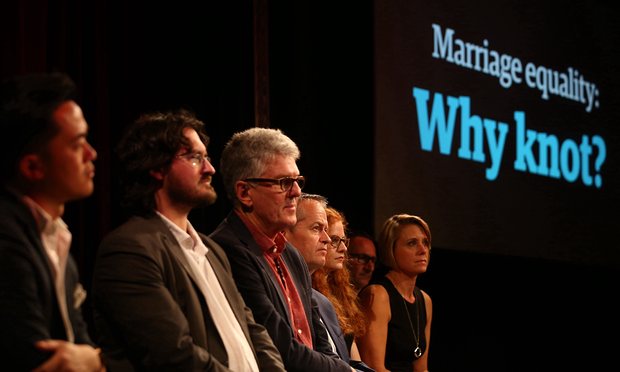
In practice, this means that the Commonwealth Government tacitly endorses discrimination by religious organisations against gay teachers, lesbian students, bisexual people accessing health of community services and transgender aged care employees, among many others.

There are also a wide variety of more indirect ways in which ‘religious freedom’ has been used, and continues to be used, to oppress lesbian, gay, bisexual transgender and intersex (LGBTI) Australians.

This obviously includes ongoing advocacy by a number of mainstream christian churches, as well as by homophobic groups like the Australian Christian Lobby, to seek continued discrimination on the basis of sexual orientation, gender identity and intersex status through the secular Marriage Act 1961.

But it also includes things like campaigning to ensure the National Health & Physical Education Curriculum does not include content that is genuinely-inclusive of LGBTI students (thus denying their right to health information), or calling on Governments to abolish the national Safe Schools Coalition, a program with the explicit goal of reducing homophobic, biphobic, transphobic and intersexphobic bullying.

For all of the above reasons, I call on you to reconsider the need to establish a ‘Religious Freedom Roundtable’ and that, if you do, to amend the scope of such a Roundtable to ensure that its primary focus is on addressing the many ways in which ‘religious freedom’ is currently used as a weapon, by some elements within society, to legitimise homophobic, biphobic, transphobic and intersexphobic discrimination that is, and should be considered, unacceptable.

Before I turn to the ‘Statement of purposes and Guiding principles’ I would like to make two additional points about the information contained in the call for submissions.

First, in relation to the dot point “[p]reserving religious freedom when an organisation receives taxpayer’s money to provide a public service”, I would note that nearly all religious organisations receive taxpayer’s money through the generous exemptions from taxation law which they currently enjoy.

I would also note that this dot point appears to relate to the ‘carve-out’ to existing exceptions contained in the Sex Discrimination Act 1984, which has the effect of prohibiting discrimination by religious-operated aged care services against LGBT people accessing their services, where that service receives Commonwealth funding.[v]

In my view, this carve-out is not wide enough – there is no justification for these services to be legally permitted to discriminate against LGBT employees, either.

But, most importantly, from my perspective it is not the involvement of Government funding that means such discrimination should be prohibited – it is the fact that, employment and service provision in the public sphere, which includes the operation of aged care services, should be free from discrimination on the basis of sexual orientation, gender identity and intersex status. Full stop.

Second, in relation to the dot point “[b]alancing the right to religious freedom and equality before the law – what are the areas of shared agreement?” I note that the right not to be discriminated against (or ‘freedom from discrimination’), is in fact much broader than just ‘equality before the law’, which could be narrowly-construed as meaning equality under legislation and/or before the courts, rather than, say, equal access to employment or service provision.

Specific Comments Regarding the Draft Statement of purpose and Guiding principles[vi]

The ‘Statement of purpose’ describes the Religious Freedom Roundtable as a forum “for representatives of religious and spiritual communities to have ongoing engagement and dialogue about freedom of religion, conscience and belief (‘religious freedom’) and its interaction with public policy in 21st century Australia.”

Given the discussion above, and the fact that LGBTI Australians are the people most negatively affected by the exercise of ‘religious freedom’ in Australia, it seems odd to establish a roundtable to look at these issues and yet not have LGBTI organisations at the table.

This omission could be seen as indicating that the Religious Freedom Roundtable is in fact concerned with prioritising or ‘privileging’ the rights of religious organisations over and above the rights of other people, including those of LGBTI Australians.

Under the heading ‘Mutual respect’, in the first paragraph, you note that “[religious freedom] interacts with other fundamental freedoms including freedoms of thought, conscience, speech and association, as well as property rights.”

In response, I reiterate the position from my submission to last year’s Rights and Responsibilities Consultation that highlighting these rights, simply because they are ‘traditional’ or even just older, but omitting other rights such as the right to non-discrimination which in practice is just as important, is unjustified.[vii]

In short, “prioritising certain rights above others potentially neglects and devalues the importance of those other rights which are no less essential to ensuring all Australians are able to fully participate in modern society.”[viii]

Finally, I would like to make the following points in relation to specific ‘Guiding principles’:

Principle 1: Religious freedom is fundamental to the Australian way of life, and should be treated equally to all other human rights and freedoms.

and

Principle 2: Religious freedom is a fundamental human right that should be respected and not limited unless it infringes on the rights of others.

I agree with these statements, and particularly the observations that religious freedom should be ‘treated equally to all other human rights and freedoms’ and respected ‘unless it infringes on the rights of others’.

In practice, this should mean that the right to non-discrimination should be ‘treated equally’ to the right to religious freedom.

More importantly, it means that, given exceptions to anti-discrimination law allowing religious organisations to discriminate against LGBT Australians in health, education, community services and aged care are clearly an infringement on the right to non-discrimination in public life, and that they cause significant harm to these people, such exceptions should be abolished.

Principle 3: Religious freedom has an essential and important role in our public life or civic affairs to contribute to the moral and spiritual guidance of our nation; and faith is as legitimate basis for participation in public life and civic affairs as any other.

I disagree with this statement for two reasons. First, as an atheist, and noting that Australia is a secular state, I reject the notion that ‘our nation’ as a whole necessarily requires ‘moral and spiritual guidance’ from organised religion.

Second, while people should not be prohibited from participation in public life on the basis of their religious beliefs, I do not believe it is appropriate for religious individuals and/or organisations to seek to impose ‘religious laws’ on their fellow citizens.

An example of this is the ongoing campaign by christian fundamentalists to impose a narrow religious interpretation of marriage on their fellow citizens through the secular Marriage Act 1961, in this way denying the human rights of those who do not share the same faith – and even of other christians who do not subscribe to their particular homophobic definition of this institution.

Thus, while participation in public life and civic affairs should be open, such participation should not be abused by using religion as a tool to oppress others.

Principle 6: No Australians should be unnecessarily excluded from participation in public life or civic affairs because of their faith, age, disability, gender, race, sexual orientation, or other irrelevant personal attribute.

While I agree with the underlying sentiment of this principle, I find it disappointing that, as both the ‘Freedom Commissioner’ and also the Commissioner with responsibility for LGBTI issues, you have not explicitly mentioned gender identity or intersex status as part of this principle. These two protected attributes from the Sex Discrimination Act 1984 should be included.

Principle 8: When considering issues that affect the rights of others, it is necessary to provide equal opportunities to enlarge and consider their perspectives with the objective of accommodating and enlarging the human rights of all.

This principle appears to contradict the Statement of purpose, described above – specifically, given most contentious issues surrounding religious freedom in fact concern its intersection with the right to non-discrimination of LGBTI Australians, it is objectionable that LGBTI people and organisations are not included in this roundtable from the beginning.

Principle 10: Individuals and communities of faith will continue to constructively work with government and other public agencies to uphold the law and improve Australia’s moral and spiritual guidance.

As with principle 3, above, as an atheist I reject the implication that Australia, as a secular nation, necessarily requires ‘moral and spiritual guidance’ from organised religion.

Thank you again for the opportunity to provide comments on your proposal to establish a ‘Religious Freedom Roundtable’, including on its draft ‘Statement of purposes and Guiding principles.’

If you would like to clarify any of the above, or require further information, please contact me at the details below.

Sincerely,

Alastair Lawrie

[i] https://www.humanrights.gov.au/our-work/rights-and-freedoms/projects/religious-freedom-roundtable-call-submissions

[ii] Ibid.

[iii] ALRC, “Freedoms Inquiry Interim Report”, August 2015, para 4.1, page 97. See http://www.alrc.gov.au/publications/alrc127

[iv] Ibid, para 4.39, page 104.

[v] Sub-section 37(2): Paragraph (1)(d) does not apply to an act or practice of a body established for religious purposes if: (a) the act or practice is connected with the provision, by the body, of Commonwealth-funded aged care; and (b) the act or practice is not connected with the employment of persons to provide that aged care.

[vi] https://www.humanrights.gov.au/sites/default/files/DRAFT_ReligiousFreedomRoundtable_2015_AHRC_1.pdf

[vii] See my full submission here: https://alastairlawrie.net/2014/10/27/submission-to-rights-responsibilities-2014-consultation/

[viii] Ibid.