Letter to Scott Morrison about Treatment of LGBTI Asylum Seekers and Refugees Sent to Manus Island, PNG

UPDATE: Sunday 20 July 2014

On Friday 18 July, I received the following response from the Department of Immigration and Border Protection, to my correspondence about the treatment of LGBTI asylum seekers and refugees:

Dear Mr Lawrie

Treatment of homosexual, bisexual, transgender and intersex asylum seekers

Thank you for your letter of 2 February 2014 to the Hon Scott Morrison MP, Minister for Immigration and Border Protection, concerning the treatment of homosexual, bisexual, transgender and intersex asylum seekers. The Minister appreciates the time you have taken to bring these matters to his attention and has asked that I reply on his behalf. I regret the delay in responding.

As a party to the 1951 Convention Relating to the Status of Refugees and its 1967 Protocol (the Refugees Convention), Australia takes its international obligations seriously. Australia is committed to treating asylum seekers fairly and humanely, and providing protection to refugees consistent with the obligations set out in the Refugees Convention, and other relevant international treaties to which Australia is a party.

The Australian Government has taken a number of measures to deter people smuggling and to ensure that people do not take the dangerous journey to Australia in boats organised by people smugglers. Under Australian domestic law, all illegal maritime arrivals (IMAs) entering Australia by sea without a visa will be liable for transfer to Nauru and Papua New Guinea (PNG) where any asylum claims they may have will be assessed, and if found to be a refugee, they will be resettled in Nauru and PNG or in another country.

Any claims made against Nauru and PNG by an IMA, including claims concerning the treatment of homosexuals, bisexual, transgender and intersex asylum seekers in either country, are considered prior to transfer. Where an IMA makes such a claim, consideration is given to whether the IMA can be transferred to the proposed country, or an alternative country, or whether the IMA’s case should be referred to the Minister for consideration or exemption from transfer.

Nauru and PNG are also both parties to the Refugee Convention. The Memoranda of Understanding (MOU) they have signed with Australia on the offshore processing arrangements reaffirm their commitment to the Refugees Convention and to treating people transferred with dignity and respect in accordance with human rights standards.

The enforcement of PNG domestic law is a matter for the Government of PNG. The government is aware of laws relating to homosexual activity in PNG and understands that there have been no recent reports of prosecution under those laws.

If homosexual activity should occur in the OPC, there is no mandatory obligation under PNG domestic law for Australian officers or contracted services providers to report such activity to the PNG Government or police.

The department notes the release of the reports by both the United Nations High Commissioner for Refugees (UNHCR) and Amnesty International on the Manus OPC. Any reports received by the department will be reviewed, and observations or comments verified. Where reports make practical observations that can be implemented and would improve the operations of the centres, the government will address these in partnership with Nauru and PNG to address any deficiencies in good faith.

Any claims of mistreatment at the Manus OPC would be primarily a matter for the Administrator of the OPC. The Manus OPC is administered by PNG under PNG law, with support from Australia. The PNG Minister for Foreign Affairs and Immigration appoints the Administrator of the Centre (a PNG national) under section 15D of the Papua New Guinea Migration Act 1978 (the Act). The Administrator, who, under the Act has control and management of the Centre (currently the Chief Migration Officer, Head of the PNG Immigration and Citizenship Service Authority) has an Operations Manager at the OPC reporting to him, who has oversight of the day-to-day operations of the OPC.

To assist PNG in the implementation of the MOU, the government has contracted appropriately trained and experienced service providers to ensure that transferees’ needs are adequately met, including through the provision of health and welfare services. Transferees can report any concerns to OPC staff.

Regarding the distribution of condoms, I can assure you that condoms are available at the Manus OPC, and the department’s contracted health service provider, International Health and Medical Service, conduct regular health information sessions on safe sex practices.

Thank you for bringing your concerns to the Minister’s attention.

Yours sincerely

[Name withheld]

Acting Assistant Secretary

Community Programmes Services Branch

9 / 7 / 2014

Some quick thoughts on the above:

  • Even though we are more than a decade into our post-Tampa nightmare of refugee policy in Australia, it is still shocking to see people simply seeking asylum in Australia described, by government officials, as Illegal Maritime Arrivals (IMAs). And it is probably almost as shocking realising that the same government official doesn’t even need to spell out what an OPC is anymore, instead it is taken as a given.
  • While the letter acknowledges there is no mandatory reporting of homosexual activity under PNG law, it explicitly does not state that there is no reporting of homosexual activity to PNG Police, or refute the claim that asylum seekers have been told they will be reported if found to engage in such activity.
  • It is difficult to accept the statement that “[t]o assist PNG in the implementation of the MOU, the government has contracted appropriately trained and experienced service providers to ensure that transferees’ needs are adequately met” from the same Government that is responsible for the death, in custody, of Reza Berati just over two weeks after I wrote my initial letter.
  • It is obviously welcome that, at least on paper, the Government claims it makes condoms available to asylum seekers on Manus Island – although whether they are made available in reality would be difficult to verify (given the shroud of secrecy surrounding, and lack of journalist access to, the detention facilities in PNG and Nauru).
  • The main problem remains however, and that is there is no firm commitment not to send LGBTI asylum seekers for ‘processing’ to countries which criminalise homosexuality, and no commitment that LGBTI refugees will not be permanently resettled in countries where they are liable to punishment merely for sexual intercourse.
  • The process outlined in the letter – that an asylum seeker must make a claim against the laws of PNG or Nauru prior to their transfer, is farcical given what we know about the current way asylum seekers are being assessed: while they are detained on navy or customs vessels, on the open sea, through a short interview (with as few as four questions by some reports) via teleconference to officials in mainland Australia. It is outrageous to suggest that the only way a gay asylum seeker can avoid being sent to another country which criminalises their sexual orientation is to declare their sexual orientation at short notice, whilst intimidated by naval or customs personnel (and potentially while intimidated by other asylum seekers, including possible family members), and to specifically claim protection against countries which they may not even be aware they are being taken to, and may not know criminalise homosexuality.

While I certainly wasn’t expecting to take much comfort from this response from the Department of Immigration and Border Protection, it is still depressing to realise that, yet again, so little solace is to be found.

ORIGINAL LETTER

The Hon Scott Morrison MP

Minister for Immigration and Border Protection

PO Box 6022

House of Representatives

Parliament House

CANBERRA ACT 2600

Sunday 2 February 2014

Dear Minister

TREATMENT OF LGBTI ASYLUM SEEKERS AND REFUGEES SENT TO MANUS ISLAND, PAPUA NEW GUINEA

I am writing regarding the treatment of lesbian, gay, bisexual, transgender and intersex (LGBTI) asylum seekers and refugees sent to Manus Island, Papua New Guinea, both for offshore processing and permanent resettlement.

In particular, I am writing about concerning allegations raised in the Amnesty International Report This is Breaking People: Human rights violations at Australia’s asylum seeker processing centre on Manus Island, Papua New Guinea, which was released on 11 December 2013.

Chapter 8 of that report, titled ‘Asylum claims on the basis of sexual orientation’ (pages 73-75), details a range of serious allegations about the mistreatment of LGBTI asylum seekers sent to Manus Island for processing.

Specifically, Amnesty International found that:

  • Section 210 of the PNG Penal Code, which makes male-male penetrative sexual intercourse a criminal offence punishable by up to 14 years’ imprisonment, applies to asylum seekers detained on Manus Island
  • Section 212 of the PNG Penal Code, which makes other sexual activity between men, termed ‘gross indecency’, a criminal offence carrying a maximum penalty of 3 years’ imprisonment, also applies to asylum seekers detained there
  • Asylum seekers held on Manus Island have been informed that if they are found to have engaged in male-male sexual intercourse, they will be reported to PNG Police (despite no requirement for mandatory reporting)
  • Gay asylum seekers have reported being subject to bullying and harassment from other detainees and staff, including physical and verbal abuse and attempted molestation, but are not reporting this abuse because of fear of prosecution for their homosexuality
  • Interviewees have indicated that some gay asylum seekers have changed or are considering changing their asylum claim, from persecution on the basis of sexual orientation to persecution on another ground, in order to avoid prosecution (thereby jeopardising the chances of their claim ultimately being accepted)
  • Interviewees have indicated that some gay asylum seekers have chosen to return home, despite the risks involved to the personal safety/liberty, rather than be subjected to ongoing mistreatment because of their sexual orientation on Manus Island and
  • Condom distribution has been banned within the Manus Island detention facility, despite the risk of HIV transmission.

In these circumstances, it is perhaps unsurprising that Ms Renate Croker, the senior official from the Department of Immigration & Border Protection located at the Manus Island detention facility, told Amnesty International that “she was unaware of any asylum claims being made on the basis of LGBTI identity.”

Not only is this contradicted by the Amnesty Report – which interviewed a man who reported that his claim was based on persecution due to his sexual orientation, and who expressed concern about being transferred to Manus Island for this reason – it also ignores the fact that some gay asylum seekers may have changed their claims to other grounds (for the reasons outlined above), or that some asylum seekers may happen to be LGBTI but their claim is in fact based on persecution on other grounds (for example, race or religion).

Irrespective of how their claim is being dealt with, the Australian Government has a responsibility to protect the human rights of any and all LGBTI asylum seekers who have sought protection in Australia. This includes the right to freedom from prosecution on the basis of sexual orientation, gender identity or intersex status, the right to claim asylum and the right to health.

From the information contained in the This is Breaking People report, it seems the Australian Government is falling well short of its obligations in this area.

I should note at this point that I am strongly opposed to the offshore processing and permanent resettlement of any asylum seekers by the Australian Government. This policy does not constitute a humane response, nor does it live up to our international humanitarian and legal responsibilities.

However, the mistreatment of LGBTI asylum seekers and refugees raises particular problems, problems that do not appear to be recognized by the Australian Government. Nor does there appear to be any evidence the Government is taking action to remedy them.

Even if the offshore processing and permanent resettlement of refugees continues, this must not include the processing and resettlement of LGBTI asylum seekers and refugees in countries which criminalise homosexuality (which both PNG and Nauru currently do).

If you, as Minister for Immigration and Border Protection and therefore Minister responsible for the welfare of asylum seekers and refugees, cannot guarantee that sections 210 and 212 of the PNG Penal Code do not apply to detainees on Manus Island, then you cannot send LGBTI people there in good conscience.

If you, as Minister for Immigration and Border Protection, cannot guarantee that LGBTI asylum seekers and refugees will not be subject to homophobic bullying and harassment, and will be free to lodge claims for protection on the basis of persecution due to their sexual orientation, gender identity or intersex status, then you must not detain them in such facilities.

If you, as Minister for Immigration and Border Protection, cannot guarantee that all asylum seekers and refugees, including but not limited to LGBTI people, have access to condoms, then you are potentially endangering their lives and you should be held accountable for any health problems which occur as a result (noting that HIV continues to be life-threatening in the absence of treatment).

It has been clear since the reintroduction of offshore processing of asylum seekers in Nauru and Papua New Guinea, passed by the previous Labor Government and supported by the Liberal-National Opposition in mid-2012, that the criminalisation of homosexuality in these countries constituted a significant threat to the human rights of LGBTI asylum seekers sent there.

Indeed, I wrote to you as Shadow Minister for Immigration expressing my concerns about this exact issue in September 2012. I did not receive a response addressing the subject of LGBTI asylum seekers prior to your assumption of the role of Minister for Immigration and Border Protection in September 2013.

I sincerely hope, now that you are the person directly responsible for the health and wellbeing of asylum seekers and refugees, and especially after the Amnesty International Report This is Breaking People has confirmed that these human rights abuses are real, that you take this issue, and your responsibilities, seriously.

I look forward to your response on this important issue.

Yours sincerely,

Alastair Lawrie

A copy of the Amnesty International Report This is Breaking People, can be found here: <http://www.amnesty.org.au/images/uploads/about/Amnesty_International_Manus_Island_report.pdf
Letter to Minister Piccoli re Proud Schools

UPDATE (Saturday 8 February): Yesterday, I received a response from the NSW Government to my letter about Proud Schools (below). It was not from the Minister, but rather from the Executive Director, Learning and Engagement, in the Department of Education and Communities.

In short, it appears that the NSW Government has completed its review of Proud Schools and on that basis has decided to abandon the Proud Schools pilot/model. Unfortunately, it does not appear as if the review of the Proud Schools pilot is going to be released.

Equally concerning, while the response talks about a “Wellbeing Framework for Education”, there appears to be very little detail about what this might entail. Given the homophobia, biphobia, transphobia and anti-intersex discrimination which continues to affect LGBTI students (a fact reinforced by the Growing Up Queer report, released yesterday), there will need to be a lot more information provided about this framework before it could be supported.

As an aside, I find it curious that in a letter about Proud Schools, and replying to a letter about Proud Schools/the needs of LGBTI students, the response does not refer to LGBTI students specifically, instead making generic statements about ‘all students’. Hmmm…

The full text of the letter:

Dear Mr Lawrie

I write in response to your email of 12 January 2014 to the Hon Adrian Piccoli MP, Minister for Education regarding the Proud Schools pilot. The Minister has asked me to respond on his behalf.

The Department of Education and Communities is committed to providing safe and supportive learning environments that respect and value diversity and that are free from all forms of violence, bullying, discrimination, harassment and vilification.

We know that learning outcomes are better where students are happy, safe and supported at school. We also know that when school communities work together real improvements in promoting understanding and reducing discrimination can be made.

From the Proud Schools pilot it has emerged that a ‘one size fits all’ approach will not be appropriate for a systemic school system.

Significant work is currently underway on developing a Wellbeing Framework for Education. This framework will provide schools with guidance and evidence informed practice to support all students within the context of their school and in consultation with their school communities. The subsequent development of any wellbeing materials will need to carefully balance the wellbeing of all young people.

Thank you for your email.

Yours sincerely

[NAME WITHHELD]

Executive Director, Learning and Engagement

5 February 2014

ORIGINAL POST Today (Tuesday 28 January) is the first official day of the school year for teachers across NSW. Tomorrow, students return to school for the first time in 2014. And yet, with teachers and students coming back, it is still unclear whether something else is returning to NSW schools this year – the Proud Schools program.

A three-year pilot of Proud Schools – which is designed to help schools include LGBTI students, and protect them from bullying – was due to be completed at the end of 2013. The pilot project was also subject to a formal review last year, to help determine whether it should be expanded, and if so in what form.

But, as far as I can tell, this review has not yet been released, and no announcement appears to have been made about the future of the Proud Schools program. Is the Proud Schools pilot being extended? Is the program being rolled out beyond the initial very small number of schools in which is began? Has Proud Schools been axed? If so, has it been replaced with another program aimed at serving the needs of LGBTI students in NSW?

Concerned about the lack of information, I wrote to the NSW Minister for Education, the Hon Adrian Piccoli, about this subject two weeks ago. Below is my letter to him (dated 12 January). I have yet to receive a response to this, but will update this post if I do.

Dear Minister

PROUD SCHOOLS/PROGRAMS FOR LGBTI STUDENTS

I am writing regarding the Proud Schools program, which has been piloted across a small number of NSW schools over the past three years (2011-2013).

I understand that the Proud Schools pilot was the subject of a review by the NSW Government during 2013, and that, following this review, the NSW Government was to make a decision about the long-term future of Proud Schools.

Has this review been finalised? If so, has a decision been taken by the NSW Government concerning the future of the Proud Schools program? If so, when will this decision, and the review upon which it was based, be made public?

I write because there are only two weeks left until the 2014 school year commences, and believe that it is important for schools, teachers and LGBTI students to have some certainty about the future of this program.

Even if the NSW Government decides not to continue with the specific Proud Schools initiative, it is vital that a program which supports the needs of LGBTI students is rolled out across NSW schools, not just in the small number that were involved in Proud Schools, but across the entire state.

This is because LGBTI students are subject to increased levels of bullying and harassment based on homophobia, bi-phobia, trans*-phobia and anti-intersex prejudice, experience higher rates of mental illness as a result of this discrimination, and are at risk of not receiving education that is inclusive of their needs.

I seek your assurance that you are giving this issue priority, and will have a program in place in NSW schools from the beginning of the 2014 school year.

I look forward to your response to this letter.

Yours sincerely

Alastair Lawrie

In search of the elusive gay or bisexual male tennis player

As we enter the second week of the Australian Open, it is time, for yet another year, to call off the search party for that rare beast, the Australian singles quarter-finalist. Not seen since 2009, this critically-endangered animal is quickly going the way of its relative, the Australian winner, not seen since 1976 (male) and 1978 (female) respectively, and now presumed extinct.

But, believe it or not, there is at least one creature in tennis which is even rarer, indeed almost mythical – the openly gay or bisexual male tennis player.

In the long history of this genteel sport, there have been only two male tennis players of note who have been linked to homo- or bi-sexuality, and both had tragic personal stories. The first, 1930s German world number 1 and dual French Open winner, Gottfried Von Cramm, was jailed for 6 months by the Nazi regime for ‘morals charges’, as the result of an affair with another man.

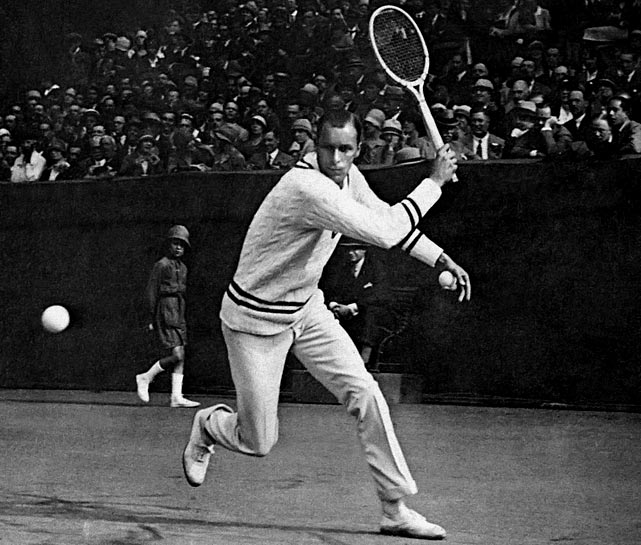
The second, the great Bill Tilden of the US, the best player in the world in the 1920s and winner of 3 Wimbledons and 7 US Opens, was twice jailed after his career had finished for male same-sex encounters (one with a 14 year old sex worker and a second with a 16 year old hitchhiker – their respective ages certainly making this a more complicated case to ‘categorise’).

Bill Tilden. Source: Sports Illustrated.

Bill Tilden. Source: Sports Illustrated.

There have been no openly gay or bisexual male players in the post-Second World War period, and certainly none of any note in the Open era.

Contrast this with the cavalcade of greats from the women’s game known to have been lesbian, bisexual or, at the very least, to have been in same-sex relationships. This includes greats like Helen Jacobs (winner of 5 grand slams); Billie Jean King (12 grand slams), who was famously outed through a ‘palimony’ lawsuit from an ex-partner; Martina Navratilova, winner of 18 slams who voluntarily came out in 1981 early in her career; and Hana Mandlikova, winner of 4 slams (and who, towards the end of her career, became an Australian citizen).

They are joined by some of the best doubles players of the past 30 years as well, including Gigi Fernandez (winner of 17 Grand Slam doubles titles and 2 Olympic gold medals), Lisa Raymond (6 Grand Slam doubles titles) and our own Rennae Stubbs, winner of 4 Grand Slam doubles titles and a 4-time Olympian.

Perhaps the most famous lesbian player of the past 15 years was Amelie Mauresmo, the Frenchwoman who made the Final of the Australian Open in 1999, and ‘came out’ at the same time, acknowledging her girlfriend Sylvie. All that, at 19 years of age (as an aside, it is worth noting that one of the players who, at least early in her career, had a reputation for being mentally fragile on the court, was incredibly strong off it). Mauresmo went on to become world number 1, and won both the Australian Open and Wimbledon Championships later in her career.

Amelie Mauresmo. Source: The Guardian.

Amelie Mauresmo. Source: The Guardian.

In 2013, in a sign of how far the women’s tour has come, Australia’s Casey Dellacqua came out via a short statement announcing the birth of her and her partner Amanda’s son, Blake. About the only consequence of that announcement has been an increase in questions from reporters about how she manages life on tour with a new-born.

It is fair to say that, when a male player does eventually come out, it will provoke a much larger response, from the tennis community, the media and of course the fans. Unlike other sports, this will not necessarily be because men’s tennis is, in an inherently sexist view, deemed more important than the women’s game (because of the wonderful work of people like Billie Jean King, gender inequality is far less in tennis than elsewhere), but simply because the novelty of a men’s tennis player coming out will make it big news.

But why is it novel? Why, when tennis as a sport has shown itself to be at ease with the concept of openly lesbian or bisexual female players, has no male player felt sufficiently at ease to come forward and identify himself? Is there such a fundamental difference between the men’s and women’s tours?

Now, I will preface the rest of this article by saying that I am not an ‘insider’ on the men’s tour, and don’t know of any gay or bisexual male players (nor am I going to play the ‘is he or isn’t he’ game of speculation – sorry). But the following are some reasons which I believe might help explain why a tennis player would choose not to come out (and, where relevant, why that factor might be more relevant for a male player):

Tennis is a truly global sport. In an age of increasing world-wide sporting competition, there are still surprisingly few sports that could be considered truly global – meaning sports that compete on each continent, and draw elite players from each continent. Tennis is one, alongside athletics and soccer and, well, I’m struggling to think of too many others. Possibly not coincidentally, soccer and athletics have also been sports where, male players in particular, have not come out until relatively recently (Robbie Rogers and Thomas Hitzlsperger in the last 18 months finally joining their tragic earlier standard-bearer in football, Justin Fashanu).

With at least 72 countries around the world still criminalising homosexuality (and some of those only criminalising male, rather than female, same-sex sexual intercourse), the threat of having to play in a country where you are considered a criminal must be a relevant consideration. Of course, most players set their own schedules, and none of the Grand Slams or compulsory Masters tournaments are held in countries where homosexuality is criminalised. Even the End of Year Championships, which moves around, hasn’t been held in a city with operative ‘anti-sodomy’ laws since New York in the late 1970s.

However, the Davis Cup (at least until 2018) was held annually in countries all around the world, on a rotating home-and-away basis. This format meant that, in 2013, Australia played ties in Chinese Taipei, Uzbekistan and Poland. Of those, Uzbekistan has laws criminalising male, but not female, homosexuality (by up to 3 years imprisonment). With some countries, like Australia, placing a high emphasis on players representing their country in Davis Cup, this must make it a more difficult calculation to decide whether to come out in tennis, compared to an athlete in a domestic-only sport (for example, Australian rules football).

Elite tennis players earn more ‘off-court’ than on. While tennis prizemoney has increased exponentially since the beginning of the Open era (and probably makes Billie Jean King simultaneously wince, and feel satisfied), the bounty to be had off-court, at least by the very top players, is even greater. For example, Forbes magazine estimated in August 2013 that, over the previous 12 months, Roger Federer earned $71.5million, including ‘only’ $6.5million in prizemoney versus $65million in endorsements.

On the women’s side, 2013’s top earner (and incidentally the highest-paid female athlete in the world at the time) Maria Sharapova earned an estimated $29million, with $6million from prizemoney and $23million in endorsements. For some players, this disparity is even greater – Kei Nishikori earned $10.5million, with ‘just’ $1.5million coming from on-court activities.

The reason is that tennis players are truly marketable commodities, both globally and within each country, or to put it bluntly, ‘market’, especially to consumers with higher average levels of disposable income. For a player to come out, in a world where more than one third of countries criminalise homosexuality, means potentially making themselves unsaleable in a large number of markets.

This consideration is even more acute when you consider that one way in which elite players line their pockets during the off-season is to play exhibition matches, increasingly staged in oil-rich Middle Eastern countries (often with their own laws against homosexuality). It is possible that an openly gay male player’s invitation could get ‘lost in the mail’ in such circumstances.

In short, elite tennis players – or those with an aspiration of being an elite player at some stage in their career (nearly all young players) – may still have a genuine financial incentive to stay in the closet. Again, this would be different from an athlete in a domestic-only sport, whose consideration about off-field sponsorship only depends on the reaction of sponsors within one country, and therefore may feel my able to come out when social attitudes within that country change.

The men’s tour may have a more homophobic culture than the women’s tour. As indicated earlier, I am not a tennis insider, so this is largely speculation. But, from an outsider’s perspective, it certainly seems like there is some evidence to support this assertion. For example, it is difficult to imagine a player on the women’s tour making the following comments, both before and after winning a major championship, and largely getting away with it:

Before the championship, at Queens: “Last year I played well here and played like a faggot at Wimbledon… Better to play like a faggot here and play well at Wimbledon.” And then, after winning: “Then I hit another serve, huge. And that ball was on the line, was not even close. And that guy, he looks like a faggot little bit, you know. This hair all over him. He call it. I couldn’t believe he did it.” Goran Ivanisevic, Wimbledon winner 2001 (and later back on tour as the coach of fellow Croatian Marin Cilic).

Australia’s own Lleyton Hewitt has similar form. In 2005, he finally experienced some reprobation for yelling out “Poof” on court. Years earlier – at the End of Year Championships in Shanghai, 2002 – I remember watching Hewitt shout, on multiple occasions, “Poofter”, when he lost points. The Australian television commentator remarked at the time “I think Hewitt thinks he will get away with this in China” and he pretty much did – despite much larger previous backlashes when he made remarks based on disability and race.

Contrast this with the reaction of one of the then youngest players on tour, the UK’s Laura Robson, who in a dignified yet steadfast manner supported the ‘rainbow’-coloured protests in 2012 following comments by notorious homophobe, and one-time tennis player, Margaret Court*. From memory, no male players joined that protest – and I doubt many would if similar circumstances arose today.

On the flipside, there are some reasons why, theoretically at least, it should be easier for a tennis player to come out than athletes in other sports.

First, competitive tennis is largely an individual sport. Yes, there is doubles, but finding an open-minded playing partner must surely be more likely than expecting every single member of a football team to be supportive. Indeed, the women’s doubles greats, listed above, and including Martina Navratilova, never seemed to encounter too much of a problem recruiting partners (although that might also be because they were so good that the promise of winning would overcome most obstacles). And, while there are some teams competitions throughout the year (most importantly Davis Cup for men and Federation Cup for women), these are only for short time periods, with many elite players opting out of them from time to time.

In my opinion, tennis is such an individual sport that it is almost individualist – in that it encourages, and has a long history of, strong characters breaking out of any box that seeks to capture them, and doing things their own way, both on court and off (see: McEnroe, John; Connors, Jimmy). It doesn’t seem outrageous to think that a gay male player could similarly have struck out on their own, saying “That’s how I play, this is who I am, deal with it.”

A second factor making it potentially easier for a gay or bisexual male player to come out now is the rapidly ageing nature of the men’s tour. Contrary to earlier generations, the average age of the men’s top 10 is now more than 30 years old (as at the end of 2018).  Indeed, only two players in the top 10 are younger than 29: Alexander Zverev at 21 years and 8 months, and Dominic Thiem at 25 years and 3 months.

Further, while there are currently a number of exciting young players inside the top 100, or just outside (Stefanos Tsitsipas, Denis Shapovalov, Felix Auger-Aliassime, Alex De Minaur, Frances Tiafoe, Taylor Fritz, Reilly Opelka, Casper Ruud, Andrey Rublev, Miomir Kecmanovic, Ugo Humbert, Alexei Popyrin, Corentin Moutet and Alejandro Davidovich Fokina), all of them are already older than both Boris Becker when he won Wimbledon and Michael Chang when he won the French Open.

An ageing tour should help because it is probably not reasonable to expect everyone to ‘do a Mauresmo’ and come out at age 19 (heck, I was nervous enough telling my family at that age, let alone the whole world). But it is reasonable to think that, as players mature during their 20s, and even play on until their early to mid 30s, at least one, and possibly more, might eventually feel comfortable enough to disclose their sexual orientation while still playing.

A third reason why a gay or bisexual male player should find it somewhat easier to come out today is that so many women have already done so. Players like Mauresmo, and Navratilova, and Raymond and Dellacqua (and recently Alison Van Uytvanck), have all shown that it is possible to disclose one’s sexuality and remain active through the week-in, week-out grind of the tennis tour.

Of course, in doing so, they have had to overcome the very same barriers I outlined earlier. They have all had to negotiate the vagaries of the global tour, and decide whether to play in countries with higher levels of homophobia, including places where female same-sex sexual activity is banned.

And they have had to confront a very real, and demonstrated, loss of sponsorship. Billie Jean King’s endorsements basically dried up the day after she was so publicly outed. Martina Navratilova probably earned an order of magnitude less off-court than she would have had she not revealed who she was. Even Amelie Mauresmo likely lost out financially, potentially millions of Euros, because of her courage at age 19.

Martina Navratilova. Winner on-court, missed out on endorsements off-court. Source: The Guardian.

Martina Navratilova. Winner on-court, missed out on endorsements off-court. Source: The Guardian.

Bisexual female and lesbian tennis players have also had to overcome homophobia on the tour. Mauresmo had to withstand not-very-subtle ‘plays like a man’ critiques in 1999 from other players like Martina Hingis and, in a lapse of judgment, Lindsay Davenport. But, and this is the important part, both were forced to apologise. In that same year, US player Alexandra Stevenson’s mother commented during Wimbledon that her daughter needed to be protected from “lesbians in the locker-room”. This time around, Davenport was on the right side of the debate, and called the comments out as bizarre and ignorant.

In short, the very existence of openly lesbian players has brought forward the arguments around homosexuality, on court and in the stands, and those arguments have been won – at least on the women’s tour. King, and Navratilova, and Mauresmo, and others, have had to fight these battles, and have eventually emerged victorious, together with the help of allies (some of whom themselves needed to be educated).

Which brings me to my almost prosaic conclusion: no gay or bisexual male player has come out in the open era because none have chosen to take on that fight. For whatever reason, as individuals – not just tennis players, but humans – each man has decided that taking on that battle, with at least some attendant personal cost, is not in their own interest. That is an understandable conclusion for an individual to arrive at, separately.

Even so, as each year brings more players onto the tour, it brings us closer to the point where a player (or multiple players) will look at those same factors, and reach the opposite view. Surely we cannot be too many years away from a male tennis player casually talking about his boyfriend in a post-match interview, releasing a statement that he and his husband have had a child together, or even going to the Wimbledon Winners’ Ball together (which would be a pretty awesome way to come out, come to think of it).

Casey Dellacqua. Where is out male equivalent? Source: Sydney Morning Herald

Casey Dellacqua. Where is our male equivalent? Source: Sydney Morning Herald

For this tennis-mad LGBTI activist, I hope that day is not too far away. Not just because it would add to the already long list of same-sex attracted tennis players to look up to but, if Australian singles players continue to under-perform at home as they have done in the recent past, having an openly gay or bisexual male player might give me someone to barrack for in the second week of the next Australian Open.


UPDATE 18 January 2016:

With this year’s Australian Open starting today, I thought I would take a look back on this post, to see what has changed during the past two years. The answer is: lots, and not very much at the same time.

Australian tennis has rediscovered what it is like to have players reach the Australian Open quarter-finals, with Nick Kyrgios achieving the feat last year (2015), and he and Bernard Tomic possibilities to do so again this year and into the future.

Amelie Mauresmo continues to break down barriers, this time as coach, since June 2014, of men’s world number 2 Andy Murray.

The ‘ageing’ trend amongst the male tour might finally be on the cusp of slowing down, and eventually reversing. While the upper echelon remains, for now at least, older than any generation in memory (the only player under the age of 28 inside the current top ten is Kei Nishikori, and even he is 26), there is a large group of new young players who appear of the cusp of breaking through.

Nick Kyrgios (ranked 30) and Thanasi Kokkinakis (ranked 86) have youthful company inside the top 100 with Borna Coric, Hyeon Chung and Alexander Zverev (currently ranked 40, 51 and 83 respectively), and look likely to be joined by Karen Khachanov, too.

While I wrote in the original post that older players might stand more chance of coming out on their own terms, it is also possible that this new generation of players will shake things up in more ways than just their on-court play.

The past few years have also seen an acceleration of the welcome trend for currently-active male professional athletes to come out as either gay or bisexual. Most prominently Michael Sam came out as gay just two weeks after my original post, with Jason Collins also becoming the first openly gay man to play in the NBA that same month (having come out publicly the previous year). They have been joined by male athletes across a wide range of sports, including New Zealand Olympic rower Robbie Manson and US Winter Olympic freestyle skier silver medallist Gus Kenworthy, among others.

Of course, one thing that hasn’t changed is that there remains no out gay or bisexual male tennis players. That is a fact that still astounds me. I had thought, when writing the original post, that it was only a matter of months, or potentially just a year or two, before a player would finally break down that particular closet door.

Perhaps the culture of the men’s tennis tour is more homophobic than it appears from the outside. Perhaps there are other factors that have not been identified or considered. We probably won’t know for sure until a male player does finally come out (and even then only if they choose to discuss such things). In the meantime, the wait for an openly gay or bisexual male tennis player continues.


*It is an extraordinary, and extraordinarily awful, achievement that someone who has won 24 Grand Slam singles titles could, through years of expressing hateful and discriminatory comments, be better known as a bigot than a former champion.

Letter to Minister Pyne re Health & Physical Education Curriculum and Appointment of Mr Kevin Donnelly

UPDATE (Saturday 8 February): This week, I received a reply from Minister Pyne to my letter to him, on 11 January (see below), in which I requested that he sack Mr Kevin Donnelly from the national curriculum review because his homophobia made him unsuitable to be involved in any review of a Health & Physical Education curriculum.

In a somewhat unsurprising, but nevertheless extremely disappointing, response, Minister Pyne did not address any of the comments made by Mr Donnelly, nor deal with the problem that through his comments Mr Donnelly appears to be unable to oversee a HPE curriculum that serves the needs of all students, including lesbian, gay, bisexual, trans* and intersex (LGBTI) students.

So, while the issue of Mr Donnelly’s homophobia has received welcome public scrutiny, especially over the course of the past week, it seems Minister Pyne doesn’t really care about it – certainly not enough to actually respond to concerns which are put directly to him.

Which, sadly, makes me even more fearful of what the final HPE document will look like when it is released later in 2014.

Full text of Minister Pyne’s letter:

Dear Mr Lawrie

Thank you for your email of 11 January 2014 regarding the review of the Australian Curriculum.

As the Minister for Education, I am focussed on improving schools and student outcomes through proven policies and initiatives. Under our Students First approach, the Coalition Government is working with the states and territories on the priority areas of teacher quality, principal autonomy, parental engagement and strengthening our curriculum.

Over the past ten years, education outcomes in Australia have gone backwards, both relatively against other countries, but also in real terms. Some have identified that the reason for this is due to our curriculum not being robust enough.

I appointed Professor Ken Wiltshire AO and Dr Kevin Donnelly to review the curriculum to evaluate its robustness, impartiality and balance. Between them, Professor Wiltshire and Dr Donnelly have a tremendous amount of experience in not only the school education sector, but also in education curricula. I am confident that their considerable expertise will allow them to bring a balanced approach to this review process.

The reviewers are interested in hearing the views of parents and communities, educators and schools, and state and territory governments, to inform their analysis. This is an open public consultation process where the community are able to have their say.

I appreciate you taking the time to contact me to express your views. I encourage you to make a submission to the review. Comments will be accepted until Friday 28 February 2014. Information can be found at http://www.studentsfirst.gov.au/review-australian-curriculum.

Yours sincerely

Christopher Pyne MP

29 January 2014

ORIGINAL POST 11 January: Dear Minister Pyne

LGBTI INCLUSION IN NATIONAL HEALTH & PHYSICAL EDUCATION CURRICULUM AND APPOINTMENT OF MR KEVIN DONNELLY TO CURRICULUM REVIEW

I wrote to you in September 2013, following your appointment as Commonwealth Minister for Education, regarding the development of the National Health & Physical Education (HPE) curriculum by the Australian Curriculum, Assessment and Reporting Authority (ACARA).

In that letter, I raised serious concerns about the draft HPE curriculum, including both the initial draft released in December 2012, and revised draft, released in mid-2013, specifically:

  • That the draft HPE curriculum failed to include lesbian, gay, bisexual, transgender and intersex (LGBTI) students, and content relevant to their needs;
  • That the sexual health information provided in the draft HPE curriculum was grossly insufficient; and
  • That the draft HPE curriculum was inadequate because it failed to even mention HIV, or other blood borne viruses (like hepatitis B and C), let alone ensuring students received the vital education necessary to reduce future transmissions.

I note that, since that letter, the COAG Standing Council on School Education and Early Childhood (SCSEEC) met in Sydney on 29 November 2013. Significantly, that meeting did not endorse the draft HPE curriculum, but instead it was only ‘noted’. From the communiqué:

“The Standing Council today noted that ACARA has developed the Australian Curriculum content and achievement standards for … health and physical education … according to its current curriculum development processes.

Ministers noted that the Australian Government will be undertaking a review of the Australian Curriculum, and will bring forward recommendations from the review to the Standing Council in 2014.”

This means that there should be the opportunity for the Health & Physical Education curriculum to be improved as part of the overall review. In particular, there is now time for the HPE curriculum to be amended to specifically include LGBTI students and content, increased sexual health information and education about HIV and other BBVs.

Unfortunately, following your announcement yesterday, Friday 10 January 2014, of the two people entrusted with reviewing the curriculum, I have serious doubts that any improvements are now possible. Indeed, I am concerned that whatever amendments are made to the HPE curriculum will be entirely negative ones, and further contribute to the exclusion and marginalisation of LGBTI students in Australia.

This is because one of the people you have appointed, Mr Kevin Donnelly, has made sustained negative comments about the education needs of LGBTI students over the past decade.

For example, in 2004 Mr Donnelly is reported as saying that “[v]ery few parents would expect that it is the role of schools to teach children about the positive aspects of gay, lesbian and transgender sex lifestyles” and that “[f]orgotten is that many parents would consider the sexual practices of gays, lesbians and transgender individuals decidedly unnatural and that such groups have a greater risk in terms of transmitting STDs and AIDS” (source: Sydney Morning Herald, 3 May 2004, “Government staffer says new-age warriors waging culture wars in class”).

Mr Donnelly returned to similar themes the following year, criticising the Australian Education Union for arguing that “school curricula should “enhance understanding and acceptance of gay, lesbian, bisexual and transgender people.”” He went on to write “[f]orgotten is that many parents would consider the sexual practices of GLBT people unnatural and that most parents would prefer their children to form a relationship with somebody of the opposite sex. This is apart from the fact that many parents expect that it is their duty, not that of teachers and schools, to teach such sensitive matters” (source: News Weekly, 26 March 2005, “Teacher Unions Enforcing the Gender Agenda”).

In the same article, he wrote “it is also wrong to introduce students to sensitive sexual matters about which most parents might be concerned and that the wider community might fine unacceptable” in response to a lesbian teacher simply telling her students of her relationship.

Mr Donnelly’s views are not confined to last decade, either. In an article published on The Drum website on 6 December 2011 (“Marriage Equality: Secrets of a Successful Campaign”), he wrote:

“Such has been the cultural-left’s success in relation to gender issues that the so-called Melbourne Declaration, the blue print for Australian school education, argues that all school sectors, faith based, independent and government, must provide an education free of discrimination based on gender and sexual orientation.

A strict interpretation of the Melbourne Declaration is that religious schools will lose the freedom they currently have to discriminate in relation to who they enrol and who they employ. One also expects that the proposed national curriculum, in areas like health, will enforce a positive view of GLBT issues.”

Implicit in these comments is that private/religious schools should be able to discriminate against LGBTI students and teachers, and that the national curriculum need not include a positive approach to ‘GLBT issues’.

In short, over the past decade, Mr Donnelly has repeatedly argued against positive representations of LGBTI students and issues, has argued that same-sex relationships are ‘sensitive matters’ that should not be referred to in schools, and has on multiple occasions repeated the view, without condemnation, that “many parents would consider the sexual practices of GLBT people (decidedly) unnatural”.

As part of his role in reviewing the broader national curriculum, Mr Donnelly will have responsibility for reviewing the draft national HPE curriculum. Based on his public comments of the past decade, he is eminently unsuitable for this position. In my view, Mr Donnelly has amply demonstrated that he is incapable of reviewing, and redrafting, a national Health and Physical Education curriculum that meets the needs of all Australian students, not simply those who are cis-gender and heterosexual.

Given this evidence, the responsible course of action for you to take, as Commonwealth Minister for Education, would be to terminate his appointment. I urge you to do so.

Irrespective of what decision you take in relation to Mr Donnelly’s specific role, your announcement of the broader curriculum review on 10 January has confirmed that it is now your responsibility to ensure that the final Health and Physical Education curriculum is genuinely inclusive, and meets the needs of all students, including LGBTI students. This is a serious burden, and one that I sincerely hope you give serious attention to during 2014.

Thank you in advance for your consideration of the matters raised in this letter. I look forward to your reply.

Yours sincerely,

Alastair Lawrie

No 4 Draft Health & Physical Education Curriculum Fails LGBTI Students

For people who read my blog regularly, you will know that this is something I have written a fair bit about over the past 12 months. For others, you could be forgiven for asking what exactly I am talking about. Which is a fair enough question, given this subject has almost completely evaded media attention, even within the LGBTI community.

In December 2012, the Australian Curriculum, Assessment and Reporting Authority (ACARA) released a draft national Health & Physical Education (HPE) curriculum for public consultation. Submissions closed in April this year, before a second draft was released for limited public consultation in July 2013.

ACARA then finalised the draft curriculum from August to November, before submitting it for approval at the COAG Standing Council on School Education and Early Childhood (SCSEEC) meeting in in Sydney on 29 November.

Through this process, it became clear that the draft HPE curriculum that had been developed would almost completely fail to serve the needs of young LGBTI people right around Australia. Neither the first nor the second draft curriculum even included the words gay, lesbian or bisexual, and, while the second included transgender and intersex, it only did so in the glossary and even then erroneously included them within the same definition.

Nor did the draft HPE curriculum guarantee that all students, LGBTI and non-LGBTI alike, would learn the necessary sexual health education to allow them to make informed choices. Almost unbelievably, COAG Education Ministers were asked to approve a Health & Physical Education curriculum that did not even include the term HIV (or other BBVs like viral hepatitis for that matter), just two days before World AIDS Day.

For more information on just how bad the draft HPE curriculums were, here is my submission to the first draft: https://alastairlawrie.net/2013/04/11/submission-on-national-health-physical-education-curriculum/ and second draft: https://alastairlawrie.net/2013/07/30/submission-on-redrafted-national-health-physical-education-curriculum/

Given the fact the draft HPE curriculums so comprehensively failed to include LGBTI students, let alone content that was relevant to their needs, why didn’t this issue receive more attention, both from the media, and more specifically from LGBTI activists and advocates?

Well, there are lots of reasons – including but not limited to the inability of something as complicated as a school curriculum to compete with the much more emotive, yes/no, good/evil, photogenic juggernaut that is marriage equality.

But simply writing it off in that way is too simple – and lets us off the hook, free from our own responsibility for this failure. Because, if the exclusion of LGBTI students and content from the HPE curriculum was not a public issue, it is because we, as LGBTI activists and advocates, did not make it one.

In which case, I would like to sincerely apologise to future generations of young LGBTI people, who we failed over the past 12 months. If the HPE curriculum that is ultimately adopted resembles anything like its draft form, then we simply did not do enough to ensure that you received the education that you deserve.

Of course, I should not be alone in making such an apology – there are many other people, and organisations, who could and should have done more in this area throughout the course of 2013. Nor should we let off the hook the Education Ministers, both Labor and Liberal, who oversaw the development of the HPE curriculum, including Peter Garrett and Bill Shorten who were Education Minister when the two drafts were released, respectively.

There is however, a small glimmer of hope, and an opportunity to make things better, in the HPE curriculum and therefore for LGBTI students over the next 10 to 15 years. That is because new Commonwealth Education Minister Christopher Pyne has commenced a review of both ACARA, and of the curriculum development process more generally.

While overall that is probably not a positive development, it did mean that the HPE curriculum was not actually agreed at the 29 November meeting, but was instead simply ‘noted’. In short, there is still time to try to convince Minister Pyne, and any or all of this state and territory counterparts (Labor, Liberal and Green), that the draft HPE curriculum is not good enough when it comes to providing essential health education to LGBTI students.

Unfortunately, doing so would require the concerted effort of LGBTI people and organisations from around the country. Based on all the evidence of the past 12 months, I am not especially hopeful. Still, I can hope to be proven wrong.

UPDATE January 11 2014: As of yesterday, the small glimmer of hope that might have existed is no more. The Commonwealth Education Minister, Christopher Pyne, has appointed Kevin Donnelly as one of two men to review the curriculum. Unfortunately, Mr Donnelly is on record as making numerous homophobic comments in the past, including advocating for the rights of religious schools to discriminate against LGBTI students and staff. If anything, there is now a grave danger that the final Health & Physical Education curriculum will be significantly worse than the already poor versions released publicly in December 2012 and July 2013. How depressing for us – and how dangerous for the health and safety of the next generation of LGBTI students and young people.

No 7 Russia’s Anti-Gay Crackdown

What is happening in Russia is horrible. The introduction of Putin’s laws, making so-called ‘gay propaganda’ illegal, is obviously a significant blow to both the country’s LGBTI population and to any concept of Russian democracy.

It is made worse because the laws are not some idle threat – they are being actively enforced against brave protesters who have the temerity to stand up and say that “To be gay and to love gays is normal. To beat gays and kill gays is criminal” as Dmitry Isakov did (just this week Dmitry was fined 4000 roubles for doing so, the third Russian to be prosecuted under the laws after Nikolai Alexeyev and Yaroslav Yevtushenko).

But, if it were ‘just’ these laws (and yes, I know that it is almost impossible to use the word ‘just’ in this context), then what is going on in Russia would probably not stand out in a world where homosexuality remains criminal in 77 countries (and where, despite these laws, Russia still does not technically criminalise homosexuality).

However, the sad reality is that the laws criminalising gay propaganda seem to be just the start. They have been accompanied by a wave of homophobia affecting many aspects of Russian society.

Legally, a threat hangs over rainbow families that their children will be taken away from them (as an Australian, the idea of children being stolen because of their parents’ social group is especially poignant).

There have also been widespread acts of physical violence and intimidation against LGBTI Russians, including numerous hate crimes and, tragically, murders. Gay clubs have been attacked, with bullets and with fire.

And the cultural debate has degenerated to the point that a Russian actor, Ivan Okhlobystin, can say that “I would have them [gays] all stuffed alive inside an oven. This is Sodom and Gomorrah, as a believer, I can not remain indifferent to this, it is a living danger to my children!” – and be applauded.

It is not just that last comment which has made many people think back 80 years to political developments to the West of Russia, in Italy and, especially, Germany. While I do not throw the word fascist around lightly (and we are, thankfully, still some distance away from the worst of Hitler’s regime), the scapegoating of a minority group in the way Russia is doing now certainly brings fascism to mind.

Part of what makes this a difficult subject to write about is that, as an Australian LGBTI activist, it is hard to work out what the best response is. So hard, in fact, that it is almost tempting to forgive the initial ‘kneejerk’ reaction of some people who indicated their disgust at the actions of Putin & co by boycotting Russian vodka (‘vodka revolution’ anyone?).

Others have concentrated their advocacy around the upcoming Winter Olympics, to be held in Sochi from February 7 to 23. While most calls to boycott seem to have died down (it was always going to be an unlikely outcome, especially in the apparent absence of a united position from Russian LGBTI groups calling on us to do so), there will be other ways to draw attention to the state-sponsored homophobia of Putin’s Russia during that fortnight.

In particular, the campaign by @allout and Athlete Ally, focusing on Principle 6 of the Olympic Charter (which states that any form of discrimination is incompatible with the Olympics), seems like a sensible way to go about it (especially because it allows athletes to take a political stand without falling foul of the Olympics rules against ‘politicising’ sports).

But the problem, with this and other campaigns, will come in the days and weeks after the closing ceremony, when the spotlight of the world’s media turns elsewhere. Because it will be very easy for the Russian Government to ensure that nothing negative happens for a couple of weeks, especially to the athletes, tourists and reporters converging on Sochi.

It is far more important to focus on what is happening to Russia’s LGBTI population now, in the days leading up Sochi, what happens elsewhere in Russia during the Games, and what will happen in the months and years that follow.

We must make sure that we don’t avert our gaze just because the global media caravan moves on. We must continue to pressure our own Governments to take action on this issue, raising it with their Russian counterparts. And, above all, we must continue to communicate with Russian LGBTI groups to learn from them what we can do to help them in their fight.

No 12 The End (Almost) of the Homosexual Advance Defence in NSW

One of the more pleasing aspects of law reform in NSW over the past 12 months has been signs of progress – at last – on the subject of the homosexual advance (or “gay panic”) defence.

The Legislative Council Select Committee on the Partial Defence of Provocation, chaired by Mr Fred Nile, handed down its long-awaited report on 23 April. (http://www.parliament.nsw.gov.au/Prod/Parlment/committee.nsf/0/61173c421853420aca257b5500838b2e/$FILE/Partial%20defence%20of%20provocation_Final%20report.pdf)

The Committee explicitly and unanimously recommended that the homosexual advance defence should be repealed. Recommendation 6 of their Report reads: “[t]hat the NSW Government introduce an amendment to section 23 of the Crimes Act 1900 to ensure that the partial defence [of provocation] is not available to defendants who… respond to a non-violent sexual advance by the victim.”

One month later, on May 22, Premier Barry O’Farrell confirmed that the NSW Government would indeed act to ensure that the partial defence of provocation, which if successful reduces a murder conviction to manslaughter, does not apply in circumstances where there is only a non-violent sexual advance. (http://www.news.com.au/national/breaking-news/provocation-laws-to-be-changed-in-nsw/story-e6frfku9-1226648578317)

In October, the Government tabled its response to the Committee. It accepted the policy intention of the Committee’s Report, and included an Exposure Draft Crimes Amendment (Provocation) Bill 2013 for public consultation. (http://www.parliament.nsw.gov.au/Prod/Parlment/committee.nsf/0/61173c421853420aca257b5500838b2e/$FILE/Partial%20defence%20of%20provocation%20-%20Govt%20response.pdf)

As part of that Exposure Draft Bill, which reframes the partial defence of provocation to a partial defence of extreme provocation, it is proposed that the new section 23 would include a clause providing that “[c]onduct of the deceased does not constitute extreme provocation if… the conduct was only a non-violent sexual advance to the accused.”

In short, if this Bill is introduced into and passed by the NSW Parliament then the stain of the homosexual advance (or ‘gay panic’) defence will finally be removed from the law books of NSW for good. And the signs continue to be encouraging – just this week, Premier O’Farrell told 2GB radio that it was the Government’s intention that the Bill will be “hopefully through the Parliament by the end of February” (audio starting at 6mins40seconds: http://www.2gb.com/audioplayer/25171#.Uqf1xyct2RM).

Which would be not a moment too soon. Because this is not some historical artefact, gathering dust somewhere, sitting neglected on a shelf. The homosexual advance defence has been used, and used regularly, over the last 20 years. When successful, it dishonours the victim of a brutal killing, implying that he was at least partly at fault, all for simply making a non-violent pass at someone else.

It is somewhat ironic that one of the most eloquent rebuttals of the homosexual advance defence comes from the very same case in which the High Court of Australia upheld its validity. In Green v The Queen [1997] HCA 50, then Justice Michael Kirby dissented, writing:

“If every woman who was the subject of a “gentle”, “non-aggressive” although persistent sexual advance… could respond with brutal violence rising to an intention to kill or inflict grievous bodily harm on the male importuning her, and then claim provocation after a homicide, the law of provocation would be sorely tested and undesirably extended… Any unwanted sexual advance, heterosexual or homosexual, can be offensive. It may intrude on sexual integrity in an objectionable way. But this Court should not send the message that, in Australia today, such conduct is objectively capable of being found by a jury to be sufficient to provoke the intent to kill or inflict grievous bodily harm. Such a message unacceptably condones sexual violence by people who take the law into their own hands.”

At the core of this partial defence lies unbridled homophobia, an irrational fear, and stereotyping, of gay men as “predators”, lurking and waiting for any opportunity to pounce on any unsuspecting “normal” heterosexual men. And it tells these “normal” men that they are entitled to use lethal force to repel any type of unwanted, non-violent sexual advance, that it is, at least in part, justified to somehow help defend their “honour”.

It is a law that has always been unjust. It seems that Members of the NSW Parliament have at last recognised that fact. To that I say, better late than never. But never forget the victims whose murderers have escaped the full convictions, and punishments, that they deserved, solely because the victim made a non-violent sexual advance to them.

Assuming that the Crimes Amendment (Provocation) Bill is passed early next year, I am sure that the actual repeal of the homosexual advance defence would feature highly on any list of the highs and lows of 2014. Til then, it is up to us to make one final push to ensure this abhorrent piece of law is finally abolished, once and for all.

Related posts:

My 2012 submission to the Select Committee Inquiry: https://alastairlawrie.net/2012/08/10/submission-on-homosexual-advance-defence/

My 2013 Submission on the Exposure Draft Crimes Amendment (Provocation) Bill 2013: https://alastairlawrie.net/2013/11/14/submission-on-crimes-amendment-provocation-bill-2013-re-homosexual-advance-or-gay-panic-defence/

13 Highs & Lows of 2013: No 13 (Alleged) Police Brutality at Sydney Mardi Gras

As I did last year, I am going to end the year by writing about the highlights – and lowlights – of the last 12 months. As always, choosing the best and worst of the year is a subjective process, and reflects my own experiences as a cis-gender gay man, who engages in LGBTI advocacy, in Sydney. But I hope that the list I have selected is reflective of some of the major issues of 2013, at least in Australia anyway. If not, please feel free to tell me why I’m wrong in the comments section below.

No 13. (Alleged) Police Brutality at Sydney Mardi Gras

Let’s begin by remembering one of the true low-points of this year – the (alleged) actions of NSW Police officers which marred Australia’s, and one of the world’s, premier LGBTI events, the Sydney Mardi Gras, in February and March.

As we approach the end of the year, almost 2 million people, from right around the world, have watched the Youtube clip of the way Police officers treated Jamie Jackson on Oxford St on the night of the Mardi Gras Parade. (http://www.youtube.com/watch?v=wxtFtVfAeeE)

Jamie Jackson Mardi Gras

Others have read about the way long-term LGBTI activist Bryn Hutchinson was (allegedly) treated by NSW Police officers, also on Oxford St after the parade had finished. Now that all charges against Mr Hutchinson, and his sister Kate, have been dismissed by the courts, he has written about his experiences in the Star Observer. (http://www.starobserver.com.au/opinion/soapbox-opinion/my-terror-of-crossing-oxford-street-at-mardi-gras/113785)

But it is important to remember that it was not just these two isolated incidents that left a sour taste in the mouths of many after what is supposed to be a celebration of pride and diversity. Nor were instances of alleged Police brutality confined to the night of the Parade and Party, but instead occurred throughout the Mardi Gras Festival.

In fact, Sydney Mardi Gras and ACON received at least 58 complaints about the way people had been treated by NSW Police over the entire Mardi Gras season. These complaints included allegations of intimidation and aggression by Police on Oxford St after the Parade had finished, reports of homophobic language and behaviour at the main Party, of intimidation, violence, excessive physical force and coercion during drug operations at both the Harbour Party and main Party, and other aggressive and intimidating behaviour in LGBTI venues along Oxford St during the Festival.

Since March, Sydney Mardi Gras, ACON, the Inner City Legal Centre (ICLC) and the NSW Gay & Lesbian Rights Lobby (GLRL) have been attempting to work through these issues in consultation with the LGBTI community. They recently released an advocacy document outlining 12 recommendations to the NSW government, although, with just 2 months left til the 2014 season gets underway, it is currently unclear how many will be accepted by Premier Barry O’Farrell, Police Minister Michael Gallacher and others. (http://glrl.org.au/images/stories/Publications/20131115_policing_at_lgbti_events_and_venues.pdf)

What is likely is that NSW Police will be much better behaved – at least for the 2014 Mardi Gras Festival, Parade and Party. They will be told by their superiors that to repeat what happened this year would reflect badly on the Government (in the media), as well as potentially jeopardising the money that is brought into the NSW economy by Mardi Gras and associated events. They will also be keenly aware that all eyes will be on them come February and March 2014, to see if their poor behaviour is repeated (on camera).

Nevertheless, the real test will come in 2015, 2016 and beyond, when the immediate controversy has died down, media interest has waned, and the temptation will emerge for some elements of the Police (because it should always be remembered that not all Police act poorly) to slip back into the (alleged) intimidation and outright aggression of 2013.

If the majority of the Mardi Gras, ACON, ICLC and GLRL recommendations are adopted (especially recommendations 1-3), then we may see some positive long-term cultural changes within NSW Police, meaning that future Mardi Gras patrons may not suffer in the same way that Jamie, Bryn and others did this year.

But, in my opinion, the two best recommendations for helping to ensure that NSW Police are ‘well-behaved’ at future Mardi Gras events are perhaps the two that are least likely to be adopted by the NSW Government.

The first, recommendation 7, calls for an end to drug detection dog operations. The evidence against the use of sniffer dogs has piled up since legislation was first passed authorising their use, without warrants, in NSW public places in 2001. The 2006 Ombudsman’s Report was damning in terms of their lack of effectiveness, as well as the risks, including health risks, of their ongoing use. In 2011, just 20% of drug dog indications resulted in Police actually finding drugs on the person searched.

The 2013 Mardi Gras experience, especially for attendees of the Harbour Party, simply confirmed the vagueness of what constitutes ‘reasonable grounds’, as well as the gross invasion of civil liberties and indeed bodily integrity involved in a subsequent drug search.

The use of drug detection dogs should end, end of story. And yet, with both the current Coalition, and previous Labor, Governments seemingly addicted to ‘law & order’, that outcome seems incredibly unlikely.

Something which is slightly more feasible is the subject of the other key recommendation (11), which calls for the establishment of a “transparent, representative civilian-led police complaints and investigatory body with the appropriate resources, capabilities and knowledge” to oversee NSW Police. Obviously, such a body would help remedy issues experienced, not just by the LGBTI community, but also by other vulnerable groups across NSW, including Aboriginal and Torres Strait Islanders, young people and people from Culturally and Linguistically Diverse (CALD) backgrounds.

It should be acknowledged that the NSW Government has taken a small step down this path, by appointing the former Commonwealth Attorney-General, Robert McClelland, to review the investigation and oversight of police critical incidents (those where police actions have resulted in the death or serious injury of a member of the community). But this represents just a small sub-set of police actions which should be subject to independent review, and it is undeniably a long, and hard, road from this narrow review to the introduction of a broad-based, independent complaints body. We’ll see what happens on this in coming months (and, I suspect, years).

There is one final comment which I feel compelled to make. In the aftermath of the incidents during this year’s Mardi Gras, some members of Sydney’s LGBTI community focused on the possible involvement of Police officers from outside the Surry Hills Local Area Command. Specifically, they argued that if we could somehow return to a (simpler) time when Surry Hills Police were sufficient to patrol the Mardi Gras, supplemented by others from around Sydney who volunteered to be on duty, then the problems of 2013 would somehow disappear.

To me, that ignores a much deeper problem. If a Police officer is going to behave in an allegedly homophobic and aggressive way on the busiest gay night of the year, on Oxford St, in front of thousands of people, then how are they going to treat an individual LGBTI person, when nobody is looking, in other parts of Sydney, or indeed elsewhere in the state?

I am not interested in just having an LGBTI-friendly Police force serving the inner-city enclaves of Surry Hills and Newtown, while simultaneously ignoring the potential for homophobia outside those supposedly safe borders. Any officer, from any part of the State, should be able to be called up for duty around Mardi Gras and behave in a responsible and respectful manner.

Above all, every single officer, in every single station across NSW, must be able to deal with, and respond appropriately to, the concerns of LGBTI people. If they can’t, they should have their badges taken off them, because they’re not fit to be a Police officer.

The ABCs of Health & Physical Education Must Include LGBTI

Next week, a decision will be made that will have a profound and long-lasting influence on the health and wellbeing of an entire generation of young lesbian, gay, bisexual, transgender and intersex (LGBTI) Australians. And it has nothing (or at most, very little) to do with marriage equality.

On Friday, 29 November, the COAG Standing Council on School Education and Early Childhood, which includes Commonwealth, state and territory Education Ministers, will decide whether to approve the national Health and Physical Education (HPE) curriculum. The HPE curriculum, developed by the Australian Curriculum, Assessment and Reporting Authority (ACARA), has largely been ignored, struggling to compete for attention against photogenic images of same-sex couples in wedding attire, and empowered adults advocating for the right to marry the person they love.

While I obviously support that campaign (indeed, I am engaged to be married myself), the national HPE curriculum will arguably have a far greater impact on young LGBTI people, right across the country, than any other possible reform.

We already know that young LGBTI people experience significantly higher rates of mental health issues, and, tragically, suicidality, than other groups. Figures from the Don’t Ask, Don’t Tell report reveal that young same-sex attracted people are roughly six times more likely to attempt suicide (20-42% compared to 7-13% of heterosexual young people). While there is less research, similar, if anything even worse, statistics affect young transgender people.

And we already know what causes poorer mental health outcomes for younger LGBTI people – the homophobia, bi-phobia, trans-phobia and anti-intersex discrimination that still occurs all too frequently. The 2010 Writing Themselves In 3 report found that 61% of same-sex attracted and gender questioning young people had experienced verbal abuse because of homophobia, 18% had suffered physical abuse, and 26% reported other forms of homophobia.

Disturbingly, “the most common place of abuse remained school with 80% of those who were abused naming school” (WTI3 pIX). Our young LGBTI people are being abused in one of the places that they should feel safest. And the trend is worsening, with that figure markedly up since 2004 (when 74% reported homophobic abuse at school) and 1998 (69%).

Just as worryingly, young LGBTI are not receiving an inclusive education in terms of content either. While just over a third of young people reported receiving useful information about homophobia and discrimination from school (WTI3, p80), less than one fifth were able to access information about gay or lesbian relationships (p81).

Our schools are also comprehensively failing to provide adequate, and appropriate, sexual health education to young LGBTI people. Writing Themselves In 3 found that less than one in five students were taught relevant information about gay or lesbian safe sex (by comparison, approximately 70% reported receiving information about heterosexual safe sex: p82). Young people themselves are aware of this gross inadequacy – 84% of LGBTI respondents found their Sexuality Education to be either not useful at all (44%) or at best only partly useful (40%) (p84).

I have painted this confronting picture because the development of a national Health and Physical Education curriculum was an ideal chance to rectify some of these deficiencies. An inclusive HPE curriculum, which specifically included LGBTI students and content relevant to their needs, could have gone some way to reducing the disparities in health outcomes experienced by young LGBTI people. But it seems likely the document that will be agreed at the end of next week will fall spectacularly short of this goal.

Two drafts of the HPE curriculum have been released for publication consultation: the first, an 82-page draft in December 2012, the second, a pared-down 50 page revised draft in July 2013. In neither draft are the terms lesbian, gay, homosexual or bisexual even used, let alone defined. The words transgender and intersex do make a solitary appearance in the revised draft: in the glossary, erroneously included together under the heading gender-diverse.

Not only is the national HPE curriculum not going to overcome the silence about LGBTI students and content which exists in many schools across Australia – it is more likely to perpetuate and further entrench it.

To be fair, the curriculum does include a single aspirational – some might say, less kindly, token – paragraph on the subject of ‘same sex attracted and gender diverse students’ (SSAGD) on page 18 of the July 2013 revised draft. But even this includes vague, and seemingly unenforceable, commitments.

It says the curriculum “is designed to allow schools flexibility to meet the needs of these [SSAGD] students, particularly in the health context of relationships and sexuality” (emphasis added). This leaves open the possibility that some schools, including but not limited to religious schools, will exercise that same flexibility to exclude LGBTI content.

The next sentence reads “[a]ll school communities have a responsibility when implementing the HPE curriculum to ensure teaching is inclusive and relevant to the lived experience of all students” (emphasis added). That could be interpreted, optimistically, to mean all schools must include SSAGD content – or it could be interpreted, by less progressive school bodies (or indeed state and territory governments), to mean HPE education must be inclusive only where they are aware of the presence of LGBTI students.

That might seem, on the face of it, to be an overly-negative reading – except that a statement that “students facing these issues [SSAGD] exist in all schools”, which appeared in the first draft of the curriculum, was axed from the revised draft. It is hard to ignore the possibility that religious and independent schools have ensured the removal of such a clause, thereby allowing them to continue to ignore LGBTI students and content unless those students identify themselves.

These schools know that many young people will not disclose their sexual orientation, gender identity or intersex status at school (often in – quite legitimate – fear of punishment from that same school), meaning that heterosexual and cisgender-only health education can continue on much as before. Even where LGBTI students do ‘come out’, the onus should never be put on them to do so in order to receive an inclusive education: all students have the fundamental right to be taught LGBTI relevant content, whether they have disclosed their status or not.

That right exists no matter which state or territory they live in, and irrespective of whether they attend a public, religious or other private school. The right to be taught LGBTI-inclusive content also supersedes whatever views the school, or its employees, may hold, based on religion or otherwise. To me, that is the definition of putting children first, something which conservatives and family values campaigners consistently tell us to do.

Any optimistic view of the curriculum, based on the ‘aspirational paragraph’ referred to earlier, is further undermined by the lack of specific content in the individual year band descriptions, which is the practical guide to what students are expected to learn (on pages 25-42). There are no sections that guarantee detailed LGBTI-relevant content will be taught. In fact, a single reference to ‘homophobia’, which was included in the original December 2012 draft, was excised from the revised draft released in July 2013.

Even worse, there does not appear to be any section which mandates that students be taught comprehensive sexual health information (and that absence even includes heterosexual sexual health). There are no references to safe(r) sex education, to condoms, or to sexually transmissible infections (STIs). Above all, there is not a single reference in the entire draft HPE curriculum to HIV.

Imagine that for a second. More than 30 years into the HIV epidemic in Australia, and in the same year that the Annual Surveillance Reports showed a 10% increase in HIV notifications (24% in NSW), our national Health and Physical Education curriculum does not even mention HIV (nor does it include other Blood Borne Viruses (BBVs) like hepatitis B or C, which themselves each affect 1% of the entire Australian population).

The idea that, just two days before World AIDS Day, Commonwealth, state and territory Education Ministers could sit around a table and agree to an HPE curriculum that excludes HIV and other BBVs is simply astounding (and a lot of other words which I am too polite to write here).

Taken together, these omissions – LGBTI students and content, comprehensive sexual health education, and HIV and other BBVs – from the national Health and Physical Education curriculum, mean that the document that has been drafted (or the public versions of it at least) is an abject failure.

And it is a collective failure, too. The original December 2012 draft, and the July 2013 revised draft, were both released under the previous federal Labor Government. Of the state and territory Education Ministers present next Friday, five will be from the Coalition, two from Labor and even one from the Greens, and they will each bear some of the responsibility.

But above all, this is a test for the new Commonwealth Education Minister, the Hon Christopher Pyne MP. He has come to Government expressing concerns about the ACARA process for developing the national curriculum, and the outcomes it has produced. Here is his opportunity to show that he is genuine, and to help ensure that the national Health and Physical Education Curriculum is genuinely-inclusive.

If he does not, if the document that is approved on 29 November excludes LGBTI students and content, comprehensive sexual health education, and HIV and other BBVs, then Minister Pyne will earn a large red “F” on his first term report card. He can – and must – do better.

Update (3 December): The Standing Council on School Education and Early Childhood met last Friday, but did NOT endorse the national Health & Physical Education curriculum. Instead, they have noted its development, while also noting that the Commonwealth is reviewing ACARA and the curriculum development process more broadly. Basically, the curriculum is on hold until that review is finished, meaning it could be adopted at some point in 2014, amended and then adopted in 2014, or could be sent back for complete redraft, either by ACARA or someone else. I will obviously post further updates as I become aware of important developments.

LGBTI Voices Absent from the Chamber

This week marked the first sittings of the 44th Parliament of the Commonwealth of Australia. It also marked the 44th sittings in which there have been no openly lesbian, gay, bisexual, transgender or intersex (LGBTI) members of the House of Representatives. The achievements of prominent Senators over the past 15 years – most notably former Greens Leader, Bob Brown, and current Leader of the ALP Opposition in the Senate, Penny Wong – mean many people, including some within the LGBTI community, are unaware of this fact.

However, the truth remains that, 38 years after the first Australian state decriminalised homosexuality (South Australia in 1975), and 16 since the last (Tasmania in 1997), no openly LGBTI MP has ever occupied a seat in our federal lower house. This ongoing absence is both an embarrassment, and means Australia is a statistical outlier amongst similar countries.

Image

Above: now retired, Senator Bob Brown, former leader of the Greens.

The United Kingdom has a long, and mostly proud, history of ‘out’ House of Commons MPs. Leaving aside the ‘outing’ of Labour’s Maureen Colquhoun in 1976, fellow Labour MP Chris Smith voluntarily came out just a year into his first term, way back in 1984. The first Tory to come out in office – Matthew Parris – did so the same year. In fact, with roughly 20 current openly LGBTI House of Commons Members (there’s so many it’s getting hard to keep up), even adjusting for size Westminster features the equivalent of 4 or 5 openly LGBTI Australian House of Reps MPs.

New Zealand is similarly a long way ahead of Australia. Like the UK, our Trans-Tasman cousins had a female MP who was ‘outed’ whilst in office (Marilyn Waring from the Nationals, in 1976), with the first MP to publicly come out being Labour’s Chris Carter, shortly after his election twenty years ago. New Zealand even had the world’s first openly transsexual Member of Parliament, Georgina Beyer, before the turn of the last millennium. And, despite having a national list as part of their electoral system, these (and several other openly LGBTI) MPs represented single-member geographic electorates.

Meanwhile, the Canadian history of openly LGBTI lower house MPs has already reached a quarter century, following Svend Robinson’s pubic declaration in 1988. Even the United States Congress has featured openly LGBTI members in their House of Representatives; after Democrat Gerry Studds was outed in 1983, fellow Democrat Barney Frank came out voluntarily in 1987. Heck, the first Republican Members of Congress to either be outed (Steve Gunderson in 1994) or come out voluntarily (Jim Koelbe in 1996) happened almost two decades ago.

So, what has gone wrong in the Australian political system such that, despite having six openly LGBTI Senators or Senators-elect (in addition to Brown and Wong, there’s Democrat Brian Greig, Labor’s Louise Pratt, Liberal Dean Smith and newly-elected Green Janet Rice), not one openly lesbian, gay, bisexual, transgender of intersex MP has ever won a seat in the House of Reps? How is it that Liberal Kevin Ekendahl, contesting the seat of Melbourne Ports in September 2013, appears to be the candidate to come closest – and even he fell more than 3.5% short?

The first possible explanation is that the party machines, in particular of the Coalition and the ALP, have actively operated to prevent LGBTI politicians from rising to the top. Given Australia’s incredibly strong two-party system (much stronger than the UK, New Zealand or Canada), it’s plausible that the increasingly powerful religious/conservative wing of the Liberal and National parties, and the virulently homophobic SDA, led by Joe De Bruyn inside the ALP, have each stopped the emergence of LGBTI politicians in Australia.

Except they haven’t been completely successful – 3 of the 6 openly LGBTI Senators have come from major parties (although none yet from the Nationals). And it ignores the Senate’s position as a quasi-‘insiders club’, where the majority of people elected have themselves emerged from, or at least have the support of, the party hierarchy. Which means that, even if discrimination within the party machine offers some of the explanation, there must be more to it.

A second possible explanation is that our political parties, operating in a system of single-member electorates with compulsory voting and compulsory preferential voting, have taken conscious decisions to find candidates who do not risk alienating any specific part of the electorate, and therefore have ruled out pre-selecting openly LGBTI candidates; or have nominated them to the multi-member Senate instead. Especially in marginal suburban or regional electorates, even a small backlash from voters motivated by homophobia (or who could be made to feel so through an exploitative campaign by opponents) could arguably be the difference between success or footnote.

At least historically, that could have been a somewhat rational, albeit craven, view from inside our major parties. But over time, with the growing acceptance of LGBTI people throughout Australian society, that perspective should have become irrelevant. And, once again, it cannot offer a full explanation, because, even accounting for different electoral systems in other countries, LGBTI candidates have had to counter, and survive, explicitly homophobic campaigns against them elsewhere. That could, and should, have happened here too.

A third possible explanation is that LGBTI people themselves have ‘self-selected’ out of becoming members of the House of Reps. There are two main ways in which this could have happened. First, if LGBTI advocates and achievers, becoming disgruntled by a (real or perceived) lack of progress on equality inside the major parties, chose instead to focus their energies on minor parties like the Democrats or, later, Greens, then they have largely ruled themselves out of being viable candidates for the House of Reps. The fact that 3 of the 6 openly LGBTI Senators to date have come from these smaller parties lends some weight to this hypothesis.

The other way in which an LGBTI person might rule themselves out is that, having progressed within the major parties and been in a position to challenge for pre-selection, they instead chose not to expose themselves to public scrutiny of their sexual orientation, gender identity or intersex status, or the possibility of outright homophobia. It’s been reported before that this is one reason why Justice Michael Kirby chose the law instead of politics (as an aside, imagine the achievements of Kirby as an activist Attorney-General?). It’s possible this fear continues to be a factor today. And, given the sexism and misogyny that is still directed at our female politicians, who’s to say they’re being irrational?

Image

Above: Senator the Hon Penny Wong, currently Leader of the ALP Opposition in the Senate, with her family. Unfortunately, as a Senator she can no longer be promoted unless or until she moves to the House of Representatives.

Last month, Bill Shorten made addressing this issue, through the introduction of LGBTI affirmative action rules for ALP candidates, one of his policy planks in the contest for Labor Leader. The proposal, oft described as a quota, drew condemnation from a diverse range of people, including Andrew Bolt and Crikey’s Guy Rundle. Disappointingly, the debate over his solution (which, for the record, I think is worthy of consideration) ignored the fact that Shorten was talking about a real problem – that LGBTI people continue to be excluded from Australia’s House of Government, long after they have stormed the barricades in comparable nations.

It’s important this problem is addressed, not because a Parliament must automatically reflect the demographic make-up of the people it represents, but because, at a time when the rights of LGBTI people continue to be a matter of major public debate (see: marriage equality), we should at least be at the table; or on a green chair or two, anyway. But above all, removing the barriers which have, in the past, operated to prevent openly LGBTI people being elected to the House of Representatives, means clearing the way to ensure that the best possible candidates are put before the Australian people, irrespective of their sexual orientation, gender identity or intersex status. That’s something we all deserve.

**********

UPDATE 7 JANUARY 2016:

On Saturday 5 December 2015, Trent Zimmerman became the first out gay man to be elected to the House of Representatives, in the North Sydney by-election created by the resignation of former Treasurer Joe Hockey.

A Liberal, Mr Zimmerman will be the first out member of the LGBTI community to serve in the lower house of our federal parliament when he formally takes his seat on Tuesday 2 February 2016.

While his historic victory was a long time coming, there is some hope that the 2016 Federal Election may even see other out LGBTI representatives elected to join him. The best chance at this stage appears to be gay army major Pat O’Neill, standing for Labor in the marginal seat of Brisbane.

Other candidates with admittedly longer odds include Carl Katter (ALP) and Jason Ball (Greens) in Higgins which is currently held by Liberal Kelly O’Dwyer (they both had much stronger chances before Malcolm Turnbull replaced the bigoted Tony Abbott as Prime Minister), and Labor’s Sophie Ismail who is running against Green Adam Bandt in Melbourne.

Of course, even if Mr O’Neill succeeds, two MPs out of a chamber of 150 do not a landslide make. LGBTI voices will still be under-represented when the issue of marriage equality is debated (yet again) next term, as well as other issues of importance to the LGBTI community.

And Australia remains well behind in terms of LGBTI representation, both in comparison to similar countries elsewhere, and when we remember the fact that there has still not been an out transgender or intersex member in either house. Despite Mr Zimmerman’s victory, there is still a very long way to go.

Trent-Zimmerman

Liberal Trent Zimmerman became the first out LGBTI person elected to the House of Representatives on 5 December 2015 [image source: The Weekly Times].