An ALP binding vote for marriage equality should not include a ‘right to abstain’

Earlier this month, Michelle Grattan’s piece in The Conversation, looking at controversial issues in the lead-up to ALP National Conference, included the following paragraph in relation to a potential binding vote on marriage equality:

“But moving away from a conscience vote would be very risky for party unity, and would require a get-out-of-jail card. Some Catholic MPs would not be able to support a bill for gay marriage – but if they voted against in defiance of a ‘binding’ position they would, under Labor rules, be expelled. A decision to bind MPs would need a qualification such as an explicit right to abstain. It would be less complicated for Shorten if the conscience vote stayed intact” (emphasis added, full article: http://theconversation.com/grattan-on-friday-shorten-faces-testing-issues-as-labor-conference-approaches-39694 ).

Michelle Grattan

Michelle Grattan of The Conversation

My first reaction was WTF? My second was to check the date – alas it was published two days too late to be an April Fool’s Day joke, even if the idea of a binding vote that includes an explicit right to abstain is absurd enough for April 1st.

Of course, it is difficult to apportion blame to Ms Grattan for coming up with the idea – given her decades of experience in covering politics I am confident that this idea must be being pursued by some within the ALP, and discussed with her, rather than being an intellectual frolic of her own.

In which case, someone needs to explain to those behind this push that a binding vote does not mean what they think it means, if they genuinely believe it can incorporate an ‘explicit right to abstain’.

Instead, what they are pursuing is an entirely new principle, or rule, within the Australian Labor Party – the idea of optional or ‘opt-out’ policy. And it flies in the face of more than 120 years of Labor Party history, and the concept of solidarity that applies to the ALP, and the labour movement, generally.

I struggled for several days to even come up with an appropriate analogy for this truly bizarre idea, because it is so anathema to traditional ‘labour values’. But here goes anyway:

MPs and Senators abstaining rather than voting for formal ALP policy is like union members calling in sick rather than going on strike with other employees. Sure, the employer doesn’t get a day’s work from them, but nor do they do anything to advance the cause of their fellow worker. They selfishly collect their own pay cheque, while abandoning the interests of the collective. And that makes them no comrade of mine.

There are many things about such a proposal that I find offensive, not least of which is the blatant hypocrisy. From August 2004 until December 2011, the Australian Labor Party did have a binding vote on marriage equality – it bound its MPs and Senators to vote against equality.

All of them. There was no conscience vote, and definitely no ‘right to abstain’, not even for those MPs and Senators who were obliged to vote against their own personal equality, on the basis of their sexual orientation, and against the equality of their relationships.

Nor was there a ‘right to abstain’ for those progressives who supported the full equality of lesbian, gay, bisexual, transgender and intersex (LGBTI) Australians. And we shouldn’t underestimate how deeply that belief – that all people should be treated equally, irrespective of sexual orientation, gender identity or intersex status – is held by many people within the ALP.

In fact, it would be hard for anyone to assert that religious beliefs are more deeply held, or more important, than the fundamental belief that all people are equal, and should be treated as such.

Yet I cannot recall a motion at either the 2007 or 2009 ALP National Conferences, held during the period of the operation of the binding vote against marriage equality, seeking an ‘explicit right to abstain’ for those who supported equality. Perhaps those trying to promote this option now could produce evidence that they supported such a proposal at the time?

It would also be difficult to assert that an explicit right to abstain should exist to allow religious conservatives to oppose the equality of LGBTI relationships, but not to allow progressive members of caucus to abstain from policies which allow the offshore detention and resettlement of refugees to Australia, or indeed on a range of other issues.

And, if the Labor Party were to start making a number of its policy positions optional, or ‘opt-out’, then it would start to resemble something very different to what it is today, what it has been for decades, and unrecognisable from the party I joined 13 years ago.

What is almost as offensive as the double standard above is that the position of anyone seeking to push for a right to abstain on the basis of religious belief is also, at its core, illogical.

There is absolutely nothing about a binding position on marriage equality which would force someone to celebrate the marriage of LGBTI-inclusive couples within their religion; none of the marriage equality Bills to date have proposed that religions should be compelled to conduct LGBTI-inclusive weddings.

Those MPs and Senators opposed to equality could continue to believe, as part of their faith, that LGBTI relationships are second-class and not as worthy of celebration as those of cisgender heterosexual couples. They could even continue to judge same-sex ‘acts’ as sinful (even if, for many of them, their religious leader has recently asked ‘who am I to judge?’).

All a binding vote would do is compel ALP MPs and Senators, as members of a secular party, sitting in a secular parliament, to recognise LGBTI relationships as being equal under secular law. Nothing more and nothing less.

Their personal religious beliefs should not prevent them from being able to vote for secular equality. And if they can’t, then maybe they have chosen the wrong profession.

Even now, ten days after reading Ms Grattan’s article, I am having trouble reconciling how people within my party could be considering trashing the ALP’s traditions, all because they are so opposed to the idea that couples like Steve and I might enjoy the same rights that they currently take for granted.

Indeed, it is almost flattering that they are so threatened by LGBTI relationships, as if we are so radical, and powerful, that the simple act of us getting married will somehow wreak havoc on their world (instead of the reality that many of our relationships are as ordinary, with the same ups and downs, and love, and yes even arguments, as everyone else’s).

But hopefully, come July, such flattery will get them nowhere. The ALP National Conference in Melbourne should adopt a binding vote in favour of marriage equality, and there is absolutely no reason why it should make that position optional by including an ‘explicit right to abstain’ for certain MPs and Senators.

4 Arguments Against an ALP Binding Vote on Marriage Equality… And Why They’re Wrong

The arguments in favour of a pro-marriage equality binding vote within the Australian Labor Party are incredibly strong.

Marriage equality is about the fundamental equality of all Australians, irrespective of sexual orientation, gender identity and intersex status, and therefore it would be inappropriate to give a ‘free pass’ to some MPs within the ALP to vote against it.

The Australian Labor Party, as a collectivist organisation, also binds its MPs to vote together on nearly all issues – and there is no legitimate reason why marriage equality should be an exception to this principle.

And, strategically, a pro-marriage equality binding vote within the ALP is probably necessary for this reform to pass in either this or the next term of Parliament.

But, despite the above, there will still be many people, both within and outside the Party, who will try to argue against a binding vote between now and when it is finally voted upon at ALP National Conference in July.

This post looks at four of the most common arguments which will be made – and why they are unambiguously wrong.

  1. The ALP never binds on ‘gay issues’

There are two insurmountable problems which face anyone who attempts to raise this argument.

First, it’s simply not true. The two biggest lesbian, gay, bisexual, transgender and intersex (LGBTI) law reforms which have ever been passed by the Commonwealth Parliament, namely:

  • the recognition of same-sex relationships (outside of marriage) in the Same-Sex Relationships (Equal Treatment in Commonwealth Laws – General Law Reform ) Act 2008 (and related changes to superannuation and family law), and
  • the Sex Discrimination Amendment (Sexual Orientation, Gender Identity and Intersex Status) Act 2013 which introduced federal LGBTI anti-discrimination protections for the first time

were passed by the Rudd and Gillard Labor Governments – and both were achieved through binding votes.

Second, even where there were conscience votes related to ‘homosexuality’ – for example, in states and territories when sex between men was being decriminalised – in order to successfully use that as a precedent for another conscience vote today means effectively saying that it was ‘right’ that some ALP MPs were historically allowed to vote for the continued criminalisation of people solely on the basis of their sexual orientation.

So, if you are basing your supposed ‘right’ to vote against the full equality of LGBTI relationships now on the fact that other people voted, unarguably, on the basis of homophobia in the past then you should expect to be called out on it – because that is the not-so-proud tradition with which you are associating (for more on this argument, see It’s Time to Bind: The Merits, here: https://alastairlawrie.net/2014/07/13/hey-australian-labor-its-time-to-bind-on-marriage-equality/ ).

  1. The ALP never binds on ‘marriage’

This is perhaps my favourite of the pro-conscience vote arguments, and it has been ever since then Prime Minister the Hon Julia Gillard employed it during her speech at the 2011 ALP National Conference to argue against a binding vote. And by favourite, I mean the most laughable.

In essence, Ms Gillard attempted to argue that, because ALP MPs had been given a conscience vote on the Marriage Act 1961 when it was introduced, and when amended by the Family Law Act reforms of the mid-1970s, ALP MPs should have a conscience vote today (full text of the speech here: http://www.theaustralian.com.au/archive/national-affairs/julia-gillards-address-to-the-alp-national-conference-on-a-conscience-vote-for-gay-marriage/story-fnba0rxe-1226213001184 ).

Leaving aside the fact that a lot had changed during the previous five decades, Prime Minister Gillard also managed to completely overlook the 2004 Howard Government amendments to the Act – which introduced a definition of marriage and about which, as Ms Gillard well knew at the time of her speech, the ALP bound its MPs and Senators to support.

If the ALP can bind its parliamentary members on something as fundamental as the legislative definition of the word marriage, as recently as 2004, then this argument is completely and utterly bogus.

Nicola Roxon, the Shadow Attorney-General who, in August 2004, first told the National Marriage Forum the ALP would be supporting Howard's homophobic legislation.

Nicola Roxon, the Shadow Attorney-General who, in August 2004, first told the National Marriage Forum the ALP would be supporting Howard’s homophobic legislation.

  1. The issue of marriage equality is so controversial the ALP cannot bind its members on it

Okay, so there is no consistent history of conscience votes on LGBTI issues, or even of marriage-related conscience votes, but maybe by combining these issues – and making the argument specifically about the issue of marriage equality – opponents of a binding vote might be more successful, right?

Wrong. As we all know (far, far too well by now), the 2004 definition of marriage introduced by the Howard Liberal-National Government, with the bound support of the Australian Labor Party Opposition, was the first major substantive vote on, and sadly against, marriage equality in the Commonwealth Parliament.

But it was by no means the last. It was followed by a series of votes, over more than seven years, in which all ALP MPs and Senators – including those who were LGBTI themselves, as well as those who were progressive and simply supported the fundamental equality of people irrespective of sexual orientation, gender identity and intersex status – were bound to vote against marriage equality.

Even though this position was overturned by the 2011 ALP National Conference, the modern Labor Party has still had a binding vote on marriage equality for more than twice as long as it has had a conscience vote.

And if it can bind its MPs against marriage equality, less than four years ago, there is absolutely no reason why it cannot bind its MPs for marriage equality in 2015 (and, if necessary, beyond).

  1. Marriage equality is about ‘choice’, therefore MPs should be given the choice whether to support it or not

This argument was made most recently by Andrew Probyn in The West Australian who, as well as repeating the rumour that ‘half a dozen Senators’ would cross the floor rather than vote for marriage equality (though as usual naming only Senator Joe Bullock), made the following comment: “[f]orcing a vote on an issue that is ultimately about choice would be dumb indeed” (story here: https://au.news.yahoo.com/thewest/opinion/a/26807957/tony-abbott-the-anti-hero-on-gay-marriage/ ).

His argument has at least the merit of being distantly (and I mean very distantly) related to something that is true. Marriage equality is indeed about choice – the choice lesbian, gay, bisexual, transgender and intersex Australians should be able to exercise, to decide for themselves whether (or not) to marry their partner.

LGBTI people should be given the exact same choice that cisgender heterosexual couples currently enjoy. Because LGBTI people deserve to be treated equally under the law.

And it is the last point that is the most important. The issue, at its heart, is not about choice, it is about equality. The equality of lesbian, gay, bisexual, transgender and intersex Australians, and the legal equality which should apply to our relationships.

And it is offensive to suggest that ALP MPs and Senators should, on the basis of their own personal beliefs, be free to choose to deny the equality, and consequently the human rights, of their fellow citizens solely because of their sexual orientation, gender identity or intersex status.

Equality, and the recognition of fundamental human rights, should not be an ‘optional extra’ for a contemporary centre-left political party.

The MP, and the Senator, threatening to cross the floor rather than vote for marriage equality

In the lead-up to this year’s ALP National Conference, and the debate about whether to adopt a binding vote in favour of marriage equality, expect to hear a lot about the supposed ‘significant’ minority of ALP MPs and Senators who would be willing to cross the floor – and therefore be expelled from the party – rather than vote for the full equality of LGBTI relationships.

Indeed, the same The Saturday Paper article in which the Hon Tanya Plibersek MP and Senator the Hon Penny Wong confirmed their support for a binding vote, included the following statement: “[o]ne senior Labor figure estimates up to six senators would abstain or cross the floor in parliament rather than voting for same-sex marriage if the party chose to enforce its official policy” (<http://www.thesaturdaypaper.com.au/news/politics/2015/03/28/pressure-builds-same-sex-marriage-libs-and-alp/14274612001683#.VR234boxGX0 ).

Which is somewhat academic, irrelevant even, if those MPs and Senators aren’t willing to put their names to this sentiment. And, as far as I can tell, there have been only two current ALP parliamentarians who have publicly declared they would cross the floor rather than support marriage equality:

I have written the below letters to both Mr Hayes and Senator Bullock asking whether they would now abide by a decision of this year’s ALP National Conference to support a binding vote and, if not, whether they would do the honourable thing and resign. I will post any response from each that I receive.

As for the other MPs and Senators – who apparently threaten to cross the floor, but only do so behind closed doors, and who will not identify themselves to ordinary ALP members – then I suggest we ignore them, and their idle threats (or, to put it more accurately, their blackmail attempts), in the same way that they are more than comfortable in ignoring our right to full equality, irrespective of sexual orientation, gender identity or intersex status.

Finally, if you know of any other MPs or Senators who have made public threats to cross the floor against marriage equality, please let me know in the comments section below (including a link to any public record, if possible). Thanks.

Mr Chris Hayes MP

Member for Fowler

PO Box 6022

House of Representatives

Parliament House

Canberra ACT 2600

Chris.Hayes.MP@aph.gov.au

Tuesday 7 April 2015

Dear Mr Hayes

Would you abide by an ALP National Conference resolution to adopt a binding vote in favour of marriage equality?

I am writing to you about marriage equality, and specifically the issue of a binding vote within the Australian Labor Party, which is expected to be debated at this year’s National Conference in Melbourne from July 24-26.

Specifically, would you abide by a decision of the ALP’s supreme policy-making body to agree to a binding vote in favour of marriage equality?

I ask you this because it was reported, in the Sydney Morning Herald prior to the 2011 National Conference, that you would ‘never vote for gay marriage, even if party policy dictated it’.

I also ask the question sincerely, especially given many others, from US President Barack Obama to NSW Labor Opposition Leader Luke Foley, have seen their positions on marriage equality ‘evolve’ during the past three and a half years.

Perhaps, even if your personal view of marriage equality may not have changed since 2011, you might be more inclined to accept the democratic decision of delegates to ALP National Conference this year.

However, if your views have not changed, and you remain committed to breaking party solidarity and crossing the floor contrary to any potential resolution to bind in favour of marriage equality, then I ask: in that event, would you resign?

I believe that, if you genuinely believed that you could no longer remain a part of the collectivist organisation of which you enjoy the privilege of being a parliamentary member, resigning would be the honourable course of action.

I also believe that, given you have made public remarks indicating your intention to cross the floor (albeit prior to the last Conference), you owe it to the members of the Australian Labor Party to clarify what actions you would take if this year’s National Conference did agree to a binding vote for full lesbian, gay, bisexual, transgender and intersex equality.

Thank you in advance for your consideration of this correspondence.

Sincerely

Alastair Lawrie

The Member for Fowler, Chris Hayes MP

The Member for Fowler, Chris Hayes MP

Senator Joe Bullock

PO Box 6100

Senate

Parliament House

Canberra ACT 2600

senator.bullock@aph.gov.au

Tuesday 7 April 2015

Dear Senator Bullock

Would you abide by an ALP National Conference resolution to adopt a binding vote in favour of marriage equality?

I am writing to you about marriage equality, and specifically the issue of a binding vote within the Australian Labor Party, which is expected to be debated at this year’s National Conference in Melbourne from July 24-26.

Specifically, would you abide by a decision of the ALP’s supreme policy-making body to agree to a binding vote in favour of marriage equality?

I ask you this because last year it was reported in The Australian that, prior to your election to the Senate, you said, “[i]f the party decides it [marriage equality] is not a conscience vote and expels me, so be it.”

I also ask the question sincerely, because, even in the space of 12 months, it is possible for people’s views on this topic to ‘evolve’. It is also possible that, now you have performed the role of Senator for more than nine months, you may have a different view of your responsibilities towards the party of which you are a parliamentary member.

However, if your views have not changed since making those comments, and you remain committed to breaking party solidarity and crossing the floor contrary to any potential resolution to bind in favour of marriage equality, then I ask: in that event, would you resign?

I believe that, if you genuinely believed that you could no longer remain a part of the collectivist organisation of which you enjoy the privilege of being a parliamentary member, resigning would be the honourable course of action.

I also believe that, given you have made public remarks indicating your intention to cross the floor, you owe it to the members of the Australian Labor Party to clarify what actions you would take if this year’s National Conference did agree to a binding vote for full lesbian, gay, bisexual, transgender and intersex equality.

Thank you in advance for your consideration of this correspondence.

Sincerely

Alastair Lawrie

Western Australian Senator Joe Bullock

Western Australian Senator Joe Bullock

Thank you Tanya Plibersek and Penny Wong for Supporting a Binding Vote on Marriage Equality

In the lead-up to ALP’s National Conference in July, if the #ItsTimeToBind campaign is to be successful, it will be important for senior figures within the party to come on board and express their personal support for a binding vote in favour of marriage equality.

Which is why it was so encouraging that, on 28 March, two members of the current parliamentary leadership group publicly indicated their own commitment to a binding vote.

In an article which appeared in The Saturday Paper, Deputy Opposition Leader the Hon Tanya Plibersek MP, and Leader of the Opposition in the Senate, Senator the Hon Penny Wong, both confirmed their backing for a change to the rules (article here: http://www.thesaturdaypaper.com.au/news/politics/2015/03/28/pressure-builds-same-sex-marriage-libs-and-alp/14274612001683#.VR8hjboxGX1).

I have sent short letters to both Ms Plibersek, and Ms Wong, thanking them for their public stands (copied below). Hopefully, these will be the first of many such thanks we get to write in the 16 weeks remaining til the party’s delegates assemble in Melbourne.

The Hon Tanya Plibersek MP

Deputy Leader of the Opposition

PO Box 6022

House of Representatives

Parliament House

CANBERRA ACT 2600

Sunday 5 April 2015

Dear Ms Plibersek

Thank you for Supporting a Binding Vote in Favour of Marriage Equality

I am writing to express my thanks to you for supporting a binding vote in favour of marriage equality, as confirmed in an article published in The Saturday Paper on 28 March 2015.

If the campaign for a binding vote on marriage equality is to be successful at ALP National Conference in July, then it will require leaders within the party to stand up for the principle that the recognition of the human rights of lesbian, gay, bisexual, transgender and intersex (LGBTI) Australians should not be optional.

Thank you for publicly supporting this principle, and for demonstrating leadership in the process.

Hopefully, you will be joined in this position in coming months by the majority of your parliamentary colleagues, from the Leader of the Opposition, the Hon Bill Shorten MP, down – and that, ultimately, the majority of delegates to ALP National Conference agree.

In this way, not only will the Australian Labor Party make history by changing its position, but the Australian Parliament will be much closer to making history by changing the law – something which I am sure you agree is long overdue.

Thank you again for supporting a binding vote. Let’s hope the campaign is successful come July.

Sincerely

Alastair Lawrie

Deputy Opposition Leader, the Hon Tanya Plibersek MP, confirmed her support for a binding vote on Saturday 28 March.

Deputy Opposition Leader, the Hon Tanya Plibersek MP, confirmed her support for a binding vote on Saturday 28 March.

Senator the Hon Penny Wong

Leader of the Opposition in the Senate

PO Box 6100

Parliament House

CANBERRA ACT 2600

Sunday 5 April 2015

Dear Senator Wong

Thank you for Supporting a Binding Vote in Favour of Marriage Equality

I am writing to express my thanks to you for supporting a binding vote in favour of marriage equality, as confirmed in an article published in The Saturday Paper on 28 March 2015.

If the campaign for a binding vote on marriage equality is to be successful at ALP National Conference in July, then it will require leaders within the party to stand up for the principle that the recognition of the human rights of lesbian, gay, bisexual, transgender and intersex (LGBTI) Australians should not be optional.

It is incredibly pleasing that your spokesperson’s quote in the article strongly reflects this view: “Senator Wong’s longstanding position is that marriage equality should not be a matter of conscience, it should be Labor policy.”

Thank you for publicly supporting this principle, and for demonstrating leadership in the process.

Hopefully, you will be joined in this position in coming months by the majority of your parliamentary colleagues, from the Leader of the Opposition, the Hon Bill Shorten MP, down – and that, ultimately, the majority of delegates to ALP National Conference agree.

In this way, not only will the Australian Labor Party make history by changing its position, but the Australian Parliament will be much closer to making history by changing the law – something which I am sure you agree is long overdue.

Thank you again for supporting a binding vote. Let’s hope the campaign is successful come July.

Sincerely

Alastair Lawrie

"Senator Wong's longstanding position is that marriage equality should not be a matter of conscience, it should be Labor policy." Hear, hear.

“Senator Wong’s longstanding position is that marriage equality should not be a matter of conscience, it should be Labor policy.” Hear, hear.

Letter to ALP MPs and Senators Calling for a Binding Vote on Marriage Equality

With less than four months left until ALP National Conference decides whether the party’s platform position, which supports marriage equality, should be made binding on all ALP MPs, over the next week I will be sending the below letter to all members of the Federal Parliamentary Caucus.

Well, all except five. I have previously written to the Opposition Leader, the Hon Bill Shorten MP, on this topic, although I am yet to receive a response (https://alastairlawrie.net/2015/01/24/bill-shorten-will-you-lead-on-marriage-equality/).

I will also send a different letter to the Deputy Leader of the Opposition, the Hon Tanya Plibersek MP, and the Leader of the Opposition in the Senate, Senator the Hon Penny Wong, thanking them for publicly supporting the push for a binding vote, in this article published in The Saturday Paper on 28 March 2015: http://www.thesaturdaypaper.com.au/news/politics/2015/03/28/pressure-builds-same-sex-marriage-libs-and-alp/14274612001683#.VR234boxGX0

Next week I will also send an alternative letter to Mr Chris Hayes MP, and Senator Joe Bullock, who, as far as I can tell, remain the only caucus members to have publicly declared they would cross the floor – and presumably be expelled from the Labor Party – rather than vote for LGBTI equality.

If you support a binding vote inside the Parliamentary Labor Party, and like the letter below, I encourage you to send similar letters to the ALP MPs and Senators in your state or territory (you can find their contact details on the Parliament House website: http://www.aph.gov.au/Senators_and_Members/Guidelines_for_Contacting_Senators_and_Members ).

Because, if you want #ItsTimeToBind to be successful, then it’s time to get writing.

Dear MP/Senator

Please Support a Binding Vote in Favour of Marriage Equality

I am writing to you about an issue that is important to me, and thousands of other lesbian, gay, bisexual, transgender and intersex (LGBTI) Australians: marriage equality.

Specifically, I am writing to call on you to support a binding vote in favour of marriage equality for all Labor Party MPs and Senators, with a motion expected on this topic at this year’s ALP National Conference in Melbourne on July 24-26.

The previous ALP National Conference, in Sydney in December 2011, took the important first step, of amending the platform to officially support marriage equality, irrespective of sexual orientation, gender identity or intersex status.

However, the 2011 conference resolution that “any decision reached is not binding on any member of the Party” effectively guaranteed that marriage equality would not pass during the last term of parliament, and continues to make passage almost impossible today.

This resolution was wrong in principle. It took a matter of human rights – of the equality of LGBTI people – and treated it as something that was ‘optional’, rather than fundamental. There is absolutely no reason why the question of whether to recognise LGBTI relationships under secular marriage law should be left up to the personal opinions of individual ALP MPs and Senators.

The 2011 conference resolution also ignores the traditions of the Australian Labor Party as a collectivist organisation. Solidarity should mean exactly that, and explicitly include solidarity to help achieve the full and equal rights of lesbian, gay, bisexual, transgender and intersex people.

In short, there is nothing so special or extraordinary about the issue of marriage equality that means the ALP’s ‘standard operating procedure’ – of binding its MPs and Senators to support the official party platform – should be ignored.

For all of these reasons, I urge you to support a binding vote at this year’s ALP National Conference. If you do, and if a new resolution is successful, then not only will it help to hasten the passage of marriage equality, but it would also be a powerful symbol of the growing acceptance of LGBTI people.

Imagine all of the MPs and Senators of Australia’s oldest and proudest political party standing as one, voting as one, to say that they will no longer tolerate the second-class treatment of LGBTI people or their relationships. That would be an incredible moment in the history of our country, and of our party.

I write ‘our party’ because I have been a member of the Australian Labor Party for 13 years. For over seven years, or more than half the time I have been a member, the ALP did have a binding vote on marriage equality; MPs and Senators were bound to vote against.

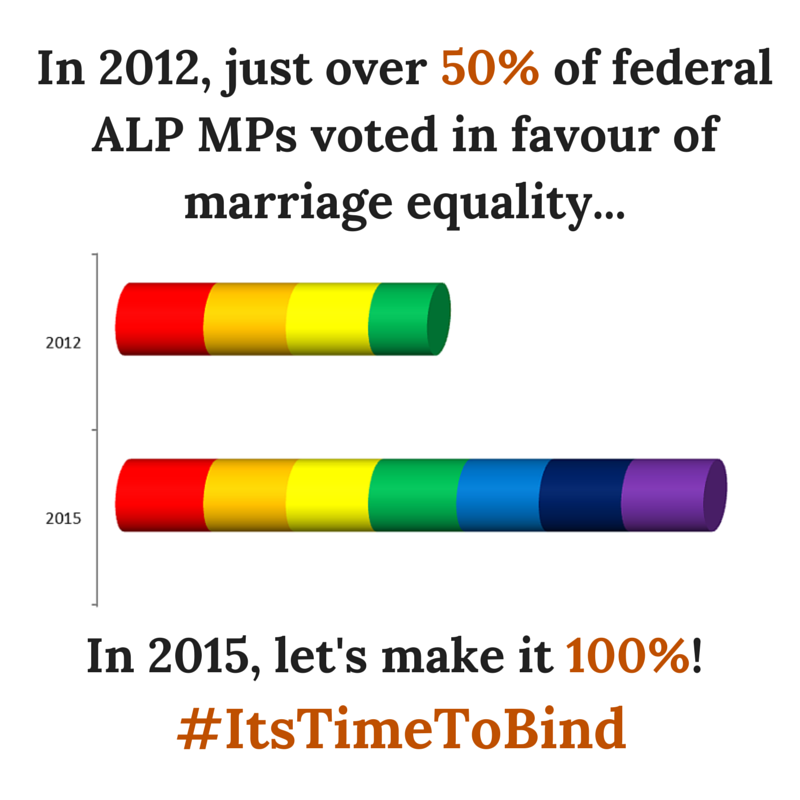
Now that the majority of the Australian community, a majority of Labor Party members, and a majority of its MPs and Senators, are in favour of marriage equality, there is no legitimate reason why there should not be another binding vote, only this time in support of equality rather than discrimination.

In 2015, rather than simply having a history of binding against marriage equality, the Australian Labor Party should make history by binding for it.

Finally, on a personal note, I want you to know that my fiancé Steve and I have been together for seven years, and have been engaged for more than five.

Just like thousands of other LGBTI-inclusive couples around the country, the length of our engagement has been, and continues to be, determined by decisions made in the House of Representatives, and Senate, and, just as relevantly, at ALP National Conferences.

And, just like thousands of other LGBTI people across Australia, we have grown tired of waiting for rights that are denied to us simply because of who we love.

The 2011 conference resolution, described above, guaranteed that marriage equality would not be passed during the past three and a half years, with the consequence that we would have to wait three and a half more years (at least) to enjoy those rights.

I implore you to do everything in your power to ensure that the 2015 National Conference does not make the same mistake, and instead supports a binding vote in favour of marriage equality so that it can be passed by the parliament as quickly as possible.

Because we deserve the right to set our own wedding dates, not the Parliament. And because we – Steve and I, and thousands of other couples just like us – have waited long enough already.

Sincerely

Alastair Lawrie

150403 50 percent versus 100 percent

Letter to ALP Caucus re Senator Leyonhjelm’s Freedom to Marry Bill 2014

The Hon Bill Shorten MP

Leader of the Opposition

c/- PO Box 6022

House of Representatives

Parliament House

Canberra ACT 2600

Monday 23 March 2015

Dear Mr Shorten

Please Amend Senator Leyonhjelm’s Freedom to Marry Bill 2014

I am writing to you regarding Senator Leyonhjelm’s Freedom to Marry Bill 2014, about which debate is scheduled to begin on Thursday 26 March 2015.

Specifically, I call on you, and all federal parliamentary members of the Australian Labor Party, to seek to amend this legislation during debate to remove provisions that would allow civil celebrants to refuse to provide services to LGBTI-inclusive couples, based on nothing more than the celebrant’s personal prejudice.

These provisions are wrong in principle, undermining legislation that is purported to promote the equal right to marriage by also expressly providing a ‘right’ to discriminate on the basis of homophobia, biphobia, transphobia and intersexphobia.

There is no justification to allow people providing secular services in a secular area of public life (ie non-religious wedding ceremonies) to discriminate on the basis of sexual orientation, gender identity or intersex status.

If passed, these provisions would also set a worrying precedent for other legislation. It is no coincidence that this legislation is being moved by an extremist who does not believe in the right not to be discriminated against in public life – indeed, Senator Leyonhjelm has previously stated that “[i]ndividuals should be able to discriminate but governments should not.”

In this way, the civil celebrant provisions of the Freedom to Marry Bill 2014 should be seen for what they are – the first steps in a campaign, supported by religious and libertarian extremists alike, to undermine Australia’s framework of anti-discrimination protections.

It took 38 years, from the passage of the Racial Discrimination Act 1975, for Australia’s lesbian, gay, bisexual, transgender and intersex (LGBTI) community to finally achieve protection against discrimination under Commonwealth law – the Sex Discrimination Amendment (Sexual Orientation, Gender Identity and Intersex Status) Act 2013 was an important achievement of, and is an essential legacy of, the previous Labor Government.

It would be devastating if the very next piece of LGBTI-related legislation to be considered by the Commonwealth Parliament were to directly undermine the right not to be discriminated against on the basis of sexual orientation, gender identity and intersex status, by instead granting civil celebrants the ‘right to be bigots’.

I sincerely hope that, given the Australian Labor Party has spent the past 12 months campaigning against Senator Brandis’ proposal that Australians should have the right to be bigots vis-à-vis racism, that you will also seek to amend these provisions that would enable bigotry of a different kind.

I also sincerely hope that enough of your parliamentary colleagues, including from the Greens and from the cross-bench, agree and that therefore these provisions are removed, meaning the Parliament can consider a Freedom to Marry Bill that is not also a ‘freedom to discriminate’ bill.

However, the question remains what the position of the Australian Labor Party should be if these amendments are unsuccessful, or if the House of Representatives insists on the Freedom to Marry Bill 2014 including the freedom to discriminate.

I acknowledge that this is an incredibly difficult decision to make – to reject the ability of LGBTI-inclusive couples to be married or to promote intolerance against those same people – indeed I have written previously of this exact dilemma: https://alastairlawrie.net/2014/12/21/senator-leyonhjelms-marriage-equality-bill-undermines-the-principle-of-lgbti-anti-discrimination-should-we-still-support-it/.

In the absence of LGBTI community consensus on this issue – and there can be no consensus because, as far as I can tell, there has been no genuine community debate or consultation – I am forced to fall back on my basic principles. And they are as follows:

I want marriage. I want the right to be married to my partner of almost seven years, my fiancé of more than five, in exactly the same way that my sister and my brother have been able to marry their respective spouses. There is absolutely no reason why I should have lesser rights than them simply because of who I love.

But, I want equality more. The principle of LGBTI equality is fundamental to any just society, and militates against the creation of ‘special rights’ or ‘special privileges’ to treat us as lesser citizens in any way.

To me, the struggle for LGBTI equality is broader than simply the battle for marriage: it includes improving the protections offered by anti-discrimination legislation (both state and federal), among many other things. This overall struggle is more important than any one Bill, and should not be undermined by the passage of flawed legislation such as this.

I will concede that there are those who wish to pursue the Freedom to Marry Bill 2014 in its current state, ‘warts and all’, as an incremental reform – a stepping stone – and to seek the removal of the civil celebrants provisions at a later date.

Not only do I believe that this could be labelled disingenuous – especially if concerns about these provisions are not placed on the public record ahead of the upcoming parliamentary debate – but it also under-estimates the difficulty of removing such legislative ‘blemishes’ after the central reform has passed.

For example, 33 years after the introduction of ‘homosexual’ anti-discrimination protections in NSW, the worst excesses of that particular compromise (such as the right of private schools to expel gay and lesbian students) remain seemingly intractable. It also took almost two decades to equalise the age of consent in NSW post-decriminalisation – and in Queensland their unequal age of consent is now 25 years old and counting.

Which means that it is no exaggeration to suggest that, if the Freedom to Marry Bill 2014 is passed in its present form, the so-called ‘right’ of civil celebrants to reject LGBTI-inclusive couples will likely still be around in 2025, 2030 or even beyond. And that is an unacceptable situation.

So, with a heavy heart, I urge you, and all federal parliamentary members of the Australian Labor Party to reject the Freedom to Marry Bill 2014 if you are unable to remove provisions which allow civil celebrants to discriminate on the basis of their personal prejudice.

Instead, I urge you to concentrate on passing other legislation, including the Marriage Equality Bill developed by the Deputy Leader of the Opposition, the Hon Tanya Plibersek MP, that does not promote homophobia, biphobia, transphobia and intersexphobia.

Marriage equality will be won, must be won, and it must be won soon. But it must also include both parts – marriage and equality. Senator Leyonhjelm’s Freedom to Marry Bill 2014 only offers the first half of that equation.

Please amend his flawed Bill and, if you are unsuccessful in doing so, please vote against it and instead support genuine marriage equality legislation in the (hopefully) not-too-distant future.

Thank you for taking this correspondence into consideration.

Sincerely

Alastair Lawrie

Cc The Hon Tanya Plibersek MP

Deputy Leader of the Opposition

PO Box 6022

House of Representatives

Parliament House

Canberra ACT 2600

Senator the Hon Penny Wong

Leader of the Opposition in the Senate

PO Box 6100

Senate

Parliament House

Canberra ACT 2600

The Hon Mark Dreyfus QC MP

Shadow Attorney-General

PO Box 6022

House of Representatives

Parliament House

Canberra ACT 2600

Letter to Bruce Notley-Smith re Baird Liberal-National Government Commitments on NSW Anti-Discrimination Act 1977

Mr Bruce Notley-Smith MP

80 Bronte Road

Bondi Junction NSW 2022

coogee@parliament.nsw.gov.au

Sunday 1 March 2015

Dear Mr Notley-Smith

REVIEW OF NSW ANTI-DISCRIMINATION ACT 1977

I am writing as an attendee at the recent #rainbowvotes forum, where five Members of Parliament from across the political spectrum, including yourself, outlined their respective approaches to lesbian, gay, bisexual, transgender and intersex (LGBTI) issues ahead of the upcoming NSW State Election.

Specifically, I am seeking clarification of your answers concerning the NSW Anti-Discrimination Act 1977 and what action you, and the Liberal-National Government, will take if you are re-elected.

At the forum, the representative attending on behalf of the NSW Labor Opposition, Ms Penny Sharpe MLC, gave a clear commitment that, if elected, a Foley Labor Government would undertake a formal review of the Anti-Discrimination Act 1977.

Following that clear commitment, you made several comments that appeared to indicate your personal support for such an approach.

However, later during the same forum, you indicated that you were appearing at the forum in your capacity as an individual MP only, and not as a spokesperson for the current Baird Liberal-National Government.

As a result, I sought clarification from you, via twitter, whether it is indeed NSW Liberal policy to support a formal review of the Anti-Discrimination Act 1977.

Given I have not received a response via social media, I am now writing to you more formally, with essentially the same question: is the Baird Liberal-National Government committed to reviewing the Anti-Discrimination Act 1977 if it is re-elected on Saturday 28 March 2015?

As I have written previously (see: https://alastairlawrie.net/2015/02/20/questions-for-mps-and-candidates-during-sydney-gay-lesbian-mardi-gras/ ), I believe the NSW Anti-Discrimination Act 1977 is now the worst LGBTI anti-discrimination legislation in Australia.

This is because:

  • It fails for protect bisexual people from discrimination (the only jurisdiction in the country to do so)
  • It fails to protect intersex people from discrimination
  • The religious exceptions in sub-section 56(d) are the broadest in Australia
  • The exceptions allowing all private schools to discriminate against lesbian, gay and transgender students are abhorrent
  • It fails to protect both bisexuals and intersex people from vilification and
  • The maximum individual fine for lesbian, gay and transgender vilification is only one-fifth of the maximum fine for racial vilification.

For all of these reasons, I believe that the Anti-Discrimination Act 1977 should be amended as a matter of priority.

However, if you are unable to give a clear commitment that a re-elected Baird Liberal-National Government would make changes to these provisions, I submit that, at the bare minimum you, and the Government, should be able to commit to holding a formal review of this narrow and out-dated legislation.

Given there are now less than four weeks left until polling day, I would appreciate a response to this letter, outlining what commitments (if any) the Liberal-National Government is prepared to make in this area, at your earliest convenience.

I have also copied the Premier, the Hon Mike Baird MP, and the Attorney-General, the Hon Brad Hazzard MP, into this correspondence.

Thank you in advance for you consideration of the issues raised in this letter.

Sincerely,

Alastair Lawrie

cc: The Hon Mike Baird MP, NSW Premier

GPO Box 5341

Sydney NSW 2001

The Hon Brad Hazzard MP, NSW Attorney-General

GPO Box 5341

Sydney NSW 2001

office@hazzard.minister.nsw.gov.au

Will Liberal Member for Coogee, Bruce Notley-Smith, be able to provide a clear commitment to review the Anti-Discrimination Act 1977?

Will Liberal Member for Coogee, Bruce Notley-Smith, be able to provide a clear commitment to review the Anti-Discrimination Act 1977?

Questions for MPs and Candidates During Sydney Gay & Lesbian Mardi Gras

Today is the official launch of Sydney Gay & Lesbian Mardi Gras, with a large and diverse festival leading up to the 37th official Mardi Gras Parade on Saturday March 7th 2015.

In recent years, as mainstream acceptance of the lesbian, gay, bisexual, transgender and intersex (LGBTI) community has grown, so too has the tendency of politicians, and would-be politicians, to appear at Mardi Gras events as a way of engaging with, and directly appealing to, LGBTI voters.

This year, Sydney Gay & Lesbian Mardi Gras overlaps with the campaign for the NSW State Election, to be held on Saturday March 28th, meaning there will likely be more Members of Parliament and candidates around than ever, trying ever-so-hard to convince us to vote for them.

Which is our opportunity to make them work (or should that be ‘werk’) for it. If MPs and candidates are going to come to our festival, then they should be made to respond to our questions (and it is our responsibility to tell them if and when their answers just aren’t good enough).

Of course, there are lots of different topics we could raise, but one issue which I would like to hear about is what each candidate – and political party – is going to do to fix the NSW Anti-Discrimination Act 1977, which now holds the dubious ‘honour’ of being the worst LGBTI anti-discrimination law in the country.

To start with, it only offers anti-discrimination protections to three of the five letters of the rainbow alphabet: lesbian, gay and transgender people.

That’s right, despite featuring the first gay anti-discrimination protections enacted in Australia (passed in 1982, so early in fact that it preceded the decriminalisation of male homosexuality in NSW by two years), the Anti-Discrimination Act has never formally protected bisexual people from discrimination[1].

All other Australian states and territories, and the Commonwealth, protect bisexuals, either specifically, or as part of ‘sexual orientation’. This ongoing exclusion from the NSW anti-discrimination scheme is nothing short of appalling.

The exclusion of intersex people, while perhaps more understandable – given the first explicit intersex anti-discrimination protections in the world were introduced in the Commonwealth’s Sex Discrimination Amendment (Sexual Orientation, Gender Identity and Intersex Status) Act 2013 less than two years ago (and only Tasmania has since followed suit) – is no less unacceptable.

The NSW Anti-Discrimination Act 1977 also has the broadest religious exceptions in the nation. Sub-section 56(d) effectively gives religious organisations carte blanche to actively discriminate against lesbian, gay and transgender people across most areas of public life.

Sub-section 56(d) states that “[n]othing in this Act affects… any other act or practice of a body established to propagate religion that conforms to the doctrines of that religion or is necessary to avoid injury to the religious susceptibilities of the adherents of that religion”.

That protects pretty much any action that a religious healthcare provider, community service, or school, might wish to take against LG&T employees, or people accessing those services, in this state.

Not that religious schools even need to rely on sub-section 56(d). In two of the most offensive provisions in Australian law today (not just anti-discrimination law, but any law), under the Anti-Discrimination Act all private schools in NSW (yes, even the non-religious ones) can explicitly refuse to enrol, can enrol under different conditions, and can expel, students solely because they are lesbian, gay or transgender.

These provisions are so utterly awful that they bear quoting in full:

Section 49ZO Education

  • It is unlawful for an educational authority to discriminate against a person on the ground of homosexuality:
    1. By refusing or failing to accept the person’s application for admission as a student, or
    2. In the terms on which it is prepared to admit the person as a student.
  • It is unlawful for an educational authority to discriminate against a student on the ground of homosexuality:
    1. By denying the student access, or limiting the student’s access, to any benefit provided by the educational authority, or
    2. By expelling the student or subjecting the student to any other detriment
  • Nothing in this section applies to or in respect of a private educational authority.” [emphasis added]

AND

Section 38K Education

  • It is unlawful for an educational authority to discriminate against a person on transgender grounds:
    1. By refusing or failing to accept the person’s application for admission as a student, or
    2. In the terms on which it is prepared to admit the person as a student.
  • It is unlawful for an educational authority to discriminate against a student on transgender grounds:
    1. By denying the student access, or limiting the student’s access, to any benefit provided by the educational authority, or
    2. By expelling the student or subjecting the student to any other detriment.
  • Nothing in this section applies to or in respect of a private educational authority.” [emphasis added]

There is absolutely no justification for this type of sexual orientation and gender identity segregation in our schools, in any schools. And we should challenge any MP or candidate who comes along to Mardi Gras and attempts to defend it.

The anti-vilification protections of the NSW Anti-Discrimination Act 1977 are only slightly less bad. On the positive side, NSW is one of only four jurisdictions in the country to have some form of anti-vilification laws covering our community – and that is certainly better than the Commonwealth, which has section 18C of the Racial Discrimination Act 1975 for racial vilification, but no LGBTI equivalent.

On the negative side, as with anti-discrimination, NSW legislation only protects against lesbian, gay and transgender vilification, and does not extend to vilification against bisexuals or intersex people.

Meanwhile, on the you’ve-got-to-be-kidding side (or, less politely, the WTF?-side), did you know that the maximum fine which an individual can receive for the offences of homosexual[2] or transgender[3] vilification is actually only one-fifth of the maximum individual fine for racial[4] vilification?

How on earth did anyone ever think that such a distinction – for offences which otherwise have exactly the same wording – was appropriate? More importantly, isn’t anyone who defends such a distinction in effect saying that vilifying lesbian, gay and transgender people is less offensive (perhaps even only one-fifth as bad) than vilifying people on the basis of race?

As you can see, there are many things distinctly wrong with the Anti-Discrimination Act 1997. As a consequence, there are many questions to ask Members of Parliament and candidates who attend Mardi Gras events over the next fortnight-and-a-bit.

And we should be asking those questions, not just at the LGBTI State Election Forum on Wednesday February 25th (details here: http://www.acon.org.au/about-acon/Newsroom/Media-Releases/2014/130 and free tickets here: http://www.eventbrite.com.au/e/nsw-state-election-forum-2015-tickets-15400759085) but also at Mardi Gras Fair Day on Sunday February 22nd, at the Parade on Saturday March 7th (asking them in the Parade marshalling area is probably your best bet), and at any other event at which they hold out a leaflet or put up a corflute.

To assist, I have attempted to summarise the above criticisms of the NSW Anti-Discrimination Act 1977 in the following six questions. Please feel free to use them whenever an MP or candidate might raise their heads during Mardi Gras (or in the run-up to polling day itself):

  1. Will you amend the Anti-Discrimination Act 1977 to protect bisexual and intersex people from discrimination?


  1. Will you repeal sub-section 56(d) of the Anti-Discrimination 1977 which currently grants the broadest religious exceptions to anti-discrimination laws in the country?


  1. Will you repeal sections 49ZO and 38K of the Anti-Discrimination Act 1977 which allow all private schools and colleges the right to refuse enrolment of, impose special conditions on or expel lesbian, gay and transgender students?


  1. Will you amend the Anti-Discrimination Act 1977 to protect bisexual and intersex people from vilification?


  1. Will you amend the Anti-Discrimination Act 1977 to harmonise the penalties for vilification, rather than having a higher penalty for racial vilification than homosexual or transgender vilification? And


  1. If you are unable to make the above commitments, will you at least agree to conduct a review of the Anti-Discrimination Act 1977, which is now the most out-dated and worst LGBTI anti-discrimination law in Australia?

These are the questions which I would like answered during Sydney Gay & Lesbian Mardi Gras. I wonder which MPs and candidates are going to ‘come to the party’ (so to speak) by supporting better anti-discrimination laws for the entire LGBTI community.

"Religious exceptions are this wide." Actually, Premier Baird, they're a lot wider than that. Time to repeal sub-section 56(d) of the NSW Anti-Discrimination Act 1977.

“Religious exceptions are this wide.” Actually, Premier Baird, they’re a lot wider than that. Time to repeal sub-section 56(d) of the  Anti-Discrimination Act 1977.

After much contemplation, Opposition Leader Luke Foley this week finally joined the 21st century by supporting marriage equality. Will he also support a 21st century Anti-Discrimination Act?

After much contemplation, Opposition Leader Luke Foley this week finally joined the 21st century by supporting marriage equality. Will he also support a 21st century Anti-Discrimination Act?

Finally, if you manage to secure a response from MPs or candidates on these questions during Sydney Gay & Lesbian Mardi Gras, whether that response is negative or positive, please leave their answers in the comments section below.

And, if you want to raise them directly with some of the relevant decision-makers, here are some people you might wish to contact:

Liberals

Premier Mike Baird

Email https://www.nsw.gov.au/your-government/contact-premier-new-south-wales

Phone 02 8574 5000

Twitter https://twitter.com/mikebairdMP

Attorney-General Brad Hazzard

Email office@hazzard.minister.gov.au

Phone 02 8574 6000

Twitter https://twitter.com/BradHazzard

Labor

Opposition Leader Luke Foley

Email leader.opposition@parliament.nsw.gov.au

Phone 02 9230 2310

Twitter https://twitter.com/Luke_FoleyNSW

Shadow Attorney-General Paul Lynch

Email ElectorateOffice.Liverpool@parliament.nsw.gov.au

Phone 02 9602 0040

Greens

Attorney-General Portfolio Spokesperson David Shoebridge

Email david.shoebridge@parliament.nsw.gov.au

Phone 02 9230 3030

Twitter https://twitter.com/ShoebridgeMLC

[1] Section 49ZG refers to discrimination on the basis of ‘homosexuality’, with ‘homosexual’ defined in section 4 as ‘homosexual means male or female homosexual’.

[2] Section 49ZTA sets the maximum individual punishment for serious homosexual vilification at 10 penalty units, or imprisonment for 6 months, or both.

[3] Section 38T provides that the maximum individual punishment for serious transgender vilification is 10 penalty units, or imprisonment for 6 months, or both.

[4] Section 20D establishes the maximum individual punishment for serious racial vilification: 50 penalty units, or imprisonment for 6 months, or both.

Submission to Australian Law Reform Commission Traditional Rights and Freedoms Inquiry

The Australian Law Reform Commission is currently conducting an inquiry into Traditional Rights and Freedoms – Encroachment by Commonwealth Laws (at the behest of Commonwealth Attorney-General, Senator the Hon George Brandis). They have released an Issues Paper for public consultation, with submissions due by Friday 27 February 2015. For more information about the inquiry, see <http://www.alrc.gov.au/inquiries/freedoms The following is my submission, focusing on LGBTI vilification, religious exceptions to anti-discrimination law, and asylum-seekers and refugees, including LGBTI refugees.

The Executive Director

Australian Law Reform Commission

GPO Box 3708

Sydney NSW 2001

c/- freedoms@alrc.gov.au

Sunday 15 February 2015

To whom it may concern

SUBMISSION TO TRADITIONAL RIGHTS AND FREEDOMS INQUIRY

Thank you for the opportunity to provide a submission to the Traditional Rights and Freedoms – Encroachment by Commonwealth Laws Inquiry.

The subject of human rights and freedoms, and how they should best be protected, both by and from Government, is an important one, and is worthy of substantive consideration.

In this submission, I will focus on three particular areas in which the rights of people are currently being breached as a result of Commonwealth Government action, or in some cases, inaction:

  1. The Commonwealth Government’s failure to protect lesbian, gay, bisexual, transgender and intersex (LGBTI) Australians from vilification
  2. The Commonwealth Government’s tacit endorsement of discrimination, by religious organisations, against lesbian, gay, bisexual and transgender (LGBT) Australians, and
  3. The gross violation of human rights of asylum-seekers and refugees, including LGBTI refugees, by the Commonwealth Government.

Before I move to these issues in more detail, however, I wish to express my concern about the Terms of Reference (provided by Attorney-General, Senator the Hon George Brandis) and therefore the overall direction of this inquiry.

The way in which the Terms of Reference have been formulated, and consequently the manner in which the Issues Paper has been drafted, appears to prioritise some rights above others, merely because they are older, or are found in common law, rather than being more modern rights or founded through legislation or international human rights documents.

This is an unjustified distinction, and makes it appear, at the very least, that property rights or ‘the common law protection of personal reputation’ (aka protection against defamation) are more important than other rights, such as freedom from vilification or discrimination.

My criticism of this inquiry is therefore similar to that of the Rights & Responsibilities 2014 Discussion Paper released by the Human Rights Commissioner Mr Tim Wilson. From my submission to that inquiry[1]:

“Specifically, I would argue that the prioritising of certain rights above others potentially neglects and devalues the importance of those other rights which are no less essential to ensuring that all Australians are able to fully participate in modern society.

From my point of view, chief among these rights is the right to non-discrimination, or to put it another way (which may be more favourably received), to be free from discrimination, including unfair or adverse treatment on the basis of sexual orientation, gender identity and intersex status.

The right to non-discrimination is fundamental in international human rights law adopted immediately post-World War II. Article 2(1) of the International Covenant on Civil and Political Rights (ICCPR) provides that:

“Each State Party to the present Covenant undertakes to respect and to ensure all individuals within its territory and subject to its jurisdiction the rights recognised in the present Covenant, without distinction of any kind such as race, colour, sex, language, religion, political or other opinion, property, birth or other status.”

Similarly, article 21 of the ICCPR establishes that:

“All persons are equal before the law and are entitled without any discrimination to the equal protection of the law. In this respect, the law shall prohibit any discrimination and guarantee to all persons equal and effective protection against discrimination on any ground such as race, colour, sex, language, religion, political or other opinion, national or social origin, property, birth or other status.”

The United Nations Human Rights Committee has, in cases which both involved complaints by Australian citizens against actions by the Tasmanian and Commonwealth Government respectively, found that the wording of these articles includes the right to be free from discrimination on the basis of sexual orientation.[2]

The Commonwealth Parliament has also recognised that the right to non-discrimination for lesbian, gay, bisexual, transgender and intersex (LGBTI) Australians is worthy of protection, with the passage of the Sex Discrimination Amendment (Sexual Orientation, Gender Identity and Intersex Status) Act 2013.

This historic legislation, providing similar rights to non-discrimination to those already enjoyed on the basis of race, sex, disability and age, was a significant, albeit long overdue, step forward for the LGBTI community. For this reason, I would not wish to see the right to be free from discrimination on these attributes to be diminished in comparison to other, more ‘traditional’ rights.

Unfortunately, that is the almost inevitable conclusion of a consultation process which aims to consider “how effectively we protect people’s human rights and freedoms in Australia”… but which then only focuses on a small number of freedoms, including the right to property, but which neglects others.”

[End extract]

Encouragingly, the ALRC at least acknowledges, on page 31, that “[f]reedom from discrimination is also a fundamental human right.” But the Issues Paper does not include a chapter on this right, nor does it include it within the list of “[o]ther rights, freedoms and privileges” in Chapter 19.

I believe that this imbalance, in examining and prioritising some fundamental rights, while essentially ignoring others, undermines the utility of this process – and is something which must be redressed in the Final Report, expected by December 2015.

I turn now to three particular areas in which the Commonwealth Government either itself breaches human rights, or authorises others to do so.

  1. The Commonwealth Government’s failure to protect lesbian, gay, bisexual, transgender and intersex (LGBTI) Australians from vilification

[NB This topic relates to Chapter Two: Freedom of Speech, and its questions:

  • What general principles or criteria should be applied to help determine whether a law that interferes with freedom of speech is justified?
  • Which Commonwealth laws unjustifiably interfere with freedom of speech, and why are these laws unjustified?]

I acknowledge the importance of the right to freedom of expression, or freedom of speech. However, I also welcome the Issues Paper’s acknowledgement that there are possible justifications for encroachment on this right. In particular, the Issues Papers notes, at paragraph 2.2.4 on page 26:

“Similarly, laws prohibit, or render unlawful, speech that causes harm, distress or offence to others through incitement to violence, harassment, intimidation or discrimination.”

This obviously includes the prohibition on racial vilification contained in section 18C of the Commonwealth Racial Discrimination Act 1975[3].

My primary question is why laws should be established to prohibit ‘advocacy of national, racial or religious hatred’ but not to prohibit advocacy of hatred on other grounds, including sexual orientation, gender identity or intersex status.

The impact of vilification on these grounds, and the negative influence of public homophobia, biphobia, transphobia and intersexphobia more generally, is just as harmful as racial or religious vilification, and therefore I can see no good reason why there should not also exist equivalent anti-vilification protections covering LGBTI Australians a Commonwealth level.

It is for this reason that I provided a submission last year in response to the Senator Brandis’ Exposure Draft Bill seeking to repeal section 18C, in which I argued that, instead of abolishing racial vilification laws, similar protections against vilification on the basis of sexual orientation, gender identity and intersex status should be added to the Sex Discrimination Act 1984[4].

In short, if there should be a law to protect against the incitement to discrimination, hostility or violence on the basis of race, then there should also be a law to protect people on the basis of sexual orientation, gender identity and intersex status.

The fact that there is no such Commonwealth law means that the Government is currently failing in its duty to protect LGBTI Australians from vilification.

Finally, I note that this answer is, in some respects, contrary to the intention of “Question 2-2: [w]hich Commonwealth laws unjustifiably interfere with freedom of speech, and why are these laws unjustified?” because it instead proposes an additional area where freedom of speech should be limited.

I submit that such an answer is necessary to redress the imbalance contained in the Terms of Reference, and Issues Paper, because the right to freedom from vilification is equally worthy of recognition, and protection, in Commonwealth law. It is a right that should be extended to LGBTI Australians as a matter of priority.

  1. The Commonwealth Government’s tacit endorsement of discrimination, by religious organisations, against lesbian, gay, bisexual and transgender (LGBT) Australians

[NB This topic relates to Chapter 3: Freedom of Religion, and its questions:

  • What general principles or criteria should be applied to help determine whether a law that interferes with freedom of religion is justified?
  • Which Commonwealth laws unjustifiably interfere with freedom of religion, and why are these laws unjustified?]

I acknowledge the fundamental importance of the right to freedom of religion. However, just as importantly, I support the statement on page 31 of the Issues Paper that:

“[f]reedom of religion is fundamental, but so too is freedom from discrimination on the grounds of gender, race, sexual orientation or some other protected attribute. Freedom from discrimination is also a fundamental human right.”

Indeed, the case at paragraph 3.20 on the same page, namely R v Secretary of state for education and employment; ex parte Williamson (2005) from the UK, provides a useful formulation:

“… there is a difference between freedom to hold a belief and freedom to express or ‘manifest’ a belief. The former right, freedom of belief, is absolute. The latter right, freedom to manifest, is qualified. This is to be expected, because the way a belief is expressed in practice may impact on others.”

Unfortunately, I do not believe that Australian law currently strikes the right balance between respecting the right to freedom of religion, and protecting others from the harms caused by the manifestation of those beliefs, including through breaches of the right to non-discrimination on the basis of sexual orientation, gender identity and intersex status.

Specifically, I am concerned that the broad exceptions and/or exemptions which are provided to religious organisations under Commonwealth, state and territory anti-discrimination laws, including those protections added by the Sex Discrimination Amendment (Sexual Orientation, Gender Identity and Intersex Status) Act 2013, are far too generous.

In practice, these exceptions provide Government approval and endorsement of the discriminatory treatment of lesbian, gay, bisexual and transgender (LGBT) Australians by religious bodies in a large number of areas of public life[5].

For example, the combined impact of sub-section 37(1)(d) of the amended Sex Discrimination Act 1984[6] and section 38 of the same law (which applies to educational institutions established for religious purposes), means that, according to Commonwealth law:

  • Religious schools can freely discriminate against lesbian, gay, bisexual and transgender students, including expelling those students simply for being who they are;
  • Religious schools can also freely discriminate against LGBT staff members, including by refusing to provide or terminating their employment, where sexual orientation and gender identity is completely irrelevant to the ability of that person to perform the duties of the role;
  • Religious health and community services can similarly discriminate against both LGBT employees/potential employees, as well as LGBT individuals and families accessing these services, with impunity; and
  • Religious aged care services can discriminate against LGBT employees or potential employees.[7]

It is difficult to see how these exemptions, which allow LGBT people to be discriminated against simply as they seek to obtain an education, or access healthcare (which are themselves fundamental international human rights), and to be treated unfairly in employment in a large number of jobs across a wide range of areas, is not a gross breach of their human rights.

Religious exceptions and exemptions under Commonwealth, state and territory anti-discrimination laws allow serious harm to be caused to LGBT Australians, on a day-to-day basis and across multiple spheres of public life, and, I submit, should be significantly curbed.

To this end, I believe the religious exemptions which are included in sub-sections 37(1)(a),(b) and (c) of the Sex Discrimination Act 1984[8], if supplemented by exemptions covering how religious ceremonies are conducted, are both more justifiable in being better targeted to protecting freedom of religious worship itself, and less likely to result in harm to LGBT people through the breach of their right to non-discrimination across broad areas of public life. These are the only religious exemptions that, I believe, should be retained.

This, much narrower, form of religious exemptions would, in my view, also be a more appropriate outcome of a system of human rights that seeks to both protect fundamental rights, and promote the responsibility not to infringe upon the fundamental rights of others.

Finally, as with my previous answer, I note that this discussion is potentially contrary to the intention of “Question 3-2: Which Commonwealth laws unjustifiably interfere with freedom of religion, and why are these laws unjustified?” because it highlights an area where, arguably, freedom of religion should be further restrained.

I believe that providing this answer is nevertheless important because, in Australia, freedom of religion is not unduly limited. Instead, freedom of religion is unjustifiably privileged, including where it tramples upon the rights of others, and especially the rights of lesbian, gay, bisexual and transgender Australians not to be discriminated against in public life.

A mature discussion of rights and freedoms would recognise this serious imbalance and seek to redress it, by ensuring that religious exceptions to and exemptions from anti-discrimination law only protected genuine freedom of religious worship, not establishing a supposed ‘right’ to discriminate against people on the basis of sexual orientation and gender identity.

  1. The gross violation of human rights of asylum-seekers and refugees, including LGBTI refugees, by the Commonwealth Government

I am not an expert in migration and refugee law, nor in the international human rights instruments that apply in this area.

Nevertheless, I know enough about this subject matter to submit that:

  • Seeking asylum is a human right, and is not a criminal act, irrespective of the manner of arrival (whether by plane or by boat),
  • Responding to people exercising their right to seek asylum by detaining them in offshore processing centres, indefinitely, in inhumane conditions, and without free and fair access to justice, is a fundamental breach of their human rights, and
  • An inquiry into the encroachment by Commonwealth laws upon traditional rights and freedoms would be incomplete without a thorough examination of this issue.

As a long-term LGBTI advocate and activist, I also feel compelled to raise the specific issue of LGBTI asylum seekers and refugees being processed and ultimately resettled in countries that criminalise homosexuality, namely Nauru and Papua New Guinea.

As I have written to several Commonwealth Immigration Ministers, under both Labor[9] and Liberal-National[10] Governments, such a policy clearly abrogates the responsibilities that the Commonwealth Government has towards LGBTI asylum-seekers.

From my letter to then Minister for Immigration the Hon Scott Morrison MP:

“… the mistreatment of LGBTI asylum seekers and refugees raises particular problems, problems that do not appear to be recognised by the Australian Government. Nor does there appear to be any evidence the Government is taking action to remedy them.

Even if the offshore processing and permanent resettlement of refugees continues, this must not include the processing and resettlement of LGBTI asylum seekers and refugees in countries which criminalise homosexuality (which both PNG and Nauru currently do).

If you, as Minister for Immigration and Border Protection and therefore Minister responsible for the welfare of asylum seekers and refugees, cannot guarantee that sections 210 and 212 of the PNG Penal Code do not apply to detainees on Manus Island, then you cannot send LGBTI people there in good conscience.

If you, as Minister for Immigration and Border Protection, cannot guarantee that LGBTI asylum seekers and refugees will not be subject to homophobic bullying and harassment, and will be free to lodge claims for protections on the basis of persecution due to their sexual orientation, gender identity or intersex status, then you must not detain them in such facilities.”

[End extract]

As I indicated at the beginning of this section, I am not an expert in this area of law, and therefore am not in a position to provide a more thorough analysis of the (multiple) breaches of human rights law involved in the offshore processing and resettlement of asylum seekers and refugees. I am confident, however, that there will be a number of submissions from human rights and refugee organisations in coming weeks that will do exactly that.

Nevertheless, I felt obliged to include this issue in my submission, given both the severity of the human rights breaches involved, and because of their particular impact on LGBTI asylum seekers and refugees, whose only ‘crime’ is to have sought the protection of our Government.

In conclusion, I wish to thank the Law Reform Commission again for the opportunity to provide this submission, and consequently to raise issues of concern for LGBTI people, namely the absence of anti-vilification protection in Commonwealth law, the breach of our right to non-discrimination because of religious exemptions in the Sex Discrimination Act, and the mistreatment of asylum seekers and refugees, including LGBTI refugees, by the Commonwealth Government.

I look forward to these issues being addressed in the inquiry’s Final Report, to be released by the end of 2015.

Sincerely

Alastair Lawrie

[1] Full submission at: https://alastairlawrie.net/2014/10/27/submission-to-rights-responsibilities-2014-consultation/

[2] Human Rights Committee, Toonen v Australia, Communication No. 488/1992, UN Doc CCPR/C/50/D/488/92 and Human Rights Committee, Young v Australia, Communication No. 941/2000, UN Doc CCPR/C/78/D/941/2000.

[3] “Offensive behaviour because of race, colour or national or ethnic origin.

  • It is unlawful for a person to an act, otherwise than in private, if:
  • the act is reasonably likely, in all the circumstances, to offend, insult, humiliate, or intimidate another person or a group of people; and
  • the act is done because of the race, colour or national or ethnic origin of the other person or of some or all of the people in the group.”

[4] Full submission at: https://alastairlawrie.net/2014/04/24/dont-limit-racial-vilification-protections-introduce-vilification-protections-for-lgbti-australians-instead/

[5] Noting that the religious exemptions contained in the Sex Discrimination Act 1984 do not apply to intersex status, only to sexual orientation and gender identity.

[6] Which provides that “[n]othing in Division 1 or 2 affects… any other act or practice of a body established for religious purposes, being an act or practice that conforms to the doctrines, tenets or beliefs of that religion or is necessary to avoid injury to the religious susceptibility of adherents of that religion.”

[7] Noting that the religious exemptions contained in the Sex Discrimination Act 1984 do not apply to LGBT people accessing aged care services.

[8] “Nothing in Division 1 or 2 affects:

  • the ordination or appointment of priests, ministers of religion or members of any religious order;
  • the training or education of persons seeking ordination or appointment as priests, ministers of religion or members of a religious order;
  • the selection or appointment of persons to perform duties or functions for the purposes of or in connection with, or otherwise to participate in, any religious observance or practice…”

[9] My letter to Labor Immigrations Ministers, the Hon Chris Bowen and the Hon Brendan O’Connor from 2012 and 2013: https://alastairlawrie.net/2012/09/07/letter-to-chris-bowen-on-lgbti-asylum-seekers/

[10] My letter to then Immigration Minister the Hon Scott Morrison from February 2014: https://alastairlawrie.net/2014/02/02/letter-to-scott-morrison-about-treatment-of-lgbti-asylum-seekers-and-refugees-sent-to-manus-island-png/


Submission to Australian Human Rights Commission Sexual Orientation, Gender Identity and Intersex (SOGII) Rights Consultation

One of my favourite campaigns of recent times – It Gets Better – performs a valuable role, letting vulnerable LGBTI youth know that, while the homophobia, biphobia, transphobia and intersexphobia they may be experiencing is awful, for most of them, it will get better. I emphasise the word most here because we should always remember that it does not get better for everyone.

Meanwhile, as the LGBTI movement itself ‘ages’, many of us are increasingly celebrating the past, and reflecting on significant community milestones (such as last year’s 30th anniversary of the decriminalisation of male homosexuality in NSW, or the 40th anniversary of Sydney’s Gay & Lesbian Mardi Gras which is now only three years away). But, while absolutely necessary, looking backwards should never obscure the challenges that remain ahead.

This consultation, including an examination of legislation, policies and practices by government(s) that unduly restrict sexual orientation, gender identity and intersex rights, provides an opportunity to highlight some of the major obstacles which continue to prevent LGBTI Australians achieving full equality. In this submission, I will concentrate on six such areas:

  1. Involuntary or coerced sterilisation of intersex children

These unjustified practices – surgeries performed with the aim of ‘normalising’ intersex children according to the expectations of their parents, their doctors, and/or society at large, so that they conform to an exclusionary man/woman binary model of sex – are human rights abuses, plain and simple.

Obviously done without the child’s consent, such practices can involve sterilisation, as well as other ‘cosmetic’ (ie unnecessary), largely irreversible surgery on genitalia to make their bodies fit within the idea of what a man or woman ‘should’ be, ignoring the individual involved and their fundamental rights to bodily integrity, and personal autonomy.

That these practices continue in 2015 is abhorrent – and the fact the Commonwealth Government has yet to formally respond to the Senate’s 2013 Report into this issue (http://www.aph.gov.au/Parliamentary_Business/Committees/Senate/Community_Affairs/Involuntary_Sterilisation/Sec_Report/~/media/Committees/Senate/committee/clac_ctte/involuntary_sterilisation/second_report/report.ashx) is, or at least should be, a scandal.

  1. Restrictions on the rights of transgender people

Another group within the LGBTI community whose rights continue to trail those whose identities are based on sexual orientation (lesbian, gay and bisexual people) are transgender Australians.

This includes the fact there continue to be ‘out-of-pocket’, in many cases quite significant, expenses for medical support for trans* people simply to affirm their gender identity. This is a denial of their human rights – access to trans* surgeries and related medical services should not be restricted by the capacity to pay, but instead should be fully publicly-subsidised through Medicare.

The ongoing requirement that married transgender Australians must divorce their spouses in order for their gender identity to be legally recognised is also a fundamental breach of their rights, and must end.

  1. Processing and resettlement of LGBTI refugees in countries which criminalise homosexuality

Australian Governments, of both persuasions, are guilty of violating the human rights of LGBTI refugees. These are people who are (often) fleeing persecution on the basis of their sexual orientation, gender identity or intersex status, and seeking our protection.

Australia’s response? To detain them, indefinitely, in inhumane prison camps on Nauru and Manus Island. For many, while detained they are at risk of prosecution under the laws of Papua New Guinea and/or Nauru, both of which continue to criminalise male-male intercourse. Even after they are found to be refugees, they are then ‘resettled’ in these countries, in effect exposing people who have fled persecution to potentially more persecution.

While I believe the offshore processing and resettlement of all refugees is unjust, it should be recognised it has a disproportionately negative impact on LGBTI refugees.

  1. Denial of the right of LGBTI students to an inclusive education

It is encouraging that greater numbers of young LGBTI people feel comfortable in disclosing their status at an earlier age – and for some, that they attend genuinely inclusive schools. However, this inclusion is by no means universal.

For example, the recently developed national Health & Physical Education curriculum does not even include the words lesbian, gay or bisexual, and does not guarantee students will be taught comprehensive sexual health education (even omitting the term HIV). This is a massive failure to ensure all students learn vital information that is relevant to their health.

Similarly, while the national Safe Schools Program is a welcome initiative to counter homophobia and bullying, participation in the program is optional, with most schools (and even some entire jurisdictions) opting out. The right to attend school free of discrimination should not depend on a student’s geographic location, or their parent/s’ choice of school.

Finally, religious exceptions to anti-discrimination legislation (in all jurisdictions outside Tasmania), mean many LGBTI students are at risk of discrimination, by their school, simply for being who they are.

  1. Limitations on anti-discrimination protections

Students are not the only LGBTI individuals let down by Australia’s current anti-discrimination framework. These same religious exceptions mean that, in most jurisdictions, LGBTI people can be discriminated against in a wide range of areas of public life, both as employees and people accessing services, in education, health, community services and (as employees) in aged care.

The attributes which are protected under anti-discrimination law also vary widely, with intersex people only truly protected under Commonwealth and Tasmanian law, different definitions of transgender (including extremely narrow protections in Western Australian legislation), and NSW excluding bisexual people altogether.

Finally, only four jurisdictions have vilification protections for (some) members of the LGBTI community – with no Commonwealth LGBTI equivalent of section 18C of the Racial Discrimination Act.

  1. Ongoing lack of marriage equality

I include this not because I consider it as important as the issues listed above, but simply as someone who has been engaged to be married for more than five years – and has no idea how much longer he will have to wait to exercise the same rights as cisgender heterosexual couples, with the only difference being who I love. Marriage discrimination is wrong, it is unjust, and it must go.

This submission is by no means comprehensive – there are a variety of other issues which I have excluded due to arbitrary word length restrictions (including mental health issues, anti-LGBTI violence, and discrimination against rainbow families – with my partner and I able to adopt in Sydney, but not Melbourne or Brisbane).

In conclusion, while it does get better, and over time, it most certainly has got better, there are still many ways in which the rights of LGBTI Australians continue to be denied – and about which we, as LGBTI advocates and activists, should remain angry, and most importantly, take action.

Human Rights Commissioner Tim Wilson, who is leading the consultation on SOGII Rights

Human Rights Commissioner Tim Wilson, who is leading the consultation on SOGII Rights

NB Public submissions to the AHRC SOGII Rights consultation close on Friday 6 February. For more details, head to: <https://www.humanrights.gov.au/sogii-rights

For more information on some of the topics listed above, see my previous posts on:

– Submission to Involuntary and Coerced Sterilisation of Intersex People Senate Inquiry <https://alastairlawrie.net/2013/07/01/submission-to-involuntary-and-coerced-sterilisation-senate-inquiry/

– Letter to Scott Morrison About Treatment of LGBTI Asylum-Seekers and Refugees Sent to Manus Island <https://alastairlawrie.net/2014/02/02/letter-to-scott-morrison-about-treatment-of-lgbti-asylum-seekers-and-refugees-sent-to-manus-island-png/

– Letter to Minister Pyne Calling for COAG to Reject Health & Physical Education Curriculum Due to Ongoing LGBTI Exclusion <https://alastairlawrie.net/2014/12/09/letter-to-minister-pyne-calling-for-coag-to-reject-health-physical-education-curriculum-due-to-ongoing-lgbti-exclusion/

– The Last Major Battle for Gay & Lesbian Legal Equality in Australia Won’t be about Marriage <https://alastairlawrie.net/2014/02/26/the-last-major-battle-for-gay-lesbian-legal-equality-in-australia-wont-be-about-marriage/  and

– Bill Shorten, Will you Lead on Marriage Equality? <https://alastairlawrie.net/2015/01/24/bill-shorten-will-you-lead-on-marriage-equality/