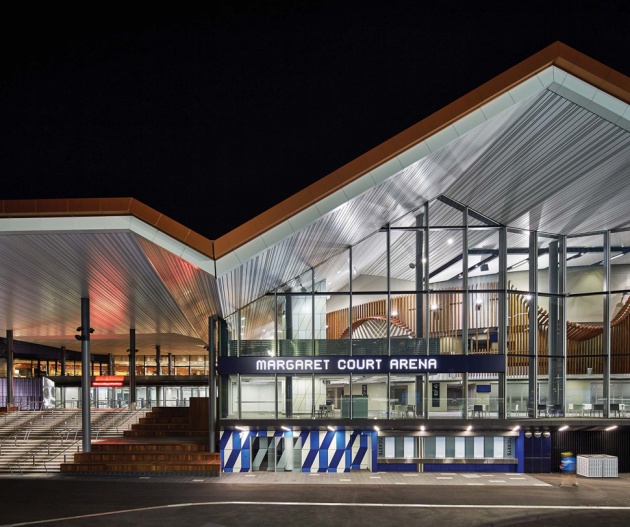
She who should not be named (on a tennis stadium)

The 2020 Australian Open starts tomorrow. As a long-term tennis fan, it is one of my favourite times of the year (although sadly I won’t be there in person this time around). As a long-term LGBTI advocate, however, I am not looking forward to the next fortnight – primarily because there will be considerable attention on a certain former Australian women’s tennis player.

Not just because the third largest court is named after her, but also because this year marks the 50th anniversary of her calendar-year grand slam – which was, admittedly, a remarkable achievement (for context, only one singles player, male or female, has repeated this feat in the half-century since: Steffi Graf in 1988).

Given we won’t be able to avoid this topic in the days ahead, I thought I would share my perspective on what should happen when Tennis Australia commemorates Margaret Court’s accomplishment, and why they should permanently remove her name from Margaret Court Arena.

I should start by saying what this is not about. It’s not about her opposition to marriage equality. Despite seeking to discriminate against LGBTI couples under secular law, she was entitled to her opinion, no matter how wrong it was (and thankfully the majority of Australians decided she was indeed very wrong).

On the other hand, it is about Margaret Court being a vocal opponent of the equalisation of the age of consent in Western Australia in 2002 (which is actually when, as a queer activist at university, I first came across her bigoted views). For those who don’t know, she literally campaigned for young gay and bisexual men, aged 16 to 20, to remain subject to criminalisation, including the threat of imprisonment, simply because of who they were.

That, to me, went beyond the pale. This was not simply a difference in policy – she used her position of influence in political debate to target vulnerable members of our community. That incident alone should be sufficient to mean she is not celebrated by Tennis Australia – or indeed anyone with a conscience.

Although unfortunately it was not the last time Margaret Court would attack LGBT young people. As recently as three weeks ago, she reportedly described trans kids as being the work of the devil (“That LGBT in the schools, it’s of the devil, it’s not of God… you know when children are making the decision at seven or eight years of age to change their sex. Just read the first two chapters of Genesis, that’s all I say. God made male and female”).

Court’s list of tennis records might be long, but her record of homophobic, biphobic and transphobic statements is much, much longer (noting that these are just a couple of examples out of many I could have chosen).

Of course, some people might respond by saying that the above actions are unrelated to tennis, and she should be judged solely on her sporting career. The only problem with this defence is that she has an equally lengthy history of anti-LGBT prejudice in relation to tennis.

As far back as 1990, Court criticised out lesbian champion Martina Navratilova (“a great player but I’d like someone at the top who the young players can look up to. It’s very sad for children to be exposed to homosexuality. Martina is a nice person. Her life has just gone astray”) and famously said that lesbians were ruining tennis.

In the three decades since, her views have not evolved, although who she attacks has – Margaret Court now adds trans tennis players, and trans women athletes in particular – to her growing list of targets (“ And you know with that LGBT, they’ll wish they never put the T on the end of it because, particularly in women’s sports, they’re going to have so many problems”).

But, out of the many hateful and hurtful ‘contributions’ Margaret Court has made to public life over the years, there is one that stands out in my memory, for all the wrong reasons. In 2013, following the birth of Casey Dellacqua and her partner Amanda Judd’s first child, Margaret Court wrote the following newspaper letter to the editor:


Fathers for babies

The article (Dellacqua, partner welcome baby boy, 29/8) rightly celebrates the birth of a child. Yet it is with sadness that I see that this baby has seemingly been deprived of his father.

If we continue to dismantle the traditional family unit as old fashioned, archaic and no longer even necessary or relevant, we will create a fatherless generation.

Indeed, the lines are becoming increasingly blurred as the march towards such partnerships, even gay marriage, is fuelled by minority voices rising in opposition to respected Christian beliefs which many cultures also believe.

For the person who is birthed with no exposure, or even acknowledgement, of their natural dad there will always remain questions as to their identity and background.

Personally, I have nothing against Casey Dellacqua or her “partner”.

I simply want to champion the rights of the family over the rights of the individual to engineer social norms and produce children into their relationships.

As a patron of the Australian Family Association, I really want to see a society where traditional family values are still celebrated and every child has the best possible start in life.

Margaret Court, Victory Life Centre


Note this was not simply an expression of her views about ‘rainbow families’ in general, it was specific criticism of one such family in particular. It was a pre-meditated attack on a couple at a time when they should have been celebrating something precious and wonderful, not being subjected to unfair commentary because of their sexual orientation.

And, contrary to Court’s protestations (‘I have nothing against Casey Dellacqua or her “partner”’), the use of scare quotes there says everything you need to know about her level of disrespect towards them.

Nor can this episode be divorced from Court’s tennis career. The letter was written by a former Australian tennis player, about a then-current Australian player – and this context was no doubt influential in ensuring it was published.

The truth is that, as much as Margaret Court was a champion on the tennis court, she has been the exact opposite off it. And, because of her actions – including the attack on Casey Dellacqua and her family – it is impossible to separate the two.

That is why, whenever Tennis Australia chooses to commemorate the 50th anniversary of Margaret Court’s calendar grand slam during the next fortnight, I hope the crowd at Melbourne Park (respectfully) turn their backs on her. And if she is given the opportunity to speak, I hope they cover their ears too – because she has abused far too many platforms, over far too many years, to demean and denigrate lesbian, gay, bisexual and transgender Australians.

It is also why she should not be named above the third largest court there. While Court may have been a tennis star in the 1960s and 1970s, everything she has done since means she has nothing to offer in the 2020s and beyond (she is definitely not a role model for the current generation of players – ask yourself, have you ever heard any Australian player, including our recent champions Sam Stosur and Ash Barty, say they look up to Margaret Court? Definitely not).

What makes this decision even easier is that there is such a clear alternative. A seven-time major winner in singles, and former world number one, from the 1970s and 1980s. An Aboriginal champion, who used her post-playing career to give back to Aboriginal young people (her Companion of the Order of Australia recognised her “eminent service to tennis as a player at the national and international level, [and] as an ambassador, supporter and advocate for the health, education and wellbeing of young Indigenous people through participation in sport, and as a role model”).

Once the 2020 Australian Open wraps up on Sunday February 2, it’s time to take down the signage for Margaret Court Arena, and put up a new name in its place: Evonne Goolagong Cawley Arena.

Margaret-Court-Arena-Gal2

2020 should be the last year Margaret Court’s name appears above the third court at Melbourne Park.

Census 2021 – Count Us In

Update:

On Monday 11 February 2020, the Guardian Australia reported that the 2021 Census Regulations had been lodged by the Assistant Treasurer, Michael Sukkar – without any new questions on sexual orientation, gender identity and sex characteristics.

In case it wasn’t clear before this, it is now undeniable that, as far as the Morrison Liberal-National Government is concerned, LGBTI Australians don’t count, and we therefore shouldn’t be counted.

The ramifications of this exclusion will last for most of the 2020s. The next opportunity to include sexual orientation, gender identity and sex characteristics will be the 2026 Census. Data from that Census will be progressively published from 2027 onwards, meaning service-delivery based on that data, in health, education and other community services, is unlikely before 2028.

The decision to effectively erase LGBTI Australians from the Census will be felt for most of the next decade (at least). Shame on the Minister, and Government, who would prefer us to be invisible.

Original Post:

It may not seem all that important right now, with everything else going on, but whether lesbian, gay, bisexual, transgender and intersex (LGBTI) Australians are included in the 2021 Census will have a long-term impact on the health of our communities.

The Commonwealth Treasury Department is currently conducting a public consultation on Exposure Draft Census and Statistics Amendment (Statistical Information) Regulations 2019.

Submissions close next Friday, 10 January 2020. If you have the time, please consider making a short submission, asking them to #CountUsIn. More information about how to make your voice heard, from the National LGBTI Health Alliance, is provided below.

Here’s my letter:


Division Head
Macroeconomic Modelling and Policy Division
Treasury
Langton Cres
Parkes ACT 2600

Submitted via: 2021CensusRegulations@treasury.gov.au

Friday 3 January 2020


To Whom It May Concern

Re: Census of Population and Housing

I am writing to you as a long-term advocate for the lesbian, gay, bisexual, transgender and intersex (LGBTI) community, to bring to your attention my personal view about the importance of including questions on sexual orientation, gender identity and intersex status in the 2021 Census.

For me, a census that captures sexual orientation, gender identity and intersex data will enable us all to better manage our health. It is important for governments at Commonwealth and state and territory level, and service providers, to have access to this data, so that I and my family and friends have the same access to targeted health services as all other Australians.

I am aware that the ABS itself asked the Commonwealth Government to consider sexual orientation, gender identity and intersex status questions to be included in the census based on an overwhelming need for this data to be collected.

I also note that in 2017 the Commonwealth Government spent $80.5 million in engaging the ABS to conduct the same-sex marriage law postal survey.

Apparently, asking all Australians to express their opinion about the relationships, and lives, of LGBTI people and their families was acceptable then.

It would be an incredible, and unjustifiable, double-standard to decide that asking people about their sexual orientation, gender identity and intersex status is unacceptable now.

LGBTI people are part of every Australian community, and everyone deserves to be counted.

We count. Our lives count. Our health counts. Our futures count. It’s time to count us in.

I respectfully ask that you reconsider the inclusion of these questions in the 2021 Census.

Yours sincerely,

Alastair Lawrie


Take Action

One of my main objectives for the blog this year is to include practical information on as many posts as possible about actions readers can take.

In this case, I strongly encourage you to visit the National LGBTI Health Alliance website, where they have provided a draft template letter on which the one above is based.

Please download it, add your own personal message and lodge it by Friday 10 January 2020. As requested by the Alliance, if you are emailing it, please also copy info@lgbtihealth.org.au and ask for your submission to be made public on the Treasury website.

Make your voice heard. Make sure our community is counted. #CountUsIn2021

ABS

What Gender Reveal Parties Actually Reveal

If the Germans hadn’t invented the term schadenfreude several centuries ago, we would have needed to create it to describe the most 21st century of phenomena: laughing at gender reveal fail videos.

These videos are (unintentionally) hilarious not just because when they go wrong, they go very wrong. With people coming up with increasingly intricate and in many cases bizarre scenarios to ‘stand out’, the potential for things to go awry has grown exponentially.

They are also deeply funny because the concept of a gender reveal party itself is inherently problematic, which means that laughing at the misfortunate of those involved is usually a guilt-free pleasure.

If you’re reading this and still think gender reveal parties are just a bit of harmless fun, perhaps it is useful to consider what exactly it is these parties are revealing – which is far more about the parent(s) than about their child(ren).

First, they reveal that some parents don’t seem to understand the difference between sex and gender.

Sex is biological (defined by the Oxford English Dictionary as ‘either of the two main categories (male and female) into which humans and many other living things are divided on the basis of their reproductive functions’).

On the other hand, gender is identity-based (with the Yogyakarta Principles defining gender identity as ‘each person’s deeply felt internal and individual experience of gender, which may or may not correspond with the sex assigned at birth, including the personal sense of the body (which may involve, if freely chosen, modification of bodily appearance or function by medical, surgical or other means) and other expressions of gender, including dress, speech and mannerisms’).[i]

Given it is impossible to know a child’s gender identity before or at birth (and usually for years after that), this means these celebrations should at the very least be renamed ‘sex reveal parties’.

Second, they reveal that some parents don’t seem to understand that both sex and gender are much more complicated than just male and female.

At its very core, a gender reveal party is an attempt to place an unborn child (or children) into one of two boxes: boy or girl.

And yet, in 2019, we know that gender identity is a spectrum, and there is a wide range of other options, including non-binary.

We also know that some children will be ‘born with physical sex characteristics that don’t fit medical and social norms for female or male bodies’ (the definition of intersex from Intersex Human Rights Australia).[ii]

Gender reveal parties therefore deliberately exclude some of the beautiful diversity of the human experience.[iii]

Third, they reveal that some parents are willing participants in a reductivist view of gender.

Gender reveal parties simplify the concepts of male and female into blue and pink respectively, as though entire genders can be signified by, even summed up by, a colour. When there is obviously more diversity within genders, and more similarities across people of different genders, than such a basic dichotomy can hope to represent.

Somewhat amusingly, these colours are also the exact opposite of those from just a century ago. From US Ladies Home Journal in June 1918:

‘The generally accepted rule is pink for the boys, and blue for the girls. The reason is that pink, being a more decided and stronger color, is more suitable for the boy, while blue, which is more delicate and dainty, is prettier for the girl.’

Mush less amusingly, while the colours have changed, some of those gender stereotypes remain and gender reveal parties tend to entrench, rather than question, them.

Based on these three factors, gender reveal parties can actually be harmful. By supporting a view that gender will match sex assigned at birth, they can make life much more difficult for trans and gender diverse children.

By raising expectations that babies will be born with sex characteristics that are exclusively male or female, they can erase intersex children (and even potentially increase pressure for unnecessary surgeries post-birth to ensure their bodies match these societal ‘norms’).

And by entrenching the notion that boys and girls are inherently different, and reinforcing stereotypes about how they will (or should) behave, gender reveal parties place artificial restrictions on all of us, and our behaviours.

It may sound like I am unsympathetic to the parents who hold gender reveal parties. I’m not, at least in part because most are simply replicating the actions of those around them (and those they follow on social media), and probably haven’t considered any of the issues described above. They are acting out of ignorance rather than malice.[iv]

I’m also sympathetic because, as a society, we seem to be placing an ever-greater emphasis on gender, certainly much more than I can remember as a child growing up in the 1980s. From unnecessarily gendered toys, to unnecessarily gendered toiletries, and even unnecessarily gendered grocery items, heightened expectations of ‘gender conformity’ are all around us – so it is perhaps only natural they will be felt most keenly by expecting parents.

The challenge then is what we can do to overcome these norms, especially the emerging norm that parents will hold gender reveal parties in the first place.

I have four suggestions to start, from the easiest to the most difficult:

  1. Don’t hold a gender reveal party

If you are having a child, simply refuse to have one of these ‘celebrations’. Which is easy for someone like me to say (a cis gay man who has decided, with his partner, not to have children, at least in part because of the climate emergency), so let’s move on…

  1. Don’t attend gender reveal parties

If you are invited to one of these ‘celebrations’, don’t attend. If people all stopped going, parents would stop holding them.

  1. Let the person know why you’re not attending

This is clearly more difficult than simply not turning up, especially because many of us prefer to avoid confrontation. But if we are to do the hard yards of ending this social norm, then we should take the time to explain to the person who has sent the invitation why you won’t be there.

  1. Stop asking ‘What are you having?’

Obviously, this is another degree of difficulty again, especially because this is something we’ve been conditioned to ask, usually first, when someone says they are pregnant (and something I have been guilty of, on more than one occasion).

But what does it actually matter? And aren’t there more interesting and/or important questions to ask, like ‘What are you looking forward to?’ ‘What are you nervous about?’ ‘Are you prepared?’ and ‘Is there anything I can do to help?’

For those having difficulty making this mental adjustment, consider thinking of it this way. When you are asking ‘What are you having?’ what you’re really asking is ‘What are your child’s sex chromosomes and/or genitalia?’ and ‘What gender do you currently intend to raise your child even though you cannot know now their eventual gender identity?’

Rationally, an expecting parent who knows the difference between sex and gender could also respond to the ‘What are you having?’ inquiry by saying that they’ll get back to the questioner in five, ten, 15 or even 20 years, when the child decides for themself.

Which brings me to the primary exception to my ‘no gender reveal parties’ stance: where trans and gender diverse people announce their own gender identity. This is truly something to celebrate, especially for those who’ve overcome years or even decades of transphobia from families, schools, and society in general.

[I suppose I would also make an exception for parents who hold a gender reveal party and then release a colour like green or brown and tell attendees that they’ll let their child determine their identity for themselves.]

Other than that, gender reveal parties are a social phenomenon that has risen to prominence incredibly quickly over the past decade – and hopefully will recede just as quickly in the early 2020s.

Indeed, that’s the view of the woman whose 2008 post is widely-credited as popularising ‘gender reveal parties’, Jenna Karvunidis. From NPR in July 2019:[v]

‘Plot twist! The baby from the original gender reveal party is a girl who wears suits,’ Karvunidis says. ‘She says ‘she’ and ‘her’ and all that, but you know she really goes outside gender norms’.

… Karvunidis says her views on sex and gender have changed, especially when she’s talking to her daughter.

‘She’s telling me ‘Mom, there are many genders. Mom, there’s many different sexualities and all different types,’ and I take her lead on that,’ Karvunidis says.

She says she does have some regrets and understands these parties aren’t beneficial to everyone.

‘I know it’s been harmful to some individuals. It’s 2019, we don’t need to get our joy by giving others pain,’ she says. ‘I think there’s a new way to have these parties.’

And that idea is as simple as just eating cake.

‘Celebrate the baby,’ she says. ‘There’s no way to have a cake cut into it, to see if they’re going to like chess. Let’s just have a cake.’

Which is a great idea. And then to eat any leftovers while watching videos of gender reveal party fails because, let’s face it, some of them are funny as hell.

Untitled design (5)

An infamous 2017 gender reveal party fail, which caused a 47,000 acre fire in Arizona.


Footnotes:

[i] Yes, I’m aware that both the concepts of sex and gender, and the relationship between them, are far more complex. However, in the context of ‘gender reveal parties’ it’s clear these celebrations are based on biological sex (chromosomes and/or genitalia) rather than identity-based ideas of gender.

[ii] IHRA website, here.

[iii] We should note here that variations in sex characteristics is separate to non-binary gender identities, with many intersex people identifying with the ‘sex’ they were assigned at birth. Again for the Intersex Human Rights Australia website:

‘Some intersex people and some non-intersex (‘endosex’) people use nonbinary terms to describe their identities and sex classifications. Often, however, we encounter assumptions that to be intersex is to be nonbinary, or to be nonbinary is to be intersex. These assumptions are harmful. They fail to recognize the diversity of the intersex population, and in this case even the existence of intersex boys and girls, and intersex women and men.’

[iv] Of course, some parents possibly are deliberately setting expectations that their children will be either male or female, and that they will ‘act accordingly’ (including not identifying as trans or gender diverse), to which I say ‘fuck you’.

[v] Woman who popularized gender reveal parties says her views on gender have changed.

Stonewall 50: Bouquets & Bricks

Today marks 50 years since the Stonewall Riots, a key moment in the history of LGBTI rights activism, both in the United States and around the world.

In a different world I had hoped to be in New York, attending the World Pride celebrations marking this significant anniversary – although unfortunately sometimes the more mundane parts of life, like mortgage payments, have other plans.

I wanted to be there to pay my respects to the activists who have come before us, and on whose shoulders we stand, who have paved the way towards the improved rights and increased acceptance many of us enjoy today.

Even though I may not be there in person I can still honour their achievements in my own small way, on this somewhat niche LGBTI rights blog, on the other side of the globe.

Thank you to the brave people at the Stonewall Inn who, in the early hours of June 28 1969, fought back against police oppression, and fought to end the injustice that was ubiquitous in the lives of queer people at that time.

Thank you to the trans and gender diverse people, the drag queens and the people of colour who have been at the forefront of this battle from the very beginning.

Of course, the Stonewall Riots was not the first instance of LGBTI people fighting back against abuse and mistreatment. Thank you too to the people at Compton’s Cafeteria, and Cooper Do-nuts, and likely other instances of queer rebellion that have been lost to history, because we were not the ones who were writing it.

Nor was Stonewall the starting point for LGBTI rights within the United States, with groups like the Mattachine Society and Daughters of Bilitis undertaking the comparatively-boring legal reform work – but who, in doing so, took far greater risks than we could possibly appreciate today.

Obviously, the story of LGBTI activism did not begin and does not end with the US either (a mistake we make all-too-often, especially on anniversaries like this).

Thank you as well to the countless campaigners for our rights around the world, from the advocates for homosexual recognition in Germany in the second half of the 19th century, to the courageous people fighting for decriminalisation in the 68 UN Member States where homosexuality remains criminalised today.

Looking closer to home, Australia’s most-famous instance of queer people celebrating amidst the spectre of police brutality had its own 40th anniversary just last year. Thank you to the 78ers, whose courage at that first Sydney Gay Mardi Gras helped inspire the generations here that followed.

Just as in the US, however, Mardi Gras was not the starting point for LGBTI rights in Australia.

Thank you to the people who stood up in the preceding decade, from the formation of the Homosexual Law Reform Society of the ACT in July 1969 (just one month after Stonewall, and who will celebrate their own 50th anniversary in four weeks’ time), through the early 70s activism of groups like Campaign Against Moral Persecution (CAMP for short), to the decriminalisation advocates in South Australia and elsewhere.

Thank you to the people who responded to the HIV/AIDS crisis in the 1980s, which decimated our community when it had only just begun to emerge from the darkness. You fought for your lives – and for all of us – and in doing so you kept the (candle)light alive.

Thank you to the HIV activists today, who understand that this struggle is not over.

Thank you to the law reformers, who over decades have secured the building blocks of legal equality, from anti-discrimination protections, to relationship recognition and most recently the right to marry the person we love.

Thank you to the trans and gender diverse activists, who have been fighting – against even greater resistance – for the right to live the lives you were always meant to. The battles for access to birth certificates and identity documentation, and health care, are not over.

Thank you to the intersex activists whose struggles seem bigger still. Many of whom are survivors of gross violations of the human right to bodily autonomy, but who speak out to stop those same coercive surgeries and treatments from being inflicted on others. And who must fight against the indifference of politicians, the arrogance of medical professionals and too-often the ignorance of other members of the LGBTI community.

Thank you to the queer people of colour, and especially to Aboriginal and Torres Strait Islander LGBTI people, who fight not just against homophobia, biphobia, transphobia and intersexphobia, but also against the racism that lies at the heart of our country (and, sadly, within our own community too).

As can be seen from the above, the incredible progress made so far on LGBTI rights has been achieved because of the work of more than any one particular individual or organisation. We have all played a role.

From the brave people who threw the first bricks at Stonewall. To others who have thrown bricks through the legal, social and cultural discrimination which LGBTI people all-too-commonly faced. And everyone who has thrown their own bricks through the closet of invisibility and shame that too many people have endured.

With those bricks we have built ourselves a community, and a home, where more people than at any point in history can feel accepted for who they are, no matter their sexual orientation, gender identity or sex characteristics.

But, as we all know, the house of LGBTI rights remains incomplete – there is still much unfinished business, in Australia, the United States and around the world, before all lesbian, gay, bisexual, transgender and intersex people can finally be considered ‘free & equal’.

Which means we need more (metaphorical) brick-throwers, to smash down the walls of homophobia, biphobia, transphobia and intersexphobia that keep many LGBTI community members imprisoned.

So today, as we celebrate Stonewall 50, and give thanks to the LGBTI activists who have made our world a better place, we should take a moment to reflect on what each of us can do, what we should do, and what we must do, to carry on their work.

the_stonewall_riots_didnt_start_the_gay_rights_movement_1050x700

If you have enjoyed reading this article, please consider subscribing to receive future posts, via the right-hand scroll bar on the desktop version of this blog or near the bottom of the page on mobile. You can also follow me on twitter @alawriedejesus

Unfairness in the Fair Work Act

This post is part of a series looking at the unfinished business of LGBTI equality in Australia. You can see the rest of the posts here

The first item of ‘unfinished business’ that I have chosen to write about is the discrimination that remains in the Commonwealth Fair Work Act 2009.

This unfairness includes two distinct issues, one relatively well-known (and which exists in other legislation, such as the Commonwealth Sex Discrimination Act 1984), the other much less so.

Starting with the sometimes-overlooked problem first: did you know that the Fair Work Act 2009 does not protect trans, gender diverse and intersex people against workplace discrimination?

While this legislation prohibits adverse treatment on the basis of sexual orientation – thereby protecting lesbians, gay men and bisexuals (at least to some extent: see the second discussion below) – it does not include equivalent protections for trans, gender diverse and intersex people.

For example, sub-section 351(1) provides that ‘An employer must not take adverse action against a person who is an employee, or prospective employee, of the employer because of the person’s race, colour, sex, sexual orientation, age, physical or mental disability, marital status, family or carer’s responsibilities, pregnancy, religion, political opinion, national extraction or social origin.’

Note that this list excludes both gender identity (which would cover trans and gender diverse people) and intersex status (the term used in the Sex Discrimination Act 1984 to protect intersex people, although the intersex community has since advocated for this to be updated to ‘sex characteristics’; see the Darlington Statement).

The same list of attributes, with the same exclusions, is found in sub-section 772(1)(f) which protects employees against unlawful termination.

In short, the Fair Work Act 2009 (Cth) does not protect trans, gender diverse and intersex Australians from mistreatment or unfair dismissal based on who they are. This is either a gross oversight, or a deliberate choice to treat transphobic and intersexphobic workplace discrimination less seriously than other forms of mistreatment.

Nor are these the only sections of the Fair Work Act to omit trans, gender diverse and intersex people:

  • Section 153 provides that discriminatory terms must not be included in modern awards. The list of relevant attributes includes sexual orientation, but excludes gender identity and sex characteristics;
  • Section 195 includes a similar prohibition on discriminatory terms in enterprise agreements, and once again omits trans, gender diverse and intersex people; and
  • Sub-section 578(c) provides that the Fair Work Commission must perform its functions taking into account ‘the need to respect and value the diversity of the work force by helping to prevent and eliminate discrimination on the basis of race, colour, sex, sexual orientation, age, physical or mental disability, marital status, family or carer’s responsibilities, pregnancy, religion, political opinion, national extraction or social origin.’

There is literally no requirement in the Act for the Fair Work Commission to help prevent or eliminate transphobic and intersexphobic workplace discrimination.

There can be no justification for these omissions. Nor can there be any excuse for the Government, or Parliament more broadly, not to pass urgent amendments to ensure trans, gender diverse and intersex Australians are finally included in the Commonwealth Fair Work Act 2009.

Here are my letters to the Prime Minister, and the Minister for Jobs and Innovation, asking them to do exactly that:

**********

The Hon Malcolm Turnbull MP

Prime Minister of Australia

PO Box 6022

House of Representatives

Parliament House

Canberra ACT 2600

27 May 2018


Dear Prime Minister

Please include trans, gender diverse and intersex people in the Fair Work Act

On 15 November last year, in your press conference following the announcement of the 61.6% Yes vote in the same-sex marriage postal survey, you said that: ‘we are a fair nation. There is nothing more Australian than a fair go. There is nothing more Australian than equality and mutual respect.’

A little later in that same press conference you added: ‘we are a nation of a fair go and mutual respect and we treat people equally. We don’t discriminate against people because of their gender of their sexual orientation, their religion or race or the colour of their skin.’

Unfortunately, trans, gender diverse and intersex Australians are still a long way from receiving a ‘fair go’, and that includes being treated unfairly within the Commonwealth Fair Work Act 2009.

Section 351 of this legislation includes protections against adverse treatment on the basis of a wide range of attributes, including sexual orientation. However, it excludes both gender identity and sex characteristics (the latter being the term preferred by intersex advocates, as articulated in the Darlington Statement, replacing ‘intersex status’ as used in the Sex Discrimination Act 1984).

Similarly, section 772 of the Fair Work Act prohibits unfair dismissal on the same grounds as 351, once again leaving trans, gender diverse and intersex Australians without equivalent protection.

Meanwhile, sections 153 and 195 do not prohibit the use of discriminatory terms against trans, gender diverse and intersex people in modern awards and enterprise agreements, respectively.

Finally, while section 578 of the Fair Work Act mandates that, in performing its functions, the Fair Work Commission must take into account ‘the need to respect and value the diversity of the work force by helping to prevent and eliminate discrimination’, this does not cover either transphobic or intersexphobic discrimination.

I am writing to ask that you, and your Government, introduce amendments to the Fair Work Act 2009 to rectify these gross oversights as a matter of priority.

Trans, gender diverse and intersex people deserve to be protected against workplace discrimination in exactly the same way as other employees, including lesbians, gay men and bisexuals.

If you fail to do so, you will be continuing to deny a ‘fair go’ to trans, gender diverse and intersex Australians, and your words of 15 November last year will ring hollow.

Sincerely,

Alastair Lawrie

**********

Senator the Hon Michaelia Cash

Minister for Jobs and Innovation

PO Box 6100

Senate

Parliament House

Canberra ACT 2600

via minister.cash@jobs.gov.au

27 May 2018


Dear Minister Cash

Please include trans, gender diverse and intersex people in the Fair Work Act

I am writing to you about the Commonwealth Fair Work Act 2009, which you administer, and specifically its failure to adequately protect trans, gender diverse and intersex employees against workplace discrimination.

Section 351 of this legislation includes protections against adverse treatment on the basis of a wide range of attributes, including sexual orientation. However, it excludes both gender identity and sex characteristics (the latter being the term preferred by intersex advocates, as articulated in the Darlington Statement, replacing ‘intersex status’ as used in the Sex Discrimination Act 1984).

Similarly, section 772 of the Fair Work Act prohibits unfair dismissal on the same grounds as 351, once again leaving trans, gender diverse and intersex Australians without equivalent protection.

Meanwhile, sections 153 and 195 do not prohibit the use of discriminatory terms against trans, gender diverse and intersex people in modern awards and enterprise agreements, respectively.

Finally, while section 578 of the Fair Work Act mandates that, in performing its functions, the Fair Work Commission must take into account ‘the need to respect and value the diversity of the work force by helping to prevent and eliminate discrimination’, this does not cover either transphobic or intersexphobic discrimination.

I am writing to ask that you, and the Liberal-National Government, introduce amendments to the Fair Work Act 2009 to rectify these gross oversights as a matter of priority.

Trans, gender diverse and intersex people deserve to be protected against workplace discrimination in exactly the same way as other employees, including lesbians, gay men and bisexuals.

If you fail to do so, you will be failing to ensure trans, gender diverse and intersex Australians receive a ‘fair go’ in their jobs.

Sincerely,

Alastair Lawrie

**********

The second, much better-known, issue of unfairness in the Fair Work Act 2009 is its inclusion of extensive ‘religious exceptions’. These are loopholes that allow religious organisations to discriminate against employees on the basis of their sexual orientation (and would likely allow discrimination on the basis of gender identity were it to be included as a protected attribute in the Act in future).

The Fair Work Act entrenches these loopholes in two ways.

First, the prohibition on adverse treatment in section 351 (described above) does not apply to any action that is ‘not unlawful under any anti-discrimination law in force in the place where the action is taken’ (sub-section (2)(a)).

This means that the Fair Work Act reinforces the religious exceptions that already exist in the Commonwealth Sex Discrimination Act 1984, and its state and territory equivalents (other than the Tasmanian Anti-Discrimination Act 1998),[i] which permit anti-LGBT discrimination.

However, the Fair Work Act then includes its own ‘religious exceptions’ in sub-section 351(2)(c), allowing adverse treatment ‘if the action is taken against a staff member of an institution conducted in accordance with the doctrines, tenets, beliefs or teachings of a particular religion or creed – taken:

(i) in good faith; and

(ii) to avoid injury to the religious susceptibilities of adherents of that religion or creed.’

In effect, the Act provides two different avenues for religious organisations to justify mistreating employees simply because of their sexual orientation.

The protection against unfair dismissal in section 772 also includes its own ‘religious exception’, while even the terms of modern awards (section 153) and enterprise agreements (section 195) are allowed to be explicitly discriminatory on the basis of sexual orientation where it relates to employment by a religious institution.

There is, however, one important difference between the religious exceptions in this Act and those that are contained in the Sex Discrimination Act 1984: the Fair Work Act religious exceptions technically apply across all protected attributes.

This means that, theoretically at least, a religious organisation could claim its beliefs required it to discriminate on the basis of race, or even physical or mental disability – and that it would therefore be protected from any adverse consequences under the Act.

Of course, in practice we all know that religious exceptions are most likely to be used to justify discrimination against women (including unmarried and/or pregnant women) and LGBT people.

Unfortunately, the Ruddock Religious Freedom Review recently handed to Prime Minister Malcolm Turnbull (although not yet publicly released) is likely to recommend that these loopholes are expanded, rather than drastically reduced. That is a subject I am sure I will be writing about further in coming months.

Nevertheless, in the meantime we should continue to highlight the injustice of religious exceptions, including those found in the Fair Work Act and elsewhere, and campaign for their removal.

One such campaign, called ‘Change the Rules on Workplace Discrimination’, is currently being run by the Victorian Gay & Lesbian Rights Lobby. I encourage you to sign their petition, here.

Ultimately, we need to collectively work towards a Fair Work Act that covers all parts of the LGBTI community – and that doesn’t feature extensive ‘religious exceptions’ allowing discrimination against us.

**********

Update 24 October 2018:

Earlier this year, the (then) Minister for Small and Family Business, the Workplace and Deregulation, the Hon Craig Laundy MP, replied to my letter. As you can see below, it is an extremely disappointing response.

He, and the Liberal-National Government, either don’t understand that the Fair Work Act excludes trans, gender diverse and intersex Australians (leaving them at a disadvantage compared to other groups, including lesbian, gay and bisexual people). Or they simply don’t care. I think we all know which is the likelier explanation.

This issue has taken on added importance in the context of the current debate around the Ruddock Review, and removing religious exceptions that allow discrimination against LGBT students and teachers.

That is because, even if those exceptions are repealed (from both the Sex Discrimination Act and the Fair Work Act), if the protected attributes of gender identity and sex characteristics/intersex status are not also added to the Fair Work Act, there will still be a two-tiered system for LGBTI teachers.

In short, lesbian, gay and bisexual teachers will be able to complain to both the Fair Work Ombudsman and the Australian Human Rights Commission, while trans, gender diverse and intersex teachers will only be able to complain to the latter.

Unfortunately, the otherwise positive Discrimination Free Schools Bill 2018 from the Australian Greens makes this fundamental mistake. We are also still waiting to see whether the now Morrison Government will introduce any reforms in this area at all, as well as what a Shorten Labor Opposition Bill (or amendments) might look like.

But, irrespective of whose Bill it is, and whatever other amendments it contains, if it doesn’t add gender identity and sex characteristics/intersex status to the Fair Work Act, it will be incomplete.

**********

16 July 2018

Dear Alastair

Thank you for your email of 27 May 2018 to Senator the Hon Michaelia Cash, Minister for Jobs and Innovation, about protection from discrimination against trans, gender diverse and intersex employees under the Fair Work Act 2009. As the issues raised fall within my portfolio responsibilities as Minister for Small and Family Business, the Workplace and Deregulation, your email was referred to me for reply.

The Australian Government believes that discrimination in the workplace is unacceptable and all employees have the right to be free from discrimination at work.

The Sex Discrimination Act 1984 (the Sex Discrimination Act) is the principle legislation providing protection against discrimination or harassment on the basis of sex and/or gender. It also covers discrimination and harassment in the workplace. The Sex Discrimination Act explicitly covers discrimination on the basis of gender identity and intersex status.

The Human Rights Commission Act 1986 provides remedies for workers who have been discriminated against, harassed or dismissed on the basis of gender identity or intersex status, including in the workplace. The Australian Human Rights Commission (AHRC) is responsible for responding to complaints about harassment or discrimination on the basis of gender identity or intersex status.

Any person who has been discriminated against, harassed or dismissed on the basis of gender identity or sex characteristics should contact the AHRC for information and advice. The AHRC has the power to investigate and conciliate the complaints of discrimination and breaches of human rights. Information on what is required to make a complaint is available at www.humanrights.gov.au under the complaints tab on that page. There is also a National Information Service line on 1300 656 419.

Yours sincerely

Craig Laundy

(then) Minister for Small and Family Business, the Workplace and Deregulation

Update 21 June 2020:

It has been brought to my attention that there is a possibility the Fair Work Commission would interpret ‘sex’ to include gender identity and potentially intersex status, based on this information on their website.

However, this interpretation is open to legal challenge, and may be overturned in the Federal Court. I remain of the view the only way to put workplace protection for trans, gender diverse and intersex people beyond doubt would be to add gender identity and sex characteristics to the Fair Work Act.

Morrison

Will Scott Morrison’s Government continue to exclude trans, gender diverse and intersex employees from the Fair Work Act?

If you have enjoyed reading this article, please consider subscribing to receive future posts, via the right-hand scroll bar on the desktop version of this blog or near the bottom of the page on mobile. You can also follow me on twitter @alawriedejesus

Footnotes:

[i] For more information on the differences in these laws, see A quick guide to Australian LGBTI anti-discrimination laws.

Twenty years


Like most people, different people would describe me in different ways. Earnest. Passionate. Opinionated. I’m sure some there’d be some less flattering terms too. One adjective that I don’t think would be used very often is melodramatic. Yet that is exactly the right word to describe my coming out experience.


Twenty years ago tonight I told my parents I was gay. The anniversary of that personally momentous occasion (as well as another upcoming ‘round number’, my 40th birthday) has prompted me to reflect both on what happened then, and how much has changed since. So here is my somewhat over-the-top, but very true, coming out story…


**********


Fenner_Hall_North_Tower


In 1998, I was a second year student at the Australian National University in Canberra. I lived in one of the larger student residences (Fenner Hall), and was a bit of a ‘joiner’ – signing up to countless clubs and societies, and participating in various sporting and cultural activities.


One such endeavour was the annual college theatre production. That year it was a not-especially memorable play called ‘The Prodigal Son’, about the return of a gay man to his estranged family following the death of his father.


I was cast as the prodigal son’s boyfriend (a role made slightly more complicated by the fact one of the first men I had ever slept with played the title character, although he is now one of my best friends).


As the ‘outsider’ in the play, my character’s main function was to observe the family’s interactions and offer insights like ‘Why can’t parents accept their children for who they are?’ and ‘Despite their differences I know they actually love each other.’


My personal response to this situation was to decide that this was the perfect opportunity to come out to my parents. So I convinced them to come down to see me perform, without explaining why.


**********


Now, that sounds like a terrible decision. Probably because, well, it was. But, while the thought processes involved only ever really made sense in the conflicted mind of a closeted 19 year old, I do recall at least some of the reasons why.


First, it gave me the firm push I required. I had actually tried to tell my parents the summer beforehand, but always found an excuse to back out. The play served as a necessary self-imposed deadline – it’s hard to completely avoid the topic of sexuality after you’re parents have already seen you as a gay man (even if it was only on stage).


Second, it was on my ‘home turf’. The play was an excuse to get my parents to Canberra, which was important because, if they disowned me, I would still have accommodation, and money (I was fortunate enough to be on a scholarship), in place. In short, I wouldn’t be homeless.


Again, that might seem a bit melodramatic to some readers, especially in this post-same sex marriage haze. I can assure you it was a legitimate fear, not just because of the time period (this was early John Howard-era Australia after all) but especially because of my family background.


I grew up on a cattle property outside Blackwater, a small town about two hours west of Rockhampton in Central Queensland. As well as being a farmer, my dad was heavily involved in agri-politics, and had stood for pre-selection for the National Party in the federal electorate of Maranoa (he would later be an unsuccessful candidate in the state seat of Fitzroy, parts of which are now included in Mirani, the only Queensland seat currently held by One Nation).


My mum, a nurse at one of the local coal mines, was also very conservative. In fact, my entire extended family were right-wing; my sister was the next most progressive after me, and that was because she voted Liberal!


Oh, and given where we lived, my parents had sent all three children to a Lutheran boarding school in Brisbane for five years, where we were indoctrinated with German efficiency (although the full horrors of my time there are for another post, at another time).


Based on this up-bringing, the idea that my parents would react badly to their son’s homosexuality was definitely not implausible.


The third reason why I chose to tell them in this way was because it meant I had a support system in place. I had only come out to a few close friends late in the previous year. Through the play I found another close-knit group of accepting people. Together they gave me the confidence, and courage, to finally follow through.


**********


Before we get to the ‘big night’ itself, there’s one other consequential choice I made: to disclose my sexuality to my sister beforehand. By that stage, she was in her 7th year of university. I figured that, if anyone in my family was ever going to be okay with me being gay, it was her.


And she was. Within 15 minutes of me telling her over the phone, she was joking around (in a light-hearted manner), putting me at ease.


What I didn’t learn until afterwards though, was that she then decided to let my parents know before they headed down to Canberra, including telling my mum as she recovered in hospital from elective surgery.


**********


Like most life-changing events, I don’t actually remember much detail about what happened the night of the play (the final performance of its short and, as far as I’m aware, only run), just certain moments and particular emotions.


The adrenaline kicking in back-stage. The words of encouragement from my cast-mates before the curtains went up. The odd mixture of sheer terror and profound relief as I looked out under the lights and saw that my parents were indeed in the audience. The surreal-ness of my character asking parents to accept their children no matter who they are – as I did exactly that.


Afterwards, I took them out for a predictably awkward dinner, and we had ‘the chat’. Again, most of what followed was a blur, although they made sure to let me know that they loved me – even if they did so in their own reserved, country kind of way.


By the time I re-joined the rest of the cast for the after-party, [cliché alert] it felt like the weight of the world had been lifted from my shoulders, and I could exhale – properly – for the first time in a long time, maybe ever.


**********


As other members of our community know all too well, ‘coming out’ is never a one-off event, but a life-long process, especially as you continually meet new people, or enter novel situations.


Even with people to whom you have already disclosed, there are degrees of being out, and a spectrum of acceptance. So it was with my parents.


They had said ‘all the rights things’ that frosty May night in Canberra because they had been forewarned by my sister. But that wasn’t necessarily a true reflection of how they really felt – as I discovered during the June/July holidays when I headed back to the farm.


The reception there was much, much colder, including from my brother who was then working on the farm (although he is much more accepting now, primarily thanks to the influence of a good woman).


Things deteriorated rapidly, and to such an extent that one day, in the car with my mum driving home from town, she said something especially egregious – which I won’t repeat here – and I had to tearfully, but forcefully, threaten to turn the car around and head all the way back to uni (two full days’ drive away) if she didn’t want me, all of me, in her life anymore.


It was the emotional confrontation that hadn’t happened the night of the play, but that was essential for things to improve. She backed down, and our relationship slowly but surely improved over the years that followed, a process that was greatly accelerated by the arrival of my fiancé Steve on the scene, ten years later.


**********


Now, two decades on, and my mum and dad are proud, yes-voting folks, very much looking forward to attending Steve and my wedding (I think they are especially pleased at the idea of him being their son-in-law – but then, who wouldn’t be?)


Indeed, so much has changed in those twenty years that even writing this post has been challenging. Because it’s difficult to remember a time when, far from being comfortable in my skin, I buried myself in so many layers just to make sure nobody could see who I really was.


Twenty years ago the idea that I would meet someone to share my life with, all of my life, and that he would be accepted as an integral part of my family, and me in his, seemed preposterous. Today it is as normal, as fundamental, as breathing.


Twenty years ago I could not conceive of a time, a place, any context, in which I would be so happy. That life could be, would be, so beautiful. I wish he could have known that back then…


**********


As a long-term activist and advocate on behalf of the lesbian, gay, bisexual, gay and transgender (LGBTI) community, I am not nearly naïve enough to underestimate the challenges that are still faced by many young people today.


Some parents do still disown their children. Or send them to gay or trans conversion (so-called) therapy. Some young people, especially those who are trans and gender diverse, from culturally and linguistically diverse backgrounds, Indigenous, or live in rural and regional Australia, can and do still face significant barriers just to become who they are. Too many tragically never make it.


So, I cannot say that #itgetsbetter for everyone. But I can speak from my own experience: it got better for me. Much, much better. Although, perhaps a little disappointingly, much less melodramatic too.

Lyle Who?

With the postal survey complete, and LGBTI marriage passed by Commonwealth Parliament, it’s time for us to ignore Lyle Shelton.


Managing Director of the Australian Christian Lobby (ACL) since May 2013, and their Chief of Staff for six years prior to that, the events of the past few months have – thankfully – seen him suffer defeat after defeat.


First, he, the ACL and the wider ‘Coalition for Marriage’ (aka the No campaign) comprehensively lost the postal survey:


By 2,943,260 votes (or more than the entire population of Western Australia and the Northern Territory, combined),


In every state and territory, and


In an overwhelming 133 out of 150 electorates across the country.


We should remember that this was the process they asked for, one that completely stacked the decks in their favour.


An optional vote, with older Australians, who are more likely to oppose marriage equality, also more likely to participate.


A postal ballot, with many younger Australians, who are more likely to support marriage equality, also less familiar with ‘physical’ mail.


A simple Yes/No question, with the long history of failed referenda in Australia demonstrating it is much easier to run a scare campaign, and sow seeds of doubt, than to convince people to vote for positive change.


Rules requiring equal media coverage of the Yes and No cases, even when the No campaign had nothing to say relating to the question of same-sex marriage itself, only misinformation and manipulation about trans and gender diverse kids, and Safe Schools.


Even with all of these advantages, the No campaign experienced what can only be described as a drubbing: 61.6% to 38.4%.


To add insult to (their) injury, they then lost again in the Parliament, where they sought numerous additional special rights to discriminate against LGBTI couples – and were denied.


Despite having a conservative Government, including a Liberal and National majority in the House of Representatives.


Despite intense lobbying to provide civil celebrants, and wedding-related businesses, and religious schools, and parents, and charities, with new legal authority to treat same-sex marriages as second-class.


Despite having Prime Minister Malcolm Turnbull support at least some of these special religious privileges.


All of these amendments were voted down in the Senate. And then again in the House of Representatives for good measure.


Shelton, the ACL and the Coalition for Marriage comprehensively failed in their mission to ‘defend traditional marriage’.


However, as enjoyable as it was to write the above – and the temptation toward schadenfreude is admittedly strong right now – that is not actually the reason we should ignore him.


After all, there is nothing wrong with losing in a democracy. As an LGBTI advocate, and a ‘progressive’ more broadly, my own history of involvement in Australian politics is littered with many more defeats than victories. And I’m sure there will be plenty more of the former in coming years too.


On the other hand, there is plenty of justification for ignoring him on the basis of how he went about the campaign itself, and the Australian Christian Lobby’s offensive conduct for many years beforehand.


Because of his (infamous) oft-repeated comments that rainbow families having children was creating a new Stolen Generation.


Because of his rhetorical link between marriage equality and Nazi Germany (“Changing the definition of marriage to entrench motherless and fatherlessness in public policy and teaching our kids their gender is fluid should be opposed. The cowardice and weakness of Australia’s ‘gatekeepers’ is causing unthinkable things to happen, just as unthinkable things happened in Germany in the 1930s”).


Because of his incitement of ‘bathroom panic’ against trans women (“Why should a man identifying as a woman be allowed into a woman’s gym or a domestic violence shelter? Why should biological males identifying as women be allowed into women’s public toilets and shower facilities?”).


Especially because of their ongoing attacks on trans and gender diverse young people. In the words of Georgie Stone:


“Although there is so much we have achieved there is still this social stigma in Australia against trans kids. That needs to change, especially in the light of the same-sex marriage debate. The No campaign used trans kids as cannon fodder” [emphasis added].


But, with the postal survey now over, and with all couples now permitted to marry, irrespective of their sexual orientation, gender identity or sex characteristics, there is no compelling reason to continue to pay attention to the likes of Lyle Shelton.


It’s time we allowed his discriminatory viewpoint to recede to the fringes of society, where it rightfully belongs.


For my part, that means ignoring his attention-seeking public commentary. And not sharing articles, posts or tweets in which he and the ACL simply perpetuate homophobia, biphobia and transphobia.


Which means that, from today, Lyle Shelton will join an ‘exclusive’ group of people who I vow to never amplify via social media.


Alongside a certain former leader of the Australian Labor Party, turned media ‘outsider’.


And a notorious internet troll, who was recently in the country and who shares a name with a breakfast beverage.


After exerting disproportionate influence on public policy over the past decade, I think we should collectively say ‘Bye Fe-Lyle-cia’. Or should that be ‘Bye Feli-Shelton’? Either way, Lyle, it’s time for you to sashay away.


Lyle Shelton

What’s Wrong With Tasmania’s Anti-Discrimination Act 1998?

This is part of a series of posts looking at Australia’s anti-discrimination laws and discussing how well, or how poorly, they protect lesbian, gay, bisexual, transgender and intersex people. The articles on other jurisdictions can be found here.

In these posts, I have analysed Commonwealth, state and territory legislation with respect to three main issues:

  • Protected Attributes
  • Religious Exceptions, and
  • Anti-Vilification Coverage

This post will be the shortest of the nine, because in all three areas Tasmania’s Anti-Discrimination Act 1998 is either best practice, or close to best practice.

**********

Protected Attributes

 Unlike some other schemes, Tasmania’s Anti-Discrimination Act 1998 protects all parts of the lesbian, gay, bisexual, transgender and intersex community against discrimination.

Section 16 sets out the protected attributes of the Act, and they include sexual orientation (sub-section c), gender identity (ea) and intersex variations of sex characteristics (eb) [noting that Intersex Human Rights Australia’s position is that this last attribute should simply be ‘sex characteristics’ rather than intersex variations of sex characteristics, in line with the Yogyakarta Principles plus 10].

The definitions of these terms in section 3 are also inclusive:

sexual orientation includes-

(a) heterosexuality; and

(b) homosexuality; and

(c) bisexuality”

gender identity means the gender-related identity, appearance or mannerisms of other gender-related characteristics of an individual including gender expression (whether by way of medical intervention or not), with or without regard to the individual’s designated sex at birth, and may include being transgender or transsexual”

gender expression means any personal physical expression, appearance (whether by way of medical intervention or not), speech, mannerisms, behavioural patterns, names and personal references that manifest or express gender or gender identity”

sex characteristics means a person’s physical, hormonal or genetic features relating to sex, including genitalia and other sexual and reproductive anatomy, chromosomes, genes, hormones, and secondary sex characteristics”.

Overall, the Tasmanian Anti-Discrimination Act 1998 adopts close to best practice in terms of the protected attributes it includes, covering all LGBTI Tasmanians.

**********

Religious Exceptions

The Anti-Discrimination Act 1998 is best practice when it comes to religious exceptions – in fact, Tasmania is better, far better, than any other Australian jurisdiction in this area.

There are three provisions outlining relevant religious exceptions in the Act:

Section 51 “Employment based on religion

(1) A person may discriminate against another person on the ground of religious belief or affiliation or religious activity in relation to employment if the participation of the person in the observance or practice of a particular religion is a genuine occupational qualification or requirement in relation to the employment.

(2) A person may discriminate against another person on the ground of religious belief or affiliation or religious activity in relation to employment in an educational institution that is or is to be conducted in accordance with the tenets, beliefs, teachings, principles or practices of a particular religion if the discrimination is in order to enable, or better enable, the educational institution to be conducted in accordance with those tenets, beliefs, principles or practices.”

Section 51A “Admission of person as student based on religion

(1) A person may discriminate against another person on the ground of religious belief or affiliation or religious activity in relation to admission of that other person as a student to an educational institution that is or is to be conducted in accordance with the tenets, beliefs, teachings, principles or practices of a particular religion.

(2) Subsection (1) does not apply to a person who is enrolled as a student at the educational institution referred to in that subsection.

(3) Subsection (1) does not permit discrimination on any grounds referred to in section 16 other than those specified in that subsection.

(4) A person may, on a ground specified in subsection (1), discriminate against another person in relation to the admission of the other person as a student to an educational institution, if the educational institution’s policy for the admission of students demonstrates that the criteria for admission relates to the religious belief or affiliation, or religious activity, of the other person, the other person’s parents or the other person’s grandparents.”

Section 52. “Participation in religious observance

A person may discriminate against another person on the ground of religious belief or religious activity in relation to-

(a) the ordination or appointment of a priest; or

(b) the training and education of any person seeking ordination or appointment as a priest; or

(c) the selection or appointment of a person to participate in any religious observance or practice; or

(d) any other act that-

(i) is carried out in accordance with the doctrine of a particular religion; and

(ii) is necessary to avoid offending the religious sensitivities of any person of that religion.”

At first glance these exceptions appear extensive in their application. However, the most important point to observe is that discrimination by religious bodies, including religious schools, is only allowed on the basis of the person being discriminated against’s religion – for example, a christian school offering preferential enrolment to students that are christian.

It specifically does not allow discrimination on the basis of other attributes, such as the person being discriminated against’s sexual orientation, gender identity or intersex variations of sex characteristics.

In this way, the Tasmanian Anti-Discrimination Act 1998 is clearly superior to other state and territory LGBTI discrimination laws, as well as the Commonwealth Sex Discrimination Act 1984 (which not only provides a general religious exception allowing discrimination against LGBT people in a wide range of circumstances, but also a specific one with respect to religious schools that permits discrimination against LGBT students and teachers). It is therefore pleasing that the ACT Government embraced the Tasmanian approach in its recent reforms to protect LGBT students and teachers at religious schools – although it retains exceptions for health and other community services at this stage.

**********

Anti-Vilification Coverage

The anti-vilification protections afforded LGBTI Tasmanians under the Anti-Discrimination Act 1998 are also strong. There are actually two provisions that prohibit vilification under the Act:

Section 17 “Prohibition of certain conduct and sexual harassment

(1) A person must not engage in any conduct which offends, humiliates, insults or ridicules another person on the basis of an attribute referred to in section 16(e), (a), (b), (c), (d), (ea), (eb) and (k), (fa), (g), (h), (i) or (j) in circumstances in which a reasonable person, having regard to all the circumstances, would have anticipated that the other person would be offended, humiliated, intimidated, insulted or ridiculed…”

Section 19 “Inciting hatred

A person, by a public act, must not incite hatred towards, serious contempt for, or severe ridicule of, a person or a group of persons on the ground of-

(a) the race of the person or any member of the group; or

(b) any disability of the person or any member of the group; or

(c) the sexual orientation or lawful sexual activity of the person or any member of the group; or

(d) the religious belief or activity of the person or any member of the group; or

(e) the gender identity or intersex variations of sex characteristics of the person or any member of the group.”

The effect of these two provisions mean that LGBTI Tasmanians are protected both against conduct that offends, humiliates, insults or ridicules, as well as conduct that incites hatred, serious contempt or serious ridicule. This means Tasmania’s LGBTI anti-vilification provisions are the equal best in the country, alongside the ACT.

[Although it should be noted that, in its previous term, the Tasmanian Liberal Government attempted to undermine these anti-vilification protections. It sought to introduce amendments that would have permitted vilification for public acts done in good faith for ‘religious purposes’ (where “religious purpose includes, but is not limited to, conveying, teaching or proselytising a religious belief”). This would have inevitably resulted in increased vilification of lesbian, gay, bisexual and transgender Tasmanians. Thankfully, while the Bill was passed by the Liberal-majority Legislative Assembly, it was rejected by the Independent-majority Legislative Council in August 2017.]

will-hodgman

Former Tasmanian Premier Will Hodgman sought to undermine LGBTI anti-vilification protections.

**********

Overall, it is clear that Tasmania’s Anti-Discrimination Act 1998 is the best LGBTI anti-discrimination law in Australia. It has set the standard to which all other jurisdictions should aspire.

If you have enjoyed reading this article, please consider subscribing to receive future posts, via the right-hand scroll bar on the desktop version of this blog or near the bottom of the page on mobile. You can also follow me on twitter @alawriedejesus

What’s Wrong With South Australia’s Equal Opportunity Act 1984?

This post is part of a series looking at Australia’s anti-discrimination laws, and examining how well, or how poorly, they protect lesbian, gay, bisexual, transgender and intersex (LGBTI) people against discrimination. The other posts in the series can be found here.

In particular, they assess Commonwealth, State and Territory legislation in terms of the following three issues:

  • Protected Attributes
  • Religious Exceptions, and
  • Anti-Vilification Coverage.

Unfortunately, while South Australia has expanded the range of people legally protected against discrimination, the Equal Opportunity Act 1984 remains grossly inadequate because of the breadth of religious exceptions it offers, and its failure to establish LGBTI vilification offences.

**********

Protected Attributes

Section 29 of the Equal Opportunity Act 1984 protects lesbian, gay, bisexual, transgender and intersex South Australians from discrimination.

Sub-section (2a) defines discrimination “on the ground of gender identity” to include (among other things):

  • “if the person treats another unfavourably because the other is or has been a person of a particular gender identity or because of the other’s past sex;
  • if the person treats another unfavourably on the basis of a characteristic that appertains generally to persons of a particular gender identity, or on the basis of a presumed characteristic that is generally imputed to persons of a particular gender identity… and
  • if the person requires a person of a particular gender identity to assume characteristics of a sex with which the person does not identify.”

Importantly, unlike some jurisdictions, South Australia protects all trans people against discrimination (and not just people with binary gender identities).

The protections against discrimination “on the ground of sexual orientation” contained in sub-section (3) are similarly broad, and would cover all lesbian, gay and bisexual South Australians.

The Relationships Register Act 2016 has expanded this coverage even further by introducing a new protected attribute of ‘intersex status’, with the addition of sub-section 29(4)[i].

With this change, South Australia has become only the fourth jurisdiction in Australia – after the Commonwealth, Tasmania and the Australian Capital Territory – to explicitly protect intersex people against discrimination. Although it should be noted that in the March 2017 Darlington Statement, intersex activists called for this terminology to be replaced by a protected attribute of ‘sex characteristics’.

Summary: The South Australian Equal Opportunity Act 1984 protects lesbian, gay, bisexual, transgender and intersex people against discrimination – with the 2017 inclusion of ‘intersex status’ making it only the fourth Australian jurisdiction, out of nine, to cover the entire LGBTI community.

**********

Religious Exceptions

Unfortunately, while the Equal Opportunity Act 1984 will soon be close to best practice on protected attributes, in terms of religious exceptions it is anything but.

Section 50 sets out an incredibly broad range of circumstances in which religious organisations are legally entitled to discriminate against LGBTI South Australians:

Religious bodies

(1) This Part does not render unlawful discrimination in relation to-

(a) the ordination or appointment of priests, ministers of religion or members of a religious order; or

(b) the training or education of persons seeking ordination or appointment as priests, ministers of religion or members of a religious order; or

(ba) the administration of a body established for religious purposes in accordance with the precepts of that religion; or

(c) any other practice of a body established for religious purposes that conforms with the precepts of that religion or is necessary to avoid injury to the religious susceptibilities of the adherents of that religion.”

While paragraphs (a) and (b) are at least directly related to religious appointments – and therefore somewhat defensible because of their connection to freedom of religion – paragraph (ba) and especially paragraph (c) effectively encourage discrimination by religious organisations in healthcare and other community services.

It is also unclear whether this general exception allows religious schools to discriminate against LGBTI students. That is because there is a separate section which provides exceptions for religious schools regarding students (section 37), and it does not allow discrimination on the basis of sexual orientation, gender identity or intersex status.

However, unlike the Queensland Anti-Discrimination Act 1991 which protects LGBT students, there is nothing in the general religious exception in section 50 of South Australia’s Equal Opportunity Act 1984 which states that it does not apply to religious schools.

This means that it is still possible the general religious exception in section 50 allows discrimination despite what section 37 says – a risk even the SA Equal Opportunity Commission expressed concern about in their submission to the South Australian Law Reform Institute’s review of Exceptions under the Equal Opportunity Act 1984 (p73). Indeed, the Law Reform Institute recommended:

“that section 50(1)(c) should be removed to make it clear that it does not apply to discrimination with respect to potential or current students of religious educational institutions” (pp83-84).

The situation is also complicated with respect to teachers in religious schools, with sub-section 34(3) setting out a separate, specific exception in that area:

“(3) This Division does not apply to discrimination on the ground of sexual orientation,  gender identity or intersex status in relation to employment or engagement for the purposes of an educational institution if-

(a) the educational institution is administered in accordance with the precepts of a particular religion and the discrimination is founded on the precepts of that religion; and

(b) the educational authority administering the institution has a written policy stating its position in relation to the matter; and

(c) a copy of the policy is given to a person who is to be interviewed for or offered employment with the authority or a teacher who is to be offered engagement as a contractor by the authority; and

(d) a copy of the policy is provided on request, free of charge-

(i) to employees and contractors and prospective employees and contractors of the authority to whom it relates or may relate; and

(ii) to students, prospective students and parents and guardians of students and prospective students of the institution; and

(iii) to other members of the public.”

Some may see this as a relatively positive approach, because at the very least it allows everyone to be informed about the policies any particular school adopts. And, admittedly, it is preferable to the carte blanche approach adopted in other states (and especially in New South Wales).

However, there are three important qualifications to this ‘benign’ assessment:

  • It still allows discrimination against teachers and other employees in religious schools. This discrimination – which has no connection whatsoever to the ability of LGBTI teachers and other staff to do their jobs – remains unacceptable, irrespective of the procedural steps a school must first negotiate,
  • It is (I believe) unique in Australia in that it specifically states that religious schools can discriminate on the basis of intersex status (despite there being no supporting evidence of doctrines, tenets or beliefs which discriminate against people born with intersex variations), and
  • The general religious exception in sub-section 50(c) may still apply, for the same reason that it may allow religious schools to discriminate against LGBT students – meaning it is possible that religious schools can ‘pick and choose’ the basis on which they discriminate against teachers and employees (and therefore potentially avoid these procedural hurdles altogether).

There is one final religious exception which allows discrimination against LGBTI South Australians – sub-section 35(2b) allows ‘associations’ to exclude and otherwise adversely treat people on the basis of their intersex status, gender identity or sexual orientation “if the association is administered in accordance with the precepts of a particular religion and the discrimination is founded on the precepts of that religion.”

Summary: The religious exceptions contained in the South Australian Equal Opportunity Act 1984 allow discrimination against LGBTI people in a wide range of circumstances, including healthcare, community services, associations and in education (although there is some uncertainty about how far the exceptions apply in that area).

[NB In late 2020, the South Australian Liberal Government released the Equal Opportunity (Religious Bodies) Amendment Bill 2020 for public consultation. This Bill would remove any ability for religious schools to discriminate against LGBT students (although not teachers) as well as limiting the special privileges of religious organisations to discriminate against both LGBT employees and people accessing their services in other nominated areas (such as housing, health and aged care).

However, this would still permit discrimination in other areas (such as university education). Therefore, while if passed this Bill would represent a significant improvement from the current provisions of the Equality Opportunity Act 1984 (SA), it would nevertheless fall well short of the best practice approach to religious exceptions in the Anti-Discrimination Act 1998 (Tas). For more information, please see my submission in response to the Equal Opportunity (Religious Bodies) Amendment Bill 2020.]

**********

Anti-Vilification Coverage

This section will be the shortest of this post – because there is none. Lesbian, gay, bisexual, transgender and intersex South Australians have no protection against anti-LGBTI vilification under the Equal Opportunity Act 1984[ii].

This is despite the fact that an entire stand-alone act exists with respect to racial vilification (the Racial Vilification Act 1996). Given homophobia, biphobia, transphobia and intersexphobia are just as damaging, and just as harmful, as racism, the lack of equivalent protections against anti-LGBTI vilification is, in my opinion, shameful.

**********

Other Issues

There are a few additional issues in the Equal Opportunity Act 1984 that it would be remiss not to at least mention.

On the negative side, there is a very broad ‘inherent requirement’ exception in relation to employment. Sub-section 34(2) provides that:

“This Division does not apply to discrimination on the ground of sex, sexual orientation, gender identity or intersex status in relation to employment or engagement for which it is a genuine occupational requirement that a person be of a particular sex, sexual orientation, gender identity or intersex status.”

It is difficult to think of many jobs in which it is an inherent requirement that someone be of a particular sexual orientation, gender identity or intersex status. It would be interesting to see on what possible basis the drafters attempted to justify this sub-section.

Similarly, sub-section 34(4) allows discrimination in employment against transgender people generally, and non-binary gender diverse people in particular, on the basis of their appearance, stating that:

“This Division does not apply to discrimination on the ground of gender identity in relation to employment or engagement if the discrimination is for the purposes of enforcing standards of appearance and dress reasonably required for the employment or engagement.”

Once again, it is hard to see how such discrimination can possibly be justified, and I would argue that both sub-sections (34(2) and (4)) should be repealed.

On the other hand, there are two exceptions that allow positive discrimination in favour of LGBTI people.

The first, in sub-section 35(2a), permits LGBT-specific associations to be created (for “persons of a particular gender identity”, for “persons of a particular sexual orientation (other than heterosexuality), or for “persons of intersex status”, noting that heterosexuality remains privileged within Australian society).

The second, in section 47, authorises actions designed to overcome discrimination against minority groups:

Measures intended to achieve equality

This Part does not render unlawful an act done for the purpose of carrying out a scheme or undertaking intended to ensure that persons of a particular sex, sexual orientation, gender identity or intersex status, have equal opportunities with, respectively, all other persons, in circumstances to which this Part applies.”

Nevertheless, while these final two provisions are welcome, they do not negate the harmful aspects of the Act, including its overly-generous religious exceptions, and the complete lack of anti-vilification coverage for LGBTI South Australians.

It remains to be seen whether the Liberal Government, under Premier Steven Marshall, will take any action to improve the South Australian Equal Opportunity Act 1984.

_MEG1426_0

Will Liberal Premier Steven Marshall amend South Australia’s out-dated Equal Opportunity Act 1984?

If you have enjoyed reading this article, please consider subscribing to receive future posts, via the right-hand scroll bar on the desktop version of this blog or near the bottom of the page on mobile. You can also follow me on twitter @alawriedejesus

Footnotes:

[i] “(4) For the purposes of this Act, a person discriminates on the ground of intersex status-

(a) if the person treats another unfavourably because of the other’s intersex status or past intersex status; or

(b) if the person treats another unfavourably because the other does not comply, or is not able to comply, with a particular requirement and-

(i) the nature of the requirement is such that a substantially higher proportion of persons who are not of intersex status complies, or is able to comply, with the requirement than of those of intersex status; and

(ii) the requirement is not reasonable in the circumstances of the case; or

(c) if the person treats another unfavourably on the basis of a characteristic that appertains generally to persons of intersex status, or presumed intersex status, or on the basis of a presumed characteristic that is generally imputed to persons of intersex status; or

(d) if the person treats another unfavourably because of an attribute of or a circumstance affecting a relative or associate of the other, being an attribute or circumstances described in the preceding paragraphs.”

[ii] Although South Australia is not alone in this regard – there are also no LGBTI vilification protections in Commonwealth law, and in Victoria, Western Australia and the Northern Territory.

Back to School, Back to Discrimination for LGBT Students and Teachers

Every year, millions of students, and hundreds of thousands of teachers and other staff, start at Australian schools excited by the possibilities of the following 12 months – of the opportunities to learn (or teach) about the world around them, and about themselves.

However, for far too many students – and teachers and other staff – in schools around the country it will be another year in which they have to worry about being discriminated against, lawfully, simply because of their sexual orientation or gender identity.

That’s because, under the anti-discrimination laws of five out of nine Australian jurisdictions, lesbian, gay, bisexual and transgender (LGBT) students can legally be treated adversely by religious schools[i]. Six jurisdictions allow discrimination against LGBT teachers and other staff – plus one state which has a ‘don’t ask, don’t tell’ approach.

To find out what the law is in your jurisdiction, see below. And to find out just how many students, teachers and other staff are potentially affected by these discriminatory provisions, please read to the end of the article.

**********

Commonwealth

While LGBT students, teachers and other staff are protected against discrimination under the Commonwealth Sex Discrimination Act 1984, these protections are fundamentally undermined by the inclusion of two excessively broad exceptions for religious organisations.

The first is contained in sub-section 37(1)(d), which states that:

“Nothing in Division 1 or 2 affects… any other act or practice of a body established for religious purposes, being an act or practice that conforms to the doctrines, tenets or beliefs of that religion or is necessary to avoid injury to the religious susceptibilities of adherents of that religion.”

It is highly likely that this provision allows religious schools to discriminate against LGBT students, teachers and staff. But, just in case there was any doubt, the Act includes an additional ‘right to discriminate’ just for religious schools:

“Section 38

Educational institutions established for religious purposes

(1) Nothing in paragraph 14(1)(a) or (b) or (14)(2)(c) renders it unlawful for a person to discriminate against another person on the ground of the other person’s sex, sexual orientation, gender identity, marital or relationship status or pregnancy in connection with employment as a member of the staff of an educational institution that is conducted in accordance with the doctrines, tenets, beliefs or teachings of a particular religion or creed, if the first-mentioned person so discriminates in good faith in order to avoid injury to the religious susceptibilities of adherents of that religion or creed.”

Sub-section 38(2) establishes a similar ‘right to discriminate’ against contract workers, while sub-section 38(3) reiterates the ability of religious schools to discriminate against LGBT students.

In short, instead of protecting LGBT students and teachers at religious schools against discrimination, the Commonwealth Sex Discrimination Act 1984 authorises their mistreatment (a pattern that, as we shall below, is sadly replicated in most states and territories).

Can religious schools discriminate against LGBT students under Commonwealth law? Yes.

Can religious schools discriminate against LGBT teachers and other staff under Commonwealth law? Yes.

**********

New South Wales

As I have written elsewhere[ii], despite being the first Australian jurisdiction to introduce gay anti-discrimination laws, NSW now has perhaps the worst LGBT anti-discrimination legislation in the country. A key reason for that is the extremely generous exceptions provided to religious (and other non-government) schools.

As with the Commonwealth, it is likely NSW religious schools have the ‘right to discriminate’ against LGBT students, teachers and other staff[iii] as part of the general religious exception provided by sub-section 56(d):

“Nothing in this Act affects… any other act or practice of a body established to propagate religion that conforms to the doctrines of that religion or is necessary to avoid injury to the religious susceptibilities of the adherents of that religion.”

And, just like the Commonwealth, there is also a specific exception applying only to schools – however, in what is a unique approach, the NSW Anti-Discrimination Act 1977 actually allows all non-government schools to discriminate against students on the grounds of homosexuality or transgender status, even where they are not religious:

“Section 49ZO Education

(1) It is unlawful for an educational authority to discriminate against a person on the ground of homosexuality:

(a) by refusing or failing to accept the person’s application for admission as a student, or

(b) in the terms on which it is prepared to admit the person as a student.

(2) It is unlawful for an educational authority to discriminate against a student on the ground of homosexuality:

(a) by denying the student access, or limiting the student’s access, to any benefit provided by the educational authority, or

(b) by expelling the student or subjecting the student to any other detriment.

(3) Nothing in this section applies to or in respect of a private educational authority” (emphasis added).

Section 38K establishes a similar right for NSW non-government schools (religious and not-religious alike) to discriminate against transgender students.

There are also equivalent sections regarding lesbian, gay and transgender teachers and other staff at non-government schools (religious and not-religious alike): section 49ZH and 38C respectively.

Therefore, all NSW non-government schools are able to fire (or not hire) LGT teachers and other staff under the Anti-Discrimination Act 1977, and to refuse to admit, treat adversely and even expel students merely for being lesbian, gay or transgender. That is, in a word, appalling.

Can religious schools discriminate against LGBT students under NSW law? Yes – and that includes non-government schools that are not religious, too.

Can religious schools discriminate against LGBT teachers and other staff under NSW law? Yes, including non-government schools that are not religious.

**********

Victoria

Victoria is another jurisdiction that has adopted the ‘two-fold’ approach to permitting discrimination by religious schools against LGBT students, teachers and other staff.

First up, sub-section 82(2) of the Victorian Equal Opportunity Act 2010 states that:

“Nothing in Part 4 applies to anything done on the basis of a person’s religious belief or activity, sex, sexual orientation, lawful sexual activity, marital status, parental status or gender identity by a religious body that-

(a) conforms with the doctrines, beliefs or principles of the religion; or

(b) is reasonably necessary to avoid injury to the religious sensitivities of adherents of the religion.”

This is then supplemented by section 83, which is entirely concerned with providing religious schools with an explicit ‘right to discriminate’:

Religious schools

(1) This section applies to a person or body, including a religious body, that establishes, directs, controls, administers or is an educational institution that is, or is to be, conducted in accordance with religious doctrines, beliefs or principles.

(2) Nothing in Part 4 applies to anything done on the basis of a person’s religious belief or activity, sex, sexual orientation, lawful sexual activity, marital status, parental status or gender identity by a person or body to which this section applies in the course of establishing, directing, controlling or administering the educational institution that-

(a) conforms with the doctrines, beliefs or principles of the religion; or

(b) is reasonably necessary to avoid injury to the religious sensitivities of adherents of the religion.”

In 2016, there were two attempts to limit the impact of these sections – the first, by the Andrews Labor Government, would have compelled religious schools (and other religious employers) to demonstrate that discrimination against LGBT employees was an ‘inherent requirement’ of the respective position[iv]. The second, by the Victorian Greens, would have prohibited discrimination against LGBT students.

Unfortunately, both Bills were voted down by the Upper House (and specifically by Liberal and National Party MLCs) leaving LGBT students, teachers and other staff in Victorian religious schools exposed to mistreatment solely because of who they are.

Can religious schools discriminate against LGBT students under Victorian law? Yes.

Can religious schools discriminate against LGBT teachers and other staff under Victorian law? Yes.

**********

Queensland

It may be surprising for some (especially given they only equalised the age of consent in 2016), but Queensland is one of four jurisdictions that does not provide carte blanche for religious schools to discriminate against LGBT students, teachers and other staff.

That is because they have adopted a more limited version of the broad general exception enacted elsewhere. Section 109 of the Queensland Anti-Discrimination Act 1991 provides:

Religious bodies

(1) The Act does not apply in relation to-

(d) unless section 90 (Accommodation with religious purposes) applies – an act by a body established for religious purposes if the act is –

(i) in accordance with the doctrine of the religion concerned; and

(ii) necessary to avoid offending the religious sensitivities of people of the religion.

(2) An exemption under subsection (1)(d) does not apply in the work or work-related area or in the education area (emphasis added).

LGBT students are protected from discrimination as a result of this provision.

Prima facie, it would appear that LGBT teachers and other staff should be too – after all, sub-section (2) says the religious exception does not apply to work.

However, there is an additional section of the Anti-Discrimination Act 1991 that does authorise discrimination against LGBT employees of religious schools in certain circumstances. Section 25 states:

“25 Genuine occupational requirements

(1) A person may impose genuine occupational requirements for a position.

Example 4- employing persons of a particular religion to teach in a school established for students of the particular religion

(2) Subsection (3) applies in relation to-

(a) work for an educational institution (an employer) under the direction or control of a body established for religious purposes…

(3) It is not unlawful for an employer to discriminate with respect to a matter that is otherwise prohibited under section 14 or 15, in a way that is not unreasonable, against a person if-

(a) the person openly acts in a way that the person knows or ought reasonably to know is contrary to the employer’s religious beliefs-

(i) during a selection process; or

(ii) in the course of the person’s work; or

(iii) in doing something connected with the person’s work; and

Example for paragraph (a)- A staff member openly acts in a way contrary to a requirement imposed by the staff member’s employer in his or her contract of employment, that the staff member abstain from acting in a way openly contrary to the employer’s religious beliefs in the course of, or in connection with the staff member’s employment.

(b) it is a genuine occupational requirement of the employer that the person, in the course of, or in connection with, the person’s work, act in a way consistent with the employer’s religious beliefs.

(4) Subsection (3) does not authorise the seeking of information contrary to section 124.

(5) For subsection (3), whether the discrimination is not unreasonable depends on all the circumstances of the case, including, for example, the following-

(a) whether the action taken or proposed to be taken by the employer is harsh or unjust or disproportionate to the person’s actions;

(b) the consequences for both the person and the employer should the discrimination happen or not happen.”

Summarising the above, religious schools in Queensland can discriminate against LGBT teachers and other staff if:

  • the employee acts in a way contrary to the employer’s religious beliefs during the selection process, at work or in connection with work, and
  • the employer can show it was a genuine occupational requirement that the employee act in accordance with those religious beliefs.

But, if the teacher or staff member does not act in such a way (which presumably includes the mere acknowledgement of having a same-sex partner, for example), they cannot be punished simply for being lesbian, gay, bisexual or transgender. Further, the religious school cannot ask whether the employee is LGBT.

In short, Queensland allows a ‘don’t ask, don’t tell’ approach to LGBT teachers and staff in religious schools – but they can still be fired for being ‘out’ at work. Of course, more than two decades of US military policy demonstrated the folly of DADT – and it says a lot about the terrible state of Australian LGBT anti-discrimination laws that the Anti-Discrimination Act 1991 remains the third-best law in this particular area.

Can religious schools discriminate against LGBT students under Queensland law? No.

Can religious schools discriminate against LGBT teachers and other staff under Queensland law? Yes, in some circumstances (including where it is a genuine occupational requirement, and the employee is ‘out’ at work). No, when the employee is not ‘out’ – and a ‘don’t ask, don’t tell’ policy applies.

**********

Western Australia

The Western Australian Equal Opportunity Act 1984 is far less complex – and far less positive – in terms of its approach to LGBT anti-discrimination protections for students, teachers and staff in religious schools.

Just like the Commonwealth, NSW and Victoria, Western Australia provides ‘dual’ exceptions to religious schools granting them the ‘right to discriminate’. Sub-section 72(d) notes:

Religious bodies

Nothing in this Act affects… any other act or practice of a body established for religious purposes, being an act or practice that conforms to the doctrines, tenets or beliefs of that religion or is necessary to avoid injury to the religious susceptibilities of adherents of that religion.”

Section 73 then sets out specific, additional exceptions with respect to teachers:

(1) “Nothing in this Act renders it unlawful for a person to discriminate against another person on any one or more of the grounds of discrimination referred to in this Act in connection with employment as a member of the staff of an educational institution that is conducted in accordance with the doctrines, tenets, beliefs or teachings of a particular religion or creed, if the first-mentioned person so discriminates in good faith in order to avoid injury to the religious susceptibilities of adherents of that religion or creed”

And students:

(3) “Nothing in this Act renders it unlawful for a person to discriminate against another person on any one or more of the grounds of discrimination referred to in this Act, other than the grounds of race, impairment or age, in connection with the provision of education or training by an educational institution that is conducted in accordance with the doctrines, tenets, beliefs or teachings of a particular religion or creed, if the first-mentioned person so discriminates in good faith in favour of adherents of that religion or creed generally, but not in a manner that discriminates against a particular class or group of persons who are not adherents of that religion or creed.”

Prima facie, that possibly means Western Australian religious schools can only discriminate against students on the basis of their religion, not their sexual orientation or gender identity. However, unlike Queensland’s section 109(2), there is no equivalent limitation on the general religious exception in WA, meaning religious schools still (probably) retain the right to discriminate against LGBT students under section 72(d).

Overall, then, Western Australia provides multiple grounds for religious schools to discriminate against LGBT teachers and other staff, and likely one ground to discriminate against LGBT students.

Can religious schools discriminate against LGBT students under Western Australian law? Yes (probably).

Can religious schools discriminate against LGBT teachers and other staff under Western Australian law? Yes.

**********

South Australia

The Equal Opportunity Act 1984 makes it clear that religious schools in South Australia can discriminate against LGBT teachers and other staff, as a result of a specific exception in section 34. However, it imposes strict procedural requirements if a religious school wishes to utilise such exceptions:

(3)         This Division does not apply to discrimination on the ground of sexual orientation, gender identity or intersex status in relation to employment or engagement for the purposes of an educational institution if— 
(a)         the educational institution is administered in accordance with the precepts of a particular religion and the discrimination is founded on the precepts of that religion; and (b)         the educational authority administering the institution has a written policy stating its position in relation to the matter; and 
(c)         a copy of the policy is given to a person who is to be interviewed for or offered employment with the authority or a teacher who is to be offered engagement as a contractor by the authority; and 
(d)         a copy of the policy is provided on request, free of charge— 
(i)         to employees and contractors and prospective employees and contractors of the authority to whom it relates or may relate; and 
(ii)         to students, prospective students and parents and guardians of students and prospective students of the institution; and 
(iii)         to other members of the public.

The situation for LGBT students is slightly less clear-cut, with sub-sections 37(1) and (2) providing that:

Discrimination by educational authorities

(1) It is unlawful for an educational authority to discriminate against a person on the ground of sex, sexual orientation or gender identity-

(a) by refusing or failing to accept an application for admission as a student; or

(b) in the terms or conditions on which it offers to admit the person as a student.

(2) It is unlawful for an educational authority to discriminate against a student on the ground of sex, sexual orientation or gender identity-

(a) in the terms or conditions on which it provides the student with training or education; or

(b) by denying or limiting access to a benefit provided by the authority; or

(c) by expelling the student; or

(d) by subjecting the student to other detriment.”[v]

These protections, for LGBT students, appear to be quite strong – however, it should be noted that the general religious exceptions featured in section 50 may still apply to this situation. Again, unlike Queensland’s section 109(2), there is no equivalent limitation on the Act’s general religious exceptions, meaning religious schools still (probably) retain the right to discriminate against LGBT students under sub-sections 50(ba) and (c).

This also appears to be the view of the Equal Opportunity Commission, as expressed in its submissions to the Law Reform Institute review of LGBTI laws in South Australia[vi].

Can religious schools discriminate against LGBT students under South Australian law? Probably.

Can religious schools discriminate against LGBT teachers and other staff under South Australian law? Yes, although procedural requirements may apply.

**********

Tasmania

Despite being the last Australian jurisdiction to decriminalise homosexuality, Tasmania was the first – and, to date, remains one of only two – states or territories to ensure that all LGBT students, teachers and staff cannot be discriminated against solely because of their sexual orientation or gender identity.

That is because the religious exceptions offered under the Anti-Discrimination Act 1998 are narrowly drafted. In terms of employment, section 51 states that:

Employment based on religion

(1) A person may discriminate against another person on the ground of religious belief or affiliation or religious activity in relation to employment if the participation of the person in the observance or practice of a particular religion is a genuine occupational qualification or requirement in relation to the employment.

(2) A person may discriminate against another person on the ground of religious belief or affiliation or religious activity in relation to employment in an educational institution that is or is to be conducted in accordance with the tenets, beliefs, teachings, principles or practices of a particular religion if the discrimination is in order to enable, or better enable, the educational institution to be conducted in accordance with those tenets, beliefs, teachings, principles or practices.”

In short, a Tasmanian religious school can discriminate against a teacher or staff member because of their religion – but there is no equivalent right to discriminate on the basis of their sexual orientation or gender identity.

The protection in relation to LGBT students is even more unambiguous. Section 51A provides:

Admission of person as student based on religion

(1) A person may discriminate against another person on the ground of religious belief or affiliation or religious activity in relation to admission of that other person as a student to an educational institution that is or is to be conducted in accordance with the tenets, beliefs, teachings, principles or practices of a particular religion.

(2) Subsection (1) does not apply to a person who is enrolled as a student at the educational institution referred to in that subsection.

(3) Subsection (1) does not permit discrimination on any grounds referred to in section 16 other than those specified in that subsection.

(4) A person may, on a ground specified in subsection (1), discriminate against another person in relation to the admission of the other person as a student to an educational institution, if the educational institution’s policy for the admission of students demonstrates that the criteria for admission relates to the religious belief or affiliation, or religious activity, of the other person, the other person’s parents of the other person’s grandparents.”

Not only does this section only apply to admission (and therefore does not authorise discrimination once a student is enrolled, including potential expulsion), it also only applies to the grounds of religious belief or affiliation, and religious activity.

Once again, a religious school can only discriminate against students on the basis of their (or their parents’/grandparents’) religion – they cannot legally mistreat students on the basis of their, or their family’s, sexual orientation or gender identity. In this way, the Tasmanian Anti-Discrimination Act 1998 provides a model to which other Australian jurisdictions should aspire (and which the ACT Government has recently emulated).

Can religious schools discriminate against LGBT students under Tasmanian law? No.

Can religious schools discriminate against LGBT teachers and other staff under Tasmanian law? No.

**********

Australian Capital Territory

The ACT Government recently passed the Discrimination Amendment Act 2018 which has successfully adopted the best-practice approach of Tasmania in this area.

The previous specific exceptions for religious schools (in section 33) were abolished, and the general religious exception (in section 32) has been limited, and now does not allow religious schools to discriminate against students, teachers and other staff on the basis of their sexual orientation, gender identity or intersex status.

Like Tasmania, they do allow schools to preference students and teachers in admission and employment, respectively – although have gone even further than Tasmania by requiring schools that want to discriminate in this way to publish their policies.

Can religious schools discriminate against LGBT students under ACT law? No.

 Can religious schools discriminate against LGBT teachers and other staff under ACT law? No.

**********

Northern Territory

The Northern Territory allows discrimination by religious schools against LGBT teachers and other staff. Arguably, it does so only once (instead of providing two separate ‘rights to discriminate’, like the Commonwealth and some other states) – although once is still one time too many.

While the ‘general religious exception’ in the NT’s Anti-Discrimination Act is comparatively constrained (covering “an act by a body established for religious purposes if the act is done as part of any religious observance or practice”: sub-section 51(d)), there is an additional special ‘right to discriminate’ against LGBT teachers and staff. Section 37A provides that:

“An educational authority that operates or proposes to operate an educational institution in accordance with the doctrine of a particular religion may discriminate against a person in the area of work in the institution if the discrimination:

(a) is on the grounds of:

(i) religious belief or activity; or

(ii) sexuality; and

(b) is in good faith to avoid offending the religious sensitivities of people of the particular religion.”

However, there is no equivalent right to discriminate against LGBT students – indeed, like the current Tasmanian legislation, the NT only allows religious schools to discriminate on the basis of the student’s faith (sub-section 30(2) provides that “[a]n educational authority that operates, or proposes to operate, an educational institution in accordance with the doctrine of a particular religion may exclude applicants who are not of that religion.”)

Combined with the more limited general religious exception outlined above, that means NT religious schools probably cannot discriminate against LGBT students. Consequently, the Northern Territory actually has the fourth-best LGBT anti-discrimination laws in Australia on this issue.

Can religious schools discriminate against LGBT students under Northern Territory law? No.

Can religious schools discriminate against LGBT teachers and other staff under Northern Territory law? Yes.

**********

Summary

In conclusion, then, far too many LGBT students, teachers and other staff members will start the 2019 school year in a vulnerable position – they can be lawfully discriminated against simply because of who they are.

In terms of students, such discrimination is permitted in religious schools under the anti-discrimination laws of:

  • Commonwealth
  • New South Wales
  • Victoria
  • Western Australia, and
  • South Australia (probably).

Only Queensland, Tasmania, the Australian Capital Territory and the Northern Territory have chosen to protect students in religious schools from homophobic, biphobic and transphobic discrimination.

As we have seen, the situation for teachers and other staff members is even worse – they can be legally mistreated under anti-discrimination legislation in:

  • Commonwealth
  • New South Wales
  • Victoria
  • Western Australia
  • South Australia (although procedural requirements may apply), and
  • Northern Territory.

In Queensland, LGBT teachers at religious schools can be discriminated against if they are ‘out’ – otherwise a ‘don’t ask, don’t tell’ policy applies. Only Tasmania and the ACT refuse to provide religious schools with an explicit ‘right to discriminate’ against LGBT teachers and other staff.

Up to this point, this discussion has been very ‘legal’, and somewhat technical. But it is important to remember that the impact of these religious exceptions is significant in practical terms.

Based on data from the Australian Bureau of Statistics[vii], in 2015 there were more than 1 million students enrolled at Australian schools where lesbian, gay, bisexual and transgender students could be discriminated against simply because of who they are.

In fact, the exact number was 1,007,864[viii]. With the number of students in non-government schools rising by 1.4% per year, this has likely risen to above 1,040,000 at the start of 2019 (despite recent changes meaning LGBT students in Canberra are now protected).

The number of teachers and other staff that can be lawfully discriminated against is just as confronting.

In 2015, 110,073.8 Full Time Equivalent positions[ix] were at religious schools that could legally discriminate against teachers and other staff members who were lesbian, gay, bisexual or transgender.

An additional 28,944.1 FTE positions – employees at religious schools in Queensland – could be adversely treated if they were ‘out’ at work.


In fact, of the 141,806.1 FTE positions at religious schools nationally, only the 2,788.2 FTE positions in Tasmania were fully protected against discrimination on the basis of their sexual orientation or gender identity – or less than 2% of teachers and staff members at religious schools nationally. Although, from the 2019 school year, they will be joined by teachers and other staff at religious schools in the ACT (2,690.8 FTE positions in 2015).

The numbers of students, teachers and staff who can legally be discriminated against if they happen to be LGBT are almost too large to comprehend. They remain so even when broken down by jurisdiction.

For example, in my (adopted) home state of NSW, 409,728 students[x] attend, and 41,487.8 FTE[xi] teachers and other staff members are employed at, religious schools that can practice this (abhorrent) discrimination.

Of course, not all religious schools engage in the mistreatment of lesbian, gay, bisexual and transgender students, teachers and staff. I’m sure there are many that refuse to discriminate on the basis of sexual orientation and gender identity, and aspire to be genuinely inclusive learning environments.

But the fact remains that these schools retain the legal ability to exclude LGBT students and employees simply because of who they are – and, in my opinion at least, I do not believe they can be fully inclusive until this ‘right to discriminate’ is removed.

And so, with the school year commencing, and parliamentary sittings set to resume around the country shortly, I would argue that Commonwealth, state and territory MPs (outside Tasmania and the ACT) should educate themselves about this unacceptable discrimination.

If they do, they might finally take action to ensure that all students can learn in classrooms that are free from anti-LGBT discrimination – and are taught by the best teachers available, including LGBT teachers, and not just the best cisgender heterosexual teachers.

If they don’t – if Members of Parliament continue to allow more than 1 million students to attend, and more than 110,000 teachers and staff to be employed at, religious schools that can lawfully discriminate on the basis of sexual orientation and gender identity – then those MPs deserve to receive an ‘F’, in 2019, and for every year until this unacceptable situation is fixed.

theres-no-place-for-discrimination-in-the-classroom

And there’s no place for discrimination in the school staffroom, either.

If you have enjoyed reading this article, please consider subscribing to receive future posts, via the right-hand scroll bar on the desktop version of this blog or near the bottom of the page on mobile. You can also follow me on twitter @alawriedejesus


Footnotes:

[i] Intersex students (and teachers and other staff) are not included in this article because, irrespective of their jurisdiction, they should be protected by the Commonwealth Sex Discrimination Act 1984, and, according to major religious groupings during the development of that legislation, the religious exceptions contained therein do not apply to intersex status.

[ii] What’s Wrong With the NSW Anti-Discrimination Act 1977.

[iii] It should be noted that the NSW Anti-Discrimination Act does not prohibit discrimination on the basis of bisexuality, at all – it is included as part of the LGBT acronym here for the sake of consistency across the article.

[iv] For more, see Victoria’s Equal Opportunity Amendment (Religious Exceptions) Bill 2016.

[v] Note that these provisions only apply to students – there is no equivalent section for teachers and other staff.

[vi] This would also reflect judicial interpretation of the general religious exception in NSW (including in cases like OW & OV v Members of the Board of the Wesley Mission Council [2010] NSWADT 293 (10 December 2010)).

[vii] Australian Bureau of Statistics – 4221.0 Schools, Australia, 2015, released 04/02/2016

[viii] This calculation is based on the total number of students attending Catholic and Independent schools nationally (1,305,843) minus the number of similar students in those jurisdictions where they are protected from discrimination: Queensland (262,166); Tasmania (24,142) and Northern Territory (11,671). Unfortunately, the dataset provided does not identify Independent schools as religious versus non-religious, although the proportion that are non-religious is considered to be extremely small. Therefore, for the purposes of calculating this estimate, all Independent schools have been allocated as ‘religious’.

[ix] As with the previous calculation, this figure is based on the number of FTE positions at Catholic and Independent schools Australia-wide (141,806.1) minus the 28.944.1 in Queensland where the ‘don’t ask, don’t tell’ policy applies, and 2,788.2 in Tasmania, where LGBT teachers and staff are protected against anti-LGBT discrimination. Once again, the dataset provided does not identify Independent schools as religious versus non-religious, although the proportion that are non-religious is considered to be extremely small. Therefore, for the purposes of calculating this estimate, all Independent schools have been allocated as ‘religious’.

[x] Noting that the caveat that applies to national figures (about the treatment of religious versus non-religious Independent schools) does not apply here – all non-government schools in NSW can discriminate against LGBT students, including non-religious schools.

[xi] The caveat – about the treatment of religious versus non-religious schools – does apply here however, because non-religious Independent schools in NSW cannot discriminate against LGBT teachers and staff, only LGBT students.