Discrimination Under the Cover of Corona

Coronavirus. SARS-CoV-2. COVID-19. Whatever you call it, it has been the biggest single story of this century (so far). Challenging health systems, governments, economies and communities – its dominance of the news cycle has overshadowed all other issues.

Of course, that does not mean those other challenges have gone away – especially climate change. Indeed, many existing problems have been exacerbated by, or exacerbated the negative impact of, coronavirus, including wealth inequality. Discrimination has sadly also been turbo-charged by the virus, with many disturbing examples of anti-Chinese and anti-Asian racism reported during the past few months.

But, as an LGBTI advocate, it is another type of mistreatment I want to focus on here: discrimination on the basis of sexual orientation and/or gender identity. While less prominent to date in comparison to racism, I am concerned about a potential outbreak of anti-LGBT discrimination under the cover of corona, in at least three ways:

  1. Discrimination in employment

Even with the Government’s temporary JobKeeper program, Australia’s unemployment numbers are expected to at least double between March and June 2020. We could see more than 1,000,000 people permanently lose their jobs in this period alone (not to mention many more who will have their hours, or pay – or often both – reduced).

While in many workplaces, the entire staff will be terminated, elsewhere employers will keep on some employees while dismissing others. With this process happening across so many businesses, small and large, and across so many sectors, simultaneously, it is inevitable some will (ab)use this opportunity to sack people for illegitimate reasons, including bosses firing LGBT workers simply because of who they are.

Even where homophobia, biphobia and transphobia are not ‘explicit’ in this way, some employers may take irrelevant factors into consideration in making their decisions – such as whether the employee has a partner, whether that partner is also employed, and whether they have children to support. Such discrimination, on the basis of marital or relationship status, or family responsibilities, is likely to disproportionately harm LGBT employees.[i]

For a variety of reasons, we will likely never know the full extent of anti-LGBT discrimination in employment during this crisis – although it should be noted the Sydney Morning Herald is already reporting that:

‘The number of workers raising issues with unfair dismissals has surged because of the coronavirus shutdown, with 65 per cent more employees bringing cases to the national industrial tribunal last month [April] than the same time last year.’ 

  1. Discrimination in service delivery

One serious problem highlighted by the coronavirus crisis has been the ‘hollowing out’ of governments, at all levels, and corresponding outsourcing of what should be public services to the private sector.

In particular, a disturbingly high proportion of essential social services in Australia are now delivered by religious organisations, despite usually using public monies. This includes housing and emergency accommodation, community support, food and even healthcare.

At a time when many Australians will be accessing these services for the first time, lesbian, gay, bisexual and transgender people will have the additional worry of whether such faith bodies will refuse to serve them, or treat them differently to cisgender heterosexual people in the same circumstances.

This is not to suggest that all or even most of these religious organisations will engage in homophobic, biphobic or transphobic discrimination – but some of these services inevitably will, to the detriment of LGBT Australians when they are at their most vulnerable.

  1. Anti-LGBT vilification

The third potential outbreak which concerns me is anti-LGBT vilification. That is, attacks on lesbian, gay, bisexual and transgender individuals – and the LGBT community more broadly – claiming that we are somehow responsible for promulgating the coronavirus, or deserving of infection because of our supposed ‘sinful lifestyles’.

This is not a hypothetical fear, either. At the start of April, Melbourne Jewish radio station J-AIR broadcast the following homophobic and transphobic comments from a Rabbi Kessin:

‘And basically he’s [god’s] 98% finished, that’s how close we are to redemption. Therefore god wants to do is bring the redemption. However, there are certain problems that must be addressed by god in order for the redemption to actually happen. And what we begin to see is that the pandemic is an exact designer drug, if you want to use that expression, that will remove these problems.

Ah, in other words, the plague itself is a vehicle, is an instrument, to accelerate the messianic process by removing these major problems. What are they? You see. So therefore what we see is the following.

The first major problem is that man has corrupted his nature. There is a tremendous amount of, ah, what’s called immorality in the world today. It’s widespread. There’s, in Hebrew it’s called “prichus”. We want, we could say it’s also in the form of homosexuality, and gays and so on and so forth, where all of a sudden the gender differentiation is, is tremendously blurred. So that is an incredible corruption of man’s nature.’

There are, obviously, strong echoes of the homophobic vilification endured by the gay and HIV-positive community as part of the HIV/AIDS epidemic. And we learnt from that experience that more bigots will emerge in the months ahead claiming that coronavirus is ‘divine punishment’ of the LGBT community for having the temerity to exist.

These three risks – anti-LGBT discrimination in employment, and service delivery, and anti-LGBT vilification – demonstrate the importance of robust anti-discrimination and vilification protections. Unfortunately, they also reveal serious weaknesses in Australia’s existing anti-discrimination and vilification framework, in at least four ways:

  1. Onus on complainants

Australia’s anti-discrimination laws are primarily complaint-based, which means responsibility falls on the victims of discrimination to pursue justice against their discriminator(s).

This is a problem at the best of times. That includes because of the usual significant power imbalances involved: between employee and employer; member and group; individual accessing services and service delivery organisation; customer and business; and more.

The burden of making a discrimination complaint should also not be underestimated, including the cost in both time and resources (such as obtaining legal advice, which can be costly), as well as the impact on mental health through stress. It is no surprise that many people who experience discrimination ultimately choose not to lodge a complaint.

And of course the coronavirus crisis means now is far from the best of times. Power imbalances are exacerbated, financial and other stresses already heightened. Even where LGBT Australians experience unequivocal discrimination, the problems of a complaint-based system mean they may not exercise their legal rights but instead focus on more immediate concerns (like where they are going to live, and how they will pay for food, electricity and other essentials).

Now more than ever our anti-discrimination laws should be improved by making it easier for organisations, such as trade unions, to make representative complaints on behalf of vulnerable individuals, as well as strengthening the powers of bodies like the Australian Human Rights Commission and its state and territory equivalents to investigate instances of discrimination even in the absence of individual complainants.

  1. Difficult to prove

Even where a victim of discrimination does choose to lodge a formal complaint, it can sometimes be difficult to prove, at least to the required legal standard.

This will not come as a surprise to most LGBT Australians – or indeed to members of other minority groups in the community. Almost all of us will have experienced multiple instances of mistreatment, where you know without a doubt that your sexual orientation, or gender identity, or sex, or race, or disability, or combination of these, is the motivation – while also knowing it would difficult to establish without an explicit admission by the perpetrator.

The coronavirus crisis, and the associated economic crisis, will only worsen this problem, with employers able to say they abandoned usual procedures because of the scale and speed of the challenge they were facing (and the potential they are given the benefit of the doubt in many circumstances, too). This doesn’t mean there was no discrimination – but it could make already high barriers even harder to overcome for the victims.

  1. Religious exceptions

Regular readers of this blog would be well aware of this major flaw in Australians LGBT anti-discrimination laws. Specifically, under the Commonwealth Sex Discrimination Act 1984, and Fair Work Act 2009 (Cth), and the anti-discrimination laws of most state and territories (other than Tasmania’s best practice Anti-Discrimination Act 1998), it is entirely lawful for religious organisations to discriminate against employees, and people accessing services, on the basis of sexual orientation and gender identity.[ii]

This means that it is legal for a faith-based homeless service in Sydney to deny shelter to someone because they are lesbian, or for a religious-run welfare service in Melbourne to reject a client because they are trans. It also means these organisations can refuse to hire, or even fire, employees because of their sexual orientation or gender identity – which is especially concerning when these bodies may be given more public funding to address the challenges of the next 12 to 18 months, making them one of the few places actually hiring.

In order for lesbian, gay, bisexual and transgender Australians to enjoy the same employment opportunities, and receive the same level of support, as everyone else, religious exceptions to anti-discrimination laws must be repealed.

  1. Gaps in vilification protections

The fourth serious weakness in our current legislative framework is the fact that only a minority of jurisdictions protect LGBT people against vilification. The biggest gap is obviously at Commonwealth level, where there remains no sexual orientation or gender identity equivalent of section 18C of the Racial Discrimination Act 1975.

But there is also no anti-LGBT vilification coverage in Victoria[iii] (meaning the earlier comments on a Melbourne Jewish radio station were likely lawful), or in Western Australia, South Australia or the Northern Territory.

Even where vilification protections exist, their coverage is sometimes incomplete. For example, civil prohibitions on vilification in the NSW Anti-Discrimination Act 1977 only protect lesbians and gay men, and binary transgender people.[iv] Bisexuals, non-binary and intersex people need not apply (or complain).

**********

These four problems, with Australia’s LGBTI anti-discrimination and anti-vilification laws, are obviously major. But they do not mean all such legal claims will be unsuccessful – merely that people should be aware of the potential pitfalls along the complaints journey that awaits them.

I should also be clear that this isn’t legal advice, either – after all, I am not currently a practising lawyer. However, if you are lesbian, gay, bisexual, transgender or intersex and do experience discrimination or vilification, and are considering your options, there are places where you can seek advice. These include:

The Inner-City Legal Centre in Sydney

The LGBTIQ Legal Service in Melbourne

The LGBTI Legal Service in Brisbane

The HIV/AIDS Legal Centre in Sydney

Or you could contact the local Community Legal Centre in your area. A searchable map is located on the Community Legal Centres Australia website.

Alternatively, you could try the Legal Aid services in your respective state or territory.

The above organisations may assist you in determining whether you wish to make a complaint – and where. They may also be able to provide you with legal representation if you do complain.

Nevertheless, it is not compulsory to obtain advice, or be represented, in order to make an anti-discrimination, or anti-vilification, claim. You could instead decide to go directly to the relevant human rights body. These include:

The Australian Human Rights Commission for discrimination complaints, including employment discrimination [remembering that there are no LGBTI vilification protections under Commonwealth law]

The Fair Work Commission if the complaint relates to employment discrimination only [noting that only lesbian, gay and bisexual people can apply – because the Fair Work Act 2009 (Cth) does not cover gender identity or intersex status/sex characteristics][v]

Anti-Discrimination NSW

The Victorian Equal Opportunity and Human Rights Commission

The Queensland Human Rights Commission

The WA Equal Opportunity Commission

The SA Equal Opportunity Commission

Equal Opportunity Tasmania

The ACT Human Rights Commission

The NT Anti-Discrimination Commission

A lot has been written in recent months about the coronavirus ‘not discriminating’. That SARS-CoV-2 is the ‘great leveller’. That in response to COVID-19 we are now all supposedly playing on the same team (namely ‘Team Australia’).

Of course, that simplistic slogan simply isn’t true. Just like life before the ‘rona, the rich will have fewer adverse outcomes than the poor. Aboriginal and Torres Strait Islander people will continue to experience extremely high rates of disadvantage.

Racial minorities, especially Chinese-Australians and other people from Asian backgrounds, will endure even greater levels of racism than before the pandemic. Prime Minister Scott Morrison is fond of telling Australians to ‘get out from under the doona’. He needs to also pay attention to the increased racist abuse which has sadly – but entirely predictably – emerged from under the covers.

As we have seen, lesbian, gay, bisexual and transgender Australians, as another vulnerable group, are at risk, too – of increased discrimination in employment, in service delivery, and through vilification.

If that happens to you, there may be legal remedies available, including under Commonwealth, state and territory discrimination laws, or the Fair Work Act. As discussed earlier, there may also be good reasons why you ultimately choose not to make a complaint under any of these processes.

But one reason homophobic, biphobic and transphobic bigots shouldn’t be allowed to get away with anti-LGBT discrimination or vilification is that you simply weren’t aware of the options available.

Christian Porter

Commonwealth Attorney-General should spend more time fixing problems with our existing anti-discrimination laws, and less time trying to introduce a Religious Discrimination Bill that would only exacerbate them.

If you have enjoyed reading this article, please consider subscribing to receive future posts, via the right-hand scroll bar on the desktop version of this blog or near the bottom of the page on mobile. You can also follow me on twitter @alawriedejesus

Footnotes:

[i] Acknowledging of course that traditionally, and unfortunately still today, the most likely targets of discrimination on the basis marital or relationship status, or family responsibilities, are women.

[ii] For more on this subject, see A Quick Guide to Australian LGBTI Anti-Discrimination Laws.

[iii] Although there is currently a Victoria Parliament inquiry considering expansion of the Racial and Religious Tolerance Act 2001 (Vic) to cover sexual orientation, gender identity and intersex status. See my submission to that inquiry here.

[iv] Although the criminal offence of publicly threatening or inciting violence, added to the Crimes Act 1900 (NSW) in 2018, does cover all of sexual orientation, gender identity and intersex status. For more on the problems of LGBTI anti-discrimination law in NSW, see What’s Wrong With the NSW Anti-Discrimination Act 1977?

[v] For more, see Unfairness in the Fair Work Act.

Submission to NSW Parliament Inquiry into Gay and Transgender Hate Crimes Between 1970 and 2010 – 57th Parliament

Standing Committee on Social Issues

NSW Legislative Council

via email: socialissues@parliament.nsw.gov.au

Thursday 30 April 2020


To the Committee

Submission re Gay and Transgender Hate Crimes Between 1970 and 2010

Thank you for the opportunity to provide this submission on the subject of ‘Gay and Transgender hate crimes between 1970 and 2010’ in NSW.

I do so further to my original submission to the inquiry into the same subject, held in the previous Parliament.

I welcome the decision by the NSW Legislative Council to re-establish an inquiry into this important topic, and continue this work, this term.

In this submission, I endorse the submissions already made to the re-established inquiry by organisations that represent the LGBT community in NSW. This includes the submission made by ACON.

Specifically, I endorse ACON’s comments relating to Recommendation 3 of the Interim Report (‘That the NSW Police Force ensure that all officers have the skills and knowledge to engage with lesbian, gay, bisexual, transgender, intersex and queer (LGBTIQ) people respectfully and equally’), namely:[i]

The recommendation of the Interim Report relating to the responsibility of the New South Wales Police Force fails to recognise the historical context that this Inquiry examined. We would assert that the NSW Police Force also needs to consider the impact of their policing and its effect on our communities in the past. It is only in conjunction with ongoing reflection on these issues that skills and knowledge will have any effect on the relationship between our communities and the Police.

I also endorse ACON’s comments about the disappointing response to the Interim Report provided by the Minister for Police, the Hon David Elliott:[ii]

ACON believes the response does not adequately take into consideration the overall content of the Committee’s Report on the Inquiry, focusing only on a singular recommendation. The work of the Committee in putting together the Report reflects, to a degree, the personal stories and experiences of community members and organisations. While the Report goes some way to frame these stories in the context of problems with policing and our communities, the response from Minister Elliott downplays these experiences. The brevity of the response, and its ignorance of the full subject matter of the Report, is disappointing…

The crimes that occurred in the past are abhorrent, and the police response to these crimes was negligent at best. These facts are known by our communities. ACON was extremely disappointed that no such acknowledgement was included in Minister Elliott’s response.

Finally, I endorse the call made by ACON for the Committee to seek evidence from NSW Police to assess the four measures that are proposed in the one-page response by Minister Elliott, including how they are being implemented in practice:[iii]

  1. Revised bias crime indicator assessment tools supported by appropriate training packages
  2. A review of internal policies ensuring open-mindedness regarding motive
  3. Ongoing internal ethical and cultural training to specifically include LGBTIQ experiences
  4. Ongoing improvements to ensure bias crimes are centrally captured for state-wide investigations.

I also endorse the submission to the re-established inquiry made by the NSW Gay & Lesbian Rights Lobby. This includes their comments that:[iv]

The trust to which our community can place in the NSW Police Force will continue to suffer as long as the Force continues to come to grips with its culture of homophobia. As per our previous submission, we want to see ongoing education modules relating to LGBTIQ people as a standard of employment for every employee of NSW Police Force, from the Commissioner down. It is no longer good enough to have a handful of ‘trained’ GLLOs, unevenly distributed across the state…

An individual living in any corner of this state should be able to deal with any NSW Police Officer or any other public service employee with confidence, knowing they will be treated equally and respectfully.

I also endorse the NSW Gay & Lesbian Rights Lobby’s submission on the need for anti-discrimination law reform to help address homophobia and transphobia in NSW:[v]

[T]he tacit approval of discrimination must be avoided. Anti-discrimination laws, and their exemptions, have been the subject of wide-spread consideration in recent years. The swift public backlash to exemptions which permit discrimination by religious schools against LGBTIQ people are heartening. However, as yet, the GLRL eagerly awaits the removal of these exemptions. The research and lived experiences … demonstrate how discrimination permitted by laws such as the Anti-Discrimination Act 1977 (NSW) contribute to a culture which sees hate crimes committed against LGBTIQ people.

Finally, I support the submission made by the Pride History Group (submission number 15), and draw the Committee’s attention to the personal accounts of homophobia and transphobia, including homophobic and transphobic violence, which it contains.

In terms of my own substantive comments, I have two criticisms of the Interim Report which I would like to make to the Committee.

The first concerns observations, both in the Chair’s foreword, and in evidence provided by Assistant Commissioner Anthony Crandell of the NSW Police Force, that appears to frame NSW Police as passively reflecting the homophobia and transphobia of NSW society, rather than being an active contributor to this discrimination and intolerance.

For example, the Hon Shayne Mallard MLC wrote on page vii that:

For many decades, pervasive prejudices against LGBTIQ people ran deeply in society. Even with legislative change following the decriminalisation of homosexuality in 1984, bias attitudes were still being perpetuated within the broader community with a legacy that is still keenly experienced today. The ensuing violence and crime against gay and transgender people, particularly in the 1970s, 1980s and 1990s, was shocking, abhorrent and all too common. Amidst this stood a NSW Police Force and a broader criminal justice system with a culture influenced by the social values of the time [emphasis added].

Similarly, on page 8, the Interim Report noted that:

While Assistant Commissioner Anthony Crandell, Police Education and Training, NSW Police Force acknowledged that the ‘police force reflected the community and was no different, with culture and values taking far longer to evolve.’

And again on page 45:

In evidence to the inquiry, Assistant Commissioner Crandell acknowledged that historically, the ‘NSW Police Force accepted a culture and society that marginalised people who happened to be sexually or gender diverse.’

He made further comments along the same lines on page 69:

Assistant Commissioner Crandell observed that at no stage had the NSW Police Force indicated that there was ‘no more homophobia, transphobia or that sort of sentiment’ within the force. Rather, he stated: ‘We reflect the community.’ He explained: ‘If we can say that about the community then perhaps I could say that about the police force, but you cannot say that about the community and I cannot say that about the police force…’

The overall impression of these comments is that NSW Police was only ever a ‘mirror’ reflecting society’s homophobia and transphobia back to itself, rather than an organisation with agency that itself generated homophobia and transphobia through its own culture, policies and operational decisions.

I would dispute this ‘mirror’ characterisation in at least two ways. First, the police force is a key shaper of societal attitudes. It plays a role in deciding those rules that are actively enforced, and those that are not (because there will always be far more ‘crimes’ committed than are investigated or prosecuted at any one time) – and this sends a signal to ordinary community members about what are serious breaches of the law versus minor infractions. In this way, the law enforcement actions of police carry a ‘normative’ value.

Indeed, this can be seen in prioritisation of anti-homosexual policing described on page 7 of the Interim Report:

Societal views and attitudes of the time were said to have been compounded by the leadership approach taken by senior policy officers. For example, during the 1950s, the then NSW Police Commissioner Colin Delaney voiced personal views regarding homosexuality that encouraged vigilant detecting and prosecution of homosexual acts and homosexual men by police. In 1958, Commissioner Delaney described homosexuality as “Australia’s greatest menace’; that homosexuals were a “cancer in the community”, who threatened to damage society’s “moral welfare.”

I submit it is impossible to argue that these comments, from the ‘top cop’ in the biggest jurisdiction in Australia, did not have an impact on societal homophobia – especially when it was reinforced by police entrapment and harassment of gay and bisexual men.

The second way in which NSW Police contributed to homophobia and transphobia in society (rather than the other way around), was by failing to properly investigate crimes against gay, bisexual and transgender victims of crime.

While I concede many people at the time may have considered LGBT people to be ‘lesser’ than other members of the community, the actions of NSW Police actually made them so under the law, and therefore actively encouraged others to treat them in the same way.

As noted by the Committee itself on page 35:

Throughout the inquiry the committee heard that police investigations into a number of suspected gay hate crimes during the 1980s and 1990s were inadequate, ineffective and in some cases absent almost entirely, with victims and loved ones never receiving adequate justice.

As described by Mr Larry Galbraith on page 32:

[E]fforts to encourage victims to report were often ‘undermined by the police themselves’, which in turn impacted on the willingness of victims to report crimes. Mr Galbraith recounted a sentiment expressed to him, that going to the police was like a ‘lucky dip – expect it was a lucky dip that too many gay men were not prepared to risk’. He explained: ‘For many gay men, it was sheer luck if the cop you saw took your matter seriously and was willing to do something about it.’

By failing to do their jobs and investigating crimes committed against anyone, irrespective of who they were, NSW Police sent a message to the community that crimes committed against gay and bisexual men, and transgender people, were less serious than crimes committed against cisgender and heterosexual people. That reflects the special role of police in law enforcement, and goes far beyond simply ‘mirroring’ intolerant attitudes.

For these reasons, it was incredibly disappointing to see on page 94 that key sections of the draft Interim Report were removed by Committee members prior to its publication.

This includes the [now deleted] observation that:

The committee accepts the view put forward by a number of inquiry participants that the homophobic culture within NSW Police during the time period examined has significantly obstructed the delivery of justice for members of the LGBTIQ community subjected to violence and hate crimes, in addition to further marginalising a community that already felt ‘rejected’ by many in society’.

Most disappointingly, it involved removing Finding 2:

That the NSW Police Force failed in its responsibility to properly investigate cases of historic hate crime and this has undermined the confidence of lesbian, gay, bisexual, transgender, intersex and queer (LGBTIQ) communities in the NSW Police Force and the criminal justice system more broadly.

I strongly urge the committee to make this finding as part of the re-established inquiry.

My second substantive criticism of the Interim Report relates to how it dealt with the issue of the gay panic, or ‘homosexual advance’, defence – or, more accurately, how it failed to properly address this topic.

The terms of reference specifically included the following:

(b) in relation to LGBTIQ hate crimes more generally:

i. what role the so-called ‘Gay panic’ defence played in the culture of LGBTIQ hate crimes between 1970 and 2010,

ii. how the so-called ‘Gay panic’ defence impacted the delivery of justice and the treatment of Gay men during LGBTIQ hate crime investigations and court proceedings

However, despite this term of reference, and Chapter 4 of the Interim Report discussing this issue at some length, the Interim Report does not include any findings or recommendations on this subject.

Even worse, once again strong statements on this subject, including a proposed Recommendation, were removed by the Committee prior to the public of the Interim Report (as noted on page 99 of the Report). These deleted paras stated:

While the Crimes Act 1900 has been amended to finally reflect the recommendations of both the 1995 NSW Attorney-General’s Working Party on Homosexual Advance Defence and the parliamentary inquiry into the partial defence of provocation, the committee acknowledges that there is a ‘gay panic’ defence legacy.

The committee supports the NSW Government’s 2013 directive for the NSW Law Reform Commission to conduct a comprehensive review of the law of homicide and homicide defences, as initially recommended by the 2013 Legislative Council Select Committee on the Partial Defence of Provocation to ensure that recent legal reforms have effectively removed any potential for further injustice to occur. The committee therefore recommends that the NSW Attorney General issue a reference to the NSW Law Reform Commission to require it to undertake a comprehensive review of the law of homicide and homicide defences in New South Wales.

Recommendation 10

That the NSW Attorney General issue a reference to the NSW Law Reform Commission to require that it undertake a comprehensive review of the law of homicide and homicide defences in New South Wales to ensure that recent legal reforms have effectively removed any potential for injustice to occur.

I believe that these paras, and the proposed Recommendation 10, were justified on the basis of evidence provided to the inquiry by ACON, Mr Larry Galbraith,[vi] and Mr Nathan Johnstone,[vii] among others.

I strongly urge the Committee to incorporate these comments, and to make a similar recommendation to the deleted Recommendation 10, in its Final Report.

This would highlight the deleterious impact of the gay panic defence, not just on the individual victims whose lives were treated as somehow being less worthy by the criminal justice system, but also the entire LGBT community because crimes against them were seen as less serious than crimes committed against others.

My final comment in relation to the Interim Report is to express my support for the position of the NSW Young Lawyers Human Rights Committee, as summarised on page 50:

The NSW Young Lawyers Human Rights Committee argued that there are limitations to the current GLLO program that need to be addressed. These include:

  • the name of the program creates barriers to access for bisexual, transgender, intersex and queer people
  • there are significant gaps in when and where GLLOs are available; and
  • there is limited evaluation of the performance of GLLOs in their role.

Given the perceived limitations of the GLLO program, the NSW Young Lawyers Human Rights Committee put forward three recommendations to improve its accessibility and effectiveness. These were:

  • Changing the name of the program to the LGBTIQ Liaison Officer program
  • Increasing the number of LGBTIQ liaison officers particularly in areas where gaps exist
  • Regularly evaluating the performance of LGBTIQ liaison officers and ensuring adequate support is provided for such officers to perform effectively in their roles.

I urge the Committee to adopt these suggestions in its Final Report. In this way, and provided they are subsequently adopted by NSW Police, it would help to strengthen this program – and, most importantly, to prevent some of the historical injustices heard by the Committee from being repeated in the future.

Thank you for taking this submission into consideration as part of this important inquiry. Please do not hesitate to contact me, at the details provided, should you require additional information.

Sincerely

Alastair Lawrie

w1-truthandjustice

ACON’s In Pursuit of Truth and Justice Report, which documents gay and transgender prejudice killings in NSW in the late 20th century, can be found here.

Footnotes:

[i]  Submission Number 12, ACON, page 11.

[ii] Submission Number 12, ACON, pages 12-13.

[iii] Submission Number 12, ACON, pages 14-15.

[iv] Submission Number 14, NSW Gay & Lesbian Rights Lobby, page 6.

[v] Submission Number 14, NSW Gay & Lesbian Rights Lobby, page 8.

[vi] From page 61 of the Interim Report:

Mr Galbraith was of the view that the ‘gay panic’ defence ‘helped perpetuate the idea that… somehow the crime was lesser and therefore… should not be treated as seriously’. He added it was likely that the ‘gay panic’ defence fed ‘into a culture where other crimes against gay men should not be treated as seriously.’

[vii] Noting that the following para, describing Mr Johnstone’s evidence, was also removed from the final report:

Mr Nathan Johnstone, Committee member, NSW Gay and Lesbian Rights Lobby summarised for the committee the legacy of the “gay panic” defence:

I certainly think that it feeds into the level of distrust or the damage to the relationship between perhaps our community and not just police but perhaps the whole criminal justice system. You have got at least, I think it was, 13 people in about a three- or five-year period… who successfully used this before it was abolished. This is remarkable… That will still breed that culture and fuel that culture of distrust.

Did You Know? Trans People in NSW and Queensland Still Require Surgery to Update Their Birth Certificates

This week marked an important milestone on the long march to trans and gender diverse equality in Australia. From 1 May 2020, trans and gender diverse people in Victoria can update their birth certificate and other identity documentation without requiring surgery.

Unfortunately, there are still two Australian jurisdictions that continue to impose this unjustified and unnecessary barrier, as well as a third where the laws also require urgent amendment.

[NB The following is up to date as at 23 March 2023]

New South Wales

Under section 32B of the Births, Deaths and Marriages Registration Act 1995, in order to apply to alter the register to record a change of sex, a person must first have ‘undergone a sex affirmation procedure’, which is defined in section 32A as:

‘a surgical procedure involving the alteration of a person’s reproductive organs carried out:

a) for the purpose of assisting a person to be considered to be a member of the opposite sex, or

b) to correct or eliminate ambiguities relating to the sex of the person.’

With the NSW election to be held on Saturday (25 March), neither the Perrottet Liberal/National Government nor the Minns Labor Opposition have given any clear commitments to amend these laws. As we will see below, that will soon leave NSW as the only place left which imposes a requirement for genital surgery on trans people who simply want identity documentation which reflects who they are.

Queensland

Section 22 of the Births, Deaths and Marriages Registration Act 2003 provides that ‘the reassignment of a person’s sex after sexual reassignment surgery may be noted in the person’s entry in the register of birth.’

This requirement is obviously the same as NSW’s – for the time being.

However, in late 2022, the Palaszczuk Labor Government introduced the Births, Deaths and Marriages Bill 2022, which would replace the requirement with a scheme based on Victoria’s (discussed below) which removes any requirement for surgery, or other medical approval (but still falls short of the best practice approach in Tasmania, also discussed later in this article).

Western Australia

The situation is only slightly better in the nation’s West, where section 14 the Gender Reassignment Act 2000 allows people to apply for gender recognition certificates where that person ‘has undergone a reassignment procedure’. Section 3 defines ‘reassignment procedure’ as:

‘a medical or surgical procedure (or a combination of such procedures) to alter the genitals and other gender characteristics of a person, identified by a birth certificate as male or female, so that the person will be identified as a person of the opposite sex and includes, in relation to a child, any such procedure (or combination of procedures) to correct or eliminate ambiguities in the child’s gender characteristics.’

Fortunately, following a decision of the High Court in AB v Western Australia; AH v Western Australia [2011] HCA 42 6 October 2011, this has been interpreted such that genital surgery is not required. However, physical medical treatment, such as hormone therapy, remains a pre-requisite to access a new birth certificate in Western Australia.

These issues were examined in the Law Reform Commission of Western Australia’s 2018 Report: Review of Western Australian legislation in relation to the registration or change of a person’s sex and/or gender and status relating to sex characteristics, which recommended that applications for change of gender involve a simple administrative process, including a statutory declaration, with no requirement for surgical or other medical treatment.

After a long delay, the WA McGowan Government promised in late 2022 to abolish the Gender Recognition Board. It is expected that they too will introduced similar reforms to the existing Victorian approach.

South Australia, Australian Capital Territory and Northern Territory

These three jurisdictions have abolished the requirement for trans and gender diverse people to have surgery, or other physical medical interventions, in order to access updated birth certificates and identity documentation.

However, they do still require doctors or other health practitioners, such as counsellors or psychologists, to approve such applications, which remains inappropriate medicalisation of people’s gender identities, that should instead be based on self-identification.

Section 29L of South Australia’s Births, Deaths and Marriages Registration Act 1996 provides that ‘if the Registrar is satisfied that the applicant has undertaken a sufficient amount of appropriate clinical treatment in relation to their sex or gender identity, the Registrar may make an entry about the change of the person’s sex or gender identity in the Register…’, with section 29H clarifying that ‘clinical treatment need not involve invasive medical treatment (and may include or be constituted by counselling).’

Likewise, section 24 of the Australian Capital Territory’s Births, Deaths and Marriages Registration 1997 provides that a person applying to have the register amended to reflect a change of sex must have ‘received appropriate clinical treatment for alteration of the person’s sex’. Clinical treatment is not further defined, meaning it does not explicitly require surgical intervention.

The Northern Territory has also adopted a similar approach, with section 28B of their Births, Deaths and Marriages Registration Act providing that trans and gender diverse people can update their birth certificates if they can show that they have ‘received appropriate clinical treatment in relation to the adult’s sex or gender’.

It is positive that each of South Australia, the ACT and NT have removed the requirement for surgery or other physical medical interventions. However, in order to reflect the self-determination of trans and gender diverse people, they should still amend their laws to remove the role of health practitioners as ‘gate-keepers’ of their identity.

Victoria

As indicated above, Victoria’s new birth certificate reforms mean trans and gender diverse Victorians can update their identity documentation without having surgery or other physical medical interventions.

Importantly, these changes, which were introduced by the Births, Deaths and Marriages Registration Amendment Act 2019 (Vic), also mean that trans and gender diverse people do not need approval from doctors or other health practitioners, such as counsellors or psychologists. Their role as ‘gate-keepers’ is over.

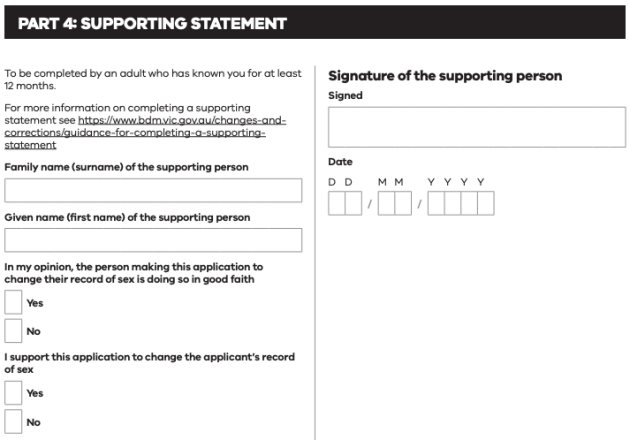
However, there is one requirement which fails the principle of complete ‘self-identification’. That’s because section 30A of the Victorian Births, Deaths and Marriages Registration Act 1996 requires adults to submit a ‘supporting statement’ made by a person who is aged 18 years or over and who has known the applicant for at least 12 months and state that the person making the supporting statement:

  • believes that the applicant makes the application to alter the record of their sex in good faith, and
  • supports the application.

This second requirement in particular (that another person must ‘support’ the application of a trans or gender diverse person for a new birth certificate) is unnecessary, and is the reason why Victoria’s new scheme, while a massive improvement from the previous regime, falls short of Australian best practice.

Screen Shot 2020-05-02 at 8.08.02 am

Ideally, access to accurate identity documentation for trans and gender diverse people should not depend on whether another person ‘supports’ their application.

Tasmania

That honour belongs to Tasmania’s Births, Deaths and Marriages Registration Act 1999. Following amendments earlier last year, it allows trans and gender diverse Tasmanians (aged over 16) to self-determine their own gender identity.

Without the need for surgery or other physical medical interventions. Without the need for medical approval. And based solely on self-identification.

When NSW, Queensland and Western Australia finally bring their own birth certificate laws into the 21st century, it is the Births, Deaths and Marriages Registration Act 1999 (Tas) they should be emulating.

**********

This article is part of a series. Find other ‘Did You Know?’ posts here.

If you have enjoyed reading this article, please consider subscribing to receive future posts, via the right-hand scroll bar on the desktop version of this blog or near the bottom of the page on mobile. You can also follow me on twitter @alawriedejesus