
It has truly been an amazing few days. With the House of Representatives vote on the Smith Bill on Thursday afternoon, its royal assent on Friday morning, and commencement at 12am Saturday (instantly recognising the overseas marriages of many LGBTI couples, and allowing thousands more to register their intention to marry), Australia is a different country – a better, fairer and more inclusive country – today than it was this time last week.
Now that I’ve had a few days to let this historic achievement sink in, here are some personal reflections on the marriage debate:
- It’s LGBTI marriage. It’s not marriage equality.
My first reflection is probably the most controversial: while the passage of the Marriage Amendment (Definition and Religious Freedoms) Act 2017, which permits all couples to marry irrespective of their sexual orientation, gender identity or sex characteristics, is obviously welcome, it does not deserve the moniker ‘marriage equality’.
That is because, as well as amending its definition, it also changes the ‘terms and conditions’ surrounding marriage in Australia, simply because LGBTI couples are finally allowed to participate.
This includes enabling existing civil celebrants to nominate to become ‘religious marriage celebrants’, and discriminate against LGBTI couples, solely on the basis of their personal religious beliefs [sub-section 39DD(2)]. As well as unnecessarily duplicating religious exceptions from the Sex Discrimination Act 1984 within the Marriage Act itself [section 47B].
The fact these amendments have been included now, but were not previously required in relation to divorced people re-marrying, suggests they have very little to do with ‘religious freedom’, and much more to do with homophobia, biphobia and transphobia.
Informed by past experience, the majority of LGBTI Australians fear that new rights to discriminate will be primarily used to target us – with recent research finding more than 60% of respondents strongly agreeing that, even if these laws technically allow discrimination against all couples, ‘it will disproportionately discriminate against same-sex couples’.
Of course, in the interests of ensuring LGBTI couples are able to marry at all, many people were prepared to accept these concessions. I certainly understand that viewpoint. But from my perspective, it means we now enjoy LGBTI marriage (or what a respected friend of mine describes as ‘partial marriage equality’) rather than genuine marriage equality.
And I think it is important to remind ourselves of this compromise, so that we can work to remove these discriminatory provisions in coming years.
- It could have been worse
Despite the significant flaws of the Smith Bill, we should also remember that it could have been much worse. At the start of November, most media commentary focused on how many ‘conservative’ amendments would be passed, allowing even more discrimination against LGBTI couples.
There was even the short-lived Bill from Liberal Senator James Paterson, the entire purpose of which appeared to be about entrenching ‘religious privilege’. Followed by amendments put forward by Attorney-General George Brandis, and supported by Prime Minister Malcolm Turnbull, to permit all civil celebrants to say ‘no gays allowed’.
One of the proudest moments of my own participation in the long fight for equality came in recent months, collaborating with a small group of advocates to oppose these changes. Rodney Croome, Felicity Marlowe, Shelley Argent, Brian Greig, Sharon Dane, Ivan Hinton-Teoh, Sharyn Faulkner, Robin Banks and Peter Furness all fought for the principle of full equality until the very end.
In that struggle we were not alone, with others – notably including the Equal Marriage Rights Australia Facebook page, Pauline Pantsdown, Jacqui Tomlins and Doug Pollard –making important public contributions.
I should also take this opportunity to thank everyone – family members, friends, blog readers, No Homophobia No Exceptions followers, and complete strangers – who completed the just.equal webform, to let MPs and Senators know there should be ‘No compromise on equality’. I understand close to 200,000 emails were sent, obviously having a massive impact. Thank you.
Together, we were able to alter the conversation, so that the Smith Bill was no longer seen as a ‘starting point’, to inevitably be dragged further to the right, but as the compromise it clearly was.
Together, we were able to persuade the Greens to introduce amendments to remove the egregious elements of the Smith Bill, amendments that, even if they failed last week, can be used for advocacy in the future.
Together, we helped to stop the Marriage Amendment (Definition and Religious Freedoms) Act 2017 from being much, much worse.
- It could still get worse
We must not overlook the fact that the reforms introduced last week are already under serious threat, as a result of the Review into ‘Religious Freedoms’ announced by Malcolm Turnbull on 22 November.
Former Liberal MP Philip Ruddock – the Attorney-General who oversaw the introduction of the ban on marriage equality in August 2004 – will spend the first three months of 2018 examining how Australian law can ‘better protect’ religious freedoms.
As we all know, increases in special privileges for religious individuals and organisations almost inevitably come at the expense of the rights of lesbian, gay, bisexual, transgender and intersex Australians (as well as other groups, including women).
Despite this, the panel for the Ruddock Review does not include any representatives from the LGBTI community (with Ruddock joined by the head of the Australian Human Rights Commission Rosalind Croucher, retired judge Annabelle Bennett and Jesuit priest Frank Brennan).
So, by all means spend the remainder of December celebrating our recent success. Because when 2018 starts we must stand ready to defend those gains, as well as protecting a wide range of other existing LGBTI rights, which will likely come under sustained attack.
- Renewed appreciation of the importance of LGBTI anti-discrimination laws
Some of the rights most at risk in the Ruddock Review – as they were during the parliamentary debate of the Marriage Amendment (Definition and Religious Freedoms) Bill – are our essential LGBTI anti-discrimination protections.
Indeed, one of the few positives of the past few months, amid the intense lobbying surrounding the Smith Bill, Paterson Bill and attempted conservative amendments, has been renewed appreciation of the importance of these laws within the LGBTI community itself.
After all, it is difficult to convey the significance of provisions, like LGBTI anti-discrimination sections within the Sex Discrimination Act, that should be needed less and less in practice as homophobia recedes (although the experience of the postal survey indicates that hopeful vision of the future remains some way off).
However, even if we don’t individually use them to lodge complaints, we all rely on the standards these laws set. Hopefully, the recent focus on the subject of anti-discrimination laws means the LGBTI community will be ready to fiercely defend our existing protections in the near future.
But we must do more than merely maintain the status quo. We must campaign to improve the protections offered by these laws, especially in terms of who is covered, removing religious exceptions, and introducing LGBTI anti-vilification laws where there currently are none (Commonwealth, Victoria, Western Australia, South Australia and the Northern Territory).
To find out more about the current status of these laws in your jurisdiction, see: A Quick Guide to Australians LGBTI Anti-Discrimination Laws.
The first opportunity to improve these laws is the public consultation by the Northern Territory Government on modernisation of their Anti-Discrimination Act. Submissions close 31 January 2018. For more information, click here.
- Marriage is not, and never has been, the only LGBTI issue
This point may seem obvious to most (but sadly not all) people within the LGBTI community, but it is less so to those outside, including some who sit in our nation’s parliament.
The denial of the right to marry was never the only form of discrimination to adversely affect lesbian, gay, bisexual, transgender and intersex Australians. For a lot of people, it wasn’t even close to being near the top of a long list of concerns.
Now that LGBTI marriage has been legalised, it is time to ensure a wide range of other issues receive the level of attention that they deserve, including (but definitely not limited to):
- Ending involuntary surgeries on intersex children
- Improving access to identity documentation for trans and gender diverse people
- Ensuring the national Health & Physical Education curriculum includes LGBTI students, and content that is relevant to their needs
- Implementing nation-wide LGBTI anti-bullying programs in schools
- Fixing LGBTI anti-discrimination laws (including the broken NSW Anti-Discrimination Act 1977)
- Stopping the offshore detention, processing and resettlement of people seeking asylum, including of LGBTI people in countries that criminalise them (such as Papua New Guinea), and
- Ending HIV.
These last two issues directly affect the LGBTI community, albeit not exclusively. There are other issues that may not be specifically ‘LGBTI’ per se, but that we have an interest in, and a responsibility to help address.
That includes improving the treatment of people seeking asylum generally, supporting the campaign for constitutional reform for Aboriginal and Torres Strait Islander people – especially because the same-sex marriage postal survey was used to push the Uluru Statement from the Heart off the political agenda – and helping to Close the Gap. Oh, and addressing climate change (including stopping the Adani coal mine) because there’s no human rights on a dead planet.
- The ends do not justify the means
One of the most nauseating parts of the parliamentary debate last week (amid some fairly stiff competition) was the sight of Liberal and National Party MPs trying to retrospectively justify their decision to hold the postal survey in the first place.
They must never be allowed to get away with this argument.
The postal survey was unnecessary.
It was wasteful – at a final cost of $80.5 million (a figure that Coalition MPs should arguably be forced to repay).
And it was harmful, just as LGBTI Australians always said it would be: “experiences of verbal and physical assaults more than doubled in the three months following the announcement of the postal survey compared with the prior six months”, while “more than 90% reported the postal survey had a negative impact on them to some degree.”
As Junkee’s Rob Stott aptly described it: “Hey Malcolm, I’m glad you enjoyed the postal survey. It was one of the worst times of my life.”
Even the United Nations Human Rights Committee recently criticized the Government for this process:
“While noting that the State party is currently undertaking a voluntary, non-binding postal survey on the legalization of same-sex marriage, the Committee is of the view that resort to public opinion polls to facilitate upholding rights under the Covenant in general, and equality and non-discrimination of minority groups in particular, is not an acceptable decision-making method and that such an approach risks further marginalizing and stigmatizing members of minority groups.”
Which is exactly what happened.
The fact Commonwealth Parliament has since passed LGBTI marriage cannot be used to excuse the postal survey – because passing legislation is what parliaments are supposed to do. You know, like how John Howard banned marriage equality in August 2004, without an $80.5 million farce beforehand.
The postal survey should never have happened. And it must never be allowed to happen again.
- This was not Malcolm Turnbull’s victory. It was ours.
Another extremely nauseating moment last week was watching Prime Minister Malcolm Turnbull try to claim credit for the passage of LGBTI marriage.
This is a so-called ‘leader’ who:
- Refused to introduce legislation to legalise marriage equality
- Instead, imposed an unnecessary, wasteful and harmful postal survey on the LGBTI community
- Then refused to participate in the Yes campaign, and
- When legislation was finally before parliament, supported amendments to allow even more discrimination against LGBTI couples.
Thankfully, his brazen ‘gloating’ has been called out by people like Magda Szubanski and perhaps even more powerfully by Jordan Raskopoulos.
Malcolm Turnbull does not deserve credit for what he did. He deserves our condemnation.
On the other hand, and given the sheer scale of the accomplishment, there are plenty of individuals and organisations that do deserve our thanks. Including the advocates I named earlier. As well as, obviously, the Yes Campaign and Australian Marriage Equality, GetUp!, PFLAG Australia, Rainbow Families Victoria, the NSW Gay & Lesbian Rights Lobby, just.equal, Equal Love, CAAH, Rainbow Labor and the unions (well, most of them), and the Greens. Plus many, many more.
Nevertheless, one of the best parts about the long struggle for LGBTI marriage in Australia is that it was truly a collective effort, much bigger than any one individual. Because it involved millions of actions, by millions of people, the vast majority of which will never be recorded by history. Which means the victory belongs to everyone who has contributed to the fight along the way. All of us.
**********
So, there you have it, my final thoughts on the marriage debate. Feel free to share yours – including where you may passionately disagree – in the comments below.
But now, on a personal level, it’s time for me to stop writing about the right to get married. And to instead go and exercise that right, by planning Steven and my long overdue wedding.
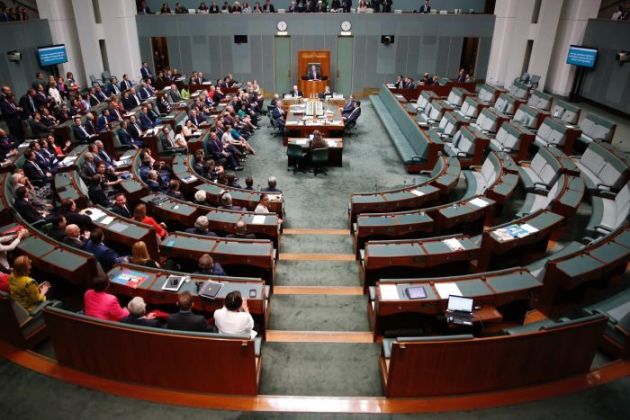
The moment LGBTI marriage was passed by the House of Representatives.


 alastairlawrie