The ALP has cut back on LGBTIQ policy commitments in its party platform. Again.

In 2015 and 2018, under then-Leader Bill Shorten, the Australian Labor Party adopted national party platforms with wide-ranging policy commitments on LGBTIQ issues. These helped to inform the promises taken to the federal elections in the following years, which were similarly-broad in scope.

In 2021, the ALP, under Shorten’s replacement Anthony Albanese, adopted a much more narrowly-drafted party platform, which involved jettisoning some previously-held LGBTIQ policies (although a few of these were restored via conference resolutions from the floor). This was then reflected in an relatively narrow range of LGBTIQ promises at the May 2022 election.

With the next ALP National Conference coming up in Brisbane on August 17-19 2023, this week the Party’s national policy forum released its draft Platform for public consultation.

Unfortunately, the LGBTIQ policy commitments it contains have been pared back even further than the already-limited 2021 offerings, including in the following key areas:

  1. The draft platform axes previous support for LGBTIQ vilification protections

 The 2021 National ALP Platform includes a commitment that:

‘Labor will work closely with LGBTIQ Australians and advocates to develop policy that will…

b. strengthen laws and expand initiatives against discrimination, vilification and harassment on the basis of sexual orientation, gender identity or sex characteristics.’ (p64).

The 2023 draft Platform instead includes the general statement that: ‘Labor will work closely with LGBTIQ+ Australians and advocates to develop policy that meets the specific needs of the community to ensure equality with broader Australian society.’ (p56).

This clause is so generic, and so bland, as to be almost meaningless.

It is difficult to comprehend why previous ALP support for vilification protections has been axed in the current political climate, with TERFs and neo-Nazis rallying on the steps of Victorian Parliament, Christian Lives Matter rioting in Sydney, Mark Latham being Mark Latham, and escalating violent threats against local councils hosting Drag Story Time events (and LGBTIQ community events more broadly).

What makes this axing even worse is that, just two pages later, under the heading ‘Freedom of thought, conscience and religion’, the 2023 draft Platform actually retains its previous commitment from the 2021 Platform for Commonwealth religious vilification laws:

‘Labor believes that people of faith deserve the same human rights, equality, respect and safety as every other Australian. No Australian should ever be vilified, discriminated against or subjected to violence or threats of violence because of that person’s religion or religious belief. Labor will work to ensure that Australia’s anti-vilification laws and discrimination framework are fit for purpose.’ (p58).

Those are strong sentiments. I, and I’m sure many other LGBTIQ Australians, could perhaps suggest another community, currently under sustained attack from far-right extremists, who could perhaps do with a similar expression of support…

But the piece de resistance of this shameful situation is that the draft Platform actually repeats the promise of religious vilification laws on the following page for a second time:

‘Labor believes that people of faith deserve the same human rights, equality, respect and safety as every other Australian. No Australian should ever be vilified, discriminated against or subjected to violence or threats of violence because of that person’s religion or religious belief. Labor will therefore ensure that Australia’s anti-vilification laws are fit for purpose.’ (p59).

So, the draft 2023 ALP Platform axes support for LGBTIQ vilification protections, at a time when we need them more than ever, while promising it to people of faith. Twice.

That’s the opposite of great.

2. The draft platform axes previous support for affordable trans health care

The 2015 and 2018 ALP National Platforms included commitments to, where possible, reducing out-of-pocket medical costs for gender-affirming health care.

While this was cut from the official platform in 2021, a conference resolution was passed which included the following:

‘Labor acknowledges the needs and rights of transgender and gender diverse people to fair, equal and affordable access to health care services. For many, this many include accessing vital specialist health services and gender-affirming medical technologies. Labor commits to removing, wherever possible, barriers to accessing these services in consultation with medical experts and government.’ (p140).

That statement appears to have been significantly cut back, reappearing in the following form in the 2023 draft:

‘Labor supports queer, transgender and gender diverse Australians and their families, and will work to support their agency in health decisions. Labor will provide access to the vital health and support services LGBTIQ+ Australians need.’ (p44).

Worryingly, this redrafted clause removes any specific reference to the affordability of trans health care, which is really the point: far too many trans and gender diverse people are currently blocked from accessing the care they need because they simply cannot afford it.

3. The draft platform axes most intersex-specific commitments

Intersex Australians fare even worse than their trans and gender diverse counterparts in the draft 2023 Platform.

The 2021 version included a commitment to: ‘support intersex-led organisations to provide support to intersex persons and their families, and advocate on intersex issues.’ (p64).

The 2021 conference also passed multiple resolutions from the floor, including statements that:

‘Labor will recognise the bodily integrity of intersex persons, prohibiting modifications to the sex characteristics of people with innate variations of sex characteristics performed for social or cultural reasons, and ensuring respect for intersex persons right not to undergo sex normalisation treatment. Labor commits to supporting the development and implementation with community participation of human-rights affirming oversight and standards of care, including for accessing lifetime medical treatments and procedures.’ (p140).

and

‘Labor will ensure that the actions of a Federal Labor Government are informed by the Yogyakarta Principles on the Application of International Human Rights Law in Relation to sexual orientation, gender identity, gender expression and sex characteristics and the Plus 10 Supplementary Principles. Further, Labor acknowledges the Darlington Statement as a guide to intersex policy responses within Australia.’ (p142).

As far as I can tell, not one of these commitments made it into the draft 2023 Platform. This is deeply troubling given the human rights abuses experienced by intersex Australians aren’t just the worst of those affecting the LGBTIQ community, they are some of the worst affecting any group in Australia.

4. The draft platform fails to support an LGBTIQA+ Human Rights Commissioner at the Australian Human Rights Commission

One area where the draft Platform hasn’t gone backwards from 2021 is on the question of a stand-alone, dedicated Commissioner for Sexual Orientation, Gender Identity and Sex Characteristics at the Australian Human Rights Commission (AHRC) – because neither version commits to creating this much-needed role.

However, the 2015 and 2018 platforms did, with the Shorten Labor Opposition promising to introduce one at both the 2016 and 2019 federal elections.

Recent events have, I believe, demonstrated the urgent need for such a position. Unfortunately, in the absence of an LGBTIQA+ Commissioner, the AHRC has not issued any media releases in response to the TERF and neo-Nazi rally, Christian Lives Matter riot, or escalating threats of violence against Drag Story Times.

The LGBTIQ community is under attack, and it feels like nobody federally is on our side.

Instead of seeking to rectify this situation, the draft 2023 Platform offers this acceptance of the unsatisfactory status quo: ‘Labor supports the Australian Human Rights Commission and its commissioners, including the important work they do to promote a more inclusive and respectful society.’ (p59).

We need an LGBTIQA+ Commissioner, and we need it yesterday.

Who knows, perhaps if there already was such an office-holder, the people responsible for drafting the consultation version of the 2023 national platform might have done a better job at understanding the need for more, and more-detailed, LGBTIQ policy commitments?

*****

If you haven’t guessed by now, I am genuinely disappointed (#understatement) by the draft national ALP platform released this week, and its omission of key policy commitments affecting the LGBTIQ community.

Beyond that, I am perturbed by the thought process that must have gone into the decision to cut support for things like LGBTIQ vilification protections, at a time of growing threats of violent extremism against our community.

The four issues outlined above are just those I have identified today. I am sure there will be others, affecting different parts of our community, which will become apparent in the coming days.

But there is an urgency to this analysis, because the draft platform is only open for public consultation until 23 June (ie just over three weeks away).

You can find the draft 2023 platform, and consultation form, at this link: https://alp.org.au/2023-draft-Platform

You can find the 2021 Platform for comparison, including to see which previous LGBTIQ commitments have been axed, here: https://www.alp.org.au/about/national-platform/

It’s time to get writing – and get lobbying – because what the ALP national policy forum has released this week is simply not good enough on LGBTIQ issues.
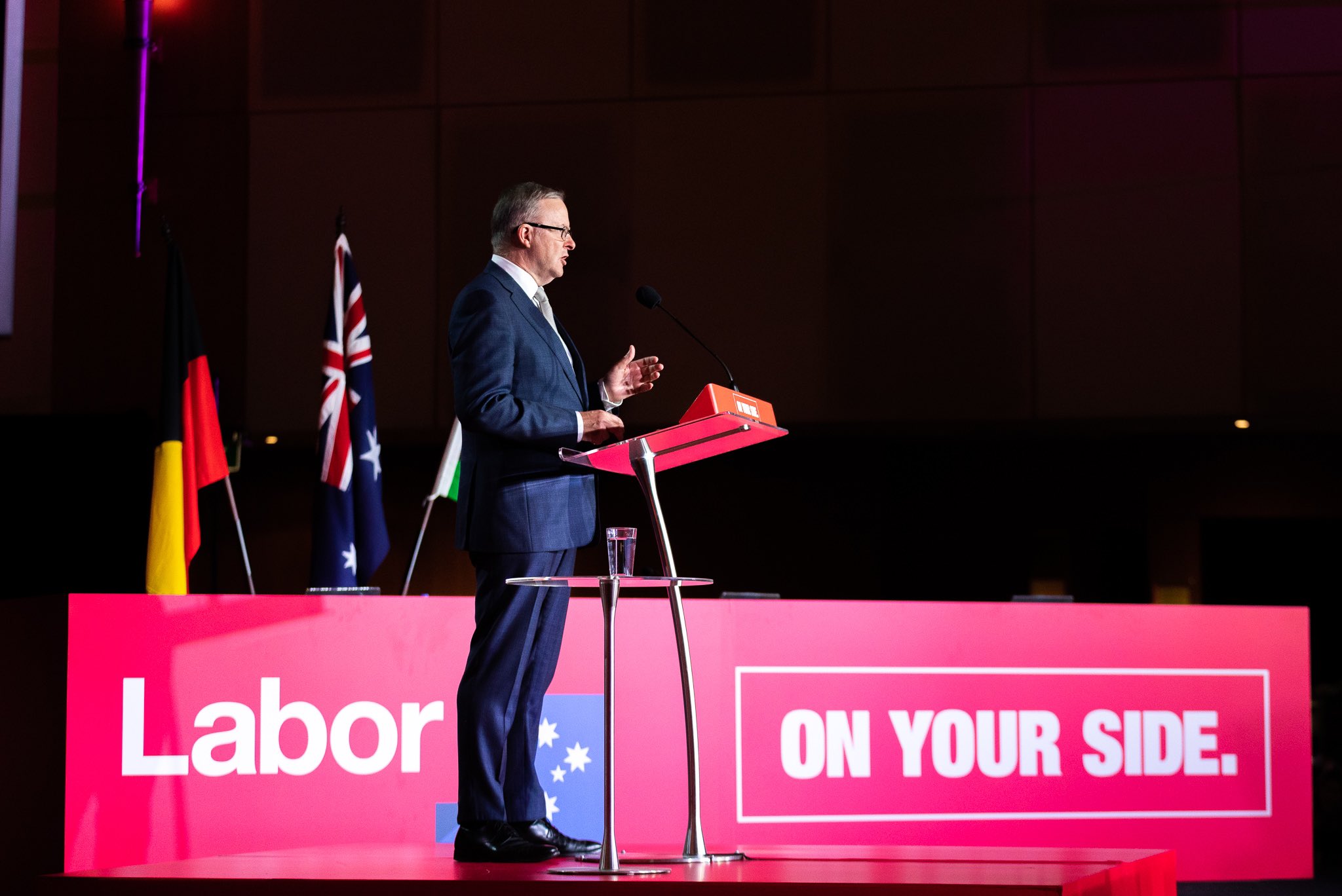
Anthony Albanese at the 2021 ALP National Conference.

What for art thou Albo?

Anthony Albanese became Leader of the Australian Labor Party in May 2019. It’s now March 2021, and we still don’t know where he stands on key issues affecting the lesbian, gay, bisexual, transgender, intersex and queer (LGBTIQ) community.

In his 22 months as Opposition Leader, Mr Albanese (commonly referred to as ‘Albo’), has only explicitly referred to LGBTIQ rights once in Parliament. On 2 July 2019, he made the following statement:

‘In an article in the NewDaily and in a number of other articles reporting on that article, it’s been suggested that I supported watering down Labor’s commitment to LGBTIQ rights. As someone who in their first speech in parliament mentioned removing discrimination on the basis of sexuality and is a strong advocate for the rights of gay and lesbian people, that is not true; it did not happen.’

Despite this, and unfortunately for LGBTIQ Australians, that article foretold what appears to have occurred in the period since.

As happens every term, the Labor Party is engaged in updating its National Platform, the document setting out its core principles.

As part of this process, Albo has expressed a clear desire for the Platform to be streamlined. The current draft, which will be considered at an online Special Platform Conference on 30 and 31 March 2021, stands at 111 pages – compared to 268 pages of policy detail in former Leader Bill Shorten’s 2018 version.

Based on that level of reduction, you might expect that LGBTIQ policy commitments would have decreased by a similar ratio (to be two-fifths of the previous document).

However, the axe seems to have fallen disproportionately on issues affecting our communities. From 46 separate mentions of LGBTIQ issues in 2018, there are just nine in the 2021 draft Platform.

Admittedly, that is a somewhat superficial criterion. Nevertheless, looking at the substantive policy commitments in closer detail, and the cuts are just as bad. Worse, in fact, with Labor’s Platform now missing in action on some of the most important challenges we face.

That includes what I consider to be the worst human rights abuses affecting any part of the LGBTIQ community today: coercive medical interventions, including surgeries, on children born with intersex variations of sex characteristics.

The 2015 and 2018 ALP Platforms included clear commitments to address these abuses. From the 2018 version:

‘Parents of intersex children can be pressured to hormonally or surgically intervene on their children if they don’t receive medically correct advice, information or support about how to parent an intersex child. Labor will ensure deferral of non-necessary medical intervention on infants and children with intersex variations until such time as the person concerned can give their informed consent is supported. Labor commits to promote and support a human rights-based patient consent model for accessing lifetime medical treatments and procedures. Labor will prohibit modifications to sex characteristics undertaken for social rationales without informed consent and ensure intersex persons’ right not to undergo sex assignment treatment is respected.’

In contrast, the draft 2021 ALP National Platform is completely silent on this issue. That is simply not good enough.

Another important policy commitment from 2015 and 2018 that has disappeared relates to the out-of-pocket costs which far-too-frequently prevent trans and gender diverse people from being able to access gender-affirming health care. Again, from the 2018 Platform:

‘Labor acknowledges the right of all Australians, including transgender and gender diverse people, to live their gender identity. For many, this includes accessing specialist health services and for some people can involve gender affirming medical technologies. Cost should not be a barrier to accessing these services. Labor commits to removing, wherever possible, barriers to accessing these services and consulting with experts in government. This should materialise in a focus on creating fair, equal and affordable access to medical care and treatments relevant to trans and gender diverse Australians.’

In 2021, Labor has so far found no room in its core principles document to address one of the biggest challenges affecting the everyday lives of trans and non-binary Australians.

A third major omission from the draft Platform is HIV – and that omission is total. If passed in its current state, the 2021 Australian Labor Party Platform would be the first in at least a generation not to even mention the term HIV.

I would argue the middle of a global pandemic is possibly the worst time to abandon commitments relating to another epidemic that, despite popular misconceptions, remains far from over. Instead, I believe the Platform should (at a minimum):

  • Highlight that lessons learned from HIV have assisted Australia in dealing with COVID-19
  • Emphasise the fundamental importance of working in partnership with affected communities, including people living with HIV and those at risk, and
  • Recommitting to ending the HIV epidemic in Australia, and globally.

The fourth and final major problem I would like to focus on is the lack of clarity around much-needed improvements to LGBTIQ anti-discrimination and anti-vilification protections. On this issue at least the draft 2021 Platform includes some detail:

‘Labor will work closely with LGBTIQ Australians to develop policy to:

(a) ensure they enjoy equality before the law and have access to public services without discrimination; [and]

(b) strengthen laws and expand initiatives against discrimination and harassment on the basis of sexual orientation, gender identity, sex characteristics and queer status’.

However, these commitments do not go nearly far enough. It is possible (although by no means certain) that para (a), above, means Labor will remove anti-discrimination exceptions which allow religious schools to discriminate against students on the basis of sexual orientation and gender identity. But there is no equivalent commitment to protect the employees of religious organisations, including teachers and other staff in religious schools.

As with the other three areas identified earlier, these anti-discrimination principles are also a significant step backwards from their 2015 and 2018 equivalents. There is no longer a commitment to introduce a stand-alone Commissioner for LGBTIQ issues within the Australian Human Rights Commission.

Nor is there a policy to introduce long-overdue LGBTIQ anti-vilification protections in Commonwealth law (despite the draft 2021 Platform twice committing to address religious vilification). Or a commitment to finally include gender identity and sex characteristics as protected attributes in the Fair Work Act 2009 (Cth) on the same basis as sexual orientation.

There are plenty of other problems with the draft Platform – perhaps most notably a policy to ensure schools are ‘welcoming and supportive environments for all’ which has removed previous explicit references to gender identity and sexuality, and added a qualifier (‘initiatives… as selected by schools’), thus rendering it close to meaningless.

Nevertheless, if the ALP wishes to demonstrate it is still committed to improving the rights of LGBTIQ Australians then I suggest the four main issues described above (ending coercive surgeries on intersex children; reducing out-of-pocket costs for gender-affirming health care; including policies addressing HIV; and improving commitments to LGBTIQ anti-discrimination and anti-vilification laws) would be a good place to start.

The defence of the Australian Labor Party to these criticisms has been to reiterate that the draft 2021 National Platform is intentionally a high-level, principles-based document, and to explain that more-specific LGBTIQ policies will be released closer to the election.

The problem with that defence, from my perspective, is that the clear message the ALP sent to all stakeholders back in 2019 was that all policies were under review, that in effect ‘everything is up for grabs’. Since then, as far as I can ascertain, there have been exactly zero policy announcements explicitly relating to LGBTIQ issues.

At the same time, the rights of LGBTIQ Australians have come under sustained attack at both Commonwealth level (including through the proposed Religious Discrimination Bill which Labor has not, to date, unequivocally opposed) and in the states and territories (including Mark Latham’s own ‘Religious Freedom’, and anti-trans kids, Bills in NSW).

In this context, it is only natural for the LGBTIQ community to closely examine the words and actions coming from the Leader of the Opposition and the Party he represents. So far, the only substantive document which we can scrutinise is the draft Platform and, particularly when compared to its 2015 and 2018 iterations, it is a disappointment.

The good news is that its deficiencies can still be fixed. The Special Platform Conference is not for another nine days, and the Leader of the Opposition, Shadow Ministers and conference delegates all have the opportunity to reinsert genuine commitments around intersex surgeries, trans health costs, HIV, and anti-discrimination and anti-vilification laws.

The bad news is that, more broadly, time is running out. We are nearly two years into a three-year term. Indeed, Prime Minister Morrison has the option of holding the next election as early as August, just five months away. There is little time left for Albo and the ALP to show us where they stand on key issues affecting the LGBTIQ community.

And I use that phrase deliberately – show us your current policies, don’t tell us about your past public positions.

Which brings me back to Albanese’s statement to Parliament in July 2019. It is interesting that, in defending his approach to LGBTIQ rights as Leader, he directly referred to his first speech which he gave on 6 May 1996.

To be fair, Albo’s comments then (‘The bigots who criticise programs aimed at the special needs of sections of our community ignore the fact that there is not equality of opportunity across class, gender, sexual preference and ethnicity’) were undoubtedly progressive for the time.

But times change. As does terminology (thankfully), as well as the needs of the LGBTIQ community which are much more complex and diverse than a general commitment to ‘equality of opportunity’.

Frankly, I am far less interested in what Anthony Albanese said as a new backbencher 25 years ago than I am in what he has to offer the country as its alternative Prime Minister for the next three years.

From my position as an advocate for LGBTIQ rights, I believe it’s time for Albanese to outline what a Government he leads would do for our community. Clearly, and in detail.

It’s time for him to answer the question ‘What for art thou Albo?’ Because, as of today, I and other LGBTIQ Australians genuinely don’t know.

Caption: It’s great that Albo is a regular participant in the Sydney Gay & Lesbian Mardi Gras Parade, including this year’s event (pictured). It would be even better if he could articulate, clearly and in detail, what he will do for LGBTIQ Australians if he becomes our Prime Minister for the next three years.

If you have enjoyed reading this post, you can sign up to receive updates about this and other issues from this blog, via the right-hand scroll bar on desktop, or near the bottom of the page on mobile. You can also follow me on twitter @alawriedejesus [NB Given the events of the past month – with this website being blocked by Facebook for being ‘news’ – it is more important than ever to sign up if you want to receive updates, especially with the possibility of further disruptions].