
Australian Human Rights Commission
Via email: TGD.Submissions@humanrights.gov.au
Sunday 5 May 2024
To whom it may concern,
Submission re Current and emerging threats to trans and gender diverse human rights
Thank you for the opportunity to provide this submission to this important inquiry.
I do so as long-term advocate for the rights of the lesbian, gay, bisexual, transgender, intersex and queer (LGBTIQ) community in Australia, including as a volunteer for a number of LGBTIQ community organisations, and through my personal website www.alastairlawrie.net
While I am a cisgender gay man, I have consistently attempted to serve as an active ally for trans and gender diverse (TGD) people. This has included writing about:
- Anti-discrimination and vilification laws, at Commonwealth and state and territory level, including how they protect (or in many cases fail to protect) TGD people
- Birth certificate laws across Australian states and territories, and
- The need for public funding, through Medicare, for gender-affirming health care.
These are the three main topics I will focus on in this submission.
Anti-discrimination and vilification laws
Australia’s anti-discrimination and vilification laws fail to adequately protect TGD people in a number of key areas, including:
Protected attributes for discrimination
While the Sex Discrimination Act 1984 (Cth) and most state and territory anti-discrimination frameworks clearly cover all sections of the TGD community against discrimination, in two jurisdictions they fall short of even this minimum standard.
NSW’s Anti-Discrimination Act 1977 only covers transgender people with binary gender identities (because of the outdated references to ‘identifying as a member of the opposite [sic] sex’ in the interpretive provision in section 38A, leaving non-binary and gender fluid people without legal protection.
While Western Australia’s Equal Opportunity Act 1984 is even narrower, only prohibiting discrimination against ‘a gender reassigned person on gender history grounds’ (section 35AB). Because of associated definitions in section 4 and section 35AA, this effectively restricts protection to transgender people with binary gender identities who have had a gender recognition certificate issued in WA (or equivalent legal recognition elsewhere).
Both the NSW Anti-Discrimination Act and WA Equal Opportunity Act must be reformed to ensure all TGD people enjoy the human right to non-discrimination.
Vilification protections
There are even larger gaps when it comes to legal prohibitions on anti-trans vilification. While Tasmania, the ACT, Northern Territory and Queensland all prohibit vilification against all TGD people, there are currently no protections against transphobic vilification under the Commonwealth Sex Discrimination Act, nor under the laws of Victoria or Western Australia (despite both State Governments having committed to doing so over several years), or South Australia.
The situation in NSW is more complex, with only transgender people with binary gender identities covered in relation to civil vilification under the Anti-Discrimination Act, while all TGD are protected by the ‘threatening or inciting violence’ offence in s93Z of the Crimes Act 1900 (NSW) (because the latter adopts the more modern terminology of ‘gender identity’).
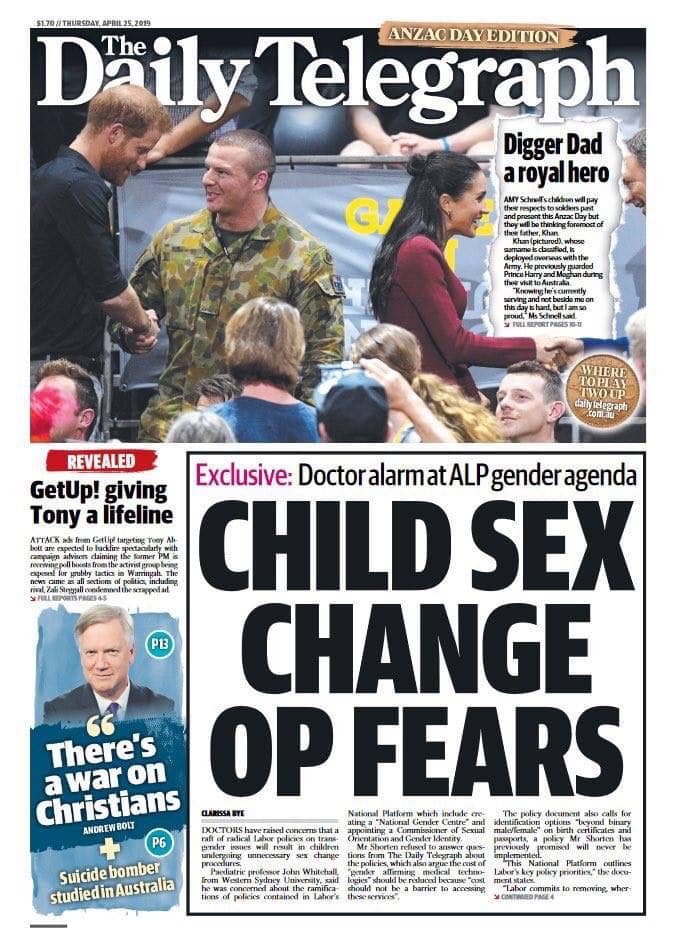
The lack of clear, nation-wide prohibitions on anti-trans vilification is even more problematic given the rise in hate speech against TGD people, especially over 2023 and early 2024, including (but sadly not limited to) the anti-trans rally on the steps of Victorian State Parliament in March 2023 to which neo-Nazis turned up shouting at trans counter-protestors with a banner saying ‘destroy paedo freaks’.
The State Governments of Victoria, WA, SA and NSW, and especially the Commonwealth Government, must take urgent action to address this worsening national crisis.
Religious exceptions permitting discrimination against TGD people
One of the major weaknesses of anti-discrimination laws relating to LGBTQ+ Australians, including TGD people, are exceptions allowing religious organisations to engage in conduct that would otherwise be unlawful.
Over the past decade, this issue has received particular attention in relation to religious schools.
In 2024, it remains lawful for a publicly-funded religious educational institution to discriminate against TGD students under the Commonwealth Sex Discrimination Act, as well as in NSW, Western Australia and, most likely, South Australia too.
Indeed, the exceptions in NSW are so broad they apply to all ‘private educational authorities’, and there is no test that these institutions are required to satisfy before being able to mistreat TGD students – the exceptions are ‘blanket’ exclusions from the Act’s operations.
These exceptions deny the fundamental human right to education. All students should enjoy the ability to learn and to grow, free from the fear of discrimination because of who they are. That must include TGD students.
The situation for TGD teachers is even worse. Once again, they are legally permitted to be discriminated against under Commonwealth law, as well as in NSW, Western Australia, and South Australia (although schools must publish their discriminatory policies).
In Queensland a ‘Don’t Ask, Don’t Tell’ regime applies, although thankfully the Queensland Government has been consulting on legislation to remove these exceptions entirely.
Religious exceptions deny the fundamental human rights of TGD workers, including the right to non-discrimination. TGD teachers should be hired or not hired, fired or not fired, and otherwise treated in the workplace, according to their skills and experience, not their gender identity.
The Albanese Labor Government was elected in May 2022 with clear commitments to end the legally authorised mistreatment of TGD students and teachers.
However, despite referring this issue to the Australian Law Reform Commission for review in November 2022, and receiving the ALRC’s straight-forward recommendations for how LGBTQ+, including TGD, students and teachers should be protected in December 2023, the Government is now refusing to implement reforms without bipartisan agreement (an unnecessary prerequisite for legislation to pass, and an artificial barrier that will most likely result in ineffective protections – or no protections at all).
The Albanese Labor Government’s failure to act is not only a broken election promise. It is a denial of the rights of TGD Australians and will have long-term implications in poorer life outcomes for TGD people.
While the exceptions which apply in relation to religious schools have received the most scrutiny to date, the special privileges that allow other publicly-funded religious organisations to discriminate, across health, disability, aged care (noting that amendments to the Sex Discrimination Act in 2013 protected LGBTQ+ people accessing aged care services but not the workers of those same faith-based providers), housing and other essential community services must also be removed.
Finally, I note many anti-discrimination laws include other exceptions, including in relation to the participation of TGD people in sport, but defer to the views of TGD organisations on these provisions.
TGD birth certificate laws
Having access to identity documents that accurately reflect who you are is a fundamental human right, but one that is currently denied to far too many TGD people in Australia.
This is especially so in NSW which, as a consequence of provisions of the Births, Deaths and Marriages Registration Act 1995, remains the only jurisdiction in Australia that still requires transgender people to have genital surgery in order to update their birth certificate to reflect their gender identity.
This is surgery many TGD do not wish to undertake – including because it is not necessary for them to live their daily lives according to their gender identity. For many who do wish to access gender-affirming surgery, they simply cannot afford the prohibitive costs (which will be addressed in more detail in the third and final section of this submission, below).
Given that this genital surgery is also sterilising, imposing this barrier in order to legally update birth certificates can justifiably be seen as a denial of the right to reproductive freedom, including the human right to found a family.
Finally, the NSW approach is also deficient in that it currently only allows binary sex or gender markers (male or female), with no legislated option to record non-binary and other gender diverse identities.
Both of these issues – the unnecessary requirement for genital surgery, and the lack of options to record gender beyond male or female – would be resolved through passage of the Equality Legislation Amendment (LGBTIQA+) Bill 2023, introduced by Alex Greenwich MP and currently being considered by a NSW Parliamentary Inquiry (although the NSW Government has still yet to indicate their position on this long overdue reform).
Unfortunately, the approach in Western Australia is only slightly better, and that is primarily because of the intervention of the High Court, rather than the provisions of Gender Reassignment Act 2000 (WA) itself.
Thanks to the decision in AB v Western Australia; AH v Western Australia [2011] HCA 42, genital surgery is no longer required in Western Australia.
However, some form of physical medical intervention, such as top hormone treatment or top surgery, is still deemed necessary, and once again, there are no legislated options to record gender beyond male or female.
Disappointingly, while the WA Government has committed to replace with Gender Reassignment Act 2000 with more contemporary legislation, including allowing options beyond male and female, and abolishing the Gender Reassignment Board, they have not chosen to adopt best practice frameworks, such as those that exist in Tasmania and, following recent amendments, the ACT.
Instead, the WA Government’s announcements have indicated they will be following the flawed approach of South Australia and the Northern Territory, both of which still require a TGD person to obtain approval from a medical professional, such as a psychologist or counsellor, before a new birth certificate can be issued.
This is unnecessary and inappropriate ‘medical gate-keeping’ of the legal rights of TGD people, including their right to have identity documents matching their lived reality.
It also perpetuates the incorrect assumption that being transgender or gender diverse is a form of mental illness, rather than simply part of the beautiful diversity of being human.
Requiring ‘sign-off’ from psychologists or counsellors places additional financial hurdles in the way of TGD people who simply want identity documents that actually reflect their identity.
Above all, identity documents are exactly that, intended to record a person’s identity – and TGD people are TGD irrespective of whether a psychologist or counsellor supports them.
Instead, a full self-identification model should be adopted, along similar lines to the legislation in Tasmania and the ACT. I urge the Western Australian Government to reconsider their decision to introduce laws that fall well short of this standard.
And for the South Australian and Northern Territory Governments to reform their own laws to ensure TGD people in those jurisdictions enjoy straight-forward access to new birth certificates too.
Medicare funding for gender-affirming health care
While much is written about the need to reform the laws which apply to TGD people seeking accurate birth certificates, far less attention is often paid to a much broader, and arguably even more important, problem – that the cost of accessing gender-affirming health care is prohibitive, and out of reach for many TGD people in Australia.
These costs apply not just to various kinds of surgery (including ‘top’ and ‘bottom’ surgeries, as well as, for some TGD people, facial surgeries), but also to other health services, including hormone treatments.
These expenses can mean the difference between being able to affirm one’s gender identity or not – but are so high that they can effectively push some trans people into poverty. While for others, they are completely unaffordable.
For example, in March 2018, the ABC reported that: ‘There’s a massive price tag on being transgender in Australia. For some, the cost of surgery and treatment for gender dysphoria will crack $100,000’ [noting there has been significant inflation in health care in the six years since then, meaning contemporary figures may be even higher].
LGBTIQ policy expert Liam Elphick noted in The Conversation in March 2019 that: ‘Medicare and private health insurance do not cover many treatments that transgender and gender-diverse people may require to transition, such as surgical changes, because these are deemed “cosmetic”.’
However, gender-affirming health care is not cosmetic, but essential.
ACON’s 2019 ‘A blueprint for improving the health and wellbeing of the trans& gender diverse community in NSW’ raised the issue of TGD out-of-pocket medical costs, noting on page 20 that:
‘For medical services to be covered by the public health system in Australia, they must be medically necessary, clinically effective and cost effective. For many trans and gender diverse people, the ability to alter their body is part of affirming their gender and can be an important treatment if they are experiencing distress or unease from being misgendered and/or feeling incongruence between their gender identity and their body.’
‘Research has demonstrated that access to gender-affirming care has led to reduced mental health risks and improved quality of life for trans and gender diverse people.’
These factors – better mental health and quality of life outcomes – are obviously important reasons why trans out-of-pocket medical costs must be reduced. Or better still, eliminated entirely.
There is an even more fundamental argument: TGD people have a human right to live their affirmed gender identity, and that right is just as important as health, education and housing.
Sadly, as with anti-discrimination and vilification laws, and access to birth certificates reflecting their identity, the rights of TGD Australians are being denied in this area too.
As a consequence, for some TGD people, whether they are able to afford gender-affirming health care turns on whether they are able to run a successful ‘gofundme’ campaign (or other fundraising initiative).
Access to essential health care should never be determined in this lottery-like manner.
Instead, it’s time for the Commonwealth Government to ‘go fund them’, by ensuring all forms of gender-affirming health care are fully covered by Medicare, so that all TGD people who want to undertake surgery, and receive other services, are able, irrespective of their individual financial circumstances.
Thank you in advance for your consideration of the issues raised in this submission. Please do not hesitate to contact me, at the details provided, should you require further information.
Sincerely
Alastair Lawrie

If you have appreciated reading this article, please consider subscribing to receive future posts, via the right-hand scroll bar on the desktop version of this blog or near the bottom of the page on mobile. You can also follow me on twitter @alawriedejesus
 alastairlawrie