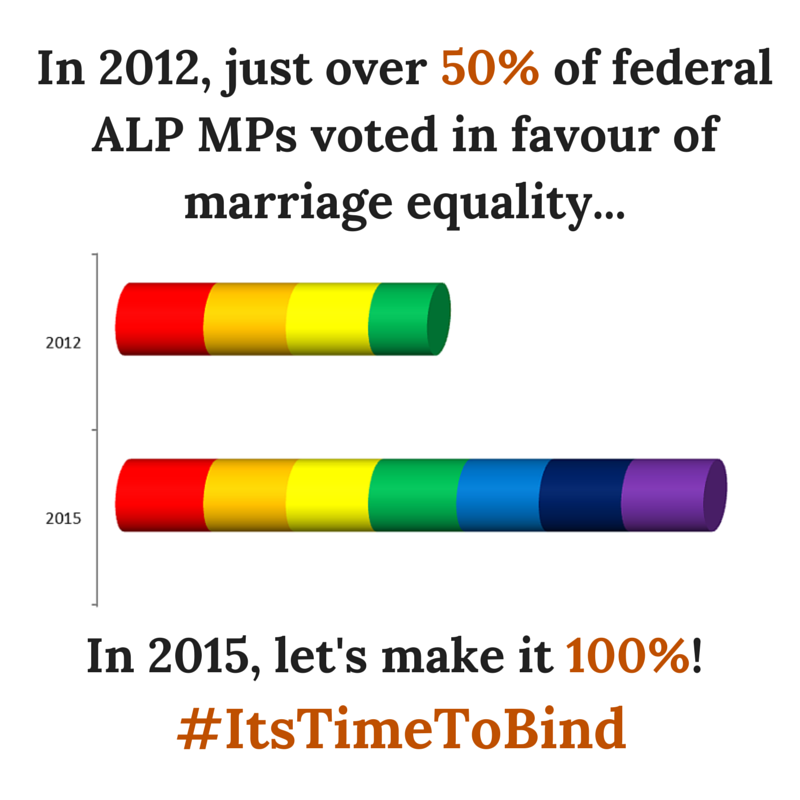
It’s Time To Bind, To stop us falling further & further behind

The US needs their Supreme Court for full marriage equality. Ireland needs a referendum. Australia just needs our parliamentarians to do their job.

Tonight, Australian time, the United States Supreme Court will hear oral arguments in a case to determine whether marriage equality exists, as a constitutional right, across all 50 states.

The decision will probably be handed down in June – and, based on current predictions, it is more likely than not that the United States will have marriage equality, nationwide, before the Australian Labor Party’s National Conference convenes in Melbourne in July (http://www.theguardian.com/society/2015/apr/27/same-sex-marriage-us-supreme-court-arguments-constitutional-right?CMP=share_btn_tw ).

The US Supreme Court, which will hear arguments about marriage equality tonight (28 April). In Australia, the High Court has confirmed that only the Commonwealth Parliament can deliver genuine marriage equality.

The US Supreme Court, which will hear arguments about marriage equality tonight (28 April). In Australia, the High Court has confirmed that only the Commonwealth Parliament can deliver genuine marriage equality.

Another country that is expected to make progress in the coming months is Ireland, which will hold a national referendum on May 22nd. Required by their constitution, current polling puts the ‘Yes’ case there ahead.

Even though prominent figures such as Panti Bliss have expressed their nervousness in the lead-up of the vote (http://www.independent.co.uk/arts-entertainment/comedy/features/drag-queen-panti-bliss-on-the-irish-samesex-marriage-referendum-international-fame-and-the-changing-gay-scene-10168417.html ) it is nevertheless likely Ireland will soon join the ranks of countries that have left Australia far, far behind on this issue.

And, sadly, it is not a short list. As at 28 April, the full list of countries where marriage equality has been introduced (or at least passed, awaiting implementation) includes:

  • Argentina
  • Belgium
  • Brazil
  • Canada
  • Denmark
  • Finland
  • France
  • Iceland
  • Luxembourg
  • Netherlands
  • New Zealand
  • Norway
  • Portugal
  • South Africa
  • Slovenia
  • Spain
  • Sweden, and
  • Uruguay

Marriage equality is also legal in three regions of Mexico, in England, Wales and Scotland within the United Kingdom, and in 37 states, plus the District of Columbia, in the US.

The longer this list grows, the greater our nation’s embarrassment at being a homophobic and discriminatory backwater.

And each and every time this list expands, our determination should correspondingly strengthen to amend our nation’s appalling laws, which actively exclude people from equal recognition of their relationships, solely on the basis of their sexual orientation, gender identity or intersex status.

Unlike the US, the path to doing so will not involve the nation’s highest court. Without a Bill of Rights, or even a comprehensive Human Rights Act, there is no scope for Australia’s High Court to mandate marriage equality in Australia.

And unlike Ireland, we do not need to hold a referendum (or plebiscite) in order for marriage equality to be lawful.

The High Court decision in December 2013, which struck down the ACT’s same-sex marriage legislation (and therefore overturned the marriages of 31 couples), found that the Commonwealth Parliament, and the Commonwealth Parliament alone, has the power to introduce genuine marriage equality in this country.

Which means that it is up to the 226 men and women who sit in our House of Representatives and Senate to step up and fix this mess.

Or at least the bare majority of them.

And it is not too much to ask, as a gay man who has been engaged to be married for more than 5 years, and as someone who has been a member of the Australian Labor Party for 13, that all 80 MPs and Senators from my political party should be part of that majority.

In fact, despite the bleatings of people opposed to a binding vote, this is the bare minimum which we should expect from a centre-left political party, one that has delivered the vast majority of LGBTI law reform in this country, and a party, and movement, which is based on the organising principles of solidarity and collective action.

This is exactly what we, the LGBTI members of the ALP, the progressive members of the Party, and labour movement, and LGBTI and/or progressive members of the broader community, should be asking demanding of the Australian Labor Party at the upcoming National Conference: that the ALP support the full equality of LGBTI people, and of our relationships, and most importantly that every single ALP MP and Senator will vote to make this happen.

If we are successful in July, and a resolution to bind is passed, then the ALP will be able to campaign for the following 12 months with the very simple promise: if you vote for us at the 2016 federal election, we will deliver marriage equality. No ifs, ands or buts.

And then finally, more than 15 years after the Netherlands, more than a decade after countries like Canada and South Africa, and three-plus years after our Trans-Tasman neighbours, Australia will be able to join the 21st century, where entry into marriage is not restricted on the basis of sexual orientation, gender identity or intersex status.

That’s what I, and most Australians, would like to see. And that’s another reason why I believe #ItsTimeToBind.

One of these things is not (treated) like the others

One of the most compelling arguments in favour of a binding vote for marriage equality within the Australian Labor Party also happens to be one of the easiest to make.

And that is simply noting the many, many examples of morally and ethically complex issues on which ALP parliamentarians are expected to abide by a binding vote – and then asking why marriage equality should be treated any differently?

The obvious answer: it shouldn’t.

Given the Labor Party binds its MPs and Senators on nearly every single policy issue that is debated and voted upon in Commonwealth (and state and territory) parliament, there are plenty of possible examples to choose from. This post will look at just four:

  1. Refugee policy

If there is a single issue in the contemporary political arena that raises profound questions of morality and ethics, then refugee policy is it. I have my own strong views on it, as do most members of the Australian community (many of whom I would vehemently disagree with, particularly when considering the results of the last federal election).

Inevitably, so do Labor members of parliament – there are some who would probably agree with boat ‘turn-backs’ (arguing that they prevent mass drownings) and offshore processing and resettlement, just as there are no doubt many ALP MPs and Senators who do not support these measures because they sincerely believe them to be inhumane.

But, despite these differences of opinion, and ignoring the strength of convictions on this topic, when former Prime Minister Julia Gillard and the majority of the caucus decided to reinstate offshore processing in 2012, leading to the indefinite detention, processing and resettlement of refugees in Nauru and on Manus Island, Papua New Guinea, there was no conscience vote.

Instead, all MPs and Senators were required to vote in favour of the ‘Pacific Solution Mark II’ – and if they hadn’t, they would have been expelled from the Party.

It is impossible for anyone to argue that, if ALP parliamentarians can be bound to support the offshore processing and resettlement of refugees (including, of course, the detention of LGBTI refugees in two countries that criminalise homosexuality), they cannot similarly be bound to support the recognition of the fundamental equality of LGBTI relationships under secular law.

Former Speaker Anna Burke, one of Labor's most outspoken critics of the offshore detention, processing and resettlement of refugees.

Former Speaker Anna Burke, one of Labor’s most outspoken critics of the offshore detention, processing and resettlement of refugees.

  1. Metadata

Turning to a more recent example – in March, the federal Labor Opposition voted for, and consequently guaranteed the passage of, legislation that requires the compulsory retention of, and allows law enforcement agencies warrantless access to, the metadata of every Australian citizen.

Argued for on the basis of preventing terrorism by a Government that seeks refuge in the welcoming arms of ‘national security’ whenever it encounters poll troubles (which makes it, at the very least, highly questionable policy), there were a number ALP MPs and Senators who internally expressed their opposition to this massive intrusion into our private lives (including at least one high profile inner-city frontbencher, whose personal stance against the data retention scheme was reported in the media: http://www.theguardian.com/australia-news/2015/mar/25/exclusive-albanese-spoke-out-against-metadata-bill-in-shadow-cabinet-meeting ).

In a party that is founded on the principles of solidarity and collective action, those same MPs and Senators were nevertheless compelled to support the legislation in parliament, no ifs, ands or buts.

Once again, it is incredibly difficult for anyone to seriously argue that, if Labor parliamentarians can be bound to support the Abbott Government’s metadata laws (which, in the views of some at least, represent one of the biggest encroachments on the civil liberties of Australians, ever), they cannot equally be bound to vote for something, like marriage equality, that would actually enhance the rights of its citizens.

  1. Single parent payments

One of the more controversial Budget decisions taken by former Treasurer Wayne Swan was the change to single parent payments, that effectively forced single parents – and primarily single mothers – onto the dole when their youngest child turned 8.

As with the previous two issues, there was significant backbench disquiet when these measures were first raised, on the basis of economic injustice, although that dissent did not prevent its adoption by the caucus, and therefore its passage in parliament thanks to a binding vote of ALP MPs and Senators.

Fast forward to the ALP leadership contest in September and October 2013, and both contenders for the top job, Anthony Albanese and Bill Shorten, argued (some might say acknowledged) that this decision had been a mistake (see: http://www.smh.com.au/federal-politics/political-news/leadership-rivals-agree-cut-for-single-parents-was-wrong-20130922-2u81m.html ).

If the ALP can bind its parliamentarians to support a cut to single parent welfare payments, something that was strongly argued against at the time, and which was later conceded as a ‘mistake’, including by the current Opposition Leader, why can’t it bind its MPs and Senators to support a policy that does not take anything from anyone, but would instead only give happiness to those couples who choose to participate?

  1. Live animal exports

The fourth and final issue which raised serious moral and ethical concerns for many members of the ALP caucus (this time borne out of concern for animal welfare), but on which those MPs and Senators were nevertheless still bound, was live animal exports.

Specifically, in 2011 and following the ABC’s Four Corners report, both when the decision was taken to suspend the live export of cattle to Indonesia, and again when the decision was taken to lift that suspension, all ALP parliamentarians were expected to vote in favour of these policies.

And, despite vocal criticism from a not insignificant number of backbench MPs at the time, ultimately crossed the floor against the position of the Government.

Just like the issues described above, if ALP MPs and Senators can be bound to support the live animal export of sheep and cattle, they can be bound to support the ability of lesbian, gay, bisexual, transgender and intersex (LGBTI) Australians to get married.

All four of these issues have raised, and continue to raise, profound moral and/or ethical issues for many members of the ALP caucus, whether those concerns relate to human rights (refugees), civil liberties (metadata), economic justice (single parent payments) or animal welfare (live animal exports).

There is nothing about the issue of marriage equality – which for most involves the question of LGBTI rights, but for others (however mistakenly) is solely about religious freedom – which makes it any more special, or controversial, or deserving of an opt-out clause from what would otherwise be a binding position of the Party.

In short, while one of these issues, marriage equality, might currently be treated not like the others, it is in fact exactly like the others – an important public policy issue, and one that may raise moral or ethical concerns for members of the caucus, but about which the ALP nevertheless adopts a position. There is absolutely no reason why that position should be made ‘optional’ with respect to marriage equality, especially when it is not for the other four.

Which means that, if the ALP can bind its MPs and Senators to vote for:

  • the offshore detention, processing and resettlement of refugees
  • the compulsory retention of and warrantless access to our metadata
  • cuts to the single parent welfare payment, and
  • the live export of sheep and cattle;

then it can also bind its parliamentarians to vote for LGBTI equality, including the equal recognition of our relationships in the Commonwealth Marriage Act.

4 Arguments Against an ALP Binding Vote on Marriage Equality… And Why They’re Wrong

The arguments in favour of a pro-marriage equality binding vote within the Australian Labor Party are incredibly strong.

Marriage equality is about the fundamental equality of all Australians, irrespective of sexual orientation, gender identity and intersex status, and therefore it would be inappropriate to give a ‘free pass’ to some MPs within the ALP to vote against it.

The Australian Labor Party, as a collectivist organisation, also binds its MPs to vote together on nearly all issues – and there is no legitimate reason why marriage equality should be an exception to this principle.

And, strategically, a pro-marriage equality binding vote within the ALP is probably necessary for this reform to pass in either this or the next term of Parliament.

But, despite the above, there will still be many people, both within and outside the Party, who will try to argue against a binding vote between now and when it is finally voted upon at ALP National Conference in July.

This post looks at four of the most common arguments which will be made – and why they are unambiguously wrong.

  1. The ALP never binds on ‘gay issues’

There are two insurmountable problems which face anyone who attempts to raise this argument.

First, it’s simply not true. The two biggest lesbian, gay, bisexual, transgender and intersex (LGBTI) law reforms which have ever been passed by the Commonwealth Parliament, namely:

  • the recognition of same-sex relationships (outside of marriage) in the Same-Sex Relationships (Equal Treatment in Commonwealth Laws – General Law Reform ) Act 2008 (and related changes to superannuation and family law), and
  • the Sex Discrimination Amendment (Sexual Orientation, Gender Identity and Intersex Status) Act 2013 which introduced federal LGBTI anti-discrimination protections for the first time

were passed by the Rudd and Gillard Labor Governments – and both were achieved through binding votes.

Second, even where there were conscience votes related to ‘homosexuality’ – for example, in states and territories when sex between men was being decriminalised – in order to successfully use that as a precedent for another conscience vote today means effectively saying that it was ‘right’ that some ALP MPs were historically allowed to vote for the continued criminalisation of people solely on the basis of their sexual orientation.

So, if you are basing your supposed ‘right’ to vote against the full equality of LGBTI relationships now on the fact that other people voted, unarguably, on the basis of homophobia in the past then you should expect to be called out on it – because that is the not-so-proud tradition with which you are associating (for more on this argument, see It’s Time to Bind: The Merits, here: https://alastairlawrie.net/2014/07/13/hey-australian-labor-its-time-to-bind-on-marriage-equality/ ).

  1. The ALP never binds on ‘marriage’

This is perhaps my favourite of the pro-conscience vote arguments, and it has been ever since then Prime Minister the Hon Julia Gillard employed it during her speech at the 2011 ALP National Conference to argue against a binding vote. And by favourite, I mean the most laughable.

In essence, Ms Gillard attempted to argue that, because ALP MPs had been given a conscience vote on the Marriage Act 1961 when it was introduced, and when amended by the Family Law Act reforms of the mid-1970s, ALP MPs should have a conscience vote today (full text of the speech here: http://www.theaustralian.com.au/archive/national-affairs/julia-gillards-address-to-the-alp-national-conference-on-a-conscience-vote-for-gay-marriage/story-fnba0rxe-1226213001184 ).

Leaving aside the fact that a lot had changed during the previous five decades, Prime Minister Gillard also managed to completely overlook the 2004 Howard Government amendments to the Act – which introduced a definition of marriage and about which, as Ms Gillard well knew at the time of her speech, the ALP bound its MPs and Senators to support.

If the ALP can bind its parliamentary members on something as fundamental as the legislative definition of the word marriage, as recently as 2004, then this argument is completely and utterly bogus.

Nicola Roxon, the Shadow Attorney-General who, in August 2004, first told the National Marriage Forum the ALP would be supporting Howard's homophobic legislation.

Nicola Roxon, the Shadow Attorney-General who, in August 2004, first told the National Marriage Forum the ALP would be supporting Howard’s homophobic legislation.

  1. The issue of marriage equality is so controversial the ALP cannot bind its members on it

Okay, so there is no consistent history of conscience votes on LGBTI issues, or even of marriage-related conscience votes, but maybe by combining these issues – and making the argument specifically about the issue of marriage equality – opponents of a binding vote might be more successful, right?

Wrong. As we all know (far, far too well by now), the 2004 definition of marriage introduced by the Howard Liberal-National Government, with the bound support of the Australian Labor Party Opposition, was the first major substantive vote on, and sadly against, marriage equality in the Commonwealth Parliament.

But it was by no means the last. It was followed by a series of votes, over more than seven years, in which all ALP MPs and Senators – including those who were LGBTI themselves, as well as those who were progressive and simply supported the fundamental equality of people irrespective of sexual orientation, gender identity and intersex status – were bound to vote against marriage equality.

Even though this position was overturned by the 2011 ALP National Conference, the modern Labor Party has still had a binding vote on marriage equality for more than twice as long as it has had a conscience vote.

And if it can bind its MPs against marriage equality, less than four years ago, there is absolutely no reason why it cannot bind its MPs for marriage equality in 2015 (and, if necessary, beyond).

  1. Marriage equality is about ‘choice’, therefore MPs should be given the choice whether to support it or not

This argument was made most recently by Andrew Probyn in The West Australian who, as well as repeating the rumour that ‘half a dozen Senators’ would cross the floor rather than vote for marriage equality (though as usual naming only Senator Joe Bullock), made the following comment: “[f]orcing a vote on an issue that is ultimately about choice would be dumb indeed” (story here: https://au.news.yahoo.com/thewest/opinion/a/26807957/tony-abbott-the-anti-hero-on-gay-marriage/ ).

His argument has at least the merit of being distantly (and I mean very distantly) related to something that is true. Marriage equality is indeed about choice – the choice lesbian, gay, bisexual, transgender and intersex Australians should be able to exercise, to decide for themselves whether (or not) to marry their partner.

LGBTI people should be given the exact same choice that cisgender heterosexual couples currently enjoy. Because LGBTI people deserve to be treated equally under the law.

And it is the last point that is the most important. The issue, at its heart, is not about choice, it is about equality. The equality of lesbian, gay, bisexual, transgender and intersex Australians, and the legal equality which should apply to our relationships.

And it is offensive to suggest that ALP MPs and Senators should, on the basis of their own personal beliefs, be free to choose to deny the equality, and consequently the human rights, of their fellow citizens solely because of their sexual orientation, gender identity or intersex status.

Equality, and the recognition of fundamental human rights, should not be an ‘optional extra’ for a contemporary centre-left political party.

The MP, and the Senator, threatening to cross the floor rather than vote for marriage equality

In the lead-up to this year’s ALP National Conference, and the debate about whether to adopt a binding vote in favour of marriage equality, expect to hear a lot about the supposed ‘significant’ minority of ALP MPs and Senators who would be willing to cross the floor – and therefore be expelled from the party – rather than vote for the full equality of LGBTI relationships.

Indeed, the same The Saturday Paper article in which the Hon Tanya Plibersek MP and Senator the Hon Penny Wong confirmed their support for a binding vote, included the following statement: “[o]ne senior Labor figure estimates up to six senators would abstain or cross the floor in parliament rather than voting for same-sex marriage if the party chose to enforce its official policy” (<http://www.thesaturdaypaper.com.au/news/politics/2015/03/28/pressure-builds-same-sex-marriage-libs-and-alp/14274612001683#.VR234boxGX0 ).

Which is somewhat academic, irrelevant even, if those MPs and Senators aren’t willing to put their names to this sentiment. And, as far as I can tell, there have been only two current ALP parliamentarians who have publicly declared they would cross the floor rather than support marriage equality:

I have written the below letters to both Mr Hayes and Senator Bullock asking whether they would now abide by a decision of this year’s ALP National Conference to support a binding vote and, if not, whether they would do the honourable thing and resign. I will post any response from each that I receive.

As for the other MPs and Senators – who apparently threaten to cross the floor, but only do so behind closed doors, and who will not identify themselves to ordinary ALP members – then I suggest we ignore them, and their idle threats (or, to put it more accurately, their blackmail attempts), in the same way that they are more than comfortable in ignoring our right to full equality, irrespective of sexual orientation, gender identity or intersex status.

Finally, if you know of any other MPs or Senators who have made public threats to cross the floor against marriage equality, please let me know in the comments section below (including a link to any public record, if possible). Thanks.

Mr Chris Hayes MP

Member for Fowler

PO Box 6022

House of Representatives

Parliament House

Canberra ACT 2600

Chris.Hayes.MP@aph.gov.au

Tuesday 7 April 2015

Dear Mr Hayes

Would you abide by an ALP National Conference resolution to adopt a binding vote in favour of marriage equality?

I am writing to you about marriage equality, and specifically the issue of a binding vote within the Australian Labor Party, which is expected to be debated at this year’s National Conference in Melbourne from July 24-26.

Specifically, would you abide by a decision of the ALP’s supreme policy-making body to agree to a binding vote in favour of marriage equality?

I ask you this because it was reported, in the Sydney Morning Herald prior to the 2011 National Conference, that you would ‘never vote for gay marriage, even if party policy dictated it’.

I also ask the question sincerely, especially given many others, from US President Barack Obama to NSW Labor Opposition Leader Luke Foley, have seen their positions on marriage equality ‘evolve’ during the past three and a half years.

Perhaps, even if your personal view of marriage equality may not have changed since 2011, you might be more inclined to accept the democratic decision of delegates to ALP National Conference this year.

However, if your views have not changed, and you remain committed to breaking party solidarity and crossing the floor contrary to any potential resolution to bind in favour of marriage equality, then I ask: in that event, would you resign?

I believe that, if you genuinely believed that you could no longer remain a part of the collectivist organisation of which you enjoy the privilege of being a parliamentary member, resigning would be the honourable course of action.

I also believe that, given you have made public remarks indicating your intention to cross the floor (albeit prior to the last Conference), you owe it to the members of the Australian Labor Party to clarify what actions you would take if this year’s National Conference did agree to a binding vote for full lesbian, gay, bisexual, transgender and intersex equality.

Thank you in advance for your consideration of this correspondence.

Sincerely

Alastair Lawrie

The Member for Fowler, Chris Hayes MP

The Member for Fowler, Chris Hayes MP

Senator Joe Bullock

PO Box 6100

Senate

Parliament House

Canberra ACT 2600

senator.bullock@aph.gov.au

Tuesday 7 April 2015

Dear Senator Bullock

Would you abide by an ALP National Conference resolution to adopt a binding vote in favour of marriage equality?

I am writing to you about marriage equality, and specifically the issue of a binding vote within the Australian Labor Party, which is expected to be debated at this year’s National Conference in Melbourne from July 24-26.

Specifically, would you abide by a decision of the ALP’s supreme policy-making body to agree to a binding vote in favour of marriage equality?

I ask you this because last year it was reported in The Australian that, prior to your election to the Senate, you said, “[i]f the party decides it [marriage equality] is not a conscience vote and expels me, so be it.”

I also ask the question sincerely, because, even in the space of 12 months, it is possible for people’s views on this topic to ‘evolve’. It is also possible that, now you have performed the role of Senator for more than nine months, you may have a different view of your responsibilities towards the party of which you are a parliamentary member.

However, if your views have not changed since making those comments, and you remain committed to breaking party solidarity and crossing the floor contrary to any potential resolution to bind in favour of marriage equality, then I ask: in that event, would you resign?

I believe that, if you genuinely believed that you could no longer remain a part of the collectivist organisation of which you enjoy the privilege of being a parliamentary member, resigning would be the honourable course of action.

I also believe that, given you have made public remarks indicating your intention to cross the floor, you owe it to the members of the Australian Labor Party to clarify what actions you would take if this year’s National Conference did agree to a binding vote for full lesbian, gay, bisexual, transgender and intersex equality.

Thank you in advance for your consideration of this correspondence.

Sincerely

Alastair Lawrie

Western Australian Senator Joe Bullock

Western Australian Senator Joe Bullock

Thank you Tanya Plibersek and Penny Wong for Supporting a Binding Vote on Marriage Equality

In the lead-up to ALP’s National Conference in July, if the #ItsTimeToBind campaign is to be successful, it will be important for senior figures within the party to come on board and express their personal support for a binding vote in favour of marriage equality.

Which is why it was so encouraging that, on 28 March, two members of the current parliamentary leadership group publicly indicated their own commitment to a binding vote.

In an article which appeared in The Saturday Paper, Deputy Opposition Leader the Hon Tanya Plibersek MP, and Leader of the Opposition in the Senate, Senator the Hon Penny Wong, both confirmed their backing for a change to the rules (article here: http://www.thesaturdaypaper.com.au/news/politics/2015/03/28/pressure-builds-same-sex-marriage-libs-and-alp/14274612001683#.VR8hjboxGX1).

I have sent short letters to both Ms Plibersek, and Ms Wong, thanking them for their public stands (copied below). Hopefully, these will be the first of many such thanks we get to write in the 16 weeks remaining til the party’s delegates assemble in Melbourne.

The Hon Tanya Plibersek MP

Deputy Leader of the Opposition

PO Box 6022

House of Representatives

Parliament House

CANBERRA ACT 2600

Sunday 5 April 2015

Dear Ms Plibersek

Thank you for Supporting a Binding Vote in Favour of Marriage Equality

I am writing to express my thanks to you for supporting a binding vote in favour of marriage equality, as confirmed in an article published in The Saturday Paper on 28 March 2015.

If the campaign for a binding vote on marriage equality is to be successful at ALP National Conference in July, then it will require leaders within the party to stand up for the principle that the recognition of the human rights of lesbian, gay, bisexual, transgender and intersex (LGBTI) Australians should not be optional.

Thank you for publicly supporting this principle, and for demonstrating leadership in the process.

Hopefully, you will be joined in this position in coming months by the majority of your parliamentary colleagues, from the Leader of the Opposition, the Hon Bill Shorten MP, down – and that, ultimately, the majority of delegates to ALP National Conference agree.

In this way, not only will the Australian Labor Party make history by changing its position, but the Australian Parliament will be much closer to making history by changing the law – something which I am sure you agree is long overdue.

Thank you again for supporting a binding vote. Let’s hope the campaign is successful come July.

Sincerely

Alastair Lawrie

Deputy Opposition Leader, the Hon Tanya Plibersek MP, confirmed her support for a binding vote on Saturday 28 March.

Deputy Opposition Leader, the Hon Tanya Plibersek MP, confirmed her support for a binding vote on Saturday 28 March.

Senator the Hon Penny Wong

Leader of the Opposition in the Senate

PO Box 6100

Parliament House

CANBERRA ACT 2600

Sunday 5 April 2015

Dear Senator Wong

Thank you for Supporting a Binding Vote in Favour of Marriage Equality

I am writing to express my thanks to you for supporting a binding vote in favour of marriage equality, as confirmed in an article published in The Saturday Paper on 28 March 2015.

If the campaign for a binding vote on marriage equality is to be successful at ALP National Conference in July, then it will require leaders within the party to stand up for the principle that the recognition of the human rights of lesbian, gay, bisexual, transgender and intersex (LGBTI) Australians should not be optional.

It is incredibly pleasing that your spokesperson’s quote in the article strongly reflects this view: “Senator Wong’s longstanding position is that marriage equality should not be a matter of conscience, it should be Labor policy.”

Thank you for publicly supporting this principle, and for demonstrating leadership in the process.

Hopefully, you will be joined in this position in coming months by the majority of your parliamentary colleagues, from the Leader of the Opposition, the Hon Bill Shorten MP, down – and that, ultimately, the majority of delegates to ALP National Conference agree.

In this way, not only will the Australian Labor Party make history by changing its position, but the Australian Parliament will be much closer to making history by changing the law – something which I am sure you agree is long overdue.

Thank you again for supporting a binding vote. Let’s hope the campaign is successful come July.

Sincerely

Alastair Lawrie

"Senator Wong's longstanding position is that marriage equality should not be a matter of conscience, it should be Labor policy." Hear, hear.

“Senator Wong’s longstanding position is that marriage equality should not be a matter of conscience, it should be Labor policy.” Hear, hear.

Letter to ALP MPs and Senators Calling for a Binding Vote on Marriage Equality

With less than four months left until ALP National Conference decides whether the party’s platform position, which supports marriage equality, should be made binding on all ALP MPs, over the next week I will be sending the below letter to all members of the Federal Parliamentary Caucus.

Well, all except five. I have previously written to the Opposition Leader, the Hon Bill Shorten MP, on this topic, although I am yet to receive a response (https://alastairlawrie.net/2015/01/24/bill-shorten-will-you-lead-on-marriage-equality/).

I will also send a different letter to the Deputy Leader of the Opposition, the Hon Tanya Plibersek MP, and the Leader of the Opposition in the Senate, Senator the Hon Penny Wong, thanking them for publicly supporting the push for a binding vote, in this article published in The Saturday Paper on 28 March 2015: http://www.thesaturdaypaper.com.au/news/politics/2015/03/28/pressure-builds-same-sex-marriage-libs-and-alp/14274612001683#.VR234boxGX0

Next week I will also send an alternative letter to Mr Chris Hayes MP, and Senator Joe Bullock, who, as far as I can tell, remain the only caucus members to have publicly declared they would cross the floor – and presumably be expelled from the Labor Party – rather than vote for LGBTI equality.

If you support a binding vote inside the Parliamentary Labor Party, and like the letter below, I encourage you to send similar letters to the ALP MPs and Senators in your state or territory (you can find their contact details on the Parliament House website: http://www.aph.gov.au/Senators_and_Members/Guidelines_for_Contacting_Senators_and_Members ).

Because, if you want #ItsTimeToBind to be successful, then it’s time to get writing.

Dear MP/Senator

Please Support a Binding Vote in Favour of Marriage Equality

I am writing to you about an issue that is important to me, and thousands of other lesbian, gay, bisexual, transgender and intersex (LGBTI) Australians: marriage equality.

Specifically, I am writing to call on you to support a binding vote in favour of marriage equality for all Labor Party MPs and Senators, with a motion expected on this topic at this year’s ALP National Conference in Melbourne on July 24-26.

The previous ALP National Conference, in Sydney in December 2011, took the important first step, of amending the platform to officially support marriage equality, irrespective of sexual orientation, gender identity or intersex status.

However, the 2011 conference resolution that “any decision reached is not binding on any member of the Party” effectively guaranteed that marriage equality would not pass during the last term of parliament, and continues to make passage almost impossible today.

This resolution was wrong in principle. It took a matter of human rights – of the equality of LGBTI people – and treated it as something that was ‘optional’, rather than fundamental. There is absolutely no reason why the question of whether to recognise LGBTI relationships under secular marriage law should be left up to the personal opinions of individual ALP MPs and Senators.

The 2011 conference resolution also ignores the traditions of the Australian Labor Party as a collectivist organisation. Solidarity should mean exactly that, and explicitly include solidarity to help achieve the full and equal rights of lesbian, gay, bisexual, transgender and intersex people.

In short, there is nothing so special or extraordinary about the issue of marriage equality that means the ALP’s ‘standard operating procedure’ – of binding its MPs and Senators to support the official party platform – should be ignored.

For all of these reasons, I urge you to support a binding vote at this year’s ALP National Conference. If you do, and if a new resolution is successful, then not only will it help to hasten the passage of marriage equality, but it would also be a powerful symbol of the growing acceptance of LGBTI people.

Imagine all of the MPs and Senators of Australia’s oldest and proudest political party standing as one, voting as one, to say that they will no longer tolerate the second-class treatment of LGBTI people or their relationships. That would be an incredible moment in the history of our country, and of our party.

I write ‘our party’ because I have been a member of the Australian Labor Party for 13 years. For over seven years, or more than half the time I have been a member, the ALP did have a binding vote on marriage equality; MPs and Senators were bound to vote against.

Now that the majority of the Australian community, a majority of Labor Party members, and a majority of its MPs and Senators, are in favour of marriage equality, there is no legitimate reason why there should not be another binding vote, only this time in support of equality rather than discrimination.

In 2015, rather than simply having a history of binding against marriage equality, the Australian Labor Party should make history by binding for it.

Finally, on a personal note, I want you to know that my fiancé Steve and I have been together for seven years, and have been engaged for more than five.

Just like thousands of other LGBTI-inclusive couples around the country, the length of our engagement has been, and continues to be, determined by decisions made in the House of Representatives, and Senate, and, just as relevantly, at ALP National Conferences.

And, just like thousands of other LGBTI people across Australia, we have grown tired of waiting for rights that are denied to us simply because of who we love.

The 2011 conference resolution, described above, guaranteed that marriage equality would not be passed during the past three and a half years, with the consequence that we would have to wait three and a half more years (at least) to enjoy those rights.

I implore you to do everything in your power to ensure that the 2015 National Conference does not make the same mistake, and instead supports a binding vote in favour of marriage equality so that it can be passed by the parliament as quickly as possible.

Because we deserve the right to set our own wedding dates, not the Parliament. And because we – Steve and I, and thousands of other couples just like us – have waited long enough already.

Sincerely

Alastair Lawrie

150403 50 percent versus 100 percent

Bill Shorten, Will You Lead on Marriage Equality?

The Hon Bill Shorten MP

Leader of the Opposition

PO Box 6022

House of Representatives

Parliament House

CANBERRA ACT 2600

Saturday 24 January 2015

Dear Mr Shorten

PLEASE SUPPORT A BINDING VOTE IN FAVOUR OF MARRIAGE EQUALITY AT THE 2015 ALP NATIONAL CONFERENCE

Today marks six months until the Australian Labor Party is scheduled to hold its next National Conference. This Conference will determine the party’s formal position on a large number of important issues ahead of next year’s election.

One of these issues is actually unfinished business from the previous National Conference, held in December 2011, and that is the position that the ALP adopts on marriage equality.

While that gathering took the welcome step of making support for marriage equality an official part of the platform, it also immediately undermined that policy stance by ensuring all MPs were to be given a conscience vote when it came before Parliament.

That decision – to ‘support’ marriage equality, but then make that support unenforceable – guaranteed that any Bill would fail in the last Commonwealth Parliament, and continues to make passage in the current Parliament extremely difficult (even with a potential, albeit increasingly unlikely, Liberal Party conscience vote).

However, you, and the delegates to this year’s National Conference, have the opportunity to right that wrong. And make no mistake, the conscience vote is inherently wrong, not just because of its practical impact in making legislative change unobtainable, but also because it is unprincipled, and un-Labor.

Having a conscience vote on something like marriage equality, which is a matter of fundamental importance for many members of the lesbian, gay, bisexual, transgender and intersex (LGBTI) community, says that our human rights are optional, our equality is optional.

A conscience vote makes it clear that homophobia, biphobia, transphobia and intersexphobia are acceptable, that the second-class treatment of our relationships is officially condoned, that Labor Party MPs are free to treat LGBTI Australians as ‘lesser’ simply because of who we are. In essence, a conscience vote on marriage equality is unconscionable.

A non-binding vote on marriage equality is also ‘un-Labor’ because it is contrary to the principles of collective organising upon which the party is founded. Ideas of solidarity and being ‘stronger together’ are supposed to reflect core philosophy, not simply act as slogans, and definitely not something that is abandoned simply because some caucus members are so homophobic they cannot abide the thought that LGBTI people might be their equal.

A conscience vote on this issue, from a party that adopts binding votes on nearly everything else (from refugee policy to climate change and almost all things in between), also makes it difficult for the Australian community, and the LGBTI community in particular, to take the platform position in favour of marriage equality seriously.

This is something that can, and must, be changed at this year’s National Conference, given only it has the power to introduce a binding vote in favour of marriage equality for all ALP MPs.

Acknowledging that there will be groups both inside and outside the ALP who will strongly oppose any moves to support full LGBTI equality, achieving a binding vote on marriage equality will be difficult, and therefore requires the support of a party leader who is willing to do just that, to ‘lead’.

Which makes the question at the heart of this letter: Bill Shorten, will you lead on marriage equality?

There is cause for optimism in that you are already part-way there. Unlike your equivalent at the 2011 Conference, Julia Gillard, who adopted the worst possible position in opposing both marriage equality and a binding vote, you were one of the first ministers to express personal support for the right of all people to marry, irrespective of sexual orientation, gender identity or intersex status.

It’s time for you to take the vital next step, to back up this personal commitment with meaningful action, to use the influence of your position as the Parliamentary Leader of the Australian Labor Party to support a binding vote in favour of marriage equality, thereby declaring once and for all that LGBTI human rights are not optional, that LGBTI equality is absolutely not optional.

Doing so could only enhance your credibility as a leader, because it would show you were unafraid to take on people like Chris Hayes and Joe Bullock, who attempt to blackmail the party by saying they would rather cross the floor than vote for equality, and that you were willing to stand up to the SDA, a union that should spend more time looking after the interests of its members, and less resources and energy on opposing the right of LGBTI-inclusive couples to wed.

It would also show the public that when you make public commitments, when you support a position on an important policy issue like marriage equality, you are ready to take action and do what is required to make sure it happens.

Finally, if you were to support a binding vote on marriage equality it would only heighten the contrast between yourself and Prime Minister Tony Abbott, a ‘yesterday’s man’ who is so homophobic he remains personally committed to denying the right of his own sister to get married. Such a contrast would surely help you at the ballot box in 2016.

In short, the option to support a binding vote on marriage equality is full of opportunity, with many possible benefits and few, if any, adverse consequences. I sincerely hope it is an opportunity you are willing to grasp, and grasp firmly.

I started this letter by noting one anniversary – that there are now exactly six months left until the 2015 ALP National Conference. I want to conclude by telling you about another, one that probably doesn’t mean much to you, but means everything to me.

Yesterday marked the fifth anniversary of my engagement to my fiancé Steve. On 23 January 2010, he made me an incredibly happy man by saying “Of course I will” to my proposal. But, here we are five years later, and we still have no idea how many more years we will be left waiting before we can both say “I do”.

To put that in perspective, you married Chloe Bryce in November 2009, roughly two months before my engagement to Steve. Which means that, for almost the entire time you have been married, we have not been – for the simple reason that you love a woman, and I love a man.

But there is another important difference. While I have absolutely no control over whether you have the right to marry, or when you might be permitted to do so, you exert a significant amount of influence over the existence, and timing, of Steve and my wedding.

As Labor Party Leader, in this a National Conference year, you have the ability to help steer the party towards a binding vote, thus correcting the gross error of the 2011 Conference decision to support a conscience vote. You can make marriage equality a genuine possibility in 2016 or early 2017, rather than something which will continue to be delayed until 2018, 2019 or even into the 2020s.

For the benefit of Steve and myself, and thousands of other LGBTI-inclusive couples who are still waiting for the same right to marry which you and other couples can take for granted, please support a binding vote in favour of marriage equality at the 2015 National Conference, and help make our long-overdue weddings a reality.

Sincerely

Alastair Lawrie

Will Bill Shorten lead on marriage equality, or will he let this opportunity slip through his grasp?

Will Bill Shorten lead on marriage equality, or will he let this opportunity slip through his grasp?

NB If you would like to read further about why I believe a binding vote is essential to achieve marriage equality, please read “Hey Australian Labor, It’s Time to Bind on Marriage Equality”: <https://alastairlawrie.net/2014/07/13/hey-australian-labor-its-time-to-bind-on-marriage-equality/

And to see a more comprehensive LGBTI agenda for the 2015 ALP National Conference, you can go to “15 LGBTI Priorities for ALP National Conference 2015”: <https://alastairlawrie.net/2014/09/12/15-lgbti-priorities-for-alp-national-conference-2015/