4 Arguments Against an ALP Binding Vote on Marriage Equality… And Why They’re Wrong

The arguments in favour of a pro-marriage equality binding vote within the Australian Labor Party are incredibly strong.

Marriage equality is about the fundamental equality of all Australians, irrespective of sexual orientation, gender identity and intersex status, and therefore it would be inappropriate to give a ‘free pass’ to some MPs within the ALP to vote against it.

The Australian Labor Party, as a collectivist organisation, also binds its MPs to vote together on nearly all issues – and there is no legitimate reason why marriage equality should be an exception to this principle.

And, strategically, a pro-marriage equality binding vote within the ALP is probably necessary for this reform to pass in either this or the next term of Parliament.

But, despite the above, there will still be many people, both within and outside the Party, who will try to argue against a binding vote between now and when it is finally voted upon at ALP National Conference in July.

This post looks at four of the most common arguments which will be made – and why they are unambiguously wrong.

  1. The ALP never binds on ‘gay issues’

There are two insurmountable problems which face anyone who attempts to raise this argument.

First, it’s simply not true. The two biggest lesbian, gay, bisexual, transgender and intersex (LGBTI) law reforms which have ever been passed by the Commonwealth Parliament, namely:

  • the recognition of same-sex relationships (outside of marriage) in the Same-Sex Relationships (Equal Treatment in Commonwealth Laws – General Law Reform ) Act 2008 (and related changes to superannuation and family law), and
  • the Sex Discrimination Amendment (Sexual Orientation, Gender Identity and Intersex Status) Act 2013 which introduced federal LGBTI anti-discrimination protections for the first time

were passed by the Rudd and Gillard Labor Governments – and both were achieved through binding votes.

Second, even where there were conscience votes related to ‘homosexuality’ – for example, in states and territories when sex between men was being decriminalised – in order to successfully use that as a precedent for another conscience vote today means effectively saying that it was ‘right’ that some ALP MPs were historically allowed to vote for the continued criminalisation of people solely on the basis of their sexual orientation.

So, if you are basing your supposed ‘right’ to vote against the full equality of LGBTI relationships now on the fact that other people voted, unarguably, on the basis of homophobia in the past then you should expect to be called out on it – because that is the not-so-proud tradition with which you are associating (for more on this argument, see It’s Time to Bind: The Merits, here: https://alastairlawrie.net/2014/07/13/hey-australian-labor-its-time-to-bind-on-marriage-equality/ ).

  1. The ALP never binds on ‘marriage’

This is perhaps my favourite of the pro-conscience vote arguments, and it has been ever since then Prime Minister the Hon Julia Gillard employed it during her speech at the 2011 ALP National Conference to argue against a binding vote. And by favourite, I mean the most laughable.

In essence, Ms Gillard attempted to argue that, because ALP MPs had been given a conscience vote on the Marriage Act 1961 when it was introduced, and when amended by the Family Law Act reforms of the mid-1970s, ALP MPs should have a conscience vote today (full text of the speech here: http://www.theaustralian.com.au/archive/national-affairs/julia-gillards-address-to-the-alp-national-conference-on-a-conscience-vote-for-gay-marriage/story-fnba0rxe-1226213001184 ).

Leaving aside the fact that a lot had changed during the previous five decades, Prime Minister Gillard also managed to completely overlook the 2004 Howard Government amendments to the Act – which introduced a definition of marriage and about which, as Ms Gillard well knew at the time of her speech, the ALP bound its MPs and Senators to support.

If the ALP can bind its parliamentary members on something as fundamental as the legislative definition of the word marriage, as recently as 2004, then this argument is completely and utterly bogus.

Nicola Roxon, the Shadow Attorney-General who, in August 2004, first told the National Marriage Forum the ALP would be supporting Howard's homophobic legislation.

Nicola Roxon, the Shadow Attorney-General who, in August 2004, first told the National Marriage Forum the ALP would be supporting Howard’s homophobic legislation.

  1. The issue of marriage equality is so controversial the ALP cannot bind its members on it

Okay, so there is no consistent history of conscience votes on LGBTI issues, or even of marriage-related conscience votes, but maybe by combining these issues – and making the argument specifically about the issue of marriage equality – opponents of a binding vote might be more successful, right?

Wrong. As we all know (far, far too well by now), the 2004 definition of marriage introduced by the Howard Liberal-National Government, with the bound support of the Australian Labor Party Opposition, was the first major substantive vote on, and sadly against, marriage equality in the Commonwealth Parliament.

But it was by no means the last. It was followed by a series of votes, over more than seven years, in which all ALP MPs and Senators – including those who were LGBTI themselves, as well as those who were progressive and simply supported the fundamental equality of people irrespective of sexual orientation, gender identity and intersex status – were bound to vote against marriage equality.

Even though this position was overturned by the 2011 ALP National Conference, the modern Labor Party has still had a binding vote on marriage equality for more than twice as long as it has had a conscience vote.

And if it can bind its MPs against marriage equality, less than four years ago, there is absolutely no reason why it cannot bind its MPs for marriage equality in 2015 (and, if necessary, beyond).

  1. Marriage equality is about ‘choice’, therefore MPs should be given the choice whether to support it or not

This argument was made most recently by Andrew Probyn in The West Australian who, as well as repeating the rumour that ‘half a dozen Senators’ would cross the floor rather than vote for marriage equality (though as usual naming only Senator Joe Bullock), made the following comment: “[f]orcing a vote on an issue that is ultimately about choice would be dumb indeed” (story here: https://au.news.yahoo.com/thewest/opinion/a/26807957/tony-abbott-the-anti-hero-on-gay-marriage/ ).

His argument has at least the merit of being distantly (and I mean very distantly) related to something that is true. Marriage equality is indeed about choice – the choice lesbian, gay, bisexual, transgender and intersex Australians should be able to exercise, to decide for themselves whether (or not) to marry their partner.

LGBTI people should be given the exact same choice that cisgender heterosexual couples currently enjoy. Because LGBTI people deserve to be treated equally under the law.

And it is the last point that is the most important. The issue, at its heart, is not about choice, it is about equality. The equality of lesbian, gay, bisexual, transgender and intersex Australians, and the legal equality which should apply to our relationships.

And it is offensive to suggest that ALP MPs and Senators should, on the basis of their own personal beliefs, be free to choose to deny the equality, and consequently the human rights, of their fellow citizens solely because of their sexual orientation, gender identity or intersex status.

Equality, and the recognition of fundamental human rights, should not be an ‘optional extra’ for a contemporary centre-left political party.

The MP, and the Senator, threatening to cross the floor rather than vote for marriage equality

In the lead-up to this year’s ALP National Conference, and the debate about whether to adopt a binding vote in favour of marriage equality, expect to hear a lot about the supposed ‘significant’ minority of ALP MPs and Senators who would be willing to cross the floor – and therefore be expelled from the party – rather than vote for the full equality of LGBTI relationships.

Indeed, the same The Saturday Paper article in which the Hon Tanya Plibersek MP and Senator the Hon Penny Wong confirmed their support for a binding vote, included the following statement: “[o]ne senior Labor figure estimates up to six senators would abstain or cross the floor in parliament rather than voting for same-sex marriage if the party chose to enforce its official policy” (<http://www.thesaturdaypaper.com.au/news/politics/2015/03/28/pressure-builds-same-sex-marriage-libs-and-alp/14274612001683#.VR234boxGX0 ).

Which is somewhat academic, irrelevant even, if those MPs and Senators aren’t willing to put their names to this sentiment. And, as far as I can tell, there have been only two current ALP parliamentarians who have publicly declared they would cross the floor rather than support marriage equality:

I have written the below letters to both Mr Hayes and Senator Bullock asking whether they would now abide by a decision of this year’s ALP National Conference to support a binding vote and, if not, whether they would do the honourable thing and resign. I will post any response from each that I receive.

As for the other MPs and Senators – who apparently threaten to cross the floor, but only do so behind closed doors, and who will not identify themselves to ordinary ALP members – then I suggest we ignore them, and their idle threats (or, to put it more accurately, their blackmail attempts), in the same way that they are more than comfortable in ignoring our right to full equality, irrespective of sexual orientation, gender identity or intersex status.

Finally, if you know of any other MPs or Senators who have made public threats to cross the floor against marriage equality, please let me know in the comments section below (including a link to any public record, if possible). Thanks.

Mr Chris Hayes MP

Member for Fowler

PO Box 6022

House of Representatives

Parliament House

Canberra ACT 2600

Chris.Hayes.MP@aph.gov.au

Tuesday 7 April 2015

Dear Mr Hayes

Would you abide by an ALP National Conference resolution to adopt a binding vote in favour of marriage equality?

I am writing to you about marriage equality, and specifically the issue of a binding vote within the Australian Labor Party, which is expected to be debated at this year’s National Conference in Melbourne from July 24-26.

Specifically, would you abide by a decision of the ALP’s supreme policy-making body to agree to a binding vote in favour of marriage equality?

I ask you this because it was reported, in the Sydney Morning Herald prior to the 2011 National Conference, that you would ‘never vote for gay marriage, even if party policy dictated it’.

I also ask the question sincerely, especially given many others, from US President Barack Obama to NSW Labor Opposition Leader Luke Foley, have seen their positions on marriage equality ‘evolve’ during the past three and a half years.

Perhaps, even if your personal view of marriage equality may not have changed since 2011, you might be more inclined to accept the democratic decision of delegates to ALP National Conference this year.

However, if your views have not changed, and you remain committed to breaking party solidarity and crossing the floor contrary to any potential resolution to bind in favour of marriage equality, then I ask: in that event, would you resign?

I believe that, if you genuinely believed that you could no longer remain a part of the collectivist organisation of which you enjoy the privilege of being a parliamentary member, resigning would be the honourable course of action.

I also believe that, given you have made public remarks indicating your intention to cross the floor (albeit prior to the last Conference), you owe it to the members of the Australian Labor Party to clarify what actions you would take if this year’s National Conference did agree to a binding vote for full lesbian, gay, bisexual, transgender and intersex equality.

Thank you in advance for your consideration of this correspondence.

Sincerely

Alastair Lawrie

The Member for Fowler, Chris Hayes MP

The Member for Fowler, Chris Hayes MP

Senator Joe Bullock

PO Box 6100

Senate

Parliament House

Canberra ACT 2600

senator.bullock@aph.gov.au

Tuesday 7 April 2015

Dear Senator Bullock

Would you abide by an ALP National Conference resolution to adopt a binding vote in favour of marriage equality?

I am writing to you about marriage equality, and specifically the issue of a binding vote within the Australian Labor Party, which is expected to be debated at this year’s National Conference in Melbourne from July 24-26.

Specifically, would you abide by a decision of the ALP’s supreme policy-making body to agree to a binding vote in favour of marriage equality?

I ask you this because last year it was reported in The Australian that, prior to your election to the Senate, you said, “[i]f the party decides it [marriage equality] is not a conscience vote and expels me, so be it.”

I also ask the question sincerely, because, even in the space of 12 months, it is possible for people’s views on this topic to ‘evolve’. It is also possible that, now you have performed the role of Senator for more than nine months, you may have a different view of your responsibilities towards the party of which you are a parliamentary member.

However, if your views have not changed since making those comments, and you remain committed to breaking party solidarity and crossing the floor contrary to any potential resolution to bind in favour of marriage equality, then I ask: in that event, would you resign?

I believe that, if you genuinely believed that you could no longer remain a part of the collectivist organisation of which you enjoy the privilege of being a parliamentary member, resigning would be the honourable course of action.

I also believe that, given you have made public remarks indicating your intention to cross the floor, you owe it to the members of the Australian Labor Party to clarify what actions you would take if this year’s National Conference did agree to a binding vote for full lesbian, gay, bisexual, transgender and intersex equality.

Thank you in advance for your consideration of this correspondence.

Sincerely

Alastair Lawrie

Western Australian Senator Joe Bullock

Western Australian Senator Joe Bullock

Thank you Tanya Plibersek and Penny Wong for Supporting a Binding Vote on Marriage Equality

In the lead-up to ALP’s National Conference in July, if the #ItsTimeToBind campaign is to be successful, it will be important for senior figures within the party to come on board and express their personal support for a binding vote in favour of marriage equality.

Which is why it was so encouraging that, on 28 March, two members of the current parliamentary leadership group publicly indicated their own commitment to a binding vote.

In an article which appeared in The Saturday Paper, Deputy Opposition Leader the Hon Tanya Plibersek MP, and Leader of the Opposition in the Senate, Senator the Hon Penny Wong, both confirmed their backing for a change to the rules (article here: http://www.thesaturdaypaper.com.au/news/politics/2015/03/28/pressure-builds-same-sex-marriage-libs-and-alp/14274612001683#.VR8hjboxGX1).

I have sent short letters to both Ms Plibersek, and Ms Wong, thanking them for their public stands (copied below). Hopefully, these will be the first of many such thanks we get to write in the 16 weeks remaining til the party’s delegates assemble in Melbourne.

The Hon Tanya Plibersek MP

Deputy Leader of the Opposition

PO Box 6022

House of Representatives

Parliament House

CANBERRA ACT 2600

Sunday 5 April 2015

Dear Ms Plibersek

Thank you for Supporting a Binding Vote in Favour of Marriage Equality

I am writing to express my thanks to you for supporting a binding vote in favour of marriage equality, as confirmed in an article published in The Saturday Paper on 28 March 2015.

If the campaign for a binding vote on marriage equality is to be successful at ALP National Conference in July, then it will require leaders within the party to stand up for the principle that the recognition of the human rights of lesbian, gay, bisexual, transgender and intersex (LGBTI) Australians should not be optional.

Thank you for publicly supporting this principle, and for demonstrating leadership in the process.

Hopefully, you will be joined in this position in coming months by the majority of your parliamentary colleagues, from the Leader of the Opposition, the Hon Bill Shorten MP, down – and that, ultimately, the majority of delegates to ALP National Conference agree.

In this way, not only will the Australian Labor Party make history by changing its position, but the Australian Parliament will be much closer to making history by changing the law – something which I am sure you agree is long overdue.

Thank you again for supporting a binding vote. Let’s hope the campaign is successful come July.

Sincerely

Alastair Lawrie

Deputy Opposition Leader, the Hon Tanya Plibersek MP, confirmed her support for a binding vote on Saturday 28 March.

Deputy Opposition Leader, the Hon Tanya Plibersek MP, confirmed her support for a binding vote on Saturday 28 March.

Senator the Hon Penny Wong

Leader of the Opposition in the Senate

PO Box 6100

Parliament House

CANBERRA ACT 2600

Sunday 5 April 2015

Dear Senator Wong

Thank you for Supporting a Binding Vote in Favour of Marriage Equality

I am writing to express my thanks to you for supporting a binding vote in favour of marriage equality, as confirmed in an article published in The Saturday Paper on 28 March 2015.

If the campaign for a binding vote on marriage equality is to be successful at ALP National Conference in July, then it will require leaders within the party to stand up for the principle that the recognition of the human rights of lesbian, gay, bisexual, transgender and intersex (LGBTI) Australians should not be optional.

It is incredibly pleasing that your spokesperson’s quote in the article strongly reflects this view: “Senator Wong’s longstanding position is that marriage equality should not be a matter of conscience, it should be Labor policy.”

Thank you for publicly supporting this principle, and for demonstrating leadership in the process.

Hopefully, you will be joined in this position in coming months by the majority of your parliamentary colleagues, from the Leader of the Opposition, the Hon Bill Shorten MP, down – and that, ultimately, the majority of delegates to ALP National Conference agree.

In this way, not only will the Australian Labor Party make history by changing its position, but the Australian Parliament will be much closer to making history by changing the law – something which I am sure you agree is long overdue.

Thank you again for supporting a binding vote. Let’s hope the campaign is successful come July.

Sincerely

Alastair Lawrie

"Senator Wong's longstanding position is that marriage equality should not be a matter of conscience, it should be Labor policy." Hear, hear.

“Senator Wong’s longstanding position is that marriage equality should not be a matter of conscience, it should be Labor policy.” Hear, hear.

Letter to ALP MPs and Senators Calling for a Binding Vote on Marriage Equality

With less than four months left until ALP National Conference decides whether the party’s platform position, which supports marriage equality, should be made binding on all ALP MPs, over the next week I will be sending the below letter to all members of the Federal Parliamentary Caucus.

Well, all except five. I have previously written to the Opposition Leader, the Hon Bill Shorten MP, on this topic, although I am yet to receive a response (https://alastairlawrie.net/2015/01/24/bill-shorten-will-you-lead-on-marriage-equality/).

I will also send a different letter to the Deputy Leader of the Opposition, the Hon Tanya Plibersek MP, and the Leader of the Opposition in the Senate, Senator the Hon Penny Wong, thanking them for publicly supporting the push for a binding vote, in this article published in The Saturday Paper on 28 March 2015: http://www.thesaturdaypaper.com.au/news/politics/2015/03/28/pressure-builds-same-sex-marriage-libs-and-alp/14274612001683#.VR234boxGX0

Next week I will also send an alternative letter to Mr Chris Hayes MP, and Senator Joe Bullock, who, as far as I can tell, remain the only caucus members to have publicly declared they would cross the floor – and presumably be expelled from the Labor Party – rather than vote for LGBTI equality.

If you support a binding vote inside the Parliamentary Labor Party, and like the letter below, I encourage you to send similar letters to the ALP MPs and Senators in your state or territory (you can find their contact details on the Parliament House website: http://www.aph.gov.au/Senators_and_Members/Guidelines_for_Contacting_Senators_and_Members ).

Because, if you want #ItsTimeToBind to be successful, then it’s time to get writing.

Dear MP/Senator

Please Support a Binding Vote in Favour of Marriage Equality

I am writing to you about an issue that is important to me, and thousands of other lesbian, gay, bisexual, transgender and intersex (LGBTI) Australians: marriage equality.

Specifically, I am writing to call on you to support a binding vote in favour of marriage equality for all Labor Party MPs and Senators, with a motion expected on this topic at this year’s ALP National Conference in Melbourne on July 24-26.

The previous ALP National Conference, in Sydney in December 2011, took the important first step, of amending the platform to officially support marriage equality, irrespective of sexual orientation, gender identity or intersex status.

However, the 2011 conference resolution that “any decision reached is not binding on any member of the Party” effectively guaranteed that marriage equality would not pass during the last term of parliament, and continues to make passage almost impossible today.

This resolution was wrong in principle. It took a matter of human rights – of the equality of LGBTI people – and treated it as something that was ‘optional’, rather than fundamental. There is absolutely no reason why the question of whether to recognise LGBTI relationships under secular marriage law should be left up to the personal opinions of individual ALP MPs and Senators.

The 2011 conference resolution also ignores the traditions of the Australian Labor Party as a collectivist organisation. Solidarity should mean exactly that, and explicitly include solidarity to help achieve the full and equal rights of lesbian, gay, bisexual, transgender and intersex people.

In short, there is nothing so special or extraordinary about the issue of marriage equality that means the ALP’s ‘standard operating procedure’ – of binding its MPs and Senators to support the official party platform – should be ignored.

For all of these reasons, I urge you to support a binding vote at this year’s ALP National Conference. If you do, and if a new resolution is successful, then not only will it help to hasten the passage of marriage equality, but it would also be a powerful symbol of the growing acceptance of LGBTI people.

Imagine all of the MPs and Senators of Australia’s oldest and proudest political party standing as one, voting as one, to say that they will no longer tolerate the second-class treatment of LGBTI people or their relationships. That would be an incredible moment in the history of our country, and of our party.

I write ‘our party’ because I have been a member of the Australian Labor Party for 13 years. For over seven years, or more than half the time I have been a member, the ALP did have a binding vote on marriage equality; MPs and Senators were bound to vote against.

Now that the majority of the Australian community, a majority of Labor Party members, and a majority of its MPs and Senators, are in favour of marriage equality, there is no legitimate reason why there should not be another binding vote, only this time in support of equality rather than discrimination.

In 2015, rather than simply having a history of binding against marriage equality, the Australian Labor Party should make history by binding for it.

Finally, on a personal note, I want you to know that my fiancé Steve and I have been together for seven years, and have been engaged for more than five.

Just like thousands of other LGBTI-inclusive couples around the country, the length of our engagement has been, and continues to be, determined by decisions made in the House of Representatives, and Senate, and, just as relevantly, at ALP National Conferences.

And, just like thousands of other LGBTI people across Australia, we have grown tired of waiting for rights that are denied to us simply because of who we love.

The 2011 conference resolution, described above, guaranteed that marriage equality would not be passed during the past three and a half years, with the consequence that we would have to wait three and a half more years (at least) to enjoy those rights.

I implore you to do everything in your power to ensure that the 2015 National Conference does not make the same mistake, and instead supports a binding vote in favour of marriage equality so that it can be passed by the parliament as quickly as possible.

Because we deserve the right to set our own wedding dates, not the Parliament. And because we – Steve and I, and thousands of other couples just like us – have waited long enough already.

Sincerely

Alastair Lawrie

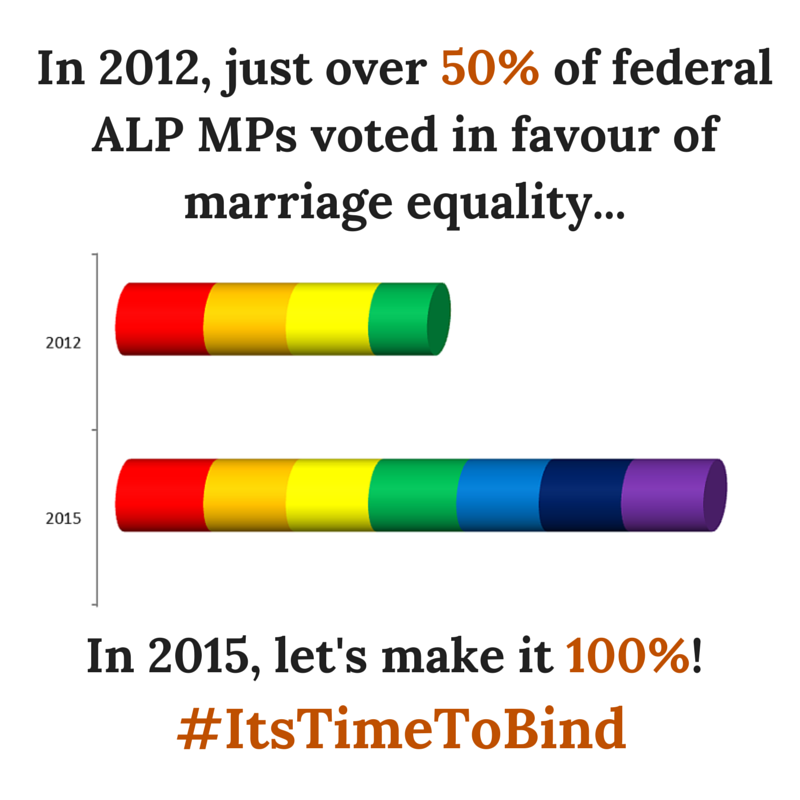
150403 50 percent versus 100 percent

Letter to ALP Caucus re Senator Leyonhjelm’s Freedom to Marry Bill 2014

The Hon Bill Shorten MP

Leader of the Opposition

c/- PO Box 6022

House of Representatives

Parliament House

Canberra ACT 2600

Monday 23 March 2015

Dear Mr Shorten

Please Amend Senator Leyonhjelm’s Freedom to Marry Bill 2014

I am writing to you regarding Senator Leyonhjelm’s Freedom to Marry Bill 2014, about which debate is scheduled to begin on Thursday 26 March 2015.

Specifically, I call on you, and all federal parliamentary members of the Australian Labor Party, to seek to amend this legislation during debate to remove provisions that would allow civil celebrants to refuse to provide services to LGBTI-inclusive couples, based on nothing more than the celebrant’s personal prejudice.

These provisions are wrong in principle, undermining legislation that is purported to promote the equal right to marriage by also expressly providing a ‘right’ to discriminate on the basis of homophobia, biphobia, transphobia and intersexphobia.

There is no justification to allow people providing secular services in a secular area of public life (ie non-religious wedding ceremonies) to discriminate on the basis of sexual orientation, gender identity or intersex status.

If passed, these provisions would also set a worrying precedent for other legislation. It is no coincidence that this legislation is being moved by an extremist who does not believe in the right not to be discriminated against in public life – indeed, Senator Leyonhjelm has previously stated that “[i]ndividuals should be able to discriminate but governments should not.”

In this way, the civil celebrant provisions of the Freedom to Marry Bill 2014 should be seen for what they are – the first steps in a campaign, supported by religious and libertarian extremists alike, to undermine Australia’s framework of anti-discrimination protections.

It took 38 years, from the passage of the Racial Discrimination Act 1975, for Australia’s lesbian, gay, bisexual, transgender and intersex (LGBTI) community to finally achieve protection against discrimination under Commonwealth law – the Sex Discrimination Amendment (Sexual Orientation, Gender Identity and Intersex Status) Act 2013 was an important achievement of, and is an essential legacy of, the previous Labor Government.

It would be devastating if the very next piece of LGBTI-related legislation to be considered by the Commonwealth Parliament were to directly undermine the right not to be discriminated against on the basis of sexual orientation, gender identity and intersex status, by instead granting civil celebrants the ‘right to be bigots’.

I sincerely hope that, given the Australian Labor Party has spent the past 12 months campaigning against Senator Brandis’ proposal that Australians should have the right to be bigots vis-à-vis racism, that you will also seek to amend these provisions that would enable bigotry of a different kind.

I also sincerely hope that enough of your parliamentary colleagues, including from the Greens and from the cross-bench, agree and that therefore these provisions are removed, meaning the Parliament can consider a Freedom to Marry Bill that is not also a ‘freedom to discriminate’ bill.

However, the question remains what the position of the Australian Labor Party should be if these amendments are unsuccessful, or if the House of Representatives insists on the Freedom to Marry Bill 2014 including the freedom to discriminate.

I acknowledge that this is an incredibly difficult decision to make – to reject the ability of LGBTI-inclusive couples to be married or to promote intolerance against those same people – indeed I have written previously of this exact dilemma: https://alastairlawrie.net/2014/12/21/senator-leyonhjelms-marriage-equality-bill-undermines-the-principle-of-lgbti-anti-discrimination-should-we-still-support-it/.

In the absence of LGBTI community consensus on this issue – and there can be no consensus because, as far as I can tell, there has been no genuine community debate or consultation – I am forced to fall back on my basic principles. And they are as follows:

I want marriage. I want the right to be married to my partner of almost seven years, my fiancé of more than five, in exactly the same way that my sister and my brother have been able to marry their respective spouses. There is absolutely no reason why I should have lesser rights than them simply because of who I love.

But, I want equality more. The principle of LGBTI equality is fundamental to any just society, and militates against the creation of ‘special rights’ or ‘special privileges’ to treat us as lesser citizens in any way.

To me, the struggle for LGBTI equality is broader than simply the battle for marriage: it includes improving the protections offered by anti-discrimination legislation (both state and federal), among many other things. This overall struggle is more important than any one Bill, and should not be undermined by the passage of flawed legislation such as this.

I will concede that there are those who wish to pursue the Freedom to Marry Bill 2014 in its current state, ‘warts and all’, as an incremental reform – a stepping stone – and to seek the removal of the civil celebrants provisions at a later date.

Not only do I believe that this could be labelled disingenuous – especially if concerns about these provisions are not placed on the public record ahead of the upcoming parliamentary debate – but it also under-estimates the difficulty of removing such legislative ‘blemishes’ after the central reform has passed.

For example, 33 years after the introduction of ‘homosexual’ anti-discrimination protections in NSW, the worst excesses of that particular compromise (such as the right of private schools to expel gay and lesbian students) remain seemingly intractable. It also took almost two decades to equalise the age of consent in NSW post-decriminalisation – and in Queensland their unequal age of consent is now 25 years old and counting.

Which means that it is no exaggeration to suggest that, if the Freedom to Marry Bill 2014 is passed in its present form, the so-called ‘right’ of civil celebrants to reject LGBTI-inclusive couples will likely still be around in 2025, 2030 or even beyond. And that is an unacceptable situation.

So, with a heavy heart, I urge you, and all federal parliamentary members of the Australian Labor Party to reject the Freedom to Marry Bill 2014 if you are unable to remove provisions which allow civil celebrants to discriminate on the basis of their personal prejudice.

Instead, I urge you to concentrate on passing other legislation, including the Marriage Equality Bill developed by the Deputy Leader of the Opposition, the Hon Tanya Plibersek MP, that does not promote homophobia, biphobia, transphobia and intersexphobia.

Marriage equality will be won, must be won, and it must be won soon. But it must also include both parts – marriage and equality. Senator Leyonhjelm’s Freedom to Marry Bill 2014 only offers the first half of that equation.

Please amend his flawed Bill and, if you are unsuccessful in doing so, please vote against it and instead support genuine marriage equality legislation in the (hopefully) not-too-distant future.

Thank you for taking this correspondence into consideration.

Sincerely

Alastair Lawrie

Cc The Hon Tanya Plibersek MP

Deputy Leader of the Opposition

PO Box 6022

House of Representatives

Parliament House

Canberra ACT 2600

Senator the Hon Penny Wong

Leader of the Opposition in the Senate

PO Box 6100

Senate

Parliament House

Canberra ACT 2600

The Hon Mark Dreyfus QC MP

Shadow Attorney-General

PO Box 6022

House of Representatives

Parliament House

Canberra ACT 2600

Bill Shorten, Will You Lead on Marriage Equality?

The Hon Bill Shorten MP

Leader of the Opposition

PO Box 6022

House of Representatives

Parliament House

CANBERRA ACT 2600

Saturday 24 January 2015

Dear Mr Shorten

PLEASE SUPPORT A BINDING VOTE IN FAVOUR OF MARRIAGE EQUALITY AT THE 2015 ALP NATIONAL CONFERENCE

Today marks six months until the Australian Labor Party is scheduled to hold its next National Conference. This Conference will determine the party’s formal position on a large number of important issues ahead of next year’s election.

One of these issues is actually unfinished business from the previous National Conference, held in December 2011, and that is the position that the ALP adopts on marriage equality.

While that gathering took the welcome step of making support for marriage equality an official part of the platform, it also immediately undermined that policy stance by ensuring all MPs were to be given a conscience vote when it came before Parliament.

That decision – to ‘support’ marriage equality, but then make that support unenforceable – guaranteed that any Bill would fail in the last Commonwealth Parliament, and continues to make passage in the current Parliament extremely difficult (even with a potential, albeit increasingly unlikely, Liberal Party conscience vote).

However, you, and the delegates to this year’s National Conference, have the opportunity to right that wrong. And make no mistake, the conscience vote is inherently wrong, not just because of its practical impact in making legislative change unobtainable, but also because it is unprincipled, and un-Labor.

Having a conscience vote on something like marriage equality, which is a matter of fundamental importance for many members of the lesbian, gay, bisexual, transgender and intersex (LGBTI) community, says that our human rights are optional, our equality is optional.

A conscience vote makes it clear that homophobia, biphobia, transphobia and intersexphobia are acceptable, that the second-class treatment of our relationships is officially condoned, that Labor Party MPs are free to treat LGBTI Australians as ‘lesser’ simply because of who we are. In essence, a conscience vote on marriage equality is unconscionable.

A non-binding vote on marriage equality is also ‘un-Labor’ because it is contrary to the principles of collective organising upon which the party is founded. Ideas of solidarity and being ‘stronger together’ are supposed to reflect core philosophy, not simply act as slogans, and definitely not something that is abandoned simply because some caucus members are so homophobic they cannot abide the thought that LGBTI people might be their equal.

A conscience vote on this issue, from a party that adopts binding votes on nearly everything else (from refugee policy to climate change and almost all things in between), also makes it difficult for the Australian community, and the LGBTI community in particular, to take the platform position in favour of marriage equality seriously.

This is something that can, and must, be changed at this year’s National Conference, given only it has the power to introduce a binding vote in favour of marriage equality for all ALP MPs.

Acknowledging that there will be groups both inside and outside the ALP who will strongly oppose any moves to support full LGBTI equality, achieving a binding vote on marriage equality will be difficult, and therefore requires the support of a party leader who is willing to do just that, to ‘lead’.

Which makes the question at the heart of this letter: Bill Shorten, will you lead on marriage equality?

There is cause for optimism in that you are already part-way there. Unlike your equivalent at the 2011 Conference, Julia Gillard, who adopted the worst possible position in opposing both marriage equality and a binding vote, you were one of the first ministers to express personal support for the right of all people to marry, irrespective of sexual orientation, gender identity or intersex status.

It’s time for you to take the vital next step, to back up this personal commitment with meaningful action, to use the influence of your position as the Parliamentary Leader of the Australian Labor Party to support a binding vote in favour of marriage equality, thereby declaring once and for all that LGBTI human rights are not optional, that LGBTI equality is absolutely not optional.

Doing so could only enhance your credibility as a leader, because it would show you were unafraid to take on people like Chris Hayes and Joe Bullock, who attempt to blackmail the party by saying they would rather cross the floor than vote for equality, and that you were willing to stand up to the SDA, a union that should spend more time looking after the interests of its members, and less resources and energy on opposing the right of LGBTI-inclusive couples to wed.

It would also show the public that when you make public commitments, when you support a position on an important policy issue like marriage equality, you are ready to take action and do what is required to make sure it happens.

Finally, if you were to support a binding vote on marriage equality it would only heighten the contrast between yourself and Prime Minister Tony Abbott, a ‘yesterday’s man’ who is so homophobic he remains personally committed to denying the right of his own sister to get married. Such a contrast would surely help you at the ballot box in 2016.

In short, the option to support a binding vote on marriage equality is full of opportunity, with many possible benefits and few, if any, adverse consequences. I sincerely hope it is an opportunity you are willing to grasp, and grasp firmly.

I started this letter by noting one anniversary – that there are now exactly six months left until the 2015 ALP National Conference. I want to conclude by telling you about another, one that probably doesn’t mean much to you, but means everything to me.

Yesterday marked the fifth anniversary of my engagement to my fiancé Steve. On 23 January 2010, he made me an incredibly happy man by saying “Of course I will” to my proposal. But, here we are five years later, and we still have no idea how many more years we will be left waiting before we can both say “I do”.

To put that in perspective, you married Chloe Bryce in November 2009, roughly two months before my engagement to Steve. Which means that, for almost the entire time you have been married, we have not been – for the simple reason that you love a woman, and I love a man.

But there is another important difference. While I have absolutely no control over whether you have the right to marry, or when you might be permitted to do so, you exert a significant amount of influence over the existence, and timing, of Steve and my wedding.

As Labor Party Leader, in this a National Conference year, you have the ability to help steer the party towards a binding vote, thus correcting the gross error of the 2011 Conference decision to support a conscience vote. You can make marriage equality a genuine possibility in 2016 or early 2017, rather than something which will continue to be delayed until 2018, 2019 or even into the 2020s.

For the benefit of Steve and myself, and thousands of other LGBTI-inclusive couples who are still waiting for the same right to marry which you and other couples can take for granted, please support a binding vote in favour of marriage equality at the 2015 National Conference, and help make our long-overdue weddings a reality.

Sincerely

Alastair Lawrie

Will Bill Shorten lead on marriage equality, or will he let this opportunity slip through his grasp?

Will Bill Shorten lead on marriage equality, or will he let this opportunity slip through his grasp?

NB If you would like to read further about why I believe a binding vote is essential to achieve marriage equality, please read “Hey Australian Labor, It’s Time to Bind on Marriage Equality”: <https://alastairlawrie.net/2014/07/13/hey-australian-labor-its-time-to-bind-on-marriage-equality/

And to see a more comprehensive LGBTI agenda for the 2015 ALP National Conference, you can go to “15 LGBTI Priorities for ALP National Conference 2015”: <https://alastairlawrie.net/2014/09/12/15-lgbti-priorities-for-alp-national-conference-2015/

Submission to Senate Legal and Constitutional Affairs Legislation Committee Inquiry into the Recognition of Foreign Marriages Bill 2014

As I committed to in my previous post on the topic of the Recognition of Foreign Marriages Bill 2014 (see here: <https://alastairlawrie.net/2014/06/26/why-i-dont-support-the-recognition-of-foreign-marriages-bill-2014/ ), unless somebody was able to provide a satisfactory explanation as to why, as a strategy, the recognition of foreign marriages should be pursued separately to, and ahead of, equality for domestic marriages, I would lodge a submission to the Senate Inquiry into the Bill expressing my serious concerns about this proposed law.

In the absence of any such explanation, I lodged my submission at the end of July, making clear my personal opinion that the Recognition of Foreign Marriages Bill 2014 should be withdrawn, and replaced by genuine marriage equality legislation.

I understand that this position may be controversial with some people, and that my words may even be used against me by others (indeed my original post has been quoted, selectively, by the Catholic Archdiocese of Sydney in their own submission to the inquiry), but I absolutely believe that, as a movement, we should be fighting for real marriage equality, and that we should be pushing for it to be passed by the Parliament as quickly as possible – unfortunately, the Recognition of Foreign Marriages Bill 2014 is not such a law.

One final, more positive, point: it appears that, as a result of a range of submissions, and the evidence given to the Senate Inquiry by Tony Briffa, there is now a strong chance that the Bill will at least be amended to ensure that it is not discriminatory on the basis of gender identity and intersex status.

This is obviously a very welcome development, but it would nevertheless leave intact the Bill’s inherent discrimination on the basis of class and nationality. Which, at least from my perspective, remains sufficient justification to argue for the Recognition of Foreign Marriages Bill 2014 to be withdrawn.

The following is the text of my submission to the Senate Inquiry into this Bill, which has been published on the APH website, and is available at the following link: <http://www.aph.gov.au/Parliamentary_Business/Committees/Senate/Legal_and_Constitutional_Affairs/Recognition_of_Foreign_Marriages_Bill_2014/Submissions

For more than ten years, and especially since the lead-up to the passage of the ban on marriage equality by the Howard Liberal-National Government, supported by the Labor Opposition, in 2004, I have been a strong and consistent – and occasionally vocal – supporter of marriage equality.

I firmly believe that all couples deserve the right to marry, and have that marriage recognized under Commonwealth law, irrespective of their sexual orientation, gender identity or intersex status.

I do not accept that there is any valid reason for the Australian Government to continue to discriminate against lesbian, gay, bisexual, transgender and intersex (LGBTI) people, and to devalue their (our) relationships, by denying a fundamental right which is offered without question to cisgender heterosexual couples.

This is particularly true following the High Court decision in December 2013, which overturned the ACT’s same-sex marriage legislation but also established that there is no constitutional impediment to the Commonwealth Parliament passing a Bill which would finally affirm that our love is indeed truly equal.

I deliberately use the word finally because we have been waiting long enough. My fiancé and I have already been engaged for four and a half years – and it may be several more before we have the opportunity to have a legally recognised wedding, something that my sister and her husband, and my brother and his wife, simply took for granted.

I strongly urge the Commonwealth Parliament, including all Senators and Members of the House of Representatives, to pass a marriage equality Bill as a matter of priority, and thus bring to an end the sorry situation whereby LGBTI Australians are treated as second class citizens in their own country.

Unfortunately, the Recognition of Foreign Marriages Bill 2014 is not such a Bill. It will not end the second class treatment of all of our relationships, and I do not believe it should be brought before the Parliament for debate.

My problem with this proposed law is not necessarily about what is included (although there is an issue in its terminology which I will come to later). It almost goes without saying that I completely support the legal recognition of the marriages of same-sex couples that have been wed in other countries.

Instead, my problem concerns what is not included in the Bill – the recognition of domestic marriages – and the consequence of only recognising marriages conducted ‘outside’ Australia, and not those ‘inside’ at the same time.

If passed, such legislation would create a situation whereby there would be three main, distinct categories of same-sex couples who wish to be treated as married in Australia:

    • Couples who have the financial resources to take advantage of the opportunity to marry under the laws of another country;
    • Couples who have been or are able to marry under the laws of another country because of their current or former nationality (including where one partner has UK citizenship, and can therefore marry in a UK consulate in Australia, or where the couple has emigrated from a country with marriage equality); and
    • Couples who do not have the financial resources or nationality to be able to take advantage of marriage equality elsewhere. 
Under this Bill, only couples in the first two categories would be able to be considered legally married.

In effect, if the Recognition of Foreign Marriages Bill 2014 were to succeed, Australia would have a system which, far from implementing genuine ‘marriage equality’, would actually create new types of marriage inequality, only this time based on distinctions around class and nationality rather than sexual orientation. 
Put simply, I cannot advocate for the progression of a Bill which would provide the opportunity for a couple who can afford it to get married overseas and have that marriage legally recognised here, but which would tell an elderly couple barely surviving on the age pension that they cannot be married under Australian law solely because they do not have the money.

If we are genuinely interested in marriage equality, then both couples must have the same right to wed. To put it another way, I am only interested in advocating for the progression of a Bill which redresses the injustice perpetrated against both couples, not just the couple that can afford to marry.

The only argument which I can see for pursuing this legislation is that some people may view it as an incremental step towards full marriage equality. And I whole-heartedly agree that, in some cases, incremental reform may be necessary to achieve larger, longer-term change.

However, I believe that in this case the people proposing this route towards achieving full marriage equality have not understood the fact that incrementalism is only ever a strategy, and not a goal in and of itself.

In this instance, there is absolutely no need for an incrementalist approach. There is no difference in how the Recognition of Foreign Marriages Bill 2014 would be treated by Commonwealth Parliament and how a genuine Marriage Amendment Bill – one that provides for the recognition of both overseas and domestic marriages – would be received.

Both Bills would involve asking the same people, sitting in the same place, exercising the same powers, and almost inevitably using the same arguments, to vote yes (or no).

The only potential justification for proceeding with the Recognition of Foreign Marriages Bill and not a genuine Marriage Amendment Bill would be if there existed Senators and Members of the House of Representatives who would tell LGBTI-inclusive couples in Australia that they can only have their marriages recognised if they travel overseas, away from their family and friends, for the wedding.

I refuse to believe that, when it came time for the second reading debate on such a Bill in the Chamber, there is a single MP who would stand up and deliver that message. I do not accept that there would be MPs willing to tell LGBTI members of their community that yes, they can be married, but only on the proviso they go somewhere else for the ceremony. Instead, I sincerely believe the same people who would be willing to vote for the Recognition of Foreign Marriages Bill 2014 would also vote yes to full marriage equality.

In which case, there is no reason why the Commonwealth Parliament should not proceed directly to a genuine Marriage Amendment Bill, rather than consider something which falls far short of what could be considered fair, and is substantively less than what LGBTI Australians deserve.

I urge Senators who wish to pursue the Recognition of Foreign Marriages Bill 2014 to reconsider their approach. I submit that they should abandon this Bill in favour of legislation that would deliver the right to marry to all couples, not just those who can afford to take advantage of the opportunity to marry under the laws of another country first.

The next Bill to be debated in the Commonwealth Parliament should be, must be, legislation which provides for genuine marriage equality, irrespective of sexual orientation, gender identity or intersex status, and not one which would allow some same-sex couples to marry, but only those from certain classes or nationalities.

As I alluded to earlier, there is another problem with the Recognition of Foreign Marriages Bill 2014. And it is not a minor problem, either – although, as it concerns terminology, (hopefully) it is something which can be more readily resolved.

The Bill would leave intact the current definition of marriage in section 5 of the Marriage Act 1961 (“marriage means the union of a man and a woman to the exclusion of all others, voluntarily entered into for life”). Instead, it replaces section 88EA with the following:

(1) Despite the definition of marriage in subsection 5(1), a union between:

(a) a man and another man; or

(b) a woman and another woman;

solemnised in a foreign country under local law as a marriage is recognised as a marriage in Australia.

(2) The parties to a union mentioned in subsection (1) have the same rights and obligations under this Act, or under any law of the Commonwealth, as the parties to a marriage between a man and a woman.

This is explicitly, and only, a same-sex marriage Bill. It is not genuinely inclusive of any marriages of people who may not be, or who may not identify as, a man or a woman. Some couples which include trans* or intersex individuals may not be able to utilise such laws or may not want to, because the language does not reflect who they are, and therefore denies the nature of their relationships.

The Recognition of Foreign Marriages Bill 2014 does not challenge the unnecessary inclusion of ‘man’ and ‘woman’ in section 5 of the Marriage Act, something which we should be moving away from – instead, it further entrenches these concepts, by replicating this language in additional subsections.

This is an issue which, I hope, is more about drafting than any deliberate intention to exclude people on the basis of gender identity or intersex status. As such, if, after this Senate Inquiry is concluded, the Recognition of Foreign Marriages Bill 2014 does proceed to Parliamentary debate, it should be amended to ensure all couples are included, not just ‘same-sex couples’.

Nevertheless, even if the Bill were amended to ensure that it did not discriminate against some trans* and intersex inclusive couples, my fundamental problem with it would remain – this legislation would not achieve genuine marriage equality, and therefore I believe it should be replaced by something that would.

The primary positive outcome to arise from this legislation, and the Senate Inquiry which it has precipitated, is that it has placed a spotlight on the injustice perpetrated on same-sex couples that have been married overseas (either Australian couples who have travelled elsewhere, or other couples who have emigrated here) and yet are told by the Australian Government that they are not considered legally married here.

Undoubtedly, this is a horrible, and heart-breaking, situation for any couple to be placed in. And it is yet another argument for the recognition of genuine marriage equality within Australia, and additional motivation for such a law to be passed as quickly as possible.

But it is not sufficient justification to proceed with legislation that addresses only this injustice. The discrimination against these couples, and the discrimination against other Australian couples who are waiting for the opportunity to be married here, is, in practice, the same discrimination. After all, we are all told that our relationships are not worthy of the same recognition as those of other Australians, simply because we are LGBTI.

These injustices can and should be remedied through the same Bill, rather than prioritising the needs of some couples over others without any clear or rational explanation why that should be the case.

One final point. I have tried to be clear in this submission that I do not support progress of the Recognition of Foreign Marriages Bill 2014 to second reading debate, and ultimately for vote on the floor of Parliament. Instead, I have consistently argued that this Bill should be replaced with genuine marriage equality legislation before it reaches that stage.

However, if the Recognition of Foreign Marriages Bill 2014 does proceed to a vote, there is no reason for Senators and Members of the House of Representatives to vote against it, and thereby vote against the potential expansion of marriage to include more couples than are currently allowed.

Nevertheless, it is still my preferred outcome that the next Parliamentary vote on marriage be on a genuine, and genuinely inclusive, marriage equality Bill – and therefore not on the Recognition of Foreign Marriages Bill 2014.

In conclusion, while the intentions of those who have drafted this legislation are most likely sound, the outcome that its passage would deliver is not. It is time to go back to the drawing board, and return with a Bill that delivers marriage equality, not just for some couples, but for all.

Alastair Lawrie

Thursday 31 July 2014

10 Things I Hate About Marriage Inequality. #1: Because I can’t marry the man I love

The number one reason why I hate marriage inequality in Australia is because it means that I cannot marry the man who I love.

Me (on the left) and Steven (aka the handsome guy with the sunnies).

Me (on the left) and Steven (aka the handsome guy with the sunnies).

I was half-tempted to leave it at that because, really, what more do I need to say?

There can be few things more beautiful than the desire to celebrate the love that you have for your partner, in front of your family and friends. I want to experience that with Steve, the person I care about most in the world, and who brings me more happiness than I ever thought possible.

At the same time, there can be few things uglier than a Government intervening to tell you “No”, you cannot experience that, simply because of your sexual orientation (or, for others, gender identity or intersex status). Especially when there is absolutely no legitimate reason why the Marriage Act 1961 should discriminate against LGBTI-inclusive couples, something that is incredibly frustrating, to Steve and me, and to the thousands of other Australian couples in the same situation.

Obviously, the issue of marriage equality is very personal for all of the people that it directly affects. And, in that, I am no different. It does affect me personally and, as the people closest in my life can attest (and as this countdown has made exceptionally clear) I take its denial very personally.

How could I not? When you celebrate wedding after wedding, of your sister, and your brother, and your cousins, and your partner’s extended family, and your friends and his friends as well, and you just want to do the same, yet you cannot because 139 Senators and Members of the House of Representatives back in September 2012 decided that you are ‘unworthy’ simply because you’re gay, well, how could that not feel like a knife right through your heart?

In fact, there are very few contemporary public policy issues for which the old maxim – that the personal is political – could be more accurate. The recognition of our relationships is obviously immensely personal, and it is impossible to deny that whether they are recognised or not, or recognised but with a lesser value than cisgender heterosexual relationships, is inherently political.

That particular saying works the other way, too. The position that each of our parliamentarians adopts on this political issue reflects something profound about who they are as a person as well.

And I’m not just talking about the Cory Bernardis or Helen Polleys of this world, either – Senators who thought it appropriate to link the prospect of marriage equality with bestiality and the Stolen Generation, respectively – although their parliamentary speeches certainly revealed their utter contempt for LGBTI Australians.

I am talking about the MPs who might not say anything ‘overtly’ homophobic during Parliamentary debates about marriage, but who cast their vote against equality nonetheless. In doing so, they indicate that they choose discrimination and inequality over love and inclusion. They stand up against the idea that all Australians deserve equal treatment under the law, instead supporting the notion that some people are ‘more equal’ than others.

Those who vote against marriage equality devalue our relationships, telling us that they are less worthy of recognition than those of other people. And they devalue us as individuals too, subtly (or in some cases, not so subtly) sending the signal that we are less than full citizens of our own country. Even if they do not say the words, their position reveals, loud and clear, that they believe LGBTI people are – and should be – second class.

At its most personal, an MP who votes against marriage equality is saying that they themselves are more deserving of certain rights, that their own relationships are more worthy of recognition, that they as individuals are simply better than LGBTI Australians.

To them I say, “How dare you”. How dare you suggest that, because I am gay and you are heterosexual, you are more deserving of certain rights than I am. And how dare you deny us the rights that you currently enjoy (whether you choose to exercise them or not) simply because we are in a same-sex relationship and you are not.

The love that Steve and I share is not better or worse, more valuable or less valuable, or more deserving or less deserving, than the love between cisgender heterosexual couples. It’s all just love. The law should not make a distinction between the love that Steve and I have for each other, and that between my sister and her husband, or my brother and his wife.

Sadly, because of the amendments made under the Howard Government in August 2004, and the failure of our MPs since then to remedy this discrimination, the law does make such a distinction.

Today, Wednesday 13 August 2014, those amendments, that legal distinction, this ongoing and unjustified discrimination against LGBTI Australians, ‘celebrates’ its own ten year anniversary.

The traditional gift for a ten-year wedding anniversary is tin. I’m sure you’ll forgive me for not wanting to buy anything special to mark the occasion.

What I will do, what I feel compelled to do on this day, is say to all of those MPs who voted against equality in 2004, and continue to do so now, you truly are the tin men and tin women of Australian politics. You have forgotten that you have hearts, or, at the very least, you have forgotten how to use them. Indeed, it seems you have forgotten what hearts are even there for.

Well, now is the time to rediscover their purpose. And now is also the time to rediscover your purpose as our elected representatives – that it is your responsibility to act for the betterment of Australia, and the welfare of its people, all of its people, not just the cisgender heterosexual ones.

On this, the 10th anniversary of the ban, it’s time to support marriage equality, and in so doing to support the full and equal citizenship of all Australians, irrespective of sexual orientation, gender identity and intersex status. If you do, if you finally agree to pass marriage equality, then you should rest assured that nothing bad will happen. The sky will not fall in. There will be no negative consequences whatsoever.

The only outcome will be overwhelmingly positive. Thousands, indeed tens of thousands, of couples will finally be able to express their love and commitment in front of their family and friends. Couples like Steve and me. We are ready and waiting to say those two small words to each other, “I do”. We just need you to say two other words first, “You can.”

10 Things I Hate About Marriage Inequality. #2: Because we’ve been waiting so damn long

Updated 12 August 2016:

The twelve year anniversary of Australia’s ban on marriage equality is now only 24 hours away. Unfortunately, the long-awaited repeal of the ban is still some time off.

The best-case scenario: Malcolm Turnbull and his Liberal-National Government abandon their unnecessary, wasteful and harmful plebiscite, hold a free vote and marriage equality becomes law before the 13th anniversary. Alternatively, we could see marriage equality passed later this term, after the plebiscite has wreaked its havoc on young and vulnerable LGBTI people. We could even see marriage equality delayed beyond this term, until sometime in the 2020s (yes, you read that right – 2020s).

No matter when it (eventually) happens, there will be thousands upon thousands of Australian LGBTI-inclusive couples who have been waiting, and waiting, and then waiting some more, simply to exercise the same rights that our cisgender heterosexual counterparts enjoy without question. And, to me at least, the waiting itself has become both seemingly interminable, and insufferable.

Australian Marriage Equality effectively tapped into that sentiment with one of its main campaigns of 2014, with stories and images of couples with the ‘We’re Waiting’ message. That campaign was both an accurate reflection of the feelings of many within the LGBTI community, and a reminder to decision-makers that this policy choice is not abstract, but affects ‘real people’ in all-too-real ways [Alas, two years later that wait continues].

It is the human element of the ongoing ban, the costs of being forced to wait, that I want to concentrate on here. Because the delay of being able to get married, for years or even decades, carries with it very real consequences for the couples involved.

The first consequence is that it directly affects the ability of couples to celebrate their wedding with all of the family members and friends who they would like to be there for their special day. For those couples that do not choose to travel overseas (which itself obviously limits who is able to attend), by forcing LGBTI-inclusive couples to wait to marry within Australia the Parliament is effectively interfering with the ‘guest list’ of many couples.

From Steve and my perspective, as I have written before, we are both very conscious of the fact that, the longer the ban on marriage equality goes on, the less likely it is we will be able to have our remaining grandmothers there for the occasion (either for reasons of ill-health, or worse). They certainly could have been there had we been married four or five years ago (ie after an engagement of 12 or 24 months), but even today it is becoming doubtful [In 2016, it is now clear my grandmother won’t be able to travel to our wedding due to declining health].

I often imagine how ‘traditional marriage’ or ‘family values’ or even ‘small government’ campaigners would react if the Commonwealth Parliament intervened to tell them who they could, or could not, invite to their wedding. I suspect they would probably have a pretty spectacular hissy fit. And yet that is exactly what they are seeking to impose on us – stealing from us our ability to celebrate our weddings with who we choose.

The second consequence is another ‘theft’, but the effects of it won’t become apparent for most of us for many years, long after the ban on marriage equality is lifted. And that is they are stealing from us future ‘significant’ wedding anniversaries. Because, the longer our entry to marriage is delayed, the less likely it is that current LGBTI-inclusive couples will reach our 60th, 50th or even 40th or 30th wedding anniversaries.

Now, to some that might seem like a petty argument. After all, we will still have ‘anniversaries’ for the significant events of our relationships (for example, Tuesday was the 8th anniversary of when Steve and I first met, and we celebrated the occasion).

But it is impossible to deny that significant cultural value is still placed on long-lasting marriages, perhaps even an increasing value when so many marriages do not last that long (for whatever reason). How many of us experience an ‘awww, that’s sweet’ moment when we see the 60th or 50th wedding anniversaries of older couples, either family members or friends, or even reported on the news?

Well, far fewer of our relationships will reach those moments in the decades to come because of the actions of Commonwealth parliamentarians in 2004, 2012 and today. Once again, imagine the outcry from ‘traditional marriage’ (aka anti-LGBTI equality) campaigners if the Government were to intervene to effectively steal those anniversaries from them. They need to be reminded that it is just as unacceptable when it is done to LGBTI Australians.

However, it is the third consequence, yet another theft, which is the most offensive, and most objectionable. And that is that there are countless couples who wanted to marry but where one or both have died since the original ban on equality was introduced in 2004, and many more who will continue to die before being able to wed while this homophobic discrimination remains in place.

These are couples who have had the right to marry stolen from them, now and for all time, merely because of their sexual orientation, gender identity or intersex status. For most, they grew up at a time when homosexuality was criminalised, and when trans and intersex people were ‘invisibilised’ and subject to the worst forms of abuse, but who have then suffered one final indignity at the hands of the Australian Government – the denial of the equal recognition of their relationships during their lifetimes.

The worst thing, the most frustrating part, about this entire situation is that everyone knows marriage equality is inevitable. I know it. You know it. Julia Gillard knew it. Tony Abbott knew it. Malcolm Turnbull does too – even if he won’t grant the free vote to make it happen. In fact, all MPs, certainly since 2011 or 2012, if not before, must have recognised that marriage equality will eventually be passed in Australia, and that the only remaining question is whether that happens now, or in five or even ten years time.

And, while there is absolutely nothing that is ‘gained’ from this delay, as I have shown above there is plenty that is lost, not least of which is the undeniable loss of those couples who were never able, and will never be able, to wed.

Which makes the ongoing failure of Commonwealth Parliamentarians to pass marriage equality one of the most petty and vindictive acts – or omissions – in recent political history.

It is, frankly, unforgiveable that our MPs are not only stubbornly opposing what is right, and standing firm against the overwhelming tide of history and progress, they are rejecting the rights of Australian couples, including members of their own electorates, when they know in their hearts that all they are doing is delaying the inevitable, and making those couples pay the cost in the meantime.

This outcome, the price that is being paid by couples around the country because of this interminable ‘wait’, is definitely one of the things I hate most about marriage inequality.

10 Things I Hate About Marriage Inequality. #3: Because it makes attending weddings a bittersweet experience

Weddings are supposed to be joyous occasions, a celebration of two people coming together to express their love and commitment to each other in front of their family members and friends. If ever an event was meant to provoke happiness – pure, unambiguous happiness – surely a wedding would be it.

But, when I go to weddings I cannot help but find them to be bittersweet. The joy of the ceremony, and my happiness for the couple involved, is tempered by sadness at the knowledge that I, and the man who I love, currently cannot participate in the exact same ritual, solely because of our sexual orientation.

Obviously, the main source of this frustration is the legislative ban on marriage equality, introduced by the Howard Liberal-National Government in 2004 (an event which itself celebrates its ‘tin’ anniversary next week), and perpetuated by his successors including Julia Gillard and Tony Abbott.

However, this hurt and anger is compounded by the section of the wedding ceremony where the celebrant is compelled to read out the following:

“I am duly authorised by law to solemnise marriages according to law. Before you are joined in marriage in my presence and in the presence of these witnesses, I am to remind you of the solemn and binding nature of the relationship into which you are now about to enter.

Marriage, according to law in Australia, is the union of a man and a woman to the exclusion of all others, voluntarily entered into for life” (emphasis added).

Talk about rubbing salt into the wound. Section 46(1) of the Marriage Act 1961 (Cth) makes it clear that these words must be read out by the celebrant (although, bizarrely enough, only by civil celebrants – ministers of religion for a recognised denomination are exempted from this requirement).

The Guidelines on the Marriage Act 1961 for Marriage Celebrants also confirm that, while there is some scope to make minor variations to the first two sentences above, there is no scope to change the third. Specifically:

• “do not replace ‘man’ and ‘woman’ with ‘people’ or ‘persons’. This could signify the marriage of two people of the same sex which is specifically excluded by the definition.

• do not change the first part of the sentence to read: “Marriage as most of us understand it is…” (from page 75 of the Guidelines).

It is appalling that there is this level of government interference into something so personal, on what is supposed to be a special, some might say unique, day for the couple involved (and especially galling that it is supported by Australian conservatives who like to proclaim their support for ‘small government’).

It is even more appalling that LGBTI Australians, and indeed all people who support equality irrespective of sexual orientation, gender identity and intersex status, must sit through this recitation each and every time they simply wish to attend the wedding of their family members or friends.

I must admit that, at the last few weddings I have been to, this recitation, together with the fact that – more than four years into Steve and my engagement – there is still so little sign we will be able to marry in our own country any time soon, really got me down.

At one of these receptions, I recall looking up at my fiancé and, from the expression on his face, seeing that he felt exactly the same way at exactly the same moment. I don’t know if that makes it better or worse – to feel comfort in the fact that someone so close shares that burden with you, or to feel anger that the government makes the person who you care about most in the world experience pain. Actually, that’s not true, it’s definitely the latter.

And I’m sure that we’re not the only LGBTI-inclusive couple, or LGBTI individuals, who experience these emotions at weddings, who are hurt by the continuing rejection of our own love as equal, and who resent, bitterly at times, that the ban on marriage equality has transformed joyous occasions into bittersweet affairs.

This is not to say the ban doesn’t affect cisgender heterosexual people too, it does. It has become increasingly common for couples who are getting married and who value their LGBTI family members and friends, or who simply reject the discrimination against LGBTI relationships contained in the Marriage Act 1961, to either say themselves, or have their celebrant say, that they support the right of all couples to marry.

In fact, this ‘disclaimer’, usually read out before the abhorrent words of section 46(1), has become so commonplace that it has almost become modern wedding etiquette itself.

And it is truly lovely that so many people have chosen to do so. On a day that is marked by symbolism, expressing their disagreement with the prejudice of Australia’s marriage laws is an important symbolic gesture, and one that does make things that little bit easier (for this LGBTI Australian at least).

But, let’s face it, they shouldn’t have to. On their wedding day, cisgender heterosexual couples shouldn’t have to be making capital ‘P’ political statements, simply because successive Australian Governments have been homophobic in determining who can, and cannot, marry. After all, there is enough small ‘p’ politics at weddings – who is in the wedding party, who is invited/not invited, who sits where – already.

Of course, the only way to fix this is for Australia to finally catch up to the progressive world by introducing domestic marriage equality, thereby allowing couples like Steve and me to get married, and cisgender heterosexual couples to go back to arguing about what song should be the wedding waltz (come to think of it, with our music tastes I’m pretty sure Steve and I might ‘disagree’ about that too).

Until then, the fact that the ban on marriage equality makes attending weddings a bittersweet experience is definitely one of the things that I hate most about marriage inequality.