What’s Wrong With Western Australia’s Equal Opportunity Act 1984?

This post is part of a series examining the anti-discrimination laws that exist in each Australian jurisdiction and analysing how well, or how poorly, they protect lesbian, gay, bisexual, transgender and intersex (LGBTI) people from discrimination. Other articles in the series can be found here.

Specifically, each post considers three main aspects of LGBTI anti-discrimination legislation:

  • Protected attributes
  • Religious exceptions, and
  • Anti-Vilification Coverage.

Unfortunately, as we shall see below, the Western Australian Equal Opportunity Act 1984 (‘the Act’) has significant problems in terms of all three elements, making it serious competition to the NSW Anti-Discrimination Act 1977 for the (unwanted) title of worst LGBTI anti-discrimination law in the country.

**********

Protected Attributes

As with most Australian anti-discrimination laws (other than those in the Commonwealth, South Australia, Tasmania and the ACT), the Equal Opportunity Act 1984 only protects some parts of the LGBTI community from discrimination, but not others.

On the positive side, it does include all lesbian, gay and bisexual members of the community – with ‘sexual orientation’ defined in section 4 as:

“in relation to a person, means heterosexuality, homosexuality, lesbianism or bisexuality and includes heterosexuality, homosexuality, lesbianism or bisexuality imputed to the person.”[i]

On the negative side, however, it completely excludes intersex people from anti-discrimination protection, an omission that should be rectified immediately.

On the negative and downright bizarre side, the Western Australian Act adopts a completely unique approach that results in only transgender people whose gender identity as been officially recognised by the State Government benefiting from anti-discrimination coverage.

Specifically, rather than prohibiting discrimination on the basis of gender identity (which would be best practice), the Act only prohibits discrimination against “a gender reassigned person on gender history grounds”.[ii]

Section 4 of the Act states that “gender reassigned person means a person who has been issued with a recognition certificate under the Gender Reassignment Act 2000 or a certificate which is an equivalent certificate for the purposes of that Act”, while section 35AA prescribes that “[f]or the purposes of this Part, a person has a gender history if the person identifies as a member of the opposite sex by living, or seeking to live, as a member of the opposite sex.”

Prima facie, the combination of these two definitions mean that only people who have transitioned from male to female, or vice versa, and had that transition recognised by the Government via the Gender Reassignment Act are protected from discrimination. People who have yet to transition, or any trans person who is non-binary, are not covered by these clauses. This is a serious flaw, and one that must be corrected by the WA State Government.

Conclusion: While lesbian, gay and bisexual Western Australians are included in the protected attributes of the Equal Opportunity Act 1984, intersex people are completely excluded, as are a large number of trans people (either because their gender identity has not been formally recognised under the Gender Reassignment Act, or because their gender identity is non-binary).

Both flaws should be rectified as a matter of priority, with the adoption of the protected attribute of ‘gender identity’ as found in the Commonwealth Sex Discrimination Act 1984, and the inclusion of ‘sex characteristics’ as called for by intersex activists in the March 2017 Darlington Statement.

**********

Religious Exceptions

While it’s approach to trans anti-discrimination regulation is unique, the Equal Opportunity Act’s provisions surrounding the rights of religious organisations to discriminate against LGBT people are pretty standard for a state and territory (or even Commonwealth) law[iii]. Unfortunately, that ‘standard’ allows homophobic, biphobic and transphobic discrimination in an incredibly wide range of circumstances.

Section 72 of the Act states:

Religious bodies

Nothing in this Act affects-

(a) the ordination or appointment of priests, ministers of religion or members of any religious order; or

(b) the training or education of persons seeking ordination or appointment as priests, ministers of religion or members of a religious order; or

(c) the selection or appointment of persons to perform duties or functions for the purposes of or in connection with, or otherwise to participate in any religious observance or practice; or

(d) any other act or practice of a body established for religious purposes, being an act or practice that conforms to the doctrines, tenets or beliefs of that religion or is necessary to avoid injury to the religious susceptibilities of adherents of that religion.”

The first three sub-sections ((a), (b) and (c)), can potentially be justified on the basis that there is a direct connection with the appointment and training of religious office-holders, or the conduct of religious ceremonies.

However, sub-section 72(d) is effectively a blanket exception that allows any religious organisation – including religious-operated schools, hospitals and community services – to discriminate against LGBT employees, and LGBT people accessing their services. This is clearly unacceptable.

Religious schools don’t even need to rely on this broad exception. That’s because they have additional, specific protections in section 73, which allow them to discriminate against teachers and other employees (sub-section (1)), contract workers (sub-section (2)), and even students (sub-section (3)).

Sub-section (1) is incredibly generous (with sub-section (2) adopting similar wording):

“(1) Nothing in this Act renders it unlawful for a person to discriminate against another person on any one or more of the grounds of discrimination referred to in this Act in connection with employment as a member of the staff of an educational institution that is conducted in accordance with the doctrines, tenets, beliefs or teachings of a particular religion or creed, if the first-mentioned person so discriminates in good faith in order to avoid injury to the religious susceptibilities of adherents of that religion or creed.”

Even though the wording used in relation to students is slightly narrower, it nevertheless envisages discrimination against students on the basis of sexual orientation or against gender reassigned persons on the basis of their gender history:

“(3) Nothing in this Act renders it unlawful for a person to discriminate against another person on any one or more of the grounds of discrimination referred to in this Act, other than the grounds of race, impairment or age, in connection with the provision of education or training by an educational institution that is conducted in accordance with the doctrines, tenets, beliefs or teachings of a particular religion or creed, if the first-mentioned person so discriminates in good faith in favour of adherents of that religion or creed generally, but not in a manner that discriminates against a particular class or group of persons who are not adherents of that religion or creed.”[iv]

Given education is conducted in the public sphere, it is, in nearly all circumstances, at least partially paid for by taxpayers, and above all it is the right of students to receive a comprehensive and inclusive education free from discrimination, there can be no justification for the continued existence of the exceptions for religious schools outlined in section 73. Just like sub-section 72(d), they should be repealed as a matter of priority.

Conclusion: The religious exceptions contained in the WA Equal Opportunity Act are, sadly, similar to those that exist in most Australian jurisdictions, in that they provide religious organisations generally, and religious schools in particular, extremely generous rights to discriminate against lesbian, gay, bisexual and trans employees and people accessing services. These religious exceptions must be curtailed to better protect LGBT Western Australians against discrimination.

**********

Anti-Vilification Coverage

This will be the shortest section of this post because, well, there isn’t any: there is currently no prohibition on vilification of LGBTI people under the Equal Opportunity Act 1984. This lack of protection is similar to the Commonwealth, Victoria, South Australia and the Northern Territory.

Interestingly, the Act also excludes racial vilification. Instead, Western Australia has chosen to outlaw racial vilification via the Criminal Code 1913, which creates a total of eight related offences, including:

Section 77. Conduct intended to incite racial animosity or racist harassment

Any person who engages in any conduct, otherwise than in private, by which the person intends to create, promote or increase animosity towards, or harassment of a racial group, or a person as a member of a racial group, is guilty of a crime and is liable to imprisonment for 14 years” and

Section 78. Conduct likely to incite racial animosity or racist harassment

Any person who engages in any conduct, otherwise than in private, that is likely to create, promote or increase animosity towards, or harassment of, a racial group, or a person as a member of a racial group, is guilty of a crime and is liable to imprisonment for 5 years.”[v]

However, there are exactly zero offences outlawing vilification of LGBTI people in the Code. This disparity is completely unjustified, especially given the real and damaging impact of homophobia, biphobia, transphobia and intersexphobia on people’s lives (similar to the detrimental impact of racism).

If vilification offences are to be retained, as I believe they should (even if some right-wing Commonwealth MPs and Senators may disagree), then they should be expanded to cover vilification against members of the LGBTI community.

Conclusion: Neither the Equal Opportunity Act nor the Criminal Code prohibit LGBTI vilification, despite the latter creating a number of offences against racial vilification. Similar offences should also be established against the vilification of lesbian, gay, bisexual, transgender and intersex Western Australians.

**********

Other Issues

We have already seen, under ‘Protected Attributes’ above, that the Equal Opportunity Act offers only limited anti-discrimination protections to Western Australia’s trans and gender diverse community.

Unfortunately, this ‘anti-trans’ approach is replicated in a number of other sections of the Act, and is even featured in the Long Title: “An Act to promote equality of opportunity in Western Australia and to provide remedies in respect of discrimination on the grounds of sex, marital status, pregnancy, sexual orientation, family responsibility or family status, race, religious or political conviction, impairment, age, or publication of details on the Fines Enforcement Registrar’s website, or involving sexual or racial harassment or, in certain cases, on gender history grounds” [emphasis added].

Note that, not only does ‘gender history’ come last, it is also the only ground which features the qualifier ‘in certain cases’.

The objects of the Act are also exclusionary with respect to trans people. While object (a) in section 3 the Act seeks to ‘eliminate, so far as possible’ discrimination on grounds including sexual orientation and “in certain cases, gender history”, object (d) excludes trans people altogether:

“to promote recognition and acceptance within the community of the equality of persons of all races and of all persons regardless of their sexual orientation, religious or political convictions or their impairments or ages.”

Apparently, promoting recognition and acceptance of transgender people is not a priority.

This approach is also reflected in substantive parts of the Bill. Whereas section 35ZD allows discrimination in favour of people on the basis of their sexual orientation “to ensure that persons of a particular sexual orientation have equal opportunities with other persons” and “to afford persons of a particular sexual orientation access to facilities, services or opportunities to meet their special needs” (ie positive discrimination), there is no equivalent section for transgender people (or gender reassigned people with a gender history).

There is even a sub-section (74(3a)) that ensures an aged care service cannot discriminate solely in favour of transgender people (even though other aged care services can discriminate on the basis of ‘class, type, sex, race, age or religious or political conviction’[vi]).

Even the way some sections of Part IX, which aims to provide ‘Equal opportunity in public employment’, are drafted indicate that transgender discrimination is to be considered separately. For example, section 140 states:

“The objects of this Part are-

(a) to eliminate and ensure the absence of discrimination in employment on the ground of sex, marital status, pregnancy, family responsibility or family status, sexual orientation, race, religious or political conviction, impairment, age or the publication of relevant details on the Fines Enforcement Registrar’s website; and

(aa) to eliminate and ensure the absence of discrimination in employment against gender reassigned persons on gender history grounds; and

(b) to promote equal employment opportunity for all persons.”[vii]

It is bizarre that even the protected attribute of ‘publication of relevant details on the Fines Enforcement Registrar’s website’ is included with sex, race and sexual orientation (among others), while gender reassigned persons are included in a separate sub-section.

Whenever the Western Australian Equal Opportunity Act 1984 is finally updated to ensure all transgender and gender diverse people are protected from discrimination, these additional sections will need to be updated to ensure that, as a protected attribute, gender identity is finally treated equally to other attributes.

Update:

In October 2018, the Western Australian Attorney-General John Quigley announced that the Equal Opportunity Act would be referred to the Law Reform Commission of Western Australia for a comprehensive review. This was in the wake of the leaking of the recommendations from the Ruddock Religious Freedom Review, and publicity about the issue of discrimination against LGBT students and teachers in religious schools.

In March 2019, the Law Reform Commission of Western Australia confirmed the details of this review (which can be found here).

Importantly, from an LGBTI perspective, this includes consideration of:

a. the objects of the Act and other preliminary provisions;

b. the grounds of discrimination including (but not limited to) introducing grounds of gender identity and intersex status;

e. the inclusion of vilification, including racial, religious, sexual orientation and impairment vilification;

g. exceptions to grounds of discrimination including (but not limited to) those for religious institutions;

l. interaction with the Commonwealth Marriage Amendment (Definition and Religious Freedoms) Act 2017 and with other relevant Commonwealth laws or proposed laws.

It will be essential for LGBTI advocates within WA, and with support nationally, to engage with the Law Reform Commission process, and then to pressure the McGowan Government to bring the Equal Opportunity Act 1984 into the 21st century.

Update 11 July 2020:

Unfortunately, while the Law Reform Commission process was commenced in early 2019, as of mid-2020 there have been no official consultations or publications arising from this Review. The website for the inquiry has not even been updated since 6 March 2019. With the next State election due on 13 March 2021, it is now highly unlikely the Review will be completed this term.

Mark McGowan

Will WA Labor Premier Mark McGowan, elected in March 2017, update the out-dated Equal Opportunity Act 1984?

If you have enjoyed reading this article, please consider subscribing to receive future posts, via the right-hand scroll bar on the desktop version of this blog or near the bottom of the page on mobile. You can also follow me on twitter @alawriedejesus

Footnotes:

[i] With discrimination on the basis of sexual orientation then prohibited under Part IIB of the Act.

[ii] Section 35AB.

[iii] Other than Tasmania’s exceptions, which are significantly narrower and, to a lesser extent, Queensland’s and the Northern Territory’s.

[iv] Interestingly, the phrase “other than the grounds of race, impairment or age” is omitted from the exceptions relating to teachers and contract workers – presumably religious schools can discriminate on these attributes then too.

[v] Other related offences include:

79 Possession of material for dissemination with intent to incite racial animosity or racist harassment

80 Possession of material that is likely to incite racial animosity or racist harassment

80A Conduct intended to racially harass

80B Conduct likely to racially harass

80C Possession of material for display with intent to racially harass

80D Possession of material for display that is likely to racially harass

[vi] Sub-section 74(2)(a).

[vii] Section 146 includes a similar delineation.

What’s Wrong With the ACT Discrimination Act 1991?

This post is part of a series looking at Australia’s anti-discrimination laws, analysing them to determine how well, or in many cases how poorly, they protect lesbian, gay, bisexual, transgender and intersex (LGBTI) people from discrimination and vilification. The other articles in the series can be found here.

In each post, the laws of each jurisdiction are assessed in relation to the following three areas:

  • Protected Attributes
  • Religious Exceptions, and
  • Anti-Vilification Coverage.

Based on these criteria, the Australian Capital Territory Discrimination Act 1991 was already better than average in terms of its LGBTI anti-discrimination laws. The good news is that, as a result of the passage of the Discrimination Amendment Act 2016 and the Discrimination Amendment Act 2018, the ACT’s LGBTI protections have improved further.

However, while many of the previous issues with this Act have been remedied, this doesn’t mean the ACT’s law is without faults – chief among them the ongoing broad exceptions provided to religious organisations (other than schools) allowing them to discriminate against LGBTI people.

Nevertheless, let’s focus on the positives first:

**********

Protected Attributes

The ACT Discrimination Act 1991 includes sexuality as a protected attribute in section 7(1)(w), which is defined in the Act’s dictionary as ‘heterosexuality, homosexuality (including lesbianism) or bisexuality’. This includes all of LGB people, and is better than some jurisdictions (including NSW, which excludes bisexuals), but could be improved by adopting the more inclusive term ‘sexual orientation’.

As a result of the Justice Legislation Amendment Act 2020, the Act’s protected attribute of gender identity in section 7(1)(g) is now defined as:

the gender expression or gender-related identity, appearance or mannerisms or other gender-related characteristics of a person, with or without regard to the person’s designated sex at birth.

Note Gender identity includes the gender identity that the person has or has had in the past, or is thought to have or have had in the past.

This includes all trans and gender diverse people, including those with non-binary gender identities.

Finally, 2016 amendments added intersex status as a protected attribute in section 7(1)(k), defined as ‘status as an intersex person’ – however, intersex advocates called for discrimination protections to be based on ‘sex characteristics’ in the influential March 2017 Darlington Statement.

In August 2020, the ACT Government responded, replacing intersex status with sex characteristics, with a definition based on the Yogyakarta Principles plus 10 (from the Act’s Dictionary:

sex characteristics-

(a) means a person’s physical features relating to sex; and

(b) includes-

(i) genitalia and other sexual and reproductive parts of the person’s anatomy; and

(ii) the person’s chromosomes, hormones and secondary physical features emerging as a result of puberty.

The ACT is now one of only four Australian jurisdictions to provide coverage for lesbian, gay, bisexual, transgender and gender diverse and intersex people, the others being the Commonwealth, Tasmania and South Australia, and more importantly has up to date definitions for all attributes.

**********

Anti-Vilification Coverage

The ACT’s vilification protections also cover all parts of the LGBTI community, with prohibitions on vilification on the basis of sexuality, gender identity and intersex status (making it only the second jurisdiction, after Tasmania, to cover anti-intersex vilification – although again note the calls by intersex organisations for this term to be replaced by the protected attribute of sex characteristics).

In fact, the ACT’s LGBTI vilification protections are now the equal best in the country, given the offence of serious vilification, contained in section 750 of the Criminal Code 2002, applies to serious vilification on the basis of intersex status (the other jurisdiction with best practice anti-vilification laws is Tasmania).

**********

Religious Exceptions

On the basis of the above, it is clear the ACT now has close-to-best practice anti-discrimination laws in terms of their protected attributes (covering all parts of the LGBTI community) and anti-vilification coverage (again, protecting lesbian, gay, bisexual, transgender and intersex people).

Alas, the Discrimination Act 1991 falls down (from its pedestal) when it comes to religious exceptions, aka special provisions that allow religious organisations to discriminate against people on the basis of their sexual orientation, gender identity or intersex status.

The primary religious exceptions are outlined in section 32 Religious bodies, which states that:

“Part 3 [which contains the prohibitions of discrimination] does not apply in relation to-

(a) the ordination or appointment of priests, ministers of religion or members of any religious order; or

(b) the training or education of people seeking ordination or appointment as priests, ministers of religion or members of a religious order; or

(c) the selection or appointment of people to exercise functions for the purposes of, or in connection with, any religious observance or practice; or

(d) any other act or practice (other than a defined act) of a body established for religious purposes, if the act or practice conforms to the doctrines, tenets or beliefs of that religion and is necessary to avoid injury to the religious susceptibilities of adherents of that religion.”

As has been noted in previous posts, the first three sub-sections ((a), (b) and (c)), can potentially be justified on the basis that there is a direct connection with the appointment and training of religious office-holders, or the conduct of religious ceremonies.

However, sub-section 32(d) is effectively a blanket exception that allows any religious organisation – including religious-operated hospitals and community and social services – to discriminate against LGBTI employees, and LGBTI people accessing their services. This is clearly unacceptable.

Nevertheless, recent amendments passed by the ACT Parliament in the wake of the Ruddock Religious Freedom Review have at least ensured that these religious exceptions do not permit religious schools to discriminate against LGBTI students or teachers and other staff.

The Discrimination Amendment Act 2018 abolished the specific exception for ‘Educational institutions conducted for religious purposes’ which was previously found in section 33 (see footnotes*).

Importantly, it also amended the general religious exception in section 32(1)(d) so that it does not apply to ‘defined acts’, which section 32(2) defines as:

means an act or practice in relation to-

(a) the employment of contracting of a person by the body to work in an educational institution; or

(b) the admission, treatment or continued enrolment of a person as a student at an educational institution.

In short, religious schools now cannot discriminate against LGBTI students, teachers and other staff on the basis of their sexuality, gender identity or intersex status.

The ACT Government has instead adopted the best-practice Tasmanian approach where religious schools can discriminate in terms of the admission of students and employment of teachers on the grounds of the student or teacher’s respective religious belief (although they’ve gone further than Tasmania by requiring any school that wishes to discriminate in this way to publish its policies up-front – section new section 46(2)-(5)).

However, the ACT Government has left in place – at least for the moment – the special privileges that allow religious organisations other than schools, such as hospitals, community and social services, to discriminate against employees and people accessing those services on the basis of their sexuality, gender identity or intersex status.

There can be no justification for such wide-ranging discrimination. Hopefully, with the issue of discrimination by religious schools now addressed, the ACT Government can move on to limiting discrimination by these other bodies too – although time is running out before the next election, due on 17 October 2020.

andrewbarr

ACT Chief Minister Andrew Barr, who has successfully removed the right of religious schools to discriminate against LGBTI students and teachers, but still needs to address religious exceptions for other organisations.

Summary

As a result of amendments in both 2016 and 2018, the ACT Discrimination Act 1991 now protects all sections of the LGBTI community from discrimination. It also features the equal best anti-vilification coverage of any state, territory or federal framework in Australia, and has prohibited discrimination by religious schools against LGBTI students, teachers and other staff.

However, the ACT Government still needs to take action to limit the ability of other religious organisations, including hospitals, community and social services, to discriminate against employees and people accessing their services on the basis of sexuality, gender identity or intersex status.


If you have enjoyed reading this article, please consider subscribing to receive future posts, via the right-hand scroll bar on the desktop version of this blog or near the bottom of the page on mobile. You can also follow me on twitter @alawriedejesus

Footnotes:

NB Footnotes [i] to [iv] have been deleted as a result of editing.

*The Discrimination Amendment Act 2018 abolished section 33 of the Act, which previously provided:

“Educational institutions conducted for religious purposes

(1) Section 10 or 13 [which prohibit discrimination against applicants, employees and contract workers] does not make it unlawful for a person (the first person) to discriminate against someone else in relation to-

(a) employment as a member of the staff of an educational institution; or

(b) a position as a contract worker that involves doing work in an educational institution;

if the institution is conducted in accordance with the doctrines, tenets, beliefs or teachings or a particular religion or creed, and the first person so discriminates in good faith to avoid injury to the religious susceptibilities of adherents of that religion or creed.

(2) Section 18 [which prohibits discrimination in relation to education] does not make it unlawful for a person (the first person) to discriminate against someone else in relation to the provision of education or training by an educational institution that is conducted in accordance with the doctrines, tenets, beliefs or teachings of a particular religion or creed, if the first person so discriminates in good faith to avoid injury to the religious susceptibilities of adherents of that religion or creed.”

What’s Wrong With the Northern Territory Anti-Discrimination Act?

This post is part of a series of posts looking at Australian anti-discrimination laws and analysing how well, or in many cases how poorly, they protect lesbian, gay, bisexual, transgender and intersex (LGBTI) people from discrimination and vilification. The other articles can be found here.

These articles look at the laws that exist in each jurisdiction, and assess them in three key areas:

  • Protected attributes
  • Religious exceptions, and
  • Anti-vilification coverage.

Unfortunately, the Northern Territory Anti-Discrimination Act has significant problems in relation to all three issues, meaning there is plenty of work to do for the Legislative Assembly to ensure LGBTI people are adequately protected against discrimination and vilification.

Protected Attributes

Sub-section 19(1) of the Northern Territory Anti-Discrimination Act sets out the grounds on which discrimination is prohibited, including “19(1)(c) sexuality.”

Sexuality itself is defined in section 4 of the Act as: “sexuality means the sexual characteristics or imputed sexual characteristics of heterosexuality, homosexuality, bisexuality or transsexuality.”[i]

On a positive note, employing this definition means the Act does offer protection to lesbians, gay men and bisexual people (something not all state and territory laws do – for example, New South Wales does not cover discrimination or vilification against bisexual people). Although arguably it could still benefit from the more inclusive definition of ‘sexual orientation’, as featured in the Commonwealth Sex Discrimination Act 1984[ii].

However, there are significant problems in terms of the Act’s application to discrimination against transgender people. First, because it includes ‘transsexuality’ within the term ‘sexuality’, when it is in fact about gender identity.

Second, and more importantly, by using the word ‘transsexuality’ rather than transgender (or including the term ‘gender identity’[iii] as its Commonwealth equivalent does, which would be preferred), it is possible that the Act fails to protect transgender people who are not ‘transsexual’ from discrimination, which is clearly a significant failing.

Another significant failing is the complete absence of protection against discrimination for intersex people. This stands in contrast to the Commonwealth, Tasmania, the ACT and South Australia who have all prohibited discrimination on the basis of ‘intersex status’[iv].

Summary: The Act does cover discrimination against lesbian, gay and bisexual Northern Territorians (although it could be further improved by adopting a more inclusive definition of sexual orientation). However, by using the term ‘transsexuality’, and including it within the term ‘sexuality’, it is likely the Act does not cover all transgender people. It also fails to offer any protection to intersex people.

Religious Exceptions

There are some positive, but also several negative, features of the Northern Territory Anti-Discrimination Act in terms of the special rights it grants religious organisations to discriminate against LGBTI people.

The primary provision establishing ‘religious exceptions’ is section 51:

“This Act does not apply to or in relation to:

(a) the ordination or appointment of priests, ministers of religion or members of a religious order; or

(b) the training or education of people seeking ordination or appointment as priests, ministers of religion or members of a religious order; or

(c) the selection or appointment of people to perform functions in relation to, or otherwise participate in, any religious observance or practice; or

(d) an act by a body established for religious purposes if the act is done as part of any religious observance or practice.”

The drafting of these exceptions is actually relatively narrow when compared with those that exist in other states and territories.

For example, while the first two paras above (section 51(a) and (b)) are identical to the NSW Anti-Discrimination Act 1977 section 56(a) and (b), the NSW legislation subsequently goes much further, allowing discrimination in relation to:

“(c) the appointment of any other person in any capacity by a body established to propagate religion; or

(d) any other act or practice of a body established to propagate religion that conforms to the doctrines of that religion or is necessary to avoid injury to the religious susceptibilities of the adherents of that religion.”

In contrast, the primary Northern Territory provision appears to more closely target the appointment of ministers of religion, and religious celebrations and practices, rather than the more nebulous criteria of ‘avoid[ing] injury to the religious susceptibilities of the adherents of that religion”.

Indeed, depending on the scope of ‘religious observance or practice’, and how this phrase has been interpreted by the judiciary, the NT provision is arguably more justifiable on the basis it seems to be concerned with religious freedom, rather than providing religious organisations with carte blanche to discriminate against LGBTI people.

Unfortunately, the same cannot be said of other sections of the Act. Section 37A provides an incredibly broad exception to religious schools:

“An educational authority that operates or proposes to operate an educational institution in accordance with the doctrine of a particular religion may discriminate against a person in the area of work in the institution if the discrimination:

(a) is on the grounds of:

(i) religious belief or activity; or

(ii) sexuality; and

(b) is in good faith to avoid offending the religious sensitivities of people of the particular religion.”

In effect, any religious school in the Northern Territory can discriminate against any employee or potential employee solely because they are LGBTI, irrespective of the role and no matter how qualified they may be. This is simply unacceptable and must be removed.

The section covering discrimination against students is not as broad. Sub-section 30(2) provides that:

“An educational authority that operates, or proposes to operate, an educational institution in accordance with the doctrine of a particular religion may exclude applicants who are not of that religion.”

Note that this only permits discrimination against students on the basis of their religion, and not because of their sexuality (or transsexuality). This is to be welcomed and, if 51(d) (above) has been interpreted narrowly, means LGBT students are protected against discrimination in NT religious schools.

The other provision that grants special rights to religious organisations to discriminate is sub-section 40(3), in relation to accommodation:

“A person may discriminate against a person with respect to a matter that is otherwise prohibited under this Division if:

(a) the accommodation concerned is under the direction or control of a body established for religious purposes; and

(b) the discrimination:

(i) is in accordance with the doctrine of the religion concerned; and

(ii) is necessary to avoid offending the religious sensitivities of people of the religion.”

If discrimination in relation to the appointment or training of ministers of religion is already allowed under section 51(a) and (b), which would presumably include the facilities used for housing these ministers/trainees, it is difficult to see how this particular section would be justified. As a result, it should be repealed alongside section 37A.

Summary: The main religious exceptions offered under the NT Act are relatively modest when compared to some other states and territories. Provided that ‘religious observance or practice’ has been interpreted to mean religious ceremonies and little else, section 51 may not require substantial amendment.

However, there is no justification for discrimination against LGBTI employees or potential employees in religious schools, meaning section 37A should be repealed as a matter of priority. Sub-section 40(3), allowing discrimination in relation to accommodation, also appears excessively broad.

Anti-Vilification Coverage

The Northern Territory is the only jurisdiction in Australia that does not prohibit racial vilification. In which case, it is perhaps unsurprising that there are no prohibitions on vilification against LGBTI people either (the definition of ‘discrimination’ in section 20(1) does include “harassment on the basis of an attribute”, however this falls far short of the usual standard of ‘offend, insult, humiliate or intimidate’[v]).

The Government should introduce prohibitions against anti-LGBTI vilification, as well as in relation to other attributes, including race.

Michael_Gunner

Will Chief Minister Michael Gunner fix the NT Anti-Discrimination Act?

On a positive note, during this term of Parliament the Northern Territory Government released a discussion paper looking at Modernisation of the Anti-Discrimination Act. It included examination of all of the above issues (protected attributes, religious exceptions and anti-vilification coverage), with submissions due by 31 January 2018.

However, more than two years later and nothing appears to have come from this consultation. Which means that, heading into the next Northern Territory election on 22 August 2020, the NT Anti-Discrimination Act remains in desperate need of reform. Will whoever is elected by up to the challenge?


If you have enjoyed reading this article, please consider subscribing to receive future posts, via the right-hand scroll bar on the desktop version of this blog or near the bottom of the page on mobile. You can also follow me on twitter @alawriedejesus

Footnotes:

[i] It should be noted here that these concepts (heterosexuality, homosexuality, bisexuality and transsexuality) are not further defined in the legislation.

[ii] Section 4: “sexual orientation means a person’s sexual orientation towards:

(a) persons of the same sex; or

(b) persons of a different sex; or

(c) persons of the same sex and persons of a different sex.”

[iii] “[G]ender identity means the gender-related identity, appearance or mannerisms or other gender-related characteristics of a person (whether by way of medical intervention or not), with or without regard to the person’s designated sex at birth.”

[iv] In March 2017, intersex activists from around Australia released the Darlington Statement which called for the protected attribute of ‘intersex status’ to be replaced by ‘sex characteristics’. For more information, see the OII Australia website, here.

[v] For example, sub-section 18C of the Commonwealth Racial Discrimination Act 1975 provides that:

“(1) It is unlawful for a person to do an act, otherwise than in private, if:

(a) the act is reasonably likely, in all the circumstances, to offend, insult, humiliate or intimidate another person or a group of people…”

What’s Wrong With the Commonwealth Sex Discrimination Act 1984?

This post is part of a series examining anti-discrimination laws around the country, focusing on how well, or in many cases how poorly, they protect lesbian, gay, bisexual, transgender and intersex (LGBTI) Australians against discrimination and vilification. The other posts can be found at the page LGBTI Anti-Discrimination[i] while the text of the Commonwealth Sex Discrimination Act 1984 (‘the Act’) can be found at the Federal Register of Legislation.[ii]

In this post I will be analysing the Act in terms of three main areas: protected attributes, religious exceptions and anti-vilification coverage. I will then briefly discuss any other key ways in which the protections offered by the Act could be improved or strengthened.

As we shall see, while the fact the Sex Discrimination Act includes all sections of the LGBTI community is to be welcomed, there are still some serious deficiencies that need to be remedied before it can be considered an effective anti-discrimination, and anti-vilification, framework.

**********

Protected Attributes

The Commonwealth Sex Discrimination Act 1984 is one of only four anti-discrimination laws in Australia that explicitly includes all of lesbians, gay men and bisexuals[iii], and transgender[iv] and intersex[v] people (with the other jurisdictions being Tasmania, the ACT and South Australia).

This high level of inclusivity is in large part a consequence of the fact the Commonwealth was the last jurisdiction in Australia to introduce any protections against anti-LGBTI discrimination.

The Sex Discrimination Amendment (Sexual Orientation, Gender Identity and Intersex Status) Act 2013 was only passed in June 2013, taking effect on August 1st of that year – more than three decades after the NSW Anti-Discrimination Act 1977 first covered homosexual discrimination (way back in 1982).

It is perhaps logical then that the most recently passed anti-discrimination law in the country would use the most contemporary terminology. Nevertheless, the achievements of the Act, and the breadth of the protected attributes that are covered, should still be celebrated.

In particular, the Sex Discrimination Amendment (Sexual Orientation, Gender Identity and Intersex Status) Act 2013 was the first national anti-discrimination law in the world to explicitly include intersex status as a stand-alone protected attribute. Although, it should be noted that, in the March 2017 Darlington Statement, intersex activists called for this terminology to be replaced by the protected attribute ‘sex characteristics’ as being more accurate and more inclusive.

The definitions of the other protected attributes introduced – sexual orientation and gender identity – are progressive in that they do not reinforce a sex or gender ‘binary’.

Sexual orientation in the Act refers to attraction to “the same sex” or “a different sex” (rather than the opposite sex), while the definition of gender identity does not require a transgender person to identify as male or female (and does not impose any medical or surgical requirements to receive protection either).

Overall, then, the Sex Discrimination Act 1984 is strong in terms of the protected attributes that it covers. Unfortunately, it is mostly downhill from here.

**********

Religious Exceptions

While the Sex Discrimination Act 1984 is close to the best of any jurisdiction when it comes to protected attributes, in terms of religious exceptions it repeats the same mistakes of most state and territory anti-discrimination legislation.

Under sub-section 37(1), the Act provides religious organisations with extremely broad special rights to discriminate against LGBT[vi] Australians:

“37 Religious bodies

(1) Nothing in Division 1 or 2 affects:

(a) the ordination or appointment of priests, ministers of religion or members of any religious order;

(b) the training or education of persons seeking ordination or appointment as priests, ministers of religion or members of a religious order;

(c) the selection or appointment of persons to perform duties or functions for the purposes of or in connection with, or otherwise to participate in, any religious observance or practice; or

(d) any other act or practice of a body established for religious purposes, being an act or practice that conforms to the doctrines, tenets or beliefs of that religion or is necessary to avoid injury to the religious susceptibilities of adherents of that religion.”

If religious exceptions are supposed to protect ‘religious freedom’, then the first three paragraphs above, (a)-(c), at least have the benefit of being targeted at activities that are essentially religious in nature (the appointment of religious office-holders, and the holding of religious ceremonies).

However, paragraph (d) appears to endorse discrimination against lesbian, gay, bisexual and transgender Australians across large swathes of public life, including in community, health and welfare services, provided the organisation that does the discriminating was established by a religious body.

This is overly generous, and completely unjustified – especially, although not solely, because the vast majority of these services receive public funding. After all, the sexual orientation or gender identity of a social worker or healthcare professional has absolutely zero bearing on their competence in their role.

The same provision also means that these services can turn away lesbian, gay, bisexual and transgender clients – irrespective of their personal circumstances and need – which is perhaps even more offensive than discriminating against LGBT employees.

Just in case there was any doubt whether religious schools were covered by sub-section 37(1)(d)[vii], the Act then includes an entire section which allows these schools to discriminate against LGBT teachers[viii], contract workers[ix] and students[x].

It appears some religious schools believe the capacity of a person to teach mathematics or science or English is somehow affected by their sexual orientation or gender identity. And it seems that the teachers employed by these schools are expected to impart the values of exclusion and intolerance to their students – what better way for young people to learn to discriminate against LGBT people, all endorsed by the Sex Discrimination Act.

There is however one area in which the Act refused to provide carte blanche to religious organisations to discriminate against LGBTI people, and that was through the inclusion of sub-section 37(2):

“Paragraph (1)(d) does not apply to an act or practice of a body established for religious purposes if:

(a) the act or practice is connected with the provision, by the body, of Commonwealth-funded aged care; and

(b) the act or practice is not connected with the employment of persons to provide that aged care.”[xi]

In other words, religious organisations that operate Commonwealth-funded aged care services cannot discriminate against lesbian, gay, bisexual or transgender people accessing those services (although they can continue to fire, or refuse to hire, LGBT employees).

This ‘carve-out’ was passed despite opposition from some sections of the then Tony Abbott-led Liberal-National Opposition, including Shadow Attorney-General George Brandis[xii], as well as some particularly vocal and extreme religious organisations, with the provisions taking effect on August 1st 2013.

In practice, there has been no controversy about the operation of this carve-out[xiii] – basically, it works to protect LGBT people accessing aged care services, irrespective of who operate those services, while having no adverse impact on religious freedom.

It is now time that this approach – limiting the ability of religious organisations to discriminate against LGBT people in one area of public life – was expanded to protect LGBT employees in those same aged care services, as well protecting employees and clients across education, community, health and welfare services[xiv].

After all, the worthy objects of the Sex Discrimination Act 1984, including “to eliminate, so far as is possible, discrimination against persons on the ground of sex, sexual orientation, gender identity, intersex status, marital or relationship status, pregnancy or potential pregnancy or breastfeeding in the areas of work, accommodation, education, the provision of goods, facilities and services, the disposal of land, the activities of clubs and the administration of Commonwealth laws and programs”[xv] cannot be met if, in the same text it allows LGBT Australians to be discriminated against by a large number of organisations, and across a wide range of services.

**********

Anti-Vilification Coverage

This section will be the shortest of this post because, well, there isn’t any – the Sex Discrimination Act 1984 contains no coverage against vilification for lesbian, gay, bisexual, transgender and intersex Australians.

This stands in marked contrast to the situation for vilification based on race, which is prohibited by section 18C of the Racial Discrimination Act 1975 – a section that has operated effectively for more than two decades (just ask Andrew Bolt), and which has withstood multiple recent attempts at its severe curtailment.

Given homophobic, biphobic, transphobic and intersexphobic vilification are just as serious, and just as detrimental, as racial vilification, there is no reason why LGBTI Australians should not have equivalent protections under the Sex Discrimination Act 1984[xvi].

This would also bring the Commonwealth into line with the four Australian jurisdictions[xvii] that already prohibit vilification against at least some parts of the LGBTI community.

**********

Other Issues

There are several other areas in which the Sex Discrimination Act 1984 does not currently provide adequate protections for the LGBTI community, including:

The failure to create an LGBTI Commissioner

Part V of the Act creates the position of Sex Discrimination Commissioner within the Australian Human Rights Commission (AHRC). Other areas of discrimination also benefit from the appointment of stand-alone full-time Commissioners, whose primary purpose is to combat such discrimination (including the Race, Age and Disability Commissioners).

However, no equivalent position, addressing LGBTI discrimination, was created with the passage of the Sex Discrimination Amendment (Sexual Orientation, Gender Identity and Intersex Status) Act 2013.

This serious oversight meant that, for most of the last term of Parliament, LGBTI issues were handled on a part-time basis by the then ‘Freedom Commissioner’ (and now Liberal MP), Tim Wilson, whose primary role was to ‘defend’ traditional rights. Whenever those two areas of human rights were deemed to come into conflict, LGBTI issues seemed to come off second-best[xviii].

If LGBTI discrimination is to be treated seriously by the Commonwealth Government, it must provide the same level of resources to address it within the AHRC – and that means introducing an LGBTI Commissioner as a matter of priority.

Superannuation protections exclude transgender and intersex people

Section 14 of the Act prohibits discrimination in employment, with sub-section 14(4) focusing on superannuation. However, while it prohibits discrimination on the basis of sexual orientation, it excludes gender identity and intersex status from the list of relevant attributes[xix], apparently leaving transgender and intersex people without protection in this area.

Partnerships of five or less people can discriminate against LGBTI people

Section 17 of the Sex Discrimination Act 1984 prohibits discrimination in relation to ‘partnerships’, including who is invited to become a partner and the terms and conditions on which they are invited. However, these protections only apply to situations where there are six or more partners, meaning that LGBTI are not protected where there are five or less partners[xx].

Voluntary bodies have no restriction on their ability to discriminate

Section 39 of the Act provides a very broad ‘right’ for voluntary bodies to discriminate on a wide range of protected attributes, including sexual orientation, gender identity and intersex status, including in determining who may be admitted as members, and the benefits that members receive. While acknowledging the importance of the ‘freedom to associate’, it seems strange that there is no requirement that the discrimination be related to the purpose of the voluntary body, but is instead essentially unrestricted.

Discrimination by marriage celebrants

As part of the recent passage of LGBTI marriage by Commonwealth Parliament, the Sex Discrimination Act was amended so that, in addition to the existing ability of ministers of religion and military chaplains to decline to perform wedding ceremonies, the new category of ‘religious marriage celebrants’ will also be free to discriminate against LGBTI couples seeking to marry[xxi]. This is despite the fact this includes existing civil celebrants who have nominated to so discriminate based on nothing more than their personal religious beliefs.

Protections in sport exclude transgender and intersex people aged 12 and over

Section 42 of the Sex Discrimination Act 1984 limits the coverage of anti-discrimination protection in relation to sport, in particular by allowing discrimination against transgender and intersex people in “any competitive sporting activity in which the strength, stamina or physique of competitors is relevant” where the participants are aged 12 or over. As with the voluntary bodies provision, this exception appears unnecessarily broad.

Requesting information that does not allow options other than male or female is not prohibited

Finally, section 43A provides that “[t]he making of a request for information is not unlawful… merely because the request does not allow for a person to identify as being neither male nor female” and that “[n]othing… makes it unlawful to make or keep records in a way that does not provide for a person to be identified as being neither male nor female.” If we are to truly recognise diversity in sex and gender, it should be reflected in requests for information.

**********

Summary

Based on the above discussion, the LGBTI anti-discrimination protections that were introduced via the Sex Discrimination Amendment (Sexual Orientation, Gender Identity and Intersex Status) Act 2013 can be described as a good start (albeit one that was long overdue).

That it includes all sections of the LGBTI community is obviously welcome, and the ‘carve-out’ of aged care service provision from religious exceptions is important in and of itself, as well as demonstrating that those same kind of exceptions are both unnecessary and unjustified.

On the other hand, the fact the Act permits discrimination by religious aged care services against LGBT employees, as well as religious organisations providing education, community, health and welfare services – against employees and clients – is its biggest downfall.

Other major problems include the complete absence of anti-vilification coverage for the LGBTI community (unlike section 18C of the Racial Discrimination Act 1975), and the failure to create an LGBTI Commissioner within the Australian Human Rights Commission.

All of which means there is plenty of work left to do until the Sex Discrimination Act 1984 provides a comprehensive and effective anti-discrimination, and anti-vilification, framework for lesbian, gay, bisexual, transgender and intersex Australians.

Christian Porter

Commonwealth Attorney-General Christian Porter should spend a little more time fixing the serious problems of the Sex Discrimination Act 1984, and a little less trying to undermine it through his proposed Religious Discrimination Bill.

If you have enjoyed reading this article, please consider subscribing to receive future posts, via the right-hand scroll bar on the desktop version of this blog or near the bottom of the page on mobile. You can also follow me on twitter @alawriedejesus


Footnotes:

[i] See LGBTI Anti-Discrimination

[ii] See the Federal Register of Legislation

[iii] Discrimination on the ground of sexual orientation is prohibited by section 5A, with sexual orientation defined by the Act in section 4 as “sexual orientation means a person’s orientation towards:

(a) persons of the same sex; or

(b) persons of a different sex; or

(c) persons of the same sex and persons of a different sex.”

[iv] Discrimination on the ground of gender identity is prohibited by section 5B, with gender identity defined by the Act in section 4 as “gender identity means the gender-related identity, appearance or mannerisms or other gender-related characteristics of a person (whether by way of medical intervention or not), with or without regard to the person’s designated sex at birth.”

[v] Discrimination on the ground of intersex status is prohibited by section 5C, with intersex status defined by the Act in section 4 as “intersex status means the status of having physical, hormonal or genetic features that are:

(a) neither wholly female nor wholly male; or

(b) a combination of female and male; or

(c) neither female nor male.”

[vi] Prima facie, it also appears to allow discrimination against intersex people, although the lengthy consultation process that preceded the legislation’s passage demonstrated that religious organisations did not propose to use this exception for that purpose. The Explanatory Memorandum for the Act also indicates these exceptions should not be used with respect to this protected attribute.

[vii] There isn’t really any doubt – sub-section 37(1)(d) clearly applies to religious schools, which means that, just like the NSW Anti-Discrimination Act 1977, religious schools can actually choose from between two different exceptions to defend their discrimination against LGBT teachers and students.

[viii] Section 38 Educational institutions established for religious purpose

(1) Nothing in paragraph 14(1)(a) or (b) or 14(2)(c) renders it unlawful for a person to discriminate against another person on the ground of the other person’s sex, sexual orientation, gender identity, marital or relationship status or pregnancy in connection with employment as a member of the staff of an educational institution that is conducted in accordance with the doctrines, tenets, beliefs or teachings of a particular religion or creed, if the first-mentioned person so discriminates in good faith in order to avoid injury to the religious susceptibilities of adherents of that religion or creed.

[ix] Section 38(2) Nothing in paragraph 16(b) renders it unlawful for a person to discriminate against another person on the ground of the other person’s sex, sexual orientation, gender identity, martial or relationship status or pregnancy in connection with a position as a contract worker that involves the doing of work in an educational institution that is conducted in accordance with the doctrines, tenets, beliefs or teachings of a particular religion or creed, if the first-mentioned person so discriminates in good faith in order to avoid injury to the religious susceptibilities of adherents of that religion or creed.

[x] Section 38(3) Nothing in section 21 renders it unlawful for a person to discriminate against another person on the ground of the other person’s sexual orientation, gender identity, marital or relationship status or pregnancy in connection with the provision of education or training by an educational institution that is conducted in accordance with the doctrines, tenets, beliefs or teachings of a particular religion or creed, if the first-mentioned person so discriminates in good faith in order to avoid injury to the religious susceptibilities of adherents of that religion or creed.

[xi] This provision is reinforced by sub-section 23(3A) which states that religious organisations cannot discriminate against LGBT residents of Commonwealth-funded aged care facilities in terms of accommodation: “Paragraph 3(b) does not apply to accommodation provided by a religious body in connection with the provision, by the body of Commonwealth-funded aged care.”

[xii]See #QandA, Senator Brandis and LGBTI anti-discrimination reforms

[xiii] Given the wide range of scare campaigns run by the Australian Christian Lobby, and others, over recent years (calling for the abolition of the Safe Schools program, and their unsuccessful opposition to marriage equality) there is no doubt if there had been any practical problems with the aged care provisions they would have been splashed across the front page of The Australian by now.

[xiv] This would involve repealing sub-section 37(1)(d) entirely, as well as restricting related provisions (such as sub-section 23(3)(b) that allows religious bodies to discriminate in the provision of accommodation) so that they only apply with respect to the appointment and training of ministers of religion, and the holding of religious ceremonies.

[xv] Sub-section 3(b).

[xvi] For more on this issue – the contrast between section 18C of the RDA, and the lack of LGBTI anti-vilification protections federally – see Don’t Limit Racial Vilification Protections, Introduce Vilification Protections for LGBTI Australians Instead

[xvii] Queensland, NSW, the ACT and Tasmania.

[xviii] For more on this issue, see Why we need a full-time LGBTI Commissioner at the Australian Human Rights Commission

[xix] (4) Where a person exercises a discretion in relation to the payment of a superannuation benefit to or in respect of a member of a superannuation fund, it is unlawful for the person to discriminate, in the exercise of the discretion, against the member or another person on the ground, in either case, of the sex, sexual orientation or marital or relationship status of the member or that other person.

[xx] The same situation applies with respect to sex, marital or relationship status, pregnancy or potential pregnancy, breastfeeding or family responsibilities.

[xxi Section 40 includes the following:

“(2A)  A minister of religion (as defined in subsection 5(1) of the Marriage Act 1961) may refuse to solemnise a marriage despite anything in Division 1 or 2, as applying by reference to section 5A, 5B, 5C or 6, if any of the circumstances mentioned in paragraph 47(3)(a), (b) or (c) of the Marriage Act 1961 apply.

(2AA)  A religious marriage celebrant (as defined in subsection 5(1) of the Marriage Act 1961) may refuse to solemnise a marriage despite anything in Division 1 or 2, as applying by reference to section 5A, 5B, 5C or 6, if:

(a)  the identification of the person as a religious marriage celebrant on the register of marriage celebrants has not been removed at the time the marriage is solemnised; and

(b)  the circumstances mentioned in subsection 47A(1) of the Marriage Act 1961apply.

(2AB)  A chaplain in the Defence Force may refuse to solemnise a marriage despite anything in Division 1 or 2, as applying by reference to section 5A, 5B, 5C or 6, if any of the circumstances mentioned in paragraph 81(2)(a), (b) or (c) of the Marriage Act 1961apply.

Note: Paragraph 37(1)(d) also provides that nothing in Division 1 or 2 affects any act or practice of a body established for religious purposes that conforms to the doctrines, tenets or beliefs of that religion or is necessary to avoid injury to the religious susceptibilities of adherents of that religion.”

What’s Wrong With the NSW Anti-Discrimination Act 1977?

UPDATED 11 March 2023:

This post is part of a series looking at anti-discrimination laws around Australia and examining how well, or how poorly, they protect lesbian, gay, bisexual, transgender and intersex (LGBTI) people against discrimination and vilification.[i]

This includes analysing three key issues: protected attributes, religious exceptions and anti-vilification coverage. Unfortunately, as we shall see below, the Anti-Discrimination Act 1977 has serious shortcomings in all of these areas, and NSW has gone from having the first gay anti-discrimination laws in Australia, to having the worst.

It is clear this legislation is in urgent need of major reform. What is less clear is whether the current NSW Government is up to the task.

Protected Attributes

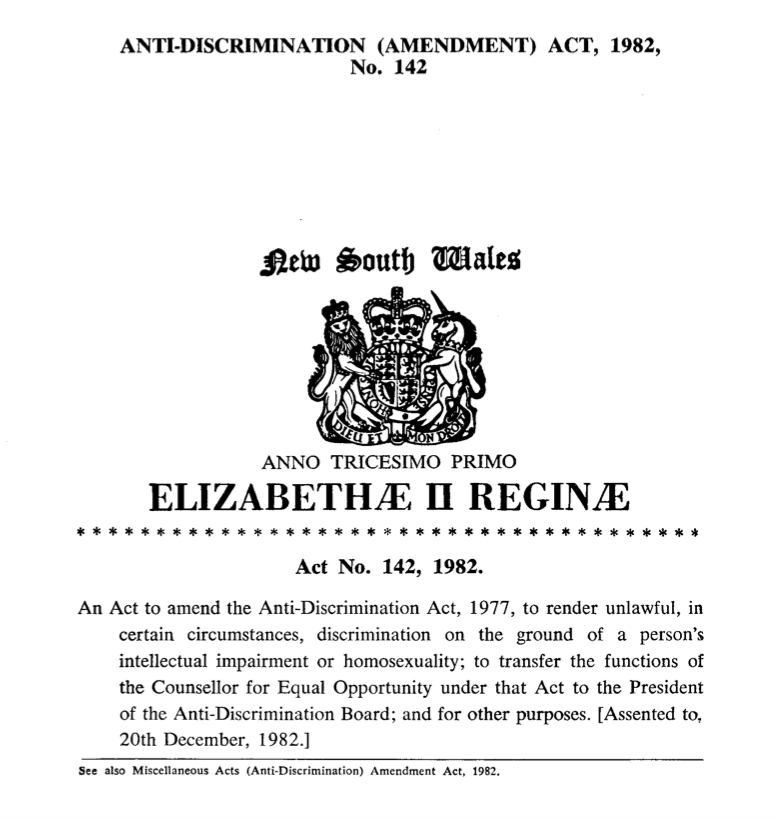
As indicated above, NSW was the first jurisdiction in Australia to introduce anti-discrimination protections for ‘homosexuals’. In fact, it passed these laws in late 1982, 18 months before homosexuality was decriminalised, meaning a gay man could not be discriminated against for who he was (in some areas of public life at least), but could still be convicted for having sexual intercourse in private. The problem is that the protected attributes included in the Anti-Discrimination Act 1977 have not kept pace with community standards in the decades since.

There was one positive clarification in 1994 that “homosexual means male or female homosexual”[ii] (to overcome any erroneous assumption that homosexuality only referred to gay men). However, the only significant expansion in the past 41 years was the introduction of transgender as a protected attribute in 1996:

Section 38A Interpretation

A reference in this Part to a person being transgender or a transgender person is a reference to a person, whether or not the person is a recognised transgender person[iii]:

(a) who identifies as a member of the opposite sex by living, or seeking to live, as a member of the opposite sex, or

(b) who has identified as a member of the opposite sex by living as a member of the opposite sex, or

(c) who, being of indeterminate sex, identifies as a member of a particular sex by living as a member of that sex,

and includes a reference to the person being thought of as a transgender person, whether the person is, or was, in fact a transgender person.”

While this reform was a major step forward, it nevertheless failed to cover all discrimination on the basis of gender identity. This protected attribute focuses only on binary genders – covering people whose sex was designated as male at birth, but now identify as female (and vice versa). It does not cover other people along a more inclusive spectrum, including people who do not identify exclusively as either male or female.

Section 38A of the NSW Anti-Discrimination Act 1977 is therefore no longer best practice, and a new, more inclusive definition[iv] should be adopted to ensure all trans and gender diverse people, including non-binary people, benefit from anti-discrimination protection.

Intersex people are even worse off under the Act. Paragraph (c) of the definition above offers their only protection under NSW law, but it is problematic because:

  • It inappropriately conflates intersex, which relates to physical sex characteristics, with gender identity, and
  • It only appears to protect people with innate variations of sex characteristics where they identify as either male or female.

To remedy this situation, a stand-alone protected attribute of ‘sex characteristics’ should be introduced, based on the March 2017 Darlington Statement by intersex activists.[v]

There is, however, one section within the LGBTI community that is not included in the entire Anti-Discrimination Act, not even in an out-dated, fundamentally flawed or only partial way. In fact, one of the five letters of the acronym has no anti-discrimination coverage at all: bisexual people.

NSW is the only jurisdiction in Australia where its anti-discrimination laws do not cover discrimination on the basis of bisexuality. That is as bizarre as it is offensive.

It must be remedied at the earliest possible opportunity by the NSW Parliament, with either the introduction of a new stand-alone protected attribute of ‘bisexual’, or (preferably) by the modernisation of the current protected attribute of ‘homosexual’ to instead refer to ‘sexual orientation’, in line with the Commonwealth Sex Discrimination Act 1984[vi].

Summary: The protected attributes contained in the NSW Anti-Discrimination Act 1977 are the narrowest in the country, only offering protection to gay men, lesbians, and some transgender people. It needs to be updated to ensure it covers gender identity and sex characteristics – so that non-binary and intersex people are protected – as well as extending anti-discrimination protection to bisexual people, whose exclusion is a gross oversight that has been allowed to stand for far too long.

**********

Religious Exceptions

In contrast to its narrowly-defined protected attributes, the religious exceptions included in the NSW Anti-Discrimination Act are in fact the broadest in Australia.

These loopholes allow religious organisations to discriminate against lesbian, gay and transgender people in a wide variety of circumstances, and are so generous that they substantially, and substantively, undermine the overall purpose of the legislation (which is supposedly “[a]n Act to render unlawful racial, sex and other types of discrimination in certain circumstances and to promote equality of opportunity between all persons”).

The main exceptions permitting anti-LG&T discrimination by religious organisations are found in section 56 of the Act:

Section 56 Religious bodies

Nothing in this Act affects:

(a) the ordination or appointment of priests, ministers of religion or members of any religious order,

(b) the training or education of persons seeking ordination or appointment as priests, ministers of religion or members of a religious order,

(c) the appointment of any other person in any capacity by a body established to propagate religion, or

(d) any other act or practice of a body established to propagate religion that conforms to the doctrines of that religion or is necessary to avoid injury to the religious susceptibilities of the adherents of that religion.”

While sub-sections (a) and (b) might appear reasonable, as they are at least related to the internal training and appointment of ministers of religion, sub-sections (c) and especially (d) are outrageous in their breadth, essentially sanctioning discrimination against lesbian, gay and transgender employees and people accessing services in any organisation that is considered ‘religious’, including schools, hospitals and social services.

The operation of these provisions, and sub-section 56(d) in particular, in giving effective carte blanche to religious organisations to discriminate on the basis of sexual orientation and gender identity in NSW was confirmed in a 2010 decision of the Court of Appeal[vii], allowing Wesley Mission to discriminate against a male same-sex couple who had applied to be foster carers to children in need.

Wesley successfully defended its prejudiced approach on the basis that “[t]he biblical teaching on human sexuality makes it clear that monogamous heterosexual partnership within marriage is both the norm and ideal.”[viii] This was in spite of the fact Wesley allowed single men and women to be carers (apparently they believed two dads or two mums had less to offer than one).

The ‘right to discriminate’ provided to religious organisations by section 56 of the NSW Anti-Discrimination Act 1977 is essentially without restriction. And this general ability to exclude lesbian, gay and transgender people in NSW is supplemented by additional loopholes covering specific areas of public life.

One of these covers discrimination in adoption services. While the equal right of same-sex couples to adopt was recognised in NSW law in 2010, those very same reforms inserted the following into the Anti-Discrimination Act 1977:

Section 59A Adoption services

(1) Nothing in Part 3A [transgender protections] or 4C [homosexual protections] affects any policy or practice of a faith-based organisation concerning the provision of adoption services under the Adoption Act 2000 or anything done to give effect to any such policy or practice.”

Which means that a religious organisation that operates an adoption service is legally permitted to deny a child the best possible adoptive parents solely because they might be lesbian, gay or transgender.

Perhaps the most (in)famous exceptions in the Act are those that apply to ‘private educational authorities’.[ix] Even though subsection 56(d) already allows religious schools to do whatever they want in relation to lesbian, gay and transgender teachers and students, NSW Parliament added specific clauses to ensure that private educational authorities can:

  • Discriminate against transgender employees[x]
  • Discriminate against transgender students, including by refusing their admission, attaching conditions to their admission, denying them benefits as a student, or by expelling them[xi]
  • Discriminate against lesbian and gay employees[xii] and
  • Discriminate against lesbian and gay students, including by refusing their admission, attaching conditions to their admission, denying them benefits as a student, or by expelling them[xiii].

Imagine considering it justified to seek special privileges to discriminate against these groups, let alone for State Parliament to condone such discrimination via legislation?

Perhaps the most extraordinary part of the ‘private educational authorities’ exceptions is that they aren’t even restricted to religious schools – in fact, the Anti-Discrimination Act 1977 allows all non-government schools and colleges, even where they have absolutely nothing to do with religion, to refuse to employ lesbian, gay and transgender people, and exclude or expel LG&T students.

Summary: The religious exceptions contained in the NSW Anti-Discrimination Act 1977 are the broadest in Australia, and fundamentally undermine the integrity of a framework which is supposed to address discrimination on the basis of sexual orientation and gender identity. Subsections 56(c) and (d) should be repealed, as well as the more specific exceptions offered to religious organisations in relation to adoption services, and those allowing private educational authorities to discriminate against lesbian, gay and transgender employees and students.

**********

Anti-Vilification Coverage

There is one area where anti-discrimination law in NSW has improved recently, and that is anti-vilification coverage, with the passage of the Crimes Amendment (Publicly Threatening and Inciting Violence) Act 2018.

However, because this was a piecemeal change, rather than part of a comprehensive reform package, it means NSW is left with a two-tier, fundamentally inconsistent anti-vilification regime.

On one hand, the civil prohibitions against vilification contained in the Anti-Discrimination Act 1977 only apply to homosexuality [xiv] and, as explained above, narrowly-defined transgender [xv] .

This means that bisexuals, non-binary people and people with innate variations of sex characteristics are not able to make complaints of vilification to Anti-Discrimination NSW.

On the other hand, the new Crimes Act 1900 offence of ‘publicly threatening or inciting violence’ in section 93Z applies to all of:

  • Sexual orientation
  • Gender identity, and
  • Intersex status.

All three are defined in section 93Z(5) [xvi] using the broadly-inclusive definitions of the Commonwealth Sex Discrimination Act 1984, and mean that bisexuals, non-binary people and people with innate variations of sex characteristics are protected in NSW anti-discrimination laws for the first time (although note that, once again, intersex advocates have called for intersex status to be replaced by the protected attribute of sex characteristics). [xvii]

The penalty for this offence is also relatively high: up to three years imprisonment for individuals, and up to 500 penalty units for corporations.

Summary: The 2018 anti-vilification reforms are welcome, both for bringing anti-LGBTI vilification provisions into closer alignment with other forms of vilification, and also for including bisexual, non-binary and intersex people for the first time. However, if anything, these changes have underscored just how out of date the other anti-vilification provisions of the Anti-Discrimination Act itself are, given it still covers only lesbian, gay and some trans people. This remains an area in desperate need of reform.

**********

Other Issues

While the ‘What’s Wrong With’ series concentrates on the three main areas of protected attributes, religious exceptions and anti-vilification coverage, I will also raise other issues relating to LGBTI anti-discrimination laws where they are significant.

In the case of the NSW Anti-Discrimination Act 1977, these include:

  • An incredibly broad exception allowing “the exclusion of a transgender person from participation in any sporting activity for members of the sex with which the transgender person identifies”[xviii]
  • An inappropriate exception allowing superannuation funds to “treat… the transgender person as being of the opposite sex to the sex with which the transgender person identifies”[xix] and
  • Perhaps most alarmingly, exceptions which allow employers to discriminate against lesbian, gay and transgender applicants and employees “if the number of persons employed by the employer… does not exceed 5”[xx].

In fact, a similar exception also permits discrimination in relation to the ground of sex[xxi] – but no such limitation applies to race[xxii].  Which means that the NSW Parliament has effectively determined that racial discrimination cannot be tolerated in employment in any circumstances – but discrimination against lesbians, gay men, transgender people and even women is acceptable in some circumstances. That message is unconscionable, and these provisions must be made uniform (by abolishing the exceptions applying to homosexual, transgender and sex discrimination in employment).

**********

In conclusion, it is clear that, while NSW once had the first gay anti-discrimination laws in Australia, it now has the nation’s worst LGBTI laws – with significant problems in terms of protected attributes and religious exceptions, and serious shortcomings where it does have anti-vilification coverage. These and other issues must be addressed by the Government, and Parliament more broadly, as a matter of priority.

NSW ADA homosexuality 1982

NSW was the first Australian jurisdiction to introduce anti-discrimination laws covering any part of the LGBTI community – but 41 years later still doesn’t protect bisexual, non-binary or intersex people.

If you have enjoyed reading this article, please consider subscribing to receive future posts, via the right-hand scroll bar on the desktop version of this blog or near the bottom of the page on mobile. You can also follow me on twitter @alawriedejesus

Footnotes:

[i] The other posts in the series can be found here: LGBTI Anti-Discrimination

[ii] Section 4 Definitions.

[iii] From section 4: “recognised transgender person means a person the record of whose sex is altered under Part 5A of the Births, Deaths and Marriages Registration Act 1995 or under the corresponding provisions of a law of another Australian jurisdiction.”

[iv] Potentially modelled on the definition adopted by the Commonwealth Sex Discrimination Act 1984: “gender identity means the gender-related identity, appearance or mannerisms or other gender-related characteristics of a person (whether by way of medical intervention or not), with or without regard to the person’s designated sex at birth” [Although obviously exact wording should be agreed with NSW’s trans and gender diverse community.]

[v] Intersex Human Rights Australia, and other intersex activists from Australia and Aotearoa/New Zealand, issued the Darlington Statement as a call for wide-ranging law and policy reforms, including ‘for effective legislative protection from discrimination and harmful practices on grounds of sex characteristics’ (paragraph 9, here).

This terminology (‘sex characteristics’) is intended to replace the previous protected attribute of ‘intersex status’, as included in section 4 of the Sex Discrimination Act 1984, and defined as: “intersex status means the status of having physical, hormonal or genetic features that are:

(a) neither wholly female nor wholly male; or

(b) a combination of female and male; or

(c) neither female nor male.”

[vi] Section 4 of the Sex Discrimination Act 1984 states ““sexual orientation” means a person’s sexual orientation towards:

(a) persons of the same sex; or

(b) persons of a different sex; or

(c) persons of the same sex and persons of a different sex.”

[vii] OV & OW v Members of the Board of the Wesley Council [2010] NSWCA 155 (6 July 2010).

[viii] OW & OV v Members of the Board of the Wesley Mission Council [2010] NSWADT 293 (10 December 2010).

[ix] Defined in section 4 as “private educational authority means a person or body administering a school, college, university or other institution at which education or training is provided, not being:

(a) a school, college, university or other institution established under the Education Reform Act 1990 (by the Minister administering that Act), the Technical and Further Education Commission Act 1990 or an Act of incorporation of a university, or

(b) an agricultural college administered by the Minister for Agriculture.”

[x] Section 38C prohibits discrimination against transgender applicants and employees, but subsection (3)(c) clarifies that this prohibition does not apply to discrimination by private educational authorities.

[xi] Section 38K Education

(1) It is unlawful for an educational authority to discriminate against a person on transgender grounds:

(a) by refusing or failing to accept the person’s application for admission as a student, or

(b) in the terms on which it is prepared to admit the person as a student.

(2) It is unlawful for an educational authority to discriminate against a student on transgender grounds:

(a) by denying the student access, or limiting the student’s access, to any benefit provided by the educational authority, or

(b) by expelling the student or subjecting the student to any other detriment.

(3) Nothing in this section applies to or in respect of a private educational authority.”

[xii] Section 49ZH prohibits discrimination against lesbian and gay applicants and employees, but, just like for transgender people, subsection (3)(c) clarifies that this prohibition does not apply to discrimination by private educational authorities.

[xiii] Section 49ZO Education

(1) It is unlawful for an educational authority to discriminate against a person on the ground of homosexuality:

(a) by refusing or failing to accept the person’s application for admission as a student, or

(b) in the terms on which it is prepared to admit the person as a student.

(2) It is unlawful for an educational authority to discriminate against a student on the ground of homosexuality:

(a) by denying the student access, or limiting the student’s access, to any benefit provided by the educational authority, or

(b) by expelling the student or subjecting the student to any other detriment.

(3) Nothing in this section applies to or in respect of a private educational authority.”

[xiv] Section 49ZT

[xv] Section 39S

[xvi] Gender identity means the gender related identity, appearances or mannerisms or other gender related characteristics of a person (whether by way of medical intervention or not), with or without regard to the person’s designated sex at birth.

Intersex status means the status of having physical, hormonal or genetic features that are:

  • neither wholly female nor wholly male,
  • a combination of female and male, or
  • neither female nor male.

Sexual orientation means a person’s orientation towards:

  • persons of the same sex, or
  • persons of a different sex, or
  • persons of the same sex and persons of a different sex.

[xvii] Interestingly, it also means heterosexual people are covered by the publicly threatening or inciting violence offence in the Crimes Act 1900, although they still don’t have any coverage under the Anti-Discrimination Act 1977 itself (for discrimination, or civil complaints of vilification).

[xviii] Section 38P. It is hoped that, given the work in recent years by transgender groups, the Australian Human Rights Commission and Australian sporting organisations, these provisions could be narrowed if not repealed entirely in future years.

[xix] Section 38Q.

[xx] Included in both sub-sections 38C(3)(b) and 49ZO(3)(b).

[xxi] Section 25(3)(b).

[xxii] Section 8, which covers Discrimination against applicants and employees on the ground of race, does not include any exception based on the number of employees that an employer has.