Decoding Life, Freedoms and Governance

On April 16 2024, I was invited to give the keynote address to launch Issue 47(1) of the UNSW Law Journal.

I was asked to talk about the Issue’s theme – ‘Decoding Life, Freedoms and Governance’ – with reference to at least some of the Issue’s articles (which are open-source, and can be found here), as well as my background as a long-term LGBTIQ advocate and professional experience in public policy.

The following is what I came up with (the two sections in square brackets were omitted on the night to keep to time, but are included here for completeness). Thanks for reading, I hope you find it interesting. 

‘Decoding Life, Freedoms and Governance’

Thank you for that generous introduction. And of course for the invitation to speak here tonight.

Thank you also for the broad theme of Issue 47(1) to address in my remarks – ‘Decoding Life, Freedoms and Governance’ – which took me several days to ‘decode’.

I must confess I don’t feel particularly qualified to talk in detail on the topic of ‘decoding life’ – which is something most people do in consultation with their therapist.

I do, however, have plenty to say on the twin, and intertwining, topics of ‘decoding freedoms’ and ‘decoding governance’, at least partly based on my lived experience.

That’s because, as a 45-year-old gay man, it has been impossible to avoid thinking about the meaning of freedom – of what I have been free to do, or not do, or protected from, or not, at different stages of my life. And what others, including religious organisations, have been legally free to do to me.

Or to deny the role of governance, and governments – state and federal – in determining the extent of those ‘freedoms’, far-too-often without consultation with or even consideration of those most affected by their decisions.

Indeed, some of the key events in my life overlap with milestones in the history of LGBTIQ rights in Australia.

I was born in July 1978, just weeks after NSW Police arrested 53 people for participating in the first Sydney Gay Mardi Gras parade – an indication of how unwelcoming both the law, and its enforcement, were for LGBTIQ people here.

Although I grew up in rural Joh Bjelke-Petersen-era Queensland, which was undoubtedly worse.

Queensland did not decriminalise male homosexuality between adults until January 1991 – but even then it introduced a differing age of consent for anal intercourse (18, compared to 16 for other sexual acts), a discrepancy that was not abolished until 2016, and with charges and convictions arising because of this inequality still not included in their historical homosexual conviction expungement scheme today.

January 1991 was also personally significant for a couple of reasons. Just one week after decriminalisation, I found myself travelling 800 kilometres from the family farm to a religious boarding school in Brisbane. Then, on my first day there, I found I was same-gender attracted too.

Audience members will be unsurprised to learn religious schools were lawfully permitted to discriminate against LGBTQ students (and teachers) in Queensland at that time. Loopholes my school took full advantage of over the following five years.

While I will spare you the details tonight, it would be an understatement to describe growing up gay at a religious boarding school which enjoyed special privileges to be prejudiced, as horrific. [You can read more about my experiences, here].

Fast forward to 2008, and to another coincidence. I was employed as a ministerial adviser to the Rudd Labor Government. At the same time as I met, and began my first de facto relationship with, the man who is still my partner today, I was provided internal on the details of Commonwealth same-gender de facto relationship recognition.

Some younger members of the crowd may not be aware this recognition did not exist before 1 July 2009.

Then, in January 2010, my partner Steve and I got engaged – meaning I would spend the remainder of my time working for a Government which did not support the legal equality of my own relationship.

Despite departing Canberra in mid-2012, I continued to advocate for the introduction of Commonwealth anti-discrimination protections for LGBTIQ people, something that was finally achieved in June 2013 – just 10 years ago, but almost four decades after race discrimination was prohibited federally, and more than three decades after homosexual discrimination protections were introduced in NSW (something we will return to later).

The subsequent four years were predictably dominated by the subject of marriage equality – not only campaigning for it to be passed, but also debating the manner of its passage, from conscience votes through to the push for the ALP to hold a binding vote.

And from successful LGBTIQ community efforts to stop the Turnbull Coalition Government’s plebiscite, to failed attempts to prevent their postal survey – in another coincidence, I started at the Public Interest Advocacy Centre just a couple of months before we helped one of the unsuccessful High Court challenges to block what may have technically been a statistical survey but was also an anti-democratic anomaly.

I note this challenge fell just prior to the relevant time period for the article ‘How does the High Court interpret the Constitution? A Qualitative Analysis between 2019-21’ – it would have been interesting to see how Tan, Paige, Hrambanis and Green characterised that Wilkie decision. 

In any event, thank you for indulging me in sharing a little of my back-story. Which I think reinforces that to be a gay man – or any member of the LGBTIQ community – in the final two decades of the 20thcentury, and the first few of the 21st, is to have been engaged in a constant state of contestation of our legal rights.

Our lives have been made inherently political, with participation in the political process rendered essential – even if ‘the State’ has frequently been our oppressor, or at least acted on the oppressor’s side.

That background also helps to explain why I am an LGBTIQ advocate today.

Why I chose ‘sexuality-related anti-discrimination law in practice’ as the topic of my law honours paper at ANU.

Why I’ve spent much of the past two decades volunteering for a range of LGBTIQ community organisations, including both the Victorian, and NSW, Gay & Lesbian Rights Lobbies.

And why I have ended up at PIAC, where over the past seven years I have been fortunate enough to work not just on marriage equality, but also on advocacy against the Morrison Government’s Religious Discrimination Bills, which presented a grave threat to the rights of LGBTQ people (as well as women, people with disability and even people of minority faiths).

Above all, I’ve focused on efforts to secure anti-discrimination protections for LGBTQ students and teachers in religious schools, under both state and federal law. Which is obviously a full-circle moment given where I started!

I intend to use the remainder of this speech to talk about what LGBTIQ rights look like in NSW today, across four key issues: conversion practices; birth certificates; medical interventions on intersex children; and anti-discrimination protections.

Now, had I given this address a month ago, I would have been able to make the pithy observation that we live in the worst jurisdiction in Australia for LGBTIQ laws.

Instead, following passage of the Conversion Practices Ban Act in late March, we’ve moved all the way up to equal worst, with Western Australia (actually, that’s perhaps uncharitable – if we’re being generous, we might even be able to say we are now second-worst… just).

From an LGBTIQ advocate’s perspective, this legislation is both welcome and long overdue.

It will legally prohibit conversion practices, defined in section 3 as:

‘a practice, treatment or sustained effort that is (a) directed to an individual on the basis of the individual’s sexual orientation or gender identity, and (b) directed to changing or suppressing the individual’s sexual orientation or gender identity.’

This is needed because, as described in the opening article in issue 47(1) – Martin Clark and Brendan Gogarty’s excellent ‘Searching the Reins and Hearts: Conversion Practices Reforms in Australia’: 

Quote

‘[S]cientific and clinical evidence has consistently shown that there is no evidence that conversion practices are ‘effective’ in their capacity to effect a change or suppression of sexual orientation or gender identity. There is also consistent evidence that conversion practices carry clear risks of harmful effects on those subjected to them, including physical and psychological harms, such as increased suicidality, self-harm, post-traumatic stress disorders, anxiety and depression, feelings of alienation, loneliness and exclusion, sexual dysfunction, substance abuse, internalised homophobia and feelings of failure, and reluctance to seek medical treatment.’

Endquote

Disappointingly to Clark and Gogarty, who argue against a carceral approach, the new Act implements both a criminal offence, and civil complaints scheme, for conversion practices.

Although I must respectfully disagree with them – given the seriousness of the harms they outline, I would suggest criminal penalties for the worst examples are appropriate.

Either way, the passage of this law is a testament to the advocacy of conversion practices survivors like Anthony Venn-Brown, Chris Csabs and Nathan Despott, over many decades.

But I would not be honouring their work without also highlighting their primary criticism of the law as passed – that, unlike the ‘best practice’ scheme in Victoria, the NSW law does not provide a formal mechanism for third-party complaints to Anti-Discrimination NSW.

As it stands, the only complaints that can be made are from survivors directly, or via representative complaints with the consent of each of those survivors.

This framework not only reinforces one of the limitations of anti-discrimination law more broadly – that the onus for seeking redress falls on the people who have been mistreated.

It ignores the particular characteristics of conversion practices, where the people undergoing them appear to do so ‘voluntarily’ (despite what, as Martin and Gogarty note, is the ‘impossibility of genuine consent’ in these circumstances), and are therefore unlikely to bring, or consent to, complaints until after they have extricated themselves from them. If they first survive them.

The lack of third-party complaints is a major gap in this scheme that must be rectified.

The Act also includes a range of ‘carve-outs’, providing that activities like ‘clinically appropriate’ healthcare, ‘stating what relevant religious teachings are or what a religion says about a specific topic’, and ‘parents discussing matters relating to sexual orientation, gender identity, sexual activity or religion with their children’, do not constitute conversion practices.

Despite this, a number of conservative religious organisations campaigned against the law in its totality, alleging it constituted an attack on ‘religious freedom’.

I must, perhaps a little less respectfully this time, disagree with them too. There is no philosophical justification for the right to inflict serious psychological harm, on children and young people, in the (misused) name of religious freedom.

Even in the case of adults – where there is at least a possible argument for the freedom to engage in practices which may result in self-harm – I would submit there is a clear justification for government regulation.

This is because of what Clark and Gogarty describe as the role played by ‘conversion ideology’ as a precursor to ‘conversion practices’:

Quote

‘Survivor-advocates have consistently contended that ‘conversion ideology’ – the worldview that it is possible and necessary for LGBTQA+ people to change their sexual orientation and gender identity, and that being LGBTQA+ is due to trauma, spiritual brokenness, and can be fixed by prayer – is central to defining and understanding conversion practices’,

because

‘the inculcation of these beliefs in congregants is important for smoothing the path for them taking part in actual conversion practices.’

Endquote

In other words, perpetrators of conversion practices first convince healthy people to believe their sexual orientation or gender identity is somehow ‘sick’ (when it is not), before offering a ‘cure’ that actually causes serious psychological harm.

The law should not protect the ‘freedom’ to engage in this abuse.

Before I conclude on this subject, I feel compelled to express my condemnation of the role played by the Liberal/National Coalition during parliamentary consideration of this law.

And especially of their vote in favour of minor-party amendments to remove ‘gender identity’ from any protection under the Conversion Practices Ban Act.

In other words, the NSW Opposition voted for the continued legality of ‘practices, treatments or sustained efforts’ to stop trans people, and especially trans young people, from being trans.

This was a shameful act, and one I would strongly urge them to reconsider in relation to future LGBTIQ law reform – including on the next topic we will turn to.

That is birth certificate legislation, and in particular, the regulation of access by trans and gender diverse people to identity documents reflecting who they are. Sadly, the NSW Births, Deaths and Marriages Registration Act 1995 is unequivocally the worst such law in the nation.

We are the only jurisdiction which still requires people to undergo genital surgery before being able to update their birth certificates – surgery many trans people do not wish to undertake, and of those that do, many cannot afford, because of a lack of Medicare funding.

While we are one of only two jurisdictions, alongside Western Australia, with no legislative options for sex or gender markers beyond male or female: non-binary people cannot access state-issued ID stating they are, in fact, non-binary.

These laws aren’t just an insult to the human dignity of trans and gender diverse people. The requirement for surgery, which causes sterilisation, is a denial of reproductive freedom and therefore the right to found a family.

While the inability of many trans and gender diverse people to access birth certificates reflecting who they are at all, means they are confronted by the possibility of ‘outing’ in the growing range of contemporary scenarios where ID is mandated.

Fortunately, the Equalities Legislation Amendment (LGBTIQA+) Bill 2023, introduced by the Independent Member for Sydney Alex Greenwich and currently being considered by a Parliamentary Inquiry, would address these problems, and at least bring NSW law up to the standard of Victoria and Queensland.

Although even then, and this is my personal rather than professional view, it would fall short of the ‘best practice’ approach of Tasmania, which is the only Australian state or territory to adopt a true ‘self-identification’ model for trans and gender diverse people.

Instead, the NSW law – like Victoria and Queensland – would still require a trans person, in addition to their own statutory declaration, to submit:

‘a support statement by an adult who has known the applicant for at least 12 months stating that (i) the adult believes the person is making the application in good faith, and (ii) the adult supports the person making the application…’

Given identity, including the characteristic of gender identity, is an inherently personal attribute, I do not agree the recognition of someone’s gender should be dependent on whether another person ‘supports’ it.

Looked at from another perspective, I do not concede that my sexual orientation, as a gay man, should only be acknowledged if I am able to produce a statutory declaration from another person saying they ‘support’ it.

I am who I say I am, a fact generally accepted by others. Trans and gender diverse people deserve to enjoy exactly the same respect.

Nevertheless, we (being PIAC), support the Equality Bill as a significant step forward along the long journey to LGBTIQ, and especially trans, equality. We urge both the NSW Government, and Opposition, to support it.

Turning to the third topic I flagged earlier, and in which NSW law is manifestly deficient: medical interventions on intersex children.

For audience members new to this subject, intersex people have innate sex characteristics that do not fit medical norms for female or male bodies. It is estimated somewhere up to 1.7% of children are born with these variations of sex characteristics.

Tragically, the medical system’s response to many intersex children is to perform so-called ‘normalising’ surgeries on them.

These interventions are frequently not clinically necessary for the child’s health, but instead performed for non-therapeutic or ‘psycho-social’ reasons, including to assuage the disappointment of parents who expected their child’s body to conform to societal norms, or to ‘assist’ the child to fulfil gendered stereotypes in the future.

For those curious about what that means in practice, I suggest reading the 2016 Family Court case of Re: Carla, which ruled that a family can consent to the sterilisation of their 5-year-old child without court approval, without clear medical necessity and at least partly motivated by gendered expectations, including attitudes to that young child’s potential future sexuality. It was then, and remains today, a genuinely heart-breaking decision.

These unnecessary surgeries are obviously done without the consent of the person affected by them, who should be free to agree, or not agree, to them when they have at least reached Gillick competency and understand what is involved.

In my view, medical interventions on intersex children, which are a fundamental denial of bodily autonomy, are one of the gravest human rights violations happening in Australia today – not just in relation to the LGBTIQ community, but across society.

There have been multiple public inquiries recommending these practices be ended, including the 2013 Senate ‘Inquiry into the involuntary or coerced sterilisation of intersex people in Australia’, and the Australian Human Rights Commission’s 2021 report ‘Ensuring health and bodily integrity: towards a human rights approach for people born with variations in sex characteristics.’

Sadly, however, only one Australian jurisdiction has so far passed legislation to prohibit these surgeries: the ACT. While I understand Victoria may be close to finalising its own laws.

In contrast, there is no NSW Government commitment to introducing equivalent laws here, nor was it included in Mr Greenwich’s Equality Bill.

This is a gross failure of governments, in NSW and elsewhere, to protect the rights of the most vulnerable.

It is unsurprising I had this issue front-of-mind while reading the article ‘Out-of-Home Care, Contact Orders and Infant Mental Health: Recognising a Unique Developmental Stage in Law, Policy and Practice’ by Rachel Gregory-Wilson, Elizabeth Handsley, Liesel Spencer and Toby Raeburn, including their observation that:

Quote

‘Infancy is, therefore, a special and critically important stage of human development, and infants as a class of persons require special recognition and safeguards, including under child protection law. Infants are not little children, just as children are not little adults; they need different and unique exposures in their environments to facilitate optimum physical growth and emotional development’.

Endquote

While they made this observation in a different context, I think it reasonable to apply these principles to intersex children, who deserve legislative safeguards for their bodily autonomy, and who should be allowed to grow and develop free from unnecessary medical interventions to try to change their bodies into what society expects them to be.

Let intersex kids be free from surgeries performed according to the wants of others, rather than their own needs – and only performed following their own timeframes, if they so consent.

[One final point before moving on – while the circumstances, and associated rights, of trans young people, and intersex children, are quite distinct, it is depressing to observe the intellectual inconsistency of those who oppose the rights of both.

For example, Liberal Senator Alex Antic’s Childhood Gender Transition Prohibition Bill 2023, currently before Commonwealth Parliament, seeks to ban access by trans and gender diverse young people to gender-affirming health care, even puberty blockers and even where they are Gillick competent.

While simultaneously providing a specific carve-out to allow non-consenting medical interventions to continue to be performed on intersex children.

According to Antic, there should be no gender-affirming health care for trans kids who want it and who are able to consent. But no protection for intersex kids from harmful surgeries that are not clinically necessary and where they are in no position to consent.

Trans and intersex kids lose either way].

Turning to the final topic of my speech – anti-discrimination coverage – once again NSW has the worst laws in the country. Nowhere is this more apparent than in the protections the Anti-Discrimination Act 1977 offers, or more accurately fails to offer, LGBTIQ people.

It wasn’t always this way. In fact, NSW was the first Australian jurisdiction to protect lesbians and gay men against discrimination, in late 1982. Incidentally, this was before the decriminalisation of homosexuality in mid-1984, meaning there was an 18-month period during which gay men were criminals but legally could not be denied housing.

But the lack of subsequent reform, especially over the past 28 years, has allowed this law to atrophy.

We are now the only place nation-wide which does not protect bisexual people against discrimination. And one of two, with Western Australia, that does not protect non-binary and intersex people.

The provisions allowing discrimination by religious schools are the broadest in Australia too.

Indeed, they are so broad they apply to all ‘private educational authorities’, not just religious schools. And they offer complete or ‘blanket’ privileges to discriminate – unlike all other jurisdictions, there is no test which NSW schools must satisfy before being permitted to discriminate. The Act simply does not apply to them.

These serious flaws are just some of the reasons PIAC has made comprehensive anti-discrimination law reform a priority, including through our August 2021 report ‘Leader to Laggard: The case for modernising the NSW Anti-Discrimination Act’.

We were obviously pleased NSW Labor listened to that report and made comprehensive review of the ADA an election commitment. And we have welcomed, participated in and will continue to participate in the current NSW Law Reform Commission inquiry into this broken and outdated law.

But, as people discovered at the start of the century – when the Law Reform Commission completed its last review of this legislation, with its report then gathering dust rather than being implemented – an inquiry is meaningless if nothing subsequently changes.

We will continue to advocate to the Minns Labor Government until we finally have an Anti-Discrimination Act fit for the 21st century, one offering genuine protection against discrimination for all communities, including LGBTIQ people.

Speaking of Law Reform Commission reports at risk of gathering dust, I cannot discuss anti-discrimination law reform tonight without also addressing the current situation federally.

[Before we get into those details, however, and on indulgence, I might take this opportunity to vent the frustrations of an advocate for protecting LGBTQ students in religious schools who regularly comes up against the intellectually disingenuous, and sometimes downright dishonest, arguments of those opposed to reform.

I speak of some conservative religious schools, and their representative bodies, who simultaneously claim that religious schools do not discriminate against lesbian, gay, bisexual and trans students – but that under no circumstances can their legal privileges to do so ever be repealed.

They can never satisfactorily answer why that should be the case.

Until you realise it is because these religious schools do in fact discriminate against queer kids – they just call it something else.

Which is how you end up with the anti-LGBTQ, and especially anti-trans, student enrolment contract, proposed by Citipointe Christian College in Brisbane in 2022.

Or the situation in late 2023, when a Sydney Catholic school rejected a female student’s request to bring their same-gender partner to their formal (with it later becoming apparent this was policy across that entire Catholic school network).

Indeed, Catholic schools seem to be experts in this special kind of hypocrisy – claiming not to discriminate, while doing exactly that – as can be seen in the 2023 Sydney Catholic Schools’ ‘Gender Dysphoria Policy’ – a 6-page guide that only ever refers to students with ‘gender dysphoria’, never once acknowledging some students are trans.

I would submit it is fundamentally discriminatory to refuse to acknowledge who a trans child is.

It is almost refreshing to witness the comparative honesty of an organisation like the Presbyterian Church of Australia, who have publicly stated gay students cannot hold leadership positions within their schools because they are unable to ‘model Christian living’.

Almost – until you remember they are unashamedly, and unrepentantly, saying they will actively mistreat young people solely because of an intrinsic attribute.

That is nothing more than bullying, pure and simple. There should be no place for it in places of learning.

Anyway, thanks again for your forbearance.]

As audience members are aware, this issue has been ongoing for several years – since late 2018, when both the then-Morrison Government, and then-Shorten Opposition, promised to protect LGBTQ students. With Labor going further in promising to protect LGBTQ teachers too.

Albanese took these commitments to the May 2022 election, with Attorney-General Mark Dreyfus referring the question of how they should be implemented to the Australian Law Reform Commission in November that year.

The ALRC handed its report to Dreyfus in December. They proposed straight-forward amendments, to the Sex Discrimination Act 1984, and Fair Work Act 2009, to reflect the following two principles:

  1. That LGBTQ young people should enjoy the freedom to learn and to grow, without fear of discrimination on the basis of who they are, and
  2. That LGBTQ teachers should be employed on the basis of their skills and experience, rather than their sexual orientation and gender identity.

We hoped the privileges for prejudice enjoyed by religious schools might finally end.

But, when the Government released the ALRC report in March, those hopes were immediately dashed – because Prime Minister Albanese indicated no legislation would even be introduced to Parliament without bipartisan support from the now-Dutton Opposition. Effectively abdicating responsibility for his own election promises to the parties he had defeated.

Remember, not only did the Coalition do nothing to implement Morrison’s 2018 promise to protect LGBTQ kids, they withdrew their own Religious Discrimination Bills from Senate consideration because of amendments to prohibit discrimination against trans students.

Just today, Shadow Attorney-General Michaelia Cash has written an opinion piece not just opposing reforms to the Sex Discrimination Act, but also backing calls by religious schools for ‘positive rights’ to discriminate under federal law, with the consequence of overriding protections for LGBTQ teachers, and even students, in states and territories that have progressive laws.

It was abundantly clear to observers when Mr Albanese announced his ‘bipartisanship’ push, and is undeniable now, there are only two possible outcomes:

  1. There is no agreement, and therefore no protection for LGBTQ students and teachers
  2. There is agreement – but any Bill supported by the Coalition will not offer genuine protection for LGBTQ students and teachers.

Either way, LGBTQ Australians lose again.

It is hard not to share the sentiments, if not the choice of language, of religious school discrimination survivor James Elliot-Watson, when he described the impasse thus:

Quote

‘MPs are paid in excess of $200,000 so everybody should do their fucking job.

And I think that’s especially true for the leader of the government and my Prime Minister.

The purpose of parliament is to enact laws that ensure the safety, integrity and protection of… Australian citizens and that’s what this is about.

It needs to protect vulnerable children from legal discrimination practices that religious institutions are allowed to engage by chang[ing] the law.

Let’s get it done.’

Endquote

If Albanese doesn’t ‘get it done’ this term, it will be no less a failure of governance, and governments, to realise the basic freedoms of LGBTIQ Australians as the failure to achieve marriage equality over many years.

Indeed, there are many similarities between these two issues.

Both were reforms supported by a large majority of the Australian community.

Both could be delivered with legislative ease, following well-established precedents (in the case of marriage equality, overseas examples; in anti-discrimination law, the successful operation of state and territory laws).

Both issues had politicians who claimed to support change, but were recalcitrant in delivering it.

Significantly, both marriage equality and anti-discrimination reform have seen Prime Ministers impose artificial barriers hindering change – in the former, an unnecessary plebiscite-cum-postal survey; in the latter, the unnecessary need for bipartisan support.

With the result that on both issues LGBTIQ Australians are made to wait far too long for positive change.

Which is the most important point. It is LGBTIQ Australians who suffer real-world harm because of political intransigence.

In marriage equality, we remember Peter ‘Bon’ Bonsall-Boone and Peter De Waal, who were together for 50 years, and, in the face of Bon’s declining health, desperately pleaded for Malcolm Turnbull to introduce marriage equality so they could finally wed.

Bon died 6 months before it was passed.

In relation to LGBTQ students, I think about the person whose story we will never get to hear – because the mistreatment they experience causes them to prematurely end their life.

I say that with confidence – because it was nearly my story.

The horrific discrimination I suffered at the hands of my religious boarding school, which I mentioned earlier, caused me to experience suicide ideation from the second term of year 8, through the final term of Year 12. And beyond.

I am, in many respects, very lucky to still be here.

But I am also full of resolve. Because that is no way for a child to learn, or to grow up.

And so I can state with equal confidence that I, and PIAC, will continue to advocate until no child has to endure the same.

As I come to the end of tonight’s speech, I’m tempted to apologise for the ‘heaviness’ of some of the subjects I’ve spoken about, including the personal impacts of anti-LGBTIQ prejudice.

It is an ‘occupational hazard’ of being an advocate, and especially one who focuses on policy and law reform, to be constantly critical, to highlight where the law is deficient, and the terrible outcomes of those shortcomings.

I do not intend to convey the impression there has been no positive law reform in my lifetime (or since that very first Mardi Gras) – not just on conversion practices, but also decriminalisation, de facto and rainbow family rights, and in many other areas.

Nor is the plight of LGBTQ people in religious schools intractable. I am reliably informed my own boarding school is now welcoming of same-gender attracted and gender diverse students, a product of anti-discrimination protections for students that have existed in Queensland for twenty years.

But I do mean to impart the understanding that the struggle for the full realisation of LGBTIQ human rights and freedoms in Australia is far from over, and that we will never reach that end-point without the concerted efforts of the community, both LGBTIQ and non-LGBTIQ alike.

I welcome those present tonight as fellow travellers on the long journey ahead.

Congratulations on Issue 47(1) of the UNSW Law Journal to Jessie Liu, your editorial team and to all of the authors published. It is truly impressive in its breadth, and depth, of scholarship.

And thank you for listening to my remarks.

[The video of this event has been published here. My speech begins at the 20-minute mark].

Photo credit: UNSW Law Journal

If you have appreciated reading this article, please consider subscribing to receive future posts, via the right-hand scroll bar on the desktop version of this blog or near the bottom of the page on mobile. You can also follow me on twitter @alawriedejesus
NSW laws are a horror-scope for LGBTIQ people

Right now, the NSW Government is consulting the community about whether to introduce new commemorative birth certificates, with proposed themes including ‘AFL, Olympic and Astrology Zodiac’ (yes, seriously).

At the same time, trans and gender diverse people in NSW continue to endure the most regressive birth certificate laws of any state or territory in Australia, which require people seeking to update their identity documents to first undergo genital surgery – something many do not want, and even more cannot afford.

It is offensive that I might be able to access an astrology-themed birth certificate (Leo, don’t judge) before many of my trans and gender diverse friends can obtain identity documents that simply reflect who they are.

The Births, Deaths and Marriages Registration Act is far from the only NSW law that treats LGBTIQ people as second-class citizens. There are many ways in which LGBTIQ people in this state wake up each day confronted by their own ‘horror-scope’ of discrimination and mistreatment.

For LGBTQ students at religious schools: You could be suspended or expelled today simply because of who you are. [Or, as we saw last week, you could be denied the ability to bring your partner to the school formal because they are the ‘wrong’ gender.] But there’s nothing you or anyone else can do about it.

For LGBTQ teachers at religious schools: You could lose your job today, and it has nothing to do with your ability to perform your role.

For bisexual, non-binary and intersex people: You could be discriminated against or vilified as you go about your everyday activities, but don’t bother complaining to Anti-Discrimination NSW – the Anti-Discrimination Act doesn’t protect you.

For LGBTQ people seeking to access publicly-funded disability, health, homelessness, and other community services operated by religious organisations: Closed doors could be a constant in your day – because the services you need can turn you away just for being you.

And for vulnerable young LGBTQ people: Watch out for people or groups seeking to change or suppress your sexual orientation or gender identity – even though what they offer is psychological torture, it’s still totally legal here.

Despite being the home of the Sydney Gay & Lesbian Mardi Gras, and recent host of World Pride, it’s no exaggeration to describe the state of LGBTIQ laws in this state as abysmal. Indeed, none of the above scenarios have changed since before the Sydney Olympics, leaving us with the worst legislation in Australia.

NSW is the gold medal winner in anti-LGBTIQ bigotry. Although somehow I doubt we’ll be able to get that on any ‘Olympic’ themed commemorative certificate.

Right now, there are two Bills before NSW Parliament that would remedy this situation: strengthening protections against discrimination, finally providing trans and gender diverse people with access to identity documents that reflect their gender identity, and prohibiting sexual orientation and gender identity conversion practices.

The Equality Legislation Amendment (LGBTIQA+) Bill 2023 and Conversion Practices Prohibition Bill 2023 were introduced by independent Member for Sydney Alex Greenwich in August.

They were drafted following consultation with the community, including trans and gender diverse people as well as survivors of conversion practices.

In many cases, they would simply drag NSW law up to minimum standards that have existed in other jurisdictions for years, or even decades (with LGBTQ students in religious schools protected against discrimination for upwards of twenty years in Tasmania, Queensland and the Northern Territory).

The NSW Government is currently considering whether to support them. It is imperative they do – and seize the opportunity to bring many of the state’s LGBTIQ laws into the 21st century.

Even if they do, however, the job of achieving full protection for the LGBTIQ community will not be over. Sadly, the Bills currently before Parliament do not follow the ACT’s precedent in addressing one of the most extreme human rights violations against any part of our community: the ongoing involuntary surgeries and other medical interventions performed on children born with variations of sex characteristics (intersex children).

Nevertheless, the reforms contained in Greenwich’s Bills are essential, and should be progressed. 

So, as the Minns Labor Government decides whether to support the fundamental protections these Bills offer, they should read their own horoscope for today:

You have the chance to make a tangible difference in the lives of LGBTIQ people across NSW. And it’s much more important than introducing star sign-themed birth certificates.

*****

You can call on Premier Chris Minns to support the Equality Bill and Conversion Practices Prohibition Bill by contacting him here: https://www.nsw.gov.au/nsw-government/premier-of-nsw/contact-premier

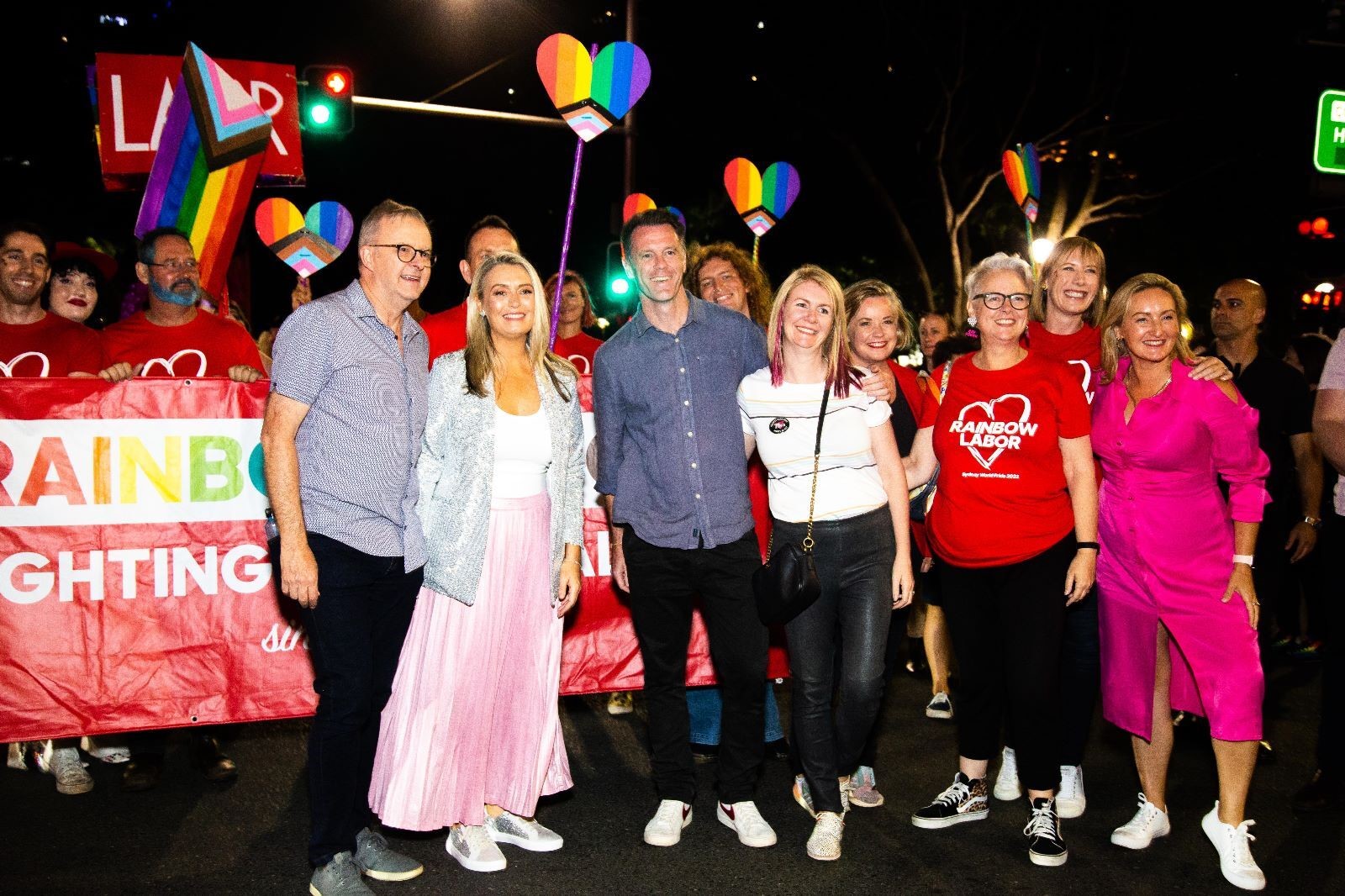
Chris Minns (centre) marching in this year’s Sydney Gay & Lesbian Mardi Gras Parade.

If you have enjoyed reading this article, please consider subscribing to receive future posts, via the right-hand scroll bar on the desktop version of this blog or near the bottom of the page on mobile. You can also follow me on twitter/X @alawriedejesus

Sydney: World Pride and Legal Prejudice

Well, it’s official. When Sydney World Pride kicks off in less than a fortnight, it will be held in the jurisdiction with the worst LGBTIQ laws in Australia.

This incontrovertible fact is not surprising to anybody who has been paying attention. But it is still shocking to observe all of the different forms of legal prejudice which still exist in NSW. And, as always, the most vulnerable members of our community are the ones left paying the price.

This includes all those let down by the worst anti-discrimination legislation in the country.

The NSW Anti-Discrimination Act 1977 is already the only anti-discrimination law which fails to protect bisexuals against discrimination.

With legislation currently before Queensland Parliament, and a recent promise by the Western Australian Government to implement WA Law Reform Commission recommendations there, NSW will also soon be the only place which fails to protect non-binary people.

And the only place with no explicit intersex protections either.

The Anti-Discrimination Act’s exceptions which allow ‘private educational authorities’ to lawfully discriminate against LGBTQ students and teachers remain the broadest in Australia too.

Once again, the WA Government’s promised response to their Law Reform Commission, and the current Australian Law Reform Commission inquiry into the Commonwealth Sex Discrimination Act 1984, mean it is highly likely, by the end of this year, NSW will retain the only anti-discrimination law which fails to protect LGBTQ young people.

When it comes to the LGBTIQ community, the NSW Anti-Discrimination Act permits more discrimination than it prohibits.

Trans and gender diverse people in NSW are also subjected to out-dated and overly restrictive birth certificate laws.

It is currently one of only two states that still require transgender people to have genital surgery in order to access identity documents which reflect their gender identity – but the other, Queensland, has a Bill before Parliament to remove this unnecessary barrier.

A third jurisdiction, Western Australia, also requires physical treatment of some kind (such as hormone therapy) although the WA Government recently committed to reform their laws.

Unfortunately, the NSW Government has made no such promise here, effectively abandoning trans people who either cannot afford (because of the prohibitive costs involved) or do not wish to undergo surgery, as well as people with non-binary gender identities.

NSW’s laws fail the LGBTIQ community in two other areas which are no less important.

First, there is no ban on sexual orientation and gender identity conversion practices in NSW.

Victoria and the ACT have already banned these dangerous and harmful psychological practices, while Queensland has partially banned it (in health settings only). Other jurisdictions, including Tasmania and Western Australia, have promised to outlaw it. But ‘ex-gay’ and ‘ex-trans’ torture remains legally permitted in NSW today.

Second, there is no prohibition on non-consenting surgeries and other unnecessary and deferrable medical interventions on children born with variations of sex characteristics in NSW either.

These are horrific and ongoing human rights abuses, denying the fundamental right to bodily integrity of intersex infants. Just as horrific is the fact no Australian jurisdiction has, to date, ended these practices.

Thankfully the ACT Government will shortly become the first, with legislation expected to be introduced in the first half of 2023.

Once again, however, there have been no promises, and no signs of movement, on this issue from the NSW Government.

The current appalling situation in these four areas (LGBTIQ anti-discrimination laws, trans and gender diverse birth certificates, sexual orientation and gender identity conversion practices, and non-consenting surgeries and other medical interventions on children born with variations of sex characteristics) constitutes nothing less than a crisis in LGBTIQ rights in NSW.

To some extent, it is a crisis that has emerged, and worsened, only gradually over time, thanks to the inaction of successive Governments of both persuasions (especially in relation to the broken Anti-Discrimination Act).

However, with the O’Farrell/Baird/Berejiklian/Perrottet Liberal-National Government about to celebrate 12 years in office, they must clearly shoulder a significant share of the blame.

Indeed, the last LGBTIQ-specific law reform which the Coalition implemented was way back in 2018.[i] That means they passed exactly zero LGBTIQ-related laws during the entire parliamentary term which has just ended.

By way of contrast, the Victorian Government reformed their Equal Opportunity Act (to better protect trans, non-binary and intersex people, and protect LGBTQ students and teachers), updated trans birth certificate laws, and banned conversion practices, all in the same period (2019-22).

To be fair, during the past term the Berejiklian/Perrottet Government did initiate a Special Commission of Inquiry into LGBTIQ hate crimes (although they rejected community calls for this to be constituted as a Royal Commission, and it obviously remains to be seen what the practical outcomes of the Inquiry will be, if any).

The NSW Government also ultimately rejected Mark Latham’s legislative attack on trans kids. Although that was only after a parliamentary inquiry in which all three Coalition Committee members supported his Bill, and an 18-month public debate during which trans kids and their families felt abandoned. Plus, as I wrote at the time, not going backwards (by rejecting Latham’s Bill) is not the same thing as going forwards (like pro-actively addressing all of the ways in which NSW law still discriminates against trans and gender diverse people).

Perhaps the only unequivocally positive achievement during the term was the development and launch of the NSW LGBTIQ+ Health Strategy 2022-27, which contains a number of important initiatives.

However, no amount of health programs can remove the legal prejudice which confronts LGBTIQ people in NSW – only Government, and Parliament, can do that.

On that note, I find it incredibly curious, and probably revealing that, despite knowing World Pride was headed to Sydney since October 2019, the NSW Government took exactly zero steps to fix any of the four major deficiencies in LGBTIQ rights in this state. They were apparently content for the spotlight to fall on NSW and proudly show their failures to the world.

With the state election on March 25 (less than a month after World Pride finishes), perhaps they thought we would be satisfied with the ‘bread and circuses’ of the coming weeks. Or, to adapt another Roman saying, maybe they believed we would be happy to just dance while our human rights burn.

Well, they might soon discover they were badly mistaken.

[UPDATE 17 February 2023: Following pressure for Independent Member for Sydney Alex Greenwich MP, who has developed his own legislation to ban conversion practices, and a promise by the Labor Opposition to do the same if elected, Premier Perrottet finally expressed ‘in-principle support’ for a ban. However, there remains no detail to this expression of support, including whether it specifically includes gender identity conversion practices, or whether it will cover all sites where conversion practices occur, including religious settings.

UPDATE 23 February 2023: This week, Premier Perrottet wrote to faith leaders to reassure them any bans on conversion practices would not affect religious freedoms, as well as telling a community forum: ‘We will not ban prayer. We will not ban preaching. That is fundamental to freedom of religion.’ In effect, it seems likely any ban by a re-elected Liberal Government would therefore exclude religious settings, where the vast majority of harm is caused. In which case, a Perrottet conversion practices ban would not be worth the paper it is printed on.]

Again, to be fair, this is not to let the NSW Labor Opposition off the hook either.

They were also missing in action in terms of defending our community from Mark Latham’s legislative attack on trans kids, with neither of their Leaders (Jodi McKay and Chris Minns) prepared to publicly condemn it, and one of the two ALP members of the parliamentary Committee actively supporting it.

After 12 years in Opposition, and less than seven weeks out from the election, they also don’t have a comprehensive LGBTIQ policy agenda. Indeed, based on Chris Minns’ ‘Fresh Start Plan’, and the issues listed on his website (https://www.chrisminns.com.au/issues), they don’t appear to have any specific LGBTIQ election policies at all.

Having said that, they do commit to referring the Anti-Discrimination Act to the Law Reform Commission for ‘holistic review’, although the policy (here: https://www.chrisminns.com.au/reviewantidiscriminationact) doesn’t make any detailed commitments in relation to LGBTIQ inclusion, such as protecting LGBTQ students or teachers, or covering bisexual, non-binary or intersex people (while specifically noting ‘the need to address discrimination on the basis of religion.’)

The Policy Committee Report to last year’s ALP State Conference also suggests ‘an incoming NSW Labor Government will work with relevant government agencies and other stakeholders to ban gay conversion therapy in NSW.’ But this is problematic, not just because it is silent on gender identity conversion practices, but also because it goes on to note ‘any proposed legislation to ban gay conversion therapy must not outlaw individuals voluntarily seeking out medical, health, allied health or other advice and assistance regarding their personal circumstances’.

[UPDATE 11 February 2023: Today, Opposition Leader Chris Minns committed a Labor Government to banning LGBTQ+ conversion practices. Importantly, this includes both formal and informal practices, covers LGBTQ+ (rather than just sexual orientation), and features a commitment to work with survivors in drafting the legislation. More details here.

UPDATE 27 February 2023: Unfortunately, just like Premier Perrottet before him, today Opposition Leader Mines ‘reassured’ faith leaders that the ALP’s ban on conversion practices would not impact ‘religious freedom’. His quote, as reported by the Sydney Morning Herald: ‘Taking offence at the teachings of a religious leader will not be banned, expressing a religious belief through sermon will not be banned, and an individual, with their own consent, seeking guidance through prayer will not be banned either.’ This means the ALP’s ban will also only be partial, and therefore only partially effective.]

While there still appears to be no ALP commitments in relation to trans access to birth certificates, or ending medical interventions on intersex kids.

This situation, in 2023, is simply not good enough. The LGBTIQ community of NSW deserves much better, from the Government and the Opposition.

I should clarify here that this article is by no means a criticism of Sydney World Pride, or of its organisers.

Celebrating pride is a worthy and important activity, in and of itself, especially if it contributes to long-lasting culture change. Sydney World Pride’s focus on First Nations LGBTQIA+SB people, as well as human rights in the Asia-Pacific, are both welcome. And, on a personal level, I’m genuinely looking forward to a fortnight of queer cultural events and parties (the tiredness that will inevitably follow, perhaps less so).

However, when the glitter has been swept up, and the paint from the rainbows which have been painted across Sydney starts to crack and fade, we will still be left living under the worst LGBTIQ laws in Australia.

Laws which mean a gay student who simply holds his boyfriend’s hand at Fair Day could be expelled the very next day.

Laws which allow a school to sack a teacher just for marching with her wife and children in the Rainbow Families float in the Mardi Gras Parade.

During World Pride, trans and gender diverse people will have the opportunity to walk across the Harbour Bridge. But most still won’t be able to walk into the NSW Registry of Births, Deaths and Marriages to update their birth certificate simply to match their gender identity.

It is also likely many LGBTQ people will begin their ‘coming out’ journey over the next month, inspired by the visibility of World Pride. But if they’re in NSW and don’t have a supportive family and/or community, they could still be subjected to sexual orientation or gender identity conversion practices – entirely lawfully.

Finally, Sydney World Pride will bring much celebration of the human body, and the joy it can bring. But – tragically – in 2023, NSW continues to allow violations of the bodily integrity of children born with variations of sex characteristics.

So, by all means celebrate during Sydney World Pride, including the achievements that have already been won, and our resilience in the face of ongoing oppression. I know I will.

But we cannot allow ourselves to be distracted from the challenges which remain, challenges which are especially acute right here in NSW.

What better time then to raise our voices, loudly, passionately, as a community, to tell the Government, and Opposition – and anybody else who is seeking our vote on 25 March – that our community deserves better than the legal prejudice which we currently endure?

NB This post is written in a personal capacity, and does not reflect the views of employers past or present, nor of any community organisations with which I am involved.

If you have enjoyed reading this article, please consider subscribing to receive future posts, via the right-hand scroll bar on the desktop version of this blog or near the bottom of the page on mobile. You can also follow me on twitter @alawriedejesus

Footnotes:


[i] In 2018, the then-Berejiklian Government passed two LGBTIQ-related reforms:

-the first ended forced trans divorce (although they were effectively compelled to do this following the passage of marriage reforms federally), and

-the second replaced homosexual and transgender serious vilification offences in the Anti-Discrimination Act with sexual orientation, gender identity and intersex status ‘threatening or inciting violence’ offences in the Crimes Act (although my understanding is that these offences have yet to be used).

NSW Equality Bill Submission

4 July 2022

Alex Greenwich

Member for Sydney

Via email: sydney@parliament.nsw.gov.au

Dear Mr Greenwich

Submission re Equality Bill Consultation

Thank you for the opportunity to provide this personal submission as part of your consultation process on a proposed Equality Bill.

Thank you also for your leadership on the issue of lesbian, gay, bisexual, transgender, intersex and queer (LGBTIQ) rights in NSW, something which has been neglected by too many for far too long.

As I have written previously, LGBTIQ rights in NSW are now the worst of any state or territory in the country – through decades of inaction on law reform by the NSW Government and Parliament, Sydney has become Australia’s capital of homophobia, biphobia and transphobia.

This includes the worst LGBTIQ anti-discrimination protections, and the equal worst birth certificate laws for trans and gender diverse people. As well as an ongoing failure to prohibit non-consenting surgeries and other medical interventions on children born with variations in sex characteristics (intersex children), and to ban sexual orientation and gender identity conversion practices.

If these issues are not addressed before next February, then Sydney’s hosting of World Pride 2023 will not be a cause for celebration, but instead the focus of global embarrassment about the incredibly poor state of legal rights for the LGBTIQ people who live here.

In this submission I will make recommendations for reform in the above-mentioned four areas, with a particular focus on LGBTI anti-discrimination law reform, as well as in relation to commercial surgery.

LGBTI reforms to the Anti-Discrimination Act 1977 (NSW)

The NSW Anti-Discrimination Act was once a leader – including becoming the first anti-discrimination law in Australia to prohibit discrimination on the basis of homosexuality in 1982 (before homosexuality was even decriminalised here, which did not happen until 1984).

However, it now compares incredibly poorly across a wide range of criteria, from protected attributes, special privileges for private schools and special privileges for religious organisations generally (for comparative analysis of how it fares overall, see A Quick Guide to Australian LGBTI Anti-Discrimination Laws).

While the Act itself is now so out-dated that it is impossible for it to become best practice without a comprehensive review followed by complete overhaul, there are some immediate, interim steps which could be taken to ensure LGBTI people are better protected against discrimination on the basis of who they are. This includes:

1. Replace homosexuality with sexual orientation

NSW is the only jurisdiction in Australia which does not prohibit discrimination against bisexual, bi+ and/or pansexual people. That is because the protected attribute in the Anti-Discrimination Act is ‘homosexuality’ rather than sexuality or sexual orientation.

This should be replaced with a protected attribute of ’sexual orientation’, with a definition drawing from s4(1) of the Equal Opportunity Act 2010 (Vic):

‘sexual orientation means a person’s emotional, affectional and sexual attraction to, or intimate or sexual relations with, persons of a different gender or the same gender or more than one gender.’

2. Replace transgender with gender identity

NSW also offers extremely narrow protection against discrimination for trans and gender diverse people, effectively excluding people with non-binary gender identities completely.

The protection attribute of ‘transgender’ should be replaced with ‘gender identity’, with a definition again drawing from the Equal Opportunity Act 2010 (Vic):

‘gender identity means a person’s gender-related identity, which may or may not correspond with their designated sex at birth, and includes the personal sense of the body (whether this involves medical intervention or not) and other expressions of gender, including dress, speech, mannerisms, names and personal references’.

The definition of ‘recognised transgender person’ in section 4 of the Anti-Discrimination Act 1977 (NSW) should be removed at the same time.

3. Add a new protected attribute of sex characteristics

Intersex people are also poorly-served by anti-discrimination laws in NSW, with the Act failing to include a stand-alone protected attribute to prohibit discrimination against them.

A new protected attribute of ‘sex characteristics’ should be added, once again drawing from the Equal Opportunity Act 2010 (Vic):

‘sex characteristics means a person’s physical features relating to sex, including-

(a) genitalia and other sexual and reproductive parts of the person’s anatomy; and

(b) the person’s chromosomes, genes, hormones, and secondary physical features that emerge as a result of puberty.’

4. Add new protected attributes of sex work, and genetic characteristics

I support-in-principle the inclusion of protected attributes of sex work, with a definition developed in consultation with sex worker organisations such as Scarlet Alliance, and genetic characteristics, developed in consultation with Intersex Human Rights Australia.

5. Remove special privileges for private educational authorities

The Anti-Discrimination Act is the only such law in the country which provides blanket exceptions to all private schools, colleges and universities, irrespective of whether they are religious or not, allowing them to engage in conduct that would otherwise be prohibited.

This includes special privileges to discriminate on the basis of homosexuality against students (s49ZO) and teachers and other staff (s49ZH), and on the basis of transgender status against students (s38K) and workers (s38C), too.

There can be no possible justification for these special rights to discriminate in 2022 – they must be repealed entirely.

In order to ensure LGBT students, teachers and other staff at religious schools are properly protected against discrimination, it is also necessary to introduce a limitation on the general religious exception in section 56 (discussed further below), so that it does not apply to religious educational institutions.[i]

6. Significantly narrow special privileges for religious organisations

In addition to specific exceptions for private schools, colleges and universities, s56 of the Anti-Discrimination Actprovides incredibly broad exceptions for religious organisations more generally.

While paras (a) and (b) of that provision (which permit discrimination in relation to the appointment, and training, of priests and ministers of religion) may be justifiable on the basis of religious freedom (because of their closeness to religious observance), the same justification does not apply to para (c), which allows discrimination by religious organisations in employment (including in the delivery of publicly-funded health, housing and welfare services) and (d), which effectively grants faith bodies a blank cheque to discriminate in service provision.

Both para s56(c) and 56(d) should be repealed entirely.[ii]

7. Remove special privileges for faith-based adoption services

Under s59A of the Anti-Discrimination Act, adoption agencies operated by religious organisations are permitted to discriminate against rainbow families.

This is frankly outrageous, not only discriminating against prospective parents on the basis of irrelevant factors such as their sexual orientation and/or gender identity, but also not being in the best interests of the child, given the exclusion of loving parents on these grounds.

S59A should be repealed entirely.

8. Remove the specific transgender exception in superannuation

Under s38Q of the Act, superannuation providers are given an exception to discriminate against transgender people, by ‘treat[ing] the transgender person as being of the opposite sex to the sex with which the transgender person identifies.’

This type of provision is not found in the equivalent Sex Discrimination Act 1984 (Cth).

Once again, there can be no possible justification for this special right to discriminate in 2022 – this provision must be repealed entirely.

9. Significantly narrow the specific transgender exception in sport

Under s38P of the Act, it is lawful to discriminate against transgender people in relation to a wide range of sporting activities, from elite level through to community sport.

This exception is much, much broader than equivalent exceptions elsewhere, including s42 of the Sex Discrimination Act 1984 (Cth), which includes qualifications that such discrimination is only permitted ‘in any competitive sporting activity in which the strength, stamina or physique of competitors is relevant’, and does not apply to children under 12.

At a minimum, these qualifications should also be introduced in NSW, with consideration of adopting the narrower approach found in s29 in the Anti-Discrimination Act 1998 (Tas), or the proposed changes in this area in the ACT Government’s recent Exposure Draft Discrimination Amendment Bill 2022.

Any reforms in this area should be made in close consultation with trans and gender diverse people, and organisations representing them, and intersex people and their representative bodies as well (given the impact of sporting exceptions on that community).

10. Prohibit civil vilification on the basis of sexual orientation, gender identity and sex characteristics

Assuming changes are made to replace the protected attributes of homosexuality with sexual orientation, and transgender with gender identity (1 and 2, above), equivalent changes to civil vilification provisions under the Anti-Discrimination Act should be made at the same time.

I also support introducing civil prohibitions against vilification on the basis of sex characteristics.

11. Ensure consistency between the Anti-Discrimination Act 1977 and the Crimes Act 1900 (NSW)

If the civil vilification provisions of the Anti-Discrimination Act are updated to cover sexual orientation, gender identity and sex characteristics, equivalent amendments should be made to s93Z of the Crimes Act 1900 (NSW),[iii] which makes it a criminal offence to ‘by a public act, intentionally or reckless threaten or incite violence towards another person or a group of persons’ on the basis of a range of attributes.

Reforms to the Births, Deaths and Marriages Registration Act 1995 (NSW)

As noted above, NSW also has the equal worst birth certificate laws in the country. It is one of just two jurisdictions, alongside Queensland, which still requires transgender people to have genital surgery in order to access identity documentation reflecting their gender identity. 

This situation is completely unacceptable. Gender identity is exactly that, a fundamental characteristic of personal identity, and exists irrespective of surgery, or other forms of medical or psychological treatment.

In my opinion, trans and gender diverse people should be able to update their identity documentation, including birth certificates, solely on the basis of self-identification.

That means imposing no restrictions based on whether the person has had surgery, whether they have had other forms of physical treatment (including hormones), or whether they have accessed counselling or psychological services. It also means not requiring an application to include supporting statements from medical or psychological ‘gate-keepers’.

There is only one Australian jurisdiction which currently meets this standard, the Tasmanian Births, Deaths and Marriages Registration Act 1999, with s28A(2)(b) simply requiring the applicant to make a ‘gender declaration’ in support of their application.

I therefore support-in-principle the introduction of birth certificate reforms in NSW drawing on the existing framework in Tasmania.

One other important element is ensuring children and young people have the right to update their identity documentation, irrespective of whether it makes some adults uncomfortable.

This, at a minimum, would involve allowing young people aged 16 and 17 to make applications for new birth certificates in their own right.

It also means ensuring there is a process to allow children under 16 to update their birth certificates where they have two or more parents or guardians and those parents/guardians disagree among themselves whether to support that application.

Finally, it means introducing a framework to allow children under 16 to apply in the absence of support from a parent or guardian, where a court or tribunal considers it to be in the best interests of the child and also assesses the child to be capable of consenting to the application (such as in s29J of the Births, Deaths and Marriages Registration Act 1996 (SA)).

However, as a cisgender member of the LGBTIQ community, I defer to the views of trans and gender diverse people, and the organisations representing them, on what the exact details of birth certificate reforms should include.

Ending non-consenting surgeries and other medical interventions on intersex children

The unnecessary, non-consenting and/or deferrable surgeries and other medical interventions which continue to be inflicted on children born with variations of sex characteristics (intersex children) aren’t just some of the biggest human rights abuses against the LGBTIQ community, but against any segment of the Australian community.

In this context, it is extremely frustrating that, approaching nine years from the historic 2013 Senate Inquiry into ‘Involuntary or coerced sterilisation of intersex people in Australia’, no Australian jurisdiction has legally prohibited these practices, including there being no signs of action in this area by the NSW Government.

Fortunately, the ACT Government has committed to ending these practices, and recently released their draft Variation in Sex Characteristics (Restricted Medical Treatment) Bill 2022 for public consultation.

On this issue, and whether the ACT legislation is best practice, I defer to the expertise of Intersex Human Rights Australia (IHRA). I note that in their submission to the current inquiry, they wrote:

‘The ACT government draft bill, published in May 2022, arises out of a commitment made in 2019, and deep engagement with community, clinicians, and human rights, bioethics and legal expertise. We commend this bill as a basis for reform in New South Wales.

‘The ACT government bill implements demands in the Darlington Statement of intersex community organisations and advocates in our region, and the Yogyakarta Principles plus 10… Action on this issue implements recommendations 1, 4, 7, 8 and 9 of the 2021 Australian Human Rights Commission report ‘Ensuring health and bodily integrity: towards a human rights approach for people born with variations in sex characteristics’. It also implements calls for reform by UN Treaty Bodies CEDAW, CRPD, CRC, HRC and CESCR, and addresses calls in 2021 position statements citing IHRA staff by the Australian Medical Association and the Public Health Association of Australia. It is consistent with a 2018 submission to the Australian Human Rights Commission by the Royal Australian and New Zealand College of Psychiatrists’ [emphasis added].

I therefore endorse IHRA’s view – that the ACT draft legislation be used as a basis for reform in NSW, with any necessary amendments developed in close consultation with IHRA.

Banning sexual orientation and gender identity conversion practices

The fourth major reform which should be included in the NSW Equality Bill is a prohibition on sexual orientation and/or gender identity (SOGI) conversion practices (sometimes referred to as gay/trans conversion therapy, or ex-gay/ex-trans therapy).

These are incredibly harmful practices which cause immense psychological, and sometimes physical, harm on LGBTQ people.

In my view, SOGI conversion practices should be banned, both through civil prohibitions, allowing for a range of legal responses, and criminal offences in serious cases (such as where it causes actual physical or psychological harm, and/or involves minors or other vulnerable persons).

Importantly, these prohibitions must apply across a broad range of circumstances, including religious settings (where much of the reported harm takes place), and not just in health settings (which means the existing Queensland approach to this issue cannot be supported).

My understanding is there are potential strengths to both the Victorian Change or Suppression (Conversion) Practices Act 2021 and ACT Sexuality and Gender Identity Conversion Practices Act 2020.

However, as with trans and gender diverse birth certificate reform and intersex surgeries, I defer to the views of survivors of sexual orientation and/or gender identity conversion practices, and the organisations representing them, on what the exact details of this legislation should contain.

Legalising commercial surrogacy in NSW

This reform is different from the previous four in that it is not exclusively or even primarily an issue for the LGBTIQ community, given individuals and couples seeking to employ commercial surrogacy services can be cisgender and heterosexual also.

However, rainbow families, and especially male same-gender couples, are disproportionately affected by the current legal approach to surrogacy in NSW, which is not only to prohibit commercial surrogacy domestically (s8 of the Surrogacy Act 2010 (NSW)), but also to capture individuals or couples who engage in commercial surrogacy elsewhere but are ‘ordinarily resident or domiciled in the State’ (s11).

The maximum penalty for this offence is high: up to 1,000 penalty units or imprisonment for 2 years, or both, for individuals.

More than a decade after this legislation was introduced, I don’t believe anyone in NSW genuinely believes that individuals and couples, including rainbow families, are not still engaging in commercial surrogacy arrangements in a wide range of international jurisdictions (and perhaps the only thing to even slow this process down has been since-eased pandemic-related travel restrictions, not domestic laws).

In this context, my personal view is that commercial surrogacy should be legalised in NSW.

There are two reasons for this. The first is based on harm reduction. Yes, I acknowledge that commercial surrogacy arrangements include a significant potential for exploitation, especially for women who are vulnerable or financially disadvantaged.

However, given commercial surrogacy is continuing (and will continue into the future, based on the strong desires of some members of the community to have children), the best way to minimise such exploitation is to permit commercial surrogacy within NSW, with careful and close oversight – in contrast to the current situation which sees people engage in surrogacy in jurisdictions potentially with minimal or no oversight, and with a legal incentive to avoid scrutiny of their activities.

The second reason for legalising commercial surrogacy in NSW is based on the best interests of the child. For the child being born into these families, it simply cannot be in their best interests for their parent(s) to be liable to up to 2 years imprisonment for the crime of the manner of their birth.

*****

Thank you in advance for your consideration of this submission. Please do not hesitate to contact me, at the details provided, if you would like further information or to discuss its contents.

Sincerely

Alastair Lawrie

NB This post is written in a personal capacity, and does not reflect the views of employers past or present.

If you have enjoyed reading this article, please consider subscribing to receive future posts, via the right-hand scroll bar on the desktop version of this blog or near the bottom of the page on mobile. You can also follow me on twitter @alawriedejesus

Footnotes:


[i] This approach applies in the absence of prohibitions against discrimination on the basis of religious belief in NSW. If religious belief is added as a stand-alone protected attribute to the Anti-Discrimination Act 1977 (NSW) in the future, it may be appropriate to allow discrimination by religious schools on the basis of religious belief only (and not other attributes), but only against students at the point of enrolment, and only against teachers and other staff where it is an inherent requirement of the role.

[ii] As with the previous footnote, this approach applies in the absence of a stand-alone protected attribute of religious belief under the Act. If such an attribute were to be introduced in future, it may be appropriate to permit some discrimination on the basis of religious belief only, in narrowly-restricted circumstances, informed by existing laws in Tasmania, and Victoria.

[iii] This includes potentially updating the existing definitions of sexual orientation and gender identity in s93Z of the Crimes Act, as well as replacing the attribute of intersex status with sex characteristics.

Not Going Backwards is Not the Same Thing as Going Forwards

Almost two weeks after the Sydney Gay & Lesbian Mardi Gras, the NSW LGBTIQ community has been given a belated reason to celebrate.

Yesterday (Wednesday 16 March), the NSW Government finally released its response to Mark Latham’s anti-trans kids Bill (formally called the Education Legislation Amendment (Parental Rights) Bill 2020), in which they categorically rejected his proposed legislation.

This was a law that, if passed, would have erased trans and gender diverse students from classrooms and schoolyards across the State.

It also would have introduced a Thatcher-esque section 28-style prohibition on positive references to LGBTQ people generally (modelled after a UK law from the 1980s and 90s which harmed a generation of queer kids there).

As well as enacting a new offensive and stigmatising definition of intersex people in NSW legislation.

Importantly, the Perrottet Liberal/National Government also rejected key recommendations of the Parliamentary Inquiry into Latham’s Bill (which, in a disturbing conflict of interest, featured Latham himself as Chair). This included ruling out:

  • Banning trans students from using the bathroom reflecting their gender identity
  • Outing trans students to non-supportive parents, even where this puts the student in danger
  • Stopping trans students from seeking confidential help from school counsellors, and
  • Outing trans students to all of the parents of other students in their year group.

The Government’s decision to reject Latham’s anti-trans kids Bill, and key recommendations of his biased inquiry, is obviously incredibly welcome.

Above all, it is a huge relief to LGBTIQ students, and especially trans and gender diverse kids and their families, who no longer need fear his legislative attack on their right to a safe and inclusive education.

However, this does not mean we should be overly-congratulatory towards the NSW Government either.

For example, in their response the Government notes, as one of their reasons for rejecting the Bill, that it ‘may lead to targeted discrimination against a marginalised community which already experiences poorer mental health and wellbeing outcomes’ (ie trans and nonbinary children and young people).

Which is true. But it was also true on the day Latham first introduced his legislation way back in August 2020.

There was no need for a drawn-out Parliamentary Inquiry to tell them that.

There was definitely no need to refer it to Latham’s Committee for that Inquiry.

There was no justification for all three Government members of that Inquiry to support the main elements of Latham’s Bill, including backing harmful recommendations about outing trans kids, and preventing them from accessing bathrooms, or seeking help from counsellors.

And there was clearly no justification for the Parliamentary Secretary for Education, Kevin Conolly, to express his personal support for the Bill (noting that he remains in that portfolio today).

The NSW Government could, and should, have spared the trans community from being forced to endure yet another debate about their very existence, by rejecting the Bill from the outset rather than taking 19 months and giving One Nation a platform to spread their transphobia in the meantime.

So, while the response yesterday was the right outcome, the tortuous route it took them to arrive there means they deserve, at best, a polite clap rather than a standing ovation.

The second reason why we should not be giving thunderous applause to the NSW Government is that all they have done is stop the situation in NSW from getting worse.

LGBTIQ people in NSW still woke up this morning in the worst jurisdiction for their legal rights in the country. Just as they did yesterday, and as they will tomorrow.

This includes having the worst anti-discrimination laws, which fail to protect bisexual people (the only place in Australia not to do so), nonbinary people, and intersex people. And which have extraordinary exceptions, allowing all private schools and colleges, religious and non-religious alike, to discriminate against LGBTQ students and teachers.

NSW will likely also soon be the only state or territory which requires trans and gender diverse people to have genital surgery in order to update their birth certificate (assuming Queensland follows through on its promises to reform their own laws this year).

NSW has made no progress on, or given any firm commitments to, prohibiting sexual orientation and gender identity conversion practices (which have already been banned in Victoria and the ACT, partially banned in Queensland, with bans under active consideration elsewhere).

And NSW has also shown no signs it will end what I consider to be the worst human rights abuses against any part of the LGBTIQ community: coercive surgeries and other non-consensual medical interventions on children born with innate variations in sex characteristics (with the ACT and Victorian Governments already committed to reform in this area, and realistic hope for change in at least one other jurisdiction).

All the NSW Government did yesterday was rule out taking another step backwards.

But even standing still means that, with each and every passing year, NSW falls further and further behind on LGBTIQ law reform.

Next week (Friday 25 March) will mark exactly one year to go until the next State election.

That’s a full 12 months for the Perrottet Liberal/National Government to do more than just publicly reject a terrible law attacking some of the most vulnerable members of our community, and instead to make long-overdue progress on at least some, if not all, of the above-mentioned law reforms to make the lives of LGBTIQ people in NSW better.

If they do, they will have actually earned some real praise.

Finally, lest I be accused of being partisan, we cannot let the Minns Labor Opposition off the hook on this subject either.

Because they too have failed to publicly condemn Mark Latham’s anti-trans kids Bill over the past 19 months.

They too voted for it to be referred to a Parliamentary Inquiry chaired by Latham himself.

And, disappointingly, they also had one of their two members on that Inquiry support the main elements of Latham’s Bill, including backing harmful recommendations about outing trans kids, and preventing them from accessing bathrooms, or seeking help from counsellors.

That’s simply not good enough. Nor is the fact that, one year out from what looks to be a highly competitive election, we currently know next-to-nothing about Labor’s plans on the issues described earlier.

It’s time for them to demonstrate to the LGBTIQ community exactly what they would do to end NSW’s reign as the jurisdiction with the worst laws in Australia.

In summary, then, while I am happy and relieved for LGBTIQ students, and trans and gender diverse kids in particular, that Latham’s anti-trans kids Bill has finally been rejected, I am far from satisfied with the current state of law reform in NSW. We can and must demand better, from both the Perrottet Liberal/National Government, and Minns Labor Opposition.

NSW Premier Dominic Perrottet

Letter to Dominic Perrottet re Mark Latham’s anti-trans kids Bill

The Hon Dominic Perrottet

Premier of NSW

Submitted online

20 February 2022

Dear Premier Perrottet

Please reject the Education Legislation Amendment (Parental Rights) 2020

I am writing to urge you to reject the One Nation Education Legislation Amendment (Parental Rights) Bill 2020 – otherwise known as Mark Latham’s anti-trans kids Bill.

All students in NSW deserve the opportunity learn and grow in a safe and welcoming school environment. That must include lesbian, gay, bisexual, transgender, intersex and queer (LGBTIQ) students.

The Education Legislation Amendment (Parental Rights) Bill 2020 fails this fundamental principle. It fails LGBTIQ students generally, and trans and nonbinary students in particular, by making them feel invisible, and denying them the same support as other students.

This includes erasing trans and nonbinary students in classrooms and schoolyards across the state via the ban on any discussion of ‘gender fluidity’, which would prevent teachers, principals and counsellors from even acknowledging that trans and gender diverse people exist, and leave students who are already vulnerable feeling even more isolated and alone.

It includes a broader ban on positive references to diversity in sexual orientation and gender identity. This provision – modelled on the notorious ‘section 28’ which harmed a generation of LGBTQ students in the UK in the 1980s and 1990s – would have a chilling effect on all school staff, and would even stop school counsellors from being able to reassure a student struggling with their sexual orientation, by telling them who they are is perfectly normal.

And it includes the insertion of a new offensive and stigmatising definition of people born with intersex variations of sex characteristics in NSW law.

Unfortunately, this is legislation that would harm LGBTIQ children and young people rather than help them. It must be rejected.

I also call on you to reject the recommendations of the Parliamentary Inquiry into the Education Legislation Amendment Bill, through your Government’s response which is due by 7 March 2022.

That Inquiry was flawed from the very beginning, with One Nation Leader Mark Latham chairing the examination of his own legislation.

Nor did it hear from the communities who would be most at risk under the Bill: only one witness out of more than 40 who gave evidence was transgender, and none were current trans or nonbinary students.

Unsurprisingly, given this bias, the Committee’s recommendations would make the problems caused by the Bill worse, rather than better, including Recommendation 8 that would (among other things):

  • Ban trans students from using the bathroom that reflects their gender identity
  • Out trans students to non-supportive parents, even where this puts them in danger
  • Stop trans students from seeking confidential help from school counsellors, and
  • Out trans students to all of the parents of students in their year group.

These recommendations would only compound the harms caused by what was a deeply damaging and divisive Bill to begin with.

The Bill, and Inquiry recommendations, are in direct conflict with the message of unity which you emphasised when you first became Premier on 5 October 2021. You said:

‘Being Premier is a great honour, but I want to be clear that the job I have committed to today is not just to lead NSW, but to serve all the people of our state’ (emphasis added).[i]

Abandoning LGBTIQ children and young people, and especially trans and nonbinary students, would clearly not be serving all the people of NSW.

In those same comments that day, you also said:

‘The true strength of NSW is its people, our working mums and dads, business owners, frontline workers, teachers, workers, doctors, paramedics, firefighters, police, tradies’ (emphasis added).

If you genuinely support teachers, then you will oppose legislation that would place them in the most impossible of circumstances: having to choose between supporting the LGBTIQ students in their classes, or keeping their job.

This is because the Education Legislation Amendment (Parental Rights) Bill 2020 would lead to teachers who acknowledge trans and gender diverse people exist, or make positive references to diversity in sexual orientation and gender identity, having their registration cancelled and therefore being fired.

Any human would choose to support the real-life person in front of them, and to meet their real-life needs, rather than implement discriminatory legislation that is not motivated by the best interests of those students.

As a human, and as Premier, you have the opportunity to reject this legislation, and to remove the threat to teachers for simply doing what teachers do: teach the child in front of them, including making sure they have an inclusive environment in which to learn and grow.

I therefore reiterate my call to you to publicly, and unequivocally, reject the One Nation Education Legislation Amendment (Parental Rights) Bill 2020, and the recommendations of Mark Latham’s Committee which inquired into his own legislation.

In doing so, you would be living up to your words on the day you became Premier, and the message of unity you delivered to the state.

Above all, you would be sending a clear message to LGBTIQ children and young people generally, and to trans and nonbinary students in particular, that who they are is valued, and that they have a place in NSW.

Thank you in advance for considering this correspondence. Please do not hesitate to contact me at the details provided should you require additional information.

Sincerely

Alastair Lawrie

Footnotes:


[i] ‘Dominic Perrottet’s first full speech as leader’, Sydney Morning Herald, 5 October 2021, available here.

For more information on this subject, see: If you thought the Religious Discrimination Bill was bad, wait til you hear about Mark Latham’s anti-trans kids Bill.

If you have enjoyed reading this post, you can sign up to receive updates about this and other issues from this blog, via the right-hand scroll bar on desktop, or near the bottom of the page on mobile. You can also follow me on twitter @alawriedejesus

If you thought the Religious Discrimination Bill was bad, wait til you hear about Mark Latham’s anti-trans kids Bill

Last week, we had some rare good news: the Commonwealth Government’s Religious Discrimination Bill stalled in the Senate, and now seems unlikely to pass before the upcoming federal election.

That Bill would have legally protected religiously-motivated anti-LGBT speech in all areas of public life, and potentially overridden state and territory protections for LGBT teachers and other workers in religious schools in Victoria, Queensland, Tasmania and the ACT (among many other problems – for more detail, see: Why the Religious Discrimination Bill must be rejected (In 1,000 words or less)). 

The fact it has been stopped (at least for now), is obviously a welcome relief.

Unfortunately, that relief is short-lived, especially for LGBTIQ people in NSW, because the NSW Government’s response to the Parliamentary Inquiry into Mark Latham’s Education Legislation Amendment (Parental Rights) Bill 2020 – otherwise known as his anti-trans kids Bill – is expected at any point in the next three weeks, and must be delivered by March 7 (the Monday after Mardi Gras).

This legislation is actually worse than the Religious Discrimination Bill, in particular because it so specifically targets the most vulnerable members of our community. For those who aren’t familiar with it, allow me to explain its main features.

What’s in Mark Latham’s anti-trans kids Bill?

The primary purpose of Latham’s legislation is to erase trans and gender diverse children from classrooms and schoolyards across NSW. It does this by inserting the following definition into the Education Act 1990 (NSW):

gender fluidity means a belief there is a difference between biological sex (including people who are, by their chromosomes, male or female but are born with disorders of sexual differentiation) and human gender and that human gender is socially constructed rather [than] being equivalent to a person’s biological sex.

It then prohibits not just ‘the teaching of gender fluidity’ (proposed section 17A), but also any ‘instruction, counselling and advice provided by’ teachers, support staff, counsellors, principals, contractors, consultants and even volunteers at any school in the state, public or private (proposed section 17C).

The punishment for teachers who breach this prohibition is immediate de-registration (ie being fired).

In effect, the Bill would impose an official silence on anything to do with transgender people – even the fact that they exist. This includes everything from exclusion from the health and physical education syllabus, through to banning school counsellors from discussing gender identity with struggling students who are at risk of self-harm or suicide.

Trans and gender diverse kids would be made to feel invisible, with nowhere to turn to for help.

The Bill then *also* includes provisions to harm LGBTQ kids more generally. It does this by inserting a definition of matters of parental primacy:

in relation to the education of children, moral and ethical standards, political and social values, and matters of personal wellbeing and identity including gender and sexuality.

Before introducing a range of provisions to limit the teaching of anything to do with these issues. Chief among them is proposed section 17B:

Teaching to be non-ideological

In government schools, the education is to consist of strictly non-ideological instructions in matters of parental primacy. The words non-ideological instruction are to be taken to include general teaching about matters of parental primacy as distinct from advocating or promoting dogmatic or polemical ideology.

The impact of this provision is incredibly far-reaching. After all, if some parents believe homosexuality is sinful, then presumably it would be ideological for a school to teach that simply being lesbian, gay or bisexual is okay. As with the ban on the teaching of gender fluidity, this ban also applies in relation to school counsellors (who could not reassure a child struggling with their sexual orientation that who they are is normal).

The use of the phrase ‘advocating or promoting’ reveals this is simply Margaret Thatcher’s infamous section 28 – which harmed a generation of LGBT kids in the UK in the 1980s and 1990s – recycled on the other side of the world for the 2020s.

The outcome would be the same here – teachers and other workers too afraid to mention anything to do with sexual orientation or gender identity at the risk of de-registration, inflicting silence on LGBTQ kids where there should be support.

Finally, Latham’s Bill attacks the ‘I’ part of the LGBTIQ community by including an offensive and stigmatising reference to intersex in NSW law (as part of the definition of gender fluidity – ‘people who are, by their chromosomes, male or female but are born with disorders of sexual differentiation). The use of disorders here is exactly the type of harmful language which encourages the imposition of coercive surgeries and other unnecessary medical treatments on children born with variations of sex characteristics.

For more detail on the Bill, see I Stand With Trans Kids, and Against Mark Latham.

But it’s from Mark Latham. Why can’t we just ignore it?

For those (blissfully) unaware of Mark Latham’s current political status, the failed former federal leader of the Australian Labor Party is now the NSW leader of Pauline Hanson’s One Nation Party. In a normal political environment, fringe extremist legislation from a fringe extremist party could sometimes be ignored.

Sadly, the NSW Legislative Council removed this option when, in its infinite (lack of) wisdom, it decided to refer the Education Legislation Amendment (Parental Rights) Bill 2020 to the Education Portfolio Committee for inquiry – the same Committee chaired by… Mark Latham.

Given this, the inquiry process into Latham’s unbalanced and transphobic Bill was, well, unbalanced and transphobic.

In the two days of hearings last April, 42 witnesses were invited to give evidence. Only one (Teddy Cook, from ACON) was trans or gender diverse. None were trans or gender diverse students, the people whose right to a safe learning environment would be stripped away by passage of this law.

There were multiple instances of disrespectful treatment towards submitters who opposed the Bill (from Latham himself), while he encouraged other witnesses to give evidence about subject matter which was not included in the legislation (such as witnesses who focused on the exclusion of trans girls from bathrooms, and sporting activities).

Unsurprisingly, the entire committee process became a platform for some of the worst examples of transphobia we have seen in any Australian parliament in recent history, perhaps best summed up by this statement from Mark Sneddon of the Institute of Civil Society:

‘What we are trying to do – or what I understand the bill is trying to do – is to reduce the social contagion influence putting more people onto the conveyor belt of gender transition.’

Which, at the very least, is being honest: through this Bill, Latham is attempting to stop trans and nonbinary kids from being trans and nonbinary. Presumably because he thinks being those things is a negative in and of itself.

While the rest of us understand that:

  • Trans and nonbinary people are part of the natural spectrum of human gender identity
  • Trans and nonbinary kids are awesome, and
  • There are really two conveyor belts – one which lets trans and nonbinary kids be themselves and delivers them to health and happiness, and one which tells trans and nonbinary kids that they are wrong and should not exist, and causes them serious harm.

For more on the Inquiry process, see: Surprise!* Mark Latham’s Inquiry is just as unbalanced and transphobic as his Bill.

What did the Inquiry recommend?

Completely unsurprisingly, given the Committee’s lack of impartiality, the Final Report released in September 2021 endorsed core parts of Latham’s anti-trans kids Bill.

This includes Recommendation 2, which supported the section 28-style approach to denying information to lesbian, gay, bisexual and trans students:

That, in recognition of its obligations under the International Covenant on Civil and Political Rights, the NSW Government supports all parental primacy provisions and protections in the Education Legislation Amendment (Parental Rights Bill) 2020 including:

  • the statutory recognition of parental primacy in definition, object and principle within the Education Act 1990 and related statutes;
  • the requirement for teaching to be non-ideological;
  • the enhanced consultation requirements with parents; and
  • the right for parents to withdraw their children from teaching that is inconsistent with their core values and convictions.

And while there was a brief glimmer of hope when I first read Recommendation 7 (‘That the Legislative Council amend the Education Legislation Amendment (Parental Rights) Bill 2020 to remove the proposed legislative provisions concerning gender fluidity’), this was immediately undone by Recommendation 8, which starts:

‘That the NSW Government update Bulletin 55: Transgender Students in Schools based on the following principles:

  1. The Safe Schools program and Gayby Baby movie are prohibited in NSW Government schools. Gender fluidity is not part of the NSW school curriculum and therefore, should not be taught or promoted, either in classrooms, teacher professional development, by external consultants, special school activities or through the distribution of material to teachers or students. This prohibition also applies to the teaching of gender as a ‘social construct’.’

In practice, the Committee still endorsed the erasure of trans and gender diverse kids from classrooms and schoolyards, they simply thought it could best be achieved via Bulletin, not Bill.

But there are other parts of Recommendation 8 which are *far* worse, and would not be out of place in regressive and repressive, redneck Republican USA. This includes (but is definitely not limited to):

  • A ban on trans students using the bathroom that reflects their gender identity (Recommendation 8.9: ‘Other than in circumstances of a full medical gender transition,[i] students born biologically male shall not be allowed in female toilets, change rooms, dormitories and excursion accommodation; and vice versa for students born biologically female. Third options shall be made available for these students, such as administrative block toilets and change rooms’)
  • Outing trans students to non-supportive parents, even where this puts the student in danger (Recommendation 8.4: ‘No school or school staff can withhold information from parents about the gender or gender transition of a student at the school, other than by court order or acting with the advice of a government child protection agency’ and Recommendation 8.5: ‘No student has the right or capacity to stop the school telling their parents information about their gender, where the school is obliged to do so’)
  • Stopping trans students from seeking confidential help from school counsellors (Recommendation 8.11: ‘For students aged under 18 years, school counsellors should not involve themselves in questions of gender fluidity and transition without prior reference to parents and any medical professionals advising the student and parents on this matter. Parents have the right to know if gender fluidity and transition are being discussed at a school. School counsellors must liaise with parents and relevant medical professionals as much as possible’), and
  • Outing trans students to all of the parents of students in their year group (Recommendation 8.12: ‘If a student has changed their gender, their parents shall be consulted about the best way of communicating this to the school community. Parents of other children in the same year group should be notified of the change, allowing them to talk to their children in advance’).

The full Committee report, and other harmful parts of Recommendation 8, can be read here.

In short, the adoption of Recommendation 8 in full would cause significant harm for thousands of trans and nonbinary children and young people in NSW.

Which makes it disturbing to realise that not only was this recommendation (and all of the others, including implementing section 28) made by Committee Chair Mark Latham, they were endorsed by all three Coalition members of the Committee, as well as one of the two Labor Opposition members.

Only Labor MLC Anthony D’Adam and Greens MLC David Shoebridge stood up for trans and gender diverse kids against this harmful and hateful Bill.

So, what happens next?

What happens next comes down to the NSW Government, and in particular to new(ish) Premier Dominic Perrottet.

As I indicated in the introduction, they must respond to the Final Report of Mark Latham’s Committee’s Inquiry into Mark Latham’s anti-trans kids Bill by 7 March 2022 at the latest.

The simplest approach would be for Perrottet to reject both the Committee Report, and the Education Legislation Amendment (Parental Rights) Bill 2020, outright, and to instead stand up for the rights of all students – including all lesbian, gay, bisexual, trans and nonbinary, intersex and queer students – to a safe learning environment.

But that outcome is by no means guaranteed. There are obviously some members within the Government who support Latham’s agenda attacking trans and gender diverse kids (starting with the three MLCs on his Committee).

Indeed, the Liberal Party Parliamentary Secretary for Education, Kevin Conolly, expressed his personal support for the Latham anti-trans kids Bill in his response to my letter to NSW MPs this time last year, asking them to reject the Bill (my original letter is here: NSW MPs can be champions for trans and gender diverse kids. Or bullies while I published Conolly’s response here: NSW Liberal Parliamentary Secretary for Education Supports Bill to Erase Trans Kids).

It is therefore entirely possible that Premier Perrottet, and the NSW Government, endorse some parts, or even all, of Mark Latham’s Education Legislation Amendment (Parental Rights) Bill 2020 before Monday March 7.

We could also see them introduce their own legislation on this subject, similar to and possibly inspired by the Latham Bill, in the following weeks or months.

If that happens, then it will take a collective effort just as strong, and just as broad-based, as the campaign against the Religious Discrimination Bill to ensure it is defeated.

We will need to fight like lives depend on it. Because they will. The lives of some of the most vulnerable members of our community: trans and nonbinary kids.

*****

For LGBTIQ+ people, if this post has raised issues for you, please contact QLife on 1800 184 527, or via webchat: https://qlife.org.au/ (between 3pm and midnight, every day)

Or contact Lifeline Australia on 13 11 14.

All eyes will be on Education Minister Sarah Mitchell (front), and Premier Dominic Perrottet (back), in coming weeks as they announce the NSW Government’s response to Mark Latham’s Committee’s Inquiry into Mark Latham’s anti-trans kids Bill.

If you have enjoyed reading this post, you can sign up to receive updates about this and other issues from this blog, via the right-hand scroll bar on desktop, or near the bottom of the page on mobile. You can also follow me on twitter @alawriedejesus

Footnotes:


[i] Noting that, for the vast majority of trans and gender diverse young people, they do not access what is referred to here as ‘full medical gender transition’ until they are 18.

No Cause for Celebration

Sydney World Pride is now just 17 months away. With the official Opening Ceremony scheduled for 24 February 2023, it promises to be one of the largest LGBTI celebrations in a post-pandemic world.

Unfortunately, when it comes to LGBTI law reform, there is very little reason to celebrate.

The NSW Anti-Discrimination Act is the worst LGBTI anti-discrimination law in the country. It’s the only one that fails to protect bisexuals, and the only one allowing all private schools, religious and non-religious alike, to discriminate against LGBT students. The ADA also excludes nonbinary people, and people with innate variations of sex characteristics.

With Queensland promising to amend their birth certificate laws, NSW will soon be the only jurisdiction in Australia requiring trans people to undergo genital surgery (which many don’t want, and some who do can’t afford) to update their identity documents.

While Queensland, the ACT and Victoria have already prohibited gay and trans conversion practices (to varying extents), and other states consider this vital reform, there’s no clear commitment for NSW to do the same.

Nor has the NSW Government promised to prohibit what are the worst of all human rights abuses against the LGBTI community: coercive surgeries and other involuntary medical treatments on intersex children.

In this context, it’s depressing to realise the next step on LGBTI rights here is likely to be a great leap backwards.

Earlier this month, a NSW Parliamentary Committee recommended adoption of the core elements of Mark Latham’s Education Legislation Amendment (Parental Rights) Bill 2020, more accurately known as his anti-trans kids Bill.

That includes support for a domestic version of the UK’s infamous ‘section 28’, which traumatised a generation of LGBT students there before being abandoned in 2003.

By threatening teachers with having their accreditation revoked for mentioning anything ‘political or ideological’ in relation to gender or sexuality – which could be as simple as telling struggling gay kids that who they are is perfectly okay – it will drive most teachers to say nothing at all, creating the perfect conditions for ignorance and shame to thrive.

Even worse are the proposed changes to Bulletin 55: Transgender Students in Schools, which would (among other things):

  • Prohibit students from confidentially coming out as transgender to their teachers or school counsellors
  • Effectively ban transgender students from being able to access toilets or changerooms matching their gender identity, and
  • Out students who transition while at school to the parents of every other student in their year group.

These anti-trans rules are just the tip of the iceberg. This Bill, and associated Committee Report, are truly a Titanic-size assault on the rights of trans and gender diverse kids in NSW.

In policing children’s names and pronouns, their ability to play sport and even go to the bathroom, these are really Texas Republican Party-level interventions in the daily lives of people whose lives don’t matter to them.

It is, frankly, embarrassing. And no-one should be more embarrassed than Premier Gladys Berejiklian, who for 13 months has steadfastly refused to condemn, or even comment on, these proposed changes – all the while allowing Latham to chair the inquiry into his own Bill.

Her reluctance to publicly reject his anti-trans agenda has only allowed it to gather strength. Not only did all three Coalition MLCs on the Committee endorse its recommendations, but her own Parliamentary Secretary for Education declared his personal support for the anti-trans kids Bill earlier this year

The Government now has six months to respond (coincidentally, the deadline is the Monday after next year’s Mardi Gras). With more Coalition MPs so far publicly expressing support for the Bill than opposing it, the starting assumption has to be they are more likely to implement these changes than reject them.

And if they do? The biggest victims will be a generation of trans and nonbinary kids whose own Government will be actively seeking to erase their very existence, closely followed by other LGBT students who will be offered silence rather than support from their schools.

As for World Pride, well, it seems highly likely there would be a global boycott – one I would fully endorse. To do otherwise would be to invite the world to come and dance over the bodies of trans kids, killed by the transphobia of NSW Parliamentarians.

Even if it ultimately does not pass, the debate since August 2020 has already caused significant harm to trans kids in NSW, and to the families who love them.

If we cannot keep trans kids safe, if we cannot protect LGBT students in private schools against discrimination, if we cannot stop the psychological torture from gay and trans conversion practices, if we cannot prevent the physical torture of intersex children – if we can’t defend the most vulnerable among us – tell me again what exactly we would be celebrating at Sydney World Pride?

If you have enjoyed reading this article, please consider subscribing to receive future posts, via the right-hand scroll bar on the desktop version of this blog or near the bottom of the page on mobile. You can also follow me on twitter @alawriedejesus

Surprise!* Mark Latham’s Inquiry is just as unbalanced and transphobic as his Bill

[*Not surprising in the slightest]

In August 2020, NSW One Nation MLC Mark Latham introduced the Education Legislation Amendment (Parental Rights) Bill 2020. As I wrote at the time, this Bill is the worst legislative attack on LGBTI rights in Australia this century. 

In particular, Latham’s Bill seeks to erase trans and gender diverse students from classrooms and schoolyards across NSW. It would also establish a UK ‘section 28’-style prohibition on positive references to anything at all to do with LGBT people, as well as introducing an offensive and stigmatising definition of intersex variations of sex characteristics.

This Bill should have been immediately rejected by the Berejiklian Liberal/National Government and (at the time McKay) Labor Opposition. Instead, Coalition and Labor Members of the Legislative Council voted to refer the Bill for inquiry by the Portfolio Committee No. 3 – Education, which just so happens to be chaired by Mark Latham himself, thus creating a serious and ongoing conflict of interest.

Even if there might be circumstances in which an MLC should be given authority to lead an inquiry into their own legislation (and, readers, I can’t think of any right now), a chair in this situation should be acutely aware of the responsibilities of their position and their obligation to act impartially and respectfully.

Unfortunately, as demonstrated in the 11 months since then, Mark Latham is not such a chair. Indeed, Mark Latham’s Inquiry into Mark Latham’s anti-trans kids Bill has been as unbalanced and transphobic as his legislation is, as evidenced in the following five areas:

  1. Lack of trans witnesses

Latham’s inquiry conducted hearings on April 20 and 21, 2021. Across those two days, 42 witnesses were scheduled to give evidence. Do you know how many were trans or nonbinary children – that is, the people who stand to lose the most if this legislation passes?

Zero.

In fact, there was only one identified trans witness out of 42 (the amazing Teddy Cook, from ACON), plus one parent of a trans child. As far as I am aware, that means 40 witnesses out of the 42 scheduled to appear (or 95% of witnesses) were neither trans themselves nor the parent of a trans child.

This imbalance alone is enough to dismiss the validity of the entire inquiry.

It’s not like there weren’t other trans individuals and organisations ready and willing to give evidence either. As I understand it, the Gender Centre – described in its submission as ‘NSW’s leading trans led organisation, providing 95% of all trans specific services in the state’ that ‘support over 500 NSW transgender and gender diverse families generally’ – were not invited to appear.

The selection of non-trans witnesses was biased, too. Of the religious organisations invited to give evidence, only faith groups that expressed support for the Bill were given a guernsey. 

As noted by Greens MLC David Shoebridge during the hearings: ‘Unfortunately, the Coalition and the Chair determined not to allow any witnesses to appear from the parts of the Christian faith who oppose the bill.’ (Hearing Transcript, 20 April, page 8).

This meant religious organisations that expressed their opposition to the Bill through their submissions – including the Pitt St Uniting Church, and Uniting Church LGBTIQ Network – did not receive an invitation to appear.

In my view, the lack of trans witnesses, and biased selection of others, rendered this inquiry process illegitimate from the outset.

2. Disrespectful treatment of submitters and witnesses

It wasn’t just the selection of witnesses that was unbalanced, but also how organisations that made submissions, or appeared as witnesses, were (mis)treated – especially by the chair.

Take, for example, the Catholic Education Diocese of Parramatta, who made a submission to the inquiry in which they expressed their opposition to Latham’s Bill.

For this ‘sin’, not only were they not invited, but they were attacked in their absence.

When Shoebridge noted that ‘The Chair and the Coalition would not allow them to come. They voted on majority to prevent them coming’, Latham ultimately responded with ‘Well, there has to be a degree of sanity here.’ (Hearing Transcript, 21 April, page 36).

Imagine, as the Chair of an inquiry, thinking it appropriate to imply an organisation that made a submission to that inquiry ‘lacked sanity’.

The attack worsened from there, with Latham asking the witness from Catholic Schools NSW (who did oppose the Bill and were not coincidentally offered an invitation) to provide data about enrolment and academic performance of schools in the Parramatta Diocese specifically:

My understanding is that a number of the Parramatta parents are none too happy about this position and that the Parramatta diocese enrolment share and academic results have collapsed in recent times because of the so-called progressive approach to education. Do you have some data on that that you can furnish to the Committee?’ (Hearing Transcript, 21 April, page 36).

In my opinion, there can be no justification for asking questions which suggest a vendetta against religious bodies which have the temerity to take a different policy view to yours.

Nor was this the only example of Latham’s disrespect to submitters or witnesses. Later that day he made a series of what can only be described as unprofessional remarks in response to the evidence of Georgia Burke, representing the LGBTI Subcommittee of Australian Lawyers for Human Rights.

Burke: ‘… The best interests of the children are entirely disregarded with the primacy of parents put to the forefront.’

Latham: ‘Jesus, seriously.’

Burke: ‘It is interesting to reflect on the comments of the special rapporteur to which we refer in our submission.’

Latham: ‘The best interests of the children are disregarded when the parents are put to the forefront?’

Shoebridge: ‘Carry on.’

[Labor MLC Anthony] D’Adam: ‘Carry on, they are just being rude.’

Latham: ‘That is unbelievable.’

Burke: ‘His report of 2010 – and I do have a copy with me if it assists the Committee for me to table that report.’

Latham: ‘Jesus Christ.’ (Hearing Transcript, 21 April, page 63).

[As an aside, it might be interesting to know what the religious fundamentalists who support Latham’s similarly-extreme ‘Religious Freedom’ Bill think about his blasphemy?]

As chair, Latham also accused witnesses of either ‘fabrication’ (saying to Ghassan Kassisieh of Equality Australia: ‘That is not what the Bill says. That is just a fabrication, I am sorry.’ Hearing Transcript, 20 April, page 63), or ‘making something up’ (to Jared Wilk of the NSW Council for Civil Liberties: ‘You see, that is the problem. You are making something up about the bill that is not actually true.’ Hearing Transcript, 21 April, page 65).

This is not the behaviour of somebody who should be in charge of anything, let alone an inquiry into legislation which carries the very real potential to undermine the human rights of some of the most vulnerable members of the community.

3. Allowing irrelevant evidence

The potential impact of Latham’s anti-trans kids Bill is incredibly broad – applying not just to classroom teaching, but also to ‘instruction, counselling and advice’ provided to students by principals, school counsellors, non-teaching staff, contractors, advisors and consultants, non-school based staff, contractors, advisors and consultants, and even volunteers (proposed new section 17C of the Education Act 1990).

However, one thing it doesn’t actually apply to is school sport. Despite this, Latham’s inquiry invited Katherine Deves from ‘Save Women’s Sport Australasia’ to address the Committee, where they were given free rein to make comments like:

It requires them [women and girls] to forego their right to compete on a level playing field in sport because fair competition is destroyed, athletic opportunities are lost and players’ safety is completely disregarded. On 1 December last year a senior bureaucrat in the NSW Sports Minister’s office told me that a woman would have to be killed before gender inclusion sports policies would be withdrawn.’ (Hearing Transcript, 21 April, page 24).

And

‘We believe that the female sports category should be for female-born females only. We need to start asking boys and men to be more accommodating of non-gender-conforming boys and accommodate them in their sports instead of expecting the girls and the women, to their own detriment, to accept them into their sports. We are getting stories now of boys competing in girls’ sports and winning and taking sports on the podium and taking sports on the team and girls being harmed.’ (Hearing Transcript, 21 April, page 27).[i]

Leaving to one side the lack of evidence to substantiate these claims, this testimony had nothing whatsoever to do with the Bill – a point which Shoebridge raised: ‘Point of order: There is not a single part of the terms of reference of this inquiry that relates to sport and I cannot see how either the opening submission or this question relates to the terms of reference.’

About which Latham eventually ruled: ‘I do not think censorship here is appropriate. The witness can answer the question.’ (Hearing Transcript, 21 April, page 27).

Except ensuring witnesses at least vaguely stick to the terms of reference of the inquiry is not censorship, but one of the core responsibilities of a Committee Chair, something Latham spectacularly failed to fulfil here.

Perhaps unsurprisingly, women’s sport was not the only unrelated matter that was allowed to be raised – Latham also provided ample space for witnesses to talk about access to bathrooms, something that is also unaffected by his legislation.

For example, Terri Kelleher of the Australian Family Association was given the opportunity to make the following comments:

‘Why would you want to set up – because part of the instructions or guidelines for schools as a result or a flow-on from teaching gender fluidity, you know, that people are the gender they feel and it may not be their natal sex, is to allow natal males into girls’ toilets. Now, that is not saying that all males or all boys who identify as girls are going to be a threat, but it sets up a situation where that can occur. This is very serious in the light of the child-on-child sexual abuse in schools.’ (Hearing Transcript, 20 April, pages 40-41).

And then allowed to elaborate:

‘One of the risks … is the staff is to monitor the length of time in a change room. So staff are to monitor the length of time. It puts teachers in a difficult situation. Are they to be rostered outside toilets? Does there always have to be someone supervising wherever the toilets may be used, which would be throughout the day?’ (page 41).

Which led to the following exchange between MLCs sitting on the Committee:

D’Adam: ‘Point of order: We are taking evidence on a bill that has nothing to do with unisex toilets.’

Shoebridge: ‘Or teachers sitting outside toilets timing.’

D’Adam: ‘It has nothing to do with it. It is outside the terms of reference of this inquiry and I would ask the Chair to bring the witness back to-‘

[Nationals MLC Wes] Fang: ‘I have been waiting for this one. ‘Any other matter’ – it has been called on me so many times.’

Latham: ‘Yes. Related matters. I think the use of – I raised earlier on the problem of boys declaring themselves to be girls to get into the girls’ change room. That was in order and I think this is in order as well.’ (page 41)

In effect, the Chair of the inquiry ruled that ‘bathroom panic’-style testimony was in order because he himself had raised the issue of change room access, from the Chair, earlier in the day. This is the opposite of an impartial investigation.

4. Providing a platform for transphobia

As we have already seen, by allowing witnesses to talk about unrelated matters like trans participation in sport and ‘bathroom panic’ (including rhetorically linking trans access to toilets to child sexual abuse), Latham ensured his inquiry provided a platform for transphobia. Nor were these the only examples of extreme prejudice against trans and gender diverse young people over those two days.

This includes multiple witnesses suggesting that the gender identities of the majority of trans and nonbinary kids were not real but instead the product of mental illness:

‘When parents are kept in the dark about gender ideology and about what children are exposed to related to gender fluidity, they face an increased risk of harm. School officials and others do not know of, or may disregard, a child’s personal history – perhaps trauma or abuse or other diagnosed conditions, whether autism or mental health issues. They may play a role in a child’s identity concerns.’ (Mary Hasson, Hearing Transcript, 21 April, page 3).

Dianna Kenny of something called the ‘Society for Evidence-based Gender Medicine’ was permitted to make the following extraordinary – and extraordinarily offensive – claim:

‘There is a very minute number of people who are what we try to call genuinely trans, and suddenly we have seen a 4,000 per cent increase in the number of young people identifying as trans. Only a tiny fraction of that 4,000 per cent increase are going to be what we call genuinely trans. The rest of them are in the thrall of the trans lobby, and they have serious mental health issues and other things that need to be addressed.’ (Hearing Transcript, 21 April, page 33).

When asked by Labor MLC Anthony D’Adam about those people who Kenny claimed were not ‘genuinely transgender’ (‘Those who are not in that category – the others – you are saying that there is something wrong with them, that they are sick.’), Kenny replied:

‘It is a manifestation of serious mental health issues, yes. I work clinically with those people. I see them at close quarters. I work intensively with the families and with the young people themselves. The evidence is increasing exponentially that those young people have serious health issues that need to be addressed…’ (Hearing Transcript, 21 April, pages 33-34).[ii]

From my perspective, this does not read like a reasonable debate of issues related to the Bill but instead seems to be a free kick for witnesses to make derogatory comments about the mental health and wellbeing of trans and nonbinary kids.

Of course, being a parliamentary hearing about trans rights in 2021, a range of other transphobic tropes – from ‘desisters’[iii]/’de-transitioners’[iv] to ‘rapid onset gender dysphoria’[v] and ‘social contagion’[vi] – made predictable appearances (and, just as predictably, none were based on high-quality, independently-verified research, because, well, it doesn’t exist).

Mark Sneddon of the Institute of Civil Society even gravely warned that: ‘What we are trying to do – or what I understand this bill is trying to do – is to reduce the social contagion influence putting more people onto the conveyor belt of gender transition.’ (Hearing Transcript, 20 April, page 42).

A quote which, perhaps unintentionally, goes to the core of the whole debate. Through their evidence, these witnesses all appear to be implying that being trans or nonbinary is itself a negative thing, and should be avoided wherever possible, including through legislation which prevents students from even hearing that gender diversity exists.

Whereas the rest of us understand that a) trans and nonbinary people are a part of the natural spectrum of human gender identity (and indeed always have been), b) trans and nonbinary kids are awesome, and c) there are really two conveyor belts – one which lets trans and nonbinary kids be themselves and delivers them to health and happiness, and one which tells trans and nonbinary kids that they are wrong and should not exist, and abandons them to darkness and depression.

That is really what Latham’s Education Legislation Amendment (Parental Rights) Bill 2020 is all about – keeping trans and nonbinary students in the dark. About who they are. And that who they are is okay. More than okay. Beautiful.

Latham’s legislation is deeply transphobic. Which means it is no surprise that so was the evidence of many of the witnesses appearing at his inquiry. And that includes Latham himself, who even deliberately deadnamed and misgendered a prominent transgender Australian. (Hearing Transcript, 20 April, page 48).

5. Giving evidence from the chair

The fifth and final way Latham’s inquiry was unbalanced is not directly linked to trans and gender diverse children, but nevertheless goes to how ‘un-parliamentary’ his behaviour was – and that was his frequent attempts to give evidence from the chair.

For example, after raising the (unverified) story of a student whose school counsellor supported their social transition against the wishes of their parents, he was asked by Shoebridge ‘Is that in evidence?’ and by D’Adam: ‘Point of order: Is the chair giving evidence?’ To which Latham replied:

‘That is in evidence – and did not tell the family. So, Jack has asked me a question. I have given you a brief summary and will be presenting more of that evidence as the inquiry unfolds…’ (emphasis added, Hearing Transcript, 20 April, pages 24-25).[vii]

Perhaps the most extreme example came when Latham attempted to ask Ghassan Kassisieh of Equality Australia about a range of non-LGBTI issues, before making unsubstantiated claims about climate change, leading not just the Greens’ David Shoebridge but even the Nationals’ Wes Fang to suggest Latham should not be doing so as chair:

Latham: ‘Climate change – that while there is evidence of warming, it is not at some of the alarmist levels that have been projected. Sea levels are not rising and Tim Flannery was wrong about his predictions that our dams in western Sydney would never fill again.’

Shoebridge: ‘Point of order: Simply making these unfounded, biased assertions from the chair on matters unrelated to the terms of reference of this inquiry is not of assistance and, in fact, it does not fit with any of the terms of reference of this inquiry.’

Fang: ‘To the point of order-‘

Latham: ‘It fits in the submission. It is the witness’s submission – wanting to know the other side of the story. I am seeking a response about the other side of the story.’

Shoebridge: ‘Call me old-fashioned but I was looking at the terms of reference of the inquiry.’

Fang: ‘To the point of order: I actually support Mr Shoebridge here. Chair, you should not be doing it and, like Mr Shoebridge, if you are going to make these unsubstantiated comments you should do it just as a participating member, like Mr Shoebridge does often through this Committee.’ (Hearing Transcript, 20 April, page 59).

Fang nails the problem here – Mark Latham should never have been permitted to prosecute the case for his own legislation as chair of the same Committee inquiring into it.

It was an inevitable conflict of interest, and just as inevitably led to serious shortcomings of the inquiry generally, and the hearings on April 20 and 21 in particular.

From a lack of trans witnesses, and only inviting faith bodies that supported the Bill to appear while ignoring those religious organisations that opposed it.

To criticising trans-supportive faith groups in their absence, implying they ‘lacked sanity’, and acting disrespectfully and unprofessionally to other witnesses.

Allowing completely irrelevant testimony, about trans inclusion in girl’s and women’s sports, and ‘bathroom panic’, which had exactly nothing to do with the legislation being considered.

And giving voice to transphobia, including providing a platform to witnesses who dismissed the gender identity of the majority of trans and nonbinary kids as not being real while simultaneously describing them as suffering ‘serious mental health issues’.

Before using the position of chair to give his own evidence, rather than impartially examining the evidence of witnesses.

If you were being charitable, you could describe these hearings, and the overall inquiry they were a part of, as a farce.

But, after reading through all of the testimony given over those two days, including the derogatory comments about some of the most vulnerable members of our community, I am not feeling especially charitable. So I will call it as it is:

This inquiry, and the fact Mark Latham has been allowed to serve as its chair, is a sick joke. And, if you can’t tell by now, I am not amused.

The other thing that is definitely not humorous? The fact the Coalition Government, and Labor Opposition, have allowed this embarrassing debasement of NSW Parliament to drag on for almost a full year.

This legislation seeks to erase trans and nonbinary kids in schools across NSW. It will cause harm to them, and to all LGBTI children and young people.

These things have been known since it was first introduced in August 2020 – and yet neither Gladys Berejiklian, nor Jodi McKay and now Chris Minns, have done the bare minimum: to speak out against it, and declare they will not support legislation that attacks kids.

What the fuck are they waiting for?

It’s beyond time for the major parties to finally reject Mark Latham’s Education Legislation Amendment (Parental Rights) Bill 2020, and Latham’s equally unbalanced and transphobic inquiry into it.

NSW Parliament can be, should be, better than this. Trans and nonbinary kids need it to be.

For LGBTI people, if this post has raised issues for you, please contact QLife on 1800 184 527, or via webchat: https://qlife.org.au/

Or contact Lifeline Australia on 13 11 14.

Footnotes:


[i] Nor was Deves the only witness allowed to raise the irrelevant issue of trans inclusion in girl’s and women’s sports, with Terri Kelleher of the Australian Family Association making the following comments:

‘What right do they [girls in schools] have to fair sporting competitions? There is a worldwide movement at the moment speaking out for women’s and girl’s rights to their own sporting competitions on the ground that natal males have serious advantages over females.’ (Hearing Transcript, April 20, page 40).

[ii] Strangely enough, despite Kenny arguing that ‘genuinely transgender’ people are extremely rare, they are also capable of ‘destroying the fabric of the nuclear family’ (‘But to withdraw parental guidance and authority in the way that the transgender lobby has implemented with children declaring themselves to be transgender is really destroying the fabric of the nuclear family.’ Hearing Transcript, 21 April, page 28), which indicates trans people must have super-powers.

[iii] John Steenhof of the Human Rights Law Alliance (Hearing Transcript, 20 April, page 36) and Mark Sneddon of the Institute for Civil Society (Hearing Transcript, 20 April, page 42).

[iv] Patrick Byrne of the National Civic Council, who suggested that transition – and not transphobia – was the cause of high rates of depression and suicide amongst transgender people: ‘Are you going to teach that there is a growing movement of de-transitioners and the risk if you go all the way down the road to full sex change surgery, a highly intrusive medical surgery, and then the longer-term risks from that. The best study on that was in Sweden, I think it was, the long-term effects of … transitioning, which had a suicide rate of 19 or 20 times the rest of the population.’ (Hearing Transcript, 20 April, page 44), and Kirralie Smith of Binary Australia (Hearing Transcript, 21 April, page 9).

[v] Dianna Kenny of the Society for Evidence-based Gender Medicine (Hearing Transcript, 21 April, page 29 and page 31).

[vi] Mary Hasson (Hearing Transcript, 21 April, page 3), and a favourite phrase of Dianna Kenny, who used it multiple times, including in this truly non-sensical quote revealing she apparently does not understand the difference between gender identity and sexual orientation:

‘Basically, what is happening is that children are being taught erroneous information and based on erroneous information these children are becoming extremely confused and as through a process of social contagion we are seeing very large increases in the number of children declaring themselves either non-binary, transgender, genderqueer, asexual, pansexual, omni-sexual, demi-boys and demi-girls.’ (Hearing Transcript, 21 April, page 25).

[vii] Another example occurred after a witness attempted to cite Latham’s Second Reading Speech for the Bill as ‘evidence’:

D’Adam: ‘Just to further elaborate, obviously we have all heard the second reading speech.’

Shoebridge: ‘It is not evidence.’

D’Adam: ‘That is not necessarily evidence of what is occurring. It is an assertion from a Member of Parliament.’

Latham: ‘Order! There is a professional development course. I will show you the course. We have got it on tape.

Shoebridge: ‘There is no order. It is not evidence.’ (Hearing Transcript, 20 April, page 37).

Friends, Jagged Little Pill and Transphobia in the NSW Legislative Council

In 1996, Australians were watching Friends and listening to Alanis Morissette while the NSW Upper House was the site of a toxic debate about trans law reform.

In 2021, Australians are watching the Friends Reunion, can book tickets to Jagged Little Pill: The Musical and the NSW Legislative Council is once again hosting hostile discussion about the rights of its trans citizens.

It is perhaps disappointing to realise how little progress has been made in terms of pop culture and representations of transgender people – with the Friends Reunion refusing to address the recurring transphobic jokes made at the expense of Chandler’s parent, and Jagged Little Pill: The Musical erasing the gender identity of a fictional nonbinary character on its journey to Broadway.

But it is downright depressing comparing the circumstances surrounding the Transgender (Anti-Discrimination and Other Acts) Act 1996 – which received royal assent 25 years ago this Saturday (19 June 1996) – and the current Parliamentary inquiry into the Education Legislation Amendment (Parental Rights) Bill 2020.

For a start, much of the language in the two debates, a quarter of a century apart, is disturbingly similar, with both deliberate misgendering,[i] and scaremongering about trans women in sports, playing starring roles in each.

With more than a hint of hyperbole, Liberal MLC Marlene Goldsmith declared in 1996 ‘This legislation will mean the end of women’s sports as a concept, an entitlement and a right.’

In 2021, Katherine Deves, speaking on behalf of something called ‘Save Women’s Sport Australasia’, complained that ‘gender identity’ requires women and girls ‘to forego their right to compete on a level playing field in sport because fair competition is destroyed, athletic opportunities are lost and players’ safety is completely disregarded.’

Meanwhile, any small advances – multiple references to ‘tranys’ in the 1996 Hansard[ii] thankfully haven’t been repeated more recently – don’t begin to overcome larger retreats elsewhere.

In the intervening 25 years, opponents of legal equality for trans people have pivoted from expressing pity about their plight, while dismissing trans issues as unimportant,[iii] to portraying trans people as potential predators, and a fundamental threat to ‘Western civilisation’.

This dramatic escalation in rhetoric comes not just from the mover of the latter Bill (One Nation’s Mark Latham, who described trans-inclusive education as ‘part of the post-modernist attack on the nuclear family’ in his Second Reading Speech), but also from multiple witnesses who appeared at April’s hearings into his horrific law.

For example, Mark Sneddon of the Institute for Civil Society said (rather uncivilly, and somewhat ominously) in supporting the Bill: ‘What we are trying to do – or what I understand this Bill is trying to do – is to reduce the social contagion influence of putting more people onto the conveyor belt of gender transition.’

Even fear campaigns about women’s bathrooms have worsened, rather than improved, over the past quarter century.

The only reference to toilets I could find in the 1996 Legislative Council debate came from Fred Nile (yes, the same one still sitting in that chamber), who said: ‘Because I am obviously not a woman, I do not know [how] a woman would feel to have a transsexual who was born a male sitting beside her in a woman’s washroom or powder room in a factory, office or club.’

In 2021, this argument has been weaponised, much more explicitly utilising the language of ‘threat’, with Terri Kelleher of the Australian Family Association giving evidence that ‘Is it not discrimination against natal girls if natal male students who identify as female are allowed to use their toilets, change rooms and showers and share overnight school camp accommodation? What about their right to feel safe and to their privacy in spaces where they may be in a state of undress or asleep?’ and later ‘Now, that is not saying that all males or all boys who identify as girls are going to be a threat, but it sets up a situation where that can occur. That is very serious in the light of the child-on-child sexual abuse in schools.’

And, although most participants in the 1996 debate seemed to at least accept that transgender people are who they say they are, by 2021 a number of extremists appearing before Latham’s Committee were regularly making points about high rates of ‘de-transitioning’ and distinguishing between ‘genuine’ and ‘non-genuine’ trans people, before citing ‘social contagion’ and ‘rapid onset gender dysphoria’ (despite all four arguments being completely unsupported by any evidence whatsoever).

However, the toxic atmosphere surrounding Latham’s anti-trans kids Bill, and the fact contemporary discussion seems to be even worse than it was two and a half decades ago, is merely one small part of much larger frustrations about the situation we find ourselves in today.

At the very least, the 1996 debate was about legislation that would ultimately deliver multiple steps forward for trans rights in this state. Not only did the Transgender (Anti-Discrimination and Other Acts) Act insert transgender as a protected attribute in the NSW Anti-Discrimination Act 1977, it also saw NSW become the first jurisdiction in Australia to legally prohibit transphobic vilification (something that still hasn’t happened under Commonwealth law, nor in Victoria, Western Australia, South Australia and the Northern Territory).

The same Act also amended the Births, Deaths and Marriages Registration Act 1995 to allow transgender people who had undergone gender affirmation surgery to access identity documentation reflecting their gender identity.

These were genuinely historic reforms.

In contrast, the deceptively-named Education Legislation Amendment (Parental Rights) Bill 2020 seeks to completely erase real-life trans and nonbinary students from classrooms and schoolyards across NSW, censoring the curriculum and denying them affirmation and support from teachers, principals and even school counsellors.

As I have written elsewhere, this legislation is the worst legislative attack on LGBTI rights in Australia this century.

Some people might be tempted to dismiss this threat given it is merely the product of fringe extremists in the NSW Upper House (one of the chamber’s perennial features). Except the positions of the major parties on this Bill are, so far, worse than when a generation of young people were mislearning the definition of ironic (myself included).

Back then, the Carr Labor Government relentlessly pursued their reforms to anti-discrimination and birth certificate laws. And, while the Collins Liberal/National Opposition ultimately voted against them (because of baseless concerns about the impact of birth certificate changes to women’s sport, including nonsensical statements about the Sydney Olympics), they at least expressed in-principle support for trans anti-discrimination protections.[iv]

In contrast, in the 10 months since Latham introduced his legislative assault on trans kids, neither the Berejiklian Liberal/National Government nor the McKay, and now Minns, Labor Opposition have publicly condemned it.

Indeed, they both voted in the Legislative Council for the Bill to be considered in more detail by a Committee chaired by Latham himself, while the Liberal Parliamentary Secretary for Education Kevin Conolly has expressed his personal support for it.

In failing to reject Latham’s transphobia, could the major parties be any more pathetic?

But the most frustrating part of all is that we need to expend significant time and energy working to defend existing rights, instead of campaigning for improvements to those same reforms passed in 1996.

Because those changes were far from perfect, even when they were first passed.

For example, the amendments to the Anti-Discrimination Act inserted a definition of ‘recognised transgender person’, applying to people who have undergone gender affirmation surgery and had that recognised under the Births, Deaths and Marriages Registration Act, even though it is irrelevant to determining whether anti-trans discrimination was prohibited under Part 3A (poor drafting which is still causing confusion in 2021, as demonstrated by transphobic discrimination by McIver’s Ladies Baths in Coogee earlier this year).

Unfortunately, neither the definition of ‘recognised transgender person’ nor Part 3A introduced protections against discrimination for trans and gender diverse people whose gender identity was nonbinary (instead only covering people who ‘identify as a member of the opposite sex’).[v]

The 1996 Anti-Discrimination Act reforms also permitted discrimination against trans students and teachers in publicly-funded ‘private educational authorities’, including (but not limited to) religious schools.[vi] Something that was difficult to justify 25 years ago, and is impossible to defend now.[vii]

Finally, in limiting access to updated birth certificates to people who have undergone gender affirmation surgery,[viii] the Births, Deaths and Marriages Registration Act changes excluded the majority of trans and gender diverse people who are either unable to access such procedures (including for financial reasons) or who do not wish to. After all, trans people should be in control of their gender identity, not the(ir) doctor.

This weakness is not brand new information, either. The serious limitations of the birth certificate changes were raised by both Democrat[ix] and Greens MLCs[x] at the time.

Indeed, over the last decade, South Australia, the ACT, Northern Territory, Tasmania and Victoria have all removed any requirement for transgender people to have physically invasive medical treatment in order to obtain new identity documentation.

While the re-elected McGowan Labor Government in WA is under pressure to implement the recommendations of a 2018 WA Law Reform Commission Report which supported the same, and the Palaszczuk Labor Government has committed to introduce its own changes later this year.

Which means it is likely that at some point this term NSW will become the only jurisdiction in Australia which still requires trans people to undergo surgery to access a new birth certificate. Just in time to be subjected to (well-deserved) global scorn as Sydney hosts World Pride in February and March 2023.

Nevertheless, just as the Liberal, National and Labor Parties have refused to publicly reject Latham’s anti-trans kids Bill, none are currently promising to fix the problems in the Anti-Discrimination Act first introduced back in 1996, nor have any committed to finally bring the Births, Deaths and Marriages Registration Act into the 21st century by allowing people to update their birth certificates without surgery or other physically invasive medical treatments.

This ongoing silence, on the fundamental human rights of the trans community, is simply not good enough. We really oughta know where the major parties stand on Latham’s anti-trans kids Bill, anti-discrimination reform and birth certificate requirements by now.

We must use whatever influence we have to demand more on these issues from our elected representatives. And by ‘we’ here I’m not talking about trans and gender diverse people, who are already fighting just for the ability to live their lives without discrimination, and to learn without erasure.

It’s time for cisgender members of the LGBT community, as well as our cis-het allies, to step up, and put pressure on Gladys Berejiklian and her Cabinet, and Chris Minns and his Shadow Ministers, to prioritise the dignity and equality of NSW’s trans and nonbinary citizens.

We must do so urgently, too. Because right now, trans and gender diverse people have very few friends in the NSW Legislative Council, and NSW Parliament more broadly.

While there remains a real chance their legal rights will go backwards, rather than forwards, in the near future. Which would be a very jagged little pill to swallow.

*****

Take Action

Following correspondence I sent in February calling on NSW MPs to reject the Education Legislation Amendment (Parental Rights) Bill 2020, today I sent the below short email to the Premier, Opposition Leader, and the Education Minister and Attorney General, plus their shadows. I encourage you to do the same (their contact details are included underneath the text):

Dear Premier

I am writing to urge you to publicly oppose the Education Legislation Amendment (Parental Rights) Bill 2020, legislation which would erase trans and nonbinary students from classrooms and schoolyards across NSW, as well as censor the curriculum and deny them access to affirmation and support from teachers, principals and even school counsellors.

This Bill is the worst legislative attack on LGBTI rights anywhere in Australia this century. It is simply not good enough that, more than 10 months after it was introduced, the people of NSW still don’t know whether you and your Party condemn or condone the harm it will inevitably cause.

Nor is it good enough that trans and gender diverse people in NSW are forced to live with second-rate anti-discrimination and identity documentation laws.

Therefore, I also urge you to publicly commit to amend the Anti-Discrimination Act 1977 to:

  • Remove the unnecessary and confusing definition of ‘recognised transgender person’,
  • Replace the protected attribute of ‘transgender’ with an attribute of ‘gender identity’ and a definition which ensures nonbinary people are protected against discrimination, and
  • Remove the special privileges which allow publicly-funded ‘private educational authorities’, including religious schools, to discriminate against trans and gender diverse students and teachers simply because of who they are.

Finally, I urge you to amend the Births, Deaths and Marriages Registration Act 1995 to allow trans and gender diverse people to self-determine their gender identity without the need for physically invasive medical treatment, such as surgery, as well as to recognise a wider range of gender identities, including nonbinary.

If the NSW Parliament fails to amend these laws, it is highly likely we will soon be the only jurisdiction in Australia which places this unfair and unnecessary barrier in front of its trans and gender diverse citizens. These hurdles must be removed as a matter of priority.

Sincerely

Alastair Lawrie

*****

Premier Gladys Berejiklian webform: https://www.nsw.gov.au/premier-of-nsw/contact-premier

Education Minister Sarah Mitchell webform: https://www.nsw.gov.au/nsw-government/ministers/minister-for-education-and-early-childhood-learning

Attorney General Mark Speakman webform: https://www.nsw.gov.au/nsw-government/contact-a-minister/attorney-general-and-minister-for-prevention-of-domestic-and-sexual-violence

Opposition Leader Chris Minns email: kogarah@parliament.nsw.gov.au

Deputy Opposition Leader and Shadow Minister for Education Prue Car email: londonderry@parliament.nsw.gov.au

Shadow Attorney General Michael Daley email: maroubra@parliament.nsw.gov.au

If you have enjoyed reading this article, please consider subscribing to receive future posts, via the right-hand scroll bar on the desktop version of this blog or near the bottom of the page on mobile. You can also follow me on twitter @alawriedejesus

Footnotes:


[i] In the 1996 debate, trans women were erroneously described by opponents as ‘transsexual males’, while in the 2021 hearings trans girls were commonly called ‘biological males’ or ‘natal males’. Mark Latham also deliberately used the deadname of a prominent transgender Australian on 20 April.

[ii] The term ‘tranys’ was used by both supporters and opponents of the 1996 legislation, perhaps indicating that this language did not carry the same pejorative connotations it does today. Either way, it was confronting seeing the frequency with which the term was used back then.

[iii] National Party MLC Duncan Gay opposed the 1996 reforms, stating: ‘I am going to be brief in my opposition to this bill. I am amazed about the amount of time spent by honourable members on what I believe is the most stupid and most unnecessary bill to ever come before this Parliament.’

[iv] With Leader of the Opposition in the Legislative Council, John Hannaford, stating: ‘I accept the need to deal with discrimination against members of the transgender community. I acknowledge that violence is committed against such members of the community and also that those members suffer discrimination. It is necessary to address such elements of violence and discrimination.’

[v] Unfortunately, this problem – only protecting trans people with binary gender identities – is shared by the anti-discrimination laws of Queensland, Western Australian and the Northern Territory. For more, see: A Quick Guide to Australian LGBTI Anti-Discrimination Laws.  

[vi] One of many reasons why the NSW Anti-Discrimination Act is the worst LGBTI anti-discrimination law in Australia. For more, see: What’s Wrong with the NSW Anti-Discrimination Act 1977?

[vii] Disturbingly, these represent only the most prominent of the problems with trans protections in the NSW Anti-Discrimination Act. One of the provisions inserted in 1996 provided an exception allowing discrimination by superannuation funds:

‘Section 38Q: A person does not discriminate against a transgender person (whether or not a recognised transgender person) on transgender grounds if, in the administration of a superannuation or provident fund or scheme, the other person treats the transgender person as being of the opposite sex to the sex with which the transgender person identifies.’

Interestingly, the then Attorney General, Jeff Shaw, made the following comment about this provision in his Second Reading Speech:

‘Granting legal recognition also has implications for the superannuation sector in terms of differential contributions and benefits. These implications have not yet been fully determined. The legislation therefore provides for an exemption to legal recognition in this area. Nevertheless, I wish to advise the House that the Government is currently examining this matter with a view to possible further amendments at a later date.’

Except, as you’ve probably guessed by now, those changes never happened – and this exception remains, with the exact same wording, today.

[viii] Interestingly, the Births, Deaths and Marriages Registration Act 1995 provisions were amended in 2008, to replace the original terminology of ‘sexual reassignment surgery’ with ‘sexual affirmation procedure’, but the requirement for surgery was not altered.

[ix] Democrat MLC Elisabeth Kirby stated: ‘Although I support the Government’s amendments to the Registration of Births, Deaths and Marriages Act, I request that the Government give serious future consideration to an expansion of the criteria under which a new birth certificate can be obtained’ before highlighting that only a minority of transgender people undergo surgery.

[x] Greens MLC Ian Cohen also expressed his ‘reservations’ about ‘the certificate provisions not including transgender members of our community who, for whatever reasons, decline surgical intervention’ and later that ‘By using medical interventions as the benchmark for altering documents of identity, the legislation leaves out in the cold 80 per cent of the transgender members of our community who do not avail themselves of medical interventions.’ Perhaps with misplaced confidence he subsequently noted that ‘I am certain that with the passage of time this flaw will be recognised and rectified.’ Well, we’re now at 25 years and counting…