Putting the ‘International’ Back into IDAHOBIT: Supporting International LGBTI Rights

This post is part of a series looking at the unfinished business of LGBTI equality in Australia. You can see the rest of the posts here

Today we celebrate the International Day Against Homophobia, Biphobia, Transphobia and Intersexphobia (variously abbreviated as IDAHO, IDAHOT, IDAHOTB or IDAHOBIT).

In Australia, we do a relatively good job of focusing on what the day means in terms of the challenges that remain in order to achieve lesbian, gay, bisexual, transgender and intersex (LGBTI) rights – domestically anyway.

However, we are much less successful in remembering the first word in the day’s title, and highlighting the even greater barriers left in addressing and overcoming homophobia, biphobia, transphobia and intersexphobia globally.

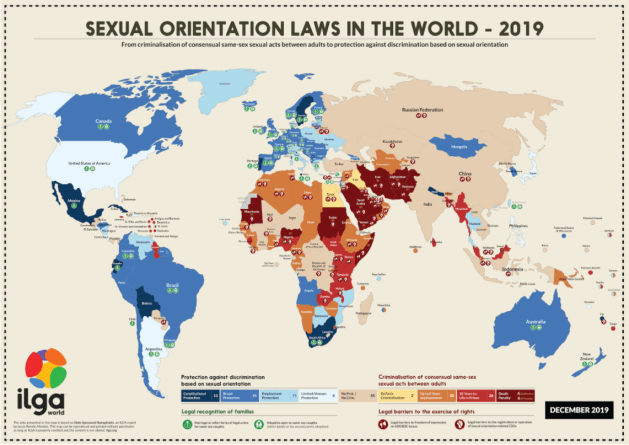
According to the International Lesbian, Gay, Bisexual, Trans and Intersex Association (ILGA), as of December 2019 there were 68 UN Members States in which consensual same-sex sexual acts remained criminalised, plus Palestine (Gaza), the Cook Islands, and some provinces in Indonesia (from pp47 State-Sponsored Homophobia Report: Global Legislation Overview Update December 2019).

A significant number of these countries are within our region. In Oceania, that includes:

Country Maximum Penalty for Homosexuality
Cook Islands 14 years imprisonment
Kiribati 14 years imprisonment
Papua New Guinea 14 years imprisonment
Samoa 5 years imprisonment
Solomon Islands 14 years imprisonment
Tonga 10 years imprisonment
Tuvalu 14 years imprisonment

There are a number of other countries that criminalise same-sex sexual activity in South-East Asia, too:

Country Maximum Penalty for Homosexuality
Brunei 10 years imprisonment
Malaysia 20 years imprisonment
Myanmar 10 years imprisonment
Singapore 2 years imprisonment

*As well as some provinces within Indonesia, including Aceh.

And Australia has another important connection with a large number of countries that still criminalise homosexuality around the world, with half being members of the Commonwealth (including more than half of countries within the Commonwealth itself).

Therefore, while Australia might have fully decriminalised homosexuality in 2016 (when Queensland finally equalised the age of consent for anal intercourse), there is still a long way to go on this issue internationally.
Screen Shot 2020-05-13 at 10.49.15 am

Source: ILGA

Of course, there is even further to go – both domestically and internationally – for trans and gender diverse people to have the right for their identity documentation to reflect their gender identity based on self-declaration, and to be able to live their lives free from discrimination, violence and in some countries criminalisation. For more, see ILGA’s 2017 Trans Legal Mapping Report.

And, as on so many issues, progress on intersex rights has lagged even further behind, with very few countries following Malta’s 2015 lead in banning coercive surgeries and other involuntary medical treatments on intersex people. That includes Australia, too, with governments at all levels failing to implement the recommendations of the 2013 Senate Inquiry on this subject in the intervening six years. [Unfortunately, I am note aware of an equivalent State-Sponsored Intersexphobia/Intersex Legal Mapping Report].

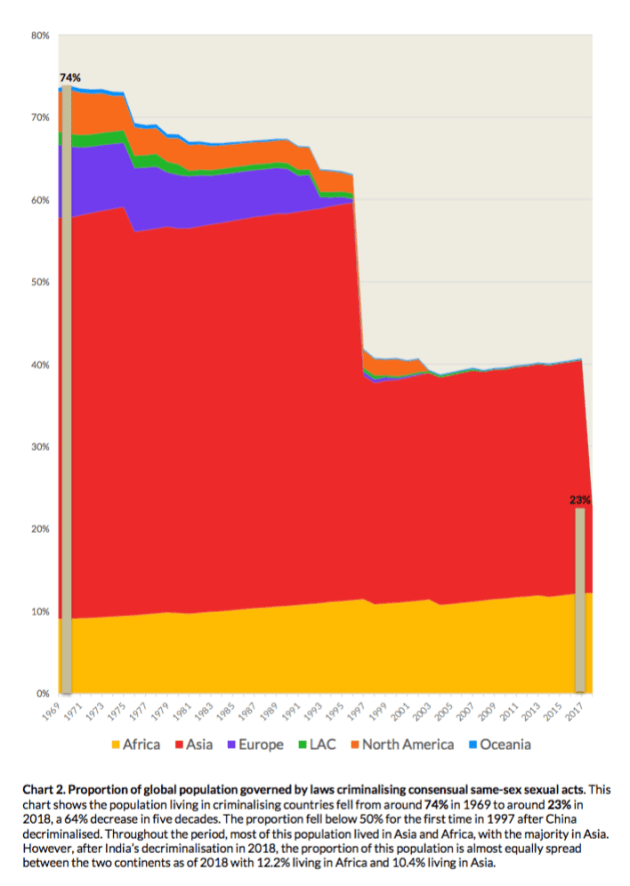
Thankfully, it’s not all bad news. There has been some significant progress in recent years on at least some of these issues, not least of which was the historic September 2018 decision by the Supreme Court of India to declare section 377 of the Indian Penal Code unconstitutional, thereby legalising homosexuality in the second most-populous country on earth.

That case, after years of amazing advocacy by Indian activists, helps make the following graph look much more encouraging:
ILGA Criminalisation by Population Graph copy

Nevertheless, there are still far too many countries where people are not free to love who they love, not able to identify with their gender and be protected against discrimination, violence and criminalisation, and not subject to coercive surgeries and other involuntary medical treatments because of their sex characteristics.

So, what can Australia do? There are a range of ways in which Australia can better support progress on LGBTI rights internationally, including the following:

  1. Support decriminalisation as a key priority of foreign policy

Australia should support decriminalisation for all LGBTI people around the world as a key human rights objective of our foreign policy. This should include a primary focus on decriminalisation within our region, as well as within the Commonwealth.

Unfortunately, the most recent Foreign Policy White Paper makes exactly zero references to supporting LGBTI human rights (despite my submission calling for their inclusion).

Of course, achieving this goal depends on partnership with communities within these countries, not only because they are best placed to know how to advocate for decriminalisation, but also because Australia acting unilaterally would risk entrenching anti-LGBTI policies and laws.

  1. Support LGBTI rights through international human rights architecture

This includes using our current term on the United Nations Human Rights Council to prioritise LGBTI rights, as well as actively supporting the reappointment of the UN Independent Expert on Sexual Orientation and Gender Identity. And it also includes regularly raising LGBTI rights issues within the Commonwealth Heads of Government framework (with the next CHOGM meeting in Rwanda next year).

Australia could also consider appointing an Ambassador for LGBTI Rights in the same way that we have appointed an Ambassador for Women and Girls.

  1. Support LGBTI rights through foreign aid

Another way in which Australia can better support LGBTI rights internationally is by supporting LGBTI human rights through our foreign aid policies (and of course by ensuring our foreign aid Budget is increased overall, after a series of mean-spirited and unjustified cuts under the Liberal-National Government have reduced it to 0.19-0.21% of GDP, far short of the UN target of 0.70% and far short of our capacity, and responsibility, as one of the richest countries on the planet).

This could include funding for international LGBTI associations, such as the International Lesbian, Gay, Bisexual, Trans and Intersex Association (ILGA), OutRight International and Kaleidoscope Trust, as well as other human rights organisations that include a focus on LGBTI rights (such as Human Rights Watch). It also means actively supporting the Commonwealth Equality Network, and LGBTI organisations working towards decriminalisation within our region.

  1. Accept LGBTI refugees and people seeking asylum

We should acknowledge that, while the aim is to ensure lesbian, gay, bisexual, transgender and intersex people are safe everywhere, this is not currently the case and will not be possible in some places for some time. Australia should therefore ensure its refugee framework helps to protect LGBTI people fleeing persecution, including through appropriate assessment processes, and providing improved support services post-resettlement. Oh, and that obviously means not detaining, processing and settling LGBTI refugees offshore, including in countries that criminalise them (for more, see Australia’s (Mis)Treatment of LGBTI Refugees).

  1. Set a better example on LGBTI rights domestically

Australia’s ongoing (mis)treatment of refugees, including LGBTI people seeking asylum, raises another key challenge – in order to better support human rights internationally, we must be seen to respect human rights domestically. That is obviously not currently occurring when it comes to our refugee policy.

It is also not the case in terms of our own treatment of trans and gender diverse people. We must make sure all states and territories follow Tasmania’s recent lead in best practice access to identity documentation on the basis of identity not surgery. And we must finally make long overdue progress on intersex human rights, including protecting the bodily autonomy and integrity of intersex children against coercive surgeries and other involuntary medical treatments.

**********

As we commemorate International Day Against Homophobia, Biphobia, Transphobia and Intersexphobia (IDAHOBIT) today, we should by all means celebrate how far we have come within Australia, as well as highlighting those challenges that remain domestically. But we must not forget the ‘International’ focus of the day, and the important role Australia can play in making progress on LGBTI rights everywhere, for everyone.

**********

If you have enjoyed reading this article, please consider subscribing to receive future posts, via the right-hand scroll bar on the desktop version of this blog or near the bottom of the page on mobile. You can also follow me on twitter @alawriedejesus
Australia’s (Mis)Treatment of LGBTI Refugees

This post is part of a series looking at the unfinished business of LGBTI equality in Australia. You can see the rest of the posts here


Of all the issues that involve human rights violations against lesbian, gay, bisexual, transgender and intersex people in Australia there are two that particularly stand out (at least in my view).


One – ongoing coercive medical treatments and surgeries on children born with intersex variations – I have written about previously.


The other is the deliberate mistreatment of LGBTI refugees and people seeking asylum by the Australian Government.


Of course, this abuse is only one small part of Australia’s broader shameful approach to refugee issues, but, as we shall see below, it does raise specific issues around where people are processed and how claims are assessed.


The following are three key areas where the Australian Government’s approach to LGBTI refugees and people seeking asylum should urgently be improved, as well as one suggestion for further consideration.


  1. End the detention, processing and settlement of LGBTI refugees in countries that criminalise homosexuality


To begin, I should reiterate my personal opposition to Australia’s overall ‘offshore processing’ policy, which essentially involves the indefinite detention of refugees in prisons in the South Pacific. There is no justification for this approach.


There can also be no possible justification for the detention, processing and settlement of LGBTI refugees and people seeking asylum in countries that criminalise homosexuality. And yet that is exactly what Australia has done for the past seven years.


This includes Nauru, where homosexuality remained criminalised until May 2016,[i] and Manus Island in Papua New Guinea, a country where the maximum penalty for male same-sex intercourse is still 14 years imprisonment.


There is no exception for people held in Australia’s immigration detention facilities in these countries either. This is demonstrated by the following report from Behrouz Boochani in The Guardian:


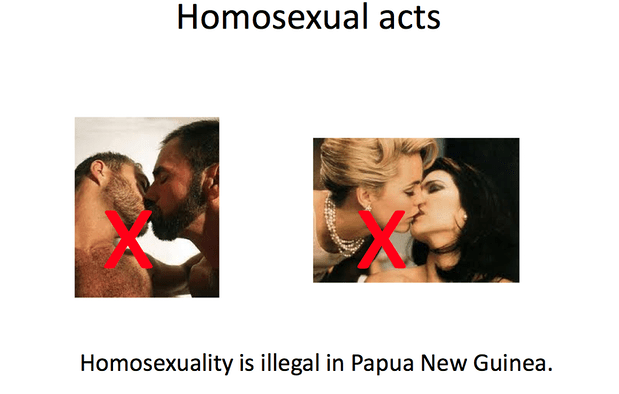
It was five years ago in Fox prison camp. A group of immigration officers accompanied by a number of interpreters burst in. All of a sudden, one of the officers stood on a chair precisely like a king’s representative in ancient times, like one of those men reading the king’s announcement for convicts. The officer took a piece of paper, and surrounded by dozens of refugees he started to read. The announcement was serious, decisive, to the point and threatening, like his voice. “Homosexuality is illegal in Papua New Guiana [sic] and considered as a crime. If anyone in the immigration detention engages in this behaviour, he will be sentenced to 14 years in prison.” It was a dire warning from the prison’s officials and directly targeted homosexual prisoners.


The article then details the horrendous impact of these laws on Alex* (pseudonym), a gay Iranian refugee imprisoned on Manus Island, who was gradually but inevitably broken by the homophobic environment there, through intimidation, harassment, abuse and even rape. His experiences ultimately led him to risk his life again by returning to Iran, before seeking asylum elsewhere – and served as a cautionary tale to other queer men on the island. As Boochani concluded:


No one knows how many gay, transgender or bisexual refugees live on Manus, but what is clear is that the suffering they experienced in their countries has been repeated on Manus in a disastrous way. Fear, humiliation, threat, banishment, rape – these are all concepts and experiences lived daily by these men. Gay, transgender and bisexual men here have experienced even greater torment than other refugees. [emphasis added]


Successive Australian Governments have been fully aware of these abuses. I know, because I have written about this issue to multiple Immigration Ministers,[ii] including then Minister – now Prime Minister – Scott Morrison in 2014. His Department’s response failed to even guarantee that LGBTI asylum seekers would not be reported to PNG police for same-sex sexual activity.


Given his ‘tough on border security’ rhetoric, there appears little hope that a re-elected Morrison Liberal-National Government would take any action to address these human rights violations.


On the other hand, there is some chance that a Shorten Labor Government might finally take a different approach. This is at least in part due to a commitment in the 2018 Australian Labor Party National Platform that:


Labor will not detain, process or resettle lesbian, gay, bisexual, transgender or intersex refugees or asylum seekers in countries which have criminal laws against any of these communities as it makes these places unsafe environments for all of them.[iii]


Consequently, there is a possibility the situation may change, along with the Government, on Saturday 18 May – although that will only happen if LGBTI and refugee advocates maintain pressure on Labor to fulfil this commitment.


160427 Refugee Submission No Kissing

The slide from the Salvation Army presentation that was shown to people seeking asylum after their arrival on Manus Island (source: Guardian Australia).


  1. Improve the assessment process for LGBTI claims for asylum


This is another major problem confronting lesbian, gay, bisexual, transgender and intersex refugees and people seeking asylum in Australia, one that has existed for many years, even decades.


Practically, the decision-makers of the Refugee and Migration Division of the Administrative Appeals Tribunal (known until 2015 as the Refugee Review Tribunal) have struggled to appropriately consider the diversity of sexual orientations and gender identities from other countries, leading to a very low rate of success in receiving refugee protection (a 2003 study by Professor Jenni Millbank showed that at most only 20% of claims were approved).


As reported in the Sydney Morning Herald:


Tribunal officials have long been accused of judging applicants based on a slew of Western gay stereotypes, such as effeminate manner or dress. In one notorious case, an applicant was deemed not gay after failing questions about Madonna, Better Midler, Oscar Wilde and Greco-Roman wrestling. The man barely spoke English and was mystified by the topics. “I don’t understand it,” he said to his interviewer. “I’m sorry.”


When in 2004 his case came before the High Court on appeal (after the Federal Court had first ruled against the applicant), the justices were staggered by the line of questioning used by the Tribunal, describing it as very odd, and almost bordering on the bizarre. “Madonna, Better Midler and so on are phenomena of Western culture,” declared Justice Michael Kirby at the time. “In Iran, where there is death for some people who are homosexuals, these are not in the forefront of the mind. Survival is.”


Unfortunately, more recent cases do not indicate that this inherent Western-gay bias has been overcome. The SMH further reported that:


Last year [2016], a man from Bangladesh was rejected in part because he was unable to correctly pronounce or spell the name of a Sydney gay club he’d visited called the Stonewall, according to Tribunal documents – which incorrectly referred to the nightclub as a “day venue”. In a similar 2014 case, an asylum seeker was told he wasn’t gay because, although he described having two monogamous relationships, he hadn’t “explored his homosexuality” by going to Sydney’s gay bars, and had little knowledge of Oxford Street.


There are additional reports of Tribunal members asking inappropriately sexual questions, as well as applicants being encouraged to supply video of themselves engaging in sexual activity in an attempt to ‘prove’ their homosexuality to the Tribunal. This occurs because, as the SMH notes, “there are no guidelines for dealing with LGBTQI applicants.”


This situation must change, as a matter of priority. Unfortunately, there is no indication that a re-elected Morrison Liberal-National Government will take action to address these problems.


Once again, however, these is some reason to be optimistic about a Shorten Labor Government, which includes these commitments in its Platform:


The assessment and review of protection claims of specific lesbian, gay, bisexual, transgender, intersex and queer asylum seekers will be underpinned by appropriate and relevant assessment tools and processes that reflect cultural experiences of the lesbian, gay, bisexual, transgender, intersex and queer community.

In assessing asylum claims where the fear of persecution arises from a person’s lesbian, gay, bisexual, transgender, intersex and queer status, the fact that the country the person is fleeing has criminal penalties for engaging in homosexual sex is sufficient of itself to establish that fear of persecution is well-founded, and any assessment of the asylum seeker’s identity and fear must take account of the very different manifestations of lesbian, gay, bisexual, transgender, intersex and queer identity that other cultures, especially ones profoundly hostile to lesbian, gay, bisexual, transgender, intersex and queer people, necessarily engender.


Labor will ensure asylum seekers who self-identify as lesbian, gay, bisexual, transgender, intersex and queer will be assessed by officers who have expertise and empathy with anti-discrimination principles and human rights law. Officers, translators and interpreters at all levels of the assessment process will have specific lesbian, gay, bisexual, transgender, intersex and queer cultural awareness training to ensure the discrimination asylum seekers face in their country of origin or transit are not replicated.


As with ending detention of LGBTI refugees in countries criminalising homosexuality however, the challenge will be in ensuring that a new Government follows through on its promises.


  1. Increase support for LGBTI refugees and people seeking asylum in Australia


Another area where urgent reform is needed is the level of support provided to lesbian, gay, bisexual, transgender and intersex refugees within Australia.


The few dedicated support services that exist receive minimal funding, and consequently are unable to meet the significant needs of this vulnerable population.


Particular challenges include the fact that LGBTI refugees and people seeking asylum may not be comfortable in disclosing their sexual orientation, gender identity or sex characteristics to services based on their ethnicity or background, but at the same time may not be welcomed by or receive adequate support from LGBTI services.


As noted in a 2018 Star Observer article on this topic:


LGBTI asylum seekers can also find themselves caught between lack of acceptance from diaspora communities and lack of understanding from mainstream LGBTI communities.


First and foremost, these gaps should be addressed by providing direct Government funding for peer-led LGBTI refugee services. However, this alone may not be sufficient to ensure LGBTI refugees and people seeking asylum are able to access the full breadth of services they may require.


Therefore, there should also be funding to support education and training programs for ethnic community organisations to assist them to be welcoming environments for LGBTI refugees (as well as inclusiveness training for interpreters, who have a key role to play not just in supporting LGBTI people seeking asylum to access services, but also in their claims for protection).


There is also a need for LGBTI community organisations to provide greater social support and outreach to LGBTI refugees and people seeking asylum in Australia. This would help to establish connections between LGBTI refugees and the wider LGBTI community, and may result in better social outcomes over the medium- to long-term.


**********


While the above three issues are presented as concrete recommendations for change, the following suggestion is raised to prompt further discussion:


  1. Introduce quotas or targets for the intake of LGBTI refugees


I should preface this discussion by saying that, philosophically, I don’t support the introduction of quotas or targets within Australia’s overall refugee program based on demographic criteria. Instead, Australia should accept refugees based on the assessment of need by the UN Refugee Agency (the UNHCR).


However, that is not how the Australian refugee framework currently operates.


Since 2015, the Australian Government has adopted a policy of prioritising Christian refugees from the Middle East (which itself is/was a part of the special quota for refugees fleeing the conflict in Syria and Iraq, operating in addition to Australia’s regular refugee intake).


I agree with many of the criticisms of this approach made in this New York Times column, Australia’s immoral preference for Christian refugees, although these criticisms do not appear to have influenced Australia’s ongoing pro-Christian bias.


Indeed, it seems the Morrison Liberal-National Government wants to introduce even greater demographic criteria within the refugee program.


During the election campaign, it has announced ‘the proposed makeup of the humanitarian program for the first time. This will include an overall target of 60% of the offshore component allocated to women. Women made up 50.8% in 2017-18.’[iv] [emphasis added]


In this context, the obvious question is: if Christians and women receive allocated quotas (or targets), then why not lesbian, gay, bisexual, transgender and intersex refugees?


Indeed, there are strong arguments in favour of this approach.


Based on analysis of 2018 UNHCR figures, and the 2019 ILGA State-Sponsored Homophobia Report, of the five top refugee-hosting countries, four retain criminal sanctions for homosexuality:


Country

Number of refugees Criminal penalties for homosexuality
Turkey 3.5 million Not criminalised
Uganda 1.4 million Life imprisonment
Pakistan 1.4 million 10 years
Lebanon 1 million 1 year
Iran 979,400

Death penalty


A significant number of LGBTI refugees are therefore unsafe and at risk even after they have fled persecution elsewhere.


There are also a number of countries in our own Oceania region that criminalise homosexuality, including PNG, Kiribati, Solomon Islands, Tuvalu and Cook Islands (all of which have a maximum penalty of 14 years imprisonment), Tonga (10 years imprisonment) and Samoa (5 years imprisonment). And that’s not mentioning the recent attempt by the Government of Brunei to introduce the death penalty (which they have backed down from – for now – but retain a punishment of imprisonment up to 10 years).


As stated earlier, my personal preference is that there are no demographic criteria for determining the intake of refugees. But, if Australia’s current approach, which gives priority to Christians and women, does continue, I can see no good reason why there should not also be quotas or targets for the intake of refugees who are lesbian, gay, bisexual, transgender and intersex.


**********


Disclaimer: As with all posts, this article reflects my own views and not those of any employer, past or present.


If you have enjoyed reading this article, please consider subscribing to receive future posts, via the right-hand scroll bar on the desktop version of this blog or near the bottom of the page on mobile. You can also follow me on twitter @alawriedejesus


Footnotes:

[i] Of course, just because homosexuality has been decriminalized in Nauru doesn’t necessarily mean it is now a welcoming environment for LGBTI refugees and people seeking asylum. This is confirmed by the following accounts, including:

In detention: Gay on Nauru, in Archer Magazine (July 2018) and

True love in Nauru, in The Monthly (September 2017)

[ii] Lest I be accused of partisanship, I also wrote to Labor Immigration Ministers Chris Bowen and Brendan O’Connor on the same subject in 2012 and 2013.

[iii] This is a commitment I drafted ahead of the 2015 National Conference, and remains one of my proudest achievements in LGBTI advocacy.

[iv] Of course, there is a great irony in the Coalition supporting a gender-based quota for refugee intake, while it steadfastly opposes gender-based quotas for the pre-selection of its candidates.