Submission on Redrafted National Health & Physical Education Curriculum

The Australian Curriculum, Assessment and Reporting Authority (ACARA) released a slightly redrafted version of the national Health & Physical Education curriculum for limited public consultation over the past 2 weeks. While there were some modest improvements from the original draft released in December 2012, there are still significant problems with what is proposed, especially as it fails to ensure that content is relevant for LGBTI students, and that every classroom is genuinely LGBTI inclusive.

This afternoon I provided my personal submission to the process, which included attachments covering my previous petition to the Commonwealth Education Minister, the Hon Peter Garrett MP, and the comments which people made on that (although not reproduced here because both are too large). Anyway, here is my submission (I understand that a range of groups, including the NSW Gay & Lesbian Rights Lobby and others, will be making submissions too, so hopefully there is more change before the final document is released later this year):

Submission on Redrafted National Health & Physical Education Curriculum

I am writing to provide a personal submission in response to the redrafted national Health & Physical Education (HPE) curriculum, as published on the Australian Curriculum, Assessment and Reporting Authority (ACARA) website in July 2013.

I also provided a submission in April 2013 in response to the original draft HPE curriculum as released by ACARA in December 2012. Please find a copy of that submission at Attachment A. In it, I outlined a range of substantive concerns with the draft curriculum, and in particular in relation to how it related to (or, more accurately, ignored) the needs of lesbian, gay, bisexual, transgender and intersex students.

These concerns included that:

  • The draft curriculum did not explicitly include LGBTI students by name, nor did it ensure that every classroom in every school included content that was relevant to LGBTI student needs
  • The draft curriculum also concentrated on ‘reproductive health’ meaning that it effectively excluded the sexual health needs of LGBTI students and
  • The draft curriculum did not even include the term HIV, let alone ensure that groups at higher risk of contracting HIV (including gay and bisexual men) receive appropriate education to help prevent new transmissions.

Following the lodgement of my submission, I also initiated a national petition to the Commonwealth Education Minister at the time, the Hon Peter Garrett MP, and his state and territory counterparts. I have since sent this petition to the new Commonwealth Education Minister, the Hon Bill Shorten MP, and the NSW Education Minister, the Hon Adrian Piccoli MP.

This petition, which called for the three issues listed above to be remedied as a matter of urgency, received an incredible level of community support, garnering more than 6,000 signatures in less than four weeks.

However, just as important as the number of signatures, the comments which people provided demonstrate the breadth and depth of community concern about the failure of the original HPE curriculum to address the issues of LGBTI inclusion, sexual health education and HIV.

These comments show that this is an issue which matters not just to LGBTI people themselves, but also to their family members and friends, as well as a broad cross-section of the community who understand that everyone has a right to inclusive, appropriate health education, irrespective of sexual orientation, gender identity or intersex status. I would strongly encourage you to read these comments, as many of them are far more articulate and passionate about why LGBTI students must be included than I could ever hope to be.

Having examined the redrafted HPE curriculum released on the ACARA website earlier this month, I would like to acknowledge that there have been some improvements made from the December 2012 version, including an attempt to include reproductive health and sexual health, rather than just reproductive health.

However, it is also disappointing to note that many of the significant problems which existed in the original draft have not been resolved.  I will use the remainder of this submission to identify those areas which still require amendment in order to meet the needs of LGBTI students, including specific recommendations to make these much needed improvements.

Recommendation 1:  The national HPE curriculum must directly and explicitly include lesbian, gay and bisexual students, and content which is relevant to their needs

As with the original draft submission, I believe that it is irresponsible for a national HPE curriculum not to even include the words lesbian, gay or bisexual. These are the most common forms of sexual orientation for people who are not heterosexual. To deliberately exclude these terms from the curriculum contributes to the marginalisation of students who may grow up to identify with any one of these terms.

By excluding these terms/sexual orientations, I believe that the curriculum would inevitably lead to some schools ignoring the health needs of these students, and ultimately contribute to higher level of mental health issues across the lesbian, gay and bisexual communities, including higher rates of depression and youth suicide.

I must also highlight that including the term same-sex attracted (in the ‘aspirational’ paragraph on page 18 – more on that at recommendation 3, below – and in the Glossary) is insufficient in and of itself to ensure that lesbian, gay and bisexual students are included in both classrooms and content. While I acknowledge that it is an inclusive term, I do not understand how referring to the term ‘same-sex attracted’ twice (and only once in the body of the document, and even then not in the content description for any year), without providing more information, will help ensure that all students learn what being lesbian, gay and bisexual mean, in the same way that they would learn what being heterosexual means.

In fact, I find it impossible to see how excluding the words lesbian, gay and bisexual does anything other than ensure that students who happen to be lesbian, gay or bisexual are denied their right to an equal and fair health education, irrespective of which school they might attend.

Recommendation 2: The national HPE curriculum must directly and explicitly include transgender and intersex students, and content which is relevant to their needs, whilst noting that gender identity and intersex status are different things meaning that education about these issues must make this distinction

I acknowledge that the terms transgender and intersex are at least included in the redrafted national HPE curriculum. However, they are only included in the glossary on page 45, and unfortunately the curriculum incorrectly includes both as part of the definition of gender-diverse. Transgender may fall within this term, but intersex is a distinct characteristic as a biological sex status.

I am not an expert in this field, and expect that submissions from the National LGBTI Health Alliance as well as Organisation Intersex International (OII) Australia will provide recommendations to improve the curriculum in terms of transgender and intersex inclusion. I would encourage you to give full consideration to their suggestions in these areas.

Recommendation 3: The statement about LGBTI inclusion must explicitly refer to lesbian, gay, bisexual, transgender and intersex students, and ensure that all schools are inclusive of these students, irrespective of whether students have publicly identified their orientation, identity or status

I note that the ‘aspirational’ statement of inclusion on page 18 of the redrafted curriculum has been amended from the original December 2012 draft. In particular, I am concerned by the decision to omit the statement that ‘same sex attracted and gender diverse’ students exist in all schools. It is unclear why this statement of fact has been removed, given we know that people who are LGBTI have come from all school communities across the country.

This omission also presents some complications when read together with remainder of the paragraph as redrafted, which talks about “becoming increasingly visible”, “designed to allow flexibility” and “have a responsibility… to ensure teaching is inclusive and relevant to the lived experiences or all students”. One reading of this paragraph is that schools now only have a responsibility to be inclusive where they are aware that students are LGBT or I (ie where schools are aware of the lived experience of their students).

If this is the case, it is not acceptable. All students have a right to be included, and to have their health and physical education needs met, and most importantly should not have the onus placed on themselves to disclose their orientation, identity or status in order to receive this education (especially when such disclosure can risk discrimination from other students, teachers and sometimes from the school itself).

I strongly recommend that this paragraph be amended so that it:

  • Explicitly names LGBTI students (for example, same-sex attracted students, including lesbian, gay and bisexual students, and transgender and intersex students) and
  • States that all school communities must provide content and classrooms which are inclusive of LGBTI students, irrespective of whether they disclose their orientation, identity or status.

Recommendation 4: The statement about LGBTI inclusion must be supported by explicit references to LGBTI content in the year descriptions

While an ‘aspirational’ statement on page 18 is welcome, in order to be most effective it should be backed up by explicit references to issues of concern to LGBTI students at relevant points throughout the curriculum.

For example, the terms transgender and intersex should be introduced and explained from Foundation/Years 1-2, given these identities and statuses can be present from early childhood and/or birth.

Ideally, the orientations lesbian, gay and bisexual should be introduced and explained in Years 3-4, so that students who experience same-sex attraction in puberty (which can commence for some in these years) are aware that these attractions are normal. At the latest, all students should be aware of the concepts of heterosexuality, as well as homosexuality and bisexuality, by the end of Year 6.

This would then leave room from comprehensive and inclusive sexual health education (and not just reproductive health) in Years 5-6 (more on this at recommendation 5, below), or Years 7-8 at the absolute latest.

I note with particular concern the sub-strand Being healthy, safe and active, on page 27 of the redrafted curriculum, which includes the following points under Years 7-8:

  • Examining the impact of physical changes on gender, cultural and sexual identities and
  • Exploring sexual identities and investigating how changing feelings and attractions are part of getting older.

This is both far too old (covering students who are turning 13 and 14 across most states, beyond the age which many people have first realised that they are same-sex attracted, including myself) and far too vague, to be genuinely inclusive of LGBTI students and their needs.

LGBTI issues should also be explicitly mentioned in the outline of the Relationships and sexuality learning area on page 9 of the document, which is reproduced in the Glossary on pages 47 and 48. For example, the dot point “changing identities and the factors that influence them” could be redrafted to include “developing sexual orientations, include heterosexual, lesbian, gay and bisexual, and the factors that influence them” while transgender and intersex should be included in in this Area of learning in Foundation to Year 2 (as indicated above).

Recommendation 5: The term sexual health should be preferred to reproductive health throughout

I welcome the amendment from the original draft of the HPE curriculum, with the addition of sexual health to the redrafted curriculum. However, I am confused by the inclusion of both reproductive health and sexual health, and the definitions of both which are provided in the Glossary on pages 48 and 49 respectively.

In particular, the definition of reproductive health seems to try to ‘cover the field’ for the physical aspects of sexual health, even though for many people their sexual anatomy/systems are not primarily related to ‘reproduction’. This is especially apparent when considering the definition of sexual health, which uses the shorter World Health Organisation definition of sexual health, but not the 2006 longer and more inclusive definition which begins:  “…a state of physical, emotional, mental and social well-being in relation to sexuality; it is not merely the absence of disease, dysfunction or infirmity” [emphasis added].

This longer definition makes it clear that sexual health includes the physical health aspects of sex education. As a result, I believe that the much more inclusive term sexual health should be used throughout the document, and if explicit references to reproduction are considered necessary, then the term should be ‘sexual health, including reproductive health’. This would help to ensure that the needs of all students are considered and not just those of heterosexual students.

Recommendation 6: The topic of sexual health should include more detailed information on safer sex, including condom usage, and Sexually Transmitted Infections (STIs)

While it is welcome that sexual health has been added as a term to the redrafted HPE curriculum, it is unclear where it is intended that detailed sexual health education, including STI information and prevention, is included in the content for specific years.

As indicated above, I believe that comprehensive sexual health education should be included in Years 5-6 (and by 7-8 at the absolutely latest). In order to meet the needs of all students, whether LGBTI or otherwise, it must include specific references to safer sex, and condom usage, as well as ensuring that students learn about STIs and how they can best be prevented (and where relevant treated). I cannot locate this information in the redrafted document.

I believe it would be irresponsible for a HPE curriculum not to ensure that students learn this information prior to the age at which they become sexually active.

Recommendation 7: The national HPE must include Blood Borne Viruses, and in particular HIV

Building on the inclusion of sexual health, and comprehensive sexual health education, including STIs (recommendations 5 and 6 respectively), I believe that it is vital for the national HPE curriculum to explicitly refer to Blood Borne Viruses, including HIV.

As a gay man who has just turned 35, I find it almost incomprehensible that HIV, including information about how it can be prevented, has been omitted from the HPE curriculum, both in the original draft and in the redraft. While HIV is no longer a ‘death sentence’, diagnoses with HIV is still a serious thing, and we should be maintaining our efforts to minimise new transmissions. This is particularly important for younger gay and bisexual men, with male same-sex intercourse remaining the primary means of HIV transmission within Australia.

The importance of this message is reinforced by recent figures which show that the number of HIV notifications in NSW rose by 24% in 2012, including 19% among men who have sex with men. The HIV epidemic is not over, and it is essential that a national Health & Physical Education curriculum provides relevant information for young people to help them avoid future HIV transmissions.

Recommendation 8: The national HPE curriculum should ensure that all students learn about homophobia, bi-phobia, trans-phobia and anti-intersex prejudice, and the damage caused by each

One of the pleasing aspects of the original HPE curriculum, released in December 2012, was that it explicitly named ‘homophobia’ as something that students should be taught about (and implicit in this, was the assumption that students would learn the damage caused by discrimination on the basis of sexual orientation). In my original submission, I argued that this should be amended to include bi-phobia, trans-phobia and anti-intersex prejudice as well, as these encompass similarly destructive beliefs and behaviours.

Unfortunately, it appears that the reference to homophobia has now been deleted, and replaced by a much more generic statement on page 34: “examining values and beliefs about cultural and social issues, such as gender, race, sexuality and disability” and “researching how stereotypes and prejudice are challenged in local, national and global contexts.”

To me, these statements do not ensure that students learn that homophobia, bi-phobia, trans-phobia and anti-intersex prejudice are entirely negative phenomena, which can cause immense hurt amongst members of these groups (indeed, the first statement makes no value judgment at all about different ‘values and beliefs’ in relation to sexuality, and leaves it open to some schools teaching that discrimination on the basis of sexual orientation, gender identity and intersex status is acceptable behaviour).

I would strongly urge you to reconsider the drafting of these dot points, and to include homophobia, bi-phobia, trans-phobia and anti-intersex prejudice as subjects about which students should learn, including being taught about the damage caused by these types of discrimination.

Conclusion

Thank you for reading my detailed submission, and attachments. I acknowledge that much of what I have written is strongly worded, but it is only done so out of genuine concern that, if the redrafted national HPE curriculum was implemented without further amendment, it would fail to meet the needs of our LGBTI students, and fail to provide them with the sexual health and HIV prevention education that they have a right to.

Research has shown that younger LGBTI people are amongst the most disadvantaged students across the country, with high rates of bullying and harassment, and consequently of mental health issues including depression and youth suicide.

I believe that the development of a national Health & Physical Education curriculum is an ideal opportunity to remedy some of the active discrimination which exists against lesbian, gay, bisexual, transgender and intersex students, through the introduction of LGBTI-inclusive content, and hopefully leading to LGBTI students being genuinely included in classrooms across the country. I hope that the final version of the HPE curriculum will implement as many of the above recommendations as possible, to help make this a reality.

Sincerely,

Alastair Lawrie
NSW Same-Sex Marriage Inquiry Submission

Given the NSW Legislative Council inquiry is set to release its final report on the issue of state-based marriage laws at 3:30pm today, I thought now might be a good opportunity to publish my submission to the inquiry from back in March (but which was not published by the Committee on their website, given the overwhelming community response to this inquiry).

Anyway, as you can see it is a bit of a personal submission and I obviously stand by what I submitted, but acknowledge that I am going to need to be clearer from here on the difference between marriage equality (where all lesbian, gay, bisexual, transgender and intersex people can marry whoever they choose), and same-sex marriage, which, as the name suggests, is much more limited but which, sadly, might be the only constitutional option available to NSW (we’ll see later today.

Anyway, here is my submission. Let me know whay you think:

Legislative Council Social Issues Committee

Inquiry into Same Sex Marriage Law in NSW

Submission by Alastair Lawrie

Friday 1 March 2013

I am writing in support of the introduction of state-based marriage laws in NSW. While, ultimately, marriage equality can only be fully realised in Australia through the passage of an inclusive federal Marriage Act, in the meantime I encourage the NSW parliament to allow lesbian, gay, bisexual, transgender and intersex-inclusive (LGBTI) couples to have their relationships recognised through state-based marriage, if they so choose.

In this submission I will briefly address the four terms of reference, before discussing the story of my relationship with my fiancé Steve, and the reasons why I think we deserve the same right to be married as anybody else.

1)      Any legal issues surrounding the passing of marriage laws at a State level, including but not limited to:

  1. a.       The impact of interaction of such law with the Commonwealth Marriage Act 1961
  2. b.      The rights of any party married under such law in other States’ and Federal jurisdiction
  3. The rights of the parties married under such a law upon dissolution of the marriage.

I am not a constitutional or family law lawyer and, as such, I do not propose to discuss whether state-based marriage laws would be constitutional in great detail, or how these laws would interact with Commonwealth and other state and territory laws, or indeed, act upon the breakdown of such marriages.

I will simply note that there is legal debate about the constitutional possibilities of state-based marriage. Professor George Williams has canvassed the legal arguments in favour of state-based marriage laws in his article “Can Tasmania Legislate for Same-Sex Marriage?”[1] I think that there is at least a credible argument, as outlined in his article, to say that it is possible that the Courts could find state-based marriage to be constitutional.

It should also be remembered that there is still some doubt that an amendment to the Commonwealth Marriage Act 1961 introducing marriage equality would be constitutional at the federal level. Irrespective of which level of government first introduces marriage equality, this matter will inevitably end up in the courts.

It should also be noted that the federal parliament has abrogated its responsibility in this area. By explicitly introducing a ban on equal marriage in 2004, and then rejecting legislation to overturn that ban in 2012, Australia’s federal parliamentarians have comprehensively failed in their duty to provide basic fairness and equality to its LGBTI citizens, including the LGBTI citizens of NSW. Based on the size of this defeat, and the immediate political outlook, it appears unlikely that this ban will be overturned at any point in the next five or even possibly 10 years.

In this context, with legal uncertainty about which level of Government can introduce marriage equality, and faced with the homophobic, bi-phobic, trans-phobic and anti-intersex intransigence of the federal parliament, I believe it is incumbent upon state parliamentarians to at least attempt to introduce marriage equality at a state level.

In the event that the legislation is overturned by the courts, which is as always their prerogative, nothing will have been lost. LGBTI-inclusive couples will know that there is a risk of this outcome, and will enter into any state-based marriages with open eyes. Nevertheless, if people are married and the legislation is ruled invalid at a later date, at least in the interim these couples will have the belief that they are married under law. And the overturning of these marriages by the courts may provide the spark required for the federal parliament to finally take the necessary action in this area.

In the event that the legislation is found to be valid by the courts, which is also possible, then the NSW parliament will have done a truly wonderful thing by recognising the ability of thousands of LGBTI-inclusive couples to have their relationships recognised as marriages under law, if they so desire. This would be an amazing recognition by state parliamentarians of the equality of LGBTI people, and the value of their relationships. If there is even a small chance of this outcome, then I cannot think of a valid reason for the parliament to shy away from this noble endeavour.

2)      The response of other jurisdictions both in Australia and overseas to demands for marriage equality.

The movement for marriage equality, both within Australia and across the world, is strong and only growing stronger. Despite the setback of defeat in federal parliament last September, and the subsequent defeat of Tasmanian state-based marriage legislation in late 2012, other Australian jurisdictions are still considering their own marriage equality proposals (including the Australian Capital Territory and South Australia). Indeed, it has been reported that the Tasmanian Labor Government and Greens are considering reintroducing their state-based marriage legislation after the upper house elections in the first half of this year (noting that the legislation was only narrowly defeated in their upper house).

Around the world, marriage equality has already been introduced in 11 extremely diverse countries: South Africa, Argentina, Canada, Portugal, Spain, Belgium, the Netherlands, Denmark, Sweden, Norway and Iceland. I am also aware of current marriage equality proposals in our near neighbours New Zealand, as well as Taiwan, Nepal, Andorra, France, Luxembourg, Finland, Scotland, England and Wales, Uruguay and Colombia (in fact, it is difficult keeping track of the long list of countries which are actively considering this issue, which means I am sure to have missed some).

In other countries with federal structures of government, state-based marriage equality has been introduced in some states of Brazil, Mexico and the United States. The United States is the best illustration of the ongoing progress of the movement for marriage equality. It is now legal there in nine states (Connecticut, Iowa, Maine, Massachusetts, Maryland, Maine, New Hampshire, New York, Vermont, and Washington, as well as the District of Columbia). While in early-adopting US jurisdictions marriage equality was introduced through either court decisions or legislative reforms (or through a combination of both), the recent additions of Maryland, Maine and Washington were the result of popular ballots (and a referendum to ban marriage equality was also defeated in Minnesota last November).

The tide of public opinion across the world is turning in favour of marriage equality, and this is one reason why 11 national governments, and some sub-national states, have introduced LGBTI equality. It is my hope that the Australian Government eventually comes to the same conclusion – but in the meantime, I believe that the parliamentarians of NSW have an ethical obligation to, at least partially, fill that void.

3)      Any alternative models of legislation including civil unions.

In some jurisdictions, civil unions have been offered as a supposed compromise proposal between the LGBTI community on the one hand, who are calling for formal relationship recognition, and religious fundamentalists on the other, who believe that the term marriage is reserved only for ‘traditional heterosexual’ couples and that, while substantive rights can be conferred on non-heterosexual couples, these relationships should carry a different name (ie civil unions or civil partnerships).

In truth, this is not a genuine compromise but instead simply a reinforcement or further entrenchment of inequality. Deliberately choosing a separate name inherently makes those relationships ‘different’ or ‘other’. Saying that opposite-sex/heterosexual couples can be ‘married’, while all other couples can only be ‘civil unioned’, does not overcome inequality; it simply perpetuates it, finding a novel way to demonstrate that those relationships are second-class.

The idea that different groups of people can be considered equal while having separate institutions has been tried before, in many different countries and applying to many different groups (including groups based on race, religion and sex). In none of these different contexts has it actually meant genuine equality. In terms of racial segregation, the US Supreme Court, in the famous case of Brown v Board of Education (1954), saw through the conceit of this concept and instead found that ‘separate but equal is never equal’.

That principle applies just as much to LGBTI people, and to their relationship recognition. To set up an entirely new system of relationship recognition for LGBTI-inclusive couples, and to maintain that system separate from the relationship recognition granted to heterosexual/opposite-sex couples, is not genuine equality. It is no wonder that the vast majority of LGBTI people reject this type of distinction and instead demand full equality. We will accept nothing less.

There are two additional points which should be made in relation to civil unions. The first is that civil unions have been adopted in some jurisdictions which are quite similar to Australia – including New Zealand, the United Kingdom and some US states. In none of these places have civil unions been adopted as a long-term solution – as described above, New Zealand, Scotland, England and Wales are all actively considering moving to marriage equality in the near future (and in several US states civil unions were merely a precursor to marriage equality). Civil unions have proved to be only an inconvenient half-way house or road-stop along the toad to equality, merely delaying full equality and ultimately pleasing no-one. There is no reason why NSW should adopt such a flawed approach.

Secondly, in some jurisdictions, particularly US states, civil unions have held some attraction because they did not have de facto recognition laws in place beforehand, meaning that the introduction of civil unions at least had the advantage of conferring additional substantive rights which LGBTI-inclusive couples did not already possess. Given that NSW and Australia have both passed comprehensive de facto relationship recognition for LGBTI-inclusive couples, this reason does not apply here. Once again, there is no justification for a new and separate category of relationships called civil unions.

4)      Changes in social attitudes (if any) to marriage in Australia.

The concept of marriage has undergone many changes over time. Originally an institution which involved male ownership of women (with that ownership passing from the father to the husband), the law now recognises the two parties to a marriage to be equal. In some countries and at some points in time, there were also laws against marriage between races – happily miscegenation laws are a thing of the past. The majority of marriages used to be performed within churches, whereas now the vast majority of weddings are officiated by civil celebrants. And the ideas of divorce, and later no-fault divorce, have been added to our marriage laws, without undermining the institution itself.

These changes show that the institution of marriage has evolved over time, changing for the better to accommodate ongoing enlightenment in societal attitudes on gender, race, religion and relationship breakdown. Through these changes, what we now understand as the fundamental nature of marriage – that it is an institution to recognise the love and commitment between two people – has not altered.

This meaning can evolve again to accommodate the fact that lesbian, gay, bisexual, transgender and intersex people are equal citizens, and should be treated equally in every respect, including relationship recognition. If society, through its laws, conveys certain rights on opposite-sex/heterosexual couples, there is no good argument to deny those same rights to other people on the basis of their sexual orientation, gender identity or intersex status.

This is a proposition which has been accepted by the majority of the Australian population. Opinion poll after opinion poll has shown that a growing majority of people support the extension of marriage rights to all adult couples, whether opposite-sex/heterosexual or LGBTI-inclusive. A Galaxy Poll in August 2012 found that 64% of Australians supported marriage equality, with only 30% opposed. This support existed across men and women, across all age groups, and from voters of all political persuasions.

The figures for NSW were consistent with this level of support – 62% of people in NSW supported marriage equality, including 28% strongly supporting, while only 32% in total were opposed. I am loathe to cite opinion polls as a stand-alone reason for social change (see Appendix A for further discussion of this point). Nevertheless, it is clear that the population have already accepted the solid public policy reasons for marriage equality – our parliamentarians should do the same.

Steve and me

My fiancé Steve and I have been together for more than four and a half years. We met two weeks after my 30th birthday. I had begun to think that I might not ever meet the person who I was supposed to be with, and then suddenly, he was standing right there in front of me.

Steve and I are the epitome of your average, everyday couple. We have our ups and downs, just like everyone else, but we know that we love each other and that is enough to get us through.

We live our lives in the suburbs. We both work, and are trying to save enough money to buy a house (and, like other couples, are finding it hard in the Sydney property market!) We might have children in the future, we might not – we certainly want to own our own house and be settled in one place before we seriously consider doing so.

Steve and I make compromises for each other – he moved to Canberra to be with me when I was working there, and I have subsequently moved to Sydney when he wanted to move back. We do most things together, and wouldn’t have it any other way.

We got engaged more than 3 years ago. I took him on a holiday to Melbourne, and was so incredibly happy when I got down on bended knee and he said yes. I still can’t believe that someone as wonderful as him has agreed to spend the rest of his life with me.

We want to have our wedding in Australia – that is why we decided to wait for last year’s Marriage Act Amendment Bills to be considered by the federal parliament, in the hope that our federal parliamentarians might allow us to get married in the same way that opposite-sex/heterosexual couples can.

Steve and I decided that, after that terribly disappointing defeat, we would nevertheless wait for the NSW state-based marriage proposal to be debated before making the decision about finally setting a date, and most importantly, a venue. Of course, state-based marriage is not quite the same – it involves setting up a new marriage scheme separate from the existing one. But we think that it would be incredibly powerful to have our marriage recognised by the state in which we live.

If the NSW marriage amendment is defeated, then we will not wait any longer. More than three years is long enough – and I certainly don’t think many heterosexual couples would accept their engagement being made that long because their government(s) refused to allow them to tie the knot. They certainly wouldn’t accept potentially being made to wait more than 10 years, which is possible if both the federal and state parliament voted no on this issue.

Obviously, that means Steve and I will have to go overseas to get married. If New Zealand passes their law in the first half of this year, then we would most likely go there. One of the advantages of New Zealand as a location is that at least some of our family members and friends might be able to join us on our special day. If New Zealand doesn’t pass marriage equality, then we are thinking we might go to New York.

That is not as romantic as it might sound. While some of it would obviously be wonderful, and I will be happy wherever I get to marry my husband, it will also be bittersweet because we would be doing so in the absence of most of our family and friends, who would not be able to travel there (whether because they could not get enough time off work, could not afford the expense, have young children, are too old, or have health problems and cannot travel that far).

Imagine that – the decisions of your government(s) effectively determining the guest list at your wedding. No other married couples would tolerate that, and nor do we. In particular, Steve and I both have grandmothers who we love very dearly, and would love to have them with us – Steve in particular would be devastated if his grandmother was unable to attend our wedding.

If we were able to get married in Sydney, then at the very least his grandmother should be able to join us (and if it had been in place federally when we first got engaged my grandmother might have been able to join us too, although she is now probably getting too old to even travel to Sydney). As it stands, if we are forced to go to New Zealand, then neither of our grandmothers would be able to join us due to their age and health.

These are the real world consequences of the decision made by the federal parliament last year, and the potential consequences of your decision later this year. Please consider them before you cast your vote on this issue.

And please do not consider passing civil unions as some kind of supposed ‘compromise’ between the LGBTI community and religious fundamentalists. Steve and I are engaged to be married, not civil union-ed. When I proposed to him, I asked whether he would marry me – and when we do (finally) have our wedding, I will be asking him to be my husband, not my civil partner.

Civil unions, passed in the absence of marriage equality, are inherently second-best. Steve and I do not accept them as a substitute, and nor should we have to.

There are thousands of other LGBTI-inclusive couples in NSW, just like Steve and me, waiting to get married. We are the couples who watched last year while the federal parliament deliberated on our fundamental human rights and who, sadly, decided that we are not first-class citizens in our own country, that our relationships are not deserving of the same recognition as others.

We will be watching again later this year, when it comes time for NSW parliamentarians to cast their votes. Hopefully, the members of the NSW Legislative Assembly and Legislative Council can ‘show up’ their federal counterparts, by demonstrating just how easy it is to make thousands of people profoundly happy.

After all, that is the ultimate consequence of this vote. There is no downside in voting to allow additional couples to celebrate their love by getting married. But the upside is immense – being able to make many thousands of LGBTI-inclusive couples, and their families and friends, happy. I don’t think the choice is that hard – please make the right one.


[1] Williams, George, “Can Tasmania Legislate for Same-Sex Marriage?”, The University of Tasmania Law Review, Vol 31, No 2, 2012, pp117-133.

Rainbow Crossings? What else have you got?

The City of Sydney held its Rainbow Flag/Crossing public consultation on Tuesday night (July 16th) at Paddington Town Hall.

While I am not the world’s biggest fan of a Rainbow Flag (I think that it would be a ‘nice’ thing for Sydney to have to commemorate the LGBTI history of the city, but there might be better options to do that as well – see discussion below), I went along because the forum also included a panel looking at the most important issues confronting Sydney’s LGBTI community today.

The following are my four main observations about the forum:

1. Who knew that butcher’s paper, hastily scrawled ideas and scribes reporting back to the broader group was still a thing, especially in a room full of more than 100 people? It was certainly not what I expected when I walked in the door (and I still don’t know whether it worked or not).

2. The forum, including a presentation from the person who ‘led’ the Rainbow Crossing movement, probably demonstrated the limitations of that particular form of activism. While chalking is/was a great opportunity to engage different people from across the wider community (and extend the message of acceptance to straight allies), its moment may have passed. And showing photos of Chinese children chalking a rainbow outside rubble, or Vietnamese orphans living with HIV jumping behind a rainbow, might not be as inspiring as you think – it might instead lead audience members to wonder about the much bigger problems which these people face, and which will not be overcome with temporary distractions.

3. There are probably better, although admittedly more expensive, ideas for celebrating the LGBTI community of Sydney than either a Rainbow Flag or Rainbow Crossings. Our table’s (entirely unoriginal) idea was to provide for a permanent LGBTI museum, which could provide an ongoing reflection on the history of LGBTI Sydney, and Australia. I think something might have been lost in the translation of our notes to what ended up on the City of Sydney website on this – whereas we wrote ‘permanent LGBTI museum’ the website describes it merely as ‘permanent space for a museum and exhibitions’. To put it bluntly, we don’t just want the space, we want the funding to help make a museum happen (link to Have Your Say consultation here: http://sydneyyoursay.com.au/GLBTI?module=news#tool)

4. The discussion of the issues confronting the LGBTI community in Sydney today was probably the most interesting part of the night. A lot of worthy ideas were raised (including youth suicide and mental health, discrimination in schools, religious exceptions, transgender services etc). But one issue which was apparently not raised outside our table, and which certainly wasn’t reported on by anybody back to the group (we weren’t asked) was the issue of rising HIV notifications. Less than 2 weeks since the release of figures showing a 24% rise of HIV notifications in NSW in 2012, and an 18% rise in notifications resulting from sex between men (which still accounts for 81% of transmissions in the state), it seemed that HIV notifications, and the enormous challenges which lie beneath it, wasn’t worth much of a mention. I was a little bit shocked by that result (although some older, more cynical heads around the table described it as disappointing but not surprising).

In any event, the failure of rising HIV notifications to register at a community event like this, and especially less than 2 weeks since the data was released, means that there is a lot of work for groups like ACON to do. But just as importantly, I think it means there is a collective responsibility for the gay male community of Sydney to consider why we don’t think increasing HIV notifications is a major issue for our community in 2013.

How Does Tony Abbott’s Paid Parental Leave Scheme Affect Same-Sex Parents?

The following is a letter which I have tonight sent to the Leader of the Opposition, the Hon Tony Abbott MP, about his Paid Parental Leave (PPL) policy. Despite the fact that PPL has been Liberal-National policy for more than 3 years, it remains unclear whether same-sex parents are included on an equal basis and, if so, how the rate of payment to the primary carer is calculated.

While I probably don’t expect an answer from him before the election, I think it is incumbent upon all activists in this area to keep asking these questions until we get a response – because after all, we deserve to know how this policy will affect LGBTI people before cast their votes.

Dear Mr Abbott

PAID PARENTAL LEAVE AND SAME-SEX PARENTS

I am writing to you concerning the Paid Parental Leave (PPL) policy which you are taking to the 2013 Federal Election. Specifically, I would like to know how the PPL policy will apply to same-sex parents.

Firstly, can you please confirm that same-sex couples will qualify, on an equal basis, to PPL under a Liberal-National Government? This should include the ability of one parent to access primary carer leave, and another parent to access the shorter, paid parental leave – in the same way that heterosexual couples would qualify.

Secondly, I would like to know how the rates of these payments will be calculated. Based on information already released, my understanding is that, for all heterosexual couples, primary carer payments will be calculated according to the salary of the ‘mother’ (irrespective of who is in fact the primary carer after birth).

How are payment rates for the primary carer calculated for same-sex couples, including male couples who have children through adoption or surrogacy? The salary of the ‘birth mother’ in these circumstances may be irrelevant, especially where she does not become a parent of the child. In this case, would same-sex parents be able to nominate the primary carer and therefore the salary according to which the payment is calculated?

These are important questions which you and the Liberal-National Coalition should answer ahead of the election – Australia’s lesbian, gay, bisexual, transgender and intersex (LGBTI) community deserve to know how one of your long-standing policies affects them, or indeed whether it covers them at all.

Thank you in advance for considering this correspondence.

Yours sincerely

Alastair Lawrie

Belvoir St Theatre’s Angels in America

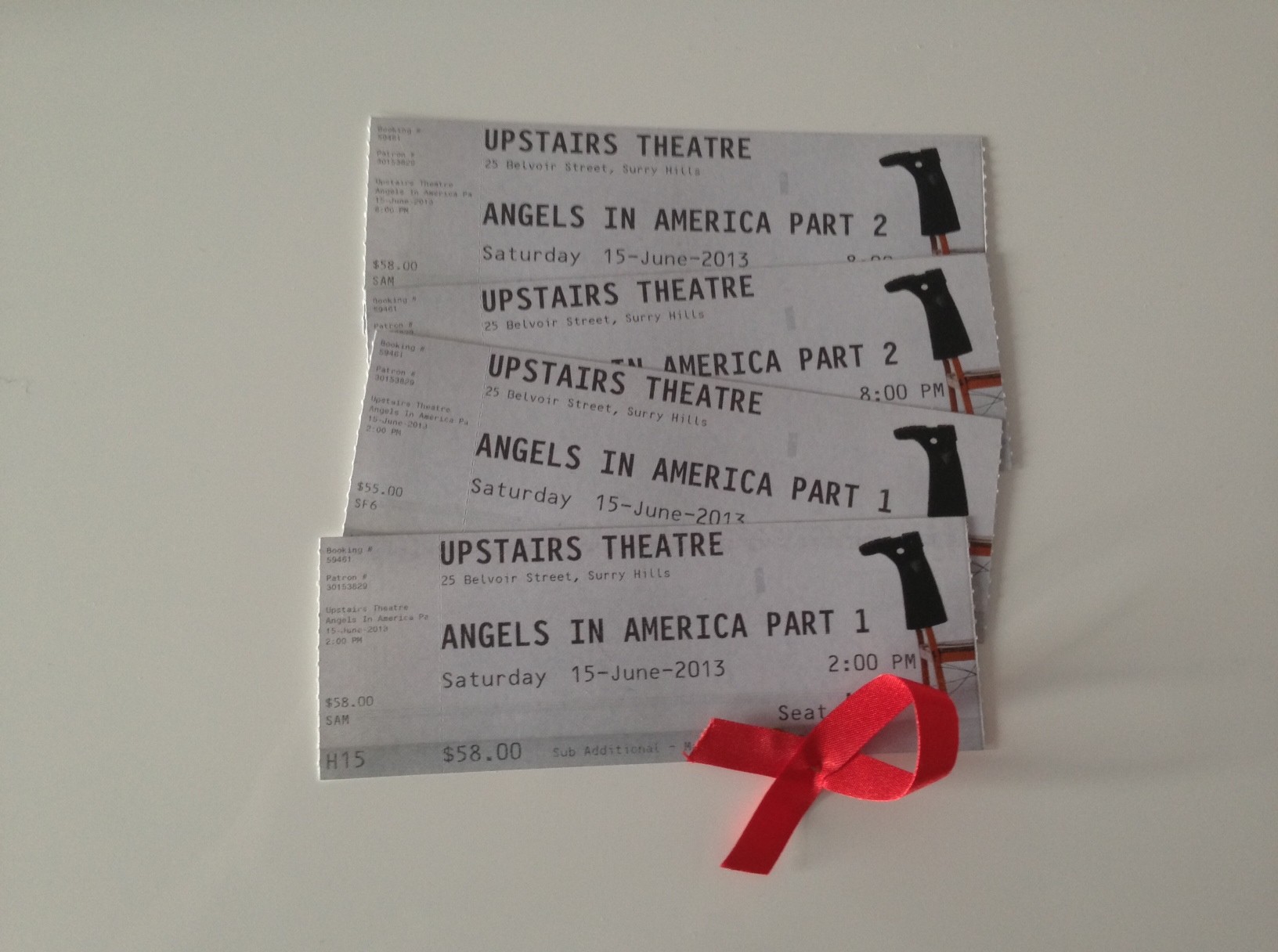
Angels in America Tickets PictureAnother thing which happened during June, and which I am still thinking about more than a fortnight later, is that I finally had the opportunity to see Angels in America.

Steve and I (somewhat ambitiously) went to see Part 1: Millennium Approaches and Part 2: Perestroika, in a double bill on Saturday 15 June. And it was one of the best theatre productions which I have ever seen. In one of the biggest compliments that a production can get, Steve even managed to stay awake – and interested – for all 7 hours.

Something about the production just clicked. The actors were uniformly great, so much so that it would be difficult to single anyone out for individual praise (although, having said that, Deobia Oparei as Belize/Mr Lies was hilarious and mesmerising at the same time).

The music, lighting and set design didn’t get in the way of the story-telling either. In fact, the decidedly ‘low-fi’ and rather ingenious way that the ‘Angels’ were brought to life in what is a small performing space actually helped – it took away some of the over-the-top fantasticality of the idea of angels appearing in contemporary society. And that, to this atheist at least, was a very good thing.

But as with most good theatre, the strength of Angels in America, and particularly in Part 1: Millennium Approaches, is the writing. Tony Kushner set down some absolutely amazing conversations between the characters. The back-and-forth about racism in America, between Belize and Louis, is still running through my head – and is still near-perfect in its encapsulation of problems of race as they are today (whether that is in the United States or indeed Australia).

The core subject matter of the play – the existential crisis presented by HIV/AIDS, how society responded to that crisis, and how the gay male community in particular was affected – has been the subject of some wonderful ‘art’ in the past 12 months, with Angels in America coming so soon after the brilliant documentaries All the Way Through Evening and How to Survive a Plague.

It is vitally important that we remember that time in our collective recent history, and the people who have been so tragically lost because of that awful virus. And just as important that we continue to work to ensure that it does not continue to claim so many lives now, and into the future.

Anyway, well done Belvoir, and Director Eamon Flack, for what really was a fantastic day – and night – at the theatre.

Submission to Involuntary and Coerced Sterilisation Senate Inquiry

Last week, in amongst the craziness of the Sex Discrimination Amendment Bill, and the US Supreme Court marriage equality decisions, the Organisation Intersex International (OII) Australia put out the call for people to make submissions to the Senate Community Affairs Committee Inquiry into the Involuntary and Coerced Sterilisation of People with Disabilities in Australia.

So, on Saturday afternoon I put together the below submission. Given the rush it is admittedly not my best work, but I am glad to have put something in with respect to this important inquiry, and today OII Australia tweeted that they appreciated my effort, so that’s good enough for me. The submission was published on the Senate’s website this morning, so here it is:

I would like to make a brief submission in relation to this important inquiry.

Specifically, in my submission I will address the second term of reference for the inquiry, namely:

2. Current practices and policies relating to the involuntary or coerced sterilisation of intersex people, including

a) sexual health and reproductive issues; and

b) the impacts on intersex people.

In doing so, I will be drawing heavily on the submission provided by the Organisation Intersex International Australia.

I am writing this submission as a gay man, and someone who does not have any personal experience of what it is like to be an intersex individual. However, that does not mean I cannot recognise the fundamental human rights of others, or support broad principles according to which each and every person should be able to live their life.

These principles include the right to personal autonomy – to have physical control over one’s body – including the right to determine whether to consent, or not to consent, to medical procedures (wherever possible). This is especially important for procedures which can have long-term, and often permanent or irreversible, impact on core matters such as sex and reproduction. These principles also include the right for individuals to be different, including differences of sexual orientation, gender identity and intersex status, and for these differences to be respected by the medical profession, the Government and society at large.

Sadly, it seems that for far too many intersex Australians they have been unable to live their lives with the benefit of these principles or rights.

It is disturbing to read the following quote from pages 3 and 4 of the OII submission dated 15 February 2013:

“Every individual member of OII Australia has experienced some form of non-consensual medical intervention, including the following:

  • Pressure to conform to gender norms and to be a “real man” or “real woman”.
  • Involuntary gonadectomy (sterilisation) and clitorectomy (clitoris removal or reduction) as an infant, child or adolescent.
  • Medical and familial pressure to take hormone treatment.
  • Medical and familial pressure to undertake genital “normalisation” surgery.
  • Surgical intervention that went outside the terms of consent, including surgery that was normalising without consent.
  • Disclosure of non-relevant medical data to third parties without consent.”

For any individual to experience any of these interventions is disturbing. That every member of OII Australia has experience of at least one (and possibly more than one) is genuinely shocking.

That is why I have no compunction in backing the recommendations made by OII in their submission. In particular, I support their Medical protocol recommendations on pages 20 and 21, namely:

“1. Medical intervention should not assume crisis in our difference, nor normalisation as a goal.

2. Medical, and in particular surgical, interventions must have a clear ethical basis, supported by evidence of long term benefit.

3. Data must be recorded on intersex births, assignments of sex of rearing, and of surgical interventions.

4. Medical interventions should not be based on psychosocial adjustment or genital appearance.

5. Medical intervention should be deferred wherever possible until the patient is able to freely give full and informed consent; this is known as the “Gillick competence.”

6. Necessary medical intervention on minors should preserve the potential for different life paths and identities until the patient is old enough to consent.

7. The framework for medical intervention should not infantilise intersex, failing to recognise that we become adults, or that we have health needs as adults.

8. The framework for medical intervention must not pathologies intersex through the use of stigmatising language.

9. Medical protocols must mandate continual dialogue with intersex organisations.”

I also endorse their call for a review of terminations on the basis of intersex differences – as intersex status should not be used as the basis for an otherwise undesired termination (in the same way that, if pre-natal tests were to become available at a later date to determine homosexuality, bisexuality or transgender status, I would ethically object to these tests being used as the basis for terminations).

Similarly, I support OII Australia’s call for a review of the use of off-label use of dexamethasone (and note with concern the possibility that this steroid could be used to prevent physical masculanisation and to “prevent homosexuality” – as highlighted on page 11 of the OII Australia submission).

I also have no qualms in supporting their Legal recommendations on page 21:

“We wish to live in a society where we are not obliged to conform to binary sex and gender expectations, where our biological distinctiveness is not treated as it it’s an errant behaviour, where we are protected despite our innate differences, and where intersex people are also not singled out or “othered” as a class. We wish to live in a society where our sex assignments are mutable, and not problematized, and where we (and others) can choose to remain silent on the matter of our sex, through an “unspecified” sex classification.

We seek recognition that our treatment by the medical profession and by the state is a human rights issue. We seek explicit inclusion in human rights and anti-discrimination legislation on the basis of our biological distinctiveness, without our having to submit either to medical intervention, nor a requirement that we “genuinely” identify as one gender or another.”

Of course, it is pleasing to observe that at least some of these recommendations have been achieved since that submission was written, with the passage this week of the Sex Discrimination Amendment (Sexual Orientation, Gender Identity and Intersex Status) Bill 2013, as well as the recent release of the Australian Government Guidelines on the Recognition of Sex and Gender. But other work, especially with the medical profession, remains to be implemented.

Finally, I would like to strongly endorse the Community support recommendations of OII Australia on page 21 of their submission. The recent history of OII Australia demonstrates that it has had incredible success in firstly, drawing attention to some important, but hitherto largely ignored, human rights issues and secondly, to achieving some key victories (such as the recent passage of federal anti-discrimination protections, which was a world first at federal level).

The fact that it has done so as a small, member and volunteer-run organisation, with no government funding, is truly impressive. With many issues yet to be resolved, hopefully the Commonwealth can see fit to provide an ongoing funding source for OII Australia.