Submission to Scottish Marriage Equality Consultation

Today I made a submission to the Scottish Government’s consultation on their Marriage and Civil Partnership (Scotland) Bill. Submissions close 5pm Wednesday 20 March 2013(Scottish time). Below is the text of comments which I made in addition to the model response to the Bill provided on the Equal Marriage UK website: http://www.equalmarriage.org.uk/takeaction I encourage other people to make a submission if you have time.

Scotland flag

I am writing this submission in support of marriage equality as an Australian of Scottish descent, and therefore someone who wishes to see Scotland leading on a key progressive issue. I am also a gay man, engaged to be married to a wonderful partner, but currently prohibited from doing so by my own government. As a result, I am keenly aware of the negative consequences of the imposition of inequality in relationship recognition on the basis of sexual orientation, gender identity and intersex status.

I do not propose to detail the general arguments in favour marriage equality here because I am confident that LGBTI people in Scotland, and their families and friends, will be able to do so far more eloquently than I could. However, from my vantage point on the other side of the world, I do wish to highlight the potential symbolic importance of a move by the government of Scotland to finally accept lesbian, gay, bisexual, transgender and intersex people as equal citizens.

I sincerely believe that the introduction of marriage equality by the Scottish parliament would have precedent value for other members of the Commonwealth of Nations. As one of the first countries colonised by the English, and one of the last to adopt any form of self-government, Scotland embracing LGBTI human rights in this way would demonstrate that it is possible to overcome the history of homophobia which often accompanied imperialism.

Together with the expected passage of marriage equality in England and Wales in the near future, and on top of earlier moves by Canada and South Africa, Scotland would be sending a signal to other members of the Commonwealth that LGBTI people deserve equal treatment under the law. This is especially important because 41 Commonwealth countries continue to impose criminal penalties for homosexuality, and with homosexuality attracting life imprisonment in six of these.

There are also two upcoming events of symbolic significance within Scotland which, I believe, would be enhanced by the passage of marriage equality. The first is the Glasgow Commonwealth Games in July and August 2014. I think it would be a wonderful achievement if these were to be the first games held on soil where LGBTI people were full and equal citizens. This would deliver a message of acceptance of different sexual orientations, gender identities and of intersex people to those Commonwealth countries who attend.

The second event with symbolic significance is the forthcoming referendum on Scottish independence, which is currently expected to be held in the autumn of 2014. I submit that it is important to remove the blemish of legislated discrimination against LGBTI people ahead of this referendum: if the Scottish people are to embrace independence, then surely all of its citizens should be able to celebrate this achievement as equals. This newly-independent country, if that is the outcome of the referendum, should be able to start its life with a clean slate, and not one that has been tarnished by homophobia, bi-phobia, trans-phobia and anti-intersex prejudice.

Of course, I am not writing this submission completely unmotivated by self-interest. If Scotland were to adopt marriage equality, it would add another name to the long list of countries which have left Australia behind on this issue. Our near neighbours New Zealand look likely to do the same in the next few months. Hopefully, as the marriage equality movement continues to sweep the world, my own government will finally be embarrassed into action on this issue.

Leaving self-interest aside, and irrespective of the symbolic arguments which I have outlined above, the most powerful argument in favour of marriage equality must always be the thousands of LGBTI-inclusive couples in Scotland who would be able to take advantage of this Bill if and when it is eventually passed. The happiness of these couples would be immeasurably increased by a law which does not deny anyone else their rights, but simply extends the rights which one group already has to other communities.

I know how important and affirming it would be to have legal recognition of my relationship with my fiancé. The LGBTI people of Scotland are no different in terms of their hopes and aspirations for full legal equality. I hope that Scottish parliamentarians listen to these voices before deciding whether to say “Yes” or “No” to the Marriage and Civil Partnership (Scotland) Bill. Ultimately, any person should be able to determine for themselves whether to say “I do”.
NSW State Same-Sex Marriage Inquiry Introductory Comments

On Friday (15 March 2013) I had the privilege of appearing with the NSW Gay and Lesbian Rights Lobby at the Legislative Council inquiry hearings into state-based same-sex marriage laws. While the Lobby’s co-convenor Justin Koonin gave some brilliant introductory comments on behalf of the Lobby and gay and lesbian communities more generally, I was able to give an introductory statement outlining how the issue of marriage equality affects me personally (and of course Steve too, who attended in the public gallery).

Below is the text of the statement which I read out at the inquiry hearings (I will provide a link to the published transcript of the full proceedings, including questions and answers, when they are published on the NSW Parliament website):

NSW State Same-Sex Marriage Inquiry Introductory Comments

I have been asked to appear on behalf of the Lobby as both a Committee member, and as someone who is directly affected by whether state-based same-sex marriage is introduced in NSW.

My fiancé Steve and I have been together for more than four and a half years, and we have been engaged for more than 3. Needless to say, he made me the happiest man alive when he said yes when I asked him to marry me in January 2010. And yes, I did get down on bended knee to propose.

However, unlike most engaged couples, we knew that, because of the 2004 federal Marriage Act amendments, our prospective wedding would not be legally recognised in our own country, and that the federal government did not issue Certificates of Non Impediment to get married overseas.

Since then, we have been actively playing the ‘waiting game’’: waiting to see if the ALP National Conference would agree to marriage equality, waiting to see how federal parliament would vote, and now waiting to see whether NSW will introduce same-sex marriage – more than 3 years since Steve said “Of course I will”, we are still waiting to see whether we can both legally say “I do.”

Of course, we cannot and will not wait forever. Fortunately, CNIs can now be issued, so getting married in another country is a possibility. This could even include New Zealand, after this week’s successful 2nd reading debate vote there.

But getting married in another country is significantly more expensive, means that many family members and friends would not be able to attend our special day, and still would not be legally recognised at home.

Please don’t misunderstand me – we are glad to have more choices than we did back in January 2010. But those choices come with costs – legal, financial, social, and emotional. Steve and I, and thousands of other same-sex couples across NSW, are confronted with these negative consequences right now.

Critics of marriage equality often claim that its introduction would be a form of social engineering. To the contrary, I submit it is social engineering to determine that only people of a particular sexual orientation, or indeed gender identity or sex, have certain rights.

Surely it is an arbitrary and intrusive level of state intervention for governments to determine on these grounds whether a couple can get married under law, how long they might have to wait, whether they have to go overseas, and as a result, how much it costs, or even who can attend.

These are the real world consequences of the upcoming decision by NSW parliament on whether its same-sex attracted citizens can get married.

Letter to Premier O’Farrell about renaming Taylor Square

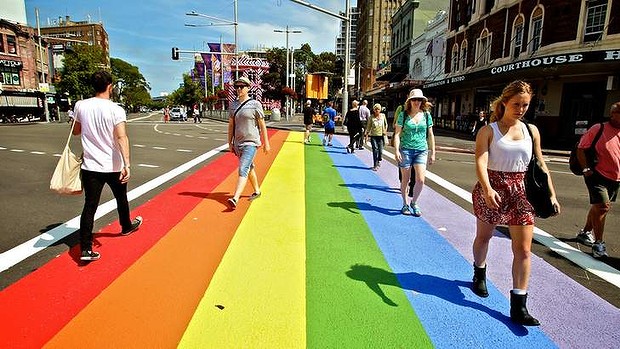
10 days ago, the NSW Premier Barry O’Farrell suggested that Taylor Square could be renamed after former High Court Justice Michael Kirby. While I support recognising his achievements, I think that it would be better to rename the square after both Mr Kirby and current, lesbian High Court Justice Virginia Bell. The outcome would reflect both the gay and lesbian history of this location. Below I have included the text of a letter which I sent to the NSW Premier on this subject this afternoon.

Taylor Square Rainbow Crossing

Dear Premier O’Farrell,

RENAMING TAYLOR SQUARE

I am writing in relation to comments which you made in the Legislative Assembly on Thursday 28 February 2013, in response to a question from the Member for Sydney, Mr Alex Greenwich MP, regarding the Government’s commitment to the Lesbian, Gay, Bisexual, Transgender and Intersex (LGBTI) community.

In particular, during your answer you suggested that Taylor Square could be renamed after former High Court Justice Michael Kirby, who, as you said in the Chamber, is “a great individual who epitomises that good community.”

While I agree with the sentiment of your proposal, I note that Mr Kirby is already highly decorated, including having the former National Centre in HIV Epidemiology and Clinical Research (NCHECR) at the University of New South Wales renamed the Kirby Institute for Infection and Immunity in Society in his honour.

Of course, this does not mean the state of New South Wales, and the City of Sydney, should not further celebrate the contributions of such an eminent jurist, and the first openly gay man appointed to the High Court.

However, I would humbly like to suggest that, if you wish to pursue this proposal, you could also consider co-naming the square after the first openly lesbian woman appointed to the High Court, Ms Virginia Bell. The location could then be known as either the Kirby-Bell Square or the Bell-Kirby Square.

I make this suggestion because I think it is important to recognise and celebrate the achievements of both the gay and lesbian communities, who each have a historical connection to Taylor Square.

Ms Bell, who replaced Mr Kirby on the High Court following his retirement, is another distinguished resident of Sydney, and one who began her legal career in the inner-city working at the Redfern Legal Centre.

Ms Bell was also a participant in the very first Sydney Gay Mardi Gras on 24 June 1978, which, fortuitously, assembled at Taylor Square before commencing the march. Renaming Taylor Square in Ms Bell’s honour, alongside Mr Kirby, would therefore acknowledge some of the important LGBTI history of this particular location.

Thank you in advance for considering my suggestion for renaming Taylor Square to be Kirby-Bell or Bell-Kirby Square, which I think would be more inclusive of the lesbian and gay communities of Sydney.

Sincerely

Alastair Lawrie

Loaded Dog Piece on Should Smoking be Allowed at Outdoor Restaurants?

Smoking should be banned at outdoor restaurants. Not because it would limit the health damage an individual smoker does to themself – there are already numerous public health interventions designed to reduce the harm people are willing to visit upon themselves through smoking (tobacco excise, plain packaging, Quit campaigns).

Instead, the ban is necessary to protect the health of other restaurant patrons, who shouldn’t be forced to inhale second-hand smoke. The ban would also improve the amenity of their meals; by being able to taste their food, rather than nicotine, and not leaving the restaurant reeking of smoke.

But the most important reason to ban smoking in outdoor restaurants is to protect the health of the employees of these venues. They shouldn’t have to cough repeatedly during their work, they shouldn’t go home smelling of tobacco – above all, they shouldn’t be put at risk of cancer because of someone else’s actions.